




Abstract
The visibility and association affordances of social media facilitate their potential use for collective action, especially for marginalized and disempowered groups. Guided by social identity theory (SIT), this study examines how perceived discrimination and perceptions of personal and objective constraints on Latinos’ social status increase Latinos’ social media expression. The results indicate that increased perceived discrimination is associated with increased social media expression, especially for those who strongly endorse the use of collective strategies to improve the in-group’s status. Furthermore, status boundaries that are perceived to be impermeable due to objective and subjective barriers are also associated with increased social media expression, regardless of the participants’ reported need for collective action. The results are discussed regarding the relevant literature and theoretical implications are offered.
Social media have become spaces for sociality, not only because of the social interactions that take place there, but also for the role they play for individuals’ self-presentation and self-concept construction. Social media supports individuals’ enactment of their offline social relationships (Valenzuela, 2013), and individuals’ identities tied to offline relationships also become apparent. In other words, the social identities that constitute an individuals’ offline self-concept can also manifest on online platforms. More importantly, online presentations of the self can reinforce in-group and out-group social identities (Spears & Postmes, 2015).
The activation and salience of identity and social categories on social media, along with socio-technical systems’ decreased barriers for interaction (Resnick, 2002), facilitate social media use for collective action, especially for marginalized and disempowered groups. Indeed, social media affords the user with visibility and association through which users can coalesce around common experiences and/or shared identities (Ellison & Vitak, 2015; Lampe et al., 2007) as they connect with others across individuals’ social networks (Spears & Postmes, 2015). Thus, we argue that given these affordances and features, social media may become spaces that facilitate the construction of collective strategies and actions through the expression of views and sharing of information on issues of significance to members of marginalized groups.
Employing a social identity theory (SIT) framework, this study seeks to understand the potential of marginalized group members’ expression on social media to constitute a form of collective action to address negative in-group status. Here, we conceptualize collective actions as those that seek to address status imbalances between social groups (in this case, Whites and Latinos) and improve the status of marginalized groups (Gurin et al., 1980). Responding to Ramos, Cassidy, Reicher, and Haslam’s (2016) suggestion that intergroup research more fully consider contemporary contexts and explanatory mechanisms, this study applies the notions of perceived discrimination, status (im)permeability, and perceived need for collective action to understand social media expression by members of marginalized communities as a form of collective action to improve their position in society. Specifically, we argue that group status (im)permeability and perceived discrimination influence members of marginalized groups’ social media expression. Furthermore, we posit that the perceived need for collective action moderates those relationships, thus configuring social media as a space for collective action directed toward improving the marginalized group’s social status.
This study centers people of Latin American descent living in the United States as one such marginalized group that may use social media as a space to share information and express their views regarding issues relevant to their group (i.e., the issue of immigration). We define Latino as people whose heritage can be traced back to Latin American, Spanish-speaking countries. Despite their diverse national origin, Latinos are bonded by their similarities in language, immigrant experience, Spanish colonial influence, and Latin American heritage (Barreto, 2010).
More specifically, we center Latinos’ experiences with immigration as a particular site of marginality. While not all US Latinos are immigrants, and not all immigrants are Latino, there is an undeniable connection between immigration and the Latino community. The Pew Hispanic Center reports that in 2015, 34% of all Latinos (48% of Latino adults) living in the United States were foreign-born, and that Latinos are the fastest growing and largest ethnic minority group in the United States, representing 18% of the entire population (Flores et al., 2017). As such, Latinos are increasingly relevant in the social, cultural, and political life of the United States.
However, the rising Latino population has been accompanied by shifts in political rhetoric and tense attitudes regarding immigration and multiculturalism among immigrant and host populations. Although many ethnic groups throughout history have been the target of the US government’s vilification of immigrant communities, Latinos are frequent and recurring recipients of the political ire surrounding immigration. Many studies have examined the systemic bias and discrimination Latinos experience across various realms of social life, including employment (Bendick et al., 1991; Espino & Franz, 2002; Pager et al., 2009), housing (Oliveri, 2009), and education (Alfaro et al., 2009; Benner & Graham, 2011), among others. Existing bias is also reflected in how Latino immigrants are portrayed by the media (Dixon & Linz, 2000; Mastro et al., 2008), and how these negative portrayals shape individuals’ evaluations of Latinos (Mastro et al., 2007). This public discourse, together with policies and immigration-related government initiatives, reflects the vulnerable position of this ethnic minority in US society.
Simultaneously, social media have become the sites of conversations about immigration in the United States and around the world for both dominant and immigrant groups (e.g., Chung & Zeng, 2016; Ekman, 2018; Righi, 2019; Siibak & Masso, 2018). Therefore, this study examines how perceptions of out-group discrimination, as well as evaluations of the presence of personal and objective constraints to improve the social status of Latinos, increase the likelihood that Latinos will express themselves on social media around an issue at the core of their experience as a marginalized group in the United States. Moreover, we argue this is the case especially for Latinos who believe their in-group members need to work together to improve their place in American society.
Literature Review
Out-Group Perceived Discrimination and Social Media Expression
There is considerable research on marginalized group members’ perceptions of and experiences related to discrimination and the coping mechanisms used to respond to discrimination (e.g., Berry & Sabatier, 2010; Branscombe et al., 1999). Among Latinos, evidence indicates that perceptions of the groups’ status, sense of place within US society and culture, and experiences with discrimination have been tumultuous for the past decade. In 2008, Pew Hispanic Center surveys indicated that 68% of Latinos reported fear of deportation, 63% reported difficulty finding and keeping jobs due to their ethnicity, and 71% reported housing discrimination based on their ethnicity. A more recent poll by the Pew Hispanic Center indicates that 38% of Latinos experienced discrimination in the past year (Lopez et al., 2018). Of this 38%, roughly one-fourth (24%) say the discrimination was based on their background, 22% reported criticism for speaking Spanish in public, and 20% had been told to go back to their home country.
SIT (Ellemers et al., 2002; Turner & Tajfel, 1986) argues that when perceptions of discrimination threaten one’s self-concept, one seeks positive distinctiveness associated with their in-group and validation of their group membership. Social media may offer a channel through which Latinos can advocate for an issue central to their identity as a marginalized ethnic group in the United States with a significant connection to immigration. Latinos’ ability to connect on social media to an empathic audience might encourage self-expression and buffer the impact of a hostile, anti-immigrant environment. It could be the case that as Latinos increasingly perceive discrimination against their in-group, they turn to places where they believe they will be supported and where their actions can have relevant outcomes.
As argued earlier, it is likely that individuals find in social media a space where they can perform and reinforce their identities as members of social groups. Prior evidence focused on other marginalized groups supports this assertion. Veletsianos et al. (2018) documented how harassed women used social media as a space for resistance and self-assertiveness. Likewise, Clark-Parsons (2018) argued that marginalized users constituted a subaltern counterpublic (Fraser, 1990) by appropriating social media applications to freely express themselves, find support, and coordinate reactions to faced injustices. According to Lim (2012), social media was used to configure networks and circulate opposition narratives against the Egyptian political regime. Moreover, in the case argued by Lim (2012), social media helped this movement expand its sphere of influence to other segments of the population. This study contributes to this research by applying these principles of social media use to US Latinos regarding a salient social issue.
Based on evidence supporting the ideas that social media is a space where social identities become more salient, and that social media provides a channel through which perceived hostile and discriminatory environments can be challenged or subverted, we hypothesize the following:
H1. Out-group perceived discrimination is positively related with social media expression about immigration.
Group Status (Im)Permeability and Social Media Expression
SIT (Ellemers et al., 2002; Turner & Tajfel, 1986) argues that negative in-group evaluations can theoretically result in individual (i.e., individual mobility) or collective (i.e., social creativity or competition) coping strategies. In this study, we construe social media expression about immigration as one such socially creative or competitive collective action. We argue that as Latinos feel that they cannot individually access the status and resources afforded to out-group members (i.e., Whites), they resort to a space where, together with other members of their group, they can devise ways to enhance their in-group status.
Social creativity, originally defined by Tajfel (1974) as strategies that “seek positive distinctiveness for the in-group by redefining or altering the elements of the comparative situation” (p. 287), include intergroup comparisons on new dimensions or changing the values assigned to group attributes. For example, Executive Order Nos 13767 and 13768, issued by President Trump in January 2017 prioritized construction of a wall along the US-Mexico border, threatened to withhold federal money from sanctuary cities, and proposed increasing migrant detention centers. In response, The Huffington Post Latino Voices launched a social media campaign asking people to post pictures of themselves and their immigrant families with the hashtag #ImAlreadyHome in an effort to “show the world that immigrants already make America great and defy those who think anyone needs to ‘go back’ anywhere” (Moreno, 2017). Such a campaign takes Latino and immigrant status, which had been devalued, criminalized, and targeted by these policies, and turned it into a positively distinct, in-group identity.
Aside from social creativity, social competition offers another route through which collective action can occur. Social competition strategies most directly relate to intergroup status hierarchies, power, and access to resources, as employing these strategies seeks to “reverse the relative positions of the in-group and the out-group on salient dimensions” (Tajfel, 1974, p. 287). Protests, boycotts, fundraising campaigns, and other direct actions are forms of social competition in which a marginalized group and sympathizers leverage their collective capital, express discontent regarding the status quo, and promote initiatives aimed at disrupting oppressive social systems. For example, residents of Brazilian favelas used social media sites to organize like-minded others to enact social programs or municipal developments that they felt the government was overlooking (Nemer & Hakken, 2016). In the United States, the past 2 years have witnessed increasing reliance on social media to galvanize support for Latino immigrant communities. The Refugee and Immigrant Center for Education and Legal Services (RAICES), a 501(c)(3) nonprofit immigration legal services center based in Texas, uses Facebook and Twitter in a variety of socially competitive ways, such as promoting pro bono legal services (e.g., reviewing Deferred Action for Childhood Arrivals [DACA] applications) and promoting Latino voter registration events.
There are socio-psychological factors, namely, permeability, stability, and legitimacy, which influence an individual’s coping strategy choices and behaviors (Ramos et al., 2016; Turner & Tajfel, 1986). We focused exclusively on status permeability in relation to Latinos’ use of social media expression as a coping strategy against discrimination. Group status (im)permeability, or “the perceived objective or subjective possibility of changing hierarchical status,” represents one’s access to the activities, power, rank, and/or resources that are afforded to dominant groups and denied to marginalized groups (Armenta et al., 2017, p. 420). Hence, highly permeable status boundaries indicate easy access to the activities and resources available to dominant out-group members, while highly impermeable boundaries suggest difficulty or impossibility in accessing these activities or resources.
Prior research suggests that perceived permeability of group boundaries has the potential to influence marginalized group members’ in-group identification and intergroup behaviors. For example, perceptions of highly permeable status boundaries are associated with increased pursuit of individual goals (Terry et al., 2006), as the barriers against gaining the status denied to the in-group are perceived as weak. Comparatively, when boundaries are perceived to be less permeable, members of marginalized groups are more likely to seek positive distinctiveness from their in-group (Ellemers et al., 2002) and endorse collective strategies to improve the group’s status (Hersby et al., 2009). In other words, as subjective and objective obstacles are perceived to strongly hinder an individual’s status gains, people turn to collective strategies to advance a better status for the group as a whole.
While perceived permeability has long been theorized as a central feature of in-group attitudes and intergroup behaviors (Turner & Tajfel, 1986), only recently did Armenta and colleagues (2017) synthesize and validate a measurement for the construct. Rather than focus on the single dimension of whether an individual can leave a low-status group and join a high-status group, Armenta and colleagues (2017) argue that perceptions of permeability behaviors are complicated by objective (i.e., whether it is even possible for a member of a marginalized group to access the same resources or activities) and personal (i.e., even if it is objectively possible, there is nothing this particular, marginalized individual can do to access resources) constraints. This study captured US Latinos’ sense of group status (im)permeability, specifically focused on the degree to which participants felt that accessing the resources or activities afforded to White US Americans was objectively possible for Latinos as a group and personally possible for the individual participant. Additionally, we argue that as marginalized groups members’ perceptions of personal and objective constraints for group status permeability increase, so will their expression on social media about immigration.
There are several theoretical and empirical connections between status boundary (im)permeability and social media expression. First, group identification and group boundary permeability vary together. When group boundaries are perceived as permeable, in-group identification becomes weaker (Armenta et al., 2017). Simultaneously, prior evidence (Velasquez et al., 2019) suggests a positive relationship between in-group identification and social media expression. Specifically, Velasquez et al. (2019) found that increased group self-definition (including factors such as self-stereotyping and perceived in-group homogeneity) was associated with Latinos’ increased social media expression about immigration. This association was also conditioned by participants’ perceived collective efficacy, whereby the association was stronger among those participants who strongly believed that, when working together, Latinos could achieve group-related goals (Velasquez et al., 2019).
Therefore, this study extends Velasquez and colleagues’ (2019) findings by incorporating and interrogating the role of perceived barriers to group permeability and synthesizes findings from Armenta et al. (2017) with results from Velasquez et al. (2019). If weak barriers to group permeability weaken one’s in-group identification (Armenta et al., 2017), and in-group identification is positively associated with social media expression (Velasquez et al., 2019), then perceptions of group status impermeability should also be positively related to social media expression.
Additionally, social media behaviors can be construed as performances of the self (Papacharissi, 2012). Thus, for members of marginalized groups, social media expression on central group issues can be considered manifestations of their social identity performed online (Velasquez et al., 2019). Moreover, as Hersby et al. (2009) demonstrated, members of marginalized groups that perceive group boundaries to be highly impermeable are more likely to focus on highlighting positive aspects of their group and, more importantly, more likely to accept support from other in-group members as a strategy to enhance the social status of their group.
Thus, members of marginalized groups’ social media expression about immigration could be one such collective strategy. As social media facilitates both interaction and connection with similar others, it is likely that members of marginalized groups employ social media as a space to gain support from other in-group members and collectively devise strategies to improve the social status of their group. Therefore, we hypothesize the following:
H2. Perceptions of status impermeability personal constraints are positively related with social media expression about immigration.
H3. Perceptions of status impermeability objective constraints are positively related with social media expression about immigration.
The Moderating Role of Need for Collective Action
Need for collective action is conceptualized as the degree to which individuals prefer to act as a group in order to achieve desired changes, rather than acting solely on behalf of the self (Gurin et al., 1980). In other words, individuals with this behavioral orientation believe that collective action is the best way to attain the social group’s interests and improve their status (McClain et al., 2009). This collectivist orientation is one of the components of the group consciousness construct, a group-based resource that members of marginalized or disenfranchised groups draw upon to mobilize political engagement (Verba & Nie, 1987).
As mentioned previously, prior research on social media expression suggests the collective nature of social media use, as users can converge around shared identities and coordinate responses to mistreatment and discrimination (Clark-Parsons, 2018), circulate counternarratives in response to oppressive policies (Lim, 2012; Moreno, 2017), and enact programs to supplement weak or absent government policies aimed at improving a group’s status (Nemer & Hakken, 2016). Hence, we argue that social media expression about immigration represents a collective strategy undertaken by Latinos to challenge the immigration-based discrimination faced by their ethnic in-group.
The social identity literature suggests a theoretical justification for this operationalization. As mentioned, strategies to cope with discrimination or prejudice toward one’s in-group are individualistic (i.e., individual mobility) or collectivistic (i.e., social creativity or competition) in nature. Chung et al. (2012) found that involvement with like-minded others significantly motivated participants’ continued use of social networking sites, echoing suggestions that social media afford users with increased association with perceived in-group members. Furthermore, Holmes et al. (2015) argue that social media applications facilitate collectivistic notions of in-group obligation and loyalty. Hence, in the face of in-group devaluation or discrimination, collectivistic individuals are more likely to behave in ways that contribute to or uplift the entire in-group rather than pursue coping strategies that solely benefit the individual. This study seeks to contribute to this area of burgeoning literature by further investigating social media expression as a possible collective strategy, whereby the effect of perceived discrimination on social media expression is conditioned by participants’ reported need for collective action.
Prior research suggests that need for collective action is positively related to different forms of political engagement (Stokes, 2003). We argue that social media expression in response to discrimination and group status (im)permeability perceptions will be conditioned by participants’ perceived need for collective action. Indeed, it is plausible that social media expression about immigration, as a type of collective strategy, resulting from perceptions of discrimination will most likely be present among those who believe Latinos need to act together in order to improve their social status.
Similarly, while we argue that collective strategies provide the means through which in-group members can challenge discrimination in the face of impermeable status boundaries, pursuit of such behaviors will more likely exist when a collective action orientation is present, which might further incentivize strategies like social media expression as a means of improving the in-group’s status. In other words, need for collective action should be a condition for social media expression to be a collective action strategy, wherein the effect of perceived discrimination, objective, and personal constraints on social media expression get stronger as a perceived need for collection action increases. Therefore, we hypothesize as follows:
H4. The relationship between perceived discrimination and social media expression is moderated by need for collective action perceptions.
H5. The relationship between status impermeability personal constraints and social media expression is moderated by need for collective action.
H6. The relationship between status impermeability objective constraints and social media expression is moderated by need for collective action.
Methods
Sample Characteristics and Data Collection
This study analyzed online survey data collected in December 2017 through an online panel company, Offerwise, specializing in the US Latino population. Offerwise’s panel includes 350,000 members and its composition is similar to that of the US Latino population. Participants received compensation based on the panel company’s incentive system. To ensure our sample closely represented the US Latino population, we used a stratified quota sampling technique, using education, gender, age, income, language spoken at home, and region as criteria. The survey was developed in English and then translated into Spanish by the first author. In all, 51.6% of participants completed the survey in Spanish.
The initial sample size was n = 601; 46.3% of the sample self-identified as male and 53.7% as female. The average age was Mage = 38.48, SD = 14.41. Table 1 compares the demographic characteristics for the sample and the US Latino population. Compared to the overall US Latino population, the sample was slightly older and had attained higher levels of education. Only those respondents that reported having a social media account (i.e., Twitter or Facebook) (n = 503) were included in hypothesis testing.
Sample and US Latino Population Demographic Characteristics.
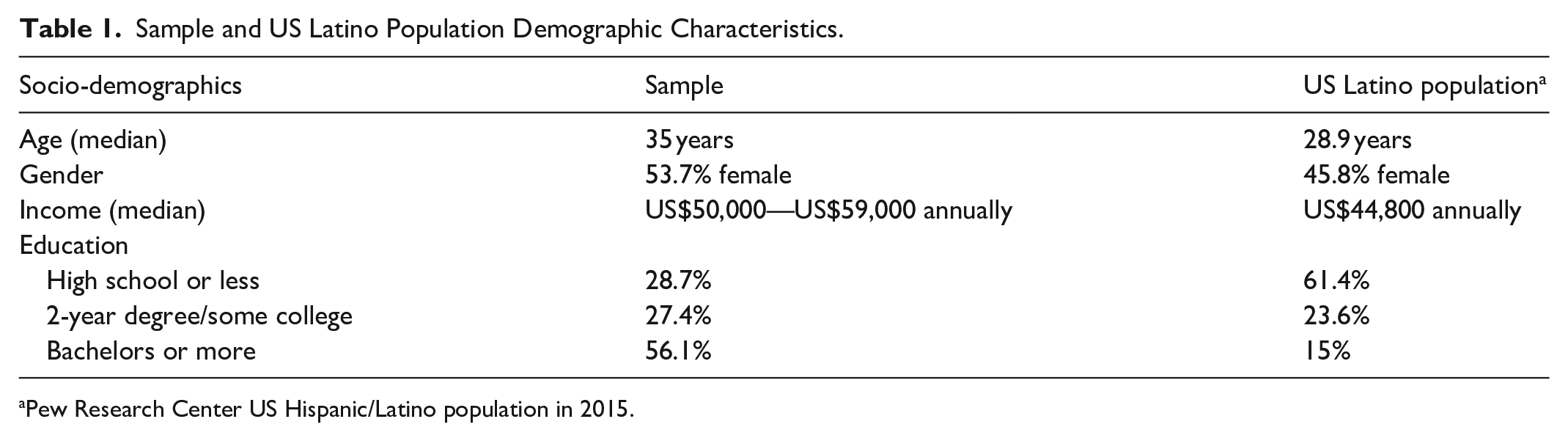
Pew Research Center US Hispanic/Latino population in 2015.
Analyses and Results
An exploratory factor analysis determined if the items measuring the two dimensions of perceived group status impermeability reflected the expected underlying process. We expected the factor analysis would reveal two distinct dimensions comprising the concept of group status impermeability. Following the recommendations by Hair et al. (1998), only those items that loaded with at least .7 on the primary factor, and at the same time less than .4 on any other factor, were retained. The number of factors was decided based on factors with eigenvalues larger than 1 and on items’ factor loadings.
As shown in Table 2, the exploratory factor analysis with principal components and varimax rotation revealed that the group status impermeability items formed two separate dimensions with eigenvalues larger than 1. Furthermore, items measuring the objective constraints of groups’ status impermeability loaded together in the same factor. One item from the personal constraints of group status impermeability did not have a loading larger than .7 and was dropped. However, the remaining two items loaded satisfactorily in their corresponding factor.
Rotated Factor Analysis Solution of Group Status Impermeability Personal and Objective Constraints.
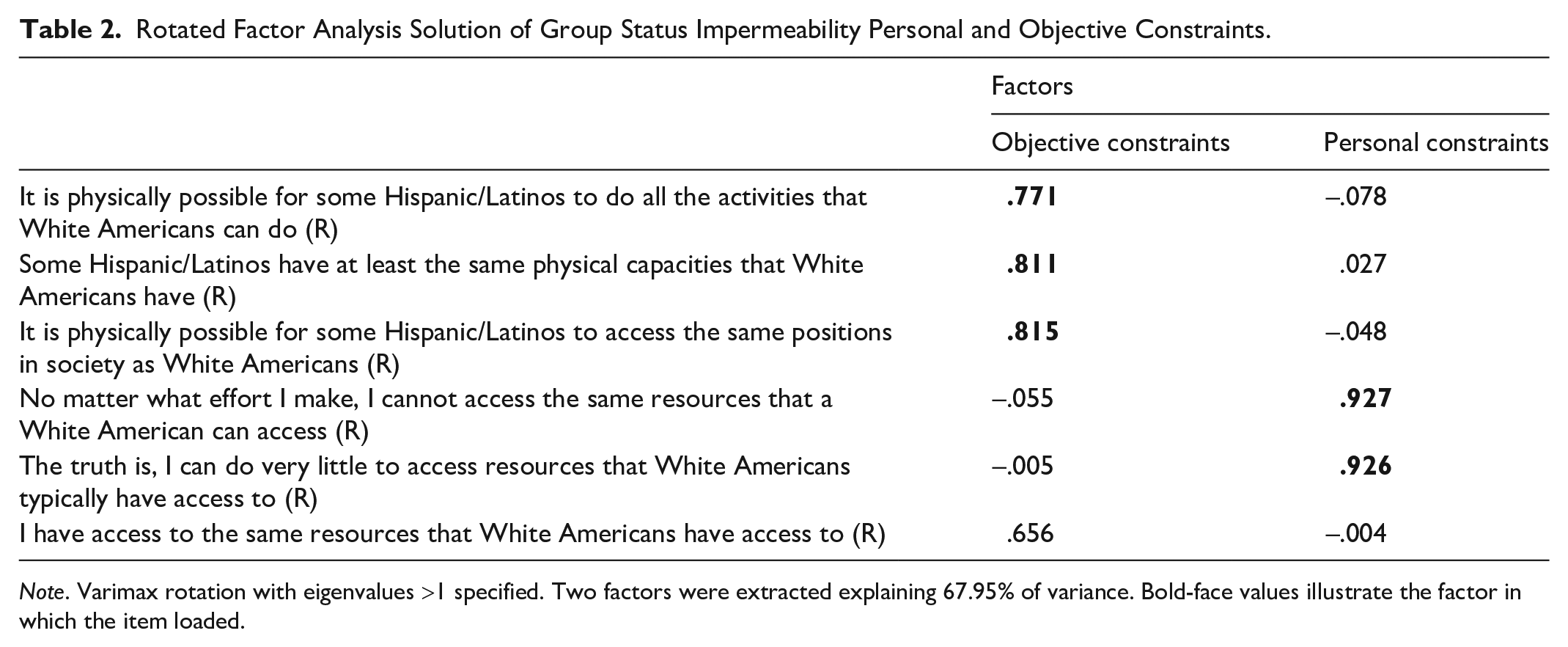
Note. Varimax rotation with eigenvalues >1 specified. Two factors were extracted explaining 67.95% of variance. Bold-face values illustrate the factor in which the item loaded.
Measures
Measures of variables that used more than one item were calculated by adding the scores of each of the items and then dividing it by the number of items measuring that variable.
Out-Group Perceived Discrimination
One item (M = 3.85, SD = 1.00) measured out-group perceived discrimination. The item was “How much discrimination or unfair treatment do Latinos face in the United States from other races/ethnic groups?” where 1 = none at all and 5 = a great deal. The item was adapted from the measurement developed by Sanchez and Vargas (2016).
Personal Constraints to Group Status Impermeability
Two Likert-type items (M = 2.88, SD = 1.39, α = .84) measured personal constraints to group status impermeability, or the inability of the particular participant to access the status and resources afforded to White Americans, regardless of whether such access is objectively possible (e.g., “No matter what effort I make, I cannot access the same resources that White Americans typically have access to”; 1 = strongly disagree and 5 = strongly agree). Items were adapted from Armenta et al. (2017).
Objective Constraints to Group Status Impermeability
Three Likert-type items (M = 1.93, SD = 1.02, α = .76) measured objective constraints to group status impermeability, or the perceived impossibility of Latinos accessing the status and resources afforded to White Americans, (e.g., “It is physically impossible for some Latinos to do all the activities that White Americans can do”; 1 = strongly disagree and 5 = strongly agree). Items were adapted from Armenta et al. (2017).
Need for Collective Action
One item (M = 4.19, SD = 0.94) measured perceived need for collective action, specifically, “How important is it for Latinos to work together to improve their position in society?” where 1 = not at all important and 5 = extremely important. The item was adopted from Sanchez and Vargas (2016).
Social Media Expression About Immigration
Four items (M = 3.07, SD = 1.31, α = .93) measured social media expression about immigration, or the frequency with which participants expressed opinions related to immigration on social media sites (e.g., How frequently do you express your views about immigration issues?”), where 1 = never and 5 = frequently. Items were adapted from Velasquez and Rojas (2017).
Outside of the major variables, several demographic variables (i.e., age, gender, education, income), as well as in-group identification, political and social media use variables (i.e., internal political efficacy, political interest, social media use, generation of the respondent, and group identification) were controlled as covariates.
Internal Political Efficacy
Four Likert-type items (M = 3.34, SD = 1.16, α = .91) measured internal political efficacy, or participants’ perceptions of their ability to participate in political systems (e.g., I feel I could do as good a job in public office as most other people”; 1 = strongly disagree and 5 = strongly agree). Items were adapted from Niemi et al. (1991).
Political Interest
One item (M = 7.41, SD = 2.74) measured political interest, asking respondents the degree to which they were interested in politics (1 = not interested at all and 10 = very interested).
Social Media Use
Two items (M = 3.79, SD = 1.02, α = .73) measured the participants’ frequency of general social media use. Participants indicated how frequently (1 = never, 5 = frequently) they checked and posted content on social media.
Generation
Respondents were asked if they were born in the United States (Yes = 41.2%, No = 58.8%). Those that responded affirmatively were subsequently asked whether they were second or third Latino generation. Finally, those that replied they were not born in the United States were coded as first generation (first generation = 58.8%, second generation = 26.4%, third generation = 14.7%).
Group Identification
Four Likert-type items (M = 4.01, SD = 0.99, α = .90) measured the strength of participants’ group self-definition, or the degree to which participants felt their sense of self was defined by their latinidad (e.g., “I have a lot in common with the average Latino”; “Latinos are very similar to each other,” 1 = strongly disagree and 5 = strongly agree). Items were adapted from Leach and colleagues (2008).
Before testing our hypotheses, we ran an analysis to identify any influential outliers in our sample, but none were identified. In addition, assumptions of multiple regression analysis were examined. There was no indication of multicollinearity among the independent variables in the study. Table 3 includes the correlations among the major variables in the study. A total of eight respondents did not report their age and were excluded from all subsequent analysis using listwise deletion (n = 495).
Pearson’s Product Moment Correlations Among Major Variables.

Note. n = 503.
p < .05.
p < .001.
Results
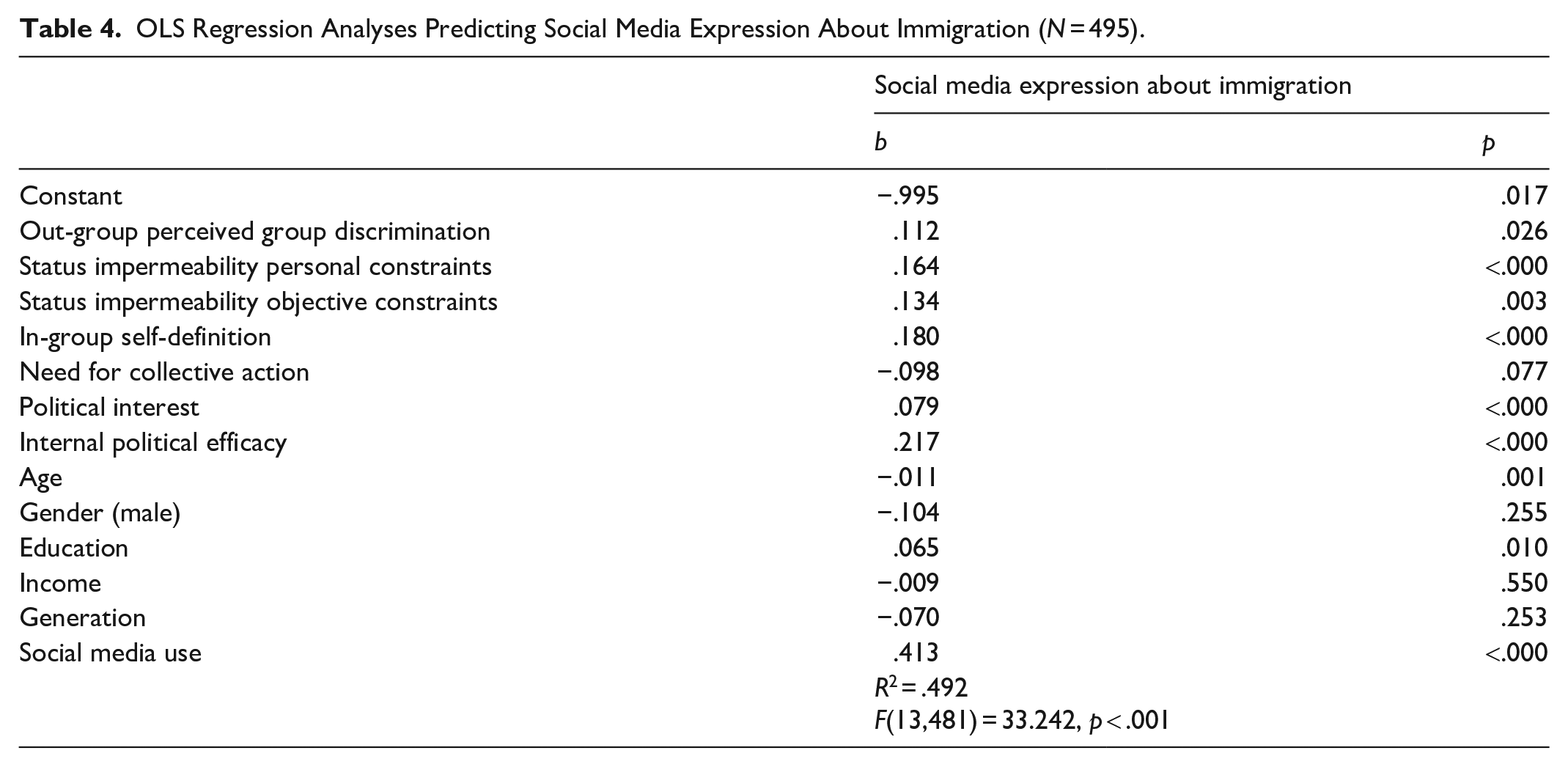
Hypotheses 1–3 were tested using multiple regression analysis. Hypothesis 1 predicted a positive relationship between out-group perceived discrimination and social media expression about immigration. The results of multiple regression F(13,481) = 33.242, p < .001, R2 = .49 showed that the hypothesized relationship between perceived discrimination and social media expression about immigration was positive, and statistically significant (b = .11, p = .03) after controlling for all other variables. Therefore, Hypothesis 1 was supported.
Hypotheses 2 and 3 predicted positive relationships between status impermeability personal and objective constraints, respectively, and social media expression about immigration. Hypothesis 2 was supported. After controlling for all other variables, the relationship between perceptions of personal constraints of status impermeability and social media expression about immigration was positive and statistically significant (b = .16, p < .001). Hypothesis 3 was also supported. The relationship between social media expression about immigration and perceptions of objective constraints of status impermeability was positive and statistically significant (b = .13, p < .01), after controlling all other variables. Table 4 includes the unstandardized regression coefficients for all variables included in the regression analysis.
OLS Regression Analyses Predicting Social Media Expression About Immigration (N = 495).
Hypotheses 4–6 were tested using Model 1 of Hayes’ (2018) PROCESS macro for SPSS. Hypotheses 4–6 predicted that perceived need for collective action would moderate the effect of perceived out-group discrimination, personal constraints, and objective constraints, respectively, on social media expression about immigration. The results showed that the interaction between out-group perceived discrimination and need for collective action perceptions was significant (b = .08, SE = 0.04, p < .05). Therefore, the relationship between out-group perceived discrimination and social media expression about immigration varied as a function of respondents’ perceptions that Latinos need to act together in order to improve their position in society. Table 5 includes the results for Hypothesis 4.
Interaction Effect Between Perceived Discrimination and Need for Collective Action on Social Media Expression About Immigration.

Note. N = 495.
Probing of the interaction using the Johnson–Neyman technique showed that the region of significance was above 4.06 for need for collective action. This means that, after controlling for the relationship between social media expression about immigration and all other variables in the analysis, the relationship between out-group perceived discrimination and social media expression was positive and statistically significant for those that believed that it was very important or extremely important for Latinos to work together to improve their position in society, and that the relationship became stronger as need for collective action increased. Figure 1 illustrates the interaction.

Interaction effect of perceived discrimination and need for collective action on social media expression about immigration.
Neither Hypotheses 5 nor 6 were supported. The results showed that after controlling for all other variables, the interaction effects between perceived need for collective action and status impermeability personal constraints (b = −.04, SE = 0.03, p = .27) and objective constraints (b = .04, SE = 0.03, p = .06) were not statistically significant. In other words, as perceived need for collective action increased, the association between status impermeability personal and objective constraints and social media expression about immigration did not become stronger. Regression coefficients are reported in Tables 6 and 7.
Interaction Effect Between Status Impermeability Objective Constraints and Need for Collective Action on Social Media Expression About Immigration.

Note. N = 495.
Interaction Effect Between Status Impermeability Personal Constraints and Need for Collective Action on Social Media Expression About Immigration.

Note. N = 495.
Discussion
This study examined how Latinos’ perceptions of discrimination against their ethnic group from out-group members, together with perceptions of personal and objective group status boundary (im)permeability, influenced their social media expression about immigration. Additionally, it examined how perceived need for collective action conditioned the relationship between out-group perceived discrimination, both dimensions of group status boundary (im)permeability and such social media expression. We argued that the influence of perceived out-group discrimination and constraints against status permeability on social media expression would become stronger as perceived need for collective action increased.
The results suggest that perceived discrimination from out-group members is related to Latino participants’ social media expression about immigration. Those that perceive their in-group is discriminated against by out-group members are more likely to express their views on the issue of immigration on social media. Moreover, the analysis of the moderating role of need for collective action showed that for those participants who thought it is very/extremely important for Latinos to work collectively in order to improve their social status, the relationship between out-group discrimination and social media expression about immigration was stronger. In other words, among participants who most resolutely preferred collective efforts over individual ones to improve their social status, increased perceived discrimination from out-group members was strongly related to increased immigration-related expression on social media than those that did not have a preference for Latinos’ collective action as a way to improve their social status.
Mobilizing SIT, social media expression about immigration represents a potential site for collective action among Latinos due to the effect that immigration policy and discourse has on the Latino community. While being Latino is not synonymous with being an immigrant, immigration-related topics remain salient among Latinos and inform their political, economic, and social attitudes (Lopez et al., 2016, 2018). The results suggest that social media may constitute a place where members of marginalized groups can express themselves around issues that affect their community and position the in-group at a lower place within social hierarchies. The fact that those who perceive the need to act together to change the social status of the group as highly important are more likely to resort to social media when they perceive greater discrimination, than those who do not perceive that need to act together indicates that social media can be a place of resistance and opposition to a hostile environment. Moreover, this evidence also shows that threats to the in-group, in the form of perceived discrimination, trigger social media expression, and this is specially the case among those that believe in the importance of collective action. It may be that this online behavior is aimed at challenging and counteracting the negative stereotypes or stigmatizing attributions assigned to Latinos. In this sense, social media can be where members of marginalized groups find an audience for their concerns, reaffirm their threatened identity, and organize actions to counteract discriminatory practices.
Evidence from prior studies shows how discrimination against the self or the in-group can deter individuals from engaging in politics (Oskooii, 2016) and affect individuals’ attitudes toward the political system (Schildkraut, 2005). This relationship has been theorized in terms of changes in self-confidence, as perceptions of discriminatory treatment negatively impact individuals’ self-confidence. As a result, the persistent effects of discrimination can lead to internalized stigma (Hoff & Pandey, 2006). Our findings contradict this evidence. As perceptions of discriminatory treatment increase, expressions on social media about their views on an issue of particular significance to their group also increase. Furthermore, our findings also add more nuance to this finding. Among those who highly believe in the need for collective action, such a relationship is even stronger. The results of this study suggest such perceptions of discrimination against a marginalized group can, instead of alienating individuals, encourage expression on social media, and this is even more the case when individuals feel strongly that their group needs to act collectively. Thus, it might be that given the connectivity and interactivity affordances of social media, these sites enable members of marginalized groups to converge around a common identity or ideology toward group-central issues, thus breaking the exposure-internalization loop created by past discrimination experiences.
The results supported the hypothesized relationships between personal and objective constraints on status permeability and Latinos’ social media expression about immigration. As participants reported more objective and subjective obstacles to changing the in-group’s social status, they reported increased expression about immigration-related topics on social media sites. However, this effect was not conditioned by participants’ perceived need for collective action. Whether participants felt strongly, moderately, or weakly that Latinos needed to work together to achieve a better position in society bore no influence on their use of social media as an outcome of perceived status impermeability.
Altogether, the results show the ways in which marginalized groups, in this case Latinos, might use social media as a space to construct collective strategies that seek to improve the social status of their ethnic group. As outlined by SIT, a person who feels their in-group is discriminated against or otherwise stigmatized, but who also perceives significant obstacles, either objective or subjective, to changing group status, can pursue collective strategies for coping with stigma and discrimination.
Evidence supports the idea that social media platforms facilitate users’ association and connection with others that share their same social identities, as well as lowers the costs for interaction and coordination among them. Therefore, social media serves the double function of offering a space where members of marginalized groups can freely express their views and construct a communal space with other group members, and at the same time be a space for devising collective strategies to revert the attributed lower social standing of the group. In other words, social media can constitute a subaltern counterpublic (Fraser, 1990) for members of marginalized groups.
The empirical support we found for the positive association between group status boundary impermeability and social media expression about immigration backs up our interpretation. Our findings suggest that as Latinos perceive more personal and objective constraints to in-group status change, thus indicating highly impermeable boundaries, they also tend to express their views on immigration on social media more often. In other words, as Latinos see changing their in-group status as increasingly improbable, due to both personal and objective obstacles, they are more likely to use social media to share their views on immigration. Such a relationship is present because highly impermeable boundaries lead members to collective strategies for coping with low relative in-group status (Ellemers et al., 2002). Therefore, Latinos’ social media expression about immigration may illustrate a collective strategy seeking to correct, counteract, and contest such lower status.
Limitations and Future Directions
This study assumed that Latinos’ expression on social media favored pro-immigration policies and views. It can be the case that the content of their expressions on social media about immigration are contrary to the interests of their group. However, our results might suggest the opposite. The results showed that higher group self-definition was related with social media expression about immigration. This dimension of group identification refers to the degree to which individuals perceive members of the group share many characteristics and how much the individual is a prototypical member of the group. Since immigration is an issue of salience to this particular group, the observed positive relationship suggests to us that pro-immigration attitudes would hold a similar pattern as group self-definition.
We also argued that social media expression illustrated a collective strategy seeking to improve the social status of the group, as social media expression was explained by increased group boundary impermeability and perceived discrimination among those that endorsed the need for collective action. However, while our evidence supports this interpretation, our operationalization of social media expression about immigration did not directly assess expression on behalf of the group to improve its social standing. Although this opens the door to alternative interpretations, it also provides opportunities for future studies using more robust measures of collective action on social media.
Moreover, future research should examine the nature and content of Latinos’ discussions on social media about immigration-related issues. Such research would identify their views on this issue and the sources and content of information they are sharing. Furthermore, it could help determine the degree to which such expressions on social media can be considered as showing the discursive patterns of counterpublics (Toepfl & Piwoni, 2015). Combined with survey data, such a study would provide further evidence about how Latinos’ social media expression serves as a collective strategy employed by those that perceive discrimination and highly impermeable boundaries.
This study measured perceptions of past behaviors as reported by study participants. Impressions of how frequently one performs a behavior are not necessarily a direct indicator of actual behavior. Self-reported data regarding attitudes and frequency of behaviors may include different biases, including social desirability. Despite measuring self-reported, not observed, behaviors, the dependent variable (i.e., social media expression about immigration) correlated with political predispositions, like political interest and internal political efficacy, in the direction and level of significance expected. Such correlations indicate the construct’s concurrent validity. This might suggest a correspondence between the measurement and the real world.
Conclusion
Despite the aforementioned limitations this study still represents a first step toward an understanding of the role that social media expression plays for Latinos as a social group in the United States. Its findings illustrate the importance that perceptions about the social position in society of a marginalized group can drive their members’ actions, and more importantly, how social media expression can represent a collective strategy available to marginalized group members in the face of discrimination.
Footnotes
Authors’ Note
The authors would like to mention that parts of the dataset used in this article have been used for a prior publication in the Journal of Computer-Mediated Communication. The full citation is Velasquez, A., Montgomery, G., & Hall, J. (2019). Ethnic minorities’ social media political use: How in-group identification, selective exposure, and collective efficacy shape social media political expression. Journal of Computer-Mediated Communication, 24(4), 147–164. 
Declaration of Conflicting Interests
The author(s) declared no potential conflicts of interest with respect to the research, authorship, and/or publication of this article.
Funding
The author(s) received no financial support for the research, authorship, and/or publication of this article.