




Abstract
Political communication about marginalized groups takes many forms, but none are more influential in the present moment than those that circulate via social media. This article takes two steps to better understand this important form of communication. First, it offers a four-part conceptual framework for studying marginalized identity invocation. It then pairs quantitative content analysis with critical/cultural analysis to examine the census of Donald Trump’s tweets during his first two years as president. Focusing especially on tonal variation in Trump’s tweets about different marginalized groups, we situate our findings in relation to the noteworthy power dynamics inherent in this variety of communication.
Identity has always been a central force in U.S. politics, but in recent years a confluence of cultural and technological forces has made it especially salient. For example, historically marginalized groups (e.g., women, people of color, people with disabilities) have increasingly harnessed social media to render discourses about identity, marginalization, and power instantaneously audible in the political and public spheres (e.g., Cross et al., 2015; Freelon & Karpf, 2015; Lu & Steele, 2019; Noble, 2018). Political leaders, too—from President Donald Trump on the right to Congresswoman Alexandria Ocasio-Cortez on the left—have used Twitter and other platforms to mobilize identity groups, spurring meaningful political shifts (Sides et al., 2018; Tourjée & Ettachfini, 2018).
This study focuses on one key aspect of this dynamic terrain: political leaders invoking marginalized identities. Long-standing power disparities ensure that marginalized identity groups are especially vulnerable to real-world tensions and conflicts facilitated and fueled by political rhetoric (Ott & Dickinson, 2019; Riggins, 1997; Smith-Frigerio & Houston, 2018). The political leaders responsible for this rhetoric, by virtue of their privileged position, exert disproportionate influence on constructions of U.S. national identity. Through the groups they praise or blame, through the identities they embrace or ignore, political leaders—especially the U.S. president—signal who matters in America (Beasley, 2004; Coe et al., 2017; Stuckey, 2004). Such rhetoric is especially significant in the current U.S. political milieu where, amid rapid diversification of the populace, attitudes about marginalized groups often inform political attitudes and shape policy (Jardina, 2019; Sides et al., 2018).
Recognizing these realities, scholars have attended to how political leaders talk about marginalized identities. Some parts of this literature are well developed, particularly that focusing on experimental manipulations of racial messages that prime identity and affect attitudes (for reviews, see Hutchings & Jardina, 2009; Tesler, 2017). A less common but growing area of research involves descriptive analyses of real-world political messages invoking a particular marginalized group (e.g., Coe et al., 2017; Neumann & Geary, 2019; Stuckey, 2004). Some of the more extensive recent works on race (Gillion, 2016; McIlwain & Caliendo, 2011) have offered both large-scale analyses of content and empirical analyses of effects. Still, research on the content side is relatively nascent and rarely addresses multiple or intersecting identities, particularly in the online environment. As Stuckey (2010) observed presciently in the context of the U.S. presidency, research “can profit from more fully examining how the issues of class, race, gender, and sexuality and how these circulate in presidential messages through the mass culture affect and are affected by presidential leadership and rhetoric” (p. 49).
This article does that, analyzing references to marginalized groups in the census of Trump’s tweets during his first two years as president. We advance the literature in two ways. First, we offer a conceptual framework for studying marginalized identity invocation. This framework unites the extant literature’s focus on content and effects while also highlighting how identity invocation issues play out in especially consequential ways in the online environment. Thus far, research on presidential communication about marginalized groups (e.g., Coe et al., 2017; Neumann & Geary, 2019; Stuckey, 2004) has focused largely on traditional forms of presidential communication, necessitating research on social media as a burgeoning political platform. Second, we contribute to the growing body of research analyzing Trump’s notoriously controversial position as our first “Twitter President” (Ott & Dickinson, 2019; Wells et al., 2016). Merging quantitative content analysis with critical/cultural analysis to analyze a corpus of 6,250 tweets, we offer needed insight into how marginalized identity invocation manifests on Trump’s Twitter feed.
Marginalized Identity Invocation
Scholars have long argued that marginalization—a complex, relational, and contextual phenomenon—is an outcome of ideological and structural oppression wherein certain identity groups and their respective interests are relegated to the margins of political and public spheres (A. G. Johnson, 2018; Noble, 2018). Consistent with this thinking, we define marginalized groups as those who “experience patterns of social and political inequality” via membership in a group that is assigned “negative meanings . . . by the broader society or the dominant culture” (Williams, 1998, pp. 15–16), thereby fostering oppression. More broadly, we define “marginalized identities” as including marginalized groups and symbolic indicators of these groups. For instance, a political candidate verbalizing voter support among “the gay and lesbian community” has invoked a marginalized identity, as has one who waves a pride flag. To provide a foundation for analyzing these invocations, we conceptualize marginalized identity invocation via a four-part framework. Each of the elements in the framework highlights a consideration central to understanding political leaders’ invocations of marginalized identities: power dynamics, forum, explicitness, and tone.
Power Dynamics
Power dynamics are inherent in all forms of communication but are especially relevant to marginalized identity invocation. By definition, marginalized groups are those that have been historically disenfranchised and therefore experience systemic inequality; that is, they have operated with less power than have systemically privileged groups (Hall, 1989; A. G. Johnson, 2018; Williams, 1998). These power dynamics are both contextual and relational; people are born into some forms of privilege while other forms are earned, and a marginalized status exists in tension with a privileged status (and vice versa). At a baseline level, then, marginalized identity invocation involves asymmetric power dynamics, wherein a political leader (who by virtue of election or appointment occupies a position of greater power) invokes a marginalized identity group (which, by definition, occupies a position of lesser power). This power disparity underscores the importance of such invocations because, in selecting which groups to highlight or downplay, political leaders harness that power to (re)shape the parameters of national identity. Whereas “othering” a particular marginalized group reinscribes structural oppression (Riggins, 1997; Stuckey, 2004), a communicative embrace generates the “affirmative visibility” that marginalized groups have long sought, deserved, and utilized to advocate for change (Fejes & Petrich, 1993; Orbe, 2011).
Importantly, the power dynamics that inhere in marginalized identity invocation are neither simple nor immutable. A given speaker’s positionality relative to the group in question matters, as does intersectionality. In terms of the former, the political leader invoking a marginalized identity might be a member of the group in question, raising questions of power in relation to perceived authenticity (E. P. Johnson, 2003). Barack Obama, for example, faced such questions regularly vis-à-vis the Black community (Orbe, 2011). These considerations are all the more poignant online because “social media collapse diverse contexts” in ways that complicate presentations of self-identity and situate the online voice as a more “authentic” representation (Marwick & boyd, 2010, p. 123; see also Meeks, 2017). As for the latter, intersectionality demarcates the experiences of those who identify with at least two historically marginalized groups (Crenshaw, 1989). In a given moment of marginalized identity invocation, intersectionality raises the possibility that more than one group identity might be salient. For instance, in July 2019, when Trump controversially tweeted that four Democratic members of Congress should “go back” to the countries “from which they came,” multiple marginalized identities (e.g., gender, race, ethnicity, and religion) were simultaneously invoked and relevant in subsequent discussions (see Silverstein, 2019). Clearly, the study of marginalized identity invocation necessitates close consideration of power dynamics.
Forum
The forum in which communication takes place is the second important consideration when marginalized identities are invoked. Whereas the traditional forum for political communication in the twentieth century was the spoken word transmitted to broad audiences via radio or television, online venues reaching “networked publics” (boyd, 2011) have now become primary sites for such communication. Nowhere is this shift more evident than in the U.S. presidency, which has transformed from a “rhetorical presidency” marked by periodic appeals via mass media to a “ubiquitous presidency” marked by omnipresent appeals across varied media platforms (Scacco & Coe, 2016). As the traditional media environment has fragmented in this way, social media sites have become a place where like-minded audiences can find information that suits their interests (boyd, 2011). In turn, marginalized constituents have access to digital enclaves that are used to build community and foster resistance (Gonzales, 2017; Lu & Steele, 2019; Noble, 2018).
These changes ensure that political leaders have more opportunities to invoke marginalized identities and a wider array of spaces in which to do so. But the circulation and impact of such messages are now less predictable. The more networked the forum in which a president delivers a message, the more possible it is for that message to spread and receive a response. For instance, a politician who invokes a marginalized group during off-the-record remarks to a small, live audience can expect very different consequences than one who does so on social media platforms, most of which include options to like, share, and respond as standard affordances. In some cases, this widespread circulation poses problems for political leaders; in others, it is exactly the point. For example, when President Obama tweeted in support of the 2015 Supreme Court decision legalizing same-sex marriage nationwide, he referenced “gay and lesbian couples” and included the hashtag “LoveWins.” It quickly became the most retweeted political tweet of the year (Lapowsky, 2015), and was celebrated and shared by the Human Rights Campaign, the nation’s largest LGBTQ+ (lesbian, gay, bisexual, transgender, queer, plus) advocacy organization—none of which would have been as possible if Obama had selected a less networked forum in which to share his supportive message. Considering the affordances and limitations of the communicative forum, then, helps scholars to account for the potential import of marginalized identity invocation.
Explicitness
Most of the research interested in identity invocation focuses on implicit messaging. Building from Mendelberg’s (2001) groundbreaking book documenting the effects of implicit messaging about race, a large body of research demonstrates that such messages can affect attitudes (Hutchings & Jardina, 2009; Tesler, 2017). In the political sphere, implicit identity invocation often takes the form of “coded” language or “dog-whistles” that prime underlying attitudes without referring directly to the group in question (e.g., “border security” in relation to immigrants)—often in a way that discredits and further disadvantages marginalized communities (Albertson, 2015; Winter, 2008). It was once thought that more explicit messages—at least those in the context of race that had a negative valence—would be rejected by audiences. Recent research, however, documents a shifting trend wherein explicit messages sometimes realize effects similar to those long observed for implicit messages (Tesler, 2017). Valentino et al. (2018) attribute this shift to partisan sorting that has weakened the potential for in-party backlash when Republicans employ such messages, as well as an increase in Whites’ perception of their own shared racial identity (see also Jardina, 2019).
This changing context underscores the importance of researchers attending to the degree of explicitness of the identity invocation messages they study. On the effects side, doing so will continue to clarify if explicit messages are indeed beginning to function similarly to implicit ones. On the content side, explicitness deserves attention because it reflects very different political strategies. A political leader who inserts coded Christian themes into campaign advertisements, for example, is engaging in a much different political calculus than is one who openly impugns members of minority religious communities (see Albertson, 2015). Furthermore, whether implicit or explicit, as marginalized identity invocation increasingly happens online it provides a simplifying mechanism for political decision-making. Indeed, “a common strategy employed by Internet information seekers is to minimize cognitive effort and mitigate time pressures through the use of heuristics” (Metzger et al., 2010, p. 434).
Tone
Finally, scholars studying marginalized identity invocation must attend to the content and context of the message. We suggest tone as a useful starting point and structuring mechanism to do so. Tone can be understood as “a tool people use . . . to create distinct social impressions via word choice” (Hart et al., 2013, p. 9). In its most basic form, tone can be assessed as the relative positivity or negativity of a message toward some target, with a hypothetically neutral message serving as an anchoring midpoint. Understanding positivity and negativity is necessary to begin to grasp the representations of marginalized groups commonly encountered in public discourse, as well as the contextual implications of those representations. Consider that research on marginalized groups in media has long been interested in positive versus negative portrayals (e.g., Greenberg et al., 2002; Griffin & Meyer, 2018). The reason is that the absence or denigration of a given group, already disadvantaged by a society ideologically and institutionally predicated upon its inferiority, creates an injurious form of “symbolic annihilation” (Tuchman, 1978). Conversely, encountering a positive media portrayal of a marginalized group can decrease stigmatization and facilitate positive attitudes (Pearl et al., 2012; Schiappa et al., 2006). As Hall (1989) explains, these representations—whether positive or negative—“operate in the domain of the social construction of meaning” (p. 48) and therefore necessitate contextual deconstruction.
The parallel to politics is clear. Positive and negative messages about marginalized groups will not only look and sound very different, they will also signify very different effects and cultural implications. In this respect, tracking and contextualizing tone provides a needed foundation for understanding marginalized identity invocation. Tone also has the advantage of being accessible via both quantitative and critical/cultural approaches. Quantitatively, tone can be measured in broad strokes—positive, neutral, negative, mixed—via content analysis. Critical/cultural analysis can then draw out more contextual detail in the specific themes that undergird broader cultural implications of tone. The case study to which we now turn illustrates both approaches.
Case Study and Research Questions
With this conceptual framework for marginalized identity invocation grounding our thinking, we narrow our focus to the case of President Donald Trump on Twitter. Trump is well known for his frenetic use of “technology, the Internet, and social media to take control of his voice and message via Twitter” (Lockhart, 2018, p. 1). This use of Twitter to, among other things, stoke fear and impugn marginalized groups has generated tremendous public attention and shaped the media agenda in ways that likely helped Trump win the presidency (Ott & Dickinson, 2019; Wells et al., 2016). Sixty-eight percent of U.S. adults indicate occasionally relying upon social media for news (Matsa & Shearer, 2018), and Trump’s use of Twitter drives attention to his presidency. For example, McGregor and Lawrence (2018) found that 87% of Trump’s tweets during his first 100 days in office circulated in at least one, and typically far more than one, news story. It seems likely, then, that Trump’s marginalized identity invocation on Twitter influences news coverage pertaining to marginalization which, in turn, shapes public attitudes and political policy. With this in mind, we ask three research questions:
RQ1. What marginalized groups did Trump invoke on Twitter?
RQ2. With what tone did Trump invoke different marginalized groups?
RQ3. What discursive themes and contexts undergirded Trump’s tonal variation when invoking marginalized groups?
Method
Our analysis proceeded in two steps. First, we content analyzed the census of tweets issued from Trump’s @realDonaldTrump account during his first two years in office. This involved retrieving all tweets from the Trump Twitter Archive (www.trumptwitterarchive.com) between 20 January 2017 and 19 January 2019, which amounted to 6,250 tweets. The single tweet served as the unit of analysis. In the relatively rare cases where the content of a single tweet was connected to an adjacent tweet, coding still focused only on the tweet in question. This created methodological consistency, while also recognizing the reality that some audiences encounter a tweet in isolation (as when it alone is retweeted or quoted in other media, for example). Tweets were coded according to three categories. We explain these categories below; the full codebook is available from the first author upon request.
Marginalized Group Referenced
This yes/no category recorded whether a marginalized group (as specified in the “Marginalized Group Identification” section below) was mentioned in the tweet. Consistent with our focus on marginalized groups per se (see Williams, 1998), references to individuals and general references to people that happened to include a marginalized group (e.g., “ladies and gentlemen”) did not garner a yes code. Examples of yes codes included “On International Women’s Day join me in honoring the critical role of women . . .” and “Mexico should move the flag waving Migrants many of whom are stone cold criminals back to their countries.” Notably, a range of different words could be used to invoke a given marginalized group. For example, “migrants” or “immigrants” were sometimes invoked explicitly and sometimes via subtler language, such as “big flows of people are all trying to take advantage of DACA.”
Marginalized Group Identification
This seven-part category identified, in cases where a marginalized group was referenced, the identity of the primary group mentioned: women, religious minorities, racial/ethnic groups (including immigrants), Native/Indigenous communities, LGBTQ+ people, people with mental or physical disabilities, or “other” (which occurred only three times, all of which were references to “minorities”). 1 When possible, we drew operational definitions from the extant literature; when not possible, we leaned on our aforementioned conceptual definition (see Williams, 1998) to derive logical operational definitions. This resulted in the following coding: women (reference to women, including those in leadership/political positions because they are still routinely marginalized based on gender; Meeks, 2017), religious minorities (reference to the roughly 6% of Americans who practice non-Christian faiths, or to the 7% who identify as atheist or agnostic; Pew Research Center, 2015), racial/ethnic groups (reference to populations who are not White or, in the domestic context, U.S. born; Coe & Schmidt, 2012); Native/Indigenous communities (reference to populations whose ancestry in what would become the U.S. predates colonization), LGBTQ+ people (reference to populations who identify with a sexual or gender orientation other than cishetero; Coe et al., 2017), and people with mental or physical disabilities (reference to populations designated as having a shared, identifiable mental or physical disability). In cases where multiple groups were mentioned, the primary group was identified based on the context and amount of discussion. If such a determination was impossible (which was rare), the first group mentioned was coded.
Marginalized Group Tone
This four-part category identified, in cases where a marginalized group was referenced, the tone taken toward the group. Building upon Coe and Schmidt (2012), tone was coded as neutral (no evaluative content present), positive (content sympathetic to the group or indicating morality/success), negative (content unsympathetic to the group or indicating lack of morality/success), or mixed (both positive and negative content). Examples included “I will be speaking at the Young Black Leadership Summit in 15 minutes . . .” (neutral), “Amy Kremer Women for Trump was so great on @foxandfriends” (positive), “Islamist mob pushes teenage boy off roof and beats him to death!” (negative), and “Children are being used by some of the worst criminals on earth as a means to enter our country” (mixed). Mixed cases typically occurred when different elements of the same marginalized group were characterized with different tones, as in the above example where the invoked group (immigrants) was painted in sympathetic terms (children being used) and unsympathetic terms (worst criminals on earth).
Two paid graduate student research assistants completed the coding. After being introduced to the codebook, reviewing sample tweets, and discussing decision rules, each student independently coded half of the census. To check intercoder reliability, 12% (n = 750) of the census was cross-coded. Disagreements were resolved by the authors. Chance-corrected reliability among the two coders was assessed using Krippendorff’s alpha calculated via ReCal (see Freelon, 2013). Results showed strong reliability: Marginalized Group Reference (.95), Marginalized Group Identification (.95), and Marginalized Group Tone (.92).
Following the content analysis, tweets that referenced a marginalized group (n = 223) were subjected to critical/cultural analysis. Drawn from cultural studies, this approach situates culture as a site of discursive struggle thereby necessitating contextual deconstructions of how power and ideology are communicatively deployed (Hall, 1989; Halualani et al., 2009). Put differently, critical/cultural analysis exposes the layered mechanics of normativity with the understanding that “meaning . . . is a practice, not a thing. We need to understand both how languages construct meaning and how symbolization functions so as to represent the world in different ways” (Hall, 1989, p. 47). Although objective versus subjective methodologies are paradigmatically incommensurable (e.g., Grossberg, 2019; Kuhn, 2012), we modeled—to the degree possible—our critical/cultural analysis after our step-by-step approach to content analysis. Our first step in critically deconstructing the quantitatively coded census of Trump’s tweets was to identify overarching themes among the tweets, using tone as a structuring dimension. Then, we selected tweets that exemplified each theme and attended to them in relation to critical/cultural emphases on context, power, and ideology (Grossberg, 2019; Hall, 1989). Finally, adhering to Grossberg’s (2019) methodological call for “radical contextuality” as a mechanism to treat “everything as relationally constituted” (p. 46), these selected tweets were interrogated to reveal congruity and/or incongruity between their tone and broader cultural connotations. Pairing critical/cultural analysis with content analysis thus fosters a more holistic assessment of how marginalized identity invocation manifests measurably and ideologically in Trump’s Twitter discourse. 2
Results and Analysis
Content Analysis
During his first two years in office, Trump issued 6,250 tweets. Our interest was in an important subset of these tweets: those that overtly mentioned a marginalized group (MG). This amounted to 223 tweets, representing 3.6% of the total. 3 Figure 1 displays the presence of MG tweets by month, as a count and as a percentage of all tweets.
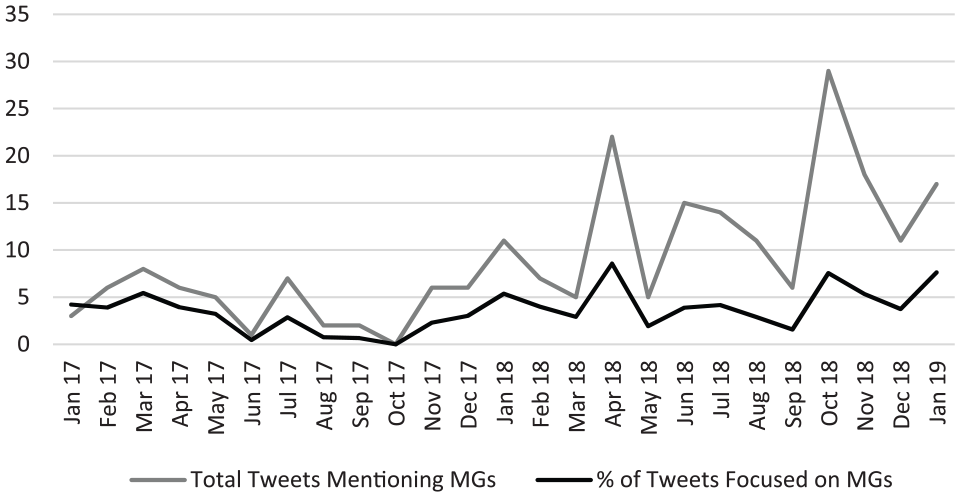
Trump tweets mentioning marginalized groups.
The figure reveals considerable variation over time. Trump’s volume of MG tweets dipped slightly during the middle portion of his first year before rebounding near the end of the year and then elevating substantially during his second year. Indeed, as a percentage of his total tweets, Trump more than doubled his MG tweets from his first year in office (2.1%) to his second (4.6%). 4 Figure 1 also reveals two spikes in the overall trend (April 2018 and October 2018), when Trump dramatically increased his MG tweets. Both cases were driven primarily by tweets about immigrants—the so-called migrant caravan—approaching the U.S./Mexico border.To better understand which specific MGs drew Trump’s attention and answer RQ1, the left-hand column of Table 1 displays, in descending order, the percentage of Trump’s total MG tweets that focused on each group. By far the most mentioned MG was racial/ethnic minorities, accounting for more than two-thirds of Trump’s MG tweets. As with the spikes noted in Figure 1, these tweets largely reflect Trump’s emphasis on immigrants. Women and religious minorities were the other two MGs that Trump referred to with some regularity. The eight mentions of Native/Indigenous groups are a small volume in general, but a surprisingly large presence given that modern presidential communication has paid this community virtually no attention (Coe & Schmidt, 2012).
Tone of Trump Tweets by Marginalized Group.
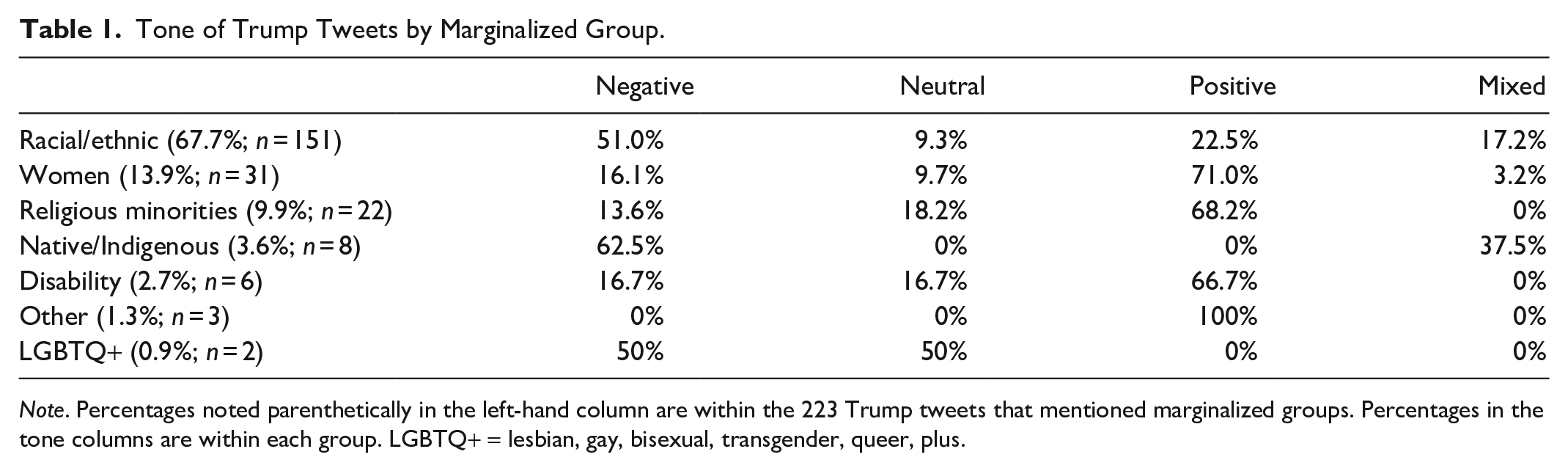
Note. Percentages noted parenthetically in the left-hand column are within the 223 Trump tweets that mentioned marginalized groups. Percentages in the tone columns are within each group. LGBTQ+ = lesbian, gay, bisexual, transgender, queer, plus.
Trump also mentioned people with physical or mental disabilities a handful of times, and only twice mentioned the LGBTQ+ community, doing so by announcing his intention to ban transgender people from serving in the military.
Looking at the rest of Table 1 reveals the tone of Trump’s tweets, answering RQ2. Overall, Trump’s tweets mentioning MGs were slightly more negative (41.3%) than positive (35.0%), with the rest being either mixed (13.5%) or neutral (10.3%). However, these trends varied substantially based on the MG in question. Most notably, Trump’s tweets mentioning racial/ethnic groups and Native/Indigenous groups were negative a majority of the time. In contrast, his tweets focusing on women and religious minorities were largely positive. In the section that follows, we address RQ3 by thematically contextualizing and deconstructing the ideological implications of these broad patterns in tone.
Critical/Cultural Analysis
Paying attention to tone as a key feature of marginalized identity invocation, we thematically examine the contextual inferences of Trump’s positively toned versus negatively toned tweets. To amplify our analysis of positivity and negativity, we occasionally draw from the smaller subsets of mixed and neutral tweets.
Positive Tone
There are two overarching and interdependent themes within Trump’s positive tweets about MGs (n = 78): (1) celebration/advocacy and (2) self-promotion. In the first pattern, Trump offers brief celebratory or supportive acknowledgment of a given MG. In the context of disability, Trump’s support for autism awareness provides an example. In 2017, Trump tweeted “Melania and I are honored to light up the @WhiteHouse this evening for #WorldAutismAwarenessDay,” and in 2018 tweeted this notice: “President Donald J. Trump Proclaims April 2 2018 World Autism Awareness Day.” At a surface level, these tweets draw positive attention to disability and celebrate disability awareness. Contextualizing these tweets more thoroughly reveals the circulation of power—both in government resources and in audience response. Indeed, Trump’s explicit and positive social media rhetoric falls short of material government support with regard to the resources required for widespread autism spectrum disorder (ASD) awareness. Organizations working on behalf of this community took note. For instance, in 2019 Autism Speaks released a statement criticizing the Trump administration’s proposed budget: “The administration’s fiscal year 2020 budget proposal eliminates funding for key programs serving children and adults with autism . . . Autism Speaks is disappointed that the administration’s 2020 budget calls for eliminating this crucial funding.” Here, Trump was able to easily promote a positive take on his support for a marginalized community. But, using the same forum as Trump, an organizational response inverting the flow of power was possible as well.
Trump’s tweets about religious minorities provide another useful example of the celebration/advocacy theme—and its contextual nuances. In many respects, Trump’s tweets about Jews are consistent with the routinized positive communication that presidents often offer around major “sociocultural touchstones” (Coe et al., 2017), including holidays and memorials. But the ultimate richness of this routinized communication took time—and criticism—to form. In January 2017, the White House released a “Statement by the President on International Holocaust Remembrance Day” that was criticized for failing to explicitly situate the Holocaust as Hitler’s anti-Semitic attempt to exterminate the Jewish population. White House Press Secretary Sean Spicer defended the statement’s lack of specificity as an effort not to exclude any of the MGs targeted by Nazis (Tapper, 2017). Spicer also chided journalists: “The idea that you’re nitpicking a statement that sought to remember this tragic event that occurred and the people who died in it, it’s just ridiculous” (Tapper, 2017).
Ridiculous or not, Trump adjusted accordingly. For example, he tweeted about the Holocaust four times (two positive and two neutral). In one case, he wrote:
On Holocaust Remembrance Day we mourn and grieve the murder of 6 million innocent Jewish men women and children and the millions of others who perished in the evil Nazi Genocide. We pledge with all of our might and resolve: Never Again!
Trump’s explicit invocation of Jewish identity and strong moralistic stance left little room for the kind of criticism his earlier statement had received.
Trump’s other tweets about Jews often displayed the advocacy side of the celebration/advocacy theme, responding with support amid acts of violence targeting the community. For example, in the aftermath of the October 2018 mass shooting at the Tree of Life Synagogue, Trump tweeted:
As you know earlier today there was a horrific shooting targeting and killing Jewish Americans at the Tree of Life Synagogue in Pittsburgh Pennsylvania. The shooter is in custody and federal authorities have been dispatched to support state and local police. . . .This evil Anti-Semitic attack is an assault on humanity. It will take all of us working together to extract the poison of Anti-Semitism from our world. We must unite to conquer hate.
Taken in combination with several additional tweets acknowledging Jews and/or Jewish holidays, Trump’s positive Twitter rhetoric humanizes Jewish oppression, demonstrates Holocaust remembrance, and advocates against the anti-Semitic hate crime at the Tree of Life Synagogue—all of which affirm Jews and Judaism as a significant U.S. populace.
The second, related theme in Trump’s positive tweets is self-promotion. Like the celebration/advocacy theme, these tweets often build up a specific MG. However, what sets them apart is that these tweets more clearly offer this celebration as a means of heralding the president’s ostensible contribution to supporting the group in question. In the context of race/ethnicity, for example, Trump tweeted: “I am proud to have fought for and secured the LOWEST African American and Hispanic unemployment rates in history.” In another case, Trump quoted this headline: “BET founder: Trump’s economy is bringing black workers back into the labor force.” In view of the asymmetric power dynamics between Trump and the groups in question, we interpret these types of tweets as self-promotion that sounds positive but falls short of genuinely advocating for or commending MGs. Rather, the recipient of commendation is Trump himself.
To explore variations on this theme, consider two tweets about different groups of women gathering for political rallies. During the 2018 Women’s March—populated by hundreds of thousands of women denouncing his presidency and policies—Trump twisted the premise of the march to imagine that the protesters were celebrating. Doing so allowed him to boast about the economy:
Beautiful weather all over our great country a perfect day for all Women to March. Get out there now to celebrate the historic milestones and unprecedented economic success and wealth creation that has taken place over the last 12 months. Lowest female unemployment in 18 years!
In another case, when the women in question were rallying in support of Judge Brett Kavanaugh’s nomination to the Supreme Court, the president took the opportunity to not only praise his nominee but to impugn those who would oppose him:
Women for Kavanaugh, and many others who support this very good man, are gathering all over Capitol Hill in preparation for a 3-5 P.M. VOTE. It is a beautiful thing to see—and they are not paid professional protesters who are handed expensive signs. Big day for America!
Tweeted during the immediate aftermath of Dr. Christine Blasey Ford’s sexual assault testimony during Kavanaugh’s confirmation hearing, Trump’s support of Women for Kavanaugh protestors rings genuine but his support for women who protested against Kavanaugh rings disingenuous via the insinuation that they are plants. Trump genuinely endorsing women exercising their right to free speech would require him to do so for all in that MG, not only those who conveniently agree with his political platform.
In the above themes, then, we see Trump leveraging his privilege and influence to celebrate and advocate for some MGs while sometimes also finding ways to promote his own perspective and agenda.
Negative Tone
Within Trump’s negative tweets about MGs (n = 92), we identified two overarching and interdependent themes: (1) polarizing partisan commentary and (2) insults toward his opposition. In the former, Trump continues one of his go-to campaign strategies by using MGs—especially immigrants—to position Democrats and Republicans as intractable adversaries. For example, Trump tweeted, “If you want to protect criminal aliens—VOTE DEMOCRAT. If you want to protect Law-Abiding Americans—VOTE REPUBLICAN!” and on two occasions encouraged Republicans to exercise the “Nuclear Option” as parliamentary procedure.
Notably, Trump’s polarizing tweets often propagate factual inaccuracies; this is particularly ironic given his repeated attempts to discredit news coverage as “Fake News.” The following tweet reflects how Trump’s tendency toward absolutist blame often results in inaccuracy:
Any deaths of children or others at the Border are strictly the fault of the Democrats and their pathetic immigration policies that allow people to make the long trek thinking they can enter our country illegally. They can’t. If we had a Wall they wouldn’t even try!. . .
Trump’s consistently acute combination of polarization and absolutism makes it impossible for several of his negative tweets to be accurate. Albeit powerful given Trump’s positionality as President, to declare that Democrats writ large are to blame for “any deaths of children,” “want illegal immigrants to pour into our nation unchecked,” and “don’t care about crime” is simply untrue. Moreover, such rhetoric pointedly stokes continued conflict and limits the possibility of bipartisanship.
Collectively, Trump’s corpus of tweets invoking immigrants signal little hope for a unified two-party government. “Bipartisan” appears in the corpus only twice; first in a negatively toned January 2018 tweet that mocks bipartisanship followed by a mixed-tone May 2018 tweet that calls for bipartisanship:
The so-called bipartisan DACA deal presented yesterday to myself and a group of Republican Senators and Congressmen was a big step backwards. Wall was not properly funded Chain & Lottery were made worse and USA would be forced to take large numbers of people from high crime…… Democrats mistakenly tweet 2014 pictures from Obama’s term showing children from the Border in steel cages. They thought it was recent pictures in order to make us look bad but backfires. Dems must agree to Wall and new Border Protection for good of country. . .Bipartisan Bill!
Trump’s tweet addressing the “2014 pictures” is of particular interest. He is correct that the image was initially taken and published in 2014 during Obama’s presidency, and that the image was tweeted and retweeted by several left-leaning Twitter users. On 27 May 2018, for example, Jon Favreau, Obama’s former speechwriter, tweeted: “Look at these pictures. This is happening right now, and the only debate that matters is how we force our government to get these kids back to their families as fast as humanly possible” (Sherman, 2018). Shortly thereafter, Favreau deleted his inaccurate tweet and tweeted a correction:
These awful pictures are from 2014, when the government’s challenge was reconnecting unaccompanied minors who showed up at the border with family or a safe sponsor. Today, in 2018, the government is CREATING unaccompanied minors by tearing them away from family at the border. (Sherman, 2018)
Lost in this roil of social media and partisan positioning is the reality that both Obama’s and Trump’s immigration detention facilities appear similarly deplorable insofar as adults and children being detained in a state of legal limbo surrounded by concrete, fencing, and severely limited basic amenities. Despite these reprehensible similarities between Democratic and Republican administrations, Trump’s negative tweets reveal a staunch difference in terms of how he and his administration characterize immigrants. Quantitatively, Trump’s tweets contain a litany of negative stereotypical characterizations of who he imagines immigrants are. Tweeted characterizations include references to immigrants as “violent criminal aliens,” “illegals,” “dangerous criminals,” “illegal aliens,” “stone cold criminals,” “very bad thugs and gang members,” and “dangerous criminal aliens.” Discursively, Trump’s perpetually negative tweets about immigrants situate immigration as a polarized controversy defined by criminality, invasion, and danger. Culturally, Trump’s extreme perpetuation of xenophobia injuriously constructs racial and ethnic MGs as undeserving of respect and dignity.
Building from this theme of polarization is the second theme: insulting the opposition. Within his polarizing tweets, it is common for Trump to pair absolutist generalizations with unnecessary insults (e.g., referring to Senate Minority Leader Chuck Schumer as “Cryin’ Chuck Schumer” and former Senator and Secretary of State Hillary Clinton as “Crooked Hillary”). The foremost examples of how Trump utilizes Twitter to couple disrespect toward MGs with insults of his opponents are his tweets addressing Democratic Senator and presidential hopeful Elizabeth Warren. Trump tweeted about Native and Indigenous peoples only eight times, all in negative (62.5%) or mixed (37.5%) tones (recall Table 1). Each of these mentions was a jeer at Warren invoking “Pocahontas.” Spanning 2017, 2018, and 2019, Trump’s pejorative tweets include the following:
Pocahontas just stated that the Democrats lead by the legendary Crooked Hillary Clinton rigged the Primaries! Lets go FBI & Justice Dept. Thank you to the Cherokee Nation for revealing that Elizabeth Warren sometimes referred to as Pocahontas is a complete and total Fraud!
Attending to Native/Indigenous representation on Trump’s Twitter feed exposes the depths of his compulsion to tweet about Warren. For example, notably absent are any mentions of the World War II Navajo Code Talkers honored at the White House in November 2017. Moreover, at this event, Trump maintained his commitment to mockery and simultaneously disparaged Pocahontas as a Powhatan historical figure when he said,
I just want to thank you because you’re very, very special people . . . You were here long before any of us were here. Although we have a representative in Congress who . . . was here a long time ago. They call her “Pocahontas.” (Parker & Zezima, 2017)
Despite being publicly criticized for his insensitivity at the commemorative event, Trump continues to refer to Warren as Pocahontas and imbues his Twitter feed with further disrespect toward sacred Native and Indigenous histories by recently tweeting,
If Elizabeth Warren often referred to by me as Pocahontas did this commercial from Bighorn or Wounded Knee instead of her kitchen with her husband dressed in full Indian garb it would have been a smash!
Underscoring the power of a networked forum in which such communication can be quickly addressed, Native and Indigenous peoples challenged Trump’s comment. For example, responding on Twitter, Ruth Hopkins, who is Sioux, said: “+300 of my people were massacred at Wounded Knee . . . . Most were women and children. This isn’t funny, it’s cold, callous, and just plain racist” (Caron, 2019). Conveying indifference toward Native and Indigenous sentiment, Trump continually fails to be culturally responsive by tweeting, for instance, to honor Indigeneity, illustrate tribal distinctions, and atone for past and present colonial suffering. Above, we saw that Trump was using marginalized identity invocation as a platform from which to self-promote; here we see it can also be a platform from which to attack.
Discussion
This study conceptualized marginalized identity invocation, using Donald Trump’s Twitter feed as an illustrative case. Returning to the four features of our conceptual framework underscores the broader implications of our analysis. We start with power dynamics, which are inherent to marginalized identity invocation. Trump’s status as president gives him tremendous political and communicative power. It ensures, for instance, that his Twitter feed will have a massive audience—and that, even if he appears to run afoul of site rules, his feed is unlikely to be suspended (see Ohlheiser, 2019). That foundational presidential positionality should also be viewed in relation to other identity categories that Trump occupies. His position as a wealthy White cishetero man, for instance, creates many tangible forms of systemic privilege, any one of which might come to the fore in a given communicative act. It seems clear that Barack Obama, who as an African American differed from Trump on only one of the identified categories, could not have said any number of things that Trump has—at least not without garnering far more backlash (cf. Stuckey, 2010).
Forum is also central to understanding Trump’s marginalized identity invocation. Twitter provides Trump with a megaphone, but it is a very particular kind of megaphone. Unlike most traditional presidential forums, which provided either broad mass-mediated audiences or narrow live audiences (Scacco & Coe, 2016), Twitter provides a “low stakes” venue where Trump can access a range of narrower audiences. He can also do so immediately, which is especially noteworthy for a president who has shown himself prone to fits of extreme emotion (Ott & Dickinson, 2019). Thinking about forum in this way helps explain why Trump might engage in marginalized identity invocation. This unique forum allows Trump to try out messages of support for audiences within his political opposition that he might be hesitant to speak to in person (for fear of having to field uncomfortable questions, for instance). Just as important, it allows him to connect with demographic groups among his base that he has virtually no real-world connection to (e.g., rural Whites, conservative evangelicals). These groups, research has begun to show, are especially attuned to the kinds of in-group identity themes that marginalized identity invocation is likely to stir (see Jardina, 2019).
Trump’s marginalized identity invocation is also strikingly explicit. Our methodological choices ensured that our focus herein is primarily on the explicit. Given this, we make no claim that Trump’s invocations are more explicit than not—our data cannot speak to that. Rather, we observe that Trump’s willingness to be explicit in many public invocations, especially negative invocations, offers further evidence of a shift occurring in political discourse. Stuckey (2004), in a sweeping historical analysis, observed the “increasingly subtle forms of inclusion and exclusion” (p. 20) evident in presidential rhetoric. More recent work has noted a change in the context of race, with political figures increasingly comfortable making explicit negative references (Jardina, 2019; Valentino et al., 2018). Our findings in the context of Trump’s rhetoric about immigrants help confirm this emerging trend.
This brings us to tone. It is fair to wonder if Trump’s tone with respect to marginalized groups is less negative than popular commentary might lead one to expect. After all, only a minority of Trump’s tweets (41%) about marginalized groups were negative. No perfect baseline is available against which to compare Trump, but Coe and Schmidt’s (2012) analysis of explicit mentions of racial groups in major presidential speeches from 1933 to 2011 provides some insight. In that case, they found no instances of negative invocations. Given this, it is at least fair to say that Trump’s negativity is above the presidential norm. And, returning to the question of why Trump might invoke marginalized identities in the way he does, it is possible that the “informality” of Twitter prompts a rhetorical vehemence less likely in more traditional forums (Ott & Dickinson, 2019).
Extrapolating from this case, imagine what presidential engagement with marginalized constituencies might look like if Trump’s practices set a standard that future presidents model. In this hypothetical future, the discursive parameters of U.S. national identity are narrow, focusing disproportionate and negative attention on immigrants and largely ignoring other marginalized groups. We do not view such a future as especially probable, for two reasons. First, the increasing pluralism of the U.S. political sphere is likely to create new incentives for presidents to engage in tonally positive marginalized identity invocation (Scacco & Coe, 2016). Second, there is already some evidence that, as the novelty wears off, Trump’s Twitter strategy is losing steam (Rothschild, 2019). If this trend continues, other political actors will have less incentive to follow Trump’s lead.
Future research would do well to explore this and other possibilities. As just one example among many, future research focusing on the forum element of our framework could explore how the specific affordances of certain online platforms might lead political leaders to engage marginalized communities in specific ways. For example, does the ease of a tweet compared to a traditional speech encourage more recognition of marginalized groups, but also more superficial recognition? And is Twitter unique in how presidents use it for identity invocation, or are other platforms used in similar ways? Answering such questions will continue to usefully expand our understandings of marginalization in political discourse.
Footnotes
Acknowledgements
The authors thank Shannon McGregor, Liane O’Neill, and Mariah Wellman for their assistance with this project.
Declaration of Conflicting Interests
The author(s) declared no potential conflicts of interest with respect to the research, authorship, and/or publication of this article.
Funding
The author(s) received no financial support for the research, authorship, and/or publication of this article.
