



Abstract
The concept, “White Rage,” has previously been used to describe the way Whites have historically responded to Black advancement with policies and practices designed to quietly disrupt the progress Blacks had been making. White rage is typically subtle, masking its true intent. In contrast, recent research has found that the covert, subtle expressions of racism that are so normal in most mainstream spaces may be less common in internet-based communication. The extent to which online racism is connected to real-world racist attitudes, behaviors, and events, however, is unclear. In this article, we test the effects of real-world racialized events on explicit expressions of racism in online spaces using days that Obama gave speeches as our treatment effect and explicit usage of the “n-word” on the social media platform X (formerly Twitter) as our measurable outcome. Does usage of the n-word, a racial slur, increase in the days following speeches made by President Obama? Our results of over 9 years and more than 2.9 million tweets demonstrate a statistically significant increase of racist speech in response to those speech cycles, which are further placed in contrast to the speeches of other political actors, including President Trump.
Carol Anderson (2016) uses the concept White Rage to describe the way Whites have historically responded to Black advancement. She highlights several key periods in history—the Reconstruction Era, the Great Migration, the Civil Rights years, and the Obama Presidency—and traces the ways Black advancement during those time periods was followed by policies and practices designed to quietly disrupt the Black progress. For example, the end of slavery was followed by the creation of the “Black Codes” that would become Jim Crow, and Obama’s Presidency was followed by an intense revitalization of voter disenfranchisement practices and gerrymandering meant to limit Black access to the polls and to diminish overall impact in the political sphere.
Anderson (2016) notes that White Rage is typically subtle. Rather than being explicitly racist, the policies and practices associated with White Rage rely on purportedly race-neutral explanations, rationales, and motivations that mask their true intent—rolling back the rights or opportunities Blacks had recently gained access to. The covert nature of White Rage, therefore, is consistent with much research on post-Civil Rights racial attitudes and expressions of racism, which are known to be more hidden than open (Bonilla-Silva, 2017).
Recent research has found, however, that the covert, subtle expressions of racism that are so normal in most mainstream spaces may be less common in internet-based communication (Eschmann, 2023; Hughey & Daniels, 2013; Ortiz, 2020). From White supremacist websites and anonymous comments on news sites (Daniels, 2009a; Guo & Harlow, 2014) to the millions of racial epithets used on social media each day (Bartlett et al., 2014), some online spaces have become characterized by overt and highly explicit expressions of racist ideologies.
This online discourse is often seen as being distinct from in-person racial discourse and the increased vitriol due to a perceived disconnect between digital spaces and the norms that limit hostility in face-to-face interactions (Groshek & Cutino, 2016; Lapidot-Lefler & Barak, 2012). The extent to which online racism is connected to real-world racist attitudes, behaviors, and events, therefore, is unclear. How do these more explicit expressions of racism online fit into understanding of racism and the racial landscape, or even White Rage and pushback against Black advancement? In this article, we investigate the connection between real-world racialized events, White rage, and online racist language. We introduce the term digital rage to refer to explicit racism online that responds to or correlates with symbols or perceptions of Black advancement or Black life. Digital rage emerges from Anderson’s (2016) White rage concept, as well as the expansive literature on varied expressions of racism in online spaces. To measure digital rage, we examine the relationship between a symbol of Black advancement (Barack Obama), and a measure of online racism (use of a racial slur, the n-word, on X (formerly Twitter)).
President Obama represents one of the most recognizable symbols of Black advancement in the 21st Century and has been a lightning rod for White Rage. Between 13 July 2009 and 20 January 2017, President Obama gave 356 speeches. Here, we operationalize President Obama’s speeches as real-world events that are symbolic of Black advancement and may therefore provoke digital rage.
The n-word is a racial slur that is more than a personal insult but also communicates the permanently inferior place Black folks are thought to hold on the racial hierarchy (Kennedy, 1999). Usage of the n-word in public or mainstream spaces is nearly universally frowned upon and can be seen as evidence of racist attitudes. For example, after audio of Judge Michelle Odinet using the n-word hit the internet, she was pressured to take a leave of absence her old cases are being reviewed for racial bias (Lemos et al., 2021; Peiser, 2021).
We therefore use days that Obama gave speeches as our treatment effect and explicit usage of the “n-word” on X as our measurable outcome. Our research question is: Does usage of the n-word, a racial slur, increase in the days following speeches made by President Obama? While others have pointed out examples of racist comments that are associated with Obama on X, including someone posting the n-word as a response to his first tweet on the social media platform (Capehart, 2015), no studies have investigated the relationship between changes in aggregate n-word usage over time and real-world racialized events, like President Obama’s speeches and the symbol of Black advancement he represents.
Our working hypothesis is that there will be an increase in overt usage of the n-word after President Obama’s speeches, when he was more prominent in the general population’s media landscape. This increase represents digital rage and suggests that real-world events that challenge White supremacy, whether symbolic or substantive, can lead to measurable changes in online racist discourse. White Rage and digital rage can be deployed in response to both real and perceived Black advancements either by individual African Americans or within the landscape of gains for racial justice. Thus, while the material conditions by which Black progress can be measured via economics, housing, health, and education may be stagnant or declining, individual racial barriers such as crossing the color line into White-dominated spaces can provide many Whites with the perception that the race on the whole has made gains or that more African Americans will follow in the footsteps of individual Black achievements.
This is an exploratory study; one of the first longitudinal tests of real-world events on online racial discourse of its kind. We discuss the implications of digital rage and the Obama effect—a term coined in the title of a paper that found that exposure to Obama decreased measured prejudice (Plant et al., 2009)—on the ways we think about online racial discourse and its relationship with real-world events, sentiments, and racialized experiences.
Background
Here, we briefly review three distinct studies to contextualize the relationship between Obama, racism, and online communication. First, we explore the impact race and racism had on Obama’s candidacy and Presidency, and the effect Obama and his Presidency have had on race relations in politics and beyond. This study builds on this literature and provides one of the first analyses of the Obama effect in real time, as we investigate changes in usage of the n-word on X immediately following President Obama’s speeches. Second, we review research on online racial discourse, which is often seen as being distinct from in-person discussions of race and racism. This literature shapes our understanding of the meaning and function of online racism, and how online patterns may be connected to real-world events and realities. Third, we discuss the historical and contemporary usage of the n-word and its relationship to racial power structures. Here, we make clear our reasons for studying the n-word in particular, as opposed to studying uncivil or profane language in general. Each of these literature studies is integral to our theoretical interventions and innovative methodological strategies as we investigate digital rage: the online racist responses to real-world symbols of Black advancement.
Race, Racism, and the Obama Administration
Much attention has been given to the racial gap in voting, with around 90% of Black voters and less than 40% of White voters voting for Obama in 2012 (Craighill & Sullivan, 2013). While the overwhelming support from voters of color certainly helped Obama overcome the deficit in White voters, research suggests that overall, Obama’s race hurt him in the polls. Obama received around 10% less votes because of race in both 2008 and 2012, (Kinder & Dale-Riddle, 2012), and research links these voting patterns to negative racial attitudes and racial resentment (Knuckey & Kim, 2015). Stephens-Davidowitz (2017) finds that the number of Google searches for the n-word in a given geographic location predicted whether voters in those districts were less likely to vote for Obama in 2008 than they had for Kerry in 2004. Obama was and is an immensely popular political figure, but would have been even more popular were it not for racial prejudice.
Obama dealt with a consistent stream of race-based challenges to his person and political agenda throughout his candidacy and tenure as President. Obama received an unusual number of threats to his life, prompting the Secret Service to begin protecting him earlier in the election period than had ever been done previously (Zeleny, 2007). Obama also faced unique challenges to his citizenship and religion; political opponents suggested he was not born in the US and was ineligible to be President, and that he was secretly Muslim. Research finds that both of these characterizations of Obama are predicted by measured racist attitudes (Tope et al., 2017). Those with increased racial prejudice are less likely to support Obama (Lundberg et al., 2017) and more likely to think that he had been elected unfairly (Appleby & Federico, 2018). An experimental study found that individuals with higher prejudice were less likely to be favorable toward health care reform when it was attached to Obama, versus another liberal politician (Maxwell & Shields, 2014; Tesler, 2012).
In addition to being affected by race, racism, and racial attitudes, Obama had an effect on how we experience and understand race in the US. For Blacks in particular, the Obama effect included an increase in perceived life chances, even if these perceptions were not tied to concrete policy changes or opportunities (Stout & Le, 2012). There is also evidence that stereotype threat—which describes how Blacks and other marginalized groups perform worse on tasks when they are primed with a stereotype—is less powerful when the priming condition includes President Obama (Marx et al., 2009). Other research finds that for Whites, exposure to Obama decreases implicit racial bias and negative stereotypes about Blacks (Columb & Plant, 2011; Goldman & Mutz, 2014). These results demonstrate the symbolic import of Barack Obama, a Black man, occupying the highest public office in the US, a major world power. His election, for many, was seen as evidence of racial progress.
During Obama’s tenure, the Tea Party Movement, a reactionary political group with the stated goal of bringing the US back to its roots, came into prominence (Skocpol & Williamson, 2016). Research finds that racist attitudes predicted tea party membership (Tope et al., 2015), the relationship between racial resentment and negative evaluations is strengthened by Tea Party membership (Leone & Presaghi, 2018), and involvement with the Tea Party predicted increased measured levels of affinity with White identity, which Knowles conceptualizes using the Perceived Racial Common Fate scale—a scale measuring “the degree to which individuals (in this case, Whites) see their fortunes as linked to that of the racial ingroup” (Knowles et al., 2013, p. 3). Furthermore, Carol Anderson (2016, 2018) makes the convincing argument that White Rage in response to Obama’s Presidency is what drove a resurgence in Republican-led voter suppression around the country. Obama’s race was a catalyst for organized political responses from both mainstream Republican opposition and more extremist white supremacist and ethnonationalist groups.
Race, Racism, and Online Communication
The emerging media landscape seems to invite an increasing amount of speech reinforcing racial stereotypes and even advancing overt racism (Daniels, 2009a; Guo & Harlow, 2014; Nakamura, 2008). Due to the lack of traditional gatekeepers, hate groups such as White supremacist groups find social media an ideal platform to distribute their messages and recruit supporters worldwide. While some of this content is open, Daniels (2009b) found that many White supremacist sites are “cloaked” or designed to trick users into accepting their arguments as being mainstream.
On college campuses, research has found that anonymous online forums can be spaces where students can be exposed to explicitly racist language, which can have deep impacts on the ways they think about race and interact with the institution and their peers (Eschmann, 2020; Tripodi, 2016). The norms that limit explicit expressions of racism in many face-to-face settings do not seem to apply to many forms of online communication (Daniels, 2009a; Eschmann, 2020).
Social media providers and their designed algorithms, which can be considered “new gatekeepers” of the online space, favor freedom over control of speech (i.e., allow all sorts of speech including potentially problematic ones) driven by the political economy of the internet (Jakubowicz et al., 2017). At the intersection of freedom of speech and the desire for maximizing profit, big social media corporations are often hesitant to police hate speech. For example, in 2016, the New York Times editor Jonathan Weisman quit his X account with 35,000 followers because the platform refused to do anything about the onslaught of antisemitic comments directed at him (Weisman, 2016). While X updated its hateful conduct policies in 2021, the effectiveness and permanence of these policies’ changes remain to be seen, however, as these not only contributed to self-proclaimed free speech advocate Elon Musk’s decision to fully acquire the social media giant but also seem to be in jeopardy in light of the mass firings that followed Musk’s acquisition (Dwoskin, 2022; X Safety, 2021). While free speech debates relating to social media are often divorced from academic debates (which are more concerned with the protection of speech from tyrannical government), many use the term free speech to refer to the debate over hate speech moderation. Just hours after Musk’s deal to acquire X was finalized, tweets using the n-word increased by 500%, something that many interpreted as users feeling more “free” to spew racism given X’s new leadership (Harwell et al., 2022).
Just like online activism for social justice can be used to mobilize collective actions offline (Harlow, 2012), online racism can also turn into real-life violence (Hatzipanagos, 2018). In fact, it has become more difficult to distinguish between online racism, which is often seen as being unique to online spaces, and the threats, violence, and abuse that victims encounter offline in this media-saturated world (Awan & Zempi, 2016). In the past few years, racially motivated mass shooters in Charleston, El Paso, and Buffalo were at least in part radicalized in online spaces and/or shared their racist views online (Levenson et al., 2022; Wu, 2019). In 2020, the Federal Bureau of Investigation (FBI), recognizing the growing threat of White supremacist domestic terrorists, raised the threat level from racially motivated terrorists to match that of ISIS (Donaghue, 2020). This study is informed by the research that connects online hate to real-world events and investigates the ways real-life events may also trigger racist speech online.
Contextualizing the N-Word
The “n-word” serves as a “key lexicon of race relations” and, in the words of journalist Farai Chideya, functions as “the all-American trump card, the nuclear bomb of racial epithets” (Kennedy, 1999, p. 87). Born from the Latin niger meaning black, and tracing an etymology of several different spellings including niggor, niggah, neger, and niggur, the meaning and purpose of the word are inseparable from the contexts and spaces in which it has serviced the social operations of racialization (Kennedy, 2002; Rahman, 2012). By the 1830s, the common usage of the word as an insult in private White spaces (White parents regularly disciplined their children by threatening that they would be “carried off by the old nigger” or shamed to “the nigger seat”) had bled into a bounty of popular music, children’s games, and nursery rhymes (Kennedy, 1999, 2002). In this peak of the cotton boom and slave trade, the word continued to provide Whites a pejorative pronoun dismissively substituting for the given name for any and every Black person. The word universally operated as an instruction in the colloquial lives of Whites, one that was intended to injure African Americans and, ergo, distinguish Whiteness as unmocked, untarnished, and superior (Kennedy, 2002).
This early usage as an insult would be the n-word’s most lasting appearance, but its arrival as a social taboo is a purely modern invention. In contemporary racial politics, the epithet acts as a smoking gun for deliberate racism. Recalling the 1995 OJ Simpson trial, proving the intentional racial bias of LAPD detective Mark Fuhrman relied upon evidence that he had used the word repeatedly in a prior taped interview (under pressure from widespread outrage, Fuhrman retired from the force the same year) (Hayes, 1995; Texeira, 1995). In a case before the Ninth Circuit Court of Appeals about the appearance of the n-word over 215 times in Huckleberry Finn, an assigned reading in a local school district, a Black parent argued that the word distressed Black students and encouraged their White classmates to engage in racial harassment (Monteiro v. Tempe Union High School District, 1998). In his opinion, Judge Stephen Reinhardt made a watershed observation: “there is no word or phrase that could be directed at any other group that could cause comparable injury” (Kennedy, 1999, p. 87). Reinhardt went a step further, however, in confirming that the term not only signaled racism but also that stigma attached to various racial epithets mirrored racial hierarchy. The power of the n-word was inextricably yoked to the permanently hyperdegraded status of Blackness in America—a powerful linguistic tool in the strike against perceived Black advancement (Asim, 2008; Pryor, 2016; Kennedy, 2002; Rahman, 2012). In popular humor online and in private White exchanges, the term is a qualifier for irrevocable Black inferiority: What do you call a Nigger with a PhD.? Nigger.
Both the Simpson trial and the Ninth Circuit ruling institutionalized the taboo of the n-word as a term, using which accompanied unwanted consequences across most public contexts. Running concurrently to its growing stigma in formal institutionalized spaces was the increasingly recognized reclamation of the term in Black popular cultural and vernacular (Asim, 2008; Smith, 2019). In intraracial Black contexts, the term was divorced from its cultural taboo and White supremacist function (Smith, 2019), but rabid White consumption of Black television, film, and music placed the word again in the laps of those who did not have within-group license to use it unproblematically (Asim, 2008; Chun, 2001; Croom, 2015; Rahman, 2012). As such, the meaning of the n-word as a tool of racialization has arrived at yet another destination, from an insult conferring white superiority, to litmus test for intentional racial bias and technology of ethnoracial stratification, to its current iteration: the only extant item in our oral and written culture that has more negative consequence when used by Whites than Blacks. What was once a “safe indulgence” for Whites (Kennedy 2002: 9) is now effectively the only thing they cannot do openly that Black people can, and, thus, is an affront to the very construction of Whiteness as a set of unearned and unchecked advantages and privileges over non-Whites. This is why we have chosen to use the n-word to operationalize digital rage. It represents a racial taboo of the highest order. And not only is its usage frowned upon in mainstream spaces, but it can also be used with impunity in some online spaces, especially when a user’s identity is hidden behind an anonymous or unidentifiable username. X users who use the n-word are invoking White supremacy while (presumably) avoiding the potential negative consequences that would come with using the word in mainstream educational, work, or social settings.
Space has consistently dictated the meaning and power of the n-word. The still-developing online community guidelines and moderating capacities that track racial epithets struggle to semiotically decipher contexts for intentionally offensive language, whereas users of the epithet rush to populate spaces where intentionally racist language has considerably more mitigated consequences than other formal institutions in their lives (Beach, 2019; Citron, 2014; Cohen-Almagor, 2015). Social media does not perfectly mirror racial interactions offline (Citron, 2014; Suler, 2004), but as it inevitably evolves as a formal social institution, White Supremacy will be inevitably institutionalized into it (Delgado & Stefancic, 2014; Persily & Tucker, 2020). Tracing how the essential lexicon of American racial stratification is adapted to it provides necessary insights into emerging modes and processes of racialization. As subtlety increasingly marks the modalities of White Rage in mainstream spaces, our investigation of the relationship between President Obama’s speeches and the usage of the n-word on X will increase our understanding of how some online spaces operate holdout destinations for racist behaviors and expressions in their most provocative and intentionally opprobrious form.
Methods
Our data come from X, a social media platform often studied by academics due to easier data access and the large role it plays in public debates. While 69% of US adults use Facebook, only 23% use X. Black folks use X at a higher rate (29%), and Black Twitter has been central to contemporary activist efforts, including both the Movement for Black Lives and #MeToo.
We used the Crimson Hexagon ForSight social media analytics platform (since acquired by Brandwatch) to perform a search for all tweets between 7 December 2009 and 10 July 2018 that included the n-word (“nigger”). 1 This platform originates out of academic research and is used by both academics and market researchers (Breese, 2016; Hopkins & King, 2010). We did not include alternative spellings because the hard “-er” ending is often what distinguishes between the n-word being used as hate speech versus its colloquial usage in hip hop or in the Black community (i.e., “nigga”), which does not always have a negative connotation. Research on online hate speech differentiates between these two spellings, finding that usage of the n-word with the “er” ending is associated with racist tweets, whereas usage of the n-word ending in “a” is less likely to be considered racist (Davidson et al., 2017; Kwok & Wang, 2013). Indeed, Kwok and Wang (2013) write that the n-word (with a hard “er” is the “standard for insulting blacks, averaging to one “nigger”-related word per two tweets against blacks” (2). 2
The platform provided access to the full X firehose, meaning that the entire corpus of public tweets (excepting those that have been deleted) ever published are searchable and can be retrieved for analysis.
Over the course of this study period, there were 7,263,746 total clearly identifiable tweets that used the n-word. Of that total, there were 2,987,949 original tweets that used the n-word retained for analysis here after excluding retweets (RTs, i.e., reposts of older tweets) and tweets that included links to outside websites (in which the word may have appeared in the link as opposed to the original content).
To avoid assigning meaning to increased usage of the n-word that might be explained not by racial animus but by increased usage of the social media platform on a given day, we also include data on the total numbers of tweets on X each day during the time period. During the study period, there were around 105 billion total tweets on X (104,979,596,526), a little less than half of which (47,560,687,355) did not include RTs or links. We used these numbers of total tweets to calculate the relative proportion of n-word tweets to the total number of tweets on X each day (details for the renormalization process are provided below).
We used the White House archive (The White House, 2017) to create a list of days on which Barack Obama gave a public speech. We limit our analysis of President Obama’s speeches to the dates in our dataset that correspond with his time in office (as his being a Black man in this seat of power is what is theorized to induce White rage) including from 12 July 2009, to 23 January 2017, shortly after Trump was inaugurated. 3 During this timeframe, there were 356 days on which Obama spoke, the earliest being 13 July 2009, and the last being 20 January 2017.
For all analyses, the hypotheses posed are directional (i.e., it is our belief that there will be an increase in the number of original tweets containing the n-word after a speech by Obama than before), and consequently, all statistical tests reported are one-tailed. In addition, for all hypotheses reported in the following sections, assessment of statistical significance will be based on the conventional significance level of α = .05.
Initial data presentations are provided using both absolute differences before and after a speech and relative differences (e.g., percent increases) before and after a speech. Analyses were conducted with a moving reference window-normalization factor (e.g., scaling the number of tweets relative to a short timeframe window preceding the dates in question). Furthermore, to confirm results are robust to violations of test assumptions (e.g., normality of errors), logarithmic transformations were conducted to account for skewness of data.
Finally, we replicated the same analysis for high-profile speeches made by Michelle Obama and Donald Trump to assess if the relationship between President Obama’s speeches and usage of the n-word in tweets is distinctly observable in the aftermath of other high-profile speeches from “most similar” and “most different” political actors, in the form of Michelle Obama and Trump, respectively.
Findings
All analyses were conducted on the following objective tweet frequency measure to keep values to manageable magnitudes. This measure is the number of tweets containing the n-word on a given day per 10,000 tweets on that day:

This can be calculated as:

For this report, we defined a speech day as any day in which a speech was given, a speech cycle is a string of consecutive days in which a speech was given each day, and a new speech day is the first day of a speech cycle, that is, a day in which a speech is given if no speech was given the previous day. The analyses reported here examine the number of tweets inclusively from 12 July 2009 to 7 October 2018.
Summary Statistics
The sample distribution for pn has M ± SD = 0.5975 ± 0.2464 (Mdn = 0.5747) over a range from 0.0748 to 5.2134; the middle-most 50% ranged from 0.5120 to 0.6553. Figure 1 presents the histogram for pn, a leptokurtic distribution with numerous extreme positive outliers. 4

Distribution for N-word tweets.
Next, we examined the longitudinal trend of the tweeting rate for the n-word. The plot in Figure 2 shows the absolute trend for

Time trend for N-word tweets.

Absolute number of tweets.
As longitudinal variation may cause some periods of time to have higher or lower numbers of tweets with the n-word, in Figure 4, we conduct an examination of the ratio of the scaled number of tweets (count per 10,000 total tweets) containing the n-word compared to a prior 3-day window over time. Figure 4 therefore illustrates spikes in usage of the n-word, relative to 3 days before, which helps control for variation in usage over time. Here, we first note that the ratio of consecutive scaled tweets is not changing over time (p = .158). Thus, there is a relatively consistent average for the ratio M = 1.02454, which represents an increase of 2.45% in the value of

Ration of scaled number of tweets to previous 3 days.
Agenda-setting research, which examines the effect of news media on public opinion, can shed light on the chosen time window for our analysis. Recent agenda-setting research suggests that traditional media influences social media discussion in a time lag ranging from hours to days (Harder et al., 2017; Neuman et al., 2014). A variety of time-frames were explored, ranging from one single day up to 2 weeks (14 days) and 1 month (28 days). While findings were not identical across different time windows, they were comparable (both in magnitude of effect and statistical significance).
Table 1 shows the relative consistency in the change of absolute count of n-word tweets using a variety of windows after the speech was given. The change in n-word containing tweets from pre- to post-speech remained consistently between 2.4 and 2.7 more tweets per million total tweets. Furthermore, the p values for the pre- and post-speech comparisons were analogous. Using this information, coupled with the theoretical support for a 3-day media coverage window, we set the arbitrary range for post-speech analysis to be 3 days.
Absolute Counts of N-Word Tweets (per 10,000) Before and After an Obama Speech.

The p value (.2062) for row #4 is naturally a bit suspicious because there are some 80+ values that appear in both the pre- and post-column (due to the overlap of the speech cycles).
As with the absolute counts, the relative counts (comparing the # of n-word containing tweets to the average of the three-previous days) showed a similar trend (see Table 2). There was a marked (and relatively consistent) increase postspeech (from 4.7% to 5.5%), and the p values for the pre- and post-speech comparisons were analogous. This only provides further empirical support for the choice of a 3-day window after the speech. Furthermore, the assessment that that percent increase was greater than 0% (ratios were larger than 100%) was also supported with relatively consistent p values regardless of the postspeech window size.
Relative Counts of N-Word Tweets (Per 10,000) Before and After an Obama Speech.

The relative counts in the previous table were compared to the 3-previous days’ average immediately preceding the speech. It is not uncustomary in longitudinal analyses to insert a brief lag time between the event of interest and the preceding time window, so as to even further isolate any possible shared influence on the pre- and post-observations. A number of lag windows were trialed, and the lag of 4 days prespeech is presented in Table 3. Here, we compare the number of tweets postspeech (averaged over 3 days) with the number of tweets prespeech separated by the lag of 4 days. Different length windows of time were chosen, ranging from 3 to 28 days (essentially 1 month). Comparable results were obtained in all analyses. Consequently, the shorter window of 3 days prior to the lag were chosen as the benchmark to be used in all subsequent analyses, as a time window of 3 days reflects the short-attention span of the national media’s focus. Further studies could be conducted to determine if there is indeed an optimal window for average time-lagging, but as it was not the focus of this study, it was not explored or presented here.
Relative Counts of N-Word Tweets (Per 10,000) Before and After an Obama Speech With a 4-Day Prespeech Comparison Lag.

Note. The choice of a 4-day lag was arbitrary, but results were relatively consistent with lags of comparable length.
Barack Obama’s Speeches
In the time frame under consideration (12 July 2009 to 23 January 2017), President Obama gave a speech on 356 days during his presidency, with the first on 13 July 2009 and the last on 20 January 2017. Within this, there were 302 speech cycles, and there were 261 singular stand-alone speech cycles (speech given on a day, but none the day before or the day after).
Absolute Increases
First, we will compare the (absolute)
Prespeech = day before the speech cycle starts (no speech given), and
Postspeech = day(s) of speech cycle and the 2 following days.
The mean
Visually, we can examine the distribution of the differences in Figure 5. We note that the distribution is essentially normal with a spattering of extreme values, particularly toward the positive end of the distribution. 5
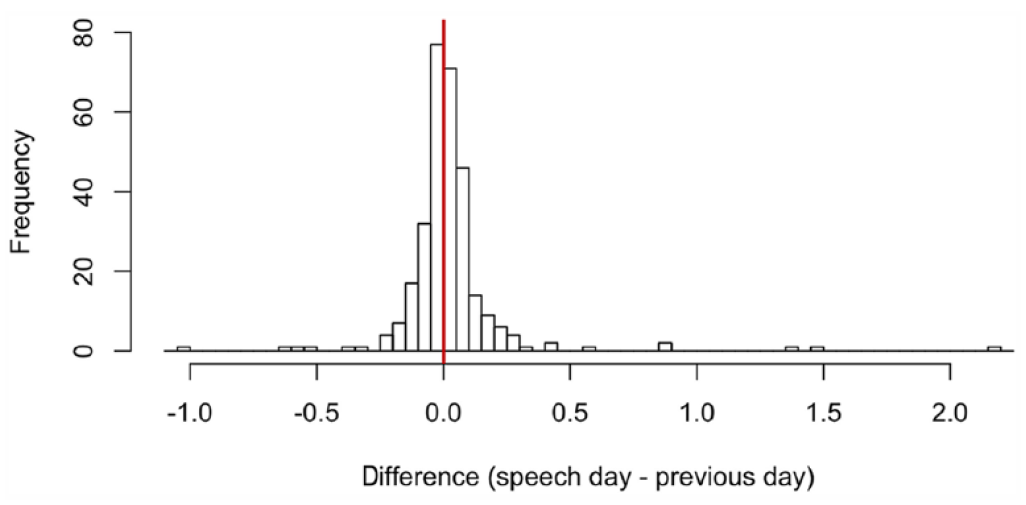
Change in tweets before and after the start of a speech cycle.
Relative Increases
As opposed to looking at differences in absolute scaled counts, we can instead look at differences in relative percentage increases or decreases. That is to say, we can ask what percentage increase over the previous day (or days) was observed. We will start with a 3-day window (i.e., comparing the current day to the average of the three days prior). As mentioned earlier, we will compare the relative change on days prior to the start of a speech cycle (i.e., days when there was no speech) to the average relative change for the three consecutive days from the start of a speech cycle.
Using 2-sample t-tests (a form of regression where the independent variable is a dichotomous grouping variable), we find postspeech mean relative increases (
Another way to examine the relative increase at the start of the speech cycle is to assess if the increase in n-word tweets is greater than 0% (or equivalently, if the ratio to previous days is greater than 1). For the three consecutive days from the start of a speech cycle, there was a 4.68% increase in usage of the n-word in tweets (
An examination of the distribution of relative increase values on the speech cycle days in Figure 6 suggests the data are skewed (or if it is normally distributed, it has substantial outliers). Consequently, a log-transform of the ratios still produces a statistically significant result with

Speech cycle ratios (average first 3 days.)

Log-transformed speech cycle ratios (average first 3 days).
Other High-Profile Speakers
To assess if the relationship of President Obama’s speeches to n-word tweets is unique, we can examine if a similar relationship exists for other high-profile speakers. We will examine the same final models considered previously and apply them to the times that Michelle Obama and Trump gave high-profile speeches. We chose these two other speakers for important reasons. Like Barack Obama, they are high-profile political figures, but they also differ in important ways.
First, the single highest spike in n-word usage occurred when both Barack and Michelle Obama spoke, with Michelle launching her antiobesity campaign. We were interested in further exploring whether the digital rage we measure in response to President Obama’s speeches carried over to First Lady Michelle Obama’s speeches. Moya Bailey and Trudy (2018, p. 762) coined the term misogynoir to refer to the form of “anti-Black racist misogyny” that is unique to Black women, and we sought to explore whether misogynoir might explain this increase in n-word usage across more of Michelle Obama’s speeches.
Second, we include Trump’s speeches because he is a political figure who many believe benefits from and speaks to White Rage. For example, Trump’s political victory in 2016 was attributed to “Whitelash” by journalist Van Jones, a term used to refer to a pendulum swing away from the racial advancement represented by Barack Obama (Ryan, 2016). And when he was asked whether he condemned White supremacist groups, his message to “stand back and stand by” was interpreted by the Proud Boys, a prominent White supremacist group, to be a message of support (Frenkel & Karni, 2020). Given this connection to White Rage, from White supremacist activity to Whitelash support, we include Trump to explore whether there is a connection between speeches by a public figure who is widely believed to support White supremacy and increases in usage of the n-word online. Table 4 compares results for our three speakers.
Change in N-Word in Original Tweets Over 12 July 2009 to 23 January 2017 by Speaker.

Abs freq = absolute frequency of n-word tweets per 10,000 original tweets. bRel. inc. = relative increase during the speech cycle compared to previous 3 day moving average. cUnique speech cycles are speech cycles that do not overlap with other 3-day speech cycles. dPost % jump = percentage increase in the number of N-word tweets compared to previous 3-day moving average.
Michelle Obama’s Speeches
In the time frame under consideration (12 July 2009 to 7 October 2018), Michelle Obama gave a speech on 450 days, with the first on 24 July 2009, and the last on 2 February 2018. Within this, there were 345 speech cycles, and there were 262 singleton speech cycles (speech given on a day, but none the day before or the day after).
For Michelle Obama’s speeches, the mean
Trump’s Speeches
In the time frame under consideration (12 July 2009 to 7 October 2018), Trump gave a speech on 330 days, with the first on 24 July 2009, and the last on 2 February 2018. Within this, there were 203 speech cycles, and there were 138 singleton speech cycles (speech given on a day, but none the day before or the day after).
For Trump’s speeches, the mean
Discussion
How connected are online expressions of racism and racism in the real world? This has been difficult to measure given challenges in studying slurs in both experimental and naturalistic contexts (Spotorno & Bianchi, 2015). But some very public examples of racial violence have been linked to prior posting or participation in online forums where hate speech is the norm (Levenson et al., 2022). There is also evidence of the relationship between online and in-person expressions of racism that focuses on online messages from particular in-person communities, not social media more broadly (Coffey & Woolworth, 2004; Eschmann, 2020).
In this case study, we observe increases in usage of the United States’ most flagrant racial slur following Obama’s speeches: This is one example of digital rage. This work is an important first step to deepening our understanding of the association between race-related phenomena, including politics, sports, or other race-centered events that capture national, international, or media attention, and online expressions of racism and their effects on people of color and society. There are, however, some limitations to investigating the effects of a real-world phenomenon on aggregate data. Of course every use of the n-word on X is not connected to Barack Obama, and there are those who express their rage at Black advancement without using the n-word, or even not on X. How then do we make sense of our findings? What does it mean that in aggregate, uses of the n-word increase following Obama’s speeches?
As we demonstrate the correlation between the Obama speech and the use of the n-word on X, we should note that the use of the n-word need not be a direct response to Obama’s speech. Our findings suggest that Obama’s speeches have some sort of effect on the public, which increases the general use of the n-word on social media. It is possible, for example, being exposed to the speech induces racist attitudes among some people, who then are more likely to use the n-word in their daily conversation. Although we cannot empirically explain the mechanism underlying the correlation in this article, the correlation itself is significant. Methodologically, research focused on correlation is common, and there is certainly a precedent for aggregate data being used to predict seemingly unconnected events. Some examples include Google searches for the n-word by county being used to predict voting patterns, or media agenda-setting research examining the correlation between media coverage and X discussion of the same topic (Neuman et al., 2014; Stephens-Davidowitz, 2017; Vargo et al., 2014; Zhang et al., 2022). In agenda-setting studies, X discussions are not necessarily responding to a specific news article, but the media coverage has some agenda-setting impact on the public, who might think a certain issue is important and therefore tend to talk about the topic more often on social media. Although research of this kind cannot prove causality, it does have more external validity than experimental research.
Our findings that Obama speaking correlates with the total number of tweets containing the n-word on X, across time and at scale, elucidates the ways real-world events are reflected in seemingly unconnected trends on social media. This study advances big data practices by incorporating numerous computational components to a social media dataset of groundbreaking proportions. In doing so, this study actively models the production of the dataset as a socially constructed artifact of this topic across time to better understand trends in public opinion and expressions of sentiment by a combination of human and algorithmic agents.
These exploratory findings should be seen as a launching pad for future studies, both quantitative and qualitative. Can machine learning algorithms be used to predict real-world events based on X data? Are there other types of real-world events besides Obama’s speeches—like protests, movie releases, or judicial confirmations—that also spark digital rage? Beyond the n-word, what are other ways and search terms that can be used to measure digital rage? Can machine learning algorithms and big data analysis be used to predict when digital rage might turn into physical rage, whether through organized events like the Capital riots, or through lone wolf attacks? Is there a way to do this work without contributing to the culture of hyper-surveillance, which already targets and over-polices communities of color (Browne, 2015)?
This study also engenders more qualitative research questions. Exposure to online racism can have negative effects on mental health (Tynes et al., 2008). Interpretive work exploring the experiences of everyday people with digital rage will elucidate our understanding of the social dangers of this phenomena. Do X users of color perceive increased overt racism—digital rage—following high-profile, racialized events? How might we measure qualitative differences in expressions of racism and digital rage?
The use of the n-word is associated with the representation of Blacks (i.e., President Barack Obama) breaking through traditional racial barriers, encapsulated by the act of Obama making speeches as the most powerful man in the world. While Trump has also been a lightning rod for racism—think of his dog whistle (or, fog horn) approach to thinly veiled racism—his speeches were not associated with increased usage of the n-word on X. This could be because Trump does not represent a threat to Whiteness, or White supremacy, which lessens the need for racists to use the n-word as a way of reclaiming their racial power.
Similarly, while the single largest spike in the usage of the n-word usage took place the day after both Barack and Michelle Obama gave a speech, Michelle Obama’s speeches alone were not associated with increases in usage of the n-word. We were surprised by this finding, given what is known from the literature on intersectionality, and the ways multiple forms of oppression can have additive effects on individuals with multiple marginalized identities, including Black women in particular (Bailey & Trudy, 2018; Brown et al., 2017; Crenshaw, 1990; Gray, 2020; Jackson et al., 2020; Noble & Tynes, 2016). Mrs. Obama has certainly received widely publicized race-gendered attacks online that took particularly racist assaults against her femininity.
We have a number of hypotheses for this particular finding. First, co-appearances of the President and First Lady may have drawn larger X traffic and are more likely to happen at campaign milestones and official ceremonies that visually re-confirm the authority of President and Mrs. Obama. Thus, an explanation of why n-word use tracks with presidential appearances versus First Lady appearances may be attributed to the media attention and post-appearance punditry allotted to presidential appearances. Second, the n-word spikes during a Michelle and Barack Obama appearance in particular due to hostility toward not only Black individuals but also Black families or groups breaking through racial barriers. Further research can help shed light on online racism in response to individuals vs. groups and whether expressions of racism diverge between them. Finally, the spikes in n-word usage may be larger following Barack Obama’s speeches than Michelle Obama’s speeches simply because Barack was President. After all, everything the president publicly says or does is, by definition, news, though this status does not follow other members of the First Family. Moreover, this symbol of power, authority, and advancement is exactly what precedes White Rage and what we predicted would precede digital rage.
Feminist sociologies of race maintain that white perceptions of racialized subjects as “threats” always map gendered beliefs about what threats racialized people impose. Selod (2018) notes that white surveillance of racialized Muslims consistently perceived Hijabi women as cultural threats to Western norms and Muslim men as physical threats to public safety. Grundy (2017) notes similarly that white online attacks on Black academics exacerbate gender to claim the particular “threat” of Black women academics in likening them to the intimate (and therefore threatening) influence over White youth that created the White historical hysteria over Black women domestics. However, this question of “why the couple and not the individuals” increased n-word usage deserves an in-depth data analysis that controls other possible variables, something we are unable to do here, but invite future studies to undertake.
Our analyses here provide insights into not only the pulse of “real-world” public opinion but also the incubation spaces of social media where opinions are formed and contribute to the literature methodologically by linking political speeches and social media responses based on large-scale data analysis. Our data collection tool gathered the numbers of relevant tweets via the full X firehose, which is more advantageous than studies that use X’s public API, which only generates an approximately 1% nonrandom sample of all of the tweets at the time (Morstatter et al., 2013). The results of this study provide a holistic view of racist responses—potentially to an event symbolizing Black advancement—on the Twittersphere and shed light on how it may react to certain high-profile political activities or events. While the current study was limited to using t-tests, we suggest future studies might use more complex models to track the effects of multiple types of events on digital rage.
The digital rage concept is a measurable response to symbols of Black advancement. This phenomenon suggests that online hate is not insulated or distinct from real-world hate. Often, online racism can seem like the work of trolls or provocateurs and be subsequently rationalized as coming from outliers rather than respectable citizens or participants in democracy. For example, some college students do not code online racism as racism simply because it occurs online (Ortiz, 2020). This may reflect what Jurgensen (2011) has called the digital dualism fallacy, which refers to the way people tend to think of online and offline phenomena as belonging to distinct and separate realities. In opposition to this notion, Jurgensen (2011) uses the term augmented reality to describe the way the physical and digital worlds have become so enmeshed that many people live their lives in a technological/physical hybrid reality. Our findings further our understanding of the augmented reality of racism and suggest that we ought to take online racism and expressions of rage seriously, as digital rage may function as a gauge with which we can measure how people react to the proliferation of symbols of Black advancement.
Furthermore, we chose the n-word because it represents the mother of all racial epithets, but surely this is not the only potential gauge of digital rage. Future studies should further investigate the nature of the relation between offline White Rage and digital rage and the connection between online hate, hostility, and uncivil language and real-world events and outcomes more broadly. Beyond political speeches, there are a host of other Black-centered or race-related phenomena, both within the realm of politics and in sports, entertainment, and popular culture, that may drive digital rage. Is overt racism on the internet simply mirroring offline racism or is it also driving more overt racism in the real world? This question is especially important given what we know about the online disinhibition effect. Digital rage may not only act as a gauge of in-person racism, but also act as a mechanism that normalizes increasingly overt offline White Rage. Emerging research on self-described “involuntary celibate” (incel) communities online points to a similar phenomenon, whereby online violent rhetoric and ideas moves off the screen and into the streets (Regehr, 2022).
Our findings also have a number of practical implications. First, various actors such as workplace executives, educators, content developers, and social media companies can be informed by this research. Digital rage can be mapped as a response to real-world events and concerns regarding race and Black advancement, which should be taken into consideration when debating and generating policies and practices that effectively respond to and curb the proliferation of harmful, racist content. Furthermore, these findings can better inform activists and organizers working to counter racism within their communities, schools, and workplaces. While responding to or combatting online racism can seem like a waste of time for some, research has found that responding to biased messages can be effective in helping other social media users change their minds or make concessions (Eschmann et al., 2021). The potential connection between real-world events and digital rage may further encourage organizers of online antiracism projects who aim to change the tide of public discourse both online and offline.
The Capital riots of 6 January 2021 were an example of White Rage taken to the extreme and were not only influenced by messages on X from some conservative politicians, including former President Trump, but were also planned using social media and online forums. While some participants in the riots have been charged, on the whole, it appears as if the political leaders who were connected to the events have escaped without much accountability.
White Rage against Black advancement—or demands for Black Lives to matter—is extending beyond the color-blind policies, laws, and practices that have been the dominant form of racism in the post-Civil Rights Movement era, and images of violent White Rage are being widely shared and circulated. The sociopolitical events we are contending with, and the public’s reaction to them, all point to the need for investigating how racial movements and violent responses to them influence—and are influenced by—online racial and racist discourse. This is especially pertinent as social media’s influence continues to grow, and White nationalist activities spill from the Net to the streets—or the United States Capitol Building.
Footnotes
Declaration of Conflicting Interests
The author(s) declared no potential conflicts of interest with respect to the research, authorship, and/or publication of this article.
Funding
The author(s) received no financial support for the research, authorship, and/or publication of this article.
