




Abstract
Twitter is increasingly being used within the sociopolitical domain as a channel through which to circulate information and opinions. Throughout the 2016 US Presidential primaries and general election campaign, a notable feature was the prolific Twitter use of Republican candidate and then nominee, Donald Trump. This use has continued since his election victory and inauguration as President. Trump’s use of Twitter has drawn criticism due to his rhetoric in relation to various issues, including Hillary Clinton, the size of the crowd in attendance at his inauguration, the policies of the former Obama administration, and immigration and foreign policy. One of the most notable features of Trump’s Twitter use has been his repeated ridicule of the mainstream media through pejorative labels such as “fake news” and “fake media.” These labels have been deployed in an attempt to deter the public from trusting media reports, many of which are critical of Trump’s presidency, and to position himself as the only reliable source of truth. However, given the contestable nature of objective truth, it can be argued that Trump himself is a serial offender in the propagation of mis- and disinformation in the same vein that he accuses the media. This article adopts a corpus analysis of Trump’s Twitter discourse to highlight his accusations of fake news and how he operates as a serial spreader of mis- and disinformation. Our data show that Trump uses these accusations to demonstrate allegiance and as a cover for his own spreading of mis- and disinformation that is framed as truth.
Preamble
Twitter is what is commonly described as a “microblogging” social media application. Users can post comments, thoughts, or opinions on various topics as well as share visual media. Bruns (2012) has further highlighted how Twitter incorporates the use of hashtags as a means of structuring the broad range of debates. Speaking to its societal function, Twitter can be understood as “an awareness system that allows for an immediate, fast, and widespread dissemination of information” (Maireder & Ausserhofer, 2012, p. 306), one which “contributes to a broadening of public debate” (Larsson & Moe, 2011, p. 741) on various issues.
In relation to political communication, Twitter is increasingly being used within the sociopolitical domain as a channel through which to circulate information during political campaigns and as a gauge of public opinion (Chadwick, 2013; Conway, Kenski, & Wang, 2015; Gil de Zúñiga, Jong, & Valenzuela, 2012; Small, 2011). From the perspective of political campaigning, Twitter enables a more empowered form of communication. Jensen (2017) outlines three main ways that this empowerment occurs. First, through Twitter and other social media platforms, it has become possible to engage more easily in dialogue with a wider and more diverse audience than might otherwise have been possible. Second, posts or comments produced can be retransmitted in the form of “retweets” (or “shares” on Facebook—other platforms have similar facilities). Finally, campaign staffers or other officials may utilize social media to encourage supporters and followers to devise ways to contribute to the campaign in their own time and on their own terms, without having to “employ” or “manage” them. In addition, one particular area that Twitter has been heavily used in the campaign and election context is as a means of “live-streaming” political events. For example, during televised political debates, a Twitter stream is often used to display the various perspectives and interpretations of the debate that are held by viewers (Yardi & Boyd, 2010). Hawthorne, Brian Houston, and McKinney (2013, p. 553) elaborate on this and state that “Twitter allows for users to annotate an event in real time and share those messages and others,” arguing that this enables the public to bypass traditional media-created frames and to create their own instead.
Throughout the most recent US Presidential election in 2016, Twitter was used prolifically by both the Hillary Clinton and Donald Trump campaigns, but Trump’s use was seen as particularly unorthodox in the context of a political campaign due to the fact that his tweets came directly from him, unmediated by advisers and other campaign staff (Enli, 2017). The non-traditional approach to the use of Twitter adopted by Trump, a reality TV personality and businessman, has continued since his election victory and inauguration as President in January 2017. This has resulted in widespread debate about the content, appropriateness, and motives of his tweets. In addition to being ridiculed due to his poor spelling, he has also drawn criticism concerning his rhetoric in relation to various issues, including Hillary Clinton, the attendance figures at his inauguration, the policies of the former Obama administration, and the state of US immigration and foreign policy.
One of the most consistently noted themes of Trump’s tweeting habits refers to his persistent attacks on the institutionalized mainstream media and the use of pejorative labels such as “fake news” and “fake media” as well as other adjectives expressing untruthfulness, deployed as an attempt to deter the public from trusting media reports, especially those critical of his presidency, and in turn to position himself as the only reliable source of truthful information. Writing in the New York Times, one of the institutions targeted by Trump, Krugman (2016) frames Trump’s online behavior as the “big liar technique” wherein the factual truthfulness of many of Trump’s claims has become increasingly irrelevant in dictating their effectiveness as discourse (p. 9). This description aligns with what cognitive linguist George Lakoff (2017) labels as a strategy of “deflection,” used within a broader taxonomy proposed to better understand Trump’s behavior on Twitter. With a focus on President Trump’s social media behavior and through a corpus analysis of his Twitter discourse, this article isolates those tweets in which he directly addresses the notion of fake news (inclusive of other related terms such as “fake media,” and “dishonest media”) to demonstrate how his rhetoric aligns within the deflection strategy described in Lakoff’s taxonomy. Furthermore, other tweets addressing Trump’s concerns about the apparent “dishonest” and “unfair” institutionalized mainstream media are discursively analyzed to further demonstrate how Trump can actually be cast as a serial distributor of mis- and disinformation when his own agenda and goals are best served by doing so.
The Evolution of “Fake News”
Alongside terms such as “post-truth” 1 and “alternative facts,” 2 the term “fake news” rose to prominence during 2016, fueled in no small part by Trump’s election campaign. Traditionally, prior to the 2016 election, the term fake news has been attached to a comedic element in political affairs through the use of satire as political commentary (Marchi, 2012). Here, the news is parodied through a medium of performance “while simultaneously presenting and criticizing it” (Borden & Tew, 2007, p. 306). Examples of the types of televised media programs associated with this conceptualization of fake news include Jon Stewart’s The Daily Show and Stephen Colbert’s The Colbert Report (both now defunct). An important observation to make regarding this understanding of fake news has been made by Baym (2005) who notes that “fake news necessitates assumptions about some kind of authentic or legitimate set of news practices, ideals that one rarely hears articulated” (p. 261). This observation is particularly relevant as it remains appropriate even in relation to the more contemporary use of the term which, through its rapid proliferation and the increased severity of the consequences of its use, is now devoid of the comedic or satirical component.
Indeed, the current propagation of the term fake news is no longer related as much to a comedic, satirical engagement with current political affairs, but can be defined as news that is “either wholly false or containing deliberately misleading elements incorporated within its content or context” (Bakir & McStay, 2017, p. 1). The authors point out that both misinformation and disinformation (previously termed as propaganda) are now part of the current digital media environment, where misinformation refers to the inadvertent sharing of false information online, and disinformation is the more malicious purposeful creation and dissemination of information that is known to be untrue. It could, though, be argued that this definition has neglected an important third dimension, that being instances when one deliberately shares information without knowing with certainty that the information is truthful, even if believing it to be so.
Mihailidis and Viotty (2017) have pointed out the degree to which the perceived credibility of the media in general has been negatively impacted by the rise of the fake news phenomenon. The rise of fake news can be attributed to the relative ease with which “content can be relayed among users with no significant third party filtering, fact-checking, or editorial judgement” (Allcott & Gentzkow, 2017, p. 211), to the extent that an individual with an online profile but no media-related reputation can accrue as many readers or followers as major news networks such as CNN or Fox News. This speaks to both the changing nature of the news information landscape in terms of fragmentation and decentralization, processes which have been expedited by the technological and cultural influence of global social media platforms. Not only is it extremely simple for users to share information through social media channels, but Silverman (2016) reports that during the US election campaign, the most popular institutionalized mainstream news reports were shared on Facebook less than other fake news stories. Furthermore, and significantly, the majority of individuals who view or read fake news stories on their social media platforms actually believed them to be accurate representations of truth as it is. In other words, it appears that the degree to which a news narrative is able to align with an individual’s perception of the world irrespective of factual accuracy, truthfulness, and objective reality is what matters most in affirming beliefs.
The Current Study
During the 2012 US Presidential election contest, the Obama campaign demonstrated for the first time the power of Twitter for the purpose of engaging citizens in the political process. While Twitter and its use in political campaigns and in relation to other political events have been a topic of interest to researchers for some time now, the manner in which President Trump uses Twitter has not been encountered before. Nor, for that matter, has quite as much emphasis been placed on the Twitter use of a major world leader. Recently, Enli (2017) mapped the features that differentiated the Twitter use of Trump from that of Hillary Clinton during the 2016 campaign. Central to these differences was the contrasting approach to professionalism (Clinton) as opposed to amateurism (Trump). While these notions are subjective and not the most influential in attracting voters and support, the author states that during the 2016 US election, the use of social media from the Clinton campaign “confirms theories regarding the professionalization of election campaigns in Western liberal democracies” (p. 54), whereas the Trump campaign’s social media was considered “more amateurish yet authentic” (p. 54). The reason for this was not, according to Enli (2017), due to lack of awareness of media processes or of a strategic campaign plan, but rather that Trump knew how to achieve and maintain media coverage through his “gut-feeling tweeting” (p. 55). In addition to this “amateurish” approach, Ott (2017) highlights an incivility that is commonplace in Twitter use and that has also been incorporated into Trump’s own tweets. Although one may have thought the prolific nature of Trump’s tweeting might have slowed after claiming victory and the Presidency, it has not, and the amateurish and uncivil style continues both in content and in affect. The following sections outline the analytical and methodological framework we adopted to analyze Trump’s tweets, which builds on the insights provided by Enli (2017) and Ott (2017) by showcasing how the tenor they highlight manifests categorically and also helps to better understand the nuances associated with Trump’s Twitter behavior. This is followed by an analysis of his own accusations of fake news and how he matches these with his own dissemination of mis and disinformation.
Method
Analytical Framework
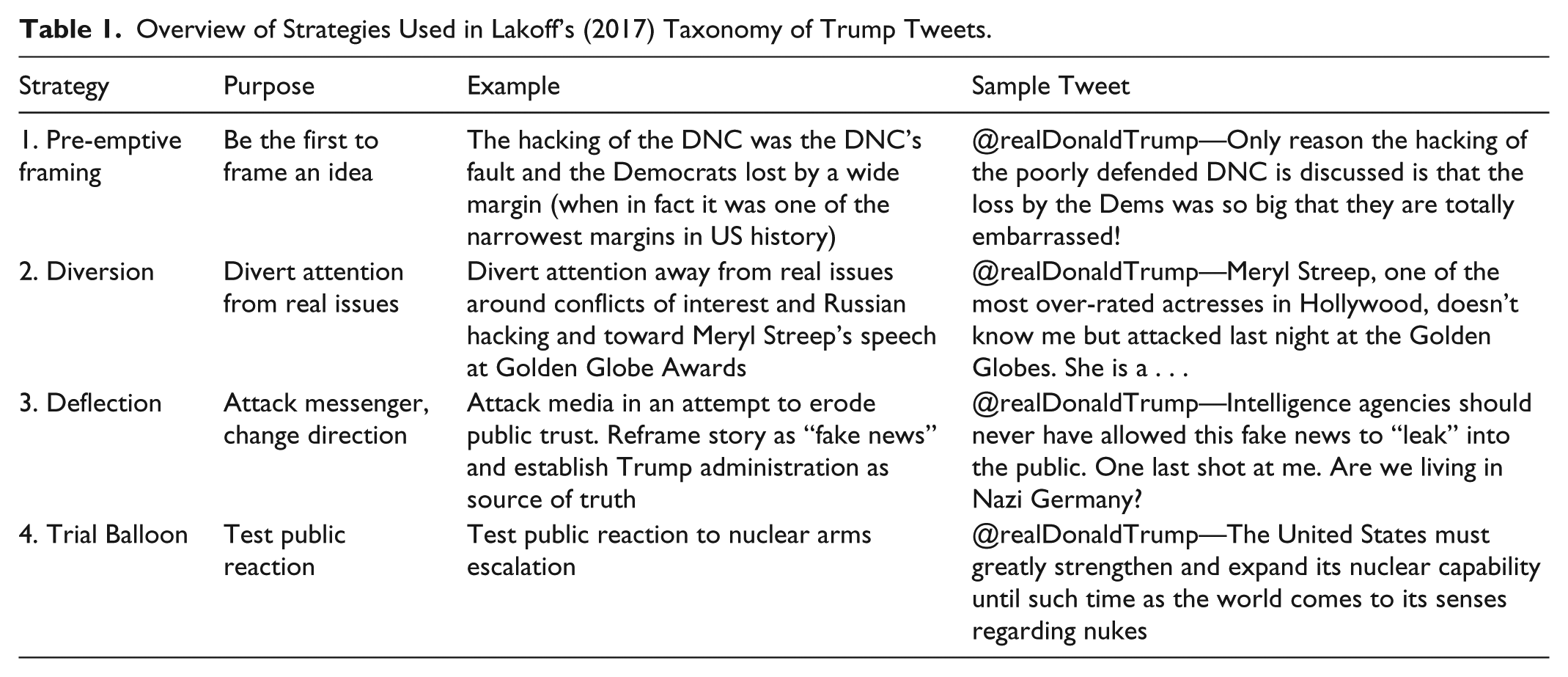
The analytical framework adopted in our study draws from the work of cognitive linguist George Lakoff. In a conversation broadcast on the radio program “On the Media,” Lakoff (2017) proposed a taxonomy to better understand Trump’s Twitter behaviors. Within this taxonomy, Trump’s tweets are divided into four discrete strategies: “pre-emptive framing,” “diversion,” “deflection,” and “trial balloon.” These strategies are described with practical examples and supporting tweets in Table 1.
Overview of Strategies Used in Lakoff’s (2017) Taxonomy of Trump Tweets.
For the purpose of our study, we conducted a corpus analysis to determine the most frequently used words and word clusters in Trump’s tweets in comparison with typical twitter use by politicians in order to see how they aligned with Lakoff’s strategies.
Data Collection and Analysis
The data for our study consist of a corpus of Trump’s tweets posted between 9 November 2016 immediately following the announcement of his victory in the Presidential election and 7 August 2017 (thus, all tweets were limited to 140 characters and not the current 280-character limit). We utilized the Twitter data collection and analysis software tool FireAnt (Anthony & Hardaker, 2017) to collect the data. A feature of this software is the ability to collect the tweet history of any particular user up to a maximum of 3,000 tweets. As Trump’s total number of original tweets was not in excess of this number within the time period specified, we were able to capture the entirety of his tweet history for the period. At the completion of the data collection process, we had compiled 1,416 original tweets (i.e., not inclusive of retweets), which constituted a research corpus of 30,928 words.
The most traditional type of corpus analysis is known as a keyword analysis where the research corpus (i.e., the collection of Trump’s tweets) is compared to “a large ‘reference’ corpus that is intended to be representative of language use in general” such as the British National Corpus (Branum & Charteris-Black, 2015, p. 202). However, the technique used in this study is known as a comparative keyword analysis, which compares a more specific “discourse reference corpus” with the research corpus to see how language is used within similar contexts; thus, it represents a more acute methodology than the traditional keyword analysis. To develop our discourse reference corpus, we needed to focus only on a data source that displayed language use that shares a particular purpose or context with the research corpus. In this case, as political rhetoric on Twitter is the focus of the study and politician tweets (i.e., Trump) form the research corpus, the discourse reference corpus was built using only language from original politician tweets (not including retweets)—the actual politicians included all current US state governors, all current members of the US Senate, and members of Congress. Only tweets from US politicians were included in the discourse reference corpus to ensure that the context from which they emerged was the same and that the same variety of English was used (US English). The final discourse reference corpus—from here referred to as the Political Twitter Discourse Corpus 3 (PTDC)—consists of 205,303 original tweets, and 4,659,381 words. Details of the corpora are displayed in Table 2.
Details of the Research Corpus and Discourse Reference Corpus (PTDC).

PTDC: Political Twitter Discourse Corpus.
Once the Twitter data had been collected and the PTDC had been built, we loaded our research corpus data into another corpus analysis software application—AntConc (Anthony, 2016). It was this software that enabled us to conduct the comparative keyword analysis. This process generated a keyword list. Within corpus-based studies, keywords are defined as those that occur “with unusual frequency in a given text” (Scott, 1997, p. 236). This does not necessarily equate to high frequency—the emphasis is on unusual frequency when compared to a reference corpus. Once the keyword list has been generated, the resulting words can be used as the foundation of a qualitative investigation (Charteris-Black, 2014). The purpose of determining the keyword list was to answer the following initial research question:
RQ1. How do the results of the comparative keyword analysis of Trump’s tweets align with Lakoff’s strategies?
After generating our keyword list, all of the words were examined and function words such as “very,” “the,” and “and” were removed. The content words were then examined to help identify features of the rhetorical language used in the tweets. Keyword lists are typically presented in an order determined by their “keyness,” which is a statistic determined by the use of a chi-square test (calculated automatically by the software) that highlights statistically significant frequency differences between the research corpus and the reference corpus (Branum & Charteris-Black, 2015). The top 25 results of the comparative keyword analysis are presented in Table 3.
Results of the Comparative Keyword Analysis.

Statistical significance is determined by chi-square and is termed “keyness” in corpus studies.
What this demonstrated was a high frequency of words used in relation to Lakoff’s strategy of deflection. For example, when expanded into clusters 4 and the entire tweet, words such as “fake,” “media,” “news,” “phony,” and “dishonest,” which all featured in the top 20 words of the keyword list, were almost completely used in reference to the media and his claim that the mainstream media were disseminators of fake news. Another tool of great use, and perhaps that helped most in understanding the context of each of Trump’s tweets, was the concordance tool. The concordance tool presents the data within a keyword in context (KWIC) display that highlights the word within its original context. This is helpful in allowing the surrounding context to be considered when analyzing the tweets and not relying merely on the frequency with which a word appears. An example of the KWIC display can be seen in Figure 1 focusing on the cluster of “fake media.”

Example of the AntConc KWIC display for the cluster “fake media.”
While the use of other words in the list could be linked in some instances to the other three of Lakoff’s strategies, this was not so in the majority of cases. In other words, while there are certainly tweets that support these strategies, they were not as obvious through the corpus analysis and related concordance and cluster analysis due to their much lower frequency. Thus, it can be said that in relation to RQ1, the comparative keyword analysis reveals that Trump’s tweets align most with the strategy of deflection. It should be noted here that once the keyword list is produced, the statistical focus discontinues apart from the order of the words, and the words are taken as “the basis of a qualitative investigation” (Charteris-Black, 2014, p. 541).
Thus, based on the results of the comparative keyword analysis, the language used in Trump’s tweets is linked most frequently to the strategy of deflection (attacking the media to establish himself as the source of truth), and this confirmed our own specific focus for the study. From this point, we therefore base our analysis and discussion on this strategy and analyze it further in relation to Trump’s ongoing accusations of the mainstream media as being disseminators of fake news, which have continued just as prolifically since Lakoff’s taxonomy was proposed and which clearly align with the description of this strategy as a means of attacking the media in an attempt to erode public trust. From this point onward, to guide our analysis and discussion of the tweets of Donald Trump that are aligned with the strategy of deflection and his use of accusation, we advance the following second research question:
RQ2. In what ways does Trump incorporate accusation into his tweets of “deflection”?
In the following sections, based on the results of the comparative keyword analysis, a discussion in relation to Trump’s accusations of fake news and his diffusion of mis- and disinformation fake news through his own claims and accusations is presented.
Analysis and Discussion
The keyword list provided the platform for our qualitative analysis of Trump’s tweets and confirmed that his tweets reflected strongly Lakoff’s strategy of deflection. Following Branum and Charteris-Black’s (2015) approach, from this point onward we selected the keywords that were most likely to provide a response to RQ2 for closer analysis. Although statistical significance and overall frequency are useful indicators of the value of a keyword, we also needed to look beyond this to less frequently occurring words which can also have the potential to support or confirm aspects of the rhetoric employed by Trump in his tweets. The following sections present several qualitative examples of Trump’s tweets and demonstrate how they align with the deflection strategy of Lakoff’s (2017) taxonomy and, further, suggest a possible expansion of this category through their utilization of accusation.
Accusation of “Fake News” Propagation as an Extension of Lakoff’s “Deflection” Strategy
The most significant revelation deriving from the comparative keyword analysis was the overall frequency of Trump’s tweets relating to fake news that were directed toward various mainstream media outlets and institutional networks. This was further confirmed by the fact that the most statistically significant keyword was, in fact, “fake” (keyness = 843.989). This word was then analyzed in relation to the various clusters it appeared within. It was found that of the 103 times Trump used the word “fake” in his tweets, on 86 occasions it was followed by “news” (keyness = 165.770) and 11 times by “media” (keyness = 328.040). Beyond these keywords, “failing” (keyness = 140.738), “nytimes” (keyness = 161.671), “phony” (keyness = 135.272), and “dishonest” (keyness = 104,237) were other keywords with high keyness values that were used as a means of making accusations of fake news—these made up 7 of the top 25 words. However, given that it is not enough to rely on the keyword analysis, it is also necessary to examine the broader context within which these labels were used and the accusations were made.
It is here that it becomes possible to realize that although all tweets represented an act of “attacking the messenger” as described by Lakoff in his deflection strategy, they were not all made in the form of an accusation. For instance, a tweet posted on 3 July 2017 read, “Dow hit a new intraday all-time high! I wonder whether or not the Fake News Media will so report?” This tweet is suggestive of Trump’s doubt that the media will in fact report this “news” that views him favorably, but does not literally make an accusation. However, accusation did feature in many tweets such as in a tweet from 25 February 2017 which read “FAKE NEWS media knowingly doesn’t tell the truth. A great danger to our country. The failing @nytimes has become a joke. Likewise @CNN. Sad!” In this case, there is a direct accusation leveled toward the mainstream media in relation to them lying and, as a consequence of this dishonesty, they are configured to represent a threat to the United States.
This led us to look upon the results of the comparative keyword analysis and differentiate between those tweets within the deflection strategy that demonstrated an act of accusation. The keywords most linked with the fake news aspect of Lakoff’s deflection were “fake” (in all instances either alone or in combination with “news” and “media”), “dishonest,” “phony,” and “failing” (which appeared with “nytimes on all but three occasions”). We looked at all instances of these keywords, and then collaboratively sorted through them to identify which were leveling an accusation of any kind (typically requiring a direct target and actually stating that the mainstream media—as target—were doing something or guilty of something). The results of this analysis are presented in Table 4.
Keywords From the Comparative Keyword Analysis Directly Linked to Lakoff’s Deflection and Representative of Trump’s Use of Accusation.

All words were from the top 20 in the results of the comparative keyword analysis.
From this point, under the umbrella of the broader deflection strategy whereby Trump attacks the mainstream media as a means of removing public trust in it and seeks to establish himself as the primary source of truth, we focus our analysis on the instances in which he utilizes accusation. We do this as a means of suggesting an extension of Lakoff’s original idea behind the deflection strategy which helps to emphasize the primary (but not the only) way that Trump deploys it in his tweets—to deliver an accusation. In relation to this focus, we categorized the rhetoric of his tweets into three main groups: direct accusation, accusation as signal of allegiance, and intra-tweet accusation of fake news and dissemination of mis- and disinformation. These categories assist us in discussing the effectiveness with which Trump has been able to do this.
Direct Accusation
The vast majority of Trump’s tweets utilizing the label “fake news” or similar terms or words, including “fake media,” “dishonest(y),” “phony,” “lies,” served to deliver a blatant accusation toward the mainstream media of not reporting the truth, much as Lakoff outlined in his strategy of deflection. This provides the initial part of the response to RQ2. Examples of these tweets can be seen in the following examples in Table 5:
Trump tweets representative of direct accusation of fake news.

Example 1 comes across as extremely negative. It is interesting to note that in this instance (and numerous others) Trump has capitalized “The Fake News Media,” which serves to acknowledge the label as an actual entity through presentation of it as a proper noun. Precisely how deliberate this is cannot be ascertained, but the fact that it appears on numerous occasions indicates that it was not an accidental or an unconscious act. The remainder of Example 1 shows negative terms, including “wrong,” “dirty,” “incorrect,” “phony,” “hate,” and “sad” (consisting of 31 of 113 characters). In combination, they create a harsh accusation against the media, and the tweet makes a more concerning accusation than just dishonesty in stating that there is an agenda driven by “hate.” The language used in the tweet is in line not only with Lakoff’s deflection strategy but also with Ott’s (2017, p. 62) belief that Twitter can be uncivil, where uncivil communication “refers to speech that is impolite, insulting, or otherwise offensive,” which readers, viewers, and employees of the mainstream media and also those who believe in the media as an institution would find it.
Similarly, Example 2 utilizes the same capitalization as Example 1 and reinforces the claim made in relation to media dishonesty. However, this tweet moves closer to Lakoff’s conceptualization of deflection wherein the media are accused of being fake news as a way of framing Trump as the primary—or even sole—source of truth as it is seen to be. Alongside accusing the media through the negative terms “demeaning” and “disparaging,” Trump’s claim is that the “real story” can only be attained from his Twitter feed. This is symmetrical with Lakoff’s deflection strategy and leaves the public in a degree of uncertainty in relation to exactly where it should go in the pursuit of truth.
Example 3 provides an instance—again, of which there are many more—where Trump appears to cast all political news polls into disrepute, that is, at least, if they reflect negatively on him. Trump goes as far as to name particular institutional news networks and newspaper publications in the tweet and directs his accusation of dishonesty toward them. It could be argued here that as a non-political elite, Trump is acting out his successful populist approach to politics in attacking the mainstream media elites such as the New York Times, CNN, and ABC, given that a core tenet of populism relates to “popular mobilization against the political and intellectual elites” (Canovan, 1999, p. 6). The important thing to note here is his assertion that only “negative” polls are indeed “fake,” which gives the impression that the label fake news is conditional, only applicable when there is negative news reported about him. While mainstream media are not known to be neutral in relation to political orientation, and certainly several mainstream news networks are underpinned by corporate funding from Democratic Party supporters, what would Trump’s reaction to these networks and publications be if they were to report positively on him? Would this immediately mean they are no longer “fake”? This question is addressed to a degree in the next section, but it is important to introduce it here as this is a common occurrence in Trump’s tweets.
In Example 4, it is claimed that “Fake News is at an all time high.” This statement in itself leads to some confusion, as Trump implies that there are previous records or levels of fake news to compare the current situation to. However, the term itself has only recently risen to prominence through his own use of it and, as mentioned in an earlier section, the term fake news was previously more associated with satirical presentations of the news on programs such as The Daily Show. Following this, Trump indicates that he is of the belief that he deserves an apology for “all the incorrect stories” about him. The content of this tweet can be likened to the final example in this section in Example 5. This is through his remark that the media use “phony unnamed sources,” but rarely in any of his tweets does Trump name where his information comes from or provide any details suggesting that he should be believed over the media sources he disparages; therefore, it is debatable as to whether or not he has effectively incorporated deflection as a strategy in these instances.
Accusations as a Signal of Allegiance
Within his deflective use of Twitter through accusations of fake news, on numerous occasions Trump also continued his attack on the mainstream media (in this case, CNN and the New York Times) at the same time as displaying allegiance to another mainstream media outlet (Fox News) which indicates the common understanding that mainstream media favor agendas drawn along, and consistent with, political party lines. With regard to RQ2, the accusations presented in Table 6 highlight the second way that accusation is incorporated into the tweets.
Trump Tweets Representative of Accusation of One Group to Signal Allegiance to Another.

What we can again see in all four of these examples is the prolific use of negative words, or at least words with a negative connotation in context, and these include “WAY OFF,” “disaster,” “crazy,” “conspiracy,” “blind hatred,” “Failing,” and of course “FAKE.” However, within tweets such as these, there is an overt signal of allegiance from Trump to Fox News, which is the only network he does not consider part of the mainstream media elite and that he excuses from his accusations of fake news. In Example 1, the tweet focuses on CNN conducting polls, and Trump uses this as an opportunity to remind the public of the inaccuracy of their pre-election poll which suggested he would lose emphatically. The final comment in the tweet can be interpreted as adding a final insult to CNN at the same time as offering support for his preferred network. This comment also seems out of place, as though it was a last minute thought at the end. It is actually very likely that was how the remark was added to the end and exemplifies the manner in which Trump uses Twitter that led Heffernan (2016, para 3) to state that in his use of the social media platform, Trump “makes himself heard in fragments, monosyllables and exclamation points, a proud male hysteric with the deafening staccato and hair-trigger immune system that Twitter exists to host.” This is interesting as the implication is that Trump’s rhetoric is actually perfectly matched to Twitter as a platform, but the debate continues about whether his use is actually becoming of a President.
Examples 2 and 3 take similar stances in their negative characterization of CNN and MSNBC, but reemphasize his support for Fox News. These tweets again show how Trump’s rhetoric can be aligned with Lakoff’s strategy of deflection by framing segments of the mainstream media as dishonest and untrustworthy, but framing Fox News as a news source of integrity and trustworthiness. Due to that network’s reciprocal support and favorable treatment of Trump, he is again indirectly framed as the only source of truth through the surrogate of Fox News. In Example 3, the final comment is also worth mentioning. Trump wrote “public is smart!” obviously referring to those viewers who actually did contribute to the Fox ratings. However, comments such as this do carry potential implications for Trump in that although it is true that Fox News did actually top the ratings at that time (Concha, 2017), several million other viewers did still watch CNN, ABC, NBC, and other “fake news” networks. Thus, the inference to be made is that the President considers all those viewers to be “not smart.” The potential ramifications would most likely relate to those individuals’ voting preference at the next election and would be almost impossible to measure, but the potential for Trump to have offended large numbers of the citizens he represents in this particular instance is significant.
Example 4 also presents an intriguing scenario in that the negative characterization of a particular newspaper—the New York Times—has been posted. Trump repeatedly refers to the newspaper as the “Failing” NY Times, and the news outlet is the recipient of the highest volume of Trump attacks. In fact, the AntConc cluster analysis tool revealed that Trump ridiculed the newspaper using this label in 33 separate tweets. The tweet presented in this example, however, is a rare instance of Trump suggesting that they have reported something worthwhile. Again, he signals his allegiance to Fox News by using a New York Times quote about Trump’s preferred program Fox & Friends being “the most powerful T.V. show in America.” When the origins of this quote are investigated, however, a significant degree of hypocrisy is uncovered. The actual full quote from Poniewozik’s (2017) article was “suddenly, for no other reason than its No. 1 fan, it is the most powerful TV show in America.” Thus, already it can be seen that Trump selected the part of the quote that said what he wanted it to say to present in his tweet, which saw the removal of important contextual elements. Furthermore, the broader context of the article focused on the flattery that both parties offer each other to serve their own interests, and the following excerpt is not particularly favorable toward Trump: President Trump is the show’s subject, its programmer, its publicist and its virtual fourth host. The stars offer him flattery, encouragement and advice. When he tweets, his words and image appear on a giant video wall. It’s the illusion of children’s TV—that your favorite show is as aware of you as you are of it—except that for Mr. Trump, it’s real. (Poniewozik, 2017, para 4)
Passages and assessments such as these are significant, considering that from Trump’s tweet there is no sense that this could be a passage from the same article. It might be said here that Trump is guilty of the same charges he has leveled continuously at the media himself—of selectively taking things out of context to fit his own agenda.
Accusation as a Cover for the Spreading of Mis- and Disinformation
In this section, a final category of rhetoric in the tweets of President Trump is presented. In a similar manner to the previous sections, Trump’s accusations of fake news are prominent; however, within the same tweet, he has also been the propagator of inaccurate and dishonest information in exactly the same manner through which he accuses the media. This, therefore, represents another manner that accusation is utilized in Trump’s tweets. The tweets to be discussed are shown in Table 7.
Trump Tweets Representative of Intra-Tweet Accusation and Dissemination of Fake News.

Attention should initially be paid to the actual fake news accusations, as it is these that continue to represent an extension of Lakoff’s broader deflection strategy. With regard to the first example, the tweet references a phone call from Australian Prime Minister Malcolm Turnbull at the beginning of his Presidency on 28 January 2016, the purpose of which was reported as being to offer congratulations and to show enthusiasm for continuing the relationship between Australia and the United States. Under the Obama administration, a deal had been struck for a relatively small number of refugees to be moved from Manus Island
5
to be resettled in the United States, and it was reported that this deal was also a focus of the conversation—for Turnbull to be assured the deal would be honored. Following the conversation, on 1 January 2017, Trump tweeted, Do you believe it? The Obama Administration agreed to take thousands of illegal immigrants from Australia. Why? I will study this dumb deal.
It is clear from the negative tone of the tweet that Trump was not in favor of the agreement, and this was echoed in other media appearances. Following the tweet, several news reports claimed that the telephone conversation had been heated, with Trump berating Turnbull about the deal and how it was not in the best interests of the United States or himself. Turnbull claimed the conversation was very civil and positive, and the tweet in Example 1 is Trump’s response. Thus, his accusation toward the media is that the claim that the conversation was less than civil is fake news and inaccurate, and his implied assertion is that Turnbull and he were therefore being truthful.
Examples 2 and 3 both focus on Trump’s proposed wall along the US–Mexico border, which was frequently a topic of the discourse surrounding Trump’s campaign and continues to be in his Presidency (see, for example, Ross & Rivers, 2017a, 2017b). Trump has always claimed that, whether before, during or after construction, the Mexican government would fund the wall, a claim that has been met with widespread skepticism and outright denial from Mexico. The accusations in these examples serve to reinforce his attack on the mainstream media elite and his assertion that they are dishonest in their reporting of the unlikelihood of Mexico funding the wall and, perhaps more importantly, help him to uphold his claim that the United States would not fund the wall.
Now that the accusations of fake news have been highlighted, it is necessary to unpack these tweets further to reveal how, within them, Trump is actually communicating and disseminating mis- and disinformation himself. These particular cases provide effective examples as, in an article in the Washington Post by Miller, Vitkoskaya, and Fischer-Baum (2017), the leaked transcripts of telephone conversations with both Australian Prime Minister Malcolm Turnbull and Mexican President Peña Nieto were published (and subsequently published in multiple other news publications around the world). The contents of the transcripts reveal that Trump’s accusations of fake news were false, meaning that through his tweets on these issues, he was himself propagating mis- and disinformation. This effectively inverts Lakoff’s deflection strategy to the effect that he is not to be trusted, but the media appear to be reporting what is true.
With regard to the conversation with Prime Minister Turnbull, Trump repeatedly expressed his dismay at the refugee agreement, usually in relation to how it would make him look weak at the beginning of his Presidency. He stated, 1. That is why they lost the election, because of stupid deals like this. You have brokered many a stupid deal in business and I respect you, but I guarantee that you broke many a stupid deal. This is a stupid deal. This deal will make me look terrible. 2. I have had it. I have been making these calls all day and this is the most unpleasant call all day. Putin was a pleasant call. This is ridiculous.
Remarks such as these demonstrate that he was not being truthful himself (nor was Prime Minister Turnbull) when describing the civility of their conversation. Thus, although attempting to adhere to Lakoff’s strategy and establishing himself as the source of truth, he has failed to do so through his own dishonesty, and his use of accusations toward the media has backfired. The leaked transcript of the conversation with President Nieto produced the same effect in that where publicly he appeared confident in his claim about Mexico funding the wall. The conversation with Nieto proved that this was not the case. Examples of the comments made by Trump in relation to the wall are as follows: 1. Trump: We cannot say that anymore [that each would not pay for the wall] because if you are going to say that Mexico is not going to pay for the wall, then I do not want to meet with you guys anymore because I cannot live with that. 2. Nieto: But my position has been and will continue to be very firm saying that Mexico cannot pay for that wall. 3. Trump: But you cannot say that to the press. The press is going to go with that and I cannot live with that. You cannot say that to the press because I cannot negotiate under those circumstances.
The effect of comments like these is that the fake news accusations are nullified and Trump is revealed as the untrustworthy party. More importantly, perhaps, is the fact that Trump appears to be actively encouraging, if not pleading with, President Nieto not to share the truth about his intentions not to fund the wall to the media. It must be said that it becomes extremely difficult for the media to report the truth—which Trump claims they do not—when he facilitates the withholding of the truth in relation to issues that would reflect badly on him. If the opposite situation were true and Nieto had agreed to pay for the wall, it is hard to imagine that outcome not reaching his Twitter feed in great haste.
To return to Lakoff’s deflection strategy, the corpus analysis and subsequent qualitative analysis and presentation of example tweets have achieved three key things. First, the comparative keyword analysis and then example tweets have indeed highlighted the fact that Trump consistently accuses the media of being dishonest and untrustworthy as a means of presenting himself as the source of truth. Second, Trump’s rhetoric was often shaped by his desire to be presented positively. Thus, at the same time as making accusations of fake news, he diverted attention to the sole news outlet he trusts—Fox News—which typically presents him in a positive light. Finally, within his tweets, Trump often ends up being the offender of disseminating fake news even when the focus of a particular tweet is to attack the media’s lack of honesty, as shown in the final examples.
Implications and Conclusion
The use of Twitter within the political domain continues to evolve, and the tweeting of President Donald Trump is representative of this evolution. To return to Enli’s (2017) study, Trump has introduced a new style of political tweeting with his, and his campaign’s, move away from professionalism toward amateurism and impulsive tweeting (Ott, 2017). Where the general public had arguably become accustomed to Twitter being used prolifically by political campaigns, they had also become accustomed to the tweets being carefully considered and posted by campaign teams and advisers. Enli and Naper (2016) point out that of all tweets from the Barack Obama Twitter account during the 2008 election campaign, only 1% were written by Obama himself. Thus, the move toward impulsivity and amateurism presents the public with a new type of message being delivered from someone in a position of power and being able to interpret that presents new challenges such as a large degree of uncertainty. However, it could be argued that the more hands-on approach adopted by President Trump is reflective of a populist President more in touch with the citizens under his command given that he speaks directly to them through social media rather than allowing faceless party assistants to relay information. As a non-elite politician, it would realistically be expected that Trump’s communication behaviors and the language used would stand in contrast to that of career politicians. In relation to this, Van Dijk, (1989) stated that within the domain of media practices typically operate around an overarching consensus and that “fundamental norms, values, and power arrangements are seldom explicitly challenged in the dominant news media” (p. 43)—as Trump so overtly challenges these power arrangements and the consensus around media engagement, the public too is being challenged to engage with and interpret this unfamiliar rhetoric.
This study builds on the work of Enli (2017) in relation to the amateurish approach, and Ott (2017) in relation to impulsivity and through the comparative keyword analysis confirms that Lakoff’s strategy of deflection is indeed the dominant strategy used in Trump’s tweets. With a focus on the use of the discursive act of accusation in his tweets, it can be argued that the public is faced with a significant challenge in interpreting, comprehending, and believing Trump’s tweets. In addition to deciphering political messages from a politician (Trump) operating in an unorthodox and non-traditional manner that are heavily influenced by the impulsive nature of his tweeting, the public must now also interpret the accusations made within the tweets toward the mainstream media with which they would likely interact on a daily basis on at least some level. To further complicate things for the public, Trump’s tweets have been shown to deliver accusations in different ways: directly, as a signal of allegiance, or as cover for his own spread of mis- and disinformation. Thus, Trump represents not only a new type of Twitter user but has also established the need for a new kind of Twitter literacy among users.
Following on from this, it can be argued that one of the most significant implications of the study is that although Trump’s tweets cannot be classified as fake news for the simple reason that he is an individual and not a media agency, his tweets do tend to carry the same ambiguous characteristics. For instance, when Trump accuses the media of reporting a false or inaccurate story, he labels it as fake news. However, when he tweets a claim or a statement that is highly contentious and attempts to present it as truth, he is doing that which he accuses the mainstream media of doing. In addition, the end result is the same in that if a media report is labeled as fake news, the reader can (1) believe it, (2) not believe it and disregard it, or (3) follow it up with further research to determine its truthfulness. Consumers of Trump tweets about himself and his administration are presented with the same scenario, and thus although we are not prepared to label Trump’s tweet as fake news explicitly as truth itself is a contestable fact, this correlation cannot be ignored. In fact, the rhetoric deployed by Trump in his tweets can be interpreted as being hypocritical, and potentially unsettling for the public, the political environment, and the collective media institution, which has become used to certain methods and modes of communication being used in the interface between politics and media.
To conclude, the frequency with which Trump accuses the media in various ways in his tweets and the overall tenor of his tweets in general require the viewer to begin to understand political Twitter in a new way. Perhaps Trump’s own accusations of fake news will ultimately undermine his own contentious messages as the public become more untrusting and engage more vigorously in fact-checking and follow-up research as opposed to relying on the words of a serving president or the words of mainstream media outlets who are hostile to the president and his public undermining of them. This being said, it might also be argued that for the public to more fully understand the impact of Twitter within the political domain and its associated possibilities, Donald Trump came along at just the right time to remap the news information landscape.
Footnotes
Declaration of Conflicting Interests
The author(s) declared no potential conflicts of interest with respect to the research, authorship, and/or publication of this article.
Funding
The author(s) received no financial support for the research, authorship, and/or publication of this article.
