




Abstract
Public health organizations are increasingly turning to social media as a channel for health campaign dissemination, as these platforms can provide access to “hidden” or at-risk audiences such as populations of color and youth. However, few studies systematically assess the effects of such campaigns in a competitive communication environment characterized by an influx of sophisticated tobacco product marketing. The objective of the current study is to investigate how content and source features of Twitter messages about truth® campaigns influence their popularity, support, and reach. Keyword rules were used to collect tweets related to each of the six campaigns from the Twitter Firehose posted between August 2014 and June 2016. Data were analyzed using a combination of supervised and unsupervised machine learning, keyword algorithms, and human coding. Tweets were categorized by source type (direct or truth®-owned social influencer; non-influencer). Tweet content was coded and classified for valence and campaign references (branded vs. non-branded or organic content). Message reach was calculated by source type and message type. Keyword filters captured 308,216 tweets posted by 225,912 Twitter users. Findings revealed that campaigns that utilized social influencers as message sources generated more campaign-branded and sharable content (e.g., campaign hashtags) and greater volume of tweets per day and reach per day. Influential users posted fewer organic messages and more branded/sharable content, generating greater reach compared to non-influencers. Oppositional messages decreased over time. Harnessing cultural elements endemic to social media, such as popular content creators (influencers) and messages (memes), is a promising strategy for improving health campaign interest and engagement.
Introduction
Social media has fundamentally revolutionized how individuals communicate about virtually every topic, including health, and how marketers reach their audiences to promote both healthy and unhealthy products and behaviors (Cappella et al., 2014; Kaplan, 2018; Knowledge@Wharton, 2017). In response to these changes, health organizations are increasingly turning to social media as a channel for health campaign dissemination. Health campaign awareness, recognition, reach, and engagement are known precursors to actual behavioral effectiveness of the intervention (Hair et al., 2017; Lelutiu-Weinberger et al., 2015). Social media popularity allows public health organizations to rapidly and inexpensively increase the visibility of their media campaigns and extend the reach of their traditional media messages. Social networking, micro-blogging, and image- and video-sharing platforms, like Twitter, Instagram, SnapChat, and YouTube, can also enhance the effectiveness of health promotion interventions by providing access to at-risk or “hidden” audiences, such as youth and populations of color, as use of these media by these groups is disproportionately high (Lenhart, 2015; Pew Research Center, 2016, 2018). In addition, data from these platforms offer visual and textual insights into audience opinions and behavior and can inform strategies to effectively disseminate campaigns for education and health promotion (Eichstaedt et al., 2015; Ireland et al., 2015). Thus, to understand campaign effectiveness among youth, young adults, and other vulnerable populations in the new media landscape, it is critically important to recognize the role of social media engagement in relation to campaign strategy and messaging (Hair et al., 2017; Vallone et al., 2016).
Furthermore, engagement with endemic cultural elements of social media platforms, such as influencer marketing and shareable content design, can greatly enhance campaign effectiveness (Ashley & Tuten, 2015; Vallone et al., 2016), but such engagement must also be carefully taken into account when evaluating effectiveness. Influencers are celebrity or “micro-celebrity” social media users who have a high number of followers—either in general or among a targeted sub-population (Carter, 2016). Shareable content includes photos (e.g., selfies), images (e.g., memes), videos, URLs/links, and numbers/statistics (Ashley & Tuten, 2015). Although early evidence suggests that influencer marketing and use of shareable content can enhance audience engagement and campaign reach (Coates et al., 2019; Gough et al., 2017; Suh et al., 2010; Vallone et al., 2016) and influencers often promote products that are harmful to health like tobacco (Kostygina et al., 2016; Richardson et al., 2014), the research on influencer marketing is scant and the mechanisms of these effects in health communication are largely unknown.
Influencer Effects
Influencer marketing offers tailored and targeted exposure to potential consumers who are susceptible to or already interested in a product category and will likely pay attention (Cohen, 2018; Kaplan, 2018; Knowledge@Wharton, 2017). There has been a substantial and multidisciplinary examination demonstrating that influencers are, indeed, influential. Influencer categories include opinion leaders, celebrities, and micro-celebrities who have large number of followers on social networking platforms (Carter, 2016). Micro-celebrity influencers or micro-influencers are social media users who have thousands of followers (for instance, between 5,000 and 10,000 or more followers—the number can vary by platform and over time) with a more localized or targeted appeal (e.g., local DJs, politicians) compared to celebrity influencers who have a higher number of followers and a more general appeal (Carter, 2016; Influencer Marketing Hub, 2019). Although celebrity influencers have greater reach compared to micro-influencers, advertisers often choose to recruit multiple micro-influencers to promote their brands, campaigns, or products rather than several celebrities as micro-influencers can have greater engagement rates per each post (like and comment rates; Influencer Marketing Hub, 2019). Advertisers may also choose influencers with large followings on specific social networking platforms that are popular among the target audience that the campaign is designed to reach. Likewise, although opinion leaders may have lower general appeal, name recognition, or reach compared to celebrity influencers, they usually have expertise or knowledge in a certain content domain that enhances their credibility among the target audience.
According to prior literature, predominantly focusing on the effect of broadcast and print media celebrity campaigns, celebrities can have a tremendous influence on individuals’ knowledge, attitudes, and decision-making behaviors, including those that affect health (Hoffman & Tan, 2013, 2015; Kata, 2012; Lee, 2013; Lum et al., 2008; Tanne, 2000; Viale, 2014). More generally, celebrity endorsements can enhance brand equity and the desirability of a product, leading consumers to more positively associate with, and easily recognize, brands (Kamins, 1989; Ohanian, 1990; Till & Shimp, 1998). Celebrities can catalyze herd behavior and help distinguish endorsed items from competitors (Bikhchandani et al., 1992; Spence, 1973); celebrity characteristics (credibility) can transfer to endorsed products and confer social capital (Hoffman & Tan, 2015; Ohanian, 1990). Through positive conditioning, consumers subconsciously follow celebrity advice to avoid cognitive dissonance (Simon et al., 1995). Indeed, emerging neuroscience research showed that brain regions involved in making positive associations are activated by seeing or hearing celebrity endorsements (Klucharev et al., 2008; Sung et al., 2018). Furthermore, the proliferation of mobile devices has, in effect, turned influencers into constant companions of the target audience (Knowledge@Wharton, 2017). Thus, the agentic, “on hand” nature of exposure to social media marketing compared with exposure to traditional media may be particularly influential. Although some studies show that the effect of celebrity campaigns is fairly similar to ordinary campaigns (Pringle & Binet, 2005), research on the celebrity influence on such vulnerable populations as youth demonstrates that campaigns utilizing celebrities (such as sports athletes) have a positive influence on adolescents’ favorable word-of-mouth, brand loyalty, and behavioral intentions (Bush et al., 2004; Coates et al., 2019). Spending on social media influencer marketing is rapidly increasing and social influencers are becoming a highly sought-after commodity for brand promotion and consumer engagement (Carter, 2016; Knowledge@Wharton, 2017; Launchmetrics, 2015). Prior studies predominantly assessed the impact of celebrity promotion through traditional media channels, and the consequences of influencer promotion in the digital media environment are understudied; it is therefore critical to analyze the impact of such campaigns on online media channels, which are particularly popular among youth (Lenhart, 2015).
Despite increasing recognition of the effects and impact of influencers, the definition of what constitutes an “influencer” on social media is as varied as the platforms and their audiences. These “influencers” generally have large social media followings and are assumed to be prominent voices that can reach large audiences. Despite recent evidence that Twitter users can “buy” followers (Confessore et al., 2018), social media influence is a valued commodity among marketers. In fact, there is currently a plethora of influencer marketplaces (e.g., Influencer.co, Famebit.com, Unityinfluence.com) that can enable marketers to find social media influencers whose followers are the target population for the brand (Knowledge@Wharton, 2017).
In the case of celebrity and micro-celebrity, the influence is evaluated primarily in relation to audience size and demographics; an alternative explanation for influence reflects users’ explicit affiliation with non-human entities such as brands and hashtags (Ashley & Tuten, 2015). Compared to its counterpart on traditional mass media, influencer marketing or endorsement on social media platforms has some unique characteristics. The endorsement information is often implied, rather than explicitly referenced, and the endorsers tend to use different tactics from those employed by advertisers on legacy media platforms, to maximize the impact on their followers. For example, “influencers” may use “native” advertisement strategies similar to product placement such as posting selfies featuring a product or using backdrop with product branding (Ashley & Tuten, 2015; Campbell et al., 2014). Prominent bloggers or micro-bloggers may cultivate followers (and endorsements) with product reviews featuring popular brands.
Effects of Sharable Content
In addition to the use of influencers, another promising strategy and audience engagement with the campaign is effective use of sharable content. On social media, the sharing of campaign-related content is analogous to earned campaign coverage in broadcast and mass media. In other words, re-posting or generating health campaign–related messages, videos, or links by non-campaign-related accounts on social media is analogous to unpaid health campaign coverage by local or national broadcast news media.
Sharable content includes entity and campaign brand names, photos (e.g., selfies), images (e.g., memes), videos, URLs/links, and numbers/statistics (Suh et al., 2010). Evidence suggests that the number of URLs and hashtags in a tweet are strongly correlated with its retweetability (Suh et al., 2010). Specifically, a recent study analyzing the content of over 2 million tweets found that photos were associated with 35% increase in retweets, videos averaged a 28% increase, and hashtag use resulted in a 17% bump in retweetability (Rogers, 2014). A meme is a piece of information (e.g., a joke, lyrics, or an image) that is reproduced, copied, or shared by media users or audiences and often represents popular culture or norms (Goffman & Newill, 1964; Lazer et al., 2009; Weng et al., 2014). Memes bear similarities to infectious diseases in terms of sharability and contagion, as both travel through social ties from one person to another, although social contagion has distinctive characteristics that are different from epidemic diseases (Christakis & Fowler, 2013; Weng et al., 2014).
truth® Campaign Background
One of the first national social marketing campaigns to incorporate innovative social media strategies like influencer marketing and shareable content is the truth® anti-tobacco campaign (Vallone et al., 2016). Since launching in 2000, the truth® campaign has grown both as a public health initiative to reduce and eventually eliminate tobacco use (K. C. Davis et al., 2009; Farrelly et al., 2005, 2009) and as a social marketing brand (Evans et al., 2018). Unlike health promotion and education campaigns in other domains, tobacco control interventions have to counter-inventive product marketing tactics employed by the industry, as well as active opposition to tobacco control efforts from the industry and its affiliates, for example, through such techniques as astroturfing (Feng et al., 2015; Jerry Zhang et al., 2013). Online astroturfing refers to coordinated campaigns where messages supporting a specific agenda—such as tobacco product de-regulation—are distributed through the Internet, for example, through the use of social media bots/robotic accounts, to create false impressions that a particular idea or opinion has widespread support. The original truth® campaign used a “counter-marketing” strategy (i.e., marketing in opposition to the tobacco industry to promote the outcome of avoiding use) and created a youth brand designed to represent an appealing alternative lifestyle to smoking, promoted the benefits of being tobacco-free, and employed branding to compete directly with tobacco products by exposing the lies and deception of the tobacco industry (Evans et al., 2018). Most recently, truth® has taken a full spectrum marketing approach to eliminate adolescent and young adult smoking (Evans et al., 2018), which incorporates social media, a popular youth platform or expression (Lenhart, 2015).
Thus, since 2014, over the course of 2 years, the truth® campaign produced multiple advertisement sub-campaigns that featured at least one element that could tie in to social media. The common thread of this new phase of the truth® campaign was the fact that these advertisements were aimed at empowering youth and young adults (the campaign target population) to make their generation the one that finally ended smoking. The first campaign was launched in August 2014 with the message “The tobacco epidemic isn’t over, but this generation can be the one to finish it” (Finishers 1.0). The initial launch of the Finishers 1.0 campaign was paired with the Unpaid Spokesperson advertisement, which leveraged images of celebrities like Lana Del Ray, Rihanna, Orlando Bloom, and Zayn Malik, knowing their fans would likely respond—both positively and negatively—on social media, thus bringing the subject of tobacco use back into the public discourse among youth and youth adults.
Next, the “Left Swipe Dat” campaign launched in January 2015 utilized endorsements in the advertisements from prominent social media content creators/personalities, including influencers such as Grace Helbig, Harley Morenstein, King Bach, Anna Akana, Jimmy Tatro, and Fifth Harmony.
The next phase of the campaign that started in August 2015 was the “Social Norms” campaign, which included “Finishers 2.0,” “It’s a Trap” advertisements featuring imagery from popular social media native content-online memes, and “Big Tobacco Be Like” ads. Similar to the “Left Swipe Dat” campaign, these ads engaged popular social media personalities and content creators to be the voice of truth® in the advertisements. The list of influencers featured in the “Big Tobacco Be Like” ads included Alli Cattt/Alli Fitz, Logan Paul, Cristian Delgrosso, and Jerry Purpdrank.
Finally, the “CATmageddon” campaign, launched simultaneously with Finishers 3.0 in February 2016, featured one of the Internet’s most enduring popular subjects (cats), many of whom were social media influencers in their own right. The goal was to capture viewer attention and, ideally, endorsement of the campaign message by sharing it on their own social media accounts.
In the competitive media environment saturated with tobacco promotion and tobacco control opposition messaging by the industry affiliates, it is critical to assess how novel digital media campaign-related strategies, such as use of influencers as message sources or message transmitters/disseminators, can affect the amount of support and opposition to campaign messaging, as well as the reach and visibility of the campaign. The objective of the current study was to investigate how key content and source features of Twitter messages about the truth® campaigns (“Finisher 1.0, 2.0. 3.0,” “Unpaid tobacco spokesperson,” “It’s a trap,” “Big Tobacco Be Like,” “Left Swipe Dat,” “CATmageddon”) influenced their popularity, support, and reach among social media users. It also aimed to characterize influencers’ posting activity with regard to sharing campaign-related messages. Specifically, the following research questions were posed:
RQ1: What was the total number of tweets posted over the course of the duration of each campaign by direct (truth®-owned), influential, and organic accounts?
RQ2: Among tweets posted about each campaign, what proportion of posts was branded/sharable, and supportive or oppositional, by message source type (direct, influential, and organic)?
RQ3: For each campaign, what was the reach of relevant messages by content type (branded, non-branded) and by source type (direct, influential, and organic)?
Methods
Data Collection
Twitter data related to each of the Truth Initiative media campaigns conducted between 2014 and 2016 were accessed through the Gnip PowerTrack for the historic Twitter Firehose using keyword filters. First, rules were generated through an iterative four-step process that began with a core set of truth® campaign search rules that could apply regardless of campaign details. These included specific references to the organization’s Twitter account and brand identity (i.e., “truthorange” or “thetruth.org”) and general references to tobacco-related ads on TV (i.e., “Tobacco . . . ad OR commercial OR PSA . . .”) (Supplemental Appendix A). Second, tailored rules referring to execution elements of each advertisement were also developed, focusing on celebrities featured in that execution, or the specific phrase or hashtag used by the campaign (i.e., “Zayn Malik” mentioned with tobacco, or leftswipedat). Third, rules were adapted to take into account additional terms identified in posts reflecting spontaneous audience reactions to the advertisements once they were aired (i.e., “tinder smoking” or “puking unicorn”). Finally, rules that achieved over 50% relevant content during testing were applied for the 1-week period prior to the launch of each campaign, and the entire campaign timeline. As some of the campaigns were launched simultaneously, data collection occurred over the course of four waves (“Finishers 1.0”/“Unpaid tobacco spokesperson” [Wave 1]; “Left Swipe Dat” [Wave 2]; “Social norms,” including “It’s a trap,” “Finishers 2.0,” and “Big Tobacco Be Like” [Wave 3]; and “CATmageddon/Finishers 3.0” [Wave 4]). The four waves of the campaign varied in length. Wave 1 of the campaign occurred over the course of 83 days, Wave 2 lasted 115 days, Wave 3 campaign period was 137 days, and Wave 4 lasted 170 days. The data were collected for the period that the campaigns were in the field. A complete list of 83 search rules used for the truth® campaigns, including the collection period and rule origin or type, is available in the Supplemental Appendix A.
Data Cleaning
Once the raw data were retrieved, non-relevant tweets were identified through a combination of human coding and supervised machine learning. Two coders first rated a random sample of 3,200 tweets (approximately 800 by campaign wave) as relevant and non-relevant. The two coders achieved high agreement (α = 0.92) on an overlap sample of 320 tweets. This human-coded sample was used to train the machine learning classifier to clean the data. Machine learning is a data-driven analytic approach in which computational systems develop algorithms based on a training set (a subset of the data) to determine prediction of outcomes in a separate test dataset (Murthy, 2012). The goal of supervised learning is generalization to unseen data (Domingos, 2012), that is, developing a model which allows to map unseen observations to one of the human labels (Russell & Norvig, 2003). If a model performs well in predicting outcomes for the test dataset, it may predict well for the rest of the database. Hence, this approach allows to reliably automate large data classification. Non-relevant tweets were removed and the remaining tweets formed our analytic sets. The machine classifier performance was further tested with additional human coding of 1,000 tweets, to confirm that the good classifier performance is not a coincidence due to the parameter set-up in the classifier training but a good fit of the whole population. Thus, to validate how clean the analytic sets were, we sampled 125 relevant tweets and 75 irrelevant tweets from each campaign, and human coders evaluated the tweets for relevance. We then used information retrieval metrics, that is, precision and recall, to evaluate the quality of the cleaned analytic set (Blei et al., 2003; Hastie, 2009; Kim et al., 2016; Murthy, 2012). As our analyses were based on Twitter data collected using the keyword filter from the entire population (census) of Twitter posts, rather than a random sample, it is not appropriate to compute confidence intervals for proportions, which provide levels of uncertainty around sample proportions. Instead, we report the level of uncertainty involved with data filtering and classifier trainings by calculating classifier precision and recall. Supplemental Appendix B contains the data quality evaluation results for each campaign. The lowest performing analytic set contained the data for the “Left Swipe Dat” campaign; its precision was 0.88 (88% of the analytic set was estimated to be relevant) and recall was 0.86 (86% of all relevant tweets were estimated to have been retrieved into the analytic set). All other campaigns had precision and recall above 0.95. Our quality threshold was set at 0.85 for both precision and recall of the relevance classifier.
Source and Content Classification
Tweet Content
Tweets were categorized as branded, that is, containing sharable content related to the truth® brand (e.g., mentions of Truth Initiative official accounts, the official hashtags of a campaign, or links to Truth Initiative websites, official campaign videos, and other official promotional media), and otherwise, as non-branded, tweets that did not feature any of the above elements.
Tweet Source
We classified tweet source as direct, that is, the Truth Initiative’s accounts; influencer accounts defined as either verified accounts or accounts with 5,000 or more followers, excluding truth®-owned accounts (FameBit, 2018); or non-influencer, that is, accounts with fewer than 5,000 followers.
Tweet meta-data on the number of account followers, featured links, as well as keyword algorithms for brand mentions were used to categorize the tweets. Reach for each type of account was defined as the sum of account followers, that is, the number of individual Twitter accounts that potentially viewed tweets about the campaigns (i.e., “potential impressions”) (Peoples et al., 2016).
Valence Classification
To assess the amount of support and opposition for each campaign and characterize audience response to the campaign (i.e., acceptance or rejection/discounting of the campaign message), we analyzed message valence of tweets related to each campaign. A sample of relevant tweets were coded by humans as oppositional if the tweet content expressed antagonism toward the campaign message (e.g., “#BigTobaccoBeLike A Big Joke. - We disagree. http://t.co/sDdqvKovra”; “@truthorange you realize that what you’re doing is literally impossible lol”; “RT @[redacted]: Can we Left Swipe the ‘Left Swipe Dat’ commercials? #Toonami #NarutoShippuden”).
The coded tweets were split into a training set containing 2,905 tweets and a hold-out set containing 523 tweets. A support vector machine (SVM) classifier was trained on “bag-of-word” features obtained from the tweet body and user profile description in the training set (Blei et al., 2003). The classifier achieved an overall precision of 0.91 and recall of 0.91 when tested against the hold-out set.
Results
Keyword filters captured 308,216 tweets posted by 225,912 Twitter users across all campaigns from August 2014 to June 2016: 57,619 relevant tweets were retrieved for Wave 1 of the campaign (“Finishers 1.0” and “Unpaid Spokesperson”; 83 days); 87,126 messages were captured for Wave 2 of the campaign (“Left Swipe Dat”; 115 days); 51,272 relevant posts were retrieved for Wave 3 (“Social Norms,” including “Finishers 2.0,” “It’s a Trap,” and “Big Tobacco Be Like”; 137 days), and 112,199 relevant messages were retrieved for Wave 4 (“Finishers 3.0” and “CATmageddon”; 170 days) (Table 1).
Total Tweets and Reach by Campaign by Message Content.

Reach for each type of account was defined as the sum of account followers, that is, the number of individual Twitter account holders who potentially viewed the posts.
Approximately 78% of posts (N = 239,205) contained branded content, including hashtags, URLs, and links to campaign website and videos. Campaigns that utilized social influencers as message sources (e.g., “Left Swipe Dat,” “Social Norms,” “CATmageddon”) generated more branded content (87%, 79%, 90%, respectively), whereas the campaign that did not engage influencers and included celebrity mentions (e.g., “Unpaid Spokesperson”) generated more organic/non-branded discussion (63% of the campaign-related conversation).
Figure 1 illustrates that the proportion of branded conversation increased from the first wave of the campaign (“Unpaid Spokesperson”) to the fourth wave of the campaign (“CATmageddon”).

Campaign-related tweets over time by message type.
The figure also demonstrates that Twitter conversation peaked following major televised events popular among youth (e.g., Grammys, VMAs) when truth® campaign advertisements aired nationwide (Hair et al., 2017). An additional spike in the amount of discussion on Twitter took place when Frankie Grande (2015) (a former Big Brother reality TV show participant, singer Ariana Grande’s brother, and a social media influencer) released his music video covering the “Left Swipe Dat” campaign. Frankie Grande encouraged his followers on social media to make their own version of “Left Swipe Dat.”
We compared the amount of conversation (or word of mouth) and reach of the campaigns that used influencers as spokespeople (e.g., “Left Swipe Dat,” “Social Norms”) and those that did not. In separate analyses, we assessed the proportion and reach of branded content posted by all influencers tweeting about the campaign (regardless of whether they were official spokespeople for truth® campaign or not) and compared these findings to the proportion and reach of branded content posted by organic users. It is noteworthy that the “Left Swipe Dat” campaign generated the highest number of tweets per day (758 tweets on average). The campaign is also characterized by the highest overall audience reach per day (2,670,609 potential follower views) compared to the other campaigns.
Top retweets related to campaigns using social influencers contained favorable branded memes and vines (examples of top retweets are presented in Table 2).
Top Retweets by Campaign.

For instance, the top retweet related to the “Left Swipe Dat” campaign stated, “Rt @fifthharmony: when we see smoking pics, we’re all #leftswipedat!! confused? watch the @truthorange music video here: [link redacted].” Top retweets for the “Unpaid Tobacco Spokesperson” campaign opposed the message of the campaign with memes and images of celebrities smoking (Figure 2). For instance, one of the top relevant retweets stated, “Rt @[redacted]: i saw lana del rey and lindsay lohan smoking cigarettes so i decided to smoke cigarettes.”

Sample oppositional (left) and favorable (right) tweets.
With the exception of influencers posting about the “Unpaid Spokesperson” campaign, influential accounts (8,965 or 4.5% of users) posted fewer messages in total but significantly more messages featuring branded sharable content (e.g., campaign hashtags, website links, videos, vines) compared to non-influencer tweeters (Table 3).
Influencers’ Branded Versus Non-Branded Tweets and Reach by Campaign.
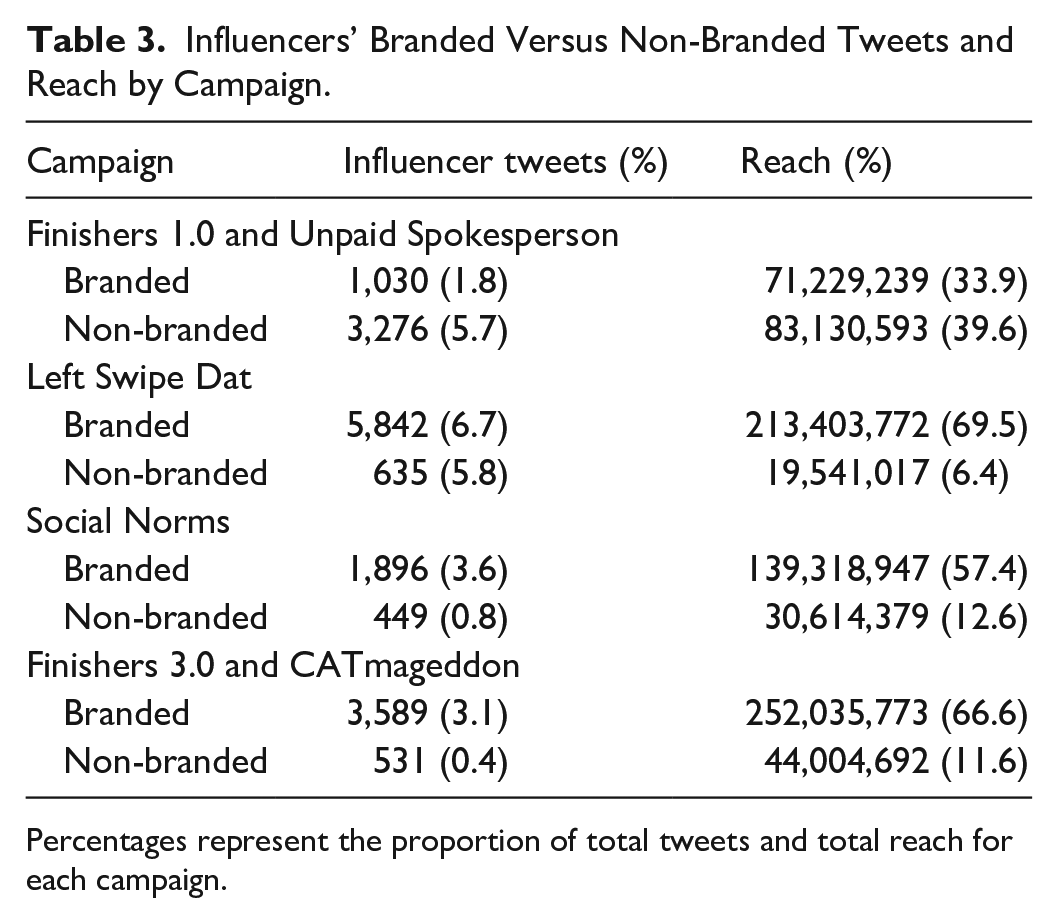
Percentages represent the proportion of total tweets and total reach for each campaign.
Furthermore, branded content posted by influential accounts had substantially greater total reach (over 50% of total reach for each campaign) compared to non-branded content posted by influencers or any content posted by non-influencer users for all campaigns with the exception of “Unpaid Spokesperson.” Thus, the “Left Swipe Dat” branded influencer tweets generated 70% of the overall campaign reach, “Social Norms” branded influencer posts produced 57% of the total campaign reach, and “CATmageddon” branded influencer tweets generated 67% of reach of the campaign. Dissimilarly, the reach of the “Unpaid spokesperson” branded influencer posts constituted only 34% of the total reach of this campaign.
The reach per day for branded content posted by influencers was highest for the “Left Swipe Dat” campaign (1,855,685 potential influencer impressions of branded content per day), followed by “CATmageddon” (1,482,563 influencer impressions per day) and “Social Norms” (1,016,927 influencer impressions per day), with “Unpaid Spokesperson” generating lowest reach per day of campaign-branded content (858,184 potential impressions on average per day).
Analyses of sentiment of the conversation about the campaigns demonstrated that opposition to the truth® campaign messages decreased over time, with a five-fold decrease in the proportion of oppositional messaging by campaign. Thus, 25% of messages related to “Unpaid Spokesperson” featured counter-campaign content; 8.8% of “Left Swipe Dat” tweets were oppositional; and 18.2% of “Social norms” (including “Finishers 2.0,” “It’s a trap,” and “Big Tobacco Be Like”) and 5% of “CATmageddon”-related messages were posted by opposition. These findings may be explained by the fact that “Left Swipe Dat”; “Social norms,” “It’s a trap,” “Big Tobacco Be Like”; and “CATmageddon” were potentially less likely to elicit opposition compared to “Unpaid Spokesperson” as the latter campaign focused on celebrity tobacco users. Oppositional content posted by Twitter users about the “Unpaid Spokesperson” campaign had the highest overall reach of 27,312,127 potential views (329,062 views per day on average), followed by “Social Norms”-related oppositional content with 22,638,154 views (165,242 potential views per day), “Left Swipe Dat”-related oppositional tweets with 10,377,811 potential impressions (90,242 average views per day), and finally by the “CATmageddon”-related unfavorable posts, which generated 8,172,236 potential views (48,072 views on average per day).
Discussion
This study builds on a growing body of literature that uses mixed-method supervised machine learning approaches to assess audience receptivity and reach of health interventions on social media (Emery et al., 2014; Hair et al., 2017). This is one of the first studies to examine the use of sharable content and influencer marketing as purposeful social media strategies for health message dissemination. This research sheds light on the underlying mechanisms by which these innovative strategies influence campaign, reach, and engagement and suggests that harnessing cultural elements endemic to social media is a useful strategy to increase campaign appeal among youth and young adults in a cluttered media environment. Use of effective content design strategies, including branded sharable message elements and memes, and effective content creators, that is, social influencers, helps propagate health campaign brand and message and encourage audience support and engagement. With fewer resources compared to the tobacco industry, strategic use of social media native content and content creators can help organizations engaged in health promotion and health education efforts overcome the huge imbalance that commercial resources bring to the tobacco-related conversation on digital media.
Thus, our findings demonstrate that utilizing social influencers as message sources is a key factor for message dissemination; “Left Swipe Dat” and “Social norms” generated more branded content, whereas the campaigns that did not engage influencers as message sources generated more non-branded discussion. Thus, the “Unpaid spokesperson” campaign which only featured celebrity mentions (e.g., Rihanna) generated 70% of all non-branded discussion. Influencer-branded content had greater total reach compared to non-influencer content. “Left Swipe Dat” campaign that utilized such social media influencers as Jimmy Tatro, Fifth Harmony, Grace Helbig, Harley Morenstein, King Bach, and Anna Akana generated the highest number of tweets per day and the highest audience reach per day. Thus, use of influencer spokespeople helped enhance campaign visibility and reach.
The study also characterized influencers’ posting activity with regard to sharing campaign-related messages. Influential users with over 5,000 followers (4.5% of users) posted fewer non-branded messages overall and posted more messages characterized by branded content (e.g., campaign hashtags, website links, videos, vines). Using strategies to engage influencer in health campaign dissemination (e.g., through tagging influencer accounts) could, therefore, be a promising strategy in promoting electronic word-or-mouth and reach of the campaign.
Use of popular social media memes and subjects also proved to be an effective strategy to promote reach and engagement with the campaign. The “CATmageddon” campaign, which featured cat memes and videos, generated the second highest reach per day for branded content posted by influencers. It was followed by a “Social Norms” campaign, which utilized popular memes like “It’s a trap” (1,118,436 influencer impressions per day). Although the “Unpaid Spokesperson” campaign generated a higher volume of non-branded conversation compared to the other campaigns, it had the lowest reach per day of branded content (858,184 potential impressions). Top retweets related to campaigns using social influencers contained favorable branded content, memes and vines, with the exception of tweets related to the “Unpaid Spokesperson” campaign.
In general, we found that campaign awareness and support increased over time, with oppositional messaging decreasing from 25% to 5% from the first wave of the campaign (“Unpaid Spokesperson”) to the last wave (“CATmageddon”), respectively.
Additional findings demonstrate the increased Twitter engagement during popular events with the target consumer (e.g., Grammys, VMAs). These findings are consistent with prior research evaluating the truth® campaigns’ reception on social media (Hair et al., 2017), which showed that premiering advertisements during a popular, culturally relevant televised event is associated with higher awareness of truth® ads and increased social engagement related to the campaign, controlling for variables that might also influence response to campaign messages.
This study has several limitations. As has been noted widely (boyd & Crawford, 2012), social media surveillance does not produce findings that are generalizable to the entire population. Furthermore, youth and young adults may use other social networking platforms in addition to Twitter to express their opinions about anti-tobacco campaigns. In addition, the “Left Swipe Dat,” “Social norms,” and “CATmageddon” campaigns all predominantly contained messages with positive emotional tone; in comparison, the “Unpaid spokesperson” campaign message was less emotionally positive. Future research is needed to examine supportive and oppositional conversation prompted by campaigns with different emotional tones and the impact of exposure to supportive and oppositional content on message compliance. It is also noteworthy that reach for each type of account was defined as the sum of account followers for the purpose of the study. This definition represents the gross number of opportunities for tweets to be seen or “potential impressions”; the proportion of actual impressions can be 1%–8% of potential impressions based on prior studies on Twitter content reach (J. D. Davis, 2016). Finally, future research could assess the effects of influencer campaigns on behavioral outcomes and address multivariate models of factors that influence campaign effects.
Further research is needed to assess the impact of influencer marketing on actual behavioral outcomes related to exposure to the campaign. Previous research has shown the effectiveness of social media messages in terms of behavioral change for public health interventions targeting physical activity, sexual health, and risky sexual behaviors (Lelutiu-Weinberger et al., 2015; Jingwen Zhang et al., 2015), but there has been little research directly linking tobacco-related knowledge, attitudes, and tobacco use to exposure to tobacco-related messages on social media.
Our findings demonstrate that social media platforms—a popular medium of expression among youth and young adults—provide rich data on health campaign reception and acceptance among this audience. Harnessing such cultural elements as popular social media messages (e.g., memes) and content creators (influencers) is a promising strategy for improving health campaign reach and engagement. Increasing number of commercial advertisers use influencer promotion; our study shows that this approach is also highly effective for social marketing and health education. These findings can be leveraged to inform future health promotion efforts in the domain of tobacco control and can translate to other public health and policy sectors, for example, to counter the effects of messages about products produced by other unhealthy commodity industries such as ultra-processed food and alcohol product manufacturers.
Supplemental Material
Appendix_SMS – Supplemental material for Boosting Health Campaign Reach and Engagement Through Use of Social Media Influencers and Memes
Supplemental material, Appendix_SMS for Boosting Health Campaign Reach and Engagement Through Use of Social Media Influencers and Memes by Ganna Kostygina, Hy Tran, Steven Binns, Glen Szczypka, Sherry Emery, Donna Vallone and Elizabeth Hair in Social Media + Society
Footnotes
Author’s Note
Donna Vallone is also affiliated with the College of Global Public Health, New York University, New York, USA and Department of Health, Behavior and Society, Johns Hopkins University Bloomberg School of Public Health, Baltimore, Maryland, USA. Elizabeth Hair is also affiliated with the Department of Health, Behavior and Society, Johns Hopkins University Bloomberg School of Public Health, Baltimore, Maryland, USA.
Declaration of Conflicting Interests
The author(s) declared no potential conflicts of interest with respect to the research, authorship, and/or publication of this article.
Funding
The author(s) disclosed receipt of the following financial support for the research, authorship, and/or publication of this article: Research reported in this publication was supported by Truth® Initiative.

Supplemental material
Supplemental material for this article is available online.
Author Biographies
References
Supplementary Material
Please find the following supplemental material available below.
For Open Access articles published under a Creative Commons License, all supplemental material carries the same license as the article it is associated with.
For non-Open Access articles published, all supplemental material carries a non-exclusive license, and permission requests for re-use of supplemental material or any part of supplemental material shall be sent directly to the copyright owner as specified in the copyright notice associated with the article.
