



Abstract
Emotions are non-negligible parts of the experience among the cancer-affected population to be reckoned with. With the increasing usage of social media platforms as venues for emotional disclosure, we ask the question, what and how are the emotions of the cancer community being shared there? Using a deep learning model and social network analysis, we investigated emotions expressed in a large collection of cancer-related tweets. The results showed that joy was the most commonly shared emotion, followed by sadness and fear, with anger, hope, and bittersweet being less shared. In addition, both the gatekeepers and influencers were more likely to post content with positive emotions, while gatekeepers refrained themselves from posting negative emotions to a greater extent. Last, cancer-related tweets with joy, sadness, and hope received more likes, whereas tweets with joy and anger were more retweeted. The implications of the findings are discussed in the context of social media health communities.
Today, cancer is one of the leading causes of death globally (World Health Organization, 2018). In the United States for instance, according to American Cancer Society (2019), it is estimated that more than 1.7 million new cases of cancer will be diagnosed across the country in 2019. Every day, cancer-affected population can be heavily burdened by both physical and psychological pressures (Moyer et al., 2014). In particular, cancer patients and their families have to deal with a series of negative emotions, such as fear, anxiety, anger, depression, despair, and helplessness (Slevin et al., 1996), in the nerve-racking process of fighting against cancer. As a result, a comfortable environment for them to vent their feelings and gain social support is critical for their health and survival (Giese-Davis et al., 2002).
Social media has gradually become a main venue for health-related talk. Going beyond learning cancer-related knowledge through health care organizations (Attai et al., 2015), people with chronic illnesses, such as cancer, have commonly used social media platforms to share personal feelings. In particular, the connectivity power of social media facilitates the formation of cancer-related communities that have significant larger sizes and scopes than previous online support groups. This, in turn, makes social media a popular choice for cancer-affected population to seek/provide social support from/to one another.
As individuals have been found to be driven by interpersonal motives the most in joining online health communities (Wright, 2002), the content shared by cancer communities on social media usually contains a great amount of emotional expressions and emotional support. Sugawara et al. (2012) analyzed 51 highly influential accounts in the breast cancer community on Twitter and found that instead of focusing on spreading news and knowledge, cancer patients’ tweets centered around emotional information exchange such as greetings, treatment discussions, and emotional support. In a similar vein, Myrick et al. (2016) found 64.7% of their sampled cancer-related tweets were inclusive of social support elements, and nearly 20% of all sampled tweets contained hope as emotional expressions. While such empirical evidence informs the common existence of emotion among cancer communities on social media, negative emotions such as fear, anxiety, and depression can also create barriers to inhibit the progress of cancer treatment (Freedman et al., 2016). Therefore, the cancer-affected population might need not only emotional exchange per se but also the appropriate type of emotions on social media.
Against this backdrop, this study seeks to answer three key questions through the theoretical lens of social sharing of emotion (SSE) on social media. First, we intend to extend previous research by probing what types of emotions people share in the social media cancer community and how those emotions are communicated. While previous literature mainly focused on the valence or sentiment of the sharing, we are particularly interested in examining what specific types of discrete emotions (i.e., joy, anger, sadness, fear, bittersweet, hope) are mainly shared in cancer-related talk. Second, we are interested how types of emotion sharing is associated with a message sender’s sociometric position in the networked community. Drawn from literature on social networks, the extent to which a user is in the central position within a network might influence what and how the user communicates with others. As less research has been dedicated to this relationship, we hope to establish such a connection and further our understanding of emotion sharing behaviors on social media. Third, to promote better-functioned social media cancer communities, it is of great importance to know how other members in the same network respond to expressions containing different emotions to provide insights to cancer-affection people’s future support-seeking/providing behaviors and other involved population.
Literature Review
SSE in Cancer Community
Emotion
Defined as internal affective experiences, emotions are concerned with person-environment relationships (Lazarus, 1991) such that sometimes we let emotions guide our reactions to entities in the external world. Depending on the dominant role of valence versus arousal, emotions can be understood with either dimensional or discrete models (Barrett, 1998). A typical example of dimensional models is the Circumplex Model of Affect proposed by Russell (1980), wherein eight affects (i.e., arousal, distress, misery, depression, sleepiness, contentment, pleasure, and excitement) were demonstrated in a circular order, indicating their structural relationships. The discrete models, instead, propose to focus on a finite number of primary emotions as scholars believe emotions can be divided into discrete categories, which arguably can yield more nuanced understanding of emotional experience. For instance, Ekman (1992) proposed six basic types of emotions (i.e., anger, disgust, fear, joy, sadness, and surprise) that differed from each other in prominent manners.
Aside from basic emotions, in recent years, there have been increasing discussions on complex emotions (sometimes interchangeably used with “mixed emotions”) that capture more subtle aspects of person-environment relationships, such as embarrassment (Hillier & Allinson, 2002), jealousy (Hobson, 2010), nostalgia as bittersweet (Barrett et al., 2010), and hope (Madrigal & Bee, 2005). Taken together, both basic emotions and complex emotions can provide invaluable insights into human interactions in the context of cancer communication, thus in this study, we take the perspective of discrete emotions to examine social sharing of different emotions on social media.
SSE on Social Media
Emotion is not only an intrapersonal experience but also shared during interpersonal interactions. The SSE framework describes the process when a person discloses information about an emotional experience to another, proposing that most emotional experience are socially shared regardless of the type of the emotion (e.g., joy, fear, anger, or sadness; Rimé et al., 1998), which is regarded as a type of emotion regulation strategy (Rimé, 2009). In this interpersonal communication context, individuals choose to disclose their feelings and experiences for purposes of informing others and venting, as well as receiving attention, feedback, support, or validation from the listener (Duprez et al., 2015). As a result, if the sharer receives appropriate socio-affective responses from the listener, she or he will show better emotional recovery and distress reduction and be more capable of bonding with the listener (Nils & Rimé, 2012).
While the overall probability of sharing emotional experience can be as high as 90% (Rimé, 2009), researchers of SSE also acknowledge that the emotional disclosure only occurs under certain circumstances, wherein the intensity of emotion matters, audience matters, timing matters, and the social norm of the platform matters (Bazarova, 2012; Bazarova et al., 2015; Rimé et al., 1998; Vermeulen et al., 2018). From an active-media-user perspective, people are thinking before sharing, that is, being selective in terms of what, when, where, and with whom they share (Vermeulen et al., 2018). For example, young people are very aware of the norm of emotional expression on different social media platforms such that they perceive WhatsApp to be the most appropriate platform to express all kinds of emotions, whereas Instagram is more associated with positive stories (Waterloo et al., 2018). This further suggests that not all types of emotions are shared equally for a specific topic on a certain platform.
When situated in online cancer communities, the findings about the type of primarily shared emotions are not consistent. Theoretically, it is often proposed that expressing negative emotional experience, such as anger and sadness, is an effective way to retain an emotional equilibrium (i.e., having less depression and anxiety after expression) for the cancer community (Lieberman & Goldstein, 2006). However, a content analysis of a cancer community composed of adolescents and young adults showed that positivity persisted in their conversations, with members utilizing humor and positive reframing to conquer negative emotions and to show support for each other (Love et al., 2012). More relevant to this study, Myrick et al. (2016) found that on Twitter, the primary emotion in cancer-related talk was hope (i.e., a mixed emotion), and the least commonly shared being fear. In light of such inconsistency between the theory and empirical findings, before examining how network-specific elements are related to SSE, we propose the first research question to explore types of emotions being shared among cancer-related people on social media:
RQ1. What are the types of emotions being shared in cancer-related talks on social media?
Network Positions and Emotion Sharing
On social media, SSE is prevalent, the manifestation of which may be shaped by different forces. Different motivations can result in different emotional disclosure such that the need for emotional expression motivates individuals to disclose both positive and negative emotions, whereas the need for self-presentation might drive users to express positive emotions only (Lin et al., 2014). In addition, the sharing decision may also be shaped by different channels people utilize. For example, Facebook users were found to prefer sharing more intense and negative emotions in private messages compared with more public channels such as wall posts (Bazarova et al., 2015). Furthermore, emotion sharing may depend on the social influence. Based on a massive-scale experiment, Kramer et al. (2014) found that a decrease in positive or negative posts in one’s Facebook feed would reduce the person’s positive or negative expressions correspondingly.
However, less research considers the question of SSE on social media from a network perspective, while networking as an affordance of social media is prominent (Boyd, 2010). Hence, building on a network perspective, our question is, is the SSE decision associated with the network position occupied by an individual? Transcending geographical and temporal boundaries, social media helps to knit networks so that users can connect with each other and engage in social interactions, which by nature is a resource for social network analysis (SNA). By representing the world through the lens of finite sets of actors and the relationships between them (Wasserman & Faust, 1994), SNA makes an assumption that a person’s social connection context has influences on his or her perceptions and interpretations of reality (Marsden & Friedkin, 1993), which benefits researchers in accounting for the social relation structures wherein a person embeds, then further examining how the structure impacts behaviors (Granovetter, 1985).
The dynamic of a social network is subject to each user’s position in the network, the variation of which can lead to different patterns of information exchange. Among all, centrality is often used to evaluate one’s network position, which implies social status and control over network resources (Ibarra, 1993). Previous research has shown that one’s centrality in a network can shape the person’s communication practices. In the context of political discussion, individuals who had a high degree centrality (i.e., more direct connections with others) on Facebook preferred interactions that minimize social risk, while those who had high-betweenness centrality (i.e., more likely to bridge disparate subgroups) talked about controversies more openly (Miller et al., 2015). In online health communities permeated with support-giving and support-providing, depending on where they located in the social network, people would emphasize different aspects of the same health issue (Cohn et al., 2019) and they may receive different types of social supports from others (Meng et al., 2016).
Following this line of thought, we may expect individuals with various centralities engage in the SSEs differently. Central users with more connections in the network are often seen as more powerful and resourceful. In online health communities, people in central positions would actively engage in information exchange with other network users, and their messages are more likely to be followed and read by others (Namkoong et al., 2017). From an interpersonal perspective, central members in a network were more likely to gain social support (Fink et al., 2015). Therefore, given the higher responsiveness and potential supports from other members, users of higher importance may talk about their emotional experience about cancer freely regardless of the types. Nonetheless, a high centrality often comes jointly with a high pressure of self-monitoring and strategic management (Mehra et al., 2001; Miller et al., 2015). As a result, central users with more connections might disclose their different emotions in a more deliberate manner.
Despite its theoretical prominence, empirical research provides few insights into the relationship between network position and emotion sharing in the context of cancer communication on social media platforms. Little do we know about whether central nodes in social networks are inclined to convey positive emotions such as joy to express their gratitude of perhaps successfully fighting against cancer, or negative emotions such as fear in terms of whether they can survive cancer in the future, or mixed emotions such as hope to encourage and unite other users to stay optimistic together. Therefore, we propose the following research question:
RQ2. How is users’ network position associated with their cancer-related talks that express different emotions on social media?
Public Responses to the Shared Emotion
Aside from expressing emotions, the process of SSE also involves responses from others, which are often desired as social supports (Duprez et al., 2015; Laurenceau et al., 1998). Social supports as a type of communication help build the perception that the person is “cared for and loved,” “esteemed and valued,” and “belongs to a network of communication and mutual obligation” (Cobb, 1976, p. 300), which is also vital to facilitate the overall SSE process. According to a sentiment analysis of a large-scale social interactions, participating in the online community of cancer survivors predicted a change toward more positivity in a user’s expressions along the time, especially when they receive a greater number of timely and supportive replies from other users (Qiu et al., 2011).
Particularly, on social media, public responses are captured and displayed to users by a variety of metrics, such as the number of “likes,” “comments,” and “shares.” These different response affordances can cast different meanings in interpersonal interactions. For “likes,” both receiving and giving “likes” on social media are associated with social support such that receivers perceive it as getting support from others (Wohn et al., 2016), while givers usually “like” the content to show their social support especially when posts are associated with significant life events (Hayes et al., 2016). In contrast, retweeting (without commenting) resembles an endorsement of the opinion and feelings of the person who post, which fits better the scope of broadcasted communication and requires more mental efforts (Burke & Kraut, 2016). Therefore, the engagement patterns of different actions can vary.
Considering the nuances among different social media responses, how other users respond to the emotional disclosure may hinge upon the characteristics of messages such as the emotion expressed. A large-scale Facebook study showed that posts with negative feelings gained more supportive comments, and posts with positive emotions received more likes (Burke & Develin, 2016). Similarly, in the breast-cancer-related talk on Twitter, scholars also found that tweets with more positive sentiments were more likely to be shared, whereas tweets with more tentative words were less likely to be retweeted (Kim et al., 2016). However, a contradictory pattern was found on diabetes-related Facebook pages such that although negative posts were less likely to be shared by others, text-only messages with negative emotions were more likely to receive likes and comments (Rus & Cameron, 2016). Going beyond, less is known about how others respond to different discrete emotions, such as anger, fear, joy, or hope. Therefore, we propose the following research question:
RQ3. How do other users respond to cancer-related tweets that express different emotions?
Method
To answer the above questions, we chose Twitter as the social media platform for this study. Twitter, as one of the main social media venues, has unique features for users to construct and join a community. For example, the use of hashtags on Twitter is not only a tool to bookmark the content but also a symbol signaling the membership of a community (Starbird & Palen, 2011; Yang et al., 2012). In addition, compared with other online support communities for cancer, such as discussion boards of the Cancer Survivors Network or relevant pages on Reddit, Twitter is more public in nature, which attracts users with a wider range of involvement in the topic, not only including patients and their families but also authoritative organizations, physicians, and researchers (e.g., Himelboim & Han, 2014). This can potentially provide us with richer information and various perspectives on cancer-related SSE.
Data Collection
Using a list of 12 commonly used hashtags related to cancer (#stupidcancer, #cancersucks, #cancersurvivor, #f**kcancer, #cancerfighter, #fcancer, #cancerwarrior, #f**kyoucancer, #CancerViking, #fightcancer, #battlecancer, and #fxkcancer), we queried the Twitter standard search API (application programming interface) from January 21 to February 27, 2019. The Twitter standard search API returned a sample of tweets posted in the past 7 days, therefore, the data were queried once a week during these 6 weeks.
The final data set consists of 53,026 tweets generated by 39,504 Twitter users, with 23,047 original tweets and 29,979 retweets. These tweets were posted on dates ranging from January 11, 2019 at 5:20:53 a.m. to February 27, 2019 at 3:57:06 p.m.
Social Network
Network-Level Measures
We first generated network-level statistics through graph-based measures to holistically investigate the obtained network. Network density takes the proportion of existing edges to all possible edges should all nodes are connected to each other in a given network, which indicates the level of cohesion among network users (Scott, 1988). Network centralization investigates the extent to which node-to-node interactions occur exclusively among small groups compared with overall networks (Sparrowe et al., 2001). Both measures help to yield general understanding of the cancer communication network on Twitter.
Users’ Network Position
In this study, we focused on the retweet network to construct relationships between users as retweeting is a direct manifestation of sharing on social media. In the given directed network, each node represents individual Twitter user, while each edge represents a retweet relationship whose direction is determined by the sender and the receiver of that information. Informed by past research on SNA, we adopted two centrality measures to pinpoint a user’s network position, respectively betweenness centrality and closeness centrality, which highlight different aspects of an actor’s power in the information diffusion network.
Betweenness Centrality
Betweenness centrality (Freeman, 1977) measures the shortest path between two nodes (see formula below as shown in Borgatti et al., 2013, p. 174), which usually captures the extent to which a node plays a gatekeeping role in a network such that users in a high-betweenness position is more likely to control information diffusion than those in a low-betweenness position (Borgatti et al., 2013). We then used the igraph package in R (Csardi & Nepusz, 2006) to generate betweenness centrality score for each node in our network, M = 116.78, SD = 8,226.41

Closeness centrality usually reflects the speed of information transmission by a user. Typically, users with a higher closeness centrality in a given network are capable of facilitating information flow faster than others (Valente et al., 2008). Therefore, complimentary to betweenness centrality that measures information control, closeness centrality can well identify users who might be less subject to the network gatekeeper and spread information more effectively (Brandes et al., 2016), that is, who are being influencers in the network. We also requested igraph package in R to generate scores for each node, M = 3.970262e-09, SD = 1.114163e-10.
Emotion Detection
To more effectively recognize the emotion from massive online user-generated contents is now a trending topic in computerized textual analysis. In this study, we adopted a deep learning algorithm developed by Colneriĉ and Demsar (2018), who provide open-sourced access to their trained recurrent neural network (RNN) models for predicting emotions from English tweets. 1 Following their posted directions, we did not preprocess the tweets before performing the emotion detection task.
Applying deep learning models to natural language processing such as analyzing tweets is advantageous, as it can potentially capture subtle semantic patterns that might not be fully discovered by manual coding or dictionary-based approaches (Zhang et al., 2016). As such, prior research indicates that using dictionary-based approaches could not correctly label more than 50% emotional expressions (McDonnell, 2015). For RNN models instead, they are capable of using the sequence information contained in the short texts and make more precise predictions. According to Colneriĉ and Demsar (2018), based on the data set of 73 billion tweets collected between August 2008 until May 2015, their RNN models built upon sequences of characters generally achieved higher precision (F-1 score = 73.0%) in detecting emotions of tweets compared with several state-of-the-art supervised machine learning algorithms.
In processing our obtained tweets then, we used the RNN models trained for recognizing Paul Ekman’s (1992) six basic emotions: anger, disgust, fear, joy, sadness, and surprise. Specifically, considering our interests in mixed emotion, a multi-labeling approach was utilized. Rather than reporting a single primary emotion for each tweet, the multi-labeling approach reports a probability between 0 and 1 for each category of the six emotions (e.g., anger, 0.20; disgust, 0.20; fear, 0.40; joy, 0.00; sadness, 0.00; and surprise, 0.10), adding up to 1. This allow for situations in which the tweet has neutral stance or contains mixed emotions.
Specifically, we identified four types of basic emotions including anger, fear, joy, and sadness, as well as two mixed emotions, including bittersweet and hope from the 23,047 original tweets, considering the repetitive nature of retweets. As shown in previous research in the context of cancer, happiness (joy), fear, anger, sadness, and hope are major emotions that emerge in online communities (Han et al., 2008; Lieberman & Goldstein, 2006; Myrick et al., 2016). Hence, we did not include disgust and surprise because these two types of emotions are less relevant to our study context.
To decide whether the tweet expresses any one of the four basic emotions, we followed the commonly used rule in previous multi-category classification task by setting the threshold for the presence of the emotion as 1 / (number of categories), which was 0.25 for a four-category classification. For example, for a tweet, if the probability generated for anger is 0.1, then the anger variable will be coded as 0 (absence); if the probability is higher than 0.25, then the anger variable will be coded as 1 (presence). We applied this rule to all four basic emotions.
Bittersweet was operationalized as the co-presence of sadness and joy in a single tweet. Therefore, if a tweet scored above 0.25 for the probability of both sadness and joy, we would classify this tweet as expressing bittersweet emotions.
Hope was operationalized as the co-presence of fear and joy. The rationale behind this choice is that hope as an emotion, often emerges from yearning for relief from negative conditions (Lazarus, 1991). On one hand, hope is a positive emotion that has joyful elements; on the other hand, both fear and joy can be triggered by a high level of uncertainty (Roseman et al., 1990).
Public Responses
We measured public responses to the shared emotions by utilizing the number of favorites (M = 4.78, SD = 151.71) and the number of retweets (M = 164.3, SD = 486.94) received by each tweet, which were generated automatically when the tweets were gathered from the API.
Results
Descriptive Statistics of Network
Our network has 15,995 nodes and 13,584 edges. The network density is 5.3099e-05, suggesting it being a sparse network where users were not strongly tied with one another. That said, the network centralization score is 0.0772884 and the longest path between two nodes is 2, which indicates the network could be centralized around several users who had great influence and control over the information flow in the overall network. Figure 1 presents a visualization of the network.

Visualization of the network.
Descriptive Statistics of Emotions
The results of classification showed that, overall, the most often expressed emotion of the cancer community on Twitter was joy, followed by sadness, fear, hope, bittersweet, whereas anger being the least appeared emotion (Table 1). According to the classification output, the tweets that had anger elements primarily expressed a person’ anger toward cancer itself. Fear in cancer-related tweets was often triggered by uncertainty about the situation and a need for guidance. Tweets of joy centered around the happy moments of cancer patients and families, such as signs of better health or a happy gathering in daily lives, while tweets of sadness were mainly about pain and loss. Bittersweet tweets were mostly emotionally supportive messages for people and families that are suffering from cancer, as one part of it was about love and joy, while the other part was permeated with sadness. Tweets identified as hope messages revealed a person’s uncertainty (i.e., the fear element) as well as good wishes (i.e., the joy element).
Emotion Detection Results and Examples.
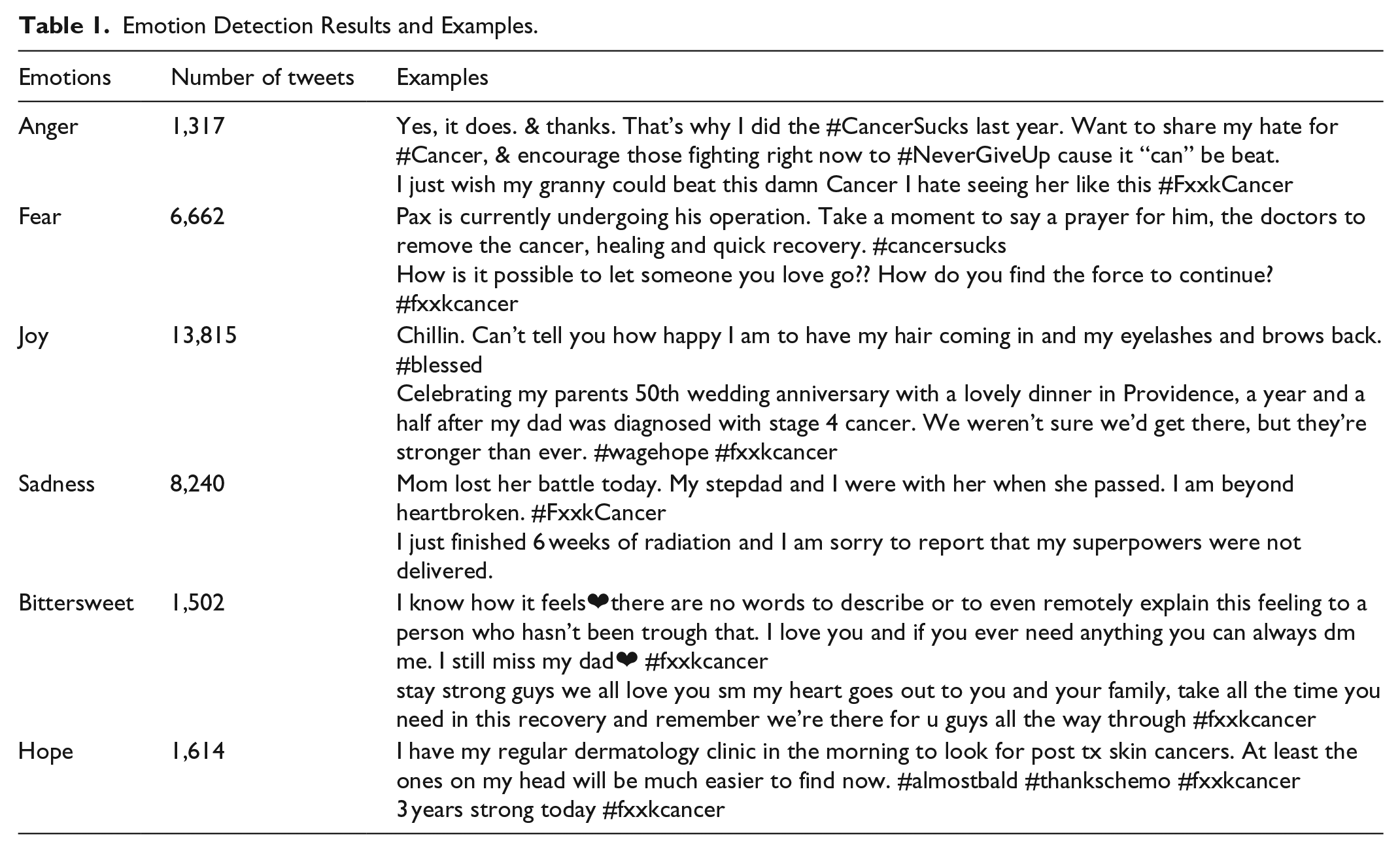
Network Position and Emotion(s)
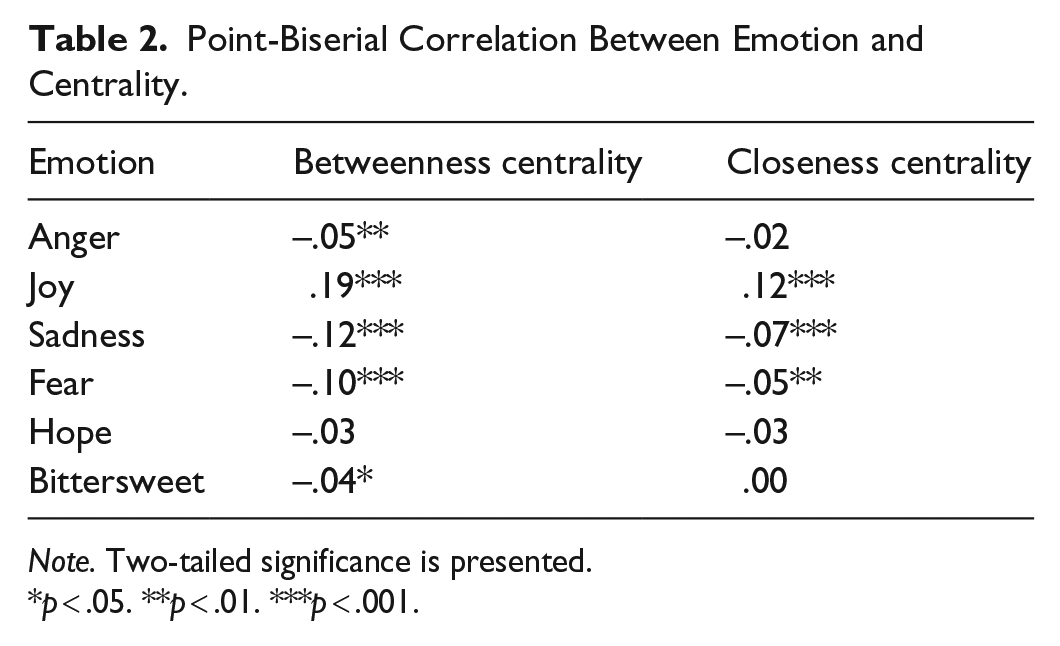
Point-biserial correlation was chosen to examine the relationship between individual emotion and centrality to examine the extent to which a user’s network position was associated with emotion(s) expressed in that user’s tweets because while both centralities are continuous variables, all the emotion variables were dichotomized. As shown in Table 2, being central in a network as gatekeeper and/or facilitator was associated with posting tweets featured with more joy, less sadness, and less fear. In addition, higher level of betweenness centrality was also associated with fewer angry and bittersweet expressions.
Point-Biserial Correlation Between Emotion and Centrality.
Note. Two-tailed significance is presented.
p < .05. **p < .01. ***p < .001.
Public Responses to Expressed Emotion(s)
To examine how Twitter users react to posts with different emotions, two negative binomial regressions were conducted on the number of likes and the number of retweets received by the tweets. We used negative binomial regression because the dependent variables (number of likes/retweets) are count variables. Six different types of emotions (presence vs. absence) were listed as independent variables.
The results for the number of favorites showed that anger and bittersweet were negatively associated with it, whereas the presence of joy, sadness, or hope was more likely to attract likes. In addition, whether the tweet expressed fear or not was not significantly related to the number of likes (Table 3). Regarding to the number of retweets, the presence of anger and joy increased the likelihood of retweeting (Table 4), while the presence of fear, sadness, or bittersweet decreased the likelihood of retweeting. Hope was not significantly correlated with the chance of getting retweeted.
Negative Binomial Regression Results for the Number of Favorites.

p < .001.
Negative Binomial Regression Results for the Number of Retweets.

p < .001.
Discussion
Going beyond a simple dichotomization between positive versus negative sentiment, our study presents an analysis of discrete emotions that is being shared in cancer-related tweets.
Expressed Emotions Through Tweets
Based on a deep learning model, the classification results reveal that joy is in actual the most commonly appeared emotion in cancer-related tweets, suggesting a prevalent positivity in this community. People are celebrating their achievements and happy moments in their daily lives, and they are willing to share them in the Twitter community. This can possibly be explained by the motivation found in previous findings, that people’s positive feelings always get reinforced through sharing (Bazarova et al., 2015). Concurrently, the cancer community on Twitter also embraces negative affect, such as sadness and fear, which are often the moments that people are driven by a need to express themselves and seek social supports from the community. As informed by previous SSE work, individuals are motivated to reexperience their past and seek attention when disclosing positive emotions, whereas they are more frequently seeking understanding and support when sharing negative emotions (Duprez et al., 2015). Compared with other social media platforms like Facebook, Instagram, or Snapchat, the norm against negative emotion sharing is much more relaxed on Twitter, perhaps due to a more anonymous nature of the interactions (Vermeulen et al., 2018). The relatively large amounts of tweets with sadness and fear in our study echoed above findings. This may be especially valuable for the cancer community, making Twitter a comfortable place for them to vent negative thoughts and feelings. In addition, a relatively smaller amount of anger, bittersweet, and hope was expressed, which are less likely to be the primary feelings of the cancer community.
Network Centrality and Emotion Sharing
Past research has already examined the relationship between network density and emotion sharing such that social media users with denser networks appeared to be more emotionally articulated with both positive and negative emotions (Lin et al., 2014). Our study, instead, captured a sparser social network concerning cancer, and unveiled more nuanced patterns of emotion sharing behaviors.
High-betweenness-centrality users, who have a higher control over the information flow in the network, were found to be more associated with joyful expressions, while at the same time, less associated with posts permeated with anger, sadness, fear, or bittersweet. Influencers, who have higher closeness centrality in the network, exhibited similar patterns, yet, they appeared to be more indifferent to posts that involved some negative emotions such as anger and bittersweet. This adds to our understanding of the relationship between network position and emotion sharing. Due to the correlation rather than a causal relationship established in this study, the results can be interpreted from two perspectives. On one hand, it is possible that central users consciously employ certain strategies to regulate their social media posts. By tweeting more often in a positive tone, central users might have been making efforts to encourage community members in the course of fighting against cancer while avoiding expressing negative emotions to demoralize their coping with cancer. On the other hand, chances are that it is because these users generated more joyful posts with less sadness and fear, they attracted more followers and retweets, thus gaining central positions in this network.
That said, we found no such significant relationship between network position and sharing hope on Twitter. This might be explained by the way that we defined hope messages as posts with both fear and joy components, which can be positive in tone but still show uncertainty. Uncertainty permeates in the process of coping with cancer, in particular with undetermined prospects. Patients that have survived cancer can have less uncertainly and more hope (Wonghongkul et al., 2000), Yet, this is not the case for everyone. Therefore, in engaging in social interactions with other cancer community members on social media, central users might refrain themselves from amplifying others’ uncertainty by spreading false hope.
Overall, the cancer community on Twitter reveals a chase in happiness, love, and survivorship stories regarding the information flow.
Responses to Tweets With Different Emotions
Our results also revealed the patterns of how others respond to tweets with different emotions. The first form of action is liking, which explicitly expresses one’s social support to the user who posts. The results reveal that tweets with joy, sadness, or hope received more favorites. Compared with previous findings regarding the difference between the liking responses to positive and negative affect (e.g., Kim et al., 2016; Rus & Cameron, 2016), the results of our study demonstrated that on Twitter, users are offering supports for tweets with positive affect like joy, negative affect like sadness, and mixed emotion like hope. These emotions are often the ones that have a strong desire for social supports. Moreover, although tweets with fear did not attract more supports, they did not receive less either, suggesting that expressing a person’s fear and uncertainty on Twitter is well accepted. In addition, tweets with anger or bittersweet were less frequently liked.
The responses in the form of retweeting showed a different pattern. Other users were more likely to share tweets with anger or joy, less likely to repost tweets that are primarily about sadness, fear, or bittersweet, and were indifferent to tweets about hope. This finding may be explained by the nature of the tweets. It is often common and acceptable that people repost other people’s joy and achievements, whereas broadcasting to one’s own network about other people’s sorrow and fear, which are much more private and intimate feelings, often violates the norm of supportive communication. In addition, tweets with anger are often expressing hatred of cancer, which is widely shared among the community and reflected in a number of hashtags the community use (e.g., #stupidcancer, #fxxkcancer). Therefore, they are more likely to get shared. Another possible explanation is that anger and joy elicited a higher level of arousal than other emotions such as sadness, fear, or bittersweet, thus being more viral on social networking sites in general (Berger & Milkman, 2010), the same principle of which may be applicable to the cancer community as well.
Implications
Theoretically, our study adds to the growing body of literature about the SSE in online health communities by displaying more nuances of the process. First, previous studies often dichotomize emotions as the positive versus negative sentiment, whereas our study detailed the role of different types of discrete emotions, such as fear and sadness, as well as more complicated emotional experience such as bittersweet and hope in the context of cancer community. Moreover, this work pushes the SSE work forward by adopting a social network perspective, showing that as a unique and important personal characteristic, user centrality in a network may be a shaping force in the SSE process. This encourages future research in the realm of SSE to adopt a structure view in addition to the current independent-actor paradigm, which may be particularly meaningful for SSE in online health communities, where networks are naturally formed through communications. In addition, our findings on how discrete emotions drive different types of public responses on social media platforms provide a better understanding about the intersection of emotion sharing, social support, and technology affordances.
Practically, for health communication professionals, our study suggests that using joy as an emotional appeal to communicate cancer information may be a good strategy, which can potentially promote public engagement with the message, such as liking and sharing. For online health community designers, it may be helpful to consider utilizing anonymity features and building a safe space for users to express their negative emotions without feeling being judged or pressured by social norms in a similar manner to what Twitter affords. Designers can also test features such as sending notifications to users about other users who use the same hashtag to further strengthen the community network and promote user engagement.
Limitations and Future Work
Several limitations of this study can be addressed in future work. To begin with, we focused on analyzing SSE on Twitter. Yet, existing algorithms and relevant platform policies restricted us from retrieving all relevant tweets during the designated timeframe. As a result, we were only able to map out cancer-related SSE on Twitter with a limited sample of tweets. Future researchers are encouraged to retrieve more data to present a fuller picture of the phenomenon.
Second, in this study, we did not differentiate individual accounts and organizational accounts on Twitter as we were mainly interested in cancer-related SSE per se. Future studies can explore whether and how organizations, compared with individuals, display different emotion patterns, as well as to what extent they occupy central positions in the information diffusion network to further implicate communications mediated by social media.
Third, future studies can extend our design to other issue contexts and examine SSE in a more holistic manner. For instance, other social network sites such as Facebook also host similar health communities, wherein social interactions and emotional disclosure might manifest different patterns due to platform-specific characteristics. Therefore, scholars are strongly encouraged to further explore emotion sharing on other social media platforms. In addition, this study implicates emotion sharing in cancer-related communities on social media, further evidence is needed to extrapolate our findings to other health communities such as HIV/AIDS support group (Mo & Coulson, 2008) and mental health support group (De Choudhury & De, 2014). Finally, researchers are encouraged to explore emotional disclosure featured with other emotions (e.g., anxiety, embarrassment), which might occur in online health communities as well to further understand this phenomenon.
Footnotes
Declaration of Conflicting Interests
The author(s) declared no potential conflicts of interest with respect to the research, authorship, and/or publication of this article.
Funding
The author(s) received no financial support for the research, authorship, and/or publication of this article.
