



Abstract
Twitter hashtags allow citizens to share vital information and make sense of acute crisis events such as terrorist attacks. They also enable those watching from afar to express their sympathy and solidarity with the victims. Perhaps the most well known of these has been #PorteOuverte (translated into English as “Open Door”), first used during the November 2015 terrorist attacks in Paris before re-emerging during subsequent atrocities in Brussels (March 2016) and Nice (July 2016). The hashtag was originally created by journalist Sylvain Lapoix in order to connect those in Paris looking for somewhere to stay with those able to offer them refuge, before reaching an international audience courtesy of its amplification by public figures and citizens based overseas. This article adds to this emergent literature by analyzing the networked gatekeeping dynamics of #PorteOuverte during the Paris terror attacks. It does so by reviewing the literature on Twitter hashtags and acute crisis events, exploring how Twitter was used during the Paris terror attacks, and presenting the results of a Social Network Analysis (SNA) of 399,256 #PorteOuverte tweets posted as the attacks unfolded on 13 November 2015. Results indicate that professional journalists were key broadcasters during four identified peaks within #PorteOuverte, helping to promote the informational hashtag and connect those directly affected. However, citizens and bloggers played an increasingly important gatekeeping function in the aftermath of events such as the Bataclan siege in Paris.
Introduction
Social media enable both elite and non-elite actors to share information that facilitates collective sensemaking during acute crisis events such as terror attacks, extreme weather events, and war. Emergency management organizations and professional journalists are no longer the only source for those wishing to know more about the scale of these incidents and the support available to victims. Twitter hashtags, in particular, have empowered citizens to play “increasingly performative and constitutive roles” in these events through their sharing of eyewitness testimonies on the microblogging site (Tikka, 2019, p. 105). Nevertheless, doubts remain about the extent to which non-elite actors actually influence these information flows; research indicates that content posted by professional journalists on Twitter during acute crisis events is more widely shared than tweets posted by citizens (Lotan et al., 2011; Reilly, 2016). Although there has been a burgeoning research interest in crisis hashtags over the past decade (see Bruns et al., 2016, for example), there have been few studies exploring how broadcasting and gatekeeping dynamics evolve as these events unfold. This study sets out to address this gap in the literature by exploring how the broadcasting and gatekeeping dynamics evolved during the November 2015 terror attacks in Paris.
On the night of Friday 13 November 2015, Islamic State of Iraq and Syria (ISIS) militants launched a coordinated series of attacks upon a number of locations in central Paris that left 130 people dead and hundreds wounded. These began at approximately 9:20 p.m., when the first of three explosions occurred outside the Stade de France during an international friendly football match between France and Germany, before being followed by a series of gun attacks on people sat outside bars and restaurants in central Paris. A siege in the Bataclan club would result in 90 people being murdered and many more critically injured, before French police brought it to an end by storming the building and killing the three terrorists responsible at 12:20 a.m. 1
Hashtags such as #prayforparis and #jessuisparis began to circulate on Twitter as citizens from across the globe expressed their solidarity with the victims (Garcia & Rime, 2019). There was also a noticeable increase in hate speech directed toward Muslims on the microblogging site in the wake of ISIS claiming responsibility for the attack (Magdy et al., 2015). This was not the first nor the last time that the affective affordances of Twitter would be leveraged by citizens united in their condemnation and grief in the aftermath of a terrorist atrocity in France. In January 2015, #jesuischarlie had been widely shared by tweeters to show their support for the satirical magazine Charlie Hebdo, in the wake of an Islamist terrorist attack on its Paris office that left 12 dead (Giglietto & Lee, 2017). Many tweeters have responded to subsequent terrorist atrocities such as Brussels (March 2016) and Nice (July 2016) through such compassionate hashtags (Schafer et al., 2019).
Twitter also functioned as a communicative space in which citizens directly affected by the terror attacks could address their information needs. Parisiens were able to post and access real-time information pertaining to the attacks through hashtags such as #Paris. Tweets tagged #rechercheParis (“search Paris”) and #rechercepersonne (“search for person”) were shared to help reunite people with missing friends and relatives (Schafer et al., 2019). Probably the most well known hashtag was #PorteOuverte (“open door”), created by French journalist Sylvain Lapoix to connect those stranded in the French capital with those able to offer them a bed for the night. It was heralded as an example of the prosocial behavior demonstrated by social media users during the attacks insofar as citizens were “offering help through Twitter in an altruistic act toward strangers” (Garcia & Rime, 2019, p. 619). Nevertheless, there remains a dearth of empirical research exploring who contributed to #PorteOuverte and which actors were its most influential broadcasters and gatekeepers. This article addresses this by providing the first in-depth analysis of the broadcasting and gatekeeping dynamics of #PorteOuverte. It does so by reviewing the literature on hashtags and acute crisis events, exploring how the microblogging site was used during the Paris terror attacks, and presenting the results of a Social Network Analysis (SNA) of 399,256 #PorteOuverte tweets posted as the attacks unfolded on 13 November 2015.
Literature Review
Twitter and Acute Crisis Events
Terrorist incidents are hybrid media events that are disruptive in nature and invariably play out on social media in real time (Vaccari et al., 2015). Twitter in particular intensifies communication about these events, amplifying their “hybrid reality” (Sumiala et al., 2016, 2018). The microblogging site is ideally suited for breaking news stories and sharing information during crisis events (Murthy, 2013). Both elite and non-elite actors use the site to engage in networked gatekeeping, the process whereby they co-create and co-curate flows of information during such incidents (Meraz & Paparachissi, 2013), and gatewatching, where they share relevant links and amplify “those tweets they deem to be important to others” (Bruns et al., 2016, p. 23). The hashtag, defined as the “prefixing of a keyword or phrase with the # symbol” (O’Reilly & Milstein, 2012, p. 43), is the primary mechanism for both these activities and typically shapes how people engage with breaking news on the platform. First proposed in 2007 by technologist Chris Messina as a “tagging system” to categorize information and objects on Twitter (Krutrok & Lindgren, 2018), hashtags first emerged as key conversation markers around disasters. For example, #qldfloods functioned as a news stream for those affected by the 2011 South East Queensland floods, enabling them to share their eyewitness testimonies and provide advice to other flood-affected residents. Axel Bruns and his colleagues at Queensland University of Technology found that this hashtag “drew on and became a source for mainstream media” (Bruns et al., 2012, p. 7). Subsequent research has shown how citizens use hashtags to address information needs during such incidents and enhance their situational awareness, thus providing actionable data that enable emergency managers to build situational awareness and allocate resources toward those most in need (David et al., 2016; Potts, 2014; Reilly & Atanasova, 2016). They also use the site to share images and videos recorded by eyewitnesses, a form of connective witnessing that helps news media document the course of such events (Mortensen, 2015). The gatewatching function of these publics during “acute events” was illustrated by research indicating that 40% to 75% of tweets in these hashtags contained URLs and 35% to 65% were retweets (Bruns et al., 2016 p. 23).
Schafer et al. (2019) identified a typology of hashtags that emerged during and after the 2015 Paris attacks. First, there were informational hashtags such as #Paris which were used by tweeters to locate where incidents were occurring and to share related information in real time. Second, people expressed their sympathy for the victims by tagging their tweets with compassionate hashtags. Universalism was the most frequently mentioned topic in both #PrayforParis and #PrayforSyria, which trended on Twitter between 13 and 18 November. The former was often used in conjunction with news icons such as French designer Jean Julien’s “Peace for Paris” illustration, which became the most widely shared image during this period (Bruns et al., 2016; Fairs, 2015). There were also many tweets consisting of only the hashtag, which left it to the audience to “fill in the blanks” (Giglietto & Lee, 2017, p. 12). Yet, there was not a complete absence of antagonism within these compassionate hashtags. Indeed, those conflating media, migration, and terrorism in #PrayforSyria were among the most heavily retweeted (O’Loughlin et al., 2017, p. 197). Similar to the Woolwich terror attack in London 18 months earlier (Williams & Burnap, 2015), there was an observable increase in hate speech online following the Paris attacks (Kaakinen et al., 2018). Moreover, despite non-elites theoretically having greater opportunities to shape information flows during such incidents, preexisting solidarities and antagonisms were often reproduced in these hashtags (Giglietto & Lee, 2017). This was congruent with a broader critique suggesting that digital technologies enable middle class rather than marginalized communities to have their voices heard during disasters and the recovery process (Madianou et al., 2015). Finally, there were organizational hashtags designed to leverage the connective affordances of Twitter to provide material assistance to those directly affected by the terror attacks. #RechercheParis (“search Paris”) and #rechercepersonne (“search for person”) circulated on the microblogging site as people looked for information about their missing friends and relatives (Schafer et al., 2019). Overall, these hashtags performed both affective and informational functions for those directly impacted by the terror attacks and those watching overseas.
#PorteOuverte as a Ritualized Connective Action During Terror Attacks
This article focuses on the most well-known organizational hashtag to emerge from the November 2015 attacks, #PorteOuverte. Journalist Sylvain Lapoix urged citizens to tag their tweets with this hashtag if they were looking for somewhere to stay or were able to offer refuge to others. His original tweet, “If you are looking for or offering shelter due to the Paris attacks, add the hashtag #PorteOuverte” (translated into English), posted at 9:30 p.m. on 13 November, was mentioned an estimated 800,000 times within 72 hr of the atrocities (Varagur, 2015). Lapoix characterized the hashtag as a form of “matchmaking”, inspired by several tweets in his timeline that appeared to be from the same street. He saw the microblogging site as an ideal platform for sharing this information and to help alleviate the pressure upon the emergency services, whose telephone lines were inundated with calls on 13 November 2015. He was able to use his own professional networks to encourage other journalists to retweet content posed under the hashtag. Nevertheless, the majority of #PorteOuverte tweeters sharing the hashtag did so in order to “pass on something positive,” with only a small minority actually using it for its intended purpose (Petersen et al., 2018). There was also little interaction on the hashtag and only limited information provided by those offering shelter, possibly due to Lapoix warning tweeters not to put themselves in danger by sharing personal details such as their home address (Serafinelli et al., 2017). While this was by no means a digital movement of opinion (DMO), wherein citizens spontaneously mobilize online and adopt the same stance on emotive issues (Barisione et al., 2019), it did have an affective dimension for those watching from afar who were unable to offer practical assistance to the victims.
#PorteOuverte was an exemplar of the prosocial behavior facilitated by online platforms in the wake of the Paris terror attacks (Garcia & Rime, 2019). Unlike similar initiatives in London in July 2005 and Mumbai in November 2008 (see Potts, 2014, for an overview), the hashtag has constantly been repurposed, to the extent that it has become a recurring feature in acute crisis events. This “universalism” is perhaps best illustrated by its circulation during subsequent terrorist atrocities in Brussels (March 2016) and Nice (July 2016). Tikka (2019) asserts that such “open door initiatives” constitute a “ritualized crisis response” of ordinary people to help others, which is distinct from the crisis communication of official agencies charged with managing these incidents (p. 114). Its “virality,” understood here as a social information flow process (Nahon & Hemsley, 2013), provides further evidence of how hashtags focus attention on issues of public concern and render visible the contributions of non-elites to these conversations (Jackson & Foucault Welles, 2016; Vicari, 2017). Yet, these are ephemeral, “ad hoc publics” rather than online communities, which mobilize quickly in response to crisis events and dissipate shortly after they have addressed their information needs (Bruns & Burgess, 2015; Potts, 2014). Moreover, the “democratizing” potential of these hashtags should not be overstated. While citizens do have greater opportunities to co-curate information flows during hybrid media events, content posted by bloggers and professional journalists continues to be the most widely shared on Twitter (Chadwick, 2013; Lotan et al., 2011; Reilly, 2016).
Current Study
This article adds to the emergent literature on crisis hashtags by presenting the results of the first empirical study of #PorteOuverte.
Specifically, there were two research questions that emerged from the preceding literature review:
These were investigated through an SNA of #PorteOuverte. SNA was considered the most appropriate method for revealing the connections between tweeters and has frequently been deployed to explore broadcasting and gatekeeping dynamics within hashtags (see Vicari, 2017). The period between 13 and 14 November 2015 was selected to capture how it was used in real time by people seeking refuge during the attacks. Tweets tagged #PorteOuverte during this timeline were purchased from Sifter in November 2017, and their metadata were analyzed using the text-mining software package DiscoverText (www.discovertext.com). 2 There were several limitations that should be acknowledged. First, the focus was on the early stages of #PorteOuverte, and therefore no generalizations could be made about its dynamics beyond these specific time periods. Second, the use of “black box” methods to collect social media data meant that it was not possible to independently verify the representativeness of these tweets. Third, Sifter gave access to the “entire undeleted history of Twitter data,” which, by definition, excluded tweets that had been deleted in the 2 years between the attacks and the period of data collection. 3 Finally, replies to hashtagged tweets that did not contain this identifier were not included. This meant that many of those who responded to requests for shelter were excluded from the study. Nevertheless, the final corpus (N = 399,256) was considered sufficient to identify which tweeters were influential in its promotion as events unfolded on 13 November 2015.
DiscoverText was used to extract metadata, such as the number of unique users and the users responsible for retweeted content, and to construct a time-series graph. This helped identify the four peaks of activity on the hashtag (see Figure 1). This sampling technique was necessary due to limits on the number of tweets that could be imported into network analysis and visualization software package NodeXL Pro, the tool used for the SNA. 4 The “peaks” of Twitter activity, investigated as part of this study, were at 9:59 p.m. (n = 6,330), 10:19 p.m. (n = 2,809), 10:49 p.m. (n = 3,513), and 11:09 p.m. (n = 5,433). It was notable that they were all within the first 90 min of the coordinated terrorist attacks across the city.
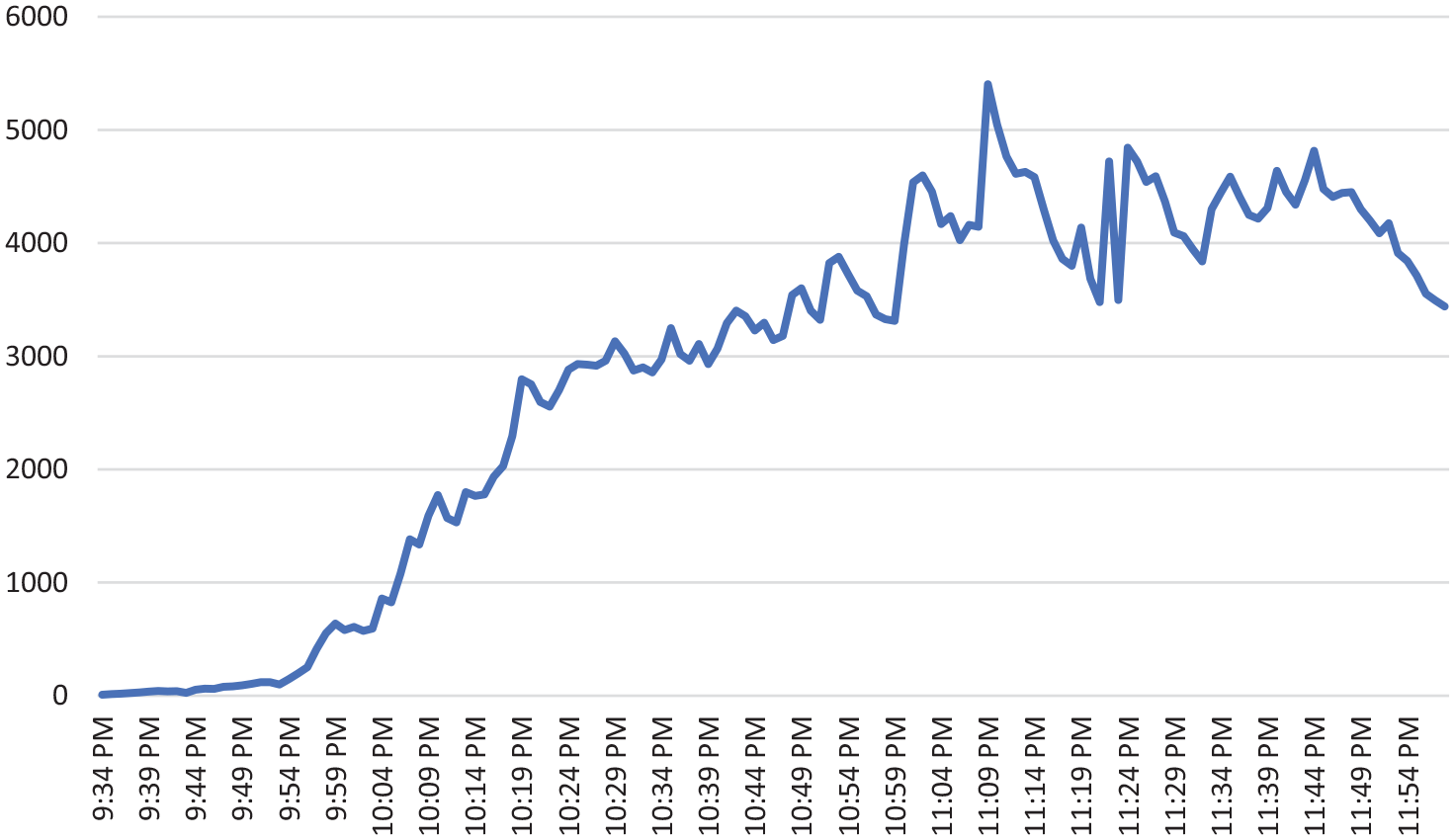
Number of tweets tagged #PorteOuverte, 13 November 2015.
Sample Characteristics
The corpus consisted predominantly of retweets (92.74%), followed by original tweets and @ replies (0.37%). This was similar to previous research suggesting that tweeters amplified #PorteOuverte in order to “pass on” a positive message and rarely interacted with other users on the hashtag (Petersen et al., 2018). Analysis of the metadata suggested that many of those retweeting this content were not physically present in Paris during the attacks. Of the 92 users who geotagged their locations in the entire corpus, only 26 were in the French capital with the rest linked to locations in countries as diverse as the United States (9), the United Kingdom (6), Spain (6), and Egypt (3) (see Table 1). However, it should be acknowledged that they accounted for only 192 tweets in the entire corpus, and therefore they could not be considered representative of all tweeters in the dataset. This dearth of geotagged tweets was congruent with previous research suggesting it was not a common practice among tweeters due to privacy concerns (Malik et al., 2015). It also indicated that few tweeters had followed Lapoix’s instruction to geotag safe spaces during the attacks (Tikka, 2019).
Country of Origin for Users Who Geotagged #PorteOuverte Tweets.

Although it was not possible to use these metadata to accurately capture their exact location, there was some evidence to suggest that the hashtag was being used by tweeters watching the attacks from afar. In terms of language, only 51.45% of the corpus (including retweets) were in French. This compared to just over one third (37.47%) that were in English and Spanish (6.1%). The international audience following the hashtag was also reflected in the top 10 most shared hyperlinks, which directed users to media coverage of #PorteOuverte in publications as diverse as USA Today, El Pais, and the Huffington Post (US). Although Parisiens may have been sharing these links, it seemed that many of those contributing to the hashtag were not in a position to offer help to those seeking shelter in the aftermath of the attacks.
Top 50 #PorteOuverte Tweeters
Although our focus was on its broadcasting and gatekeeping dynamics, it was still important to identify the most active tweeters in #PorteOuverte. Similar to previous research into crisis hashtags (Bruns et al., 2012; Lotan et al., 2011; Reilly, 2016), there was a long-tail distribution of user activity within #PorteOuverte. A total of 208,015 tweeters were identified in the corpus, the majority of whom (149,671 or 71.2%) only posted once during the night of the terror attacks. The top 50 contributors were responsible for 1.42% of the tweets in the dataset. The majority of these tweeters were citizens (74%), followed by bloggers (8%) and suspected bot accounts (6%). 5 Further analysis revealed how a parody account, a business account, and an online news aggregator were among this group of highly engaged tweeters (Figure 2). There was also one account which had been removed between the attacks and the period of data analysis, which was unable to be coded.

Classification of top 50 #PorteOuverte tweeters.
Data Analysis
This study used SNA to identify the key broadcasters and gatekeepers during the four peaks of #PorteOuverte activity. SNA empirically explored whether this organizational hashtag conformed to the “broadcast networks” of political-oriented Twitter streams, “hub and spoke” structures that allow non-elites to be periodically elevated into positions where they influence information flows (Jackson & Foucault Welles, 2016; Meraz & Papacharissi, 2013). Like Vicari (2017), our focus was on the “life story” of a Twitter stream and how “power roles” transfer between elite and non-elites, as well as collective and individual actors. We adopt this definition of gatekeepers and broadcasters, with the former indicating users whose posts are the most heavily retweeted, and the latter referring to those who most frequently retweet content. This was used in conjunction with the theoretical framework of networked gatekeeping (Meraz & Papacharissi, 2013) and curation (Bennett et al., 2014), which refers to how users co-curate and co-create information flows on the microblogging site. Scholars like Barzilai-Nahon (2008) emphasize these functions as forms of information control within online social networks, which revolves around the “editorial” decisions made by users. Therefore, a key objective of this study was to identify which actors exercised informational power within #PorteOuverte, and whether these communication dynamics shifted as events unfolded on 13 November 2015.
DiscoverText was used to sample tweets from the four spikes in Twitter activity under investigation. These were then exported into NodeXL Pro. Our focus was on who was retweeting whom during the attacks. In order to explore how these dynamics changed as events unfolded, this procedure was followed for each of the subsamples. SNA outdegree and indegree centrality measures (Freeman, 1979) were used to identify the top 10 broadcasters and gatekeepers for each peak, which were then coded according to the information provided in their bios, including their country of origin. In SNA, a network is a number of units—(i.e., nodes) connected by ties (i.e., edges). In directed networks, edges start from a node—called source—to reach another node—called target. In these networks, a node’s outdegree centrality measures how often that node is a source in the network, while indegree centrality measures how often it is a target in the same network. In network terms, retweets can then be seen as directed edges between a user (source node) retweeting another user (target node), with all retweets together forming a “retweet network.” Top broadcasters are then retweet network nodes with highest outdegree centrality values, while top gatekeepers are those with highest indegree centrality values.
The final step was to visualize each peak’s retweet network via graphs generated with NodeXL Pro. To highlight broadcasting and gatekeeping patterns, nodes were clustered according to indegree centrality, outdegree centrality, and betweenness centrality. The last measure indicates how often a node lies on the shortest path (i.e., the geodesic) between two other nodes in the network (Freeman, 1979). Nodes with high betweenness centrality scores are central in connecting different areas of the network that may otherwise be isolated.
It should be acknowledged that no generalizations could be made about the entire life story of #PorteOuverte, as per previous hashtag studies (Vicari, 2017), due to the fact that it has been repurposed during various terror attacks in Europe during the past 5 years (Tikka, 2019). Nevertheless, this study was the first to explore how the communication dynamics of #PorteOuverte evolved in real time during its first iteration. In accordance with the ethics application authorized by the host institution, as well as previous research into networked publics (Reilly & Trevisan, 2016), tweeters are not afforded anonymity due to the public, benevolent nature of this hashtag. These users were identified in order to publicly acknowledge their efforts to provide help to those affected by the terror attacks; it was considered highly unlikely that de-anonymization would result in them experiencing reputational harm.
Results
French Citizens Are Key Broadcasters Within #PorteOuverte
The conversation was very fluid, as demonstrated by the changes in the top broadcasters across these peaks of activity (see Table 2). The SNA provided further evidence that French citizens were indeed key broadcasters within #PorteOuverte, especially in its early phases. The bios of most active tweeters in three of the four sampling periods stated they were based in France, with a UK citizen being the most frequent contributor to the hashtag at 11:09 p.m. (see Table 2). This finding was broadly in line with previous research suggesting non-elites have an influential role within Twitter broadcast networks (Bruns et al., 2016; Vicari, 2017). While bloggers such as @Chantalrebelle were prominent at 9:59 p.m., citizens accounted for the majority of the top 10 broadcasters during each period. The study also showed the evolution of the hashtag from a localized phenomenon to a global one. While nine of the top broadcasters at 9:59 p.m. were either French citizens or bloggers, only half of those at 11:09 p.m. appeared to be based in the country. Non-elite individual actors from countries such as Italy, Switzerland, the United Kingdom, and the United States were among those most frequently retweeting others in the 11:09 p.m. sample. This geographic shift meant that #PorteOuverte was increasingly likely to reach international publics, as events such as the Bataclan siege unfolded later that night.
Top Broadcasters in Each Spike of Twitter Activity.

Source. Authors’ analysis via NodeXL Pro.
Note. Rankings are based on absolute outdegree values. Each user is accompanied by the abbreviation of their geolocation and user category.
The shifting broadcasting dynamics of #PorteOuverte were further illustrated by the visualization of these networks (see Figure 3). Although the first peak had the highest number of tweets (n = 6,330), broadcasting was centralized around a small number of nodes, such as @PronoOuf, who exercised significant influence on the network. This began to change during the second peak, which, despite having the fewest tweets in the study (n = 2,809), contained more nodes with higher outdegree scores. This illustrated how French citizens such as @Christ_Yvan were amplifying the voices of those who had recently discovered the hashtag and were keen to encourage others to share their tweets. It was observed that more of these nodes had higher outdegree scores compared to those in the first peak. The third peak was characterized by a proliferation of sub-retweet networks, with clusters of users tightly connected around the content being shared by key broadcasters but disconnected from the rest of the #PorteOuverte retweet network. These trends continued during the fourth peak, where there were again multiple sub-retweet networks which appeared detached from the rest of those in the hashtag. There was evidence of the more centralized broadcasting dynamics of the first peak within three large clusters, which were tightly connected around key broadcasters such as French citizens @ManonACOP and @Eternxllement. However, the largest cluster in this network did not contain any of the top broadcasters identified above.

User interactions in #PorteOuverte clustered according to outdegree and betweenness centrality.
Non-Elites Play Key Role in Gatekeeping Dynamics of #PorteOuverte
Non-elites also played an important, if not integral, role in the networked gatekeeping of #PorteOuverte, especially during the first peak where citizens accounted for half of the top 10 broadcasters. The gatekeeping dynamics appeared to be even more fluid than the broadcasting ones, with only one tweeter (@the_audreyc) being in the top 10 gatekeepers for more than one peak (see Table 3). Whereas citizens accounted for the vast majority of top broadcasters throughout the attacks, bloggers such as @Parisianavores, who ran a blog dedicated to food and tourism in the French capital, played a key gatekeeping role as the hashtag began to gain wider attention at 9:59 p.m. However, from the second peak onward, it appeared that elite gatekeepers such as celebrities and legacy media outlets became more influential. At 10:19 p.m., the list included British sports journalist and television presenter Jake Humphrey (@mrjakehumphrey) and French radio and television presenter Camille Combal (@camillecombal). The inclusion of Humphrey was noteworthy as this was the first top gatekeeper identified in the study to be based outside France. The final two peaks saw a further shift in the geographic and power dynamics. While French citizens such as @the_audreyc accounted for half the top gatekeepers at 10:49 p.m., there were only three citizen accounts in the list for 11:09 p.m., one of whom (@MrsAnneTwist) appeared to be based in the United Kingdom. Elite gatekeepers were much more prominent than during the first two peaks; these included French filmmaker and musician Para One (@paraone) and journalist Lionel Teixeira (@lioneltxr) at 10:49 p.m. There was an observable increase in international gatekeeping of the hashtag during this period, as demonstrated by UK news media website LAD Bible (@theLADBible) being the most influential gatekeeper during the third peak. Further evidence of this internationalization of gatekeeping was evident in the 11:09 p.m. sample, which included UK news organization ITV News (@itvnews) and US print journalist Ishaan Tharoor (@ishaantharoor) among those whose tweets were the most shared in the hashtag. While this might point toward a shift in the power dynamics of the hashtag, it should be noted that four of the accounts in the final peak were attributed to either citizens or bloggers. Moreover, it illustrated how the organizational function of the hashtag, much in evidence in its early stages, was increasingly being overshadowed by its affective and informational dimensions. International legacy media organizations had been quickly mobilized in order to report live from the scene of the attacks; they were not offering beds to those in need of shelter and focused on the popularity of the hashtag as part of this reporting. This finding also suggested that evidence of widely praised prosocial behavior synonymous with #PorteOuverte was more likely to be found in the subnetworks that were not directly connected to these prominent gatekeepers.
Top Gatekeepers in Each Spike of Twitter Activity.

Source. Authors’ own analysis via NodeXL Pro.
Note. The rankings are based on absolute indegree values. Each user is accompanied by the abbreviation of their geolocation and user category.
A notable omission was the French journalist responsible for creating #PorteOuverte, namely, Sylvain Lapoix. One explanation for this was that the sampling strategy did not include the time (9:30 p.m.) of this original tweet. However, it should also be acknowledged that many of the tweets analyzed in this study may have indirectly referenced Lapoix’s original rallying call, rather than directly sharing his original post.
The visualization of these networks provided further evidence of how the hashtag grew from a local to an international phenomenon after it had been amplified by celebrities and legacy media (see Figure 4). During the first peak, gatekeeping was highly centralized and clustered around a small number of nodes, such as French travel blogger Carnets de Traverse (@CarnetsTraverse). While Lapoix was not among the top 10 gatekeepers discussed above, he was connected to several of these Twitter accounts. This suggested that his original tweet had indeed been influential in the early stages of the hashtag’s evolution. The second peak showed how legacy media accounts and journalists had begun to pay attention to the events unfolding in Paris. There was an observable increase in the number of nodes in this network compared to 9:59 p.m., with a corresponding increase in the number of gatekeepers whose content was being retweeted by others. Notable gatekeepers, with the highest levels of betweenness centrality, included British television presenter Jake Humphrey, French blogger @enjoyphoenix and citizen @the_audreyc. Gatekeeping was also distributed among accounts dedicated to celebrities (the diamond-shaped nodes in the 10:19 p.m. visualization), including US pop singer Ariana Grande (@TeamGrandeFR) and British singer-songwriter Ed Sheeran (@Sheeran_FR).
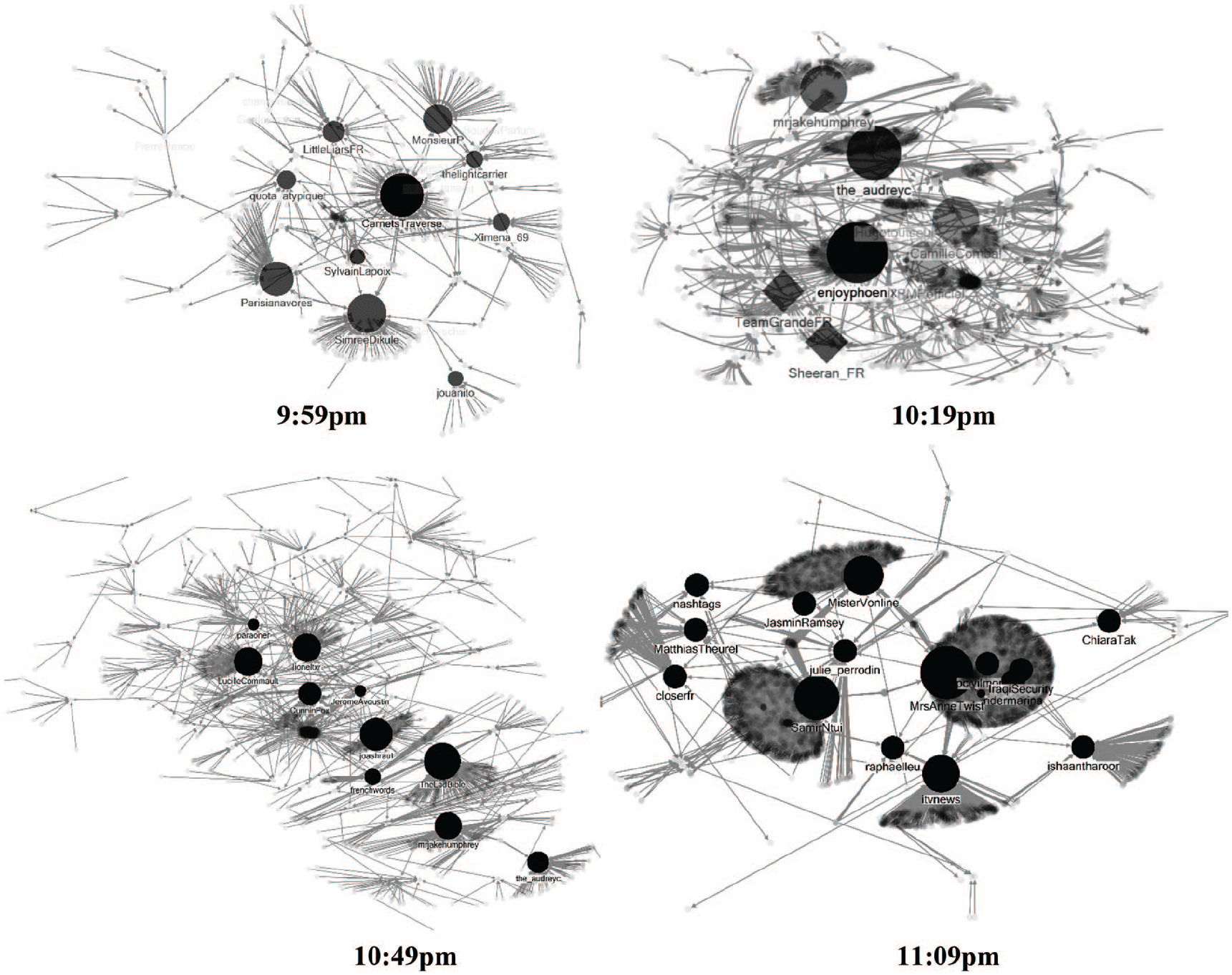
#PorteOuverte interactions clustered according to indegree and betweenness centrality.
The third peak was characterized by a growing number of decentralized clusters, as the number of accounts being retweeted multiplied. There were a few tightly connected clusters focused around nodes such as @LADBible and @MrJakeHumphrey; however, for the most part, these were loosely connected retweet subnetworks that revolved around nodes with lower scores for indegree and betweenness centrality. Finally, 11:09 p.m. saw decentralized clusters emerge around top gatekeepers such as @MrsAnneTwist and @itvnews. These were retweet subnetworks which were virtually independent from one another, showing the importance of these top gatekeepers in promoting #PorteOuverte to geographically disparate audiences on Twitter.
Discussion and Conclusion
Previous work on hashtags created during acute crises has emphasized their “democratizing” effect on crisis communication. Non-elite actors have been found to play important roles in the curation of Twitter streams in the aftermath of incidents such as terrorist attacks (Bruns et al., 2012; Jackson & Foucault Welles, 2016; Meraz & Paparachissi, 2013). Citizens increasingly turn to online platforms to address their own information needs and the digital footprint they leave often helps emergency managers allocate resources to the areas worst affected (Potts, 2014). Hashtags not only provide vital information to those affected by such atrocities but also have an affective dimension that allows those watching from afar to express solidarity with victims. #PorteOuverte has been widely recognized as an exemplar of an organizational hashtag, due in no small part to the frequency with which it has been repurposed for subsequent terror attacks in Europe. Hence, scholars such as Tikka (2019) have gone so far as to characterize such open door initiatives as ritualized connective actions in response to terrorist attacks.
This first empirical investigation of the broadcasting and gatekeeping dynamics of #PorteOuverte provided some evidence to corroborate this work. The high number of retweets (92.74%) and lack of interaction in the corpus were broadly congruent with previous research into crisis hashtags and reflected its universal message. Originally intended as an organizational hashtag to provide assistance to Parisiennes caught up in the terror attacks, the SNA provided some evidence to show how celebrities and legacy media organizations played an increasingly important gatekeeping role in the hashtag as events unfolded. Many, such as BBC television presenter Jake Humphrey, were based outside France and therefore not in a position to directly affect events on the ground themselves. Whether #PorteOuverte actually helped people find shelter in the aftermath of the attacks is of course beyond the scope of this article. Previous research has indicated that many of those using the hashtag embraced its positivity but were not in a position to offer assistance to those in need (Petersen et al., 2018). However, the presence of public figures among the top gatekeepers arguably illustrated the affective dimension of what has commonly been characterized as an organizational hashtag. In other words, elite individual actors called on their social media followers to retweet #PorteOuverte messages in order to express proximity with the victims. While often heralded as a form of prosocial behavior on the microblogging site (Garcia & Rime, 2019), Chouliaraki (2013) is among those to suggest this performance of solidarity is more about the self-image of the tweeter rather than addressing the injustices that underpin such incidents and empathizing with those affected. Yet, as Tufekci (2013) suggests about online activism (often pejoratively referred to as “clicktivism”), this helped generate much-needed attention for those wanting to help the victims of the attacks. Future work should build on this study by qualitatively exploring the motivations of tweeters who participated in the #PorteOuverte hashtag.
It is a truism to suggest that #PorteOuverte became a global hashtag after the intervention of elite individual and collective actors, many of whom were based outside France. This study certainly found some evidence to support this in the analysis of top gatekeepers, with legacy media organizations and professional journalists particularly prominent during the fourth peak. These actors were amplifying the hashtag as part of their coverage of the attacks rather than engaging in the prosocial behavior with which it has become synonymous. The global nature of this hashtag was also illustrated by the analysis of the few geotagged locations in the corpus, which revealed that over two thirds were outside France. However, these gatekeeping dynamics need to be contextualized in terms of the life story of #PorteOuverte, as well as the timeline of the attacks. French bloggers and citizens accounted for all of the top 10 gatekeepers at 9:59 p.m., just 6 min after a third explosion had been reported outside the Stade de France and 19 min after gunmen had begun their assault on the Bataclan concert hall. At this stage, it was reasonable to presume that the key gatekeepers were based in the French capital or the country itself. The visualization illustrated how gatekeeping was increasingly decentralized throughout the later peaks, with clusters emerging around tweeters such as Humphrey, who were based overseas. However, the analysis of the top gatekeepers showed that the majority were still based in France, according to information disclosed on their Twitter bios. While the early gatekeepers could be broadly categorized as non-elite individual actors, elite actors such as US journalist Ishaan Tharoor were among the most retweeted during the fourth peak of activity on the hashtag. In this way, there was some evidence of a shift in power dynamics from non-elite to elite actors in terms of whose content was traveling the furthest within #PorteOuverte. Such was the fluidity of the gatekeeping dynamics, only a single top gatekeeper appeared in more than one peak. Further work is needed to empirically explore the type of content posted by these gatekeepers, and whether they provided any other information revealing where they were based during the attacks.
The study’s other major finding was that key #PorteOuverte broadcasters were predominantly, but not exclusively, non-elite individual actors based in France. While gatekeeping was shared by elite and non-elite actors, the former were virtually absent from the list of those who were most frequently sharing content on the hashtag. Bloggers and citizens accounted for the vast majority of the key broadcasters across these four peaks. This was congruent with previous research into hashtag publics, which suggested that power dynamics shift from non-elite collective to individual actors or “minorities within minorities” (Vicari, 2017, p. 12). However, there was an observable geographic shift in the broadcasting dynamics during the later two peaks, with tweeters from Italy and the United Kingdom among the most frequent contributors at 11:09 p.m. The network visualizations also showed that broadcasting dynamics were more centralized than the more dispersed gatekeeping patterns seen during each of these peaks. One interpretation of these broadcasting dynamics was that it mirrored the diffusion of information about the terror attacks on the microblogging site, with the presence of international tweeters in the final peak illustrating how global audiences had turned their attention toward the atrocities. These were analogous with the hub and spoke structures associated with previous Twitter broadcast networks insofar as non-elite individual actors were temporarily elevated into positions where they appeared highly influential in the flow of information within #PorteOuverte. However, the fluidity of the conversations on this hashtag must be acknowledged; there was a noticeable lack of continuity in the top broadcasters and gatekeepers across these four peaks, which represented a time period of just 70 min.
Future research should build on this article by increasing the sample of top broadcasters and gatekeepers, as well the number of peaks analyzed, in order to further explore the fluidity within organizational hashtags like #PorteOuverte. This study focused on four peaks due to the limit on the number of tweets that could be imported into NodeXL Pro, and no generalizations can be made about how these dynamics evolved beyond the final one. Focusing on the life story of such hashtags gives a clearer indication of how actors, whether elite or non-elite, collective or individual, contribute to hashtags created in the aftermath of terrorist atrocities. That is not to say that analysis of the gatekeeping dynamics will invariably reveal the prosocial behavior associated with such open door initiatives. This study suggests that the amplification of these hashtags may form part of the media coverage of such atrocities rather than an effort to offer assistance to those affected. Nevertheless, this analysis indicates that non-elite individual actors play a crucial role in both the broadcasting and gatekeeping of organizational hashtags such as #PorteOuverte. It remains to be seen whether celebrities and professional journalists would have actively contributed to this hashtag if citizens and bloggers had not responded to Lapoix’s original tweet. In this way, #PorteOuverte could be accurately characterized as a citizen-led initiative in response to the November 2015 Paris terror attacks.
Footnotes
Acknowledgements
We would like to acknowledge the assistance of Ioanna Tantanasi, Danny Kirby, and Wasim Ahmed in this work.
Declaration of Conflicting Interests
The author(s) declared no potential conflicts of interest with respect to the research, authorship, and/or publication of this article.
Funding
The author(s) disclosed receipt of the following financial support for the research, authorship, and/or publication of this article: This paper is supported by the European Union’s Horizon 2020 research and innovation program under Grant Agreement No. 653390, Project IMPROVER.
