



Abstract
BookTubers (from the acronym book + YouTuber) have become key players for the publishing industry, given their influence on children and teens to promote reading and book consumption. Based on an 18-month digital ethnography that combines direct observation, digital interactions on YouTube channels, and other social media and semistructured interviews with 17 Spanish-speaking BookTubers, this study uses Pierre Bourdieu’s concepts of field and capital to analyze how BookTubers negotiate their practices with other agents of the publishing world. This article characterizes the challenges the Spanish-language publishing industry is facing in the context of digitalization to attract readers; describes the position that BookTubers have within the YouTube ecosystem, and how they relate with the platform’s actors, politics, and affordances; and analyzes the exchanges that BookTubers establish with publishers—often referred as collaborations—and their implications for their autonomy. This case study helps to understand how platformization allows new agents to transfer capital gained in social media to other cultural industries.
Introduction
In the vast territory of reading-related media practices, literary vloggers (commonly known as BookTubers, as an acronym of book + YouTubers) have gained a strong social recognition in Ibero-America as an influential group to promote reading, especially among children and young adults (Lluch, 2017; Tomasena, 2016). Most BookTubers are between 16 and 25 years old, both male and female. They do not just make book reviews, but they have adapted other types of video genres that are popular on the channels of other YouTubers, like challenges, vlogs, hauls, or tags. This discourse differs from traditional literary criticism in its emphasis on the emotional experience of books and its vindication of the authority of “the passionate common readers” (Scolari et al., forthcoming, 2021).
Even when many BookTube channels used to be focused on young adult literature, there is a growing number of channels specialized in sci-fi, horror, fantasy, or feminist literature. They all have a strong sense of community, both in the sense of their followers and other BookTubers, and by having a constant presence in other digital platforms, especially Twitter, Facebook, Instagram, and Goodreads. Unlike gamers, fashion vloggers, tech-reviewers, or beauty vloggers, most BookTubers do not have large enough audiences to live professionally through YouTube’s partners program or through product placement from advertisers. However, they have established themselves as key players for the publishing industry, which is facing a deep transformation regarding how books are marketed, distributed, and sold. Publishers see a need to relate with young audiences who spend a lot of time on social media and that—contrary to the apocalyptic visions about e-books—still love beautiful and well-crafted printed books.
Given this special position, BookTubers are an excellent case study to understand how platformization (Nieborg & Poell, 2018) allows for the emergence of new agents who have the capacity to commoditize the social capital gained on YouTube and other connective platforms like Instagram, Twitter or Goodreads, and mediate the relationships between readers, distributors, publishers, and authors. To perform this analysis, I will use Pierre Bourdieu’s field theory to analyze how BookTubers negotiate their practices with other agents of the publishing world. For Bourdieu (1993, 1996), a field is a relational concept used to describe the social space occupied by agents that share a common logic and a socially structured sense of the field (habitus). These agents possess different types of capital that they use in different forms of competition, collaboration, and reward according to specific rules of the field. Capital can be economic (the financial and productive resources), human (the accumulated knowledge and expertise), social (the network of contacts and relationships) and symbolic (the accumulated prestige). The struggles in the literary field are structured around a double principle of hierarchization. On one hand, the autonomous principle, given by the symbolic recognition of other artists, is the degree of specific consecration (literary or artistic prestige); on the other, the heteronomous principle, related to the logic of the field of power—particularly the economic field—is commercial success, expressed in book sales, number of theatrical performances, honors, and awards.
Bourdieu (1993) gives a great importance not only to study the positions and position-takings (“prises de position”) of the producers of the literary work, but also “the producers of the meaning and value of the work—critics, publishers, gallery directors, and the whole set of agents whose combined efforts produce consumers capable of knowing and recognizing the work of art as such” (p. 37). In this sense, I argue that the power that BookTubers have gained in digital platforms to make books visible has an increasing role to frame that recognition within the literary field, but also that these mediations open new disputes over the legitimacy of these exchanges in the lens of the “artistic” versus “commercial” divide that characterizes artistic fields.
In the first section of this article, I briefly characterize the challenges the Spanish-language publishing industry is facing in the context of digitalization: a hyper-saturated market of new titles with fewer copies, the menace of the big tech companies (Amazon, Google, Apple) over the book industry, and the constant battle for consumers’ attention—not only with other book publishers, but, more widely, with a hyper-saturated media ecosystem. In the second section, I describe the position that BookTubers have within the YouTube ecosystem and how they relate with the platform’s actors, politics, and affordances. Even though they do not have the popularity of videogame, fashion, or travel vloggers, they have acquired social capital and a sense of what their audience wants that is highly valuable for publishers. In the third section, finally, I analyze the symbolic and material exchanges that BookTubers are establishing with different agents from the literary field, such as publishers, authors, or book fairs. Given their popularity on online platforms and their ability to connect with younger readers, they have become key players in the promotion and marketing strategies for certain titles, especially young adult books. BookTubers use the term “collaboration” to describe these exchanges: they don’t receive a payment or a salary, just free books, access to exclusive events with their favorite authors, and the possibility to widen their social capital to become part of the industry. The power imbalance in these relationships often compromises their autonomy.
Method
This research is based on a 18-month digital ethnography (Hine, 2015; Pink et al., 2016) that is part of a broader project on the communicative practices and cultures of Spanish-speaking BookTubers. It combines direct observation, mediated interaction, semistructured interviews, semiotic-discursive video analysis, and descriptive statistics.
Fieldwork included participant observation in public events like Guadalajara’s International Book Fair (the largest in the Spanish language), which includes the closing award ceremony of the annual video reviews contest organized by the Fair, book presentations, and a BookTubers meetup. I also attended TubeCon, a YouTuber convention organized in Madrid in February 2017 that included activities for fans, advertisers, and creators, and I was invited to join some creators’ production spaces to observe their filming process. Throughout, I tracked 25 BookTubers, not only on their YouTube channels, but all their public social media profiles (mainly Twitter, Instagram, and Goodreads), and other online spaces, such as personal blogs. I also created my own BookTube channel, in which I published videos on a weekly basis about the theoretical works that guided my research, my empirical observations, and personal literary readings. This approach was rooted in an auto-ethnographic and reflective practice proposed by Hine (2015).
Complementing my ethnographic work are 17 semistructured interviews that were conducted in person (3) or through videoconference (14) and lasted approximately an hour. It included participants’ production routines, personal motivations and values, the social bonding with other BookTubers and the creation of communities among their audiences, the adoption of established audiovisual genres and the creation of new ones, the relationships with YouTube’s ecosystem and with the publishing field. Transcriptions of the interviews, along with video transcriptions, field notes and clippings, were coded using NVivo. The coding process was guided by a first rough thematic categorization; the data were further coded inductively looking for power relationships with other agents and institutions. The categories that emerged were related with their position within YouTube’s ecosystem and different forms of “collaborations” with the publishing field.
Finally, statistical data were gathered from 275 Spanish-language BookTube channels. The sample was collected through mentions in interviews and my own observations in the field, as well as through the “Channel Network” module of YouTube Data Tools. 1 From this data sample, I eliminated channels in other languages or about other topics.
Publishing: A Shrinking Industry and the Battle for Attention
In the last 20 years, the publishing industry has faced structural transformations, deepened with digitalization, regarding the way books are produced, marketed, sold, and consumed (Bhaskar, 2013; Thompson, 2013). In the Ibero-American contexts, these transformations are characterized by (a) the concentration of property in global corporations; (b) the proliferation of local-indie publishers; (c) the increase of published titles and the decrease of copies; (d) the dispersion of national markets; (e) the battle between publishers and big tech companies (Amazon, Google, Apple) for copyright, hardware and software protocols, and price setting; (f) the struggle for attention in a media-saturated ecosystem. In the last 8 years, the number of edited and sold copies in Spain has dropped by 34.67% (see Figure 1). However, a huge number of new titles are published every year. Around 86,000 new titles were published during 2016, adding to the previously total of published books of 620,316.

Number of edited and sold copies.
Publishers have minimized risks by printing fewer copies. Since 2008, the average print run per title has dropped 45.50%. According to the last data available, the average book run is 2,749 copies (see Figure 2). Another consequence of this dispersion is that it is hard to get reliable and unifiable data from so many countries, so I will only focus on the information available from the books published in Spain.
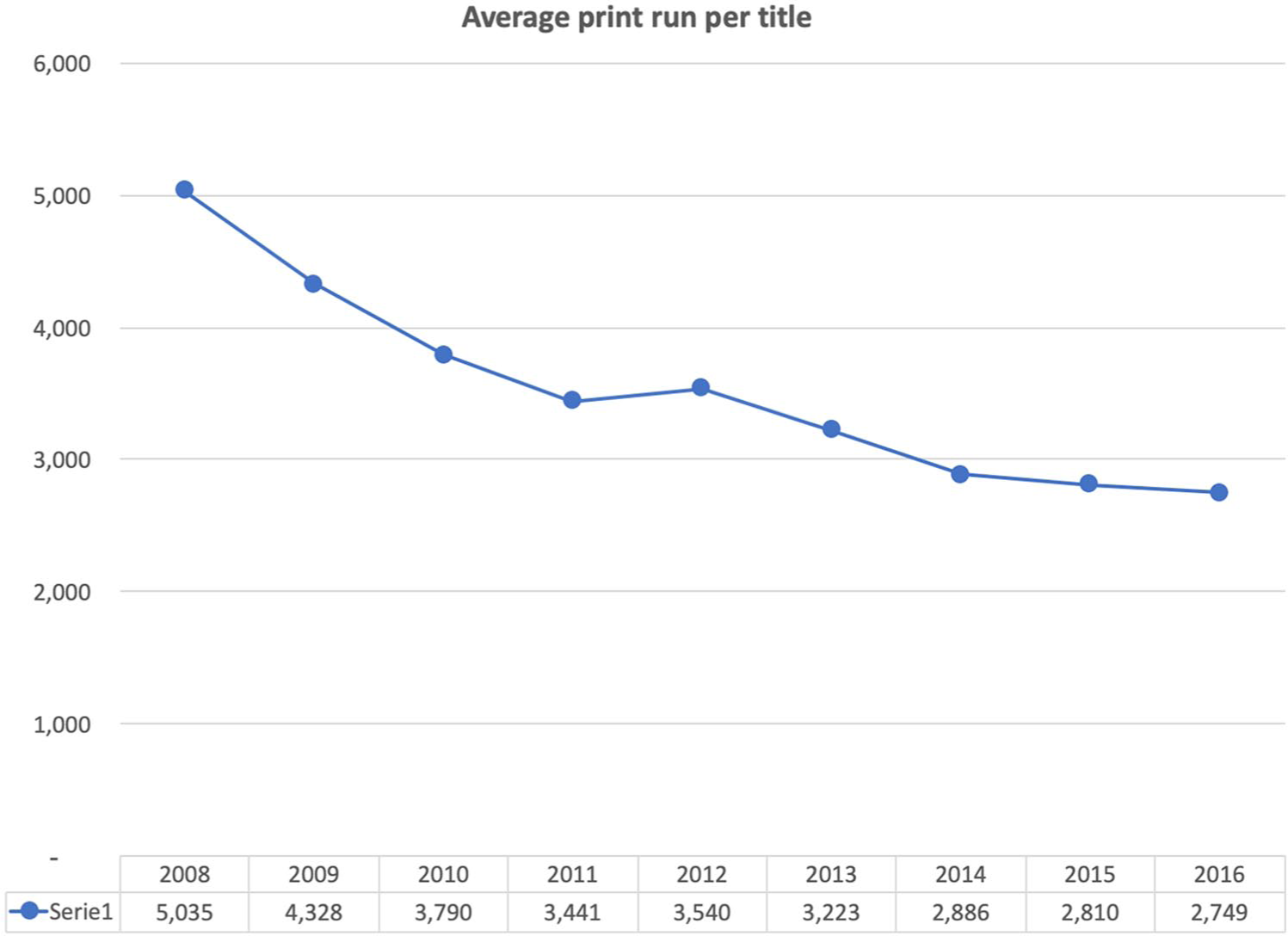
Average print run per title.
In these saturated, dispersed, and specialized markets, it is increasingly difficult for books to reach their potential readers. As Michael Bhaskar (2013, p. 286) claims, in the old world which was based on scarcity, to print a book meant to amplify it. But now, in a media landscape saturated with tweets, blog posts, photographs, videos, and Amazon’s inventory of almost everything, “the amplificatory weight of frames shift from the distributional element, making it available, to the subjective, finding an audience.” This explains why marketing and communications professionals in the publishing houses have been constantly trying to find out how to connect with active readers. With the decline of circulation and the crisis of literary magazines and supplements, they must continuously fight for customers’ attention. Reaching the potential readers of a given book is harder. The battle for attention is not a secondary issue for publishers; it is one of its core problems.
YouTube as a Platform for Creators
YouTube has faced significant transformations since it was launched in 2006 with the programmatic slogan “Broadcast yourself.” Early studies framed it as a place for participatory culture (Burgess & Green, 2009; Lange, 2014), but it soon evolved to a more complex platform, connected with the whole ecosystem of connective media (Burgess, 2015; van Dijck, 2013) with new mediators, like “multi-channel networks” (Cunningham et al., 2016; Lobato, 2016; Vonderau, 2016), new discourse conventions (Frobenius, 2014; Scolari & Fraticelli, 2017), and new communicative actors, like YouTubers (Ardèvol & Márquez, 2018).
According to Craig and Cunningham, the three emblematic and successful YouTube genres are (video)gameplay, beauty do-it-yourself videos, and personality vlogs (Cunningham & Craig, 2017). These types of videos dominate what they have named “Social Media Entertainment” (Cunningham & Craig, 2019), a proto-industry at the intersection of other cultural industries, like entertainment, advertising, and digital platforms. For example, gameplayers broadcast themselves while playing and commenting on videogames. Postigo (2016) has defined them as “game commentators.” Among the 12 most successful gamers listed by Business Insider (Clark, 2018), half of them speak Spanish, like El Rubius, Fernanfloo, JuegaGerman, Vegetta777, or Wilyrex (see Table 1). Craig and Cunningham’s study of Chinese livestreamers shows how gamers use their accumulated social capital (in the form of quantitative popularity metrics) to establish themselves as key players for three industries: game publishers, e-sports tournaments, and livestreaming platforms (Cunningham et al., 2019). Second, beauty and fashion vloggers are studied under the lens of the postfeminist and labor theories. Duffy has studied how these female content creators have built a discourse of self-empowerment and entrepreneurship (Duffy, 2017; Duffy & Hund, 2015). García-Rapp (2016, 2017), through a case study of beauty guru Bubzbeauty, studied how a creator uses different genres like tutorials or vlogs to build her reputation through the lens of celebrity studies. The third type of a successful YouTube channel is the personality vlog, exemplified by Hank and John Green who are known as “the Vlogbrothers.” They are considered “the thought leaders of, and largest creative and social entrepreneurs in the SME space” (Cunningham & Craig, 2017, p. 8). Other Spanish-speaking vloggers, like Germán Garmendia (HolaSoyGermán), EnchufeTV, and Werevertomorro also rank very high.
Comparison between most Popular YouTubers and the most Popular BookTubers.

Source: YouTube. Retrieved on August 21, 2018.
The research about BookTubers is relatively scarce. They have been studied through the lens of teenage literacies, framing them as a “networked knowledge community” (Sorensen & Mara, 2013), or from the perspective of participatory cultures and the debates around Brazilian BookTubers’ legitimacy to talk about books (Jeffman, 2017). Lluch describes how BookTubing in Spain has evolved from other online participatory spaces, like literary blogs and online forums. This movement involved very young readers and the confluence of the emergence of Amazon and other online retailers, with new marketing trends: “Authors and publishers started to address the reader directly, leaving other mediators like librarians, teachers and parents out of the reading circuit; in other words, they created marketing campaigns outside the traditional spaces, moving to the internet” (Lluch, 2017, p. 31)
Compared with these other YouTuber clusters—gamers, fashion/beauty DIY, and personality vlogs—BookTubers represent only a small niche in YouTube (see Table 1).
The size of their popularity diminishes even more when we examine the distribution of their channels according to the number of subscribers (see Figure 3). The success of BookTube channels is heavily concentrated and follows a “long tail” distribution (Anderson, 2010). The channels in the top 20% represent 87.19% of subscriptions and 90.63% of the views. If we consider the next decile, the polarization grows even more: The top 10% of BookTube channels encompass 75.82% of subscribers and 80.74% of all views.

Distribution of BookTube channels by subscribers (n = 273).
This dominant position in the YouTube field situates most BookTube channels outside traditional revenue streams. Their income through YouTube’s “Partner Program,” affiliate links from online booksellers like Amazon or Book Deposit, or through crowdsourcing platforms like Patreon are marginal. Or as a young Spanish BookTuber answered me cheerfully when asked about her income, “It gives me enough to pay for my Netflix.” Only the elite of BookTubers, those who have more than 60,000 subscribers, can take part in the “influencer economy,” having significant income through the YouTube Partner Program or from advertisers. However, most of them have, or have had, deals with multichannel networks. The general opinion among BookTubers is that these deals have not given them significant advantages. For a significant amount of their earnings (from 30% to 50%), they get access to music libraries or receive occasional feedback. Yet, in the long term, they do not find it worthwhile. Most of them have already abandoned such deals and some are planning to leave soon.
Even though they do not receive much economic benefit from their performance, most BookTubers follow the conventions to become a successful YouTuber. Many of these practices, similar to those of the gamers studied by Postigo (2016), are determined by YouTube’s affordances, which are aligned to commoditize creators’ online popularity. BookTubers expect that their channel will grow over time—in terms of number of views and subscribers—in a reasonable manner and they tend to feel frustrated when their channel “stagnates”; they constantly read their analytics page to evaluate their own performance and adapt their content to their audience’s reaction. That is, they work hard to improve their filming and editing skills and engage heavily in “building a community,” answering comments on their videos and interacting with their followers on other social media platforms, especially Twitter and Instagram. All these practices, dispositions, and knowledge can be qualified as a habitus, in terms of Bourdieu: a practical sense of what is the game about, how it is played, and what they have to do.
Like other content creators, BookTubers must frame their videos within the content standards of YouTube’s Terms of Service: They are forced to use “appropriate language”; to respect copyrighted material, especially in the use of music; and avoid violent or hate speech. In some cases, this relationship has been problematic. In March 2017, BookTuber Javier Ruescas complained on Twitter that YouTube had censored one of his videos about gay and transsexual characters in young adult books. “It’s sad,” he tweeted, with the hashtag #YouTubePartyIsOver. The case generated a discussion among the lesbian, gay, bisexual, transgender, and intersex (LGBTI) community about YouTube’s automated indexing filters for younger audiences, and forced the company to apologize. This case shows the problematic relationship between the platform’s governance standards and free speech, which has been historically linked to book publishing. How many books have challenged the cultural standards about what was considered obscene, immoral, or subversive?
In summary, being a BookTuber is not a great business in economic terms; however, it is highly positive in terms of the accumulation of other forms of capital, like human capital (the ability to film, edit, publish, and engage with others through social media), social capital (the amount of people who follow them, expressed in terms of the number of followers, subscribers, viewers), and symbolic capital (their reliability, taste, expertise, charisma, knowledge). This dissociation between economic and symbolic capital situates BookTubers in a subaltern position within the YouTube ecosystem, but puts them in a privileged position to perform the functions that publishers need to make books visible. They perform the mix of reviewer, advertiser, public relations person, and bookseller. As we will see in the next section, the word for this kind of relationships is “collaboration.”
BookTube and the Publishing Industry
The most commonly used word that my informers employ to describe their relationships with different agents is “collaborate.” This word can be used in different senses. First, it is used to refer to the cross-appearances YouTubers make as invited guests on other channels. This type of video is used as a strategy to increase popularity, as the subscribers of one channel are exposed to other creators and might also follow them. In the case of Mexican BookTubers, this was key to building a strong and clustered audience for this type of content. Second, “collaboration” is used as a euphemism for the commercial relationships with the brands that sponsor online content (to collaborate with a brand means to have an advertising contract). And in the third sense, BookTubers use it to refer to the relationships they establish with publishers, book fairs, or self-published writers. These deals are not necessarily monetary, but constitute the core of the symbolic and material exchanges with which they participate in the literary field. As Bourdieu stated in his study of the literary field, one of its core characteristics is its inverted value system. While economic capital is a form of distinction and power in most fields, in the artistic fields it is considered “suspicious.” The true artist, according to the implicit rules and beliefs of the field, produces “art for art’s sake.” Contrary to other power fields, economic motivations are considered spurious (Bourdieu, 1996).
BookTubers’ collaborations within the field are marked by this split: The most “purist” pole, moved by intellectual or artistic values indicated by the symbolic prestige of a publishing house, literary awards or critics’ reviews, tends to despise them because of their lack of intellectual credentials, their supposed “exhibitionism,” and their taste for delegitimized genres like sci-fi, horror, or fantasy; on the other hand, the commercial pole of the field, sensible to the industry’s economic pressures and desperate to sell books, tends to praise their ability to connect with young readers and tries to establish alliances with them. This characterization is obviously rough; reality is more nuanced. Most of the agents in the literary field act according to a mix of economic and symbolic motivations. There is no purism. But I think these tendencies are related to the polarization of the field and help us to clarify with which sectors of the publishing industry BookTubers collaborate.
In the next pages, I analyze how BookTubers have established power relations with the following agents in the literary field: (a) publishers, (b) authors, (c) book fairs, and (d) booksellers and retailers.
Publishers
Most of the BookTubers I interviewed have been in touch with the marketing teams of publishing houses, especially the ones focused on young adult literature. There is no need to have big numbers in terms of views, subscribers, or followers in other social media platforms, but to have a constant presence and to upload videos regularly.
Publishers invite them to special events, like movie premieres or meetups with their authors, but the main deal consists of sending them free books in exchange for reviews. BookTubers tend to thank publishers publicly, posting photos on Instagram (and Twitter and Facebook). In some cases, BookTubers can choose from a catalog which books they want to receive; in others, they receive surprise boxes with personalized messages and gifts. The ritual of opening packages is often broadcasted on Instagram Stories and YouTube, where unboxing videos are very popular among their followers, so marketing departments tend to select carefully which books they send BookTubers, depending on each channel profile.
Another common practice is to receive books to distribute among their followers, which are usually given through social media contests where followers must like, retweet, mention, or perform other actions to spread a marketing message. Through these contests, BookTubers gain social capital, while publishers benefit from the exposition of their new titles.
A Spanish BookTuber, age 36, told me about the crisis he experienced after he started to receive so many free books that he lost control of his content: You think you can get one or two books, but then you can’t get enough, because you see that your neighbor has more and is talking about a book that you want to read. So you ask the publisher for the book and it becomes a maelstrom of collaborations.
He felt responsible to review the books he received and committed to review because he knew how important those reviews are for writers and publishers, but no one was paying him to do it and the books were piling up on his shelves: “I wanted to read the books I was interested in, but at a certain point the books were dominating me.” The trouble was not only the quantity of pending books he had to review, but that he realized that he was talking about the titles that publishers wanted him to promote, not the books he wanted to read when he started his channel. As a result, he decided to cut drastically his commitments and to stick with his own agenda: “It’s so easy to say yes when they offer you all the books you want . . . But then you have to guess, which ones can I really read?”
The practice of sending free books is nothing new; publishers have been sending advance copies of their titles to key players in the industry—journalists, critics, book clubs, public figures—for a long time; it is a usual and consolidated practice. In fact, as Thompson argues, strategies to create “buzz” are key for promotion, especially if the publisher paid a high advance for a book. Advance copies and preorders create an “anticipation effect” that help to hit the best-selling lists early, which also helps to get better store placements and attract media attention (Thompson, 2013, pp. 244–251).
In this sense, BookTubers become integrated into the commercial production of books through the promotional tactics of publishers, like other content creators (often known as “influencers”) with other cultural industries, like fashion, videogames, toys, music, or tech gadgets.
A less visible dimension of this relationship is that BookTubers are also valuable as trends researchers. Publishers are constantly looking for new books, so the BookTubers’ taste and sensibility for new popular trends is highly valuable. As a publisher was quoted recently in an Argentinian newspaper, they sometimes review books that have not been published in the local market, they are aware of new TV series and movies, and they tend to have a very rich literary and cultural agenda (Krom, 2018). Some BookTubers are getting freelance jobs as proofreaders, both for unpublished manuscripts and for English books they are considering buying.
These relationships with publishers have been largely discussed within the community. In 2015, Oscar Leal (2015), a Mexican BookTuber, proposed the hashtag #Prostitubers (“prostitutes + BookTubers”) to discuss how BookTubers were faking love and passion in exchange for free books. This video generated a lot of debate, as Leal stated that he decided to end his collaboration with publishers when they asked him to delete some of his videos on his channel and, instead of publishing a bad review, to ignore the books he did not like. Another video, “BookTube, junk literature and critical reading,” published by Spanish BookTuber Maria Antonieta, deepened these criticisms (de Maria Antonieta, 2016). In the video, she questions the abuse of “BookHauls,” a type of video genre in which the BookTuber talks briefly about the books he recently acquired, and accuses BookTubers of transforming their channels into commercial showcases for publishers.
Authors
When I asked a widely known BookTuber from Monterrey, Mexico, about her most significant experience, she answered me without hesitation that it was the possibility of establishing a personal relationship with her favorite author, the Spanish writer Rosa Montero. When she was young, Montero’s novels changed her life and turned her into a passionate reader. When she became a BookTuber, she made several videos about Montero’s books, whose links she sent to her through Twitter. Montero answered in a friendly way. And after an exchange of message, they arranged to meet during Guadalajara’s Book Fair where they filmed their encounter and became friends.
For authors and readers, the possibility of engaging through this media can be very rewarding in emotional terms. For some authors, it is very flattering to discover that someone else can be so passionate about your books and encouraging other readers to do the same. For BookTubers, like the Mexican BookTuber, it is the reward a fan has always dreamed of. A special case in this regard is Mexican author Benito Taibo, who had published several books that sold relatively well, but became a best-selling author when his novel Persona Normal (Normal Person) was adopted by major BookTubers as a favorite—to such an extent that one of my sources joked in an interview that “to become a real BookTuber you have to publish a video about Persona Normal.” This relationship was nourished by Taibo, who became a mentor and a friend for many BookTubers and has often publicly praised them as the reason for his success.
A similar dynamic between music fans and artists is described by Baym and Burnett’s in their work on fan labor in the Swedish indie-music scene. Even though their interviewees performed tasks that can be considered “professional work,” like reviewing or promoting shows, they expressed they did not feel exploited because of the possibilities of “forming relationships” with artists (Baym & Burnett, 2009). But the power balance does not work that way in every case. The proliferation of self-publishing through Amazon and other online services has increased the number of amateurs trying to reach BookTubers for reviews. Self-published writers are the most deprived agents in the field, both in symbolic and economic terms. They fight against the prejudice that they were not good enough to overcome the filter of established publishers and do not have marketing budgets for promotion or the practical sense of the implicit rules of collaboration. “I know where they come from, but they are always demanding a review, now, now, now, and they obviously want you to say that it’s the best book you have ever read, so I don’t like to expose myself to that,” a Mexican BookTuber said when he decided to stop collaborating with self-published authors when an author started to harass her on Twitter after a bad review.
Book Fairs
Other ways of transferring online popularity into the publishing field are book fairs and literary festivals, which, according to García-Canclini, are crucial for cultural industries “to reconvert their business models in relation to digital circulation and live events” (Revista Ñ (Clarín), 2018). In his view, Latin American book fairs “are the place where we see reading as sociality linked to the shared joy of texts. Hence, the importance of the BookTubers as invited guests that can have more public than a Nobel Prize winner.” Indeed, the presence of a well-known BookTuber can fill rooms, attracting young people to book fairs or book presentations. Due to the precariousness of the distribution and sales chain in many regions of Latin America, book fairs organized by local governments play a remarkable role in a book’s circulation. Some of the most important book fairs, such as those in Buenos Aires, Lima, Bogotá or Guadalajara, have started to include BookTubers in their programs.
In the case of Guadalajara`s International Book Fair, the largest in the Spanish language, it organizes two activities: first, a video-review contest called #SomosBooktubers. The first round is decided by popular vote, through the number of views and likes on YouTube; later, 10 finalists are evaluated by a specialized jury. The mechanism has been criticized by small BookTubers, arguing that it reproduces the inequalities of online popularity and questioning whether a book fair should have a more active role promoting quality debates over quantitative indicators. The finalists are invited to an all-expenses-paid visit to the book fair, where they attend the second activity, the BookTubers meetup, which features different activities for content creators. On a smaller scale, some BookTubers are getting invitations as speakers or workshop coordinators in public libraries, schools, and bookstores. In these kinds of collaborations, organizers cover travel expenses and, depending on the case, the BookTuber might receive a payment as a speaker.
Booksellers and Retailers
Even though it is not as common, some BookTubers relate to book retailers through two different strategies: first, through affiliated links to online retailers, like Amazon and Book Deposit, that are posted in the description section of the videos. As Albrecht has noted, these links explicitly mention the titles they discuss on the video and the online selling of the product, thus “reading on BookTube is intricately linked with consuming. The platform is not only about sharing among a community what to read next but also what to buy next. Thus reading becomes a commodity” (Albrecht, 2017, p. 33). The other strategy—significant but not generalized—is the collaboration of three well-known Mexican BookTubers with a retailer and bookstore specialized in young adult literature. In 2016, during Guadalajara’s Book Fair, the stand of this bookstore featured pictures of three well-known BookTubers, accompanied with the book covers they usually show on their channel—the exact selection of titles they were selling. In this case, the personal brands of these BookTubers were used as an endorsement for a small bookstore.
BookTubers Become Authors
The last way to commoditize the accumulated capital of YouTube and other social platforms has been, of course, to convert popular BookTubers into authors. In the last 5 years, all the most popular BookTubers have published books for children and young adults. Apart from Javier Ruescas, who already had a long trajectory as a writer (he published 16 books), the 20 most popular BookTubers have become authors of well-established publishers. With this move, publishers not only acquire a title that already has a network of loyal fans, but they assure that the publishing process will be accompanied by a series of promotional videos, tweets, Instagram photos and stories, and full venues to organize a book tour. The trend has been so remarkable that Sebas Mouret—the only one who has not published anything—during a Q&A video with his followers answering why he has not published a book, responded: “I’m not sure I have sufficient literary quality to publish a book, so you’ll have to wait” (Mouret, 2017). To be sure, this process is neither new nor isolated. As Thompson explains, in the market of contents, where publishers compete for the best titles, the value of a book increases depending on an author’s popularity. In fact, publishers use the word “platform” in a different sense than scholars are using it and that Gillespie (2010) has examined deeply. “Essentially, platform is the position from which an author speaks—a combination of their credentials, visibility and promotability, especially through the media” (Thompson, 2013, p. 87). Or, to put it simply, the built-in audience attached to an author that can guarantee a certain number of book sales.
Thus, in the publishing business, there are authors who, because of their accumulated capital, are a brand on their own (e.g., Stephen King, Danielle Steel, J.K. Rowling) and who have the power to impose conditions on publishers through their literary agents. Conversely, authors who have not been able to sell enough copies of their first books tend to be in a weak position, because of this lack of audience. That is why nonfiction books from TV celebrities, chefs, politicians, athletes, and other personalities are a big revenue generator for publishers. In the case of the tech gurus studied by Marwick (2013) in her book Status Update, for example, online popularity was converted into revenue precisely through book contracts.
The landing of BookTubers as authors is part of the larger editorial trend to publish books signed by YouTube celebrities, like the fashion vlogger Yuya, comedians YosoyGerman, or Chumel Torres, or gamers and entertainers like Veggeta777 and Willyrex, El Rubius, or DalasReview. Even though these publishing trends are common, there are constant disputes over the cultural legitimacy of these transferences between cultural fields. In January 2018, Spanish BookTuber Javier Ruescas complained publicly on Twitter when Planeta published a book by DalasReview, a popular YouTuber famous for his misogynistic and homophobic content. “You can’t publish Good Night Stories for Rebel Girls and then publish Dalas. I know that money is money, but THERE ARE LIMITS.” Why was Ruescas complaining, considering that Dalas’ audience on social media is significantly greater than he can achieve through book publishing? (Dalas has 8.7 million subscribers on YouTube). The response is symbolic legitimacy; books still have great social prestige. Another example was the presentation of the book by Chilean YouTuber Germán Garmendia during Bogotá’s International Book Fair in April 2016. A crowd of young fans blocked the street traffic surrounding the building, while the Noble Prize Winner Svletana Alexievich was speaking in a smaller auditorium. The incident triggered a wave of indignation in media about the alleged invasion of young barbarians into the sacred precincts of culture (El Espectador, 2016; El Tiempo, 2016; Paulettee, 2016).
Discussion
This case of BookTubers illustrates how platformization allows the social and symbolic capital acquired on digital platforms like YouTube, Instagram and Twitter to be transferred to other cultural industries. Similar to what Cunningham et al. found when studying Chinese gamers, the popularity that creators accumulate online is becoming a crucial resource disputed by platform owners, advertisers, and the creators: For platforms, such a large number in the online audience is ideal to advertise. But the fans will follow the livestreamers if they move to different platforms. It is a challenging battle for platforms to avoid losing players and their audiences. (Cunningham et al., 2019, p. 8)
Pierre Bourdieu’s field theory enables us to examine how BookTubers accumulate power by positioning themselves between two different fields: on one hand, the field of “Social Media Entertainment” (Cunningham & Craig, 2019); on the other, the literary publishing field.
Compared with other popular YouTubers, like gamers, fashion/beauty or personality vloggers, BookTubers have a dominated position in digital platforms: They are not popular enough to profit through YouTube’s partners program or advertisers. However, their social and symbolic capital among passionate communities of young readers is highly valuable for the publishing industry, which faces a big struggle to make books known in a hyper-saturated and competitive market. What differentiates this case is that it shows how, even when most creators cannot afford the level of popularity required to become part of the established “influencer economy,” when they overlap with a field that works on another scale, they can occupy a key position in certain niches or build a professional career as manuscript readers, community managers, librarians, or authors. “Collaborations” with different agents of the literary field is a good way for BookTubers to accumulate capital. It enables them to transform the resources they receive from the publishing world (like free books, merchandizing, access to events or authors) into online popularity. By the same token, the social capital acquired on digital platforms, expressed in standardized quantitative indicators (number of views, subscribers, followers) and active engagement with their audiences, gives them more power to make books visible (and salable) in the literary field.
So far, the “collaborations” between BookTubers and publishers are not paid. This can be framed through the lens of digital labor and the debates around the unpaid labor, precariousness, and exploitation of content creators (Fuchs, 2014; Terranova, 2000). Duffy’s (2017) work on fashion vloggers has already showed how discourses on “collaboration” or “partnerships” with established brands, mask firmly entrenched power relations. BookTubers, like fashion vloggers, often work “for exposure” or in exchange for nonmonetary compensation. This noneconomic gratification can be rewarding enough to justify their participation, as some interviewees have stated, and coincides with Baym and Burnett’s (2009) work on music fans. However, even when these gifts seem convenient for them as reading fans, they can be problematic: In some cases, they compromise their autonomy to set their own agenda. In others, they receive critiques from their audience or from other BookTubers for doing it “just for the money” or “selling out.”
Unsurprisingly, dominant BookTubers also embrace what Duffy (2017) calls “the passion-payout solution” (p. 183): They publicly acknowledge branded relationships with publishers and booksellers, but only if they “love” their books.
The Consortium of Emerging Directions in Audience Research (CEDAR) found the same problematic trend in their study about the future of audience research: one of the main challenges for researchers is related to the “co-option” of audience creativity by major powers and cultural industries (Das & Ytre-Arne, 2017). In this sense, a comparative approach using field theory to study the dynamics of different types of social media creators and their relationships with other industries, like videogames, fashion, food or tourism, would enable us to have a better understanding of the dynamics of these exchanges.
Another key element of field theory is Bourdieu’s (1993) emphasis in studying not only the agents who produce literary works, but “the whole set of agents whose combined efforts produce consumers capable of knowing and recognizing the work of art as such” (p. 37). The ascent of BookTubers and other digital creators in the literary field opens important debates regarding the status of their mediation as a heteronomous force that pushes readers’ perception toward commercial interests instead of autonomous artistic values. One of the most prominent forms of capital transactions between fields is the trend to transform BookTubers into authors. Even when celebrity books are not new—publishers are always looking for titles from chefs, politicians, athletes, and other famous people—book publishing is becoming a good way to monetize online popularity, as Marwick (2013) argued in her work about tech micro-celebrities.
The controversies around the books of DalasReview and Germán Garmendia reflect these tensions: first, by revealing how book publishing still has the power to confer cultural legitimacy, even when authors have a much wider audience in digital platforms; second, by highlighting the fear that mainstream popular products may displace highly valuable art from the center of public debate. From a wider perspective, the overlapping of these two different cultural logics is at stake if the popularity principles enthroned by digital platforms—the more likes you get, the more you are worth—can become the legitimizing principles in other cultural and artistic fields.
It is important to keep analyzing the way that platforms—mediated by affordances, algorithms and terms of service—contribute to making certain contents visible and popular, thereby reinforcing the values and logic of mainstream publication but leaving unnoticed some of the eccentric, marginal, and revolutionary books that have been central through the history of arts, knowledge, and ideas.
Footnotes
Acknowledgements
I thank the anonymous reviewers and the guest editors of this Special Issue, David Nieborg, Thomas Poell, and Brooke Erin Duffy, for their valuable comments. I also thank John L. Sullivan and my PhD supervisor, Carlos Scolari, for their feedback on earlier drafts of this research.
Declaration of Conflicting Interests
The author(s) declared no potential conflicts of interest with respect to the research, authorship, and/or publication of this article.
Funding
The author(s) disclosed receipt of the following financial support for the research, authorship, and/or publication of this article: This research was funded with a PhD Scholarship by the Mexican National Council for Science and Technology (Conacyt).
