




Abstract
With increasing socioeconomic precarity and ecological threat, resilience has become the individual responsibility and moral obligation of the neoliberal subject. Digital labor platforms are a clear expression and beneficiary of this development, offering hustling as a way to gain resilience as a micro-entrepreneur. However, we present evidence to the contrary, demonstrating how hustling in the digital economy erodes resilience on a systemic level. For this purpose, we draw on an in-depth, ecological ethnography about Poshmark, a social commerce platform for predominantly female hustlers to sell clothes. We tell the story of a pattern set in motion by the rapid scaling of the platform, which requires hustlers to do more and more click-work to yield smaller and smaller sales. As a result, they are caught up in a runaway dynamic that erodes the resilience of the ecology as a whole.
Introduction
Resilience is the capacity of a complex system to adapt to shock—to reorganize and change in order to stay the same (Walker, 2020). While the term has its origins in ecology (Folke, 2006), it has recently become associated with individualizing personal responsibility to “bounce back” (Bracke, 2016). Thus, resilience has become part of the moral obligation of the neoliberal subject to hustle in the face of adversity and to triumph over systemic problems such as job insecurity, growing debt, deteriorating social welfare, and increasing environmental threat (Neocleous, 2013). This individualized resilience, however, denies its fundamentally systemic nature and the interconnection and vulnerability to one another, instead praising self-mastery (Butler, 2004).
Individualized resilience and self-mastery are at the core of digital labor platforms, promising to lower the barriers to economic activity through “be your own boss” micro-entrepreneurship (Ravenelle, 2019). Having an idle afternoon is then an opportunity to make money driving for Uber (Rosenblat, 2018), an unworn dress becomes a potential sell on eBay (White, 2012), and the private home turns into an asset to be rented out on Airbnb (Knaus, 2020). The micro-entrepreneurs themselves, and increasingly research and media, use the term hustling to refer to the work conducted on these platforms (Guillebeau, 2017; Watkins, 2019). 1 However, in contrast to earlier connotations of stigmatized and quasi-legal labor, such as petty crime and sex work (Polsky, 1967; Whyte, 1943), to hustle has become part of mainstream capitalism, celebrated as the expression of a resilient subject “making do” in a world where risk is now an existential part of the human condition (Fleming, 2017). Yet, in our ethnographic study, we found evidence to the contrary, demonstrating that hustling on digital labor platforms exhibits wider, systemic patterns that can result in the erosion of resilience. The purpose of this article is to explain the dynamics of how that happens.
Associated with make-do improvisation under precarious living-conditions, hustling is the constant search for economic opportunity outside of traditional employment structures (Thieme, 2018). Digital labor platforms facilitate and profit from hustling, as they provide the means to earn an income without formal employment, furthering the historical trend toward flexible temporary work arrangements and the restructuring of the modern job society (Arendt, 1958; Márton and Ekbia, 2021; Murillo et al., 2017; Schor and Attwood-Charles, 2017). In this sense, digital hustling encompasses a broader phenomenon than gig work, which refers to only a particular type of digitally mediated service work that is on-demand and task-based, and offered by nominally private workers, such as driving for Uber or freelancing on Upwork (Fleming et al., 2019). For a digital hustler, however, gig work is but only one revenue stream to be combined with those from other digital platforms, including renting out accommodation on Airbnb, selling crafted goods on Etsy, publishing do-it-yourself tutorials on YouTube, monetizing a personal brand on Instagram and so forth (Chan, 2019; Ravenelle, 2019). Digital hustling is, therefore, not tied to a particular type of work or platform, but a coping strategy to utilize all platforms available for generating income.
The current rise of digital hustling is taking place against the backdrop of neoliberal hegemony and capitalism reinventing itself as platform capitalism (Ekbia and Nardi, 2017; Srnicek, 2017). A platform is, first and foremost, a particular business model that profits from the interactions between the different user groups it mediates (Katz and Shapiro, 1994), such as social media or information platforms (e.g. Google or Facebook), cloud or innovation platforms (e.g. Amazon Web Services or Apple’s iPhone), and transaction platforms (e.g. Airbnb and Uber; Caplan and Boyd, 2018; Van Dijck, 2020; Van Dijck et al., 2018). Data are key, as they provide insights into user behaviors and tastes used to further capital expansion and labor exploitation (Ekbia and Nardi, 2017; Srnicek, 2017). This includes exploiting the attention of users as audiences for advertising as well as their cognitive and behavioral surplus as prosumers of cultural production and computational data (Caplan and Gillespie, 2020; Graham et al., 2017; Scholz, 2013; Smythe, 1977; Terranova, 2000; Zuboff, 2019).
With the rise of platform capitalism, concerns have been raised about the workers’ lifeworld (Gandini, 2018; Lehdonvirta, 2018; Rosenblat, 2018; Schor and Attwood-Charles, 2017; Shapiro, 2018). In particular, research has shown a pattern that workers mold their lives to fit the demands of digital labor platforms. For instance, social media influencers, such as on Instagram, have to take on significant amounts of unpaid aspirational labor to boost their profiles (Duffy, 2017; Guarriello, 2019; Pruchniewska, 2018), while workers on labor platforms, such as TaskRabbit, have to accept nearly all task requests or face being down ranked by the platform (Ravenelle, 2019). In other cases, workers are incentivized to work when demand is high, leading to irregular hours, overwork and often exhaustion (Wood et al., 2019). This pattern is the product of coercive pressures exerted by algorithmic management systems (Fleming et al., 2019), as they pit workers against one another vying for visibility toward customers, and determining the remuneration workers get for their labor (Chan, 2019; Cotter, 2019; Duffy et al., 2021; Gruszka and Böhm, 2020; Kneese and Palm, 2020; O’Meara, 2019; Wood et al., 2019).
Our conceptual point of departure into digital labor platforms is an ecological framing of digital hustling. An epistemological stance diametrically opposed to modernistic reductionism, ecological thinking commits a researcher to trace patterns across arbitrary “social/natural boundaries or social/technical dichotomies” (Star, 1995: 2) and, thus, to understand their wider, systemic dynamics (Bateson, 1972, 1979; Meadows, 2008). In this sense, “ecology” does not only refer to protecting natural environments. It is also distinct from what management research understands under the rubric of business and innovation ecosystems, as arrangements of actors and artifacts that coalesce around an integrating organization or platform (Jacobides et al., 2018). Rather, this article is a study about a dynamic ecological pattern (or melody, if you will) of digital hustling and not about a representative sample of individual experiences of platform workers (Zundel, 2014).
To demonstrate how digital hustling reduces resilience, we draw on an ethnographic study of Poshmark, a social commerce platform targeting women to sell new and used clothing and accessories to other platform members. Selling involves the promotion of items through two central functions, sharing and following, both of which involve high amounts of click-work. As the platform scaled its user numbers, we observed how this click-work triggered a self-reinforcing arms race among the Seller Stylists, outdoing each other in their attempts to win the attention of potential buyers in an increasingly saturated market. As a result, it required more and more click-work to yield smaller and smaller sales, which is symptomatic for a pattern of erosion. This dynamic turned runaway and consumptive, both for the Seller Stylists and platform alike, rendering the entire ecology (i.e. the Seller Stylists, their families, their suppliers, their customers, Poshmark [the company], Poshmark employees, early investors, etc.) less resilient (Bateson, 1972). Hence, our findings contribute to the understanding of the wider, systemic conditions of digital hustling in platform capitalism, as we explain the pattern of digital hustling as runaway erosion. That is, individual efforts to bolster one’s resilience by hustling on digital labor platforms contribute to the intensification of the very same precarity that makes digital hustling necessary, and digital labor platforms attractive in the first place. Ultimately, such dynamics of erosion are indicative of an unsustainable business model at the heart of platform capitalism that is kept alive by offloading the social costs of its exponential growth onto the hustlers as the new ideal of the neoliberal subject.
Empirical setting and methods
Poshmark was launched in the United States in 2011, growing its user base from around 1.000 to 31.7 million active users in 2020, of which 80% are women (Securities and Exchange Commission (SEC), 2020). With this exponential growth, the platform expanded operations to Canada in 2019 and Australia in 2021. The basic business model is to match sellers (or Seller Stylists) of fashion items with potential buyers, charging a 20% commission on each item sold, with a flat rate of US$2.95 for sales under US$15 (Poshmark, n.d.). In total, the company raised US$153 million from venture capital (Crunchbase, n.d.) and returned their first profitable quarter in late 2020, the same year they launched an inital public offering (IPO) raising another US$277 million (Wilhelm, 2021). 2
Allowing users to follow one another and to share fashion items, Poshmark emphasizes social shopping and community. The interface of the app is designed accordingly based around the following three screens: (1) the closet, (2) the feed, and (3) news (see Image 1). The closet displays the listings (e.g. shoes, dresses, jewelry), the respective Seller Stylist is willing to sell. Similar to Facebook’s wall, the second screen is the community feed, aggregating personalized content from across the platform. Finally, the news screen displays personally relevant messages, informing the account owner that, for instance, one of their listings was liked by another user.
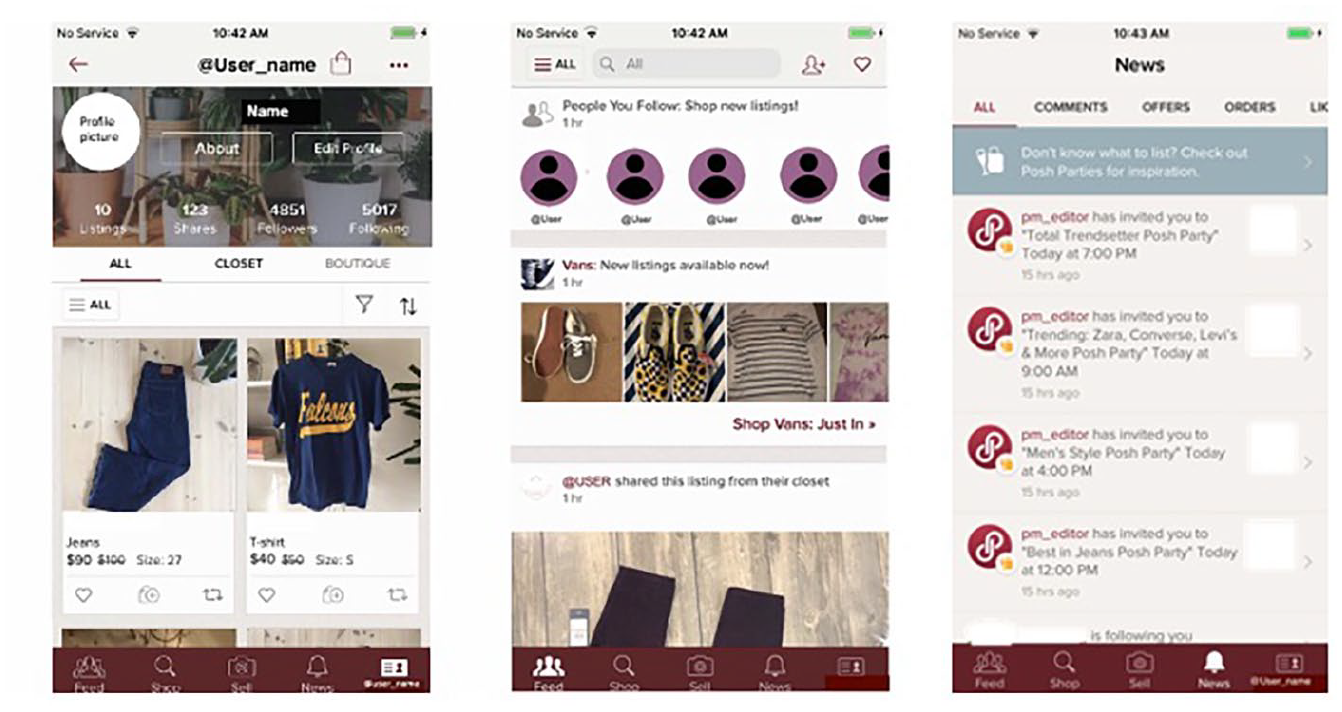
Closet, feed, and news screens.
Characteristic for this kind of online social shopping, Poshmark is a hybrid between a transaction platform and social media platform, crowdsourcing the curation and sales of fashion items to their hustling Seller Stylists. For this purpose, the underlying algorithmic management system is designed to incentivize Seller Stylists to boost their sales by (1) sharing their listings and (2) increasing their following. To grow one’s business on Poshmark, therefore, involves high amounts of repetitive clicking of the share and follow button, as that pushes a listing to the feeds of more followers and, importantly, increases its ranking in relevant search results. This continuous sharing and following is a central aspect of the Poshmark hustle and at the core of the runaway dynamic we describe in the empirical analysis below.
The ethnographic fieldwork was done by the first author Nicola Ens from September 2018 through January 2021. Because the setting is spread across online and offline spaces, empirical research was a hybrid of traditional (Hammersley and Atkinson, 2007; O’Reilly, 2012) and digital ethnography (Hine, 2016; Pink et al., 2016). Online participant observation took place following 266 accounts on Instagram, 16 Facebook groups, 2 Reddit threads, and 10 YouTube channels, with varying degrees of involvement (Spradley, 2016). Nicola also engaged on Poshmark, making several purchases and practicing sales techniques, and collected relevant company emails about tips, promotions, and so forth. Offline, Nicola attended the annual PoshFest conference in Phoenix, AZ, in 2019 with roughly 1600 Seller Stylists, during which she built close contact with a group of five Seller Stylists, who became key informants. Finally, Nicola also collected documents from the Internet Archive, blogs, news articles, as well as company information, such as press releases and terms of service, to contextualize observations and findings. In total, the data corpus consists of 495 fieldnotes and documents, as well as 37 ethnographic interviews.
The data were analyzed thematically (Flick, 2014), tracing processes, not actants, in order to understand their dynamics as part of a wider, ecological pattern (Bateson, 1972; Meadows, 2008). Sharing piqued our interest because of how little sense it made at first that Seller Stylists spent hours every day just clicking the sharing button. We then traced sharing and its interaction with other processes, such as sales growth, which led to the recognition of how a simple feature (more shares = more sales) can result in a runaway dynamic that erodes the resilience of the entire ecology.
In the following, we tell the story of the Poshmark hustle, presenting a thick description of what it is like to be a Seller Stylists as observed and experienced by the first author. We maintain the tone of the ethnographic fieldwork by taking Nicola’s perspective using first person. All Seller Stylists are referred to by pseudonyms and identifiable details are altered.
The Poshmark hustle
The first item I bought on Poshmark was a black Marmot raincoat (FN_119). I had borrowed the same one from a friend countless times for outdoor holidays and, having fond memories of hikes in the rainy English countryside and on the blustery beaches of west coast Canada, I decided to buy my own. I knew exactly the coat I wanted but did not know what it was called specifically. I began typing Marmot into the search bar of the app and, when the word was auto-completed, suggesting the brand, I clicked through. This brought up a range of listings, from tops to leggings and shorts. Filtering for jackets and coats, I scrolled through a seemingly endless list as I clicked the like button for those that looked like a match. Liking on Poshmark alerts Seller Stylists that they have a potential customer on the line and some reached out to me, offering a reduced price or free shipping. The coat most similar to my favorite borrowed item looked near perfect, but I was unsure of its thickness and contacted the Seller Stylist to ask. She added some extra pictures, which reassured me; I clicked the buy button and completed the transaction (see Image 2). Purchasing this raincoat was deceptively easy, however, behind the scenes was a significant amount of hustling, which went into getting me to find and ultimately buy it.
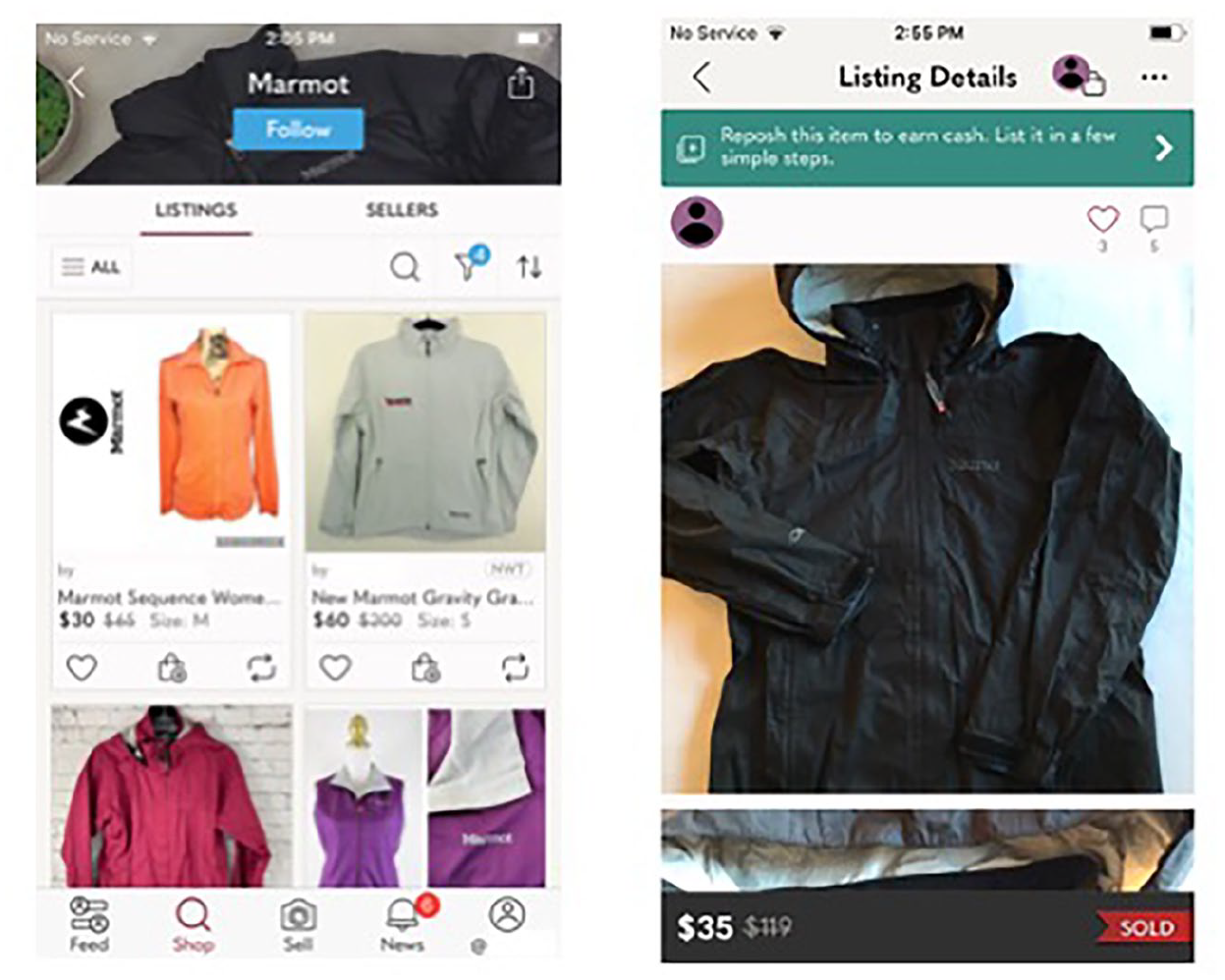
The search results, the perfect coat.
The pattern begins
Enter Jessie, who I met at PoshFest 2019 in Phoenix, AZ. Clad in a bright yellow blazer, colorful printed skirt, and adorned with a “sustainability rocks!” pin, she was a burst of energy and enthusiasm. Jessie is a part-time Seller Stylist who has been on Poshmark since January 2013 (PM_26). As a student in her early 20s, she was living in Boston with a little space for her growing wardrobe; selling her old clothes on Poshmark to make room for the new kept her closet from overflowing. She was pleasantly surprised at how quick merchandise moved, loved the community feel of the platform, and the ethos of recycling. When Jessie moved from her small apartment into a house, she gained the extra space she had been missing, and expanded her revolving closet into a part-time business. Nearly 8 years later, Jessie has a career, working 30 hours a week in a dentist office, and a daughter. Having set herself a target of reaching US$60,000 total sales, she has been hustling a lot, proudly telling me, “I’m one $60 sale away from hitting my goal and I am determined to make it happen!”
Seller Stylists hustle on Poshmark for a variety of reasons. For Jessie, it is paying the bills, creating room in the family budget for fun activities (FN_369). For others, it is about affording necessities, such as for Michela, a full-time office worker in her 40s, who gave me a ride back to my hotel from a local Poshmark meetup on the outskirts of Phoenix (FN_312). When I got in the car, she immediately apologized that, despite the 40°C heat, she had no air conditioning. She went on that paying for the AC had been her original motivation for becoming a Seller Stylist. While she had already earned enough to cover the expense, she had opted to instead save the money for her upcoming wedding. She hoped that, eventually, selling on Poshmark would also help her save up for retirement.
Another group of sellers are stay-home moms, like Geri, who sees Poshmark as a solution for balancing the family budget amid rising day-care costs, which prevented her from returning to a nine-to-five job (PM_05). After the birth of her third child and a family move, she had realized, “that daycare cost would be as much, if not more, than our mortgage payment. We had to make a plan.” Poshmark provided her with a modest income, which covered some of the household expenses, while allowing her to be home with her toddler and drop-off her two other children at school. Finally, there are those attracted by the opportunities of running their own business. Danika, for instance, started selling part-time after she dropped out of college: “I just thought I’d do it to make some extra money [. . .]. I started out of my parents living room and have grown it into a 7000 + item business, operating out of a 3,000 square foot warehouse” (PM_04).
More shares = more sales
A core part of the Poshmark hustle is a form of promotion referred to as sharing. Jessie, in her quest to reach US$60.000, was using self-sharing as a way to promote her own listings as her main sales tactic. The procedure is straightforward; when Jessie clicks the share button for a listing, it is moved to the top of her closet and pushed to the feeds of her followers. As was the case with the Marmot jacket I purchased, sharing also boosts the listing in relevant search results, as most recently shared items are displayed first. Therefore, it is vital to provide good coverage of one’s closet by constantly self-sharing its contents, ensuring that if a buyer performs a related search, the listing will be displayed higher in the results than competing products.
As a second option, Seller Stylists can also promote their listings by sharing them through the community. This community sharing is what makes the platform social, creating constant interactions between Seller Stylists, and is included in the criteria of becoming a Poshmark Ambassador, a title that certifies an experienced seller. Crucially, community sharing is based on norms of reciprocity. For example, Jessie starts following a new seller, Amanda, who has a similar aesthetic to her closet. She shares four of Amanda’s listings, which moves them to the top of Amanda’s closet and, at the same time, pushes them to Jessie’s own followers. This might seem counter-intuitive for Jessie, as her followers are now exposed to a potential competitor; however, the hope is that Amanda, seeing the notification that Jessie shared her listings, will reciprocate.
Sharing, in both its forms, is designed to crowdsource the curation of the platform to the Seller Stylists, as each of them is expected to attract those followers who find their respective fashion sense appealing and are inclined to buy from them. The curation mechanism is for Seller Stylists to decide which listings to share and, thus, to signal what they like best. By displaying those listings prominently in closets, search results, and user feeds, they are easier to discover by potential buyers. In this sense, hustling on Poshmark is different from other platforms like eBay, because Seller Stylists combine the role of fashionista curators with being salespeople and micro-entrepreneurs. However, the fashionista side of the role has become increasingly neglected, as millions of Seller Stylists are all sharing at the same time, pressured to push their listings to the top only to be replaced by somebody else’s listings the next moment. Jessie was no exception: “I started tracking my self shares on my posh stats and am over 10k for the month now (see Image 3) and I seem to notice the more I share the more activity I see.” Looking over her dashboard, I pointed out that she had to have done around 300 clicks a day, sharing each item in her closet five times in average. I was curious when she had the time to do all of this click-work. She answered, “I try to do it in the morning or when I have downtime at work. I am terrible and sometimes share when I’m at a long red light and then I try to do it again at night.”
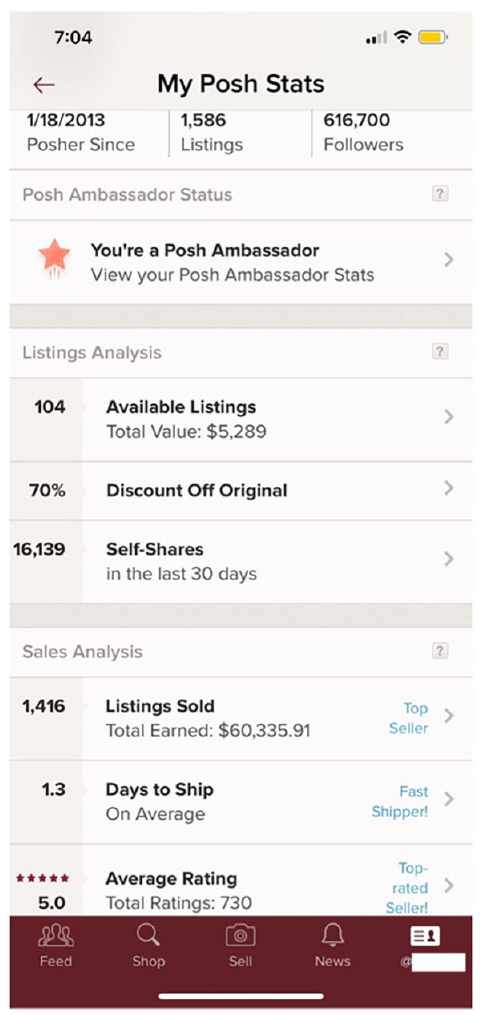
Sharing stats.
During my field work, I observed hundreds of conversations about sharing and following as a necessary evil of being a Seller Stylist. As Debbie put it, “in order to make a sale you have to follow people and share your closet every day” (FN_417). This pressure is reinforced between sellers. Gemma, for example, explained to a seller who was complaining about a lack of sales: “You have lots of nice items, but little to no shares and followers. It really takes a lot of personal shares and having more followers helps when you share” (FN_402). This dynamic is found on other social media platforms, such as Instagram, where users try to grow their following by following and liking other users’ profiles and content. On Poshmark, however, the pattern is particularly pronounced, as sharing and following are taking place on a mass scale.
I experienced the stresses of this click-work, when I tried out a popular approach for making sales called the “Speedy Sales Method” (FN_218). Rather than doing sporadic and constant click-work throughout the day, the method limits it to an intense 30–45 minutes, following a specific order of tasks; first, you self-share your entire closet, then follow-back new followers, and, finally, do as much community sharing as there is time left. After rolling up my sleeves and sharing my humble closet of 10 items (typical Seller Stylists have hundreds), following back all of my followers, and doing a few community shares, I had clicked the sharing and following buttons (see Image 4) over 600 times. Since there is no share all and follow all functionality, I had to click share for each listing and click follow for each follower. This took me well over the allotted time, but according to the proponents of the method, my speed would improve with practice. When I opened the app the next day, I had hundreds of notifications that my shares had been shared by others and that I had gained 200 new followers. I now had to start over, sharing my entire closet again, following back my new followers, and doing some more community sharing; a Groundhog Day ordeal that repeated itself throughout the entire week I completed the Speedy Sales Method. A mere 7 days and I was already exhausted, writing in my fieldnotes: “It was painful, and it took forever. More follows = more followers = endless cycle of bullshit” (FN_218).
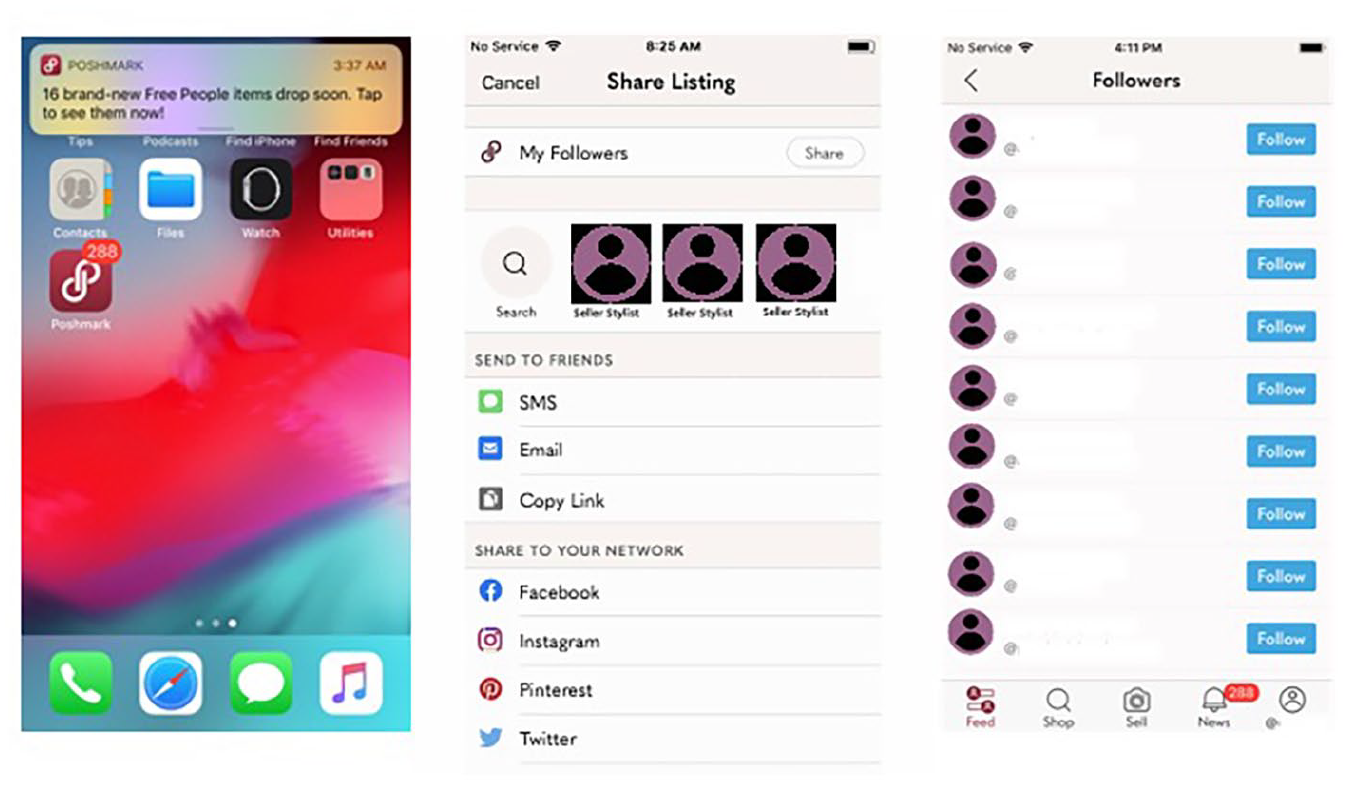
Typical notifications, sharing an item, following.
The sharing arms race
The excessive click-work is the primary way for Seller Stylists to gain attention and, thus, to make sales. After all, I saw the raincoat I bought, because it had been shared shortly before I searched for Marmot raincoats. Alternatively, I could have come across this coat through my feed, if I had followed the seller. However, ensuring your listing is seen by a potential buyer became an increasing challenge as the number of Sellers Stylists grew from 500,000 in 2014 to 2 million in 2016 and finally 4.5 million in 2021, while the overall number of listings increased to around 201 million (FN_492). As it was explained to me by Val, a Seller Stylist of only 5 months, this exponential growth turned selling into a “numbers/ratio game,” forcing you to “share and follow a lot” (FN_83). In Belinda’s terms, “[sharing] is the only way I stay consistent with sales because my items aren’t super sought after or easily searchable, so I have to constantly bombard the app with my crap” (FN_208). As a consequence, the average number of daily clicks of the share button grew from 5 million in 2014 to around 30 million in 2019 (FN_378). The same applies to attracting more and more followers, as a typical Seller Stylist has follower/following numbers upward of 50,000, 200,000 seen as the lower limit to being successful (FN_310).
To increase self-shares and followers, Seller Stylists recruit additional fingers for clicking. As Laura told me, “I hired (forced) my fiancé to share my closet for me. My son is practicing his fine motor skills by following for me. Soon, I’ll let him share my closet” (FN_417). The practice of including one’s family is commonplace, as I witnessed hundreds of conversations among Seller Stylists, joking about their “posh husbands” and tactics to entice their children to hustle along, such as Vicky who invented “the blue button game” (FN_208) for her kids to follow users for her. This dynamic escalated noticeably in the time I researched Poshmark, as Seller Stylists also began hiring virtual assistants (VAs), some being Seller Stylists themselves who pivoted to run a new side-hustle (FN_46, PM_22; FN_47). I also saw bots, automating the clicking process. One such service was developed by a “Posh husband” after he observed his wife’s sharing woes (FN_368). When he released the bot for free, he received so much positive interest that he ended up monetizing the service. Now, there are a handful of companies, offering, for around US$25 a month, 3000 clicks per day (FN_474). Although these companies claim that they provide clicks by human fingers, it is generally acknowledged by Seller Stylists that there must be bots involved.
The pressure put on Seller Stylists to share and follow are significant and, importantly, continue to intensify. At PoshFest 2019, all the Seller Stylists I spoke to emphasized the time-consuming nature of such work (FN_310). Sitting at a big table the second morning with six women, they discussed the ways they personally handled sharing. One woman had hired a pregnant friend, another a 16-year-old niece, and a third was paying for a professional VA service. The other three were seriously considering hiring someone as well. For more casual sellers, like Jessie, paying someone seems excessive, although she admitted that sometimes Poshmark “feels like so much effort. I get like that heavy, depressed feeling just thinking of all the work I have to put into getting an item listed and then deal with sharing it” (PM_26). After all, the best way to sell on Poshmark, by design, is to keep on sharing more and more. In Jessie’s words, I’m not worried about over sharing. I don’t think there is such a thing. I frequently check the brands [. . .] to see how far down the page I have to go to see them and it’s shocking how I can share and then a few min later they’re buried. (PM_26)
This runaway dynamic eventually raised some red flags at Poshmark head quarters (HQ) (FN_309). Since 2019, there have been interventions, banning Seller Stylists from sharing or following for a period of time, when they exceeded certain limits (FN_306). In the community, this is called “Posh purgatory” or “share jail.” The company has not communicated exact numbers, but the general consensus among Seller Stylists is that the limit is around 5000 shares and follows within a 24-hour period (FN_368). This frustrates those Seller Stylists who surpass these limits through honest clicking. As Kim lamented, “their message; share, share, share! Me: sharing! Them: whoops. You shared too much. Now you can’t share again for 24 hours” (FN_268). In response, this policing has only led to bots being programmed to stay below the threshold (FN_368). Nevertheless, overall, sharing continues to grow only dampened by the 5000 a day limit, a number that, when practiced by millions of Seller Stylists, is still a whole lot of clicks.
Platform spillover
Seller Stylists balance the pressures of click-work against the demands of other areas of their lives, be it employment, children, friends, or spouses. For example, Annika explained to me that during her first few months as a Seller Stylist, she had been constantly on her phone trying to keep up with the “share game” to the chagrin of her husband and children (FN_310). Annika’s story is all too common; the pressure to share and follow spills over, “tak[ing] over your whole life” (FN_310), including the relationships with friends, spouses, and children. For Jamie, who had left salaried employment to become a full-time Seller Stylist, Poshmark had even become a topic in couples’ therapy (FN_54). She felt conflicted about “all of the notifications, the sharing, the following the offers, how do you decide to shut it off at night? Seriously! How do you decide?” Lauren reflected about similar issues: I love doing posh but being on your phone constantly people around you start noticing it. I don’t want to hang out with someone who is constantly on their phone [. . .] I’m trying to not constantly be on posh when I’m out with people. (FN_417)
Finding the right balance between digital hustling, regular employment, parenting, and relationships is a prevalent challenge. Some tasks are easier to handle. For instance, Seller Stylists are typically disciplined about blocking time for photographing and listing items and will even set a timer to ensure they perform tasks quickly enough (FN_469). By contrast, sharing and following are highly granular tasks, taking only one click at a time, which can be completed in any idle moment at any place, be it while waiting for an elevator, at a doctor’s office, or when children play. The pressure to sell, coupled with the granularity of such click-work, means that each moment becomes a possible opportunity to grow one’s business.
With such conditions, some Seller Stylists decide to quit. For instance, Sally, who had hustled on Poshmark alongside her full-time job, left because of how the platform had changed (PM_32): I weighed the good with the bad and decided it was not a sound enough system for me to continue to sell on, which is sad, because I think if more things were set up more equal, it would actually prosper these sites better in the end.
Others, by contrast, remain, finding meaning and purpose in the hustle. Beside her full-time job in operations management, Lauren, for instance, maintained an active Poshmark closet, sold anything she could on eBay, while also selling groceries on Amazon (FN_298). She was proud of her 4 am wakeup time, laughing how she “never stops [. . .], it’s a constant hustle” (FN_298). Similar for Teresa who explained, “being a stay-at-home-mama my goal is to help my hubby with the bills! Truck payments, daycare etc . . . the ‘guilt’ of being a stay-at-home-mom kills me! I’m a hustler so let’s get it!!” (FN_01). Hustle is a word of pride in the community, a label that Seller Stylists wear on sweatshirts and use to adorn coffee mugs and notebooks (FN_62).
The platform today, scaled to millions of Seller Stylists all sharing and following en masse, is entirely different to the one Jessie had joined in 2013. Seller Stylists hardly perform as fashionistas anymore, as outsourcing the click-work to family, friends, VAs, and bots has eradicated the curatorial role sharing was originally designed to facilitate. Instead, Seller Stylists share their entire closets regardless of their sense of fashion. Likewise, the feeds are no longer curated by the Seller Stylists one chose to follow, but by hundreds of thousands of people, all sharing randomly. Jessie reflected on these changes: “I feel like people used the app differently [. . .] and maybe saw their main feed more because I don’t know anyone now that ever even looks at the feed” (PM_26). Jessie knows that, as the platform has scaled, buyers mostly use the search function to find listings. With over 600,000 followers (a fairly typical number for experienced sellers), she does not focus too much on community shares or following anymore, but on self-sharing to push her listings to the top of the search results. This change of dynamics comes as the result of Poshmark’s quest to scale the platform by exponentially growing the number of Seller Stylists and, thus, to increase overall revenue. As we will explain below, sustaining such growth comes at the cost of eroding the resilience of the entire ecology.
Discussion
The thick ethnographic description offers an account of the Poshmark hustle marked by runaway click-work. Viewed in ecological terms, this runaway pattern is caused by a self-reinforcing feedback loop (Meadows, 2008); the more one seller (X) shares and follows, the more another seller (Y) is forced to share even more, and vice versa. Apart from the lackluster attempts to curb the usage of bots, there is no noteworthy dampening of this feedback loop, as there is no incentive for any single Seller Stylist to slow their clicking. At the same time, growing user engagement is required for Poshmark to secure more capital to keep on growing even more (Patel, 2021).
However, this singular focus on scaling as quickly as possible, or blitzscaling, results in the runaway pattern observed, pushing and ultimately breaching ecological limits. The first, noteworthy limit was reached, when Seller Stylists could not keep up with the runaway sharing by themselves. This systemic problem was then met with local solutions. X increased time spent on the app or started using their spouse and kids to generate more shares. In response, Y hired a VA, which was met by X, who started using bots. These solutions alleviated the pressure only for a time, because, once a sufficient number of other sellers implemented the same solution, its effects were nullified, and the local solution became part of the systemic problem and, by doing so, intensified it. As a consequence, the increased pressures are merely being shifted around the ecology rather than reduced. This is the case, when family members step in to help, which shifts the stress onto the family. Likewise, spending money for extra services only helps until it puts stress on the Seller Stylist’s finances. Thus, the costs of blitzscaling are offloaded onto the hustlers themselves. Figure 1 illustrates the clickwork feedback loop.
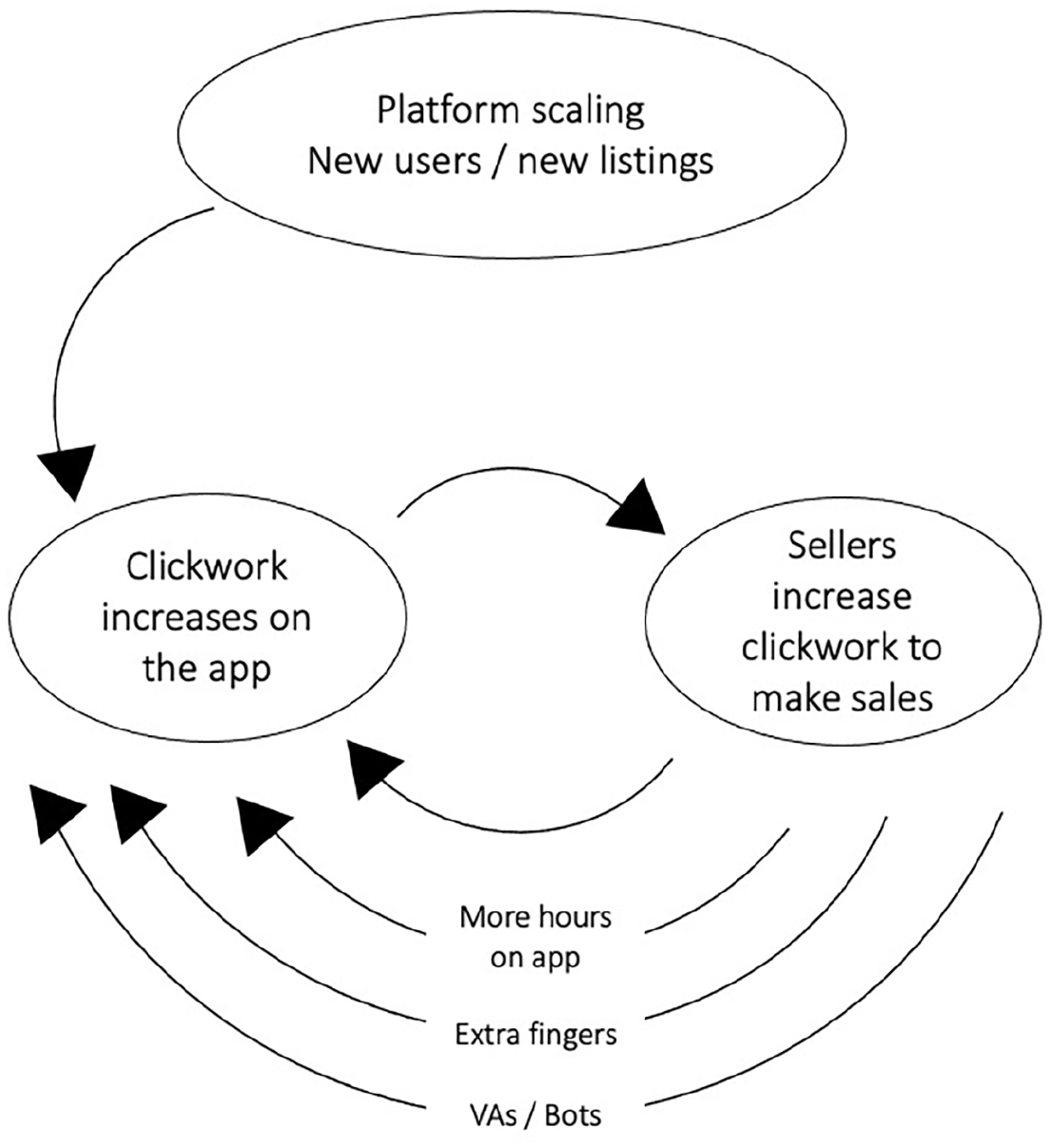
The ecology of hustling on Poshmark—Feedback loops.
Long-term, blitzscaling platform growth can set in motion a pattern of erosion outlined earlier (Bateson, 1972). In the case of Poshmark, hustling, at first, did bring benefits, as Seller Stylists were able to earn some extra income to cover family expenses, pay back loans, or afford a nice holiday. However, once the dynamics turned runaway, doing more of the sharing yielded smaller and smaller sales. Indeed, the pattern is such that the very same activity that allows one to sell more is also what erodes the capacity to sell more. Importantly, this pattern of erosion is not a local affair or subject to situated negotiations between individual actors, but a systemic emergence from the interaction of feedback loops (Márton and Mariátegui, 2015; Meadows, 2008). However frustrated Seller Stylists may be with the status quo, if they want to participate meaningfully on the platform and make sales, they must dance to the melody of sharing and following.
The runaway pattern we observed is to a significant degree due to the granularization of sharing and following down to a single click, which can then be done in any available moment (Kallinikos et al., 2013). It is precisely through this possibility to accomplish minute tasks and work for a second here and there that the platform spills over, taking over moments that were previously too small to have economic value. While such granularization can be seen on other digital labor platforms, Poshmark is an extreme example, with its singular focus on sharing and following as its growth engine. Thus, our findings illuminate how granularization of tasks enables hustlers to increasingly granularize their lives and thus mold it to fit the demands of the platforms (Ekbia and Nardi, 2017).
Identifying the systemic repercussions of digital hustling expands existing research of how platform companies control their platform workers (Shapiro, 2018). At first glance, it appears that the company operating the platform is in control. However, by tracing the wider ecology beyond considerations of profits and user numbers, we find the same signs of erosion. On a systemic level, the company is by no means better off, forced to continue the share game to keep up growth and gain more capital to secure even more growth. That is because of the growth engine at the center of an unsustainable business model; growing click-work results in more user engagement, which leads to more capital (investments and revenue), which then needs to be reinvested to attract more users, who then, closing the loop, need to do more and more click-work for smaller and smaller sales. Again, sharing and following brought initial benefits, allowing the company to crowdsource the curation function while increasing important metrics like time spent on the app. However, as the dynamics escalated, the company now faces the dilemma of dealing with the runaway sharing and following without killing growth. The company finds itself in a similarly inflexible position but appears unfazed, as they launched their IPO in January of 2021, suggesting that their solution to the dilemma is to flee forward, doing more of the same (Wilhelm, 2021). Figure 2 illustrates this runaway pattern, including the interrelations between click-work, growth, capital expansion, and the erosion of resilience in the wider ecology.
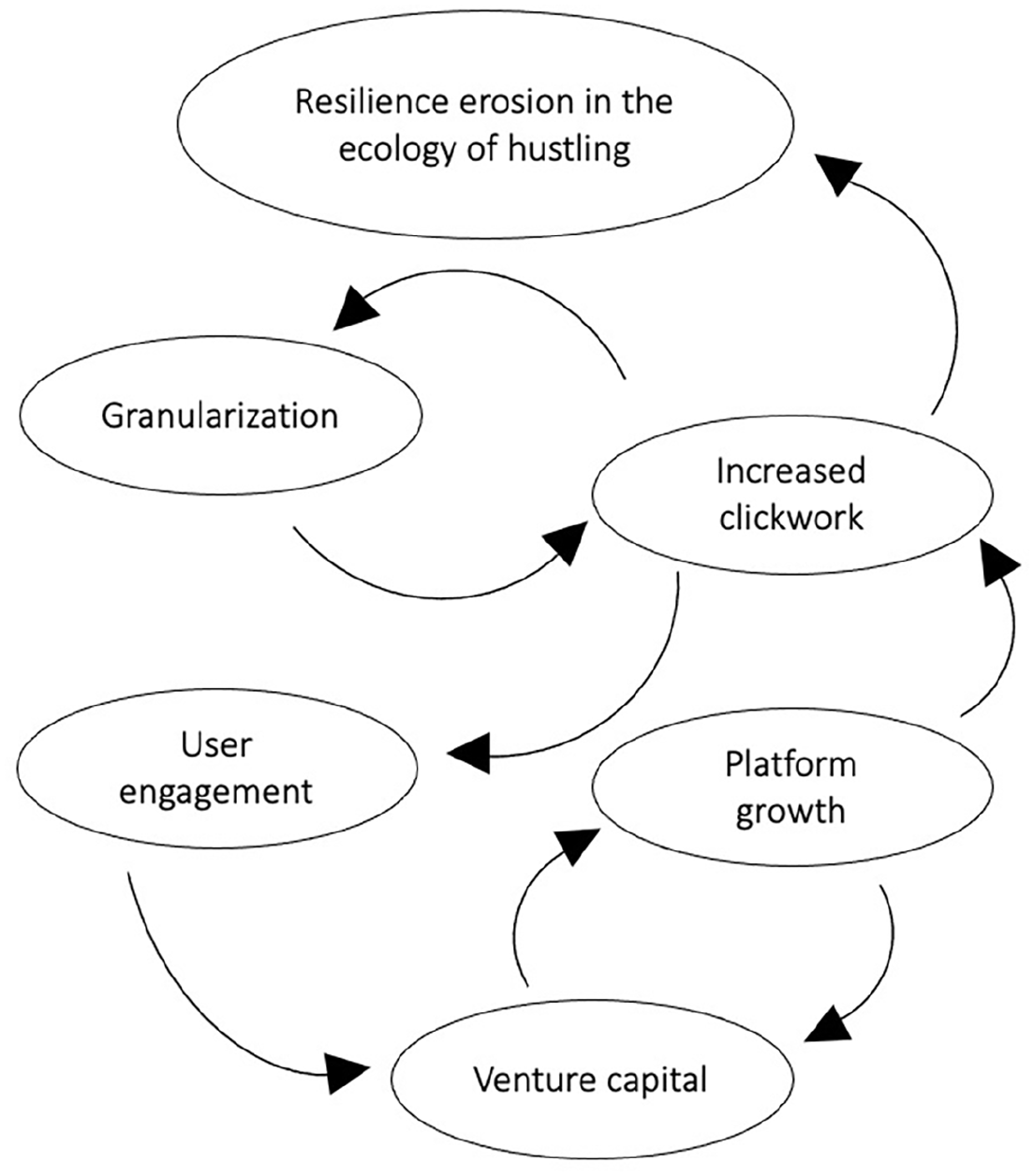
The ecology of hustling on Poshmark—runaway patterns.
The political ecology of digital hustling
Our findings raise further concerns regarding the wider political ecology, as they demonstrate the patterns by which individuals shoulder the burden of ecological problems in platform capitalism. Notably, the Poshmark hustle does not increase but erodes the resilience of Seller Stylists, suggesting that they are actually losing any capability they may have had to adapt to shock, let alone to gain self-mastery (Bracke, 2016). In fact, every time they came up with local solutions for systemic problems, demonstrating the resilience of a neoliberal, self-reliant hustler, those solutions ended up exacerbating the systemic problems, undermining the conditions for securing individualized resilience and self-mastery—the reasons for joining the platform in the first place. In this sense, our explanation that it is a pattern of erosion, by which digital hustling can become a trap of increasing dependency on precarious labor, resonates with existing accounts of digital labor platforms and their false promises of micro-entrepreneurship (Cotter, 2019; Duffy et al., 2021; Ravenelle, 2019) and even more lofty ideals, such as freedom of speech promised by the likes of YouTube (Gillespie, 2010).
Likewise, our findings draw attention to the systemic costs of digital platforms being borne by the entire ecology. Our study builds on and expands research about labor exploitation at the hands of platformed overlords (Curchod et al., 2020; Gandini, 2018; Graham et al., 2017; Lehdonvirta, 2018; Shapiro, 2018; Wood et al., 2019), as we aimed to demonstrate that indeed the wider ecology (the Seller Stylists, their families, their suppliers, their customers, Poshmark [the company], Poshmark employees, early investors, etc.) is rendered less resilient, leaving everybody worse off in the long run. This also applies to the algorithmic management systems used by platform owners to exert control over their participants (Constantiou et al., 2017; Rosenblat, 2018; Wood et al., 2019). Our findings show the dynamics by which algorithmic management can become self-defeating for the platform owner, thus explaining why digital platforms can become an unsustainable business model of platform capitalism at large (Fleming et al., 2019; Srnicek, 2017). That is, because even if Poshmark shuts down, the ecological damage will have long been done. While platforms come and go, the intensification of the self-defeating pattern remains, undermining the health of our labor markets and societal discourse.
Finally, our research also has implications in terms of the gendered nature of work on Poshmark. The platform joins a long history of female multi-level marketing (MLM) organizations that promote individual hard work and personal resilience as a solution for systemic conditions, such as rising day-care costs and lack of maternal benefits (Biggart, 1989; Clarke, 1999; Vincent, 2003). Similar dynamics have also been identified on other platforms, such as eBay and Etsy, facilitating home-based businesses for women (White, 2015). The female hustle, whether through MLM firms or digital labor platforms, celebrates a neoliberal feminist logic (Rottenberg, 2014), valorizing individualized resilience, while adding a layer of “whistling while you work,” as women are expected to also feel grateful to have the opportunity to hustle in the first place (Duffy and Hund, 2015). This type of aspirational labor specifically draws on the passion of its workers, prompting them to take on greater amounts of unpaid work in the name of “doing what they love,” oftentimes at the costs of their own needs (Duffy, 2017).
For already marginalized workers, such as women excluded from the labor market due to family demands, a vicious cycle is set in motion that traps them in a pattern of compounding dependency. Such dependencies are particularly concerning, as they, given the volatility of digital labor platforms, are forced to migrate to new revenue streams whenever a platform goes bankrupt (Duffy et al., 2021). Hence, our research joins other critical voices, highlighting the vital importance to be vigilant of the erosion of hard-won rights for vulnerable populations, paying careful attention to invisible work (Gruszka and Böhm, 2020), and working conditions in platform capitalism (Guarriello, 2019). If such vigilance fails, the digital hustle economy will remain to be yet another step in the colonization of the lifeworld, subjecting it to the instrumental rationality of clicks and shares and sales, turning smaller and smaller niches of the everyday into resources for digital growth and economic value (Habermas, 1987; Heidegger, 1977; Heyman and Pierson, 2015).
Conclusion
We presented an ecological ethnography about the social shopping platform Poshmark to explain how digital hustling erodes resilience on a systemic level. By doing so, we stayed away from implying that in any way the digital hustlers on Poshmark, the Seller Stylists, are dupes. They are indeed capable individuals who understand their working conditions and what it requires to experience financial and personal benefits as a result of their hustling. What we demonstrated, by contrast, is that the hustle that is offered as a solution for precarity by digital labor platforms exacerbates the conditions, which made hustling necessary in the first place. In case of the Poshmark hustle, we found that the Seller Stylist got caught up in such a pattern of erosion through the runaway dynamics of having to do more and more click-work for fewer and fewer sales. This also applied to Poshmark, the company, as it was bound to the same runaway dynamics in order to sustain its growth in ways that can lead to its own demise. In the end, the entire ecology (the Seller Stylists, their families, their suppliers, their customers, Poshmark [the company], Poshmark employees, early investors, etc.) was rendered less resilient and, thus, more precarious, undoing the neoliberal promise of platform capitalism to reward those who hustle hard enough with economic opportunity and self-mastery.
Footnotes
Acknowledgements
We would like to acknowledge the many people who helped develop this work along the way. Firstly, we would like to thank the editor Steve Jones, and the excellent review team at New Media and Society for their formative feedback. We would also like to recognize our team of friendly reviewers, Alison Gerber, Mike Zundel and Aleksi Aaltonen for their developmental comments prior to submission. We would like to further thank the two groups who read and engaged with early versions of the study, the ‘Cultural Space’ group at the Department of Sociology, Lund University as well as the theme ‘Algorithms and Organization’ at the 2020 European Group for Organization Studies colloquium. Finally, we would like to acknowledge all of the Poshers who have openly shared their experiences and lives over the past three years of ethnographic study. Without their willingness to participate this work would not have been possible.
Funding
The author(s) received no financial support for the research, authorship, and/or publication of this article.
