




Abstract
This article examines the emerging illicit, sprawling yet obfuscated global market for artificial social media engagements, which inflates follower counts and engagement metrics on social media profiles and posts. The organization of this market has previously been characterized using industrial metaphors such as “click farms,” “follower factories,” and “digital sweatshops” primarily based in the Global South. Using a mixed-methods approach that integrates ethnography with digital methods, this research delineates the platformization of the follower factory, highlighting a shift toward automation rather than manual interaction. This has facilitated the rapid expansion of a multi-sided market, enabling resellers to scale up and consequently necessitating a more complex labor organization that includes marketing and customer service, which have shaped cottage industries across the Global South. This market capitalizes on social media platform economies, using the existing infrastructure and user bases to operate. In other words, the engagement market has become centered on what we term a para-platform ecosystem, which, while operating alongside, remains reliant on social media platform infrastructure. By examining and conceptualizing platformization and platform ecosystems “from below,” as well as the conflictual asymmetry yet productive relationship between the para-platform ecosystem and social media platforms, this article provides an unprecedented description of the engagement market while challenging and expanding the boundaries of platform theory.
The market for social media engagements
Wayan is relieved. 1 Following Instagram's latest security update, his Indian provider has resumed supplying Instagram followers. Wayan resells these followers to his more than 2800 registered clients in Indonesia, half of whom subsequently sell them to other domestic buyers, many of whom further resell, creating a cascading chain of transactions in which each ideally profits through arbitrage. Neither Wayan nor his resellers control the Instagram accounts that are the source of the followers. They are, in effect, reselling the right to followers from social media accounts controlled by Wayan's provider or someone further up the chain, which, once the series of payments have been made, will be transferred to the purchasing account, perhaps a high school student in Yogyakarta looking to increase their popularity, a social media manager at a company in Jakarta, or a buzzer in Surabaya paid to post for brands or opinions (Rasidi, 2023). In this business model, social media users are sold bundles of Instagram followers, likes, or any kind of engagement in the thousands or even millions.
Wayan's business is centered on a platform, a modular webshop created to automate the buying and selling of social media engagements, an innovation that has allowed him, despite limited technical skills, to become a major reseller on the Indonesian market. The primary threat to automation and Wayan's business is Instagram's platform security updates, which, in this case, halted the transnational market for days before developers figured out workaround methods. In the meantime, using laptops and cell phones out of his residential house on the outskirts of Jakarta, Wayan and his five co-workers frantically engage with their resellers via WhatsApp, promising that the problem they have no control over will soon be resolved.
Social media platforms have emerged as significant commercial forces over the past decade, not least for users. The quantification and metrification of user engagement are at the heart of attention-driven platform economies, exemplified by Facebook's “like economy” (Gerlitz and Helmond, 2013), which highlights social media platforms’ reliance on user engagement to generate revenue and drive their business models, and “Instafame” (Marwick, 2015: 137), in which the ability to gather and retain an engaged audience is valued. In this economy, football superstar Cristiano Ronaldo, boasting over 600 million Instagram followers, reportedly earns over 3.2 million US dollars per sponsored post (Stynes, 2023). More broadly, approximately 200 million Instagram users worldwide have more than 50,000 followers (in 2020), the level at which it arguably is possible to make a living wage by posting for brands as a Social Media Influencer (Frier, 2020: xvii–xviii; see also Khamis et al., 2017).
The emphasis on metrics has encouraged a form of disinformation centered on staging rather than content, as artificial engagements inflate the significance of a person or message on social media (Lindquist and Weltevrede, 2024). Investigative journalism (Confessore et al., 2018) has revealed an illicit and extensive global market for “fake followers,” “inauthentic engagements,” or “simulated influence” (Cotter, 2018). Services such as Instagram followers, YouTube views, Facebook comments, TikTok likes, and Spotify premium plays are readily available for purchase. What we term the “market for social media engagements” (in short: “engagement market”) has been described in terms of click farms, follower factories, or digital sweatshops (Clark, 2015; Confessore et al., 2018). A significant part of the market, however, is centered on reselling and distributing third-party-generated engagements, emphasizing automation over manual interaction—a process we characterize as the platformization of the follower factory. Platformization, as defined by Helmond (2015), refers to the process through which platforms integrate themselves into various areas of society by shaping and standardizing interactions, data flows, and technical infrastructures. This has fueled rapid market expansion and allowed resellers to scale up, necessitating a more complicated labor organization that includes marketing and customer service, leading to the professionalization of the market. Notably, labor conditions have evolved as workers enter the market by setting up their instances of a platform, effectively becoming owners of their businesses.
This article investigates the rise of a platform ecosystem that benefits from and profits through social media platforms while developing and functioning outside their direct control. A platform is understood here as a multifaceted concept encompassing a business model, technology, infrastructure, and organizational form designed to facilitate distributed value creation by controlling information flows (Gillespie, 2010; van Dijck et al., 2018). A platform ecosystem refers to the interconnected network of participants who engage with and depend on the platform's infrastructure, extending beyond the platform to include diverse social, economic, and cultural practices (Van der Vlist, 2022). Scholarship on platformization “from below” has described the rise of solidarity-oriented platform cooperatives that aim to create worker autonomy vis-à-vis corporate platforms (Grohmann, 2023). While engagement market platforms seek comparable forms of autonomy, their concern is economic profit in the face of precarity while remaining dependent on corporate platforms, rather than an explicit form of politics. The term “para” proves invaluable here, signifying “beside, adjacent to,” and also “beyond, or distinct from, but analogous to” (Gray, 2010). In line with this, we approach the engagement market as a para-platform ecosystem that takes shape from below and alongside, thus highlighting a hierarchical relationship between common forms—an auxiliary platform alongside a significant platform. In line with Serres’s (2013) conceptualization of the parasite, the para-platform highlights the conflictual asymmetry yet productive relationship that characterizes our case study (see also Aradau et al., 2019).
Despite the ease with which social media engagements can be purchased through reseller platforms, market operations remain opaque. We approach this opacity with a mixed-methods approach, focusing on the distribution side of the market, which provides us with insights into the innovation structures that drive the market. Our methodology combines ethnographic research with digital methods to investigate the engagement market through two interconnected processes: the emergence of the para-platform ecosystem and the situated local impact of this ecosystem on market actors in the Global South, focusing on cases such as Wayan's in Indonesia.
Our first point of empirical concern is Perfect Panel, a global provider of modular platforms—called “panels” by market actors—similar to e-commerce platforms for online stores provided by Shopify (Lu, 2020). Panel refers to a platform that allows resellers and providers to manage and distribute engagement services, while acting as centralized hubs where services, such as followers, likes, views, and other forms of social media engagement, are offered and managed. A panel is essentially a control panel or dashboard specifically designed for managing the sale and distribution of social media engagements. It provides functionalities for users to order, track, and manage their purchases. For resellers, these panels often include features to automate the reselling process, handle customer orders, integrate multiple service providers through Application Program Interfaces (APIs), and offer customer support tools. While a “panel” could be considered a platform due to its functionalities and role in facilitating transactions, it is tailored for the engagement market, focusing on the management and automation of social media engagement services. It has a more specific connotation within the engagement industry compared to a general platform. Perfect Panel rents these panel platforms to thousands of clients worldwide but does not create social media accounts or sell engagements, the key commodities in the market. These must be sourced by the clients, typically from other providers.
Our second point of empirical concern is Just Another Panel, the most popular platform renting from Perfect Panel and a significant provider of social media engagements—referred to as “social media marketing (SMM) services” by market actors. This term underscores a marketplace focused on marketing, which involves promoting and selling products and services through various means. In this context, SMM services facilitate making profiles and messages appear more popular and influential than they actually are. Using Just Another Panel as a case, the article describes how services are sold and how resellers profit in and beyond the ecosystem. By combining these two focal points—Perfect Panel as the infrastructural backbone of the market and Just Another Panel as a key service provider—we are able to analyze the workings of this reselling ecosystem and explore the interconnections between its different platforms and their geographical locations.
Finally, our third point of empirical concern is resellers such as Wayan, who run their own platforms, most often in the Global South. In our research, we interviewed and observed resellers in Indonesia in person and via the internet. These encounters initially pointed us toward the global significance of Perfect Panel and Just Another Panel while offering insight into how work relations are organized in the para-platform ecosystem.
In the following section, we position ourselves within the literature and offer a conceptual framework for comprehending the platformization of the follower factory as a market that operates alongside influential social media platforms, providing fresh insights into corporations that wield significant cultural and economic influence in today's world. In particular, this offers perspective on the ambivalent relationship between social media platforms and para-platforms, as user activity generated by the latter is at the center of the business model of the former, which at the same time are increasingly pushed to crack down on “inauthentic” accounts and engagements (Lindquist and Weltevrede, 2024). We then detail the mixed-methods approach used to collect our data and how we analyzed it. The para-platform ecosystem helps us describe the interconnected network of panels at the center of a highly efficient reselling market for social media engagements. In the discussion, we consider the implications of this novel perspective on the organization of the market for social media engagements for platform studies by offering more specific interventions concerning geography, labor, and the nature of engagements.
Decentering platform theory
The growing body of research on social media manipulation and online engagement marketing reveals a multifaceted market, as many of the actors and enterprises, including “dark PR” firms (Verwey and Muir, 2019), “political consultants and strategists” (Ayeb and Bonini, 2024), “disinformation-for-hire” actors (Grohmann and Corpus Ong, 2024; Ong and Cabañes, 2018), and “data analytics firms” (Briant, 2021), operate with a front and back-end that reflects the boundary between legal and illegal, or licit and illicit activities. While the engagement market, in particular, has been approached in policy briefs as a “black market for social media manipulation” (Bay and Reynolds, 2018) and investigative journalists have employed industrial metaphors such as “click farm” (Clark, 2015) and “follower factory” (Confessore et al., 2018) to describe labor organization, the emerging ecosystem we study reveals a notable shift to a post-industrial form that we term the platformization of the follower factory (see also Nevado-Catalán et al., 2023; Paquet-Clouston and Bilodeau, 2018).
The platformization of the follower factory involves a shift from manual, centralized production methods to more dynamic, decentralized, adaptive, and automated systems characterized by modular websites, innovative practices, and novel economic models that organize the engagement market. This perspective is grounded in work that defines platformization as the process through which platforms infiltrate and reshape various sectors of society, including labor, media, business, and governance, integrating platform infrastructures into different areas of life and transforming how these sectors operate (Poell et al., 2021). Our research pushes this work in a new direction by including (il)licit activities and dynamics that unfold on major social media platforms but are visible neither to users nor the platforms themselves (cf. Aradau et al., 2019: 2549). Exploring these dynamics and the shifting boundary between visibility and invisibility is critical to creating a more comprehensive understanding of platformization.
We conceptualize the platform as a dynamic and relational “ecosystem” (Plantin et al., 2018; van der Vlist, 2022) that extends beyond the platform itself to include a wide array of social, economic, and cultural practices, and thrives on the interactions among its diverse members, leading to continuous evolution and adaptation. Such a relational perspective focuses on how platforms influence practices and vice versa (Poell et al., 2021). This is evident in social media as a key site for entrepreneurialism that straddles boundaries between work and leisure (cf. Duffy, 2017) or platforms’ strategic use of “partnership” as a boundary resource to create asymmetrical dependencies, including labor relations in sectors across the urban landscape (van Doorn et al., 2021: 716).
Our research contributes to these discussions by making visible entrepreneurial activities, labor relationships, power dynamics, and, more generally, “actually existing forms of platformization” (Van Doorn et al., 2021). This is in line with work on “commercial content moderators” (Roberts, 2019), “ghost work” (Gray and Suri, 2019), and the “remote gig economy” (Wood et al., 2019), which has highlighted the importance of the concealed and precarious global labor force that works for tech giants such as Amazon, Facebook, and Uber, as well as labor platforms such as Upwork (Irani, 2015). While this research has focused on labor organizations through corporate platforms, this article turns to labor and innovation taking shape alongside these platforms.
In light of this, we introduce the para-platform ecosystem. Steinberg (2024) builds on Gray's (2010) use of “paratext” to describe the role of trailers, games, and merchandise for films or television shows, to suggest that “paraplatforms inform, condition, support, and operate around the platform,” exemplified by batteries for gig workers using for e-bikes, while van Doorn and Shapiro (2023) use “platform-adjacent” to take into account the productive practices and relations that sustain platforms and their workers—that is, financial investments or migration policies—but which are located outside of the platforms themselves. While these perspectives describe modes of engagement that complement and support platforms, our understanding of the para-platform illuminates a conflictual and asymmetrical relationship that takes shape from below.
This is inspired by Serres’s (2013) description of the parasite as a “third” party, in this case between social media platforms and users, as para-platforms disrupt and redirect “authentic” engagements between users on social media platforms while concealing their role and profit in the process of mediation (cf. Brown, 2013: 87). The parasite creates a new modality of exchange that remains dependent on the hospitality of the host, in this case, the social media platform, which has the “power to authorize or withhold resources and access” (Fisher, 2020: 16; see also Grohmann et al., 2022: 8). The parasite, inevitably the weaker party, engages in these actions until it is driven out or forced to change tactics (Brown, 2013: 89). The main threat to the parasite is generally not the host but other parasites that may replace them. This aligns with the fact that the para-platform ecosystem is congruent with the economic interests of Instagram and other social media platforms whose business model is based on increasing platform activity while they, at the same time, are compelled to show advertisers and users that these activities are “authentic.” The social media engagement market is thus allowed to exist—punctured by recurring acts of hostility through security updates—but remains characterized by intense competition and volatility, as will become apparent in the coming sections.
Mixed-method approach
To make the engagement market visible for description and analysis, we used a mixed-methods approach centered on ethnography and digital methods in a step-by-step process exploring and assembling various “entry points” (Dieter et al., 2019) to understand the structure of the para-platform ecosystem and the actors who run websites within it, as well as how it is organized and has come to change and expand over time. This is in contrast to less comprehensive studies of the same ecosystem, which have focused strictly on digital methods (Nevado-Catalán et al., 2023; Paquet-Clouston and Bilodeau, 2018).
Lindquist's extensive research experiences in Indonesia, a world leader in mobile internet and social media engagement, 2 led us in the first stage of the project to contact 130 engagement sellers in the country via internet searches, 30 of whom agreed to meet in person, around a quarter repeatedly, between 2017 and 2019 just before the COVID-19 pandemic. The main search word we used was jual follower, or “sell follower,” the most widely used market term. Initial contact was transparent as we explained that we were conducting a research project on the engagement market, with guaranteed anonymity. Respondents were mainly lower middle-class young men based in the Greater Jakarta region and other major cities nationwide. Interviews were conducted in public settings, usually cafés, where questions revolved around their social backgrounds, history of involvement in the market, and market practices and technologies. Meetings were at times characterized by suspicion—one initially believed we were spies from Instagram—and most were cagey about their actual practices, some referring tongue-in-cheek to “company secrets” (rahasia perusahaan), and would usually not respond to follow-up invitations. Others would show their work practices on their cell phones, while a few, such as Wayan, invited us to observe them in their homes or offices, in what are best described as cottage industries. It was thus possible to understand how the market and work practices were organized and to develop new research questions that led us to develop other methodologies. Notably, it quickly became evident that the majority were resellers and utilized platforms, while our most knowledgeable interlocutors identified Perfect Panel as the dominant actor in the platform market and Just Another Panel as the key global reseller (confirmed by comparing traffic to websites on similarweb.com).
Through Weltevrede's experience in digital methods, we navigated and experimented with multiple approaches. This confirmed Perfect Panel's integral role as the host and website template provider for the ecosystem and repurposed it as a key entry point for data collection, 3 enabling us to map the para-platform ecosystem and operationalize an evolutionary perspective (Brügger and Milligan, 2018). Using internet domain research tools, notably a reverse internet protocol (IP) lookup, we identified over 2900 domain names hosted on the same server, the number of customers renting panels, and the countries they were registered in. Historical Whois data revealed that its current owners first registered perfectpanel.com in 2016. Using historical hosting data, we traced the reseller websites on their servers, charting the para-platform ecosystem's growth from a dedicated server in October 2016 with 85 initial customers to multiple servers hosting 2917 customers by October 2021, reflecting server migration to support expansion. We soon observed the high volatility of panels entering and exiting the market. Since Perfect Panel's business model is a monthly subscription plan, we systematically collected the domain names hosted on their servers every month from October 2016 to October 2021. We then identified which domain names were no longer hosted on Perfect Panel servers. This approach enabled us to highlight the ecosystem's volatility, illustrating the frequent changes in the market with panels continuously opening and closing.
As it became clear that Perfect Panel was the key global panel provider, we contacted the websites in service (at the time, in late 2019, around 1000). Ten agreed to be interviewed via Skype; several did so multiple times: six through voice calls and four via chat. They were based in Australia, Bangladesh, Egypt, India, Morocco, Russia, Serbia, Taiwan, Turkey, and the United States. These interviews built on the knowledge gained through fieldwork in Indonesia. The reverse IP technique thus provides a comprehensive overview of the Perfect Panel ecosystem between October 2016 and June 2021, while the ethnographic interviews and observation offer qualitative insights into labor organization and market practices.
Although Perfect Panel is hosted and registered in Russia, its ecosystem in October 2021 comprised over 2900 panel websites globally. To investigate the geographical distribution of the market, we employed a combination of techniques to ascertain the locations of the panels in the ecosystem (Table 1). Location data is often ambiguous, erroneous, or incomplete, and indicators strengths can vary. For example, language can be a strong indicator when it is a locally specific language such as Swedish or Japanese. In contrast, a global language such as English or Spanish is less robust, as are panels that offer services in multiple languages. We used multiple techniques to determine a panel's location and compared the results.
Location and language indicators collected from panels.

Geographical location is assigned to a panel when two or more indicators point to the same country (e.g. when a language is dominant in the country of the registrar's address/phone number) or when the country is explicitly mentioned on the website. An exception is made for combining a registration address in the United States with English as the interface language, which will be further discussed in the analysis. Language is assigned when the location is ambiguous. If a panel uses only one language, that language is assigned; if it uses two languages and one is English, the other language is assigned; if three or more languages are used, then the language is marked as “undetermined.” In cases where location and language indicators contradict each other, the more robust indicators (such as the address or text found on the panel website) take precedence over the lesser ones (such as registration data). In cases of doubt, “undetermined” is assigned.
To map the evolution of engagement services over time, we used Just Another Panel as an entry point. Using the Internet Archive's Wayback Machine, we retrieved historical and annual snapshots of the services page on the Just Another Panel website between early 2017 and 2021. The services page has been archived irregularly, thus we collected five annual snapshots ranging between 27 January and 6 May. The services page data includes long lists of SMM services, including ID numbers, descriptions, titles, and pricing. The resulting data was subsequently analyzed and visualized by grouping services by the social media platform they target and capturing the presence and absence of IDs over time.
Finally, we chose one specific service of Instagram followers common across reseller websites and Googled it to find its prevalence in the search index. Comparing the search results against our list of panels from the Perfect Panel ecosystem allows us to consider how open the ecosystem is to panels not hosted by Perfect Panel. Moreover, collecting the prices for one service across different panels allows us to trace price differentials in the reseller market.
Perfect Panel and an ecosystem of standardized panels
Perfect Panel is a critical entry point for mapping the para-platform ecosystem. As noted, a “panel” refers to a platform tailored specifically for the engagement market that serves as a hub where services such as purchasing followers, likes, views, and other forms of social media engagement, are offered and managed. For resellers, panels include features to automate the reselling process, manage customer orders, integrate multiple service providers through APIs, and offer customer support tools. The Perfect Panel business model is based on a monthly fee of between 50 and 200 USD per panel, depending on the number of orders. The market entry threshold is low, as both the cost of renting a panel and the technical knowledge for its operation are minimal. This enables a “low-code entrepreneurship” (Dushnitsky and Stroube, 2021) with actors focusing on reselling rather than the intricate task of creating social media accounts.
Perfect Panel hosts a rapidly growing number of (re)seller panels. In 2022, more than 2900 panels had reportedly filled more than five billion orders. Figure 1 illustrates the growth of the Perfect Panel ecosystem from its inception in October 2016, with the Perfect Panel platform provider and 85 early adopters, through October 2021. The graph highlights the significant uptake of Perfect Panel platforms, showcasing nearly 9000 unique panels hosted on Perfect Panel servers from 2016 to 2021. A notable dip in early 2020, likely due to enhanced detection by social media platforms—particularly Instagram—led to the discontinuation of many services. Akin to other online labor dynamics, however, the COVID-19 pandemic and the broader economic crisis seemingly spurred further expansion (e.g. Schmidt, 2022). At the same time, 40% of panels leave the market within a year. The graph delineates the junctures at which the number of discontinued panels (depicted in stripes pattern) outnumbers the active ones (in solid fill).

Evolution of the perfect panel ecosystem. Visualization by Carlo de Gaetano.
Perfect Panel shapes the affordances for interactions on the market infrastructure by offering standardized functionalities in highly templated panels (Figure 2). Renters can customize their panels by selecting from 10 styles and three themes. Figure 3 shows the 2900 panels hosted by Perfect Panel in 2021 and their visual similarity. Renters can also choose various functionalities to tailor the setup to their needs, making the process user-friendly and accessible. An integrated payment mechanism, which supports over 110 payment methods, is vital for facilitating the panels’ adaptation and integration in national markets. The customer's data is hosted on Perfect Panel's servers, which facilitates payment transactions, reduces hacking risks, and outsources server maintenance for their customers. Interlocutors agree that Perfect Panel is the dominant panel provider because it has the best functionality, and the owner is reliable, often referred to on a first-name basis, as a friend, or even a “sheriff”—a particularly revealing metaphor about this type of market. Perfect Panel maintains order and enforces rules within the ecosystem but refrains from controlling the ecosystem's operational dynamics by mediating interactions between stakeholders or centralizing data circulation, as is often the case in platform ecosystems (Plantin et al., 2018).

Perfect panel offers a standardized panel for rent. Source: demo.perfectpanel.com.

Image sort of over 2900 panels hosted by Perfect Panel in October 2021. The panels show the templated panel styles offered by Perfect Panel. Visualization by Carlo de Gaetano.
The ecosystem's defining feature is its flexible network of interconnected panels, which unites resellers, customers, and service providers within a multi-sided market. Figure 4 illustrates the ideal workflow designed by the Perfect Panel architecture. Customers rent a panel and connect to other panels to provide or resell services through the API infrastructure, and after payment by end-users, the engagement services are delivered to the social media account or content. The technical specifics of how engagements are transferred remain unknown, but our interlocutors are convinced that this is mainly done by automated bots rather than manual clicks.

Perfect Panel engagement market architecture. The workflow of setting up a panel and (re)selling services. Visualization by Carlo de Gaetano.
Each panel incorporates APIs, essential for enabling seamless integration and automation. They allow panels to interlink, forming conduits through which engagement services such as followers, likes, and views from multiple sources can be resold across the network. This connectivity ensures that resellers can offer their customers a diverse range of services without manually managing each provider, resulting in reduced operational costs and increased cost efficiency. The APIs also enable the automation of order placement and processing, allowing the panel to communicate with the service provider's system to automatically fulfill orders. APIs also facilitate real-time data exchange between the panel and service providers, ensuring that information regarding order status and service availability is continuously updated. Furthermore, APIs provide scalability by allowing panels to easily integrate new services and providers as the market evolves. Critical to scaling up is that reseller panels that are not renting from Perfect Panel can be integrated into the expansive ecosystem upon request. 4 This integration and automation are central to the platformization of the follower factory, transforming how engagement services are distributed, managed, and sold in the marketplace.
The geography of the ecosystem
The Perfect Panel ecosystem has taken shape through the proliferation of panels worldwide, especially in the Global South. As shown in Figure 5, Brazil, India, Nigeria, and Turkey have among the most significant number of panels globally. In the collected data, we categorized a panel as belonging to a country when two or more indicators converged: language, the registered address, or phone number (see Mixed-method approach). We argue for an exception for the United States, as the language and registration data appear to be relatively weak indicators because of the country's global internet dominance and the ubiquitousness of English. One of our interlocutors in India registered his panel in the United States to appear as though he was based there, apparently because this suggested a higher status that translated into a stronger position on the market. Following this logic, we classify 340 of 369 panels as “English” instead of “United States” (for a different interpretation, see Nevado-Catalán et al., 2023). 5

Geography of the para-platform ecosystem hosted by Perfect Panel. Visualization by Carlo de Gaetano.
A postcolonial perspective supports the hypothesis that many English-language panels are physically located in former British colonies such as Bangladesh, India, Nigeria, Malaysia, or the Philippines (earlier a United States colony) (cf. Casilli, 2017). This illustrates the predominance of the Global South within the para-platform ecosystem while suggesting that English-language skills offer access to a broader market. For instance, all our interlocutors in Indonesia worked on the Indonesian-language market. A few dreamed of “going global” by developing an English panel, however, suggesting a binary between national markets and a higher-status English-speaking global market. The fact that none of our Indonesian interlocutors had, to the best of their knowledge, clients from neighboring Malaysia or Singapore (where Indonesian/Malay are widely spoken but which have a stronger socio-economic position than Indonesia on a country level) suggests that this hierarchy should be understood as much in terms of identity as language (i.e. Indonesia as a developing country with lower-quality businesses or services).
In principle, anyone can rent and run a panel anywhere, but in practice, this depends on finding willing individuals to do the work. This is a critical facet of digital work globally (Graham and Ferrari, 2022: 1), as platform capitalism has come to shape labor relations around the world, not least through freelance piecework, or “ghost work” (Gray and Suri, 2019), performed by a largely invisible labor force. In other words, it is critical to be attentive to the diverse forms of geography that digital labor takes. As we will describe in the next section, there are striking similarities in how work is organized across this geography. We know very little, however, about differences between countries beyond how language skills constrain or facilitate access to broader markets.
Reseller work in Indonesia and beyond
Many panels we encountered ethnographically were run by groups of young men such as Wayan and his collaborators, often based in the same cities—Jakarta, Cairo, and Istanbul. Many started gaming, hacking, or carding (credit card fraud) in competition with teenage peers. They found the internet to be a vehicle for developing a livelihood in the face of a precarious labor market. Wayan, for instance, initially excelled in the mobile game Clash of the Clans and realized he could sell advanced accounts on online marketplaces before turning to other business opportunities.
The scaling up in the wake of the platformization of the follower factory demanded a more diverse labor organization, such as advertising, marketing, and customer service (Figure 6), in particular, but also administrative work on spreadsheets, blogging for improving Google rankings, and market research. Young men such as Wayan developed cottage industries with friends, neighbors, or family members in Indonesia, as did interviewees in Egypt, India, Morocco, and Turkey (Lindquist, 2022). This revealed a North–South divide and a competitive market in which petty capitalism centered on small-scale entrepreneurship appear critical (cf. Zhang, 2022). The platformization of the follower factory thus has an informal labor organization familiar across the Global South (cf. Grohmann et al., 2022; Lindquist, 2022), as what Simone (2014: 181) calls the “urban majority” has developed the “capacity to stretch and provide work.” While a laptop computer, cell phone, and internet connection offer easy entry into the market, the significant investment is the time it takes to learn how the market functions. In parts of the Global South where digital competence is high and underemployment and “timepass” pervasive among the educated middle classes (Jeffrey, 2010), the engagement market thus appears as a compelling opportunity.

Reseller customer service via WhatsApp in Indonesia. Photograph by Johan Lindquist. The image is partially blurred for anonymization purposes.
Wayan's business is an example of how the para-platform ecosystem has taken shape on the ground. He uses a panel developed by an Indonesian builder who has successfully mimicked Perfect Panel. Like many of our Indonesian interlocutors, he purchases social media engagements from a panel hosted by Perfect Panel. He tried several providers before settling on his current one in India, which offered excellent customer service, reliable services, and a “VIP account” with lower prices since he had purchased services for more than 50,000 USD. The provider had even come to visit him on Bali, though Wayan knew little about his life, operations, or the source of his services. Although Wayan did not admit this, another leading reseller claimed he used Just Another Panel.
In collaboration with his panel-maker and provider, and by dropping prices significantly (competitors claimed he was “destroying” (hancurkan) the market), Wayan quickly became one of the leading resellers on the domestic market. The distinct architecture of, in principle, equal stakeholders in the market infrastructure facilitates the hierarchical layering of service providers and resellers, not least because resellers tend to purchase engagement services from a small number of providers or panels. This is done through a simple registration and payment process on the website. At the pinnacle of his success in 2019, Wayan said his monthly turnover was 1.8 billion rupiah (around 130,000 USD), with approximately 300 million rupiah (around 24,000 USD) in profits.
Recruiting and retaining resellers that allow panels to scale up and increase profits through automation is critical to the business model. The leading actors in the Indonesian market must offer inexpensive and reliable engagement services, 24/7 customer service, tutorials for resellers, bonuses for top resellers, and post testimonials of successful resellers on Facebook to create a reseller “community.” For instance, Figure 7 shows an image and caption Wayan posted on Facebook sent to him via WhatsApp from a reseller—“our friend,” in West Papua—who writes: “God is great bless Wayan with the money I made I have purchased a house, boss, with ten rooms, for 400 million rupiah” (30,000 USD).
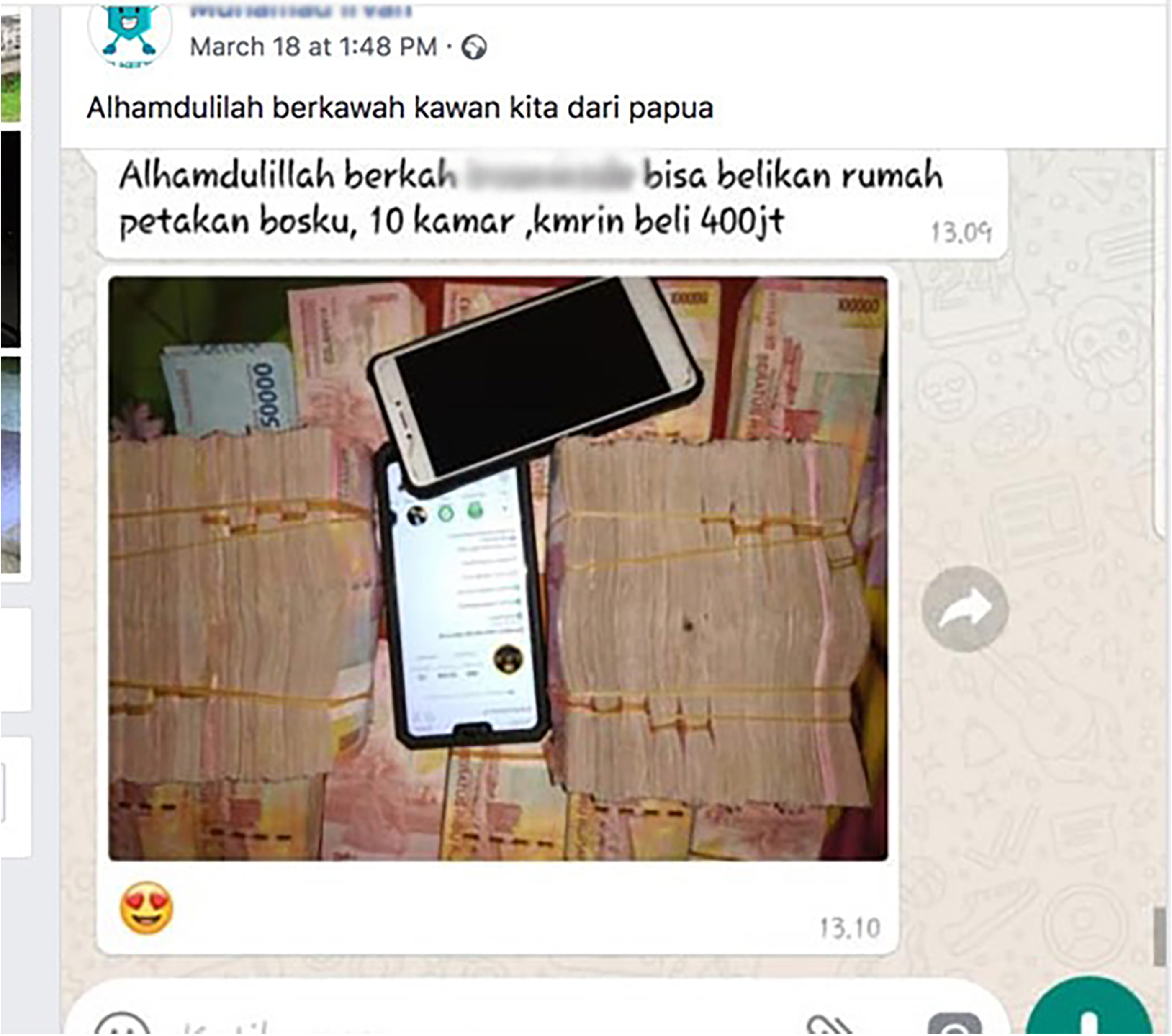
Profits of a local reseller business flaunting proceeds on social media. Source: screenshot of Wayan's Facebook account. The image is partially blurred for anonymization purposes.
There is, however, also an enduring uncertainty among resellers who depend on providers and co-workers. First, because of easy market entry, new resellers frequently appear who may be able to access higher quality and more inexpensive engagement services, which can quickly reshape the market, as Wayan did. Second, recurring platform security updates shut down accounts and regulate user engagements, pushing some providers out of the market while others emerge. Third, since knowledge is the primary investment, reseller cottage industries easily splinter as co-workers rent their own panels to gain greater profits, and many work in smaller groups or even alone. In other words, while the stability of the para-platform ecosystem as a whole is pervasive, it is also characterized by volatility and intense competition between panels. As shown in Figure 1, most resellers quickly drop out of the market because they cannot generate profits through arbitrage.
Profit through arbitrage in the reseller ecosystem
Establishing a sustainable reseller business depends on delivering high-quality engagement services to buyers that do not “drop” from accounts that quickly stop following or are closed down by platforms. Since Perfect Panel does not recommend providers, resellers must find the most inexpensive and reliable services themselves. In the face of an obfuscated market, resellers create knowledge networks through forums and engage in ongoing tinkering and experimentation. The major providers are the producers of social media accounts and the “bottom of the market” remains a significant source of speculation. 6 Even if some of our interlocutors admitted they were engaged in producing accounts for the market en masse, we have limited insight into these processes and the forms of labor involved, as this is the leading market secret, an issue we will discuss in more detail later.
The reseller economy is based on profiting by taking advantage of price differences. A buzzer in Surabaya may purchase 1000 Instagram followers from the menu on Wayan's website for the equivalent of five USD in Indonesian rupiah. These followers come from his provider in India, however, who sells them to Wayan for four USD, allowing a profit of one dollar on the transaction. The followers the buzzer purchases from Wayan's website are delivered by the Indian website from actual accounts without any manual action from Wayan through the API infrastructure connecting the panels. This chain potentially extends indefinitely since the Indian website may also be a reseller. As noted, the monetary transactions take place in the para-platform ecosystem. However, the actual transfer of the purchased engagements takes place from user accounts active within the Instagram platform, which an unknown (at least to most) provider controls.
Controlling price differential information is critical but challenging since pricing is generally listed on panel websites. The example in Figure 8 shows significant price differentials, where one engagement service for 1000 Instagram followers is sold on 19 panels. In this case, price variations from around three to 16 USD can be seen across different panels. Just Another Panel has the lowest price for this service and could be the primary provider. The whole process of revenue sharing is seamlessly (ideally, at least) facilitated by the API infrastructure. At the same time, intense competition means sustainable profits are difficult to uphold.

Price differences (horizontally) for one engagement service across panels (vertically). Visualization by Carlo de Gaetano.
Of 19 panels, seven are not hosted by Perfect Panel, indicating the semi-open nature of the Perfect Panel ecosystem, which requires panels to request the integration of external panels into the ecosystem. While only a few of the interlocutors we interviewed in Indonesia between 2017 and 2019 rented from the platform, all significant actors on the market purchased engagement services from panels inside the Perfect Panel ecosystem. The geographical distribution in Figure 5 from October 2021 lists nine Indonesian panels renting from Perfect Panel, but Wayan had around 2800 Indonesian members on his website, around half with their own panels. The panels in the Perfect Panel ecosystem thus appear to be a small proportion of active resellers worldwide, as the open-endedness of the ecosystem is critical for the expansion and durability of the market.
“Para” to social media platforms
Finally, we turn to the relationship between the para-platform ecosystem and the social media platforms from which they are profiting. More specifically, we investigate the engagements being (re)sold. Despite corporate platform security measures leading to account closures, shadow bans, and other restrictions, providers continuously innovate to create “good-enough” (Lindquist, 2021) accounts that remain active and form the basis for engagement services. Consequently, the para-platform ecosystem depends on and remains deeply intertwined with social media platforms’ infrastructure and user accounts. Nevertheless, the ecosystem can also be distinguished as a unique entity because the distribution and sales activities occur beyond corporate platforms’ immediate control and oversight. This dynamic establishes an asymmetrical and parasitic relationship, as the para-platform ecosystem operates under the hospitality of corporate platforms, which is essential for delivering its market services.
The market's core product, engagement services, is sourced from accounts concealed by the ecosystem's design. As noted, the production and control of these accounts are the major market secrets that generate different theories on black-hat marketing forums and among our interlocutors. One Indonesian interlocutor even suggested that Instagram itself controlled these accounts. Most believed there was a limited number of significant account providers worldwide, perhaps numbering in the hundreds, who specialized on different platforms and that key panels in the Perfect Panel ecosystem, such as Just Another Panel, were also key providers. Most agreed that the accounts used on the market were primarily bots.
The reseller website Just Another Panel was the primary entry point for tracking popular social media engagement services over time. Established in September 2016, Justanotherpanel.com quickly became a central player in the engagement market. Promoting itself as the “Resellers’ #1 Destination for SMM Service,” the site claims to process an order every 0.14 s, with over 210 million orders fulfilled by March 2021. Using the Wayback Machine of the Internet Archive to compile annual snapshots of engagement services offered by Just Another Panel, we analyzed and charted the expansion and diversification of these services. As of March 2021, the site advertised over 2500 distinct services across more than 40 platforms. While each service has numerous iterations, unique engagements, such as an Instagram like or a Spotify play, are assigned specific identification numbers, enabling consistent tracking over time. Figure 9 visualizes the proliferation of engagement services per platform, as delineated by our annual data collection (see also Nevado-Catalán et al., 2023).
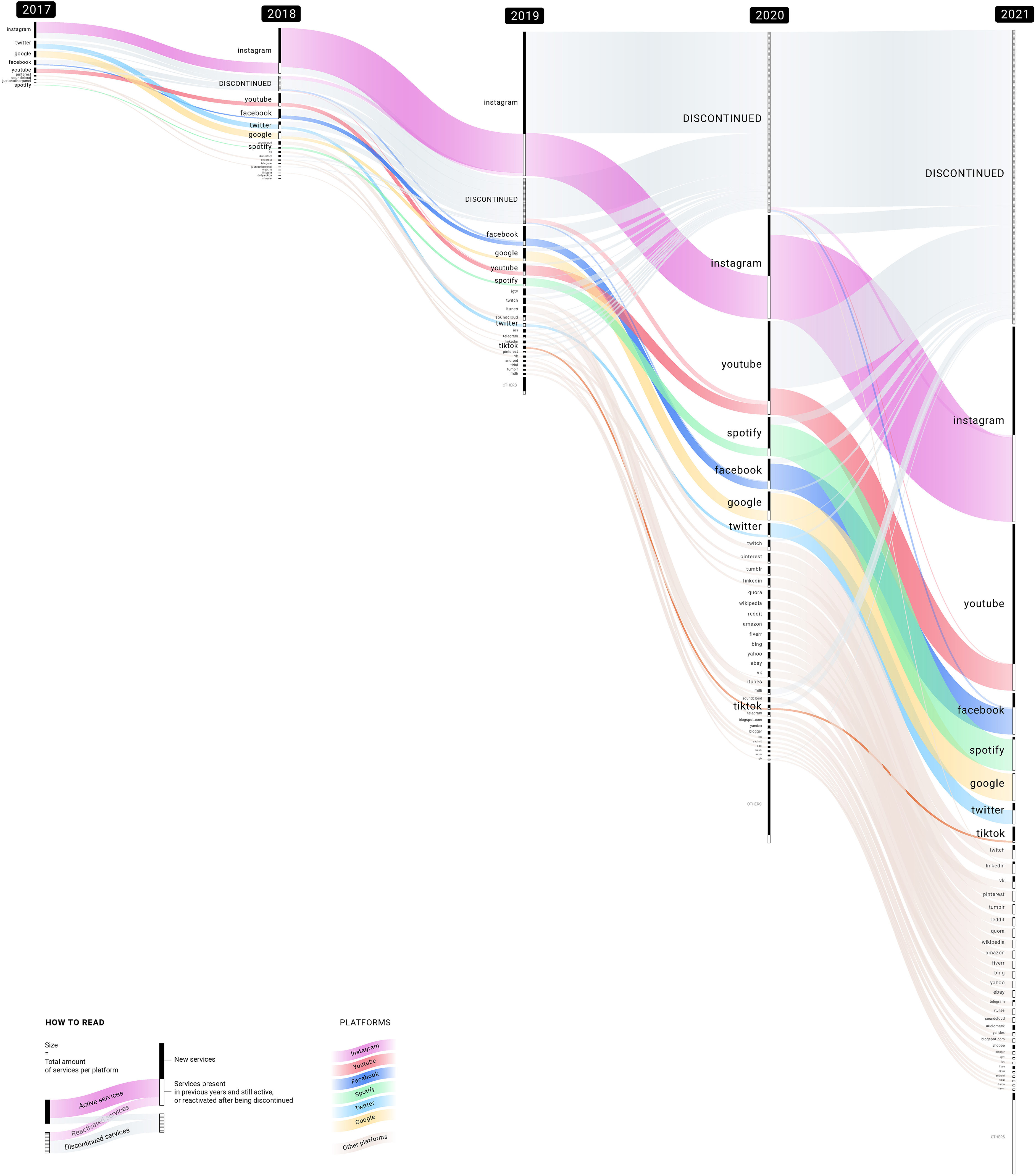
Evolution of services offered per social media platform by Just Another Panel. Visualization by Carlo de Gaetano.
The evolution of engagement services makes visible which social media platforms are the most popular targets for the market. Figure 9 suggests rapid growth in engagements on various social media platforms in a short time. Most interlocutors claimed that Instagram followers were the dominant service, making up the majority of profits. Indeed, in our study of Just Another Panel, Instagram was the platform with the most services, followed by YouTube, Facebook, Spotify, and Twitter, while TikTok was on the rise. The volume of discontinued services also indicates high volatility. The edges that connect specific platforms over time indicate the relative persistence of services per platform. The height of the bar indicates how many services are offered per platform, and the connecting edge between the bars how many of the services persist over time. Figure 9 thus also shows which platforms are least and most effective in their countermeasures (see also Lindquist and Weltevrede, 2024). Critical to developing high-quality services are ongoing cat-and-mouse interactions with platform security updates. Notably, Instagram has the most discontinued services whereas the majority of Spotify's services persist over time, signaling that Instagram has the most effective security updates. Most market actors agreed that Instagram's updates were improving the quality of bot accounts, becoming, as one of our Indonesian interlocutors put it, “as human as possible.” A Turkish interlocutor put it the following way: “High-quality followers are very important. If your account doesn’t have some profile photos and posts, it is worthless. If you create profile pictures, names, and at least three posts that match, it is like they are real” (Interview via Skype, 24 June 2019). This illustrates the forms of creativity necessary for the engagement market and the para-platform ecosystem to endure beyond the visibility of social media platforms.
Conclusion: Para-platformization as a mode of inquiry
Platformization is usually linked with the Silicon Valley corporations that have shaped the digital economy. While corporate platforms need to maintain a level of openness to facilitate third-party contributions and position themselves at the core of an application ecosystem, thereby regulating data circulation, this article complicates the dominant narrative by showing how platformization has proliferated in informal and often illicit economies. It underscores how individuals with minimal technological knowledge can partake in market activities by renting automated platforms. We specifically explore a platform ecosystem centered on the resale of social media engagements, evolving in tandem with, yet independent from, corporate platforms and reliant on social media accounts for generating profit. This delineates an asymmetrical and parasitic dynamic with corporate social media platforms.
Conceptually, we decenter platform theory through the concept of para-platform ecosystem, which along with other spatial metaphors such as “from below” (Grohmann, 2023), “adjacent” (van Doorn and Shapiro, 2023), or “around” (Steinberg, 2024) point to ongoing attempts to understand not only the limits of platforms but to understand them as inherently, and often uneasily, situated in cultural, economic, and political environments. The engagement market and the para-platform ecosystem provide a viewpoint from below on corporate platforms. We use a mixed-method approach to operationalize this perspective, combining digital methods and ethnography to provide a multifaceted understanding of platform theory.
Digital methods enable us to analyze infrastructural relationships, making visible connections between panels and between the para-platform ecosystem and social media platforms. This sheds light on critical issues such as platform governance and the technical specificities of disinformation. Ethnography, on the other hand, offers a comprehensive view of the socio-economic dynamics at play, providing insights into labor conditions on the ground, allowing the analysis of the organization of labor in cottage industries while showing how the platformization of the follower factory has led to professionalization and innovation within illicit and informal markets in the Global South. Building on these insights and focusing on para-platforms, we shift attention from conventional platform narratives and examine central topics in platform studies, exploring five key themes.
First, regarding geography, the corporate platform economy is typically associated with the Global North, whereas the para-platform economy predominantly resides in the Global South. The North–South divide is a significant aspect of contemporary digital economic geographies. This article, however, enables a more precise mapping of the para-platform ecosystem's origins and the global distribution of panels. Although Perfect Panel, the principal supplier in the para-platform ecosystem, is based in Russia—a country at the forefront of systematic disinformation campaigns (DiResta et al., 2018)—most reseller platforms are located in the Global South. Fieldwork and interviews with panel owners indicate that the market is also segmented by language. Indonesian resellers typically focus on the domestic market, while those in India with English-language proficiency often participate in the global market. This suggests that postcolonial forms of differentiation influence hierarchies within the para-platform ecosystem (cf. Casilli, 2017). Furthermore, fieldwork in Indonesia revealed that only a small proportion of reseller platforms in the country are hosted by Perfect Panel. This implies the existence of a much larger market and a more intricate geographical landscape than delineated in Figure 5.
Second, this article offers nuanced perspectives on common views regarding digital labor in the Global South. It highlights forms of digital labor characterized by automation, professionalization, and extensive networking, enabled by the platformization of the follower factory. The emergence of automated reseller platforms has simplified market entry, facilitating scalability in sales while simultaneously intensifying competition. Success in this market increasingly requires professionalization and adopting new labor forms, including social media marketing, customer service, and administrative tasks. Fieldwork and interviews suggest that labor is often organized in cottage industries involving neighbors, friends, and family members. This aligns with historical labor practices in the informal sector among the “urban majority” across the Global South (Simone, 2014).
Third, this research calls for the reassessment of social media metrics. The formatting of engagements such as follows and likes has made it a metric for comparison and, thus, a basis for creating value through differentiation. Yet, the valuation of engagements diverges across different stakeholders: corporate platforms view them as indicators of activity and popularity, impacting both the company's market value and its ability to generate advertising revenue; users see engagements as markers of social validation or as a means to monetize influence, particularly for influencers endorsing brands; advertisers rely on these metrics to gauge the effectiveness and reach of their campaigns; digital researchers use social media metrics as data to study cultural and societal trends; and within the engagement market, these very interactions are commoditized as services. Social media engagements have arguably become “formatted procedures” driven by a perpetual need to contribute, thus questioning their intrinsic value (Kelty, 2019: 17–18). This study finds just the beginning of the vast scale of purchased engagements, with Perfect Panel reporting over 5.8 billion orders consisting of one to 1,000,000,000 engagements. This urges a critical reassessment of the value attributed to engagements by users, advertisers, researchers, and platforms alike, hinting at widespread manipulation within the ecosystem and not least by social media platforms themselves.
Fourth, we examine the ethical considerations surrounding the market for inauthentic engagements. Our characterization of this market as a “parasite” highlights the tension between platforms such as Instagram and the engagement market they exploit. Artificial engagements disrupt Instagram's system for organizing users and allocating advertising spaces, revealing a fundamental conflict: the rise of engagement markets is both a threat to Instagram's value and a consequence of its economic model. Eliminating this market could paradoxically undermine Instagram's revenue. There is a conflict between Instagram's need to appear “clean” and its reliance on user engagement metrics for profit. Thus, Instagram's actions against engagement markets aim to keep these operations discreet rather than eradicate them. These para-platforms, seemingly autonomous and empowering as they profit from social media accounts, navigate a delicate balance—the “threshold of accommodation” (Fisher, 2020: 25)—between acceptance and resistance by corporate platforms regulated through account closures. Although it is only possible to speculate about the degree of acceptance by means of security updates at the interface between hospitality and hostility, it is clear that social media platforms must strike a balance between increasing user activities, which form the basis for advertising revenue and the demands from the same advertisers, as well as broader ethical concerns regarding the regulation of artificial accounts and other forms of “inauthentic” actions (Lindquist and Weltevrede, 2024).
Fifth, the engagement market has significant implications for disinformation on social media platforms. By inflating engagement metrics, these markets are used to stage users or messages as appearing more influential, thereby distorting the visibility and perceived credibility of content, more broadly undermining platform integrity, public discourse, and democratic processes. Additionally, generative Artificial Intelligence introduces a new dimension to the engagement market by enabling artificial accounts to participate in interactions, further complicating the detection and management of fake engagements. From the perspective of social media platforms, the engagement market is a governance problem, whereas, for para-platform workers, it represents a means of livelihood. The mixing of methods helps reveal these tensions, highlighting the ethical complexities in addressing the contrasting views of platform governance and economic survival.
In conclusion, the concept of the para-platform presents opportunities for further exploration. While platforms have been studied from the centralized perspective of major corporate entities, para-platforms shed light on the activities and dynamics occurring from below, alongside, or around platform ecosystems. This approach provides new insights into platform power and operations, revealing the diverse economic activities within the platform economy and challenging the notion that it is entirely dominated by a few major players. The para-platform concept can theoretically enrich platform studies by uncovering the intricate networks that support these activities and offer a broader perspective that includes informal and often hidden systems of operation. Ultimately, the para-platform concept challenges and expands existing assumptions about platforms, suggesting new directions for research and policy-making in platform studies.
Footnotes
Acknowledgements
This article has been through numerous iterations over the past few years and we thank the following audiences for their engagement: the Stockholm Centre for Organizational Research, the Department of Sociology at Nanyang Technological University, the Asia Institute in the Munk School of Global Affairs at the University of Toronto, the Royal Netherlands Institute of Southeast Asian and Caribbean Studies in Leiden, the Platform Economies Research Network, and last, but not least, the Global Perspectives on Platforms, Labor & Social Reproduction conference in Amsterdam in 2023. Thank you to Guy Geltner, John Murray, and Francis Lee for offering constructive criticism on earlier written versions. We thank Carlo de Gaetano for the data visualizations and Yantri Dewi and Scott Springfeldt for their research assistance in Indonesia, and India and Sweden, respectively. Finally, we thank the editors, particularly Rafael Grohmann, and the anonymous reviewers for their constructive comments.
Declaration of conflicting interests
The authors declared no potential conflicts of interest with respect to the research, authorship, and/or publication of this article.
Funding
The authors disclosed receipt of the following financial support for the research, authorship, and/or publication of this article: Parts of this work were supported by the Netherlands Organisation for Scientific Research (NWO) under Grant VI.Veni.191C.048 (Weltevrede) and the Swedish Research Council (Vetenskapsrådet) under Grant 2017–02937 (Lindquist).