



Abstract
Upward social comparison on social networking sites (SNSs) makes SNS users feel bad about themselves. Would emphasizing overall similarity between SNS users and the upward comparison targets make them feel good about themselves (i.e., assimilation)? We examined this question using a 3 (overall similarity: zero vs. moderate vs. high) × 2 (comparison dimension: physical appearance vs. financial status) between-subjects online experiment with 143 college students. Participants were recommended with a Facebook user who was physically attractive or financially successful (i.e., an upward comparison target). Right before seeing more details about the target, participants saw a visual cue indicating they shared zero (0%), moderate (50%), or high (90%) overall similarity with the target purported to be algorithm-generated. Results revealed that after seeing images showing the target’s physical attractiveness or financial success, those who shared moderate and high overall similarity with the target rated themselves more positively on physical appearance and financial status and also reported higher liking for the target, the effect of which was mediated by perceived similarity with the target. Moderate, but not high overall similarity improved participants’ life satisfaction. Theoretical and design implications are discussed in light of our findings.
Keywords
Introduction
Upward social comparison is difficult to avoid on social networking sites (SNSs). Technological affordances of editability (Treem & Leonardi, 2013; Walther, 1997) and customization (Sundar, 2008) allow SNS users to put their best foot forward in their online self-presentation, making them a perfect upward comparison target for other users. Consequences of upward social comparison can be dismal. SNS users report experiencing negative emotions (Alfasi, 2019; de Vries et al., 2018) and lowered life satisfaction (Krasnova et al., 2015; Park & Baek, 2018), feel physically unattractive (de Vries & Kühne, 2015; Hogue & Mills, 2019; M. Lee, 2019), edit their selfies more frequently to hide their flaws (Wang, 2019), and express greater intention to quit (Wenninger et al., 2019) after comparing themselves to other users who seem to have better life than them (Chou & Edge, 2012).
Research on social comparison in face-to-face (FtF) contexts indicates that upward social comparison is not necessarily ego-deflating, but can be self-enhancing. That is, under certain circumstances, seeing a superstar makes individuals feel incompetent and desperate (i.e., contrast effect), while in other cases, the same exposure may make individuals feel competent and hopeful (i.e., assimilation effect; Ganegoda & Bordia, 2019; Lockwood & Kunda, 1997). Although both contrast and assimilation effects have been observed for social comparison on SNSs, empirical evidence indicates contrast effect as the dominant response (e.g., Alfasi, 2019; Hogue & Mills, 2019; Meier & Schäfer, 2018; Peng et al., 2019; Utz & Maaß, 2018).
Whether it is assimilation or contrast that occurs during upward social comparison matters for individuals’ well-being. Upward social comparison can powerfully dictate how we feel and behave toward ourselves and others, which in turn affect how well we fulfill our essential needs for competence and relatedness (Deci & Ryan, 2000). After the comparison, do we feel confident about ourselves, act kinder toward others, and subsequently fulfill our essential needs? Or do we hate ourselves, hate others out of jealousy, and subsequently fail to fulfill our basic needs?
Against this background, our goal in the present study is to understand how we might leverage technology to facilitate assimilation after upward comparison on SNSs (i.e., positive self-views on the dimensions of comparison). Guided by the theoretical framework of selective accessibility model (SAM; Mussweiler, 2003), we examined the effect of overall self-target similarity at different levels on SNS users’ experience of assimilation, subjective well-being, and positive interpersonal outcomes with an online experiment with undergraduate students. According to SAM, if technology can be designed in a way that foster the perception of overall similarity between users and upward comparison targets and therefore assimilation in the comparison process, users can develop positive self-attitude and experience meaningful online interpersonal interactions, walking closer to fulfilling their essential needs.
In light of the up-to-date technology of artificial intelligence that can produce various personal and interpersonal metrics on SNSs, overall self-target similarity was operationalized with a fictitious Facebook’s friend-matching algorithm that could tell participants the degree of similarity they had with a recommended friend on Facebook, who was a potential upward comparison target. After seeing this target’s images showing their physical attractiveness or financial success, participants reported their perceptions about themselves and the target.
Literature Review
Social Comparison on SNSs
According to social comparison theory (Festinger, 1954), we are motivated to evaluate our current abilities and opinions by comparing ourselves to better-off others (i.e., upward social comparison; Wood, 1989), worse-off others (i.e., downward social comparison; Wills, 1981), or similar others (i.e., lateral social comparisons; Alicke, 2000). Among these three types of comparison, upward social comparison has the greatest impact on one’s subsequent cognitions and behaviors (Rancourt et al., 2015). One particular online space where we observe an excessive occurrence of social comparison is SNSs. On SNSs, upward social comparison may be more prevalent than downward and lateral comparisons because many SNS users present themselves in utmost positive manners (Haferkamp & Krämer, 2011; Manago et al., 2008; Vogel et al., 2014). That is, SNS users tend to carefully craft a positive public persona for their audiences using diverse methods (Krämer & Winter, 2008). For instance, some convey their popularity by posting group selfies with their friends (Zhao et al., 2008), some project their funny-self through captions (Kang & Wei, in press), and others highlight their moral superiority by showing their affiliation with charities (Smith & Sanderson, 2015).
With SNSs filled with their users’ rosy portrayals, some may fall prey to upward social comparison and consequently undergo negative outcomes. Alfasi (2019) found that Facebook users who browsed through their own Facebook News Feed, which offered a constant stream of information from upward social comparison targets, reported higher level of depression and lower level of self-esteem compared with those who browsed through a local National Geography Facebook page. Similarly, Lee (2019) demonstrated that Instagram users viewing others’ photos and posting their own photos were associated with more appearance comparison, which in turn led to lowered body satisfaction. Finally, Utz and Maaß (2018) showed that seeing one’s colleagues’ achievement on ResearchGate, an SNS for academics, evoked higher envy and lower motivation to work harder compared with seeing one’s own personal achievement. In addition, SNSs provide their users with new comparison opportunities through social media metrics, such as the number of likes (Tiggemann et al., 2018), the number of followers (Maclsaac et al., 2018), and the valence of posted comments (Tiggemann & Barbato, 2018).
Certainly, upward social comparison on SNSs does not necessarily result in contrast effect. That is, assimilation effect is also possible. For instance, Peng et al. (2019) found that upward social comparison with an attractive male Instagram user triggered higher self-improvement motivation and workout intention as compared with downward and lateral social comparisons. Meier and Schäfer (2018) showed that Instagram users felt inspiration and benign envy (i.e., a type of envy that motivates individuals) after comparing themselves with other Instagram users, be it friends, social influencers, or strangers.
Yet, it seems contrast effect is the dominant response after upward social comparison on SNSs. What factors can steer SNS users toward assimilation? Social comparison research in FtF contexts suggests that assimilation depends on a host of dispositional (e.g., envy), contextual (e.g., task interdependence), and relational factors (e.g., interpersonal liking; Ganegoda & Bordia, 2019). In this study, we examined the effect of overall similarity between SNS users and the upward comparison targets in promoting assimilation during upward social comparison.
Selective Accessibility Model
According to SAM, upon facing a comparison target, a comparer quickly judges overall similarity between the self and the target based on salient features that are not directly related to comparison dimensions (Mussweiler, 2003). These salient features can be as trivial as birthdays (Lee et al., 2019), or as meaningful as ethnicity (Keh et al., 2016). This initial assessment of overall self-target similarity influences social comparison outcome by determining the types of mind-set (a similarity mind-set vs a dissimilarity mind-set) the comparer uses for post-comparison self-evaluation. Specifically, high overall similarity induces a similarity mind-set under which comparers search for self-target consistent knowledge indicating that the self and the target are also similar on the comparison dimension. With the self-target consistent knowledge being more accessible in mind, the comparer assimilates toward the target and evaluates the self positively on the comparison dimension. In contrast, low overall similarity leads a comparer to adopt a dissimilarity mind-set under which they focus on the dissimilarities between the self and the target on the comparison dimension. With the self-target inconsistent knowledge that indicates the self and the target are dissimilar, the comparison dimension becomes highly accessible, the comparer contrasts away from the target and evaluates the self negatively on the comparison dimension (Mussweiler, 2001b, 2003).
Several studies provide empirical support to SAM. In a study by Mussweiler and Bodenhausen (2002), male participants read about either a caring male or a caring female as their comparison target and then evaluated their own caring levels. They predicted that being in the same-gender category as the target would make male participants perceive high overall self-target similarity with the male target, which in turn would set participants with a similarity mind-set, leading them to recall more instances when they were caring (i.e., assimilation). In contrast, comparing the self with the female target would make male participants perceive low overall self-target similarity, which in turn would set them with a dissimilarity mind-set, leading them to recall instances when they were not caring (i.e., contrast). The results supported their hypotheses. Keh et al. (2016) found that female Chinese students assimilated their self-evaluation toward a Chinese model (shared ethnicity), but contrasted their self-evaluation away from a Caucasian model (different ethnicities) on the dimension of appearance. Vogel (2017) showed that individuals reported higher self-evaluation of fitness after comparing themselves with their past selves who were fit (vs comparing with a general other who was fit) because their past selves were more similar to the present self than a general other. Finally, Johnson and Knobloch-Westerwick (2017) found that participants reported positive mood after seeing highly successful SNS users’ profiles only when they strongly identified with these users based on a shared group identity.
Given this, could establishing overall self-target similarity for SNS users lead to assimilation? Applying the logic of SAM, our answer is “Yes.” Sharing overall similarity with upward comparison targets can make SNS users adopt a similarity mind-set, which in turn would activate the self-target consistent knowledge on a comparison dimension, consequently leading to assimilation. On SNSs, overall self-target similarity can be established effortlessly where information about other users abounds (e.g., demographic information, people they follow) and is easily accessible at SNS users’ fingertips. All this information might be employed to establish overall self-target similarity once it is made salient enough. In FtF context, however, the establishment of overall self-target similarity can be effortful and sometimes impossible because a comparer often has little direct access to the target’s information.
Beyond this hypothesized positive effect of overall self-target similarity in promoting assimilation on SNSs, does the amount (level) of similarity matter? Prior research on SAM and social comparison has paid little effort to uncover how different levels of overall self-target similarity might affect assimilation. These studies have mainly manipulated overall similarity by having participants to share one attribute with upward comparison targets (e.g., Keh et al., 2016; Mussweiler & Bodenhausen, 2002). This approach treats overall similarity as a binary variable where the self and the target are either similar or not, which only tells us about the effect of one particular level of overall similarity on assimilation. With algorithm-generated metrics, SNS users can experience different levels of overall similarity with upward comparison targets, which allows us to test if the similarity mind-set can be a matter of degree and whether it is a function of overall self-target similarity.
Some empirical evidence indicates that the effects of similarity can be linear (i.e., the higher the similarity the better; Michinov & Monteil, 2002) or curvilinear (i.e., higher levels of similarity are better up to a certain point; Snyder & Endelman, 1979; Tian, 2018) in various contexts. For instance, Michinov and Monteil (2002) demonstrated a linear relationship between attitudinal similarity and interpersonal attraction. In contrast, Tian (2018) reported that participants who shared a high level of facial similarity to a hypothetical donor made less donation to the charity compared with those who shared moderate and low levels of facial similarity, demonstrating a curvilinear effect of similarity. If similarity mind-set is binary in nature, as implied by SAM, overall similarity, regardless of the exact amount, might evoke an equal level of assimilation during upward comparison. We aim to address how different levels of overall self-target similarity might affect assimilation to on one hand, detect the existence of a sweet spot of overall similarity to evoke assimilation for SNS users during upward social comparison, and on the other hand, to test whether the nature of similarity mind-set is binary or not.
The Present Study
We examined the effect of overall self-target similarity in fostering assimilation on SNSs by creating three different levels of overall self-target similarity—zero, moderate, and high. We included two comparison dimensions, namely physical appearance and financial status, as these two are the domains where envy is easily triggered especially for young adults (Krasnova et al., 2013). Users’ positive self-evaluation on these two dimensions after upward social comparison would provide evidence for assimilation effect, whereas users’ negative self-evaluation on these dimensions after upward social comparison would provide evidence for contrast effect. We first hypothesize that high and moderate overall self-target similarity would facilitate assimilation compared with zero overall self-target similarity:
Furthermore, we examined the effect of upward social comparison on interpersonal liking and life satisfaction, as these two variables have been shown to be downstream outcomes of upward social comparison (Lin et al., 2018; Schaubroeck & Lam, 2004; Verduyn et al., 2017). Participants who compare themselves with a more similar upward comparison target are expected to express higher liking for the comparison target, as they would feel good about themselves due to the assimilation effect and there is no need to derogate the comparison target to protect their self-esteem. Also, comparison with a better-off but similar target is expected to enhance indivduals’ life satisfaction because they would perceive themselves equally physically attractive and financially successful as the target. Thus, we posited the following hypothesis:
As predicted by SAM (Mussweiler, 2001a), we hypothesize that the positive effects of high and moderate overall self-target similarity on participants’ physical appearance and financial status self-evaluations, interpersonal liking for a comparison target, and life satisfaction would be mediated by perceived overall similarity.
Finally, we posed our research questions addressing how different levels of overall self-target similarity might affect assimilation, subjective well-being, and interpersonal liking for a comparison target, which can help us understand impact of self-target similarity on similarity mind-set and the following assimilation for SNS users:
Method
To examine our study hypotheses and research question, we conducted a 3 (overall similarity: zero vs. moderate vs. high) × 2 comparison dimension (physical appearance vs. financial status) between-subjects online experiment. The study had received approval from the authors’ institutional human participants ethics review board before execution. Participants were given a cover story that experimenters were beta testing a newly developed friend-matching algorithm for Facebook. We operationalized overall self-target similarity as a percentage of shared personal information with an upward comparison target. Participants were told that this algorithm matched Facebook users based on certain shared personal information, and in this beta test, they would be recommended with a real Facebook user using this algorithm. Before seeing the photos of the recommended Facebook user who was either physically attractive or financially successful, participants saw a “similarity cue” indicating whether they shared zero (0%), moderate (50%), or high (90%) overall similarity with the recommended Facebook user.
Stimulus Photos
We first conducted a pretest to choose a set of stimulus photos that featured an upward social comparison target. We first chose 10 photos for each comparison dimension from free image online resources. For the physical appearance dimension, photos showed a person who was in good shape; for the financial status dimension, photos showed their luxurious lifestyle or expensive goods with only small part showing body parts (e.g., arms, legs). We recruited participants from Amazon’s Mechanical Turk (male: N = 46; female: N = 17) for a compensation of US$ 0.20. Participants saw a total of 20 photos (i.e., 10 for physical appearance and 10 for financial status) featuring a target of the same gender as themselves (i.e., male participants would see a male comparison target).
For each photo, we asked participants two questions for each dimension, followed by one common question (physical appearance: “How physically attractive is the person in the picture?” and “How physically fit is the person in the picture?”; financial status: “How much do you think the person has ‘a good life’?” and “How fancy is the person’s lifestyle in the picture?”; both dimensions: “How much do you think seeing this picture on social media will make people feel jealous?”). Participants responded to these questions on a 7-point Likert-type scale (1 = strongly disagree; 7 = strongly agree). We selected six photos with the highest means on these measures to serve as final stimuli for the main experiment. This pretest gave us confidence that these photos would serve as effective upward comparison targets for our participants.
Participants
For the main experiment, we recruited a total of 203 college students in a large US university who participated in the study for extra-course credits. After removing participants who failed our manipulation check (see details under the section “Results”), our final dataset had 143 participants (female = 120; Mage = 19.83, SDage = .80) and consisted of Caucasian (85.31%), Asian (7.00%), African American (2.10%), Hispanic/Latino (1.40%), and others (4.20%).
Procedure
Participants were given an online survey link to participate in the study. As a cover story, they were told that the current study was beta testing for a Facebook’s new friend-matching algorithm. This new friend-matching algorithm purportedly recommended Facebook users with other users who were similar to them on numerous personal information.
Participants first completed individual difference measures. Next, they were directed to a mock-up Facebook website created using an online website creation platform called Wix (https://www.wix.com). Participants saw a same-gender upward comparison target, and thus, we created a total of 12 Facebook mock-up websites, with overall self-target similarity (zero, moderate, and high) and comparison dimension (physical appearance and financial status), and gender (male and female) fully crossed. The websites had a same design look as Facebook homepage and consisted of six sections, where the fourth, fifth, and sixth sections were critical to the study manipulation. Participants clicked a “continue” button that appeared at the bottom of each subpage to navigate through the website. Once they had landed on the first and second subpages, participants received a welcome message and read that this newly developed friend-matching algorithm recommended Facebook users with other users who were similar to them. On the third section, the instruction stated, “Please enter some basic information about you. This new algorithm will find you potential friends from a group of real Facebook users who are similar to you based on the information you provide us today.” In reality, however, participants were not matched with a real Facebook user, but saw six photos chosen from the pretest. For participants in the zero and moderate overall self-target similarity conditions, there was a possibility that they would get suspicious about the whole cover story because the friend-matching algorithm “found” them a user with whom they shared zero or only moderate level of similarity. To address this issue, we told all participants that our friend-matching algorithm was still at its developing stage and may be subject to errors.
On the fourth section, participants responded to 20 open-ended questions asking about their basic personal information (e.g., current residency, favorite animals, books, and musicians). These questions were chosen because they were not intrusive and can be easily answered. This section was designed in such a way that participants could not skip any questions. After they were done responding to these questions, participants proceeded to the fifth section where a similarity cue appeared. This cue had two pieces of information: first, it stated that the algorithm recommended them a Facebook user, named “Taylor Williams,” a gender-neutral name, and second, it indicated the percentage of shared personal information between them and Taylor. Participants in the zero overall similarity condition saw a 0% similarity cue indicating they had 0 shared similarities with Taylor; participants in the moderate overall similarity condition saw a 50% similarity cue indicating they shared 10 similarities with Taylor; and participants in the high overall similarity condition saw a 90% similarity cue indicating they shared 18 similarities with Taylor (see Image 1a–c).
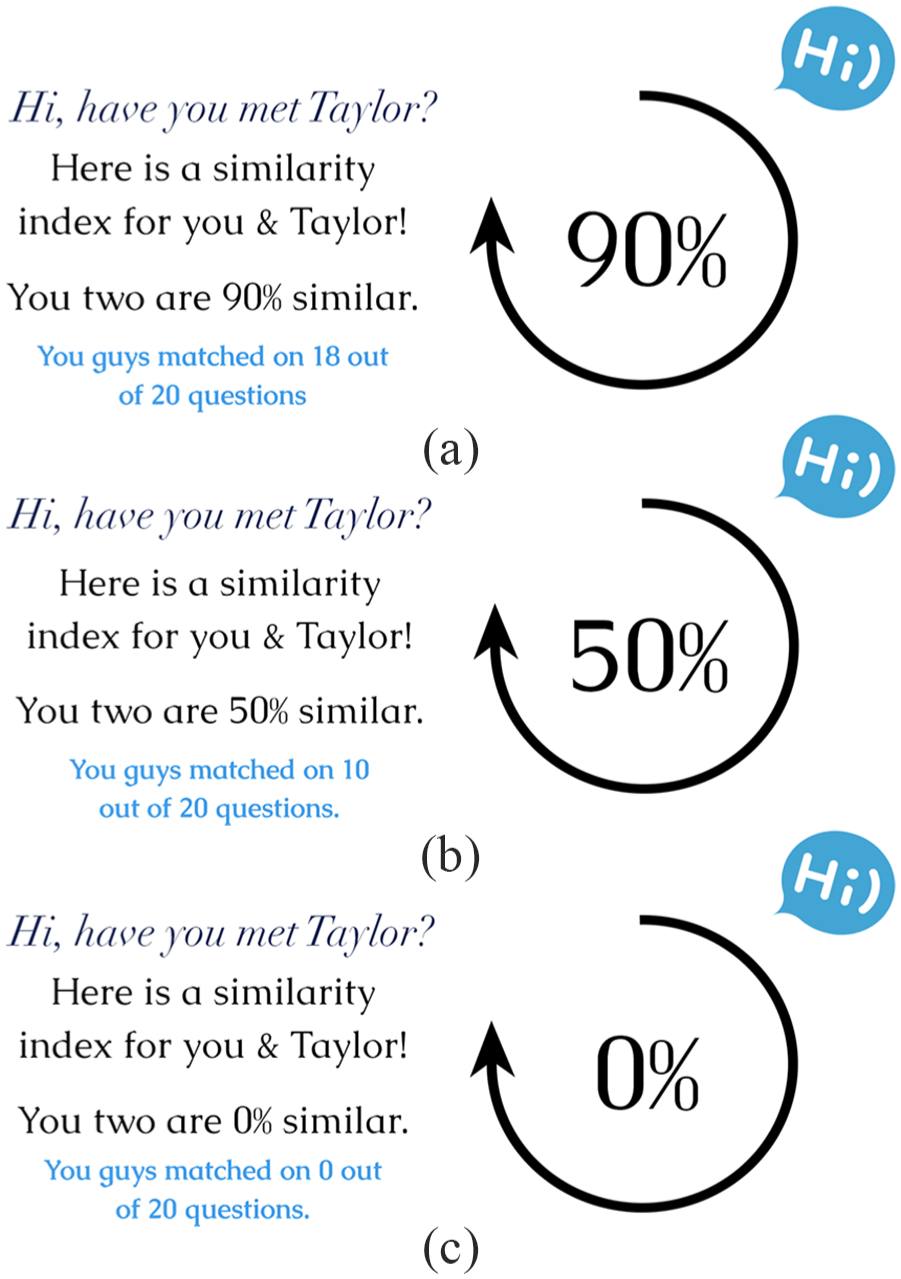
(a) 90% similarity cue, (b) 50% similarity cue, and (c) 0% similarity cue.
We employed two additional features to strengthen the manipulation of overall similarity. First, we had a “continue” button to show up after 4 s the similarity cue had appeared, so participants could not advance to the next section without seeing the similarity cue. Second, when the similarity cue had appeared, the website background turned from gray to white color to focus participants’ attention on the cue. Once participants had advanced to the sixth section, they saw six photos of Taylor Williams that were presented using a built-in slideshow app. Participants in the physical appearance condition saw Taylor who was physically attractive, while participants in the financial status condition saw Taylor who was financially successful. Participants saw each photo at their own pace by clicking an arrow button on the slideshow with the option of seeing the photos again. While viewing the photos, their respective similarity cue was visibly displayed at the top of the slideshow all the time. After they had viewed the last photo, participants clicked a button to be directed to an online survey platform (Qualtrics) where they completed the outcome variable measures.
Measurement
Unless otherwise specified, all variables were measured on a 7-point Likert-type scale (1 = strongly disagree; 7 = strongly agree).
Manipulation Check
Target’s Physical Appearance
Participants answered to the question, “How would you characterize Taylor’s physical appearance?” on a 3-item semantic scale of “Not very attractive—Very attractive,” “Not very fit—Very fit,” and “Not very good looking—Very good looking.”
Target’s Financial Status
Participants answered to the question, “How would you characterize Taylor’s lifestyle?” on a 3-item semantic scale of “Not very successful—Very successful,” “Not very good life—Very good life,” and “Not very fancy—Very fancy.”
Actual Similarity
Participants answered to the question, “What was the similarity index provided for you and Taylor by our algorithm?” that had four options, 90%, 50%, 25%, and 0%.
Individual Difference Measures
Social comparison tendency, trait self-esteem, and depression were measured and controlled for because research suggests these variables influence a person’s response after upward social comparison (e.g., Dittmar & Howard, 2004; Kim & Park, 2016; Vogel et al., 2015; Wang et al., 2017). Participants completed these measures before their exposure to the study manipulation.
Social Comparison Tendency
Participants answered to the 11-item Iowa–Netherlands Comparison Orientation Measure (Gibbons & Buunk, 1999). Sample items are “I often compare myself with others with respect to what I have accomplished in life,” and “I am not the type of person who compares often with others” (Cronbach’s α = .73).
Self-Esteem
Participants answered to the 10-item Rosenberg self-esteem scale (Rosenberg, 1965). Sample items are “I feel that I am a person of worth, at least on an equal plane with others,” and “I feel that I have a number of good qualities” (Cronbach’s α = .89).
Depression
Participants answered to the 9-item Center for Epidemiologic Studies Depression (CES-D) scale (Radloff, 1977). Sample items are “I feel insecure,” “I feel alienated,” and “I feel as if I have experienced some emotional loss” (Cronbach’s α = .88).
Post-Manipulation Measures
Perceived Overall Similarity
We modified the 1-item Inclusion of Other in the Self (IOS; Aron et al., 1992) scale to assess participants’ perceived similarity to an upward comparison target. Participants were shown seven pictures of two circles with varying overlapping area and asked to choose one picture that best represented their perceived overall similarity to Taylor. Seven circles were presented in order of increasing overlapping, with greater overlapping indicating one’s greater perceived similarity to Taylor.
Physical Appearance Self-Evaluation
Participants in the physical appearance condition evaluated their current physical appearance on a 6-item scale, “Sexy,” “Attractive,” “Fit,” “Healthy,” “Nice body,” and “Popular” (Cronbach’s α = .88).
Financial Status Self-Evaluation
Participants in the financial status condition evaluated their current financial status on 6-items, “Financially secure,” “Successful,” “Dress well,” “Established,” “Competent,” and “Bright” (Cronbach’s α = .87).
Interpersonal Liking
Participants indicated their liking for Taylor Williams on a 4-item scale, and sample items are “I am interested in adding Taylor as my friend on Facebook,” “I am interested in learning more about Taylor,” and “I am interested in accepting a friend request from Taylor” (Cronbach’s α = .95).
Life Satisfaction
Participants reported their current level of life satisfaction with the 8-item Life Satisfaction scale (Diener et al., 1985). Sample items are “In most ways my life is close to my ideal,” “I am satisfied with my life,” and “If I could live my life over, I would change almost nothing” (Cronbach’s α = .89).
Results
For all of our inferential statistical analyses, we had social comparison tendency, self-esteem, depression, and gender as control variables. None of these three variables significantly moderated the effect of overall self-target similarity on the main outcome variables (ps > .05).
Manipulation Check
We first checked for participants’ response to the actual similarity question (i.e., the manipulation check item) and examined whether our similarity cues worked in an expected direction across two comparison dimensions. For the actual similarity question, we found that 60 out of 203 participants did not correctly recall the similarity cue presented to them, which potentially resulted from a lower level of attention in online setting due to higher level of distraction and lower experimenters’ control as compared with in-lab experiment (Clifford & Jerit, 2014). To ensure that these participants’ failure to recall the similarity index was not dependent on their assigned experimental conditions, we conducted a 3 (overall similarity: zero vs moderate vs high) × 2 (comparison dimension: physical appearance vs financial status) × 2 (actual similarity recall: pass vs fail) three-way chi-square test of independence. Participants who correctly recalled their similarity cues were coded as 0 (pass), while participants who failed to recall was coded as 1 (fail). We did not find any significant association between overall self-target similarity and actual similarity recall for physical appearance domain, χ2(2, N = 107) = 2.35, Cramer’s V = .15, p = .31, and for financial success domain, χ2(2, N = 96) = 1.94, Cramer’s V = .14, p = .38. Since participants’ correct recollection of their assigned similarity cue was crucial to address our hypotheses and research question, we removed these 60 participants from our final dataset, leaving us with a total of 143 participants. Also, all participants gave us valid and complete answers to 20 personal information questions that were asked to purportedly establish overall self-target similarity.
Finally, our endeavor to create appropriate upward comparison targets was successful. Participants in the physical appearance condition found Taylor highly physically attractive (M = 6.03, SD = 1.04), and participants in the financial status condition found Taylor financially successful (M = 6.60, SD = .70). Using one-way analysis of variance (ANOVA), we did not find that participants across three overall self-target similarity conditions differ significantly from each other on their evaluation of Taylor’s physical appearance or financial status (ps > .05).
Preliminary Analysis
We conducted a 3 (overall similarity: zero vs moderate vs high) × 2 (comparison dimension: physical appearance vs financial status) analysis of covariance (ANCOVA) test to examine whether our similarity cues were effective across two comparison dimensions. There was no significant interaction effect, F(2, 133) = 1.62, p = .20, partial η2 = .02. As expected, there was a significant main effect of overall similarity on perceived overall similarity, F(2, 133) = 3.80, p < .05, partial η2 = . 05. Using Bonferroni correction, we found that participants in the moderate overall similarity condition (M = 1.98, SE = .18) significantly felt more similar to Taylor than participants in the high (M = 1.71, SE = .19) and zero overall similarity conditions (M = 1.27, SE = .18). The latter two similarity conditions did not significantly differ from each other. We did not find the main effect of comparison dimension. As our similarity cues worked in an expected and uniformed manner across two comparison dimensions, we combined the data cases across the two dimensions to test our hypotheses and research question.
Hypotheses Testing
We conducted a series of one-way ANCOVA with overall similarity as an independent variable to address our H1 to H4 and RQ1 to RQ2. We hypothesized that participants who were exposed to high and moderate overall similarity cues would evaluate themselves more positively on physical appearance (H1a, H2a) and financial status (H1b, H2b) and report higher interpersonal liking for a comparison target (H3a, H4a) and life satisfaction (H3b, H4b) compared with participants who were exposed to zero overall similarity cue. Our RQ1 and RQ2 asked how different levels of overall similarity might affect all our dependent variable measures. Albeit in an expected direction, we did not find significant main effect of overall similarity on physical appearance self-evaluation, F(2, 65) = 1.72, p = .19, partial η2 = .05, or financial status self-evaluation, F(2, 64) = 1.30, p = .28, partial η2 = .04 (Table 1). There was no significant main effect of overall similarity on participants’ liking for a comparison target, F(2, 136) = 1.45, p = .24, partial η2 = .02. There was no significant main effect on life satisfaction, F(2, 136) = 2.86, p = .06, partial η2 = .04. Thus, our H3 to H4 were not supported. In response to RQ1 and RQ2, we found that three levels of overall similarity were not significantly different from each other.
Effects of Overall Similarity on Main Outcome Variables.
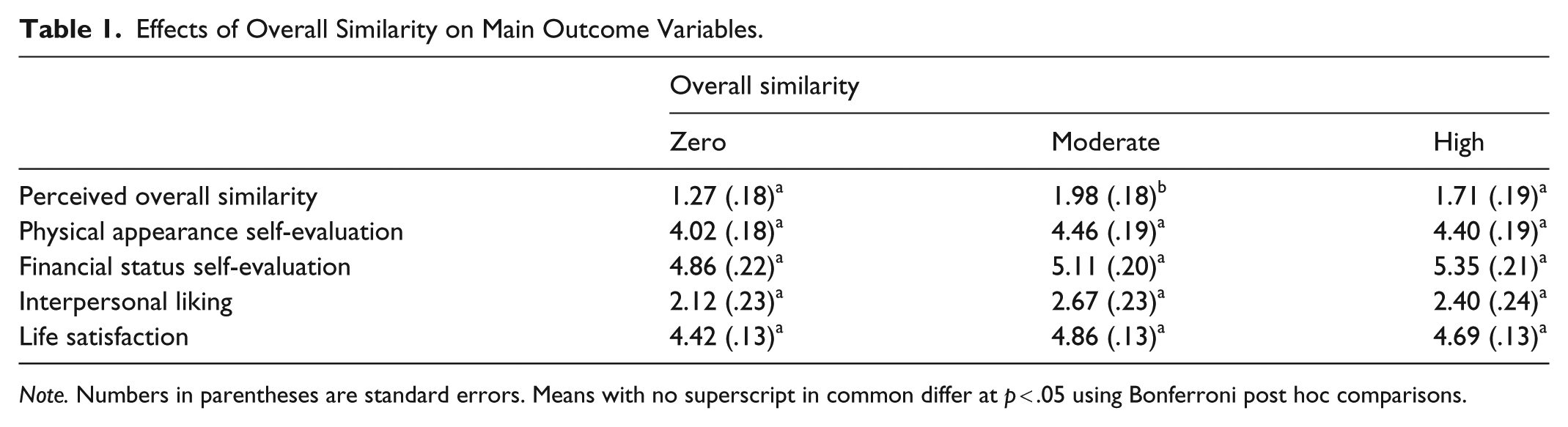
Note. Numbers in parentheses are standard errors. Means with no superscript in common differ at p < .05 using Bonferroni post hoc comparisons.
Our H5 and H6 predicted that the effects of overall similarity on main dependent variables would be mediated by perceived overall similarity. To answer these hypotheses, we used Model 4 in PROCESS Macro with 10,000 bootstrap samples and a 95% confidence interval (Hayes, 2013). We followed the method outlined by Hayes (2013) when conducting a mediation analysis with an independent variable of three levels. The zero overall similarity condition served as the baseline from which two sets of comparisons were made: (a) zero-to-high overall similarity comparison (H5) and (b) zero-to-moderate overall similarity comparison (H6). Two dummy codes were created—D1 coded for the moderate overall similarity condition and D2 coded for the high overall similarity conditions and the zero overall similarity condition was coded 0 on D1 and D2. For the zero-to-high overall similarity comparison (D2), D1 was entered as an additional covariate, while for the zero-to-moderate overall similarity comparison (D1), D2 was entered as an additional covariate.
Tables 2 and 3 report total, direct, and indirect effects of overall similarity on main dependent variables for all sets of comparison. All reported coefficients for mediation analyses are unstandardized. First, for zero-to-high overall similarity comparison, there was a significant indirect effect of overall similarity on financial status self-evaluation (B = .23, SE = .14; Figure 1a) and participants’ liking for a comparison target (B = .51, SE = .20; Figure 1b) via perceived overall similarity. Compared with participants in the zero overall similarity condition, participants in the high overall similarity condition perceived greater overall similarity to Taylor, which in turn led to more positive self-evaluation on financial status and higher liking for a comparison target.
Mediation Effects of Perceived Overall Similarity.

ULCI: upper limit confidence interval; LLCI: lower limit confidence interval. *p < .05.
Total and Direct Effects of Overall Similarity.

ULCI: upper limit confidence interval; LLCI: lower limit confidence interval. *p<.05; **p<.01; ***p<.001

Indirect effect of high overall similarity on (a) financial status self-evaluation, (b) interpersonal liking, (c) physical appearance self-evaluation, and (d) life satisfaction via perceived overall similarity. *p < .05; **p < .01; ***p < .001.
However, perceived overall similarity was not a significant mediator for effect on physical appearance self-evaluation (B = .14, SE = .11; Figure 1c) or life satisfaction (B = .04, SE = .04; Figure 1d). None of the total and direct effects were significant. For the contrast between the zero- and the moderate-similarity conditions, there was a significant indirect effect of overall similarity on physical appearance self-evaluation (B = .22, SE = .12; Figure 2a), financial status self-evaluation (Figure 2b), and participants’ liking for a comparison target (B = .60, SE = .20; Figure 2c) via perceived similarity. For life satisfaction, while perceived similarity was not a significant mediator (B = .05, SE = .05), the total effect (B = .43, SE = .18) and direct effect of overall similarity (B = .39, SE = .19) were significant (Figure 2d).

Indirect effect of moderate overall similarity on (a) financial status self-evaluation, (b) interpersonal liking, (c) physical appearance self-evaluation, and (d) life satisfaction via perceived overall similarity. *p < .05; **p < .01; ***p < .001.
In sum, our H5 to H6 were partially supported. The moderate overall similarity cue increased participants’ evaluation of their physical appearance and finance status via perceived overall similarity, while the high overall similarity cue increased participants’ evaluation of their finance status via perceived similarity compared the zero overall similarity cue. These high overall similarity cues also increased participants’ liking for a comparison target via perceived similarity. Interestingly, we found that only the moderate overall similarity cue increased participants’ life satisfaction, but its effect was not mediated via perceived similarity.
Discussion
The present study examined the effects of algorithm-suggested overall self-target similarity in promoting assimilation, subjective well-being, and positive interpersonal outcomes after upward social comparison in the context of SNSs. First, we found that sharing higher levels of overall similarity with an upward comparison target can lead to more positive self-evaluation on comparison dimensions compared with sharing zero level of overall similarity, but only when they succeed in evoking the perception of overall similarity. As results of ANCOVA showed, only the cue of moderate similarity, but not high similarity, evoked more perceived overall similarity than the zero-similarity condition. One explanation could be that participants had doubts on the truthfulness of an overly high similarity suggested by an algorithm based on very limited information input. Alternatively, it could also be that effect of overall self-target similarity on similarity mind-set is nonlinear.
Relatedly, we also found that, in comparison with the zero overall similarity cue, the moderate and high overall similarity cues did not equally promote assimilation on both comparison dimensions. That is, the high similarity cue was associated with positive self-evaluation on financial status, but not for physical appearance, while the moderate similarity cue was associated with positive self-evaluation on both financial status and physical appearance. Altogether, these findings indicate that first, higher overall similarity cues must be designed in such ways to evoke the perception of overall similarity with upward comparison targets to promote successful assimilation, and second, moderate overall similarity cue might be superior over high overall similarity cue. Our study adds to the existing literature on SAM in that different levels of overall similarity with upward comparison targets can uniquely influence assimilation via perceived overall similarity depending on the comparison dimensions.
Second, we found a positive indirect effect of overall similarity (both high and moderate cues) on participants’ liking for a comparison target via perceived similarity. Past studies suggest that people dislike upward social comparison targets (e.g., Lin et al., 2018; Schaubroeck & Lam, 2004). Instead, our results indicate that SNS users can come to like the targets if they perceive high overall similarity with them. While SAM only posits for the positive effect of overall similarity on one’s post-comparison self-evaluations, our findings extend the model by demonstrating that overall similarity can positively influence one’s evaluation of a comparison target in SNSs context.
Third, we found the significant total and direct effects of moderate overall similarity on life satisfaction, and against our hypothesis, this relationship was not mediated by perceived similarity (Figures 1d and 2d). This indicates that, first, higher overall similarity can enhance life satisfaction after upward social comparison, irrespective of perceived similarity, and second, perhaps we have failed to capture the true important mediators. As affect has been identified as a strong predictor of life satisfaction (e.g., Schimmack et al., 2002), the positive affect generated from sharing high overall similarity with an upward target, rather than a cognitive component (i.e., one’s perceived similarity), could be a potential mediator to account for the relationship between high overall similarity and life satisfaction for upward social comparison on SNSs.
Upward social comparison outcomes have an important implication for the fulfillment of two basic psychological needs in the long term—competence and relatedness. When one experiences assimilation, we feel confident about ourselves and our positive self-view positively shapes our interactions with others, satisfying our needs for competence and relatedness. However, contrast effect can severely undermine SNS users’ needs fulfillment. After the comparison, one feels ineffective and becomes solely focused on restoring their threatened self-view, thereby failing to be attentive to others’ needs (Crocker & Park, 2004). The fulfillment of competence and relatedness needs are essential nutriments in humans for happiness, vitality, and personal growth (Deci & Ryan, 2000). For many SNS users, social media have become a part of their daily routine (Pew Research Center, 2018), and what they do on social media can significantly contribute to satisfying their daily dose of these two needs. Our study offers one way through which SNSs can protect and enhance their users’ online experience, so that they experience assimilation and consequently satisfy their basic needs.
It is quite remarkable that our simple SNSs interface cues, especially moderate overall similarity cue, were powerful in facilitating assimilation during upward social comparison. One drawback of our similarity cues is that they do not reflect the typical cues that SNSs users see on SNSs—typically, users neither see a cue itself occupying the whole screen nor a cumulative similarity percentage. While this indicates that our results cannot be confidently generalized to real SNSs settings, our study also opens up a venue for new social media designs. Currently, major social media platforms convey overall self-target similarity tacitly. For instance, Facebook users can see which group of friends they have in common with other users via feature called, “Mutual Friends.” They can also see which contents are “liked” by other users, which may also be their favorite contents. However, such presentation of the overall similarity may not be explicit and salient enough for SNSs users to perceive a strong and instant personal connection with the upward comparison targets, and as a result, assimilation will not happen. Given that the majority of SNSs share the mission of improving their users’ life, it is imperative that social media designers consider designing interface cues that positively contribute to users’ multiple needs fulfillment.
Our study results and design recommendation also hold a dark side. First, would exposing SNS users with a similarity index encourage them to only interact with similar others and avoid dissimilar others? By adopting a similarity mind-set, it is plausible that our similarity cues prime users to selectively search for other similar others, preventing them from forming diverse social networks. Second, how might the adoption of a similarity mind-set spill over to SNS users’ real-world behaviors? By associating themselves with superior others, would users align their real-world behaviors with their inflated self-perceptions (e.g., purchasing luxurious items to match with their self-perception of being financially successful)? Finally, SNS users may feel that their privacy has been violated, as the algorithm collects their personal information and reveals how similar they are to online strangers and marketers, thereby feeling helpless and lack of control. Against the backdrop of the study’s positive contributions, we need to be mindful of these implications of our similarity cues on SNSs users’ online and offline well-being.
Limitations and Future Directions
Our study has several limitations. First, we designed our fictitious Facebook websites in such a way that participants could look at the upward comparison target’s photos repeatedly for unlimited time duration. Given that the current study was conducted in an online environment, we had no control over the number of times that our participants saw the target’s photos, as well as their browsing duration for each photo, which might have produced noise in the data. It is also important to note that we used photo stimuli that mostly focused on body shot or objects, which did not fully capture the diversity of photos posted on real SNSs. Relatedly, although we ran a pretest of our chosen photos appropriate to be an upward comparison target on either the wealth dimension or the attractiveness dimension, there is a threat to generalizability of using just a single person for each condition, as compared with using several models randomly assigned to participants. In the future, stimulus sampling should be utilized to address this issue.
Second, we observed that a high number of participants failed to recall correctly their respective similarity index, and this could be attributed to some participants’ lack of motivation to participate in the study and lack of attention during their participation. Hence, a more controlled, in-lab experiment would be an ideal next step to replicate our findings.
Third, our study lacked statistical power. A post hoc power analysis indicates that we need 1,548 participants for a between-subjects factorial ANCOVA, with small effect size (f = .10), three covariates, an alpha of .05, and a power of 95%, to detect meaningful main effects and interactions. Our study had less desirable number of participants per cell (appearance: 0%: 26, 50%: 23, 90%: 27; success: 0%: 22, 50%: 26, 90%: 19).
In addition, we had a small number of male participants (n = 23), which limits the generalization of our results to male SNS users. Some researchers indicate that males and females react differently to upward social comparison (Christensen & Jaeger, 2018; Lian et al., 2017), and another future line of inquiry is to examine how female and male SNS users might react to similarity cues in different manners.
Finally, we only considered perceived similarity as the potential mechanism explaining effects of similarity cue on interpersonal outcomes. Existing research on exposure to social media posts on interpersonal outcomes suggests that observers’ attribution of the intention behind the posts matters (Liu & Kang, 2017; Liu & Wei, 2018). In the current study, posts by the upward comparison target might be interpreted as out of the target’s intention of showing off due to the nature of SNSs as highly public (Liu & Kang, 2017), which might also be influenced by self-target similarity. Future research may explore the attributional mechanism in social comparison online.
Despite these limitations, our study opens up interesting questions for future studies. One obvious follow-up question is, “What would establishing high overall similarity mean for downward social comparison?” According to SAM, overall self-target similarity also facilitates assimilation for downward social comparison (Mussweiler, 2001) which means SNS users will feel negative about themselves after comparing themselves with a worse-off other. Consistent with this prediction, empirical research has found that on SNS, seeing negative self-disclosure from more similar SNS users induces more empathy and less schadenfreude, indicating psychological assimilation (Wei & Liu, 2020). Hence, it may not be ideal to emphasize high overall similarity when SNS users engage in downward social comparison. Then, should we emphasize high overall dissimilarity to elicit contrast effect? Given this, future researchers and social media designers are encouraged to explore novel means to protect and enhance SNS users’ online experience and well-being when they engage in upward and downward social comparisons. Second, our study demonstrated that establishing overall similarity with a stranger based on basic personal information can lead to positive outcomes via perceived overall similarity, and more research is needed to understand whether the same positive effect would be observed with SNS users’ close friends. For weak ties, it might be acceptable or even expected the overall self-target similarity with upward comparison targets to be superficial, as they do not know each other well. However, for strong ties, it is expected the self and the target to be similar on meaningful dimensions (e.g., general outlook, ethics, life values), and as such, overall similarity based on trivial information might not be effective in promoting assimilation, life satisfaction and interpersonal liking. Instead, deep-level similarity might be more effective to promote positive post-comparison outcomes. Effective design of similarity cues requires replication of our study with users of relational history and other comparison dimensions taken into account.
Conclusion
SNSs confront users with numerous upward social comparison opportunities. Our study sheds light on how we can make upward comparison a positive experience by leveraging technology to emphasize overall similarity between SNS users and the upward comparison targets. We found that higher levels of overall self-target similarity, especially moderate overall similarity, effectively facilitated assimilation, as well as interpersonal liking for the comparison target and life satisfaction. Social media designers can consider improving their users’ online networking experience by incorporating such similarity-emphasizing features.
Footnotes
Acknowledgements
The authors would like to thank their study participants for taking their time to participate in the study.
Declaration of Conflicting Interests
The author(s) declared no potential conflicts of interest with respect to the research, authorship, and/or publication of this article.
Funding
The author(s) received no financial support for the research, authorship, and/or publication of this article.
