



Abstract
The debate surrounding protesting National Football League (NFL) games began with player Colin Kaepernick’s decision not to stand for the national anthem in response to increased police violence toward people of color in the United States. Public use of social media has cast players’ behavior of kneeling or sitting during the anthem into an international spotlight and led to individuals’ participation in political consumerism, including boycotting the NFL. The goal of this research is to examine the role of a hashtag in political consumerism through the lens of social impact theory and its relation to individuals’ consumption practices. Using social network and content analysis, this study examined a 4-day sample of tweets and accompanying hashtags that included #BoycottNFL during 9 days of the 2017 NFL season. Findings of this study suggest that the line between lifestyle and contentious political consumerism is blurred. Boycotting the NFL is contentious political consumerism, but it consists of lifestyle political consumerism through the individualized behavior of creating a tweet, which inadvertently is a part of collective action. Furthermore, the analysis indicated that accompanying hashtags demonstrated three types of political consumerism sentiment (i.e., political-, civic-, and consumption-related) that change the tone of a tweet, which may alienate actors who are focused on the consumption practices of the collective action. Theoretical and practical implications are discussed.
Introduction
The debate surrounding protesting National Football League (NFL) games began with player Colin Kaepernick’s decision not to stand for the national anthem in response to increased violence toward people of color on the part of police in the United States (Intravia, Piquero, & Piquero, 2018). On 14 August 2016, during a preseason NFL game, Kaepernick remained seated during the national anthem. Later, after speaking with a member of the military, he opted to kneel instead of sitting, during the anthem (Tynes & Lyles, 2018). Although other players, including Marshawn Lynch, had remained seated during the anthem previously, Kaepernick’s action initiated one of the nation’s most visible social protests in both the physical and digital worlds. Widespread public use of social media has cast this issue into an international spotlight, where the behavior of kneeling or sitting during the anthem has led individuals to boycott the NFL, including its products and sponsors. A pivotal point in the movement occurred when President Donald Trump gave a speech on 22 September 2017 in which he called publicly for a boycott of the NFL. This, together with Kaepernick’s act of kneeling, spurred a flurry of online protests using hashtags. For example, #IStandWithKap, #StandForOurAnthem, or #TakeAKnee are used on Twitter to voice shared opinions surrounding this social issue.
Technology has influenced the way individuals communicate collective discontent, and social media platforms, such as Facebook and Twitter, are pivotal components in the development of collective actions (Freelon, McIlwain, & Clark, 2016; Isa & Himelboim, 2018; Schradie, 2018; Tremayne, 2014). Social media is an interactive platform that reduces the barriers to social exchange and has become a tool that allows individuals to discuss and demonstrates immediate support for, or opposition to, current societal issues (Hwang & Kim, 2015). Moreover, by using hashtags, social media allow for varied and complex communication among users, given hashtags’ linguistic and pragmatic functions (Scott, 2018). Twitter hashtags also can serve as an indexing system to order and retrieve information quickly (Bonilla & Rosa, 2015). As such, social movements that originate either offline or in the digital world are commonly associated with hashtags (Johri, Karbasian, Malik, Handa, & Purohit, 2018; Yang, 2016). For example, #BoycottNFL, a call to cease all support of the NFL and their sponsors, was used to both support and oppose Kaepernick’s stance. This is an example of political consumerism. Individuals intentionally avoid the use of certain products based on ethical and political considerations (Bossy, 2014). Shah, Cho, Eveland, and Kwak (2005) wrote, The act of boycotting remains a powerful form of political engagement, though it is now seen as part of a much broader array of consumer behaviors that are shaped by a desire to express and support political and ethical perspectives. (p. 217)
Previous literature has noted that the impetus for political consumerism traditionally is political and ethical considerations, and we argue that practices related to consumption are a necessary component in understanding political consumerism’s full nature. This is evident when consumers use their individual or collective consumption power to switch brands or find alternative products or services and persuade others to follow suit. As Boström, Michele, and Oosterveer (2018) noted, “consumers potentially can and in certain circumstances do collectively influence societal developments through what they decide to purchase, what they decide not to purchase, and how they relate to consumption in general through discourses and lifestyle projects” (p. 2).
This conversation on boycotting the NFL has sparked our interest in the way hashtags can be used for political consumerism and their association with consumption practices. This interest is grounded in social impact theory, which posits that people’s behavior, attitudes, and beliefs are influenced by the presence of and interaction with other people (Cialdini & Goldstein, 2004; Cialdini & Trost, 1998). On social media, this impact occurs during social interactions between users, for example, participating in conversations by making an original post, retweeting, or liking. The literature has established relationships between political consumerism and social media (e.g., Gil de Zúñiga, Copeland, & Bimber, 2014), the influence of online communication in political consumerism (Kelm & Dohle, 2018), as well as the role of hashtags in modern-day collective action (e.g., Freelon et al., 2016; Housley et al., 2018; Yang, 2016). To this end, we contend that hashtags may act as facilitators of social interactions on social media platforms. However, to our knowledge, no research has focused on the use of hashtags specifically in political consumerism.
There are some questions that remain to be answered, largely those that address whether hashtags are used to encourage political consumerism or simply to express opinions. Social impact theory states individuals have the ability to interact and impact each other, relative to the strength, immediacy, and number of people (Latané, 1981) within a given space. When participating in conversations on social media, users can be influenced by the presence and social influence of other users, post content, and reactions. The use of hashtags can strengthen the impact of the users in a conversation, shrink the distance between users, and increase the number of users involved in conversations. Moreover, in instances of online political consumerism, it is unclear whether the hashtag serves to initiate conversation or as a vehicle for political consumerism. That is, are individuals using the hashtag to fuel conversations related, or related tangentially, to the hashtag’s meaning, or is the hashtag being used to further conversations unrelated to boycotting. The goal of this research is to examine the hashtag’s role when engaging in political consumerism through the lens of social impact theory. We also seek to explore whether using #BoycottNFL is synonymous with the intention to boycott the NFL.
Literature Review
Political Consumerism
In her seminal book, Micheletti (2010) defined political consumerism as “. . . actions by people who make choices among producers and products with the goal of changing objectionable institutional or market practices” (p. 2). These actions are characterized as “individualized collective actions” because they convey both “self-interest” and “the general good” (p. 25). Following this, Stolle, Hooghe, and Micheletti (2005) extended the definition to “. . . consumer choice of producers and products based on political or ethical considerations, or both” (p. 246). While these scholars’ initial definitions addressed the ethical aspects of political consumerism, Boström et al. (2018) focused on the societal concerns of the “market-oriented engagements” associated with consumption (p. 2). Furthermore, Bossy (2014) defined political consumerism, a specific type of social movement, as a “. . . network of individual and collective actors that criticize and try to differentiate themselves from traditional consumerism by politicizing the act of buying in order to search and promote other types of consumption” (p. 182). This definition differs, in that it considers as a network of individual and collective actors in a given space. Actors in this context are individuals who exist within this space. While Bossy’s intention was not to explain political consumerism in a digital context, it fuels our application to digitally networked environments. Therefore, based on these discussions, we adopt Bossy’s definition; however, the focus of this research is not to debate whether political consumerism is a form of social movement. As Micheletti (2010) noted, political consumerism, as individualized collective action, is independent of a social movement’s organization or mobilization. In this research, #BoycottNFL is examined as an example of political consumerism enacted both individually and collectively.
Types of Political Consumerism
The literature presents two perspectives regarding political consumerism: (1) as an individually oriented behavior motivated by personal values and (2) as a collectively oriented action influenced by others who share similar ideology on the power of purchasing (Gotlieb, 2015; Gotlieb & Cheema, 2017; Micheletti, 2010). Examples may include canceling a subscription because of a disagreement with a company’s policy or beliefs or participating in a protest against a clothing manufacturer that engages in unjust practices. The former may be seen as an individual behavior of political consumers in daily consumption practices (Zukin, Keeter, Andolina, Jenkins, & Delli Carpini, 2006), while the latter can be viewed as collective actions that pursue common goals and concerns (Micheletti, 2010). Gotlieb and Cheema (2017) made a similar distinction when they argued that political consumerism enacted in the private sphere reflects individualized lifestyle politics, while that in the public sphere reflects contentious politics. Lifestyle politics may represent socially conscious consumption habits in daily life, while contentious politics involves participation in organized boycotts or buycotts, that is, “. . . supporting business that display desirable behavior” (Neilson & Paxton, 2010, p. 214). Thus, political consumerism is enacted in a variety of ways (Micheletti, 2010; Stolle & Micheletti, 2013).
Consumer behaviorists question whether political consumerism constitutes political behavior. For example, Gil de Zúñiga et al. (2014) found political consumerism to be more strongly associated with civic engagement than traditional political participation. Civic engagement refers to behaviors that address social or community issues that are not political but, nevertheless, are conducive to overall societal wellbeing. Ward and de Vreese (2011) focused on lifestyle-based political consumerism and classified political consumers into two types based on the level of participation and civic engagement: socially conscious consumers (SCC) and critical citizen consumers (CCC). SCC use their purchasing power to bring about social change and their consumption choices as a political act. CCC, in addition to using their purchasing power like SCC, actively form groups or networks of like-minded consumers to stay on top of a societal issue and monitor any progress. Other studies have shown a relationship between association involvement and political consumerism (Neilson & Paxton, 2010), and suggested that consumers are more likely to engage in political consumerism if they are involved in connective behaviors either off- or online (e.g., social media).
Political Consumerism and Social Media
Political consumerism has increased in popularity because of the Internet’s development and diffusion (Copeland & Atkinson, 2016). Web 2.0 offers numerous channels for communication through social media by providing easier ways for engaged consumers to express discontent, in that digital platforms offer an opportunity to express individual beliefs. Consumers have more power as individuals when they share their consumption behaviors and present their ideas. Gotlieb and Cheema (2017) found that some consumers choose to engage in political consumerism as a representation of lifestyle politics by creating content online (i.e., a digital post) that may serve as a way to connect to other like-minded individuals.
Literature on political consumerism has shown that online and offline media use influences political consumption activities significantly (e.g., Keum, Devanathan, & Deshpande, 2004; Zhang, 2015). Gil de Zúñiga et al. (2014) found that social media use mediated the relationship between Internet use and political consumerism and posited further that political consumption and social media have a “networked character.” People who engage in boycotts or buycotts learn about these activities online, either through email, the Internet, or social media (Earl, McKee Hurwitz, Mejia Mesinas, Tolan, & Arlotti, 2013). Moreover, Earl et al. (2013) demonstrated that people who use the Internet to gather information are more likely to engage in political consumerism than those who use social media for political reasons. Later, Kelm and Dohle (2018) found that the intensity of (online) information and (online) communication influence the frequency of political consumerism. More importantly, the intensity of online information has a greater effect on boycotts and buycotts compared with that of offline information. Furthermore, the Internet, particularly social media, provides transactional transparency to consumers and makes them aware of a corporation’s support of controversial topics (e.g., NFL players who kneel during the national anthem). Social media content can reveal “. . . information about the author’s emotional state, his or her judgment or evaluation of a certain person or topic, or the intended emotional communication (i.e., the emotional effect the sender wishes to have on the receiver)” (Stieglitz & Dang-Xuan, 2013, p. 218), which we define as sentiment. Based on the literature, we conceptualize political consumerism sentiments as civic-, political-, and consumption-related. Thus, social media’s communicative ability plays an important role in political consumerism.
Hashtags as a Tool in Political Consumerism
Social media, as digital outlets, have transformed individual voices from a proverbial whisper to a collective shout. Social media sites such as Facebook and Twitter have become important in wielding “integrative power” (Pavan, 2017, p. 434) when mobilizing and organizing online debate and offline support (e.g., protests, boycotts; Harlow & Harp, 2012; Micheletti, 2010). Freelon et al.’s (2016) analysis of the Black Lives Matter movement supported this further, in which they discovered that social media were a catalyst in initiating the conversation on race and police brutality. They concluded that using social media and a hashtag (e.g., #BlackLivesMatter), was an essential component in the movement’s longevity and offline influence. The hashtag is used to arrange conversations on social media and has become a method to coordinate information and identify trending topics. A hashtag is more likely to become a trending topic on social media if its use is high (Rightler-McDaniels & Hendrickson, 2014). Furthermore, users can see public conversations about trending topics via hashtags that they may not see or be aware of otherwise (Yardi & boyd, 2010). Thus, some users include popular hashtags in their tweets’ content to make them more visible in trending public conversations.
Hashtags are instrumental for users who engage in public debates and enable others to join the conversation. All users have equal access to hashtags, making it an inclusive and democratic tool (Enli & Simonsen, 2017). Furthermore, hashtags hold the “intertextual potential” to link a wide range of tweets on a specific topic that encompasses diverse perspectives (Bonilla & Rosa, 2015, p. 5). Researchers have coined the term “hashtag activism” to denote a “. . . discursive protest on social media united through a hashtagged word, phrase or sentence” (Yang, 2016, p. 13). Online instances of political consumerism serve as a call to action in which key actors ask consumers to engage in boycotting or buycotting a specific product, brand, or corporation by using hashtags to reflect objections to the consumption of goods, services, or ideas. With respect to political consumerism, these words, phrases, or sentences are meaningful, as they may instruct consumers how to behave. Yang (2016) noted that some of the more pervasive cases of hashtag activism use “complete sentence structures” and contain “verbs expressing a strong sense of action and force” (p. 14). Moreover, social media content that contain greater sentiment, that is, strength of emotion, are reposted more rapidly and more often than are neutral or non-affective posts (Stieglitz & Dang-Xuan, 2013). Furthermore, boyd, Golder, and Lotan (2010) discussed this practice specifically on Twitter and noted, “. . . the practice contributes to a conversational ecology in which conversations are composed of a public interplay of voices that give rise to an emotional sense of shared conversational context” (p. 1).
A vast majority (e.g., Freelon et al., 2016; Johri et al., 2018) of the literature explores hashtag activism in relation to social and political protests. However, no literature to our knowledge has explored the use of hashtags in relation to political consumerism. We argue that the use of additional hashtags within a social media post may inherently influence the overall sentiment of a message. Therefore, examining hashtags outside the context of the social media post can provide additional insight.
Social Impact and Social Media
Social Impact Theory
“In the age of social media, it is easier than ever for individuals to be influenced by others, as social media has become an indispensable activity of people’s lives and the main source of information for many” (Chang, Zhu, Wang, & Li, 2018, p. 283). Social impact theory defines how individuals’ feelings, beliefs, and behaviors can be influenced by the presence of others within a social environment (Latané, 1981). The theory suggests the impact to an individual is a function of the strength, immediacy, and number of sources (Latané, 1981; Li & Sakamoto, 2014). The strength is defined by the salience or intensity of a source; the immediacy refers to the distance and the absence of barriers between individuals and the source; and the number of sources represents the number of sources of influence (Latané, 1981). Therefore, social impact theory provides a robust framework for understanding how individuals are affected in a social media environment because (1) conversations on social media are centered around actors that are more influential within a network, (2) there are lower physical barriers on social media, and (3) social media provide a large volume of opinions from various sources. If an individual considers a group of social media users to be influential due to their collective opinions, the group would be important to that individual (strength), the individual would feel close to the group who are interested in the same topic (immediacy), and the number of people in the group is often large (numbers; Li & Sakamoto, 2014).
Literature has examined social impact theory in the context of social media. Kwahk and Ge (2012) found that the transfer of information and knowledge on social media, that is informational social influence, impacts user’s online behavior. Chang et al. (2018) suggested that an individual’s political attitude is influenced by the social media information, however, the immediacy (as defined as close relationships between an individual and a source) does not have an influence on political attitude change. Li and Sakamoto (2014) found that individuals follow collective opinion of others on social media regardless of the statements being true, false, or debatable.
Social Network
Social networks on social media platforms form as a result of users who follow, reply, like, and mention other users on the same platform. The social forces as discussed in social impact theory can explain the magnitude of social influence present within these networks between users. Users may recreate and reinforce their traditional offline network on social media, or they may choose to connect with a wide range of information sources (e.g., individuals or organizations), like-minded or not, and become an information source to many others (Himelboim, Espina, Smith, Rainie, & Shneiderman, 2017). Social media provides an opportunity for engagement among actors through rapidly shaping online social networks. The nature of online networks differs from that of offline networks, in that they are more ephemeral, sparse, and centralized. However, social media includes functionality that allows actors to actively transform the ephemeral, sparse, and centralized nature of online networks into a force to drive change (Pavan, 2017). Thus, it provides support for individuals with different backgrounds to form dynamic networks and fosters individualized collective actions, such as political consumerism (Bennett, 2012).
The network perspective also allows researchers to learn more about the individuals who hold crucial positions in the network and may have heightened influence on others. Typically, those who have more central positions in a network on a social media platform are celebrities, politicians, and other influencers who have more followers and therefore, a greater influence than ordinary people (Lee, Kwak, Park, & Moon, 2010). In their article that discusses hashtag activism, Johri et al. (2018) highlighted the importance of different actors, particularly high-profile actors who champion a cause and signal the importance of the issue. For actors who often are the hub in their communities and the leaders in such networks, social media can be a tool to foster social identity (Kende, van Zomeren, Ujhelyi, & Lantos, 2016) and increase motivation for participating in collective actions. These communities’ leaders take advantage of social networks to interact with others directly, establish interpersonal, and inter-organizational allies. Therefore, the actual content and framing central actors create may affect how far the content travels and how frequently it is shared (i.e., diffusion; Stieglitz & Dang-Xuan, 2012).
Online social networks’ effect on political consumerism can be demonstrated through several cases in which a message that called on consumers to employ their buying power to drive change went viral (e.g., the Nike sweatshop email Peretti & Micheletti, 2011, studied). However, few studies have examined political consumerism through the lens of social networks. The use of a social network lens allows us to focus on the post content of actors who are highly engaged. There are still unanswered questions as to the relationship between political consumerism, social media, and the messages conveyed from the resulting networks. Thus, the following research questions are proposed: (1) How does post content demonstrate political consumerism through the use of a primary hashtag? (2) What political consumerism sentiments are demonstrated through the use of accompanying hashtags? (3) What message is conveyed through posts that are not a clear representation of political consumerism?
Methods
To address our three research questions, we identified consumption-related language in tweets based on our definition of #BoycottNFL. Twitter is popular among researchers because of the enormous amounts of data available as a movement evolves (Korolov et al., 2016). We also classified accompanying hashtags according to their political consumerism sentiments and conducted a deeper analysis of the tweet content s that do not match with our definition of #BoycottNFL. Tweet data were collected during 9 days in September 2017 that coincided with Weeks 3 and 4 of the 2017 NFL season. The data were procured from a third-party company with access to historical Twitter data. We received a total of 781,768 tweet IDs as a result of a case-insensitive search for tweets that used English language, were public, and contained #BoycottNFL. Next, 569,173 full tweets with their accompanying author information and time stamp were hydrated from active accounts at the time of hydration, while 27% of tweets were not available because they derived from suspended or removed accounts.
We used a 4-day sample in this study that included data representing the beginning (Day 1), middle (Days 3 and 6), and end of our full collection period (Day 8). We chose data of Weeks 3 and 4 which happened to be the height of #BoycottNFL discussion including demonstrations by teams before games, an in-house meeting held by the NFL Commissioner, and comments concerning the situation from other sports-affiliated personalities and government officials. Choosing non-consecutive days within random subset of our full dataset allowed for capturing days that were linked to these offline events. This gave us a manageable and sufficient sample size to complete analyses, especially labor-intensive manual coding. Then, we used social network analysis (SNA) to construct networks of actors for each day and identified tweets from the top 5% of actors in the top 5% of communities based on in-degrees. SNA is a research method that focuses on the ties (i.e., connections, such as social interactions and social relations) between actors (i.e., entities, such as people) and the networks (i.e., communities) formed by these ties among all actors (Borgatti, Everett, & Johnson, 2013). We adapted the methodology and code for creating communities from Freelon et al. (2016) and used Python modules to conduct SNA with each actor in our dataset representing a node and each retweet (RT), reply, or mention representing a tie between two actors, capturing the two actors’ involvement in the conversation. To conduct a robust analysis of individual tweet data, we focused on a 3% random sample of these tweets from each day, resulting in a total of 5,568 tweets. This gives us a manageable and sufficient sample size to complete analyses, especially labor-intensive manual coding. Using a smaller portion from the data sample is a common practice in social media analytic research (e.g., Kitzie, Mohammadi, & Karami, 2018). Among these, 75% were RTs, which is consistent with past literature that used hashtagged tweet data (e.g., Freelon et al., 2016).
In this study, we also seek to explore whether using #BoycottNFL as part of a tweet is synonymous with the intention to boycott the NFL. To determine this, we begin with a working definition of #BoycottNFL for the context of this study. Tweets that fit this definition are considered on message and a match. These are tweets with content that references consumption practices, such as watching NFL games, purchasing related items, ratings, or referencing NFL-related brands or companies, which we derived from a preliminary analysis of the data. A tweet also is a match if it mentions participation or non-participation in NFL-related events, or support/lack of support of sponsors, players, teams, activities, merchandise, and sports media.
Identification of Tweet Content
We began the tweet identification analysis by determining whether the tweets’ content matched the aforementioned working definition of #BoycottNFL. We evaluated the tweets’ full text and any accompanying hashtags that were not #BoycottNFL to determine whether there was a mismatch, partial match, or complete match to our definition. Particular attention was paid to gleaning as much information as possible from the actual tweet without making assumptions. If there was too much ambiguity or uncertainty attributable to lack of information to make a matching judgment, the tweet was coded as such and not included in the final analysis. Seven researchers coded each tweet manually. Before beginning this process, all seven researchers were trained to code tweets and coded 75 tweets selected randomly. Two independent coders were assigned to each tweet, and discrepancies were resolved using a third coder as a tiebreaker.
Hashtag Classification
Next, we attempted to understand the role of accompanying hashtags, noting again that hashtags can convey civic, political, and consumption sentiment. Therefore, we defined our classifications according to Gil de Zúñiga et al. (2014): civic (hashtags that referred to civic activities intended to address social and/or community issues that are not political by nature); political (a hashtag that included distinct references to political people, entities, or associated phrases from political administrations and/or elections), and consumption (any hashtag that referenced a company, industry, or consumer’s decision to acquire, use, and/or dispose of a product or service). Any hashtag that did not fit one of the three sentiments defined was coded other. In addition, hashtags that accompanied each tweet were gathered with a frequency count.
Tweet Content Analysis
Once all tweets were checked to determine whether they contained language related to consumption (i.e., complete or partial match), we conducted additional analyses of their contents by employing topic modeling using Python and predefined lists of words based on our preliminary data analysis. Topic modeling is a text-mining tool that provides frequency data for topics. For tweets that were complete and partial matches, we used two lists, one of which was composed of words that reflect action, or such behavioral words as watch, cancel, subscribe, and burn, while the second was composed of words related to brands or companies, such as Pepsi, Hollywood, and Papa Johns. For tweets that were mismatches, a content analysis was conducted to examine further the messages that were unrelated to consumption.
Findings
To answer Research Question 1, we categorized the random sample of tweets (n = 5,568) as either a mismatch, partial match, complete match, or undetermined (see, for example, Table 1). Overall, 54.26% of the tweets were completely unrelated to boycotting. Tweets related to consumption (i.e., partial match, 24.69%, and complete match, 17.83%) comprised 42.52% of the data overall (Figure 1). When comparing categories across the 4 days, at least half (50.17%) of the data were a mismatch for all days except Day 1. Surprisingly, the percentages of complete matches hovered at approximately 21–25% (Figure 1) except for Day 6, when complete matches accounted for only 13% of the total data. Day 6 contained the highest number of tweets (n = 2,824), but the fewest complete matches. It is worth noting that some tweet content was retweeted and therefore appeared in our data repeatedly, thus adding to certain categories’ counts. However, that should not be considered a bias, as the tweets were selected randomly from the top 5% of actors in the top 5% of communities. For example, on Day 6, the tweet retweeted most (n = 62), which was coded as a mismatch, was “‘Hero’ of the @NFL wearing socks depicting police officers as pigs. #BoycottNFL.” Approximately 23% of the tweets for Days 3 through 8 were partial matches. In comparison with complete matches, Day 6 showed the largest difference between complete and partial matches, but together they accounted for approximately the same percentage as the other days. In total, complete and partial matches constituted at least 40% of the data, indicating that tweet content coincided at least in part with the consumption-related practices associated with boycotting the NFL. For example, one actor tweeted “@[redacted] . . . My dollars will no longer go to the @NBA @NFL or their sponsors until they stop this crap. #BoycottNFL #BoycottNBA #MAGA.”
Tweet Identification Codes and Examples.

Note. NFL: National Football League; RT: retweet.

Tweet identification.
The results from topic modeling using the complete and partial match tweets revealed that actors mentioned watch, burn, and fire most frequently (e.g., players or NFL commissioner), cancel (subscriptions), and refund, in conjunction with NFL consumption practices. Actors also mentioned boycotting sponsors, tickets, merchandise (specifically jerseys), advertisers, and the NFL in general. Tweets that mentioned contentious acts of political consumerism, such as burning jerseys, and death of the brand, sponsors, and affiliated players, were retweeted commonly (Figure 2). While actors mentioned boycotting NFL sponsors frequently, for example, “RT @[redacted]: boycott NFL sponsors for permitting this unamerican, inappropriate behavior. @nflcommish @NFLComrnish @boycottNFLSpons @pepsi @Budweiser https://[redacted],” the majority of actual references were to non-NFL sponsors that is, ESPN (a US-based global sports network) and the National Basketball Association (NBA). For example, “RT @[redacted]: @[redacted mentions] Regardless of what Teams do now, I’m not spending another dollar at NFL games & already cancelled ESPN/NFL Network. #FireGoodell #BoycottNFL https://[redacted],” expressing discontent with a brand in relation to the NFL. It is important to note that by Days 6 and 8, the number of brands mentioned had more than doubled, with Nike, DirecTV, Anheuser-Busch, and Pepsi mentioned frequently. Most of the brands mentioned either were current or previous NFL sponsors, with the exception of the NBA. Although not related directly to the NFL, the NBA and Hollywood also were mentioned frequently, because some high-profile NBA players and Hollywood celebrities supported Kaepernick’s protest publicly.

Content analysis: actions.
For Research Question 2, we examined all accompanying hashtags associated with #BoycottNFL to understand the political consumerism sentiments. There was a total of 1,268 hashtags, some of which were misspelled, and included odd characters, punctuation, or were coupled with other words attributable to missing spaces or conjoined mentions. After removing these, 1,200 usable hashtags remained. Guided by Gil de Zúñiga et al.’s (2014) idea that political consumerism is associated closely with civic engagement and our working consumption-focused definition of #BoycottNFL, we created the political consumerism sentiment categories: civic, political, and consumption (see Table 2 for definitions and examples). Sub-categories were created to capture the essence of tweets in certain categories better. For example, the consumption category was split into behaviors related to consumption, references to brands, companies, or celebrities, and attitudes or opinions toward brands. There were hashtags (32.25%) that either referenced unknown things, profane language, or words that were not comprehensible because they were out of context, and these were categorized as unknown. Overall, our sample of hashtags was related largely to consumption sentiment (36.17%; Figure 3).
Hashtag Classification.


Hashtag classification.
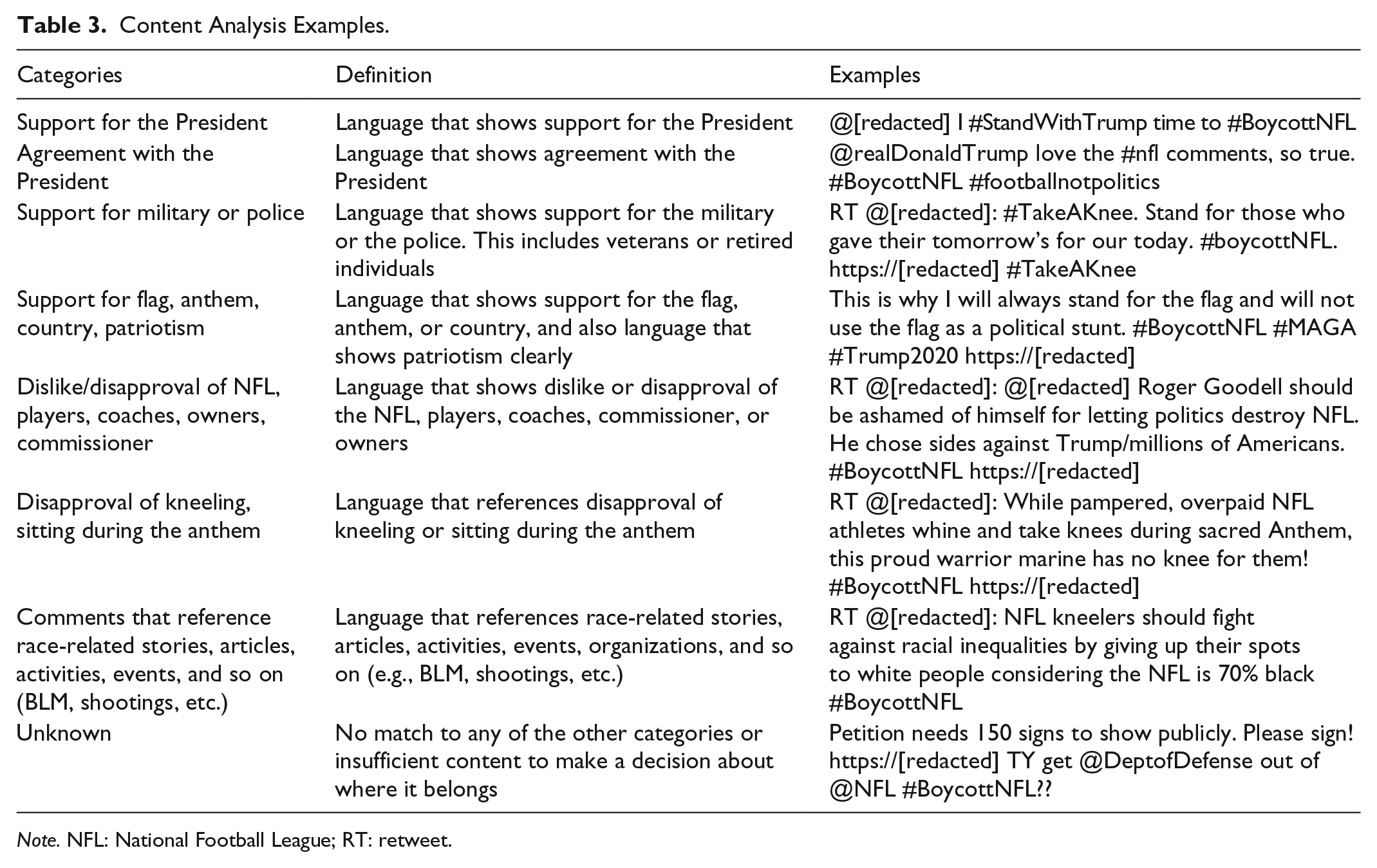
To explore the content from tweets that did not represent political consumerism, the last research question, we focused on tweets that were mismatches. As noted above, over 50% of tweet content was a mismatch, indicating a need to delve more deeply to obtain a more complete story of #BoycottNFL. To do so, we conducted topic modeling using the mismatched tweets. The words that emerged from the modeling included flag, disrespect, commissioner, overpaid, spoiled, anthem, veterans, military, police, and President/POTUS/Trump. From these words, in conjunction with inductive reasoning, we identified the following topics: (1) support for the President; (2) agreement with the President; (3) support for military or police; (4) support for flag, anthem, country, patriotism; (5) dislike/disapproval of NFL, players, coaches, commissioner; (6) disapproval of kneeling, sitting during the anthem; and (7) comments that referenced race-related stories, articles, activities, events, organizations, and so on (BLM, shootings, etc.). Next, tweets were coded using these seven topics to examine their relationship to political consumerism. Tweets could be categorized into multiple topics, and any content that did not fall into one of these seven topics was coded unknown (see Table 3 for definitions and examples).
Content Analysis Examples.
Note. NFL: National Football League; RT: retweet.
A large portion of the mismatched data expressed dislike/disapproval of NFL players, entities, and stakeholders. For example, “RT @[redacted]: The .@NFL has become an absolute disgrace to America . . . #AntiAmericanLeague #TakeAKnee #NotForLong #BoycottNFL ⦸.” The second largest category was support for the flag, anthem, country, and patriotism. Tweets coded in this category expressed support for the national anthem. For example, “@[redacted] The NFL or anyone who disrespects our country is an embarrassment to our country #BoycottNFL #AmericaFirst #MAGA.” Although certain topics, such as support for the President and comments related to race relations, were mentioned infrequently, these comments signified civic and political topics’ importance in the #BoycottNFL conversation. Further interpretation of our findings is discussed in the next section.
Discussion
#BoycottNFL began as a response to Colin Kaepernick’s decision to not stand during the anthem at an NFL game. This study used a social network approach to explore political consumerism, and its relationship to the hashtag, specifically, the way tweet content represents a hashtag and an actor’s intention to engage in political consumerism in the digital space. Social impact theory provided a theoretical framework for understanding how individual’s online behavior, attitudes and beliefs are influenced by their interactions with others. Overall, our findings revealed that identifying political consumerism online is a complex phenomenon. Yang (2016) discussed online hashtag activism as the use of hashtags for “discursive protest”; however, we argue that political consumerism requires not only a hashtagged phrase, but also tweet content that is consistent with the meaning of the hashtagged phrase as part of its overall message. For example, tweet content referred to “watching NFL is a massive time suck,” “burn those NFL jerseys and merchandise!” or “turn them off! burn your tickets!” as a result of Colin Kaepernick’s protest. We analyzed our sample of tweets to examine whether their content matched completely, in part, or mismatched the primary hashtag #BoycottNFL. Our sample of tweets reflected two critical elements from Bossy’s (2014) definition of political consumerism: (1) a network of individual and collective actors in the given space and (2) a change in behavior in current consumption practices in relation to the NFL. A change in behavior is consistent with social impact theory as it proposes that individuals’ behaviors within a given environment will be influenced by others based on proximity. We found that less than 50% of the tweets in the sample were related to the consumption-focused definition of #BoycottNFL. Our results revealed that #BoycottNFL played two primary roles: to engage actors in actual boycotting and to show public support for, or discontent with, the topic itself. For many, this hashtag (i.e., #BoycottNFL) was used to galvanize individuals to withdraw their support for the NFL by engaging in certain consumption practices, that is, encouraging consumers not to watch or attend NFL games, to cancel subscriptions to premium television services that allow games outside one’s local area to be viewed (i.e., DirecTV), or to discard purchased licensed products. For others, the hashtag was used to express opinions and attitudes concerning the boycott. Diversity in themes and phrases in the complete and partial match tweets increased by day, indicating heightened individualization in the collective action of boycotting, as actors “pick their own outlets for anger” (Bennett, 2012, p. 23) from among different brands and consumption practices. Such individualization may signal personal commitments in the actors’ support (Bennett & Segerberg, 2012). However, as Haenfler, Johnson, and Jones (2012) noted, these individualized acts often lead to collective participation in the form of an organized social movement.
Accompanying hashtags were analyzed in relation to the primary hashtag (#BoycottNFL) to explore the sentiments of political consumerism they demonstrated. We recognize that, although accompanying hashtags may tell only part of the story, they possess the ability to change a tweet’s sentiment or tone. This change in tone may indicate a change in the conversation that may alienate actors who are focused on the movement’s consumption practices. For example, individuals who use hashtags such as #BlackLivesMatter or #StandForOurFlag change the tone of tweets inadvertently to be more civic, while individuals who include political hashtags, such as #MAGA or #BuildTheWall in tweets, may indicate a focus on political participation. Although we expected to see accompanying hashtags aligned with buycotting (i.e., deciding to watch NFL games), our analysis did not reveal content specifically relevant to this topic. This could be attributed to the sample data analyzed using #BoycottNFL was not used by those who intended to buycott. We agree that hashtags instigate action (Yang, 2016), and also contend that hashtags are a call-to-action within the context of political consumerism, in that hashtags with political consumerism sentiment mobilize and stimulate an immediate response. Overall, consumption was the primary component in the accompanying hashtags. As the corporation is the center of political consumerism (Micheletti, 2010), brands should be mindful of partnerships with companies engulfed in civic-, political-, and consumption-related controversy that can reflect negatively on their brand image and affect sales adversely.
Previous literature on hashtags and trending topics on Twitter shows that through hashtags, users can witness public conversations about trending topics they may not be aware of otherwise (Yardi & boyd, 2010). Users also may include popular hashtags in their tweet content to increase the number of times their tweets are viewed. Although mismatches indicated a discrepancy between the primary hashtag (i.e., #BoycottNFL) and consumption practices within the tweet content, this does not indicate whether actors actually were engaged in political consumerism. In our analysis, we noticed that some tweets contained elements of political consumerism that were not related directly to consumption practices. Specifically, opinions of disapproval related to NFL players, teams, and officials, fit Bossy’s (2014) definition of political consumerism, in which users “. . . criticize traditional forms of consumption” (p. 182). Moreover, despite the exclusion of consumption practice language in mismatched tweets, it does not mean that these actors did not engage in political consumerism offline. Users can use a hashtag even though the content of their tweets is unrelated to the hashtag’s meaning. We contend that mismatch does not denote an actor’s unwillingness to engage in political consumerism, but may indicate instead the importance of other aspects of political consumerism unrelated to consumption, for example, political participation. These tweet contents also indicated actors’ opinions of Kaepernick’s protests and referenced reasons for them, as well as specific political parties and politicians’ influences. As Kende et al. (2016) noted, social media can be a tool to foster social identity and increase the motivation to participate in collective actions.
What is missing from the literature is the association between contentious political consumerism and individualized behavior on social media. Gotlieb and Cheema (2017) suggested that political consumerism behavior is a dichotomous concept, in that users can only engage only in one (lifestyle political consumerism) or the other (contentious political consumerism). They also argued that some consumers may engage in lifestyle political consumerism by creating online content, such as a digital post, to connect with like-minded individuals. Based on our results, the line between lifestyle and contentious political consumerism is blurred. Boycotting the NFL is contentious political consumerism, but it consists of lifestyle political consumerism through the individualized behavior of creating a tweet, which inadvertently is a part of collective action. Future research will be served better by exploring these two constructs as not mutually exclusive.
We extend the literature further by suggesting that retweeting can represent individualized political consumerism, but one that carries lower risk. Retweeting allows actors to indicate resonance of some form (often agreement) with another actor’s content. This allows low-risk participation in the conversation without having to voice an individual opinion, which is high risk. Thus, conversations surrounding controversial topics may contain more RT data because actors want to avoid sharing their direct opinion for fear of risking too much. Actors on Twitter may have a sense of being consumed in a conversation on a particular topic, even when they are not active participants (boyd et al., 2010), as retweeting allows actors to be engaged in a particular conversation without participating directly or fully. We note that original content production (i.e., original tweet, RT with a comment attached, or a reply) may play an important role in channeling the motivation for political consumerism motivation rooted in social-identification needs toward more organized and collective modes of consumer action. Retweeting could be an actor showing agreement with an original tweet without the risk of revealing their full political thoughts, a practice that protects political privacy (Park, 2018).
Limitations and Future Research
A study designed to examine social media data always can benefit from further analysis. Our sample did not include tweet threads, only first level tweets, RTs, and replies that included #BoycottNFL. Tweets that may have been part of the thread but did not include #BoycottNFL and could have been about an unrelated topic were not included in our dataset. Investigating full tweet threads, Twitter conversations that include a tweet containing #BoycottNFL, and corresponding RTs and replies that may not contain the same hashtag, could provide a more in-depth understanding of the motivations of political consumerism, why actors used accompanying hashtags, or lead to the discovery of additional political consumerism sentiment. Moreover, further analysis of the full tweet thread may reveal if the participating actors are CCC who Ward and de Vreese (2011) define as actively forming networks of like-minded consumers to monitor the progress of societal issues. Although a discussion of offline events that could have affected our sample was outside this project’s scope, we recognize the limitation that this presents and reserve this investigation for future research. Support for Kaepernick was out of the scope of our study, but we believe this is an interesting avenue for future studies to explore types of political consumerism, representing diverse sides of the issue. In our study, we also refrained from clicking URLs that were present in tweet content and adding this additional content to our analysis. Exploring these data may have shed more light on the inconsistencies we found between accompanying hashtags and tweet content with respect to #BoycottNFL. In the future, inclusion of URL content as part of the tweet thread could prove useful. Moreover, we posit that there is a connection between participating in online political consumerism and the offline manifestation of these behaviors. Further study of this that documents offline behavior could be valuable in understanding social media’s true influence on contemporary social movements. Finally, our sample was a 3% random sample of the top 5% actors in the top 5% of communities for only 4 days, which we believe is a representative sample of the dataset, but is a limitation nevertheless. Social media data contain nuances from the various hubs of actors within the network of the data. It is possible that there are other user hubs within our larger 9-day dataset that were not included in our random sample with tweets that would provide some insights into our research questions. We acknowledge and accept this limitation and do not imply that this study’s results can be generalized to all studies of this nature. In analyzing the data, we were not blind to the impact of offline events that may be political in nature and their impact on user-generated content in social media networks; however, this is not within the scope of this article, but should be a topic for future research. As Johri et al. (2018) noted, “triggers such as events and media refocus the attention of the movement” and potentially could have extended, altered, or redirected the conversation surrounding #BoycottNFL. Similarly, we also cannot dismiss the effect of high-profile actors and the influence they bring to a movement, as Stieglitz and Dang-Xuan (2012) noted, which could serve as another topic for future research.
Footnotes
Declaration of Conflicting Interests
The author(s) declared no potential conflicts of interest with respect to the research, authorship, and/or publication of this article.
Funding
The author(s) disclosed receipt of the following financial support for the research, authorship, and/or publication of this article: The author received financial support from Texas State University’s Research Enhancement Program (REP) for the data analys and authorship of this article.
