




Abstract
Digital media use can connect citizens across geographic boundaries into coordinated action by distributing political information, enabling the formation of groups, and facilitating political talk. These activities can lead to political consumerism, which is an important and popular form of political participation that translates across geographic borders. This article uses original survey data (n = 9284) to examine the relationship between digital media use and political consumerism in the United States, United Kingdom, and France. Talking politics online, joining social groups on social media, and searching online for political information increase participation in political consumerism. However, the strength of these positive correlations differs by age, country, and mode of political consumerism. Joining social groups on social media has a much larger effect size on buycotting compared to boycotting. The findings imply that social groups are more salient in the mobilization process for buycotting campaigns compared to boycotting campaigns.
Keywords
Introduction
How people participate in politics has changed dramatically over time, with more people opting for more expressive, personalized, and individualized forms of participation (Dalton, 2017; Newman and Bartels, 2011; Nonomura, 2017; Theocharis and van Deth, 2018). Digital media use supports these new forms of participation as both a mode for participation and a tool for mobilizing people to participate. In this article, we use original survey data from the United States, United Kingdom, and France (n = 9284) gathered in 2017 and 2019 to examine the role of digital media use for political participation. This study specifically focuses on political consumerism, which includes deliberately buying (i.e. buycotting) or avoiding (i.e. boycotting) products for political, ethical, or environmental reasons. For example, political consumerism could involve avoiding chocolate that was produced using child labor and instead purchasing Fair Trade chocolate.
Political consumerism is a distinct form of political behavior because it transcends geographical borders and creates opportunities to influence global politics. This is important because, in an increasingly globalized economy, people lack formal procedures to express their political views or influence environmental and ethical business practices. In this context, political consumerism is an important form of political participation that represents a shift in focus from the state to the economy. This results in a change in the balance of political power from the government to the market (Ward and de Vreese, 2011), as citizens use public concerns to guide their private purchasing decisions (Neilson and Paxton, 2010).
Our survey-based study makes four contributions to scholarship: (1) we explore three different types of digital media use and their role in political consumerism, highlighting theories about information, social ties, and social interaction; (2) we examine buycotting as a distinctive form of political consumerism whereas most research focuses on boycotting; (3) we test for cross-national differences in the mobilization potential of digital media use, while most scholarship focuses on the United States; and (4) we examine age differences in the role of digital media use in mobilizing citizens, which is untested in this subfield.
To address these gaps in the literature, we use a large sample, three-country study of people in the United States, United Kingdom, and France. We use a similar case method (Seawright and Gerring, 2008), choosing countries that have similar macro-level characteristics. Macro-level characteristics, such as Gross Domestic Product per capita and quality of democracy scores, have been found to predict cross-national variations in political consumerism. We find that discussing politics online, joining groups (associated with social causes) on social media, and searching online for political information are positive and significant predictors of boycotting and buycotting across countries and age groups. These forms of digital media use point to a mobilization process that transcends borders, age groups, and different dimensions of political consumerism. However, the strength of these positive correlations differs by age, for boycotting versus buycotting, and to a small extent by country. The large sample with a cross-national approach allows us to identify both similarities and differences in the role of digital media in political consumerism.
Digital media use and political consumerism
Digital media are defined as media in which data are communicated via computerized networks, allow one-to-one, one-to-many, and many-to-many communication in a variety of formats and include sites where people share and exchange information in online communities and networks (e.g. Facebook, Twitter, YouTube, and Instagram) (Gordo, 2020).
In relation to political consumerism, digital media have been described in terms of email use, web use to find information and make purchases, and use of social networking sites. Digital media use plays a variety of roles in political consumerism. Kelm and Dohle (2018: 1524) summarize these roles as follows: Online media provide political consumers with greater access to information; Web 2.0 offers numerous channels for communication with like-minded others, and online marketplaces enable easier ways for political consumerism, for example, buycotting products which are rarely available in local supermarkets.
In other words, people who search for political information or who discuss politics online should be more likely to engage in political consumerism. Finally, digital media use should correlate with political consumerism because of the opportunities presented by online purchasing of ethical products and services. In this article, we extend this argument further. Through social media, people can join a group associated with a political cause. Connecting to these groups opens a line of communication through which these groups can mobilize their followers to participate in boycott or buycott campaigns. In the following section, we outline some of the findings and theoretical claims attached to each of these roles of digital media in political consumerism.
Digital media use increases exposure to political information, which can increase awareness of political issues and specific campaigns (Becker and Copeland, 2016; Boulianne, 2016). This increased exposure to information is believed to translate into increased participation, replicating expectations from traditional media use (e.g. Atkinson, 2015). We hypothesize that if people use digital media to seek out news and information online, they will be more likely to participate in political consumerism. Indeed, the unique feature of digital media, as opposed to traditional or broadcast media, is the opportunity to easily seek a vast amount of information.
Few studies examine how digital media use differs for boycotting versus buycotting. Returning to Kelm and Dohle (2018), they suggest the opportunities for online consumption of goods might lead to greater participation in buycotting, that is, people can buy ethical products online. However, a recent meta-analysis suggests buycotting is rarely the focus of political consumerism studies (Copeland and Boulianne, 2020). Only three studies treat buycotting as distinct from boycotting in relation to digital media use (Earl et al., 2017; Endres and Panagopoulos, 2017; Kelm and Dohle, 2018). In each case, the effects are similar for boycotting and buycotting. For example, Kelm and Dohle (2018) find the effect of online information about political consumerism to be identical for boycotting (β = .124) and buycotting (β = .114). Our first set of research hypotheses is as follows:
H1a. Searching for political information online positively relates to boycotting.
H1b. Searching for political information online positively relates to buycotting.
Social media can be used to circulate information, and this information may have stronger implications for political behavior because it is filtered and promoted through family and friends (Bode, 2012; Boulianne, 2016). In the case of political consumerism, family and friends can share information about boycott and buycott campaigns, raising awareness of the environmental or ethical issues motivating such campaigns. However, early studies show that exposure to political information through social media has little effect on political consumerism (Baumgartner and Morris, 2010; Boulianne, 2016).
Social media uses are a subset of activities related to the broader concept of digital media use. Social media use may have different effects than digital media use. Combining a variety of social media activities and a variety of digital media activities, Gil de Zúñiga et al. (2014) find much larger effects for social media use than digital media use. Trying to capture the essence of what is distinctive about social media use, later studies explore the role of social interaction on social media and its implications for political consumerism. Becker and Copeland (2016) argue that social media use allows people to meet and engage with others with similar interests and identities, developing a networked public that can be mobilized to participate in specific campaigns. Using Pew Research data of lesbian, gay, bisexual, and transgender (LGBT) adults in the United States, they find people are more likely to engage in political consumerism to promote LGBT equality if they use social media to meet new LGBT friends online or discuss LGBT issues (Becker and Copeland, 2016). Here, we extend this research by offering a robust measure of political talk online and its influence on political consumerism, similar to Kelm and Dohle (2018) who found slightly larger effects of online communication for boycotting (β = .147) than buycotting (β = .119). Our second set of research hypotheses is as follows:
H2a. Discussing politics online positively relates to boycotting.
H2b. Discussing politics online positively relates to buycotting.
Social media platforms are also important for creating social ties to groups that may circulate news and information about boycott campaigns. People with more organizational ties are more likely to participate because they are more likely to be asked to do so (Schussman and Soule, 2005; Verba et al., 1995). Using the European Social Survey 2002–2003, Neilson (2010) found that associational involvement was a stronger predictor of buycotting than boycotting. She explains this pattern in terms of less media attention to buycott campaigns compared to boycott campaigns, resulting in a greater need for organizations to address this informational void. Social media can facilitate requests for participation as well as provide information about why people should support specific campaigns.
Existing research does not address whether online ties to social groups are associated with political consumerism. Instead, the scholarship focuses on whether online information matters more for organizationally driven political consumerism versus self-directed political consumerism. Several studies show online information-seeking matters more for lifestyle political consumerism, which tends to be self-directed, than for contentious political consumerism, which tends to be organizationally directed (Earl et al., 2017; Gotlieb and Cheema, 2017). Self-directed activity may depend on people’s own political awareness rather than on organizational cues. At the same time, digital media use also enables individuals to connect with organizations, which can create opportunities to learn about and connect with social media groups as well as increase participation in organizationally driven activities (Earl et al., 2017). Following other studies about social group participation and political consumerism (Neilson, 2010; Neilson and Paxton, 2010), we expect social ties to online groups will help mobilize people to participate. Our third set of hypotheses is as follows:
H3a. Joining a social group (that is defending a social cause) on social media positively relates to boycotting.
H3b. Joining a social group (that is defending a social cause) on social media positively relates to buycotting.
Differential effects
Scholars argue the effects of digital media use on civic and political participation may differ by age (Andersen et al., 2020; Boulianne and Theocharis, 2020; Gotlieb et al., 2015; Shah et al., 2001, 2009). Much of this research utilizes youth or student samples. In some cases, the choice of sample reflects an assumption that both political consumerism and digital media use are more popular among young people (e.g. Atkinson, 2015; Gotlieb et al., 2015; Shah et al., 2009). In other cases, the use of student samples seems to be one of convenience (e.g. Baumgartner and Morris, 2010; Boulianne, 2016; Conroy et al., 2015). Regardless, studies with student samples report very small effects (cf. Wang et al., 2012).
Gotlieb et al. (2015) argue that digital media may have larger socialization effects for young people because they have more agency in choosing these online sources in contrast to family and school. In addition, digital media use may have differential effects because youth are able to create and disseminate this information more easily than older populations (Gotlieb et al., 2015).
A recent meta-analysis of 66 studies on political consumerism suggests the effects of age are nonlinear, with middle-aged people more likely to participate in this activity (Copeland and Boulianne, 2020). That said, the effects of digital media use on political participation may be larger for younger people compared to older adults because their political identities are more malleable and they use digital media more extensively (Boulianne and Theocharis, 2020; Shah et al., 2001, 2009) As such, rather than a hypothesis we propose the following research question:
Few studies on political consumerism and digital media use are conducted outside of the United States. Zhang (2015) is the only study of digital media use and political consumerism that includes multiple countries, finding that Internet use, gross domestic product (GDP) per capita, and quality of the political system (civil liberties and political rights) have statistically significant effects on political consumerism. However, his models do not consider whether the effect of digital media use on political consumerism differs by country.
Cross-national studies of political consumerism exist outside of the digital media context, including a key study in the field that compared students in Canada, Belgium, and Sweden (Stolle et al., 2005) as well as studies that used pooled country data, such as the European Social Survey (Christensen, 2016; Filetti, 2016; Gallego, 2007; Grasso, 2016; Koos, 2011; Moeller and de Vreese, 2013; Neilson, 2010; Neilson and Paxton, 2010; Sandovici and Davis, 2010; Solt, 2015; Vassallo and Ding, 2016; Yates, 2011), International Social Survey Program (ISSP) (Summers, 2016), and World Values Survey (Campante and Chor, 2014; Crepaz et al., 2017; Gundelach, 2020). For the most part, these studies do not focus on whether the predictors of political consumerism differ by country characteristics (exception: Summers, 2016) and do not present country-specific coefficients (exceptions: Stolle et al., 2005; Yates, 2011).
However, this set of studies offers repeated tests about whether GDP per capita and quality of democracy scores impact political consumerism (Christensen, 2016; Koos, 2011; Moeller and de Vreese, 2013; Solt, 2015; Summers, 2016; Vassallo and Ding, 2016). Using the 2004 ISSP, Summers (2016) finds that GDP per capita predicts political consumerism. Gundelach (2020) finds the degree of democracy predicts engagement in political consumerism in both high and low political trust political systems. Using European Social Survey data, Moeller and de Vreese (2013) confirm that the quality of a democracy influences political consumerism. We use a similar case method (Seawright and Gerring, 2008), choosing countries that have similar GDP per capita and quality of democracy scores.
Freedom House (2021) scores are based on political rights and civil liberties; Freedom House (2021) also includes Internet freedom scores. For both measures, the scores are consistently high for our three countries (Table 1). In sum, these three countries are quite similar on macro-level indicators, supporting our “most similar” case selection. As for GDP per capita, the United States is the highest, with the United Kingdom and France being similar (World Bank, 2018). Following this line of research, we raise questions about whether digital media effects are similar in all three countries.
Country comparisons.
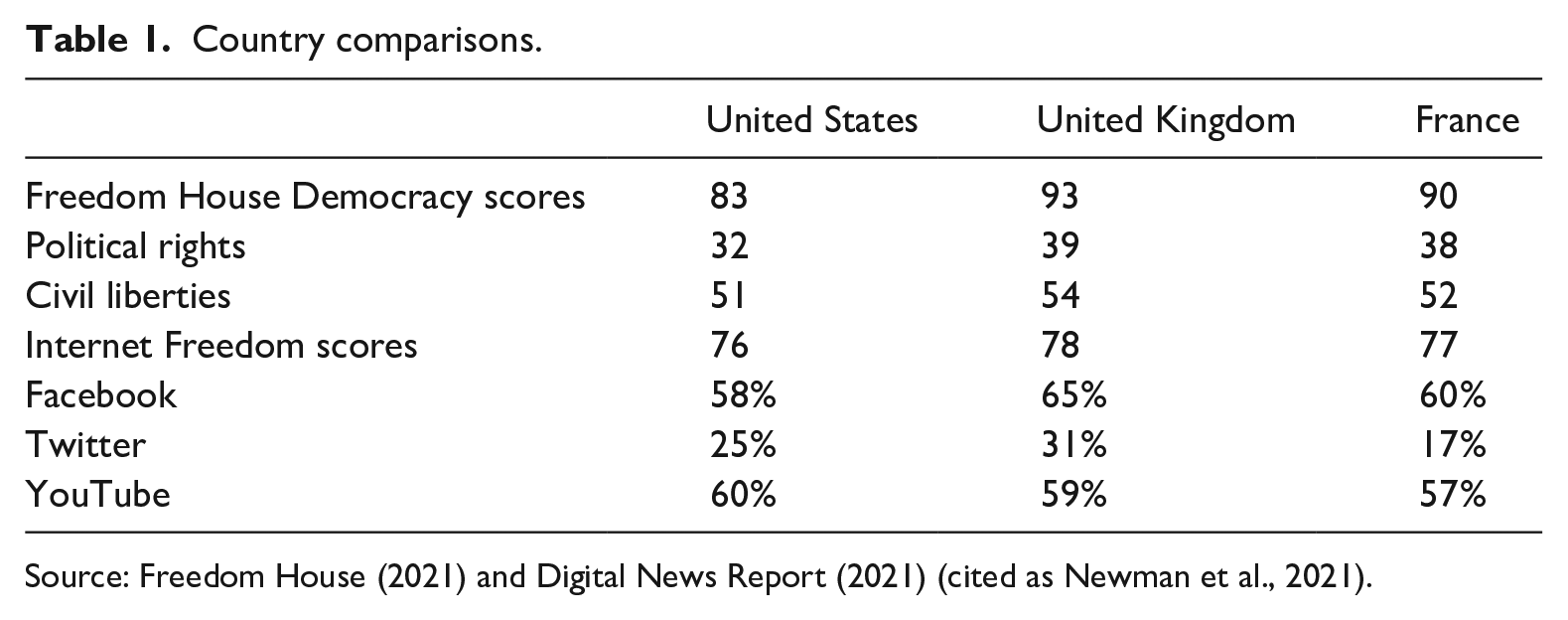
Source: Freedom House (2021) and Digital News Report (2021) (cited as Newman et al., 2021).
In the scholarship on media effects, factors such as having public service media and a high degree of journalistic professionalism impact citizens’ exposure to diverse political news and political knowledge (Esser, 2019). The online environment, in contrast, offers more similarity in the infrastructure in terms of the platforms being used (Boulianne, 2020). As such, we might expect homogeneity in the effects of digital media use. Considering the platforms studied in the Digital News Report (Newman et al., 2021), Facebook and YouTube are the most widely used in the three countries (Table 1). Furthermore, Facebook usage is important for H3 about joining social media groups. Facebook (and Twitter) are important for H2 about talking politics. YouTube usage is important for H1 about searching for information. These platforms are also important given Gordo’s (2020) definition of digital media (see the beginning of this paper). Ideally, we would also have measures of Google use, but the Digital News Report does not include this information. While these countries may have different offline media structures (Esser, 2019), their digital infrastructure is quite similar, which suggests the possibility of consistent digital media effects across countries.
Our final research question is as follows:
Data and method
This article uses survey data gathered in three countries in 2017 (May to June, n = 4532) and in 2019 (September to November, n = 4752). The sample is based on an online cross-sectional panel with quotas in place to ensure representation of the population in each country (sex, age). In Supplemental Appendix A1, we compare the sample statistics to the official/census information for each country. The survey data and replication files are available at: 10.6084/m9.figshare.16811311.
The survey was administered by Lightspeed Kantar Group in both years and in all countries. The pooled sample includes 3210 people from the United States, 3043 from the United Kingdom, and 3031 from France. Pooling samples across years is a common practice in this field (Grasso, 2016; Moeller and de Vreese, 2013; Shah et al., 2007; Solt, 2015; Vassallo and Ding, 2016). In our case, this pooling enables the age group analysis related to RQ1. The survey questions are identical in 2017 and 2019. We account for the year of data collection in our models. Given our choice of countries, we significantly extend scholarship by examining countries other than the United States, as implied by Research Question 2. Our choice of countries reflects the “most similar” case selection for large sample studies (Seawright and Gerring, 2008). We chose multiple cases that are similar on the variables of GDP per capita and quality of democracy, which have been the focal point of comparative research on political consumerism. Before country/case selection, we did not know whether the cases would be similar on the independent variables (specific digital media uses), given the lack of comparative research on these countries. As for political consumerism, the last two rounds of the World Values Survey in 2010–2014 and 2017–2020 (Gundelach, 2020; World Values Survey, 2020) did not include Great Britain or France in the line of questions about boycotting. As such, we did not know the participation rates across these countries.
Seawright and Gerring (2008) would call our design an exploratory design because we did not know the characteristics of x (digital media use) and y (political consumerism) in these three countries before data collection. We do know the countries are similar in background characteristics that have been tested in existing scholarship (GDP per capita and quality of democracy). A comparative approach does not necessarily have to focus on identifying differences. Identifying differences helps to advance more nuanced theories about contextual conditions that moderate the relationship; however, comparative approaches can also reveal similarities. In our case, we examine the robustness of theories beyond the US context and beyond limited samples of students/youth. We do not find substantial differences within each country; however, we see some differentiation in the strength of variables or predictors across countries.
Dependent variables
Our dependent variables are buycotting and boycotting, which measure different dimensions of political consumerism. To measure buycotting, we asked, “During the past 12 months, how often have you bought a certain product or service because of the social or political values of the company that provides it?” To measure boycotting, we asked, “During the past 12 months, how often have you refused to buy, or boycotted, a certain product or service because of the social or political values of the company that provides it?” We offered relative frequency categories: never, rarely, from time to time, and often. This approach is advantageous because most of the research on political consumerism employs a binary measurement. We find that about half of respondents engaged in buycotting and half in boycotting. Descriptive statistics are provided in Table 2. Country-level statistics are available in Supplemental Appendix A2. Question wording is available in Supplemental Appendix A3.
Descriptive statistics.
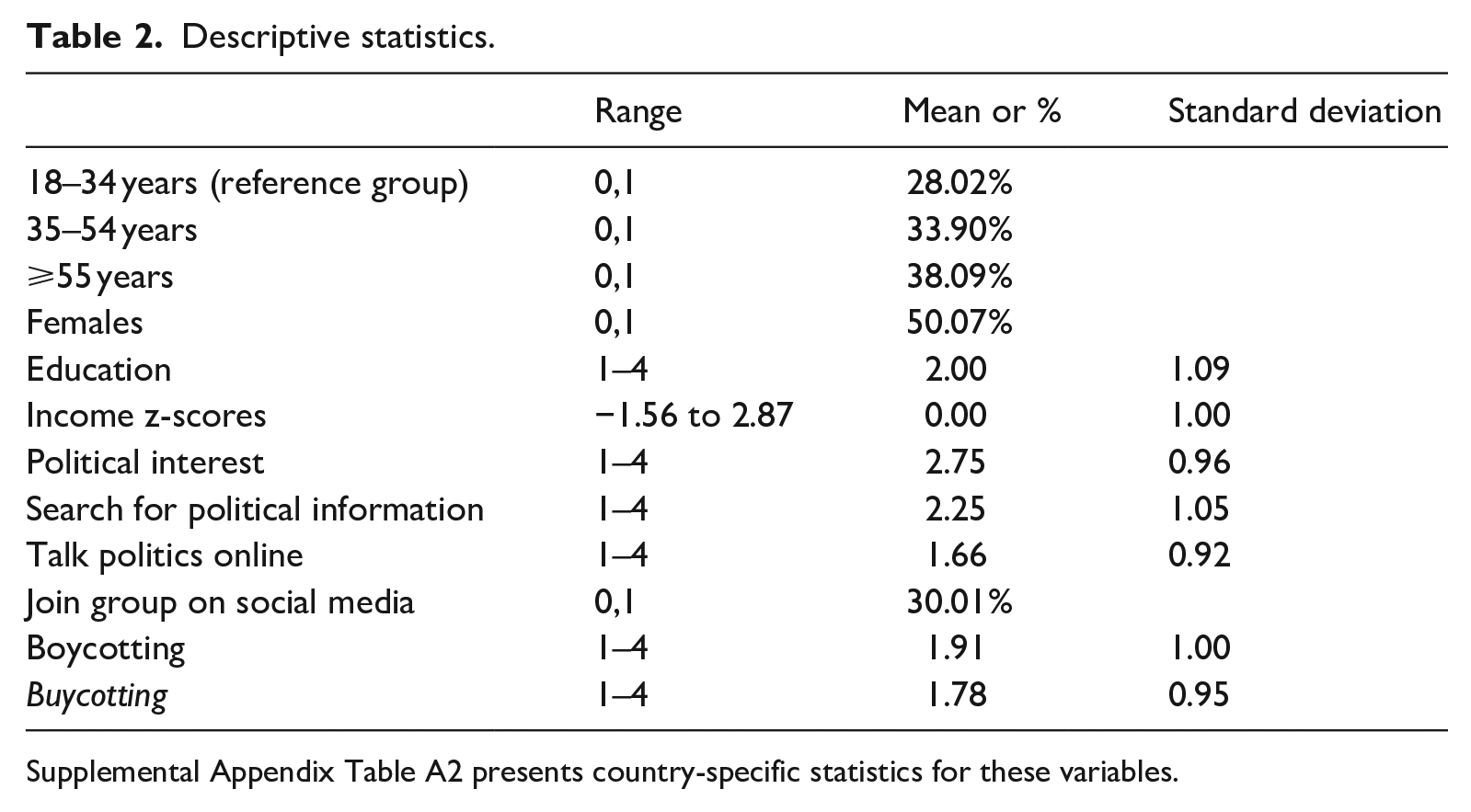
Supplemental Appendix Table A2 presents country-specific statistics for these variables.
The 2019 questionnaire included some follow-up questions about political consumerism. We asked, “For products and services that you boycott, how important were the following reasons for boycotting?” The response scale ranged from 1 (not at all important) to 5 (extremely important). We offer additional details about the motivations for participating in boycott campaigns in these three countries based exclusively on those who reported engaging in boycotting (see Supplemental Appendix A3). Figure 1 outlines these results. Labor practices and the environment are slightly more important in France compared to the other countries as a motivation for boycotting. Compared to other countries, respondents in the United States reported higher importance scores for corporate donations to political campaigns as a factor motivating boycotting.
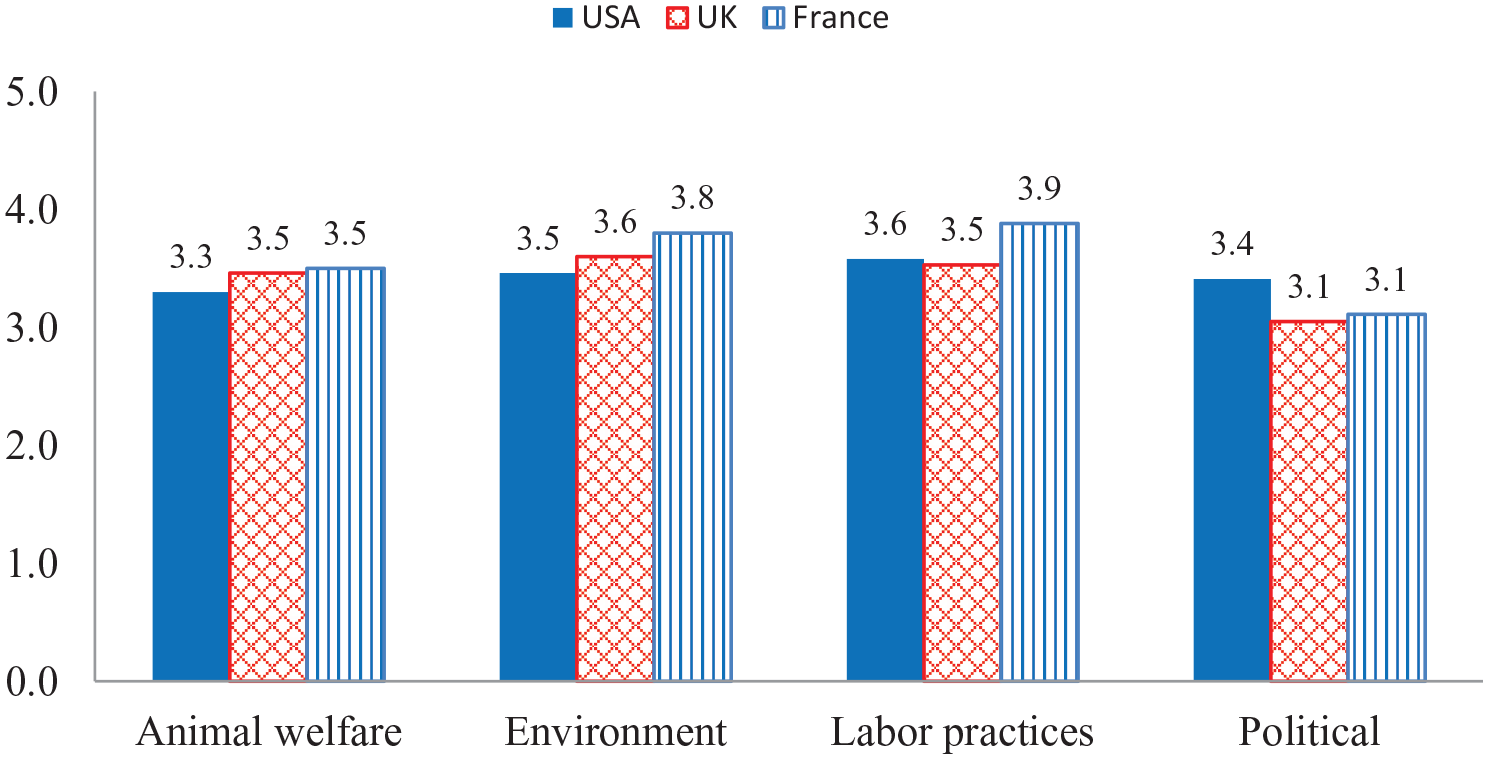
Cross-national comparison of motives for boycotting.
Digital media variables
We asked a series of questions about online activities in the past 12 months. These activities included the frequency with which respondents “searched for political information online” (H1). The full question wording is available in Supplemental Appendix A3. We offered relative frequency categories: never, rarely, from time to time, and often. In relation to H2, we also asked, “How often have you talked about politics with people online (e.g. via social media, chats or emails)?” We offered relative frequency categories: never, rarely, from time to time, and often. People who did not use social media were coded as “never.” We asked whether people had, in the past 12 months, “Joined a special group that is defending a social or political cause or in response to a current event” (H3).
Other variables
The models control for sex, age, education, income, and political interest (see Supplemental Appendix A3 for specific question wording). The choice of variables is based on a meta-analysis of existing research on political consumerism. This meta-analysis finds strong effects for education and political interest (Copeland and Boulianne, 2020). Different countries have different education systems. As such, we revised the responses into high school or less, some college, bachelor’s degree, and more than a bachelor’s degree. In the pooled sample, approximately 52.64% of the respondents had completed more than high school.
Age is well-tested in this body of research, with the weight of the evidence in favor of nonlinear effects (Copeland and Boulianne, 2020). To further examine these nonlinear findings, we decided to code age as a series of categories. This approach helps highlight nonlinear effects observed in other studies, but also how the effects may differ by age group, as suggested by the review of literature on digital media effects (RQ1). The average age in the pooled sample is 47.76 years (SD = 17.01, minimum = 18 and maximum = 99).
The effects of income are also inconclusive in the meta-analysis (Copeland and Boulianne, 2020). Income was measured in different currencies in the United States, United Kingdom, and France. To enable comparisons across countries, all values are standardized (respondent’s answer minus the country’s average divided by the standard deviation for the country). In the United States, respondents’ average income was US$63,836 (SD = 47,410, minimum = 5000 and maximum = 200,000). In the United Kingdom, respondents’ average income was £29,001 (SD = 15,457, minimum = 6000 and maximum = 55,000). In France, the respondents’ average income was €31,221 (SD = 15,418, minimum = 7200 and maximum = 60,000).
Political interest is measured by the question, “How interested would you say you are in politics,” with responses of not at all interested, not very interested, fairly interested, and very interested (M = 2.75, SD = 0.96).
Analytic technique
Our analysis proceeds in three stages. First, we examine the pooled results across countries, years of data collection, and age groups (H1–H3). Then, we examine whether the relationships between digital media uses and political consumerism differ by age group (RQ1). Finally, we examine whether the relationships between digital media uses and political consumerism differ by country (RQ2). Because the dependent variables, boycotting and buycotting, are measured at the ordinal level, we opted to use ordinary least squares (OLS) regression analysis, which is common in the existing studies on this topic (Atkinson, 2015; Copeland and Feezell, 2017; Gil de Zúñiga et al., 2014; Gotlieb and Cheema, 2017; Shah et al., 2007, 2009; Stolle et al., 2005; Wang et al., 2012). The advantage of OLS lies in the standardized coefficients, which allow a comparison of coefficients across types of digital media uses, dimensions of political consumerism, age groups, and countries. Using OLS, we can identify which uses have the strongest roles for boycotting versus buycotting, for younger versus older age groups (RQ1), and for different countries (RQ2). As a robustness test, we ran ordered logistic regression (Table B1) for the main variables of interest, which confirms the findings from OLS. Supplemental Appendix Tables C1–C8 presents a series of interaction effects to assess the significance of differential effects for the different age groups (RQ1) and by country (RQ2).
Results
Overall, all of our research hypotheses are supported with positive and statistically significant coefficients across all models (Table 3). As such, our analysis focuses on the strength of these coefficients rather than merely documenting their statistical significance. Standardized coefficients are presented to enable this comparison. Our first hypothesis (H1) is about whether searching online for political information has a positive correlation with political consumerism. We find it positively relates to boycotting (B = .175) and buycotting (B = .192), with comparable effect sizes.
OLS regression of boycotting and buycotting.
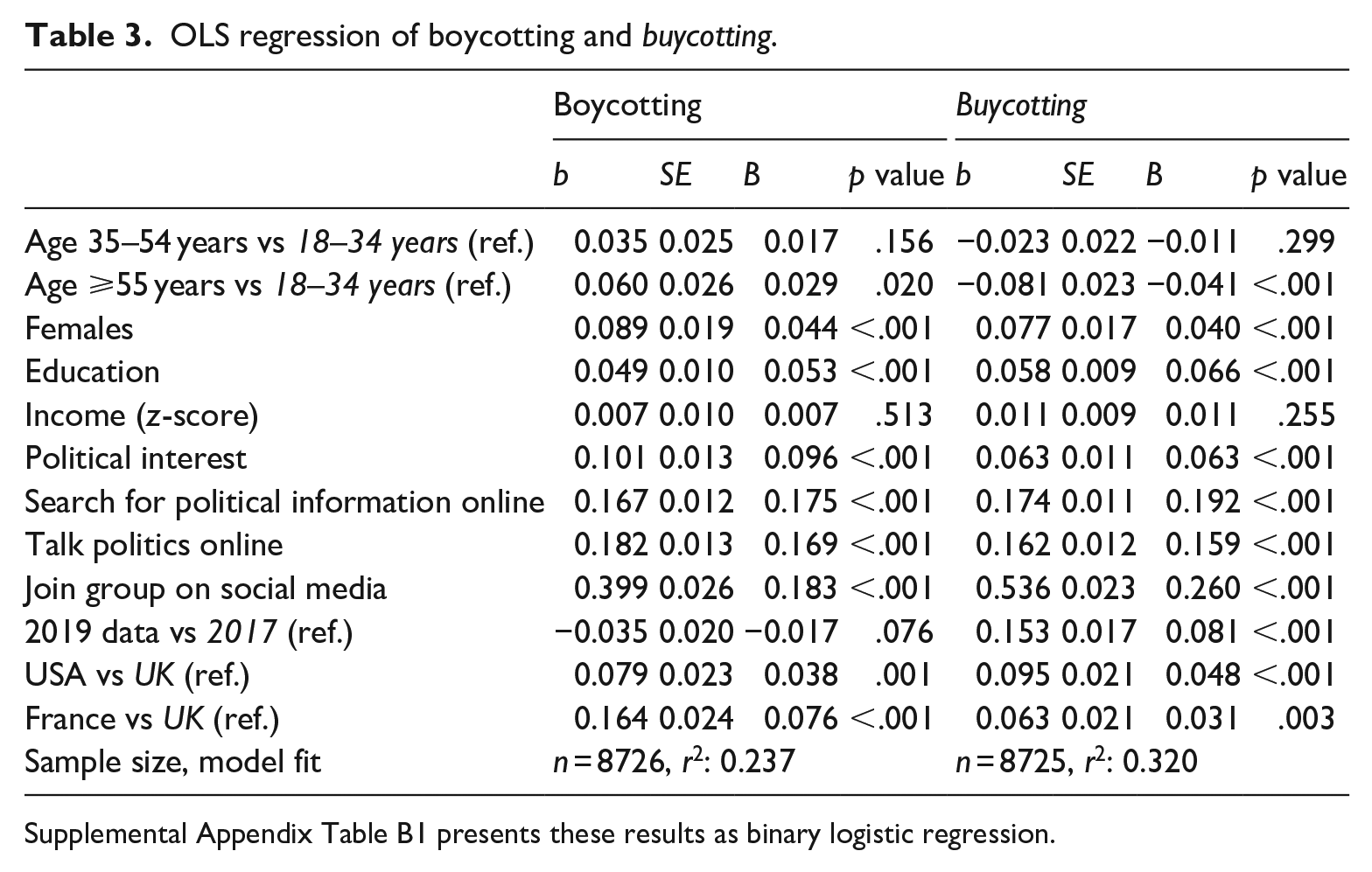
Supplemental Appendix Table B1 presents these results as binary logistic regression.
Second, we hypothesize that talking about politics online increases engagement in political consumerism (H2). We find that political talk online increases the frequency of boycotting (B = .169) and buycotting (B = .159), with comparable effect sizes.
We also examine how joining groups on social media is associated with political consumerism. We see substantial effect sizes for boycotting (B = .183) and buycotting (B = .260). We find that the coefficient is much larger for the role of joining groups on social media on buycotting (H3b) compared to boycotting (H3b).
The explained variance is higher for buycotting (r2 = 32.0%) than boycotting (r2 = 23.7%). As such, digital media use and other factors in our model are much better at explaining buycotting than boycotting. The list of statistical controls is based on an existing meta-analysis study that did not distinguish between boycotting and buycotting but noted the focus of the research was on boycotting (Copeland and Boulianne, 2020). We find consistent effects for sex, education, income, and political interest across boycotting and buycotting. Political interest correlates with both boycotting and buycotting (B = .096 vs B = .063, respectively). Females are slightly more likely than men to participate in boycotting (B = .044) and buycotting (B = .040). Education is positively correlated with boycotting (B = .053) and buycotting (B = .066). Income is also consistent in its null effects across boycotting (B = .007) and buycotting (B = .011).
Age has a different influence on buycotting than boycotting. Buycotting is more popular among younger people than older people (B = −.041). In contrast, those aged ⩾55 years are more likely to boycott (B = .029) compared to those aged 18–34 years (reference group).
Age differences (RQ1)
Our next set of analyses examines the extent to which the results differ by age (Table 4), referring to our first research question. Searching for political information (H1) increases the likelihood of boycotting for all age groups, with coefficients ranging from .156 to .193. These strong, positive correlations also occur with buycotting. The standardized coefficients range from .159 to .217. This variable is positive and statistically significant in every model. For the youngest age group, the standardized coefficient for searching for information online and buycotting is smaller than for other age groups. To test for a differential effect, we added an interaction term (Supplemental Appendix Table C1) for age groups and searching for information on political consumerism. For the middle-age group, this coefficient was small but statistically significant for buycotting (B = .044, p = .043) but not significant for boycotting. For the oldest age group, we see a much smaller effect of searching that is significant for buycotting (B = −.081, p < .001) but not significant for boycotting (Supplemental Appendix Table C2). In sum, searching for political information has a larger role in middle-aged people’s buycotting compared to other age groups.
Age group comparison of boycotting and buycotting.
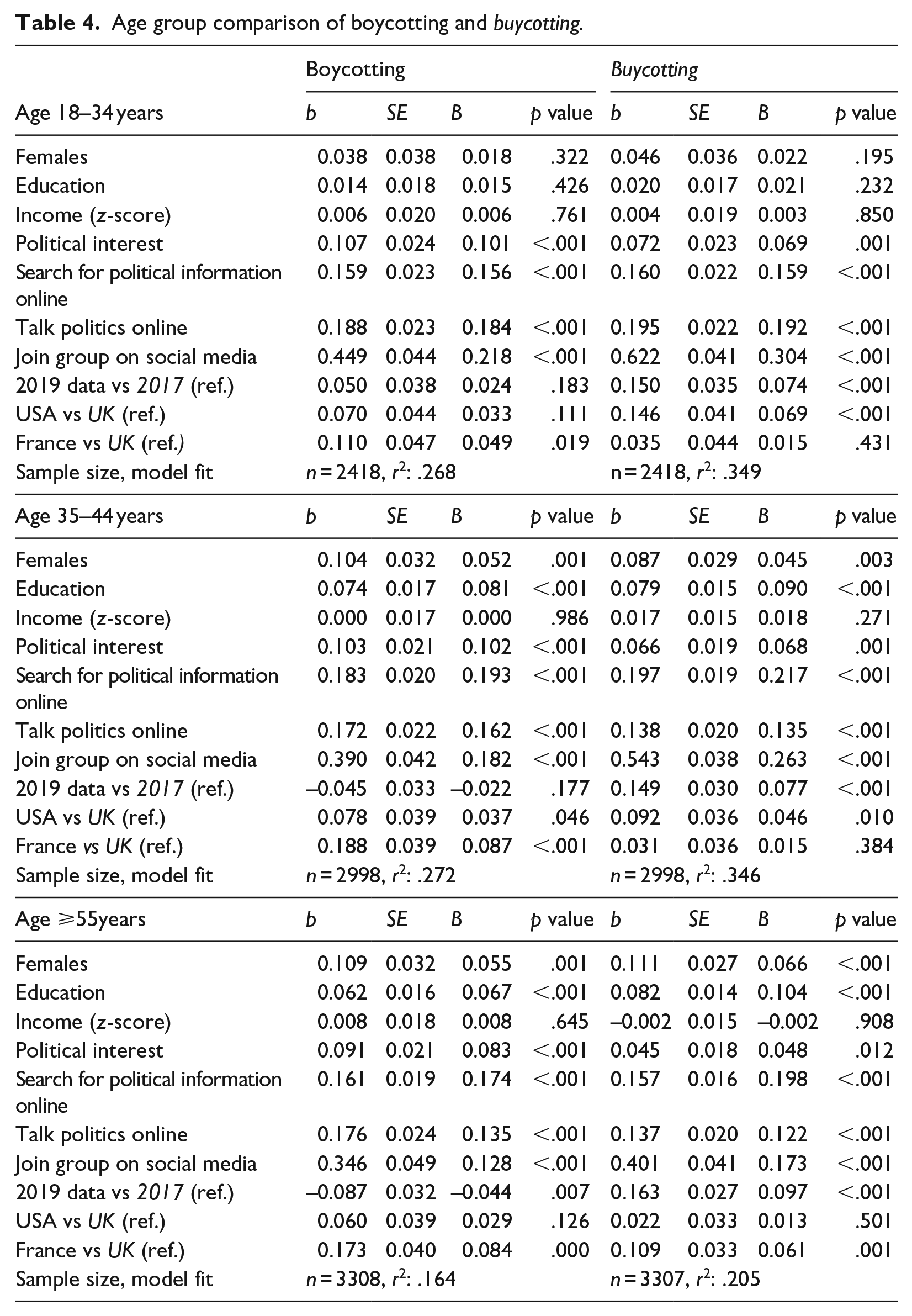
The coefficients for talking politics online (H2) are also positive and statistically significant in every model. The standardized coefficients for talking politics and boycotting range from .135 to .184. In relation to buycotting, the standardized coefficients for talking politics online range from .122 to .192. This correlation is smallest for the oldest group. Again, we introduce an interaction term for the oldest age group and talking politics online, then examine the relationship with political consumerism. The analysis confirms a significant difference in the strength of the coefficients between talking politics and buycotting among respondents in the oldest age group (B = −.082, p < .001) compared to other age groups (Supplemental Appendix Table C4). In short, the effect size is smaller for older adults. The interaction term for the oldest age group and talking politics online is not significant for the model predicting boycotting. For the middle-age group, we did not find significant differential effects of talking politics on political consumerism (Supplemental Appendix Table C3).
The coefficients for joining social groups on social media (H3) and political consumerism are also positive and significant for all age groups. For joining social groups on social media and boycotting, the coefficients range from .128 to .218. For joining social groups on social media and buycotting, the coefficients range from .173 to .304. Again, we see a pattern where the coefficients are the smallest for the oldest age group. We examine whether this difference is significant. The analysis confirms a significant difference in joining groups and buycotting among respondents in the oldest age group (B = −.058, p < .001), but the same test for boycotting did not produce a significant differential effect (Supplemental Appendix Table C6). We did not find differential effects for the middle-age group (Supplemental Appendix Table C5). In sum, significant age differences are evident in terms of the magnitude of the relationship between digital media uses on political consumerism, especially for older respondents and for buycotting.
Cross-national comparisons (RQ2)
Our next set of analyses (Table 5) addresses our research question about the extent to which the relationships differ across countries (RQ2). Searching for political information (H1) has a consistent role in boycotting for all countries. The coefficients range from .154 to .188. These strong, positive correlations also occur with buycotting. The standardized coefficients range from .172 to .200. This variable is positive and statistically significant in every model for every country. Searching for political information increases the likelihood of boycotting and buycotting. We examine whether there are country differences in the relationship between searching for political information and political consumerism by introducing interaction variables to the models. We find the effect is slightly larger in the United States, compared to the United Kingdom, for both boycotting (B = .066, p = .005) and buycotting (B = .078, p < .001) (see Supplemental Appendix Table C7). France did not differ from the United Kingdom in the relationship between searching for information and political consumerism.
Cross-national comparison of boycotting and buycotting.
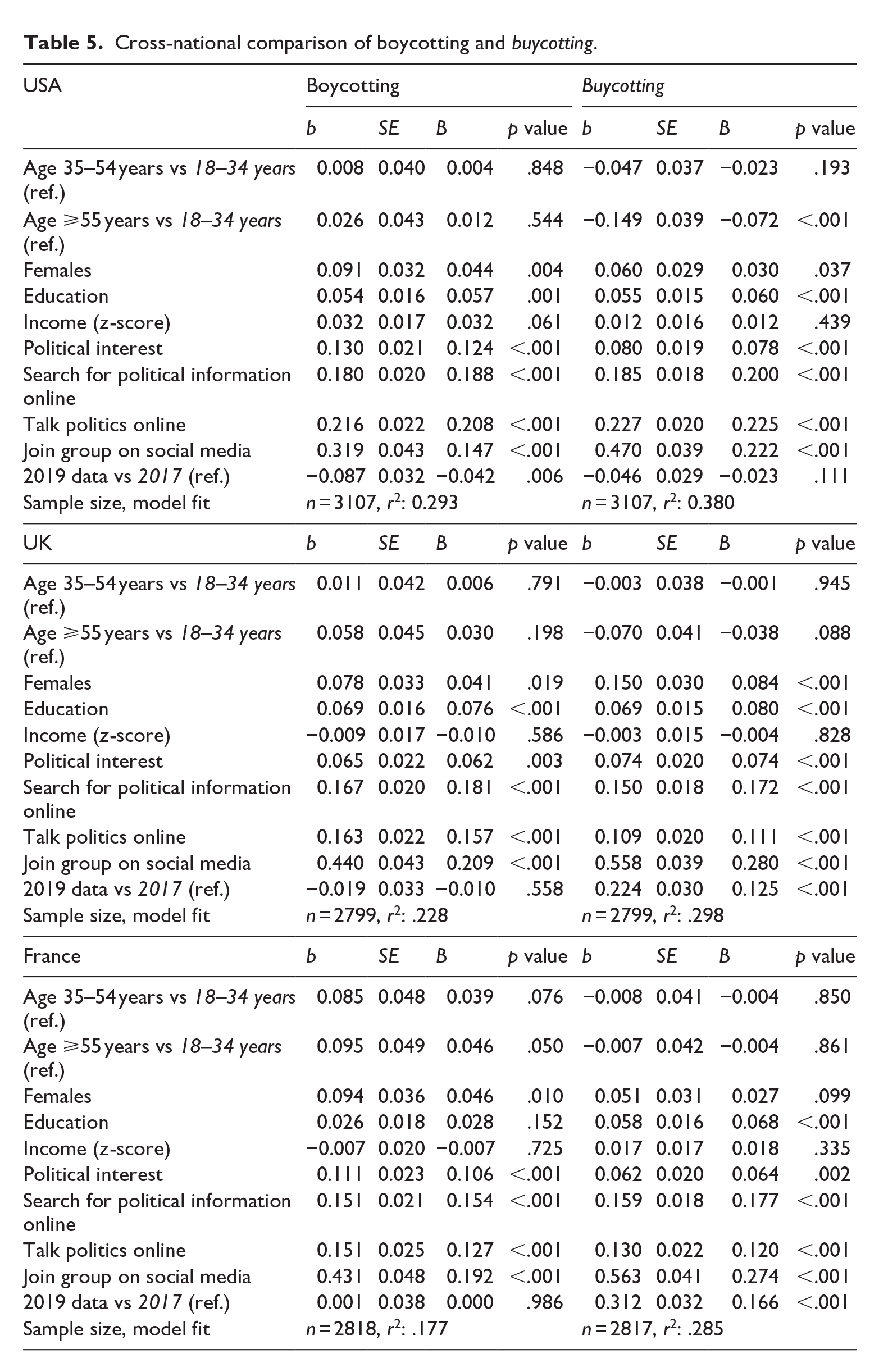
Talking politics online (H2) has the largest correlation with political consumerism in the United States (boycotting B = .208, buycotting B = .225), followed by the United Kingdom (.157, .111), and France (.127, .120). We examine whether these country-level differences are significant by introducing an interaction term (with the United Kingdom as the reference) (see Supplemental Appendix Table C8). The analysis confirms a significant difference in the strength of the coefficients for the United States for boycotting and talking online (B = .063, p = .004) and for buycotting and talking online (B = .117, p < .001). France differed from the United Kingdom in having slightly smaller relationships between talking politics and boycotting (B = −.039, p = .049) and buycotting (B = −.039, p = .037).
We also see cross-national differences for joining a social group on social media (H3), with a larger impact in the United Kingdom (boycotting B = .209, buycotting B = .280) and France (.192, .274) compared to the United States (.147, .222). We examine whether these country differences are significant by introducing interaction terms between the country variable and joining a social group (Supplemental Appendix Table C9). We find small differences with the United States and joining a social group on buycotting (B = .031, p = .018), but not boycotting. France did not differ from the United Kingdom in the role of joining a social group on social media on political consumerism.
Discussion and conclusion
This article examines how digital media use can mobilize citizens to boycott and buycott by providing political information to inform purchasing decisions, facilitating connections to social groups who can circulate information and calls to participate, and supporting political discussions through which citizens can mobilize each other to participate in political consumerism campaigns. We find strong, positive effects for these forms of digital media use on political consumerism, which advances our understanding of the mobilization processes. These findings offer evidence of a mobilization process that transcends geographic boundaries. We further extend research on digital media use and political consumerism by examining differences in the mobilization for boycotting versus buycotting by country and age group. Across all countries, we see that talking politics online, joining a social group on social media, and searching for information on digital media have strong, positive correlations with political consumerism.
Although all correlations between digital media use and political consumerism are positive and significant, they vary in strength. In the United States, we see evidence to support the idea that people are self-mobilizing and/or mobilizing their own networks to participate in political consumerism. Earl et al. (2017) ask about whether people participated in self-directed, organizationally directed, or hybrid boycotts and buycotts. Their findings demonstrate political consumerism is self-directed in their American sample (72% of the sample reported self-directed boycotts and 77% reported self-directed buycotts). Prior studies focused on the United States (Endres and Panagopoulos, 2017; Gotlieb and Cheema, 2017; Gotlieb et al., 2015; Shah et al., 2009), and our results here reveal a pattern that is strongest in the United States but also evident in other countries. We find that talking about politics online has a larger positive correlation with political consumerism in the United States and smaller correlations in the two European countries. American citizens mobilize each other to participate in political consumerism through online political discussions.
Furthermore, we see larger correlations between searching for political information and political consumerism in the United States, affirming that mobilization in the United States works differently than in the two European countries. The difference is a degree of magnitude rather than a completely different process. Again, Earl et al. (2017) offer insights about these differences; they find that information searching has a larger impact on self-directed versus organizationally driven political consumerism. The larger coefficient in the United States may reflect American political consumerism being more self-directed than is the case in the other countries, thus requiring greater effort to search for information.
Using a similar case method of country selection (Seawright and Gerring, 2008), we found that the theory of digital media uses and political consumerism applies to the United Kingdom and France in addition to the United States; the difference is in the magnitude of the relationships. As mentioned, the United Kingdom and France have not been included in the latest rounds of the World Values Survey (Gundelach, 2020; World Values Survey, 2020), and thus, this data source could not compare the United States to these two countries. As such, while our research focuses on those types of countries that are overrepresented in this body of research, that is “industrial and developed countries with democratic political systems” (Zhang, 2015: 434), there is a gap in understanding with respect to transatlantic differences in political consumerism. In addition to addressing this gap, we offer unique insight into the role of digital media use for political consumerism in these well-established democracies. We find a mobilization process that transcends geographic borders; the countries vary in terms of the magnitude of relationships, but our findings suggest a consistent process of mobilization.
Our study addresses clear research gaps in terms of the lack of attention to buycotting, particularly with respect to digital media use (Copeland and Boulianne, 2020). Age influences participation in boycotts and buycotts but in different ways. Age is positively correlated with boycotting but negatively correlated with buycotting. We find that the oldest age group was distinctive in being the least impacted by digital media use. While the correlations between these media uses and political consumerism remain strong, positive, and significant among the oldest age group, the coefficients are indeed smaller than those for the younger age groups. As mentioned, a good portion of the existing research focuses on young people or student samples, which may exaggerate the effects of digital media uses on political consumerism. A more age-diverse sample shows that youth/student samples do not represent the larger population’s experiences.
Further research should try to directly assess how often buycotting is done online as well as offline. Current measures do not assess the mode of participation, yet this can imply a different mobilization process and different predictors. Kelm and Dohle (2018) suggest online marketplaces offer new avenues for political consumerism. This may be the case, as our models are better at explaining buycotting than boycotting. Existing research refers to buycotting without reference to whether it is completed online or offline, but we theorize this activity can be done in both modes (as opposed to boycotting, which does not have a clear mode of participation). Survey questions about the modes would help to understand this activity, which has received little attention in existing research (Copeland and Boulianne, 2020).
Our findings suggest joining social groups on social media has a larger effect size on buycotting, compared to boycotting, and relates to early research about the role of organizational ties in political consumerism. Neilson (2010) finds associational involvement has a larger impact on buycotting than boycotting using the European Social Survey 2002/2003. We replicate this finding in the online context. Online group ties through social networking sites have a larger impact on buycotting than boycotting. These findings imply social groups are more salient in the mobilization process for buycotting campaigns compared to boycotting campaigns. Neilson (2010) explains this pattern in terms of less media attention to buycott campaigns compared to boycott campaigns, resulting in a greater need for groups to address this information gap. However, this finding may reflect organizations’ different strategies—promoting buycotts more so than boycotts. Further research might explore the social media posts of these groups to provide insights into the differential role in boycotting compared to buycotting. In addition, this content analysis of social media posts might explore cross-national differences in reference to environment, labor, and political donations as the justification for political consumerism, as Figure 1 implies some small differences by country. Do French organizations emphasize labor and environment more so than organizations in other countries? We could use CrowdTangle or a similar program to download and analyze Facebook Public Pages to compare the messaging from groups in different countries.
Citizens are choosing more expressive and personalized forms of participation (Dalton, 2017; Newman and Bartels, 2011; Nonomura, 2017; Theocharis and van Deth, 2018). In this study, we examined how digital media use supports these new forms of participation. Political consumerism is distinctive as a form of political participation because it transcends geographical borders. People can participate in transnational campaigns to reward companies for ethical, environmentally sound business practices and punish companies with poor ethical and environmental practices. In this context, people are empowered to influence environmental and ethical business practices in the current globalized system. This form of participation also represents a shift in power structures from the state to the economy (Ward and de Vreese, 2011), creating a set of citizen consumers using their purchasing power to reflect their concerns about labor and environmental practices (Neilson and Paxton, 2010). Digital media are well-positioned to offer a transnational mobilization process. Digital media uses have significant positive correlations with political consumerism, but the strength of different mobilization processes differs by age group, by country, and for boycotting versus buycotting campaigns.
Supplemental Material
sj-pdf-1-nms-10.1177_14614448221083025 – Supplemental material for Digital media and political consumerism in the United States, United Kingdom, and France
Supplemental material, sj-pdf-1-nms-10.1177_14614448221083025 for Digital media and political consumerism in the United States, United Kingdom, and France by Shelley Boulianne, Lauren Copeland and Karolina Koc-Michalska in New Media & Society
Footnotes
Funding
The author(s) disclosed receipt of the following financial support for the research, authorship, and/or publication of this article: This project was funded by a Social Sciences and Humanities Research Council (SSHRC) Insight Grant (435-2019-04-94), as well as research grants from Audencia University and Baldwin Wallace University.

Supplemental material
Supplemental material for this article is available online.
Author biographies
References
Supplementary Material
Please find the following supplemental material available below.
For Open Access articles published under a Creative Commons License, all supplemental material carries the same license as the article it is associated with.
For non-Open Access articles published, all supplemental material carries a non-exclusive license, and permission requests for re-use of supplemental material or any part of supplemental material shall be sent directly to the copyright owner as specified in the copyright notice associated with the article.
