



Abstract
This article looks at the discourses of Instagram users about interrupting the use of social or digital media, through hashtags such as “socialmediadetox,” “offline,” or “disconnecttoreconnect.” We identified three predominant themes: posts announcing or recounting voluntary interruption, mostly as a positive experience associated to regaining control over time, social relationships, and their own well-being; others actively campaigning for this type of disconnection, attempting to convert others; and disconnection as a lifestyle choice, or marketing products by association with disconnection imaginary. These discourses reproduce other public discourses in asserting the self-regulation of the use of social media as a social norm, where social media users are responsible for their well-being and where interruption is conveyed as a valid way to achieve that end. They also reveal how digital disconnection and interruption is increasingly reintegrated on social media as lifestyle, in cynical and ironic ways, and commodified and co-opted by businesses, benefiting from—and ultimately contributing to—the continued economic success of the platform. As Hesselberth, Karppi, or Fish have argued in relation to other forms of disconnection, discourses about Instagram interruptions are thus not transformative but restorative of the informational capitalism social media are part of.
Introduction
On September 14, 2018, Chiara Ferragni, a prolific content creator turned social media celebrity, also known in the industry as a “macro-influencer,” announced she would be spending the day off Instagram, much to the surprise of her 15 million followers. The next day, she posted, “I wanted to get some time off social media to rest and to treat my skin with the new @EsteeLauder Advanced Night Repair Eye crème.” Ferragni’s announcement of an exceptional interruption was clearly commercially motivated, but her action to suspend the expectation of constant connection—through posting content, commenting, liking, scrolling, or any other form of interaction the platform allows—is exemplary of discourses and practices across Instagram and beyond. As other players in the digital media industry offering self-regulatory measures, Instagram reports on how much time the user used it over the previous 7 days, on a given page of the app (Instagram, n.d.). What does this construct for the user?
In this article, we contribute to the scholarship on voluntary digital disconnection by looking at how (ordinary) social media users represent temporary disconnection from platforms on those same platforms. In particular, we analyze the representation of the interruption of use on Instagram, both because Instagram is currently one of the most globally popular social media platforms and has a reputation for its addictiveness or at least intensiveness of use. Through our analysis, we discuss not only how these representations reveal the individual management of well-being online, where disconnection from the social media platform is constructed as part of people’s self-control in their relationship with digital media, but also how digital disconnection and interruption are increasingly commodified and co-opted.
Digital Disconnection
A growing body of literature, mostly from the fields of audience and reception studies, technology studies, and sociology of technology (Baumer, Guha, Quan, Mimno, & Gay, 2015; Kaun, Hartley, & Juzefovičs, 2016), examines forms of digital media non-use. Non-use can result from media resistance, which describes “individuals who intentionally and significantly limit their media use” (Woodstock, 2014, p. 1983). The emphasis is placed on voluntary avoidance or rejection of certain forms of media, and thus on individual agency (Kaun & Schwarzenegger, 2014; Kaun & Treré, 2018). Other forms of non-use include more assertive and collective methods of media refusal or media resistance (Syvertsen, 2017). Attempting to move the discussion from a media-centric perspective to one centered on social activism, Kaun and Treré (2018) distinguish three types of disconnection: repression (imposed from above), resistance (enacted grassroots), or lifestyle politics (individualized, micro-actions, often temporary). In the latter case, the authors include “Quit Facebook Day, Facebook suicide machine, digital detox [. . . ] [and] Policy against digital communication after working hours” (p. 8).
As Kaun and Treré (2018) explain, “practices of disconnection supposedly counter the hegemonic temporality of fast capitalism that is especially connected to the adoption and massive spread of social media platforms” (p. 15). For example, one of the reasons some people stopped using Grindr was to leave “a constant source of distraction” (Brubaker, Ananny, & Crawford, 2016, p. 13). Related to this attempt to suspend time pressures is the desire for more meaningful social connection with others through mobile media non-use and disconnection from media devices (Hardey & Atkinson, 2018; Karlsen & Syvertsen, 2016; Light & Cassidy, 2014; Woodstock, 2014). However, in an exploratory survey in Portugal (Ganito & Jorge, 2018), most of the 24% of people who had tried to stop using Internet temporarily said they wanted to do other things in their free time, more than to spend time with family or friends.
As mobile digital media have become an undisputed part of social life in most parts of the world, they are seen to directly challenge people’s interest in non-mediated experiences, which are deemed more authentic. So the story of connectivity and disconnectivity is about temporality as well as spatiality. In tourism, for example, despite their practical advantages, mobile media may also “cause disengagement leading to disembodied experiences, a loss of sense of place and lack of interaction with those physically present” (Dickinson, Hibbert, & Filimonau, 2016, p. 194). In Dickinson et al.’s study, rural camping tourists in the United Kingdom reported disconnection for structural reasons (lack of signal—dead zones) and a personal balance between detaching from and remaining in contact with home/work contexts. Rosenberg (2019) similarly studied Israeli young backpackers’ relationship with mobile media to find that, in their attempt to escape the pressures of daily routines, most of them carried mobile and digital media, but “described a range of refrainment practices and tactics for reducing their availability to a necessary minimum” (p. 11), which was part of the ethos of the backpacking experience.
In relation to a perceived loss of authenticity, Hutchins (2016) researched negative reactions to adding wi-fi to sports stadiums, while Bennett (2017) found that some artists and fans reject the use of digital technologies during music concerts because they are seen to run counter to nostalgic, more “authentic” modes of engagement. Light, Bagnall, Crawford, and Gosling (2018) similarly document how museum-goers resist, do not engage with, or even devalue the use of digital media created by museums trying to make the experience more social and interactive.
However, in a mediatized world and hyperconnected age, the distinctions between media/non-media or digital/non-digital are complicated. Thorén, Edenius, Lundström, and Kitzmann (2017) analyze cultural artifacts, targeted at hipsters, that blur the boundaries between digital and analogue, for instance, in retro aesthetics where objects are built to resemble analogue but hold digital functions. Therefore, if “selective and reversible disconnection” were found to be a moderate strategy by Mainwaring, Chang, and Anderson (2004), “in the current context of media convergence and ubiquity, resistance is rarely total” (p. 425) or permanent (Ribak & Rosenthal, 2015).
Disconnection From Social Media
Forms of rejection, avoidance, quitting, or abandonment of social media have been a central topic of these studies of voluntary and intentional disconnection from digital media. Portwood-Stacer (2012) noted how abstention from using Facebook had a performative value for its practitioners, as it signaled a form of identity they wished to be associated with. Light and Cassidy (2014) found that strategies to prevent or suspend connections through Facebook can be fluid and diversified, including the permanent removal or suspension of their relationship with a SNS profile, temporarily pausing or suspending their engagements with SNSs, “unfriending” or disestablishing online links with members of their networks and [. . . ] a range of activities aimed at altering the ways that SNSs, and people engaging with SNSs, record events, actions and associations. (p. 1177)
Some leave the platform while retaining the possibility of returning (Light & Cassidy, 2014—see also Brubaker et al., 2016). For example, the authors studied Grindr users defined “leaving” the platform: “from leaving a constant source of distraction, finding the app no longer welcome after starting a relationship, leaving a space that was not meeting expectations, to gradually using the app less and ultimately forgetting about it” (p. 13). The authors also concluded that “departure” was not a linear process and that it can be reversed, for example, by the pressure of other users (also Franks, Chenhall, & Keogh, 2018). This finding resonates with Ribak and Rosenthal’s (2015) contention that “media ambivalence is the dominant structure of feeling, and media practices are temporary, local, specific, and subject to change,” and that media resistance changes over time, with changing routines and practices. In turn, this argument can help to explain (re)adoption as well as abandonment: some Messenger users were found to abandon the service as the list of contacts grew and interruptions became difficult to control and bear, showing how the “utility of technology may change over time as users move to new contexts, meet new friends and their priorities change” (Birnholtz, 2010, p. 1427).
Regarding temporary suspension of social media use, Schoenebeck (2014) looked at breaks from Twitter during Lent, finding that “more than half of users who tweet about giving up Twitter for Lent successfully do so” (p. 779). Taking breaks from social media is hard and “requires self-control and willpower” (p. 774), but it can have a performative dimension as well, where the time spent on social media is represented as “a waste of time, [that] should be spent elsewhere” (p. 780). Among some Facebook suspenders (Baumer et al., 2015), discourses circulated around the perception of addiction and feelings of withdrawal; some users became reverters, going back to using the social networking site for the functions it offered. Franks et al. (2018) also found Facebook sabbaticals to be popular mechanisms for “Facebook-induced technostress,” used cyclically, and mostly by young adults who feel they overuse. “Temporarily disconnecting from SNS has been shown to provide stress relief and even restabilizes emotional health and well-being” (p. 3), but, at best, sabbaticals offer a short-term relief, and might result in increased anxiety and FoMO (fear-of-missing-out).
Disconnection Rhetoric
In the discourses on disconnection, there is an underlying rhetoric wherein digital is equated with weaker, less authentic experiences. Sutton (2017) notes this “disconnectionist rhetoric” starts with the food-related metaphor of the “digital detox”: “online life is indulgent and unhealthy, while off-line experiences are more demanding” but more rewarding, so the individual should resist the temptation. In her ethnography on digital detox camps around San Francisco, California, Sutton found that detoxers felt they learned not only to live better with technology but also to reconnect with themselves by appreciating privilege, and with others in deeper connections. They “specified certain quantities of digital technology use as unhealthy, comparing them to problematic eating behaviours.” It also conveys a special effort from the individual—or services offered to them—that needs to be done, as the brain seems “disobedient” in face of technology (Guyard & Kaun, 2018).
In studying the same digital retreat programs, Fish (2017) highlights how [t]echnology retreats pay careful attention to context (nature), embodiment (play), and consumption (technology and food) in order to teach “healthy” self-regulation—a necessary skill for a digital worker interpolated by capitalism. Digital healthism is a discourse of self-regulating digital consumption for personal health. The goal of the technology retreat is to improve one’s health so that one may live or work better. (p. 360)
Digital detox camps are, to Fish (2017), a corporate response that sustains individual management of the problem—that ultimately serves to calibrate the digital workers of Silicon Valley companies—but not a collective call for action, that is, regulation, from the state or social media companies “to make their platforms less addictive” (p. 366). Detox camps are part of a “growing industry currently being built around services that offer us ways to unplug” (Karppi, 2018, p. 109). And, while they do that, contribute to reinforce the paradoxical discourse on disconnectivity, which Hesselberth (2018) addresses. She deconstructs discourses on the right to disconnect, which is not outside the connectivity culture but rather serves to restore it. Furthermore, she sees that scholarship on disconnection has contributed to propagate the idea that users find it difficult to self-regulate their connectivity.
It is thus important to consider user agency in the context of the imbricated “social, technological, political, and economic factors” that sustain the system of social media platforms (Karppi, 2018, p. 104), particularly how they depend on the value of the labor of users and design their interfaces to keep them engaged. For instance, Facebook used integrations as a way to secure users, and allows users who suspend their accounts to reactivate them. To Light and Cassidy (2014), the form of disconnection constructed by the platform acts as “socioeconomic lubricant” to avoid mass exodus. In this sense, in individual actions to disconnect from social media as in detox camps, notably Hesselberth but also Karppi or Fish argue that disconnection is not transformative but restorative of the informational capitalism the culture of connectivity is part of.
Methodology
Far from a binary understanding of use and non-use of digital media, this article conceptualizes digital disconnection as embedded in the everyday lives of individuals, encompassing their negotiations of online and offline uses in place, time, and social context, and thus as a fluid, ambivalent, highly contingent, and reversible process. This understanding of disconnection means moving beyond the rationale of disconnection as a deviation from the norm, or as a form of performative resistance, to look into the gradations and combinations of use and non-use of social media, and interruptions and recesses. The article’s framework thus responds to Thorén et al.’s (2017) call for further investigation of “the causality, the oscillations and motivations behind hybridized solutions and how the digital and analogue coexist as equals in hybridized solutions” (p. 14). Understanding that disconnection can take place at an individual level, we also take a socioconstructivist perspective that sees that these actions work to construct meanings around the use of social media, as much as they are influenced by other forms of interaction (Burr, 2003). Therefore, we also take disconnection as a performative practice, intended to convey meaning to others (Portwood-Stacer, 2012).
In this article, we examine part of the paradox of dis/connectivity that Hesselberth describes by analyzing the discourses shared by Instagram users to describe periods of suspension of Instagram use. This method intends to capture the meanings attributed to connection via social media and disconnection. We explore how disconnection from Instagram is visually and textually constructed and what emotions are associated with it, addressing the following questions: How is temporary disconnection represented on Instagram posts? What are the motivations, contexts, and consequences associated to voluntary disconnection? What cultural tropes are these contents associated with, and what is the role constructed for the user of Instagram and other social media platforms?
Taking inspiration from other studies of Instagram (e.g., Tiidenberg & Baym, 2017, on pregnancy, or Holmberg et al., 2016, on food habits), we conducted searches of hashtags such as #disconnect, #digitaldetox, #offline, #unplug, then through snowball sampling (searching for hashtags used in the posts found in the first search), we retrieved other hashtags such as #disconnecttoreconnect, #nowifigreatconnection, and #slowdown. The hashtags serve “as markers for the main subjects, ideas, events, locations, or emotions” (Highfield & Leaver, 2015), created by the users and thus as folksonomy (Mathes, 2004, in Highfield & Leaver, 2015). Thus, the posts retrieved through hashtag searches are “situated between self-representation and public discourses” (Locatelli, 2017, p. 10).
All hashtags were in English, the most commonly used language on the platform. Data collection occurred between July and August 2018, by saving searches by hashtag, extracting screenshots of posts, and reorganizing them with the Padlet and Clipular tools; posts and captions included as figures in this article were all captured in September 2018. We analyze both the images displayed in the posts (settings, people, and objects) and the post captions (hashtags in combination, before/after disconnection, emotions). We excluded the number of followers of the account, numbers of likes and comments on the post, and geo-location from our analysis. We began our analysis by registering the number of results of the search for each hashtag to get a sense of their relevance and popularity.
Hashtags are not taken at face value, in the sense that hashtags can “be used to enhance (or simply be) the caption or description of that photograph” and not necessarily for “image or tweet to be grouped together with all other #tired or #cantwaitforbed instances” (Highfield & Leaver, 2015). Veszelszki (2016) distinguishes thematizing tags (how the post was made or what is in it), contextualizing tags (emotions, etc. that do not intend to enhance searchability), and like-hunter tags. Therefore, our fundamental goal was to use these different types of hashtags to reach a limited number of themes of these representations, for which we used an open coding, inductive analysis (Corbin & Strauss, 2008). For ethical reasons, the posts were anonymized; where images of people are present, faces are pixelated; and URLs were not included.
After a first level of analysis, we identified that some users announce their disconnection before they start the process, whereas others recount the experiences they have had of disconnecting. We also found that while some users reflect on their relationship with social media, as well as social relationships and their own well-being, there are some who actively campaign for this type of disconnection, and still others who reincorporate content on disconnection in their attention economy efforts, trying to capitalize on the experience to sell products and services, or their own social media accounts. We categorized these results according to three different themes: enjoying life offline and gaining back control; converting others; and disconnection as a lifestyle choice, and marketing disconnection. We present these themes in the next section.
Recounting Temporary Disconnection on Instagram
Enjoying Life Offline and Gaining Back Control
A predominant theme we identified was how users disconnect temporarily to gain control particularly over of social media use but also of digital media or even technology as a whole. Popular hashtags include not only #digitaldetox, #digitalretreat, #socialmediabreak, or #socialmediadetox, but also #unplug, often used in combination. These hashtags were used to insert posts into a wider theme recognized by the Instagram community, but their use can also work to increase searchability of the posts. Disconnection is more often associated with moments on weekends or Sundays (#switchoffsaturday, #offlinesunday, #socialfreeweekend), and, given that we collected our data during summer in the Northern hemisphere, moments of disconnection can also be found during also with summer holidays. This is evident in the use of the popular hashtag #offlineoutdoors, depicting posts about holidays and tourism in rural areas, naturally “dead zones” (Dickinson et al., 2016; Rosenberg, 2018), which users may seek out precisely for disconnection.
Only a minority of posts—under #nowifi, for instance—were related to users who did not enjoy being offline. Some people find it hard to cope when disconnection is forced, on airplanes, holidays in dead zones, or when Internet goes off at work or on a train. Their expressions and captions were of boredom or discontentment. So digital disconnection seems to be positively valued when it is associated with voluntary disconnection, which accounted for most of the cases in our sample.
As we have already mentioned, among these forms of voluntary and temporary disconnection, some of the posts used a type of “see you on the other side” tone to announce that they are going to start a retreat (Figure 1)—as Ferragni did. One way to explain this is that these users are attempting to manage the expectations of their followers; in other words, this indicates they understand that their followers expect them to be online more often than they will be during the break. If they were seldom or irregularly posting content, they would not need to warn followers that they would be offline, as those absences would not constitute a break in itself or would not be noted. As a reversed phatic function, these posts are meant to close the line of communication, sometimes with a fixed or more or less established duration—over the holidays, a week, or a calendar month (Figure 2). Another way to explain the motivation behind posts of this kind is to increase their commitment to the break, as if asking others to perform a kind of vigilance over this disconnection. They mostly refer to a break from posting, and it is not clear whether commenting or using other types of interaction within the platform is also going to be suspended. Because the structure of Instagram requires that their posts be visual, some of these use pictures from previous breaks or holidays, showing the cyclical nature of these efforts, whereas many use images available online or created by them (Figures 1 and 2). This reiterates or helps to create tropes of digital disconnection.

‘Gone offline – back in a week :).’
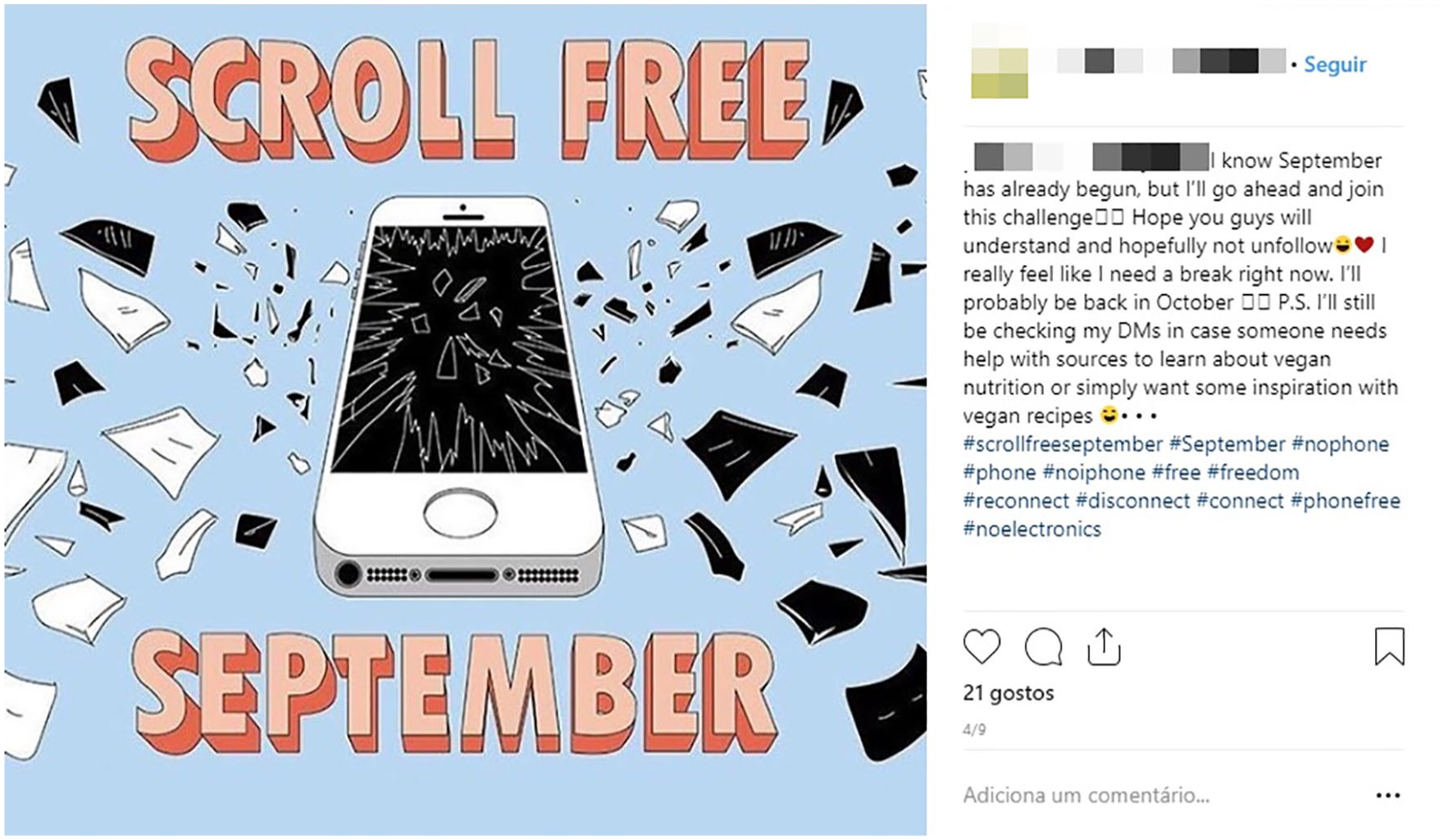
‘Scroll free September.’
Other users who post using “detox” or “break” hashtags do it after the experience of disconnection from the platform. 1 This type of posts includes more reflexive accounts of not only the break from Instagram but often their relationship with social media, smartphones, and the Internet more generally. The majority of users speak of the experience in a positive way, as we said, recounting the advantages of being offline: that they were more productive, more in control of their time, and more focused; that they had more time to be with their family or read books. Others associate being offline exclusively with being alone, away from the obligations of work or family as well as the pressure created by social media, and Instagram in particular to be online, to share content and to engage with content from others. Overall, they report feelings of increased well-being.
[ . . . ] I had 5 days away and purposely took time out from my phone, I wanted to be fully present in the moment and enjoy the Greek culture without distraction. As soon as I turned my WiFi on I got a headache . . . I don’t think it was a coincidence! [. . . ] FOMO → JOMO. Fear of missing out to JOY of missing out. I don’t have to be everywhere, I don’t have to be with everyone and I don’t have to know everything. Social media can be tricky for my mind sometimes as it wants to compare and convince that I should be at other places but here and doing something better. I took a month off from social media this summer, and I am better at catching my monkey mind As you have probably noticed, every weekend now, I log off Instagram to spend quality time with my boys. [. . .] It also serves as a break for me. Sometimes I find Instagram to be mentally exhausting and in those moments I consider closing my account. Taking a few days away to reset means I come back with the same excitement I did when I first started this account. . Now it’s Friday night and it’s time for me to enjoy “missing out.”
  [. . . ]
In the narratives about disconnection, posts often include some contextualizing tags such as #lessscrollingmoreliving, #nowifigreatconnection, #disconnecttoreconnect, #offlineisthenewluxury, or #jomo (meaning joy of missing out, an inversion of FoMO), as we have seen in the previous excerpt. These hashtags are relatively popular on Instagram, also circulating as posters (or even as lifestyle products, as we will discuss below). They are also used by non-English users, as can be seen in the rest of the captions.
Under these hashtags, disconnection from social and digital media is narrated as necessary to reach other, better and superior experiences. The users categorize their experiences as abstaining from the use of digital media and social media, including avoiding living their lives according to what can be socially valued on these platforms or “living to post”; as something which is not only good in itself but also provides a better way to live. They reflect ideas of mindfulness and of being more in control of their use of technology and, by extension, of their lives. Some of the posts under these hashtags also convey the benefit of focusing (on offline activities) and not multitasking. One user speaks of the joys of abstaining from using social media as she breastfeeds: I do a whole lot more of this since I quit my iPhone—looking at my baby. It’s terrifying how much I missed in those first few months, just constantly on my phone while feeding, bathing and playing. I have to be kind to myself and try not to dwell on this too much but sometimes I feel sick to my stomach thinking about it. The smiles I must have missed. We are totally making up for lost time now—these days I don’t even look for my phone when I go to feed. [. . . ]
One user reflects after a week of using just landline phones: “I read a lot more and had a much more creative and productive use of time”; “when you put your phone away you realize how much time everyone else is on theirs”; but she also realized the connected phone is convenient, and thus she concluded that I still bloody love my phone  and what it can do for me too—access music, Shazam music, Waze, pay for parking app, being able to find out the answer to any question in my head, being able to take photos, and my inspiring insta community BUT best use, and only use of the week that I
  it for, is just using it as a phone to talk to people! So loved the offline week and using my phone purely as a home phone—I generally feel happier, more engaged and relaxed in the world. [. . .] I don’t want to loose [sic] that so going forward, just like with our children, I’ve realized it’s also good as an adult to limit screen time unless the time is spent talking. And absolutely no phones on dinner or meeting tables!
As for many other users, interrupting the use of social media helps them to appreciate the benefits of both being offline and online, and can thus lead them to set their own limits in connecting and disconnecting.
Converting Others
Some of the posts in our dataset go beyond reflecting on the experience of interrupting social and digital media use to urging or recommending others to look for offline experiences. This is a proselytizing group of posts where users campaign for others to disconnect, not out of an intent to profit—as we will see in the next section—but for social purposes, or for “selfish” reasons: Karppi (2018) describes Dan Yoder, a blogger who in 2010 announced to delete his Facebook account and urged his readers to do the same so that “he wouldn’t miss anything” (p. 103).
Among this group of posts on Instagram, hashtags include mostly verbs and imperatives: #stopstaringatyourphone, #turnyourphoneoff, #domorethingsthatmakeyouforgettocheckyourphone, or #findabetterconnection. Again, digital connection is seen as being of lesser value than disconnection, for personal gain. These are also contextualizing hashtags, often used in association, that work as tropes: they are transformed into visual posters (Figures 3-5), and they can also be found incorporated into captions of posts: for instance, one user posted a picture in the forest stating “There is no wi-fi in the forest, but I promise you’ll find a better connection. #forest #tranquility #nowifi.”

‘Do more things that make you forget to check your phone.’

‘It’s ok to take a break.’

‘Reset your energy the same way you reset your phone. Turn off, unplug, reboot.’
Sometimes this effort to lead others to disconnect appears in the form of challenges to be taken up by a collective group of users: for example, one post with a picture of a paper notebook stating “live the moment/leave the phone” reads in the caption: [. . .] who wants to join us for a 5 day digital detox starting this Monday? Each day we share a tip to help you get control of your digital influences, so that they bring more of a positivity into your life [. . .].
These challenges speak of the community affordances of Instagram, used to build strength in the difficult task of resisting social media (Schoenebeck, 2014). But they are also performances of disconnection as “lifestyle politics” (Kaun & Treré, 2018), which can only work in their value if more collective than just conducted on an individual level.
Some posts include even more composed and stylized pictures or poster images, original or regrammed, to demonstrate the urgency and gains of using the smartphone, social media, and the Internet less (Figures 6 and 7). They seem to be part of wider accounts or projects on wellness and mindfulness, calling attention to supposed “addiction” to social media and inviting the user to “takebackcontrol” (Figure 6). Self-control over the use of social media and the digital life is part of a broader neoliberal subjectivity that is self-aware, self-confident, autonomous, and responsible. This does not require changes from social media and other digital services, but seeks to solve problems on the side of the users.

‘Today’s schedule.’

‘Good reasons to put down your phone.’
Even if offline experiences are, again, portrayed as better or superior—for example, in #moresociallessmedia—and if the disconnection that these posts dictate may be integral (regarding the phone and not just social media, for instance), they are not projected as being permanent. As one user writes, “Who did #switchoffsaturday with me? [. . .] This is about [. . .] trying to be a bit more mindful about the time you spend here. [. . . ]” Here, this user explains that interrupting social and digital media use can lead to increased self-awareness. Thus, we can see that staying off and away from social media implies not only a wider effort to slow down but also to keep life offline, by maintaining private moments or living without subjecting everything from offline to social media. However, it does not mean a total dismissal of digital or social media, but an attempt to find their place in a life with well-being.
There is a certain amount of judgment of and criticism toward others who are “too connected” or use social media and digital technologies “too much.” This judgment contrasts with the user who portrays himself or herself as a sensible individual in keeping the use of social media and smartphone to a reasonable level. For instance, one user draws on the Mona Lisa example in the Louvre museum to criticize the excessive use of smartphones in touristic moments, to take pictures and/or to share the experience on social media.
The Mona Lisa! Look at all the people taking pictures of a picture! Haha. Everytime I get to a new country, I’ve been doing my first couple days as “No Phone” days. I take a couples days to just walk around, get lost and explore. No pictures, no posting, no social media . . . so I can absorb the place I’m at instead of constantly doing this whole, phone-picture-post thing. It’s amazing walking around, paying attention to your surroundings . . . literally about 95 percent of people I see everywhere are looking down at their phone [. . .] after a few days I go back to “normal” I go around taking pictures and acting like all the other [. . . ]
On one hand, this excerpt echoes the cultural trope that tourism should be a time and space outside constant connectivity, as Rosenberg and Dickinson et al.’s research demonstrated. But, on the other hand, it illustrates how individuals resist ubiquitous connectivity, as Light et al. (2018) demonstrated. Crucially, however, it reinforces that connectivity is the “natural” and easy state, and that to disengage from digital photography and social media sharing demands a self-conscious effort.
Disconnection as a Lifestyle Choice, and Marketing Disconnection
Under such strong and broad hashtags as #offline or #unplug, a significant group of posts that we found were related to objects, locations, or situations of disconnection, from social media and digital media or technology more radically, where disconnection appears as part of an individualized “lifestyle politics” (Kaun & Treré, 2018) in a performative, commodified, and reintegrated way. These posts are mostly based on pictures, reporting not only to past moments when the users were indeed offline but also to present and current moments, where products allusive to disconnection are part of the setting. So disconnection becomes embedded in personal items and is portrayed as part of a lifestyle that is molded for the online even when it is offline. As we can see in Figures 8 to 11, several commodities are put to use by people and their audience is not only an offline, but also an online one, back through Instagram.

‘Offline.’

‘Offline – I am on vacation.’

‘Offline.’

‘Offline / Salut.’
Figures 8 to 11 show that disconnection has been commodified and is offered through the market to be part of a lifestyle, which is incorporated into social media content.
Furthermore, Instagram is also used to advertise and sell lifestyle items such as clothes and accessories suggestive of disconnection. In Figures 12 to 15, a set of posts shows how personal items, clothing, and accessories, especially, incorporate contextualizing hashtags or mottos, while these posts themselves use hashtags to hunt likes and attention. Another example is a post on “How to unplug your wedding,” calling the audience to a blog post link in the Instagram profile to know the services of a photographer.

‘#DeleteFacebook.’

‘Airplane mode.’

‘JOMO – joy of missing out.’
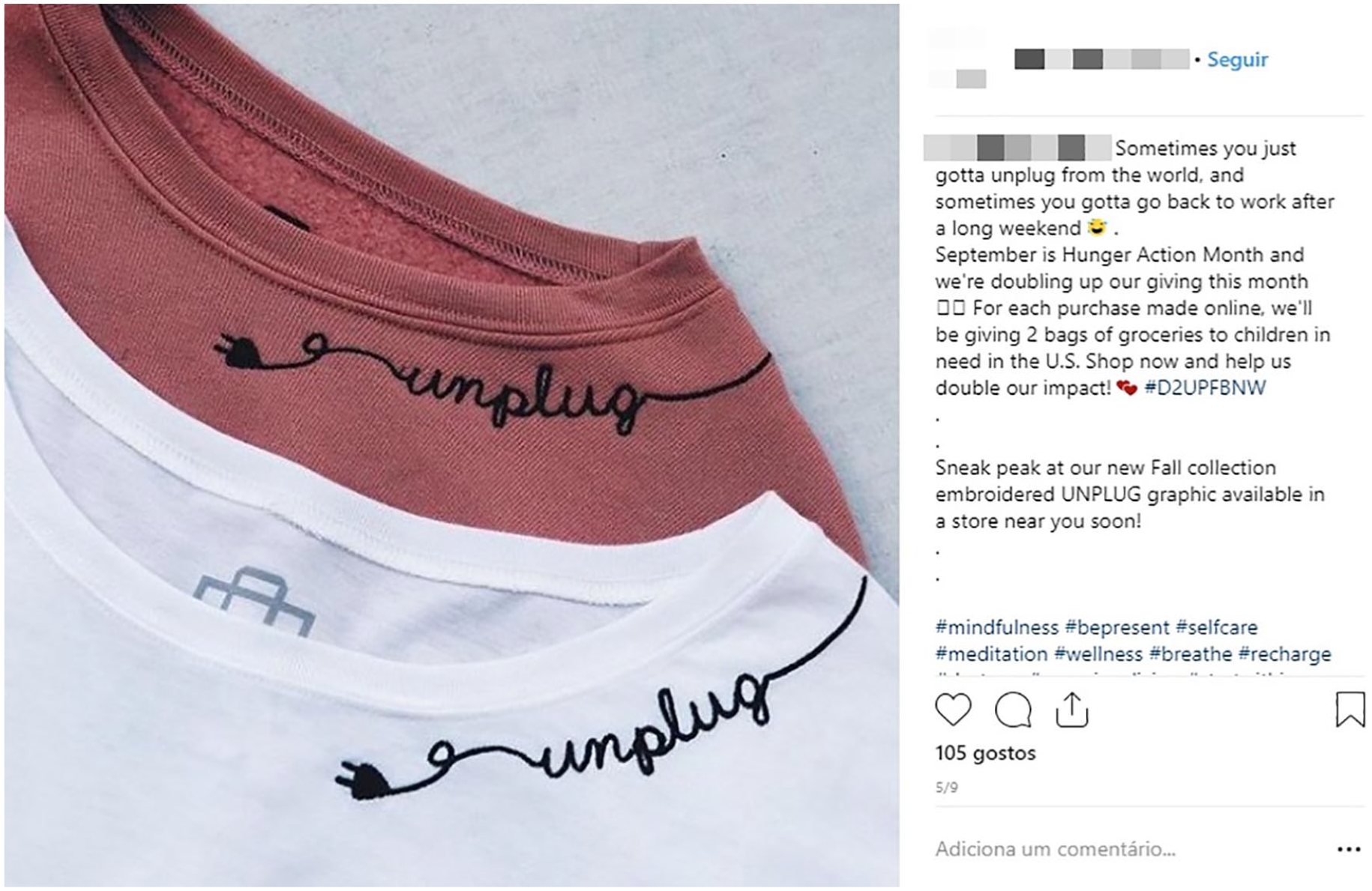
‘Unplug.’
We also came across a group of posts related to touristic or leisure locations that have disconnection messages. They can be simple, but, as we can see in Figures 16 to 19, also stylized and prescriptive in alternatives (“Talk [or sing],” “Talk to each other and get drunk,” “Talk to each other, pretend it’s 1995”). These are not inherently but affirmatively “dead” zones, which are constructed—marketed—as more social and authentic for leisure and tourism as they discard mediation. Moreover, these locations encourage “real” interaction that they seem to blame the Internet for preventing. However, at the same time, they invite Instagram (or any other social media) users to mediatize these messages and their locations and thus contribute, in a first instance, to market their service. As they are incorporated into Instagram by the hand of the users, they contribute to propagate this association, to market the location and to project the user as seeking authentic experiences for his or her followers, and ultimately reinforce the value of disconnectivity through social media connectivity.
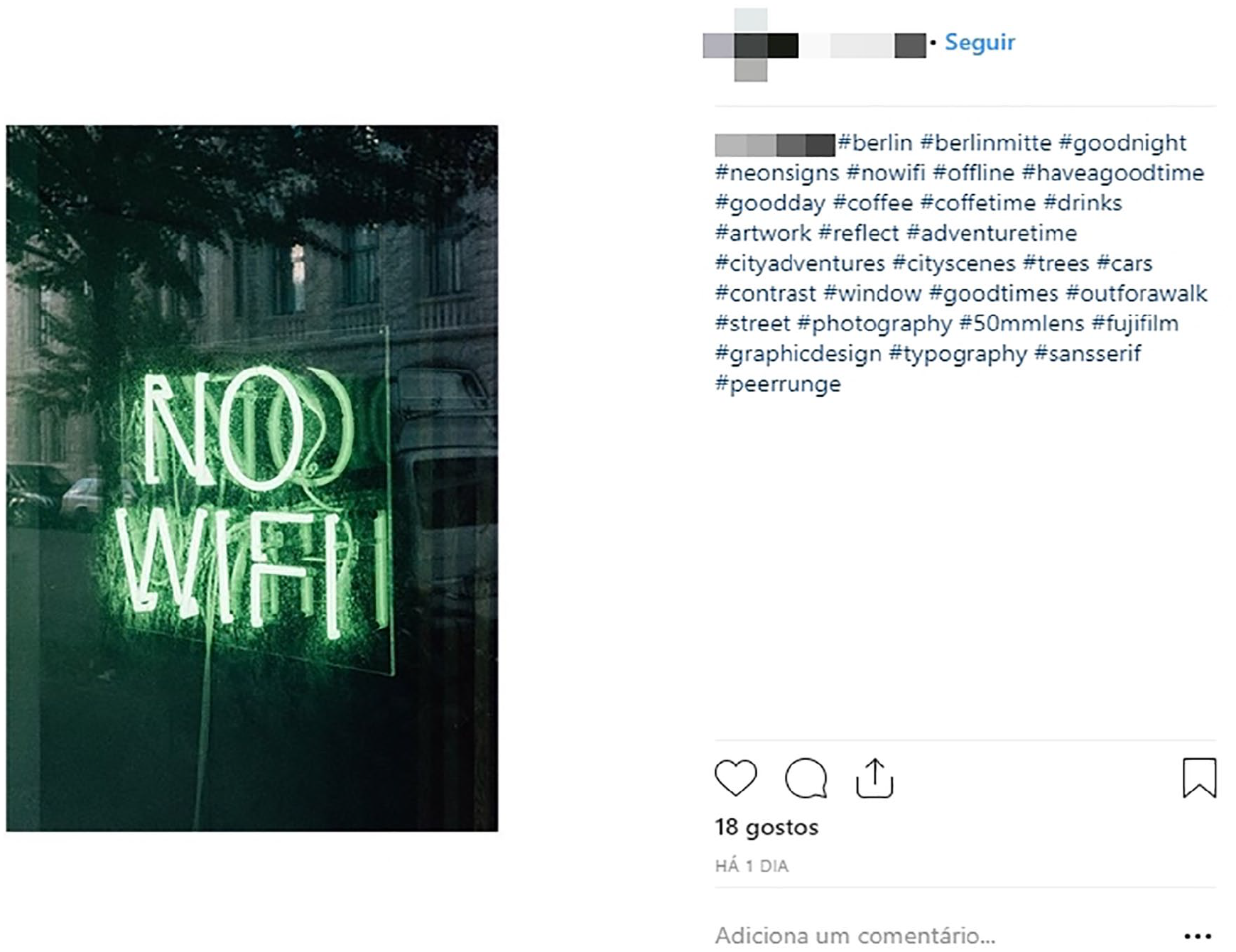
‘No wifi.’

‘No wifi. Talk – or sing.’

‘Sorry, no wi-fi – talk to each other and get drunk.’

‘We do not have WiFi – Talk to each other, pretend it’s 1995.’
In all three of these aspects of disconnection as lifestyle and marketing, we find hybrid cultural products and practices that stand between the offline and online realms (Thorén et al., 2017), some of them in ironic and cynical forms.
Discussion
In recounting the interruptions of social media and/or Internet use on Instagram, disconnection is constructed primarily as involving being with oneself, “reconnecting” in the most immediate and urgent way. This frame often involves the imagery and imaginary of nature and “dead” zones, as well as indoor moments alone, and days or time off work. Here, the suspension of time pressures seems the primary goal or achievement of the interruption. Users express feelings about the difficulty of dealing with the acceleration of time on social media, and interruptions of social media use help them not only gain control over their time but also improve the experience of social media when they go back to using them.
Disconnection is also associated with increased interaction with others offline (Hardey & Atkinson, 2018; Karlsen & Syvertsen, 2016; Light & Cassidy, 2014; Woodstock, 2014). This association often means social and digital media are placed as the main causes for the lack of meaningful offline social connection because of how they engage the users in prolonged interaction with platforms.
As it is discursively represented on Instagram, disconnecting seems to result from, and further promote, users’ self-awareness of their use of social media, digital media, and technology, and this is presented as a precondition to regain control over it. Digital and social media in particular are depicted as overwhelming and in need of being controlled. This does not stand in antinomy with the fact that disconnecting is portrayed and even promoted as useful as a temporary experience, to later go back to using the digital in a more balanced and sensible way, as Franks et al. (2018) found in Facebook sabbaticals. Ultimately, tropes as “disconnect to reconnect” would be quite literal: users should disconnect temporarily from social media to reconnect with social media later on. Instagram interruptions are thus part of social media users’ self-regulation, and their representation on the same platform is also a performance of their (search for a) balanced way of using social media. This can even entail the judgment of the people who use social media “too much,” and can lead to blaming users for their lack of sensibility, instead of discussing factors that explain their use.
The proselytizing discourse on disconnecting from social media works at a grassroots level and can be seen as a seed of activism, in a parallel way to what Locatelli (2017) understands as hashtag activism on breastfeeding. However, by suggesting to other users that they should use social media less frequently and leave temporarily, ordinary users ultimately reinforce the idea that each social media user is responsible for their use, and to maintain their well-being, mostly at a mental and social level. This form of discourse does not promote the search for alternatives or make the social media platforms more accountable. Moreover, we should acknowledge the interplay and contamination between these activist hashtags and the contextualizing hashtags, as they get reincorporated by other users’ discourses as mottos, that is, become Instagram vernacular.
We also detected a representation of disconnection as a lifestyle choice (Kaun & Treré, 2018), associated with individualized and short-term interruptions of the use of the social media platform, as well as part of conspicuous non-consumption (Portwood-Stacer, 2012), as it serves to associate valuable meanings to the subject by a cynical or ironic reference. Significantly, a considerable number of posts used “disconnection” imaginary to market other products and services. This constitutes a remarkable form of co-option of digital disconnection imaginary, whereby symbols and tropes are used to generate value for private agents, while generating value for the platform. In exchange, products or services are offered to convey—offline—disconnection from digital or social media, or even commodified activism.
In looking at the social media discourses about disconnection, then, we find that the message of self-responsibility that Sutton (2017) and Fish (2017) found among digital detox services is produced and reproduced by and among user communities, and that interruption is conveyed as a valid way to achieve digital well-being. Furthermore, the tropes associated with digital interruption—such as “offline is the new luxury,” “less scrolling, more living”—circulate in captions, poster images, or hashtags. This truly social discourse benefits from affordances of the social media platforms to create and maintain a community, while it helps to create representations and meanings of what the use and non-use of social media are and should be. Voluntary disconnection from the digital is shown among users as necessary to appreciate and value the utility of Instagram and other social media as central to contemporary social life. Thus, it restores value of the current social media system rather than undermines it.
Furthermore, as these discourses are appropriated and co-opted by other users and entities, for instance, by regramming poster images and incorporating hashtags and captions by ordinary users, as well as being used in touristic and leisure marketing, we can see it as an important part of a constructionist process where the meanings and value of the use of social media, and the place of the social media user in it, are constructed in interaction with other circulating public discourses. Thus, the discourses of self-care and self-responsibility to maintain the user’s digital well-being are socially co-created and reflected inside the platform, without compromising its purpose.
Limitations of the Study and Future Research
We recognize the shortcomings of an analysis conducted in a short period of time that coincided with summer in the Northern hemisphere. We could also point out the limitations of conducting the analysis only in the English language, although hashtags and tropes are repeated in English by other language users. We did not analyze Instagram Stories, which have grown in popularity, nor did we consider comments. The interaction between the users would be interesting to analyze but it should also be noted—interestingly—that in most posts, we did not see many comments. We also recognize that many Instagram users, particularly those maintaining private accounts, do not use hashtags at all (Gerrard, 2018).
For future research, we suggest analyzing the representation of disconnection by users across social media platforms, studying the topic for longer periods of time or through ethnography, articulating analysis of user-generated content with face-to-face interviews. Another line of research would be to study social media interruption among social media celebrities, some of whom have been at the center of public debate with episodes of breakdown due to the pressures of the attention economy.
Conclusion
This article offered a close look at discourses of disconnection among Instagram users. We searched an array of hashtags to identify the dominant forms of representation of voluntary and temporary disconnection, which users deem as necessary to find a balanced way of using social media, and which draw on wider popular discourses around “well-being” and self-care. Through these modes of representation, interruptions are represented as a more realistic form of disconnection than total rejection of social media (Ribak & Rosenthal, 2015). The visual representation of interrupting social media use—a requirement of posting to Instagram—is associated with outdoors pictures, socializing, and indoor moments of the suspension of time pressures, as well as with an array of images that users create and circulate. In revealing this, a general feeling of ambivalence toward Instagram, social media, and the digital seems to be present, which the users show to manage on their end, and are incited by others to do so, through proselytizing and activism.
Obviously, as Hesselberth (2018) rightly notes, the method used in this study would not capture the discourses of those who have effectively and radically disconnected. By looking inside this paradox, we are also able to see how tropes such as “no wifi, great connection,” “less scrolling more living,” or “joy of missing out” spread from social media into public discourses, products, and services, and back again into social media in ironic and cynical ways, as lifestyle commodities as well as saleable ones. We thus hope to have demonstrated how these discourses correspond to a neoliberal rhetoric both in the promotion of privatized solutions, and governmentality of the user, which diffuses the self-regulation of the use of social media as a social norm, and in the co-option of disconnection through lifestyle and marketing, which benefit from, and ultimately continue to foster, the economic success of the platform. In these discourses, there is no space for a public debate about regulation or self-regulation of the social media industry. The tools provided by social media to measure time thus work as just one more way to make the users accountable for their self-management.
Footnotes
Acknowledgements
The author acknowledges Jessica Roberts and Ysabel Gerrard for proofreading earlier versions of this article.
Author’s Note
Ana Jorge is also affiliated with NOVA University of Lisbon, Portugal.
Declaration of Conflicting Interests
The author(s) declared no potential conflicts of interest with respect to the research, authorship, and/or publication of this article.
Funding
The author(s) received no financial support for the research, authorship, and/or publication of this article.
Notes
Author Biography
