



Abstract
Drawing upon Bandura’s self-efficacy theory, this study conceptualizes “social media news efficacy” and examines how news efficacy connects perceived news overload on social media to news avoidance and social filtering. Findings from a two-wave panel survey of South Korean adults show that news overload is significantly related to a decrease of news efficacy, which in turn increases news avoidance on social media. The analysis also finds that news efficacy mediates the positive link between perceived news overload and social filtering over time.
Through the explosive penetration of social media, news is disseminated more intensively, quickly, and widely to people than ever before (Fedeli & Matsa, 2018). A growing number of people receive information about politics and current affairs from social media instead of from the mass media (Gottfried & Barthel, 2018; Gottfried & Shearer, 2016). However, identifying relevant news from excessive amounts of information on social media requires substantial time, energy, and mental efforts (A. R. Lee, Son, & Kim, 2016; Zhang, Wu, & Mattila, 2016). Furthermore, constant news updates and pop-ups of breaking news in social media may increase the feeling of news overload (Song, Jung, & Kim, 2017; York, 2013). The present study explores the implications of this critical trend of news overload on social media in terms of democracy, considering that news plays a pivotal role in informing citizens (Fenton, 2010; Gans, 2003).
Several studies have looked into the issue of news overload in social media, but they mostly explored antecedents affecting news overload, such as demographics (Ji, Ha, & Sypher, 2014), news interest (Holton & Chyi, 2012), use of specific news platforms (Holton & Chyi, 2012), and available time to process news (Pentina & Tarafdar, 2014), or consequences of news overload, such as news fatigue, news analysis paralysis, and news avoidance (Song et al., 2017). The present study aims to complement the extant research on news overload, by examining a theoretical link that can explicate how news overload can be related to remedial tactics, such as news avoidance and social filtering.
Because, in the social media context, “news comes to the user with so much diversity and in such large quantities” (Schmitt, Debbelt, & Schneider, 2018, p. 200), the ability to cope with information is crucial. However, when overloaded with news, people feel less confident about whether they can get the news they want (Pentina & Tarafdar, 2014). To make sense of and overcome the challenging situation of news overload, it seems essential to feel capable of properly accessing and understanding news from social media. Thus, this study, relying on Bandura’s (1977, 1997) self-efficacy theory, conceptualizes social media news efficacy as news users’ confidence in how much they can find their preferred news stories from social media and make sense of them.
Considering that exposure to too much information makes people unmotivated to process the information (Eppler & Mengis, 2004; Schultz & Vandenbosch, 1998), perceptions of news overload in social media may result in backing away from news (Islam, Whelan, & Brooks, 2018). At the same time, some users overwhelmed by excessive news may become more selective in their news searching (Janssen & de Poot, 2006), and one of the dominant news selection tactics in social media is “social filtering,” which means that users rely on their close friends to identify and access the news they need (Park & Kaye, 2018). Furthermore, the links between news overload and news avoidance and between news overload and social filtering are not simple because one’s confidence in news searching (“news efficacy”) may attenuate or reinforce the effects of news overload on behaviors (Islam et al., 2018).
Taken together, this study investigates (1) whether perceived news overload leads to news avoidance, (2) whether perceived news overload leads to social filtering, and (3) what roles news efficacy plays between perceived news overload and news avoidance/social filtering. To do this, this study conducted a two-wave panel survey in South Korea in 2017.
Literature Review
News Overload in Social Media
Coined by Alvin Toffler (1970) in his novel Future Shock, information overload refers to “the feeling of being overwhelmed with information to the point of becoming disorientated, a kind of crisis brought about by too many mentally-diverting stimuli” (Pearse, 2012, p. 1). Information overload takes place when people encounter more information than they can process (Eppler & Mengis, 2004). Exposure to an excessive amount of information can negatively influence decision-making (Bawden & Robinson, 2009).
News overload roughly falls into the category of information overload, but the two are not exactly the same. While information overload can be invoked by various types of information sources, such as advertisements, promotions, and announcements (Edmunds & Morris, 2000), news overload is invoked by exposure to too much news (Holton & Chyi, 2012). While information overload is closely related to cognitive psychology (Eppler & Mengis, 2004) and has been investigated usually through experiments in consumer behavior research, information science, management information systems, and marketing, news overload has drawn attention recently in the communication discipline (e.g., Song et al., 2017). Furthermore, news overload differs from information overload, in that it is closely tied to an informed citizenry, which is critical in democracy (Buckingham, 2002).
The extensive adoption and use of social media has exposed people to a massive amount of information that may require energy and cognitive processing beyond their capabilities, creating a phenomenon called “social media overload” (Islam et al., 2018; S. K. Lee, Kim, & Koh, 2016; Zhang et al., 2016). Too much information on social media can quickly cross users’ cognitive limits in processing news and can make them feel overwhelmed and overloaded (Schmitt et al., 2018; Song et al., 2017). Indeed, a study found that accessing news through social media is positively related with news overload, while news consumption via traditional news media is not (Holton & Chyi, 2012).
Self-Efficacy Theory and Social Media News Efficacy
The main focus of this study is the nuanced relationship between social media news overload and two remedial tactics—news avoidance and social filtering. Prior studies report several cognitive and behavioral consequences of news overload, such as social media fatigue (Bright, Kleiser, & Grau, 2015), news analysis paralysis (Song et al., 2017), news stress (Ralph, 2017), or news avoidance (Song et al., 2017). The current study argues that the link between news overload and its consequences is indirect as well as direct (Islam et al., 2018), and accordingly pays special attention to the role of news related self-efficacy, which has been deemed as a key trigger of information-seeking behavior (Savolainen, 2012; Yan, Zha, Yan, & Zhang, 2016).
Self-efficacy refers to individuals’ belief in their abilities to control their actions as well as events that may affect them (Bandura, 1997). Self-efficacy is a reflection of what people believe they can do with the skills they have. Self-efficacy touches virtually every aspect of people’s lives, providing the foundation for human motivation, well-being, and personal accomplishment (Pajares, 2002; Serap Kurbanoglu, 2003). Recently, self-efficacy has emerged as an important variable in the study of human–computer interactions (e.g., Bronstein, 2014; Hocevar, Flanagin, & Metzger, 2014).
Drawing upon Bandura’s (2001, 1997) work, this study conceptualizes social media news efficacy as the extent of positive confidence about how much a user can get news he or she wants and understands the meaning of it. If people believe that the use of a certain medium meets their needs concerning news acquisition, they are more likely to possess a strong perception of self-efficacy (Hocevar et al., 2014; Pinkleton, Austin, Zhou, Willoughby, & Reiser, 2012). Hofstetter, Zuniga, and Dozier (2001) argued that people have a high level of “media self-efficacy” when they feel good at gathering political information from the media to fulfill their personal needs. Furthermore, the perception that news consumers are able to understand the presented news content enhances their task-related efficacy and motivation (Schunk, 1984). Accordingly, news efficacy should play a crucial role in gaining and processing news from social media.
Self-efficacy is influenced by environmental factors, such as distractions, the uncertainty and complexity of a challenging situation, and the sequential or coordinative steps required to make sense of a difficult situation (Gist & Mitchell, 1992). Those uncontrollable factors may reduce self-efficacy (Lazarus & Folkman, 1984). Those who judge a challenging situation as more formidable than it really is will reduce their self-efficacy (Lazarus & Launier, 1978).
Every day we are being expected to “cram” with information fired at us by social media. According to a recent study of 1,000 UK adults (ESRI, 2015), 65% say that the need to keep track of a great deal of information is a “major concern” in their lives, and 35% feel that having to keep up with today’s information overload leaves them stressed out. Exposure to large amounts of news in social media may act like a noise or an obstacle when they cause a feeling of overload (Livni, 2017). The fact that many people leave Facebook because they perceive the site to be cognitively burdensome (York & Turcotte, 2015) implies that news overload can cause a significant consequence to users’ self-efficacy. Indeed, Karia (2015) found that information does have a negative impact on self-efficacy. In short, perceived news overload is likely to decrease users’ confidence that they can get the news they need and understand it. Thus, the following hypothesis is proposed:
H1. Perceived news overload on social media is negatively associated with social media news efficacy over time.
News Overload, News Avoidance, and News Efficacy
Research has identified the consequences of information overload, such as anxiety, stress, and the feeling of losing control (Edmunds & Morris, 2000; Savolainen, 2007). Furthermore, with information overload, individuals may be tired of receiving and processing information (Crook, Stephens, Pastorek, Mackert, & Donovan, 2016), feel difficulty in identifying relevant information (Lincoln, 2011), or experience difficulty in selecting and evaluating relevant information (Eppler & Mengis, 2004).
A recent survey by Pew Research Center found nearly 7 in 10 Americans feel exhausted and “worn out” by the excessive amounts of news (Gottfried & Barthel, 2018), which may lead them to avoid news consumption. The Reuters Institute’s “Digital News Report 2017” found that 57% of populations worldwide “sometimes” or “often” avoid the news (Newman, Fletcher, Kalogeropoulos, Levy, & Nielsen, 2017). Considering more and more people rely on social media for news (Fedeli & Matsa, 2018) and perceive an increasing level of news overload (Boskers, 2011), the Reuter’s findings of news avoidance may apply to social media.
Cognitive-load theory posits that brains have only so much bandwidth, so to best take in information, people must limit it (Paas, Renkl, & Sweller, 2003). Technology use, once exceeding the optimum level, can result in negative outcomes (Karr-Wisniewski & Lu, 2010). Information overload is a form of cognitive barrier, which blocks or limits the information-seeking process and causes frustration to the information user (Savolainen, Kaakinen, Sirola, & Oksanen, 2018). In this vein, people who perceive news overload from social media can employ avoidance tactics (Song et al., 2017). Individuals may avoid the excessive supply of news as much as they can (Savolainen, 2007). As the frequency of news exposure increases, people gradually perceive news overload, which can lead them to shut down cognitively and deny the necessity of news consumption (Aldoory & Van Dyke, 2006) or to put less effort to acquiring news (Nordenson, 2008). People have a tendency to shelter themselves from the bombardment of information (Savolainen, 2007). Thus, the following hypothesis is posed:
H2. Perceived news overload on social media is positively associated with news avoidance in social media over time.
In Bandura’s (1977) social cognitive theory, behavior change is explained by the principle that humans intentionally influence the actual functioning and circumstances of life. The theory explains human behavior in terms of a three-way, reciprocal model in which personal factors, environmental influences, and behavior continually interact (Bandura, 1997). Through this interaction, the individual is able to act on her or his surroundings. This active behavior works through a key mechanism, known as self-efficacy (Bandura, 1977).
Self-efficacy particularly helps individuals deal with a social reality that requires constant confrontation of difficulties and obstacles (Bandura, 1994). Self-efficacy act as a mediator between environments and behaviors, in four different levels (Bandura, 1994). The first level is cognitive processes—self-efficacy influences behavioral patterns by developing rules that determine effectiveness in problem solving. The second level occurs when people intend to employ a particular behavior, by avoiding certain situations that exceed their abilities (selection processes). The third level is affective processes, which mean affective reactions to the events that people consider of vital importance. The last mediating function of self-efficacy is motivational processes that influence the individual’s effort that will be put into and the persistence in the face of difficulties.
Aforementioned four mechanisms clearly explain that the beliefs people hold about their capabilities (self-efficacy) significantly influence the ways in which they will behave, mediating the relationship between surroundings and their behavioral choice (Pajares, 1984). In other words, environmental influences affect self-efficacy, which then causes changes in behavior (Hsieh, Hsieh, & Huang, 2016; Schwarzer, 2015).
News efficacy is a precondition of news seeking, playing a role in triggering one’s news-seeking behavior and increasing attention to news content (Yan et al., 2016). Knobloch-Westerwick, Carpentier, Blumhoff, and Nickel (2002) argue that even a basic orientation toward news consumption is a partial function of self-efficacy. Particularly, news efficacy can help reduce cognitive load in an interrupting situation (Basoglu, Fuller, & Sweeney, 2009) such as information overload. To the extent that people believe they can obtain the news they need from social media and make sense of the news overload situation, they will come to view themselves as more efficacious, and this heightened efficacy may result in more active news-seeking behavior. This reasoning is consistent with the motivational processes of self-efficacy by Bandura (1977).
On the contrary, if people are not confident about whether they can get the news they need and want from social media because of news overload, they may end up reducing or rejecting news consumption from social media because low self-efficacy is closely linked to information avoidance (Case, Andrews, Johnson, & Allard, 2005). According to the selection processes of self-efficacy (Bandura, 1977), people tend to avoid difficult situations that exceed their abilities. When information input exceeds the information processing capacity of a person, he or she is bound to experience declining self-efficacy (Mazzola, 2017), which subsequently reduces news seeking.
Based on the above reasoning, this study predicts that news efficacy will play a crucial role in connecting news overload and news avoidance:
H3. Social media news efficacy negatively mediates the relationship between perceived news overload and news avoidance on social media. In other words, perceived news overload leads to a decrease of news efficacy, which in turn increases news avoidance.
News Overload, Social Filtering, and News Efficacy
People facing news overload can think of other tactics to handle the situation, in addition to news avoidance. Given their limited capacity to process news, news consumers may make compromises when it comes to their attention. Social media users are more frequently exposed to either algorithm- or network-filtered streams of news than users of traditional news media (Klinger & Svensson, 2015; Weeks & Holbert, 2013).
Algorithmic filtering is based on digital algorithms that conduct intelligent searches and return pertinent information to the user (Teevan, Ramage, & Morris, 2011). Algorithms display subsets of a corpus of information for consumption by prioritizing, classifying, associating, and filtering information (Eslami et al., 2015; Rader & Gray, 2015). News content offered by algorithmic filtering tends to match users’ preferences and political orientations (Pariser, 2011), thereby reinforcing confirmation biases (Y. Kim, Chen, & Gil de Zúñiga, 2013). Algorithms have great power to shape users’ experiences, but many users are unaware of their presence. According to one study, 62.5% of Facebook users are not aware of the “News Feed” algorithm’s existence at all (Eslami et al., 2015). Furthermore, algorithms are an automated process by social media companies, and individual users have little power to control them.
Social media users can also put their friends to the task of finding and filtering news for them. A study reports that over half of Twitter-users who complain of information overload feel the need for a tool to filter out irrelevant posts (Bontcheva, Gorrell, & Wessels, 2013). Social media allow users to easily track their friends’ activities: what new stories they submitted, commented on, or read. To seek the most useful and relevant information and to filter out less important or irrelevant information, users can change social media settings, subscribe to a certain media channel, follow certain news experts, and block uninterested news feeds, thereby potentially reducing their feeling of news overload (Savolainen, 2007). People trust news articles shared on Facebook by their friends more than those coming from news organizations (Owen, 2017), because friends act as gatekeepers, who vet the significance and relevance of news content (Turcotte, York, Irving, Scholl, & Pingree, 2015). Filtering news on the basis of social networks offers a new paradigm for obtaining and interacting with news—what this study conceptualizes as social filtering. Social filtering is one of the most important usages of social media. Through a data analysis of Digg and Flickr, Lerman (2007) shows that social filtering is one of the primary usage modalities in social media.
There is no editorial team on social media that guarantees journalistic quality and information veracity. Social media users often confront abundant news from a wide variety of sources of varying credibility within the same news feed (Westerman, Spence, & Van Der Heide, 2014), and feel the need to count on social filtering to reduce the cognitive burden of evaluating the news sources. To the users who are tired of news consumption because of news overload, social filtering that delivers customized, selected news can be one convenient option to get credible news with very little effort. Based on the reasoning, this study poses the following hypothesis:
H4. Perceived news overload on social media is positively associated with social filtering over time.
According to the cognitive processes of self-efficacy, one of the four mediating mechanisms of self-efficacy (Bandura, 1977), perceptions of self-efficacy enable people who face a difficult environment to come up with an idea to make sense of the environment, mediating the surrounding and their behavioral reaction. Social filtering will occur when users feel efficacious about their capabilities to handle the stressful situation of news overload. This prediction is based on the assumption that believing in one’s ability to handle the news (news efficacy) should reduce the feeling of overload (Islam et al., 2018). At the same time, it is likely that news efficacy facilitates engagement in social filtering, because self-efficacy facilitates cognitive involvement and behaviors to fulfill one’s interest in a subject (Bandura, 1993). Indeed, Tsai and Tsai (2003) found that high Internet self-efficacy is associated with better search performance and better search strategy development, which suggests a positive link between news efficacy and social filtering. Taken together, it is likely that news efficacy plays the key role in connecting perceived news overload and social filtering (Figure 1):
H5. Social media news efficacy positively mediates the relationship between perceived news overload and social filtering. In other words, perceived news overload leads to a decrease of news efficacy, which in turn decreases social filtering.

Hypothesized model.
Research Context
South Korea has a highly developed digital media infrastructure. South Korea records the world’s highest smartphone penetration rate as 94% (Poushter, Bishop, & Chwe, 2018). The Internet penetration rate is 96% (Poushter et al., 2018). As of the third quarter of 2017, 84% of the population are active social media users (Statista, 2017). The most popular social media platforms are YouTube (74% penetration rate), Facebook (62%), KakaoTalk (58%), and Instagram (39%). South Korea ranks among the countries with the highest number of monthly active social media users in the Asia Pacific region.
South Korea is one of the countries where online news consumption (84%) surpasses TV news (74%) (S. Kim, 2018). Online news access is largely controlled by giant Internet portals such as Naver (65%) and Daum (38%), which function as both news aggregators and search engines. Among the social media platforms, YouTube (31%), KakaoTalk (39%), Facebook (25%), and Twitter (8%) serve as major channels through which news and political information is shared and spread. These statistics suggest that South Koreans may feel a high level of news overload from social media.
Method
Data Collection
This study relies on two-wave panel survey data collected in South Korea in January and September of 2017. The study administered a web-based survey to an online panel, which is managed by a survey company. Participants were selected from over 500,000 previously registered users of the company. To secure maximum data representability, the survey company created a quota sample from this panel of registered users, ensuring specified quotas that match the South Korean census for gender, age, education, and income (National Election Commission, 2016).
The Wave 1 (W1) survey was conducted between January 10 and January 20, 2017. The questionnaire was originally prepared in English and then was translated into Korean by a communication graduate student, who is fluent in both English and Korean. In total, 5,588 adults were invited to the first round survey, and 1,945 completed the survey. Respondents were given a small reward. Based on the American Association for Public Opinion Research (AAPOR; 2011) response rate calculator, the response rate was 34.8%. We collected Wave 2 (W2) data between September 15 and September 25, 2017, with 1,008 final participants (retention rate 51.8%). This retention rate is similar to those of other panel surveys (e.g., Diehl, Weeks, & Gil de Zuniga, 2016). In a panel survey, sample size reduction does not necessarily lead to biased estimates although there is a risk of bias (Callegaro et al., 2014).
The interval between waves is usually determined by cost, respondents’ burden, likelihood of recall, and the frequency of transitions of interest (Buck, Ermisch, & Jenkins, 1996). A longer interval often leads to a significant deterioration in the quality of data, while a shorter interval may not capture nuanced patterns of change (Lynn, 2009). The great majority of household panel studies in the United States have adopted a 1-year interval (Buck et al., 1996). Thus, this study believes the 8-month interval is appropriate to capture meaningful changes of major variables and minimize panel attrition.
Independent Variable
All independent, dependent, and control variables were measured with a 7-point Likert-type scale unless indicated otherwise.
News overload
Drawing upon Song et al. (2017), this study tapped three items: (1) I feel overloaded with the amount of news available on social media; (2) considering my limited time to read, I face too much news on social media; and (3) I receive more news than I can process on social media. Responses were averaged to create an index (W1 α = .85, M = 3.48, SD = 1.75; W2 α = .83, M = 3.55, SD = 1.49) (Table 1).
Factor Analysis of Items of News Overload, News Efficacy, and News Avoidance.

Note. Bold items indicate factor loadings >.60. Total variance accounted for 69.5%.
Dependent Variables
Social media news efficacy
Drawing upon Bronstein (2014), this study asked respondents to rate how confident they feel about the extent to which (1) they can find the news they want from social media, (2) they can tell the meaning of the news obtained from social media, and (3) they can tell the importance of the news obtained from social media (W1 α = .83, M = 2.92, SD = 1.93; W2 α = .80, M = 2.98, SD = 2.03).
Social filtering
Two items were used: (1) I prefer to read the news recommended by my friends on social media and (2) I prefer to read the news posted by my friends on social media (W1 Spearman–Brown coefficient = .60, M = 3.37, SD = 1.24; W2 Spearman–Brown = .64, M = 3.21, SD = 1.29).
News avoidance on social media
Three items were adopted from Pentina and Tarafdar (2014): (1) I feel it useless to read the news on social media; (2) I’d like to reduce the amount of time I spend on news consumption on social media; and (3) I do not want to waste time reading the news on social media (W1 α = .85, M = 2.97, SD = 1.03; W2 α = .84, M = 2.98, SD = 1.25).
Control Variables
Mainstream media news consumption
For television, respondents were asked, “How many days during the last week did you watch news on (1) network television, (2) local television, and (3) cable television?” (W1 α = .82, M = 3.75, SD = 2.01; W2 α = .80, M = 3.79, SD = 1.82). For print, “How many days during the last week did you read news from (1) a national newspaper, (2) a local newspaper, and (3) a current-affairs magazine?” (W1 α = .82, M = 1.05, SD = 0.91; W2 α = .80, M = 1.08, SD = 0.82). Radio news use was assessed with “How many days during the last week did you listen to news on (1) network radio and (2) local radio?” (W1 Spearman–Brown = .55, M = 1.39, SD = 1.04; W2 Spearman–Brown = .58, M = 1.55, SD = 1.09). Online news was measured with “How many days during the last week did you read news from (1) online news sites and (2) news aggregators such as Yahoo! News, Naver News?” (W1 Spearman–Brown = .59, M = 3.26, SD = 1.45; W2 Spearman–Brown = .60, M = 3.32, SD = 1.62). Drawing upon Strömbäck, Djerf-Pierre, and Shehata (2013), hours per week spent using television news, print news, radio news, and online news was combined and averaged to create an index (W1 α = .83; M = 2.98, SD = 1.36; W2 α = .84; M = 2.92, SD = 1.62).
Social media use frequency
This study asked respondents during the last week how often they used three types of social media—Facebook, YouTube, and Twitter, which are among the most popular social media in South Korea (W1 α = .78, M = 4.01, SD = 1.45; W2 α = .79, M = 4.13, SD = 1.66).
News interest
Drawing upon Holton and Chyi (2012), respondents were asked “In general, how much are you interested in the news?” (W1 M = 3.03, SD = 1.57; W2 M = 3.25, SD = 1.66).
Political interest
Respondents were asked how much they are interested in (1) local politics and (2) national politics (W1 Spearman–Brown = .65, M = 3.48, SD = 1.07; W2 Spearman–Brown = .65, M = 3.56, SD = 1.07).
Demographics
Respondents were asked their gender (50.7% females) and entered their age as of their last birthday (M = 39.7, SD = 12.8). Respondents marked their highest level of formal education completed on a 6-point scale ranging from “middle school or less” to “graduate degree” (M = 3.6, Mdn = some college degree). Family household income for 2016 was selected from a 9-point scale ranging from 1 (less than KRW 2 million) to 9 (more than KRW 10 million) (Mdn = KRW 40 million to KRW 50 million).
Demographic characteristics of the sample (W1) resemble the profiles of the population figures of South Korea, with respect to age (mean ages: 39.7 in the sample and 40.7 in the population), education (some college degree: 41.0% in the sample and 40.2% in the population), and gender (50.7% female in the sample and 51.2% in the population). The annual median household income of the population (KRW 4,050,000) is within the same range as the sample median (KRW 40 million to KRW 50 million).
Data Analysis
To figure out how major variables are related one another, this study first ran a partial correlation test. Then, a structural equation modeling (SEM) analysis was conducted, to test the proposed hypotheses and assess the mediating roles of news efficacy.
Results
Table 2 exhibits a strong negative correlations between perceived news overload in Wave 1 (W1) and news efficacy in Wave 2 (W2) (r = −.30, p < .001). Perceived news overload (W1) was positively correlated with social filtering in W2 (r = .19, p < .001) and news avoidance in W2 (r = .26, p < .01). Mainstream media news consumption was inversely correlated to news avoidance in W2, indicating that exposure to news from mass media does not cause a negative consequence.
Partial Correlations Among Key Variables.

Note. W1 N = 1,928, W2 N = 995. Cell entries are partial correlation coefficients, controlling for age, gender, education, income, political interest, and social media frequency. *p < .05; **p < .01; ***p < .001.
Overall, the SEM model fitted the data fairly well, yielding χ2/df = 4.851, goodness of fit index (GFI) = .944, root mean square error of approximation (RMSEA) = .062, standardized root mean square residual (SRMR) = .048, Tucker–Lewis index (TLI) = .920, and comparative fit index (CFI) = .958. All fit indexes met the recommended threshold criteria (Hair, Black, Babin, & Anderson, 2014).
Figure 2 depicts the main path coefficients and explained variances of the endogenous variables (R2). Perceived news overload is found to have a significantly negative association with news efficacy (β = −.266, p < .001), supporting the first hypothesis. Approximately, 20% of the variance in news efficacy is explained by perceived news overload.

The structural model of perceived news overload and its consequences.
The second hypothesis predicted a positive association between perceived news overload and news avoidance, and the analysis supports it, explaining approximately 30% of the variance in news avoidance (β = .226, p < .001). Perceived news overload also has a positive effect on social filtering (β = .108, p < .05), supporting the fourth hypothesis. The structural equation model explained 25% of the variance in social filtering.
The SEM test also allowed us to shed light on the influence of perceived news overload on two remedial tactics by estimating indirect paths through news efficacy (Table 3). The analysis supports the prediction that news efficacy bridges the relationship between perceived news overload and news avoidance/social filtering. Specifically, perceived news overload operated on news avoidance (β = .053, p < .01) and social filtering (β = −.049, p < .01) via news efficacy, supporting both H3 and H5. These findings suggest that people who feel overloaded by news experience a decrease of their confidence in their ability to find and understand the news from social media, and decreased news efficacy results in avoidance of news consumption on social media or a decrease of social filtering.
Indirect Effect of Social Media News Efficacy on News Avoidance and Social Filtering.
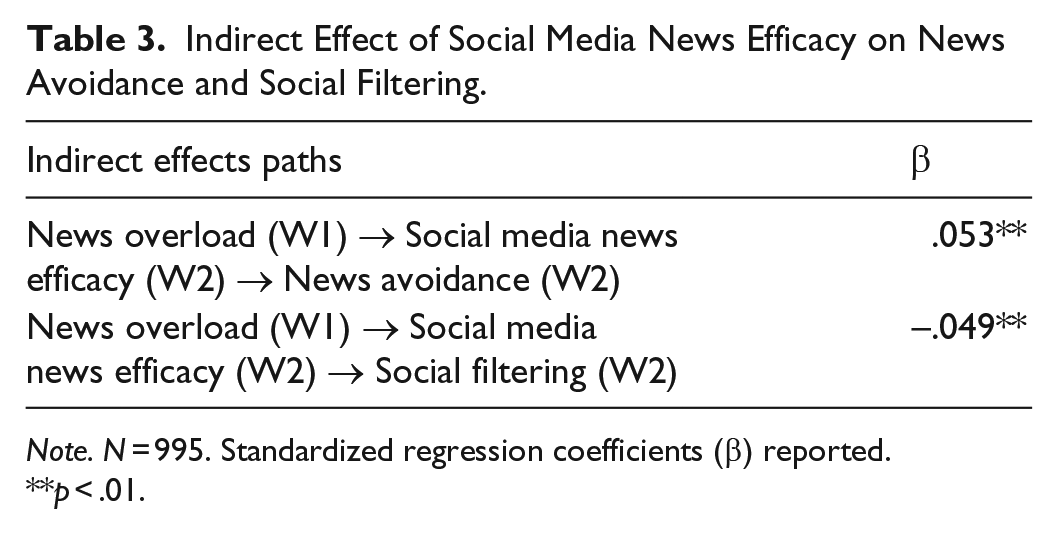
Note. N = 995. Standardized regression coefficients (β) reported.
p < .01.
Discussion
Audiences are awash in news on social media (Bright et al., 2015; Shearer, 2018). The extensive amount of news available on social media may intensify the feeling of news overload of news consumers. Extending Bandura’s (1997) self-efficacy theory, this study proposes a theoretical framework that illuminates the mechanism by which perceived news overload leads to cognitive and behavioral consequences of news seeking in the social media context. This study, particularly, conceptualized social media news efficacy as a key element that can explain the link of news overload and news-seeking tactics occurring in social media.
Consistent with prior studies (e.g., S. K. Lee, Kim, & Koh, 2016; Song et al., 2017), the current study finds that news overload results in avoidance of news consumption on social media. One plausible reason for this relationship is that the perception of information overload increases fatigue of news consumers (Misra & Stokols, 2012; York, 2013), and this fatigue makes them avoid news intentionally and unintentionally (Van den Bulck, 2006). The more overwhelmed people feel toward news on social media, the less effort they are willing to put into reading the news from social media. There is little doubt that social media have expanded the availability of news—there is more news, delivered more quickly, in more formats, and disseminated to a wider public than ever before (Shearer & Gottfried, 2017). However, availability of information does not necessarily result in an increase of news consumption. Some news users who feel overwhelmed by the excessive information on social media end up avoiding news consumption on social media, and this study supports that.
Unlike prior studies that reported only negative consequences of information/news overload, such as a loss of control (Reinke, Chamorro-Premuzic, 2014), psychological stress (Misra & Stokols, 2012), and anxiety (Bawden & Robinson, 2009), this research also finds that news overload does not always keep users from seeking news from social media. Some users are likely to rely on “social filtering” as a way to relieve perceived news overload. Friends on social media could help users who are frustrated by news overload. People agonized by the excessive news supply can receive news stories filtered, curated, and explained by their friends on social media (Lerman, 2007; Park & Kaye, 2018). Social media users can use their networks to filter the vast stream of new submissions to find stories they like (Pentina & Tarafdar, 2014). Our findings suggest that while some users back away from getting news from social media because of news overload, others continue to seek and receive news through their friends on social media, alleviating news overload. Overall, this study’s findings imply that perceived news overload on social media drives users to take less effort-requiring tactics regarding their news consumption.
Another important theoretical contribution of this study is that it delved into the mediating mechanisms between news overload and two news use tactics (news avoidance and social filtering) and found that “news efficacy” is the key hook. Self-efficacy, the central construct in social cognitive theory (Bandura, 2001), has been treated as an important variable in human–computer interaction studies (e.g., Bunz, Curry, & Voon, 2007; Rains, 2008), but little research has investigated what roles self-efficacy plays in relation to perceived news overload and remedial tactics on social media.
According to Bandura (1997), self-efficacy mediates people’s interpretation of the surrounding environment and their behavior, and this mediation occurs at four different levels—cognitive, selection, affective, and motivational processes. These mechanisms demonstrate that perceptions of self-efficacy play a connecting role between a social reality and people’s behavioral choices in such a reality.
When exposed to too much news on social media, people become debilitated by news overload and unsatisfied by the news experience (Hocevar et al., 2014). One reason for this is that news overload makes people feel cognitively burdened (Crook et al., 2016). If the amount of news requiring processing is large enough, people feel stressed (Song et al., 2017) and ineffective in information processing (Schmitt et al., 2018) and, as a result, experience difficulty in understanding news stories. In other words, social media users experience changes in their confidence in finding and understanding the news.
The more overloaded people feel for the news on social media, the less efficacious they feel in finding news stories they want from social media and in making sense of them (Basoglu et al., 2009). Subsequently, decreased news efficacy can lead people to reduce time and effort spent on news, making them avoid news consumption through social media. Consistent with the selection process mechanism that describes a low self-efficacy person tends to avoid a situation that requires excessive information processing, this study’s finding demonstrates how news-overwhelmed users dampen their perceptions of news efficacy about finding and processing excessive amounts of news and as a result reduce their effort of news seeking. Furthermore, the cognitive process mechanism (Bandura, 1977) explains that those who doubt their efficacy tend to dwell upon the things that go wrong in the face of pressing situational demands and become more erratic in their analytic thinking and quality performance. Likewise, those with low news efficacy will slacken their rational thinking of finding the best information-seeking strategy and feel tired of following their networks’ news feeds when they confront the tasks of managing excessive amounts of news.
Taken together, beyond previous studies that focused on either predictors of news overload (e.g., Holton & Chyi, 2012; Ji et al., 2014; Schmitt et al., 2018) or consequences of it (e.g., Lee, Son, & Kim, 2016), this article’s so-called “news efficacy mediation model” explains how people respond to news overload and pursue news on social media through the mediating role of news efficacy. Particularly the application of the self-efficacy mechanisms by Bandura to social media makes a theoretical contribution to the literature of news overload on social media.
This study has also practical implications in terms of democratic citizenship. News use is closely associated with increases in political knowledge, political participation, and voting (Liu, Shen, Eveland, & Dylko, 2013; Pinkleton et al., 2012). If people feel overloaded with news, they may lose chances to get exposed to civic and political information, but some users still find a way to remain in the loop of news acquisition through social filtering, which is one of the dominant news access methods today (Lerman, 2007). Furthermore, if politicians and educators make effort to boost citizens’ confidence in their news finding and handling (news efficacy), news overload may not remain as an obstacle to informing citizens.
Limitations and Future Research
This study contains several limitations. The relationship between news efficacy and news avoidance can be reversed. Although, we are positive about the impact direction from news efficacy to news avoidance because our data are based on a panel survey, it is also possible the two variables have a reciprocal relationship. Future studies should test our study’s model using experiments, to test causality more rigorously.
It is also possible that other mediating variables can work between news overload and social filtering. For example, need for news (Song et al., 2017) can play a certain role, although this study believes news efficacy is a pivotal bridge between perceived news overload and news-seeking behaviors. Thus, we suggest future research should expand this study’s model by including other plausible intervening variables.
Finally, this study employed quota sampling, which is not a probability sampling method. To increase representativeness, we stratified the sample based on demographics, but a probability sample will be ideal in future research.
Despite some limitations, this study contributes to the literature of news overload in the context of social media, by illuminating the mechanisms by which perceived news overload results in social filtering or news avoidance through the mediating role of news efficacy.
Footnotes
Declaration of Conflicting Interests
The author(s) declared no potential conflicts of interest with respect to the research, authorship, and/or publication of this article.
Funding
The author(s) received no financial support for the research, authorship, and/or publication of this article.
