



Abstract
As the field of journalism becomes increasingly unrecognizable, the messages that identify the journalist, their work, and their affiliations are of increasing importance. This study envisions journalism and social media both as gendered spaces and examines their intersection as the setting of much of journalists’ branding work. In this setting, gender’s influence on the extent, style, and target of journalists’ branding efforts is examined using data from two different datasets (content analysis and survey). The findings suggest that female journalists take a more personalized approach by speaking about themselves in their profiles and their tweets and focusing more resources and attention on their individual brands. This suggests that female journalists are not well served by male-dominated news organizations and therefore turn to a more personalized self-image in their branding efforts. This understanding is particularly important as societies and newsrooms both work toward a more inclusive, egalitarian future.
Introduction
As social media have become a regular feature of the information environment and news media work in particular, scholars have followed with interest the trend of media workers representing themselves online and developing personal brands. In a digital economy where attention is the primary currency exchanged (Davenport & Beck, 2013; Kinstler, 2013), one’s reputation is as valuable as the work performed or the content produced. The online profile page has become a sort of status symbol, communicating to the rest of the world one’s place within it (boyd & Ellison, 2007). This combined with a constant stream of updates, posts, images, and interactions forms a digital brand that differentiates its owner from others in the field and helps make assurances about origin or quality (Murphy, 1987; Stanton & Stanton, 2013).
This practice of personal branding has become especially important for journalists (Brems, Temmerman, Graham, & Broersma, 2017), whose work conditions are inherently precarious and becoming more so (Deuze, 2013). In an effort to communicate their value, journalists’ branding efforts speak to multiple constituencies. They market their content and defend their credibility to their audiences. They demonstrate to their employers their careful adherence to policy and commitment to the organization. Also, they show solidarity with other journalists in an age when news media and their democratic functions are under attack. These interactions have been styled as individual, organizational, and institutional branding in previous research (Molyneux, Holton, & Lewis, 2017; Sacco & Bossio, 2016). These branding efforts are not strictly professional, as studies suggest that journalists’ and other media workers’ self-representations often blend both personal and professional aspects (Duffy & Pruchniewska, 2017; Scolere, Pruchniewska, & Duffy, 2018). This means journalists’ performance of identity on social media often includes aspects of gender and the self.
While the prevalence, forms, and motivations behind this form of personal branding work are beginning receive much scholarly attention, this work has yet to fully examine how performances of gender may interact with branding efforts. Research suggests that in general, men and women communicate differently, especially on social media (for a meta-analysis, see Liu, Ainsworth, & Baumeister, 2016). But these patterns may be overridden by organizational and institutional norms as many media professionals feel compelled to use social media as part of their job (Scolere et al., 2018) while trying to adhere to company social media policy (for an example of such policy, see The New York Times, 2017). Therefore, this study focuses specifically on the development of personal brands by media workers, on the assumption that these professionals face different pressures and dynamics than the average user that may induce them to devote more time and attention to their personal brands. In addition, professional spaces including journalism are seen to be heavily gendered in both structure and norms, potentially creating points of tension as people represent themselves and their work. This study focuses specifically on working journalists as one form of media worker, one that is increasingly beset by rules and regulations on one hand (Opgenhaffen & Scheerlinck, 2014), and demands for engagement and interaction on the other (Lewis, 2012; Lewis, Holton, & Coddington, 2014). The multifaceted nature of journalists’ motivations (Molyneux, Lewis, & Holton, 2018), audiences (Napoli, 2011), and approaches to branding (Hedman, 2016) make journalists a particularly illuminating group to study.
This study addresses the question of whether gender is an explanatory factor in understanding how male and female journalists develop their personal brands. This is done by using data from two datasets collected using (1) content analysis and (2) survey methods. By studying the words and images people include in their profiles, the tweets they send, and analyzing their responses to a series of questions about attitudes toward and practices of branding, it is possible to paint a fuller picture of ways in which gender may intersect with approaches to and enactments of branding. This study extends existing literature by adding detail and nuance to our understanding of branding practices among journalists, especially as they intersect with gender. In a broader sense, it responds to scholarly calls to illuminate how and why journalism operates as a gendered space (Steiner, 2012).
Self-representations and the Personal Brand
As long as there have been people, there has been a need to represent oneself to others. To summarize an argument made effectively by Liu et al. (2016), there is an evolutionary reason that many human traits facilitate communication, trust, and mutual understanding. That is, humans are a species that depends upon forming cooperative partnerships and sharing resources to survive and reproduce (Suddendorf, 2013; Tomasello, 2014). Because we depend upon cooperation for survival, it is necessary for individuals to build a reputation for trustworthiness and reciprocity, and research suggests that humans are therefore more concerned with their reputations than other primates (Engelmann, Herrmann, & Tomasello, 2012). As a result, it is not surprising to see humans appropriating new communications technologies (including social media) for the purpose of presenting themselves to others in a favorable light.
This drive toward reputation management is prominently manifest in the relatively recent proliferation of personal branding. The popularization of the personal brand as a professional tool can be traced to a 1997 article (Peters, 1997), but the practice has proliferated in the subsequent two decades to the point that it is almost second nature for many professionals, but especially those in creative industries. This push to develop a personal brand that is felt in many aspects of professional life and is driven by increased precarity in the job market, weakening of organizations, and (at least in the United States) American individualism (Jeanquart Mies & Mangold, 2004; Lair, Sullivan, & Cheney, 2005; Vallas & Cummins, 2015). There is also a sense that if you do not exert control over your personal brand, you are effectively allowing others to define you (Shepherd, 2005). These factors (precarity, weakening organizations, individualism, and control) are nowhere more prominent than in journalism. Over the decades, the news industry has destabilized as a result of losing the business model which sustained it for generations. As a result, newsrooms find themselves fighting for audiences, and much of this effort is foisted upon individual journalists (Tandoc & Vos, 2016). This weakening of organizations has led to mass layoffs and heightened job precarity for the workers that remain (Bunce, 2017; Deuze & Witschge, 2018). At the same time, the profession as a whole is assailed in popular discourse as inaccurate, irrelevant, and overall “fake” (Nielsen & Graves, 2017). Professionalization efforts in response to these criticisms have included distinguishing journalists from other mediated speakers, creating a need for individualization and image control. This combination of precarity, weakening organizations, and a desire for individual control, have in large part contributed to journalists’ conclusion that branding is an essential part of their work (Brems et al., 2017).
Previous scholarship has determined that journalists mix personal and professional elements of self into their appeals for audience attention, and that branding for journalists is essentially an effort in garnering attention and relationship building (Hedman, Djerf-Pierre, 2013; Ottovordemgentschenfelde, 2017). Additional research has suggested that journalists’ branding motivations and activities can be grouped into organizational and individual concerns, with one group operating as “company journalists” and another oriented toward more individual and entrepreneurial practices (Molyneux et al., 2018). Less understood are subtle differences in how subgroups perform these activities—political reporters seem to behave differently from sports reporters or fashion bloggers (Ottovordemgentschenfelde, 2017; Scolere et al., 2018); journalists at large, national organizations seem to have different practices from those working at smaller, local publications (Lasorsa, Lewis, & Holton, 2011); and age and years of experience also seem to influence how journalists represent themselves (Parmelee, Roman, Beasley, & Perkins, 2017). This study, however, focuses on the differences between genders as a key dynamic shaping journalists’ enactment of branding.
Gender and Gendered Spaces
The structure of society in the United States and many other Western countries around patriarchal leadership and male domination of power and resources means that gender is often an important aspect of social interactions. While gender may be important in multiple forms of social interactions, this study is primarily concerned with how it informs the way people present themselves to others. A prominent view is that one’s identity is socially constructed, and in fact that identity is created and maintained only insofar as it is performed for others (Goffman, 1959). These identity performances may be different for different audiences based on the nature of the relationship. Because gender structures social interactions, it is a key influence in these performances, depending on who is performing their identity for whom. To give a few relevant examples, men tend to be oriented toward large social groups, whereas women emphasize close, one-to-one interactions (Baumeister & Sommer, 1997). Women are more likely to self-disclose than men, and women use this disclosure to foster intimacy in relationships (Courtney Walton & Rice, 2013; Cross & Madson, 1997; Dindia & Allen, 1992). Personalized, intimate, and conversational communication styles are perceived as being more feminine, whereas impersonal, factual, and analytical styles are perceived to be more masculine (Campbell, 1989; Davisson, 2009).
Of course, feminine and masculine styles of communication may be employed by both males and females for different purposes and in different settings. That is, some spaces may value certain types of self-representations more than others such that gender itself is not the sole characteristic structuring the interactions. In particularly gendered spaces, the logic of the space may privilege particular forms of communication, leading to similar communication styles from men and women as both seek to fit in. This study positions itself at the intersection of two such spaces—social media and journalism—and asks how male and female journalists inhabiting this intersection differ in the ways they represent themselves to their constituents, the news audience.
Social media may be seen as a gendered space. Meeks (2016) suggests that social media, especially Twitter, tend to value feminine styles of communication, and indeed she found that among political candidates, men and women were similar in their use of personalization as a communication strategy. Despite this, on the whole, women see Twitter as a dangerous, misogynist place and have worked to reclaim it (Amnesty International, 2018; Chen, Pain, & Zhang, 2018). Social media duties have been added to many media jobs, and although required, are often unpaid or systematically undervalued. This undervalued labor has been assumed to be feminine and disproportionately falls to women (Duffy & Pruchniewska, 2017). Considering journalists specifically, studies suggest that female journalists are subject to extensive harassment and trolling online (Everbach, 2018; Ferrier & Garud-Patkar, 2018). Female journalists, especially those who appear on television or in video, are judged (often harshly) on their appearance, sometimes over and above, or in place of, their professional skill (Bock, Cueva Chacón, Jung, Sturm, & Figueroa, 2018; Pain & Chen, 2018). The norms, etiquettes, vernaculars, and cultures of social media also vary from platform to platform (for a journalistic example, see Maares & Hanusch, 2018), but this study focuses specifically on Twitter as the platform most relevant for journalists because it is the most widely used (Wilhoit, Weaver, & Willnat, 2017).
Scholars also have argued that journalism itself is a gendered space. Ruoho and Torkkola (2018) suggest that given the powerful effects of the male-dominated journalism institution, women who work in journalism may feel as if they must act like men to get along or to advance. Indeed, study after study has found that women are underrepresented in news content and on newsroom staffs (e.g., Armstrong & Gao, 2011; Artwick, 2014). Multiple studies even find that women are generally assigned to particular beats and are underrepresented in traditional “hard news” beats (e.g., North, 2016). And of course, women are underrepresented in leadership positions in journalism and in the field in general (McCracken, FitzSimons, Priest, Girstmair, & Murphy, 2018; Wilhoit et al., 2017).
The intersection of social media and journalism can sometimes result in the worst of both worlds. A study of White House reporters suggests that Twitter exacerbates journalism’s pre-existing gender disparities and biases by creating gendered silos in which men “amplify and engage male peers almost exclusively” (Usher, Holcomb, & Littman, 2018). That is, the gender asymmetry that is already present among journalists in offline settings is amplified in online networks and interactions. In some ways, female journalists are taking steps to push against the difficult situations they encounter on social media (Ferrier & Garud-Patkar, 2018), but studies also have found few behavioral differences between men and women journalists on Twitter (Lasorsa, 2012; Parmelee et al., 2017). Where differences are found, these differences are not assumed to be “hardwired” (Fine, 2010) but rather due to socialization both within and without the newsroom (Rodgers & Thorson, 2003). Given this, Steiner (2009) suggests moving away from framing questions about gender and journalism in dichotomous, hard/soft ways. Gender, rather, is best understood as a relational act (Butler, 1990) that may shape and structure communication performances. The ways in which these performances emerge in self-representations and branding among journalists tell us something about emerging professional practice, the structure and influence of journalism as a gendered institution, and the relationship of gender to information and knowing in modern society. Because attitudes surrounding gender in Western countries appear to be changing in some ways, Ruoho and Torkkola (2018) suggest that we cannot automatically accept old assumptions about men, women, and their respective roles or inclinations. Rather than positing that innate value systems drive men and women to perform gender differently, we might consider how gender emerges as a factor in the complicated “matrix of relationships” (Steiner, 2012) that affects how journalists present themselves to the world.
Research Questions
Given what we know about journalism and social media as gendered spaces, we might expect that female and male journalists differ in their approach to personal branding in three ways. First, there may be differences in terms of frequency, volume, or intensity. Women feel disenfranchised and are systematically excluded from journalistic spaces on Twitter, which may increase their perceived need for reputation management and branding. In other words, they may be branding themselves more, or working harder to develop a personal brand, in an effort to achieve parity with men. Alternatively, the dangers women face on Twitter in particular may cause them to withdraw, in an effort to maintain their privacy and safety. To investigate these possibilities, this study poses the following research question.
Second, the literature suggests that men and women adopt different approaches to social interactions. But are there differences between genders in how they develop and prioritize individual, organizational, and institutional branding efforts (Molyneux et al., 2017)? It might be expected that females are more likely to employ feminine communication styles, including primarily an individual, personalized approach. However, it is possible that, as in Meeks’ (2016) study and as suggested by Lasorsa (2012), socialization and the pressures of the institution privilege particular communication styles, effectively homogenizing journalists’ approach to branding regardless of gender. In an effort to resolve this quandary, this study poses the following research question.
Finally, studies of female media workers find them to be actively supporting one another (Duffy & Pruchniewska, 2017; Usher et al., 2018), whereas males are assumed to be competitive and aggressive in positioning their careers. These differences might reasonably be expected to affect how journalists think of the audiences they hope to reach with their branding efforts. Another possibility is that journalists are particularly used to envisioning an audience for their content and so may have rather similar conceptions of whom they are presenting themselves to. That is, beyond the general and widespread audience journalists ostensibly work for when they produce content, they may also be drawing on reader metrics (Anderson, 2011; Vu, 2014) or the vision of the audience articulated by their organizations (Opgenhaffen & Scheerlinck, 2014). This study investigates the audiences that male and female journalists imagine for their personal brands by posing the following research question.
Methods
Data for this study come from two waves of data collection. Data collection focused on journalists’ use of Twitter, which is the most commonly used social media platform among journalists (Wilhoit et al., 2017). In the first, content analysis was used to collect data from Twitter profiles and tweets of more than 380 US journalists. In the second, a survey was administered to a separate sample of 642 journalists in the United States asking about their branding practices. Both samples were drawn using the Cision media contacts database, which is widely regarded as the most comprehensive listing of media contacts in the United States. Although the datasets are unrelated, 1 they both capture a broad cross section of US journalists that is as representative as current methods allow. Thus, both samples and datasets can be understood as representing the same target population, which is journalists in the United States. The benefit of analyzing both datasets here is that together they provide a relatively comprehensive view of both behaviors and attitudes related to branding among journalists, thus providing a fuller picture in answer to this study’s research questions. Data collection and analysis procedures for both datasets are described separately. Following this, data from both of these datasets will be called upon to answer the three research questions in the order they were posed.
Dataset 1: Content Analysis
To identify a sample of US journalists, the Cision database of media contacts was searched for those working in the United States at television stations and shows, radio stations and shows, newspapers and their bureaus, wire services, and news websites. This search was further specified by identifying those whose job titles contained writer, reporter, columnist, contributor, correspondent, anchor, or journalist. This obviously excludes editors, producers, hosts, and so on, with the assumption that these types of news workers do not typically have bylines and therefore work more behind the scenes. As such, they are less likely to have a public-facing presence on social media or, if they do, may use it quite differently from bylined reporters.
The list of results contained 25,599 individuals, of which 18,649 had Twitter accounts listed in the database. A stratified sample of 400 individuals was drawn such that the sample contained the same proportions of media types as in the overall search results (232 from newspapers, 75 from television, 73 from websites, and 20 from radio stations). Within this sample, some accounts were blocked or had never sent any tweets, and one was not in English. After excluding these accounts, 384 remained. Each of the accounts was coded for gender using the salutation (Mr or Ms) specified in the Cision database, checked against names and photos for consistency. In this sample, 40% of the accounts analyzed belonged to female journalists.
Two kinds of data were collected from these 384 twitter accounts using custom software programs to query Twitter’s application programming interface (API) and scrape publicly available data. First, information in the account’s profile was collected. This included the account name, text presented in the “bio” section, number of followers, number of tweets sent, and when the account was created. The accounts’ profile images were also collected via a Web screenshot utility that captured a full overview of how the user’s profile page appears when visiting it online. Second, each journalist’s five most recent tweets (including retweets) were captured. The bio text and tweets were captured in March 2016; the images were captured in September of that year. Altogether, this is a collection of what appears when you visit a journalist’s Twitter page: images, bio, and a few recent tweets. In this way, the scraping captures the way a journalist brands his or her Twitter presence, and the coding quantifies characteristics of this presence.
The data were coded using a codebook developed based on existing literature on journalists’ use of social media for branding and visual self-representations (Lasorsa et al., 2011; Lawrence, Molyneux, Coddington, & Holton, 2013; Lough, Molyneux, & Holton, 2018; Molyneux et al., 2017). The profiles were coded for the presence of any references to the journalist’s employer (in the bio text or in the handle), references to another journalist or news organization (such as places the journalist used to work), any mention of the journalist’s beat or coverage, and the presence of any personal information that does not deal with work. The profile images were also coded for whether the image included a person and how that person was presented, including smiling, making eye contact, professional or casual dress, and depiction passively or in “work action” (Ottovordemgentschenfelde, 2017). The tweets were coded individually for whether they included mentions of the journalist him- or herself, or to the journalist’s own work; whether the tweet contained mentions of coworkers or the organization where the journalist is employed; and whether the tweet referenced a journalist or the work of a third-party news organization, or the institution of journalism as a whole. These three categories can be understood to represent individual, organizational, and institutional branding (Molyneux et al., 2017). The tweets were also coded for whether they mentioned public affairs, whether they expressed opinion, whether they made an attempt at humor, and whether they included any elements of personal information or “lifecasting.” In all cases, variables and operationalizations were adopted from previous studies of journalists’ self-presentations on Twitter (Lasorsa et al., 2011; Lawrence et al., 2013; Lough, Molyneux, & Holton, 2018). The tweet codes were merged to create a variable for each journalist (rather than for each tweet, which would be nested data) indicating whether each of these items (three forms of branding, humor, opinion, etc.) were part of a journalist’s Twitter presence. That is, if any one of the journalist’s tweets included humor, the variable associated with the journalist indicated humor as a part of the journalist’s Twitter presence. All codings were done by the researcher and two research associates; intercoder reliability was computed using a 10% sample of each variable, and alphas ranged from .77 to 1.
Dataset 2: Survey
A year after Dataset 1 was collected, a new sample of US journalists was drawn for invitation to participate in a survey of their branding attitudes and activities. The sample was again drawn using the Cision media contact database. This time, the database was searched for individuals whose job role was listed as reporter, writer, editor, columnist, correspondent, freelance journalist, news director, producer, or blogger, and who also worked at newspapers, television stations, cable stations, radio stations, magazines, news websites, wire services, news blogs, or as freelancers. This resulted in a list of 109,843 contacts, which is much larger than the first search because it included additional categories of journalists (such as editors and producers) and new media sectors (such as magazines, blogs, and freelancers). This list is obviously overinclusive, but it attempts to capture the wide range of work that could be considered journalism in the 21st century. As an additional guard against ineligible participants, the survey invitation and the first page of the survey specified that it was intended only for working journalists. From this list, a random sample of 10,455 journalists were invited to participate, resulting in 242 partially completed surveys and 642 completed surveys, for a response rate of 8.9%. In this sample, respondents ranged in age from 24 to 61 (M = 49) years and 45% identified as female. 2 Whites made up 88% of the sample. Most journalists were employed full-time (73%), though a significant number worked as freelancers (19%). Most held college degrees (61% bachelor’s and 23% master’s).
Using an online questionnaire, respondents were asked a series of questions about their social media use, their branding activities, and the audiences they are trying to reach in their branding efforts. They also answered standard demographic measures including age, gender, education and income and estimated the number of editorial employees at their organization. They also indicated whether their work was full-time, part-time, or as a freelancer.
Social Media Use
Journalists were asked which social media accounts they have, and how often they use them on a scale from 1 (hardly ever) to 7 (all the time), among the following platforms: Facebook, Twitter, Instagram, LinkedIn, Pinterest, Reddit, and Other. Responses to these questions were summed to create a scale of social media use (range = 0–49, M = 17.43, SD = 9.31).
Branding Activity
Because approaches to branding can be highly idiosyncratic, this study measures the prevalence of branding practices at individual, organizational, and institutional levels by asking how often journalists practice branding, regardless of the specific strategy employed. Journalists were asked how often they “make an effort to develop a personal brand” (i.e., individual level), “promote your news organization’s brand” (i.e., organizational level), and “promote the work of journalists outside your news organization” (i.e., institutional level). Responses were measured on a 7-point Likert-type scale ranging from “never” to “all the time.” Journalists were also asked to rate the relative importance of their individual and organizational brands, with 1 meaning the individual brand is most important, 7 meaning the organizational brand is most important, and 4 meaning both brands are equally important. Finally, journalists were asked how often they were trying to reach the following groups when promoting their personal brand and their news organization’s brand: their news audience, their sources or potential sources, their employer, potential employers, other journalists, or another target audience.
Results
The first research question asked how male and female journalists differ in the extent of their branding efforts. This question is concerned primarily with measures of frequency, volume, and intensity of branding activity. Using independent samples t-tests, data from the content analysis suggest that female and male journalists employ branding strategies at roughly similar rates overall in both their Twitter profiles (for the six indicators of profile branding measured, Mm = 2.509, SD = 1.08; Mf = 2.338, SD = 1.07; t = 1.507, p = .133) and in their tweets (Mm = .814, SD = .39; Mf = .853, SD = .36; t = –1.00, p = .317).
Using the survey data, age, race, education, income, and organizational size were entered in the first block of a liner regression analysis as controls, followed by gender in the second block. The survey data suggest that female journalists report being more active social media users than males (β = .098, p < .05, ΔR2 = 1%) and engaging in branding practices more frequently than males (using a sum of all branding types as the dependent variable; β = .136, p < .01, ΔR2 = 1.7%). These data suggest that female journalists report a more active focus on branding in their work, but their practices on Twitter specifically are not so different from men’s in terms of frequency.
Going beyond broad differences in the overall amount of branding activity, the second research question seeks to uncover differences in particular branding approaches. It asks how male and female journalists differ in the style of their branding efforts. Using cross-tabulations, data from the content analysis of profiles suggest that female journalists are more likely to include personal information in their profile (χ2 = 4.589, p < .05), whereas males are more likely to mention their beat (χ2 = 13.716, p < .001). Males more often mentioned an employer in the profile, but this difference only approached significance (χ2 = 3.601, p = .058). Women were more likely to be smiling (χ2 = 19.963, p < .001) in their profile images, and men were more likely to picture themselves in work action (χ2 = 5.812, p < .05). Overall, then, men’s profiles were more likely to focus on their work, whereas women’s profiles were more likely to focus on themselves. Differences by gender for all variables coded in tweets and profiles are presented in Table 1.
Comparison by Gender of the Characteristics of a Journalist’s Twitter Presence Measured by Content Analysis. Profiles and Tweets Were Coded for Presence of Each Characteristic.

p < .10, *p < .05, **p < .01, ***p < .001.
The content analysis of the tweets tells a slightly different story. Using measures of whether a journalist’s recent tweets exhibited individual, organizational, and institutional branding, crosstabs found that female journalists were more likely to practice organizational branding (males = 60.4%, females = 75.2%, χ2 = 7.69, p < .01). No significant differences based on gender were found in exhibitions of individual or institutional branding in tweets. Finally, cross-tabulations of data from the tweets show women were more likely to mention public affairs (χ2 = 11.168, p < .001) and more likely to include personal information (χ2 = 22.523, p < .001) in their tweets. Men were slightly more likely to express opinion in their tweets (χ2 = 4.865, p < .05).
Turning to the survey data, three styles of branding (individual, organizational, and institutional) were each used as dependent variables. The other two styles were used as controls, along with age, race, education, income, and organizational size. Results show that female journalists are more likely to promote themselves (β = .111, p < .01, ΔR2 = 1.1%) while there are not significant differences in terms of organizational or institutional branding (see Table 2). On the scale asking journalists to rate the relative importance of their personal (1) and organizational (7) branding efforts, female journalists had significantly lower mean scores, indicating a preference for personal branding (Mm = 4.37, SD = 1.83; Mf = 4.01, SD = 1.80; t = 2.447, p < .05).
The Influence of Gender on the Practices of Individual, Organizational, and Institutional Branding Measured in a Survey of Journalists.
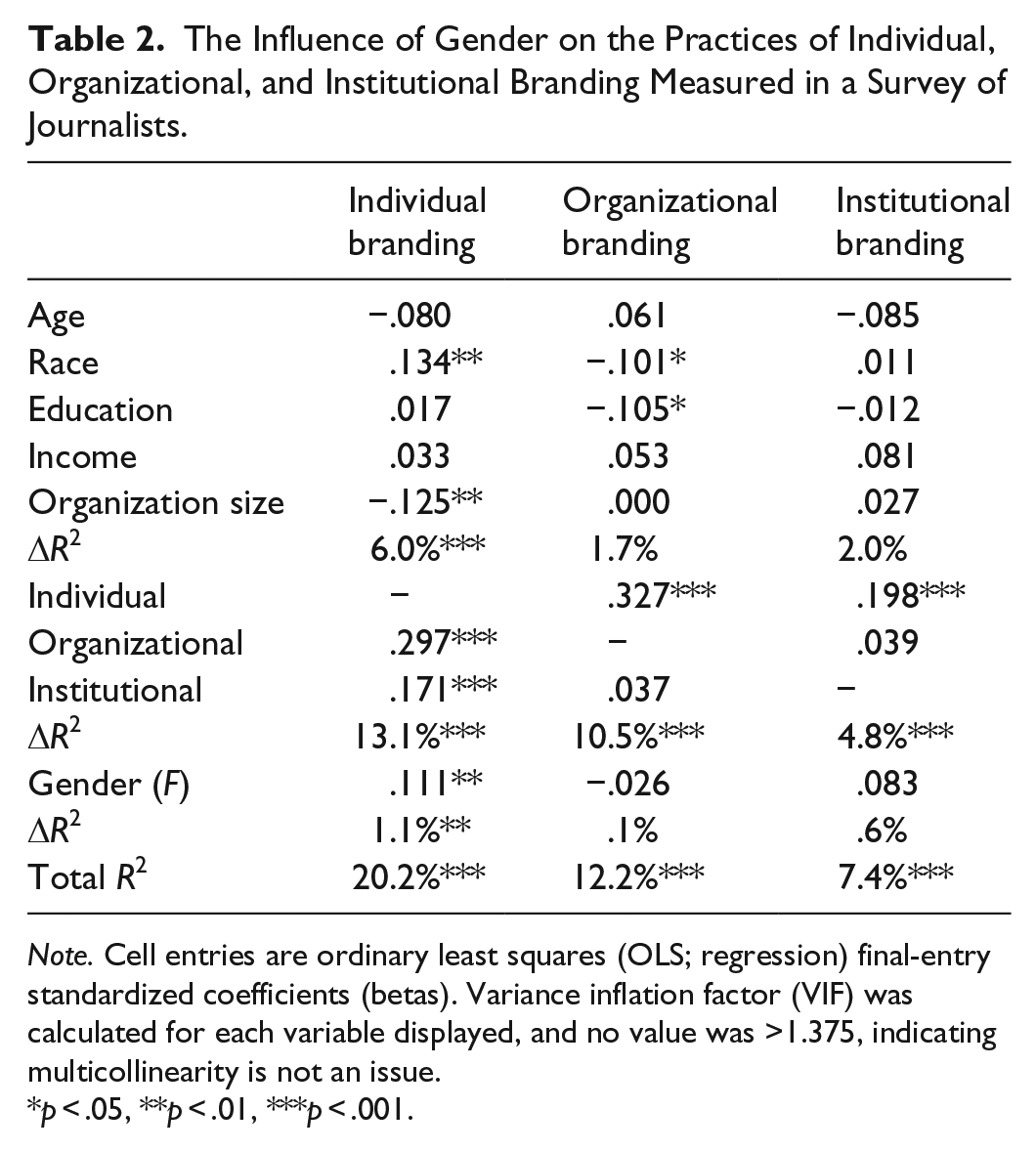
Note. Cell entries are ordinary least squares (OLS; regression) final-entry standardized coefficients (betas). Variance inflation factor (VIF) was calculated for each variable displayed, and no value was >1.375, indicating multicollinearity is not an issue.
p < .05, **p < .01, ***p < .001.
Finally, the third research question asked how male and female journalists differ in the targets of their branding efforts. This question is answered using data from the survey, asking journalists about who they are trying to reach in their branding efforts. The survey asked journalists how often they were trying to reach their news audience, their sources, their boss, potential employers, or other journalists when promoting themselves or their organization. Both sets of questions (for individual and organizational branding) yielded the same patterns: one-way analysis of variance (ANOVA) tests showed that female journalists were more likely to be seeking to reach their employer (F = 4.826, p < .01), potential employers (F = 15.918, p < .01), and other journalists (F = 7.868, p < .05). But these relationships become non-significant once age is added as a control. In fact, the female journalists in this sample are much more likely to be younger (average age for males = 52.1 years, females = 43.8 years; t = 7.648, p < .001) and to be freelancers, 26% of females compared with 14% of males; χ2(4) = 14.443, p < .01, which appears to influence who they target with their branding appeals. That is, it is not necessarily female journalists but the younger, less-experienced journalists who tend to want to reach upward on the professional ladder in their branding efforts.
Discussion
This study brings together two different datasets to answer questions about the influence of gender on journalists’ branding practices. These branding messages that identify the journalist, their work, and their affiliations are of increasing importance as the field of journalism becomes increasingly unrecognizable (Ryfe, 2016) and as interlopers seek to hijack or destroy journalists’ credibility, particularly on social media (Allcott & Gentzkow, 2017; Nielsen & Graves, 2017). Perhaps never before has it been so important for journalists especially (and media workers generally) to manage their reputations by branding themselves, their news organizations, and their profession. While previous studies have uncovered the styles, modes, motivations, and enactments of branding among journalists generally, research has yet to address differences among subgroups. Thus, a key contribution of this study is to illuminate how gender informs branding efforts across attitudes, reported practice, and actual practice as observed on Twitter.
The findings presented here suggest that gender has an important role to play in shaping these branding activities. In general, male journalists tend to focus their branding efforts on work and the profession, being more likely to mention their employer, beat, and include photos of themselves at work. Female journalists, by comparison, take a more personalized approach by expressing personal information and including photos that evoke interpersonal exchanges (eye contact, smiling). This is not to say women are less professional—female journalists were marginally more likely to tweet about public affairs, for instance. In fact, these interpersonal exchanges may even be considered professional, gendered norms women feel they must follow (e.g., female political candidates are sometimes criticized for not smiling enough).
This could be interpreted as women simply employing a more feminine communication style when engaging in branding, a finding that would support previous research suggesting that social media cultures favor and tend to perpetuate gender-specific forms of communication (Abidin, 2016; Duffy & Pruchniewska, 2017). That is, considering the politics and practices that coalesce around social media broadly and even around specific platforms (Papacharissi, 2010, 2015), both men and women may have developed different ways of navigating these spaces. That women tend to employ more personalized communication approaches has been found in other settings as well. It is difficult, however, to leave this as the only explanation, given that women are subject to greater harassment on Twitter—a more personalized approach could invite more trolling and personal attacks online.
Another consideration may be what is happening in journalism itself. The female journalists in the survey sample are younger, are more likely to be freelancers, and even while having similar levels of education as the males, reported lower household incomes. In short, the female journalists in the survey sample occupy more precarious work positions, a finding which matches those of previous studies (McCracken et al., 2018; Ruoho & Torkkola, 2018). This, combined with findings that female journalists also are systematically marginalized in their coverage assignments (North, 2016) and in social media spaces (Armstrong & Gao, 2011; Usher et al., 2018), suggests another conclusion: female journalists are not well served by male-dominated news organizations, and so turn to a more personalized self-image in their branding efforts. Going it alone, unfortunately, would seem to perpetuate rather than offset the disadvantages women face in professional journalism. In short, this is not an inequity female journalists themselves can fix through entrepreneurialism. Instead, as has often been suggested, it would require commitment from entire news organizations and shifts in culture among journalists at large.
An exception to this trend of personalization is the finding that female journalists are more likely to mention their coworkers or their organization in their tweets, despite the survey findings where women report placing more emphasis on their individual brands. This suggests that something of a disconnect between the way female journalists think about their branding activities and the way they actually perform them. While female journalists say their individual brand is most important to them, they are more likely than male journalists to mention their coworkers or their organization in their tweets. This could be the result of female journalists’ proclivity toward supportiveness, as documented in other groups of female media workers (Duffy & Pruchniewska, 2017). It might also be a bid for legitimacy and belonging, which female journalists may rightly feel they do not have as underpaid, freelance workers. Or it could simply be that, in the year between the content analysis and the survey data collections, attitudes and practices both had changed. Future studies might be designed to measure attitudes and practices of the same journalists all at once for a more integrated view of these phenomena. Also, this study focuses specifically on journalists’ use of Twitter, but it is likely somewhat different practices have developed among other groups on Twitter or among journalists on Instagram, for example.
Overall, the fact that there are gender differences in the ways that male and female journalists approach their branding efforts suggests that socialization within the profession is not so strong as to enforce a single, homogeneous approach. Previous studies have found that journalists overall have noted increasing organizational pressures to behave in certain ways online (Holton & Molyneux, 2015), so it would have been reasonable to expect to see a single, socialized approach to branding work—and indeed, Lasorsa (2012) found very few differences between genders. But this study suggests that, at least when it comes to managing their own reputations online, male and female journalists take different approaches, likely based on their different levels of centrality, stability, and editorial capital (Schultz, 2007) in their professional lives. It is apparent that journalists’ branding practices are performances of gender in addition to being professional or journalistic performances. That is, gender is an important factor in structuring these self-representations, intersecting with age, professional experience, and employment to construct these branding enactments. To the extent that these gendered differences indicate inequities in opportunity or status, it will be important for journalism and other media professions to consider structural and cultural adjustments to alleviate these inequities.
Footnotes
Declaration of Conflicting Interests
The author(s) declared no potential conflicts of interest with respect to the research, authorship, and/or publication of this article.
Funding
The author(s) received no financial support for the research, authorship, and/or publication of this article.
