




Abstract
Based on six newsroom surveys, this article analyzes the history of digital German journalism. The surveys cover a period of 17 years (1997–2014). Periodizing the history of digital journalism into three phases, this article considers the interplay between journalism and journalism research. The results show how journalistic digital media define their role in the relationships between old media and the Internet, digital media and other outlets, and digital media and their audiences. Furthermore, the results substantiate how digital editorial staff define their journalistic identities regarding tasks, rules, and skills. During the first period (surveys conducted in 1997 and 2000), the view from old mass media to the Internet dominated, also in scholarship where the mass media paradigm was extended to the Internet. The second period (surveys conducted in 2006 and 2007) was characterized by clarifying the relationships between journalism and newly emerged outlets. These studies focused on how participative formats (such as Wikipedia and blogs) and search engines could be used for journalistic purposes without compromising quality. These new outlets were not regarded then as much of a threat. This attitude did not change during the third period (surveys conducted in 2010 and 2014). In this phase, too, the studies focused on how editorial staff utilized the ever-increasing number of social media. The six surveys’ different research interests reveal that the reviewed journalism research primarily addressed changing demands in journalistic practice. Therefore, exogenous factors (“the sector”) had a greater impact than endogenous factors (the “scholarship”) on research interests.
Introduction
The Internet’s breakthrough as a journalistic medium occurred 30 years ago. In the mid-1990s, the websites of the first mass media in Germany (the country considered in this article) were launched. On October 25, 1994, the news magazine Der Spiegel started “the very first Internet news site worldwide, even beating out Time magazine by a day” (Steuerwald, 2001). By September 1, 1994, Deutsche Welle had become the first public broadcaster in Germany to launch an information service on the Internet (Deutsche Welle, 2018). Regional public broadcasters such as Ostdeutscher Rundfunk Brandenburg (October 1994), Südwestfunk (July 1995), and Bayerischer Rundfunk (October 1995) followed suit. National commercial television stations soon also found their way onto the Internet, and they included RTL II (August 1995), Sat.1 (February 1996), and ProSieben (April 1996) (Siegle, 1998: 6299). The first daily German newspapers ventured online in May 1995: the regional paper Schweriner Volkszeitung and two national papers, the alternative leftist taz and the conservative Die Welt (Riefler, 1995: 126–128; Rada, 1999: 197–198).
Beyond such founding dates, however, the historical examination of digital journalism and digital communication in general remains in its infancy (Schwarzenegger et al., 2022). If one disregards periodic user surveys (e.g., Beisch and Koch, 2021), empirical studies that describe the history of digital journalism are considerably lacking. Together with colleagues, the author of the current work conducted six newsroom surveys that made it possible to reconstruct digital German journalism broadly, beyond a few outstanding examples. These studies were not intended as a longitudinal project, though they offer great insights into the historical trajectory of Germany’s digital journalism development and the challenges it faced as it evolved. The studies also document how interest in journalism research has changed. Longitudinal analyses of digital journalism (such as the “Media in cyberspace” surveys of journalists in the United States starting in 1994; e.g., Ross and Middleberg, 2001) have generally been rare.
This article’s aim is not only to synthesize the six surveys in order to reconstruct the development of digital journalism in Germany but also to reflect on the relationship between research and journalism. The remainder of this article is structured as follows. First, the theoretical framework is outlined, specifically the institutionalization of digital journalism and the periodization of its history. Then, the study’s design and results are presented.
The institutionalization of digital journalism: Germany as a case
Digital journalism had to establish cross-media relationships between the old mass media and new activities on the Internet (Boczkowski, 2004), relationships with other digital providers—especially platforms (Nielsen and Ganter, 2022)—and relationships with audiences (Bruns, 2005). A network journalism (Heinrich, 2011) developed from these relationships as part of a hybrid public sphere (Chadwick, 2017). In this process, digital journalism had to define its specific tasks, rules, and skills. As a result, a variety of new practices and presentation modes emerged (Loosen et al., 2022; Püchel and Wellbrock, 2021). The borders of digital journalism are fuzzy and in flux (Lewis, 2020; Schapals, 2022; Waisbord, 2019a).
How digital journalism became institutionalized depended mainly on the media system in question (Oggolder et al., 2020: 340). Germany represents the corporatist democratic model of media systems with a high number of regional newspapers, strict ownership regulations, few press subsidies, strong public-service broadcasting, a high degree of journalistic professionalism, and a low degree of political parallelism (Brüggemann et al., 2014; Hallin and Mancini, 2004; Humprecht et al., 2022). “The Media for Democracy Monitor 2021” concluded: “Overall, Germany’s leading news media managed to keep their standards during this turbulent decade of unleashed digitalisation. Measured by our indicators, Germany’s news media serve democracy fairly well” (Horz-Ishak and Thomass, 2021: 249)
In general, the widespread adoption of the Internet took place late in Germany (with a few exceptions, such as Der Spiegel). The old mass media press and broadcasting still hold strong positions in Germany in terms of their usage and trust (Horz-Ishak and Thomass, 2021: 202–204). This hesitant digitalization has been evidenced in international comparative studies, for example, in the shift in news usage to the Internet and social media (Newman et al., 2023: 77), the emergence of convergent newsrooms (Menke et al., 2016), and journalists’ assessments of future digital transformations (Hanitzsch et al., 2019, Appendix 1). This slow adaptation has also led to Germany’s rather minor problems of digitalization compared with other countries. The share of partisan “fake news” is comparably low (Humprecht, 2019: 1981), and the country’s resilience to digital disinformation is high (Humprecht et al., 2020: 505). However, Germans’ willingness to pay for digital news (Newman et al., 2023: 18) and German news users’ active participation (Newman et al., 2023: 37) are also rather low.
The periodization of digital journalism
A reconstruction of the history of digital journalism should focus not only on the object of observation—that is, digital journalism—but also on how it has been observed in journalism research. In this respect, Steensen and Westlund (2021: 19–25) distinguish between a “sector” and “scholarship.” The relationship between these elements is determined through various mechanisms. For example, the pro-innovation bias in the media industry leads to research that follows short-term trends in practice. Which innovations are addressed in research depends highly on the extent to which they are visible. Therefore, the public meta-discourse on journalism influences the research agenda. Additionally, analytical research tools (terms, theories, and methods) determine the perception of digital journalism (Balbi et al., 2021).
A periodization of digital journalism’s history must consider this interplay between the sector and the scholarship (Ahva and Steensen, 2016; Schatto-Eckrodt and Quandt, 2023; Steensen and Westlund, 2021). So far, a convincing periodization of the digital news evolution is lacking (see, as early suggestions, Scott, 2005; Noci, 2013). The periodization proposed in the current work relates to Germany but also considers international trends. Two newsroom surveys were assigned to each of the three distinguished periods.
The design of the newsroom surveys
The six newsroom surveys used in the current research covered a period of 17 years and are probably unique in the international research context. Conducting a standardized survey of newsrooms’ overall population has been very unusual in journalism research (e.g., Menke et al., 2016). Usually, only case studies have been conducted on a few participating editorial offices. Surveys of digital journalists at the micro level have been more widespread, and a few such studies have been conducted also in Germany (Hanitzsch et al., 2019; Löffelholz et al., 2003; Quandt et al., 2006; Scholl and Malik, 2009). These studies have the disadvantage of being unable to depict editorial offices’ characteristics or doing so inadequately.
Newsroom surveys in Germany (1997–2014): An overview.
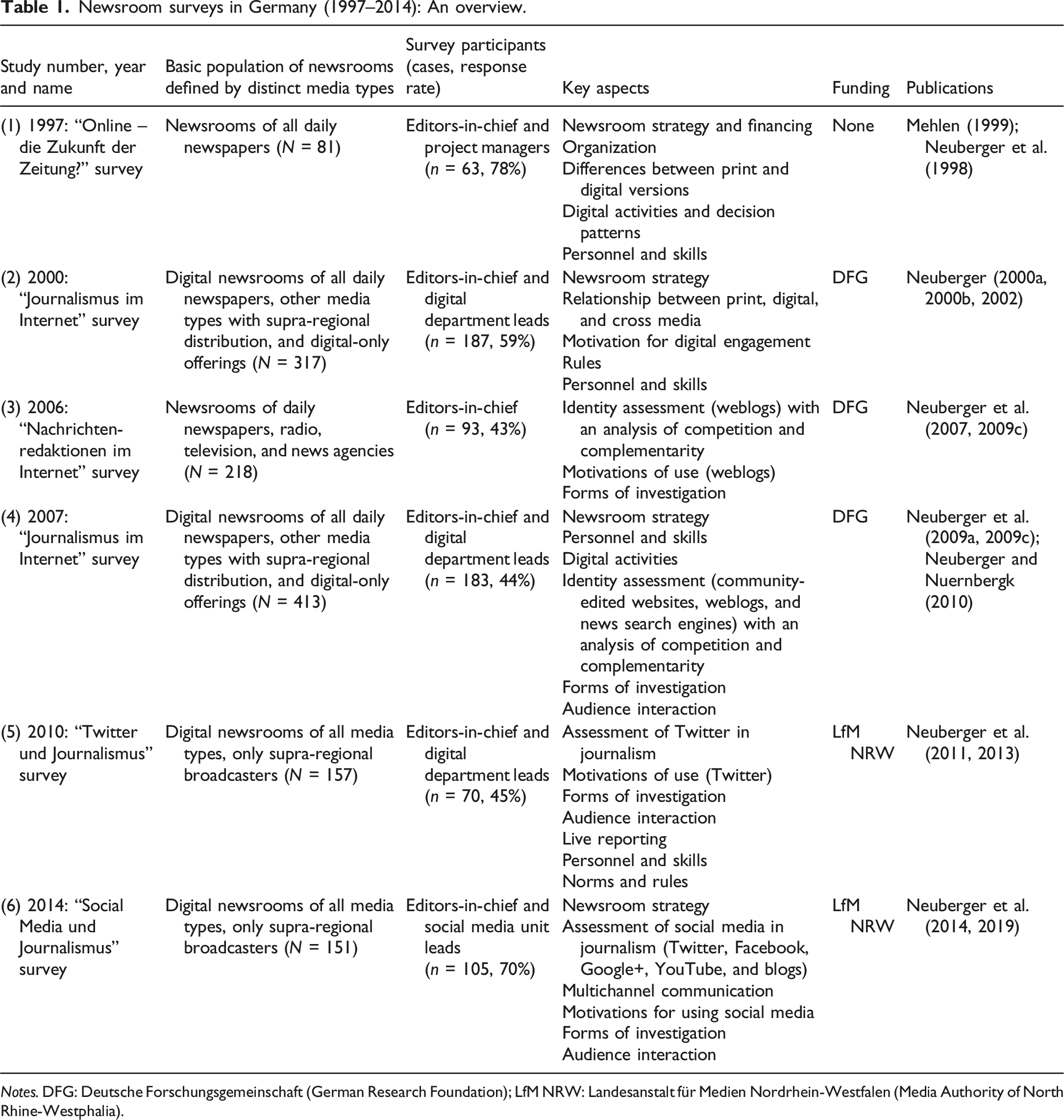
Notes. DFG: Deutsche Forschungsgemeinschaft (German Research Foundation); LfM NRW: Landesanstalt für Medien Nordrhein-Westfalen (Media Authority of North Rhine‐Westphalia).
These newsroom surveys were not planned as part of a longitudinal study. New opportunities for surveys arose repeatedly. Therefore, the time intervals between the surveys, the definitions of the surveyed populations, and the questions—which changed according to current interests—varied. Despite these surveys’ lack of direct comparability, they can still be used to describe significant trends. They also document changing research interests and, therefore, show how the scholarship and the sector interacted.
Since no complete and systematically collected directories of digital journalistic offerings were available, a large number of such offerings had to be examined in advance through quantitative content analysis to determine the overall population of newsrooms. Offerings with defining journalism characteristics were selected, specifically public and independent offerings of current general-interest news with a high updating frequency (for details, see Neuberger, 2000b; Neuberger et al., 2009b, 2011: 37–39; Neuberger et al., 2014: 35–38). Thus, the entire range of digital journalistic offerings was recorded quantitatively, and individual web pages were archived. The population was defined by the number of digital newsrooms by distinct media type. Great effort was needed to determine the population, leading to the exclusion of media types for which only a very small proportion of digital offerings included journalistic content. These media types comprised broadcasters with local and regional distributions and special-interest magazines. The surveys were directed at editors-in-chief and other editors in leading positions who had a good overview of the strategy, activities, and members of their digital newsrooms. The first two studies were conducted as paper and pencil surveys, the others as digital surveys. The response rates ranged from 43% to 78%, which are comparatively very high percentages for this type of surveys. Further methodological details can be found in Tables 1 and in the published reports.
The two research questions of the current article apply a broad focus and can, therefore, capture the different interests explored in the six studies: • RQ1: How do journalistic digital media define their roles in the relationships between (a) old media and the Internet, (b) digital media and other outlets, and (c) digital media and its audiences? • RQ2: How do digital editorial staff members define their journalistic identities with regard to (a) tasks, (b) rules, and (c) skills?
Results
The history of digital journalism is divided here into three parts: the pioneering period, the Web 2.0 period, and the rise of social media. Each period will be characterized by the major developments and, additionally, by the relationship between the sector and the scholarship.
The pioneering period of digital journalism (surveys conducted in 1997 and 2000)
In the 1990s, opposing expectations of digital journalism were articulated in the meta-discourse. Joshua Quittner (1995) announced the “birth of a completely new journalism” that would “take storytelling to a higher level of perfection” through video, audio, and hypertext, establishing a closer relationship with audiences through interactivity. Conversely, Jon Katz (1994) stated that the Internet was an inappropriate setting for journalism: “They take away what’s best about reading a paper and don’t offer what’s best about being online.” He argued that a newspaper is expected to provide order, reliability, gatekeeping, and opinion leadership, which is incompatible with the Internet’s chaotic and egalitarian culture. The hope for better journalism on the Internet did not seem to be fulfilled: “It’s a job, but is it journalism?” Christina Ianzito (1996) asked about the first generation of “content providers,” who essentially transferred print material to the Internet. In Germany, Klemens Polatschek (1996: 54; translated by the current author) called for the “death of the electronic newspaper,” arguing that the digital offerings of the press remained merely a “knock-off of their old paper relatives on digital sites.” Only “proto-journalism” with short news articles could develop on the Internet, Jochen Wegner (1998: 68) noted, because journalistic content could not be marketed directly.
Interest in the Internet was rather low in these early days. After disappointing experiences with Bildschirmtext (videotex) and Videotext (teletext), which had been introduced in Germany in the 1980s (Tonnemacher, 2003), the Internet seemed at first glance to constitute just a further development of these unsuccessful electronic text media. For this reason, it met with “restrained euphoria” (Siegle, 1998: 149; translated by the current author). Moreover, the press and broadcasting did not face an economic crisis in Germany until 2000, and accordingly, the Internet was not yet perceived as a serious threat for them (Neuberger, 1999a: 20–22). Therefore, there was little reason to see the Internet as anything more than a marginal medium. This assumption also resulted in limited research attention. A scientific book entitled The Future of Journalism (translated by the current author), published in 1994 and presenting the results of a Delphi study, did not even mention the Internet (Weischenberg et al., 1994).
In journalism research, the perspective was mostly directed from an old mass medium to the Internet. The primary focus of newsroom surveys (Mast et al., 1997; Neuberger, 2000a; Neuberger et al., 1998) and content analyses (Neuberger, 1999b; Wagner, 1998) was newspapers’ digital activities (Brössler, 1995; Höflich, 1998; Neuberger and Tonnemacher, 1999; Riefler, 1995). Interest in the digital activities of magazines (Rada, 1999; Rank, 1999) and of radio and television (Goldhammer and Zerdick, 1999; Siegle, 1998) was rather low. Early content analysis focused on the cross-media relationship between print and digital editions (Brüggemann, 2002; Neuberger, 1999b).
The old-media perspective on the Internet made sense in these pioneering days (Boczkowski, 2004). Throughout media history, practices, content, and formats have been repeatedly observed to transfer first from old media to new media before they became independent (Balbi, 2015: 232–237). Over the longer term, however, such an approach fell short. Too little attention was paid to the Internet’s novelty.
The first study, a survey of German daily newspapers in 1997 followed this route and focused on the relationship between the print medium and the Internet. The majority of publishing houses took a cautious approach to their Internet presence (RQ1a); only half of such publishers (48%) had created separate editorial boards for their digital version, while approximately one-third (37%) had their digital version produced by editorial staff members who all also worked for the print version. One in 10 dailies (11%) employed external companies to produce their digital version (Neuberger et al., 1998).
In about one-third of the cases surveyed (34%), the articles and topics were selected not by digital editorial staff but by the editors-in-chief of the printed version or the authors of the articles themselves. Thus, in many cases, digital journalists depended on the editors of the print edition. Digital team members were completely free to decide what to publish on the Internet in only 39% of cases. In 8% of cases, articles were selected completely automatically by a computer (Neuberger et al., 1998).
Opportunities for audience participation were limited. The editorial offices and authors still received a manageable number of emails per day (RQ1c). Only rarely were more than 10 responses to an article registered (Mehlen, 1999: 118–119). The relationship to other offerings on the Internet was not examined in this first study (RQ1b). Relevant competitors to journalists were not yet considered.
Concerns that technical activities could displace core journalistic tasks were widespread (RQ2a). These concerns were partially confirmed: in 63% of the editorial offices surveyed, the technical preparation of texts for the Internet and the programming of web pages were among the tasks performed by the editorial staff. The most frequent activity was the selection of texts (90%). New activities also included digital research (55%), handling and answering emails (52%), maintaining Internet servers and administrating databases or networks (15%), helping users or providing a hotline service (7%), and providing Internet access (4%) (Mehlen, 1999: 100–102). Only about half of the employees at digital editorial departments (197 of 433) fulfilled core journalistic tasks (writing, editing, selecting news, and researching). Digital papers’ news sections mainly comprised articles duplicated from the printed “parent” paper. These articles were rarely revised for digital publication. Very few external links and no graphics were added (Mehlen, 1999: 103–114; Neuberger et al., 1998).
Among the qualifications expected of digital journalists (RQ2c), good general knowledge of the Internet (very important: 54%) and knowledge of scripting and programming languages (34%) were of great importance in many editorial offices. In addition to these Internet-specific and technical qualifications, however, a sound journalistic education (31%) and at least 1 year of professional experience (36%) were often expected (Mehlen, 1999: 102–103). New rules on the Internet were not asked about in the 1997 survey (RQ2b).
The process of detaching from parent media continued in 2000 (RQ1a), when the second survey was conducted. The digital editorial teams of traditional mass media predominantly pursued cooperation strategies. They targeted dual users of both media or “test users” (who were to be won over to the digital version from the printed version). This approach was expressed in numerous cross-connections between old media and the Internet (Neuberger, 2000a: 316). In the case of the press and broadcasting, about half of the articles still originated from the parent medium (Neuberger, 2000a: 313). The Internet was still seen primarily as an extension of mass media.
Nevertheless, digital journalism gradually took on an independent form. In particular, the digital editorial teams of digital-only providers, broadcasters, and general-interest magazines took advantage of the design possibilities that the Internet afforded to journalism (Neuberger, 2000a: 315). Competition with other Internet offerings, such as digital-only providers and classified markets, was often seen as a threat (RQ1b), especially for daily newspapers (Neuberger, 2000a: 312). Concerning audience participation, processing and answering emails still played a significantly greater role than support and moderating forums and chats (Neuberger, 2000a: 317) (RQ1c).
Daily newspapers’ poor performance (few employees, a high proportion of non-journalistic activities, low in-house production quotas, and the sparse use of digital design possibilities) compared to the other media surveyed must be considered against the background that daily newspapers were quantitatively very strongly represented with (local) information offerings on the Internet by 2000 (Neuberger, 2000b: 103). Many smaller newspapers were already represented on the Internet even if they mainly pursued a “foot in the door” policy.
What was digital journalism’s identity in terms of tasks, rules, and skills? The low number of staff employed at daily newspapers in the digital sector was reflected in journalists’ range of activities (RQ2a). Daily newspaper staff members found comparatively little time for writing and editing their own articles or for research (Neuberger, 2002: 108–109). They mainly selected texts. Moreover, they participated in non-journalistic technical and commercial tasks relatively often—for example, technical editing of online texts, programming digital offerings, or marketing.
On the other hand, journalists from digital-only providers wrote and researched most frequently. This result is understandable since these journalists were unable to recycle content from parent media. Generally, journalists were also noticeably responsible for non-journalistic offerings. For example, they were engaged in designing advertising content, e-commerce, and customer service (Neuberger, 2000a: 317).
Whether digital journalism can be distinguished from other content providers on the Internet depends on whether journalistic professional norms are also acknowledged online (RQ2b). The respondents were asked to state whether, according to their observations, digital journalists recognized the existence of certain rules. Digital journalists predominantly accepted all such rules. However, the rules that were recognized the least were revealing: the respondents expressed disagreement over whether journalists should be allowed to design websites on clients’ behalf. This result corresponds with the finding that a proportion (albeit a small one) of digital journalists were employed for this purpose. Also, relatively little agreement was expressed about the rule that consumer recommendations from the editorial team should not be directly linked to matching sales offers. Designing websites for customers and e-commerce was an important revenue stream. On the other hand, fact-checking had to be adapted to the Internet’s special conditions and extended to chats, forums, archives, and external links, which was hardly disputed. Overall, widespread agreement on journalistic rules and best-practice cases—that is, how to define quality on the Internet—was expressed (Neuberger, 2000a: 315–318).
In 2000, digital journalists were relatively inexperienced, and only one-third had completed traineeships. The proportion of newcomers and career-changers among this group was strikingly high (Neuberger, 2002: 105–107). Concerning qualification requirements (RQ2c), digital editorial managers focused on a sound journalistic education and professional experience. They had not yet succeeded in attracting the desired staff. Technical qualifications were requested relatively frequently only by daily newspapers and broadcasters. A willingness to engage in dialog with users was expected by all types of providers (Neuberger, 2002: 109–110).
Blogs, wikis and search engines: The web 2.0 period (surveys conducted in 2006 and 2007)
The third and fourth survey were conducted in 2006 and 2007, after the burst of the dot-com bubble (Scott, 2005: 96) and during Web 2.0, when early participatory formats such as blogs and wikis became increasingly important (Bruns, 2005, 2008) as the activities of the “people formerly known as the audience” (Rosen, 2006). Additionally, the search engines Google and Google News gained the dominant positions that they still hold today. Losses in the advertising and audience markets increased the economic pressure on media companies, especially newspapers. This pressure resulted in a defensive attitude characterized by fear and a lack of creativity (Boczkowski, 2004; Nguyen, 2008). The use of the Internet in various stages of the editorial process came into journalism studies’ focus, and these stages included research (Machill and Beiler, 2009) and audience interaction (Singer et al., 2011).
Accordingly, the 2006 and 2007 surveys focused more on the relationships between digital newsrooms and other providers than the earlier surveys had—especially concerning blogs, Wikipedia, Google, and Google News. Internet-only offerings’ importance increased significantly during this period (Deuze et al., 2007): their share of the total digital journalistic offerings reached 23% in 2007, almost one-quarter (Neuberger et al., 2009a: 176; Neuberger et al., 2009b: 222), versus just 15% in 2000 (Neuberger, 2000a: 311).
The third survey of newsrooms (2006) at daily newspapers, radio stations, television stations, and news agencies (Neuberger et al., 2007, 2009c) focused primarily on the use of new sources (blogs and Wikipedia) and search aids (search engines and news search engines) in research and on assessing whether blogs and search engines posed a threat to journalism (RQ1b). Additionally, questions were asked about the rules for dealing with search engines (RQ2b). This survey’s questionnaire was designed in parallel with the fourth survey of digital editorial offices in 2007. Therefore, the two surveys’ results are not presented separately.
In the survey of digital editorial teams (2007), the continued, strong dependence on print content was noticeable among daily newspapers (RQ1a). About half of the digital providers surveyed (52%) still primarily engaged in news recycling on the Internet—that is, they adopted 50% or more of their online articles from their parent media. Another 24% of newspaper websites sourced articles predominantly from news agency reports. Articles were written exclusively for the Internet only rarely (3%). Conversely, radio stations’, general-interest magazines’, and weeklies’ online editorial teams had already shifted away from their parent media relatively far (Neuberger et al., 2009a: 178).
An examination of the motives for digital engagement revealed that daily newspapers adopted a relatively defensive and cautious stance overall. They sought to protect their parent media through avoiding self-cannibalization and start-up losses on the Internet. The surveyed general-interest magazines and weeklies, on the other hand, were more proactive, seeking to offer services with content independent of their parent media (Neuberger et al., 2009a: 178–179).
The empirical findings suggest that professional journalism and blogs, user platforms, and (news) search engines (RQ1b) shared multiple complementary relationships, rather than a competitive relationship (Neuberger and Nuernbergk, 2010: 324–329; Neuberger et al., 2009a: 180–186). They had become especially important for journalistic research. Furthermore, follow-up communication with mass media audiences took place through participatory offerings. Journalistic and participatory offerings also influenced each other through mutual thematization and commentary.
User participation on journalistic websites was still in its early stages (RQ1c). The possibility for users to comment on articles was available for 40% of the digital media. Many other participation options, such as supporting editorial staff (12%) and rating articles on a scale (6%), were implemented only rarely (Neuberger and Nuernbergk, 2010: 329–330; Neuberger et al., 2009a: 182-183).
The third and the fourth survey focused on research as an editorial task (RQ2a). Wikipedia—unlike blogs—was already used as a research source by almost all the editorial departments surveyed. Only 4% of the newsrooms and 1% of the Internet newsrooms denied using that encyclopedia. Wikipedia served primarily as a reference source for background knowledge. More than half of the Internet newsrooms surveyed (57%) also used Wikipedia “frequently” to cross-check information, implying a basic trust in Wikipedia’s reliability.
Nearly all the newsroom heads of traditional media (98%) and Internet newsrooms (99%) surveyed cited Google as the search engine they used most often. This result indicated a high degree of dependence on a single provider. At the same time, 88% of newsroom editors and 89% of Internet newsroom respondents said Google was the search engine that delivered the best results. In newsrooms, the question of how to properly deal with search engines was addressed mainly informally (84%). Only one-third (33%) of the editorial offices surveyed had already addressed this question at an editorial conference or through in-house training (37%). Google News was most frequently used as a news search engine in both traditional media (85%) and Internet (91%) newsrooms. It was also used to track changes in an agenda during the course of the day, as well as competitors’ publications (Neuberger et al., 2009c: 330–333).
The establishment of new rules (RQ2b) regarding research was also examined in more detail in these two surveys (Neuberger et al., 2009a, 2009c). The heads of traditional media and Internet newsrooms emphasized two rules for dealing with search engines: Internet research should be supplemented by traditional research channels, and only sources that were known and considered credible should be used. The parallel use of search engines, on the other hand, was only common among a minority of editorial teams (Neuberger et al., 2009a: 185).
Among qualification requirements (RQ2c), general education and a sound journalistic education were foregrounded. Internet-specific technology and design skills, on the other hand, were at the bottom of this list. More important was the ability to implement new technical possibilities journalistically; target-group-oriented information preparation, dialog skills, and the ability to convey information in multimedia forms were key requirements. Internet-only providers expected specialized knowledge on topics relatively often. In contrast, sound journalistic training was less important for them (Neuberger et al., 2009a: 178).
The rise of social media (surveys conducted in 2010 and 2014)
The 2010 and 2014 surveys focused on the journalistic opportunities and risks of social media platforms. The rise of social media confronted newsrooms with the challenge of developing multi-channel strategies and diverse integrations of platforms (Humayun and Ferrucci, 2022; Neuberger et al., 2019). New forms of interaction with audiences fostered the “audience turn” in journalism research (Costera Meijer, 2020). The question of how to demarcate professional journalism from other providers and balance the tension between professional control and open participation in “collaborative journalism” (Rusbridger, 2009) became more important (Singer, 2015). Therefore, the focus of the fifth and sixth newsroom survey was narrower than the focus of the surveys in the previous periods and primarily directed at digital journalism’s relationship with platforms (RQ1b).
The 2010 survey focused on the journalistic uses of the micro-blogging service Twitter (Neuberger et al., 2011, 2013). At this time, Facebook and YouTube had already established themselves as dominant platforms. Twitter was an interesting newcomer that merited its own study. However, Twitter never achieved a high overall reach in Germany (Newman et al., 2023: 77) beyond politicians and journalists (Bruns and Nuernbergk, 2019; Nuernbergk and Conrad, 2016).
The results of the fifth survey show that almost all editorial departments had at least one Twitter account (RQ1b) in 2010, with an average of five accounts (Neuberger et al., 2011: 44–45, 64). Most of the studied providers also interacted with Twitter users (RQ1c): 66% of editorial heads stated that their editorial departments interacted with users via Twitter (Neuberger et al., 2011: 50–53). This outreach was intended to attract new target groups or better retain users.
The editorial offices surveyed used Twitter (RQ2a) to draw users’ attention to their own website (97%) and conduct research (94%). Two-thirds (66%) of newsrooms used Twitter to interact with their users. Additionally, nearly two-thirds (63%) used Twitter for the live coverage of events (Neuberger et al., 2011: 84). Newsrooms had already established consistent rules for reporting, user interaction, and research (RQ2b). The rule that “careful review is more important than speed” had been applied in 91% of the surveyed editorial offices. Additionally, the respectful handling of user queries was mandatory (100%). The rule that “research in Twitter should always be supplemented by other research channels” had also been applied to almost all the surveyed editorial offices (97%) (Neuberger et al., 2011: 97–98). Thus, although rules that could be learned were already in place, in 60% of the cases, the editorial managers considered their employees’ competence in dealing with the social web to greatly need improvement (RQ2c). “Learning by doing” and informal exchanges with colleagues were the most common ways to acquire competence in this area (Neuberger et al., 2011: 66–70).
The 2014 survey compared Twitter, Facebook, Google+, YouTube, and blogs (Neuberger et al., 2014, 2019). Virtually all Internet newsrooms had Facebook and Twitter accounts. Blogs and YouTube were not used by about one-quarter of the surveyed editorial offices (RQ1b) (Neuberger et al., 2014: 12). Almost all the editorial offices allowed comments on their digital editorial articles. Slightly more than half provided the option to contact authors by email. Only about one-quarter of the editorial offices (RQ1c) offered forums where topics could be discussed over longer periods (Neuberger et al., 2014: 48–49).
The five different social media (Twitter, Facebook, Google+, YouTube, blogs) were used in a variety of ways by the surveyed editorial teams (RQ2a, b). The sixth survey identified these uses and consent to rules in a very differentiated manner (Neuberger et al., 2014: 48–67). These uses and rules are presented in the following subsections.
Audience participation
Facebook was the most frequently used tool for almost all forms of participation. Twitter was the second most important, surpassing Facebook only in real-time interactions with audiences. Users rarely participated in journalistic productions—for example, via research or their own contributions. The quality of audience participation was mostly to be ensured by excluding users who broke rules and by referring to guidelines. In almost all editorial offices, certain rules applied to audience participation (respectful treatment and rapid responses to user inquiries without exception).
Research
Facebook was used the most often for reactions to one’s own reporting, topic ideas, or eyewitnesses who could be interviewed or quoted. Twitter, on the other hand, was used more often for the continuous monitoring of prominent sources, cross-checking information, or locating experts who could be interviewed or quoted. Almost all the editorial departments considered the careful verification of visual materials’ authenticity and further research channels’ involvement essential.
Publishing
Breaking news was disseminated via Twitter and somewhat less frequently via Facebook. Live reporting also took place primarily via Twitter and secondarily via Facebook. Blogs in particular were used to publish personal views. YouTube was, naturally, used for the publication of providers’ own videos. The rule that posts must be carefully reviewed was prioritized over speed almost everywhere, except among the surveyed Internet-only providers, for which this rule applied in only half of the cases.
Monitoring audiences
About four-fifths of the surveyed editorial offices collected data on the frequency of use and screened freely-form comments by their users. Only about half of the editorial offices surveyed conducted their own user surveys.
Improving staff members’ social media competence was evident (RQ2c) (Neuberger et al., 2014: 77–79): in 2010, 60% of survey participants considered their competence to be “in need of strong improvement.” This proportion was significantly lower in 2014, at 28%. This also applied specifically to daily newspapers (68% of which deemed their staff members to be “in need of strong improvement” in 2010 vs 36% in 2014). Social media competence was still acquired the most frequently through “learning by doing” and informal exchanges with experienced colleagues. Additionally, however, formalized approaches to skill acquisition had become more important.
Discussion
What development trajectories can be traced with the help of the results of the six newsroom surveys?
RQ1a: The relationship between old media and the Internet
The reviewed research from the pioneering period (the first and second survey) focused on the relationship between the old mass media and the Internet. Digital activities had only gradually gained independence from the traditional mass media in terms of their content and organization. The Internet was seen primarily as an extension of the mass media in both practice and research. Daily newspapers relied on print-medium content particularly heavily and tried to strengthen that old medium via the Internet. This very defensive attitude was evident until the third survey was conducted in 2007. Interest in the relationship between old media and the Internet later waned.
RQ1b: The relationship between digital media and other outlets
Other providers came into focus with Web 2.0 (as evidenced by the third and fourth studies). These surveys examined how new sources (blogs and Wikipedia) and (news) search engines (including news search engines) were used journalistically and whether they could represent sources of competition. A complementary relationship was overwhelmingly evident, even in 2010 and 2014 (per the fifth and sixth survey), when social media were in focus. Journalists used these platforms in a wide variety of ways, creating an asymmetrical relationship with the platforms. Research responded with the concept of network journalism (Heinrich, 2011) and the analysis of platform power (Nielsen and Ganter, 2022).
RQ1c: The relationship between digital media and their audiences
In the pioneering period, audience participation comprised only emails to editors or forums. Later, comments on articles followed. However, only through social media a wide variety of participation forms emerged. The research addressed these new possibilities for participation with an “audience turn” (Costera Meijer, 2020).
RQ2a: Tasks
Initially, concern that technical tasks would displace journalistic tasks was expressed. The surveys in 1997 and 2000 partially confirmed this assumption (though a later survey in 2002 did not; Quandt et al., 2006: 177–178). Additionally, the pioneers of digital journalism had to perform non-journalistic tasks. Journalistic tasks were analyzed in the later surveys (2010 and 2014) only with reference to social media, which were used with significant nuance for different editorial purposes.
RQ2b: Rules
Comparing the surveys over time enables an observation of how rules have emerged for different tasks. Initially (the 1997 and 2000 surveys), disagreement regarding whether commercial tasks should also be adopted was expressed. Concerning research (the 2006 and 2007 surveys) and social media use (the 2010 and 2014 surveys), a great deal of agreement was established later on. This points to an increasing professional consent on how to execute tasks in digital journalism.
RQ2c: Skills
Concerning qualification requirements, general education and a sound journalistic education were foregrounded (in the 1997 and 2000 surveys). Technical skills remained secondary. In 2010, the surveyed editorial managers saw considerable competence deficits in dealing with social media. Learning by doing was widespread. The lack of qualified personnel could also have contributed to digital journalism’s delayed development.
Conclusions
The six newsroom surveys presented here have provided an overview of digital journalism’s development in Germany over 17 years. During the first period (surveys conducted in 1997 and 2000), the Internet was used in journalism for the distribution of material produced for the old media, and also the scholarship extended the mass media paradigm to the Internet. However, some voices in the meta-discourse already pointed beyond the mere duplication of old media on the Internet. The second period (surveys conducted in 2006 and 2007) was characterized by clarifying the relationships between journalism and newly emerged outlets. The studies from this period focused on how participative formats and search engines could be used for journalistic purposes without compromising quality. These outlets were not then regarded as much of a threat. This attitude did not change during the third period (surveys conducted in 2010 and 2014). During this stage, the focus was on how editorial staff utilized the ever-increasing number of social media. In other words, it concerned learning about social media’s possible uses and adopting rules. Strikingly, journalism’s dependence on platforms and the asymmetric power distribution between journalism and platforms were not viewed as critically then as they are today, 10 years later (Nielsen and Ganter, 2022).
The studies from the second and third period focused on the relationship between journalism and its audiences. This research interest confirmed the evolution of audience-related concepts in journalism studies (Loosen et al., 2022: 48–52). Datafication and algorithmization, as the latest developments in journalism, did not yet play significant roles in these periods. Therefore, the presented studies’ time frame is an obvious limitation. The six surveys’ different research interests reveal that journalism research primarily followed changing demands in journalistic practice. Exogenous factors (the “sector”) had a greater impact than endogenous factors (the “scholarship”) on research interests. This finding may also have resulted from a deficit in theory development (Neuberger, 2018). Digitalization requires a reorientation of journalism research and communication science as a whole (Waisbord, 2019b: 75–91).
The presented newsroom surveys were conducted in only one country. International comparative studies are needed to make national paths of digitalization of media systems (Mattoni and Ceccobelli, 2018) and the journalistic adaptation of the Internet (e.g., Singer et al., 2011) obvious. Historical studies show not only variations but also general trends in the professionalization of journalism in Europe (Kunelius et al., 2020; Requate, 1995). This evidence raises the question how digital journalistic practices’ transnationally diffuse (Broersma, 2020; Kunert et al., 2022) through mutual observation and imitation (Oggolder et al., 2020: 341).
Footnotes
Declaration of conflicting interests
The author(s) declared no potential conflicts of interest with respect to the research, authorship, and/or publication of this article.
Funding
The author(s) received no financial support for the research, authorship, and/or publication of this article.
