




Abstract
This article presents the findings of a corpus linguistic analysis of the hashtags #mansplaining, #manspreading, and #manterruption, three lexical blends which have recently found widespread use across a variety of online media platforms. Focusing on the social media and microblogging site Twitter, we analyze a corpus of over 20,000 tweets containing these hashtags to examine how discourses of gender politics and gender relations are represented on the site. More specifically, our analysis suggests that users include these hashtags in tweets to index their individual evaluations of, and assumptions about, “proper” gendered behavior. Consequently, their metadiscursive references to the respective phenomena reflect their beliefs of what constitutes appropriate (verbal) behavior and the extent to which gender is appropriated as a variable dictating this behavior. As such, this article adds to our knowledge of the ways in which gendered social practices become sites of contestation and how contemporary gender politics play out in social media sites.
Introduction
Social media now play a central role in providing a platform for people to discuss a range of contemporary social issues, including terror attacks (Cheong & Lee, 2011; Crijns, Hudders, & Cauberghe, 2017), institutional sexism (Fox, Cruz, & Lee, 2015), right-wing extremism (Hartung, Klinger, Schmidtke, & Vogel, 2017), domestic violence (Wong & Bostwick, 2017), online misogyny (Banet-Weiser & Miltner, 2016), and more. In this vein, gender politics has come to the fore in recent years, particularly following the revelation of sexual abuse in journalism, politics, and the movie industry (Almukhtar, Gold, & Buchanan, 2018), high-profile stories of sexual harassment like “Gamergate” (Massanari, 2017), Donald Trump’s infamous “grab them by the pussy” exposé (Maas, McCauley, Bonomi, & Leija, 2018), and many more examples of male privilege, toxic masculinity, and sexual violence against women. Such stories have formed the backdrop of online discussions about gender relations and power inequalities, leading to the emergence of viral hashtags like #metoo, which was used to highlight issues of sexual abuse, assault, and harassment faced by women.
In this article, we study the hashtags #mansplaining, #manspreading, and #manterruption (man + explaining, spreading, and interruption, respectively), three innovative formations which have been co-opted as a shorthand method of highlighting men’s (socially problematic) behavior. These terms have been covered in multiple news stories, op-ed pieces, blog posts, and tweets, focusing on how rude, unthoughtful, patronizing, condescending, and sexist men can be (Ahluwalia, 2017; Price, 2017; Van Ness, 2017; but see Barker, 2018 for alternative perspectives on the politics underlying these terms). Such discussions, however, tend to be limited in that they focus on only a handful of examples and do not capture the variety of uses to which such hashtags are put.
Using a corpus linguistic analysis, we discuss the wider communicative functions of these three hashtags on the social media site Twitter, drawing on a corpus of 20,803 English tweets collected over a 6-month period (November 2016 to April 2017). Our results show how these hashtags are part of the overt social policing of gender norms in online spaces and argue that the behaviors associated with these hashtags become sites of contestation about permitted and proscribed gendered social practices. In doing so, we contribute to ongoing discussions regarding the utility of corpus linguistic methods in the analysis of online talk and help shed light on the ways in which gender politics are embedded into the everyday fabric of Twitter.
Linguistic Creativity and Hashtags in Online Talk
Over the past 20 years, online forums and social media sites have become goldmines for linguistic analysis (Page, 2017, p. 315), providing researchers access to significant amounts of naturally occurring texts. Among these, Twitter has attracted increasing attention from linguists, primarily due to its status as one of the world’s largest social networking and microblogging sites. Beyond the sheer volume of data produced on a daily basis, though, Twitter is a productive locus of linguistic creativity, originality, and innovation, where communicative practices are pushed beyond their usual envelope as users “play” with language (North, 2007). Through the use of memes (Blommaert & Varis, 2017), Graphic Interchange Formats (GIFs; Tolins & Samermit, 2016), emojis (Pavalanathan & Eisenstein, 2016), orthographic variation (Ilbury, 2016), and more, users can add layers of interactional meaning and intent which go beyond the basic denotational content of their talk, giving rise to new ways of communicating affect, stance, meaning, and other sociolinguistic aspects of interaction (cf. Blommaert, 2015, p. 19).
Of particular interest in this regard are hashtags, a textual practice initially introduced on Twitter to help users tag and find relevant topics and shared interests, structured as the combination of a hash symbol (#) with a set word or phrase (e.g., #motivation or #fridayfeeling) that may be appended to or integrated into tweets. Hashtags are a semiotic technology, as they can be regarded as metadata (i.e., data about data) with specific affordances, while they are also instances of language use with particular functions (Zappavigna, 2018: Chapter 2). It is this duality that distinguishes hashtags from untagged stretches of text in tweets. According to Zappavigna (2015), hashtags have experiential, interpersonal, and textual fuctions (cf. Halliday, 1978), and they may thus mark the topic of a tweet, reflect the interpersonal relationships enacted, or organize a tweet at the structural level. The hashtags #mansplaining, #manspreading, and #manterruption primarily signal the topic of the tweets they tag, but they equally link them to other tweets expressing the same stance toward this topic, which may be expressed through the use of additional hashtags or in the untagged text (Zappavigna & Martin, 2018; see also Evans, 2016).
In terms of the textual function of hashtags, the # symbol indicates that what follows is metadata. It signals a distinction between “two orders of meaning” (Zappavigna, 2018, p. 30), between tagged and untagged language use in tweets and thus highlights the special textual status of hashtags as metadiscursive material. Zappavigna (2018, p. 16) refers to them as “multimodal discourse markers” that function as “both inward and outward facing metadiscourse”. Not only do hashtags provide information about a tweet, they also embed these tweets in wider discussions on the same topic. This process is facilitated by the hyperlinked nature of Twitter hashtags, leading to other tweets with the same tags. They therefore do not conform to traditional definitions of metadiscourse, as they “make meanings not only about themselves . . . but also about the potential co-presence of other texts in the social stream” (Zappavigna, 2018, p. 36). As such, hashtags facilitate communing (ambient) affiliation between users who may use the same tag and thus bond around a specific value they share. At the same time, they may position this value in relation to other potential values (Zappavigna, 2011; Zappavigna & Martin, 2018). In the case of #mansplaining, #manspreading, and #manterruption, this may involve taking a supportive or non-supportive stance toward the behaviors discussed, as the examples below will show.
Previous studies on hashtags have, for instance, focused on their role in promoting the visibility of tweets and consequently the social status of their authors, resulting in the strategic construction of micro-celebrity (Page, 2012). In a different approach, Scott (2015) argues that hashtags highlight additional information that facilitates a reader’s understanding of a tweet, suggesting that this makes the retrieval of intended meaning easier and more efficient. Hashtags have been discussed with regard to their function as narrative (Giaxoglou, 2018) and pragmatic devices (Matley, 2018a, 2018b), as well as their spread from online to offline media and even spoken language (Scott, 2018; Zappavigna, 2018).
Less investigated, however, is how hashtags relate to discussions of sexist behavior and marginalizing social practices (although see Fox et al., 2015; Smith, 2018 for two recent exceptions). This gap in the literature is surprising, given sociolinguists’ general interest in the intersection of gender and sexism, interactional dominance, power, and control and the ways in which language encodes male privilege, gender inequality, and sexist ideologies (cf. Edelsky, 1981; Mills, 2003; Spender, 1980; Zimmerman & West, 1975). The concepts of mansplaining, manspreading, and manterruption fall within the realm of describing contemporary substantiations of problematic and sexist behavior. But while a number of scholars have examined these concepts from critical discourse and feminist activist perspectives, to date there have been no large-scale corpus linguistic analyses which examine broader patterns of use. For example, Bridges (2017) analyses only 200 Twitter and Facebook posts containing the term mansplaining, while Jane (2017) adopts a looser framework of “Internet historiography” in her examination of manspreading, relying on the Google Alerts service to track use of this neologism across news sites, blogs, and other sources. These studies certainly provide a number of insights into the nature of these terms in different (social) media outlets, but they are limited by a lack of coverage, unsystematic data collection methods, and partial considerations of context. Furthermore, the focus on individual terms means that it is difficult to see patterns of commonality and difference. In the next section of the article, then, we discuss in more detail the three blends which form the focus of our analysis, before introducing our data.
Mansplaining, Manterrupting, and Manspreading
The origins of mansplaining can be traced back to 2008 in a blog post titled “Men explain things to me” (Solnit, 2008/2012), which describes Solnit’s experience during a party where the male host attempted to explain Solnit’s book River of Shadows, about Eadweard Muybridge and the Western technological revolution, to her. Not realizing at the time that Solnit was the author, the host assumed that his partial engagement with the subject matter, gleaned from the New York Times Book Review, meant that he knew more than Solnit about the topic of the book. Solnit’s post swiftly led to the coining of the term mansplaining to describe an explanation, usually offered by a man, which is patronizing, condescending, or ignores women’s experience and knowledge (see Rothman, 2012 for a more detailed history of mansplaining). As such, mansplaining has been viewed as a substantiation of institutionalized sexism which contributes to the silencing and marginalization of women’s voices (Kidd, 2017, p. 2). The BBC even published an infographic to help men avoid committing mansplaining (Goodwin, 2018), underscoring the level of social penetration that this term has garnered.
Mansplaining inspired a host of similar neologisms which exploited the same structure of man* blends, with manterruption the next to gain noteriety. Although language and gender research has argued that men tend to interrupt more frequently than women, especially in mixed-sex conversation (cf. Zimmerman & West, 1975), the gendered basis of this finding has depended on interactional context, group composition, and more (see, for example, Anderson & Leaper, 1998). Nevertheless, the idea that men are conversationally dominant is widespread, and the introduction of manterruption thus gave interruptions a more explicitly gendered character than was previously the case. Like mansplaining, manterruption has since featured in numerous editorial pieces and blog posts, many of which criticize the ways in which men use interruptions to dominate conversations and close down contributions from women (cf. Weiss, 2017; Weisul, 2017).
Unlike mansplaining and manterruption, which highlight behavior at the level of conversational interaction, manspreading instead centers on the control and occupation of public spaces, including trains, subway trains, and buses, where men take up more seating space due to sitting with their legs spread. Manspreading has since come to be treated as a public order issue, with a number of cities banning or proscribing the behavior, including New York, Madrid, Los Angeles, and Tokyo (cf. Fitzsimmons, 2014; Jones, 2017). The term relates to the physical embodiment of male privilege and domination of public space and plays into gendered cultural tropes about power versus subservience through control of space (or lack thereof). It also speaks more generally to the assumption that men unthinkingly and unreflectively make their way through their daily lives and fail to consider the impact their behaviors have on others.
Despite the fact that these terms could be considered part of an overarching strategy to highlight men’s problematic behavior, there is debate about whether the terms themselves are sexist, since they essentialise men and assume that the practices are rooted in gender (see, for example, a related discussion thread on Reddit). 1 Thus, the sematics inherent to the blends entails that mansplaining, manspreading, and manterruption are taken to be things only men do, even though the underlying behavior (explaining, interrupting, or spreading) can be carried out by anyone, including women. Ultimately, then, these terms have contested meanings which play out in both large and small ways across the social media landscape.
Methodology, Data, and Corpus Construction
Our analysis of tweets is corpus-assisted, where we investigate naturally occurring language use in the form of an electronic text collection or corpus (see e.g., Baker, 2006). For this study, a Twitter corpus was created comprising a total of 20,803 English tweets, all of which include at least one of the hashtags #mansplaining, #manspreading, and #manterruption. The corpus was compiled by downloading relevant tweets over a period of 6 months, from November 2016 to April 2017, using TAGS, a cloud-based tool that connects to the Twitter API and fetches up to 3,000 results per hour for the search terms specified (https://tags.hawksey.info/; see e.g., Gaffney & Puschmann, 2013). 2 Usernames, URLs, pictures, and videos were not included in the corpus. The respective forms were chosen as the basis of the current analysis as they were most commonly used online at the time of data collection, according to a search of WebCorpLive (www.webcorp.org.uk), compared to related forms, such as mansplain/s or manterrupt/s. In addition, it was decided to study tagged uses of these forms only, rather than all uses of the respective lexis in tweets, as hashtags render the topics discussed more easily searchable and traceable due to their hyperlinked nature, and they thus have a wider reach and show different functions compared to non-tagged uses (see section “Linguistic creativity and hashtags in online talk”).
It is, at this point, worthwhile discussing the role hashtags play in audience selection. For example, Marwick and boyd (2011) argue that Twitter users are aware of their (real and imagined) audiences and that they correspondingly design their talk and self-presentation in response to these audiences. Pavalanathan and Eisenstein (2015, p. 205) show that tweets including hashtags are directed at wider audiences, whereas tweets without hashtags contain more non-standard variants and are thus aimed at the more local audience of users’ followers. The fact that this study focuses on tagged uses of #mansplaining, #manspreading, and #manterruption entails that only a snapshot of discussions is being studied, which may have an effect on claims about broader discursive trends in terms of gender politics. That said, we would argue that these hashtags represent a level of social awareness about gendered practices that goes beyond local uses and that they should yield representative insights given their wider reach.
In terms of ethics, the “gold standards” of anonymity proved to be impossible. As the data are in an online public space and a variety of online search options exist, including Twitter’s own internal search engine, guaranteeing anonymity is impossible, as has been discussed by a range of other social media researchers (e.g., D’Arcy & Young, 2012; Rüdiger & Dayter, 2017, p.257). There is also an inherent tension between anonymity and Twitter’s guidelines, which recommend that tweets should not be altered when reproduced (Page, 2017, p. 318). 3 Nevertheless, steps were taken to adhere to ethical guidelines as much as possible, for instance, by excluding usernames.
Table 1 shows the distribution of tweets for each of the three hashtags; as it shows, the hashtag #mansplaining is used most frequently in our corpus, resulting in more than four times as many tweets as #manspreading, and the hashtag #manterruption is used least frequently.
Distribution of Original Tweets and Retweets.

Table 1 also reveals that the hashtags appear with considerable frequencies in retweets. Thus, for #manterruption, the number of retweets including this hashtag amounts to 36% of the overall number of tweets. In the case of #manspreading, retweets make up about one-third of the total and it is only slightly more for #mansplaining with 37%. This shows that for the topics discussed, which are indexed in the tweets through the use of the respective hashtags, retweeting forms an integral part of their discursive spread. Retweeting facilitates raising awareness of the phenomena of mansplaining, manspreading, and manterruption by distributing messages to a larger audience and thereby stimulating further discussion about these concerns.
In the analysis of our data, we focus on original tweets, excluding retweets, so as to avoid skewed results which could be caused by the frequent repetition of the same linguistic constructions in retweets. The following analysis is therefore based on a total of 13,314 original tweets, comprising 166,495 words.
Analysis
In order to gain insights into the context in which each of the three hashtags is used in our corpus of English tweets, we conducted a keyword analysis. In corpus linguistics, keywords are defined as “items of unusual frequency [in a target corpus] in comparison with a reference corpus of some suitable kind” (Scott & Tribble, 2006, p. 55). Consequently, keyness refers to a textual quality of statistically based “outstandingness” that goes beyond the general use of the word to denote social, cultural, or political significance.
In this analysis, we studied words that are used significantly more frequently in each of the three subcorpora for #manterruption (1,585 words), #manspreading (30,835 words), and #mansplaining (134,075 words). We used each of these subcorpora as the target corpus in turn and compared it against the respective reference corpus consisting of the other two subcorpora combined. The results of our keyword analysis are given in Table 2, which lists the keywords for each of the three subcorpora (basic English stopwords, like articles and pronouns, were excluded). 4
Keywords in the #manterruption, #manspreading, and #mansplaining Subcorpora.

Note. NYC: New York City; MTA: Metropolitan transport authority.
Table 2 highlights some of the main features of each subcorpus. Unsurprisingly, the hashtag itself is most “key,” as it appears in each tweet included in the respective subcorpus and constitutes its main topical focus. In addition, the three keyword lists comprise examples that would be expected: manterruption is associated with the verb interrupt/ed and it pertains to (discontinuous ways of) communicating. Manspreading, on the contrary, involves taking up space or seat/s, for instance, on a bus, train or the tube, by spread/ing one’s legs. Mansplaining, finally, entails male speakers explain/ing situations or concepts to women by tell/ing them about what they know or how to do something, often in a condescending manner.
At the same time, Table 2 includes a number of keywords that relate to the extralinguistic context and specific situations concerning the phenomena of manterruption, manspreading, or mansplaining. Thus, in the keyword list for the #manterruption subcorpus, we come across words such as app, artists, BETC, detects, and São Paulo, which all appear in examples (1) to (3).
This Agency Dropped an App on International Women’s Day That Detects When Men Interrupt Women #manterruption
EXHIBIT: BETC São Paulo turns to female artists and technology to help fight #manterruption.
Donald Trump–inspired app counts how often men interrupt women via #manterruption #YesAllWomen
These examples refer to a project run by the advertising agency BETC, based in São Paulo, which developed the Woman Interrupted App to help identify instances of manterruption. As example (1) states, the app was revealed on International Women’s Day (8 March 2017), which appears as the hashtag #internationalwomensday in our data. In addition to the app, a video was released to explain both the background to and the functionality of the app and artists were involved in an exhibition of “Portraits of Silence,” reflecting the underlying issue of gender inequality, see example (2) Example (3) illustrates that timely examples of manterruption, such as by the then newly elected President of the United States of America, Donald Trump, were also linked to BETC’s efforts of raising awareness about and fighting manterruption.
Likewise, the top 20 keywords for the #manspreading subcorpus in Table 2 include the forms nyc, mta, and subway, referring to the Metropolitan Transport Authority (MTA) in New York City that launched the Courtesy Counts campaign in 2015 (see http://web.mta.info/nyct/service/CourtesyCounts.htm). This campaign involved the introduction of posters which showcased, on the one hand, passenger behavior conforming to appropriate “transit etiquette,” while, on the other hand, also calling out behavior that contradicted it, as for example manspreading (see Figure 1).
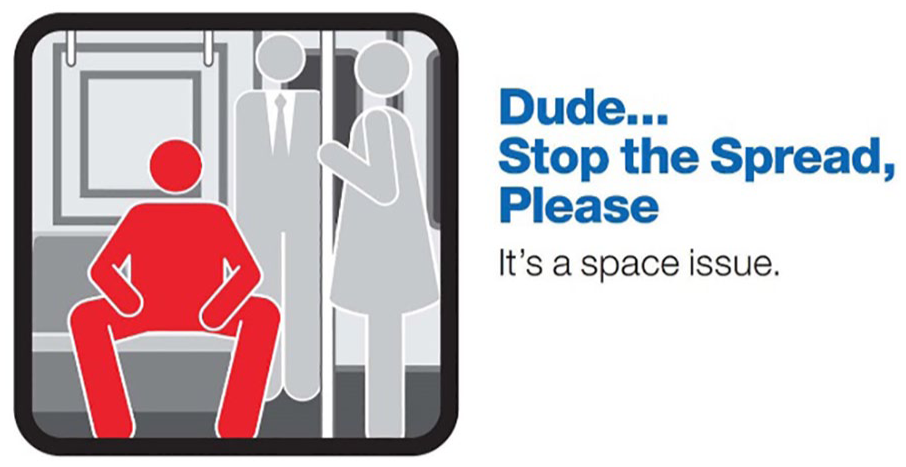
Manspreading in MTA’s Courtesy Counts campaign. 5
Our #manspreading subcorpus contains examples of tweets in which the keywords mta, nyc, and subway co-occur, often appearing as hashtags to index the topic of manspreading to the specific context of MTA’s subways in NYC. These tweets include metadiscursive comments on the Courtesy Counts campaign, such as example (4), which shows sarcastic features through the use of the discourse marker you know and ellipsis at the end of the sentence. Example (5), on the contrary, refers to further efforts taken as part of the campaign, such as the introduction of a “Baby on Board” badge for pregnant passengers to help them being offered a seat. As the user tweeting the comment quoted in (5) notes, however, they do not have much confidence in the effectiveness of such buttons, especially if they are not particularly large or prominent and will thus not be noticed by fellow passengers.
4. You know I’m really happy that the #MTA is working hard to fight #manspreading on the subway . . .
5. Interesting – but I don’t see it making a difference. How big is the button? Ha! #mta #subway #manspreading
6. To spread or not to spread. Answer? He spread. #manspreading #mta #nyc #subway
In addition to commenting on MTA’s efforts at encouraging appropriate behavior on the NYC subway, our data also comprise several examples which involve passengers reporting incidents of manspreading to MTA and the general public, as in (6). These tweets often included pictures or short videos of men occupying more than one seat by spreading their legs and are thus examples of what Jane (2017, p. 460) refers to as “‘naming and shaming’ digilante strategies” (digilante itself a blend of the adjectives digital and vigilante).
The keywords for the #mansplaining subcorpus in Table 2 include hotline, Sweden, and Swedish. They relate to the introduction of a hotline in November 2016 which was intended to allow women to report incidents of mansplaining in the workplace, encouraging them to call “when male colleagues give them unsolicited lectures on things they already understand” (England, 2016). This hotline was launched by the largest union in Sweden, Unionen, as part of a campaign to highlight gender inequalities, give female employees the opportunity of getting advice on the topic of mansplaining, and address it in a professional context. This is reflected in example (7), which cites a tweet reporting on the union’s efforts in raising awareness of mansplaining at work.
7. A Swedish trade union starts workplace hotline for #mansplaining. Their goal: Awareness.
8. Love this! A hotline to report #mansplaining incidents in Sweden? We need this in America!
9. Men call Sweden’s mansplaining hotline to mansplain why they don’t like it #sweden #mansplaining #hotline #mansplain
Examples (8) and (9), on the contrary, are not as neutral in tone as example (7), but they take sides for and against the union’s initiative. While example (8) expresses appreciation for their efforts and indicates that other countries, such as the United States, could also do with a hotline of this kind, example (9) refers to a group of opponents of the hotline. Ironically, this latter tweet reveals that men started calling the hotline to explain why they did not like it, displaying the kind of behavior that the hotline intended to fight in the first place.
In addition to the keywords relating to the phenomenon of mansplaining in general and the mansplaining hotline introduced in Sweden, Table 2 also includes tech and thanks. Tech appears at rank 15 and relates to one of the contexts in which mansplaining can be encountered. For instance, example (10) provides a definition of the phenomenon of mansplaining and includes the insertion “in tech this happens a LOT,” which qualifies the otherwise general description by linking mansplaining to the world of technology. In example (11), a user states that she has been working in the field for 14 years and still has simple tasks explained to her by men, whereas example (12) refers to an event with a technological theme, recounting a situation in which a male participant told a female author about the book she had written (cf. Solnit, 2012 and the discussion above).
10. #Mansplaining: when a man assumes a woman knows less, in tech this happens a LOT, or over-explains something in a condescending way.
11. So I’ve been in tech for 14 years and I was just mansplained on how to use Google image search. #wtf #womanintech #mansplaining
12. sounds like #mansplaining guy told woman at tech event about great book. She wrote the book & her photo was on cover
In addition to contexts with a technological focus, the form tech is also used in our data to refer to people working in the field. Example (13), for instance, shows a user complaining about the mansplaining behavior of the “tech-guy,” whereas example (14) highlights the condescending nature of the “tech support” they consulted. Note that example (13) also comprises the form thanks, which will be discussed further below.
13. Thanks for #mansplaining everything in one sentence tech-guy. #patronising
14. Condescending tech support #Mansplaining me but kept being wrong & got more obnoxious when he realised I knew more than him
The final keyword to be discussed for the #mansplaining subcorpus is thanks. Given the context and the fact that the subcorpus consists of tweets which all include the hashtag #mansplaining, the majority of the examples including thanks do not concern sincere uses of the form with the illocutionary force of thanking an interlocutor. On the contrary, these examples primarily convey a sarcastic message. This is further supported by the most frequent three-word cluster of thanks appearing in the data: thanks for #mansplaining, which accounts for one-third of all uses of thanks in the subcorpus and which we have already encountered in example (13) above. While it is unlikely that someone would offer a sincere thanks to their interlocutor for mansplaining something, there are several clues in the tweet text surrounding the respective cluster to confirm this interpretation. There are, for instance, other negatively connotated words which co-occur with the cluster, such as bimbo in example (15), or users draw on established stereotypes, as in (16), to seemingly belittle themselves. At the same time, users stress their own educational background and professional experience to highlight that they would not have needed help with a particular definition, such as that of cereals in example (17), thereby indicating that the advice given is unwanted. In examples (18) and (19), the sarcastic nature of the tweets is stressed in particular through the explicit hashtags #contributingtotheproblem and #sarcasm attached at the end.
15. Thanks for #Mansplaining this difficult concept to a bimbo like me 
16. Apparently we have thick skulls. Maybe we’re just too emotional. Maybe we’re on our periods. In any event, thanks for #Mansplaining
17. Thanks for #mansplaining. I might be a nutritionist & studied botany at uni as well, but what cereals are just completely escaped me
18. Yeah . . . Thanks for #mansplaining this for me . . . Really helped put it in perspective . . . #contributingtotheproblem
19. ps – thanks for #Mansplaining what was going on like I couldn’t figure it out. You’re the absolute best. #sarcasm
In the remaining examples, in which thanks is used in constructions other than this three-word cluster, we find similar clues. Thus, in example (20), the use of the single word not followed by a full stop clearly indicates that the user was not serious about what they had said before, while in (21) punctuation underlines a sarcastic meaning, such as the use of capitals for the interjection OMG or the exclamation mark at the end of the second sentence. In example (22), it is the insertion of the expletive fuck between thank and you’re that explicitly conveys that the user is not grateful for the insights shared, whereas in example (23), the request for someone to mansplain mansplaining points toward a non-literal interpretation of the tweet.
20. Thanks for explaining things I already knew, just because I’m a woman&you’re a man. Really makes me thankful, humble & happy. Not. #mansplaining
21. OH EM GEEEE thanks. I had no idea and never would have known that without you! #Mansplaining
22. Some British dude #Mansplaining how the American government works. Thanks, guy. I was born & raised there but thank fuck you’re here to help
23. I can’t wait for the #mansplaining about the #million women march to begin. Also, can someone mansplain mansplaining? K, thanks.
The top 20 keywords for the #manspreading subcorpus are provided in Table 2. While manspreading appears at rank 1, the form manspread can be found at rank 20. Example (24) illustrates that the hashtag #manspread forms part of our data as an alternative to the gerund construction, with both hashtags indexing the topic of the tweet, and example (25) shows that, in addition to its nominal uses, manspread may also form part of a verb phrase. The fact that the two forms co-occur in these examples, and that both of them appear among the top 20 keywords of this subcorpus, indicates that in this case two alternate forms have gained currency in usage.
24. The #manspreading or #manspread is real #mta
25. Nothing like having the guy next to you manspread so far you have to get up #manspreading #dickhead
26. Manspreading everywhere. I manspread extra when I sit next to a dude #manspreading
Example (26) illustrates that in some of the tweets included in our data more than two references to manspreading occur. In this example, both the forms manspread and manspreading are used and the hashtag #manspreading is added at the end. At the same time, example (26) conveys a certain competitive aspect with regard to manspreading, which we also found reflected in other tweets: the user claims that they manspread intentionally when sitting next to a male passenger.
In addition to manspreading, the form womanspreading appears in the subcorpus’ keyword list (Table 2). Similar to the original blend manspreading, the form womanspreading refers to women occupying more than one seat or more space than necessary by, for example, putting their bags on the seat next to them or crossing their legs. Our data includes examples such as (27), where the two concepts of manspreading and womanspreading are juxtaposed. The user states that “#manspreading isn’t only limited to men,” which of course is not congruent with the semantic definition of manspreading and the fact that womanspreading denotes the behavior of another gender. This compares to example (28), where a user claims that he is manspreading by using womanspreading techniques. This example introduces a differentiation between the two concepts, each of them equipped with certain features that can be observed when displaying the respective behavior, which allows one to identify and distinguish them from one another, without restricting the use of certain techniques to a specific gender.
27. #manspreading isn’t only limited to men anymore #womanspreading
28. I’m #manspreading the shit outta this train with #womanspreading techniques. #NJTransit #H3H3
Examples (29) and (30) illustrate the discussion about the two types of spreading. Example (29) is rather neutral in tone and emphasizes that spreading is not limited to one specific group of people only but that both men and women are guilty of the behavior in question. Example (30), on the contrary, explicitly expresses a negative attitude toward womanspreading, calling it “the real epidemic” and thereby trying to put the discussions on the topic of manspreading into perspective. This tweet also refers to the media company BuzzFeed, whose name is a keyword in the #manspreading subcorpus, as Table 2 shows. This will be discussed further below (see examples [33] to [40]).
29. #feminist complain about #manspreading, but what about #womanspreading? Seriously though, #idc. Just pointing out we all do it.
30. All this talk from @BuzzFeed about #manspreading, but #womanspreading is the real epidemic. #truth
The final two examples, (31) and (32), show that womanspreading is not only discussed as a phenomenon similar to manspreading, with users taking sides as to which of the two behaviors is worse or more prevalent, but that it is also presented as a means of opposing manspreading. As both examples (31) and (32) illustrate, womanspreading is viewed as a way of “countering” or even of “combat(ing)” manspreading. It therefore takes on an additional defining feature as a defense tool that can be referred to when encountering manspreading and trying to ensure that one has enough space, primarily on public transport.
31. O dear – serious case of #manspreading on the Cambridge #bus today. I’m countering by #womanspreading;) #equality of space
32. Do we combat manspreading with womanspreading? #manspreading #womanspreading #publictransit
Neither manspreading nor womanspreading had been included in the Oxford English Dictionary by the time of writing this article. However, they do appear in the Urban Dictionary (n.d., s.v. manspreading, womanspreading), with the earliest entry for manspreading from December 21, 2014, and the earliest one for womanspreading from March 27, 2015. They were thus first recorded in this dictionary at around the same time as MTA’s Courtesy Counts campaign was introduced. A further extralinguistic event leading to increased discussion of the topic on Twitter occurred in November 2016. It was then that BuzzFeed featured a video on its website which reported the experiences of three women who tried manspreading for a week (Boyajian, 2016). They deliberately took up as much space as possible on public transport as well as in other everyday life situations and commented on this experiment in short video diary sequences.
The examples in our #manspreading subcorpus indicate that the general reaction to this video was far from positive. In fact, there are only very few tweets that convey a more neutral tone, such as in examples (33) and (34). While the tweet in (33) makes general reference to the video and acknowledges that it has already been widely discussed, the user in example (34) states that this video has made them notice instances of manspreading in their own life. Thus, one could say that the BuzzFeed initiative succeeded in raising awareness of the phenomenon.
33. NEW video on #manspreading I know loads has already been said on this but i’ve only just seen it:’) #buzzfeed
34. After watching the @BuzzFeed video on #manspreading it’s the first thing I notice on a crowded train. 1 man = 2 seats, or 1 seat and isle.
However, the experiment and its results also led to several negative reactions and challenging tweets, such as examples (35) and (36). In these examples, users admit that they are manspreading and either explicitly challenge BuzzFeed, as in example (35), or stress that they are aware that BuzzFeed is opposed to this type of behavior but still continue displaying it, as in example (36). At the same time, there are sarcastic tweets, such as (37). Neither the exclamation oops at the beginning of this tweet nor the prototypical apology marker sorry are used sincerely in this example, but rather underline the sarcasm inherent in the message. By reporting their own manspreading to BuzzFeed, the users in examples (35) to (37) mock the initiative and express their opposition to it.
35. I’m #manspreading. Come at me Buzzfeed!
36. buzzfeed gonna beef with me hardcore after this. But fuck em anyway. We out here #manspreading . . .
37. Oops, just caught myself #manspreading at the coffee shop. Sorry, Buzzfeed!
Furthermore, there are several tweets which challenge the information provided in the BuzzFeed video. Thus, there are tweets trying to justify the phenomenon of manspreading by referring to male anatomy, such as example (38). Others offer to mansplain why men manspread, as in example (39), which notes that the “video isn’t accurate.” And the user in example (40) points out that the issue of taking up more space than needed and thereby taking it away from others is not gender based but due to a selfish attitude shared by people of different gender.
38. I swear to God, if I come across yet another Buzzfeed #manspreading video I’ll lose my shit. It’s called HAVING BALLS you morons
39. damn buzzfeed #man spreading Im going to do some #Mansplaining about manspreading b/c this video isn’t accurate #bs
40. Hey #buzzfeed it’s not #manspreading or #womanspreading, it’s a general social problem involving selfish people.
Discussion
In this article, we set out a corpus linguistic analysis of three innovative hashtags related to gender politics in contemporary society, one focused on physical behavior (#manspreading) and two related to interactional features (#manterruption and #mansplaining). In terms of the general patterns in our corpus, we found that #manterruption was the least frequent hashtag, while #mansplaining was the most frequent. This suggests that there is more cultural awareness and recognition of mansplaining as a concept, potentially due to the fact that this term is the oldest of the three. Furthermore, it certainly seems to be the case that the hashtag is primarily used to highlight a pervasive form of sexist discourse, with many of the tweets discussed demonstrating that it co-occurs with criticisms of men offering explanations which are condescending, derogatory, or insulting. Conversely, manterruption and manspreading are relatively new additions to the lexicon and therefore do not yet seem to have the wider social distribution that mansplaining has.
The corpus linguistic analysis of more than 13,000 tweets focused on keywords, that is words which are statistically significant in each of the three subcorpora when compared against the remaining two. This keyword analysis allowed us to take a neutral approach to data analysis that did not rely on coding our data according to pre-set criteria or studying a smaller sample for qualitative purposes. The keyword analyses of the #manterruption and #mansplaining subcorpora resulted in fewer than 20 keywords each. This is, on the one hand, a reflection of the frequency with which words appear in these subcorpora as in corpus linguistics a word can only be “key” if it appears repeatedly in the target corpus. For instance, as the mansplaining hotline was mentioned in a high number of individual tweets in our #mansplaining subcorpus, the forms Sweden and Swedish, which more closely define the context in which the hotline was implemented, formed part of the respective keyword list. Thus, the keywords for both the #manterruption and #mansplaining subcorpora indicate that initiatives such as this were discussed extensively on Twitter at the time when we compiled our corpus.
On the other hand, the fact that there were fewer keywords for both the #manterruption and #mansplaining subcorpora entails that the discourse surrounding the concept of manspreading is more significantly different from them. When carrying out the keyword analysis, each subcorpus was compared against the remaining two subcorpora combined. The fact that there were fewer keywords for two of them means that there were fewer statistically significant words that characterize the discourse pertaining to each of these concepts respectively. While #manterruption and #mansplaining occupy the most extreme edges of the frequency range, they seem to share discursive features rather than reflecting unique forms of language use.
Our analysis of the top 20 keywords for the #manspreading subcorpus showed that all of them were related to public transport, transport organizations, and parts of the male body. These keywords highlight how the hashtag intersects with discussions about men encroaching on people’s personal space, taking up more than their allocated seat space and disrupting other travelers. The MTA advertising campaign is a good example of public authorities discouraging manspreading, with other cities also taking steps to intervene and reduce incidence rates of this behavior on trains, buses, and subways.
Closer analysis of the data further revealed that many of the keywords are typically linked to extralinguistic contexts, including real-world events like the development of the “manterruption” app, the roll-out of Sweden’s mansplaining hotline, or an MTA advertising campaign. By launching campaigns to raise social awareness of these topics, advertising companies, unions, and public transport organizations stimulated discussions of these sociocultural phenomena and contributed to highlighting inappropriate practices with a view to reducing their occurrence.
While all three hashtags are primarily intended to draw attention to men’s socially problematic activities and act as a means of policing gendered behavior in online spaces, our analysis also demonstrates that the underpinning meanings, and the social practices they point to, are contested and challenged. Indeed, there is significant disagreement about whether the practices they mark out actually happen or not, and there are discussions about the extent to which essentialising these practices as “male” is sexist in and of itself, and about the reasons why men are singled out for doing things that women also do. The fact that it is mainly men who do not agree with the dominant discourses typically present on Twitter suggests that they feel singled out or mischaracterised and that engaging with these hashtags is an attempt to put forward alternative readings which present them in a more positive light.
Conclusion
Manterruption, manspreading, and mansplaining are phenomena that have received increasing attention in public discourse in recent years. While only one of them has made it into the Oxford English Dictionary so far (Oxford English Dictionary, n.d.: s.v. mansplain, v.), our study has shown that all of them are used on the microblogging platform Twitter, although to varying extents. #Mansplaining turned out to be the most frequently used hashtag, whereas #manspreading could be shown to differ considerably in its discursive features from the remaining two hashtags that are related to interactive rather than physical behavior.
By studying the keywords of the #manterruption, #manspreading, and #mansplaining subcorpora, we gained detailed insights into the distribution and usage patterns of the hashtags and at the same time into users’ metadiscursive reference to each of the respective behaviors, which negatively influence gender equality. While individual instances of being affected by these types of behavior may often go unnoticed or may not be given immediate attention in everyday life, at the workplace, or in political debates, it is on social media platforms such as Twitter that they are discussed by those affected, those witnessing the respective behaviors, and those who want to join the discussion of these sociocultural phenomena and express their individual stance toward them. Thus, our study has highlighted that the Twittersphere does not only criticize the behavior denoted by the hashtags but also contests and challenges the sexist nature of these terms or their restriction to the male gender. This both confirm Bridges’ (2017) findings of her qualitative study on the word mansplain and it adds further support that these discourses are extending to a range of related blends.
In contrast to previous work which usually focuses on one of the three forms, our study provides further insights into the similarities and differences between #manterruption, #manspreading, and #mansplaining. We have shown that discussions of all three phenomena mainly center on extralinguistic developments, such as the introduction of an app, a campaign, or a hotline. At the same time, we have seen that the concept of manterruption was least frequently discussed and the discourse surrounding it was found to have the fewest unique features. For the #mansplaining subcorpus, the keyword analysis uncovered a strong association with the professional field of technology. In addition, a predominantly sarcastic stance on the topic was revealed by the keyword thanks, which appeared most frequently in the three-word cluster thanks for #mansplaining. With regard to #manspreading, finally, the form womanspreading appeared among its top 20 keywords, which could be seen as an attempt at balancing the discussion about spreading between the two genders. Different techniques of spreading by male and female passengers of public transport were discussed and a competitive element could be discerned. Thus, womanspreading was mentioned as a way of countering or combating manspreading and initiatives to raise awareness of manspreading, such as the BuzzFeed video, often triggered challenging tweets, threatening further manspreading action or providing explanations as to why it occurred.
By carrying out a contrastive analysis of #manterruption, #manspreading, and #mansplaining, our study both addresses a gap in the literature and enhances our understanding of gender politics on Twitter. More specifically, users include the respective hashtags in tweets to index their individual evaluations of, and assumptions about, “proper” gendered behavior. Their metadiscursive references to the respective phenomena reflect their beliefs of what constitutes appropriate (verbal) behavior and the extent to which gender is appropriated as a variable dictating this behavior.
With debates about gender becoming more volatile and socially fraught, especially in contemporary online contexts, there is an increasing need to better understand the role that hashtags play in policing and evaluating particular constellations of social practice. The hashtags considered in this article are not just examples of “searchable talk” but rather they also open a window onto current reflections on gender-based norms and social values within the framework of individual approaches and experiences. As such, this article represents an attempt to unpack the strategies of normalization and contestation surrounding socially salient discourses of gender in social media spaces and adds to our knowledge about the multivalent roles of hashtags in online talk.
Footnotes
Acknowledgements
The authors would like to thank audiences at the Sociolinguistics Summer School 8 and Vienna University of Economics and Business for their questions and suggestions on early research presentations. They are also particularly indebted to Andrew Kehoe, who offered useful advice and comments on draft versions of this article.
Declaration of Conflicting Interests
The author(s) declared no potential conflicts of interest with respect to the research, authorship, and/or publication of this article.
Funding
The author(s) received no financial support for the research, authorship, and/or publication of this article.
