




Abstract
This article explores customer service interactions between the Irish airline Ryanair and its passengers on the social networking platform Twitter. Using a corpus linguistic methodology, it investigates a 1-million-word corpus of Twitter threads comprising tweets addressed to and posted by Ryanair between August 2018 and July 2019. Studying the communicative strategies used in the corpus reveals customers’ main concerns and causes for complaint, and how the airline addresses these in their response tweets offering assistance to passengers. In addition, the analysis of customer response tweets to these corporate replies allows insights into customers’ reactions to and perception of the (often generic) answers they receive. The aim of this case study is to gain further understanding of the linguistic and communicative features that characterize customer service interactions online, and the attitudes customers voice toward them, with a view to streamlining customer communication and improving levels of customer satisfaction.
Introduction
The Irish airline Ryanair has a reputation. It has the reputation of being the ‘worst’ airline in Europe, where it mainly operates. In fact, the budget airline was voted worst airline for 6 years in a row before the COVID-19 pandemic (see e.g., Coffey, 2019; Topham, 2019) and it successfully defended this title in 2022 by making it particularly difficult for passengers to get a refund, as a recent survey found (Hobbs, 2022). In addition, customers repeatedly refer to Ryanair as the worst company when complaining about the airline and its service provision as previous research into their meta-pragmatic references has shown. Ryanair is, thus, known as an airline which offers a service that is generally perceived as being below par and that passengers evaluate in a largely negative manner. The customer service interactions between Ryanair and its customers therefore lend themselves very well to the study of how customers express their (dis)satisfaction online and how the airline reacts to their messages, which is the focus of this Special Issue.
This study explores these customer service interactions on the social networking platform Twitter, now X, 1 which is one of the main sites Ryanair uses when communicating with customers. The airline even introduced a second Twitter account (@askryanair) that is specifically dedicated to dealing with customer service concerns and offering customer support (https://twitter.com/askryanair). The platform was thus appropriated by Ryanair as a channel for customer service interactions and customers are often encouraged to get in touch through Twitter if they have a question or need assistance (https://linktr.ee/ryanair). While customers engage in numerous exchanges with social media managers on Twitter on a daily basis, their reaction to and perception of the replies they receive has not been studied extensively to date (but see Abney et al., 2017; Fuoli et al., 2021). This study aims to provide further insights into the nature and structure of Ryanair’s customer service interactions on Twitter, and to explore customers’ attitude toward the answers social media managers post in reply to their tweets.
The empirical analysis is informed by the Ryanair Twitter Corpus, which includes tweets that customers addressed to the airline over the course of a year as well as the airline’s replies. This 2.8-million-word corpus comprises a total of 136,833 tweets that were posted between August 2018 and July 2019. To explore the interactive component of customer communication in this study, a subcorpus was created in which complete Twitter threads were reconstructed, which facilitates the analysis of how different contributions and reactions by customers and Ryanair staff influence each other in online conversations. This subcorpus, which includes 18,061 threads and 1 million words, forms the basis of the empirical analysis. By studying the component parts of these Twitter conversations in a contrastive analysis, this article illustrates a new approach to the study of customer service interactions on Twitter, showing how a corpus linguistic methodology can be used to reveal insights into their development and customers’ reaction to customer service replies.
This study combines different types of corpus linguistic analysis to explore the linguistic features and communicative strategies characterizing customer tweets and uncover those used by Ryanair to address customer queries and concerns. Customers’ reaction to these (often generic) replies is then explored by studying their responses to corporate reply tweets, opening a window on their attitude toward the airline’s approach to customer communication on Twitter. This study thus sheds additional light on customers’ discursive construction of (dis)satisfaction with the airline, and reveals to what extent customer service interactions on Twitter reflect their impression of Ryanair being the worst airline. At the same time, the results indicate how changes in the linguistic and communicative features used by the airline could improve levels of customer satisfaction. Before presenting this study’s findings in detail, Section 2 embeds it in previous research on digital customer communication. The specific data and methodology used are described further in Section 3, followed by a discussion of the results obtained through the corpus linguistic analysis in Section 4. This article then closes by summarizing this study’s main findings, discussing its limitations and providing an outlook for future research.
Communicating With Customers Online
The online sphere and social media in particular have opened up new possibilities for two-way communication between companies and their customers. Whereas companies could previously control communication by crafting corporate messages carefully, aiming them at specific groups of stakeholders, and deciding on when to publish them, today customers have many opportunities to talk to and about businesses on the internet (Argenti, 2006). This has led to a blurring of production and consumption and shifted the focus to co-creating content online, which in addition to corporate messages includes user-generated content today. Social media, which allow for the public discussion of consumer issues and concerns, thus function as “new communicational spaces in which the legitimacy of organisations can be shaped and contested” (Glozer et al., 2019, p. 625). They have added a new dimension to legitimation processes by introducing a dialogic perspective in which multiple voices and audiences can witness and contribute to discursive legitimation. As social media are known to facilitate fast exchange on a large scale, it is of significant importance to gain further understanding of the way communication works in this digital environment that is prone to the voicing of complaints and the expression of dissatisfaction.
In fact, in the social media landscape, Twitter is known to be a platform that users often turn to when they wish to complain about brands (Vargo et al., 2019, p. 1157). And it is quite a considerable number of users who may do so given that Twitter is one of the most popular social networks 2 with 238 million daily active Twitter users worldwide. 3 The tweets that these users post are public by default and through platform-specific features, such as the use of hashtags and the retweet function, they can be spread to and read by a very large audience (Squires, 2016, p. 247). While Twitter thus facilitates easy information transfer and wide-reaching communication, these general benefits of the platform, which allow customers to get immediate help if they have an issue with a product or service, also open up the possibility for negative electronic word of mouth (eWOM) to go viral (Hennig-Thurau et al., 2004, p. 39).
This study is embedded in research on webcare and service recovery. It starts out from the premise that customers’ reactions to service recovery efforts often influence their eWOM behavior on social media (Kim & Tang, 2016, p. 916). If they are not satisfied with the outcome of their customer service journey, they may engage in negative eWOM, for instance, to seek revenge (van Vaerenbergh et al., 2019, pp. 104–105). As tweets are a form of eWOM (Jansen et al., 2009), it is of primary interest to know how customers react to and perceive the responses they get from companies to their queries or complaints on Twitter. One field of research that studies online customer feedback and investigates how best to respond to it revolves around the concept of webcare. Webcare is “[t]he act of engaging in online interactions with (complaining) consumers” (van Noort & Willemsen, 2012, p. 133) with the aim of sharing information, fostering relationships, acknowledging positive eWOM, as well as reducing the damaging effects and unfavorable brand evaluations resulting from negative eWOM. This is because negative eWOM may harmfully influence customers’ product evaluation and purchase intention, which in turn may affect a company’s sales performance and stock prices (Ismagilova et al., 2020; Kim et al., 2016). While companies have little control over consumers voicing their opinions online, it is in their interest to monitor customer feedback and respond to it through webcare to ensure customer satisfaction.
Today, many service industries, such as airlines, use Twitter for customer service and service recovery. Ever since the first corporate tweet by Delta Airlines in 2006 (Kovacs et al., 2017, p. 8), it has been shown that Twitter can increase the value of a company, in particular, if it is used for two-way interaction to engage with stakeholders and it can have an impact on stock prices (Chahine & Malhotra, 2018). With regard to the transport industry, previous research on train operating companies has, for example, studied the influence of corporate tweets on consumer relationship management (Nisar & Prabhakar, 2018), investigated the expression of linguistic (in)directness in complaints addressed to these companies (Decock & Depraetere, 2018), and assessed to what extent it influences the perceived face threat of complaints (Ruytenbeek et al., 2023). For the airline industry, studies have explored the influence of a company’s CSR efforts on eWOM behavior during service delays (Vo et al., 2019), the effectiveness of response types to customer queries and complaints (Fan & Niu, 2016), as well as differences in response time and response rate between different types of airlines (Carnein et al., 2017).
In addition, Lutzky (2021a) offers a detailed corpus linguistic investigation of the discourse of customer service tweets, studying linguistic, communicative, and platform-specific features, such as hashtags, in two large corpora of tweets addressed to and posted by British and Irish train operating companies and airlines (see also Lutzky, 2020). This study also investigates the structure of customer service exchanges evolving on Twitter and gives first insights into how corpus linguistic analyses may be used to uncover customers’ attitude toward the corporate responses they receive. Using a different methodological approach, Depraetere et al. (2021) consider the unfolding interactions between social media managers and their customers in a qualitative analysis paying particular attention to how linguistic (in)directness is expressed in complaints. They conclude that follow-up tweets by complaining customers generally do not show increased levels of explicitness and that third-party users mainly contribute to interactions by expressing solidarity with them.
Fuoli et al. (2021) study corporate responses to customer complaints on Twitter and to assess the effectiveness of webcare styles, they use a mixed methods approach that combines corpus linguistics with a follow-up experiment. Their study of webcare interactions from six companies in the satellite navigation industry shows that an affective style, which involves showing concern for customers and expressing empathy, is most effective in response to customer tweets. van Hooijdonk and Liebrecht (2021) explore the use of apologies and their effectiveness in airline tweets posted in response to negative word of mouth shared by passengers. They also use a mixed-methods approach that is based on a corpus linguistic study and an experimental research design. While they find that apologies are most effective in protecting an airline’s reputation if used with a defensive and an accommodative strategy, they unfortunately do not account for the multifunctional nature of illocutionary force indicating devices (IFIDs). As a consequence, they do not distinguish between the form sorry when used as an apology and when expressing empathy, but they seem to treat all occurrences of sorry as examples of the former. This is indicated, for instance, by Table 4 in van Hooijdonk and Liebrecht (2021), which includes several instances of the construction sorry to hear that does not function as an apology but as an expression of empathy (see also Lutzky, 2021b for a detailed study on this topic).
This study builds on previous research exploring customer communication on Twitter and contributes to the field by adopting a new approach to its analysis. Digital customer communication takes place in a specific context that requires direct exchange between companies and their customers, who can interact with each other by asking questions and providing updates (Lutzky, 2021a, p. 95). This study foregrounds the interactive nature of these customer service exchanges by investigating the different layers that make up a Twitter thread, exploring their linguistic and communicative similarities and differences, and analyzing the interplay between them in a corpus linguistic analysis (see Section 3). To this end, the analysis takes a three-layered approach: it investigates customers’ initial tweets in which they ask questions, share feedback, or voice a complaint, and which are explicitly addressed to the airline Ryanair; it analyses the company’s responses to these initial as well as customers’ follow-up tweets, and its use of reactive webcare (van Noort et al., 2015, p. 84), that is, the way in which social media managers address customer feedback and concerns, with a focus on its linguistic realization; and it explores customers’ reactions to and attitude toward the corporate responses they get to uncover whether or not they are satisfied with the help they receive.
These three layers are illustrated in example (1) from the Ryanair Twitter Corpus, 4 which includes a tweet exchange between a customer and a social media manager that extends over a thread of three tweets. 5
(1) Customer: Is there a problem with your website currently?? Been trying to book a flight for an hour and every time we but our card details in it says they are invalid? Can you help ASAP (3 October 2018: 11:59)
Ryanair: Hi Clare, in here you would be able to find the permitted cards: https://ryanair.com/ie/en/useful-info/help-centre/faq-overview/Making-payment/How-can-I-pay-for-my-flights . . . AM (3 October 2018, 13:00)
Customer: Does AM stand for automated message?? Well just for your information AM It is not the first time I have used your service and I know what credit cards are valid. Mine is so ‘valid’ that I booked with another airline while waiting for your response. Thanks CB (3 October 2018, 13:09)
As example (1) shows, the customer asks a question in their initial tweet, inquiring whether there was a problem with the Ryanair website as their card details were not accepted when trying to book a flight. They indicate that they have had issues with the booking system for quite some time and that they need help urgently by including the abbreviation ASAP, which stands for as soon as possible, at the end of their tweet. The corporate reply tweet they get an hour later includes a link to a frequently asked questions page with a list of different forms of payment the airline accepts. It features a personal form of address (Hi Clare) and is signed with the social media manager’s initials AM, which is common practice in customer service tweets (see e.g., Lutzky, 2021a). Nevertheless, this corporate response was perceived as impersonal by the user, who makes a sarcastic comment by asking whether AM possibly stands for automated message. They also criticize the information received, which they had already been aware of, and thus express that they found the response to be unhelpful, as the issue experienced did not pertain to the type of card used but the fact that the system would not process the payment. While several (para)linguistic features underline the sarcastic undertone of this message, such as the discourse marker well, the intensifier so, and quotation marks around the adjective valid, the user also highlights that Ryanair took too long to reply to their tweet and adds that they have already booked a flight with another airline.
By focusing on these different interactional levels, this study addresses the following research questions:
What are the linguistic features and communicative strategies used by customers and the airline Ryanair when interacting with each other on Twitter?
To what extent do corporate responses address and are thus aligned with customers’ original queries and complaints?
How do customers react to the corporate responses they receive and what do their reactions reveal about their attitude toward Ryanair’s customer service provision?
Data and Methodology
This study investigates customer service tweets that were addressed to and posted by the Irish airline Ryanair between August 2018 and July 2019. These data are studied using a corpus linguistic methodology, an approach that has not been used extensively to explore business communication yet (Jaworska, 2017). The analysis, which is corpus-driven in nature, is based on the Ryanair Twitter Corpus which comprises a total of 136,833 tweets and 2.8 million words, excluding retweets (Lutzky, 2022). The corpus was compiled using the software TAGS (https://tags.hawksey.info/), which downloaded a maximum of 3,000 tweets every hour. 6 When examining this corpus in more detail and comparing the total number of tweets posted by the airline to that shared by customers, a certain imbalance is revealed. In fact, customer tweets constitute 78% of the complete corpus (i.e., 106,467 tweets and 2.3 million words) whereas airline tweets amount to only 22% (i.e., 30,366 tweets and around half a million words). Thus, this initial assessment of the data already shows that not each customer tweet will have received a reply, which implies that Ryanair did not fully engage in webcare on Twitter at the time and many customer tweets were therefore left unanswered.
As this study is interested in exploring the interactive component of customer communication, it is important that the data set includes Twitter conversations that have been captured in their entirety. The Ryanair Twitter Corpus was compiled using a random sampling technique, downloading a sample of tweets every hour as discussed above. While this is convenient for corpus linguistic studies in general, it is not ideal when wanting to study contributions and reactions by customers and companies, and how they influence each other in online conversations. As a consequence, a subcorpus was extracted from the Ryanair Twitter Corpus in which Twitter threads of up to five tweets were reconstructed on the basis of the metadata provided in TAGS. 7 It includes 46,671 tweets forming part of 18,061 threads and consists of three samples of tweets: customers’ initial tweets, the corresponding corporate response tweets, as well as customers’ reactions to Ryanair’s responses. This subcorpus is the focus of the empirical analysis and its unique nature and size, including 1 million words of Twitter conversations, opens up new methodological possibilities for the study of customer service interactions on Twitter.
For each of the three samples of tweets, I began by carrying out a keyword analysis using the corpus linguistic software WordSmith Tools Version 7 (Scott, 2016). Keywords are words that appear unusually often in a target corpus when compared to a reference corpus and reveal statistically significant differences between two (sub)corpora on a lexical level (Scott, 2010; Scott & Tribble, 2006). Their study thus allowed me to identify those linguistic and communicative features that characterize customers’ initial tweets and distinguish them from those typical of corporate answers, as well as customer response tweets, providing insights into the development of customer service interactions and the usefulness of social media managers’ replies. In addition to keywords, I studied frequently occurring word combinations in the form of clusters and collocations. Clusters are recurrent sequences of usually three, four, or five words which appear in a specific order (e.g., apologies for the inconvenience caused; see e.g., Tyrkkö & Kopaczyk, 2018) and their study may uncover the use of formulaic expressions in corporate tweets.
Collocations are words that frequently co-occur within a span of words and may show a weak or strong level of attraction (Evert, 2009). For example, the adjective sincere and the noun apology have a strong level of attraction as apologies are often modified or described by using this adjective, and the two words may appear adjacent to each other (e.g., The president gave a sincere apology) or they may be used in close proximity to each other, that is, within a span of usually five words (e.g., An apology should always be sincere). This example also illustrates that collocations are a means of gaining further understanding of the attitude users express, for example, when posting messages online, as a word’s collocates often reveal an evaluative component (such as judging the necessity for an apology to be sincere). The following discussion of findings presents the results gained by combining the analysis of keywords, clusters, and collocations in the study of Ryanair’s customer service interactions on Twitter.
Findings
Customers’ Initial Tweets
To uncover linguistic differences between the three samples of tweets forming part of my 1-million-word corpus (see Section 3), I carried out keyword analyses in which I compared the airline’s language use to that of its customers. For my first keyword analysis, I used the sample of customers’ initial tweets as my target corpus and compared it to the sample of corporate response tweets, which functioned as my reference corpus, and the results are given in Table 1. 8 As the top 20 keywords in Table 1 show, customers often address tweets to Ryanair because they lack information. This is reflected in several keywords that form part of requests for information, such as what, why, when, how, and the auxiliary do. Customers tweet Ryanair explaining what they want or are trying to do, such as checking in for a flight or adding luggage to a booking, and they ask questions about the process or complain about issues they are experiencing in the process.
Keywords of Customers’ Initial Tweets.
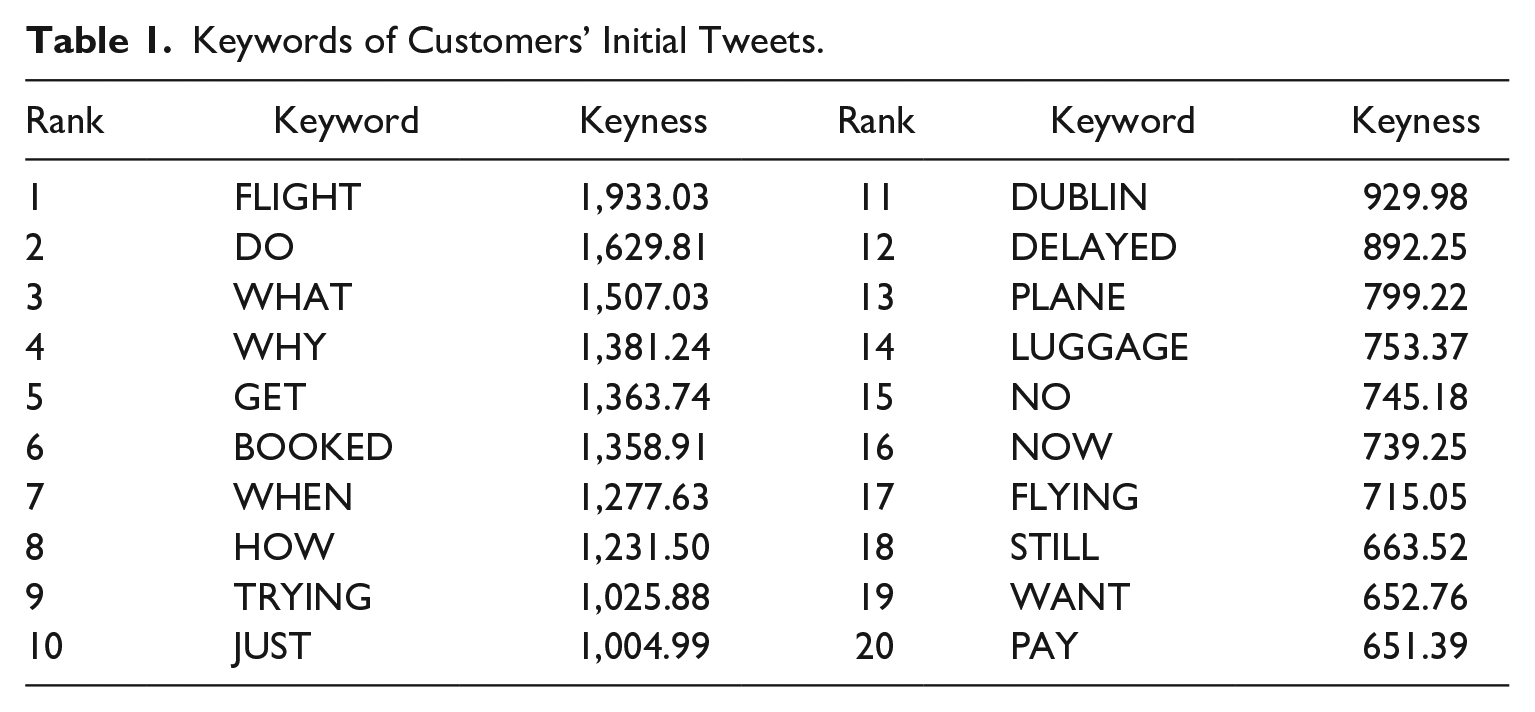
Other keywords, such as flight, flying, booked, and Dublin, where the airline has its headquarters, indicate that customers tend to ask questions about the flight they have booked (to/from Dublin) with Ryanair. Thus, the form flying mainly appears in clusters expressing that customers are travelling with the airline in the (near) future (e.g., am/are flying with/to/from) and the top collocates of flight show that customers talk about their return, in/outbound, connecting, or upcoming flight in their tweets. In addition, several keywords refer to specific aspects of customers’ flight experience that they require information on or want to complain about, such as their flight being delayed or their plane being grounded. The keyword luggage shows that customers have questions about Ryanair’s rather complex and strict baggage policy, leaving many passengers unsure as to the weight, size, and dimensions of luggage allowed onboard a Ryanair plane. At the same time, they complain about having to pay extra for checking in luggage or bringing an additional piece of luggage, as well as for choosing a specific seat rather than being allocated one randomly by the check-in system. This is reflected in the top five collocates of the keyword pay: the collocate with the strongest collocational relationship is extra (z-score 37.31), followed by the forms forced (25.89) and forcing (18.31), as well as unless (14.67) and together (13.84). Customers thus complain about the additional charges Ryanair issues and the fact that they feel like they do not have a choice but to comply, especially, for example, if they want to sit together with their friends and family.
The negative particle no appears at rank 15 in Table 1. The fact that this particle is key in customers’ initial tweets indicates that they repeatedly point out the absence of certain features. To find out what customers are missing, a collocation analysis was carried out. The aim of this analysis was to uncover the top collocates of no, that is, those with the strongest collocational relationship, that appear in first position to the right of this particle. The results of this analysis are given in Table 2, which lists the top 20 collocates of no sorted by z-score, a measure of statistical association which takes into account the frequency of the node (in this case the word no) and of each collocate in relation to corpus size.
Collocates of No in R1 Position in Customers’ Initial Tweets.
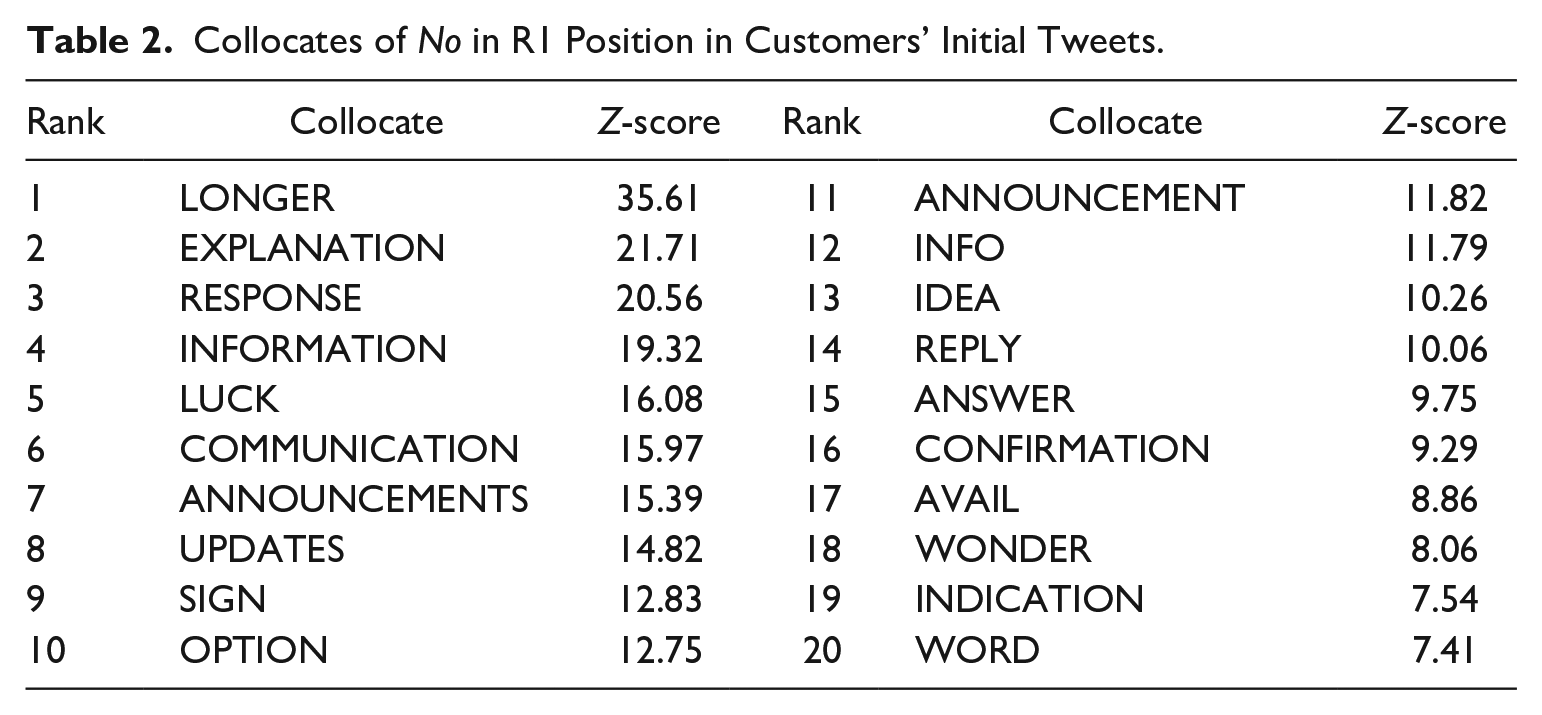
As Table 2 shows, the top collocate of no is the comparative form longer, which is used by customers to ask why specific aspects of Ryanair’s service provision are no longer available, why they cannot make changes to their booking any longer, such as adding priority boarding, or what they need to do if they are no longer able to make a flight. In example (2), for instance, a customer asks a question about changes to Ryanair’s baggage policy, which entailed that only passengers booking priority boarding were allowed to bring a 10 kg bag on board a plane, but the option of just adding a bag to an existing booking was no longer available. However, the majority of the top 20 collocates of no are words that refer to some form of communication. The collocate with the second strongest collocational relationship is the noun explanation (see Table 2). In example (3), a passenger complains that they did not receive any explanation, or communication in general, from the airline even though their flight was delayed by 4 hours. In order to add further weight to their complaint, they use this opportunity to also underline that they do not appreciate the fees Ryanair charges for hand luggage and use an active construction when talking about the flight delay (see you delay our flight), explicitly attributing the responsibility for their disruption to the airline.
(2) is there
(3) Not only do you now charge fees for hand luggage you delay our flight by 4 hours with
(4) tweeted the other day and
(5) told us over 3 hours ago to go to gate at #dublinairport since then nothing.
(6) 8 pm flight from BUD to BCN delayed half hour. It is 1 hour later and everyone is standing outside on the tarmac waiting and waiting.
In addition, passengers mention that they have not had any response, reply, answer, or word from Ryanair, with response appearing at rank 3 in Table 2. In example (4), a customer tweets Ryanair again because, even after several attempts, they have not been able to book any flights online. They point out that they already tweeted the airline concerning this issue before but have not had any response, emphasizing their upset about this through the repeated use of exclamation marks. Passengers, furthermore, underline that they are lacking info(rmation) regarding their specific flight experience, as in (5). In this example, a passenger tweets that they were told to go to their gate 3 hours ago but have not had any further information since, which is also due to the fact that ground staff have not been available to assist them. This lack of communication and help infuriates this passenger so much that they even threaten to never travel with Ryanair again. As Table 2 shows, the absence of information may take the form of an explanation or a confirmation, for example of a booking that has been made, and passengers also complain about not receiving any updates or announcement(s). This is illustrated in example (6), where a passenger explains that they were left waiting for their delayed flight to Barcelona outside on the tarmac in Budapest without any announcements or updates as to the exact extent of the delay. Given this lack of communication, customers repeatedly note that they have no idea how to sort out the issues they are experiencing on their travels, and this is often due to the fact that they have not had any luck in getting help from the airline or tried different ways of contacting them but to no avail, with idea, luck and avail all being top collocates of no (see Table 2).
The analysis of the first level of customer service interactions on Twitter, that is, customer’s initial tweets addressed to Ryanair, thus reveals the main topics discussed and concerns raised by customers. Studying the words that are key in customers’ tweets and their collocates allows insights into repeatedly mentioned causes of customer complaint and dissatisfaction, including for example flight delays, issues relating to luggage, and additional fees charged by Ryanair. The results also show that customers’ tweets are often sparked by a lack of information, as well as the absence of features that they would normally expect to form part of an airline’s service provision, such as consistent policies or readily available customer support.
Corporate Responses
The second level of analysis then focused on the communicative strategies used in corporate responses to customer tweets. To this end, I carried out a keyword analysis in which I compared the language use of corporate tweets to that of all customer tweets to uncover the linguistic features that characterize Ryanair’s contributions to customer service interactions. The results of this keyword analysis are given in Table 3, which lists the top 20 keywords in corporate response tweets and highlights those expressions that define the airline’s approach to digital customer communication and its webcare efforts. This includes the use of the informal greeting hi to introduce its tweets, which is the top keyword and thus used more frequently than expected by social media managers compared to customers, as well as the speech act of apologizing in the standard construction sorry for the inconvenience caused, as the forms sorry at rank 5 and inconvenience at rank 10 indicate.
Keywords of Corporate Response Tweets.
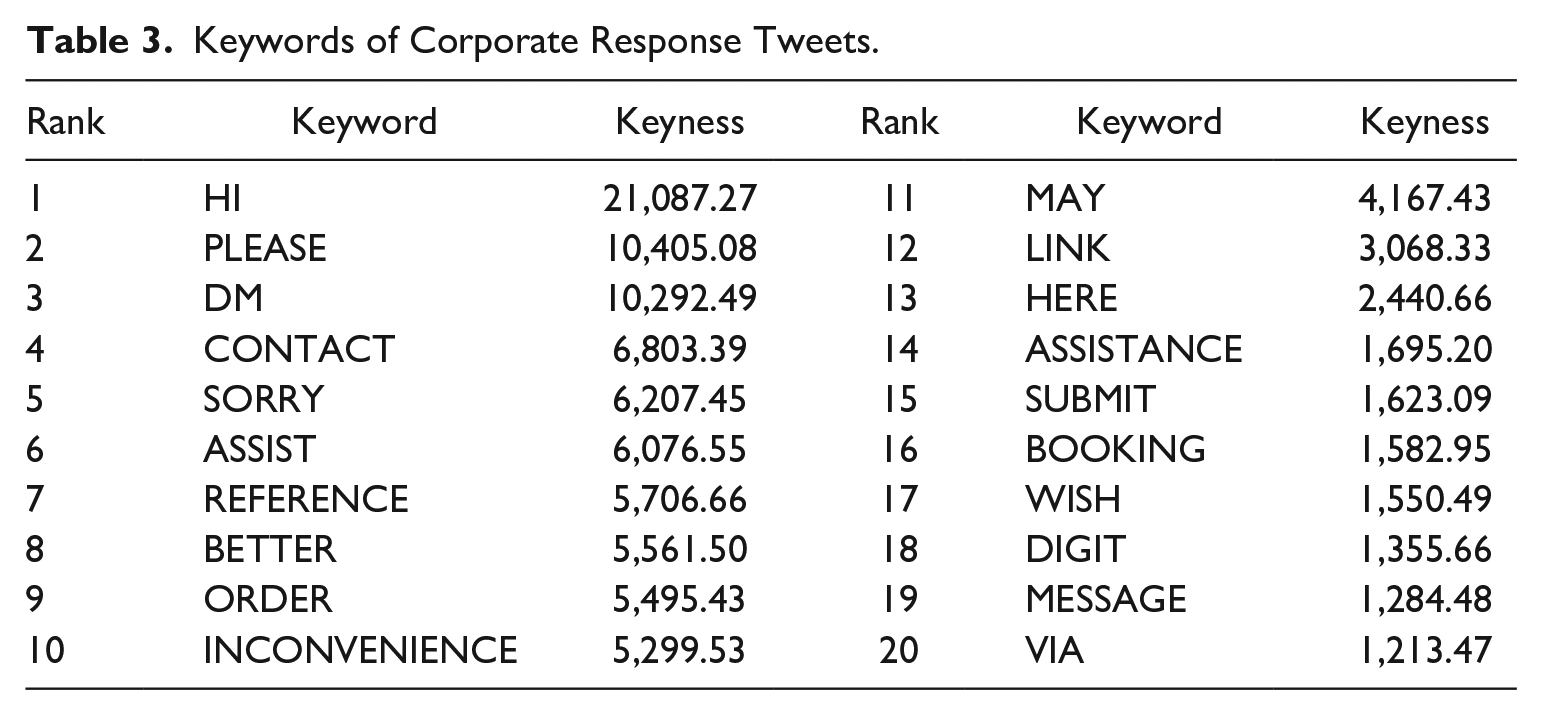
When complementing the findings of Table 3 with a cluster analysis, thus expanding the range from studying single words to constructions of four to six words, it turns out that several of the customer service related keywords co-occur with each other. Thus the keywords please, DM, and contact appear in the cluster please contact us DM, which is a condensed way of asking customers to send the airline a direct message by eliding the otherwise required preposition by or via and using the abbreviation DM. In fact, this cluster is the most frequent four-word cluster of the verb contact, which accounts for two thirds of all uses of this verb in the corporate response tweets. In addition, the keywords assist, better, and order form part of the commonly used cluster in order to assist you better. This is the most frequent six-word cluster of the verb assist, which makes up 80% of all of its occurrences. When expanding the range studied even further, it turns out that these two clusters tend to follow each other, resulting in the construction please contact us DM in order to assist you better, which shows that the airline often refers to formulaic expressions and generic responses when interacting with its customers on Twitter and has even developed idiosyncratic features in this respect.
Customers’ Reaction to Corporate Responses
To discover customers’ perception of these generic replies, the third sample of tweets including customers’ answers to Ryanair’s response tweets was studied. For this final keyword analysis, customer response tweets functioned as the target corpus and were compared to the reference corpus consisting of corporate response tweets. The aim of this analysis was to reveal words and expressions that characterize customers’ language use when addressing the airline after having received an answer to their query or complaint on Twitter, and to see to what extent they give insight into customers’ attitude and indicate whether they were satisfied with the response they received or not. The results of this analysis are given in Table 4, which includes the top 20 keywords in customer response tweets.
Keywords in Customer Response Tweets.
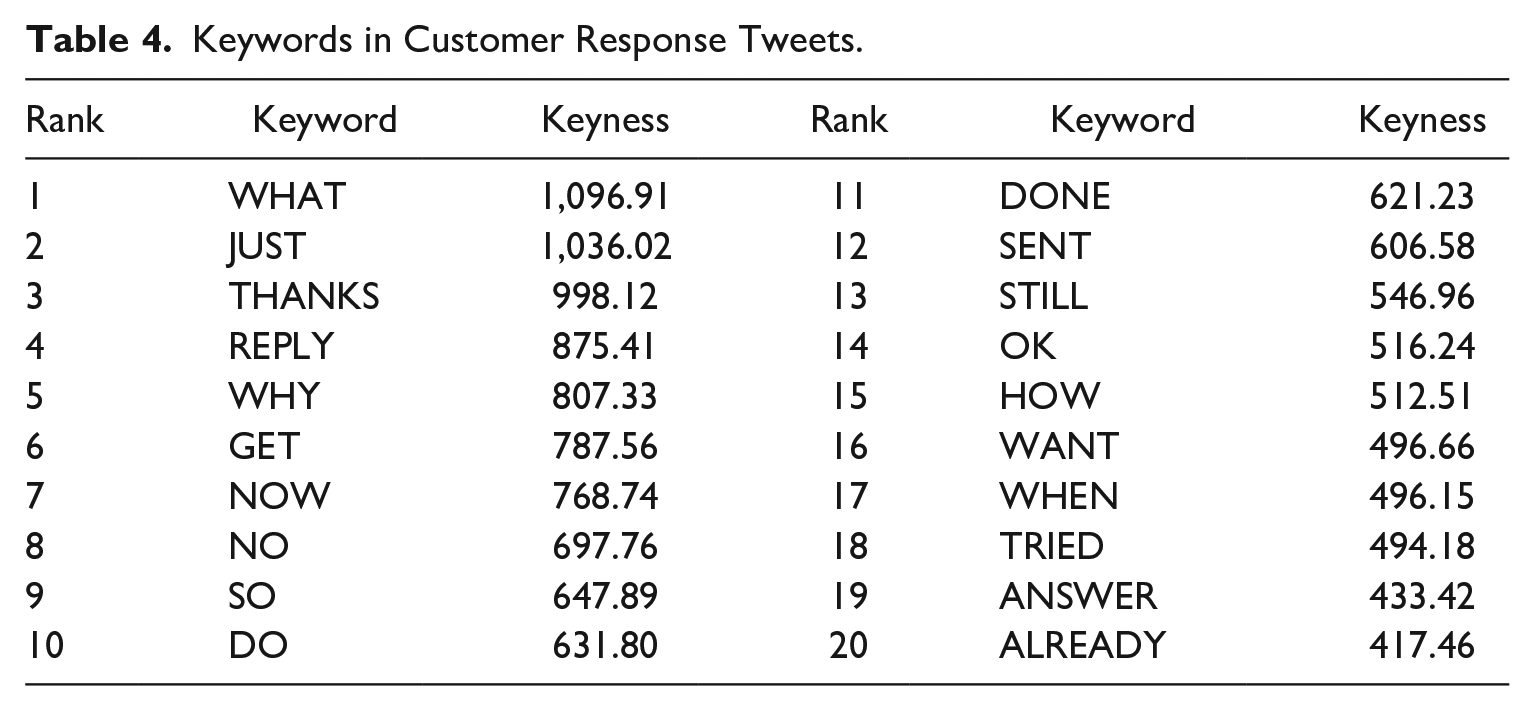
As Table 4 shows, several of the words that are key in customer response tweets are the same as the keywords that were identified for customers’ initial tweets in Table 1. Thus, several of them indicate that customers are still asking questions, such as the top keyword what, the keywords why, how, when, and the auxiliary do. The fact that they include requests for information when responding to Ryanair’s social media managers implies that the information they initially requested was not provided or the reply they received did not answer their question to a sufficient extent. Likewise, the verbs want and tried are also key in customer response tweets, which shows that they are still talking about what they want to do or what they have already tried to do to solve their travel issues, often to no avail (e.g., I tried and didn’t work; I tried that but it wasn’t very helpful; I’ve tried that too and no luck; tried that still not working; we tried to do this but kept receiving an error message).
In addition, the adverbials just, still, and now are key in customer response tweets and they also characterized customers’ language use in their initial tweets, as Table 1 showed. Together with the form already, these keywords indicate that customers are concerned about temporal issues when replying to the airline. They point out what they have already tried to do, complain about still not having had any help from Ryanair, and explain which problems they are facing at this point in time (e.g., nearly 3 hours delayed now; been on hold for 20 minutes now; you now want us to pay extra for our cabin bags). Customers thus emphasize the amount of time that has passed already, that they have tried to resolve their travel issues for some time, and that—despite it all—they have still not had a solution to their problem. Likewise, the form just is used with a temporal meaning to express, for example, that a customer has just sent a direct message, often providing the information that a social media manager had asked for in their tweet, such as a booking reference. At the same time, next to sent, also the forms want and wanted as well as wondered and wondering are top collocates of the adverbial just in the customer response sample, which indicates that it is also used as a hedging device, toning down the face-threatening aspects of their requests for information.
Furthermore, the particle no is also key in customer response tweets. This indicates that customers still deplore the absence of certain features that they are missing and that they would normally expect to form part of an airline’s service provision. When studying the top 20 collocates of no in customer response tweets (see Table 5), it turns out that several of them are the same as in their initial tweets. The top collocate is again the adjective longer and customers repeatedly complain about not having received any communication, pointing out the absence of an explanation, info(rmation), updates, and announcements. Studying collocates and meta-discursive references thus shows that even after they have received a reply from Ryanair, customers still often find themselves in a state of uncertainty (e.g., no idea) in which they lack information (e.g., no info, no explanation). In fact, more than half of the top 20 collocates of no are the same in customers’ initial tweets addressed to Ryanair and in their response tweets. This indicates that customers have similar questions and concerns before and after they have had a reply from the airline, which implies that the answer they got did not provide them with the information or help needed, and could thus be regarded as unhelpful.
Collocates of No in R1 Position in Customer Response Tweets.
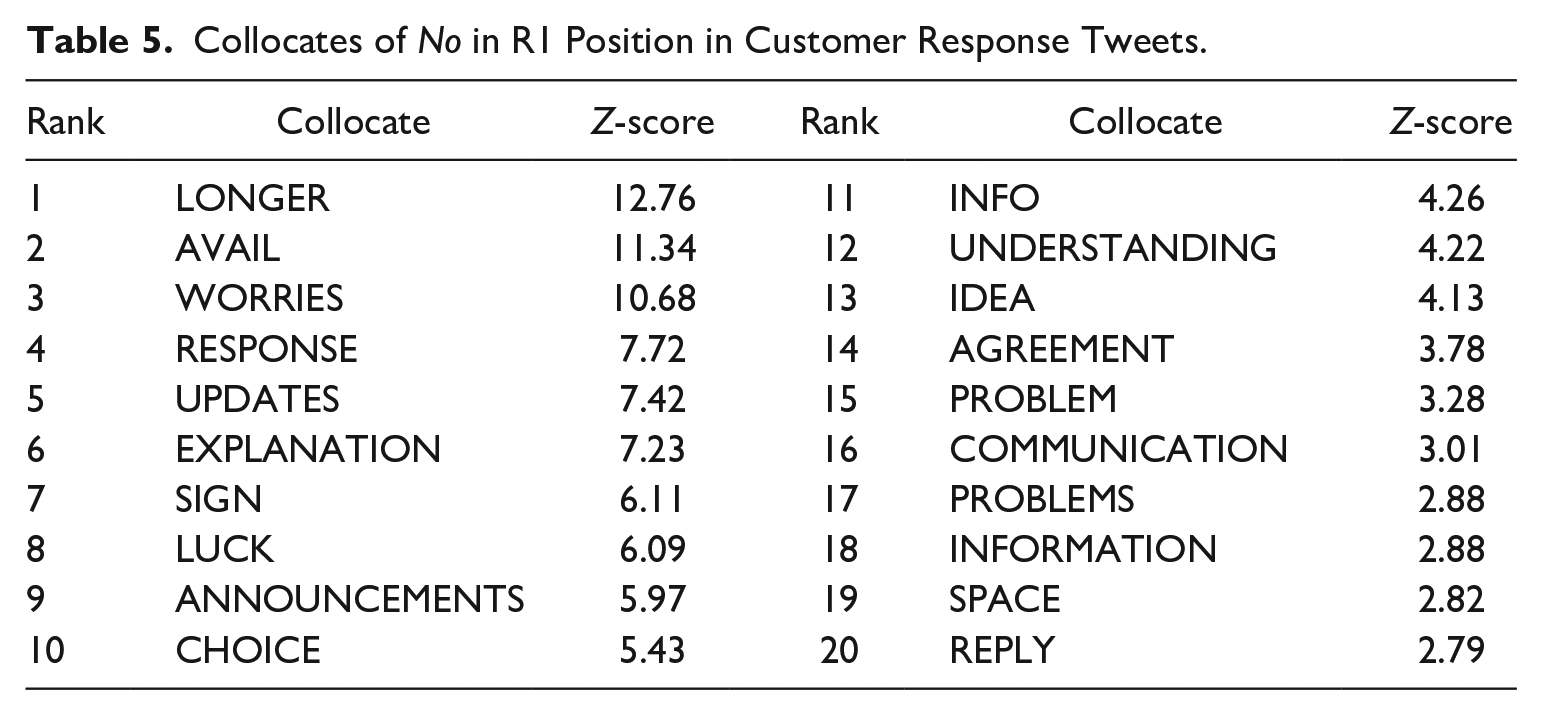
In addition to these shared collocates, the remaining top 20 collocates of no in customer response tweets include the forms worries and problem(s). The collocations no worries and no problem are mainly used by customers to acknowledge the response they have received from Ryanair’s social media managers and to express understanding, for example, for a delayed reply or the fact that the airline does not offer a specific service. In this sense, no does not indicate an absence but conveys empathy with Ryanair staff. Likewise, the keywords thanks and ok in Table 4 underline that customers tend to express appreciation for the corporate replies they receive on Twitter, with thanks being the keyword with the third highest keyness value, 9 and they acknowledge the information received by using the interjection okay. In fact, both thanks and thank (you) are two of the top three collocates of the form ok in customer response tweets, which indicates that they frequently co-occur and have a strong level of attraction. Like the use of the particle just as a hedging device, these collocations and keywords illustrate that customers use politeness markers in their responses to corporate tweets: they acknowledge the help they have received and express appreciation for it. In addition to requesting information, pointing out the absence of features, and expressing their frustration by emphasizing the amount of time they have spent trying to get support, customers therefore also express positive evaluation of customer service efforts and communication.
Two further keywords in Table 4 pertain directly to the topic of communication: the forms reply and answer. These forms are interesting as they give insight into customers’ meta-discursive references to the corporate responses they get from the airline and therefore reveal how customers perceive these responses, both with regard to their helpfulness as well as aspects of corporate language use. To gain further understanding of the way in which customers use these keywords, I carried out a collocation analysis to uncover the attitudes that customers express toward Ryanair’s tweets and to determine the communicative features that lead to customer satisfaction or frustration with customer service. The results of this analysis are given in Table 6, which lists the top 10 collocates appearing in first position to the left of the words reply and answer in the sample of customer response tweets.
Collocates of Reply and Answer in L1 Position in Customer Response Tweets.
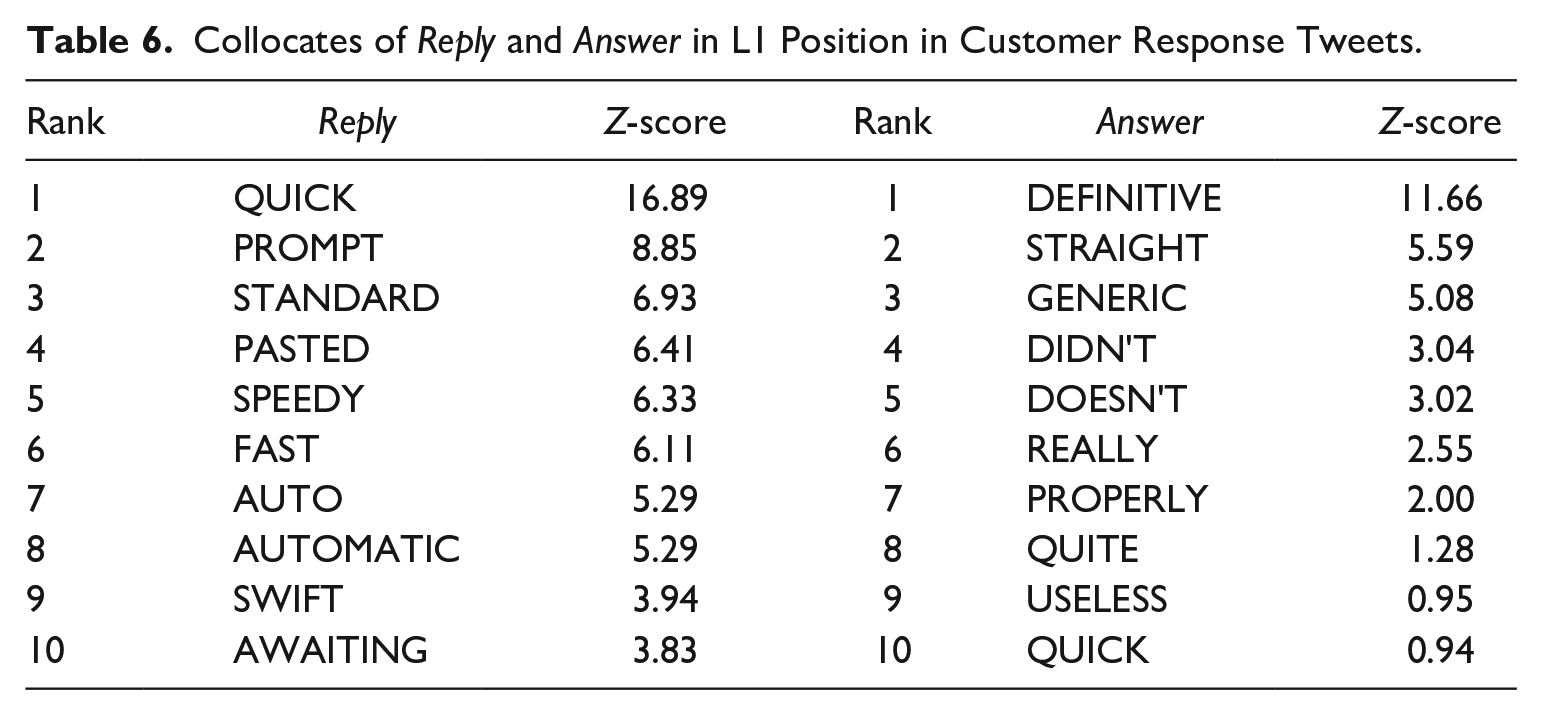
As Table 6 shows, five of the top collocates of reply pertain to the speed with which a response is sent. This links back to the finding discussed above pointing out that time and temporal issues seem to be among passengers’ main concerns. The number one collocate of reply is the adjective quick and, as example (7) illustrates, customers use it when thanking social media managers for a quick reply. In this example, the user expresses positive evaluation of and appreciation for getting a response so quickly and also notes that this is an improvement compared to previous experiences they have had with Ryanair. At the same time, their tweet indicates that the answer they received, though fast, did not provide the required information, which pertained to the current status of their flight. Example (8) shows that the adjectives conveying speed are not exclusively used when thanking the airline but also form part of requests. Here a customer confirms that they have just sent a direct message stating their booking reference, as asked for by the social media manager, and they underline that they expect a prompt reply, adding force to their statement through the repeated use of exclamation marks.
(7) Thanks. It is great to get such a
(8) Done!! I’m waiting for a
(9) great, unfortunately your “service” provider does not read clearly. Second time stating my problem, second time I get a scripted
Next to speed, 4 of the top 10 collocates of reply refer to the automated nature of the corporate responses tweeted by Ryanair. Thus, customers point out that the reply they got was a standard reply that was copied and pasted or had an auto(matic) feel to it. This is illustrated in example (9), where a customer describes a reply as being scripted and standard, highlighting that it did not address their problem as it did not properly take their initial message into account. This shows some of the main criticism customers have of standard replies: they are often not relevant as they do not refer to their individual needs and can thus be considered unhelpful. Fuoli et al. (2021, p. 21) note that generic responses may be perceived as impolite by customers as they reflect a detached style, which may give the impression that a company is not interested in the customer’s problem. However, it may as well be that their dissatisfaction stems from the mismatch between the question they asked and the answer they received, and the ensuing uncertainty.
Concerning the keyword answer, its top 10 collocates in Table 6 show that there is some overlap with the collocates of reply through the adjectives generic and quick, providing further evidence that customers are concerned about the speed of corporate responses as well as their standardized nature. The remaining collocates, however, open up a new perspective: the top two collocates of answer are the forms definitive and straight. As examples (10) and (11) illustrate, they are often used by passengers to underline that the answers they have received did not provide them with the information needed. Example (10), for instance, quotes the reply to a corporate tweet in which a social media manager had sent a link to Ryanair’s terms and conditions page. This page, as the customer points out in (10), does not include any information about suit carriers qualifying as cabin luggage though, which is why they had tweeted the airline in the first place. Likewise, in (11), a customer complains because they have repeatedly been unable to get a straight answer from customer service, leading them to describe it as useless and crappy.
(10) I’ve already checked the terms page, there’s nothing specific regarding suit carriers as carry on cabin luggage hence why I was looking for a
(11) customer service is worse than useless, I have contacted them 3 times with a simple query and still can’t get a
(12) Yeah doesnt
(13) Thanks for the
In addition, the collocates didn’t and doesn’t indicate the absence of a relevant answer, as do the adverbs really and properly. In example (12), for instance, a passenger complains that the social media manager did not provide an answer to their question, which was not about the delay to their flight. They highlight their annoyance with the corporate response by starting their tweet with a rhetorical question and imply that their request was not too difficult to solve by underlining that the social media manager only had one job, emphasized through the repeated use of exclamation marks. In (13), a customer explicitly describes the answer that did not provide them with the information asked for as useless. The collocation analysis of the keywords reply and answer has thus revealed that customers appreciate and expect to get a response from the airline quickly. They do not appreciate responses that are generic in nature or that do not properly address their original query, which are perceived as irrelevant and unsatisfactory. Customers therefore seem to care about speedy support, tweets that reflect an individual approach to language use, and answers that directly respond to their initial question or complaint.
Conclusion
This study has explored customer service interactions between the Irish airline Ryanair and its customers on Twitter using a corpus linguistic methodology. In particular, it has shown what a corpus linguistic approach can add to research on customer communication when studying a corpus that includes complete Twitter threads and combining different types of corpus linguistic analysis. Starting out from a corpus of tweets addressed to and posted by the airline Ryanair in 2018 and 2019, customer service interactions were first reconstructed based on the available metadata and then separated into three samples including customers’ initial tweets to the airline, the corporate responses they received, as well as customers’ reactions to these replies. These three samples were then explored by combining the study of keywords with collocation and cluster analysis, showing how this methodological approach can reveal the linguistic and communicative features used by customers and the airline when interacting with each other, as well as uncover passengers’ attitudes toward Ryanair’s customer service efforts.
The findings of my analysis have shown that customers often tweet Ryanair because they lack information, resulting in their initial tweets being characterized by requests for information and complaints pointing out the absence of communication. Surprisingly, the study of their reply tweets reacting to corporate responses revealed that these speech acts are still prevalent also at this stage, that is, after they have already received an answer to their initial query from the airline. This indicates that their problems were not solved by the social media team most of the time, the answer they got did not provide them with the information or help needed, and they therefore make a new attempt at inquiring about their concerns. These concerns often relate to flight delays, luggage restrictions, and additional fees charged by Ryanair for priority boarding, seat selection, and check-in luggage, as the analysis of customers’ initial tweets has uncovered. The study of the sample of corporate response tweets has revealed that Ryanair tends to use formulaic expressions and standardized responses when replying to these customer tweets, with several of the keywords of this sample co-occurring in clusters, such as please contact us DM in order to assist you better. However, it is this type of auto(matic) or generic response that customers tend not to appreciate as the analysis of customers’ responses to social media managers’ replies has shown.
In fact, by focusing on customers’ reactions to Ryanair’s tweets in a separate keyword and collocation analysis, this study has illustrated how corpus linguistic techniques can be used to study their attitude (see also Lutzky, 2021a). In particular, this part of the analysis underlined customers’ concern with temporal issues, showing that they are frustrated if they have lost time due to the airline and appreciate it when social media managers value their time by sending them a quick reply. In addition, the keyword analysis foregrounded that customers frequently use (partly routinized) polite features when replying to social media managers, expressing their appreciation and engaging in positive evaluation, which implies that their customer service queries will have been answered satisfactorily and that they do not exclusively express their dissatisfaction with Ryanair’s customer service. Studying customers’ meta-discursive references to corporate tweets through the keywords reply and answer and their collocates, furthermore, revealed that they expect to receive a response that addresses their specific situation, properly answers their initial query and is relevant, which confirms previous findings in the field (see, for example, Einwiller & Steilen, 2015: 202; Fuoli et al., 2021: 21; Mattila et al., 2013: 55). As generic responses are often not relevant and do not account for individual needs, they are generally not appreciated by customers but considered as unhelpful. Likewise, customers complain about corporate tweets that do not give a definitive or straight answer, that do not really answer their original question, and do not provide the information they requested (see also, for example, Fan & Niu, 2016; van Herck et al., 2020). While template responses may appear to be an efficient means of replying to customers from a corporate perspective, a context-sensitive approach to language use and communication that takes into account the customer’s original message may go a long way in contributing to customer communication that is perceived positively.
The corpus linguistic analysis of customers’ reactions to Ryanair’s response behavior thus allows insights into what customers appreciate and what they do not appreciate, reflecting their positive or negative attitude toward certain webcare efforts on the part of the airline. It opens a window on customers’ perception of corporate communication: It highlights areas of customer dissatisfaction (e.g., lack of information, a generic answer) and customer needs (e.g., a clear, quick answer), and thus indicates which aspects of communication lead to customers’ satisfaction or frustration with customer service. At the same time, these findings imply which changes would need to be made on a linguistic and communicative level as part of the airline’s webcare efforts in order to facilitate customer service interactions and improve levels of customer satisfaction. This study, therefore, shows that corpus linguistic methods may also fruitfully inform consultancy work, and offer advantages to practitioners aiming to gain further understanding of existing approaches to customer communication and find ways of enhancing them (see also Lutzky, 2021a: Chapter 8).
While this study has contributed to research on digital customer communication, it also has several limitations. By carrying out a case study of the airline Ryanair, the corpus analyzed focused on tweets addressed to and posted by a single airline. As a consequence, the results gained only give a snapshot of customer service exchanges on Twitter and future research could expand the methodological approach introduced here to a data set that is more representative of the airline industry. At the same time, this study has shown how a corpus linguistic methodology can be used to gain insights into customers’ reactions to the corporate replies they receive in online customer service exchanges. In particular, it has illustrated how taking a layered approach to interactive exchanges between customers and social media managers, and studying the tweet text customers post when replying to social media managers, can uncover their attitude toward the customer service interaction and reveal whether their initial queries and complaints were resolved. While this is a promising starting point, the corpus linguistic approach would benefit from being complemented by additional methods, such as experiments, to also assess the effectiveness of the communication. Thus, future research could build on the advantages of corpus linguistics, which can give an impression of customers’ perception of a company and its customer service efforts by analyzing its language use, and combine it with an experimental research design in a mixed methods approach (see, for example, Fuoli et al., 2021, for one of the first studies in the field adopting such an approach).
Footnotes
Declaration of Conflicting Interests
The author declared no potential conflicts of interest with respect to the research, authorship, and/or publication of this article.
Funding
The author received no financial support for the research, authorship, and/or publication of this article.
