




Abstract
The growing importance of social media in the political arena seems to be in line with the mediatization of politics thesis, which states that mediated communication is becoming more important in politics and increasingly influences political processes. However, how politicians’ social media activities and politicians’ perceptions concerning social media have developed over time has rarely been examined. Moreover, it is unclear how the politicians’ activities and perceptions are related to each other. Referring to theoretical approaches, such as the influence of presumed influence approach, four surveys were conducted among German parliamentarians (MPs) between 2012 and 2016 (n = 194/149/170/118). The results indicate that the MPs’ self-reported social media activities and perceptions have remained remarkably constant since 2012. Regression analyses indicate that MPs’ self-reported social media activities and perceptions are hardly related to each other. This raises the question whether mediatization processes are indeed driven by politicians’ perceptions about media influences.
Keywords
Social media have become more and more relevant political communication arenas. Social media are used by various political organizations (Nitschke, Donges, & Schade, 2016), they have evolved to key territories for populist actors (Engesser, Ernst, Esser, & Büchel, 2016), and their importance in election campaigns as well as their influence on election results is highly debated (Groshek & Koc-Michalska, 2017).
These trends seem to be in line with the mediatization of politics thesis, which states that the media and mediated communication are becoming increasingly important in politics and increasingly influencing political processes (Mazzoleni & Schulz, 1999; Strömbäck & Esser, 2014). Several authors have discussed the consequences of the growing importance of social media (Chadwick, 2013; Klinger & Svensson, 2015; Schulz, 2014; van Dijck & Poell, 2013). Although first empirical studies have analyzed the “social mediatization” in organizations (e.g., Olsson & Eriksson, 2016), most empirical studies on the mediatization of politics still focus on traditional news media (Elmelund-Præstekær, Hopmann, & Nørgaard, 2011; Kepplinger, 2002; Maurer & Pfetsch, 2014; Strömbäck, 2011; van Aelst et al., 2008; van Aelst & Walgrave, 2011; Zeh & Hopmann, 2013). On one hand, this is convincing, as the news media still dominate Western media environments (e.g., Klinger & Svensson, 2015; Strömbäck & Esser, 2014). In addition, mediatization focuses on long-term processes (Kepplinger, 2002; Mazzoleni & Schulz, 1999; Strömbäck & Esser, 2014), and social media are a relatively new phenomenon. On the other hand, media environments have changed dramatically since the emergence of social media (Chadwick, 2013), and within a short time period, political actors, organizations, journalists, and citizens have integrated social media into their media repertoires (Broersma & Graham, 2013; Gulati & Williams, 2013; Newman, Fletcher, Kalogeropoulos, Levy, & Nielsen, 2017; Nitschke et al., 2016). Thus, even short-time longitudinal studies are necessary to identify changes and stable patterns in the importance of social media in politics.
Since it has become widely accepted that mediatization is less fostered by media and rather by individuals (Schulz, 2014), there is a shift from a “media-centric” to an “actor-centric” perspective in mediatization research (Esser & Strömbäck, 2014, p. 227). In particular, politicians’ perceptions and politicians’ media activities as well as the relationship between both factors often served as indicators of the extent to which politics is mediatized (e.g., Cohen, Tsfati, & Sheafer, 2008; Kepplinger, 2002; Strömbäck, 2011). These indicators, with a focus on social media, were also used in this study. The study is based on data from four surveys conducted between 2012 and 2016 among members of Germany’s national parliament (MPs) and asks how have the German MPs’ self-reported social media activities and perceptions changed over time, and how have the German MPs’ social media activities been affected by their perceptions? Thus, the study supplements the few longitudinal studies that have investigated the process of the mediatization of politics (Elmelund-Præstekær et al., 2011; Kepplinger, 2002; Negrine, 1999; Pontzen, 2013; Zeh & Hopmann, 2013). Furthermore, to the authors’ knowledge, this is the first study which analyzes the influence of perceptions about media influences on one’s own self-reported media activities over time (cf. “influence of presumed influence,” Gunther & Storey, 2003). This allows investigating whether mediatization processes are indeed “driven to a large extent by politicians’ perceptions that media have a powerful influence on politics” (Tsfati, 2014, p. 572).
Mediatization of Politics
Mediatization of politics can be defined as “a long-term process through which the importance of media and their spill-over effects on political processes, institutions, organizations and actors have increased” (Strömbäck & Esser, 2014, p. 6). Following Strömbäck (2008), this process can be differentiated in four highly related phases. The phases refer (1) to which degree the media constitute the dominant source of political information, (2) to which degree the media have become independent from political institutions, (3) to which degree the media coverage is mainly governed by the media logic instead of the political logic, and (4) to which degree political actors are governed by the media logic instead of the political logic. While the first two phases are largely completed in most western European democracies (Maurer & Pfetsch, 2014, p. 340), it is unclear to what extent the third and fourth phases are developed. In this study, the fourth phase of mediatization is analyzed, which “deals with the very essence of the mediatization of politics” (Strömbäck & Esser, 2014, p. 6).
Fourth Phase of Mediatization: The Role of News Media
Studies focusing on the fourth phase of mediatization examine to what degree political actors are guided by the media logic instead of the political logic (for the theoretical discussion of the political and media logic, see, for example, Altheide & Snow, 1979; Esser, 2013; Lundby, 2009). Most of these studies have analyzed the impact of the news media logic, and thus, the impact of “media-specific rules of selecting, interpreting, and constructing political news messages” (Esser, 2013, p. 160). If politicians create, for example, pseudo-events or change their language style in favor of the news media’s needs, they follow (news) media logic rather than the political logic (Esser, 2013; Strömbäck & Esser, 2014). This form of self-mediatization (e.g., Esser, 2013) is only rational, if political actors perceive that the content that is distributed via news media influences relevant target groups (Donges & Jarren, 2014; Strömbäck, 2011; Strömbäck & Esser, 2014). Thus, “the first aspect of mediatization is perception” (Donges & Jarren, 2014, p. 189).
Empirical studies on the mediatization processes among politicians have analyzed the politicians’ media activities, perceptions, and the relationship between both factors. Kepplinger (2002), for example, shows that the quantity of German MPs’ information-related activities has increased over time, while their decision-making activities remained rather constant. According to Pontzen (2013), the number of press releases, interviews, and media trainings of German MPs significantly increased from 2005 to 2011.
Most politicians perceive that the mass media have some or great influence over politics (Strömbäck, 2011), can “make and break politicians” (Strömbäck, 2011; van Aelst et al., 2008), are important on diverse stages of the political process (Fawzi, 2018), and rather set the political agenda than politics itself (van Aelst & Walgrave, 2011). Moreover, a majority of Dutch politicians perceived that other politicians would do anything to get media coverage (Brants, de Vreese, Möller, & van Praag, 2010), and German MPs stated that the media have more influence on candidates’ recruitment than in the past (Pontzen, 2013). According to the “influence of presumed influence” approach (Gunther & Storey, 2003), these perceptions have consequences: individuals who perceive strong media influences on others react to these perceptions and change their attitudes or behaviors. This assumption was, for example, confirmed in a study among Israeli MPs (Cohen et al., 2008): their media-related activities were influenced by their perception that the media have a strong political influence on the public.
Taken together, politicians perceive that the media have a strong influence on politics and react by investing more time in media-related activities. However, most studies are based on cross-sectional data (but see, e.g., Kepplinger, 2002) and analyze either politicians’ perceptions or activities (but see, e.g., Cohen et al., 2008). Moreover, these results cannot simply be transferred to social media, as these platforms have a different media logic.
Fourth Phase of Mediatization: The Role of Social Media
Citizens across countries increasingly use social media as a source to receive news, and many social media users in countries such as the United States (54%), the United Kingdom (42%), and Germany (25%) followed at least one political party or politician (Newman et al., 2017, pp. 12, 17). Politicians, in turn, have adopted social media within short time periods. For example, Facebook adoption among the major party candidates for the United States Congress increased remarkably from 2006 to 2012 (Gulati & Williams, 2013). Finally, many journalists conduct a daily social media monitoring and increasingly include social media content from politicians and other actors in their news reports (e.g., Broersma & Graham, 2013).
These examples show that political communication processes have rapidly changed. However, as the news media still dominate political information and communication (e.g., Newman et al., 2017), Chadwick (2013) argued that the contemporary media system has evolved to a hybrid media system. “The hybrid media system is based upon conflict and competition between older and newer media logics but it also features important pockets of interdependence among these logics” (Chadwick, 2013, p. 207). Politicians need to adopt both media logics to succeed in this media environment. Klinger and Svensson (2015, 2016) have carved out the differences between the ideal types of news media logic and network media logic (for an alternative conceptualization, see, van Dijck & Poell, 2013). They focused on the differences regarding production content, distribution of information, and media usage. Contrary to the news media logic, the network media logic is much more based on amateurs who produce content based on their own interests and based on the anticipated interests of fragmented publics. The distribution of information is based on virality, which means that users distribute popular content with like-minded others, who possibly share this content within their network. Finally, contrary to the news media audience, the social media audience is more fragmented, interactive, and bound to networks of peers or interests, which enables a high level of selective exposure.
Politicians can address these fragmented social media audiences directly with their messages. Popularity cues, such as the number of likes, shares, or retweets, give politicians hints as to who and how many individuals of a specific audience receive these messages and “what content and presentations techniques ‘work’ online” (D’heer, 2018, p. 177). However, as it is “nearly impossible to determine the actual audience” (Litt, 2012, p. 312), politicians communicate to an “imagined audience” (e.g., Litt, 2012). This imagined audience can be differentiated in an abstract audience and specific target audiences (Litt & Hargittai, 2016) with whom politicians should communicate for several reasons.
Assuming that politicians want to be (re-)elected, they need to convince as many citizens as possible to vote for them in the next election. Thus, politicians should address the rather abstract audience of “the general public.” However, this general public more frequently receives political information from news media than from social media (Newman et al., 2017). Because journalists, as gatekeepers of the news media, also monitor social media platforms and include social media content in their coverage (e.g., Broersma & Graham, 2013), they are an important target audience of politicians’ social media activities. Another important target audience are the politicians’ voters. First, politicians need to communicate with their voters, because former voters have to be persuaded to vote again for the politician. Second, politicians’ voters or followers may interact with the politicians’ messages (Kalsnes, Larsson, & Enli, 2017), which increases the virality of these messages. Finally, other politicians are an important target audience. For example, in party-centered political systems such as Germany, political parties and their members primarily determine the chances of politicians getting a parliamentary seat by deciding about a politician’s position on the party list. German MPs are aware of this and accordingly perceive that relationships within one’s own party are a very important factor for political success (Pontzen, 2013).
Hypotheses
Empirical studies show that the majority of politicians have adopted social media within short time periods (e.g., Gibson & McAllister, 2015; Gulati & Williams, 2013). However, many politicians use social media only occasionally and less in an interactive way (e.g., Enli & Skogerbø, 2013; Nuernbergk & Conrad, 2016; Pontzen, 2013), with usage decreasing shortly after election campaigns (e.g., Enli & Skogerbø, 2013; Nuernbergk & Conrad, 2016). Furthermore, politicians adapt and use Facebook and Twitter in different ways (e.g., Enli & Skogerbø, 2013; Larsson & Kalsnes, 2014; Quinlan, Gummer, Roßmann, & Wolf, 2018). Since most of these studies did not have a longitudinal design, it is unclear if and how fast social mediatization processes take place. Moreover, these studies did not argue from a mediatization perspective and did not consider the specifics of the network media logic. However, based on these results and according to the mediatization of politics thesis, we assume that German MPs report that the amount of their social media activities changed over time:
H1. According to the German MPs’ self-reports, their Facebook and Twitter activities increased from 2012 to 2016.
Although politicians or campaign managers perceive that traditional news media (e.g., television and newspapers) and traditional campaign tools (e.g., press releases) are more important or influential than social media, social media are attributed some or even great political influence (e.g., Karlsen & Enjolras, 2016; Lilleker, Tenscher, & Štětka, 2015; Magin, Podschuweit, Haßler, & Russmann, 2017; Pontzen, 2013; Quinlan et al., 2018). In particular, “Facebook is a must have” for political parties (Magin et al., 2017, p. 1707), while Twitter is perceived as less influential (e.g., Karlsen & Enjolras, 2016; Lilleker et al., 2015; Quinlan et al., 2018). Moreover, the politicians’ perception that Facebook is important significantly increased during the last years (e.g., Karlsen & Enjolras, 2016). It is likely that the perceived influence of Twitter is also increasing over time, particularly since politicians like Donald Trump detected Twitter as campaign tool. Thus, considering that social media have fragmented audiences and in line with the mediatization of politics thesis, we assume:
H2. According to the German MPs’ perceptions, the political influence of Facebook and Twitter on (1) the general public, (2) journalists, (3) other politicians, and (4) their own voters increased from 2012 to 2016.
Finally, some studies have analyzed the influence of politicians’ perceptions on their social media activities. Politicians who strongly perceive that their voters, colleagues, and party expect that politicians should use social media are more likely to adopt social media (Hoffmann, Suphan, & Meckel, 2016). Politicians who perceive that social media are important in electoral campaigning increase their social media activities (Karlsen & Enjolras, 2016). Focusing on the influence of presumed social media influence, studies indicate that the perceived influence of social media or the Internet on other politicians, citizens, and journalists partially affected politicians’ social media activities (e.g., Bernhard & Dohle, 2015; Metag & Marcinkowski, 2012 for contrary results: e.g., Marcinkowski & Metag, 2014). A longitudinal and largely context-independent analysis should make these previous findings more robust and could show to what extent politicians’ self-mediatization in social media is affected by their perceptions regarding their imagined audiences. Thus, in line with the mediatization of politics thesis, it is hypothesized:
H3. The stronger German MPs perceived the political influence of Facebook and Twitter to be on (1) the general public, (2) journalists, (3) other politicians, and (4) their own voters between 2012 and 2016, the more extensively, according to their self-reports, they used Facebook and Twitter between 2012 and 2016.
Method
Procedure and Sample
To test the hypotheses, two standardized surveys were conducted among the members of the 17th (spring 2012 and 2013) and 18th German Bundestag (spring 2015 and 2016). At the time of the surveys, no national elections or other specific events occurred that could have distorted the responses.
To increase the number of participants, all MPs were invited to participate in the surveys. In addition, the respondents were guaranteed absolute anonymity. 1 The invitations were sent by letter. The questionnaire and a stamped return envelope were enclosed. The MPs were also able to complete the survey online. At 2 and 4 weeks after the invitation, reminder emails were sent.
In 2012, 194 members of the 17th German Bundestag participated in the survey (response rate: 31.3%), while 149 MPs took part in 2013 (24.0%). In 2015, 170 members of the 18th German Bundestag participated (27.0%), while 118 MPs participated in 2016 (18.6%).
Although the response rates varied over time, the samples were not biased with respect to sex and age (Table 1). With respect to party affiliation, the 2012 sample fitted well to the entire Bundestag. In 2013, 2015, and 2016, MPs of the Christian Democratic Union of Germany/Christian Social Union in Bavaria (CDU/CSU) were underrepresented. Social Democrats were overrepresented in 2013 and 2016, while members of the Left Party were overrepresented in 2015 and 2016.
Samples Compared With the Entire Bundestag.
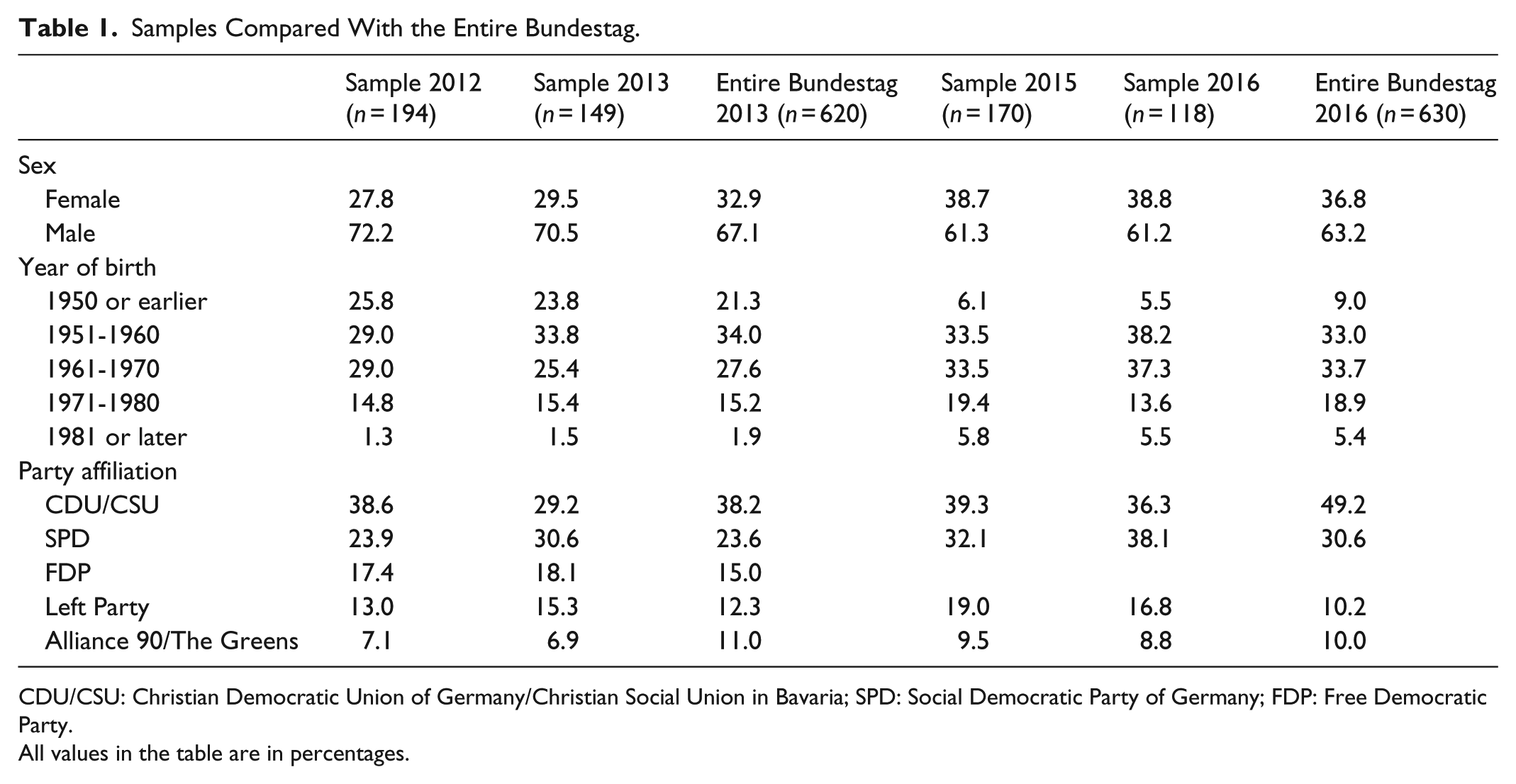
CDU/CSU: Christian Democratic Union of Germany/Christian Social Union in Bavaria; SPD: Social Democratic Party of Germany; FDP: Free Democratic Party.
All values in the table are in percentages.
Measures
The study was part of a larger research project. Therefore, not all characteristics of mediatization could be addressed in the surveys. Moreover, the concept of the network media logic was not yet developed when conducting the first surveys. Thus, if we would design the surveys today, some questions would be added and some question wordings would be adjusted. However, to maintain the longitudinal character of the study, most questions were not adjusted between the surveys.
German MPs’ Self-Reported Social Media Activities
In each survey, the MPs were asked how often they used Facebook and Twitter (1) to get political information and (2) to broadcast information about their political work. In the 2015 and 2016 surveys, they were additionally asked how often they used Facebook and Twitter (3) to broadcast information about their everyday lives. All items were measured on five-level scales. To make the scales more comparable, all scales were slightly adjusted in 2015 and 2016 (2012/2013: 1 = never to 5 = daily [get information] and 1 = not at all to 5 = very intensive [broadcast information about political work]; 2015/2016: 1 = never to 5 = very frequently).
German MPs’ Perceptions About the Political Influence of Social Media
MPs were asked in each survey how strongly they believed the political influence of (1) Facebook and (2) Twitter to be on (a) the general public, (b) journalists, and (c) other politicians. In 2015 and 2016, MPs were also asked to assess the political influence of Facebook and Twitter on (d) their own voters (all items: five-level scales: 1 = no influence to 5 = very strong influence).
Covariates
In addition to sex, age, and party affiliation, the MPs’ perceptions about the reach and suitability of social media were requested, because these perceptions also seem to influence political actors’ social media activities (e.g., Kelm, Dohle, & Bernhard, 2017). Thus, the MPs were asked to estimate how many people in Germany (in each survey), journalists, politicians, and their own voters (in 2015 and 2016) used Facebook and Twitter to receive political information. The items were measured on five-level scales (2012/2013: 1 = very few people to 5 = very many people; 2015/2016: 1 = almost no one to 5 = almost all). Moreover, the MPs were asked how suitable they considered Facebook and Twitter to be for getting political information (in each survey) and for broadcasting information about their own political work (in 2015 and 2016; all items: five-level scale; 1 = not suitable at all to 5 = very suitable).
Results
German MPs’ Self-Reported Social Media Activities
It was hypothesized that German MPs’ self-reported Facebook and Twitter activities increased from 2012 to 2016 (H1). However, according to the MPs’ answers, their social media activities were rather constant (Table 2).
Bundestag Members’ Self-Reported Social Media Activities.
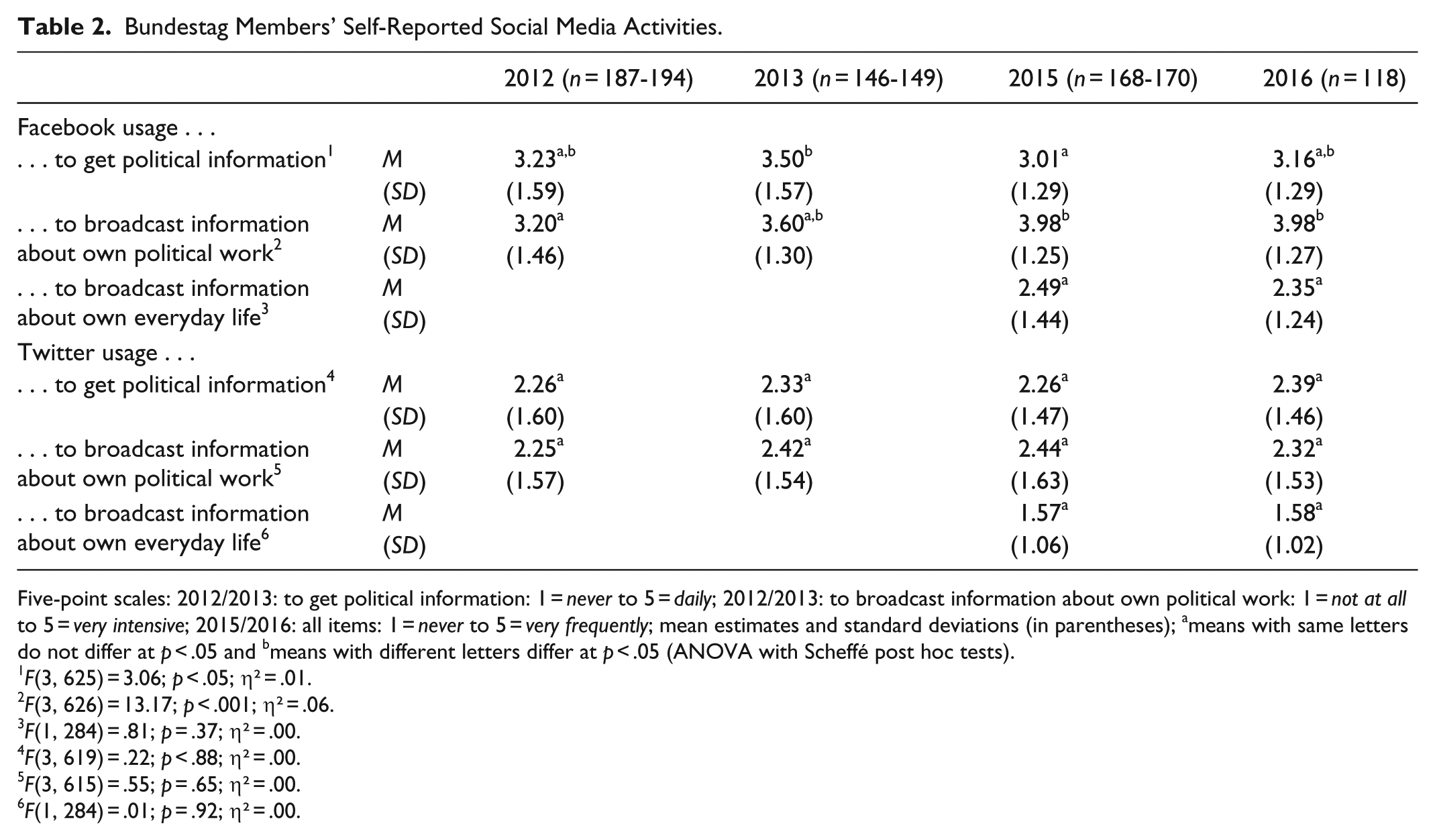
Five-point scales: 2012/2013: to get political information: 1 = never to 5 = daily; 2012/2013: to broadcast information about own political work: 1 = not at all to 5 = very intensive; 2015/2016: all items: 1 = never to 5 = very frequently; mean estimates and standard deviations (in parentheses); ameans with same letters do not differ at p < .05 and bmeans with different letters differ at p < .05 (ANOVA with Scheffé post hoc tests).
F(3, 625) = 3.06; p < .05; η² = .01.
F(3, 626) = 13.17; p < .001; η² = .06.
F(1, 284) = .81; p = .37; η² = .00.
F(3, 619) = .22; p < .88; η² = .00.
F(3, 615) = .55; p = .65; η² = .00.
F(1, 284) = .01; p = .92; η² = .00.
Using Facebook and Twitter to receive political information did not increase over time. Instead, German MPs stated that their Facebook usage for this purpose significantly decreased between 2013 and 2015, but reached the former level in 2016. The MPs’ self-reported Facebook usage for broadcasting information about their own political work significantly increased between 2012 and 2015 and remained at a high level in 2016. In contrast, using Twitter to broadcast information remained at a consistently lower level. In 2015 and 2016, the MPs were also asked how often they broadcasted information about their everyday lives via Facebook and Twitter, with the results indicating that they rarely used Facebook and Twitter for this purpose. For all purposes, German MPs stated that they used Facebook more frequently than Twitter.
Taken together, according to the MPs, only broadcasting information about their own political work via Facebook noticeably increased in the observed period. However, MPs’ self-reported intensity of other social media activities hardly changed between 2012 and 2016. Thus, H1 has to be rejected.
German MPs’ Perceptions About the Political Influence of Social Media
It was hypothesized that the German MPs’ perceptions about the political influence of Facebook and Twitter on the (1) general public, (2) journalists, (3) other politicians, and (4) their own voters increased from 2012 to 2016 (H2). However, in most instances, the perceived influence of Facebook and Twitter remained more or less constant (Table 3).
Bundestag Members’ Perceptions About the Political Influence of Social Media.

Five-point scales: 1 = no influence to 5 = very strong influence; percentages summarize both approving scale digits; ameans with same letters do not differ at p < .05 and bmeans with different letters differ at p < .05 (ANOVA with Scheffé post hoc tests).
F(3, 621) = 6.00; p < .001; η² = .03.
F(3, 619) = 5.67; p < .001; η² = .03.
F(3, 620) = 2.97; p < .05; η² = .01.
F(1, 283) = .10; p = .76; η² = .00.
F(3, 583) = .06; p < .01; η² = .03.
F(3, 580) = 2.46; p = .06; η² = .01.
F(3, 584) = 3.38; p < .05; η² = .02.
F(1, 254) = 4.69; p < .05; η² = .02.
The perceived political influence of Facebook on the general public was significantly lower in 2015 than in 2012/2013, but reached the former level in 2016. Politicians’ perceived political influence of Facebook on journalists decreased from 2013 to 2015/2016. The perceived political influence of Facebook on politicians and their own voters did not change in the observed period.
The perceived political influence of Twitter on the general public decreased from 2012/2013 to 2015, and the perceived political influence of Twitter on other politicians increased from 2012 to 2013. However, both perceptions reached the former level in the following years. Regarding the perceived political influence of Twitter on journalists, the MPs’ perceptions did not change in the observed period. In contrast, German MPs’ perceptions about the political influence of Twitter on their own voters significantly increased from 2015 to 2016.
Taken together, the German MPs’ perceptions about the political influence of social media hardly changed between 2012 and 2016. Thus, H2 has to be rejected.
However, looking at those respondents who observed a strong social media influence (for a similar proceeding, see, for example, Fawzi, 2018; Strömbäck, 2011; van Aelst et al., 2008), the picture is different. The proportion of German MPs who perceived a (very) strong influence of Twitter on the general public (+83.0%), journalists (+63.1%), politicians (+93.3%), and their own voters (+109.0%) strongly increased from 2012 to 2016. This trend is not visible on average, because the proportion of those MPs who perceived Twitter as not or slightly influential decreased by only 13.3% on average in the observed period. However, the proportion of those who perceived a strong influence of Facebook on the general public (–39.4%), journalists (–1.8%), politicians (+11.4%), and their own voters (+3.2%) decreased or did not change notably from 2012 to 2016.
Influence of German MPs’ Social Media Perceptions on Their Self-Reported Social Media Activities
To test to what extent the self-reported Facebook and Twitter activities of German MPs were affected by their perceptions about the influence of Facebook and Twitter on the (1) general public, (2) journalists, (3) other politicians, and (4) their own voters (H3), hierarchical linear regression analyses were calculated with the data from all surveys. The German MPs’ perceptions about the influence of Facebook and Twitter on the general public, journalists, politicians, and their own voters served as the independent variables. The frequency of the MPs’ self-reported Facebook and Twitter usage to broadcast information about their own political work served as dependent variables. Sex, age, education, party affiliation, the perceived reach, and the perceived suitability of Facebook and Twitter served as covariates. 2
Table 4 indicates to what extent the German MPs’ self-reported Facebook activities were influenced by their perceptions about the political influence of Facebook on their target groups. In almost all cases, there was no relationship between the German MPs’ perceived political influence and their self-reported Facebook activities. The only significant result is observed in 2015, where the German MPs’ self-reported Facebook activities were positively influenced by their perception of Facebook’s political influence on their own voters (β = .23, p < .01).
Influence of Bundestag Members’ Perceptions on the Self-Reported Intensity of Their Facebook Activities to Broadcast Political Information.

CDU/CSU: Christian Democratic Union of Germany/Christian Social Union in Bavaria; SPD: Social Democratic Party of Germany; FDP: Free Democratic Party.
Standardized beta coefficients: #p < .10; *p < .05; **p < .01; ***p < .001.
The picture changes little when focussing on Twitter (Table 5). In almost all cases, the German MPs’ self-reported Twitter activities were not affected by their perceptions about the political influence of Twitter on their target groups. The only remarkable results are observed in 2013, where the perceived political influence of Twitter on other politicians positively affected German MPs’ Twitter activities (β = .23, p < .05), and in 2016, where the perceived influence of Twitter on journalists had a positive impact (β = .26, p < .10). 3
Influence of Bundestag Members’ Perceptions on the Self-Reported Intensity of Their Twitter Activities to Broadcast Political Information.

CDU/CSU: Christian Democratic Union of Germany/Christian Social Union in Bavaria; SPD: Social Democratic Party of Germany; FDP: Free Democratic Party.
Standardized beta coefficients: #p < .10; *p < .05; **p < .01; ***p < .001.
Taken together, the German MPs’ self-reported social media activities between 2012 and 2016 were hardly affected by their perceptions about the political influence of social media on their target groups. Thus, H3 has to be rejected.
The effects of some control variables partly confirm the results of other studies. The younger the MPs, the more they stated that they used Facebook and Twitter (see, e.g., Metag & Marcinkowski, 2012). MPs of the Greens stated that they used Twitter more frequently than MPs of other parties (see, e.g., Quinlan et al., 2018). The most consistent effect on the German MPs’ social media activities is exercised by the perceived suitability of social media (see, e.g., Bernhard & Dohle, 2015; Kelm et al., 2017).
Discussion
Contemporary media systems and individuals’ media behavior have changed rapidly since the emergence of social media. Within mediatization research, these developments were worked up in a theoretically meaningful way (e.g., Klinger & Svensson, 2015), but hardly considered empirically (but see, e.g., Olsson & Eriksson, 2016). Particularly, it is unclear how these developments have changed the media behavior and the perceptions of important political decision makers. Moreover, the few studies that have examined how politicians’ perceptions and social media activities are related have led to mixed results (e.g., Bernhard & Dohle, 2015; Metag & Marcinkowski, 2012). Thus, it is unclear to what extent perceptions are indeed a major driver of mediatization processes (e.g., Cohen et al., 2008; Tsfati, 2014). This study addressed these research gaps by examining the development of German MPs’ self-reported social media activities and perceptions over time and by analyzing the relationship between politicians’ perceptions and self-reported social media activities. Data from four surveys among German MPs between 2012 and 2016 were used.
It is striking that German MPs’ Facebook and Twitter activities remained largely constant from 2012 to 2016. Only the German MPs’ self-reported Facebook activities for broadcasting information about their own political work increased significantly in the observed period. On one hand, this consistent pattern was unexpected because the (political) online world has significantly changed in recent years (e.g., Vowe & Henn, 2016). For example, social media play an increasing role for political information (Newman et al., 2017) as well as in other fields of public communication (e.g., Broersma & Graham, 2013). Moreover, a new kind of political actor was growing with the help of social media (e.g., Groshek & Koc-Michalska, 2017). On the other hand, the results could be explained by the fact that Facebook and Twitter were already the most prominent social media platforms used by German MPs at least since 2012 (results not presented). Those who have used Facebook and Twitter since 2012 may have established consistent routines that do not vary from one year to another. Moreover, as citizens have become accustomed to the MPs’ social media communication, MPs did not feel obliged to change their social media habits (Tromble, 2018).
Likewise, the German MPs’ perceptions regarding the political influence of Facebook and Twitter on their target groups, and thus on the general public, journalists, politicians, and their own voters, hardly changed from 2012 to 2016. There are some significant changes, but in most instances, these short-time peaks disappear in the following years. Again, a possible explanation for this consistency could be that Facebook and Twitter were already well established in 2012, and MPs have not changed their perceptions regarding social media since that time. Moreover, since the mediatization of politics is not a linear process (e.g., Strömbäck, 2011, p. 426), short-time upswings and downswings are expectable.
Nevertheless, the picture becomes less clear when looking at those respondents who perceived a (very) strong political influence of social media on their target groups. While the proportion of those respondents who perceived a (very) strong political influence of Facebook on their target groups has also not changed or even decreased over time, the proportion of those respondents who perceived a (very) strong political influence of Twitter on their target groups has increased by 87.1% on average. This indicates a digital divide in German MPs’ Twitter perceptions. While, on one hand, more and more German MPs perceived Twitter as (very) influential, on the other hand, the proportion of those who perceived Twitter as not or slightly influential decreased only slowly. In other words, although more and more German MPs “believe in Twitter,” there is a relatively constant proportion of parliamentarians who are rather skeptical about Twitter’s political influence. This digital divide of politicians’ Twitter perceptions is not yet mirrored in politicians’ Twitter activities. But if perceptions are indeed “the first aspect of mediatization” (Donges & Jarren, 2014, p. 189), Twitter will become more important for German MPs in the future, while the relevance of Facebook is likely to remain similar or even to decrease.
The third hypothesis assumed, in line with the influence of presumed influence approach (Gunther & Storey, 2003), that German MPs’ self-reported social media activities are influenced by their perceptions about the social media influence on mentioned target groups. The findings indicate that politicians’ perceptions about the social media influence are largely independent from their social media activities. The few significant findings should not be overstated, especially since the findings are not based on one specific independent variable (e.g., the perceived influence on journalists). Thus, the results raise two questions. The first question is whether mediatization processes are indeed driven by politicians’ perceptions about media influences. While perceptions about media influences seem to be a relevant driver in the offline world (e.g., Cohen et al., 2008), these perceptions seem to have little or no impact in the online world (e.g., Marcinkowski & Metag, 2014; Metag & Marcinkowski, 2012). One reason could be that the news media logic and the network media logic imply very different affordances. For decades, politicians have internalized the affordances of the news media logic and therefore act strategically in the offline world. However, politicians still try to understand the network media logic and use social media rather as a playground than as a strategic communication platform. Since the network media logic is in flux and will develop new affordances as technology changes, politicians are likely to continue to lag behind these developments in the future.
The second question is what motives politicians have to use social media. Maybe perceptions and activities are still somehow related to each other, but politicians do not change their social media activities automatically when they perceive a growing influence of a social media platform. Instead, they might observe the developments and perhaps adapt their social media activities at later times or occasions (e.g., election campaigns). Another explanation could be that politicians use social media just because they want to present themselves “as being modern, open minded, and up-to-date” (Marcinkowski & Metag, 2014, p. 161). Moreover, politicians may have intrinsic motives to use social media. Some studies, for example, indicate that politicians also use social media simply for having fun or passing time (e.g., Hoffmann et al., 2016). However, the strongest and most consistent effect on the German MPs’ self-reported social media activities was the perceived suitability to get and broadcast political information via Facebook and Twitter. This indicates a rather strategic use. Obviously, further studies are needed that focus on the motives of politicians’ social media activities.
This study has limitations. The results were based on self-reports by the MPs, which is problematic for several reasons. First, MPs’ staff often co-curate politicians’ social media communication. Thus, it is unclear to what extent politicians can correctly assess the nature and intensity of their social media activities. Although German politicians state that they have control over their social media communication (Meckel, Hoffmann, Suphan, & Poëll, 2013, p. 4), this perception could also be biased. Second, the respondents may have brightened the frequency of their social media activities (social desirability) although absolute anonymity was guaranteed. In addition, politicians may have changed their attitudes toward a socially acceptable intensity of social media usage over the years. As a consequence, politicians may have overstated their social media activities in some years and understated their activities in other years. For this reasons, further research should try to avoid measuring social media by self-reports, especially if the activities leave “digital trace data” (Jungherr, 2015). Instead, further research should use scraping tools, which were developed in recent years (e.g., Keyling & Jünger, 2016).
Another limitation was that not all items were queried in all surveys. In addition, the constructs were partly measured in slightly different ways, which might have distorted the comparisons over the years.
Moreover, the element of change, which is inherent for mediatization, could not be addressed in the items directly. In addition, some activities and perceptions that address the specificity of network media logic (Klinger & Svensson, 2015) or social media logic (van Dijck & Poell, 2013) could not be take into account, because these logics were not developed in 2012. Future research should consider these logics and their specific characteristics more clearly when developing their study designs (e.g., Olsson & Eriksson, 2016). Especially, other researchers are encouraged to develop survey questions that could measure social mediatization in cross-national and longitudinal study designs. How often, for example, have MPs considered information in their decision processes that they have obtained via social media? To what extent are politicians trying to create messages that “go viral?” And do politicians use the features of social media to address different target groups?
Finally, future research should consider that in the hybrid media system, the mass media logic and the network media logic overlap (Chadwick, 2013) and therefore compare politicians’ perceptions and activities in traditional and social media.
Despite these limitations, the data provide a valid overview of how a group central to German politics, members of the German Bundestag, state to use and perceive social media platforms. These aspects were measured four times, and changes were traced over a period of 5 years. Thus, the study contributes to the few empirical studies that considered the process character of mediatization (e.g., Kepplinger, 2002). Moreover, the study enriches the literature on MPs’ motivations for online activities by revealing the extent to which social media activities are influenced by subjective perceptions. Other researchers are encouraged to analyze MPs’ social media communication in different national contexts to make changes in political communication in the online world more visible.
Footnotes
Declaration of Conflicting Interests
The author(s) declared no potential conflicts of interest with respect to the research, authorship, and/or publication of this article.
Funding
The author(s) disclosed receipt of the following financial support for the research, authorship, and/or publication of this article: The study was supported by the German Research Association (research group “Political Communication in the Online World,” subproject 3, grant no. 1381).