




Abstract
Fake science news is a type of fake news that can threaten the credibility of the scientific community. Scientists’ attention to fake science news can indirectly influence the way they react to tackling fake science news through socio-psychological factors. Applying the influence of presumed media influence (IPMI), this study examines how scientists’ attention to fake science news indirectly influences their support for initiatives to tackle fake science news through presumed harm of fake science news on other scientists and the general public, as well as their attitude and personal norm towards tackling fake science news. Specifically, this study explicates the behavioural outcome into support for education and support for legislation against fake science news. The results from a survey of 706 Singapore-based scientists supported the relationships posited in the IPMI. Theoretical and practical implications are discussed.
Amidst the rise of fake news, fake science news is an underexplored type of fake news that presents notable threats. Fake news comprises fabricated content with malicious intents (i.e. disinformation) or unintentional misleading information (i.e. misinformation; Agosto, 2018; Lazer et al., 2018). Fake science news pertains to fake news on science and technology. This category of fake news can obscure understanding of science and technology and incite unnecessary fear. Citizens rely on their knowledge of science and technology to make decisions and politicians use key scientific evidence to bolster their arguments (Scheufele and Krause, 2019). Hence, fake science news can interfere with risk perceptions and the scientific state of agreement (Roozenbeek and van der Linden, 2019). Arguably, an onslaught of fake science news can weaken trust in science, cripple decision-making processes and threaten the legitimacy of science.
Notwithstanding the presence of misinformation, this study focuses on disinformation. In this regard, perpetrators create fake news to deceive readers into believing their facticity (Allcott and Gentzkow, 2017). They adopt the layout of genuine news articles (DiFranzo and Gloria-Garcia, 2017) to create wholly-fabricated or partially-manipulated news (Bakir and McStay, 2018). Contrastingly, misinformation constitutes unintentional inaccuracies that can be corrected to reflect the genuine intent to inform (Jack, 2017). The stealth nature of fabricated content makes exposure of undesirable intents difficult, thus rendering disinformation a more chronic problem than misinformation. Fakery can be particularly injurious to science because manipulation and fabrication are the exact antitheses of the evidence-based approach to making claims. Just as Lazer et al. (2018) recognized that ill intents and fabrications make fake news prominent topics in the political realm, this study contends that these characteristics render fake science news worthy of scholarly examinations. If little were known about how the deleterious effects can be prevented, the persistence of fake science news may undermine the bedrock of rigorous evidence-seeking upon which science is built and erode the public’s trust in how the fraternity can protect them.
Fake science news has been making its rounds. The British tabloid Express made use of a sensationalized title and subheading to make an untruthful declaration of an impending asteroid collision (Evon, 2019). A Telegraph article on climate change was reportedly interspersed with inaccuracies and included long-rebutted claims (Johnson, 2019). In health news, Daily Mail used a clickbait title to make an exaggerated claim that scientists have found a cowpox virus that could kill all types of cancer when the reported preclinical research only provided evidence for certain types of cancer (Teoh, 2019). The use of journalistic styles to create impressions of authenticity can interfere with risk judgements, understanding of crises and assessments of scientific contributions. It also implies that scientists have to face the burden of separating the contorted reports of science from real science.
As experts who generate a specialized body of knowledge, scientists are deemed to be the stewards of science. Makri (2017) argued that in the post-truth era, scientists should equip citizens with critical thinking skills to help them tease out falsehoods from truths, lest their emotions and false beliefs impede their ability to assess information objectively. The argument that science is supported by a reliable and systematic generation of knowledge that guides decision-making (Scheufele and Krause, 2019) highlights the importance of accuracy. The consequences of fake science news make accurate and timely science communication pertinent. Williamson (2016) alluded to the authoritative voice that scientists can provide against fake science. Lazer et al. (2018) suggested two strategies to address fake science news: (1) equipping individuals with skills for evaluating the trustworthiness of news and (2) enacting structural changes in the form of government interventions to curb the spread. If scientists position themselves as figures who can accomplish these tasks, their involvements can contribute to curbing the spread of fake news.
With the focus set on scientists’ attention to fake science news and how they can potentially combat fake science news, this study applies the influence of presumed media influence (IPMI; Gunther and Storey, 2003) to examine the processes that underpin scientists’ support for efforts that address fake science news. The IPMI posits that upon paying attention to a media content, individuals would presume that the same content reaches many other groups of audience and then presume that they also pay attention to the content. Following, the individuals would presume that the content influences the other audiences. The individuals’ presumed media influence on others would then affect their own behaviours. For instance, a recent study on fake news found that the general public’s presumed media influence on others was predictive of their support for legal sanctions on creators and sharers (Baek et al., 2019). Extending this notion to the current study, presumption of media influence can establish the linkages between scientists’ attention to fake science news and their intentions to address the issue.
This study aims to accomplish several objectives that have potentially important theoretical and practical implications. First, we aim to compare scientists’ presumptions of harm of fake science news on their peers (i.e. others in the same scientific profession) and the general public. As fake science news can threaten scientists’ work and obscure the general public’s understanding of science, it is important to examine scientists’ presumption of harm on these groups of referent others. This comparison has potential theoretical implications because few IPMI studies considered niche audiences and the general public together. Second, we seek to explicate strategies to address fake science news by examining support for education on fake science news and support for legislation. According to Tal-Or et al. (2009), prevention is one category of outcomes that IPMI studies have examined. As support for education and legislations can help to prevent the spread of fake science news, the proposed explication can extend the concept of prevention in the IPMI. Practically, this study can lend new perspectives to the current efforts in curbing fake news. Policymakers who wish to involve scientists in their ongoing efforts will gain insights into the type of prevention that scientists are more inclined to carry out. As policymakers have sought the professional views of academics on the development of legislations against fake news (e.g. Parliament of Singapore, 2017), they can also involve scientists to mitigate the effects of fake science news.
The influence of presumed media influence
The perceptual component
The IPMI posits that people react to media effects based on their assumptions of how others react towards media content. Based on the notion of persuasive press inference (Gunther, 1998), the IPMI postulates that when individuals pay attention to a content, they presume that it has a broad reach and that others also pay attention to the same content. Individuals then assume that others who are exposed to the same content would be influenced. This is because people are naïve social scientists who would create theories about media effects on others (Eveland et al., 1999). This component explains how people form perceptions of influence based on their own attention to media content.
IPMI studies provide evidence for people’s presumed influence of the media on others. For instance, Chia (2006) found that adolescents’ attention to sex-related television programmes was positively associated with their presumed peers’ attention and presumed influence on peers. Lin (2014) found that voters’ attention to election advertisements was positively associated with their presumed influence of the content on others’ voting decisions. Similarly, Ho et al. (2020a) found that the general public’s attention to media messages that focus on the benefits of nano-enabled food was positively associated with presumptions of others’ attention to the same messages. According to Gunther and Storey (2003), the presumptions of media influence arise from people’s tendency to think that they are more immune to the negative effects.
Based on past findings on presumed influence, it is likely that scientists who pay attention to fake science news would form expectations of how much others are influenced. Attention refers to the devotion of mental effort to process media information (Chaffee and Schleuder, 1986). As studies have found that attention to media can predict media effects such as risk judgement, learning and support for innovations (Ho et al., 2011, 2020b), we apply this concept to predict IPMI effects. The examination of IPMI effects within an expert group – the scientists – allows this study to examine two dimensions of presumed influence, namely, scientists’ presumed media influence on other scientists and on the public.
Presumed media influence on others (other scientists vs the general public)
Some IPMI studies have compared presumed influence among key stakeholders and their presumptions of media influence on referent others. For example, studies of political contexts have examined politicians’ presumptions of the influence of political content on the general public, other politicians, journalists and communication practitioners (e.g. Kelm et al., 2017). Scholars have also examined presumed media influence on male and female peers in the context of physical appearance (e.g. Cho and Choi, 2011). Owing to the viral nature of fake science news (Sheldon, 2017), the two key stakeholders relevant to scientists would be the scientific community and the general public.
According to Makri (2017), indiscriminate reporting of science and other reports that suggest the unreliability of some scientific findings can undermine the authority of science. In the same vein, exposure to fake science news among scientists may lead them to presume that the manipulated content can harm the credibility of their fellow scientists. Scientists’ authority can also be challenged when audiences believe in dubious sources of science knowledge (Williamson, 2016) and begin to question good science. Following the point on deceptive intents, scientists might also presume the harm of fake science news on audiences’ ability to make informed decisions for matters related to their safety and welfare. On the grounds that scientists have a stake in safeguarding their professionalism and public welfare, we compare scientists’ presumptions of harm on two relevant groups of referent others:
H1: Scientists’ attention to fake science news is positively associated with presumed harm of fake science news on (a) other scientists and (b) the general public.
Figure 1 presents the full hypothesized model.
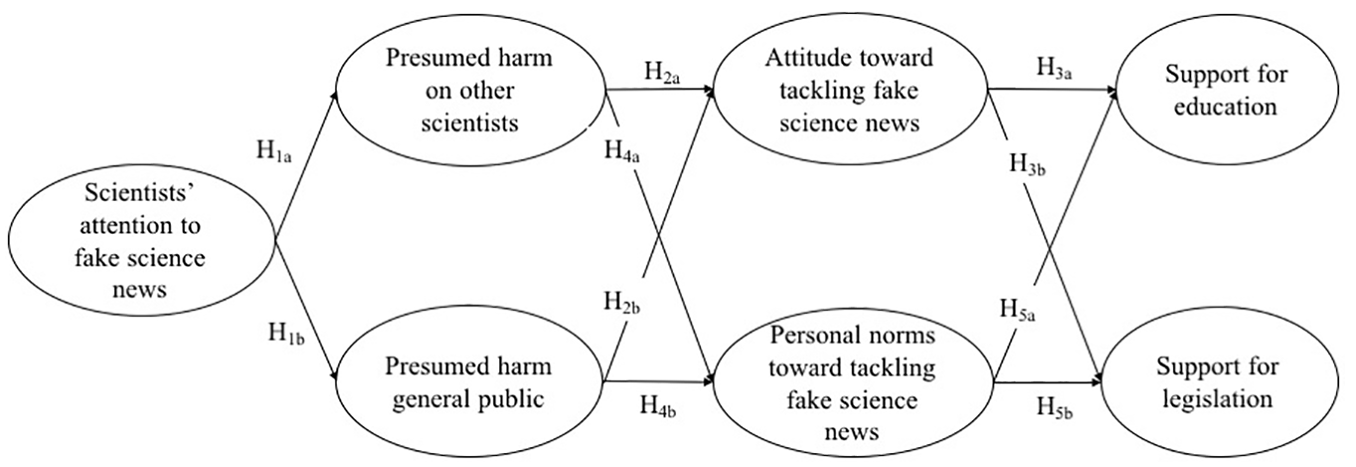
Proposed IPMI model with two support outcome variables.
The behavioural component
Support for education and legislation
Educating the public about fake news entails strengthening their ability to identify falsehoods. Several organizations have implemented media literacy campaigns to achieve this outcome. For instance, in 2019, Canada’s Media Literacy Week tailored its educational materials for different age groups to identify fake news (MediaSmarts, 2020). Scientists’ support for education can indicate their perceived usefulness of media literacy campaigns in equipping people with the necessary skills to detect fake news, and whether such efforts are sustainable solutions. Besides education, some governments believe that legislative measures can help to limit the spread of fake news and its negative impacts. For example, the Singapore government introduced a bill that requires perpetrators to correct or remove falsehoods (Ng, 2019). Scientists’ support for legislation can reflect their approval for taking legal actions against perpetrators. In alignment with the earlier discussion on the roles that scientists can play in addressing fake science news, scientists’ support for education and legislation can suggest the scientific community’s involvements in these areas. Considering the potential for joining efforts against fake news, this study examines how the processes in the IPMI may influence scientists’ support for education and legislations.
Attitude towards tackling fake science news
The IPMI posits that the influence of presumed media influence would shape individuals’ behaviours. The behavioural component focuses on people’s attitudinal, normative and behavioural reactions to their presumptions of media influence on others. A form of reaction, attitude refers to positive or negative evaluations of an attitudinal object (Eagly and Chaiken, 1993). Individuals form an attitude based on their perception of the anticipated outcome of the attitudinal object. If they believe that the attitudinal object will bring about a positive outcome, individuals would evaluate it positively (Maio et al., 2018). In turn, attitude guides behaviours (Ajzen and Fishbein, 1977) because individuals are motivated to behave in ways that help them achieve their goals (Fishbein, 1963). When individuals do not act according to their attitude, they experience cognitive dissonance, a state that causes them to experience psychological discomfort (Festinger, 1962). The discomfort will motivate individuals to employ dissonance-reduction strategies to align their attitudes and behaviours (Elliot and Devine, 1994). The attitudes that people develop towards objects through presumed influence compel them to carry out tangible actions to address the situations constructively. In the case of fake science news, scientists who have a favourable attitude towards tackling fake science news are likely to feel more compelled to support appropriate measures.
Studies in the IPMI found support for the relationships among presumed influence, attitude and behaviour. For example, Wen et al. (2017) found that youths’ presumed influence of cosmetic surgery-related media on peers was positively associated with their attitude towards cosmetic surgery. Gunther and Storey (2003) found that the indirect media effects of a Nepalese radio drama aimed at raising health workers’ professionalism motivated the public to form positive attitudes towards the workers, as the public assumed that the workers would provide better services. The literature points to the strong relationships in the behavioural component of the IPMI.
In this study, the attitudinal object refers to efforts made to tackle fake science news. Extending the foregoing arguments on attitude and behaviours to fake science news, this study argues that scientists who perceive that fake science news would inflict harm may aim to limit it. If they perceived certain measures to be useful in doing so, they are likely to form positive attitudes towards them. They will then react according to their attitude to avoid cognitive dissonance. Hence, the formation of a favourable attitude towards tackling fake science news can translate to greater support for education and legislation.
H2: Presumed harm of fake science news on (a) other scientists and (b) the general public are positively associated with attitude towards tackling fake science news.
H3: Attitude towards tackling fake science news is positively associated with (a) support for education and (b) support for legislation against fake science news.
Personal norms
The behavioural component also constitutes normative influence. Earlier studies that investigated the IPMI have examined how social norms mediated the relationship between presumed influence and behavioural intention (e.g. Ho et al., 2014; Liao et al., 2016). Specifically, Ho et al. (2016) incorporated personal norms as a mediator between presumed influence of health messages and intention to lead healthy lifestyles. Personal norms refer to moral obligations to adopt a behaviour (Parker et al., 1995). Personal norms are activated when individuals develop an awareness of consequences and an ascription of responsibility (Schwartz, 1977). Awareness of consequences manifests when individuals become cognizant that their actions have an impact on others or become mindful of the consequences of an issue. Ascription of responsibility refers to individuals attributing responsibility to themselves to address an issue. When individuals develop a personal norm towards a behaviour, they see a legitimate reason to carry it out (Thøgersen, 2008). For example, personal norm motivates altruistic behaviours, which benefit others but do not bring about personal gains. Once a personal norm is triggered, individuals are likely to act in accordance with the personal norms. This is because a violation of the personal norm arouses feelings of guilt (Schwartz, 1977). To avoid the anticipated guilt, individuals are unlikely to violate their personal norms (Baumeister et al., 2007; Lindsey, 2005).
The IPMI assumes that individuals presume that media content has a strong influence on others. When the media promotes undesirable behaviours, individuals assume that the media content would harm other individuals (Davison, 1983). Presumption of harm equates to gaining an awareness of consequences, which then motivates individuals to react in ways that would help to mitigate the effects of the harm or eliminate the source of the harm completely. It is possible that presumed harm on others triggers an ascription of responsibility that in turn activates personal norm. Where message valence is concerned, individuals perceive others to be harmed by negative messages more than they are (Weinstein, 1980). Feeling that negative media content has harmed others, individuals may develop a great sense of social responsibility to take it upon themselves to ensure that others would not be harmed further.
In this study, we argue that tackling fake science news is an altruistic behaviour aimed at reducing harm. Studies examining scientists’ motivations to carry out public outreach found that most scientists see little materialistic reward in doing public outreach; instead, most scientists cited a sense of duty to educate the public as the main motivator of public outreach (Farahi et al., 2019; Ho et al., 2020c). Presumed harm of fake news on others could help to activate scientists’ personal norms to tackle fake science news. When scientists perceive fake science news to cause harm to others, they perceive fake science news to bear negative consequences to society (awareness of consequences). Further, scientists play a unique role in the context of fake science news as they are experts in science. As such, scientists may take it upon themselves to rectify the issue of fake science news (ascription of responsibility). Upon activating their personal norms to tackle fake science news, scientists can become more supportive of initiatives to counter fake science news.
H4: Presumed harm of fake science news on (a) other scientists and (b) the general public are positively associated with personal norm for tackling fake science news.
H5: Personal norm is positively associated with (a) support for education and (b) support for legislation against fake science news.
Method
We disseminated an online survey to scientists working in the public universities and public research institutions in Singapore. We collected 706 completed responses and attained a response rate of 40.9% (based on AAPOR formula 3). We offered S$20 shopping vouchers to the participants who completed the questionnaire as tokens of appreciation.
Sampling
Sampling procedures
To qualify for the survey, participants must meet three criteria: (1) hold a PhD degree, (2) work in a public university or public research institution in Singapore and (3) conduct research in STEM fields. To develop the sampling frame, we compiled an exhaustive list of STEM researchers from all the six public universities and 19 public research institutions in Singapore. We randomized the list and disseminated the questionnaire in the order of this list.
Data collection took place between 11 July 2018 and 20 August 2018. We sent out 2662 email invitations in four batches. 1 Invitees received a total of three emails: one invitation email and two reminder emails. Each email was sent two working days after the preceding email. Invitees who were willing to participate in the survey could access the questionnaire via a link embedded in the email. To ensure that invitees were eligible to participate in the survey, we required them to answer four screener questions before they answered the actual questionnaire.
Sample
The sample comprised 75.4% male and 24.6% female, reflecting the gender proportion in STEM fields. 2 There were 336 employees of public universities and 370 employees of public research institutions in our sample. In terms of seniority, 47.7% of participants held senior positions while 52.3% held junior positions. 3 The participants were aged between 26 and 73 years (M = 40.9, SD = 9.45), and had between 0.3 and 45 years of experience working as a researcher in Singapore (M = 10.2, SD = 8.05). In all, 317 Singaporeans, 164 permanent residents, 221 foreigners, and another 4 scientists who did not indicate their nationality participated in the survey. The participants represented 35 disciplines that we categorized into science, technology, engineering, mathematics and others. 4 The distribution of the sample allows for the representation of opinions of scientists at different points of their careers and from a diversity of backgrounds.
Measurements
Prior to disseminating the survey, we pretested the questionnaire with 14 PhD students in STEM fields to ensure comprehensibility of the item wording. Unless stated otherwise, all items used a 5-point Likert scale. Appendix A of Supplemental Material presents the item wordings, factor loadings and descriptive statistics, while Appendix B of Supplemental Material presents the correlations among all variables.
Scientists’ attention to fake science news
Participants responded to a single-item measure on their attention to fake science news. A higher score represents a higher level of attention (M = 2.63, SD = 1.17).
Presumed harm on other scientists
Participants responded to a single-item measure on their presumed harm of fake science news on other scientists. A higher score indicates greater presumed harm (M = 3.11, SD = 1.16).
Presumed harm on the general public
Participants responded to a single-item measure on their presumed harm of fake science news on the general public. A higher score indicates greater presumed harm (M = 3.93, SD = 1.06).
Attitude towards tackling fake science news
Participants responded to three 5-point semantic differential scale items adapted from Poliakoff and Web (2007). A higher score represents a more positive evaluation of tackling fake science news (M = 3.66, SD = 1.30).
Personal norm
Participants responded to three items that were adapted from Schultz et al. (2014) to measure their personal norm towards tackling fake science news. A higher score represents stronger personal norm (M = 3.89, SD = 1.02).
Support for tackling fake science news
Participants answered seven items measuring support for tackling fake science news. Specifically, three items measured support for education on fake science news and four items measured support for legislation against fake science news. We adapted the items from past studies by Leung and Lo (2015) and Lim (2017) to make them relevant to the context of fake news on science. A higher score represents stronger support for tackling fake science news (education: M = 3.95, SD = 0.77; legislation: M = 3.66, SD = 0.92).
Analytical approach
We conducted data analysis using Mplus version 5.2. First, we verified the factor structure of the support items. Second, we tested the model presented in the literature review.
As we had a strong conceptual basis to separate the two types of support, we directly conducted a confirmatory factor analysis to verify the factor structure of the support items. After ascertaining an acceptable model fit, we conducted structural equation modelling to test the hypotheses. We included age, sex, years of research experience in Singapore and whether participants were holding tenure-track positions as control variables.
We used the following criteria to assess statistical fit for both the confirmatory factor analysis and structural equation model. First, the maximum likelihood chi-square (χ2) value obtained should be non-significant (p > 0.05). Second, the relative chi-square ratio (χ2/df) should not exceed 5.00 (Wheaton et al., 1977). Third, the root mean square error of approximation (RMSEA) value should fall below 0.08 (MacCallum et al., 1996). Fourth, the standardized root-mean-square residual (SRMR) should fall below 0.08 (Hu and Bentler, 1999). Fifth, values obtained for both the comparative fit index (CFI) and the Tucker-Lewis Index (TLI) should exceed 0.95 (Hu and Bentler, 1999). We dropped items with factor loadings under 0.40 to ensure that the resulting items had good reliability (Stevens, 1992).
Results
Support for tackling fake science news
The final factor structure attained good statistical fit (χ2 = 59.68, df = 13, p < 0.001; χ2/df = 4.59; CFI = 0.99, TLI = 0.98, RMSEA = 0.071, SRMR = 0.033). All factor loadings were significant (p < 0.001). Hence, the data support the proposed factor structure. Further, support for education interventions was moderately correlated with support for legislation (r = 0.52, p < 0.001), suggesting that there is value to separate the two support outcome variables.
IPMI and support for tackling fake science news
The structural model attained good fit (χ2 = 308.94, df = 127, p < 0.001; χ2/df = 2.43; CFI = 0.97, TLI = 0.96, RMSEA = 0.045, SRMR = 0.035) and all factor loadings were significant (p < 0.001). The model explained 24.4% of the variance in support for education and 16.0% of the variance in support for legislation. Figure 2 represents the structural equation model.
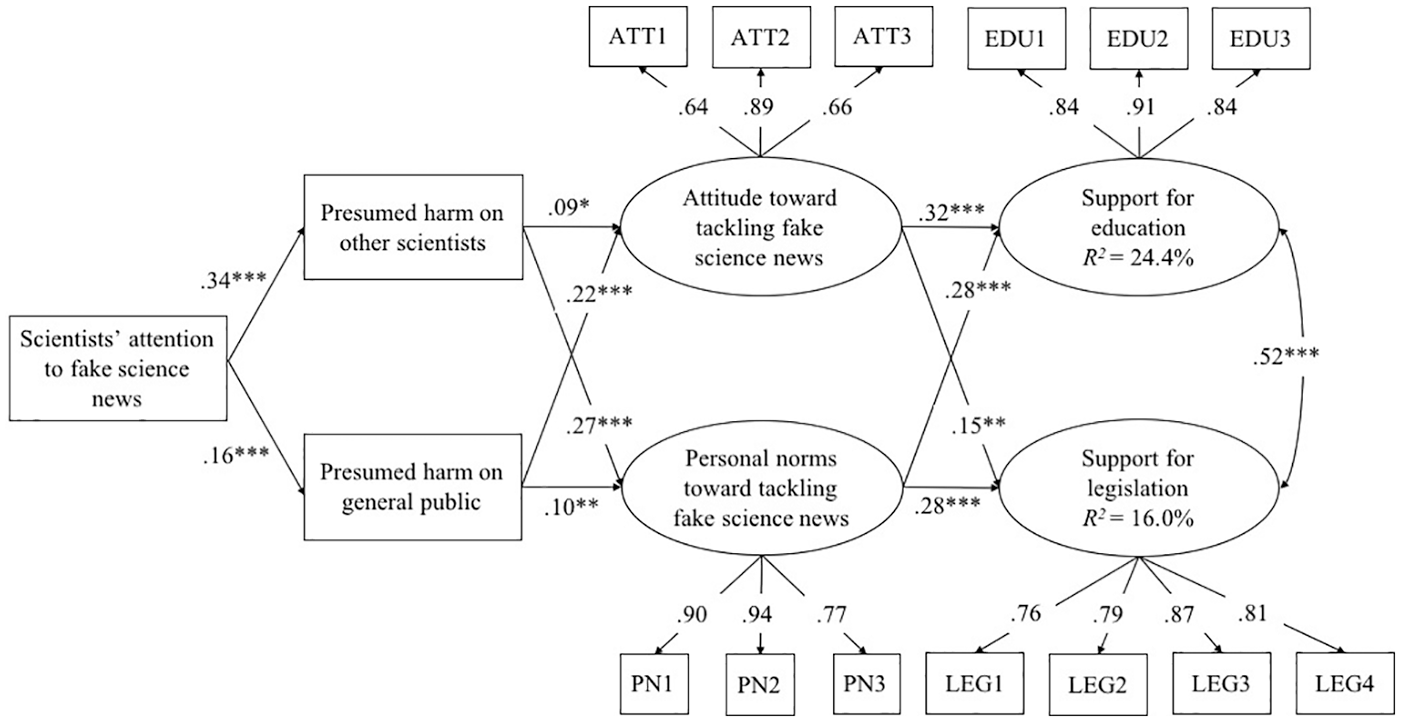
Structural equation model with path coefficients and factor loadings.
Scientists’ attention to fake science news was positively associated with presumed harm of fake science news on other scientists (β = 0.34, p < 0.001) and on the general public (β = 0.16, p < 0.001). Hence, the data supports H1a and H1b.
Presumed harm of fake science news on other scientists was positively associated with attitude towards tackling fake science news (β = 0.09, p < 0.05). Presumed harm of fake science news on the general public was positively associated with attitude towards tackling fake science news (β = 0.22, p < 0.001). The results supported H2a and H2b. Attitude towards tackling fake science news was positively associated with support for education (β = 0.32, p < 0.001) and support for legislation (β = 0.15, p < 0.01), supporting H3a and H3b.
Further, presumed harm of fake science news on other scientists was positively associated with personal norm (β = 0.27, p < 0.001). Presumed harm of fake science news on the general public was positively associated with personal norm (β = 0.10, p < 0.01). The results supported H4a and H4b. Subsequently, personal norm was positively associated with support for education (β = 0.28, p < 0.001) and support for legislation (β = 0.28, p < 0.001), supporting H5a and H5b. Overall, the data supported the proposed hypotheses and validated the use of IPMI in the context of fake science news.
Discussion
As one of the first studies to apply and explicate the key concepts in the IPMI to a niche group of scientists in the context of combating fake science news, our research generated several noteworthy findings that contributed to the general body of knowledge on IPMI and fake news. Notably, regarding the perceptual component of the IPMI, we found that the association between scientists’ attention to fake science news and presumed harm on other scientists was greater than presumed harm on the general public. More importantly, in terms of tackling fake science news, our findings demonstrated that scientists showed more support towards educational efforts than the establishment of legislations.
The perceptual component of the IPMI in the context of fake science news
With the explication of presumed media influence on others into the dimensions of other scientists and the general public, this study found that media attention influenced presumed harm on other scientists more strongly than on presumed harm on the general public. According to the peer proximity hypothesis (Paek, 2009), close peers are stronger sources of influence on one’s behaviours due to stronger identification with in-group members. Scientists could have maintained stronger identification with fellow scientists, who are their more proximal peers professionally, and therefore felt a stronger sense of similarity, familiarity and closeness to them as compared to the general public. Following their own attention to fake science news, scientists could have presumed a common threat to their fraternity in terms of reputation, credibility and authority, which manifested in the form of stronger presumption of harm on other scientists. Contrastingly, a greater sense of social distance from the general public is a plausible explanation for the weaker relationship between media attention and presumption of media influence. The difference between media attention and presumed media influence on two distinct groups of referent others is indicative of the influence of scientists’ social psychology on their behaviours.
Likewise, presumed harm on other scientists was more strongly associated with personal norms than was presumed harm on the general public. This could be due to the scientists in Singapore having a strong group identity with other scientists. When threatened, individuals would be motivated to protect the shared identity and the group’s welfare. Individuals would be more inclined to respond to negative information about their groups as compared to cases when group identity is lacking (Pantaleo et al., 2014). Group identity can even motivate cooperative behaviours that promote the common good rather than the individual good (Dawes et al., 1988). Scientists may feel that the harm inflicted by fake science news to scientists can appear not only in the form of misinforming or misleading them but also in the form of tarnishing the reputation of their fraternity. Hence, scientists, as stewards of science, may be more morally obligated to protect other scientists, who are their in-group members and their group identity.
In contrast, presumed harm on the general public was more strongly associated with attitude towards tackling fake science news than was presumed harm on other scientists. This could be due to scientists perceiving that tackling fake science news might be more useful in protecting the general public than in protecting other scientists. The social distance corollary (Eveland and McLeod, 1999) states that people perceive others who are more socially distant from them to be more vulnerable to negative media influence than those who are socially proximal. Based on the argument of optimistic bias (Weinstein, 1980), scientists may perceive that the general public, who constitute dissimilar others, are not as able as themselves or the other scientists to remain immune to the negative influence of fake science news. For these reasons, scientists might deem that efforts to address fake science news will be more beneficial to the general public than to other scientists.
The behavioural component: Support for education versus support for legislation
In terms of tackling fake science news, the results revealed that scientists showed more support for educational programmes (M = 3.95, SD = 0.77) than the establishment of legislative measures (M = 3.66, SD = 0.92) against fake science news. Scientists may be more inclined to support the former because they are cautious about setting up too many legislative frameworks in Singapore’s already highly-regulated media environment (British Broadcasting Corporation, 2017). Arising from this understanding is possibly a concern that implementing new laws may further curb free speech and therefore stifle science discussions among the public. Scientists may also be worried that involving the law on how science news is being disseminated might bring about unwarranted consequences in scientist–audience interactions on their future outreach efforts. In contrast to punitive and deterring measures such as legislation, scientists may perceive that setting up educational programmes for the public to learn about fake science news to be a more productive strategy to curb the spread of fake science news. Scientists may also perceive that raising public awareness of fake science news and equipping members of the public with specific skills to detect fake news would yield more constructive outcomes than merely involving the law. From scientists’ perspectives, the inclusive and pedagogical natures of educational programmes could have been stronger bases for their support.
Study implications and directions for future research
With the comparison of presumed media influence on others and the explication of behavioural outcomes in the context of fake science news, this study made several key findings that highlight its theoretical implications. As experts in their respective science domains, scientists are a niche group of professionals. We initially posited that this characteristic may result in scientists reacting differently to their presumptions of the harm of fake science news on other scientists and the general public. This initial proposition was somewhat supported as some IPMI pathways between presumed media influence on others and scientists’ support for intervention measures through attitude and personal norm of tackling fake news accounted for the scientists’ support for education and legislation more strongly. The significant relationships between attitude and personal norm to tackle fake science news and intentions to support education and legislation suggest that the explications of the behavioural outcomes into the didactic and legal dimensions are valid in the context of fake science news. Overall, the results attested to the use of the IPMI in the novel context of fake science news.
We recommend that future studies in the IPMI examine how the group identity of other niche professional groups may shape the psychological and sociological relationships in the model. Multi-group structural equation modelling can be employed in future studies to see how group identity might play a moderating role in affecting the indirect relationships in the IPMI model.
We propose several communication strategies to encourage scientists to support interventions against fake science news. First, stakeholders who wish to strengthen their current efforts with the help of scientists can activate scientists’ personal norm by highlighting the negative consequences of fake science news to their profession and the public; more emphasis should be given to the impact on the credibility and reputation of the science community. Second, to encourage scientists to raise the public’s science news literacy, stakeholders can strengthen the scientists’ attitude towards tackling fake science news and activate their personal norms. These can be done by bringing to the scientists’ attention their contributions to public welfare and the sense of duty that they already possess in providing accurate information on science. Overall, these recommendations stress the need to highlight to scientists the worthiness of their involvement as professionals in enhancing the state of science reporting and public understanding of science.
The involvement of scientists to combat fake science news can complement current efforts. According to the Poynter Institute, the major actions that governments across the world are taking against fake news include legislating, educating through media literacy campaigns and shutting down the Internet (Funke and Flamini, 2019). Since governments and social media companies are ramping up their efforts against fake news (e.g. Thomas, 2020), these institutions can adopt our proposals to streamline their actions. Multi-parties collaborations that involve scientists answer strong calls for scientists to step up their efforts against fake news (e.g. Bothwell, 2018; Fox, 2018; Williamson, 2016). Scientists can serve as advisors for science news literacy programmes. For example, governments can set up task forces with scientists and representatives from social media companies to collectively review reports of fake science news and decide on the appropriate rulings according to the severity of the offences and media regulations of individual states. Such collaborations can help to reduce legislative biasness and provide opportunities for scientists to offer regular critical reviews on the adequacy of prevailing legislative measures against fake news. The effectiveness of the combined efforts on the public’s trust towards scientists and the public’s perceived efficacy in detecting fake science news can be reviewed regularly to strengthen existing strategies. Active collaborations with other stakeholders give scientists the opportunities to protect the reputation of their profession and the well-being of the public.
Limitations of the study
There are several limitations to our study. First, this study used cross-sectional survey data, in which causality cannot be inferred. Despite this, the IPMI model proposed in this study is theoretically-driven and previous studies have supported the IPMI model’s claims of causation (Tal-Or et al., 2010). Second, this study used self-reported data, which is prone to social desirability bias (Johnson et al., 2002). Participants might give what they deem as socially desirable answers instead of truthful answers in order to present a more positive self-image. However, respondents are also more likely to be truthful in answering sensitive questions when the questionnaire is online and self-administered (Kreuter et al., 2008). To reduce the likelihood of social desirability bias, we recruited participants via email and administered the survey questionnaire online. Third, self-selection bias might have reduced the representativeness of the sample (Olsen, 2008). The invitation email requested participants to complete a questionnaire on the public engagement of science. Scientists who are interested in public outreach activities might be more interested to complete the questionnaire. To reduce the likelihood of self-selection bias, we kept the invitation email neutral to avoid promoting or undermining participation in public engagement of science such that neither proponents nor opponents of science outreach would be alienated. Fourth, the measurements of attention to fake science news and presumed media influence were limited by the use of single-item measures. We suggest future IPMI studies to use multiple items to measure these concepts by taking into consideration a wider variety of media platforms (e.g. news on social media vs traditional media) and news disseminators (e.g. news propagated by friends, family members or strangers) in future conceptualizations. Next, the types of harm inflicted by unique media content on specific groups of audiences are important considerations in the development of appropriate measurements for presumed media influence. Finally, future studies can consider other scientists’ opinions of fake science news, such as their acceptance of fake science news as facts, as possible behavioural outcomes.
Supplemental Material
sj-pdf-1-jou-10.1177_1464884920937488 – Supplemental material for Let’s nab fake science news: Predicting scientists’ support for interventions using the influence of presumed media influence model
Supplemental material, sj-pdf-1-jou-10.1177_1464884920937488 for Let’s nab fake science news: Predicting scientists’ support for interventions using the influence of presumed media influence model by Shirley S Ho, Tong Jee Goh and Yan Wah Leung in Journalism
Footnotes
Funding
The author(s) disclosed receipt of the following financial support for the research, authorship and/or publication of this article: This work was supported by the Singapore Ministry of Education Tier 1 Grants [Grant Numbers 04MNP000073C440 and 04MNP000243C440].

Supplemental material
Supplemental material for this article is available online.
Notes
Author biographies
References
Supplementary Material
Please find the following supplemental material available below.
For Open Access articles published under a Creative Commons License, all supplemental material carries the same license as the article it is associated with.
For non-Open Access articles published, all supplemental material carries a non-exclusive license, and permission requests for re-use of supplemental material or any part of supplemental material shall be sent directly to the copyright owner as specified in the copyright notice associated with the article.
