




Abstract
Do parties in Spain use Instagram and for what purpose? What characterizes posts that are effective at engaging the electorate? This article examines the use of Instagram during the Spanish general elections of 2015 and 2016. Content analysis of party publications on Instagram was carried out to test whether parties use the application to broadcast their policy positions, mobilize voters, or to promote their main party candidate. Regression estimation models are then used to explain the varying levels of user engagement with party posts. The findings illustrate that the new challenger parties, Podemos and Ciudadanos, use the social media app in a systematic way that is distinct from the traditional mainstream parties in Spain. Moreover, party newness, attempts at mobilization, and the promotion of the main party candidate are found to be important explanations for party success on Instagram.
Introduction
Much has been made in recent years of the role of social media as a core means of political communication during election campaigns. As readership of the mainstream printed press has steadily decreased (Stanyer, 2007), political actors have sought to fill the gap in their communication linkages with voters and, as a result, new media platforms such as Facebook, Twitter, and Instagram seem to provide the opportunity to fill this void. While the analysis of Facebook and Twitter has enjoyed a significant amount of attention from political scientists, particularly toward the latter (Di Fraia & Missaglia, 2014; Hermans & Vergeer, 2013; Jürgens & Jungherr, 2015; Lassen & Brown, 2011; Lilleker & Jackson, 2011; Vergeer & Hermans, 2013; Zittel, 2009), evaluations of the use or impact of Instagram have, until very recently (see, for example, Eldin, 2016; Larsson, 2017a; Russman & Svensson, 2016) been very much ignored. Moreover, much of what has been analyzed in relation to Instagram has been centered on how individual candidates use the platform (Lalancette & Raynauld, 2017; Liebhart & Bernhardt, 2017; Muñoz & Tower 2017) with very little being made of how political parties themselves use the application (Filimonov, Russman & Svensson, 2016).
Taking the 2015 and 2016 general elections in Spain as a case study, this article contributes to this void and explores the use of Instagram as a tool of electoral communication by political parties, opposed to party candidates (Abejón-Mendoza & Mayoral-Sánchez, 2017; Quevedo-Redondo & Portalés-Oliva, 2017). Given the exploratory state of research into Instagram use among political actors, the three main research questions are as follows: Did political parties in Spain use Instagram during the 2015 and 2016 election campaigns and to what extent? Did party use of Instagram appear to seek a clear strategic goal? Which features of party posts yielded higher levels of engagement with Instagram users? To answer these questions, the publications of the four main political parties in Spain are subjected to content analysis adopting the tools designed by Russmann and Svensson (2016) to identify whether parties used Instagram as a means of (a) promoting their top candidates, (b) broadcasting their policy positions, or (c) mobilizing their supporters. The resulting output of this coding as well as variables capturing core features of the Spanish parties is then applied in a multivariate regression analysis to examine what variables are associated with higher levels of engagement by Instagram users with the parties’ posts.
Consistent with existing findings regarding the use of Instagram elsewhere (Bossetta, 2018; Selva-Ruiz & Caro-Castaño, 2017), the results show that the use and level of engagement witnessed by underdog challengers and political entrepreneurs was significantly higher than those of traditional mainstream parties. Moreover, the use of Instagram by entrepreneurial parties displayed an identifiable strategic purpose that was absent from traditional parties. The right-of-center challenger party, Ciudadanos, shows a clear preference for promoting the image of the main party candidate, while the left-of-center challenger, Podemos, elected to focus on mobilizing its supporters.
The main contribution of this article to existing work on Instagram use is twofold. First, it represents the first assessment of Instagram use by official Instagram accounts of political parties in Spain across two national election cycles. The results of the analysis find that there are some noteworthy distinctions between how Instagram is used by the accounts of the Spanish political parties in comparison to findings regarding the use of Instagram by Spanish party candidates (Marcos-García & Alonso-Muñoz, 2017). Second, the analysis presented here ties in with existing work on the use of Instagram in another European and party-centered political system using the same methodological framework as that used in the assessment of partisan use of Instagram in the Swedish case (Filimonov et al., 2016). By replicating the methodological approach used across political systems with similar characteristics, the understanding of partisan use of Instagram can be extended in a comparative context.
This article continues as follows. I provide a discussion of the rising importance of social media as a means of political communication and highlight the main affordances offered by Instagram for political parties. Subsequently, I engage with a discussion of the existing literature assessing the use of Instagram by political actors and highlight the framework of analysis to be used in line with the guidelines provided by Russman and Svensson (2016). I then provide a description of the data collection and coding procedure before entering into a discussion of the main results.
Theoretical Framework
Our first point of discussion is why the study of the political use of Instagram is an important unit of analysis that merits investigation. In June 2016, the number of active Instagram (2016) users, those who use the application on a weekly basis, surpassed the number of active users on Twitter reaching a total of more than 500 million, of these some 300 million use their accounts at least once every day. This total has reached even greater heights in 2017 with the social media company boasting a total of 700 million active users, making Instagram the second most widely used social media platform after Facebook. Since Instagram attracts in surplus of 700 million users worldwide, allowing them to share and promote material at little cost, it would seem rational for political parties to want to take advantage of this communication tool. Moreover, as parties have had difficulty in reaching out to young people and motivating them to engage with and participate in politics (O’Toole, Marsh & Jones, 2003; Quintelier, 2007), it is understandable why parties would seek to communicate with this demographic using the media platforms that they are most likely to frequent (Xenos & Foot, 2008). Indeed, carrying out interviews with political party candidates using social media as part of the campaign efforts, Enli and Skobergø (2013) find that attempting to communicate with young people is an often-cited motivation behind political use of Twitter and Facebook. Of note is that the authors find that both self-identified motivations as well as observable content in candidates’ posts seem geared at mobilization efforts. While not focused on Instagram, there is a clear rationale for parties to engage with social media in general as a means of broadcasting to the electorate and driving their vote-maximizing (Downs, 1957) objectives, particularly among the young, so it is reasonable to expect parties to echo the same behavior across a new social media platform that has emerged as popular platform among the population.
Within the context of an evolving hybrid media environment (Chadwick, 2013), where traditional mediums, such as the printed press and television, operate alongside both online media outlets and social media: direct user-generated content from social media has the potential to interact with traditional sources (Lalancette & Raynauld, 2017) as well as aid the communication of ideas beyond the restrictive editorial controls of the “gatekeepers” (Skovsgaard & Van Dalen, 2013). Being able to “speak” directly to their voters as well as the wider electorate is a motivation behind social media use among political actors that has been identified in survey responses (Karlsen & Enjolras, 2016).
However, as noted by Bossetta (2018), given the asymmetric digital features of social media applications, different social media platforms provide distinctive affordances (Bucher & Helmond, 2018) for political communication, and therefore, one should be weary of aggregating the potential benefits of “social media” into the same category. Practically, the technical affordances of Instagram for parties is to allow them to communicate with a large proportion of the electorate via the publication of user-generated media content that can be easily engaged with in the form of likes, comments, and shares. The rising use of Instagram use among the electorate also incentivises the application’s use for parties vis-à-vis less popular social media alternatives too. The higher-level affordances (Bucher & Helmond, 2018) are the product of these technical features, which include the ability to present persistent and visible material free of third-party interpretation in a persistent and instantaneous way. Instagram is the only social media platform whose original focus was the sharing of photos with the role of the images as a core tool in communication strategies being well noted. Images have been observed to be more effective at capturing the gaze of spectators in marketing campaigns (Fahmy, Bock, & Wanta, 2014) and within the field of political communication, images are more effective at establishing the political agenda, harnessing emotive responses, and communicate political messages in a more concise manner (Schill, 2012). In other words, “images often supersede words” (Lalancette & Raynauld, 2017, p. 3). Indeed, recent analysis of Instagram use across a number of political contexts reveal a number of interesting findings. Of note is that the image-driven content of the platform makes the posts made by political actors easily diffusible across other platforms within the hybrid system (Lalancette & Raynauld, 2017) with the material shared by political actors on Instagram itself shaping and driving the political punditry observed over televised media outlets. Moreover, because the digital architecture of Instagram facilitates the sharing of images originating on the application across other platforms such as Twitter and Instagram (Bossetta, 2018), political candidates are able to ensure that there is a visibly observable cohesion between the material they post across different mediums (Liebhardt & Bernhardt, 2017).
Moreover, the potential communicative power of an image that expresses a policy stance or ideological position is far greater than a generic statement of support. Indeed, as Lalancette and Raynauld (2017) argue in their analysis of the Instagram material of Canadian president, Justin Trudeau, the presentation of a physical image of the president taking part in a gay pride parade is a far more powerful communication of the president’s egalitarian stance on issues of lesbian, gay, bisexual, and transgender (LGBT) rights than could be achieved without a photograph. As a result, Instagram with its focus on image sharing, functions for political actors as a low-cost, easily transferable, interactive, fluid, and spontaneous tool that facilitates the communication of powerful, personal, and potential distance-reducing messages to the electorate.
One criticism made of the relevance of social media as a tool for political electioneering is that there is a process of self-selection involved whereby only members of the electorate who choose to “follow” a particular political party’s online account are the ones being exposed to the political messages being published so that, in effect, the parties are communicating their campaign messages and soliciting support from their own supporters (Norris, 2003). A popular term used to refer to this self-selection bias of engagement on social media networks is “echo chambers” (Garrett, 2009; Sunsteain, 2007), a term which seeks to depict the fact that social media users tend to only engage with other users that share the same interests and beliefs as each other. Indeed, empirical evidence of Twitter and online blog use (Aragón, Kappler, Kaltenbrunner, Laniado, & Volkovich, 2013; Hargittai, Gallo, & Kane, 2008) provide support for this argument. While self-selection is indeed an important part of the Instagram user interaction, through the functions of the social media platform itself, political messages have the potential to move beyond their active follower base and penetrate additional users’ feeds. Should any Instagram user interact with a party’s post by either liking or commenting on the publication, this action will have a number of knock-on effects that increase the exposure of this post. Members of the social network of this same user, additional Instagram participants who follow this user, will be able to see any interaction activity that this user exercises, thus providing them with a direct link to the party’s material even if they do not themselves follow the party’s account. In addition, Instagram also routinely promotes popular publications on the explore tab (Bossetta, 2018) and user account profiles from the interactions of one’s own social network and from those in close geographical proximity, again increasing the possible exposure level of political party publications beyond their own supporter groups. As Vissers (2009) found in a study based on the role of official campaign websites, this means that parties are able to “preach through the converted” (own emphasis) in addition to the already converted. It has also been argued that such interpersonal interactions and communication between already like-minded members of the same community play a more critical role in the formation of persuasive political arguments (Norris, Curtice, Sanders, Scammell, & Semetko, 1999, p. 6) thus demonstrating the potential political utility available via Instagram.
The infiltration of political messaging into apolitical spaces, in this case the virtual space of a social media platform which was designed to facilitate the sharing of user-created images, lessens this self-selection bias as users are restricted in their capacity to limit their exposure to political messaging that may infiltrate into their news feeds. In addition, it is clear that the ability to select the content that a user is to be exposed to does not remain within the complete control of the Instagram user themselves and political parties may use certain hashtags that are more likely to cover a wider catchment area and thus increase the likelihood of a user being shown the party’s material. Support for this argument can be found in Utz’ (2009) study on the 2006 Dutch general elections, showing that politically disinterested citizens had a greater likelihood of being exposed to the political campaigns of parties on social media websites than they would be on more traditional webpages. Thus, while echo chambers may exist in the same vein that they do across all forms of media conduits, 1 social media networking applications do provide for the penetration of these chambers despite a lack of active volition on behalf of the user, underlining their potential power as an important and effective tool for political communication.
Having established an understanding of the core affordances of Instagram to political actors and rationalizing the incentives for them to use the application in the face of its rising popularity among the public, there is a strong expectation that parties in Spain will use Instagram as part of their wider communication strategy. In Spain, parties compete in multi-member districts with closed party lists and parliamentarians are elected via proportional representation. A total of 350 parliamentary seats are divided between 52 electoral districts depending on their population size and, with the exception of the autonomous cities of Ceuta and Melilla which only have one seat, all other districts have a minimum of at least two. Political campaigning is highly centralized, party-dominated, and more and more reflects a presidentialised and personalistic election campaign style (Magone, 2009) where the top candidate serves as the main public face of the party. It is not common practice for candidates on the party list or even for party members to carry out their own independent campaign activities (apart from perhaps local elections), and the concept of door-to-door canvassing is unheard of. Social media thus serves the potential function for parties and candidates in Spain of increasing the perceived proximity between candidates and their potential voters by facilitating direct interaction between the two.
Instagram use in Spain is also very much on the rise. Mirroring global trends, electoral survey data shows that Instagram is the second-most widely used social media application after Facebook. In general, social media has the potential to be an efficient influencer in political campaigns in Spain. For the cohort of young people aged 18–24, 53% of them claimed that they used social media as their main source of information regarding parties and candidates during the December 2015 election period. 2 This figure, while the largest percentage noted of all of the age categories, is sizable and is surely reflective of the likely trajectory of future partisan campaign efforts aimed at young people in Spain. Since social media represents a sizable portion of the campaign source material for young people and since Instagram is the second-most popular social media platform in the country, Spanish parties are clearly incentivised to promote their campaigns on Instagram. Moreover, Spain has recently been marked by a high level of political volatility which has resulted in the transformation of the party system and the emergence of new political parties which are challenging the dominance of the bipartisan status quo. Given the consensus regarding the superior fluency of political underdogs with social media platforms (Bossetta, 2018), there is an increased likelihood that the new parties emerging in Spain will provide impetus for parties across the system to respond to the electoral incentives of Instagram use. Given the strong potential of Instagram for electoral ends, what uses have been observed in the political uses of the application?
To date, the analysis of the use of Instagram as a means of political communication by political parties is very much still in its infancy. The first study was completed by Eldin (2016) who analyzed the impact of electoral advertisements placed on the Instagram platform during the 2015 election in Bahrain. Eldin’s study relied on the collection of data from individual questionnaires that were administered to young people to judge whether members of the country’s youth had been exposed to these advertisements with extremely high numbers responding affirmatively. The study also found that more than 60% of respondents received information either about a party’s program or candidate(s) via the Instagram application. The article chose the effects of paid-for advertising on the application as the unit of analysis rather than the use of typical user-generated published content. Thus, the impact factors claimed here are not representative of typical Instagram user account activity but rather a commercialized advertisement facility. Moreover, these results demonstrate Instagram’s reach as a means of political communication, yet it does little to display how parties themselves use the platform nor how users respond to parties’ material. Are posts orientated at communicating their program or ideas, promoting the image of their candidates, or for mobilizing their own supporters in a Get Out the Vote (GOTV) effort? Since a Downsian (1957) understanding of political parties perceives them to be vote-maximisers, it is reasonable to assume that partisan communication efforts on Instagram might echo electoral efforts made elsewhere that seek to ensure their supporters are mobilized to turnout on election day.
One study (Filimonov et al., 2016; see also more generally Russmann & Svensson, 2016) does, however, lay the groundwork for an assessment of party postings on Instagram, in particular as a means of analyzing the strategic motivations behind party content. The authors used the 2014 Swedish elections as a case study to analyze the content of party posts to make conclusions as to what purpose Instagram use might afford them. Coding the content of political party posts, the authors found that Instagram use tended to focus on promoting the party message (penned broadcasting) as opposed to other objectives found to be common on other social networks such as to mobilize the electorate (Anduiza, Cristancho, & Sabucedo, 2014; Vaccari, 2013). The authors also found that promotion of the main party candidate formed a large part of the, if however limited, number of publications. In Sweden, Instagram use represented some form of cohesion within the wider communication campaign of parties, with the study’s coding system capturing references to other campaign material and the promotion of official campaign images within the Instagram platform demonstrating Instagram use’s incorporation within the hybrid media system. This study, while an important first step in the assessment of party use of Instagram is limited in terms of its generalisability in that it captures the observations within only one election cycle within only one country. In seeking to replicate the framework of analysis completed by Filimonov et al. (2016) and advocated by Russman and Svensson (2016), this article has the potential to extend the external validity of their main findings within another party-centered European polity allowing for a comparative understanding of the strategic purposes behind partisan use of the social media platform.
In the Spanish case, the earliest studies on the impact of the Internet and social media on Spanish politics focused on political party websites (Dader, 2009), and now include numerous assessments of party use of Twitter (Aragón et al., 2013) and Facebook (Abejón-Mendoza & Mayoral-Sánchez, 2017). More recently, emerging literature has initiated analysis on the political use of Instagram, with a particular focus on the Instagram accounts of Spanish MPs (Selva-Ruiz & Caro-Castaño, 2017), mayoral candidates (Quevedo-Redondo, Portalés-Oliva, & Berrocal-Gonzalo, 2016), and those of the party leaders both during (Marcos-García & Alonso-Muñoz, 2017; Quevedo-Redondo & Portalés-Oliva, 2017) and outside of (López-Rabadán & Doménech-Fabregat, 2018; Selva-Ruiz & Caro-Castaño, 2017) moments of electoral competition. The predominant finding of all these studies is that candidate accounts using Instagram are very much focused on promoting the personal image of the candidate themselves with the majority of posts presenting him or her within the public sphere in a geographic place of relevance to the political arena and fulfilling their formal role as candidate/politician. The Spanish candidates’ posts on Instagram, therefore tend to mirror the behavior observed by candidates from other political contexts (Lalancette & Raynauld, 2017; Muñoz & Tower, 2017) as well as Spanish candidates’ activities across other social media platforms (Quevedo-Redondo et al., 2016). The dominance of the candidate(s) self-promotion might not be transferable to posts of the parties given the highly party-centered structure of the Spanish political system. In the Norwegian context, for example, Karlson and Enroljas (2016) find that top-level candidates focus more on party-orientated as opposed to individual-orientated posts with the latter being negatively associated with user engagement. In the Spanish context, then, political party Instagram accounts may be more likely to echo alternative focuses such as that observed by Filimonov et al. (2016) on general party broadcasting, or that observed elsewhere (Anduiza et al., 2014; Gibson, 2015; Karlsen & Enjolras, 2016) on mobilizing supporters. Despite the functions of social media platforms allowing for a multi-directional flow of interaction between political parties and candidates with the electorate, existing explorations of social media use have displayed that systems such as Twitter tend to be used in line with the uses of traditional media platforms, that is unidirectional information sharing from the political party to the electorate (Criado, Martínez-Fuentes, & Silván, 2012) with the same conclusion being drawn from the use of Instagram (Abejón-Mendoza & Mayoral-Sánchez, 2017; Bossetta, 2018; Lalancette & Raynauld, 2017). There is therefore, consensus, regarding the unidirectional communication of Instagram by political parties with the initial work of Filimonov and colleagues (2016), with parties being observed to use the social media principally as a means of talking to, as opposed to with, their supporters and the general electorate. This makes us return to the original question, if parties are using Instagram to communicate with the electorate, does their use of the platform as a tool for communication display any systematic trends that might allow one to infer the strategic purpose of its use? Applying the framework utilized by Filimonov et al. (2016), this article will analyze the material posted by political parties to assess whether there is an observable strategy with there being an expectation that parties will publish posts that seek to (a) promote the image of their main candidate, (b) broadcast their positions to the electorate, or (c) seek to mobilize their supporters. Understanding to what extent parties in Spain use the application and inferring to what ends they do so, one might then consider what predicts successful partisan engagement on the platform.
Data and Method
The study aims to assess three main questions regarding the use of Instagram in the 2015 and 2016 elections. To that end, our main research questions were as follows: To what extent did Spanish political parties use Instagram during the 2015 and 2016 election campaigns? Did partisan use of Instagram appear to seek a clear strategic goal? How did users respond?
This study relies on a content-analysis of posts from the Instagram accounts of the four main political parties in both the 2015 and 2016 election campaigns. Up until the 2014 European Parliament elections, Spanish party politics has been marked by a strong bipartisan divide which has now been undermined by the introduction and success of new challenger parties (Cordero & Montero, 2015; Orriols & Cordero, 2016; Rodon & Hierro, 2016): the left-wing Podemos (We can) and the center-right Ciudadanos (Citizens). The parties under consideration in this study are the four largest parties in Spain and includes the two traditional parties, Partido Popular (PP) and Partido Socialista Obrera Español (PSOE), as well as the two new challenger parties, Ciudadanos and Podemos. The Instagram accounts analyzed for these parties were those linked to the official party website: the fact that these accounts were even embedded on the websites of the parties is already an indicator of the level of significance parties give to the use of Instagram as a tool for promoting their online presence. Of note is that in the United Kingdom, for example, none of the three main national political parties, the Conservatives, Labour, or the Liberal Democrats, have any direct link to their Instagram accounts on their party website at the time of writing.
Content analysis of the posts, defined as both the actual picture contents as well as the accompanying caption provided by the party (but excluding the content of comments), was carried out on publications made in the four weeks prior to the election including the election day itself. For the 2015 election, content was analyzed that was posted between November 15th and December 20th inclusively, while for the 2016 election material posted between May 22nd and June 26th was analyzed. In addition to photographs, Instagram allows for the publication of short videos. These were not included in the content analysis to ensure uniformity of comparison, although it should be noted that the decision to only include photographs does not significantly change the number of observations included as no party had posted more than two videos during the timeframe under analysis indicating that photographs are the preferred media type that parties tend to publish on the platform. This is a result echoed elsewhere (Bossetta, 2018).
A total of 135 posts were made by the four parties in the 2015 election campaign with 86 being made during 2016. Given the overall small N, all of the posts published by the political parties were submitted to content analysis, thus the posts included in the analysis represent that of the total population of posts made during the final four weeks of campaigning. The coding of the content analysis was completed manually by the author since computational means of analyzing Instagram data was not available (Bossetta, 2018). The reliability of the coding was confirmed by submitting a random sample of 10% of the posts (N = 20) to coding by a graduate research assistant using the same codebook.
The variables included in the coding of posts draws upon the framework and method advocated by Filimonov et al. (2016) and Russman and Svensson (2016). While a wider coding guide of Instagram image has been applied elsewhere (Liebhardt & Bernhardt, 2017), the reduced framework provided by Russmann and Svensson is adopted here because it caters to the needs of the specific research question. That is, capturing the potential strategic motivations behind political party use of Instagram. A summary of the coding variables included in the analysis is provided in Table 1A (see Appendix).
Broadcasting is penned by the authors of the Swedish study as a variable that captures the transmission of information to the electorate regarding “political opinions, positions, statements and performance to the voters” (p. 5). The definition of broadcasting provided in the present study has been designed using a more limited definition. The indicator used in the former study can be considered too broad, effectively capturing for the communication of range of different types of information—this is arguably why their study reported such high levels of broadcasting, reaching 100% in the case of some of the parties they analyzed. In the present study, a post by a party on Instagram was only coded as largely broadcasting if it articulated a clear and explicit policy stance. Where policy positions were implied, or more generic supportive statements were made without stating a specific policy proposal, these posts were identified as slightly broadcasting. To provide an illustrative understanding of the differences between broadcasting values, representative examples of posts identified as broadcasting are provided in the Appendix (Figures 1A to 7A).
As political party use of other social media platforms has evolved in line with the growing population of the electorate that also uses these applications, so too has the effectiveness of their use. A growing consensus has begun to emerge that shows that party campaigning on Twitter and Facebook can lead to voter mobilization (Anduiza, Gallego, & Cantijoch, 2010; Krueger, 2002; Quintelier & Vissers, 2008). With regards to the use of mobilization strategies via social media in Spain, this is a phenomenon that has proven particularly effective as the adoption of Twitter as a medium for diffusing political discontent and organizing large-scale political activism by the 15-M (and later Indignados) movement between 2011 and 2013 (Anduiza et al., 2014). In this present study, mobilization is a variable that captures a party’s intent to rally a specific action from the electorate. Posts were coded as largely mobilizing if they contained explicit requests for action to be taken by the electorate. This includes invitations to vote, suggestions to follow the party (or other accounts associated with the party) on additional media platforms, opportunities to attend an event, or to tune into a media debate. Where posts contained generic rallying cries such as “Let’s do this” or “We can do it,” these posts were categorized as being slightly mobilizing. Examples of posts identified as mobilizing are included in the Appendix (Figures 8A to 13A).
Posts were coded to identify the presence of the top candidate from each party as the main object in the post’s image. The incumbent president Mariano Rajoy was the main candidate of the governing PP with Pedro Sánchez being presented as the main candidate of the opposition party, PSOE. Albert Rivéra and Pablo Iglesias were the respective main candidates of Ciuadanos and Podemos. In the case of Podemos’ feed in the 2016 election, the appearance of either the Podemos party leader, Pablo Iglesias, or the leader of Izquierda Unida, Alberto Garzón, was coded because of their agreement to form a pre-electoral coalition in the June elections. Under the current climate of politicians-as-celebrity, Thompson (1995, p. 136) argues that glimpses into the private life or intimate moments of politicians have become a core feature in constructing a candidate’s image and identity. The use of social media likely facilitates this perceived intimacy as politicians are able to represent themselves in quotidian and relatable scenarios (Stanyer, 2007). Empirical evidence displays, however, that these strategies are not applied uniformly by political candidates, with some presenting images of themselves centered purely on them performing their political functions (Lalancette & Raynauld, 2017; Muñoz & Tower, 2017) and others operating in the private sphere (Selva-Ruiz & Caro-Castaño, 2017). For this reason, an indicator was included to capture such images and encoded a post as representing a private image if the top candidate was presented in a behind-the-scenes context or when shown outside the context of an official party or campaign event.
Furthermore, variables that were adopted to capture the content of posts included an indicator to note the presence of a celebrity figure in the post’s image, whether or not the post was a produced image using official party and/or campaign branding, and whether or not the post referred to other campaign media (hybrid). One additional content variable included here that was not present in the Swedish study was the existence of Europeanisation, here defined as any reference to the European Union (EU), the actors that operate within the EU or actors from the same transnational party to which the domestic party belongs. It was hypothesized that, since recent literature has shown that the role of the EU has begun to have a greater impact on domestic political competition (Hernández & Kriesi, 2016), we might expect parties to make reference to these issues in their social media activity.
In order to capture how users of Instagram responded to the publications made by parties, the number of likes and engagement scores were included. Users of the Instagram application can respond to content by providing a heart-shaped “like” icon to material they approve of, the total number of likes the post receives is then displayed alongside the post itself. The total number of likes a post received at the time of coding was recorded and for engagement scores, both the number of likes and comments a post were considered. Importantly, the decision to like a post is purely representative of a user’s approval of a publication, while comments allow users to express a more heterogeneous response. Although the content of comments was not systematically coded in this study, it was apparent that comments reflected both positive and negative responses from users, justifying the need to distinguish between likes and engagement.
Muñoz and Tower (2017) operationalize engagement as the sum of the number of likes and comments. Here, I argue that such a method of measuring engagement is methodologically flawed because it fails to capture the asymmetric cost to users of liking and commenting on posts. Because the cost of making a comment on a post is higher than hitting the like button, it requires more effort and time on the part of the user, comments are considered to be weightier indicators of user engagement. In order to provide some accommodation for the greater significance of comments vis-à-vis likes, engagement scores were weighted to include the sum of the number of likes and two times the number of comments. The number of likes and comments recorded here are those that posts had on the date of coding (April 2017) rather than at the time of the publication of the posts themselves. News feeds on the application that display posts from the accounts that users follow, however, constantly refresh with the most up-to-date information. For this reason, the recorded likes and engagement scores are still likely to be representative of their reception and interaction by users at the time of the actual publication and any lag effect across time is assumed to be equal across parties and therefore any significant differences between the postings remains the same.
Using these scores as the dependent variables, a series of multivariate regression models are run with the results of the content analysis forming the main explanatory variables in order to analyze the impact of different post characteristics on the effectiveness of party material. The results of the content analysis and the statistical models are reported in the following two sections.
Instagram Use in Spanish Elections
At the time of collecting the content data from the Instagram accounts of the Spanish parties, the number of followers (Instagram users that subscribe to the publications of a particular account) were as follows: the new parties Ciudadanos and Podemos had 29,800 and 59,300 followers, respectively; in the traditional bloc, the PP had only 18,400 while the PSOE had 14,400. With just looking at this descriptive data regarding the number of users who receive automatic updates from parties’ accounts, it is clear that the new parties, Ciudadanos and Podemos, grossly outperform the two traditional parties, PP and PSOE, in their efforts at attracting followers.
The distribution of posts across parties in each election is reported in Table 1. A total of 221 posts were made by the Spanish political parties during the two election campaigns: 135 posts were made during the 4 weeks prior to the 2015 election, with a smaller number of 86 being made in 2016. The use of Instagram seems to have been pointedly more prominent by the new challenger parties as opposed to the two traditional parties. The number of posts made by both Ciudadanos and Podemos, competing in national elections for the first time, is far greater than that made by either the PSOE or the PP, the main opposition and governing party, respectively. This is not surprising as new parties often rely more on online media platforms because of a lack of access to traditional means of communication (Bossetta, 2018; Larsson, 2017a; Owen, 2017). This is even more so in the case of Spain where access to airtime on television is regulated and dependent on the vote share of the party in the previous election.
Political party postings and average interaction scores.
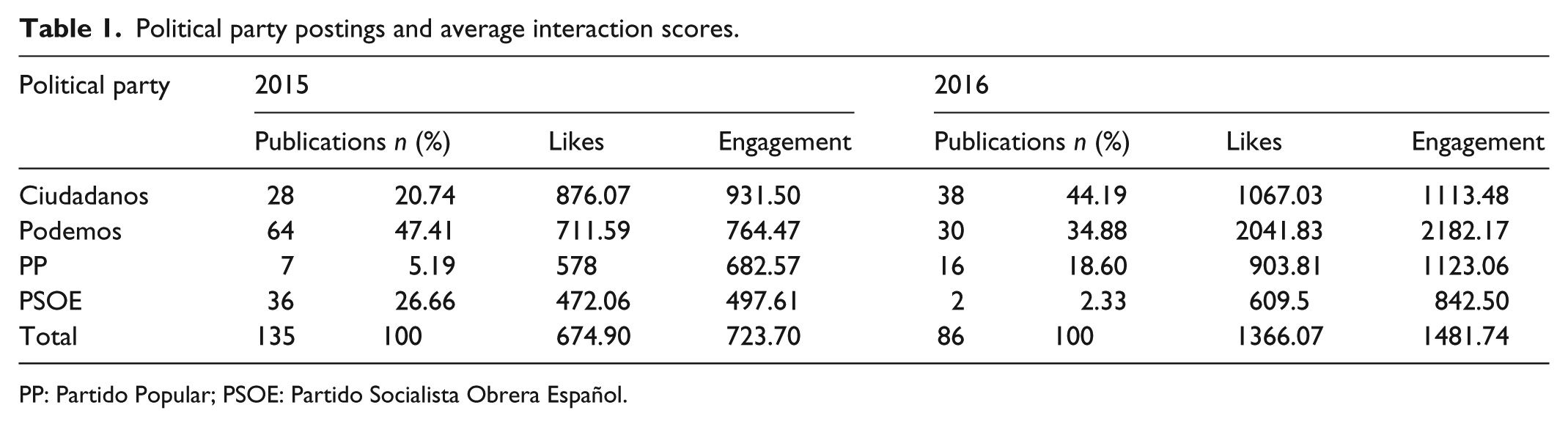
PP: Partido Popular; PSOE: Partido Socialista Obrera Español.
The number of likes and level of engagement is also significantly more and is discussed further in the following section. On average, posts by Ciudadanos in 2015 were the most successful in terms of engaging Instagram users, achieving an average number of likes and engagement score of 876 and 931 respectively.
Undoubtedly, the party with the weakest use of the platform was the PSOE. While they were not the party that made the fewest publications, across both elections they received the lowest engagement score. In the case of the PP, the party doubled the number of publications, the majority of which were official glossy campaign images, between the two campaigns yet the total number of posts made by the party in both cases remains so low that no statistical comparison is viable. What appears to be a lackluster attempt at the use of Instagram by the two traditional parties, accumulating around only a third and a fifth of the total number of publications between them in 2015 and 2016 respectively, is perhaps representative of the lack of consideration of Instagram as a legitimate tool for electioneering among the traditional bloc.
The priority given to Instagram by the new parties as represented by their higher frequency of use in comparison to the traditional parties may be explained by the demographic targeting of these parties. Orriols and Cordero (2016) presented evidence to show that there was a clear generational divide in voting for new parties and old parties in the 2015 elections, with the former being favored by the Spanish youth. Moreover, data reported in the CIS’ post-election surveys in both 2015 and 2016 show that young people remained the demographic group most susceptible to political persuasion in Spain, with just over half (50.5%) of 18- to 24-year-olds claiming that they decided who to vote for at some point during the official campaign period in 2015. This figure was less in 2016 at only 37%, but still represents the biggest group of undecided voters in that election too. The same group claimed that social media sites were their biggest source of information related to the parties and the candidates (53% in 2015 and 36.6% in 2016). Of note is that 54.5% of the young respondents in the 2016 post-election study used Instagram which was the second most popular social media platform only to Facebook, surpassing the usage of the frequently studied Twitter. As there is a tendency for the PP to be most popular among the oldest in Spanish society (39.4% of their 2016 vote share came from those aged 65 and above, with less than 5% their votes coming from young people), the incentives of prioritizing Instagram posts as an electoral tool would have been limited and this may explain why the party strategy toward the application seemed minimal if, in fact, existent. However, as discussed earlier, in the case of the 2015 elections at least, the traditional parties were able to enjoy a far larger amount of access to the regulated airtime than that available to the new parties. The potential incentives, therefore, of both reach as well as supporter demographics afforded by Instagram vis-à-vis media alternatives are reduced for traditional parties.
A rival justification for the new party dominance may be afforded by the desire to achieve the so-called “multiplier effect” (Copsey, 2003; March, 2005). As access to traditional sources of media is more restricted for new parties, these same parties have a harder time of displaying their relevance as significant political players within the domestic party system. One strategy that has been adopted by parties to augment their significance and multiply their perceived size has been to flood social media platforms such as Twitter with high volumes of content, thus creating a higher number of interactions which emits the impression that they are a larger political force than they may actually be. This, however, seems unlikely in the case of Instagram use by Spanish parties as the difference in the average daily number of publications does not provide evidence for such a systematic or coordinated approach to the platform. The average number of posts per day was relatively low at around four.
December 18th, the final day of official campaigning in 2015, is the day that recorded the most activity from all parties, with a total of eleven publications being made. On the final day before the election, the PSOE was the only party of the four to make any posts on Instagram. What is surprising, however, is the choice of material to publish taken by the PSOE. While the other three parties’ final posts before election day were oriented toward objectives to mobilize the electorate or to promote their top candidate, the PSOE publications were of seemingly random everyday objects such as socks and plants in the color red, red being the color associated with the socialists. Interestingly, the trend in the number of publications does not coincide with dates of importance for activity occurring offline. Analysis of the use of Twitter, for example, has displayed that the number of posts on the day of the televised debates was substantially more than on other days (Di Fraia & Missaglia, 2014; Larsson, 2017b). This is not the case in either of the election cycles examined here as shown in Figures 1 and 2.

Daily Instagram usage in 2015.
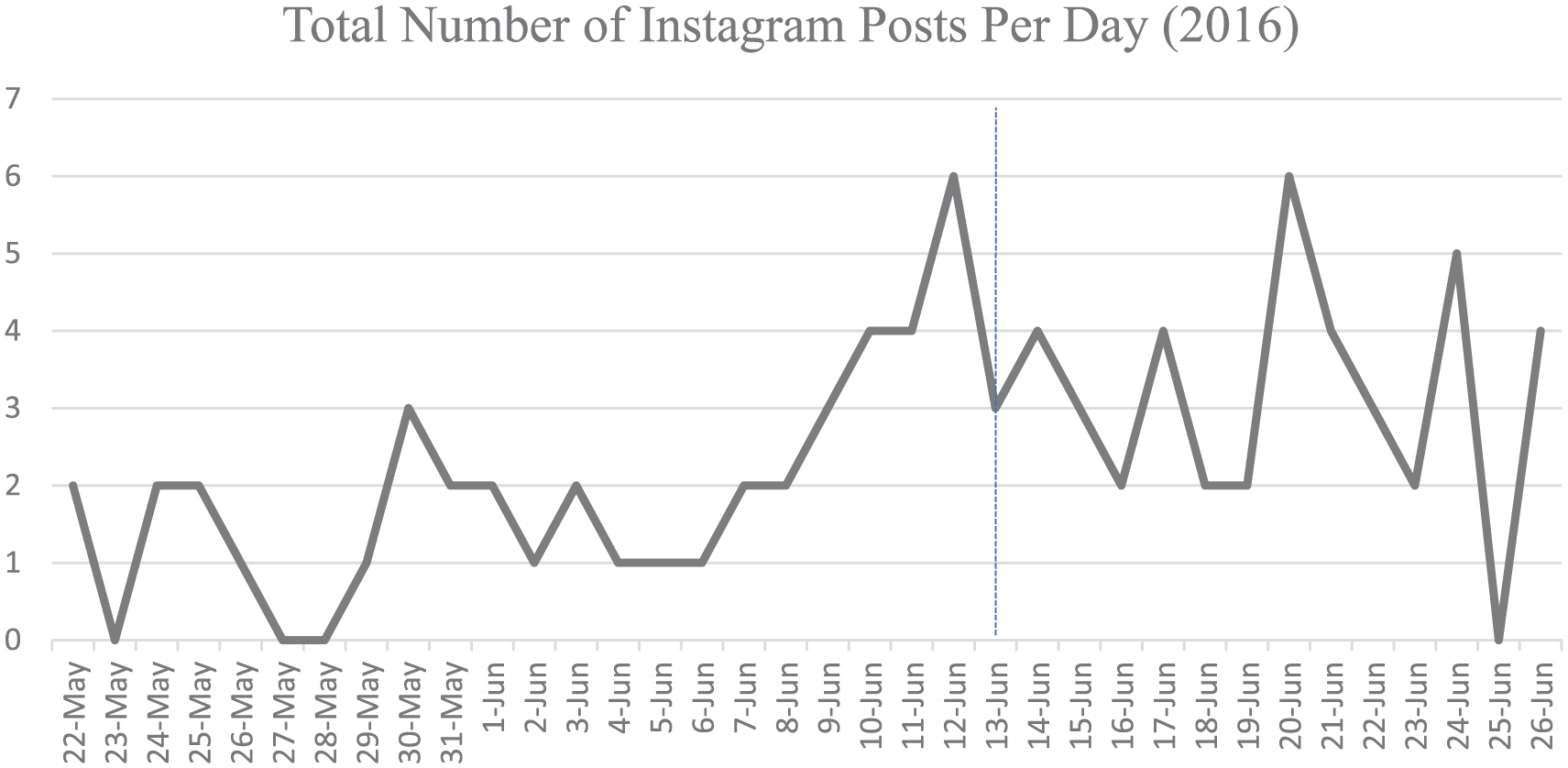
Daily Instagram usage in 2016.
An additional observation of interest, at least in the 2015 case, was the use of Instagram on the so-called “reflection day.” Spanish electoral law requires that the official campaign end on the Friday before polling day (Sunday) to allow the electorate a day of quiet reflection and to consider the proposals of the competing candidates. Social media is exempt from these regulations and parties seem to have continued posting on this day in 2015. Because the 2016 case records levels of no Instagram activity from the parties on a number of days other than the reflection day; it is unclear whether or not the lack of activity in 2016 is merely coincidental or not.
The purpose of the content analysis of the pictures and their captions was to assess the motivations of party use of Instagram, the results of which are shown in Tables 2 to 4.
Broadcasting of party policy.

PP: Partido Popular; PSOE: Partido Socialista Obrera Español.
Electoral mobilization.
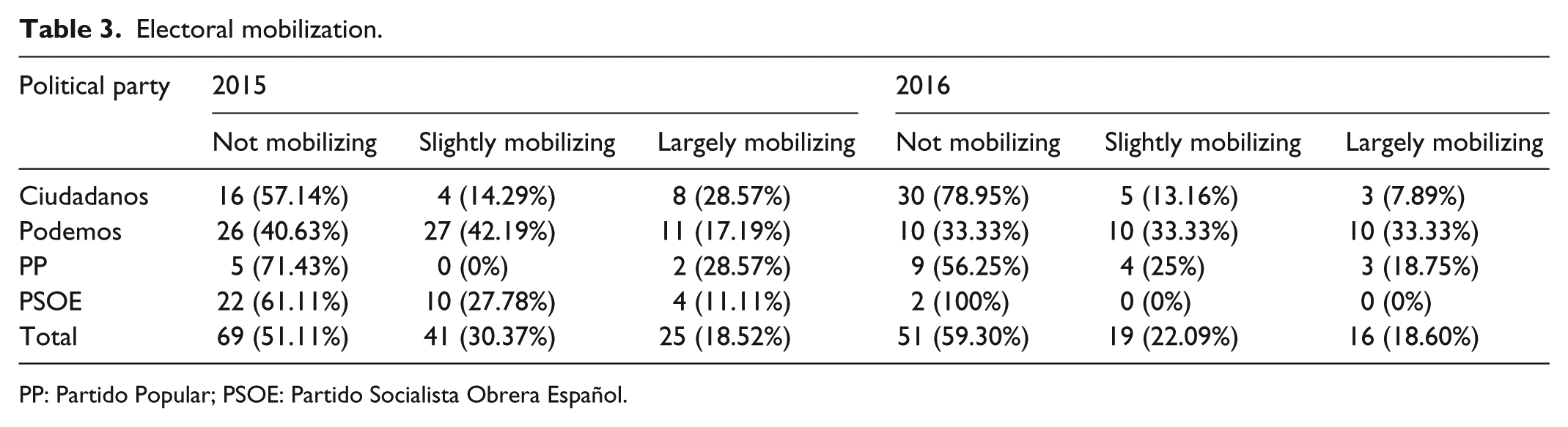
PP: Partido Popular; PSOE: Partido Socialista Obrera Español.
Top candidate promotion.
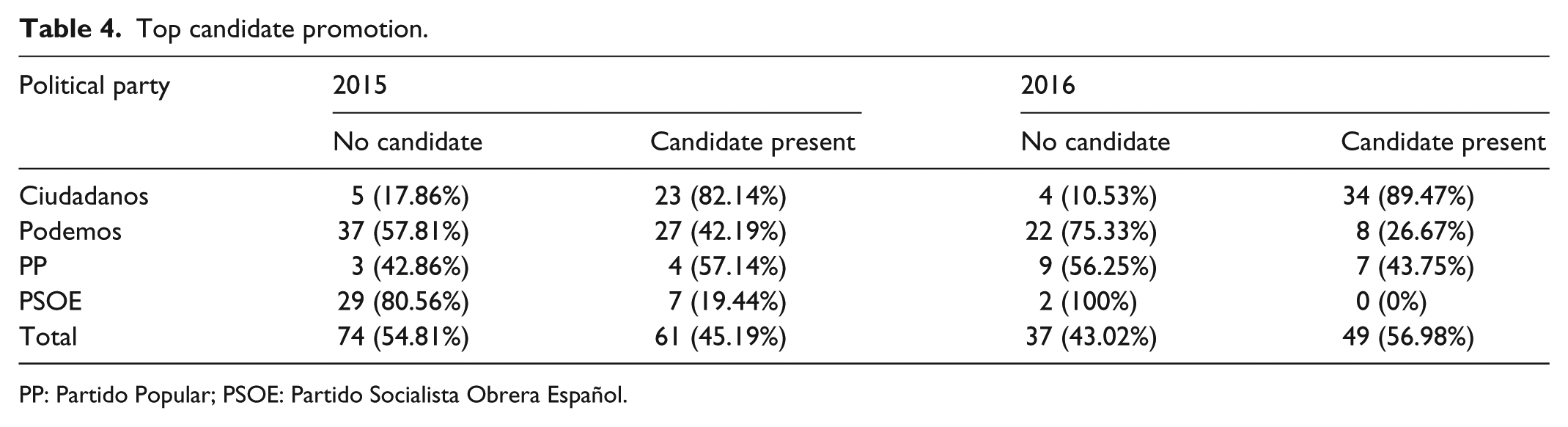
PP: Partido Popular; PSOE: Partido Socialista Obrera Español.
One of the clear conclusions that can be taken from the content analysis is that no party displayed a pattern of Instagram use that reflects an ambition to promote party policy on the social media platform. The articulation of policy positions was only slightly clear in the case of the PP during the 2015 elections but even then, the results do not suggest any systematic trend that may allow for the inference of motivations. In fact, the number of posts by the PP are so few that it would be somewhat of an overreach to claim that the party’s behavior of Instagram represents any strategic utilitarian value for the party.
Capturing attempts for the parties to mobilize specific action from the electorate displays that Podemos is the only party that expressed some form of mobilizing reference across the majority of their publications during both election cycles. As the foundation and development of Podemos emerged from that of the former 15-M/Indignados political activist groups, which displayed strong use of social media for mobilizing (Anduiza et al., 2014; Fernández-Albertos, 2015), it may be that Podemos sought to replicate these uses on Instagram. Mobilization attempts to activate the party faithful may also represent Podemos’ view of social media as tool for communicating with their own supporters as opposed to persuading undecided voters. This would be in line with the political communication strategies whose main purpose is often to rally the troops rather than persuade the masses (Norris, 2003; Vaccari, 2013).
Undoubtedly, Ciudadanos is the only party that decided to aggressively use Instagram as a conduit to promote the image of their top candidate. It is the only party that increased both their number of publications across the two elections as well as their posts of their main candidate. It seems probable that Ciudadanos sought to take advantage of the popularity of the party leader, Albert Rivéra. The pre-electoral CIS survey in 2015 revealed that the leader of Ciudadanos received the most favorable assessment of the four candidates for the presidency by the electorate, a result that was widely reported in the press at the time. In the case of Podemos, the decrease in the number of posts of their leader, Pablo Iglesias, and the marginal number of photos of Alberto Garzón in 2016 were, however, balanced out by an increase in the number of publications by the party that showed Inigo Errejón, Podemos’ effective number two. The fact that all parties bar Ciudadanos reduced their posts promoting the main candidate in the second election cycle may be explained by the overall decrease in popularity for all of the individual candidates after their failure to form a government after the 2015 elections.
Analysis of the posts found very little evidence of any Europeanisation effect, with the only exception being a very small number of posts from Ciudadanos. This may be due to the lack of salience regarding the EU in Spanish electoral competition (Vazquez-García, 2012, p. 119), and is not to say that other case studies should expect to find similar results. Interestingly, while the Europeanisation variable proved somewhat insignificant in that it returned only four EU references from Ciudadanos out of the 220 observations analyzed across the two elections, the number of EU-related publications from this same party seems to be numerous outwith the limitations of the timeframe selected for analysis here. Both the feed of the official Ciudadanos Instagram account and that of Albert Rivéra display ample posts with other sister party leaders belonging to the same European party group (ALDE) and captions on other posts make reference to policy debates going on in other member states. The fact that Ciudadanos, as one of the two new parties in the Spanish political system, is the only party which shows any kind of Europeanisation effect is noteworthy. There may be reason to suggest that in the same way that European Parliament elections provide a legitimizing effect for emerging parties (Hix & Marsh, 2007; Shulte-Cloos, 2018), as was the case with Podemos, perhaps engagement with European and transnational party actors is also carried out as a means of legitimizing the party (Bressanelli, 2012; McDonnell & Werner, 2018). An additional explanation may be that appearing alongside these same actors allows the electorate to better place the party within the traditional ideological axis. As has been argued above, new parties suffer from lack of recognition and appearing alongside generally recognizable figures such as the leader of the ALDE, Guy Verhofstadt, whose pro-European videos have often been viral material for social media users, serves as a proxy for voters in their attempts to identify where Ciudadanos stands vis-à-vis their competitors. This line of enquiry would provide for an interesting avenue of research as the same behavior does not seem to be witnessed by Podemos, the other new party in Spain. One possible hypothesis may be that the challenge of Ciudadanos in placing itself within the Spanish system has proven to be more difficult in that its position as a purely centrist party (Rodríquez Teruel & Barrio, 2015) doesn’t fit well with the typical polarized party positions of the Spanish system (Magone, 2009).
Spanish Parties on Instagram. What Works?
In the following section, I move beyond a description of the different posts made by parties and the motivations of the same and begin to analyze those characteristics that explain party success on Instagram. Increasing the level of engagement of posts on Instagram is important for political parties. First, politicians claim (Karlsen & Enjolras, 2016) and are observed (Abejón-Mendoza & Mayoral-Sánchez, 2017) to be using social media platforms such as Instagram to make sure that they are present and forming part of the conversation that is going on online; at the core of their strategy is to make sure that they are the topic of conversation. Engagement in the form of the number of likes as well as comments on Instagram are important performance indicators that will communicate to parties how they are being received on the application. Moreover, in addition to the chronological structuring of user feeds on Instagram, the explore page uses algorithmic allocations (Bossetta, 2018) based on how popular posts are as indicated by how many likes and comments they receive. Therefore, the higher the level of engagement received on a party’s post, the greater the likelihood that the posts will be promoted to networked users via the explore page. In short, then, engagement matters for two reasons: it signals to the party how they are received, and it also promotes the party’s material beyond its core block of follows.
Using the number of likes and engagement scores described above as the dependent variable, a multivariate regression analysis is conducted regressing the dependent variables on the core coding variables used in the content-analysis. In addition, two binary variables are included to indicate new party status (Ciudadanos and Podemos) as well as whether a party was left-leaning (Podemos and PSOE) or right-leaning (Ciudadanos and PP). Three estimations are completed: one independent estimation for each of the election periods under analysis as well as a pooled ordinary least squares (OLS) model including a control for year effects. The results reported in Table 5 display the impact of variables on the natural logarithm of the likes and engagement scores, although a reproduction of the OLS estimation using the raw data is provided in the Appendix and finds results of both a similar impact and significance.
Modeling engagement with party posts.

EU: European Union.
Robust standard errors in parentheses.
p < .01; **p < .05; *p < .1.
As displayed in Table 5, there are a number of interesting findings of note. Being a new party (either Ciudadanos or Podemos) is associated with both achieving greater number of likes and generating higher engagement. The coefficients are positive and reliable across all models despite a lack of statistical significance at conventional levels in the 2016-only estimation. This lack of significance is likely explained by the impact of the left-wing dummy which is significant and positive in 2016. Because Podemos made up 94% of left-wing party posts made in 2016, this variable is effectively capturing party newness. In the pooled model, newness represents the largest coefficient value of all statistically significant variables meaning that challenger party status had the biggest substantive impact on how Instagram users responded to party material. While positive in 2016, the effect of being in a left-wing party displayed the reverse effect in 2015 with the relationship displaying a negative association with both likes and engagement. The individual significance of this variables falls away in the pooled model.
In terms of how content impacted Instagram users’ engagement with the party publications, the use of official branded material, or appearing alongside celebrities did not have any noticeable effect. The negative coefficients of the broadcasting variable indicate that users of the social media application did not tend to react particularly positively to posts that sought to promote party policy. It is clear, however, that posts that sought to mobilize the electorate did provide a significantly more positive response. The same is also true for the promotion of the top party candidate. In the pooled model, the size and significance of these variables is the same meaning that party posts that seek to get Instagram users to take action or those that display images of their top candidates are statistically more popular than other posts.
The limitation of this present analysis, however, is that the impact of the engagement with Instagram users displayed here may not necessarily be linked with changes in users’ views and or behavior. An interesting line of research may seek to assess whether posts that seek to mobilize voter responses are effective at actually triggering the desired response, namely in terms of turning out the vote. Moreover, the very small N of observations pertaining to the traditional parties, particularly in the case of the PSOE, compared with the challenger parties means that some of the estimated effects presented in the OLS models above may not reflect their true impact. As parties make more systematic use of the social media application, however, a more equal distribution of posts will likely be made by the parties. This is something that could be reassessed in future election cycles. Nevertheless, the results presented here do provide for an initial understanding of which parties in Spain are the most proficient users of Instagram and what content tends to resonate well with the Spanish electorate who use the application.
Conclusion
The daily use of the application by the four main parties in Spain across both elections shows that political parties are actively innovating their communication strategies to keep up-to-date with an ever-evolving political communication market. A simple analysis of the extent of the parties’ use shows that the new challenger parties of Podemos and Ciudadanos have been both the most active and indeed the most popular users of the photo-sharing social media platform. Of note is the reduction in the use of the platform between the two election cycles with a significantly lower number of publications being made during the second round of elections, arguably the result of electoral fatigue with two general elections taking place in the country within six months.
The guiding hypotheses supposed that Instagram posts would reflect party communication strategy that focused on promoting (a) the party’s policy positions, (b) electoral mobilization, and (c) the image of the main party candidate. Content analysis of the publications made by the parties across both elections provides for mixed results that reflect the heterogeneous development of party uses for Instagram. No party seems to have used Instagram as a means of systematically communicating their policy positions with references to the same remaining limited across both election cycles. Podemos remains the only party that tended to use Instagram as a means of mobilizing its supporters with a majority of its publications aimed at inspiring support or specific action from voters in 2015 and again in 2016. One of the most evident findings was the focus of Ciudadanos on the promotion of their lead candidate, the extent of which far surpassed the promotion of the lead candidates by any of the other parties. This finding, echoes that of candidate’s use on Instagram with Abejón-Mendoza and Mayoral-Sanchez (2017) highlighting that the Facebook page of Rivera tended to focus on images of himself, 77% of all posts, at a rate much higher than that of the other candidates. Analysis of the traditional parties does not show any identifiable strategic utility to their Instagram use and the low level of participation on the platform vis-à-vis their new competitors is likely indicative of either their inability to understand the incentives and affordances of Instagram for political communication or the result of their ability to monopolize and focus on traditional means of communication in light of electoral regulations that restrict access to the same for emerging political challengers.
In terms of explaining the successes of party use of Instagram, overall the new challenger parties of Ciudadanos and Podemos tend to be the most efficient users. Being a new party is associated with both an increased number of likes as well as a higher engagement score. Of note is that the strong correlation between belonging to the bloc of new parties and achieving a greater level of engagement with Instagram users echoes the findings presented by Selva-Ruiz and Caro-Castaño (2017). Focusing on the accounts of individual MPs from the main parties, their analysis reveals that the mean level of engagement (number of likes and comments) is far superior among MPs from the two new parties compared with those published by MPs from the PSOE and the PP. The findings contradict, however, the claims made by Marcos-García and Alonso-Muñoz (2017) who argue that the main candidates of the old parties are the most active, if, however, not the most successful at gaining engagement.
A party’s ideological leaning does not appear to exhibit any effect on influencing the level of engagement with Instagram. The results of the regression analysis also show that posts that seek to mobilize voters or promote the main party leader play more positively with the electorate than posts that seek to promote party policy. As such parties may wish to consider focusing their Instagram use on these two functions should they wish to increase their impact on this particular social media platform.
The biggest limitation of this study is the small number of electoral cycles in Spain that we can apply a systematic review of Instagram use to. The application itself as well as its use by political parties as a tool of political communication is very much in its infancy. Analysis tracing the trends in party use of the picture-sharing platform to include future elections across time will provide data for a more robust assessment, although as noted by Bossetta (2018), the digital architecture of Instagram is evolving at a fast pace meaning that longitudinal analysis will need to consider how changes in the interface and tools of the platform may impact upon how parties use it in practice. This contribution is one of only a very limited number that assesses within country data. As more empirical evidence emerges from other national level assessments, so too will our capacity to make more generic claims regarding the use, and indeed benefits of, Instagram for political party electioneering. Given the methodological constraints on providing comparative analysis across countries due to the longitudinal evolution of the application’s tools, the next European Parliament elections due to take place in May 2019 would provide fertile ground for a comparison of Instagram use by political actors across a large cohort of countries that take place simultaneously.
Supplemental Material
RR_supplementarymaterial – Supplemental material for Selfies, Policies, or Votes? Political Party Use of Instagram in the 2015 and 2016 Spanish General Elections
Supplemental material, RR_supplementarymaterial for Selfies, Policies, or Votes? Political Party Use of Instagram in the 2015 and 2016 Spanish General Elections by Stuart J. Turnbull-Dugarte in Social Media + Society
Footnotes
Acknowledgements
Author expresses thanks to feedback received from fellow doctoral students at King’s College London as well as the support and guidance of Dr. Christel Koop and Dr. Rubén Ruiz-Rufino. Any errors, of course, remain those of the author.
Declaration of conflicting interests
The author(s) declared no potential conflicts of interest with respect to the research, authorship, and/or publication of this article.
Funding
The author(s) received no financial support for the research, authorship, and/or publication of this article.
Supplemental material
Supplemental material for this article is available online.
Notes

Author Biography
References
Supplementary Material
Please find the following supplemental material available below.
For Open Access articles published under a Creative Commons License, all supplemental material carries the same license as the article it is associated with.
For non-Open Access articles published, all supplemental material carries a non-exclusive license, and permission requests for re-use of supplemental material or any part of supplemental material shall be sent directly to the copyright owner as specified in the copyright notice associated with the article.
