




Abstract
The United Kingdom political landscape has historically been dominated by the two main political parties: Labour and the Conservatives. However, by the 2010 General Election, their vote share had dropped to 65%. The 2010 election also saw a new development enter the UK political landscape—televised leaders’ debates, which featured the leaders of the three largest political parties. Discussions before the 2015 General Election resulted in a decision to repeat the debate experiment, but this time, partly due to changes in projected vote shares, seven leaders were invited to the main debate. Using content analysis of the debate, this research questions the presentation of the debate as a deliberative event. Participatory parity was not achieved in the debate—far from it. Instead, the debate served to reinforce extant power differentials between the leaders of parties of differing political standings.
For much of the twentieth century, the United Kingdom operated with essentially a two-party political system. In the second half of the century, the Labour and Conservative parties typically shared over 80% 1 of the vote at General Elections and regularly swapped places as The Government or The Opposition. The Effective Number of Electoral Parties (ENEP) figure (Laakso & Taagepera, 1979) for the United Kingdom averaged 2.36 from 1945 to 1970, and post-1970 rose to 3.21 (Gallagher & Mitchell, 2008). An alternative measure, the Effective Number of Parliamentary Parties (ENPP), more specifically measures the effective number of parties at the parliamentary or legislative level; this figure hovered around two from 1945 to the turn of the century. By 2010, the ENEP had risen to 3.72 and the ENPP to 2.57—clear illustration that the United Kingdom was moving slightly in the direction of a multi-party system. Slightly is emphasized, as the most recent available ENEP/ENPP figures for other comparable nations are Spain 5.03/4.16; Germany 4.81/3.51; Australia 4.47/3.07; Canada 3.33/2.50. The ENEP/ENPP figures for Spain, Germany, and Australia are, partly at least, illustrative of the opportunities afforded to multipartyism by different electoral systems, such as proportional representation. The parliamentary first-past-the-post system, as used in the United Kingdom, is inimical to multipartyism, as argued by Duverger (1954) and his oft-cited law; “the simple-majority single-ballot [i.e., simple plurality rule] system favors the two-party system” (p. 217).
However, smaller parties have been gaining in prominence, and this increasing prominence saw an intriguing development prior to the 2015 General Election—the leaders of seven UK political parties were invited to participate in a live televised debate. Televised political debates are common in the United Kingdom, but leaders’ debates in such a format are new to the UK political arena; it was only in 2010 that the first one ever took place. Chadwick (2011) argues that this was possibly the most important development in politics-media relations in the United Kingdom since televised coverage began in 1959. The 2010 debates featured the leaders of the three biggest parties in the United Kingdom. The increasing complexity of the political arena was recognized in 2014/2015 and, following months of debates about the debates (see “Election 2015: Seven-Party TV Debate Plan Announced,” 2015 for a brief summary) by parties and the media organizations, an agreement was reached to broadcast two debates.
Debate one featured the leaders of seven of the biggest political parties in the United Kingdom. 2 Debate two featured five of the same lineup, with Prime Minister David Cameron and Deputy Prime Minister Nick Clegg not in attendance. Due to this setup, and the specific research question of interest, this research focuses on the first debate which occurred 2 April 2015. This was the first time that “minor” parties had shared an ostensibly equal platform. The debate was setup to try to protect this equal access ethos with pre-agreed rules governing such factors as response time and response order. Leaders were given time for 1-minute opening and closing statements. Then, four audience questions (sight unseen) were asked, with each leader given 1-minute to respond. Following each round of timed responses, the debate was opened for “real” discussion of around 20 minutes duration per question.
Tully (2002) argues that there is increasing agreement that in a constitutional democracy, deliberation must be a requisite component. Dryzek (2009) echoes this sentiment, stating that “deliberation that is authentic, inclusive and consequential is central to democracy” (p. 1399). The debates were sold as an opportunity for the public to evaluate the credentials of the competing leaders—debaters in a televised agora where arguments would compete for public support. This research examines whether the debate could be considered as a contributor to deliberative democracy. The guiding research question is whether the 2 April debate should be considered as a deliberative event.
The normative model of representative democracy requires that individual groups of people elect a person (or persons) to represent them in some form of legislative or parliamentary body. The United Kingdom operates a first-past-the-post constituency-based voting system. Each of the 650 Members of Parliament (MP) is chosen to represent a geographically bounded area of, on average, 70,000 constituents. However, although people ostensibly vote for their local candidate, it is largely the candidate’s party which drives most voting behavior. Indeed, one not atypical study shows that up to 75% of people cannot even name their MP (Hansard Society, 2013), but they will likely know for which party they voted. Almost inevitably in modern democracies, elected officials will belong to a political party, with a leader chosen from those officials to represent the views of the party officials, members, and supporters. And although both party membership (Marshall, 2009) and alignment (Negrine, 2008) in the United Kingdom had been trending downward prior to 2015, many of the millions watching the debate would have identified one (or more) of the participants as their representative in the debate, and/or their hoped-for future representative as Prime Minister.
Deliberative theory focuses on communication processes of opinion and will-formation, deliberation being seen as an extension of representative democracy rather than a replacement of it (Chambers, 2003). The democratic model normatively presupposes a meaningfully informed electorate, an electorate able to differentiate and choose between the political positions on offer. As Friedenberg (1994, p. xi) puts it: “From ancient Greece and Rome to the present, free societies have relied upon the vigorous clash of ideas in an open and free marketplace of ideas as a means of decision making.” Although there is no strictly agreed upon definition for what a debate should look like to afford deliberative democracy, deliberation presupposes some level of equitable participation. Fraser (1990) argues that, “participatory parity is essential to a democratic public sphere and that rough socio-economic equality is a precondition of participatory parity” (p. 74).
Although Fraser was clearly not discussing social or economic disparities between political parties, the point is germane; there were clear political-power disparities among the leaders entering the television studio. The debate was sold to the viewing public as an opportunity to level this imbalance; the opening voiceover of the coverage intoned how viewers would see, “seven party leaders go face-to-face.” ITV News Director, Michael Jermey, in prior publicity stated that, “The programme will provide a fair forum for a proper debate between the party leaders” (“Revealed: Set and Location for Political Leaders’ Debate Showdown,” 2015). Deliberative theorists have made attempts to empirically measure communicative acts in order to assess the quality of discourse. The updated Discourse Quality Index (DQI) by Steiner (2012) is one such measure. This index is rooted in the work of Jürgen Habermas (Steenbergen, Bächtiger, Spörndli, & Steiner, 2003). Steiner (2012) notes that the empirical examinations he discusses were far from the “Habermasian normative ideal of equal and unconstrained participation” (p. 49). This work uses the participation constraint from the DQI to illustrate the disparity in contribution to the debate. The index also contains elements to measure respect for other participants; these measures require inter-participant engagement as a starting point for the measure. This research borrows from these elements to illustrate how there was an imbalance of engagement by the leaders leading to marginalization of certain voices and prominence of others, specifically how frequently leaders mention their opponents by name or party and how frequently they disagree (and, at times, agree) with an opponent. A content analysis methodology is utilized to examine the debate texts and visuals. The findings here indicate that viewers were presented with a debate which reflected and relayed extant power hierarchies, thus disabling any consideration of the debate as a deliberative event; this brings into question the role played by debates and has clear implications for the role of such debates in the UK political landscape.
The debate
Political debate is of course as old as politics itself. The iteration of televising a debate with seven leaders was merely the latest evolution from a practice that can be traced to early democracies. Many scholars credit Habermas with reviving the idea of deliberation in recent decades (Gutmann & Thompson, 2004). Habermas (1962/1989) in his discussion of early politics, details how bios politikos, took place in the agora when lexis occurred. However, not all were invited to the discussion, as only a master of an oikos could participate. A replacement of the italicized words with political life, television studio, debate, and political party updates the point quite succinctly and allows it to be borrowed analogously for this discussion. Calhoun (1992, p. 1) writes that Habermas’ central question was to ask, “What are the social conditions . . . for a rational-critical debate about public issues conducted by private persons willing to let arguments and not statuses determine decisions?” In Habermas’ (1975) terms, it should be “the forceless force of the better argument” (p. 108) which is the deciding factor in normative models of deliberative events, and there should not be “intimidation by social or economic status” (Ferrell & Old, 2016, p. 219).
There is still frequent political programming scheduled in the United Kingdom, and the multi-party debate format has been a fixture for many years, notably with the BBC program Question Time—first broadcast in 1979, and the show has long been a Thursday evening staple that helps establish, “the rhythms of the British media’s regular politics, commentary and opinion cycle” (Chadwick, 2011, p. 27). The leaders’ debate was scheduled for a Thursday to fit in with this cycle. Despite this history of political debate, it took many years of discussions before televised leaders’ debates became a reality in 2010 (see Bailey, 2011, for a historical context). Consequently, there is very little research on the role of televised leaders’ debates in UK politics.
US presidential debates, however, have been the focus of much study. Most notably perhaps the Kennedy–Nixon debates which decades later were still objects of interest. Benoit and Harthcock (1999) analyzed how the candidates used acclaim, attack, and defense as rhetorical strategies. Kraus (1996) evaluated the veracity of the claims of differing interpretations of debate victor between radio listeners and television viewers. Druckman (2003) used the passage of time and a novel experimental model to further investigate that claim. The Lincoln–Douglas debates were subjected to close textual analysis a century after they occurred, and with further update 50 years later still (Jaffa, 1959/2009). Of course, a presidential system is different to a parliamentary system in that, ostensibly at least, voters do not vote for the Prime Minister in a parliamentary system but rather their local constituency representative—one of the reasons why televised leaders’ debates were so long in arriving to the United Kingdom, and indeed remain an object of contention.
Pattie and Johnston (2011) in their analysis of the 2010 UK leaders’ debates confirmed what was much reported at the time, that Liberal Democrat leader Nick Clegg’s performance in the debates had a significant impact on support for his party, although they note that the initial bump in support following Clegg’s debate performance (particularly the “I agree with Nick” debate 3 ) maybe did not endure and translate into voting outcomes. Wring (2011) argues that Clegg’s performance may have even been injurious to Liberal Democrat fortunes as it resulted in some of the Conservative Party and conservative press to increase attacks on Clegg’s party. In 2010, no one party returned a sufficient number of MPs to form a majority government, resulting in a coalition agreement between the Conservative and Liberal Democrat parties, with party leaders, David Cameron and Nick Clegg becoming Prime Minister and Deputy Prime Minister, respectively.
Following the reception of the 2010 debates, it was perhaps inevitable that they would be revisited in 2015. However, the same concerns which had inhibited previous attempts to stage debates resurfaced during the discussions between broadcasters and party officials. Initial proposals in late October 2014 were for a mixture of formats: one head-to-head featuring Cameron and Labour leader—Ed Miliband, a second to also include Clegg, and a third to which UKIP leader—Nigel Farage—would be invited. Cameron, however, rejected these proposals, arguing publicly that the Green Party should be invited. Many commentators, however, postulated that his intransigence on this point was more likely due to political considerations rather than lofty deliberative ideals—perceived wisdom is that the incumbent usually has the most to lose in a debate setting and therefore is likely to attempt to minimize such exposure where possible. The final format agreed, alongside the seven-way debate considered here, was a five-way challengers’ debate, constituent country debates in Northern Ireland, Scotland and Wales, and individual interviews with leaders (see “Election Debates Agreement Reached,” 2015; Padmanabhan, 2015; Watson, 2015 for further details).
The novelty, media prominence, and presumed importance to electoral fortunes, of the 2010 debates makes the descriptor of them as a “media event” (Dayan & Katz, 1994) quite apposite. They were certainly interruptions to the “normal flow of broadcasting and our lives” (Dayan & Katz, 1994, p. 5) and were live events transmitted in primetime on all major broadcast channels (though not simultaneously—broadcasters shared coverage). The debates were heavily advertised in the preceding weeks by the broadcasters and were objects of extensive discussion in all forms of media both pre- and post-debate. An estimated 37% of the television audience saw at least some part of the first debate. A similar level of prominence was given to the eventually agreed on debate and interview series in 2015. This time, pre-publicity often focused on the new aspect of the inclusion of multiple parties. Although not as high as the viewership in 2010, the viewing figures for the 2 April debate show that many people did again interrupt their lives—only the most popular soap operas and reality television shows were watched by more viewers that week.
Although by no means the sole focus, much of the research on political debates has concentrated on debate performance and how it may have subsequently influenced electoral outcomes. However, what has been less well covered is the influence of pre-debate factors in the deliberative performance of the debate, specifically the political standing of those participating.
Party standings
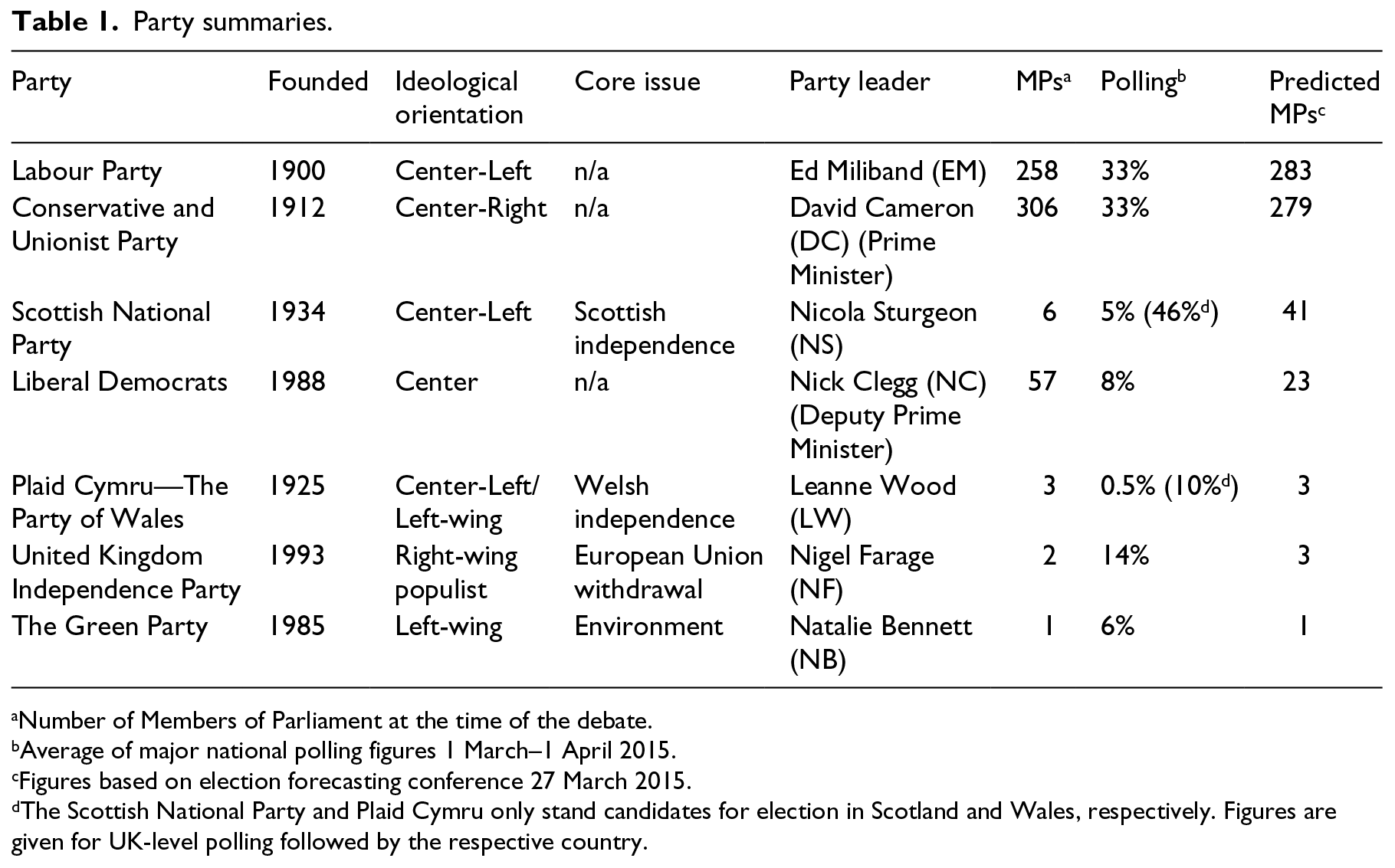
Table 1 summarizes the history and political standing at the time of the debate of the parties participating.
Party summaries.
Number of Members of Parliament at the time of the debate.
Average of major national polling figures 1 March–1 April 2015.
Figures based on election forecasting conference 27 March 2015.
The Scottish National Party and Plaid Cymru only stand candidates for election in Scotland and Wales, respectively. Figures are given for UK-level polling followed by the respective country.
Before the debate, polling consistently predicted a hung parliament with no one party forecast to achieve a parliamentary majority, and a coalition would be required to govern. An election forecasting conference on 27 March, examining a wide range of polls, predicted the likeliest numbers of Members of Parliament by party, 4 which is detailed in Table 1, would result in no majority. Therefore, it was manifest that there were essentially only two possible formats to such a potential coalition—a Conservative-led right-of-center coalition with David Cameron as Prime Minister (supported again by the Liberal Democrats), or a Labour-led left-of-center coalition with Ed Miliband occupying 10 Downing Street (supported by either the Liberal Democrats and/or the Scottish National Party (SNP)). I, therefore, argue that Cameron and Miliband entered the debate with a particular hierarchical advantage over the other leaders, and therefore belonged to a primary social stratum. Their coalition potential (Hopmann, Elmelund-Præstekær, Vliegenthart, de Vreese, & Albæk, 2012) places Clegg and Sturgeon in a secondary level, with Bennett, Farage, and Wood occupying a tertiary level.
However, issue-ownership (Petrocik, Benoit, & Hansen, 2003; Sides, 2006; Walgrave & de Swert, 2007) would predict that these levels need not necessarily be fixed through the debate. The concept of issue-ownership is of salience here, particularly with respect to core-issue parties. Political parties have traditionally been seen as having particular strength on certain policy areas. Parties of the right are typically seen as stronger on the economy and defense, and parties of the left granted greater authority on social welfare issues, to use the common examples. Core-issue parties are typically granted if not ownership, then at least “issue-interest” or “competence” in/on that policy. One of the main areas debated during the program was the issue of immigration—an issue which Deacon, Downey, Stanyer, and Wring (2017) note was one of the issues most prominently covered in media coverage of the campaign. Cushion, Thomas, and Ellis (2015) note that UKIP were prominent agenda-setters in the 2014 European election cycle, and Hughes (2019) shows how prominently UKIP placed this issue in their news releases in the years prior to the debate. It is reasonable, therefore, to predict that on this issue, UKIP may be ceded ownership of the issue of immigration during the debate.
Methods
A content analysis was undertaken by hand by the author to examine the texts of the speech of the leaders and aspects of the media in the debates. The debate was viewed and transcribed by the author. There were a few instances where cross-talk made the audio impossible to transcribe or able to be transcribed but not possible to assign to a participant. These data were not included. Also not included were speech acts by the debate moderator or audience members. Conforming to Steiner’s (2012) work using the DQI, a single speech act was the unit of analysis used. That is, each time a leader spoke counted as a speech act. If a leader was briefly interrupted the text prior, and subsequent, to the interruption was counted as one speech act, and the interruption a separate speech act. As in the DQI, level of participation was recorded, operationalized as the number of speech acts and the duration of speech acts. Opening and closing statements for the debate plus the opening statement to each question were recorded as part of the total time speaking. These elements were all pre-agreed to be of 1-minute duration and uninterrupted; something largely adhered to by all the participants. Speech acts outside these restricted (and presumably pre-written and rehearsed) contributions were recorded as time debating. It is these “debating speech acts” which were coded to measure participation in the debate.
The DQI measures quality of interaction with other participants, operationalizing respect in terms of use of foul or respectful language or listening. Such a qualitative assessment is not undertaken here as an important precursor to such an assessment is whether participatory parity was achieved. The operationalization of participation, however, borrows from the DQI to measure how much other participants engaged with each other. For this, leader speech acts were coded for mentions of other leaders, mentions of other parties and (dis)agreements with other leaders. Personal mentions were invariably clear to code—typically first names or full names were used. David Cameron’s title of “Prime Minister” was used on occasion and coded as a reference to him. Party names were also usually obvious—typically shortened versions were used (e.g. “Lib Dems” and “ukip”) and “Tory/ies” used to refer to the Conservative Party. “This government” and “coalition” were coded as a reference to both the Conservatives and Liberal Democrats.
These data are best displayed visually (Figures 1 and 2) using network mapping techniques to illustrate leader engagement and how this engagement emerged. Therefore, network terminology is utilized in describing the methods and findings. The four measures of debate involvement were treated as ties between leaders, with leaders treated as nodes. Every time a leader was engaged with, their node size was increased by one, and the tie between that leader and the one engaging them also increased by one.
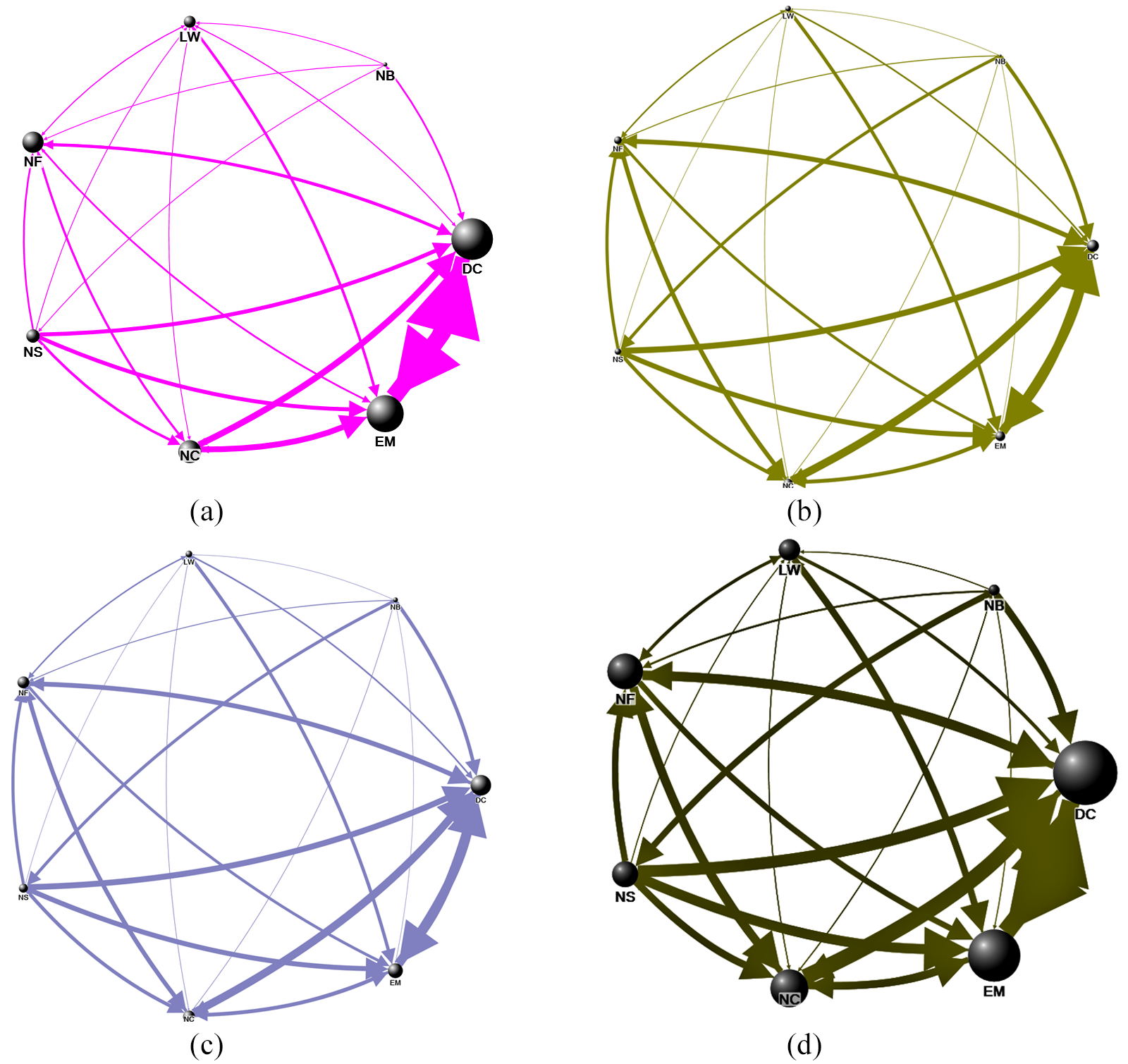
Varying directions and strengths of ties and engagement of leaders based on (a) mentions; (b) (dis)agreements; (c) camera shots; and (d) mentions, (dis)agreements, and camera shots.

Varying directions and strengths of ties and engagement of leaders based on mentions, (dis)agreements and camera shots: (a) economy question; (b) NHS question; (c) youth future question; and (d) immigration question.
Agreement and disagreement were coded using explicit verbal statements where it was both clear that the speaker was (dis)agreeing with a previous statement, and who they were (dis)agreeing with. Speech acts such as “I think Leanne makes a good point” (Cameron) and “I’ll just say this Leanne . . . but you’re right” (Miliband) were coded as Cameron and Miliband agreeing with Wood. Similarly, “I would say to David Cameron his scares about free schools are wrong” (Miliband) and “David said in his opening . . . that’s actually not the case.” (Sturgeon) were coded as disagreements between Cameron and Miliband and Cameron and Sturgeon, respectively, and also coded as personal mentions of Cameron by those leaders.
The directionality of the link was also recorded, directing from the leader speaking to the leader/party they were addressing or (dis)agreeing with. The Sturgeon statement above, for example, was coded NS → DC.
A visual component was also included as a measure of inter-leader engagement (see Grabe & Bucy, 2009, for discussion of the importance of the consideration of visual cues). Camera shots were treated as directed links leader A → leader B when conforming to one of the two stipulations: first, if leader B is shown in close-up while leader A is talking; second, if leader A is talking and leader B is shown in a shot with leader A where the shot is clearly intended to frame just the two leaders. Typically, such shots were done as reaction shots, that is, a leader whose name was mentioned or who was clearly pertinent to the current dialogue would be cut to for viewers to see their reaction.
These are useful measures of engagement as they are specific speech acts by one debater which clearly directly engages with one of the other debaters. Such engagement also frequently leads to further engagement between the two, increasing the prominence of both. Although not an explicit requirement under most debate rules, it is often convention, as was usually observed in this debate by the moderator, that a participant who is engaged with in some manner, such as being named or disagreed with, is offered a right of reply.
To explicate the network terminology and coding further: if, when speaking, David Cameron mentions Ed Miliband, a directed link DC → EM was recorded; if Nick Clegg mentions the SNP, a directed link NC → NS was counted; if Leanne Wood agrees with Nigel Farage, this constituted a directed link LW → NF; and if Natalie Bennett is specifically framed while David Cameron is talking, a directed link DC → NB was recorded. In each instance, the second leader listed was recorded as having one additional in-degree value. Visually, this translates in Figures 1 and 2, to an increase in their node size by one, the link between them by one and the directed link between them by one.
Four questions, asked by audience members, were debated, allowing analysis to also be undertaken on these separate elements of the debate, and this illustrates how leaders may gain or lose prominence dependent on the area of policy being discussed.
Findings
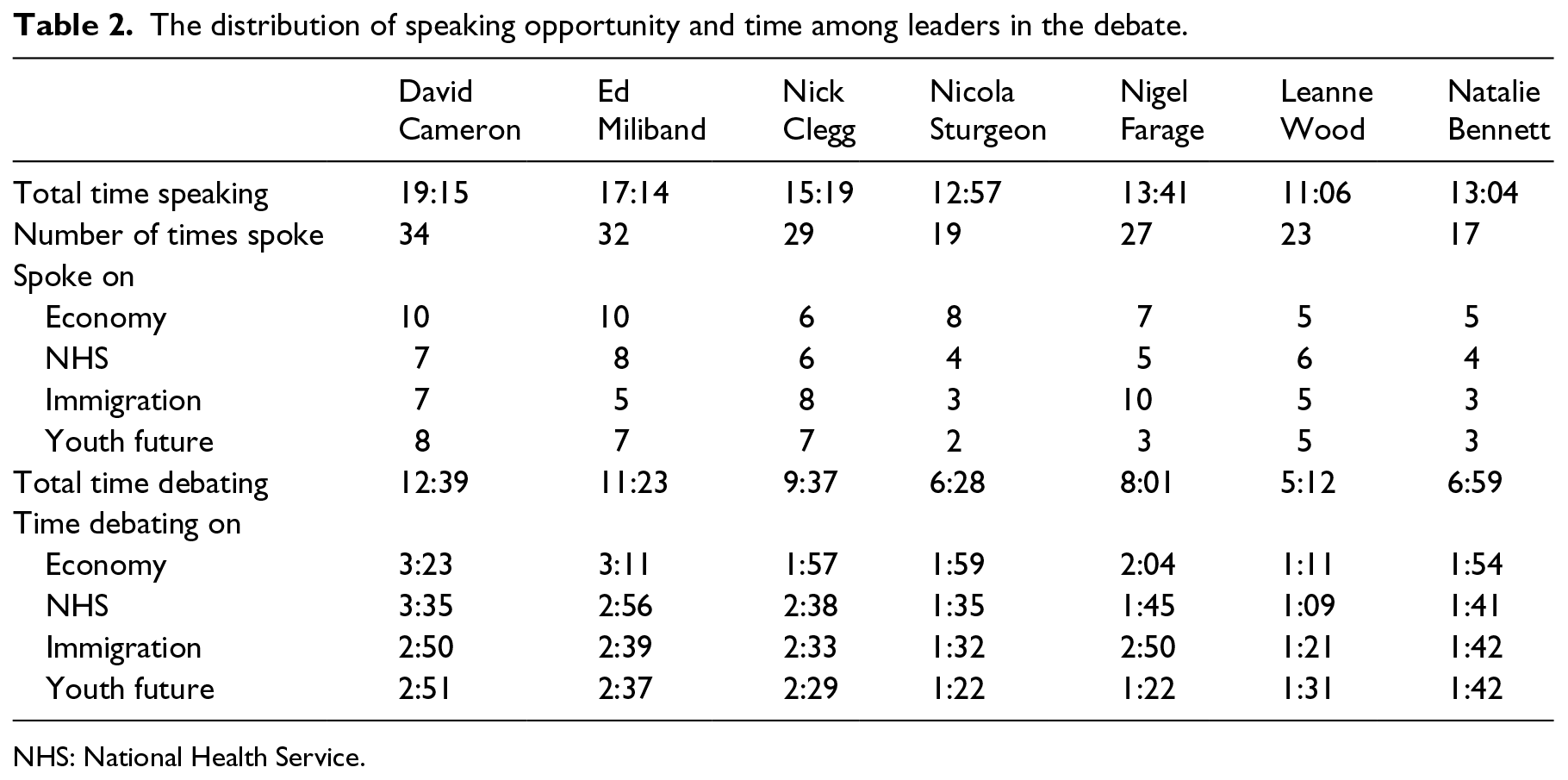
The initial content analysis of the debate is indicative of a somewhat unequal debate. A basic frequency analysis, see Table 2, shows that Cameron and Miliband had significantly more opportunity to speak than the other leaders, most notably Sturgeon and Bennett (Cameron spoke twice as often as Bennett). Also, the total time spent speaking was significantly different, with Cameron’s 19 minutes 15 seconds being around 6 minutes longer than Bennett and Farage’s times and over 8 minutes longer than Wood’s.
The distribution of speaking opportunity and time among leaders in the debate.
NHS: National Health Service.
The distinct elements of the debate were parsed out to separate the prepared statements (the opening and closing statements to the debate, and the opening response to each of the four questions) and the “debating speech acts.” The four questions asked by different audience members were on the economy, National Health Service (NHS), immigration and youthful hopes for the future (“youth future”), with about 20 minutes debate occurring for each question. Cameron had the most debating opportunity at 12 minutes 39 seconds, with Wood, Bennett, and Farage getting around 5, 7, and 8 minutes, respectively.
The leaders also illustrated clearly who they believed were worth attacking, mentioning or who could be ignored, as shown in Table 3. Cameron, or his party, was mentioned or referred to 96 times during the debate, 51 times by Miliband alone. Therefore, Cameron has an in-degree value of 96 for “mention” ties. The directed tie strength of Miliband → Cameron is 51. Miliband or Labour were referred to 76 times, around half of those references from Cameron (Cameron → Miliband is 35). At the opposite end of the scale, Natalie Bennett or the Green Party was referred to only once. Similarly, Cameron is disagreed with far more than any other leader, but almost nobody bothered to take issue with anything said by the three female leaders.
In-degree measures of leaders in the debate and how leaders contributed to opponents in-degree measures.
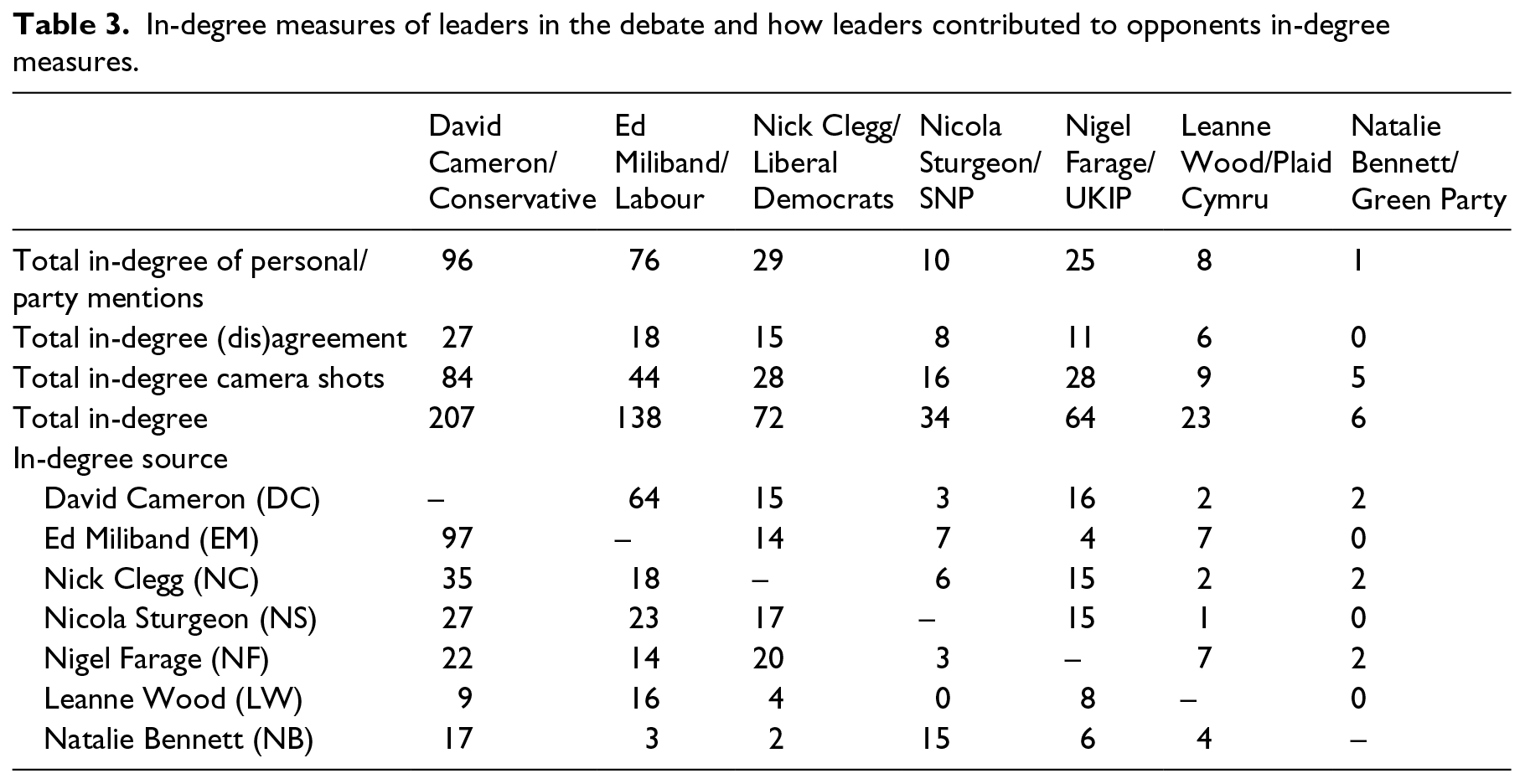
The frequency analysis of camera shots used as others talked is also revealing. Along with his domination of talking screen-time, Cameron is also a favorite for reaction shots. Furthermore, frequently as Cameron speaks, the shot cuts to Miliband, and vice-versa.
Although, of course, it is not unreasonable for a sitting Prime Minister to be the most discussed, shown and attacked during a debate; Cameron had 5 years of governing for the other leaders to attack (as of course, to an extent, did Clegg), and the ostensible role of the debate was to allow them to present their case to replace him. Similarly, Miliband was the only possible alternative Prime Minister on the stage, so his prominence is also understandable. Yet the extent of prominence is the issue of question; to qualify as a deliberative event requires some level of participation equality. Their dominance of the economic question is illustrative of the uneven platform—between them they accounted for almost half of the debate time on the economy, an issue of obviously particular salience to voters.
The figures in Table 3 give a clear illustration of the disparity of links between leaders. This unevenness of debate can be neatly visualized using network graphing techniques. In each figure to follow, tie frequency is illustrated with the width of line connecting nodes, arrowhead size is illustrative of directed ties, and node size is illustrative of in-degree measure. Distance between nodes carries no significance—the tool is set to illustrate in a (2D) spherical configuration. If one first considers Figure 1(a) as an example; the line connecting Nick Clegg (NC) and Cameron (DC) is proportionate to the 22 times Clegg or Cameron mention each other or each other’s party. This compares to the much thicker line connecting Cameron and Miliband illustrating the 86 times they discuss each other or the other’s party (at the other end of the scale, no line connects Clegg and Bennett). The arrowhead going from EM to DC is proportioned to illustrate 51 mentions of Cameron or the Conservatives by Miliband and the reciprocal sized at 35. The Cameron sphere is sized proportionally to illustrate that Cameron has 96 personal or Conservative Party mentions, compared to Natalie Bennett’s (NB) sphere of size 1. Figure 1(b) utilizes the same scaling system but illustrates (dis)agreements, Figure 1(c) is based on camera shots, and Figure 1(d) combines the four measures.
These figures nicely illustrate several factors: the dominance of ties between Cameron and Miliband, the large disparities between in and out-links for both, the relative isolation of both Wood and Bennett, and the centrality of Cameron in particular. Bennett has a total in-degree value of just six, and Wood 23, compared to Cameron’s 207 and Miliband’s 138.
A co-occurrence analysis of undirected ties also illustrates the dominance of the Cameron–Miliband discussion. Here, the total speaking opportunities of both leaders served as the denominator, with the ties between leaders as the numerator. For “mention” ties, the Cameron–Miliband pairing has a co-occurrence figure of 1.30, the next highest figure for a pairing is Cameron–Clegg with 0.35. Similarly, for all ties Cameron–Miliband has a value of 2.44 with Cameron–Clegg on 0.79. One can interpret this first figure as illustrating that any time either Cameron or Miliband spoke, they were linked to the other in some way on average almost 2.5 times. If directed links are considered, every time Cameron spoke, he links to Miliband 1.9 times on average; every time Miliband spoke, he links to Cameron just over 3 times on average. In contrast, the Cameron → Wood and Cameron → Bennett figures are both 0.06. For Miliband → Wood, it is 0.22; for Miliband → Bennett, it is zero. Essentially, these figures show that Cameron and Miliband largely just spoke to or about each other and almost completely ignored Wood and Bennett throughout the debate.
These findings do question whether the debate even approached being a deliberative event. Indeed, is it accurate to say that Natalie Bennett even took part in a debate? Given that not one person (dis)agreed with her, her name was only used once, and her party never mentioned by anyone else, can she be counted as a participant in a deliberative event?
The discussion above centered on Natalie Bennett and Leanne Wood, omitting discussion of UKIP leader Nigel Farage. This is because Farage, as already seen in Figure 1(d), appears to have gained greater prominence in the debate than his fellow smaller party leaders. When the analysis is parsed out per question, it is clear why this is the case as the structure of the map changes considerably for one of the audience-posed questions. Figures 2(a) to (c) illustrate how Farage is a fringe figure for three of the questions, yet with immigration (Figure 2(d)), he becomes the most central figure. Across the four questions, Farage had a total in-degree value of 69, the immigration question alone provided 50 of that value. Other metrics confirm this imbalance in his presence in the debate. Farage spoke 27 times in total, 10 of those on the immigration question. The average percentage of all debate time which leaders spent speaking on the four questions were: the economy 27%, NHS 25%, immigration 26%, and youth future 23%; illustrating a fairly balanced debate in terms of time devoted to the four questions. The commensurate figures for Farage were 26%, 22%, 35%, and 17%; considerably less evenly distributed. These figures supply a conservative estimate for how dominant the subject was for Farage, as they assume that leaders kept on topic during each question section. Naturally, all the leaders wavered off-topic at time, but generally the debate kept on issue. Farage managed to pivot to his core issues in most of his answers—out of the 27 total contributions he made to the debate, he mentioned immigration and/or Europe in 18. UKIP were clear owners of immigration during the debate, making them of interest for any viewers with a concern over that issue.
Discussion
This research aimed to evaluate whether the televised leaders’ debate of 2 April did provide a platform to allow for a debate, and a debate which could be considered a deliberative event. The answer appears to be a partial yes. It allowed for debate, but a debate that was dominated by the primary social hierarchy on the stage. It is clear that status was indeed a salient factor and not simply argument that held primacy. Dennis Thompson, though writing in the context of citizen participation in deliberative events, noted that, “equal participation requires that no one person or advantage group completely dominates the reason-giving process, even if the deliberators are not strictly equal in power and prestige” (pp. 504-5). The data here show that the representatives of the two major parties came to almost completely dominate, certainly for large parts of the debate. At one point in the economic discussion, 2.5 minutes of debate ensued simply between Miliband and Cameron, and the same debate partly continued through the remainder of that question section. Chambers (2003) remarks that, “a well-ordered deliberation is based on full information and the representation of all points of view” (p. 319). Even here, in this limited and staged setting, in a format hammered out over months, viewers got to hear very little from some leaders about probably the most central policy issue in politics. At one point, moderator Julie Etchingham asked Nick Clegg, “austerity heavy or austerity light?” These were essentially the economic positions of the Conservative and Labour parties, and what Cameron and Miliband had been debating for the previous few minutes. The alternative point of view of government investment rather than austerity, shared by Bennett, Sturgeon and Wood, was barely heard. Dryzek (cited in Steiner, 2012) notes that participants should, “not possess authority on the basis of anything other than a good argument.” Cameron and Miliband were here ceded authority to set the acceptable bounds of economic possibilities.
To answer Calhoun’s synthesis of Habermas—apparently a seven-way televised leaders’ debate does not provide the requisite social conditions to remove status from the equation. David Cameron and Ed Miliband had an obvious hierarchical advantage which they were able to successfully “weaponize” (to borrow a term from the debate) to their advantage over others. It is very clear in terms of the differences between the primary and tertiary strata on stage with respect to Leanne Wood and Natalie Bennett. Nicola Sturgeon and Nick Clegg, in overall prominence, fall between these strata. It is of note that despite Sturgeon’s relative marginalization in the debate by these metrics, many commentators following the debate declared her the victor on the night—testament perhaps to the quality rather than quantity of her participation. The SNP recorded an historic victory in the election, almost completing a clean sweep of all seats in Scotland.
The situation with Nigel Farage is complicated by the specific content of the debate. On most areas, he is a marginal figure, but for the 20 minutes of debate on immigration, he was very much center stage. Had a question been posed on the environment rather than immigration, Bennett may have achieved greater prominence, but, given the level of her marginalization overall, it is hard to envisage her dominating that question in the same manner that Farage did on the topic of immigration.
Were someone with no knowledge of UK politics to watch the debate, even without sound, it is highly probable that they could accurately predict who the most “important” people on the stage were. The co-occurrence figures relating Cameron to Miliband and Cameron/Miliband to Wood/Bennett are particularly revealing. The debate was presented as an opportunity for voters to be able to evaluate the full range of opinions of all parties on central political issues—not all positions appear to have been given equal opportunity to persuade. Beyond questions of whether the debate could be considered a deliberative event, that should be of concern as a democratic failure.
Of course, it should be recognized that the participants in the event were not seeking to provide a deliberative event. The debate was part of an election campaign, a “competitive struggle for the people’s vote” as Gutmann and Thompson (2004, p. 14) note. The 2010 debates were a prominent media event, resulting in a real, or at least perceived, bump in support for the Liberal Democrats. The parties were, therefore, aware of the possible ramifications of a poor debate performance—leaders and parties were concerned with winning or, at least, not losing, rather than providing considered deliberation. The debate must be viewed as a part of majoritarianism—representatives being chosen according to majority voter wishes, and campaign debates have been likened more to advertising of product (politician/party) A as better than product B (Gutmann & Thompson, 2004).
That a deliberative event did not occur is, therefore not surprising, what is however perhaps disappointing is that the debate, as illustrated with these data, could be discounted as a deliberative event without the necessity of any qualitative analysis of the debate text being undertaken. The relatively simple quantitative measures here were enough.
The representative democracy model largely cedes decision-making on matters of import to a legislative body. Normatively, this smaller group of people—in this case, 650 MPs—is expected to deliberate prior to voting on such issues. Practically, of course, MPs are usually directed to vote along party lines in a manner prescribed by the party leadership. It is these same leaders who are often called upon in parliament to elucidate their party’s position on the issue of consideration. In the debate here under discussion, seven people were chosen to stand for those 650 representatives, their constituents and those people who share their views. This distillation to a manageable number of participants did not seem to afford the representative deliberation requisite in a normative representative democracy. Polling ahead of the debate placed the Green Party on around 6% of votes and UKIP on 14%, a potential 1.8 and 4.3 million voters, respectively. It is questionable whether Bennett was given an opportunity to adequately represent the views of those people in the debate. In the debate, Farage, who had been chosen by UKIP to represent the views of their 624 candidates standing for election, was unable to represent in depth outside a narrow range of policy areas.
The inclusion, for the first time, of seven leaders on a stage to debate political issues appeared to mark a change in the political landscape of the United Kingdom. Yet, 6 weeks later, electoral status quo returned with a Conservative government opposed by a Labour opposition. The Liberal Democrat vote collapsed and their position as the most prominent third party was taken by the SNP who gained 50 MPs—almost a complete sweep of Scottish seats. The Greens and UKIP did gain considerably in terms of vote share, but in representation, figures remained almost where they were before, with one MP each.
In 2017, a surprise General Election was called by new Prime Minister, Theresa May. The short notice made extended discussion about debates impossible, with May refusing to participate in a similar debate to the 2015 one. The result of the election also saw a return to the two major parties achieving a vote share comparable to post-war figures—they gained over 82% of votes and 89% of MPs. This result saw measures of multipartyism reverse; the ENEP dropped to 2.89 and the ENPP to 2.48. This result shows that, despite the gains made by smaller parties, they are still minor players. They do not have a large loyal voting base, and they do not have the political power to force the two big parties into a debate. The results here, however, question whether that would even be something they would wish to do.
Of course, this research makes no attempt to evaluate the ultimate influence of the debate on voters, which is naturally the most important consideration in election debates. Televised debates are still new to the UK political arena, and their influence and power needs to be better understood. This research also only considered the one debate. A fuller understanding of their influence needs to consider the debates about the debates also—what forces were involved in establishing the eventually decided upon format? As previously alluded to, months of negotiations took place between parties and broadcasters before the format was decided—it may be the case that more could be learned about the role and influence (or lack of) of the debate from an analysis of those discussions than the actual debate content itself. Such analysis was far beyond the scope of this investigation, and it may not even be an investigation possible to pursue—the details of the debate discussions were not made public (see “Election Debates Agreement Reached,” 2015; “Election 2015: Seven-Party TV Debate Plan Announced,” 2015, for some details on this).
Nancy Fraser (1993), in her critique of public sphere theory, argues that for a public sphere to exist, it requires the elimination of all social inequality. Clearly, Fraser was discussing a wider social inequality than the differences in political standing between party leaders, but her point can again be used analogously. It is difficult to conceive of how political power inequality could be eliminated given the extant voting system within the United Kingdom. However, it does appear that even in this enclosed space containing seven people, a sphere was often absent and something more akin to Cunningham’s (2001) “sphericules” occurred (to extend the analogy). Cameron and Miliband debated within one, immigration formed another containing Farage with other leaders being sucked in occasionally, and Leanne Wood and Natalie Bennett were largely relegated to their own. Debates are a likely permanent fixture to the election landscape, but it is unclear currently, given the variety of debate/interview formats adopted in 2017, what they may look like in future elections. Clearly, one debate was never going to change the political landscape and decades of political orthodoxy predicted how the debate would likely unfold; it would have been remarkable had these findings not reported such an imbalance. Yet, it was sold to the British public as an event to ameliorate the competitive disadvantage of the smaller parties. That was not achieved—the debate fell short of providing an equitable deliberative platform for all those invited, what that means for both academia and the political system is worth further consideration.
Footnotes
Acknowledgements
The author would like to acknowledge the following people for their help in developing this manuscript. Megan Duncan for invaluable technical help and expertise, Sue Robinson for insighful comments on an early draft and the anonymous reviewers who rightly pushed for an improved piece of work.
