




Abstract
The use of visual self-personalization by politicians to shape perceptions of their character and personality is a prominent form of modern political communication, especially on social media. Yet, little is known about the effect these portrayals have on the visual attention of voters and their impressions of the traits of the politicians depicted. This exploratory study examines the effects of visual self-personalization (professional vs. private focus) by Finnish political leaders of both genders on Instagram. Through a pilot laboratory study, viewers’ visual attention was measured using eye-tracking technology and, in combination with this, leader trait impressions were experimentally examined. The results indicate that photos depicting politicians in professional settings are more attention grabbing and effective in shaping trait impressions than photos showing politicians in private life. Among the recommendations for future research, it is noted that gender aspects should be further explored as this study, by focusing on a gender-egalitarian country, had a limited scope in that respect.
Introduction
Images in political communication are utilized to capture attention and offer different representations of political life. Portraying politicians visually to shape perceptions of their character and personality is an area of growing importance. In parliamentary democracies, the personalization of politics, that is, making individual politicians prominent in politics (e.g., Cross et al. 2018), has particularly accentuated the visibility of party leaders. Correspondingly, research has demonstrated that voters’ perceptions of the personality and traits of party leaders affect voter decisions and the distribution of votes in elections (e.g., Bittner 2011; Garzia 2011). Moreover, the rise of social media has increased the availability of visual information about the character of party leaders, which might further increase the role that the personality of party leaders plays in the minds of voters.
Party leaders, and other politicians, increasingly use a range of social media to influence how others perceive their image (e.g., Enli and Skogerbø 2013; Lalancette and Raynauld 2017; Larsson 2019; Rahat and Zamir 2018). This kind of image management has been conceptualized as “self-personalization,” which includes “professional self-personalization” highlighting professional and public representations, and “private self-personalization” focusing on the personal life through a more intimate and private representation (McGregor 2018; Metz et al. 2019; Russmann et al. 2019). Empirically, Metz et al. (2019) have shown that both professional and private self-personalization by politicians in social media are most often present in visual communication, thus suggesting that politicians understand the power of visual images and effective image management within social media.
However, the state of knowledge is still nascent regarding the effects that different kinds of visual self-personalization (professional vs. private focus) have on people’s perceptions of politicians, when seen through the images political leaders and other politicians place within social media. Furthermore, previous research has overlooked the question regarding the specific visual elements and symbols that the audience pays attention to when forming image impressions from the visual portrayals of politicians. Another research gap concerns the effects of visual impression management in social media by male and female party leaders when dealing with the viewing patterns and image impressions of viewers.
Accordingly, this article provides a pilot study that aims to conduct an exploratory examination into the effects of visual self-personalization by party leaders on Instagram, a predominantly visual platform, focusing on viewers’ visual attention and, in conjunction, leader trait impressions. Based on that exploration, a second aim is to inform about avenues for further research. The study has a quasi-experimental design, utilizing eye-tracking technology in a laboratory setting, to first examine viewers’ visual attention to photos published on the Instagram accounts of real party leaders, depicting them either in professional or private settings, and second, to study how the visual exposure and attention to these photos influences the subjects’ evaluations of the professional and personal traits of the leaders. Empirically, the study explores the effects of visual image impression strategies by a male and a female party leader in Finland. From the perspective that gender stereotypes may affect how politicians and their traits are perceived (see McGregor 2018; Meeks 2017), Finland provides a seemingly “least likely” case due to the Nordic gender-egalitarian political culture (cf. Lefkofridi et al. 2019).
Literature Review
The rise of social media in political communication has changed the visual strategies of politicians. Previously, carefully articulated television messages were an important channel into the public sphere (Jones 2005). However, the Internet has shifted the way politicians now reach the public (Karadimitriou and Veneti 2016). The use of “selfies” has several advantages for politicians: They can attract widespread media coverage and offer “the potential of a new type of political portraitures of a less stilted and more intimate nature” (Karadimitriou and Veneti 2016: 3). By circumventing mediators, politicians can control their messages and manage the public image of them. Images of a more personal and private character can reduce the distance between voters and their representatives, offering an aura of proximity (Dahlgren 2009). The importance of social media on political campaigning is undeniable (Dimitrova and Matthes 2018) and research is turning to the question of how specific types of content on social media influence voters’ perceptions.
Political communication on social media can be characterized as a form of self-personalization, shifting the attention from political parties to individual politicians (Kruikemeier et al. 2013). Based on the work of van Santen and van Zoonen (2010), Metz et al. (2019) distinguish between professional, emotional, and private self-personalization. By focusing on qualities connected to the official office, the professional persona is conveyed. Emotional personalization puts the personal feelings and emotions of politicians as the key message, while private self-personalization displays the ordinary human behind the official office. Metz, Kruikemeier, and Lecheler’s analysis of German politicians’ Facebook posts found that all types of self-personalization were most often present in posts containing visuals. Moreover, they found that posts expressing emotional and private self-personalization had a positive effect on audience engagement (likes, emoji, shares, and comments), whereas the most common content in the posts, professional self-personalization, had no impact. Hence, their conclusion was that “softer self-personalization styles can be beneficial tools in politicians’ impression management” (Metz et al. 2019: 11).
Regarding the specific use of Instagram for self-personalization by politicians, some studies have identified subcategories of professional and private self-personalization. Concerning imagery of professional life, Ekman and Widholm (2017: 21) distinguish between everyday professional footage (meetings and other day-to-day duties/tasks), political performances (e.g., giving speeches), media appearances, and participation in celebrity events and public demonstrations. Images depicting campaigning activates (e.g., rallies, shaking hands) are still another subcategory (Russmann et al. 2019: 128). Concerning the depiction of personal images, that is, private life, studies have identified the imagery of politicians associated with personal day-to-day duties/tasks, hobbies such as sports (Avedissian 2016; Larsson 2019), religious life (Avedissian 2016), and private moments with friends and family (Jung et al. 2017: 2197; Lalancette and Raynauld 2017). Content analyses have shown that the use of Instagram for self-personalization by politicians varies between the politicians using it, ranging from a more personal celebrity-like rationale to others preferring a more strictly political style (Avedissian 2016; Lalancette and Raynauld 2017; Poulakidakos and Giannouli 2019). Differences in the choice of imagery can be explained by party affiliation, individual strategies, and gender (Ekman and Widholm 2017; Poulakidakos and Giannouli 2019).
Concerning the effects of portraying politicians in professional and personal contexts, Larsson’s (2019) study of posts on Instagram accounts operated by Norwegian parties and party leaders showed that the most popular posts, gaining the most likes and comments, were of party leaders skiing, wishing for snow, and portraying themselves as “regular citizens.” Another example is that seeing a leader pictured with ordinary people, or people from minority and underprivileged groups, influenced ratings of authenticity and trustworthiness (Lilleker and Liefbroer 2018). However, a reversed result was found in a study from Singapore investigating the effects of private and public styles of visual self-personalization among politicians on Instagram (Jung et al. 2017). The experimental study showed that photos depicting the public life of a (fictitious) politician had a more positive effect on voters’ character evaluation of the politician than photos showing the politician in a private setting.
Obviously, visual imagery in social media is important when it comes to political self-personalization. Still, little is known regarding how voters pay attention to visual elements in those portrayals and how that attention affects the impressions of politicians. In a study of the 2016 U.S. presidential elections, Towner (2017) examined the effects of attention paid to visual and textual content on evaluations of the presidential candidates. Using survey data, Towner found that attention to photos and infographics about the campaign had a positive effect on the overall evaluations of presidential candidates. Towners’ conclusion is that photos and infographics are the most powerful tool to use in social media. Still, the study relied on self-reports by the respondents and the direction of causation could not be ensured.
Regarding whether visual self-personalization in social media affects voters’ trait evaluations of the politicians differently, depending on the gender of the politicians, nothing is known to the best of our knowledge. However, concerning textual personalization on Twitter, two U.S. studies exist. McGregor (2018) exposed subjects to personalized or de-personalized tweets from a male or female U.S. Senator running for re-election and examined the effects on, inter alia, the subjects’ evaluations of the social presence of the candidate and parasocial interaction with the candidate. She found that self-personalization on social media appeared “to ‘work’ better for male candidates” (McGregor 2018: 1152). Although respondents rated both male and female candidates with personalized tweets higher in terms of presence and parasocial interaction, the effect was mediated by partisan identity only when the candidate was female. Meeks (2017) experimentally examined the effects of personalized tweets by male and female candidates on the public’s evaluations of, inter alia, character traits. Her analysis showed that personalizing male candidates did not differ from personalizing female candidates regarding evaluations of agentic traits that are stereotypically associated with men (strength, leadership, decisiveness, confidence) and communal traits that are stereotypically ascribed to women (compassion, collaboration, honesty, friendliness).
In sum, studies still need to distinguish between different types of visual self-personalization online, as the effects of each style may differ. The role that the gender of the self-personalizing politician plays should be further addressed. There is also a need to study the causal relationship through experimental designs, since there are mixed results concerning the benefits of professional and private self-personalization. Previous research has mainly looked at political candidates, party leaders have seldom been in focus. Moreover, some of the previous research has found an effect of online visual communication on candidate evaluations but failed to show what specific visual elements the participants of the study viewed. Dimitrova and Matthes (2018: 336–337) note that asking respondents to self-report their estimated attention to visual exposure is problematic and recommend eye-tracking data as a more valid measure (see also Vraga et al. 2016). An example of research utilizing eye-tracking data is found in the work of Sülflow and Maurer (2019), who examined how viewers’ visual attention to a politician smiling in a video clip (measured by eye-tracking) affects their impressions of the politician.
This study explores two main research questions. The first question is whether the type of visual self-personalization (professional vs. private) by party leaders in their Instagram accounts affects viewers’ visual attention (amount of time watching photos and areas of interest [AOI] in the photos), and if the gender of the party leader moderates this relationship. Second, in conjunction with the observed visual attention patterns, the study addresses the question on whether the two types of visual self-personalization by party leaders affects viewers’ trait impressions of the leaders in different ways, and, again, if the gender of the party leader matters in that process.
The Case of Finland
In a study of the personalization of politics in parliamentary democracies, Karvonen (2010) distinguishes Finland as a case where political personalization has clearly increased over time. Finnish voters assign party leaders a growing role regarding the electoral fortunes of the parties and they increasingly use party leaders as arguments for their personal party choice (Karvonen 2010: 103). Finland has a multiparty system with a high degree of interparty competition and the party leaders are nowadays pivotal actors in election campaigns (von Schoultz 2018). Most party leaders have a personal presence on multiple social media platforms. Regarding Instagram, a study of the photos posted by Finnish party leaders on their personal accounts during the campaign for the 2019 National Elections (Mattlar 2019) found that approximately 80 percent of the pictures showed the party leader in the post. Concerning the proportion of photos depicting leaders in official and private settings, respectively, the female and male leaders used similar strategies (female leaders: 59 and 41 percent, respectively; male leaders: 55 and 45 percent, respectively).
As the other Nordic countries, Finland has a gender-egalitarian political culture with a high proportion of female politicians. After the 2019 elections, the proportion of women’s representation in the Finnish national parliament was 47 percent. For comparison, in the United States, women held nearly 24 percent of seats in Congress in 2019. Regarding political gender stereotypes among the Finnish electorate, not much is known except for a recent study by Lefkofridi et al. (2019), which shows that although such stereotypes have diminished over time in Finland, and are less pronounced compared with the United States, they have not been completely erased. Concerning personality trait stereotypes, Lefkofridi et al. (2019: 16) analyze survey data from 2012 and find that 51.3 percent of Finns perceive male politicians to be more assertive (an agentic trait stereotypically associated with men) than female ones. A total of 1.5 percent find assertiveness a predominately female trait, while 47.2 percent associate this trait with both genders. Conversely, a majority (56.0 percent) perceive female politicians to be more compassionate (a communal trait) than male politicians (4.0 percent find compassion a predominately male trait and 40.1 percent associate it with both genders). Possibly, then, Finnish male politicians may gain an advantage from engaging in private, “humanizing” self-personalization, that complements and broadens their image, whereas female politicians may capitalize on “harder” professional self-personalization (compare Åström and Karlsson 2016; Meeks 2017: 7–8).
Method
The exploratory laboratory study utilized the quasi-experimental “posttest-only design with nonequivalent groups” (Shadish et al. 2002: 115–25). Subjects were randomly assigned to two treatment groups. The control group was arranged to consist of subjects being as similar as possible to those in the treatment groups. Regarding the aim to explore how subjects pay attention to the Instagram photos of party leaders, the design is unproblematic as the study observes and compares two treatment groups that are similar due to random assignment.
Concerning the aim to test whether the type of visual exposure (professional vs. private self-personalization) influences the subjects’ perceptions of the traits of the depicted party leaders, the design raises the question whether the outcome difference in the posttest, measuring trait perceptions, is due to treatment or is related to initial differences between the treatment groups and the control group. This issue becomes salient as the groups are not pretested on the dependent variable: Can it be assumed that the groups were initially similar regarding the respondents’ party leader perceptions? The reason why a posttest-only design was chosen, in spite of this, is that a pretest asking about party leader trait perceptions would most likely make the treatment groups more sensitive to the treatment, which would affect the scores on the posttest. To reduce the threat to internal validity by selection bias, two techniques recommended for studies with a posttest-only design with nonequivalent groups were utilized: the use of an “internal control group” and the logic of a “proxy pretest.”
Participants
The experiment was conducted in a laboratory where eye-tracking technology was applied during exposure to treatment. Because this is an exploratory study, only a relatively small number of subjects were recruited. The population consisted of students from a Finnish university campus. In total, twenty students were recruited (seven females; age twenty-one to thirty-five years old, Mdn = 22) and randomly assigned to the treatment groups (ten subjects per group). Paying attention to the demographical profile of the twenty enlisted participants, an internal control group—a group “plausibly drawn from a population similar to that from which the treatment units are taken from” (Shadish et al. 2002: 122)—was recruited. Specifically, students available on the same campus area (inter alia in the student refectory) were randomly approached and eventually twelve students formed the control group.
The fact that the participants could not self-select into the three groups raises internal validity. A randomization check was conducted by testing for group differences for the measured background variables. There were no statistically significant differences (p < .05) by gender (Freeman–Halton extension of the Fisher exact probability test, p = .61), age (Kruskal–Wallis test, p = .21, Mdn for the three groups = 23.00), political interest (Kruskal–Wallis test, p = .16, Mdn for the three groups = 4.00 on a scale from 1 to 7), or habit to follow politicians’ social media flows (yes/no; Freeman–Halton extension of the Fisher exact probability test, p = .48). It should be emphasized that random allocation to groups is an effective way to control not only for known factors that can affect the outcome of the experiment (e.g., gender, age, and political interest) but also for unmeasured unknown factors that may affect the outcome (e.g., Stoker 2010: 304). Hence, factors such as knowledge and opinions about the party leaders and exposure to news/campaign information about the leaders should be evenly spread across the groups due to randomization techniques.
The subjects also reported how much they like the two parties that the party leaders represented, on a scale from 1 (“do not like at all”) to 7 (“like very much”). As the treatment groups as well as the control group answered this question, this attitudinal variable may, arguably, serve as a proxy pretest, that is, a variable that is “conceptually related to and correlated with the posttest within treatments” (Shadish et al. 2002: 118). The plausible assumption made here is that a person who likes a party very much also tends to rate the traits of the party’s leader in a positive way. It is not a perfect proxy that would motivate a systematic pretest–posttest statistical analysis, but by using the initial party attitude as a proxy for a pretest score, it was possible to further test for group equivalence at, so-to-say, baseline.
Regarding the attitude toward the first party, the conservative National Coalition Party, there was no significant difference between the three groups (Kruskal–Wallis test, p = .41, Mdn for the three groups = 3.00). Concerning the attitude to the second party, the liberal-centrist Swedish People’s Party of Finland, the difference between the groups is a borderline case of statistical significance, but it is not significant (Kruskal–Wallis test, p = .07, Mdn for the three groups = 5.00). The Dunn–Bonferroni post hoc test revealed that the treatment groups were very similar (p = 1.00). The control group and the treatment group that was exposed to “private” photos of the party leaders did not differ (p = .37), but there was a difference approaching significance between the treatment group that was exposed to “public” photos of the party leaders (Mdn = 6.00) and the control group (Mdn = 4.50), p = .07. In comparing these groups in the analysis, there is a need to control for the effect of the initial attitude toward the party.
Treatment
The treatment consisted of sets of photos depicting two individual Finnish party leaders, which were published on their official Instagram accounts. To study whether the gender of the party leaders moderates the relationship between the type of visual self-personalization (professional vs. private), the viewing patterns and the perceptions of party leader traits, a male party leader, Petteri Orpo (the National Coalition Party), and a female leader, Anna-Maja Henriksson (the Swedish People’s Party of Finland), were selected. These two were chosen as they have several relevant similarities besides gender: both are leading middle-right parties, are middle-aged (Orpo fifty years, Henriksson fifty-five years), are married with children, and are relatively new as party leaders (Orpo was chosen in 2017; Henriksson in 2016). In addition, both can be characterized as, so-to-say, run-of-the-mill leaders: None of them is especially colorful or controversial, nor do they divide opinion. In all, ten photos of each party leader were chosen (five depicting the leader in professional settings; five showing the leader in private settings). The selection criteria, reported in Table 1, encompass some of the subcategories of visual professional and private self-personalization identified in previous research.
Selection Criteria for the Photo Sets in the Treatment.
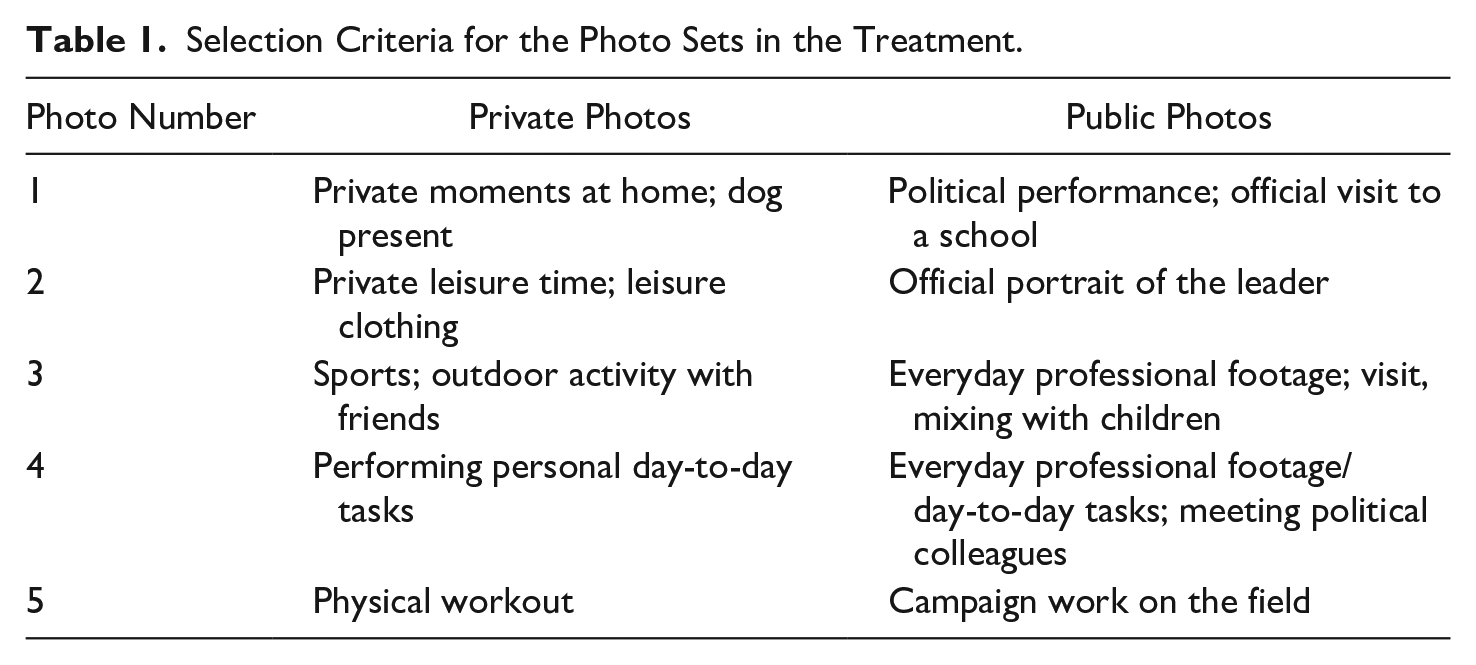
The photos that were chosen for each criterion were as equal as possible for both party leaders. Apparently, the selected images do not explicitly play to or counter gender stereotypes. The selected images are displayed in the Supplementary Information File. Of course, the choice to use real rather than artificially constructed stimuli decreases some of the control over the manipulations. Even if the matched photos show the party leaders in similar situations or doing similar activities, there is inevitably some variation in props and details in the background that can possibly affect visual attention and processing by the subjects in the treatment groups. On the other hand, the use of real stimuli enhances external validity, which was prioritized here.
Measurements
The laboratory study utilized eye-tracking technology, a technical method for following a user’s gaze and eye movements. Eye-tracking data were collected using the Tobii Pro X3 120 eye-tracker with a sampling rate of 120 Hz. In this study, attention distribution was measured by creating three AOI on each image: (1) the face of the party leader, (2) the rest of the body of the party leader, and (3) the rest of the picture with the party leader excluded. The measurement used in this study was the total fixation duration in seconds. This metric measures the sum of the duration of all fixations within an AOI. Moreover, the fixation time distribution (as a percentage) over all AOIs per image was calculated. Detailed information on the eye-tracking procedures and measurements is provided in the Supplementary Information File.
In measuring the subjects’ perceptions of the traits of the party leaders, two dimensions of leader traits, which are frequently distinguished in the literature (see Bittner 2011: 30–52), were considered: traits that are related to the political persona of political leaders (e.g., competence, leadership) and traits that are associated with their personal character (e.g., compassion, trustworthiness). Among the personal characteristics, traits that are linked to the private persona of leaders were included (Jain et al. 2018; Langer 2006, 2010). The posttest questionnaire featured a thirteen-item semantic differential scale. The following traits were constructed as bipolar adjective pairs (e.g., dishonest/honest) and were rated by the subjects on a scale from 1 to 7: competent, knowledgeable, leadership ability, intelligent, inspiring, compassionate, honest, trustworthy, friendly, nice, warm, down-to-earth, and sympathetic. For each leader, a principal component factor analysis was performed on the items. 1 In both cases, a two-factor rotated component matrix was produced (eigenvalues exceeding 1). The items loading on factor 1 focused on personal character. The items that had a high loading (>.60) in factor 1 for both leaders were nice, down-to-earth, warm, friendly, sympathetic, and compassionate. The scores of these items were averaged to a character scale (Orpo: Cronbach’s α = .93, Mdn = 4.25; Henriksson: α = .96, Mdn = 5.16). Items with a corresponding high loading in Factor 2 were traits that are associated with competence and leadership: knowledgeable, competent, leadership ability, and intelligent. These items were averaged to a competence scale (Orpo: α = .89, Mdn = 5.00; Henriksson: α = .93, Mdn = 5.00).
Procedures
Data collection took place during the second week of April 2019 in a laboratory setting. At the time, the campaign for the 2019 Finnish parliamentary elections was in its final week. The timing enhances external validity as the experiment could explore how voters are affected by the visual self-personalization of party leaders during a real election campaign. The downside is that news coverage and other information about the campaign and the leaders may have influenced the participants’ preexisting impressions of the party leaders. Still, such factors should have been evenly spread across the groups in the experiment due to random assignment to the groups (in the case of the control group: by randomly selecting participants). The stimuli consisted of five pictures of a party leader followed by a survey featuring the semantic differential scale, then five more pictures of the second party leader and the corresponding survey again. Depending on the random assignment to the treatment groups, the participant looked at photos depicting the leaders in either official or private settings. To control for order effects, the technique of counterbalancing was applied: The order of which of the party leaders that appeared first was randomized for each participant in both groups. As stated by Corriero (2018), counterbalancing does not eliminate order effects, but “distributes them evenly across all experimental conditions so that their influence is ‘balanced’ and does not confound the main effects due to the independent variables” (p. 278). The participants were asked to look at pictures in their own time, skipping to the next image by pressing a keyboard key. The participants in the control group simply filled in a questionnaire with the same items that the participants in the lab answered. Thereafter, they were told about the study and were thanked for their participation.
Statistical Analysis
As the subjects were not randomly drawn from a population, and the number of subjects per group is small, robust nonparametric statistics were used in the analysis. For continuous variables, median values (Mdn) that are less sensitive to outliers, and interquartile range (IQR: 75th minus 25th percentile) are presented. The nonparametric Mann–Whitney U test, performed on ranks instead of initial scores, was carried out for comparisons between groups. As the groups are small, exact significance (2*[1 − tailed sig.]) was used. Because of the small sample size and the exploratory nature of the pilot study, the significance level was set at p < .10 to minimize the likelihood of Type II error. To assess effect size, which is a crucial issue in studies with small numbers of subjects (Kramer and Rosenthal 1999), a nonparametric effect size estimator, Cliff’s delta (d), was used since it is robust in small sample sizes with non-normal distributions (Cliff 1996). According to Vargha and Delaney (2000), Cliff’s d of .11, .28, and .43 correspond to small, medium, and large effects, respectively.
To create a holistic picture of the explorative empirical analyses, findings from the eye-tracking analysis are juxtaposed with findings concerning leader trait perceptions in the “Discussion” section.
Results
Concerning the amount of attention (total number of seconds) that the treatment groups spent on the sets of Instagram photos, a first finding is that photos depicting the party leaders in private milieus (hereafter “private photos”) do not capture the interest of the participants more than photos showing the leaders in professional settings (hereafter “public photos”). In fact, it is rather the opposite. Regarding the female leader, Henriksson, the treatment group looking at the public photos paid more attention to the photos of her (Mdn = 58.00 s, IQR = 37.33, mean rank = 13.50) than the treatment group being exposed to private photos did (Mdn = 33.05 s, IQR = 21.55, mean rank = 7.50), Mann–Whitney U = 20; p = .023, Cliff’s d = .60. A similar result, although not reaching statistical significance, was noted concerning the male leader, Orpo. The subjects looking at public photos looked at his photos for a longer time (Mdn = 45.55 s, IQR = 28.15, mean rank = 12.60) than the subjects looking at private photos did (Mdn = 28.80 s, IQR = 21.92, mean rank = 8.40), Mann–Whitney U = 29; p = .123, Cliff’s d = .42.
Within the treatment groups, there was no significant difference regarding the total number of seconds that the subjects watched the photos of the two leaders, respectively (group watching public photos: p = .203; group looking at private photos: p = .508, Wilcoxon signed ranks test). This implies that the gender of the party leaders does not affect how much subjects pay attention to official or private visual portrayals of party leaders. This finding is valid within the scope of this study, but should, of course, be treated with caution as only one male and one female leader is included. Moreover, “gendered” perceptions of politicians are arguably less common in the Finnish gender-egalitarian culture than in other contexts.
Regarding the subjects’ visual attention to the three defined AOI in the photos (the party leader’s face, the rest of the body of the leader, and the rest of the picture with the leader excluded), the percentage of time (seconds) that the subjects spent looking at each area out of the total time that the three AOIs were fixated was calculated. 2 These percentages were calculated for each subject by first summing the fixation time for each of the three AOIs in the five photos depicting Henriksson and Orpo, respectively. 3 Table 2 reports the median percentage time that the two treatment groups spent looking at the three AOIs in the photos.
Visual Attention by the Treatment Groups to Three Areas of Interest in the Party Leader Photos.

Note. Values represent median percentage time (IQR in parentheses). IQR = interquartile range.
Table 2 first shows that the distribution of attention to the face of the leaders is greater when the leaders are depicted in private settings than in official settings. There is a strong effect regarding the female leader: the subjects looking at private photos fixated on Henriksson’s face more intensively (mean rank = 14.90) than the subjects being exposed to official photos did (mean rank = 6.10), Mann–Whitney U = 6, p < .001, Cliff’s d = .88. A similar effect, although weaker, can be observed concerning the male leader: mean rank for the subjects watching private photos = 13.00; mean rank for the subjects exposed to private photos = 8.00, Mann–Whitney U = 25.00, p = .063, Cliff’s d = .50.
Apparently, when the leaders appear in official settings, the subjects pay more attention to other people, details, and props in the motifs than to the leaders. This is valid especially concerning the female leader: subjects looking at official photos were more likely to distribute visual attention to other areas in the photos than to Henriksson’s face and body (mean rank = 15.30) than the subjects looking at private photos did (mean rank = 5.70), Mann–Whitney U = 2.00, p < .001, Cliff’s d = .96. A similar difference, although smaller, can be noted for the male leader: The group that was exposed to official photos was more likely to fixate on other areas than Orpo in the photos (mean rank = 13.10) than the group studying private photos did (mean rank = 7.90), Mann–Whitney U = 24.00, p = .052, Cliff’s d = .52.
Finally, regarding the visual attention distribution to the body of the leaders, the gender of the party leaders seems to matter. Whereas the two treatment groups did not differ significantly concerning the attention distribution to the body of the male leader (p = .853), the share of time distributed to the female leader’s body was greater for subjects watching private photos (mean rank = 14.30) than for those seeing official photos of her (mean rank = 6.70), Mann–Whitney U = 12.00, p = .003, Cliff’s d = .76.
In sum, the eye-tracking analysis first showed that professional imagery captures attention longer than portrayal of personal life, independent of the gender of the leaders, and that subjects pay an equal amount of attention to the photos of the male and female leader, independent of the visual setting (professional or private). However, regarding AOI, some apparently “gendered” viewing patterns were discerned when paying attention to p values and effect size. Next, the effect that exposure to the Instagram photos had on the subjects’ perceptions of the leaders’ traits is examined. In that analysis, too, it is possible to observe whether the gender of the party leaders moderates the perceptions of the treatment groups, which are now compared with the control group. Table 3 reports the findings concerning the effects of exposure to photos showing the leaders in public professional settings.
Effects of Exposure to Instagram Photos Depicting Public Life on Trait Perceptions.
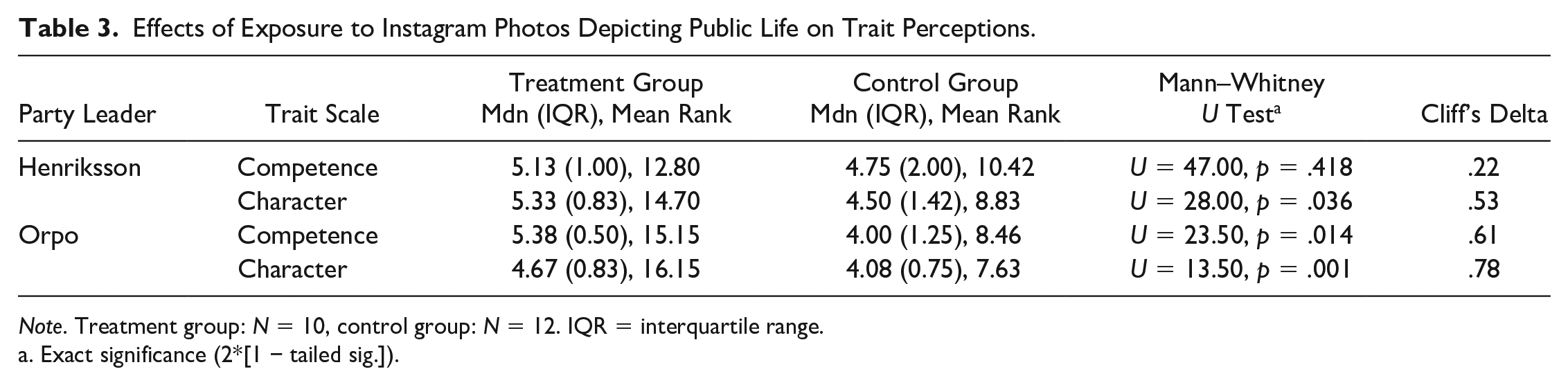
Note. Treatment group: N = 10, control group: N = 12. IQR = interquartile range.
Exact significance (2*[1 − tailed sig.]).
If the logic of self-personalizing communication that focuses on professional activities is to convey an image of competence (e.g., Metz et al. 2019: 3), the results presented in Table 3 show that it was only effective in one case. Regarding the female leader, there is no statistically significant difference between exposure and the control group concerning the rating of the competence traits. In contrast, the treatment group rated the competence traits of the male leader significantly higher than the control group. Interestingly, the exposure to public images has a statistically significant positive effect on the subjects’ impressions of the personal character of both party leaders. Again, comparing the effect sizes, the effect is stronger regarding the male leader.
As it was earlier noted that the treatment group watching public photos of the leaders initially liked the party that Henriksson represents more than the control group did, a nonparametric two-way analysis of variance (ANOVA), whereby an aligned rank transformation was applied to the data prior to testing (Wobbrock et al. 2011), was performed to test the effects of treatment (treatment group vs. control group) and attitude toward the Swedish People’s Party (lower [or equal] value than the median [5] on the scale 1–7 vs. higher value than the median) on the evaluation of Henriksson’s personal character. The analysis revealed an interaction effect of the two factors, F (1, 18) = 3.68, p = .071, η2 = .17, meaning that the initial party attitude moderated the treatment effect on the evaluation. An analysis of simple effects was then carried out (not reported in detail here) which, with due caution to the small number of observations, suggests that the treatment influenced subjects, unless they felt extremely close to the party that the leader represents. Among the subgroup liking the party much, the rating of Henriksson’s character was at an identical high level (Mdn = 5.33) for both those exposed to stimuli and for those in the control group.
Next, the effects of exposure to photos showing the leaders in private settings are presented (Table 4).
Effects of Exposure to Instagram Photos Depicting Private Life on Trait Perceptions.
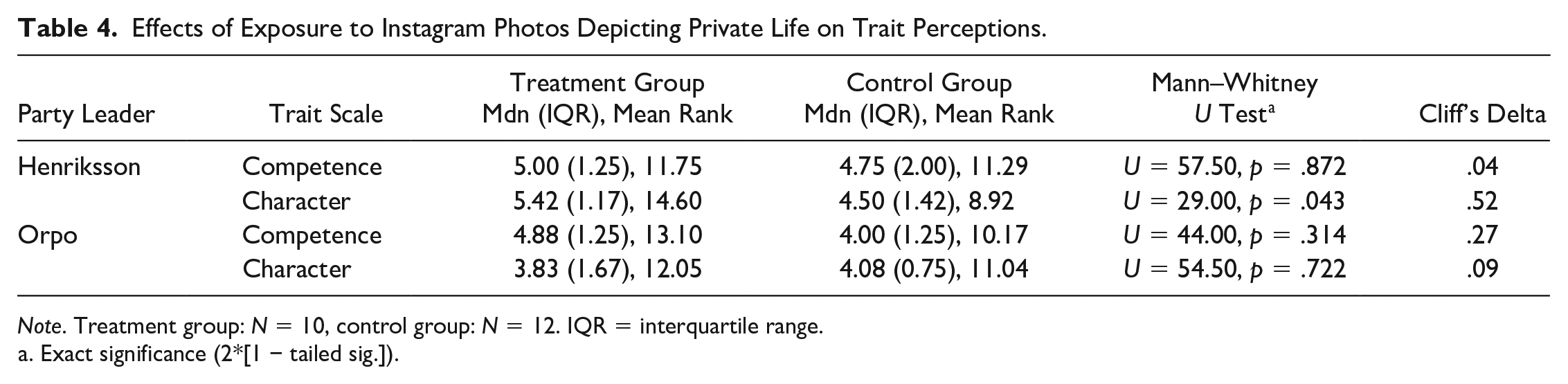
Note. Treatment group: N = 10, control group: N = 12. IQR = interquartile range.
Exact significance (2*[1 − tailed sig.]).
Maybe not surprisingly, the exposure to photos depicting the leaders’ private life did not have a significant impact on the subjects’ impressions of the competence traits of the leaders. More unexpectedly, Table 4 shows that looking at photos showing leaders in private settings only enhanced the ratings of the personal character of the female leader. It should also be noted that the exposure to private imagery did not negatively affect the competence impressions of her.
As the impressions of the personal character of both leaders were affected by exposure to photos depicting professional life, a comparison of the specific personal traits that were rated higher due to exposure is presented in Table 5, which ranks the three specific traits impressions that were most strongly influenced (indicated by effect size values, Cliff’s d). Since none of the specific personal traits of Orpo were rated higher in a statistically significant way due to exposure to private imagery, the table only reports trait impressions affected by exposure to public photos in the case of Orpo.
Personal Traits of the Party Leaders Rated Higher due to Exposure: Top 3 according to Effect Size.
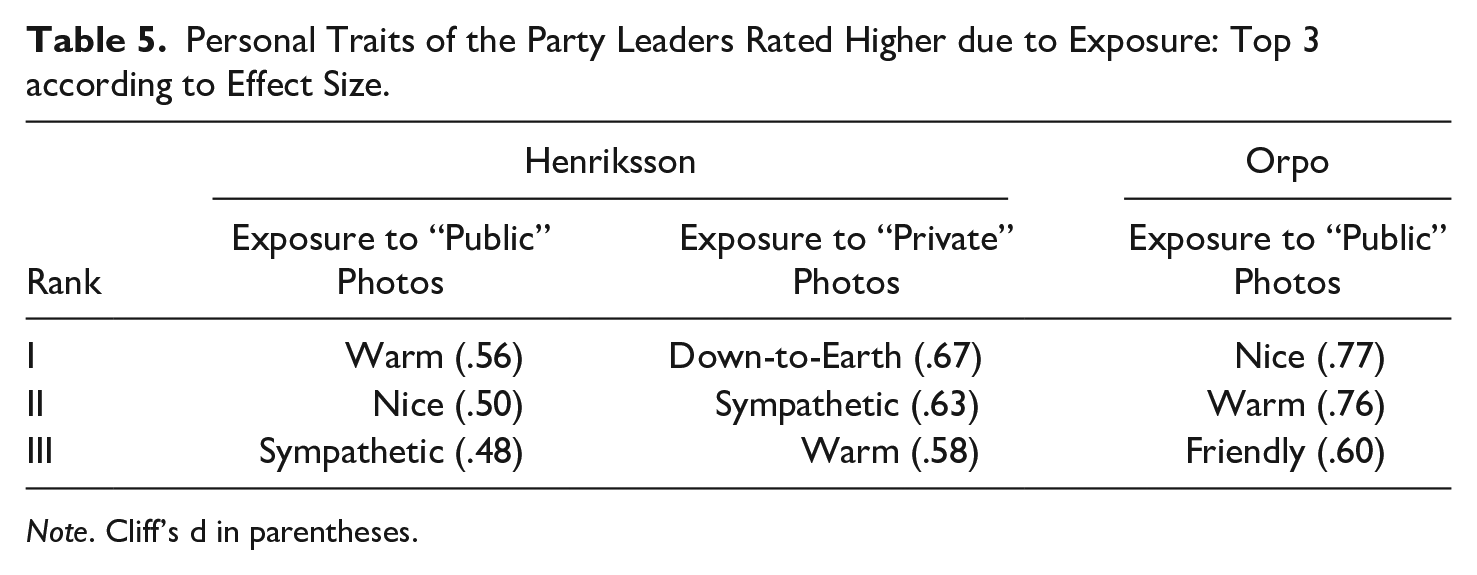
Note. Cliff’s d in parentheses.
Regarding the exposure to imagery showing the leaders in professional settings, Table 5 shows that the trait impressions that were strongest affected were rather similar for the two leaders; both were perceived as warm and nice individuals due to exposure. In the case of Henriksson, Table 5 also demonstrates that exposure to private photos to a certain extent enhanced another type of image that revolves around being a sympathetic down-to-earth person.
Discussion
Due to the limitations of this exploratory pilot study—using a small number of subjects and only two party leaders, and conducting the exploration in a political context characterized by a high level of political gender-equality—it should be emphasized that it is not possible to draw any general conclusions based on the results presented. The results and the conclusions should be seen as more exploratory and tentative than definitive. Nonetheless, some of the findings raise intriguing questions and areas for further research, especially when the findings from the eye-tracking analysis are juxtaposed with the findings concerning leader trait perceptions.
First, the study indicates that photos showing party leaders in professional settings are visually processed by viewers differently than photos depicting them in private everyday life. Somewhat counterintuitive, the analysis found that seeing politicians in professional life is more attention grabbing and interesting than watching them in private milieus. Further studies could test whether this holds true more generally and, if so, why images of politicians’ professional lives draw more viewer attention than imagery of their private lives.
Second, the eye-tracking analysis showed that subjects distributed attention to other areas in the public photos than the party leader, indicating that seeing politicians in professional settings draws interest to inspecting the context that they act in, which in turn arguably influences how the traits of that politician are perceived and evaluated. However, only the male party leader benefited from trait impressions associated with competence and leadership in images showing the leaders in professional contexts. On the other hand, the same exposure enhanced the impressions of the personal character of both leaders. Still, that effect was stronger for the male leader. Taken together, these exploratory findings suggest that professional self-personalization in visual social media appears to, in the words of McGregor (2018: 1152), “work better” for male politicians than for female politicians, also in a gender-egalitarian political culture (like the Finnish) where political gender stereotypes have diminished over time. Given the limitations of this study, this is a question that should be further addressed by future research.
Third, regarding private self-personalization, the analysis showed that depicting politicians in private settings appears to be associated with other types of viewing patterns and perceptions of the traits of the politicians. Although counterintuitive at first glance, the eye-tracking study did show that subjects looking at “private” photos, compared with those exposed to “public” photos, distributed less attention to the setting in the motifs and more to the face of the party leaders. Further thought provides a tentative explanation for this pattern. Seeing politicians in private, everyday settings stimulates viewers to explore and evaluate who the politicians are as individuals and, as demonstrated by research on nonverbal politics (see Dumitrescu 2016; Sülflow and Maurer 2019), people seek heuristic visual cues about the personality of politicians in their facial expressions. The eye-tracking analysis suggests that the gender of politicians seems to matter in this case. When subjects were exposed to private photos, they tended to focus more on the face of the female than that of the male party leader. Moreover, regarding the female leader, the subjects looking at private photos fixated on her body more intensively than those studying official pictures. These possibly “gendered” viewing patterns should be further explored.
Regarding how such patterns may have influenced how the leaders are perceived, an exploratory conclusion is that the role of political gender stereotypes may not have been strong in the examined case. The finding that the impression of the personal character of the male leader was not affected by exposure to “private” photo motifs indicates that private self-personalization does not always “pay off” for male politicians, whose aim is to soften up and complement their professional image (see Åström and Karlsson 2016; Meeks 2017: 7–8). Neither was the so-called femininity/competence double bind for female politicians—a situation where female politicians presenting more “feminine” private sides are perceived as less competent (Jamieson 1995; Meeks 2017: 7)—present. In the examined case, the exposure to private imagery did not negatively affect the competence impressions of the female leader. Tentatively, these findings indicate that the subjects did not draw on stereotypes in evaluating the character of the two leaders based on exposure to the visual self-personalization by the leaders. Obviously, this is an area that should be further addressed, since the case analyzed here, Finland, was a “hard” case with an arguably relatively low level of political gender stereotyping. In addition, it should be stressed that the use of young participants in this study (even if they may be considered a main target for a social media campaign) is not without problems, as this cohort possibly holds less gender-stereotypical views about politicians than older generations. Future studies should not only compare different age groups but also explore whether male and female subjects differ in how they perceive the character of male and female politicians after exposure to visual self-personalization.
As noted, this study has several limitations that further studies should address and overcome. Since the study was conceived as an exploratory pilot study, no power analysis to calculate the sample size was performed. Obviously, further studies should consider larger and more representative samples. Naturally, true experimental designs should be applied. Finally, in exploring the role that the gender of the politicians might play regarding viewing patterns and the forming of image impressions on visual-oriented platforms, such as Instagram, a wider array of male and female politicians, preferably representing different political cultures, should be considered.
Supplemental Material
_online_supp_-_Lindholm_et_al._Supplementary_information_file – Supplemental material for See Me, Like Me! Exploring Viewers’ Visual Attention to and Trait Perceptions of Party Leaders on Instagram
Supplemental material, _online_supp_-_Lindholm_et_al._Supplementary_information_file for See Me, Like Me! Exploring Viewers’ Visual Attention to and Trait Perceptions of Party Leaders on Instagram by Jenny Lindholm, Tom Carlson and Joachim Högväg in The International Journal of Press/Politics
Footnotes
Acknowledgements
The authors would like to thank the three anonymous reviewers for their helpful comments and advice, as well as the students in the course Emotions and Visual Imagery in Politics in spring 2019 at Åbo Akademi University for assisting in the laboratory work.
Declaration of Conflicting Interests
The author(s) declared no potential conflicts of interest with respect to the research, authorship, and/or publication of this article.
Funding
The author(s) received no financial support for the research, authorship, and/or publication of this article.

Supplemental Material
Supplemental material for this article is available online.
Notes
Author Biographies
References
Supplementary Material
Please find the following supplemental material available below.
For Open Access articles published under a Creative Commons License, all supplemental material carries the same license as the article it is associated with.
For non-Open Access articles published, all supplemental material carries a non-exclusive license, and permission requests for re-use of supplemental material or any part of supplemental material shall be sent directly to the copyright owner as specified in the copyright notice associated with the article.
