



Abstract
This article is based on a content analysis of the 17,811 Instagram posts made by all 534 members of the United States Congress who were seated for the duration of the first 6 months of the 115th session. I find that women are significantly more likely than men to have an Instagram account. Senators and women post significantly more times to their accounts. And a member’s personal characteristics, such as their chamber, party, and age, had significant effects on the type of content posted to Instagram. I conclude that members of Congress use Instagram similarly to how they use other social media platforms, that parties in and out of power use Instagram in substantively different ways, and that the more personal accounts of younger members suggest future changes in Congressional representation.
When New Jersey Senator Cory Booker first arrived in Washington at the end of 2013, he set an unusual goal for himself: taking a selfie with all 99 of his fellow Senators (Saenz, 2014). Booker would post these selfies to Instagram, the most popular photo and video sharing app in the world. First released in 2010, Instagram allows users to share photos and videos that can be edited with various filters. Other users can then like and comment on these posts, or even send them directly to their friends in a private message. By the end of 2018, this relatively simple app is expected to be used by over 1 billion people worldwide (Frier, 2018).
Booker’s Instagram series, “Selfies With Fellow Senators,” attracted national attention and allowed Booker to showcase his attempts to build bridges across the aisle. With each selfie, Booker posted a caption containing words of praise for his colleague, sometimes humorous ones. Selfie #8, for example, was taken with Sen. John Thune (R-SD), and complimented Thune for his intense workouts:
Senator Thune has become a valued colleague and friend who challenges me on issues in constructive ways. He is also hands down in the best shape of all the Senators. 8 years my senior, his work ethic in the Senate gym shames and inspires me to get in better shape. #DudeAreYouSeriouslyLiftingThatMuchWeight. (Itkowitz, 2014)
Now settled in the Senate, Booker has continued to actively engage with his followers on Instagram in an open and honest way. For example, Booker has been candid about his struggles maintaining a healthy weight while living the unconventional life of a politician. At one point, Booker’s weight soared to over 300 pounds, a dramatic increase from the days when he played football at Stanford University (Fenton & Palmeri, 2013). Booker has chosen to use Instagram as a means of connecting with followers facing similar challenges. As he has embraced a vegan diet, often going on cleanses where he eliminates products like sugar and carbs from his diet altogether, Booker has taken to posting pictures of his meals, and to trading tips for healthy eating with commenters (Viebeck, 2015).
Booker’s Instagram posts are important activity that is worthy of scholarly attention. How a member uses Instagram can be thought of as part of the way they present themselves to their constituents, an integral part of their “home style.” Members want their constituents to see them as “a good man,” or a “good woman.” So members try to build trust with their constituents by convincing people they are qualified for their jobs, that they can personally identify with them, and that they understand and care about their problems (Fenno, 1978). In the past, members could only accomplish these ends in person—by going home to their district and trying to manipulate how people respond. Today, one might well argue that members can effectively present themselves through social media, too. By posting carefully selected pictures, members can construct an image of themselves that reflects what they want people to think of them, and not necessarily who they actually are.
Fundamentally, this insight speaks to why Congressional use of Instagram might be unique when compared with other social media platforms. Whereas networks like Facebook and Twitter encourage users to engage in a series of different activities—public discussions, forming groups, creating special pages, and the like—the primary rationale for Instagram’s existence is the sharing of photos. Instagram’s emphasis on visual presentation means that users therefore tend to be far more focused on the goals of self-presentation and self-promotion rather than on the goal of building relationships (Dumas, Giulietti, & Maxwell-Smith, 2017). Indeed, users will often go to extreme, almost comical, lengths to broadcast an idealized vision of their life. Consider that many younger users of Instagram actually have two accounts, a public one and a private one known colloquially as a “finstagram,” or fake Instagram (Safronova, 2015). Access to a finstagram account will be carefully controlled, with the number of followers typically limited exclusively to a person’s closest friends and family. Given their controlled nature, users feel comfortable sharing photos on their finstagram that they would never share with their wider circle—ugly selfies, mundane events from their daily life, failed attempts at cooking. Hence, their finstagram represents their authentic self, a self that Instagram, by its very nature, encourages them to hide.
We should not expect members of Congress to be immune to these pressures. They, too, will feel compelled to present themselves in a certain light on Instagram. Assuming that members are single-minded seekers of re-election, they will engage in a series of common activities. One of these activities is “advertising,” defined as an attempt to create a favorable image among their constituents through messages having little or no issue content (Mayhew, 1974). It should be clear that Instagram is the perfect modern tool for accomplishing this end. By posting carefully curated pictures, members can generate a brand name for themselves that best fits their political needs. If a member shares a photo of himself or herself at every chicken dinner in their district, the takeaway is unmistakable: this is a responsive, accessible elected official. A picture is truly worth a thousand words, and so we can learn a lot about the political strategies of members of Congress simply by unearthing the patterns behind the pictures they share.
But regardless of what members hope to achieve by using Instagram, the simple reality is that elected officials will have no choice in the future but to compete for attention on the platform. Instagram is experiencing rapid growth that is outpacing that of almost all other social media platforms. According to a Pew Research Center Study completed in March of 2018, 35% of U.S. adults now report using Instagram, a dramatic increase of 7% of the population in just the last 2 years (Smith & Anderson, 2018). Most importantly, Instagram’s growth is being driven predominately by younger Americans who increasingly favor Instagram over its rivals. In all, 71% of Americans aged 18 to 24 years use Instagram today; by comparison, just 45% of this group uses Twitter. As platforms like Facebook, battered by bad news about fake news and data breaches, continue to lose teenage users (Kosoff, 2017), Instagram stands to continue to gain political value.
Yet, despite these reasons why Instagram is of political importance, there has been little published research on Instagram to date. There have been a handful of comparative studies, including one exploring the Instagram accounts of Swedish political parties (Filimonov, Russmann, & Svensson, 2016), another examining the Instagram account of Syrian president Bashar al-Assad (Holiday, Lewis, & LaBaugh, 2015), and a third study surveying Bahraini youth about their exposure to political posts on Instagram (Eldin, 2016). In terms of work specifically focusing on American politics, Terri Towner and Caroline Lego Munoz have two papers on the role of Instagram in the 2016 presidential primaries. The first documents the relationship between the candidates’ Instagram posts and the issues that were covered at the time in four major newspapers (Towner & Munoz, 2017). The second applies a framing typology to make sense of how the candidates presented themselves on Instagram (Munoz & Towner, 2017). No work that I am aware of looks at how members of Congress use Instagram.
This research is based on an analysis of 534 members of Congress and 17,811 individual Instagram posts. I use this data to try to provide a first cut at understanding the relationship between Congress and Instagram. In many ways, this is an exploratory article, and intentionally so. I set out to answer three simple questions: Who is likely to have an Instagram account? For those individuals who do have an account, who is likely to actively use it? and, finally, Which type of member is more or less likely to post certain content?
Ultimately, I find that women are significantly more likely than men to have an Instagram account. Senators and women post significantly more times to their accounts. And personal characteristics, more so than electoral security or the make-up of their constituency, are the most important predictors of the kind of posts that will appear on a member’s page. A member’s chamber, a member’s party, and a member’s age all have multiple significant effects on the type of content posted to Instagram. I argue that my findings reveal that members of Congress use Instagram similarly to the way they use other social media platforms, that parties in and out of power use Instagram in radically different fashions, and that the openness of younger members on Instagram heralds a coming change in the norms of Congressional representation.
Congress and Other Social Media
Although the relationship between Congress and Instagram remains unexplored, a modest body of work has examined how members of Congress use other social media such as Facebook and Twitter. In contrast to this study, the majority of this work has looked at members of Congress as political candidates, rather than as government officials. Still, despite the fact that the focus of existing research is centered on both different platforms and different questions, a review of this literature at least can be used to generate some rudimentary thoughts about the ways Congressmembers might also use Instagram. In general, scholars have discovered that three broad sets of factors tend to influence Congressional behavior on social media: personal characteristics, electoral security, and constituencies.
One personal characteristic that appears to be important to understanding how Congressmembers use social media is the chamber in which they serve in. Senators are significantly more likely than Representatives to use Twitter (Lassen & Brown, 2011). Indeed, a good number of Senators are actually “power users” on Twitter, meaning that they are active on the platform, they have a large following, they post original content, and they frequently interact with others (Straus, Williams, Shogan, & Glassman, 2016). Chamber-based differences predictably show up on the campaign trail, too, as research has also shown that Senatorial candidates tweet 2 times more often than candidates for the House (Gainous & Wagner, 2014, p. 91).
Scholars have found that an individual member’s party affiliation has a consistent effect on their social media use as well. Broadly speaking, Republicans have been more apt to embrace new forms of communication than Democrats. Republicans were quicker than Democrats to set up a Congressional website (Adler, Gent, & Overmeyer, 1998). Similarly, Congressional Republicans have been shown to be more likely to use Twitter (Peterson, 2012; Straus, Glassman, Shogan, & Smelcer, 2013). And Republican candidates for office tweet much more regularly than their Democratic counterparts (Gainous & Wagner, 2014, pp. 90-91). The effects of party on social media use can be quite large; one study found that Republicans were 53% more likely to have a Facebook page, and twice as likely to have a Twitter account (Lawless, 2012). However, it is possible this relationship may have changed over time as members have become more accustomed to using social media. In one recent study, Russell (2018, p. 702) found Senate Democrats were actually slightly more active on Twitter than Senate Republicans.
Gender and racial identify also appear to matter. Research has shown that female politicians are substantially more active on social media (Evans, Cordova, & Sipole, 2014; Evans, Ovalle, & Green, 2015). Like party, gender can have a sizable effect on social media usage. Wagner, Gainous, and Holman (2017) found that female candidates for Congress tweeted about 49 times more than male candidates over the 6 months leading up to an election, holding other predictors constant. Their explanation for this finding is that women turn to social media because they often perceive themselves to be at a competitive disadvantage due to their gender and, given such circumstances, feel compelled to embrace innovative campaign strategies in an attempt to improve their odds. Of particular importance to this study, Conners (2017) found that female candidates for the Senate are additionally more likely to link to pictures via Twitter—a finding we might well expect to be mirrored when examining patterns of Instagram use, a service designed around the practice of photo sharing.
In contrast to women, African American politicians have been consistently shown to use Twitter, Facebook, and the Internet, in general, less frequently than White politicians (Gainous & Wagner, 2014, p. 82; Herrnson, Stokes-Brown, & Hindman, 2007; Lawless, 2012).
Finally, previous findings regarding the impact of age on social media use are unsurprising: Older politicians are less likely to be active on social media (Lassen & Brown, 2011; Lawless, 2012; Peterson, 2012; Straus et al., 2013).
Research on the influence of electoral security is more mixed. Some studies have failed to find any effect for variables measuring the strength of a member’s political position on their Facebook and Twitter usage (Lassen & Brown, 2011; Lawless, 2012). The relative level of electoral competition certainly appears to influence candidate behavior, though. The competitiveness of a race influences the likelihood that a Congressional candidate will adopt Facebook, with nonadopters being significantly more likely to be candidates facing a noncompetitive race (Gulati & Williams, 2013). Both House and Senate Candidates in competitive elections send significantly more attack tweets than their colleagues running for safer seats (Evans, Smith, Gonzales, & Strouse, 2017). Similarly, Senate candidates in more competitive races as well as Senate candidates who are substantial underdogs are both more likely to share negative posts on Facebook (Auter & Fine, 2016). Furthermore, Senate candidates in more competitive races also use Facebook more often to solicit donations and to mobilize people online (Auter & Fine, 2018).
Last, other work has identified specific aspects of a member’s constituency that seem to predict a member’s activity on social media. Herrnson et al. (2007) alert us to the potential importance of the distribution of a member’s constituents by age. Their research found that state legislative candidates running in districts with large numbers of constituents older than 55 years were less likely to use the Internet to contact supporters, and less likely to create campaign websites. Straus et al. (2013) found that the distance between a member’s district and Washington also might be an important factor in explaining social media presence as well. In some of their models, distance influenced the probability that a member adopted Twitter, with the intuition being that members representing communities located further away from the capital were more likely to use social media because it can function as a useful means of keeping in touch with the folks back home when traveling often to their district might not be possible.
Still, it must be noted that other studies have failed to find a relationship between district demographics and social media use (Peterson, 2012). Factors such as the proportion of a member’s constituents with a college degree, or the proportion of a member’s constituents living in urban areas, may not do much to help us understand how a member elects to use social media (Straus et al., 2016). Given the relative newness of these technologies, it is not a surprise that many open questions about their consequences remain.
Description of the Dataset
The data for this study are drawn from a content analysis of every single Instagram post made by all members of Congress, including nonvoting delegates, who were seated for the duration of the first 6 months of the current 115th Congress (January 3, 2017, to July 3, 2017). In practice, this means that members who left their positions to join the Trump Administration (i.e., Rep. Tom Price, Sen. Jeff Sessions, Rep. Ryan Zinke, etc.) were not included in the study, nor were the new members who would go on to replace them (i.e., Rep. Karen Handel, Sen. Luther Strange, Rep. Greg Gianforte, etc.).
The first step in the data collection process involved identifying which members had Instagram accounts. Only official accounts used for government business were sought. Several members, such as Sen. Dean Heller (R-NV) and Rep. Beto O’Rourke (D-TX), had active accounts that were clearly affiliated with their nascent campaigns. Given that posting activity on these accounts would serve different purposes, they were excluded from the dataset.
To determine whether a member had an account, a search was first performed on the Instagram platform. If this search failed to return any results, a member’s official Congressional website would be reviewed for a link to their account. Should that also fail to turn up a result, a general Google search was finally performed. For the most part, it was easy to identify accounts because Instagram verifies the accounts of prominent public figures. However, if any questions happened to arise about the legitimacy of an account, a call would be placed to the member’s Washington office for confirmation.
Once an account was identified, information was collected on each individual post, including the number of likes the post received, the number of comments made in response to the post, and the number of words contained in the post’s caption. 1 Then, posts would be hand-coded in simple binary fashion. Four different categories of posts would ultimately be created from this process.
First, the general type of post was marked. Posts could be one of three basic varieties. PERSONAL posts were photos or videos capturing anything about a member’s personal life. Examples include pictures of a child’s graduation, pictures of meals, or pictures of the member participating in a recreational activity like outdoor sports. PROFESSIONAL posts were photos or videos capturing anything about the professional life of a member, including meetings with constituents, shots taken at Congressional hearings, photos of a member interacting with the press, and so on. Finally, TEXT posts were infographics, memes, screen captures of tweets, news articles or press statements, or quotes superimposed upon a stock background image. Examples of TEXT posts are presented in Figure 1. Note that a small number of posts, mainly pictures that were copied and pasted from the Internet, fell outside of all three categories.

Examples of Text Posts.
Next, the location of the post was marked. DISTRICT posts were photos or videos taken in a member’s district, while DC posts were photos or videos taken in Washington, D.C. Typically the location of a post was clear because the post was geotagged, or the caption would explain where photo or video had been taken. If the location of a post would not be obvious to a general observer both variables would receive negative codes.
The next set of coding decisions sought to capture who appeared in a photo or video. CONSTITUENTS posts were photo or videos including a member’s constituents, or a local group representing a member’s constituents (i.e., the Arizona delegation for a truckers association). FAMILY posts were photos or videos including any members of a Senator or Representative’s family. GOVOFFICIALS posts were photos or videos taken with any other government official. The definition of government official was left purposely broad so as to include foreign, federal, state, and local officials, in addition to people who have since left office (i.e., a picture with a former president). CELEBRITIES posts were photos or videos taken with nationally recognized sports or entertainment celebrities. Examples in the dataset include pictures taken with the actors Richard Gere, Edie Falco, Jesse Williams, and Bradley Whitford.
A final category of variables measured the kind of posts that tend to distinguish Instagram as a social media platform. SELFIE posts were photos or videos taken by the member, with himself or herself in the photo or video. VIDEO posts were short video clips of less than 60 s, or the looping photos of up to 20 frames known on Instagram as Boomerangs. PETS posts were photos including a pet animal. Pet photos are extremely popular on Instagram (Bender, 2017), with many animals like Doug the Pug (@itsdougthepug) having their own accounts, and common hashtags like #NationalDogDay encouraging regular people to celebrate their furry friends on specific occasions. LANDSCAPE posts were photos or videos that did not include any other people, but instead captured natural scenery. These kinds of artistic shots proliferate on Instagram, too, often being posted unedited with the hashtag #nofilter. Indeed, National Geographic’s account (@natgeo), composed primarily of beautiful shots of the Earth’s grandeur taken by their professional photographers, is currently followed by over 88 million people, making it one of the 15 most followed accounts on Instagram. Finally, THROWBACK posts were photos and videos taken over 1 year ago from the date of the post, and/or those including common Instagram hashtags for older photos, that is, #TBT, #flashbackfriday, and so on.
Coding was almost always straightforward, with most posts receiving multiple positive codes. For example, on February 28, 2017, Rep. Susan Brooks (R-IN) posted a photo of her with champion swimmer Michael Phelps. The post was geotagged as being taken in the Rayburn Office Building, and it included the caption: “After his testimony at @energyandcommerce on #antidoping #cleansport #cleanathlete, I got to say hello to the most decorated #olympian ever, @m_phelps00!” The post was coded as being a professional photo, in Washington, with a celebrity. The majority of posts were coded by the author, with student research assistants helping to assemble the remainder of the dataset. Any questions about difficult coding decisions were resolved in regular meetings.
To address my research questions, the same set of independent variables will be used throughout. These variables were selected based on the past findings described above.
First, a series of variables were created meant to capture a member’s personal characteristics. Binary variables were created to indicate whether a member belongs to the Senate (SENATE), whether a member belongs to the Republican Party (REPUBLICAN), whether a member is woman (FEMALE), and whether a member was African American (AFRICANAM). A continuous variable (AGE) also measures the age of a member in years on the first day of the 115th Congress.
Given the exploratory nature of this research, formal hypotheses may not be advisable. But it is reasonable to expect Senators, Republicans, women, and younger members to be more engaged on Instagram. African American members may well be less engaged. How different groups of members use their accounts is also of interest. Whether or not women post more family and personal pictures might shed light on the gender dynamics they face as female politicians. A higher incidence of these kinds of posts might suggest that women feel pressured to visibly demonstrate to their followers that they meet the expected stereotype of a woman (compassionate, caring, motherly) while still performing their government duties (Brooks, 2013). In a similar sense, African American members may well post systematically different kinds of content given the connection they feel to other African Americans living outside of their district (Dawson, 1995). And we might also expect that younger members will be more likely to embrace the specific types of posts common to Instagram (i.e., selfies), given the greater likelihood that they are personally experienced with the platform.
A second series of variables were created to study the impact of electoral security on Instagram usage. TERMS is the number of terms a member had served to date. VOTESHARE is the percent of the vote the member received in their last election, with candidates running unopposed being assigned 100% of the vote. COMPETITIVERACE is a measure of the expectation that the member would be facing a competitive re-election campaign in 2018. Following the approach of Evans et al. (2014), this is a binary variable where a positive code was assigned if a member’s race was listed by the Cook Political Report as “toss-up,” “lean Democrat,” or “lean Republican” in their ratings posted nearest to the end of data collection period (August 17, 2017, for the Senate, July 5, 2017, for the House). Bear in mind that these ratings were published nearly a year and a half before the next election—well before most retirement decisions were made, even before many quality challengers had announced their candidacies. Ultimately only 35 out of 534 members received a positive code, making this variable an excellent indicator of the Congressmembers who were in the absolute most precarious political circumstances. Overall, the logical expectation would be that members who are less electorally secure—meaning they’ve served fewer terms, they won a smaller share of the vote, and they are facing a tough re-election challenge—should have a greater presence on Instagram. Furthermore, we might expect that less secure members will also post more district photos, and more photos with constituents, to project an image of attentive service to the voting public.
Last, I include two constituency specific variables. PERCENT2034, measures the percent of a member’s district population that falls between the ages of 20 to 34 years, according to the most recent Census data. Members with younger constituencies might be more likely to use Instagram, and more likely to embrace its particular nuances, given the reality that more of their constituents will be active on the platform. LOGDISTANCE is the natural log of the great circle distance in miles between Washington, D.C., and the capital city of a member’s home state. I take the natural log of this value to account for the fact that distribution of distance is right skewed; almost all members live within 2,400 miles of D.C., but a few from places like Hawaii or the territories live 5,000 miles or more away. This kind of data distribution can result in heteroskedasticity, which using the natural log adjusts for. Including this variable in the models will allow us to see whether members living farther from D.C. might be more likely to have an Instagram account to showcase their professional activity given the obstacles they face traveling home. Distance may also factor into the location of these member’s posts, as well as the frequency with which constituents appear in their posts.
Who Has an Instagram Account?
The first thing to note is that the Congressional relationship to Instagram is still very much in its infancy. While it is true that 78.84% of members in the dataset had an account, the reach of these accounts remained limited. The median number of followers for a member of Congress is just 873 other accounts. There are, of course, a few outliers. The most followed member on Instagram was Sen. Bernie Sanders (I-VT). In the summer of 2017, Sanders had 2.26 million followers; no other member of Congress had more than 230,000 followers. Indeed, on the other end of the spectrum, 10% of members had less than 211 followers each.
Similarly, the median number of average likes a member’s posts received was only 55.53. The median number of average comments made in response to a member’s post was 1.63. With so few followers, so few likes, and so few commenters, it is fair to say that members of Congress have a long way to go to build their audiences on Instagram.
To gain a better understanding of the relationship between a member’s personal characteristics, their electoral standing, their constituency, and the decision to establish an Instagram account, a logit model predicting the adoption of Instagram is presented in Table 1.
Logit Model Predicting Whether a Member Has an Instagram Account (N = 534).

Note. Standard errors in parentheses.
p ⩽ .10. **p ⩽ .05. ***p ⩽ .01.
According to these results, only a single variable is a significant predictor of whether or not a member has an Instagram account—gender. As is the case with other social media platforms, women are significantly more likely to have an Instagram account than men. A female member of Congress who is average on the other covariates is 12.92% more likely to have an Instagram account than a male member. Within the population, 87.16% of women had Instagram accounts, as opposed to 76.71% of men; t(532) = –2.3912, p = .0171.
Who Uses Their Instagram Account?
Assuming a member has an account, who is likely to regularly post to it? The average member of Congress posted to their Instagram account 42.31 times in the first 6 months of the 115th Congress—or, an average of about 7 times a month. The most active member of Congress was Sen. Chuck Grassley (R-IA; 391 posts), followed by Rep. Cheri Bustos (D-IL; 353 posts), and then Rep. Andy Biggs (R-AZ; 320 posts). These three individuals are examples of the modest number of members that used their accounts at a very high rate; 14 members, for example, posted more than 150 times in these 6 months. On the other hand, 43 members did not post a single time during the time period observed.
In practice, this means that the distribution of posting activity is skewed to the right. This kind of data distribution is consistent with overdispersion, where the conditional variance is greater than the conditional mean. As a result, many traditional methods of data analysis are inappropriate (King, 1988). So, to examine which type of member posts frequently to his or her account, I opt to estimate a negative binomial regression model, which is commonly recommended to address this issue (Hilbe, 2007). When overdispersion is present, standard errors can be downwardly biased, and therefore I estimate the model using robust standard errors (Long & Freese, 2014, p. 512). The results of this statistical analysis can be found in Table 2.
Negative Binomial Model Predicting Total Number of Posts (N = 421).

Note. Robust standard errors in parentheses.
p ⩽ .10. **p ⩽ .05. ***p ⩽ .01.
The coefficients for Senators and women are both positive and significant, indicating that Senators and women post significantly more times to their accounts. 2 Being a Senator increases the expected number of Instagram posts by 42.1%, holding all else constant. Similarly, being a woman increases the expected number of Instagram posts by 46.9%, holding all else constant. During these 6 months, Senators posted significantly more times than Representatives, posting an average of 51.11 times, versus 40.27 posts for Representatives; t(419) = –1.7761, p = .0764. Women also posted significantly more times than men, posting an average of 54.32 times, versus 38.81 posts for men; t(419) = –2.7339, p = .0065.
Which Type of Member Is Likely to Post Certain Content?
Finally, we turn to examining which type of member is likely to post specific content such as personal photos, photos with constituents, selfies, and so on. Figure 2 is a chart displaying the average percent of a member’s total posts that fall into each subcategory.

Typical Instagram Posting Activity for a Member of Congress.
Figure 2 illustrates how, overwhelmingly, Congressmembers’ posts serve to highlight their professional work. Nearly 70% of a typical member’s posts will publicize some activity related to their job. On top of that, more of these posts will be located in Washington rather than in their districts. About 41.38% of a typical member’s posts will be photos or videos taken in D.C., as opposed to an average of 27.24% of posts being photos or videos taken in their district. Constituents are also a common appearance in any given member’s posts. On average, almost 29% of a member’s total posts will include a constituent.
Hence, mostly what someone can expect to see if they follow their Senator or Representative on Instagram are pictures of him or her meeting with constituents in D.C. Almost every House member posted a photo welcoming their district’s winner of the Congressional art competition to the Capitol in June. Likewise, countless members of both houses posted pictures of themselves addressing local school children outside on the Capitol steps. Also popular were posts of constituents in a member’s office after just concluding a meeting.
Yet what is equally apparent from this chart is that members of Congress are reluctant to reveal much of their personal lives on Instagram. Only 8.16% of an average member’s total posts were personal content, and just 6.57% of an average member’s total posts featured their family. Likewise, members infrequently share the types of posts Instagram is known for; none of the averages for selfies, pets, landscape, or throwback posts are above 3.2% of all posts, respectively.
If the average member hesitates to reveal much of their personal lives to their followers, it is certainly worth asking which kind of member does not? Throughout this part of the analysis, the dependent variables will be the percent of a member’s posts falling into each of the subcategories identified above. For example, a member who posted 10 personal photos out of 40 overall posts would be assigned a score of 25% for PERSONAL. The argument here is that this hypothetical member would have a more personal account than another member who also posted 10 personal photos but out of 80 overall posts (12.5%).
Tables 3 to 6 display the results of ordinary least squares regression models that predict the percentage of a member’s posts falling into each subcategory using the same set of independent variables as before.
OLS Models Predicting Content of a Member’s Posts (N = 421).

Note. Standard errors in parentheses. OLS = ordinary least squares.
p ⩽ .10. **p ⩽ .05. ***p ⩽ .01.
OLS Models Predicting Location of a Member’s Posts (N = 421).

Note. Standard errors in parentheses. OLS = ordinary least squares.
p ⩽ .10. **p ⩽ .05. ***p ⩽ .01.
OLS Models Predicting People Included in a Member’s Posts (N = 421).

Note. Standard errors in parentheses. OLS = ordinary least squares.
p ⩽ .10. **p ⩽ .05. ***p ⩽ .01.
OLS Models Predicting a Member’s Use of Common Types of Instagram Posts (N = 421).

Note. Standard errors in parentheses. OLS = ordinary least squares.
p ⩽ .10. **p ⩽ .05. ***p ⩽ .01.
Personal Characteristics
The results show that personal characteristics are far more important to understanding Instagram behavior than either electoral security or constituency. The three most important personal characteristics influencing Instagram activity are a member’s chamber, a member’s party, and a member’s age.
Being in the Senate has a consistent impact on Instagram activity. When a member is a Senator rather than a Representative, the percentage of personal posts is 4.09% higher, the percentage of photos/videos taken in a member’s district is 4.83% higher, the percentage of posts featuring a celebrity is 1.11% higher, the percentage of videos is 8.36% higher, the percentage of pets posts is 0.95% higher, and the percentage of landscape posts is 1.76% higher. The fact that Senators post a higher percentage of three of the five specific types of common Instagram posts suggests an overall comfort level with the platform that Representatives do not fully share.
Being a Republican also has a consistent impact on Instagram. When a member is a Republican rather than a Democrat, the percentage of personal posts is 2.47% higher, the percentage of professional posts is 6.29% higher, the percentage of photos/videos taken in D.C. is 12.63% higher, the percentage of posts including family members is 3.27% higher, and the percentage of posts including other government officials is 4.91% higher. When a member is a Republican rather than a Democrat, the percentage of text posts is 6.54% lower.
But perhaps the most important personal characteristic when it comes to predicting the kinds of posts appearing on a member’s Instagram account is age. As expected, older members are less engaged on Instagram. The accounts of older members are marked by lower percentages of personal posts, posts taken in their districts, family posts, selfies, videos, and pet posts. Most of these coefficients for AGE are highly significant at the .01 level. There is no question that younger members are more willing to share their lives with their followers, and that they do so in a way that embraces the unique conventions of Instagram as a social media platform.
In contrast, most of the coefficients for gender and race failed to reach statistical significance. Still, there are a few important findings to highlight. When a member is a woman rather than a man, the percentage of photos and videos taken in D.C. is 6.9% higher, and the percentage of photos and videos featuring another government official is 5.61% higher. When a member is African American, the percentage of text posts is 5.14% higher, while the percentage of posts with constituents is 6.08% lower.
Electoral Security
Three variables were chosen to study how electoral security might affect behavior on Instagram—the number of terms a member has served, the percent of the vote the member received in their last election, and a dummy variable capturing whether or not the member was expected to face a difficult re-election campaign in 2018. Most of these coefficients fail to reach statistical significance across the 14 total models.
There is one notable finding, however. When a member is facing a competitive re-election race, the percentage of photos and videos taken in their district is 7.3% higher, while the percentage of photos and videos taken in D.C. is 9.16% lower. The interpretation of these results is readily apparent; members who are worried about their political future want to show people that they are not losing touch with the voters who sent them to Washington in the first place. So they use Instagram to present an image of themselves that suggests they spend more time at home than in D.C.
A good illustration would be the account of Rep. Dana Rohrabacher (R-CA). Rohrabacher may have been in his 15th term representing the 48th district of California, but he was also facing the toughest political challenge of his career (Mai-Duc, 2018). Polls showed that Rohrabacher was opposed by a majority of his constituents due to a history of controversial comments, unresponsive district staffers, and troubling ties to the investigation into Russian involvement in 2016 election. His Instagram account offered clear evidence of his political predicament. Out of 165 total posts, 126 (76.36%) of Rohrabacher’s posts were photos taken back home in California. Just 6.06% of his photos were taken in D.C.
Constituency Characteristics
Finally, constituency characteristics, like electoral security, do not seem to be as important as personal characteristics when it comes to explaining Instagram activity. Almost all of the coefficients for PERCENT2034 and LOGDISTANCE fail to reach statistical significance. The most relevant finding regarding constituency characteristics is that the accounts of members who have more residents aged 20 to 34 years living in their districts will be made up of a higher percentage of text posts.
This finding makes sense. Younger constituents are well versed in the world of memes—amusing pictures or images that are widely distributed across social media. Logically, representatives might want to communicate with their younger voters in a style those individuals enjoy. For example, Hakeem Jeffries (D-NY) represents a district where over 25% of his constituents fall between the ages of 20 and 34 years, an amount about 5% higher than the national average. Jeffries had one of the most interesting Instagram accounts, where a few of his posts would be inscrutable to some of his followers. In one, he shared a still from an Ice Cube music video in which Jeffries’ head was superimposed on the rapper’s body, with the text “Today Was a Good Day” plastered across the bottom of the image (Figure 3). This meme has been circulating around the Internet since 2009, and is one that would easily be recognized by the young rap fans in Jeffries’s Brooklyn district. It is also an example of the kind of text post only younger constituents would understand.
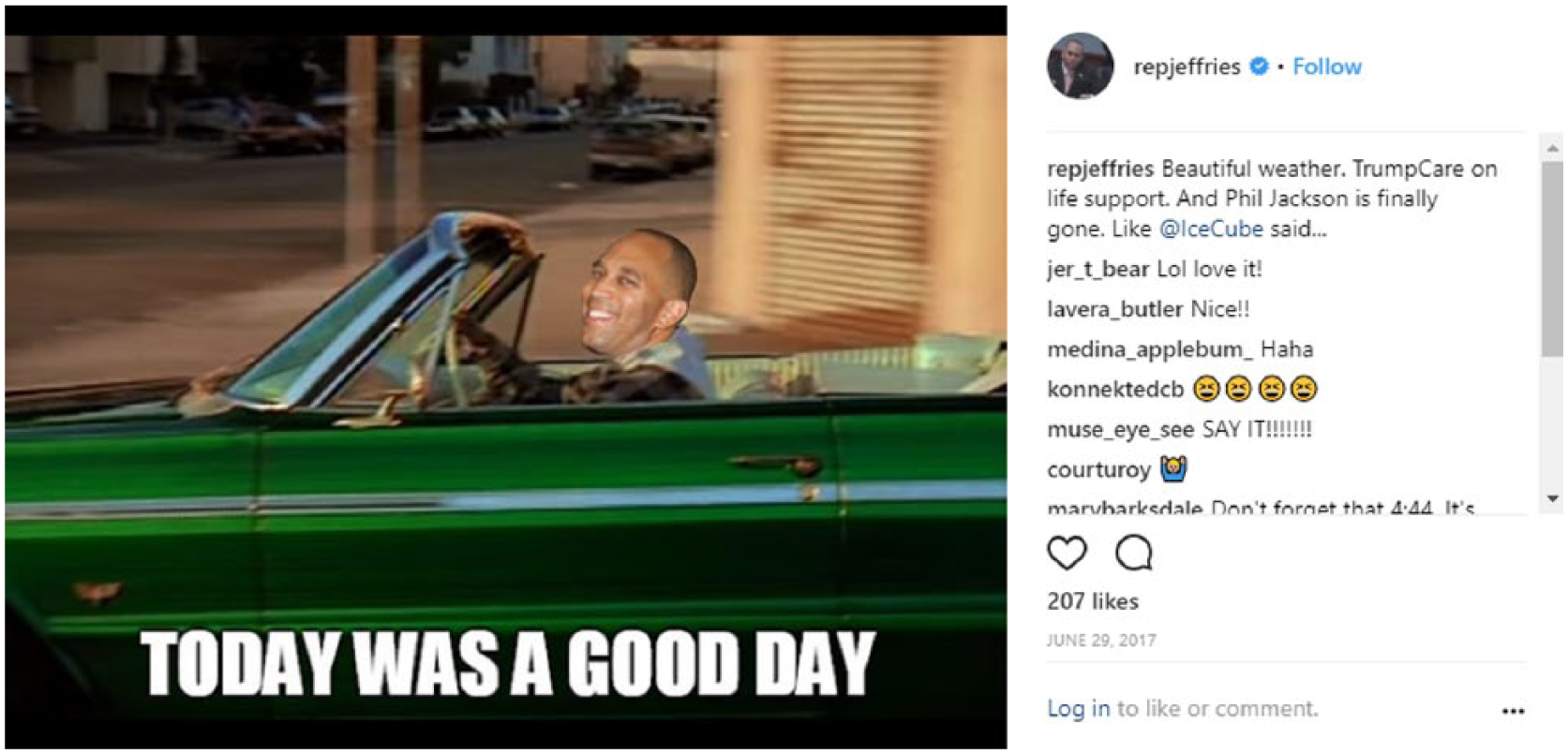
Example of a Text Post Targeted to Younger Constituents.
Discussion
I believe we can organize these findings into three important general conclusions.
Members of Congress use Instagram in pretty much the same way they use other social media platforms.
Based on what I have found, I am able to conclude that in at least three ways—who uses Instagram, the type of content likely be posted to Instagram, and the way men and women use Instagram—members of Congress appear to be using Instagram exactly the way they use other social media platforms like Twitter and Facebook.
I conclude that women are significantly more likely to have an Instagram account than men. An average female member of Congress is 12.92% more likely to have an Instagram account than a male member. I also conclude that female members and Senators post significantly more times to their accounts. Being a woman increases the expected number of Instagram posts by 46.9%, while being a Senator increases the expected number of Instagram posts by 42.1%. These findings mirror previous research that found women and Senators to be more active on other social media platforms, too (i.e., Evans et al., 2014; Lassen & Brown, 2011). So, in terms of who is likely to use the app, Instagram resembles other types of social media.
But the similarities between Instagram and other platforms go deeper than this. My data definitively proved that members of Congress are using Instagram in a businesslike fashion. Nearly 70% of a typical member’s posts publicize some activity related to their job, 41% of a typical member’s posts will be photos or videos taken in D.C., and almost 29% of a typical member’s posts will include a constituent. In contrast, just around 8% of a typical member’s posts include personal content. Indeed, the kinds of posts that make Instagram such a fun creative outlet for so many people—selfies, landscapes, throwback photos, and the like—make up even smaller percentages of the content posted by an average member.
Research has shown that Congressmembers tend to act conservatively on social media. One content analysis found that a healthy majority of Congressional tweets were informational, meaning they provided a fact, opinion, or position on an issue. Only 4% of tweets were personal messages (Golbeck, Grimes, & Rogers, 2010). Another study found that just 4.3% of Facebook posts and only 5.6% of tweets mentioned a member’s personal life (Lawless, 2012). At the high end, maybe 13% of a median member’s tweets contained nonpolitical content (Lassen & Bode, 2017). Thus, the 8% personal figure I report seems par for the course.
Finally, we were interested in seeing whether men and women use Instagram differently. If women were to post significantly more personal and family content, that might tell us something about the role gender plays in Congressional representation. This turned out not to be the case. Mostly gender did not predict the percent of each kind of post a member would make. My findings therefore echo those of Meeks (2016), who found that male and female Senate candidates reveal equal amounts of their personal lives and identities on Twitter, and of Mueller, Cain, Wallace, and Sarich (2017), who found that gender did not impact the amount of any of three different types of tweets posted by House candidates (see also Evans et al., 2015; Just, Crigler, & Owen, 2017).
The major differences my analysis did reveal between men and women instead seem to be an accurate reflection of long-observed differences in Congressional behavior. Women share higher percentages of photos and videos taken in D.C. and higher percentages of photos and videos featuring other government officials. Many scholars have argued that female and male lawmakers have different leadership styles, with women being more inclusive, and more likely to emphasize consensus (Rosenthal, 1998). Instagram provides visual evidence of these differences. A higher percentage of the posts of female lawmakers include other officials because they are more likely to be working collaboratively in the first place. Cheri Bustos’s (D-IL) account is a good example. Bustos regularly posted pictures with the same group of female Congresswomen whom she referred to as her “girlfriends” (Figure 4).
2. Differences between the parties may actually reflect differences in political power.

Example of a Post Reflecting the More Inclusive Lawmaking Style of Female Members.
Contrary to expectations, Republicans and Democrats are equally likely to have an Instagram account, and they post to their accounts at the same rate. Previous research had suggested that Republicans would be the more enthusiastic users of Instagram. They are not. But, that being said, there were several significant differences in terms of how members of each party use Instagram. My suspicion is that these differences actually have more to do with the balance of power between the parties at the time than anything else.
At the start of 2017, Republicans returned to a changed Washington. A new Republican president was taking office, while Republicans maintained control of both the House and Senate. This was a time for Republicans to be excited about what they might accomplish working together. As a result, Republicans shared higher percentages of professional posts, posts in D.C., and posts featuring government officials. Republicans were fairly obviously using their Instagram accounts to showcase their efforts and enthusiasm at the start of a promising new legislative session. For instance, scores of Republicans posted optimistic shots with their colleagues celebrating the Inauguration—photos which were, all at once, professional posts in D.C. featuring government officials (Figure 5). Many Democrats, of course, skipped the Inauguration altogether.

Example of Common Style of Republican Post at the Start of the 115th Congressional Session.
In contrast, consider the position of those Democrats. Democratic members of Congress returned to Washington fully aware that their angry supporters back home wanted them to #resist everything and anything the new Administration proposed. As a result, their Instagram accounts were used much more for position-taking (Mayhew, 1974), as seen in the fact that Democrats shared higher percentages of text posts, holding all else constant. Among the population, 14.44% of the average Democratic member’s posts were text posts, as opposed to an average of 6.56% for Republicans; t(419) = 5.8248, p = .0000. These text posts, as one might imagine, were quite often used to express opposition to the Trump agenda.
Similarly, Democrats posted significantly longer captions to accompany their Instagram posts, too. On average, the captions of Democratic posts ran 38.28 words in length. By comparison, Republican posts averaged just 31.12 words in length; t(376) = 3.6053, p = .0004. Democrats wrote longer captions because there was more political messaging in their posts. Indeed, even when Democrats would post a personal photo, sometimes the caption would still be used to articulate a political difference with the Republicans (Figure 6).
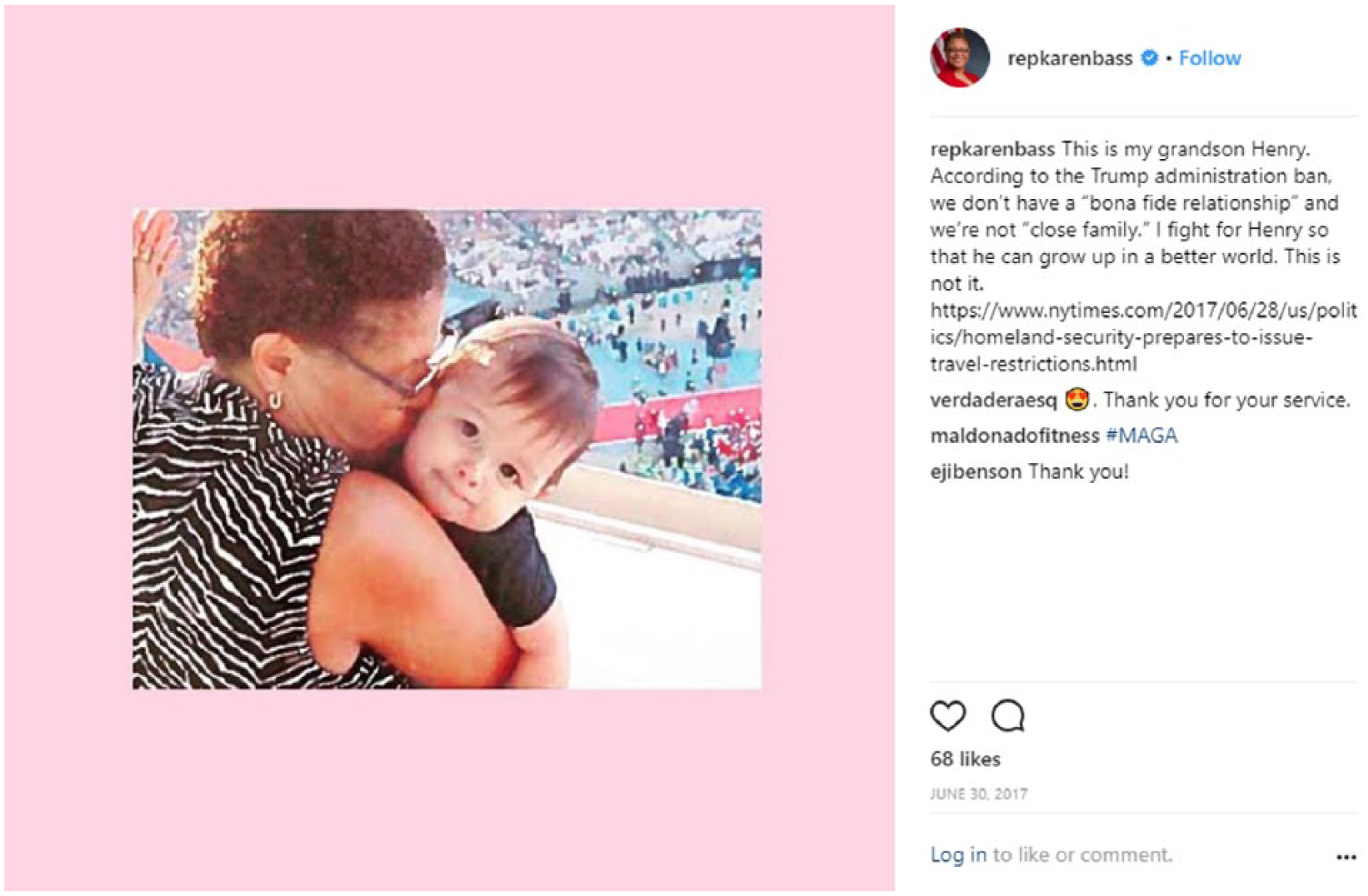
Example of Democrats Including Political Text With a Personal Photo.
One can contextualize the findings about African American members along similar lines. African American opposition to President Trump during this time period was particularly intense after Trump picked a fight with civil rights icon Rep. John Lewis (D-GA) on the eve of the Inauguration. Even holding party constant, African Americans shared higher percentages of text posts, and lower percentages of posts featuring their constituents. The accounts of these African American members provide evidence that many were attempting to use Instagram to express opposition to national policies they felt hurt the wider African American community. Many African American members’ accounts looked a lot like Rep. Yvette Clarke’s (D-NY). In all, 127 of her 256 posts were text posts (49.61%), almost always marked by the hashtag #brooklynresists.
This finding about partisan differences in Instagram behavior opens the door to future potential research. It will be worth re-examining the differences between the two parties once the Democrats return to power to see whether the direction of these relationships switches.
3. he way younger members use Instagram may point to an important future change in representation.
The most meaningful findings I offer relate to impact of age on Congressional Instagram behavior. Younger members may not post more often than older members, but they definitely use Instagram in a different way. In the models predicting the percent of each type of post appearing on member’s account, often the coefficients for age were highly significant at the .01 level. Holding all else constant, younger members post greater percentages of personal photos, photos at home, family photos, selfies, videos, and pictures with their pets.
It’s not hard to see that the higher percentages of personal photos, family photos, pet photos, and so on means that younger members are far more comfortable allowing their followers an authentic glimpse into who they are outside of work. Rep. Kristi Noem (R-SD, 45) posted videos of her dancing to Fifth Harmony, of her singing along to Toto in the car, and of her recreating Rocky Balboa’s famous run up the steps of the art museum in Philadelphia. Rep. Eric Swalwell (D-CA, 36) shared posts of the birth of his new baby boy, while also regularly posting pictures of his dog, Penny (about 10% of his 94 posts). Rep. Will Hurd (R-TX, 39) shared photos of delicious looking Texas food, beautiful Western landscapes, and funny throwback photos with his family. Rep. Elise Stefanik (R-NY, 32) posted regular photos of the Sunday meals she cooked and the books she was reading. Later, she shared photos from her wedding that summer. In all, 50 of her 151 posts were personal photos or videos (33.11%). Rep. Scott Taylor’s (R-VA, 37) Instagram account resembles a personal fitness account. He shared landscapes from his runs, and pictures of him swimming and hiking. Over 16% of Taylor’s 68 posts were selfies.
Members of Congress have long felt that what their constituents want most from them is “access.” As Richard Fenno (1978) wrote, people want “to feel that they can reach their congressman, that he is or can be available to them, that they can—if they wish—see him, listen to him, talk to him” (p. 131). Younger members of Congress are offering their constituents the kind of access they have never before had—the ability to experience, in real time, a member’s meal, or workout, or family gathering. This access may therefore strengthen the trust between a member and their constituents. Future research ought to examine whether members with more personal Instagram accounts do, indeed, form a stronger bond with their constituents.
What is also worth noting is that younger members’ openness on Instagram appears to translate into a wider social network. Sixty-two Members under 45 had Instagram accounts. The median number of followers for these younger members is 1,219. Recall that the median number of followers for all members of Congress is 873 other accounts. The drivers of Instagram popularity need to be more systematically examined than this. But, for now, this small piece of information is tantalizing because it points to the broader ways Instagram promises to change representation. Elise Stefanik’s endearing personal account had helped her build an audience of almost 6,500 followers by the end of the summer of 2017. It’s reasonable to think that many of these followers do not live in her district. Rather, they chose to follow her because they enjoy the type of content she posts. If so, Instagram is helping to facilitate what Jane Mansbridge (2003) has called “surrogate representation,” or representation by an official that an individual has no electoral relationship with. Even with no formal accountability, Mansbridge argues that representatives often still feel responsible to their surrogate constituents living elsewhere.
The intuition here is simple. Younger members better understand and make use of Instagram. As a result, they likely attract more followers, including more followers living in other places around the United States. These members then feel obligations to that dispersed online constituency that may pull them in different directions, and ultimately even impact their behavior in office. As generational replacement alters the make-up of the entire body, more and more of Congress will feel these same forces. Instagram’s impact on American politics is only just now beginning to be felt.
Footnotes
Acknowledgements
The author gratefully thanks Kailey Zengo, Molly LaBelle, Sally Matlock, and Ben Fleming for the assistance they provided in collecting data for this study.
Declaration of Conflicting Interests
The author(s) declared no potential conflicts of interest with respect to the research, authorship, and/or publication of this article.
Funding
The author(s) disclosed receipt of the following financial support for the research, authorship, and/or publication of this article: Funding for the student research assistants was provided by Dickinson College’s internal Dana Research Assistantship program.