




Abstract
Young adults are known to adopt Facebook (FB) sabbaticals as a coping strategy for FB-induced technostress, which are often linked to problematic overuse habits. Yet, there has been little investigation of how young adults experience, navigate, and negotiate FB sabbaticals and the impact this has on their social connections and overall well-being. To address this, we conducted a qualitative study of six young adults, aged 18–34 to understand their FB sabbatical experiences, how they negotiated their social connections during their sabbatical and sough to explain the reasons associated with their return to FB. We propose a FB sabbatical support model and offer three research propositions. Our results suggest that (1) FB sabbaticals are of benefit in addressing unhealthy FB habits, yet key supportive factors vary in value of importance and influence between genders; and (2) despite young adults’ efforts to mitigate technostress via FB sabbaticals, this strategy presented multiple challenges that affected their online and offline connections and personal health and well-being in positive and negative ways, contributing to cyclic habits of FB discontinuation and reconnection.
Keywords
Introduction
Social network sites (SNSs) are a widespread phenomenon that has redefined the landscape of social connections.
SNS dominates how young adults communicate and interact, reshaping how they engage with their online and offline social groups (Grieve, Indian, Witteveen, Anne Tolan, & Marrington, 2013; Yao & Cao, 2017). The introduction of smartphone technologies has contributed significantly to increased access and regular use of SNS among young adults aged 18–34 years (Chen et al., 2017). The primary function of popular SNSs like Facebook (FB), Instagram, Snapchat, and Twitter is to increase social interaction opportunities online that are private, public among close friends, or casual acquaintances (Boyd & Ellison, 2007). Despite the popularity and ease of access among its young cohort of users, FB users have reported struggling with the negative aspects of FB use mainly associated with problematic overuse (Salo, Pirkkalainen, Chua, & Koskelainen, 2017; Schoenebeck, 2014a; Turel, 2014), information overload (Maier, Laumer, Weinert, & Weitzel, 2015a; Zhang, Zhao, Lu, & Yang, 2016), emotional exhaustion (Maier, Laumer, Eckhardt, & Weitzel, 2012b), and technostress (Maier et al., 2015a). Consequently, young adults are conflicted between their desire, pressure and need to be connected online, and the negative ramifications of regular FB use. So much so that many young adults are now considering or adopting FB sabbaticals as a self-styled mitigation strategy to cope or escape FB-induced stress (Alam & Wagner, 2013; Zhang et al., 2016).
The growing trend of FB sabbaticals is reflected across academic literature. For example, Cannarella and Spechler (2014) predicted that FB would experience a loss of 80% of its frequent users by 2017 (Cannarella & Spechler, 2014). Dindar and Akbulut (2014) reported that approximately 73% of their total 231 participants took regular FB sabbaticals (Dindar & Akbulut, 2014). Recently, Luqman, Cao, Ali, Masood, and Yu (2017) reported 360 FB users suffered psychological and behavioral consequences motivating disconnection or reduction in their use of FB due to exhaustion and technostress (Luqman et al., 2017). These studies highlight the commonality of FB sabbaticals and draw attention to the significant role of stress online in motivating FB sabbatical behaviors. This phenomenon can result in young adults adopting FB sabbaticals, ranging from a few days to months, with the intention of returning (Take a Facebook Sabbatical, 2011).
Of the few researchers who have investigated SNS discontinuation behaviors, Luqman et al. (2017) and Zhang et al. (2016) examined the antecedents associated with young adults’ FB discontinuation intentions (e.g., excessive social, hedonic, and cognitive use and system-feature, information, and social overload), whereas Tromholt (2016) investigated well-being in terms of life satisfaction and emotional outcomes associated with FB discontinuation. Salo et al. (2017) explored a variety of ways individuals attempt to mitigate technostress, discussing temporary discontinuation as one of many strategies. Mutually, concluded that the SNS habit of users, such as excessive or problematic overuse, contributes significantly to SNS exhaustion and technostress, triggering young adults’ decision to suspend their FB use.
Academics have been able to agree that gender differences exist when it comes to problematic SNS overuse issues. Moreover, social networks are key supporting factors known to be used and benefit males and females differently during times of stress. Still, which gender is more prone to and/or affected by the negative aspects of FB use remains a topic of debate. Currently, there is little research that discusses how offline social supports aid male and females’ behavioral health changes separately in relation to issues of problematic FB overuse. Neither has there been research that investigates whether gender roles can be used to explain gender differences associated with FB sabbatical experiences and how such roles influence decisions for negotiating and navigating FB sabbaticals. Although previous studies have significantly contributed to the growing body of discontinuation research, young adults’ experiences of their FB sabbatical and the impact this has on their social connections and reconnection strategies remain largely unexplored.
This study explores (1) young adults’ FB experiences in mitigating technostress and problematic FB overuse through the means of FB sabbaticals, (2) investigates how young adults navigate social connections in a world demanding their constant digital connectivity and reasons associated with returning to FB, (3) proposes a three-category FB sabbatical support model important in learning to live without FB, (4) offers three research propositions, and (5) discusses how gender roles influence their FB sabbatical motivations and experiences.
Past studies have focused primarily on the quitting behaviors of SNS users, often largely neglecting to provide a holistic view of the entire discontinuation–reconnection habits of the SNS-user lifecycle. Our study intends to contribute to the literature through a qualitative exploration of young adults’ experiences engaging in FB sabbatical cycles and to lay the groundwork for future research. A sabbatical was defined as a conscious decision to not use FB for a period of 3 days or more. Our aim was to provide insights into young adults FB sabbatical experiences adopted to manage aggravated technostress triggered through problematic overuse. In addition, paying attention to reconnection experiences and strategies employed so to achieve a healthy balance online and offline. This study was designed to address the following research question:
What are the motivations and experiences for young adults aged 18–34 years to take Facebook sabbaticals?
To answer this question, the article will address the following threefold aims: first, identify the motivations associated with young adult’s conscious decision to take FB sabbaticals. Second, explore how young adults experience FB sabbaticals, with attention to their social connections and networks during an FB sabbatical. Finally, explore the reasons associated with why young adults decide to return to using FB after a sabbatical.
This article is organized as follows: section “Literature Review” presents the theoretical background of FB sabbaticals, technostress influencing FB discontinuation behaviors, and the role of gender. In section “Method,” we describe the research methodology including data collection and data analysis. Section “Results” provides an interpretation of this studies results followed by the discussion, including practical implications and recommendations for future research. Finally, the research limitations and conclusion are presented in section “ Discussion.”
Literature Review
FB Sabbaticals
FB can be a tempestuous environment, especially for the naïve user. The excitement and elation of the positives associated with FB, met with the sometimes disempowering and challenging negatives, makes little wonder for why so many young adults experience the push–pull effect of the FB force. More often than not, the positive aspects of FB use, receiving positive reinforcement via online feedback such as “comments” and/or “likes” (Andreassen, 2015), can result in heightened sensation-seeking behaviors (Rahmani & Lavasani, 2011) linked to increasing rates of problematic FB/SNS overuse and overall reductions in self-reported health and life quality (Andreassen, 2015; Maier et al., 2012b; Rahmani & Lavasani, 2011; Turel, 2016). When problematic FB overuse results in stressful experiences, users are likely to alter their FB behaviors in an attempt to mitigate the imposed stress (Luqman et al., 2017). Problematic FB/SNS overuse is the most commonly reported technostress among young adults (Zheng & Lee, 2016). Technostress is the outcome of stress induced by technology among information technology (IT) users (Yao & Cao, 2017). The term was introduced in 1984 to describe the technology stress induced in the workplace, due to the increase in computer-reliant occupations (Ayyagari, 2007). Currently, the term has evolved to include any stress resulting from SNS, or “online social network-induced stress” (Maier, Laumer, Eckhardt, & Weitzel, 2012a). Although its definition is still evolving, many agree it is significant distress or impairment to an individual’s online and offline experiences caused by unhealthy habitual use of Internet and SNSs (Aboujaoude, 2010; Kuss & Lopez-Fernandez, 2016).
Problematic Overuse and Technostress
FB overuse by young adults can increase stress levels and reduced overall well-being (Maier, Laumer, Eckhardt, & Weitzel, 2015b), loss in interpersonal trust (Chaudhry, 2015; Müller et al., 2016), and negatively impacts on self-reported health (Fox & Moreland, 2015). Turel (2014) and Luqman et al. (2017) found that to mitigate stress induced from addictive SNS habits, users sometimes discontinue or reduce using SNS (Luqman et al., 2017; Turel, 2014). Temporarily disconnecting from SNS has been shown to provide stress relief and even restabilizes emotional health and well-being (Luqman et al., 2017; Salo et al., 2017; Tromholt, 2016; Turel, 2014; Zhang et al., 2016). Furthemore, provides SNS users with the opportunity of returning to a pre-stress status, ready to reengage with SNS once again (Ravindran, Yeow Kuan, & Hoe Lian, 2014; Salo et al., 2017; Schoenebeck, 2014b; Turel, 2014). Yet, some researchers have raised concerns that temporal discontinuation strategies, like FB sabbaticals, are only capable of providing short-term relief to SNS users, not to mention provoking negative emotional states such as FoMO (Fear of Missing Out) and anxiety either directly or indirectly through peer and social pressures (Brubaker, Ananny, & Crawford, 2016; Dindar & Akbulut, 2014; Ravindran et al., 2014; Salo et al., 2017; York & Turcotte, 2015). Ironically, young adults, who are self-confessed SNS addicts or problematic SNS overusers, are more likely to engage in FB sabbaticals habitually. This has the potential to exacerbate unhealthy addictive SNS behaviors and technostress upon reconnection, especially in the absence of changing negative user characteristics and habits (Andreassen, 2015; Salo et al., 2017). Despite SNS providers such as FB, beginning to acknowledge the presence and potential damage technostress can exert over user retention rates, the main focus remains on retaining users and discouraging discontinuation habits (Luqman et al., 2017). However, attempts by SNS providers to maintain users through the addition of new SNS features, or more controversial measures related to increasing the difficulty of disconnecting, have not been successful. Instead, such attempts have increased experiences of SNS overload and frustrations among young adults, unintentionally resulting in continued FB discontinuation rates (Zhang et al., 2016). These studies indicate that young adults and SNS providers alike are seemingly challenged in their attempts to navigate both the positive and negative aspects of FB in a way that benefits all.
The Role of Gender
Recent research has referred to young adults’ problematic FB overuse as an “addiction,” but noted the moderating effects of gender (Zhang et al., 2016). When considering the difference between genders associated with SNS use, majority of the literature available explores the different ways male and females use such platforms (Hargittai & Walejko, 2008; Ji & Skoric, 2013). Males are often reported as using the Internet for research, entertainment (Hargittai & Walejko, 2008), and information gathering purposes (Jackson, 2007), in comparison to females who prefer to utilize the Internet for socializing as a means of relationship maintenance (Hargittai & Walejko, 2008; Jackson, 2007; Ji & Skoric, 2013). Males are also more likely to use FB for bridging social capital, thus establishing and forming new relationships as opposed to just maintaining them, as observed in females (Muscanell & Guadagno, 2012). While males have been reported to be more prone to SNS addiction in comparison to females (Müller et al., 2016), other research has found the converse, suggesting that females are heavier users, thus greater potential of developing and SNS addiction (Lougheed, 2012). Attempts to explain the differences between male and female SNS use have utilized theories related to gender roles (Chen et al., 2017). Gender role theory posits that male and female behaviors are socially and culturally conditioned and that gendered behaviors are defined and redefined accordingly to societal norms (Ashton & Fuehrer, 1993; Connell, 2012). Following this logic, we assume that offline gender roles and norms are likely to produce gendered engagement with the online environment of FB. This may explain the observed differences displayed in users’ online behaviors resulting in addictions. For instance, female role norms expect that women will value and invest in interpersonal relationships more readily. Hence, females may engage in an environment such as FB that promotes social connections and interactions, meaning that they will be more likely to experience FB addictions, based on their FB usage and engagement habits. In contrast, the social expectation that males will be more analytical and prioritize problem solving may contribute to their experiences of increased IT confidence, thus more likely to engage in newer SNS platforms and features, potentially stimulating problematic FB overuse issues. Although these traits contribute to males’ digital competence and satisfaction, they do not equip males to deal with the element of social overload when using FB regularly, potentially contributing to the increased rates of technostress among males than females (Zhang et al., 2016). Research findings relating to gender differences in SNS addictions warrant further investigation and specifically young adults’ experiences of FB sabbatical implemented to mitigate technostress.
Method
Based on the theoretical background discussed in the previous section, we decided to conduct a qualitative study using semi-structured interviews. This research approach was necessary to produce context-specific evidence for generating early-stage theory development for previously unexplored phenomena such as FB sabbatical habits.
Recruitment Strategy and Participants
Human ethics approval was granted by the Human Ethics Sub Committee at the University of Melbourne (1545403.1). Upon receiving the necessary ethical approval, convenience sampling was adopted recruiting participants from a regional community in Victoria, Australia, through an advertisement placed on FB and personal networks.
Inclusion criteria were as follows:
Aged 18–34;
Reside in the regional community;
Voluntarily chosen to take an FB sabbatical in the past or were currently on a sabbatical.
A total of 11 participants expressed an interest in the study responding via email, FB, telephone, or mutual personal contacts. A recruitment pack was distributed to each participant containing relevant information regarding the study, with the opportunity to ask questions about the study. Participants were informed that their participation was voluntary and they could withdraw from the study at any stage. Five participants withdrew from the study before attending the interview due to personal commitments. Four females and two males provided consent. Pseudonyms are used for all the participant’s names. Table 1 illustrates the demographic profile of the interviewed participants.
Profile of Interview Participants.
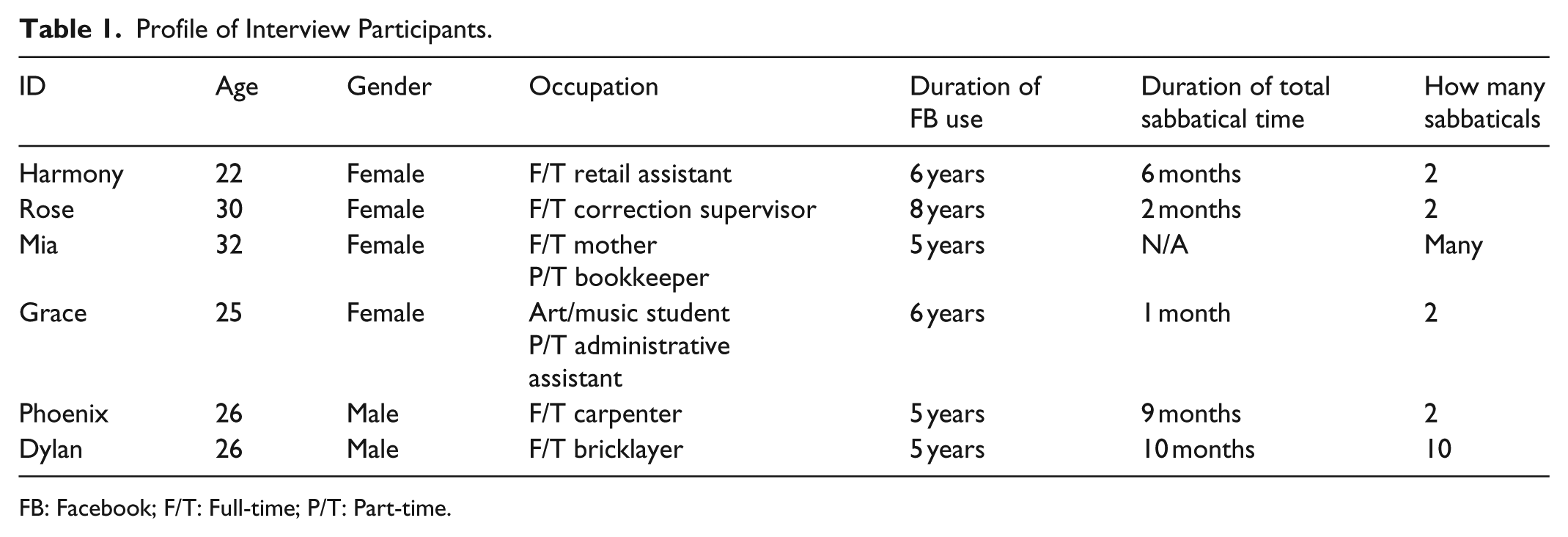
FB: Facebook; F/T: Full-time; P/T: Part-time.
Data Collection
All semi-structured face-to-face interviews were conducted in English at a preferred location nominated by the participants themselves, with the longest interview lasting up to 2 hr. Written informed consent was obtained from all participants prior to interview. Interviews were audio-recorded and transcribed verbatim. Participants were reassured that their interview would remain confidential and transcripts would be anonymized. A semi-structured interview guide was developed and used to steer discussion for each individual interview and allowed flexibility to explore narratives and areas of interest raised by the participants. A series of open-ended questions were developed and themes of the interviews focused on motivations (e.g., “what particular motivations and reasons influenced your choice to take a Facebook sabbatical?”), social connection experiences during an FB sabbatical (e.g., “when on a Facebook sabbatical did you find this affected how friends connected to you and you with them?”), and reasons influencing reconnection to FB (e.g., “what are some reasons associated with you deciding to return to using Facebook after your chosen sabbatical?”). Prompts were used where necessary to elicit more detailed responses from participants. Participants were free to direct the interview according to their interests and concerns.
Data Analysis
The framework to present the results focused on four important project topics, which represent the FB sabbatical process. First, the initial focus discussed the number of FB sabbaticals (number of FB sabbaticals) as a segue into discussing motivations associated with participants’ conscious decision to take an FB sabbatical (motivations for a Facebook sabbatical). The experiences of taking a FB sabbatical focusing on perceived and/or actual benefits and/or consequences of taking a FB sabbatical followed, with special attention on social connections and networks (during the Facebook sabbatical—impact on social connections). The final topic discussed were the participants’ reasons associated with returning to using FB after a sabbatical and their experiences upon their return (the Facebook sabbatical ends—returning to Facebook). We performed an interpretive thematic analysis on all semi-structured interviews. The research analysis identified codes and categorized them into a hierarchy of emerging themes for understanding FB sabbaticals under each of the project topics. The data analysis focused on the similarities of general trends across the data set, in addition to identifying possible differences between gender groups. Data analysis involved an iterative process whereby new emerging themes within each topic area were compared and refined against previous themes (Fereday & Muir-Cochrane, 2016).
Results
Analysis revealed multiple motivations associated with young adults’ reasons for undertaking an FB sabbatical, while identifying gendered patterns of behavior. Despite all participants initially experiencing a reduction in their social connections during their FB sabbatical time, all participants benefited from their FB sabbatical. Female participants were focused on making active changes in their life, privileging their offline social connections, while the males saw this as an opportunity for time out from FB, allowing time to engage in physical activities.
Number of FB Sabbaticals
All participants revealed the cyclic nature of their FB sabbatical habits. Participants reported undertaking multiple FB sabbaticals, with their sabbaticals centered around having a rest from the addictive aspects of FB use, to mitigate technostress. The FB sabbatical cyclic behavior demonstrated by the young adults was discussed as a necessary temporary escape as a reset point. Furthermore, young adults admitted they would most likely continue to take FB sabbaticals across their FB use lifespan, indicating that not only is this their regular way of engaging with FB but also a successful yet short-term mitigating strategy addressing their technostress. Mia (age 32), Grace (aged 25), and Dylan explain, I would say I have probably taken many breaks and they have become more frequent. I feel like I need to have a break to get it out of my system and then I feel fresh and happy to get back on or when I’m prompted. (Mia, aged 32) It’s how now I engage with FB, I love taking regular breaks, I love, love doing it. It’s like I’ve got a restart point. (Grace, aged 25) I will definitely continue to keep taking breaks. (Dylan, aged 26)
Motivations for a FB Sabbatical
While participants discussed various motivations for choosing to take a FB sabbatical, there were four commonly occurring and consistent themes that all participants experienced. Three of the four themes corresponded with findings from the current literature including (1) information overload, (2) problematic FB overuse and antisocial behavior, and (3) FB as an artificial environment. A novel theme to emerge in this study was related to the issue of Facebook wars and keyboard warriors relating to participants FB usage habits.
Information Overload
All participants discussed retreating from social media due to information overload. Participants reflected upon scrolling through their FB newsfeed and becoming dissatisfied with the content and information presented. Most of the young adults described being “overwhelmed” or “overloaded” by “unwanted” information in their FB newsfeed. As Rose (aged 30) explained, We have to process important information during the day, then trying to process useless information . . . was a bit of an overload and it wasn’t useful. It was a lot of information for little outcome.
Dylan (aged 26) expresses his frustration of other FB users posting content and intensity: Ease up a bit, it’s too much information . . . the same stuff over and over again with nothing of value to me.
Harmony (aged 22) described that there is no escape from the consistent flood of information and this impacted negatively on her life and emotions: FB is kinda shoved in your face like other peoples’ problems . . . I was worrying about everyone else’s problems instead of dealing with my own.
Nevertheless, participants recognized that their constant use of FB contributed to the large amounts of FB information they received daily.
Problematic FB Overuse and Antisocial Behaviour
The negative impact of problematic FB overuse on participants’ offline social relationships was a strong influence for them to take a FB sabbatical. Participants felt that they were “addicted” to FB and it had become a distraction. Participants acknowledged that over-using and/or misusing FB impacted on their available time for engaging in offline social connections or other activities. Dylan (aged 26) explains, I had FB addiction, I would wake up in the morning and bang on it . . . always on it . . . but there are other things I could be doing, you know time for activities.
FoMO was connected to their reason for feeling addicted to FB as Mia (age 32) elaborates, I would think there is FB addictions, I definitely felt it, it was like you had to get on and check you couldn’t get enough and if you weren’t on there you would feel like you were missing out.
Harmony (aged 22) described a conversation where she reached out to a friend regarding her FB addiction: I was talking to one of my friends and we were saying that FB now has become an addiction for a lot of people, you know the first thing in the morning you wake up and you will post or message on FB, the first thing in the morning to do is check FB.
Grace (aged 25) describes how others FB use would interrupt their social interactions when together: I don’t like it when I’m sitting with someone and they are scrolling through their newsfeed, I like interaction . . . they get a notification on their phone or something and I’m with them, they will check it and I’m like, “no don’t do that, it can wait.”
Participants reflected upon misusing FB, such as FB stalking and searching for interesting or “scandalous” content online, acknowledging this sort of use was unhealthy. As explained separately by Harmony, Dylan, and Rose: I would scroll through the newsfeed . . . there might be photos of something that was scandalous or ummm gossip worthy . . . but I don’t think it was positive. (Rose, aged 30) I would just keep stirring everyone up and I would just spend all my time on it . . . then I thought there were better things to do with my life then just sit on FB all day long. (Dylan, aged 26) You look at one person then you are like “who is that,” then you are in deep, looking at their cousin’s cousin, ridiculous, after you have gone through everyone else. (Harmony, aged 22)
FB: A Pressure-Cooker Environment
There was consensus among the participants interviewed in this study that FB creates a highly pressured environment where the lifestyles of both self and others are scrutinized and compared, based on FB activity. The participants articulated their frustration and jealousy toward other FB users who regularly posted overly positive or negative content. For the female participants, it was a combination of positive and negative FB posts by others that were disturbing, resulting in negative feelings affecting their self-reported health. Grace (aged 25) explained the negative impact that “glamorized” posting had on her well-being: What do people put on FB? All these exciting things they are out for dinner or they are on an adventure, out on the road traveling doing all these exciting things and I have definitely had those thoughts of not being good enough.
Despite the jealousy and negativity evoked in participants by extremely positive FB posts, Rose (aged 30) ironically acknowledged that she was as equally guilty of this activity: I wanted to share something like a holiday or some type of event like a wedding or a friend’s birthday but in saying that, that exact activity I’m describing is the very activity other people do that causes the negative feelings that I’ve had when seeing people put these wonderful things up about their lives.
However, for the male participants the negative FB posts were most disturbing as Dylan (aged 26) describes, When you look through the newsfeed and people are whining . . . sook about their lives . . . it makes you all negative . . . you shouldn’t have to you know put up with it . . . FB people are fake and contradictive which is annoying and yeah makes you all negative.
FB Wars and Keyboard Warriors
FB wars are defined as situations where FB users instigate or participate in cyber arguments on either public FB newsfeeds or private FB walls (Facebook war, 2012). Keyboard warriors are often the instigators or perpetrators of FB wars, where they express their anger and/or frustration by writing comments on other people’s posts (Definition of keyboard warrior in English, 2016). In this study, male participants identified themselves as keyboard warriors and engaged in FB wars. However, the females described that they had only observed cyber attacks.
The female participants in this study reported that witnessing FB wars threatened their enjoyment of FB and was a motivation for their FB sabbatical. All of the female participants expressed anger at the activities of “keyboard warriors” and saw it as “counterproductive” and “unnecessary.” Rose (aged 30) elaborates, People put up their opinions; often about contentious subjects to almost provoke an argument or some type of tension or conflict . . . this frustrated me and made me angry.
Interestingly, both male participants identified themselves as keyboard warriors and participated in FB wars. As Phoenix (aged 26) and Dylan (aged 26) explain, Yeah FB wars . . . I suppose I get stuck into them . . . I just keep stirring everyone up . . . like mouthing off on people . . . you just want to say something. (Dylan) You shouldn’t have to you know put up with it . . . you get sucked in by it. (Phoenix)
The male participants reported that negative FB posts would often provoke emotions such as anger and frustration resulting in their engagement in “FB wars” as “keyboard warriors.” They felt it was their duty to challenge FB users who were “whinging,” “complaining,” and/or posting misleading information. Male participants were encouraged by this type of activity through the receiving of FB “likes” and/or comments from either their own FB friends or others. Phoenix (aged 26) describes, When you go on to your phone and you see it might go from 4 likes to 36 likes going up like that and you keep checking ya phone . . . cause it’s all about the likes and that’s what gets ya addicted.
Somewhat paradoxically, in describing their motivations to go on an FB sabbatical, Dylan stated that FB needed a rest from him. The male participants expressed a level of guilt associated with their keyboard warrior activities. Phoenix (aged 26) articulated, Yeah I’ve put things up and then it’s been received so bad or I thought “gee that’s not cool,” so I’ve deleted it.
For the male participants in this study, engaging in FB wars as keyboard warriors was a significant motivation for their voluntary FB sabbatical.
During the FB Sabbatical—Impact on Social Connections
All the young adults in this study experienced a reduction in social connections during their FB sabbatical. Participants described two types of losses directly related to their social connections while on a FB sabbatical. First, participants described that they experienced a loss of their casual acquaintances. However, they acknowledged that this loss was not of great importance. Second, when participants’ friends and families were using FB in their presence they experienced a reduction in these connections, leaving them feeling “isolated” and “neglected.” Before their FB sabbatical, all participants described using FB in the presence of others as a normalized activity. However, during their FB sabbatical, participants explained how they felt this practice was “rude,” “inconsiderate,” and “antisocial.” This left them feeling isolated while on their FB sabbatical, as explained by Phoenix (aged 26): It gets so annoying cause you look around and everyone is doing the same thing and then you are not on ya phone, ’cause you are not on FB and then ya like, “come on let’s get off ya phones,” you know. It’s like they aren’t even listening or interested, not very social.
Participants described three key factors that were important in learning to live without FB. We described these as the three Rs, “Remind,” “Reassurance,” and “Realize.” Figure 1 illustrates our proposed 3Rs research model.

A visual representation of the 3Rs model and the important key factors for participants to maintain their Facebook sabbaticals.
Learning to Live Without FB
Participants were asked about their everyday experiences of living without FB and specifically its impact on their social connections. All discussed three key factors that were important in learning to live without FB temporarily. We developed a set of specific propositions to explore the relationship between participants’ maintenance of their FB sabbatical to achieve their desired outcome/s and each key support factor and the 3Rs model, respectively. The three propositions presented are by no means designed to be exhaustive and represent the participants’ individual experiences of learning to live without FB temporarily.
First, participants needed to “Remind” themselves of the original motivations for leaving FB. Many factors would threaten the participants FB sabbatical, specifically their desire to socialize with others, triggering feelings of loneliness and FoMO. For the participants to stay committed to their temporary FB sabbatical, it was important they reaffirmed their decision by reminding themselves of their motivations. This suggests the following proposition:
Proposition 1. Frequent self-reminders of the motivations for taking a FB sabbatical contribute to reducing the threats associated with being on a FB sabbatical.
Second, participants required “Reassurance” from their offline social connections, providing them with the confidence that they would remain socially included. Perceived or actual social exclusion significantly threatened participants’ FB sabbatical length, even though a FB sabbatical was needed for their overall health and well-being. Harmony (aged 22) discusses a strategy implemented by her offline social friendship group that contributed to her sense of inclusion and supporting her decision to be on a FB sabbatical: Yeah, we implemented a phone ban when together . . . I think it’s really good, it kinda forces you to have to talk to people (laughs), which is sad in this day and age . . . but it got to that point in our group, it’s the thing we had to do to make ourselves more involved with each other.
Rose (aged 30) recalls how she started to feel reassured that she was not going to miss out on valuable information: I realised I wasn’t missing out on anything important, because the people that are important in my life, I would find information on or about regardless of FB.
Reassurance was especially important for the female participants in comparison to the male participants, leading to the following proposition:
Proposition 2. Close offline social connections are positively related to reassuring FB sabbatical maintenance, particularly for females.
Finally, it was important for the participants to “Realize” the benefits of being on an FB sabbatical, which again varied between genders. Male participants prioritized the practical aspects, reporting the benefits of increased organization time in planning their work commitments and physical gains, such as more time for exercising, including running and playing golf with “mates”: Instead of just sitting at home on the couch you might go outside doing something . . . like I would take my dog for a run. (Dylan, aged 26)
Females focused on the social benefits, explaining that their FB sabbatical provided an opportunity to reconnect with their offline close relationships: I just would find myself spending more time with my children or more so my partner in the evenings, which is the general time I would get on (look at FB) . . . we would spend time together with no distractions so more quality time. (Mia, aged 32) I don’t know whether the conversations increased but there was probably more a feeling of connectedness. (Rose, aged 30) I actually find when I’m not on FB it is when I find most of the good memories . . . I go and visit friends. (Grace, aged 25)
Based on these results, the following proposition was developed:
Proposition 3. Gender variations are positively related to the benefits associated with being on an FB sabbatical.
The need to escape and recovery from technostress linked with problematic overuse habits was important for participants, strongly influencing their commitment to their FB sabbatical. Each of the key factors in the 3Rs model played a role in supporting the participants to learn to live without FB. Yet, the role and importance of each key factor highlighted the differing gender values and priorities.
The FB Sabbatical Ends—Returning to FB
The Males Return
Males reported several reasons associated with their decision to return to using FB, including advertising and promoting their own business, in addition to boredom. However, FoMO and peer pressure were discussed as the major influences motivating their return to FB. One male participant pointed to the relationship between drinking alcohol and the heightened desire to check FB, prematurely breaking his sabbatical. Dylan (aged 26) describes, When drunk I would want to have a look and see what everyone else is doing, you would just like to see what everyone is doing, if I wasn’t drunk I probably wouldn’t go back on FB.
When the male participants were asked about reengaging with FB after their sabbatical, they both stated that they resumed with their normal FB routine. Phoenix (aged 26) and Dylan (aged 26) explain separately: I’m just straight back to normal use, a couple of hour’s regular use a day. (Phoenix, aged 26) I find I’m flat out, it’s like you are making up for lost time. (Dylan, aged 26)
Despite recognizing the interference of FB use on their offline relationships, the male participants felt that they were unable to achieve “a happy medium” as Dylan (aged 26) explains, I don’t think there is a happy medium, not for me anyway . . . like FB can be the best thing in the world or it can be the worst thing in the world definitely.
Here, Dylan describes the conflict he experiences when using FB, where FB sabbaticals seem only to be a temporary escape.
The Females Return
Females reported that their choice to return to using FB included achieving a balance between their online and offline relationships or as a reward. Female participants did mention FoMO as an influence for their return; however, this was only a minor concern in comparison to the males. All female participants were primarily motivated to return to FB due to its ability to complement and enhance their refreshed offline relationships that were reaffirmed during their sabbatical, as Mia (aged 32) explains, It’s just kind of an extra communication tool, a visual to look at each other’s photos to complement the relationship that you already have and established before FB.
Taking an FB sabbatical allowed the females to distinguish between the positives and negatives of FB, as Rose (aged 30) elaborates, I think being more aware of what the positives of social media and FB are and the awareness of what the negatives and downfalls are as well, you are seeing it for what it is and having more of a well-balanced view of it I think.
Female participants were optimistic and proactive in redefining and renegotiating their FB use. They implemented many different strategies to achieve a healthy balance between their online and offline worlds. This included creating an entirely new FB account with fewer friends, auditing their friend’s list, changing privacy settings, removing tags, reducing posting activity, and muting FB notifications. The FB newsfeed was recognized by many of the females as negative. For this reason, after returning to FB they would restrict how often they would view the newsfeed. The female participants sought to restrict and control their use upon return, as Grace (aged 25) describes, I’m using it like a tool now, like how can FB benefit me and what makes me feel better about myself . . . I do still put up photos but it’s very rare compared to when I used to back then.
However, their ability to redefine their FB use upon their return was not without its challenges, as Harmony (aged 22) describes, Upon returning I started to use it more and more often . . . I guess in a way relapsing into old habits . . . I didn’t want to waste all my hard work, you know, it shouldn’t be hard work but it was, so I stopped for just a week and then slowly eased back.
Despite these initial challenges, female participants described being able to achieve a healthy balance negotiating between their online and offline environments when returning to FB.
Discussion
In this study, we sought to better understand FB sabbatical habits, the lived experiences, and motivations from young adults’ perspectives to explore the potential benefits and/or consequences regarding their online and offline social connections and overall well-being. The key findings from our study are as follows: (1) motivations for young adults’ decision to take a FB sabbatical were gendered and driven by the participants recognizing some element of overuse; (2) development of The “Remind,” “Reassure,” and “Realize” (3Rs) model describing participants key factors involved in sustaining an FB sabbatical, for the necessary length of time required to introduce reengagement strategies for recovery from technostress; however, the influence and importance of the 3Rs model factors varied between genders; and (3) FB sabbaticals can potentially become a habitual cycle of disconnection and reconnection used by young adults to cope with FB-induced technostress, with benefits and consequences. Each of these key findings is discussed in further detail below.
This study clearly found that motivations for young adults’ decision to take a FB sabbatical were significantly linked to the participants recognizing their overuse issues and gendered. For example, young adults’ positive experiences during FB use stimulate sensation seeking behaviors that often lead to negative and unhealthy patterns of FB use (Rahmani & Lavasani, 2011). An increased quantity of young adults are self-reporting problematic overuse issues (Luqman et al., 2017; Zheng & Lee, 2016), and this is thought to be motivating their decision for undertaking a FB sabbatical. Furthermore, this study identified that the negative impacts of regular FB use were multiple and gendered. For instance, the male participant’s keyboard warrior habits online led to positive reinforcement through positive comments and likes. Yet, these activities also contributed to the males FB overuse problems that simultaneously threatened their online social identities, well-being, and to a lesser extent their social connections. Although we are unable to comment on the relative size of this problem in male and female populations, we can reflect on how the experience varies depending on gender.
Current literature states that males are usually more affected by technostress than females (Müller et al., 2016; Zhang et al., 2016) and when SNS use results in stressful experiences users will inevitably alter their SNS behaviors (Luqman et al., 2017). An FB sabbatical is only one of the possible behavioral responses reported in the literature. While research exploring mitigation strategies adopted for coping with technostress is limited, one particular study has explored specific types of mitigation employed by individuals as a coping mechanism (Salo et al., 2017). Salo et al. (2017) reported three types of personalized mitigation strategies: type 1, a problem focused stress reduction approach, where users modify their IT use and/or features; type 2, an emotionally focused problem-solving approach to achieve tolerance by modifying personal reactions, feelings, and thoughts; and finally type 3, a recovery from strain tactic, where users temporary disconnect from IT or vent online or offline (Salo et al., 2017). They proposed that IT users might transition between these three types of mitigation strategies, yet they acknowledged this was beyond the scope of their study and area of research requiring investigation (Salo et al., 2017). Our study supports Salo et al.’s (2017) predictions that not only one mitigation strategy is evident instead young adults do transition between the different strategy types to address technostress. However, this transitioning was mainly observed across the female participants and was dependent upon a few key factors, such as whether their motivations were aligned with their emotions, whether they had social supports and whether they adopted alternative activities, and this became the basis for our development of the 3Rs model. We expand upon our contribution to the literature on this strategy and how it is experienced by young people.
We propose a three-category FB sabbatical support model, the “Remind,” “Reassure,” and “Realize” model (3Rs), to facilitate our limited knowledge of young adults FB sabbatical experiences. There is seemingly a right and wrong way of taking an FB sabbatical. Where the successfully enactment of a FB sabbatical is dependent upon the collective three key factors of the 3Rs model, with the influence and importance of the model factors varying between gender. We found that the benefits of FB sabbatical are immense and potentially even long term, if used as a self-reflection and behavior change tool to reassess the user relationship and habits with FB. However, this may in fact be an unintentional yet positive outcome associated with taking a FB sabbatical, which we expand upon further later. The 3Rs model depicts the supportive factors important in sustaining a FB sabbatical for the necessary length of time required to (1) introduce new user strategies upon reengagement to reduce the likelihood of technostress and/or (2) restore users’ emotional health and thus ability to return to a pre-stress state capable to resume normal SNS activity. The influences and importance of this model were stronger for females than males. In this study, both males and females were considered as being in the action stage of the transtheoretical model (TTM) of change (Prochaska, 2008). The TTM can be useful in this context, to understand the decision process with implementing FB sabbaticals and possibly change FB use (Prochaska, 2008). Participants transformed their intention to discontinue FB use into action, demonstrated by their FB sabbatical. However, this action stage was unstable partly due to the multiple threats associated with undertaking an FB sabbatical. These include peer and social pressures triggering feelings of loneliness and FoMO anxiety. It is through our proposed 3Rs model, we can highlight three specific factors necessary for young adults to successfully mitigate and recovery from problematic FB overuse issues and severe addictions. These include the importance of “Reminding” themselves of their original motivations to take a FB sabbatical, “Reassurance” and security that they would remain socially included from their close social connections, and to “Realize” the benefits of being on an FB sabbatical. The 3Rs, along with the users own acknowledgment and more importantly addressing their negative FB habits, were the contributing factors responsible for the reduction of their FB-induced technostress. These findings support Salo et al.’s (2017) argument that for SNS users to adequately address their technostress, their decisions to change should address the identified problem directly, for example, either by personally modifying user behavior habits or SNS features, rather than strategies such as online and offline venting and/or temporary SNS discontinuation (Salo et al., 2017). We add to Salo et al.’ findings by identifying the gender difference associated with the specific factors necessary for young adults to adequately address their negative FB usage behaviors. For instance, females were proactive about seeking and engaging with their offline social support networks during their FB sabbatical. This engagement supported changes to their FB habits and equipped them to achieve a healthier balance between their online and offline social connections and overall well-being, when they returned to FB. The changes implemented by the females in this study were creating new FB accounts with fewer friends, auditing their “friends” lists, changing their privacy settings, removing tags, reducing posting activity, reduction in visiting the newsfeed, and finally muting FB notifications.
The male participants in this study had more ambivalent motivations and emotions about maintaining their FB sabbatical and did not engage with social supportive networks during this time. These findings are consistent with those of Davis and Jason (2005), who found gender differences in social support in the recovery from substance addictions. Davis and Jason (2005) suggest that social support in males plays a minor and/or different role in addiction recovery, due to its minimal impact on their self-efficacy, in comparison to females (Davis & Jason, 2005). Explanations of these observed discrepancies highlight how young adults conform to their gendered norms and roles when attempting to negotiate and navigate their social connections and personal well-being during their FB sabbatical experience. In accordance with affective gender relations, females tend to be more invested in their families and friendship groups compared to males (Connell, 2012). As such, females prioritize empathy, social support, social connections, interpersonal relationships, and are more expressive, disclosing, and empathetic than males generally (Gilligan, 1982). Supporting this, we found that the females, unlike the males in this study, favored a problem focused strategy guided by their emotions which enabled them to proactively seek social support during their FB sabbatical. Using the 3Rs model, we clearly found that females prioritize the social factor of reassurance, whereas the males favored the remind and realize factors.
Finally, our study exposed the cyclic habits of FB sabbaticals adopted by young adults in their efforts to mitigate technostress repeatedly, with gender influencing their experiences. It is through these cyclic habits of FB sabbaticals that we can suggest the primary function of a FB sabbatical is a method of escapism and avoidance from technostress. As indicated previously, self-reflecting upon how negative FB user habits contribute to the severity of technostress experienced is instead, an unintentional, yet positive outcome. Introducing the FB sabbatical paradox, where FB sabbaticals are not only encouraging and even beneficial but also concerning and potentially damaging. For instance, we too observed the benefits of taking a FB sabbatical for young adults in addressing FB technostress yet, also exposed the damaging social ramification and negative emotional states users’ experience when attempting to mitigate technostress and problematic overuse issues through a FB sabbatical, which go against the digitally connected societal grain. Still, FB sabbatical behaviors are encouraging in that young adults are experimenting with mitigation strategies to renegotiate how to engage with FB in a balanced and healthy manner. However, the cyclic habits are somewhat concerning, suggesting young adults’ multiple attempts to address technostress in this manner only provide short-term success.
Practical Implications and Future Direction
This study contributes a number of important practical implications to the literature and stimulates future research. First, despite increasing trends of FB sabbaticals among young adults, understanding young adults’ experiences of mitigating technostress and problematic FB overuse through the means of FB sabbaticals is limited. Research on this topic is in its infancy. Therefore, the aim of this study is to extend the current knowledge to gain in-depth insight into young adults FB sabbatical experiences. To the best of our ability, our study is among the early ones to explore directly the perspectives and experiences of FB sabbaticals in young adults. First, consistent with other research, we reveal how negative FB user habits increase the likelihood of negative FB experiences, simultaneously increasing technostress and motivating FB sabbaticals. We call for the need to increase awareness and educate SNS users on the healthy ways to engage with SNS and the impact negative SNS practices can have on their SNS enjoyment and satisfaction. In addition, we encourage SNS providers to be transparent about the negative impacts of regular FB use and to make mitigation strategies like FB sabbatical, easier for users.
Second, this study reveals gender differences. With problematic FB overuse and talk of SNS addictions increasing among young adult populations, it is essential that we understand the gender differences in not only the context of user habits but also mitigation strategies. We found a positive influence and the importance of social support during an FB sabbatical, stronger for females than males. We propose the 3Rs model highlighting three key factors, which we believe will be important in guiding the development of gender targeted management strategies for coping with SNS-induced technostress and implementing healthier SNS habits among users. SNS providers may even provide gendered links to supportive networks of other users who are struggling to manage technostress online or have adopted FB sabbaticals as a mitigation strategy. While these findings need to be validated by larger samples, the development of gender-focused interventions for coping with FB technostress is vital.
Third, FB sabbaticals are a popular mitigation strategy adopted by young adults. So much so, we demonstrate how FB sabbaticals can potentially become a habitual cycle of disconnection and reconnection, a proactive, yet, short-term mitigation strategy used by young adults to cope with FB-induced technostress. Although young adults are currently exploring and renegotiating how to engage with SNSs, such as FB, they are doing so with very little outside support or information. For example, support for young adults wanting to take an FB sabbatical is solely their responsibility and social ramification can negatively impact young adults FB sabbatical experiences and the severity of this impact is gendered. These challenges leave young adults on an FB sabbatical feeling isolated and even risk the possibility of reengaging to FB to early, before self-reflecting on user habits so to develop the necessary skills required to use FB in a healthy and positive manner upon returning. This brings to light young adults’ struggle to balance the social pressures and isolation felt when on an FB sabbatical along with the need to address their declining health and well-being. Collectively, these factors increase the likelihood of young adults’ cyclic FB sabbatical behaviors as a coping mechanism. Therefore, providing support and resources, increasing SNS user awareness of complementary mitigation strategies that may potentially result in the long-term benefits and reduce the risk of SNS addictions for young adults are essential.
Due to the complexity of understanding FB sabbaticals, future research may benefit from conducting a gender-based ethnographic study. It would be worthwhile for future researchers to determine whether FB sabbaticals or SNS temporary discontinuation is a preferred strategy among the range of possible alternatives. Or whether FB sabbaticals are adopted as an extreme measure, with young adults perceiving this as their only option in addressing their FB technostress. Larger sample sizes to empirically test the proposed 3Rs model and a longitudinal research design is necessary. This will allow for enhanced understanding of the gendered specific key support factors, transition pathways, and strategies essential for long-term relief from SNS technostress. Additional exploration of the moderating effects gender plays on young adult’s FB sabbatical experiences would be of value in the development of gender-specific management strategies for coping with SNS-induced technostress. Future research should also study multiple SNS platforms and the impact different intersecting social identities has on SNS user’s temporary discontinuation experiences.
Research Limitations and Conclusion
This is one of the first studies to explore the experiences of FB sabbaticals and its impact on young adults’ social connections and well-being. The limitations of this exploratory study must be acknowledged and caution should be taken when interpreting these results, due to its limited generalizability and convenience sampling. Our research study focused on FB in exclusion of other SNSs and recruited participants from the same cultural background, consequently reducing the generalizability of this study. Another limitation of this study refers to the small sample size. Usually, qualitative research designs call for theoretical saturation to be reached, whereby no new data or concepts emerge. We may have found additional findings had we continued to sample, so while acknowledging the positive contributions that additional data would have undoubtedly had on the results of the study, we believe the findings reported here are novel and make an important contribution to directing future research. It has previously been argued that when exploring participant’s subjective perceptions, there is the potential for an endless amount of content and categories to emerge despite sample size. For example, a recent study published in Computers in Human Behavior by Singleton, Abeles, and Smith (2016) made significant contributions in this field of research, using a small sample size to investigate young people’s psychological experiences associated with their online social networking use (Singleton et al., 2016). We are not proposing that our results are generalizable, instead, that these findings are of importance. We suggest an interesting problem that requires further analysis and research investigating SNS users’ adoption of SNS discontinuation habits and the impact it has on health, well-being, social media habits, and social connections in a digitally connected society.
The recruitment strategy of convenience sampling means that there was a potential for this self-selected sample of individuals to represent only a specific population, regional young people, engaged with SNS, who were willing and able to talk about the difficulties of FB sabbaticals. We may have missed those participants who managed sabbaticals in different ways. Although this study did recruit both male and female participants, the unequal gender balance is another limitation of this study. Despite this limitation, the male participants raised some differing experiences across all three research aims. With the limited amount of research currently available on understanding FB sabbaticals, or SNS sabbaticals in general, the gender difference identified in this study is a noteworthy finding for future research to examine in greater depth.
SNSs, like FB, are here to stay, however, the more pressing question is, how are young adults going to manage the complex interactions between both the positive and negative aspects of SNS in healthy and balanced ways? In conclusion, the results from this exploratory research study support the notion that FB sabbaticals are of benefit in addressing FB technostress. It is encouraging that some young adults are in fact exploring and/or redefining alternative ways to manage the negative aspects of FB use to achieve a better balance between online and offline social interactions. Yet, this is not without its challenges where young adults may feel lonely, neglected, and/or unsupported by peers, personal social networks, SNS providers, and society in their endeavor. We point to the role gender exerts on the FB sabbatical experiences and highlight the need for transparent and easy to perform discontinuation options, combined with increased awareness of other mitigation strategies in addition to gender appropriate supports. By no means are we claiming to understand fully how all young adult FB users mitigate technostress through FB sabbaticals and their associated experiences; however, we have identified some interesting findings that would benefit greatly from further investigation.
Footnotes
Declaration of Conflicting Interests
The author(s) declared no potential conflicts of interest with respect to the research, authorship, and/or publication of this article.
Funding
The author(s) received no financial support for the research, authorship, and/or publication of this article.