




Abstract
Adult attachment orientations can influence emotion regulation. Such influence on the tendency to employ two strategies, cognitive reappraisal (which aims to modify emotional experiences) and expressive suppression (which inhibits emotional expression) and later symptoms is understudied. This longitudinal study evaluated indirect associations between adult attachment orientations—with a focus on the dimension of security—and transdiagnostic anxiety and depression symptoms (General Distress; GD) through reappraisal and suppression. Correlational analyses examined cross-sectional associations among constructs across four timepoints. A cross-lagged panel model was fit to examine prospective hypotheses using 30-month longitudinal data from young adults (N = 270 at baseline). Correlational evidence provided support for expected cross-sectional associations. In prospective analyses, there was a significant unique effect of attachment-related avoidance on expressive suppression such that higher attachment-related avoidance predicted higher use of subsequent expressive suppression. There were significant unique effects of emotion regulation on symptoms such that higher reappraisal predicted lower subsequent GD and higher suppression predicted higher subsequent GD. There was no evidence for significant direct or indirect effects of attachment orientations on GD. Results suggest that adult attachment orientation may inform how one expresses emotions in the future, and how one regulates emotions may inform subsequent shared symptoms of depression and anxiety. There was no evidence that attachment orientations informed future transdiagnostic symptoms of depression and anxiety.
Introduction
One approach to studying individual differences in close adult relationship experiences is to examine adult attachment orientations, or how adults relate to important people in their lives (Carver, 1997). Originally developed to describe infant expectations concerning caregiver accessibility and responsiveness (Ainsworth et al., 1978), attachment orientations are also conceptualized as useful ways to describe adult relationships (Hazan & Shaver, 1994). Considered distinct from infant attachment relationships, adult attachment relationships are reciprocal, represented by beliefs and expectations, and commonly between peers who gradually meet attachment functions (i.e., emotional support; security needs) (Hazan & Shaver, 1994). Conceptualizing attachment orientations as dimensional (Fraley & Waller, 1998), adult attachment relationships characterized as those with higher security are ones in which individuals experience comfort that results from having a responsive and available attachment figure from whom they are free to explore and to whom they can return (Carver, 1997). Individuals with higher attachment security characterize their romantic relationships positively (e.g., happy, trusting), endorsed support and acceptance for their partners, and indicate longer relationship durations compared to attachment orientations considered more insecure (Hazan & Shaver, 1987), including attachment-related avoidance (regarding closeness, openness with emotions, and interpersonal connection) and attachment-related anxiety (regarding abandonment and insufficient care or love) (Carver, 1997; Crowell et al., 2008). Higher attachment security is also associated with higher perceived social support (Moreira et al., 2003; Priel & Shamai, 1995). Consequently, adult attachment security corresponds to more positive close relationship experiences. Separately, adult attachment orientations are associated with depression and anxiety in adult samples such that higher attachment security is associated with more positive outcomes and higher attachment-related avoidance and anxiety are associated with more negative outcomes (Dagan et al., 2018; Guo & Ash, 2020; Manning et al., 2017; Zhang et al., 2022). The present secondary data analysis aims to clarify how adult attachment orientations—with a focus on the dimension of security—relates to later depression and anxiety outcomes through distinct emotion regulation strategies.
Emotion regulation
Emotion regulation is the process by which individuals control their emotional experience and expression to accomplish one’s goals (Gross, 1998; Thompson, 1994). Emotion regulation encompasses not only intrapersonal emotion regulation strategies, but also the external influences including the regulation of emotions from close others (Thompson, 1994). The process model of emotion regulation and its extension (Gross, 1998, 2015) posit that emotion regulation begins with identification of a difference between one’s current and desired states, leading to selection and implementation of strategies at different stages of emotion generation (Lincoln et al., 2022). Emotion regulation strategies are classified across dimensions including adaptivity (adaptive vs. maladaptive) and timing of use (antecedent-focused vs. response-focused) (Lincoln et al., 2022). Cognitive reappraisal (“reappraisal” hereon) is a antecedent-focused cognitive change strategy that involves interpreting a situation in an attempt to change its emotional impact (Gross & John, 2003). In contrast, expressive suppression (“suppression” hereon) is a response-focused strategy that involves inhibition of emotion-expressive behavior, without reducing the experience of negative emotions (Gross & John, 2003). Reappraisal has been categorized as putatively adaptive, and suppression as putatively maladaptive, given negative and positive associations with negative emotions and psychopathology, respectively (Gross & John, 2003).
Adult attachment orientations and emotion regulation
Attachment security in adult relationships relates to reliance on support seeking and constructive means of coping with stress. This contrasts with insecurity in adult relationships, which relates to suppressing and inhibiting distress, self-reliance as opposed to support seeking, or intensification of emotions (see Mikulincer & Shaver, 2019 for review). It has been posited that the experience of availability and positive interactions with attachment figures in relationships characterized as more secure contribute to appraisal of stressors as manageable (Shaver & Mikulincer, 2007) and learning that displaying distress can elicit support (Mikulincer et al., 2003). Supporting this literature, more secure individuals report greater self-efficacy in regulating distress and greater effectiveness and comfort with getting support from others (Mikulincer et al., 2003). In contrast, less secure individuals employ strategies that prompt activation and suppression of negative emotions, instead of relying on support seeking and interdependence (Mikulincer & Shaver, 2019). In the emotion regulation literature, interpersonal dynamics have been documented to influence emotion regulation by affecting the interpretation of stressful situations and resources available (Thompson, 1994). As such, someone with higher attachment security may be more likely to employ reappraisal. In contrast, someone who does not perceive an emotionally safe relationship may not express their emotions to others (Thompson, 1994). Therefore, someone with higher attachment security may be less likely to employ suppression. In support, cross-sectional research demonstrates that attachment security is positively associated with reappraisal, and negatively associated with suppression (Karreman & Vingerhoets, 2012). There is also support for insecure orientations as they relate to emotion regulation difficulties (e.g., Lewczuk et al., 2021; Marganska et al., 2013; Nielsen et al., 2017).
Emotion regulation is one mechanism through which adult attachment may lead to depression and anxiety, disorders characterized by emotion regulation difficulties (Lincoln et al., 2022). Longitudinal and cross-sectional evidence from adult samples supports the association between adult attachment orientations and emotion regulation (as measured by emotion regulation difficulties, coping styles, and emotional expressiveness rather than use of specific strategies), which in turn reduces depression and anxiety (e.g., Lewczuk et al., 2021; Nielsen et al., 2017; Pascuzzo et al., 2015). Regarding the study of attachment security in these associations, work is limited to cross-sectional research. One study found that securely attached undergraduates reported more adaptive emotion regulation (e.g., accepting emotions during distressing times), which coincided with lower symptoms of depression and generalized anxiety (Marganska et al., 2013). Another study in a community adult sample reported results consistent with the effect of attachment security on self-reported well-being (i.e., positive mood, vitality) being partially mediated by cognitive reappraisal, but not expressive suppression (Karreman & Vingerhoets, 2012). However, such a claim is not strongly warranted in the absence of a longitudinal design (Cole & Maxwell, 2003).
Limitations to address
To date, there are key limitations to address in studies examining associations among adult attachment orientations, emotion regulation, and psychopathology. The first limitation is the dearth of longitudinal research. Existing cross-sectional evidence of emotion regulation accounting for the attachment orientation and mental health relationship does not allow for causal claims. A second limitation of extant research is the focus on insecure attachment orientations related to emotion regulation and psychopathology (and hence the lack of insecurity as a measure of security) (e.g., Nielsen et al., 2017), therefore overlooking study of protective effects of the dimension of attachment security as a whole in adults. Although attachment security is characterized as low anxiety and low avoidance in the Experiences in Close Relationships (ECR) framework (e.g., Brennan et al., 1998; Fraley et al., 2011), it has been argued that attachment security should be assessed on its own as a third attachment dimension (e.g., Carver, 1997; Gillath et al., 2009). Thus, in our analyses, we examine levels of attachment-related anxiety, attachment-related avoidance, and attachment security (which necessitates its own measure as not explicitly examined in the ECR framework) within a single model. Finally, existing research relies on single symptom questionnaires that broadly classify depression and anxiety as opposed to measures that account for overlapping features. Examining features shared by depression and anxiety in relation to attachment orientations and emotion regulation may facilitate identifying intervention principles that would alleviate general distress, as opposed to symptoms specific to depression and anxiety.
The present study
The present longitudinal study examines indirect effects of attachment orientations on symptom distress shared by depression and anxiety (General Distress; GD) through reappraisal or suppression in young adults. Given that adult attachment orientations are relatively stable, examining mediators—such as specific emotion regulation strategies—can help to overcome such stability and potentially produce change in resulting symptoms as they relate to adult attachment (Cantazaro & Wei, 2010). Young adulthood is a unique developmental stage marked by uncertainty and instability and a high prevalence of mental health disorders (Arnett et al., 2014). This developmental stage also marks a time at which non-caregiver relationships become increasingly important (Steinberg & Morris, 2001). Therefore, exploring whether adult attachment orientations may impact emotion regulation and resulting mental health is crucial to study in young adults. We hypothesized that higher levels of attachment security would predict subsequent higher average reappraisal use and lower average suppression use, which would in turn predict subsequent lower GD. In contrast, we expected that higher levels of attachment-related avoidance and anxiety would predict subsequent lower average reappraisal use and higher average suppression use, which would in turn predict higher GD.
Method
Participants
Sample demographics and diagnoses at baseline.
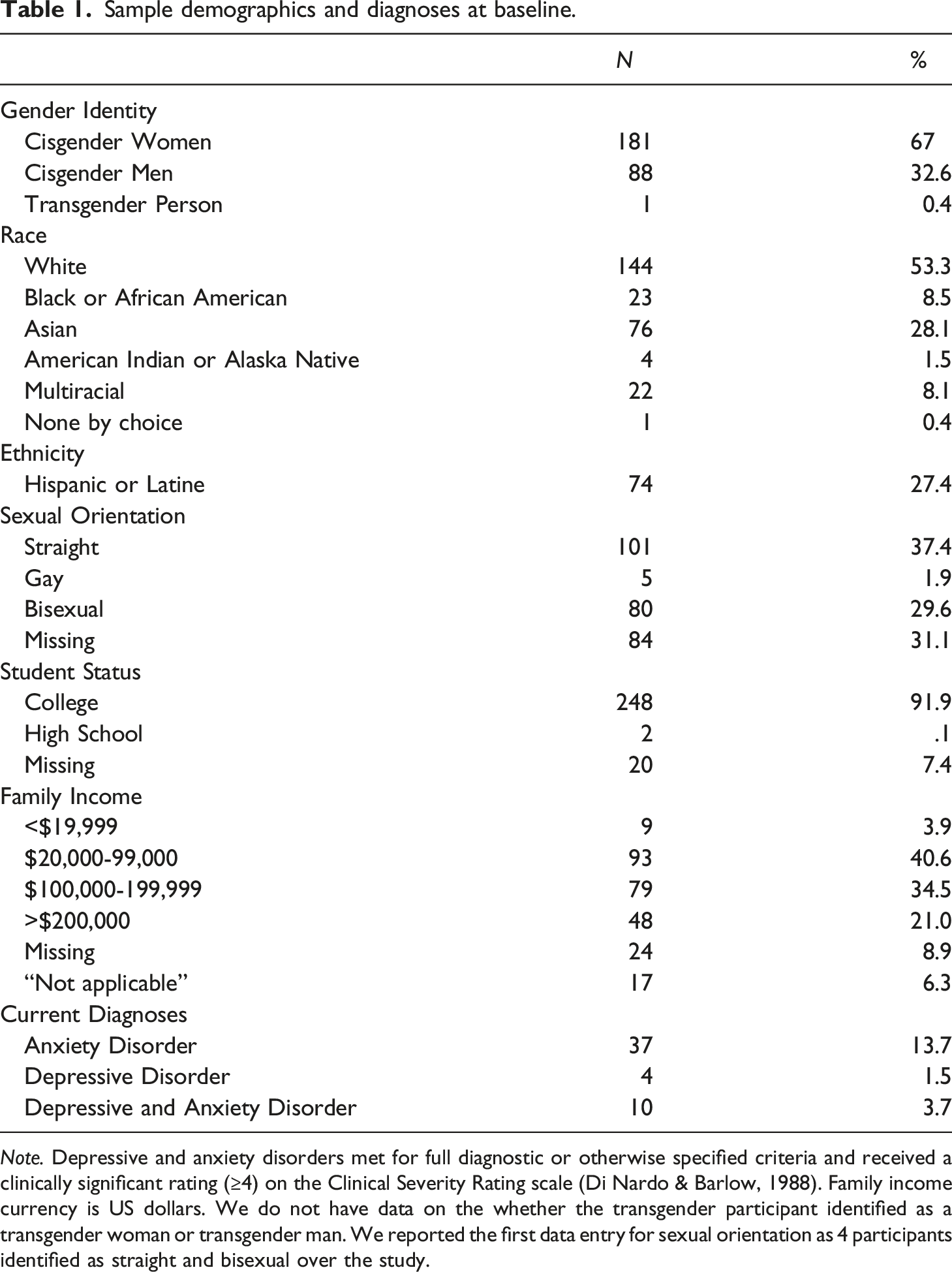
Note. Depressive and anxiety disorders met for full diagnostic or otherwise specified criteria and received a clinically significant rating (≥4) on the Clinical Severity Rating scale (Di Nardo & Barlow, 1988). Family income currency is US dollars. We do not have data on the whether the transgender participant identified as a transgender woman or transgender man. We reported the first data entry for sexual orientation as 4 participants identified as straight and bisexual over the study.
Participants were recruited based on self-reported trait Neuroticism as measured by a 12-item version of the Eysenck Personality Questionnaire-Neuroticism scale 1 (EPQ-N; Eysenck & Eysenck, 1975) and Reward Sensitivity as measured by the Behavioral Activation Sensitivity Scale (BASS) (Carver & White, 1994). Sampling procedures were designed to recruit participants from high/mid/low ranges on both scales, with oversampling from the two diagonals of the bivariate space defined by the quasi-orthogonal EPQ-N and BASS scales (i.e., high EPQ-N/high BASS, low EPQ-N/low BAS, mid EPQ-N/mid BAS, high EPQ-N/low BASS and low EPQ-N/high BASS). This sampling method was employed because the parent study aimed to examine positive and negative valence systems and understand factors related to psychopathology onset in a non-clinical sample. Other inclusion criteria were between 18-19 years old, right-handed (for neuroimaging), and English fluency. Exclusion criteria were a history of a DSM-5 criteria for lifetime diagnosis of bipolar disorder or psychotic disorder, or current, severe substance use disorder. We also excluded participants with a moderate or greater traumatic brain injury/neurological disorder, MRI contraindications, and color-blindness given that the parent study collected neuroimaging data (not reported in this paper).
Although the parent study was designed to use a dimensional approach to investigate broad symptom domains, diagnostic interviews were conducted for sample characterization. Participant diagnoses were assessed using the Structured Clinical Interview for Diagnostic and Statistical Manual of Mental Disorders (5th ed.) (First et al., 2016). 18.9% of participants met for a current clinically significant depressive or anxiety disorder at T1. 2
Procedure
During a T1 laboratory assessment, participants provided informed consent and completed self-report measures and other behavioral and biological measures not included in this paper. Procedures were repeated at 10 (T2), 20 (T3), and 30 (T4) months. 3 All study procedures were approved by the UCLA (#13-001606) and Northwestern University (#STU00086226) IRBs.
Measures
Attachment security
Three items from the Measure of Attachment Qualities (MAQ; Carver, 1997) were used to measure levels of attachment security. This security subscale captures a “positive sense of benefitting from closeness in relationships” distinct from insecure attachment qualities and conceptualizes attachment security as “an appreciation of one’s relationship as a safe haven and a secure base for exploration” as opposed to a lack of insecurity (Carver, 1997). An example item on this subscale is “When I’m close to someone, it gives me a sense of comfort about life in general.” Participants were instructed to “rate the extent to which you believe each statement best describes your feelings about close relationships in general.” 4 Items are rated on a 7-point Likert scale ranging from 1 (strongly disagree) to 7 (strongly agree). The measure yields a dimensional measure of attachment security, with higher scores corresponding to greater levels of security. This measure has evidence of convergent validity (Carver, 1997; Segal et al., 2009) and acceptable internal reliability (Justo-Núñez et al., 2022; Segal et al., 2009). High interitem reliability was observed in our sample over time (Mα = .85).
Attachment-related avoidance and attachment-related anxiety
Levels of attachment-related avoidance and attachment-related anxiety were measured using the Relationships Structures questionnaire of the Experiences in Close Relationships–Relationships Structures (ECR-RS), which was designed to assess dimensions in multiple contexts as opposed to being relationship-specific (Fraley et al., 2011). Although this measure can be administered for separate targets, it can be used to assess general/global attachment with phrasing regarding close relationships in general (Fraley, 2014). This measure is a 9-item self-report questionnaire that assessed two subscales: attachment-related avoidance (6 items) and attachment-related anxiety (3 items). Participants were instructed to “rate the extent to which you believe each statement best describes your feelings about close relationships in general.” Items are rated on a 7-point Likert scale ranging from 1 (strongly disagree) to 7 (strongly agree). Higher scores correspond to greater levels of attachment-related avoidance and attachment-related anxiety. This measure has evidence of convergent validity and good internal reliability (Fraley et al., 2011). High interitem reliability was observed in our sample over time (attachment-related avoidance: Mα = .87; attachment-related anxiety: Mα = .89).
Emotion regulation
The Emotion Regulation Questionnaire (ERQ; Gross & John, 2003) contains 10 items assessing one’s tendency to use reappraisal (6 items) and suppression (4 items). An example item on the reappraisal subscale is “I control my emotions by changing the way I think about a situation.” An example item on the suppression subscale is “I keep my emotions to myself.” Items are rated on a 7-point Likert scale ranging from 1 (strongly disagree) to 7 (strongly agree). Higher scores correspond to greater use of the strategy. Acceptable to high interitem reliability was observed in our sample over time (reappraisal: Mα = .85; suppression: Mα = .74). Research has demonstrated moderate heritability estimates of ERQ tendencies (McRae et al., 2017), used the ERQ to examine habitual use of these tendencies (e.g., Eldesouky & English, 2018), and demonstrated relative stability of ERQ tendencies following adolescence (Sai et al., 2016).
Symptoms of anxiety and depression
Symptoms of anxiety and depression were measured in a dimensional framework, termed “tri-level factor scores.” Tri-level factor scores were previously developed using Confirmatory Factor Analysis (CFA) from self-report symptom items using Mplus version 5 (Muthén & Muthén, 1998-2007). This analysis identified a “broad” factor, General Distress (GD), which taps symptoms common to all depressive and anxiety disorders (Naragon-Gainey et al., 2016; Prenoveau et al., 2010). Prenoveau et al. (2010) contains model specification details.
The self-report measures that provided symptom items used in previous CFA analyses can be found in Supplemental Material. GD was loaded on most highly by items related to social fears and depression symptoms (e.g., restlessness, motor retardation). Scalar invariant factor scores were used in the present analyses for follow-up timepoints. 5
Data analysis
We examined cross-sectional associations among study variables by calculating Pearson correlations in SPSS, Version 28 (IBM Corp). To address hypotheses, we examined associations among attachment orientations, reappraisal, suppression, and GD across four timepoints in a cross-lagged panel model (CLPM; Campbell, 1963; Kenny, 1975). The present study’s CLPM analyses were conducted using Mplus version 8 (Muthén & Muthén, 2012-2022). This approach is recognized as an approach to mediation analyses using longitudinal data (Selig & Preacher, 2009) and allows for modeling prospective relationships and maintaining temporal precedence. To examine (1) the effect of attachment orientation on GD through reappraisal and (2) the effect of attachment orientation on GD through suppression simultaneously, multiple mediation analyses were performed to examine one indirect effect conditional on the presence of another mediator in the model (Preacher & Hayes, 2008).
Model selection was performed in a series of steps (see Figure 1 for model and Supplementary Table 1 for fit statistics of tested models). First, we estimated saturated models (i.e., all possible paths, freely estimated). Next, we tested stationarity for relationships across time because it is believed that the degree to which one construct relates to another construct remains the same over time (Cole & Maxwell, 2003). The regression coefficients for which we tested the stationarity (i.e., constrained to the same value at each wave) were: autoregressive paths within each construct from T to T+1 and T+2, paths from attachment security (T) to other constructs (T+1), paths from attachment-related avoidance (T) to other constructs (T+1 and T+2), paths from attachment-related anxiety (T) to other constructs (T+1), paths from reappraisal (T) to other constructs (T+1 and T+2), paths from suppression (T) to other constructs (T+1 and T+2), paths from the GD (T) to other constructs (T+1 and T+2), and ethnicity effects. We also tested the stationarity assumption for residual covariances. We freed constraints in the case that the stationarity assumption was violated. For a more parsimonious model (i.e., estimating fewer parameters), we removed lagged paths between constructs at time T to T+3 as well as different constructs T to T+2 that were not needed for indirect effect estimation. Model selection stopped when removing any lagged path between same constructs at time T to T+2 introduced misfit. We examined Chi-square tests of model fit (with non-significance of test indicating good fit) and fit indices using conventional cut-offs (RMSEA ≤ .06, SRMR ≤ .08, CFI ≥ .95; Hooper et al., 2008). Supplementary Table 1 contains fit statistics for tested models. Tested CLPM. Note. GD = General Distress. Black lines informed direct and indirect effects in the mediation test. Ethnicity on GD paths and paths between different constructs (T→T+2) are not included other than AttachmentT→GDT+2 for simplicity purposes.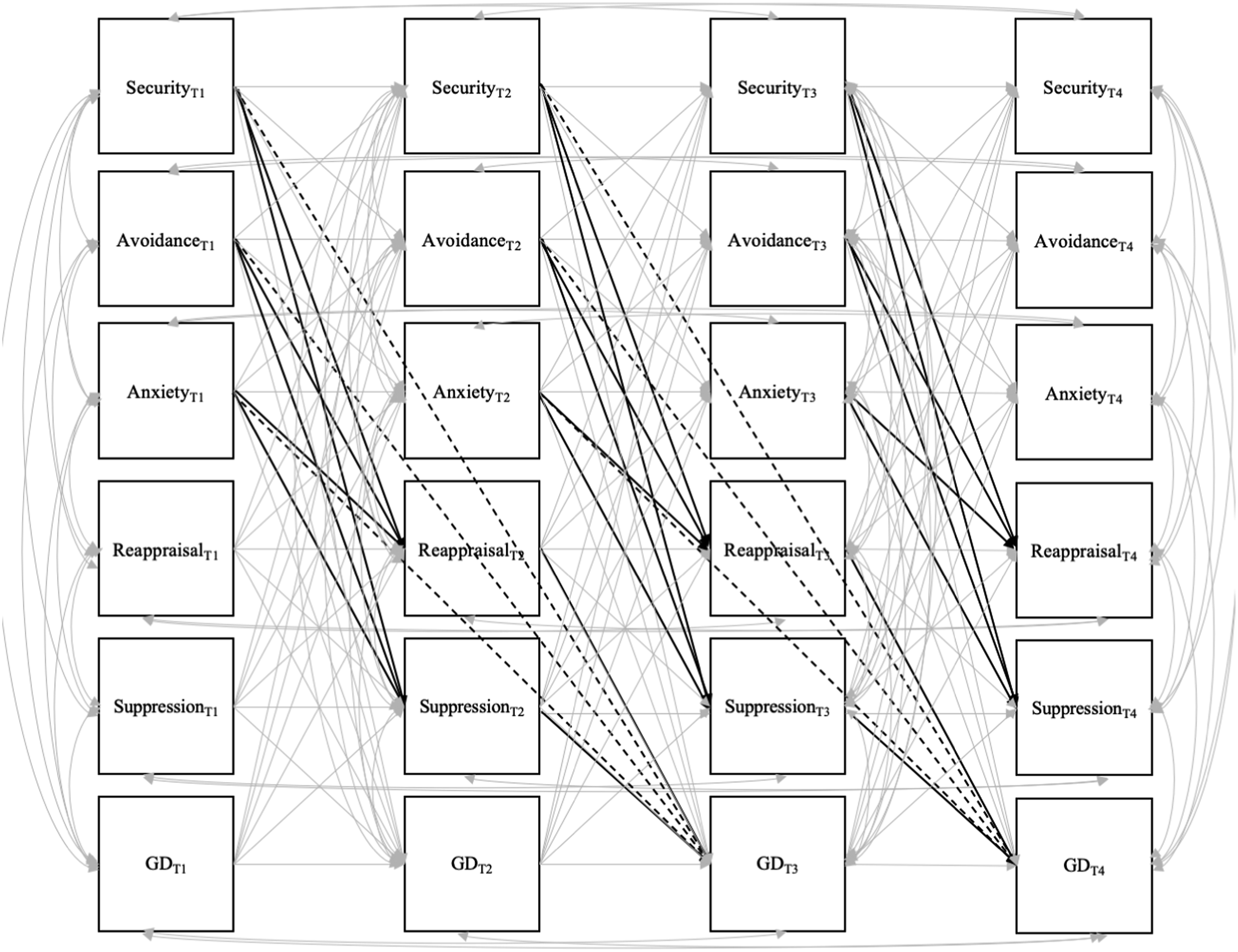
Of note, CLPMs were chosen over more recent advances to this analytic approach that separate the within-person and between-person components (i.e., random intercept CLPM; RI-CLPM; Hamaker et al., 2015) because of theoretical and empirical reasons. Theoretically, because of our interest in predicting changes in trait-like constructs (i.e., adult attachment orientations) that are not specific occasion fluctuations, CLPM was preferred. 6 RI-CLPM captures between-person variance using random intercepts and prospective effects focus on within-person effects. Thus, a between-person process is better tested by the CLPM (Orth et al., 2021). Empirically, the RI-CLPM requires estimation of more parameters compared to the CLPM. Given our sample size and time points, the CLPM was preferred.
The indirect effects of attachment orientations (T) predicting GD (T+2) were calculated using MODEL INDIRECT. The bootstrapped method (1,000 iterations) was employed (Cheung & Lau, 2008). Full information maximum likelihood addressed missing data (T1: 4.1%, T2: 12.6%, T3: 13.7%, T4: 44.4%). 7 We examined associations with focal variables at baseline (attachment orientations, reappraisal, suppression, GD) and demographics (race, gender identity, ethnicity) with a missing data variable (computed by dichotomously coding focal variable data) at each timepoint. Logistic regression analyses tested Missing Completely at Random (MCAR)/haphazard missingness in which aforementioned variables were regressed on the missing data variable. The significance level for analyses was p < .05. CLPM effect size benchmarks provided by Orth et al. (2022) were used: .03 (small effect), .07 (medium effect), and .12 (large effect).
Results
Descriptive statistics
Descriptive statistics and bivariate correlations.
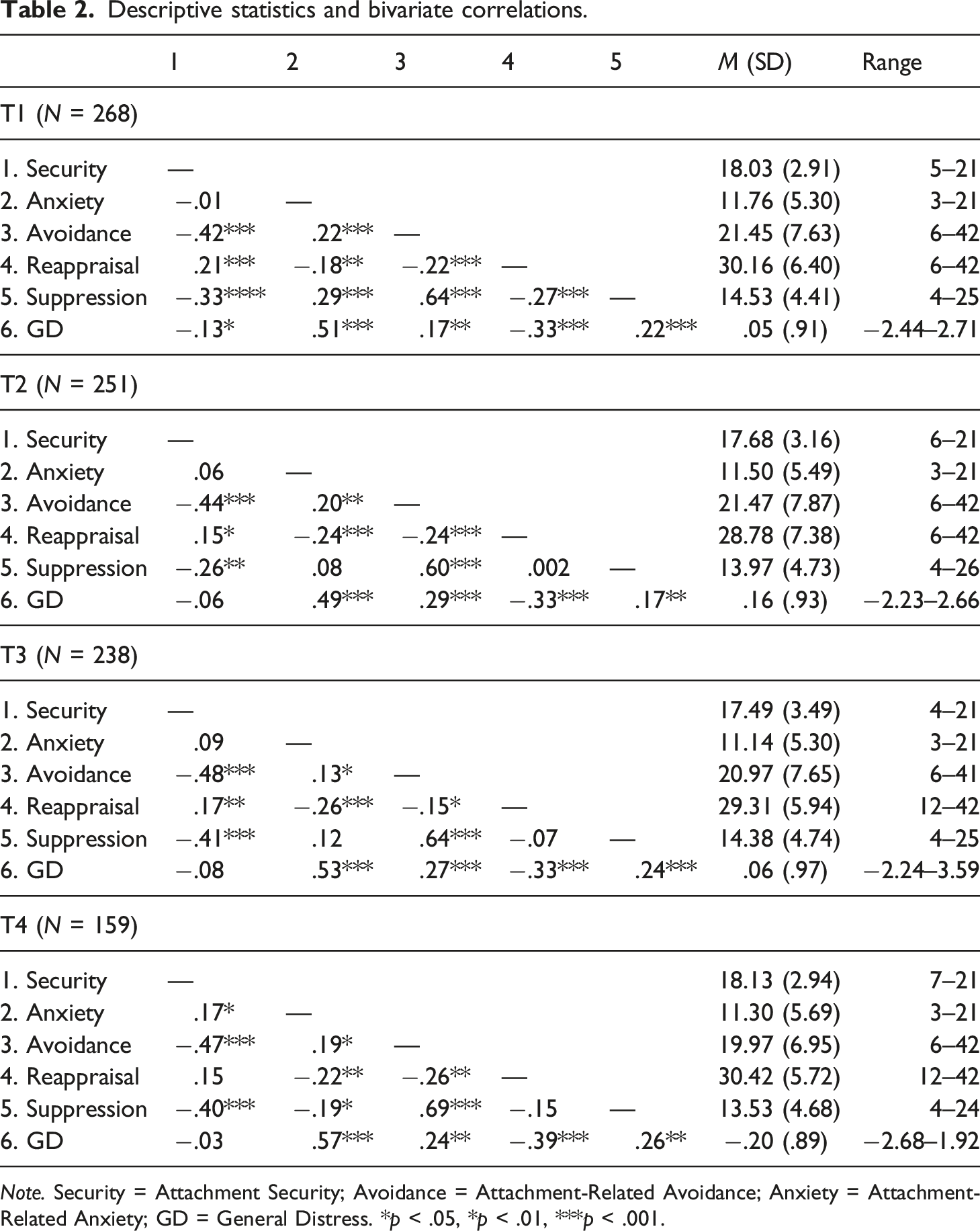
Note. Security = Attachment Security; Avoidance = Attachment-Related Avoidance; Anxiety = Attachment-Related Anxiety; GD = General Distress. *p < .05, *p < .01, ***p < .001.
Cross-sectional associations
Attachment and emotion regulation
There was a small, positive effect of attachment security on reappraisal (T1-T3 only) and a small-to-moderate, negative effect of attachment security on suppression. There was a small, negative effect of attachment-related anxiety on reappraisal and a small, positive effect of attachment-related anxiety on suppression. There was a small, negative effect of attachment-related avoidance on reappraisal and a moderate, positive effect of attachment-related avoidance on suppression.
Attachment and general distress
Attachment security was not significantly correlated with GD other than a small, negative effect of attachment security on GD at T1. Attachment-related anxiety had a moderate, positive effect on GD and attachment-related avoidance had a small, positive effect on GD across timepoints.
Emotion Regulation and GD
There was a small-to-moderate, negative effect of reappraisal on GD and a small, positive effect of suppression on GD (Table 2).
Missing data analysis
Race, gender identity, T1 reappraisal, and T1 suppression did not predict missingness (ps > .11). T1 attachment security predicted missingness in T2 attachment-related anxiety (b = −.14, p = .035), T2 attachment-related avoidance (b = −.14, p = .032), T2 suppression (b = −.16, p = .018), and T2 GD (b = −.17, p = .015). T1 GD predicted missingness in T4 attachment-related anxiety (b = .30, p = .035), T4 attachment-related avoidance (b = .30, p = .035), T4 suppression (b = .29, p = .036), and T4 GD (b = .34, p = .015). Ethnicity predicted missingness of T4 GD (b = −.68, p = .021). Given that baseline GD and attachment security were already incorporated into the CLPM, we added the effect of ethnicity 8 on GD given that it predicted GD missingness.
Cross-lagged panel model results
Cross-lagged panel model results.
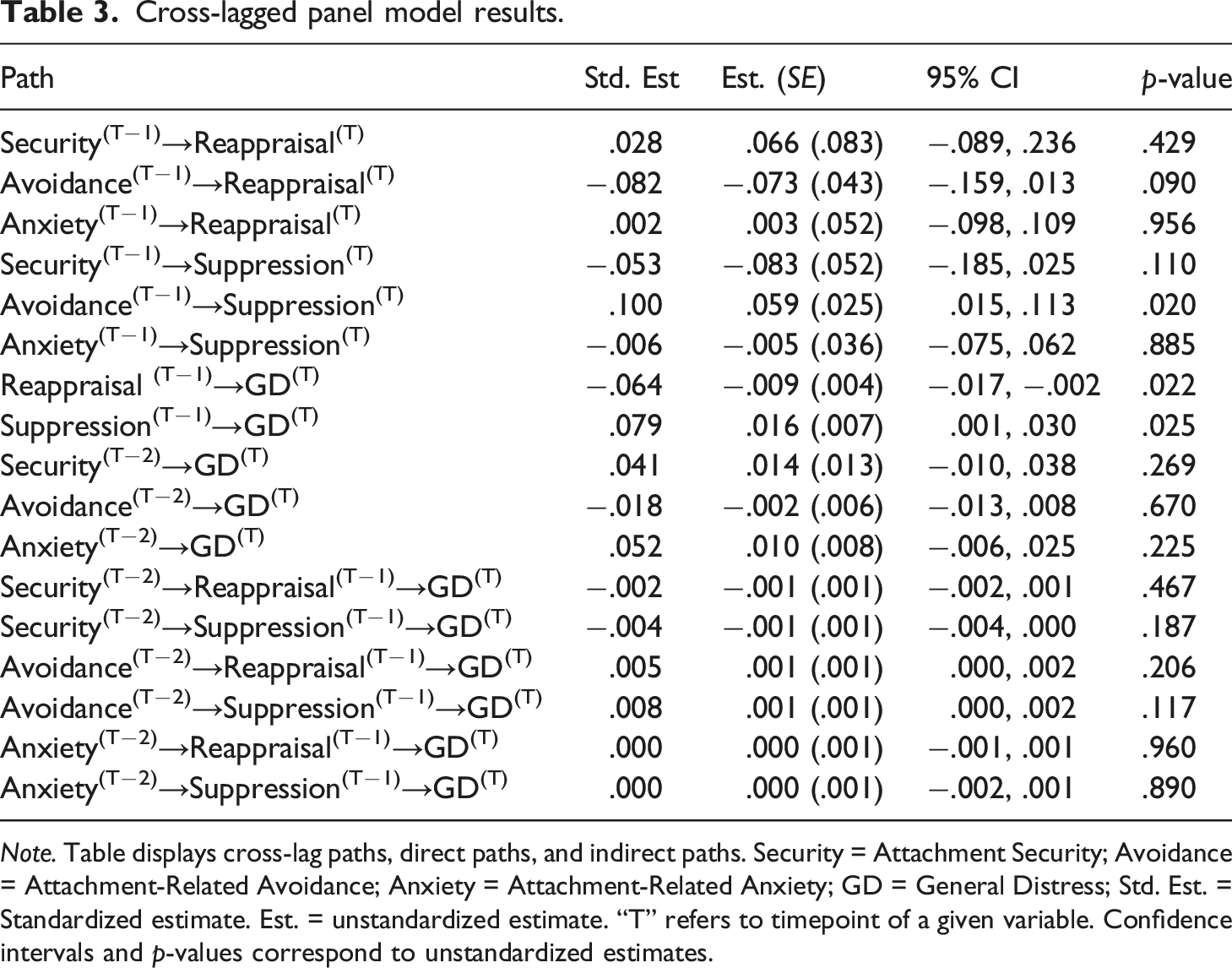
Note. Table displays cross-lag paths, direct paths, and indirect paths. Security = Attachment Security; Avoidance = Attachment-Related Avoidance; Anxiety = Attachment-Related Anxiety; GD = General Distress; Std. Est. = Standardized estimate. Est. = unstandardized estimate. “T” refers to timepoint of a given variable. Confidence intervals and p-values correspond to unstandardized estimates.
Effects of attachment orientation on emotion regulation
The effects of attachment security on reappraisal and suppression were both non-significant. The effect of attachment-related avoidance on reappraisal was nonsignificant. There was a medium-large, positive effect of attachment-related avoidance on suppression. The effects of attachment-related anxiety on subsequent reappraisal and suppression were both non-significant.
Effects of emotion regulation on general distress
There was a medium, negative effect of reappraisal on GD and a medium, positive effect of suppression on GD.
Effects of attachment orientations on general distress
The direct and indirect effects of all attachment orientations on GD 20 months later were non-significant (Figure 2). Results Summary. (a), (b). Note. (a) Contains a, b, and c (indirect) paths for mediation. (b) Contains c’ (direct) paths for mediation. GD = General Distress. Standardized estimates are presented. *p < .05.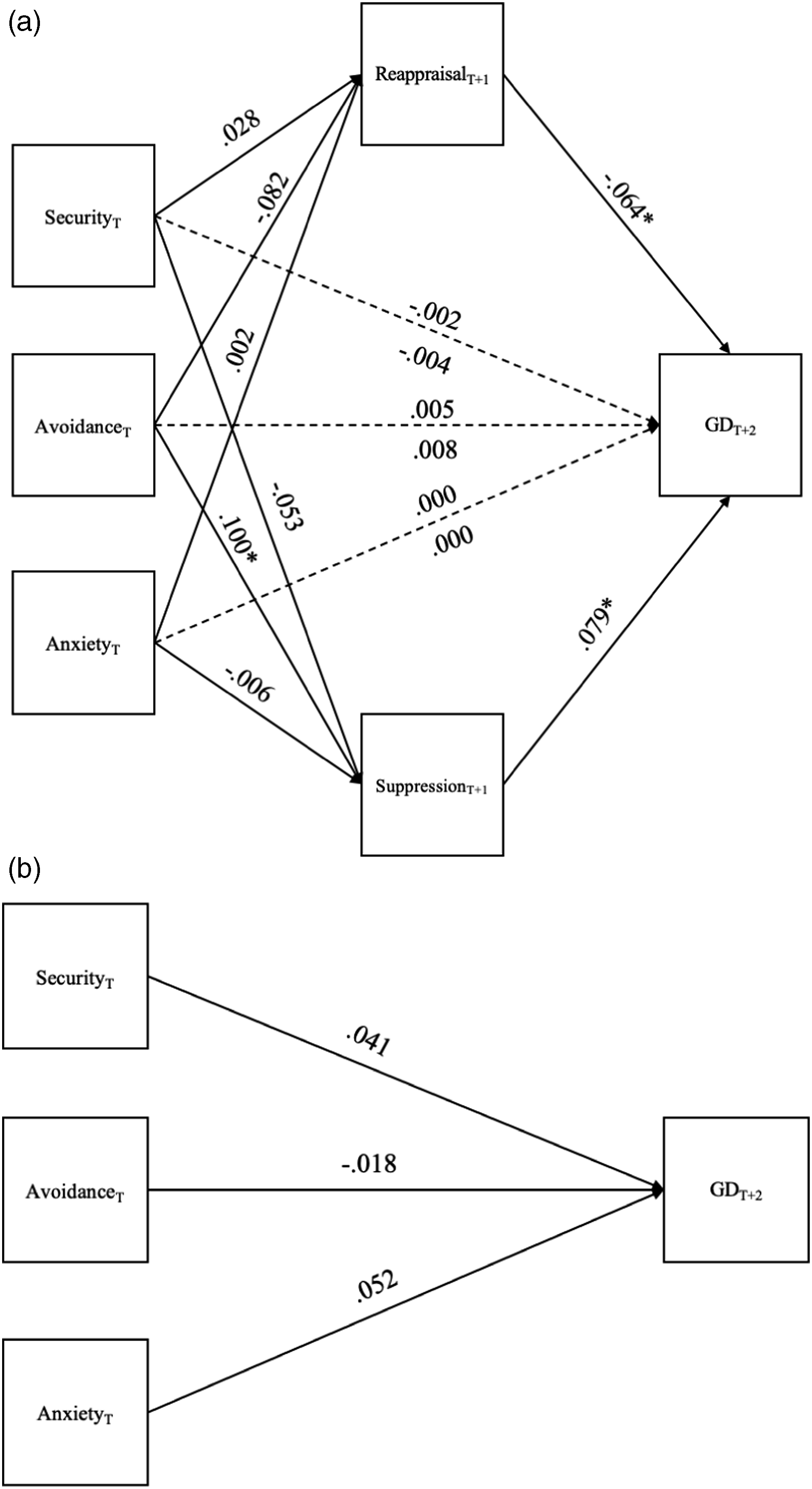
Discussion
Our study’s results provide support for cross-sectional associations among attachment orientations, emotion-regulation tendencies, and general distress. However, 30-month longitudinal analyses indicated that of the three attachment orientations examined, only attachment-related avoidance positively predicted suppression 10 months later over and above effects of previous suppression, reappraisal, other attachment orientations, and transdiagnostic anxiety and depression symptoms. In addition, both higher reappraisal and lower suppression predicted lower transdiagnostic anxiety and depression symptoms 10 months later. Tendency to suppress emotional expression therefore seems to be impacted by attachment orientation as well as a predictor of higher future general distress. Also, how one tends to employ reappraisal to modify their emotional experience predicts lower future transdiagnostic anxiety and depression symptoms. There were no unique effects of attachment security or attachment-related anxiety on emotion regulation tendencies or general distress observed.
First, cross-sectional evidence from correlation analyses demonstrated associations among attachment security, attachment-related avoidance, attachment-related anxiety, emotion regulation, and symptomatology in the expected directions and consistent with those demonstrated in the literature (e.g., Cooper et al., 1998; Marganska et al., 2013; Shorey & Snyder, 2006). Our results suggest that how one currently experiences their close relationships relates to their concurrent tendencies to employ distinct emotion regulation strategies and their current levels of general distress. However, this pattern of results highlights the discrepancy between associations found in cross-sectional work (e.g., Karreman & Vingerhoets, 2012; Lewczuk et al., 2021; Marganska et al., 2013; Nielsen et al., 2017) and longitudinal work that may provide evidence regarding causal claims.
Regarding evidence of longitudinal associations, our findings suggest that higher attachment-related avoidance is uniquely associated with emotion regulation, providing evidence to support interpersonal influence within adult attachment relationships on emotion regulation tendencies (Mikulincer et al., 2003; Thompson, 1994). The pattern of results regarding suppression is also consistent with research demonstrating positive associations between attachment-related avoidance and suppression (Karreman & Vingerhoets, 2012) as well as attachment-related avoidance and emotion dysregulation (e.g., Lewczuk et al., 2021; Marganska et al., 2013). Our findings add to previous research by demonstrating that the effect of attachment-related avoidance on suppression persists and is robust when examined longitudinally, underscoring the predictive ability of attachment-related avoidance in terms of how one may inhibit emotional expression. In addition, given that we accounted for variances of reappraisal, attachment security, and attachment-related anxiety in the same model, our findings are unique to attachment-related avoidance and suppression.
In contrast, we did not find support for longitudinal associations among attachment security and attachment-related anxiety and subsequent tendencies to employ emotion regulation strategies. These results are out of line with previous cross-sectional research on these attachment orientations and emotion regulation (Karreman & Vingerhoets, 2012; Nielsen et al., 2017). This pattern of results may be due to employing a more rigorous analytic approach (i.e., prospective associations; accounting for all attachment orientations, suppression, and symptom variances). It is also possible that attachment security and attachment-related anxiety relate to other intrapersonal emotion regulation strategies (e.g., acceptance; avoidance; Aldao et al., 2010), emotion regulation ability (i.e., overarching way individuals respond to emotions) as opposed to a micro-level strategy (i.e., a specific strategy like reappraisal or suppression used in any given moment) (Gratz et al., 2018), or interpersonal emotion regulation (Zaki & Williams, 2013). Nevertheless, our findings add more nuance to existing research such that the influence of attachment orientations may be more specific to how individuals tend to express their emotional experience.
In addition, findings from all tested models demonstrate prospective relationships between emotion regulation tendencies and shared symptoms of depression and anxiety. As such, we add to existing cross-sectional (e.g., Mutz et al., 2017; Tran & Rimes, 2017) and limited longitudinal (e.g., Brewer et al., 2016; Hu et al., 2014; Riepenhausen et al., 2022; Romero-Moreno et al., 2012) evidence demonstrating that emotion regulation strategies predict symptoms and diagnoses. Our findings suggesting that emotion regulation tendencies predict symptoms of depression and anxiety provide support for predictors of broad distress, which expands the relevance of emotion regulation tendencies beyond a given set of symptoms or diagnoses. Given the high co-occurrence of depression and anxiety (Kessler et al., 2012), taking a dimensional perspective affords advantages in the study and treatment of these disorders (Kircanski et al., 2017). Our results improve understanding regarding prospective associations between emotion regulation tendencies and distress associated with both depression and anxiety.
We failed to find evidence for significant direct or indirect effects of attachment orientations on symptoms of depression and anxiety. Therefore, how one relates to important people in their lives seems to have little bearing on one’s future broader distress when accounting for prior symptom levels, emotion regulation tendencies, and other attachment orientation levels. Previous cross-sectional evidence indicated that undergraduates who had higher levels of attachment security experienced less severe depression and anxiety symptoms, which coincided with less emotion dysregulation (Marganska et al., 2013). There is also cross-sectional evidence to support the claim that those with higher levels of attachment insecurity experienced higher symptoms of depression and anxiety and more emotion dysregulation (Marganska et al., 2013; Nielsen et al., 2017). However, our results suggest that the effects of adult attachment orientation on general distress may not be causal and is likely small. It is also possible that we were underpowered to detect these particular associations. Because of this, more longitudinal work with a bigger sample and lower attrition is necessary. Apart from the fact that our analysis was a more rigorous test of prospective relationships, our results may also be due to our self-report measures of attachment orientations with few items to capture complex constructs. Nevertheless, future research should incorporate interview-based or behavioral measures (e.g., Current Relationship Interview; Secure Base Scoring System; Crowell et al., 2002) or include several measures of attachment orientations (e.g., Relationships Style Questionnaire; Griffin & Bartholomew, 1994).
The present findings have potential clinical implications, including those related to the effects observed for emotion regulation tendencies on future general distress. Whereas many cognitive behavioral therapies incorporate reappraisal strategies, our results further suggest that attending to suppression as a response to one’s emotions may also be important to lessening symptoms shared by depression and anxiety. Emphasis could be given to psychoeducation on consequences of inhibiting emotional expression and practicing emotional expression in vivo to lessen symptom severity. In addition to the symptom consequences of suppression, there are also notable social consequences (e.g., lack of comfort and closeness in interactions; Dryman & Heimberg, 2018; Gross & John, 2003). Consequently, individuals who suppress emotions may be less likely to engage their social resources and experience the benefits from social support. The notable consequences of suppression render it a meaningful clinical target that could also have a broader functional impact. In addition, adult attachment orientations may be informative for treatment planning (Shorey & Snyder, 2006). Given the medium-large effect size observed for the relationship between attachment-related avoidance and suppression in the present study, interventions that target avoidance of closeness, connection, and openness with emotions may decrease inhibiting emotional experiences.
Our findings should be considered with several limitations in mind. First, we relied on self-report measurement to assess our constructs and common method variance may inflate these associations as a result (Klein et al., 2011). We also studied these associations in a nonclinical young adult sample who had a narrow age range and higher family incomes on average. Regarding the unique sampling procedures (i.e., oversampling on the two diagonals of the bivariate space defined by neuroticism and reward sensitivity levels), the sample does not represent a known population (Zinbarg et al., 2023). These sampling characteristics make it unclear how these results may generalize to clinical samples, other age groups, non-clinical samples without unique sampling procedures, or lower socioeconomic status samples. In addition, we examined general distress shared by depression and anxiety as an outcome, because of interest in risk associated with these associations relevant to general distress. Nevertheless, despite evidence demonstrating strong effects of suppression in social anxiety (Dryman & Heimberg, 2018), our dimensional tri-level model does not allow for comparison of specific diagnoses.
Notably, we considered tendencies to use emotion regulation strategies in the present study, which is distinct from one’s capacity to implement such strategies (Gross 2015; Lewis et al., 2010). Therefore, the pattern of our findings may not inform associations among adult attachment orientations, emotion regulation strategy implementation, and subsequent symptoms. In addition, the present study investigated emotion regulation regardless of a specific emotion type, overlooking the fact that individual differences in emotion regulation associated with attachment can be emotion-specific (e.g., Brenning & Braet, 2013). Separately, the tendency to engage in regulatory strategies are simplistically viewed as maladaptive or adaptive, overlooking the influence of context (e.g., life stress) and the idea that there are some contexts in which suppression may be useful and some situations in which reappraisal may be less efficacious (Bonanno & Burton, 2013). Relatedly, we were not adequately powered to create subgroups (e.g., Asian vs. other racial groups; collectivist vs. individualistic cultural values), nor did we collect measures to appropriately address the question of cultural differences in these associations. However, there is research demonstrating suppression may be normative for individuals of Asian descent due to values of interdependence and harmony (Sun & Lau, 2018). Future work on how adult attachment orientation influence emotion regulation should consider the roles of contextual factors and culture. Lastly, we did not collect demographic data on disability status. This data should be collected in future studies to examine this variable may influence the studied associations.
In sum, our findings underscore the value of attending to adult attachment orientations and emotion regulation tendencies. Specifically, results suggest that the more avoidance of closeness, comfort, and openness of emotions individuals experience in close adult relationships, the more individuals tend to respond to their emotions in a way that discourages their expression. In addition, responding to emotions to reduce negative impact or encourage expression predicts less severe transdiagnostic anxiety and depression symptoms prospectively.
Supplemental Material
Supplemental Material - Longitudinal associations among adult attachment orientations, emotion regulation tendencies, and transdiagnostic anxiety and depression symptoms in young adults
Supplemental Material for Longitudinal associations among adult attachment orientations, emotion regulation tendencies, and transdiagnostic anxiety and depression symptoms in young adults by Allison V. Metts, Richard E. Zinbarg, Robin Nusslock, Benjamin A. Tabak and Michelle G. Craske in Journal of Social and Personal Relationships.
Footnotes
Declaration of conflicting interests
The author(s) declared the following potential conflicts of interest with respect to the research, authorship, and/or publication of this article: Dr. Craske has editorial positions and receives royalties from Behaviour Research and Therapy (Editor-in-Chief) and for UpToDate (Author). She has also received research support from NIMH. No other authors have any conflicts of interest to report.
Funding
The author(s) disclosed receipt of the following financial support for the research, authorship, and/or publication of this article: This study is supported by National Institute of Mental Health (R01 MH100117-01).
Open research statement
As part of IARR's encouragement of open research practices, the author(s) have provided the following information: This research was not pre-registered. The data used in the research can be publicly posted. The data can be obtained at:  . The materials used in the research can be publicly posted. The materials (i.e., code) can be obtained at: https://osf.io/hfkrj/?view_only=6251d1db6e6248929af8d889699d51b6. Any other materials can be obtained by emailing:
Supplemental Material
Supplemental material for this article is available online.
Notes
References
Supplementary Material
Please find the following supplemental material available below.
For Open Access articles published under a Creative Commons License, all supplemental material carries the same license as the article it is associated with.
For non-Open Access articles published, all supplemental material carries a non-exclusive license, and permission requests for re-use of supplemental material or any part of supplemental material shall be sent directly to the copyright owner as specified in the copyright notice associated with the article.
