



Abstract
Political campaigns’ use of digital technologies has been a topic of scholarly concern for over two decades, but most studies have been focused on analyzing the use of digital platforms without considering contextual factors of the race, like public opinion polls. Opinion polls are an important information source for citizens and candidates and provide the latter with information that might drive strategic communication. In this article, we explore the relationship between the use of social media in the 2016 US presidential elections and candidates’ standing in public opinion polls, focusing on the surfacing and primary stages of the campaign. We use automated content analysis to categorize social media posts from all 21 Republican and Democratic candidates. Results indicate that a candidate’s performance in the polls drives certain communicative strategies, such as the use of messages of attacks and advocacy, as well as the focus on personal image.
Introduction
Presidential political campaigns now routinely and actively use digital media to reach, engage, and mobilize voters (Bimber & Davis, 2003; Foot & Schneider, 2006; Kreiss, 2012; Stromer-Galley, 2014). The affordances of social media enable rapid response, cultivating communities of supporters and pushing their agenda onto the national stage (Kreiss, 2012; Stromer-Galley, 2014). In the 2016 presidential elections, social media played a crucial role in enabling candidates to target their audiences (Kreiss & McGregor, 2017). With over 79% of US adults on Facebook (Greenwood, Perrin, & Duggan, 2016) and roughly two-thirds of Americans getting their news on social media (Shearer & Gottfried, 2017), these platforms are central to campaigns’ communicative strategies.
Although research has focused on understanding how campaigns are using digital technologies, most studies examined how major party candidates use a single social media platform, typically Twitter (for a review, see Jungherr, 2016). Most candidates, however, are simultaneously active on multiple social media platforms (Vaccari & Nielsen, 2013). As these platforms cater to different demographics and have unique affordances (Bossetta, 2018; Greenwood, Perrin, & Duggan, 2016), candidates tailor their strategies to the platforms that they use (Stromer-Galley, 2014). This article aims at filling this gap by analyzing how the 21 Republican and Democratic candidates in the 2016 US elections used Facebook and Twitter during the surfacing and primary stages. Specifically, we focus on comparing the types of messages shared by candidates in these two platforms to understand the role different social media platforms play in the campaigns’ communicative strategies. Moreover, few studies have considered how contextual factors, such as a candidate’s performance in the race, might influence social media activity (Druckman, Kifer, & Parkin, 2009; Rossini et al., 2018).
Few studies examine the primaries; instead, most focus on the general election period. As such, these studies are generally limited to the observation of a small number of viable campaigns. We take a different approach by considering both the surfacing and primary stages, when candidates are campaigning for the party nomination. This allows us to study a major larger set of presidential candidates: 21. In the highly competitive 2016 presidential nomination race, we examine the changing dynamics of social media use as candidates become more or less viable, indicated by their position in the polls.
Our results suggest a relationship between a candidate’s performance in public opinion polls and the types of messages they post on social media, specifically that those who are performing better in the polls are more active on both Facebook and Twitter and more likely to use these platforms to attack opponents and to advocate for themselves. We also observe that time is another important factor, as candidates tend to rely more heavily on social media to engage supporters as the vote nears. Finally, our study also demonstrates that Twitter and Facebook are used in different ways; candidates are more likely to use Twitter than Facebook as the platform to attack their opponents and to post persuasive messages focused on the issues, and Facebook is used more often for messages focused on personal traits. While these findings are limited to this specific dataset, we believe that future research needs to address the different uses of social media platforms to understand how contextual factors, including, but not limited to, public opinion polls, influence how campaigns use digital technologies for strategic advantage.
Political Campaigns in the Social Media Era
Political campaigns in the United States and across the world have been systematically adopting social media platforms, such as Facebook and Twitter, for strategic communication. These technologies afford campaigns with new and creative ways of reaching the public and crafting the right message for specific publics (Stromer-Galley, 2014). Social media platforms are also increasingly important sources of information for the public (Shearer & Gottfried, 2017). According to a recent study by Pew Internet Research public (Shearer & Gottfried, 2017), 79% of the American public are on Facebook and 76% of those access the service on a daily basis. Although Twitter has a penetration of 24% (Shearer & Gottfried, 2017), it is still a vital component for campaigns insofar as its public comprises traditional and digital news media, political analysts, politicians, and the general public. Much of the information generated by campaigns on Twitter makes its way to mainstream media channels, thus signaling its importance as a vehicle for strategic messaging in the hybrid media context (Chadwick, 2013).
Research has demonstrated that political campaigns adopt social media for strategic advantage and create an environment of controlled interactivity, which aims at engaging supporters online in ways that are beneficial for the campaigns instead of fostering genuine interactions with citizens (Stromer-Galley, 2014). They also adopt a broadcasting behavior by providing information directly to voters (Graham, Broersma, Hazelhoff, & van’t Haar, 2013). Yet, some scholars see social media as a game-changer for politicians to inform, recruit, and interact with citizens (Graham et al., 2013; Hendricks & Denton, 2010). Moreover, the role of technology firms in the US electoral process goes beyond what is often acknowledged (Kreiss & McGregor, 2017). While studies have largely focused on examining the ways campaigns adopt social media, Kreiss and McGregor’s research shows that technology companies have a far more active role in providing aid and guidance for campaigns to leverage their tools to reach and target particular voter demographics. These findings further confirm the central role of social media among the set of communication strategies available to presidential campaigns.
Party affiliation might influence the ways candidates use social media. For instance, research by Evans, Cordova, and Sipole (2014) found that third-party candidates are significantly more likely to attack than Republicans, and challengers tend to be more active than frontrunners on Twitter, as well as more likely to attack. Challengers are more likely to use Twitter somewhat more interactively (Evans et al., 2014; Jungherr, 2016). Although these differences suggest that candidates’ traits are important to shape social media use, Kreiss (2016) notes that both major parties in the United States have been heavily focusing on digital media to craft effective advertising strategies and make data-driven decisions about communicative strategies. As Stromer-Galley’s (2014) historical review of digital campaigns in the United States suggests, challengers tend to be more open to digital innovations and are more prone to use social media in creative ways.
While scholars have been scrutinizing digital campaigns for over two decades, few studies have looked at how candidates use multiple social media platforms. Most candidates, however, typically use several platforms during an electoral cycle, which reinforces the importance of understanding how differently (or similarly) platforms are used by campaigns (Vaccari & Nielsen, 2013). In specific, Twitter has been the main focus of research on online campaigns in the past decade (Jungherr, 2016), with fewer studies focusing on Facebook (for exceptions, see Bode, 2012; Vaccari & Nielsen, 2013; Vitak et al., 2011). A literature review of political campaigning on Twitter suggests that the platform is mostly used for posting information about campaign activities and links to campaign websites, with few messages targeted at engaging or interacting with the public (Jungherr, 2016). The scholarly emphasis on Twitter can be explained by the fact that the platform is perceived as public in a way that Facebook is not (Bruns & Highfield, 2013; Larsson & Moe, 2013; Small, 2011). In addition, Twitter provides easier ways to collect public messages through its application programming interface (API) on specific topics, such as those indexed via hashtags (e.g., Papacharissi & de Fatima Oliveira, 2012). The few studies of politics on Facebook have focused more on how the platform may influence political participation—either through promoting “get out the vote” initiatives or through social capital (e.g., Bode, 2012; Settle et al., 2016; Vaccari & Nielsen, 2013; Vitak et al., 2011).
Scholarship on digital campaigning identifies some contextual factors that influence strategies. Competitiveness, for example, is related to distinct campaign behaviors: those in competitive races are significantly more likely to use social media to attack opponents and to engage supporters to act on behalf of the campaigns (Evans et al., 2014). Evans et al. also found that although Republicans and Democrats used Twitter in similar ways, Republican candidates are more likely to target the Democratic Party in negative messages.
Considering that the context of the race is likely to influence the ways candidates communicate on social media, this study analyzes the impact of candidate’s polling performance on social media usage and particular communicative strategies. We also compare how candidates use Facebook and Twitter, given that different platforms enable candidates to target specific demographic groups and that platform affordances may shape the types of messages produced by campaigns. By comparing the differences and similarities in how candidates use different social media platforms to communicate with the electorate, this study aims at contributing to a better understanding of how campaigns leverage the hybrid media system for strategic advantage (Chadwick, 2013).
Elections and Public Opinion Polls
Little attention has been given to the relationship between social media use and a campaign’s contextual factors, such as a candidate’s position in public opinion polls (for exceptions, Rossini, Baptista, Oliveira, & Sampaio, 2015; Rossini et al., 2018). Polls, however, are important information resources to voters and to politicians. To the former, public opinion polls provide information about a candidate’s performance and may inform the vote insofar as they are largely covered by the media (Lau & Redlawsk, 2006). To the latter, polls provide relevant feedback on whether campaign messages are effectively reaching voters.
Public opinion polls are also important predictors of the amount and tenor of news coverage, as candidates who are leading the race are more prominently covered by the media (Farnsworth & Lichter, 2007). Polling numbers may also affect a candidate’s ability to fundraise, and money is the lifeblood of the campaign that enables the whole operation to thrive or to die (Denton, 1998). Prior research on mass-mediated campaigning has demonstrated that a candidate’s position in the polls affects communication strategies (Jamieson, 1993, 1996; Kaid & Johnston, 1991); as races become more competitive, candidates are more likely to go more negative and attack more (Belt, Buell, & Sigelman, 2009; Hassell & Oeltjenbruns, 2016; Lau & Pomper, 2004).
Although several studies have explored the relationship between polling performance and campaigns’ communicative strategies using mass media, the effect of polls on candidates’ strategic communication on social media has not been sufficiently explored. One exception is an analysis of 2014 gubernatorial campaign general election social media messages by Rossini et al. (2018), which found that candidates who are behind in the polls are more likely to be more active on social media, more likely to call supporters to action, and to use their social media to persuade voters. They also found that candidates who are behind are more likely to attack than those leading in the polls. A study of 2012 congressional campaigns’ social media similarly found that race competitiveness is a predictor of negative messages and calls to action (CTA; Evans et al., 2014). Similarly, research on 2008 congressional campaign websites found that challengers who are trailing in public opinion polls have a tendency to be more negative, while incumbents who are leading the race are less likely to use their campaign websites to attack (Druckman et al., 2009).
Prior research suggests that political party affiliation is relevant to predict social media usage. In the 2014 gubernatorial elections, for instance, Republican candidates were more active on Facebook, and Democratic candidates relied more heavily on Twitter (Rossini et al., 2018). Research looking at presidential elections over time has suggested that Democrats are more likely to use social media in innovative ways, emphasizing campaigns such as Howard Dean’s in 2014 and Barack Obama’s in 2008 and 2012 (Kreiss, 2012, 2016; Stromer-Galley, 2014). However, these studies tend to focus on the general election when there are fewer candidates overall and just one candidate per party. Our study presents a unique contribution by analyzing the surfacing and primary stages, when several candidates compete for their party nomination.
Based on the prior scholarship, we examine how standing in public opinion polls might influence the ways candidates use social media. First, we hypothesize the following:
H1. Candidates who are behind in public opinion polls are likely to be more active on social media than those who are leading the race.
H2. Candidates who are leading in public opinion polls are less likely to produce negative messages.
To explore the relationship between a candidate’s position in the polls and the message types used by presidential candidates on social media, this article also asks the following questions:
RQ1. Based on candidate standing in the polls, are there differences in how candidates use Twitter and Facebook?
RQ2. Does a candidate standing in the polls affect the volume of persuasive messages focused on image and issue?
RQ3. Does partisan affiliation influence the types of messages on social media?
Methods
To answer our research questions, we analyze a dataset comprising Twitter and Facebook messages produced by the US presidential campaigns competing for the nomination to run for president in the 2016 election. These messages were collected as the campaigns unfolded. These social media data were merged with national polling data covering the period of analysis from ABC News/Washington Post Topline database. Our analysis used regression modeling and reports standardized beta coefficients, allowing us to compare effect sizes of the model variables.
Social Media Data
We collected all the Twitter and Facebook posts made by politicians during the 2016 US presidential campaign and who were considered the most viable by the news media. The data cover the surfacing stage—that is, the early period when candidates are announcing their candidacy—and the primary stage of the election: from 1 June 2015 to 15 March 2016. We end our analysis in March because by this time period the number of viable candidacies for the party nomination had narrowed considerably, problematizing comparisons. The dataset includes 56,417 tweets and 26,658 Facebook posts, sent by 21 candidates: 5 Democrats and 16 Republicans. 1 When collecting social media data, researchers should be aware of the ethical implications of their methods and the potential harm to social media users. In this study, we follow the principles of ethical research proposed by the Association of Internet Researchers (AoIR) (Markham & Buchanan, 2012). The data collected for this research consist of public messages posted by candidates on Facebook and Twitter and were retrieved using public APIs provided by these platforms. As political candidates are public figures whose messages are constantly under the scrutiny of the public, we do not believe that this study causes harm to the candidates whose public messages were collected and analyzed.
Each tweet and Facebook post in the dataset includes one of the six main categories to represent candidate campaign messages: persuasive messages, CTA, informative messages (which are neutral messages that neither clearly call to act nor persuade), conversational messages (only for Twitter), ceremonial messages, and non-English messages. Persuasive messages have two subcategories, attack and advocacy, and can be focused on either image or issue. For this work, we focus on the message types CTA and Persuasive Messages (Attack, Advocacy) and distinguish between the Persuasive Message subcategories (Image, Issue). These categories were grounded in prior research on political campaign messages found on television (Jamieson, Waldman, & Sherr, 2000; Johnston & Kaid, 2002) and adapted and expanded to include the range of message types on social media.
Attack and Advocacy messages are subcategories of Persuasive messages and are focused on persuading voters by emphasizing desirable features about a candidate or by attacking opponents. Attacks messages are aimed at criticizing opponents, surrogates, or opposing an administration or party. Advocacy messages highlight a candidate’s positive traits or record. These messages can be focused on image or issue. Messages focused on image emphasize personality, character, and traits of a candidate, including family or surrogates. Issue messages are focused on policy proposals or a candidate’s stance on issues and topics of public concern.
CTA are messages aimed at urging the reader to act, including traditional means of engagement, such as volunteering or attending an event, or digital engagements, such as visiting a website or sharing a post, donating money, and voting.
In preparing the data, we trained coders to conduct a systematic content analysis on 4,355 tweets and 3,718 Facebook messages. We used Krippendorff’s alpha to measure intercoder agreement on a random sample of 648 messages and obtained alphas above .79 on the main categories, .77 agreement or above on the two types of persuasive messages (attack, advocacy), and .72 on focus of persuasive messages. A Krippendorff’s alpha of .70 or higher suggests a variable is reliable (Lombard, Snyder-Duch, & Bracken, 2002). Next, coders discussed and reconciled any disagreements to generate a gold standard dataset that was used to train automated classifiers and predict message categories for the remainder of the data. The adjudicated dataset comprised 1,575 CTA tweets and 2,780 Persuasive tweets (1,371 Image, 1,409 Issue, 809 Attack, and 1,971 Advocacy) and 2,058 CTA Facebook posts and 1,660 Persuasive posts (720 Image, 940 Issue, 586 Attack, and 1,074 Advocacy).
Using the Python package, Scikit-learn (Pedregosa et al., 2011), we used a Support Vector Machine (SVM) algorithm for tagging Twitter and Facebook data (Zhang et al., 2017). This algorithm uses supervised learning from the gold standard data and non-probabilistic methods to predict the classification of campaign-generated messages. We evaluated our models using the Micro-F1 scores, which is a weighted average of two measures: precision and recall. Precision measures how often machine-predicted message types align with human annotated judgments, and it is sensitive to false positives. Recall measures whether relevant human-coded message categories can be identified by the classifier, and it is vulnerable to false negatives. An F1 score of 1 represents perfect precision and recall. Contrariwise, a 0 would indicate totally incorrect precision and recall. Table 1 shows the scores of precision, recall, F1, and message frequency for the message types we use in this work.
Performance of Machine Learning Classifiers.

Public Opinion Polling Data
For polling data, we use ABC News/Washington Post Topline presidential data. We chose this source for two main reasons: first, the source is highly rated by specialists; second, this source conducted surveys more frequently than most during the early electoral cycle. We relied on poll rating information published on Nate Silver’s FiveThirtyEight.com blog for companies that conduct presidential polling at the national level. FiveThirtyEight.com rates pollsters based on their historical accuracy and methodology. ABC News/Washington Post had an A+ rating in the report published in August 2016, which refers to the poll’s performance during the early stages of the 2016 Presidential campaign. In addition, out of all A+ rated polling companies, ABC News/Washington Post conducted the most polls during the 2016 election cycle as of August 2016.
We collected data for 93 questions spanning 21 different ABC News/Washington Post 2016 Presidential polls released between 8 June 2014 and 7 August 2016. Questions told respondents the names of the candidates running for president and asked if the election were held today, who would they vote for. In this analysis, our variable of interest is candidates’ performance in these polls, indicated by voting intention and grouped by week.
Analysis
To explore the relationships between each type of message and a candidate’s performance in the polls, we use a regression model for each message type. Regression modeling allows us to examine the relationship between a single dependent variable and multiple independent variables. It also allows us to use simple autoregression time series techniques (Gujarati & Porter, 1992) to control for how a candidate’s behavior in a previous time period may be related to their behavior in a current period. That is, we would expect that candidates who tend to be more active will, all else equal, continue to be more active. As is typical with this type of regression, we include a control variable for the passage of time in models where it is found to be significant. In developing these models, we find that our dependent variables are not normally distributed, an assumption of standard ordinary least squares regression. Thus, we follow the suggestion of Faraway (2004) for count data and transform our dependent variable with a square root. We verify our independent variables are not overly correlated, another regression assumption, using variance inflation factor (VIF) and use diagnostic plots to verify our residuals are roughly normally distributed and that the models do not suffer from autocorrelation (correlated residuals) and heteroscedasticity (non-constant variance) 2 (Faraway, 2004).
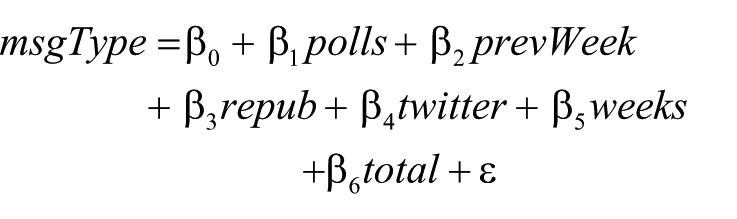
The dependent variable for each model is the number of messages of the given message type for a given candidate for a given week for a given platform. Each observation, or row of data, is a specific candidate’s number of, for example, attack messages, for a specific week on either Twitter or Facebook. Thus, we have multiple rows for Hillary Clinton, one for each week for Twitter and one for each week for Facebook. The independent variable we are most interested in is the polling data, which is the candidate’s polling score from the previous week.
In addition to the variable for polling data, we include independent variables for the volume of messages in the previous week (referred to as prev. week in Table 2), party, platform, number of weeks until the election, and total number of messages (see equation below). The inclusion of the number of messages from the previous week controls for a specific candidate’s trend for a message type, while total number controls for their overall activity, as some candidates are more active than others. Similar to the dependent variable, we transform the previous week’s message count using a square root. Weeks till conventions is simply an integer and acts as a control variable for the passage of time. As we get closer to the Republican and Democratic conventions in July, the number decreases. Party is a dichotomous variable where Republican is 1 and Democrat is 0. Platform is another dichotomous variable that indicates whether the message was posted on Twitter (1) or Facebook (0). Note that the variable for weeks till conventions was not significant and did not significantly improve the models, except in the case of the model for CTA. Thus, for CTA we include a variable for weeks until the election, but it is dropped from the other models:
OLS Regressions for Each Message Type.

OLS: ordinary least squares.
Significance codes: 0 ‘***’ 0.001 ‘**’ 0.01 ‘*’ 0.05.
We note that we have “population data.” That is, we have all of the posts from all of the candidates over the timeframe of our study. Since our data are not a sample, p-values of estimated model parameters are suspect; thus, we also report confidence intervals. As is typical in such cases (Gorard, 2013), we report the standardized regression coefficients (i.e., betas), which allow us to compare effect size. For dichotomous variables, standardized coefficients are difficult to interpret since they rely on the standard deviation of the variable. Although we can use them to compare effect sizes between variables, they do not give us useful information about the specific effect size of our dichotomous variables. We also report R2 as an indicator of model fit and the degree to which it explains the observed variance in the data.
Results
Table 2 presents the results of the regression models. Each column represents a model and the first six rows show the coefficient estimated betas and confidence intervals (also standardized). The last rows show the R2 and F-statistic, which has 5 and 186 degrees of freedom for each model except CTA, which has 6 and 186. As indicated by the F-statistics, all models had a p-value equal to .000. Due to space requirements, we generally only show two decimal points.
The confidence interval for the polls variable in the first three models suggests that polling numbers affect the types of messages candidates produce on social media, a result that contradicts our hypothesis. Contrary to what prior research suggested, candidates who are performing better in the polls are the ones who are more likely to use social media. Results also demonstrate that the effect is greater on specific types of messages, which was the focus of our second hypothesis. Contrary to what we predicted, the results show that candidates who are leading the polls are not less likely to go negative than candidates who are trailing in the polls. In particular, the positive betas and significant relationships suggest that candidates who are polling higher in the polls are more likely to produce persuasive messages of both types—attack and advocacy—on social media. Note that attack messages have a slightly larger effect size. However, the effect of candidates’ polling performance does not appear to be related to the number of CTA messages posted by candidates.
Our first research question inquired about the relationship between a candidate’s polling numbers and the focus of their persuasive messages on image or issue. Candidates who are polling higher are more likely to focus on building their own image or on attacking opponents based on personal traits. In other words, there is a positive relationship between higher polling numbers and candidates posting more messages that positively highlight their personal qualities and traits and also attack opponents by emphasizing their negative personal characteristics. However, polling higher does not appear to affect the use of persuasive messages focused on issues.
Our second research question focused on platforms. The regression results suggest that candidates used social media platforms in different ways. Specifically, our results suggest that candidates are significantly more likely to use Twitter than Facebook to post nearly all message types, except for persuasive messages focused on image. Candidates tend to post a similar volume of image posts on both platforms. The largest effect size is negative for CTA, suggesting that candidates prefer to use Facebook over Twitter when they are trying to engage supporters to act.
Finally, our last research question focused on differences by party. To that end, our models suggest that political party only influences the use of two specific message types, with Republicans being more likely than Democrats to use persuasive messages focused on issues and also more likely to call their supporters to action. The use of CTA increases significantly as candidates moved closer toward the Republican and Democratic Primaries in July 2016, independent of party affiliation.
The control variable for weeks until the conventions was not significant in the models for attack, advocacy, image, and issue. This suggests that the ratio of messages sent out by candidates for these messages was fairly consistent over the period of election we looked at. Consistently across all models, the largest effect size was previous week, suggesting that candidates’ previous posting behavior was the best predictor for a current week when controlling for the other factors in the models. That is, candidates who were posting a particular type of message on social media in a given week tend to continue to focus on that type of message in the following weeks.
Discussion
Scholars have been studying campaigns’ social media use for over a decade in the United States and globally. The growing presence of daily users on social media incentivizes campaigns to actively and creatively adopt these platforms to reach and engage citizens in the hybrid media system (Chadwick, 2013; Stromer-Galley, 2014). Although there is a growing literature on social media use during political campaigns, few studies have considered the impact of contextual factors, such as a candidate’s performance in public opinion polls, in the ways candidates use social media. In addition, most studies have focused on a single platform, which limits our understanding of how candidates may use different social media platforms in a cohesive strategy (Jungherr, 2016). Our study contributes to the understanding of how polling status may influence the ways presidential campaigns use Facebook and Twitter. By examining 21 candidates running for president in the United States, we provide a unique overview of how the context of a race affects a candidate’s communicative strategies online.
Specifically, our study has demonstrated that candidate standing in public opinion polls is positively related to social media use in several ways. Candidates who are performing better, as indicated by higher polling numbers, tend to rely more heavily on social media to communicate with voters. This finding is contrary to a prior study looking at gubernatorial elections by Rossini et al. (2018) that suggested that those who were behind in the polls were more likely to frequently post on social media platforms. One possible explanation for this may be the level of race or the time period. Perhaps presidential discourse during the primaries is distinct from gubernatorial candidates during the general election. More work is needed to better disentangle race level and stage of the campaign to ascertain how polling shapes discursive behavior by campaigns on social media.
Our study also suggests that candidates who have higher standing in the polls are those more likely to actively post on social media. Although we cannot claim that social media use is a predictor of standing in the polls, our findings provide some indication that candidates who are ahead are also more likely to actively engage in social media. Prior scholarship has examined the role of campaign financing and has found that campaigns with larger war chests are also more likely to have high standing in the polls (Adkins & Dowdle, 2002). In the 2016 campaign cycle, however, this was not the case as Jeb Bush, for example, has the largest campaign fundraising apparatus in the surfacing stage, yet his standing in the polls was never in the top spots. Meanwhile, candidates such as Bernie Sanders, on the Democratic side, and Donald Trump, on the Republican side, did not have large volumes of cash, but yet often lead or were second in the polls, especially as the campaign shifted from the surfacing into the primary stages.
Our study also suggests that those who are gaining higher standing in public opinion polls are more likely to attack and also to advocate for themselves, even when controlling for overall volume of messages. The analysis suggests that the increased volume of persuasive messages, in particular attack messages, is consistently associated with better positioning in the polls. This suggests that candidates’ discourse becomes more clearly persuasive and less neutral when their standing improves. This finding also goes against prior research indicating that those who are behind in public opinion polls are more likely to go negative than those who are leading the race (Rossini et al., 2018). Again, the reason for this difference in findings needs further investigation. However, it provides some evidence that candidates’ strategic behaviors on social media in earlier stages of the campaigns might be different than the general election.
Those with higher polling numbers are more likely to produce social media messages focused on image as compared with issues. They use Twitter and Facebook to spend more of their messaging time constructing a desirable and credible image for themselves or attack their opponents based on personal characteristics and traits. They spend less time highlighting their policy positions or contrasting their policies and vision with those of their opponents. Because Facebook and Twitter have an emphasis on constructing one’s image (Marwick & boyd, 2011) and with a variety of studies underscoring the challenges of real deliberation occurring on these platforms (Bruns & Highfield, 2016; Halpern & Gibbs, 2013), these results perhaps are not surprising.
Another noteworthy result of this study is that the candidate’s posting behavior changes as the partisan primaries get underway, but only for one message type: CTA. As campaigns move from the surfacing stage into the primaries and caucuses, they are more likely to use social media to try to engage the public by urging supporters to vote, donate, and share messages on social media. This finding suggests that campaigns see social media as beneficial outlets to mobilize their supporters as Election Day nears to get involved. Especially with the intensity of the US presidential primary season, with different contents occurring across the country at the same time, social media becomes an inexpensive way to enlist supporters in the work of organizing and giving money for their candidate.
Our analysis also suggests that campaigns use Twitter and Facebook in different ways. Candidates are more likely to use Twitter to attack their opponents and to post persuasive messages focused on issues. That candidates posted a higher volume of messages on Twitter for nearly all message types might be explained by platform affordances, such as Twitter’s character limitation. Another explanation may be that candidates leverage the fact that Twitter skews toward more elite actors, such as political elites and journalists (Himelboim, Hansen, & Bowser, 2013) who disproportionately influence the public agenda (Chadwick, 2013; Russell Neuman, Guggenheim, Mo Jang, & Bae, 2014). Thus, candidates may be posting more attack and advocacy messages on Twitter in the hopes of being picked up by the mainstream media, while they use Facebook to call their supports to action on their behalf. This comports with interviews conducted with campaign staff by Stromer-Galley (2014) and Kreiss (2012) on how they view the different social media platforms: Twitter allows them to communicate with the news media and set the media agenda, while Facebook is used more to cultivate their base and communicate with their supporters. Our findings also comport with prior scholarship on the ways Facebook’s social network dynamics expand a campaign’s reach through supporters’ engagement (Bode, 2012; Ellison & boyd, 2013; Johannessen, 2012; Vitak et al., 2011).
Our findings suggest differences by political party. Republican candidates were significantly more likely to rely on social media than Democrats. In previous elections, such as 2008 and 2012, scholars have noted that Democratic candidates had the advantage in terms of their digital campaigning structure (Kreiss, 2012, 2016; Stromer-Galley, 2014). Our data suggest that Republican candidates were more invested in social media than Democrats—at least in terms of volume of messages posted on Facebook and Twitter during the early stages of the 2016 campaign. This may be due to the distinct campaign dynamic on the Republican side. With so many candidates vying for the Republican nomination, the contest was intense, and campaigns may have been more aggressively using every communication channel at their disposal, whereas on the Democratic side the contest was fought largely between Clinton and Sanders.
We also found that the prior week’s communication style predicted the current week’s communication style on social media. This suggests that campaigns develop distinct communication styles and tactics that they continue through the weeks of the campaign. No prior scholarship has explicitly examined the ways that candidates communicate across the weeks of campaigning on social media, but our work suggests that their campaign style on social media is consistent through the weeks. Subsequent scholarship should consider controlling for candidate or for the campaigns’ previous behavior in analysis about candidate discourse.
While these findings are limited to this specific dataset, they indicate that platform affordances and the audiences on them likely shape the ways campaigns strategize and promote their messages. As Bossetta (2018) finds, campaigns approach Twitter and Facebook—and also Instagram and Snapchat—in distinct ways. This study has other limitations. First, our findings are limited to the US electoral context and may not be generalized to other countries. Second, our study aggregates candidates by party affiliation and polling performance. However, it has been suggested that candidates’ personal traits, such as age and gender, can influence the use of social media, even though findings are inconsistent (Jungherr, 2016). Future studies should address the impact of these variables. Finally, our analysis does not take into account the influence of other contextual variables, such as campaign spending overall and investment in advertising, which are also relevant for understanding the role of social media within the broader context of campaign communication. Despite these limitations, we believe that this article contributes to a better understanding of how contextual factors such as polling performance and temporality, as well as platform affordances, may shape the ways candidates use social media for strategic advantage in the early stages of the US Presidential campaigns.
Conclusion
Using Facebook and Twitter data collected during the 2016 US presidential election, our work examined the relationship between voting intention polls and the ways political campaigns shape their communication strategies on social media. Our study addresses a gap in the digital political communication scholarship by looking at earlier stages of the campaigns, where candidates are formalizing their candidacies, and the primary stage, where candidates compete for the party nomination, which allows us to compare a greater number of candidates within each party (5 Democrats and 17 Republicans). Our research design also allows us to observe how communication strategies change over time, particularly as the race moves from the very early stages through the critical voting stage of the primaries that determine the nominee for each party.
Our findings suggest that communication strategies on Facebook and Twitter are significantly related to how well candidates are performing in the polls. We find that candidates tend to post more persuasive messages of both types—attack and advocacy—when their polling numbers are up. Those with higher polling numbers are also more likely to focus their persuasive messages on image, either to advocate for themselves by emphasizing desirable personal traits or to attack opponents based on their character or individual characteristics. Interestingly, candidates who are polling higher are not likely to use their social media profiles to take a stance on issues or to advance policy discussions. These findings are counter-intuitive, as prior studies suggest that candidates who are leading the race are less likely to go negative, and those who are behind are more likely to post social media messages more frequently (Evans et al., 2014; Rossini et al., 2018). Our findings suggest that the communicative practices adopted by campaigns in the primaries are noticeably different than in the general election and confirm the need for future studies to look beyond the general election period to better understand the nuances of digital campaigns. Temporality also matters for strategic communication, with candidates from both parties more likely to increase the volume of posts classified as CTA to urge supporters to engage with the campaign as the vote draws near.
This study also suggests that social media platform matters for campaign strategies. Candidates are more likely to use Twitter than Facebook to post nearly all message types, except for persuasive messages focused on image and CTA. These results indicate that campaigns are attentive to both platform affordances and platform demographics when they develop their communication strategies and try to leverage the hybrid media system to influence public opinion and media coverage (Chadwick, 2013; Kreiss, 2016; Kreiss & McGregor, 2017; Stromer-Galley, 2014).
Footnotes
Acknowledgements
The research was supported in part by a Fellowship from the Tow Center for Digital Journalism at Columbia University and the Center for Computational and Data Sciences at the School of Information Studies at Syracuse University. The authors would like to thank Dr. Nancy McCracken and Yatish Hedge at Syracuse University for their invaluable work in various aspects of this project.
We would also like to acknowledge Olga Boichàk, Dr. Lauren Bryant, Billy Ceskavich, Sania Furtado, Mabi Harandi, Karen Hawkinson, Michael Hutchinson, Sam Jackson, Amanda Quick, Dr. Jerry Robinson, G. Jamar Smith, and Shweta Worliker.
Declaration of Conflicting Interests
The author(s) declared no potential conflicts of interest with respect to the research, authorship, and/or publication of this article.
Funding
The author(s) received no financial support for the research, authorship, and/or publication of this article.
