




Abstract
Political campaigns have a temporal nature, which means that the strategic environment shapes the nature of candidate communication, especially the stages of campaigning—from surfacing to the general election. As social media platforms have matured and political campaigns have normalized their use of those platforms in this decade, this study examines the 2016 and 2020 US presidential campaign communication on Facebook and Twitter using data from the Illuminating project at Syracuse University. Our objective is to explore how the stages of the campaign cycle shape political communication. We also explore social media platforms as additional factors. Moreover, given the distinct and anti-normative communication style of Donald Trump, we examine whether his communication is an outlier relative to his competition in the primaries and the general election, and while a challenger in 2016 and an incumbent in 2020. Our results suggest that campaign messaging changes over the stages of the campaign, with candidates more likely to advocate for themselves during the crowded primaries, and then engage in high volumes of calls to action in the general election. The 2016 posts were substantially more attack-focused than in 2020. There is some evidence to suggest that the global pandemic affected the ways in which campaigns used their social media accounts. Of note, campaigns seem to heavily rely on Facebook for all types of strategic communication, even as the academic community primarily analyzes Twitter. Finally, Trump’s sum-total of his discourse is less negative than Clinton’s in 2016 and more advocacy-focused, overall.
Keywords
Over the past decade, the communication strategies of presidential candidates in the United States have normalized on digital communication technologies (DCTs). Since the 2012 presidential campaign, the candidates have established an active, routine presence on social media platforms, alongside their long-standing use of the World Wide Web to communicate to the public and their supporters (Stromer-Galley, 2019). Given that routinization, scholars can begin to probe the strategic communication of candidates longitudinally. Although political communication scholars have long recognized that political campaign messaging is shaped by external factors and the distinct stages of the political campaign (Denton et al., 2020), little research looks across those stages to ascertain whether there are distinct strategies. Drawing from the existing literature on campaign message strategies and social media, this article fills an important gap by investigating changes in campaign messaging across three campaign stages (surfacing, primaries, general) in two recent presidential election cycles, 2016 and 2020.
The 2016 and the 2020 elections provide a relevant comparative framework for a set of reasons. First, while social media is no longer a novelty, scholars raised concerns about the 2016 campaigns and how platforms were used (and at times, abused) by political actors (Kreiss et al., 2018). Second, both elections featured Donald Trump—a challenger in 2016 and the incumbent in 2020—whose use of social media is distinct in terms of tone and rhetoric (Stromer-Galley, 2019). Third, these two races were marked by intense competition within parties, with 2016 featuring a crowded primary in the Republican Party and 2020 featuring the same among Democrats.
We used human-supervised machine learning (ML) methods developed for the Illuminating project at Syracuse University to classify all social media messages by candidates on Twitter and Facebook to examine messaging over time. 1 Our analysis focused on the distinct types of campaign messages used by candidates in the different stages of the election, across elections, and on different platforms. In particular, we focus on advocacy and attack messages, which can be image or issue-based, as well as calls to action, which leverage social media’s organizing and mobilizing potential, and ceremonial messages that pay tribute and honor supporters, family members, and the nation.
Our findings suggest that campaigns communicate in distinct ways during each stage, and that each campaign cycle has distinct differences that are shaped by external factors. In the primaries, with the large field of Democrats, the 2020 campaigns were more likely than 2016, with its large field of Republicans, less likely to attack than to advocate and to focus on issues. As the field narrowed and primaries became more high-stakes, the messaging continued to emphasize advocacy, but with a greater emphasis on constructing candidate image, while also calling supporters to action (such as fundraising and donating). There are also differences in the general election in 2020 compared with 2016, as Trump and Biden issued more calls to action, and emphasized issues and policy positions over image and character promotion. We note that in 2020 there were more ceremonial posts that commemorate challenges and pay tribute (whether holidays, natural disasters, or thanks to supporters) in all the stages of the race compared with 2016. This perhaps reflects the challenges the nation faced during the COVID-19 global pandemic. Attack messages were more prevalent in 2016 than in 2020, echoing scholarship that finds that election to be one of the most negative on record (Fowler et al., 2016). Unlike the surfacing and primary stages, platforms had a relevant effect on messaging strategies during the general election, with campaigns preferring Facebook for attacks, issue-based, and ceremonial posts, while Twitter was used more for calls to action, image construction, and advocacy. As Election Day drew closer, however, candidates favored Facebook for all message types. This suggests that at least for campaigns, Facebook may be the more important platform for communicating with supporters. In the “Discussion” section, we reflect on the implications of this research for studying political campaigns.
Literature Review
The Temporal Nature of Political Campaigns
Political communication scholars have long held that there are distinct stages of campaigning, and that they affect the strategic communication by political campaigns. Denton et al. (2020) detail them at length in their canonical work on the subject. The first stage is surfacing, although the media today refers to it as the invisible primary, when candidates test their viability and ascertain their base of support. Candidates must establish name recognition and advance their policy positions. The second stage is the primaries when campaigns compete for votes within their party. This creates a challenging rhetorical environment where they must differentiate themselves from their opponents but not damage their party or the eventual nominee as the race shifts to the general election. Primaries generally start at the end of January of the general election year and end in early June. The nomination and general election are the third and four stages. The nominating conventions establish the Party nominee and set the tone for the general election campaign. The general election is when the race boils down to one contender from each major and minor political party, and the public is attentive.
There is a dearth of research that looks across these stages systematically. Jamieson’s (1996) analysis of presidential campaigning from 1952 to 1992 looks across them but does not offer a systematic comparison. Studies that have conducted more systematic, longitudinal analyses, such as Benoit (2001), Johnston and Kaid (2002), and Geer (2006), focus on the general election period only. These studies encompass the mass media period of campaign and do not factor in the changed media landscape of digital media. Unfortunately, analysis of messaging longitudinally on digital media is also lacking; researchers tend to aggregate data from a time period rather than analyze it longitudinally (see, for example, Evans et al., 2014; Stromer-Galley et al., 2018).
Types of Political Campaign Messaging
There are several key elements that drive political campaign communication. Denton (1998), highlights that the strategic environment, standing in public opinion polls, finances, the organization of the campaign, the coverage by the news media, and the candidate’s image all shape the strategic communication by political candidates. These elements work in concert during the campaign to affect the type and emphasis by political candidates. The core premise, however, is that political communication patterns by presidential candidates are affected by a variety of exogenous factors.
Political campaign advertisements (ads), in particular, have been analyzed at length over the decades. Paid advertising allows candidates to introduce themselves directly to the public, thereby bypassing the gatekeeping function of the news media (Jamieson, 1996). Benoit (2001) notes that most analyses of candidate ads break along two dimensions: image versus issue ads and negative versus positive ads. This is because political campaigns are primarily an effort to convince the electorate to vote for the candidate over the opponent. As such, candidate communication emphasizes their own positive characteristics while attacking their opponents.
Conceptually, scholars have disagreed on the conceptualization of negative and positive messaging. Johnston and Kaid (2002), among others, have typically categorized ads using those categories. Geer (2006) argues that it is essential in a functioning democracy for opponents to challenge candidates on their policy positions, their past behaviors, whether legislation or character-related, and their ability to lead, and Jamieson et al. (2000) advocate using the terminology of attack and advocacy rather than negative and positive to connote the legitimate nature of criticism of opponents in advertising.
Several studies have analyzed attack advertising over time in television advertising. Scholars have found that it has increased over the past six decades (Fowler & Ridout, 2013; Jamieson et al., 2000; Johnston & Kaid, 2002). Fowler et al. (2016) find that Hillary Clinton, in particular, was overwhelmingly negative in her television spots in the 2016 election. Tedesco and Dunn (2018) suggest that her ads had more ad hominem attacks, while Trump’s were more likely to contrast his character and policies with Clinton’s. Although there is limited analysis of social media on this dimension, Gelman et al. (2020) analyze the 2018 Tweets by candidates running for US Congress and for Governor and find that tweets were more likely to be positive than negative in the general election.
The research on the primary campaign stage shows mixed findings. Benoit (2017b) in his summary of functional analysis of campaign messaging over time notes that acclaims or positive/advocacy messages are more common in the primaries. Yet, in a study of the 2012 presidential primary campaign, Benoit and Compton (2014) find that television ads by the Republican primary candidates were as likely to attack as to acclaim. Peterson and Djupe (2005) analyze the television advertising by senatorial primary campaigns and find that in more competitive primaries with more candidates, candidates attack more to try and differentiate themselves via negatively defining their opponents. Their analysis also suggests that candidates will be more negative in the surfacing stage, but will then shift to more positive messaging, and then as the primary vote approaches, they again go on the attack. On social media, Gross and Johnson (2016) analyze the 2016 Republican presidential primary candidates Tweets and find that negative Tweets increase over time.
The concept of image in television advertising has been explored extensively. Hacker (2004) explains that several different meanings have been ascribed to the concept, which has introduced confusion into the scholarship. Patterson (1980), for example, defined image as pertaining to the perceptions that voters have of candidates, while Denton and Woodward (1998) define image as the messages conveyed to voters, or in the terminology of Benoit (2014), character.
Studies that have analyzed image and issue messaging over time have focused primarily on television advertising. Johnston and Kaid (2002), for example, analyzed 50 years of presidential advertising and found that the majority of ads aired during the general election between 1952 and 2000 were focused on issues. They also found shifts over time in the emphasis on image versus issue ads. For example, in the 1970s and 1980s, there was an increase in image-focused advertising compared with the decades before and since. Their explanation for this shift is based on changes in the strategic environment, including the increase in alternative news sources, the introduction of adwatches—critical evaluations of ads—by journalists, and growing distrust by the public in both the media and in politicians.
With regard to image and issue advocacy during the four stages, several trends have been noted. In the surfacing stage, Denton et al. (2020) highlight that the candidates advocate for themselves, detailing their character, their origin story, and ability to lead. This stage also gives rise to the key policy positions that drive their candidacies. During the primaries, candidates need to continuously update their image based on the campaign dynamics of their opponents. Scholars, such as Patterson (1994), have found that this stage tends to cement the impressions that the public has about the candidates. As such, image construction continues to be a critical aspect during this stage. Benoit (2017b) notes that character discourse is more common than issue discourse in the primaries. During the general election, the campaigns make their last appeal to the public to construct their persona and to emphasize their key policy positions. At the same time, they also attack their opponents, especially if it is a contested election without a clear frontrunner (Denton et al., 2020).
Research that analyzes issue and image messaging on social media is limited. Gerodimos and Jusinussen (2015) content analyzed Barack Obama’s 2012 presidential campaign Facebook page and found that posts emphasize Obama’s image over his policy positions. Hemphill and Shapiro (2019) found that in the 2016 congressional general election, Democrats decreased their partisanship in the weeks leading up to the vote. By contrast Republicans produced equally high volumes of partisan messaging. This is an area in need of further examination.
Based on the prior research, we propose the following hypotheses:
H1. During the primary stage, candidates overall would advocate more than attack on Facebook and Twitter.
H2. During the primary stage, candidates would overall emphasize image messaging over issue messaging on Facebook and Twitter.
H3. As the race draws closer to the general election vote, attack messaging would increase on Facebook and Twitter.
Given the lack of research on the surfacing stage, we ask as follows:
RQ1. To what extent do candidates change their campaign messaging during the surfacing stage compared with the primaries on Facebook and Twitter?
Given the lack of research around mobilizing messaging, we also ask thus:
RQ2. To what extent do candidates change their calls to action during the stages of the campaign on Facebook and Twitter?
The Role of Social Media in Political Campaigns
While social media is no longer a novelty in political campaigning, each electoral cycle is marked by a mixture of innovation and consolidation of strategies (Stromer-Galley, 2019). In the United States, social media has become central for candidates to generate campaign donations and mobilize supporters (Kreiss, 2012), and broadcast relevant campaign information and bypass traditional media filters (Graham et al., 2013). Although there was some hope that social media would allow for genuine interaction between citizens and candidates, campaigns have instead mastered what Stromer-Galley (2019) defines as controlled interactivity, that is, using social media to engage supporters in activities that are beneficial to the campaign, such as making donations or sharing the candidate’s message in their own networks.
Research indicates that the affordances of platforms structure campaign communication (Bossetta, 2018; Kreiss et al., 2018), but most studies on the use of social media by campaigns have focused on a single platform (Auter & Fine, 2016; Evans et al., 2014; Freelon, 2017; Jungherr, 2016), and cross-platform research is needed to investigate how campaign strategies unfold in different platforms for several reasons. First, there are important differences in who uses them: while 69% of Americans are on Facebook (Pew Research Center, 2019), just about one in five use Twitter, and they are generally younger, have higher levels of income and education, and are more likely to lean Democrat than the general public (Hughes & Wojcik, 2019). Research suggests, however, that journalists rely on Twitter to originate story ideas, giving politicians the ability to drive the news agenda (Kreiss, 2016; Parmalee, 2014). Hence, the potential audience for political campaigns on Twitter is smaller, but also considerably different than the general public, which could influence messaging strategies.
Second, Twitter and Facebook have different affordances that can shape campaign strategies. For example, even though campaign pages are searchable in both platforms, the network structure of Facebook is based on mutual connections among friends as well as unidirectional connections with “pages,” while Twitter is primarily focused on a structure of unidirectional followers, which means that Twitter is more likely to have networks of people who have weak, or non-existing, social ties (Bossetta, 2018). We expect these differences in both platform affordances and publics to influence the types of messaging candidates post on social media insofar as campaign strategists recognize and leverage the distinct affordances of distinct platforms. For instance, Kreiss et al. (2018) find in interviews with campaign staff that Facebook is seen as more effective than Twitter to promote various forms of engagement, such as donating to the campaign or sharing content. Twitter, though, also serves an important function for campaigns in driving press coverage.
This research suggests the following hypothesis:
H4. Distinct messaging strategies will exist between Facebook and Twitter during the stages of the campaign.
The 2016 and 2020 Campaigns, and the Novelty of Donald Trump
With no incumbent running for reelection, the 2016 presidential campaign included a large field of candidates from both parties. On the Republican side, 17 candidates mounted major campaigns for the nomination. There were several other notable features about the 2016 campaign. The election was won by Donald Trump, a businessperson and reality television star who had never held public office (Crockett, 2017). Throughout the primary and general election, Trump eschewed much of the conventional wisdom on how to conduct a successful presidential campaign and repeatedly violated democratic norms (Kreiss, 2017). Hillary Clinton, the eventual Democratic nominee, faced several challenges in her run for office, including the surprising performance by Democratic candidate Bernie Sanders during the primaries (Gaudiano, 2017) and an enduring perception in the public that she was untrustworthy and unlikable (Stromer-Galley, 2019). Throughout the campaign, Clinton faced allegations and a federal investigation into the possible mishandling of government emails, including an announcement by FBI Director James Comey with less than 2 weeks before the election that the FBI had discovered new emails potentially relevant to the at that time now closed federal investigation (Silver, 2017). Trump’s Access Hollywood video was a low point in public opinion polls for his campaign during the general election, in which an old audio recording of Trump surfaced in which he denigrates and brags of sexually harassing women (Benoit, 2017a; Stromer-Galley, 2019).
The 2020 election featured President Donald Trump running for reelection against Democratic candidate Joe Biden. The Democratic nomination attracted a large field of contenders, with 16 viable candidates (Ballotpedia, n.d.). The 2020 election took place during the COVID-19 global pandemic which forced campaigns to shift to digital campaigning given the risks to public safety in holding in-person events. During the general election campaign, Trump also tested positive for COVID-19 and was briefly hospitalized. According to Green (2020), despite running as the incumbent, Trump portrayed himself as a Washington outsider, frequently criticizing what the campaign portrayed as other political leader’s failures in response to the pandemic, and growing civil unrest due to repeated police killings of unarmed Blacks and people of color rather than focusing on his administration’s accomplishments.
Trump’s 2016 campaign was unique from both Trump’s opponents in the primaries and general election as well as from established campaign norms, in part because of Trump’s distinct rhetorical style. For example, Ware (2016) argues that Trump’s primary campaign introduced a new reality-TV style of campaigning focused on flamboyance and insults. Kreiss (2017) argues that Trump repeatedly violated long-standing norms of democratic discourse throughout the 2016 campaign by using racist and sexist rhetoric, praising autocrats, and threatening to imprison his political opponents.
Given the prior scholarship, it is worth examining whether and how Trump’s uniqueness permeated into other facets of campaign messaging on Twitter and Facebook (i.e., call to action, advocacy) and whether these differences extended into the 2020 campaign:
RQ3a. What are the differences between Donald Trump’s campaign messaging strategies and his opponents in the primaries?
RQ3b. What are the differences between Donald Trump’s campaign messaging strategies and his opponents in the general election campaign stage?
RQ4. Are there differences in campaigning between 2016 and 2020?
Method
Data Collection
For this analysis, we collected data from Twitter and Facebook over two different date ranges covering the 2016 and 2020 US elections. For both elections we started the data collection on 1 September, the year before the election (2015 and 2019) and collected through the day after the general election. As such, our data cover the surfacing, primaries, and general election stages. We included posts from both major party candidates in the Republican and Democratic parties. To collect these data for Twitter, we used an open-source toolkit that pulls Tweets from the candidates’ timeline from Twitter’s streaming Application Programming Interface (API). For 2016 and 2020 we collected 58,221 and 39,270 Tweets, respectively. For Facebook, we used FacePager (Jünger and Keyling, 2019), which collects the data from Facebook’s Graph API for 2016 Facebook posts, and CrowdTangle (CrowdTangle Team, 2020) for the 2020 Facebook posts. We collected 19,961 and 30,909 posts for 2016 and 2020, respectively.
Content Analysis
Following guidelines recommended by Krippendorff (2003), we performed systematic content analysis using a codebook that was developed to deductively classify political speech acts in social media messaging (Zhang et al. 2017). We build on the prior conceptual scholarship, especially Jamieson et al. (2000), Benoit (2001) and Johnston and Kaid (2002), to develop our categorizations. Four of the categories—advocacy, attack, image, and issue—describe forms of persuasive messaging that endeavor to influence the reader’s opinion of the candidate and/or their opponent. Whereas advocacy messages encourage readers to support the candidate, attack messages push readers to reject their opponent(s). The image and issue categories describe the focus of advocacy and attack messaging. A message is labeled as image if its persuasive focus is the candidate’s or opponent’s personal traits, values, beliefs, or popularity. The issue label is used when the persuasive focus of a message is the candidate’s or opponent’s position on a specific policy. Because social media campaign messaging also includes mobilization messaging (Gross & Johnson, 2016), we also include a call-to-action category to classify messages that feature a directive for readers to take (e.g., watch, retweet, and share). Finally, our inductive analysis of social media messages identified another type of communication in candidate social media messages that we characterize as ceremonial. This label captures messages that include social and community-building elements, such as honoring, praising, thanking, or joking.
Trained annotators coded samples of Tweets and Facebook posts from all stages of the political campaigns and from all candidates. Annotators had to demonstrate sufficient inter-annotator agreement before creating the training corpus used for ML. All annotators were required to achieve at least .75 using the Krippendorff’s alpha calculation. Then, annotators were split into pairs to categorize samples. They worked independently on samples, and then adjudicated disagreements to create the gold-standard training corpus for the ML work.
ML
We developed semi-supervised ML classification models using a base model of Google’s pretrained Bidirectional Encoder Representations from Transformers (BERT) algorithm (12-layer, 768-hidden, 12-heads, 110 million parameters; Devlin et al., 2019; see also Gupta et al., 2020, for more details). We also experimented with the BERT’s base model to determine which parameters produced the strongest message type performance. After tokenization, we ultimately selected a model that used a maximum input length of 128 and was fine-tuned on the training data for four epochs. In addition to these steps, we utilized the BERTAdam optimizer, which helped to manage weight decay. We built our 2016 classifiers using a stratified sample of 50% gold-standard samples from 2016 and 2020, and a stratified sample of 50% of our 2020 classifiers using only gold-standard samples from 2020. The remaining splits were used for testing the accuracy of the classifiers.
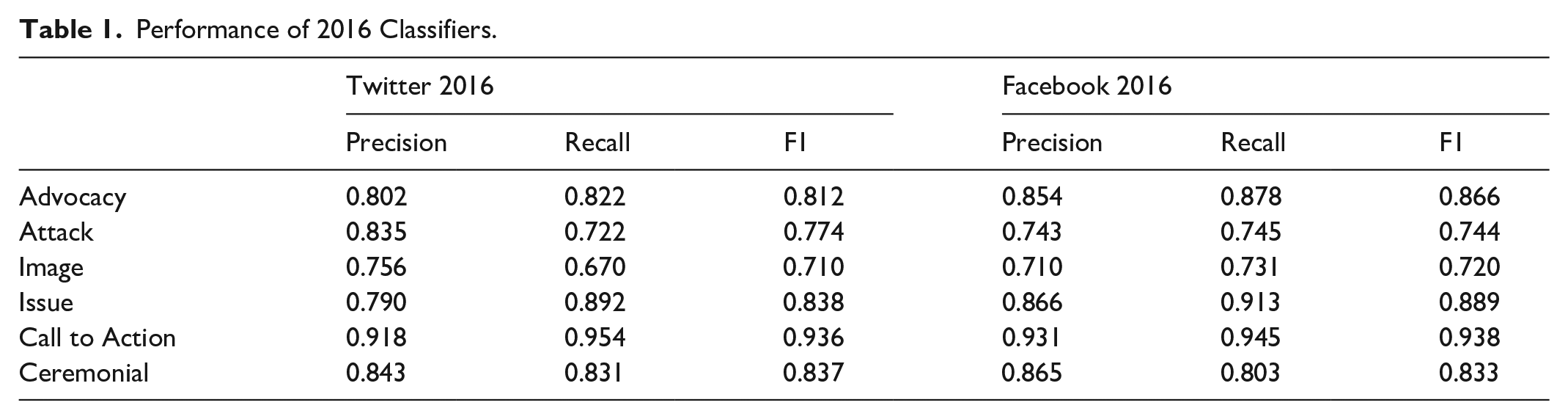
The complete set of precision, recall, and F1 scores are detailed in Tables 1 and 2. Generally, the model’s performance is strong—overall F1 scores range from 0.613 to 0.938, with scores ⩽ 0.69 occurring only with the image classifier.
Performance of 2016 Classifiers.
Performance of 2020 Classifiers.

Table 3 shows the number of messages tagged with each type for each platform for each year, across all candidates.
Number of Messages Tagged With Each Message Type for All Candidates in 2016 and 2020 on Both Facebook and Twitter.

Regression Analysis
We used regression analysis to test our hypotheses and answer our research questions. The elections for each year (2016 and 2020) were split into three periods: surfacing, primary, and general election. We treat the start of the first convention as the start date of the general election period because it is a foregone conclusion of the primaries, and the parties themselves treat the nominating conventions as the kickoff to the general election. For 2016, the Republican National Convention started on 18 July and for 2020 the Democratic National Convention started on 17 August. The primary stage analysis includes all the posts between 1 January and the first conventions, and the general election analysis starts after these dates. The surfacing stage includes all posts between 1 September and 31 December of the year before the general election.
We used autoregression models, which use lagged variables as predictors or control variables. They also support the use of dichotomous variables and the use of non-normal data given the correct variable transformations (Faraway, 2006). Finally, by using lag variables we can control for the effects of a variable at a previous time period, making it an autoregression model that allows us to examine how variables change over time (Gujarati & Porter, 1992).
We use six autoregression models per campaign stage (12 in total), one for each message type, the count of which is the dependent variable in the model. To prepare the data for analysis, we generated a dataset for each message type aggregated by platform, candidate, and week number. As an example, for the calls-to-action model, each observation in the model includes the number of posts in that category for a given week, candidate, and platform. Thus, for the fifth week before the election, Clinton had two rows: one for Twitter and one for Facebook. Each row contained the count of call-to-action messages on that platform for Week 5. Equation 1 provides the general model for each message type as

where Y is the dependent variable, number of messages predicted as a corresponding message type posted by the candidate for a particular week on the given platform. Lag (Yt−1) is a time lag variable that accounts for changes in candidates’ messaging based on their behavior in the past. This variable is the message count from that candidate for the previous week. Weeks to the election is the number of weeks before the election. A 0 corresponds to the week of the election, so the count is negative as it counts down to the election. Primary, 0 means the surfacing stage and 1 means the primary stage. Platform is a dichotomous variable where 1 is Facebook and 0 is Twitter. Year is a dichotomous variable where 1 is 2020 and 0 is 2016. Trump is a dummy variable where 1 is Trump, otherwise 0. Msg. total is the total number of all types of messages. Weeks × platform is an interaction variable between the number of weeks before the election and the social media platform. Finally, β0 is the Y-intercept, β1–β7 are regression coefficients on each independent variable, and ε is an error term.
We calculated the variance inflation factor (VIF) to determine whether any of our predictors were highly correlated, thereby introducing multicollinearity into our models. We also checked for autocorrelation and heteroskedasticity.
As we have all the posts from all the candidates for each messaging category, we are analyzing the population without sampling variations. We therefore did not conduct statistical significance tests to confirm the predictive ability of the variables. Rather than reporting p values and confidence intervals, we report the standardized regression coefficients (i.e., betas), which allow us to compare the effect size and are typical in studies using similar approaches (Gorard, 2013). Note that for dichotomous variables, standardized coefficients are difficult to interpret as they rely on the standard deviation of the variable. Although we can use them to compare effect sizes between variables, they do not give us useful information about the specific effect size of our dichotomous variables.
Results
Table 4 presents the results of the six regression models for the surfacing and primary stages, and Table 5 presents the results of the six regression models for the general election stage.
Combined Regression Results—Primaries.

Combined Regression Results—General Election.

Our first hypothesis predicted that candidates would rely more on advocacy than on attack messages in the primaries. Table 4 shows that the primary variable is positive in both the advocacy and the attack models, which means that candidates used more of both message types in the primaries compared with the surfacing stage. However, the effect size in the advocacy model is much larger than in the attack model, suggesting that, as hypothesized, candidates are more likely during the primary stage than in the surfacing stage to communicate advocacy messages over attacks.
Our second hypothesis was that social media messaging would emphasize image over issue in the primary stage. The coefficients for the primary are positive in both cases, but the effect size is bigger for image. These results suggest that the candidates are more likely to communicate messages about their character and persona during the primary stage than to convey policy-focused messages, supporting H2.
Table 5 provides information for the third hypothesis that candidates will attack more on Twitter and Facebook the closer it is to Election Day of the general election. The negative coefficient indicates that the number of attack messages during the general election phase declines as the election draws nearer, rejecting H3.
To answer the first research question regarding to what extent candidates change their campaign messaging during the surfacing compared with the primaries, the positive coefficients in all regression models mean that there was an increase in all message types in the primary stage compared with the surfacing stage. However, the effect size is very large for issue and is considerably large for advocacy and call-to-action, suggesting that these three types of messages are much more likely to be used in the primaries instead of the surfacing stage.
To answer the second research question regarding whether there are changes in calls to action across the stages of the campaign, Table 4 shows that the weeks variable is negative. This indicates that the number of calls to action during the primary phase tended to decline over time from surfacing through the primaries Table 5, which analyzes the general election compared with the prior stages, shows a positive coefficient. This indicates that candidates tended to use calls to action more frequently in the general election and more heavily as the election drew near. In Table 4, we note that the platform variable is positive, but in Table 5 it is negative. This suggests that in the primaries candidates tended to post more call-to-action messages on Facebook, but in the general election, they favored Twitter slightly more for calls to action.
The third research question focuses on differences between Trump and his opponents. All else being equal, Trump is less likely to post advocacy, issue, and calls to action, and more likely to go on the attack and to focus on image and ceremonial messaging (RQ3a). In the general election, Trump is less likely than his opponents to post all message types with the exception of ceremonial (RQ3b). In fact, the effect size for Trump in the ceremonial model indicates it is probably the strongest predictor for this message type. The effect sizes for advocacy and for issue-based messages indicate that these are the two least prevalent strategies in Trump’s social media communication.
As Figure 1 shows, Trump’s messaging patterns were distinctly different from his opponents. He advocates for himself more than his opponents, especially on Twitter in 2020, and he attacks more in 2016 on Facebook than his opponents. He also produces substantially more issue-focused messages on Facebook in 2016 and 2020, and on Twitter in 2016, but only during the general election in 2020.

Trump versus Opponents in 2016 and 2020, Facebook and Twitter.
Platform differences, which is our fourth hypothesis, were more pronounced in the general election stage, with Facebook used more for attacks, issues, and ceremonial posts while Twitter is used more for advocacy, image, and calls to action. In the primaries, only calls to action are more likely to be posted on Facebook, with the remaining message types are more frequent on Twitter. The interaction term for platforms and weeks until the election suggests a small impact of time on messages posted on Facebook for all message types, meaning that candidates prioritized Facebook over Twitter as Election Day became closer.
Finally, to answer our fourth research question, we note differences in how candidates use each message type between 2016 and 2020 in both the primaries and the general election. The 2020 primary campaign messaging was more likely to feature attacks and advocacy messages, as well as messages focused on policy issues and ceremonial posts. The negative coefficients for weeks suggest that all message types increased as candidates approached the party conventions. Likewise, the positive coefficients for the primary variable suggests that all message types became more prominent in the primary stage compared with the surfacing stage, and the effect is stronger for advocacy, image, and calls to action. Time has distinct implications for the types of messages posted by candidates in the general election: advocacy messages and calls to action are more likely to be posted as the Election Day becomes closer—with the effect size for call to action suggesting a large effect. There are also important differences between electoral cycles, with issue, calls to action, and ceremonial messages being more likely in 2020 versus 2016. This suggests that the 2016 general election between Trump and Clinton tended to be more negative than the Trump versus Biden election.
As for the control variables, the lagged (lag) count variable and the total of messages are the strongest predictors across all campaign types, with the remaining coefficients accounting for relatively small changes, meaning that a given candidate’s prior posting frequency is the main variable explaining the use of a given message type over time.
Discussion
Given that campaigns have normalized their use of social media in this decade, we examine the communication across two presidential elections to understand what campaigns are posting on two popular platforms. Our analysis suggests that campaigns communicate in distinctly different ways depending on the stage of the campaign (surfacing, primaries, general election), in line with prior scholarship of campaign communication from the mass media era (Denton et al., 2020). During the primary stage of the campaign, candidates are more likely to advocate for themselves than to attack their opponents, and to emphasize their image and character over their policy positions. This suggests that candidates differentiate themselves from their opponents from the same party but not by extensive attacks on opponents, as this could ultimately hurt the party nominee during the general election. Instead, they emphasize more the character differences between themselves. Given that social media lends itself to microcelebrity and an emphasis on the self (Marwick, 2013), it makes sense that even political candidates would adopt a self-aggrandizing posture and especially on Twitter.
Our data further suggest that in the general election the candidates attack less as Election Day gets closer. These results are somewhat surprising, given that we might expect that the candidates would increase their efforts to appeal to undecided voters (or dissuade undecided voters from voting for their opposition) by denigrating their opponent as the vote draws closer. Prior scholarship suggests, for example, that in competitive races, gubernatorial candidates are more likely to attack (Rossini et al., 2018). Given the closeness of both the 2016 and 2020 presidential general elections, it is noteworthy that this pattern did not extend to presidential candidates—suggesting that the level of race may affect campaign communication patterns on social media.
A different factor that may be changing when presidential candidates go on the attack is the changing nature of voting in the United States. In 2016, 27 states offered nontraditional methods of voting, ranging from mail-in ballots to voting early (Desilver & Geiger, 2016). In 2020, because of the COVID-19 pandemic states expanded absentee balloting, mail-in ballots, and early voting. As a result, voting no longer occurs for all voters the first Tuesday in November, and campaigns must strategically adapt to that altered landscape.
When exploring the types of posts by candidates across the stages of the campaign, the data suggest a few noteworthy patterns. During the primaries compared with the surfacing stage, candidates increase the volume of issue and of advocacy messaging and calls to action over time. During the general election we see a shift in that the volume of calls-to-action posts increases as Election Day grows near but not the other types. This suggests that candidates change their communication strategies to meet the external realities of the campaign. During the primaries, they advocate for themselves and urge supporters to donate and vote. During the general election, they ramp up their call-to-actions to raise much-needed cash and urge supporters to vote. Given that campaigns see social media as beneficial for communicating with supporters (Kreiss et al., 2018), our results suggest that their strategic communication practices on social media heavily rely on mobilization communication over persuasive communication; they are not trying to persuade undecided voters on social media, they are trying to rally their supporters to action.
When comparing 2016 and 2020, our results suggest that the 2020 campaign was less negative than 2016, and candidates posted more issue-based messages, calls to action, and ceremonial messages. Some of these differences may reflect the pandemic and the need by campaigns to rely more heavily on digital media for campaign mobilization efforts, given the dearth of in-person events. As well, in 2016, the Republican Party had a crowded field of viable candidates seeking the nomination (16 announced, but 5 dropped out before the primary cycle began) while the Democratic primary was mainly centered on two candidates (with another 4 withdrawing before or early in the primary stage). Donald Trump, however, did not have meaningful internal competition during his reelection bid in 2020, while Democrats had 10 viable candidates in the primary stage and over 15 who withdrew before the primaries. This dynamic likely also drives some of the differences.
We find that platform uses are contingent on distinct campaign stages, and especially in the general election. In the primaries, Facebook is the favored platform for calls to action, which could be explained by the ability to reach like-minded networks while candidates are competing within their own parties. In the general election Facebook communication is focused on attacks, issue-based messages, and ceremonial posts. Our findings thus highlight the need for more research on Facebook and other social media platforms. The preponderance of research on campaigns and social media has focused on Twitter, primarily because of the ease of collecting messages through the platform. Yet, campaigns seem to heavily rely on Facebook to communicate with the public.
Finally, Trump communicates in distinctly different ways from opponents, including using more ceremonial language, and perhaps surprisingly communicates more often on issues while advocating for himself. Contrary to qualitative analyses that highlight that Trump’s rhetoric was anti-normative and lacked decorum (Jamieson & Taussig, 2017), our results suggest that the volume of his attack messaging was in line with his opponents when analyzing the totality of his social media messaging. As noted by Nai et al. (2019), though, Trump’s communication style is comparatively emotional and negative compared with other world leaders. Moreover, Gross and Johnson (2016) conducted a sentiment analysis of Trump’s Tweets compared with his Republican primary opponents in 2016, and they find his had higher negative emotionality. Thus, it may be that although Trump is not attacking more frequently than other candidates in terms of conveying criticism of others’ ideas and character; the civility and the emotionality of that messaging may be more extreme.
Our conceptualizations of the categories of analysis were built from the prior work on television advertising classifications. The benefit of our work is that it extends the analysis of television advertising into the digital realm by examining Facebook posts and Tweets and allows for meaningful comparisons across the decades. It is worth considering, however, whether it is an appropriate comparison to analyze social media messages as a kind of advertising. Social media messaging is more conversational and functions differently from paid advertising (Stromer-Galley, 2019). Moreover, the prior content analysis frameworks of television advertising in the past decades may no longer properly characterize the style and tone of campaign messaging in the digital age. Geer’s (2006) argument that attack messaging is a legitimate form of discourse in a highly functioning democracy did not factor in the distinct and problematic rhetorical style of a candidate like Donald Trump who produced a kind of vulgar eloquence (Stromer-Galley, 2020) that it its core is demagogic (Mercieca, 2020). More research is needed to consider what makes social media messaging similar and distinct from what is typically recognized as paid advertising, how campaign messaging in style and substance has changed in the digital media age, and how much Trump was an aberration compared with a new “normal” of campaign rhetoric.
There is another limit to be noted. The image classifier is a relatively poor performing model compared with the others. Because its overall accuracy is only about 60%, the classifications are likely wrong 40% of the time. This means that our findings regarding image construction by candidates should be considered as tentative.
Conclusion
Our analysis of the surfacing, primaries, and general election stages of the 2016 and 2020 US presidential campaign Tweets and Facebook posts suggests that campaign communication shows distinct patterns depending on the stage of the campaign. The surfacing stage, when candidates are introducing themselves to the public, use social media to do some of that work by advocating for themselves, and that messaging continues during the primaries stage when they work to construct their image of themselves more so than their policy positions. During the general election, the volume of calls to action increases. What the totality of our results suggests is that while scholarship suggests that communication on digital media is filled with attacks and outrage (Sobieraj & Berry, 2011), political candidates use their social media platforms to mobilize their supporters and tell them and the public about the character and qualities of themselves more than attack their opponents. By analyzing social media messaging over time, we can see trends that further our understanding of the temporal nature of campaigning—what is common across time and what changes based on context—that the single case study cannot reveal. Given that social media is now a standard part of campaign communication strategy, more longitudinal study is needed.
Footnotes
Declaration of Conflicting Interests
The author(s) declared no potential conflicts of interest with respect to the research, authorship, and/or publication of this article.
Funding
The author(s) disclosed receipt of the following financial support for the research, authorship, and/or publication of this article: Research of the 2016 campaign was supported by a Fellowship from the Tow Center for Digital Journalism at Columbia University. The 2020 campaign research was supported by the John S. and James L. Knight Foundation.
Authors’ Note
Portions of these findings were presented at the Association of Internet Researchers annual meeting in October 2019, Brisbane, Australia.
