




Abstract
While plenty of research have provided useful insights into political parties’ use of Twitter, comparably few efforts have focused on the arguably more popular Facebook service. This article presents a comparative approach, detailing similar functionalities on each platform and providing statistical analyses of the social media activities undertaken by Swedish political parties during the 2014 elections. Moreover, the types of attention and feedback received by these parties are analyzed, suggesting that while sizable parties are not necessarily the most ardent at using their social media presences, they receive the most attention. The study largely complements previous research, suggesting that larger actors receive the bulk of new media attention on both platforms – with some internal variation. However, the role of the right-wing populist Sweden Democrats is clearly felt throughout, suggesting the apparent prowess of controversial parties in the online context.
Introduction
Novel media and communication channels have always been greeted by pundits, critics, and some scholars, with unrealistic ideas about their applications to remedy some societal malady. In particular, such speculation has revolved around traditional definitions of parliamentary democracy and the lack of engagement in it among the general public, particularly younger generations (Chadwick, 2006). Musings like these have perhaps been especially plentiful in relation to the Internet (Blumler and Kavanagh, 1999; Loveland and Popescu, 2011). However, Druckman rightfully points out that ‘each innovation has advantages and drawbacks’ (2007: 251), and while the online environment undoubtedly carries with it the potential to allow politicians to ‘communicate directly with the citizens without direct interference from the mass media’ (Hermans and Vergeer, 2012: 74), the fact that this potential has not been acted upon by said actors to any larger extent must be considered a drawback – even for those most enthusiastic about the medium at hand (Larsson, 2013; Margolis and Resnick, 2000).
While the largely sober, perhaps even ‘somber assessments’ (Vaccari, 2008b: 2) of previous research, would suggest largely conservative efforts on behalf of political actors online, the advent of the so-called Web 2.0 rationales for Web design, coupled with the emergence of a range of services often collectively understood as social media, has yet again raised such hopes regarding platforms like Facebook or Twitter. While a range of studies are available regarding the uses of the latter of these two services (see Jungherr, 2014, for an overview), an arguably comparably smaller amount of work has been performed, looking into Facebook use at the hands of politicians and political parties. Even fewer studies undertake comparable or multimodal efforts, analyzing activity on both services (Kim et al., 2013; Vergeer and Hermans, 2013). The current study, then, makes a contribution in this regard.
Given the popularity of Facebook – especially when compared to Twitter (Bruns, 2011) – more scholarly insights are needed, concerning the political uses of social media in a broader sense. While in-depth case studies can certainly provide rich insights into the practices associated uniquely with one specific platform, our current efforts feature a different approach. Specifically, what is presented here is a comparative study of Facebook and Twitter use at the hands of Swedish political parties during the 2014 general elections. While previous research has indicated the routine aspect of simply having an online presence – in the form of Web sites (Druckman et al., 2007; Gibson, 2004) or on the services discussed here (Groshek and Al-Rawi, 2013) – more insights are needed into the actual use – as undertaken by political actors – and the types of feedback that this activity yields on both platforms (Hansen and Kosiara-Pedersen, 2014). Indeed such a focus on the outcomes of online activities is seemingly suggested by Bimber (2014) who states that ‘new tools are broadly available […] scholars can learn little from comparing which candidate has more, or better, technology’ (p. 132). With this in mind, the study at hand moves beyond what could be described as the often-employed dichotomous approach – essentially asking ‘has/has not’ type questions (Marcinkowski and Metag, 2014; Strandberg, 2013). Instead, it adopts an approach that allows for different types of insights regarding the overarching implications of the online actions of different types of parties – specifically differentiating between comparably larger and smaller competitors. Employing a series of overarching quantitative analytical efforts, the study is guided by two research questions, the first of which is phrased as follows: What influenced Swedish political party use of Facebook and Twitter during the 2014 election?
Taking into account different types of feedback that could tentatively be received, the second research question reads accordingly: What tendencies can be discerned regarding the influences on the feedback received by Swedish political parties on Facebook and Twitter use during the 2014 election?
The previously suggested broad availability of novel online tools is especially valid in our case country of Sweden. Featuring high levels of voting attendance as well as an ‘avant-garde position regarding Internet access, broadband and social media penetration’ (Gustafsson, 2012: 1111), Swedish political actors have similarly been known as early adopters and ardent users of various Web technologies (Vergeer et al., 2012) – with some variation (Larsson and Moe, 2014; Larsson, 2011). As such, the selected case should make for some interesting comparative insights – especially since it is undertaken outside the often-studied Anglo-American context (as suggested by Hermans and Vergeer, 2012). The next section outlines the specific analytical rationale for the study at hand – comparing political parties of varying sizes.
Size is everything? Larger and smaller political parties online
While the influx of the Internet in general and tendencies of political professionalization in particular led to suggestions of individual politicians gaining more power vis-à-vis their respective party organizations (e.g. Lisi, 2013), the traditionally party-centered Swedish parliamentary system has largely remained focused as such also in the digital age (Oscarsson and Holmberg, 2013). While individual politicians have certainly made clear marks in various online spheres, the focus on parties as championed here thus appears as suitable. As for our specific case, the 2014 election saw the 8-year incumbent liberal (Fp)–conservative (M) alliance facing a series of different challengers, the largest of which were the Social Democrats (S). As a result of the 2010 elections, the right-wing populist Sweden Democrats (Sd) made their way into parliament. However, throughout the 4-year period between the former and the current election, the remainder of parliamentary representatives made clear efforts to block many of the often-controversial issues advocated by this latter party to come to fruition. For both elections, two prominent minor candidates also made waves to some extent. Although neither the Feminist Initiative (Fi) nor the Pirate Party (Pp) managed to gain access to parliament, they were both able to raise interest among the populace enough to be a part of preelection discussions and some debates. The weeks leading up to Election Day in September 14th saw a close race between the Fp-M alliance and their Social Democratic challengers, resulting in a shift of power, where the former of the two formed a minority government with the Environmental Party (Mp).
Given these basic characteristics of the Swedish political system as outlined in Table 1 – two large parties, two very small ‘outsider’ parties, and one controversial party – previous research on the topic at hand can provide us with some insights regarding what to expect in terms of online performance as a result of party size or party ideology.
Characteristics of Swedish political parties and their social media presence.
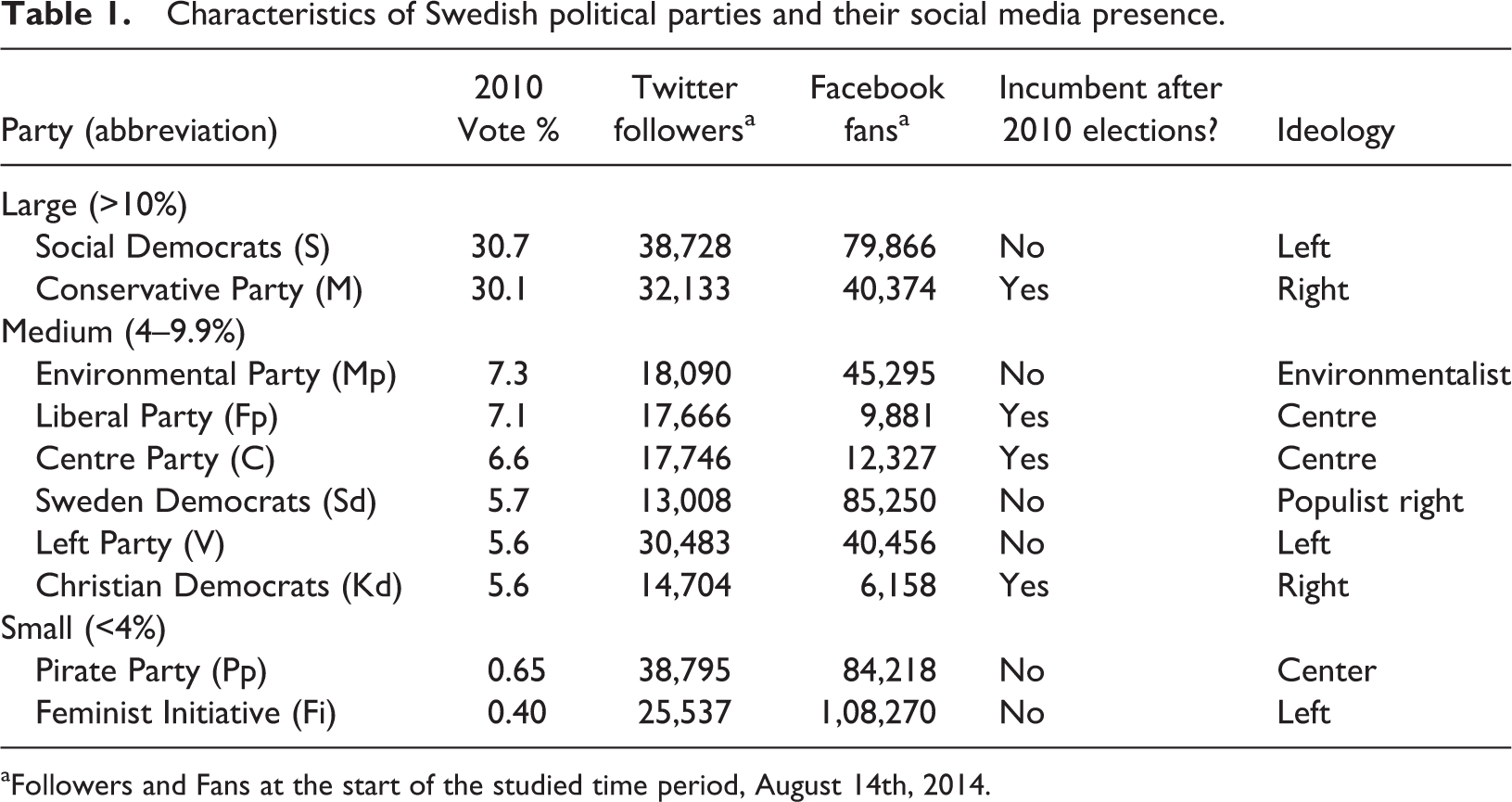
aFollowers and Fans at the start of the studied time period, August 14th, 2014.
The suggestion that party size would have an influence on performance, both by the party itself and by its supposedly larger share of supporters, might seem self-evident. However, research have shown that while comparably smaller parties proved to be more geared toward online campaigning endeavors during the popularization of the Internet during the mid-1990s (Sadow and James, 1999; Strandberg, 2009; Gibson, 2004), they were eventually overtaken with regard to Web site functionality, design sophistication, and overall quality by their more sizable competitors (Lilleker et al., 2011). This development is neatly summarized by Hansen and Kosiara-Pedersen who suggest that ‘even if new technologies require fewer resources, they still require time and money’ (Hansen and Kosiara-Pedersen, 2014: 207). Indeed, curating a high-standard Web site is associated with such costs – costs that are arguably smaller when one considers undertaking activity on the largely ready-made platforms of Facebook and Twitter. With such comparably low-cost alternatives in mind, more recent research findings have suggested what could be labeled a ‘leapfrog’ or perhaps circular tendency, where smaller parties are yet again leading the way in online employment – now for social media (Gibson and McAllister, 2014; Koc-Michalska et al., 2014).
As Gibson et al. have suggested that ‘party does matter, although not necessarily in terms of size’ (2008: 26), the influence of ideology on the matters at hand appears as particularly salient in Sweden. As previous scholarship has suggested that right-wing populist or extremist parties have been successful in gaining online attention despite rather low levels of activity undertaken by the parties themselves (Larsson, 2014), the presence of the Sd might serve as a case in point. Albeit not a large party, they cannot easily be considered small. Following the 2014 elections, they emerged as the third largest party (gaining close to 13% of the vote), superseded only by the two ‘catchall’ parties – the S (31%) and the Conservatives (M; 23%). As such, the combination of a comparably large and ideologically marginalized party could be especially interesting with regard to the topic at hand.
As discussed above, while our knowledge about what appears to influence the online activities undertaken by the parties themselves might be large, our insights into the factors influencing the level of feedback received in relation to this activity are comparably limited – especially in the comparative fashion favored here. The next section details the steps undertaken to facilitate such a comparison between the two different, yet also similar, social media services under scrutiny.
Comparing feedback options on Twitter and Facebook
While Twitter and Facebook are sometimes seen as similar in terms of their usage, they are distinctly different in terms of their respective technical infrastructures, appearance, and terminology (boyd and Ellison, 2008). Nevertheless, the argument is made here that the user of both services are faced with a series of feedback that are somewhat similar in that they offer comparable modes of communication. The three suggested modes – redistributing, interacting, and acknowledging – and their distinctive counterparts on each platform are presented in Figure 1.
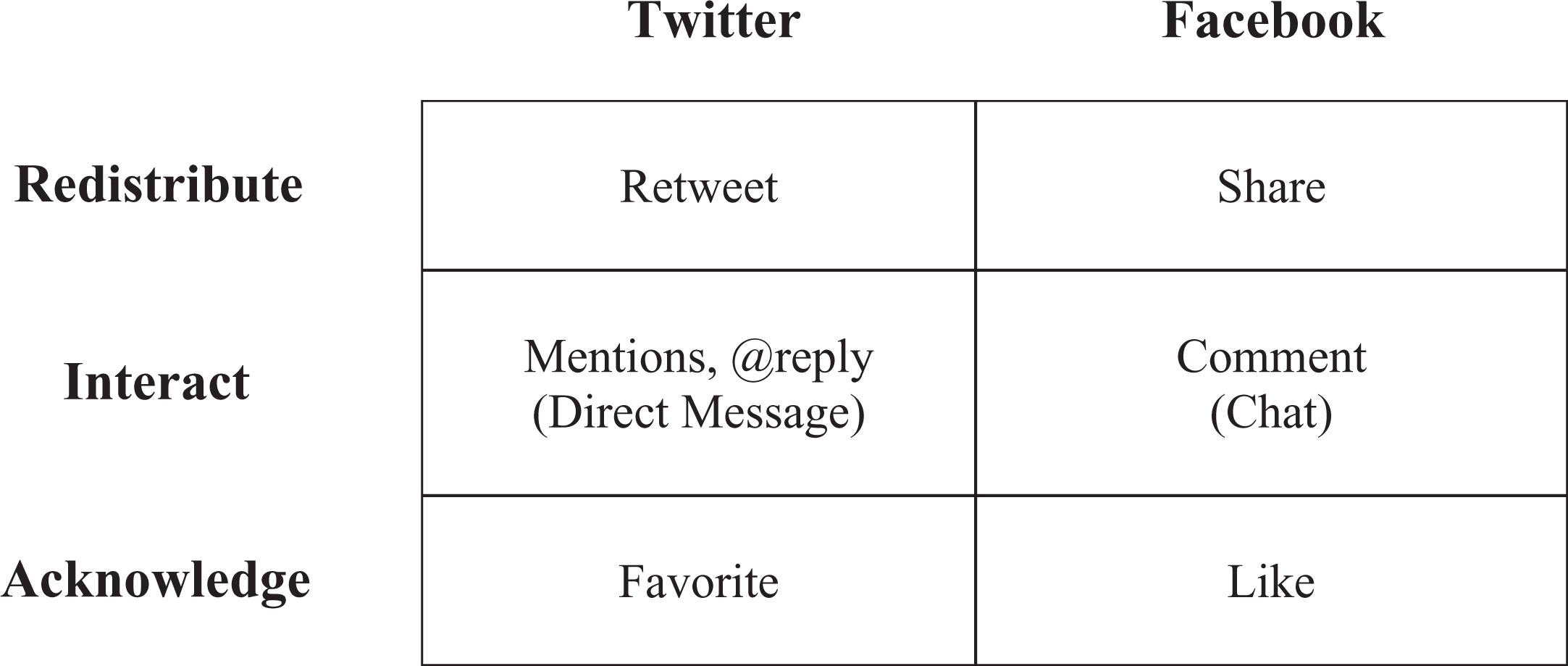
Three types of feedback functionalities on Twitter and Facebook.
First, much as Twitter users can employ the retweet functionality to redistribute a tweet sent by some other user, so can a Facebook user choose to share posts made by others – such as political parties. Indeed the potential spread of the redistributed message is dependent on a multitude of factors – individual user settings and preferences, platform characteristics, previous choices made, and so on (Bucher, 2012). Nevertheless, from the perspective of those actors whose messages are being redistributed in retweets or shares, this type of feedback must be regarded as very attractive. It allows for their dispatches to potentially spread beyond their own networks, reaching the attractive status of ‘virality’ (Klinger and Svensson, 2014).
Second, while interaction has been pointed to as the defining character of the Internet, uptake of such practices among politicians and parties has been mostly slow and hesitant (Stromer-Galley, 2000, 2014), indicative of the risk of exposure and embarrassment taken when interacting as a politician (Marcinkowski and Metag, 2014). Be that as it may, the functionalities for contacting and commenting are by now a commonplace feature on each platform. For Twitter, the practice of mentioning another user by including their user name somewhere in the body of a tweet signals interaction, perhaps especially so when that mention comes in the form of an @reply, where the user addressed is mentioned at the beginning of the tweet (Twitter, 2014). Moreover, both platforms offer more private settings for interaction in the form of Twitter’s Direct Messages and the Chat functionality available on Facebook. These are shown in parentheses in Figure 1 so as to indicate their less than public nature. While citizens might not choose to engage in discussion with political actors in these ways, leaving room instead for the established ‘Twitterati’ (Bruns and Highfield, 2013), gaining comments, and @replies can be seen as indicative of having an interesting (or controversial or both) message to convey – a message yielding reactions in terms of attempted interaction initiated by social media users.
Finally, while acknowledging features like favorite marking a tweet or liking a Facebook post are perhaps best described along the lines of ‘clicktivism’ (Karpf, 2010) or ‘slacktivism’ (Morozov, 2011), the exact role of these measurements in deciding the influence of a specific user or post on either studied platform remains somewhat unclear. While the sharing or retweeting of posts and tweets are arguably more important for the coveted viral effects to occur (Socialbakers, 2013), the tracking of likes and favorites are nevertheless of interest for our current purposes as they allow us to track the different ways that Twitter and Facebook are employed in the current setting. With these issues in mind, the forthcoming analyses will take all these measurements into account but will focus especially on the redistributive feedback gained by the parties under scrutiny.
Based on the above reasoning, Figure 1 provides an overview of the empirical focus of the study at hand. While tracking these measurements will provide useful insights into the effects of online political communication, the adopted study design nevertheless misses out on other aspects of Twitter and Facebook use. First, while @replies and comments are open in the sense that other users can potentially take part of them, both platforms offer ‘hidden’ or more private interaction as well. For ethical as well as for technical reasons, this direct communication could not be included in the present work. Second, while the procedural definitions of the terms associated with each service might be clear, the current study cannot make any inroads with regard to what these practices mean to each specific user. For example, a retweet might indicate an expression of support for one user, while others may have ascribed different or even fluctuating meaning to this or any of the other practices discussed above (Driscoll and Walker, 2014; Lomborg and Bechmann, 2014). Admittedly, the aggregated view championed here might not be able to delve into these intricacies. The approach employed is nevertheless useful, as it provides an overview of the feedback given – whatever form or connotation that attention might take among those giving it. These delimitations aside, the argument is made here that this comparative view can help in securing comparative analytical efforts with those future platforms that will inevitably follow after Twitter and Facebook. As pointed out by Bekafigo and McBride (2013), ‘while SNS [social network services], even Twitter, may come and go, Internet technology is here to stay’ (p. 13). The proposed typology, then, suggests a focus on the basic functionalities of the services in play today – and perhaps also characteristic of those yet to be seen.
Method
The online presence of political actors will most certainly change during the course of an election campaign (see Foot and Schneider, 2006; although Gibson et al., 2008 appear to disagree on this point), thereby suggesting interesting analytical opportunities of such ‘platforms that are by design or dysfunction constantly in flux’ (Elmer, 2012: 18). Nevertheless, the final stretch of the quest for votes – the ‘short campaign’ (Aardal et al., 2004) – often defined as the monthlong period leading up to election day, is still interesting to study, as it can be assumed to offer up the parties, politicians, and perhaps also their respective supporters at the very height of their online abilities (Enli and Skogerbø, 2013; Vaccari, 2008a;). Along this line of reasoning, our analytical efforts are focused on the time period of August 14, 2014 to September 17, 2014. As Election Day took place on September 14, the prescribed analytical setup allows us to gauge not only the buildup to election but also some of the electoral aftermath.
Given the adopted multimodal approach, data collection for the previously mentioned time period was undertaken for both Twitter and Facebook. As each platform is characterized by specific characteristics with regard to these endeavors, the subsequent two sections detail the actions taken in both cases.
Twitter is often pointed to as a social media platform of a ‘generally public nature’ (Bruns and Highfield, 2013: 671), and while data collection from the said service is generally considered to be unproblematic from a purely technical point of view, ethical issues ensue when the object of study concerns political issues (Moe and Larsson, 2012). While one could argue that those citizens who choose to interact in some way with political actors on a public Web service such as Twitter are not necessarily in need of privacy protection, our current efforts are not directed toward such identification, especially, of active citizens (for a somewhat contrasting approach). As such, the data collected regarding all other actors than the parties were anonymized with precautionary measures in mind.
Twitter data were collected by entering suitable key words tracking the official accounts of parties into a localized installation of YourTwapperKeeper (Bruns and Highfield, 2013). The service queries the Search and Stream application programming interfaces (APIs) of Twitter, and while such a noncommercial approach to data collection has potential limitations (Driscoll and Walker, 2014), the limited amount of Twitter use in the Swedish context (Nordicom, 2013; Larsson and Moe, 2013) coupled with our use of delimiting key words (Morstatter et al., 2013) provides confidence regarding the procuration of a full sample of tweets sent in relation to the parties.
For Facebook, the Netvizz service was employed to facilitate data gathering (Rieder, 2013). The service allows for extraction of post content as well as metadata (such as the date the post was made, number of likes, shares, and comments at the time of archiving) regarding each post. Moreover, Netvizz features automatic anonymization – an especially useful feature for our current purposes. With this in mind, the officially endorsed Facebook Pages were gauged for activity (Gulati and Williams, 2013).
While these rationales for data collection allow for careful scrutiny of activity at the hands of politicians, as well as the reactions to this activity, the results derived from these data must nevertheless be considered a ‘snapshot’ of the studied accounts as they appeared at the time of data collection (Brugger, 2012). For example, it is entirely possible that parties have removed their posts since these were first offered or that their supporters have retracted their shares or retweets of the posts made. As such, what is presented here is essentially an aggregated view of the Facebook and Twitter experiences of leading political actors (Lomborg and Bechmann, 2014). The need to ‘freeze the flow’ (Karlsson and Strömbäck, 2010) of online data in order to make it suitable for analysis is nonetheless obvious, but should be assessed with the aforementioned caveats in mind.
With regard to the parties under scrutiny, their characteristics of specific importance for the current study are available in Table 1. The table features the parties in descending order based on their share of the votes during the last election to be held prior the one studied here – in 2010.
While all political parties are indeed present on both services, their base of fans and followers vary considerably. For instance, it is worth noticing that the two of the smallest parties in terms of vote percentage from the 2010 elections are in the lead when it comes to Twitter followers (Pp) and Facebook fans (Fi). These characteristics, then, serve as backdrops for the results of the analyses undertaken in the next section.
Results
The first research question concerned the activities undertaken by the political parties themselves. In order to provide an overarching view of these practices, Figure 2 presents a clustered bar chart detailing the activities undertaken by the party accounts on Facebook and Twitter respectively.
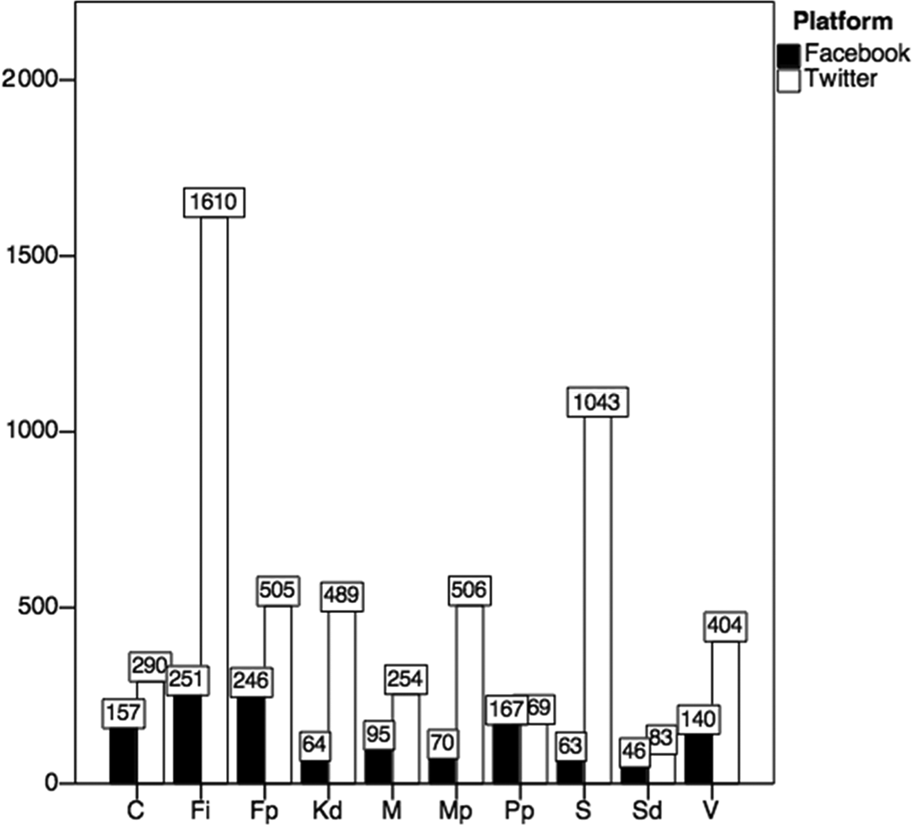
Total amount of posts and tweets provided by parties on Facebook (black bars) and Twitter (white bars) during the studied period. Presented in alphabetical order based on party abbreviations.
The predominance of white bars in Figure 2 suggest the prevalence of Twitter use over Facebook use at the hands of those supposedly responsible for the party accounts on both services. Interestingly, this pattern of use appears to hold true also for all parties, while the reported differences must be considered rather small in a few cases. Consider, for example, the results provided regarding the activity undertaken by the Pp (no. of Facebook posts = 167, no. of tweets = 169) or the Sd (no. of Facebook posts = 46, no. of tweets = 83), both parties visible in Figure 2, indicating lower degrees of activity.
Conversely, for those parties exhibiting high degrees of activity, two such actors emerge as particularly fervent. First, the data presented in the figure suggest especially high level of activity for the Fi, who at the time of election – as well as after the election, one might add – were not seated in parliament. The results indicate that this party takes the lead in terms of activity on both platforms (no. of Facebook posts = 251, no. of tweets = 1610). The second most active party – at least in terms of Twitter use – are the S (no. of Facebook posts = 63, no. of tweets = 1043). While their presence on Facebook is diminished by several other actors identified in Figure 2 (e.g. Fp = 246 or Pp = 167), their activity on Twitter is surpassed only by the Fi.
Looking a bit more closely at the Twitter activity of these two parties, they appear to share a similar approach to this particular service. To a certain extent, their adamant employment of Twitter can be explained by their tendency to utilize content provided by their respective supporters to higher degrees than their competitors. In accordance with the terminology provided previously, it would appear that Fi and S alike are more willing to redistribute content originally tweeted by others. However, some differences can be discerned in the apparent strategy employed by each party for retweeting practices. For the Fi, these redistributed messages tend to carry themes of user-generated support, such as first-time voters airing their encouragement for the party, after which they are often retweeted by the party account itself – and sometimes also approached with an @reply of thanks penned by the party leader. While such tendencies can be perceived also in the tweets sent from the Social Democratic Twitter account, the overall picture here is one of followers reacting to content provided by the party account – after which the party account then performs what could be referred to as a ‘looping’ of this reaction by retweeting it. While this type of tweeting behavior is indeed criticized by some of the followers through @replies along the lines of ‘spamming the feed’, this does not appear to have had an impact on those in operation, as this conduct on behalf of the Social Democratic account appears to permeate throughout the studied period – especially in conjunction with releases of party commercials.
While the results presented in Figure 2 provide us with important information regarding the use levels of Swedish political parties, they convey very little detail about the types of feedback received resulting from these activities. With our second research question in mind, Figures 3 and 4 detail the averages of the different types of feedback options described earlier for Facebook and Twitter, respectively. For these figures, means and standard deviations (SDs) are reported rather than medians in order to provide what was deemed as a more suitable representation of the sometimes rather small levels of engagement.
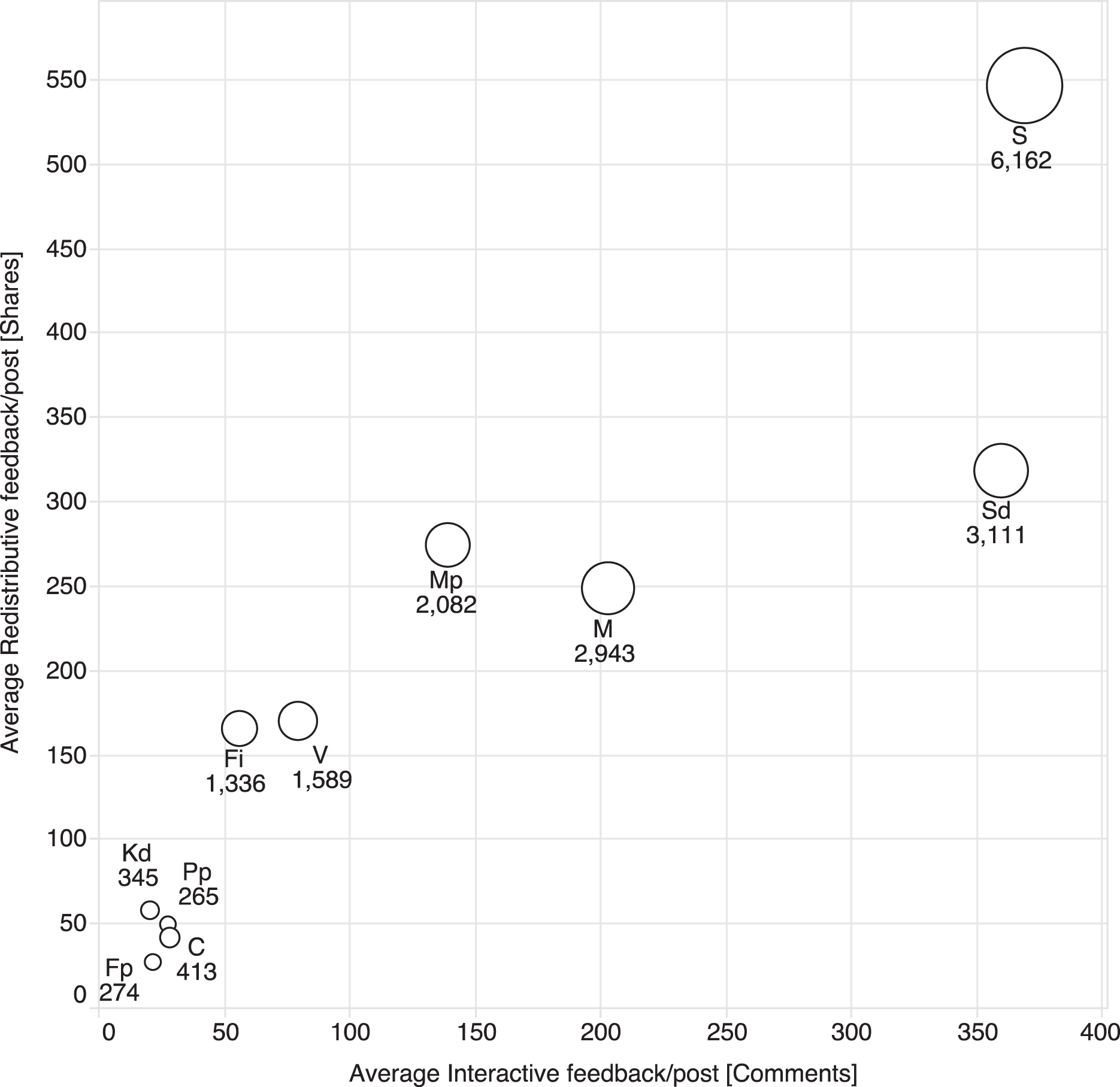
Average feedback received per post on Facebook. Horizontal axis indicates mean of comments/post; vertical line indicates mean of shares/post; and node size and label indicate mean of likes/post.
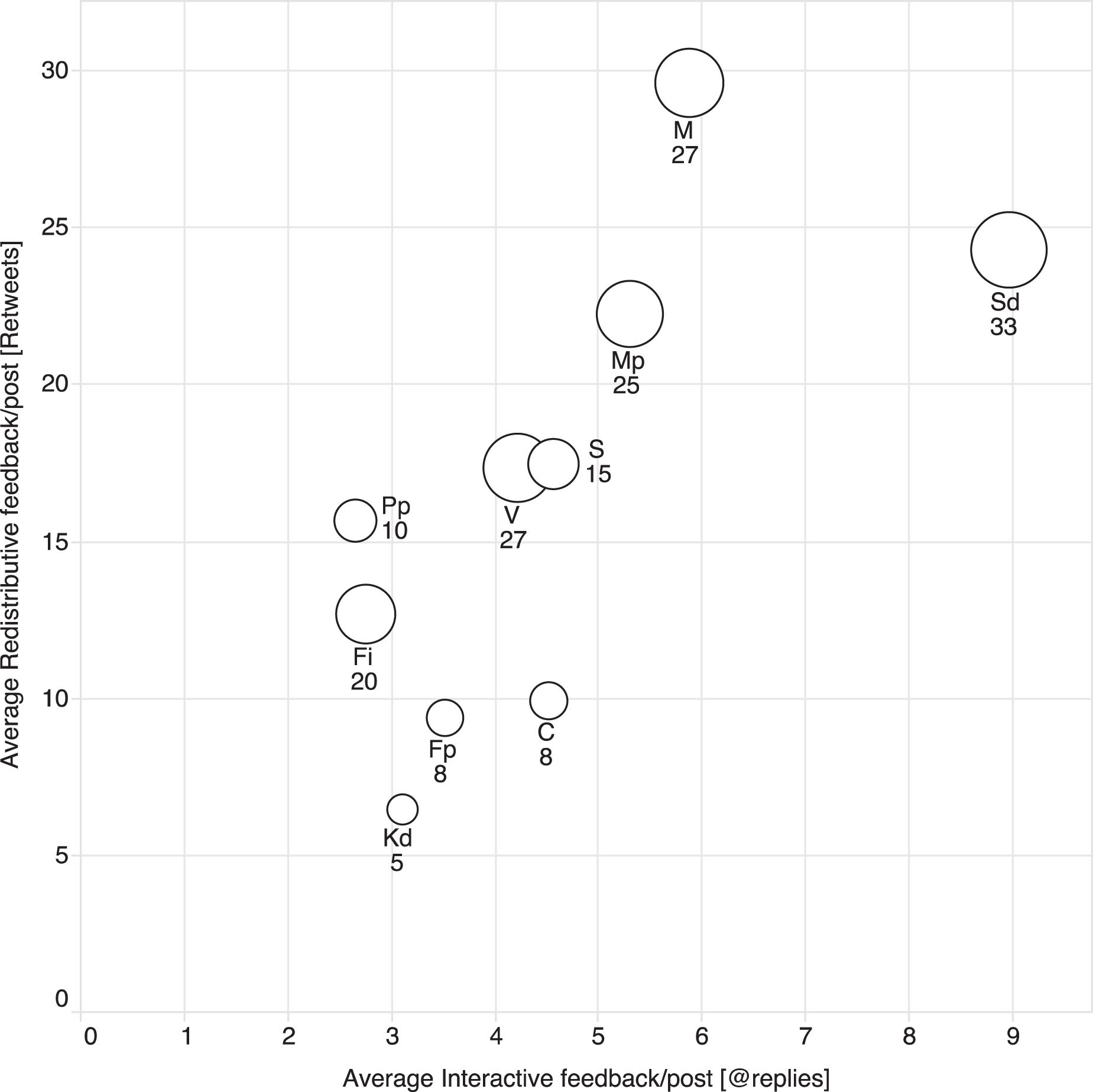
Average feedback received per tweet on Twitter. Horizontal axis indicates mean of @replies/post; vertical line indicates mean of retweets/post; and node size and label indicate mean of favorites/post.
The results presented in Figure 3 suggest a linear tendency among the represented parties – meaning here that as the average statistic for the redistributive type of feedback for Facebook (shares) increase, so does also that same statistic for interactive feedback (comments). Given the sizes of the nodes and their corresponding labels, this tendency of increasing averages as we move diagonally from the downward left corner to the upward right can be discerned also here. Indeed, correlation analyses using Spearman’s ρ proved correlations between all three involved variables to be significant (p = < 0.000 for all correlations) and comparably strong since ρ varied between 0.779 and 0.871 for all correlations (interpretative guidelines for correlation strength suggested by Hair, 2010).
With this in mind, it would appear that while the S in the figure – only amassed the fourth highest amount of ‘Facebook fans’ on the service at hand (see Table 1), these fans appear to have put in quite an effort to make the specified account visible. This seems especially true in terms of Shares (M = 547, SD = 442) and Likes (M = 6162, SD = 5128), where high SDs nevertheless suggest a considerable spread around the reported means. The same claim appears as valid for the average number of comments received (M = 368, SD = 323). Focusing on the content provided through the account, the most liked (no. of Likes = 28,810) post offered by the Social Democrats is coincidentally also the most commented (no. of Comments = 2361). This post, penned late election night, features Party Leader Stefan Löfven giving thanks to party supporters and staffers after the party had been declared victorious. 1 The most shared content from the Social Democratic account was posted on August 27th – the very same day that advance voting possibilities opened for the election. Consequently, this post urges supporters to vote in advance and to share the post so as to spread the message about this possibility. 2
This tendency of popularity of posts that encourage supporters to vote and to share this encouragement using the redistributive functionality of Facebook is visible also for other parties, such as the M and the Mp, although not for the other stand out party, as visible in Figure 3 – the right-wing populist Sd. Here, the most shared as well as the most commented post is offered on September 4th and features sneak premiere of an election commercial to be broadcast on Swedish commercial television the following day. 3 Their most successful post in terms of Likes (no. of Likes = 9648) was made available on August 20th and deals with the controversy started when the party wanted to place its admittedly polarizing political advertisements on Stockholm public transport buses. 4
As for those parties that were not as successful in gaining traction on Facebook, a particularly interesting case to focus on here could be the Fi. As shown in Table 1, while Fi had succeeded to amass the largest quantity of Facebook fans at the beginning of the studied period, the party did not reach similar success in activating these as well as other users, given the comparably limited levels of feedback received by the party as shown in Figure 3. Looking more closely at the posts provided by the party at hand that did reach a larger audience through Facebook sharing, these are largely focused on voting mobilization efforts centering on their tentative role in the balance of parliamentary power between the left- and right-hand side in Swedish government. 5
Moving on to consider the feedback received on Twitter, while the axes and nodes in Figure 4 indicate the same features as those in Figure 3, the scales have shifted to the diminutive – a reflection of the comparably large spread and popularity of Facebook in comparison with the service at hand. With these changes in mind, we can nevertheless compare the relative placements and sizes of the visible nodes in order to say something about what parties appeared as more or less successful in the Swedish ‘Twittersphere’ leading up to the 2014 elections. In further comparison with Figure 3, the linear tendency detailed earlier is visible also here. However, correlation analyses for the three variables involved resulted in significant, but comparably weaker Spearman’s ρ values than reported for the previous figure (p = <0.000, ρ between 0.408 and 0.721 for all correlations). While these results indicate a similar ‘rich-get-richer’-type effect to the one seen in Figure 3, this relationship is weaker for Twitter than for Facebook.
Similar to the activity charted on Facebook, the Sd emerge as particularly successful on Twitter as well – in terms of gaining comparably high average amounts of retweets (M = 24, SD = 29), @replies (M = 9, SD = 8) as well as favorites (M = 33, SD = 41) per tweet sent. Again, we must pay attention to the large SDs, indicating considerable spread around the reported means – but the popularity of the Twitter account under scrutiny cannot be denied. As for the content provided by the party, their most popular tweets in terms of redistribution tend to be authored by the party leader, Jimmie Åkesson, and centered on critique, for instance, against the tabloid newspaper Expressen (no. of Shares = 157) or, more generally, against the immigration policies favored by their political competitors. 6
While the Sd were paired with the S as being the two most successful parties on Facebook, for Twitter the former party has a new competitor, specifically the other catchall party in Swedish politics – the M. This account featured statistics largely on par with the aforementioned retweets (M = 29, SD = 39), @replies (M = 6, SD = 6), and favorites (M = 27, SD = 48). As for the types of tweets sent by this party that gained the most traction in terms of redistribution, these involve a retweet that was originally sent by the comedian Jonas Gardell, suggesting that some of the recruitment choices of the S were less than original (no. of retweets = 430). Another example is taken from Election Day, where the party calls on supporters to retweet the message at hand if they had voted for the party M – supposedly a last-minute attempt to rally the forces (no. of retweets = 229). 7
As shown in Table 1, the S and the Pp had managed to leverage the highest amount of Twitter followers going into the final monthlong stretch leading up to September 14th (38,728 and 38,795 followers, respectively). However, such comparably large followings appear to have had limited effects on the popularity of the parties, as detailed in Figure 4. While the Pp appears to be slightly more successful in terms of gaining feedback on Twitter rather than on Facebook, the S and the M almost appear to have switched places when we compare Figures 3 and 4. While these figures are arguably measuring these tendencies at different scales, these differences regarding the ways in which the two main parties in Swedish politics fare on the services under scrutiny here are nevertheless interesting. These and other issues that emerged from the analyses are discussed in the following and final section of the article.
Discussion
While large amount of followers or fans on the services studied might be considered a prerequisite for viral success, the results presented in this study indicate that amassing a comparably large fan base does not necessarily translate to attention gained on Facebook or Twitter respectively. This becomes clear when comparing the data regarding party fans and followers (as provided in Table 1) to the spread each party enjoyed on both services. Indeed, while size does matter to some extent in this regard, it appears that other factors also come into play.
Perhaps such factors can be assessed further by focusing first on the results presented in Figure 2. The dominance of Twitter over Facebook among the parties is clearly felt here. Given the popularity of Facebook over Twitter in the population at larger, this finding suggests a communicative mismatch of sorts between citizens and those elected to govern them (Larsson and Kalsnes, 2014). Moreover, Swedish Twitter users have been described along the lines of societal elites – a classification that might make these users especially attractive for political parties on the campaign trail to relate to (Larsson and Moe, 2013). While there are discrepancies, the results presented here suggest the priorities of Swedish political parties appear to lay on reaching out societal elites on Twitter rather than to the more ‘everyday’ type citizen one would find on Facebook. The ways in which this content is provided are particularly interesting for Twitter. As suggested earlier, while both the S and the Fi make extensive use of content originally provided by their respective supporters, the former of these parties does so in a looping fashion – essentially retweeting the retweets sent carrying their original content. In comparison, the latter party appears as more encompassing of user content – retweeting the messages sent by supporters to a higher degree than any other party, largely avoiding the looping tactic. For the Fi Party, this could be taken as signaling trust in its supporters and a willingness to move beyond a supposed strict line of ready-made messages and narratives to be distributed through a variety of communication channels. Moreover, this rhymes well the general ‘social movement’-type framing that the party maintains in popular media coverage and, which to some extent, forms the basis of its organization. By allowing supporter content to be broadcast as official party messages, the Fi Party could be said to strengthen the bonds with its Twitter followers.
Be that as it may, when one compares how the parties fared in terms of gaining redistributive, interactive, and acknowledging feedback on the two services under scrutiny, the right-wing populist Sd emerge as comparably successful on both Facebook and Twitter. This result aligns itself with previous indicators of online prowess at the hands of right-wing parties, suggesting a tendency for ideologically marginalized parties to gain more traction in novel media spheres than in the coverage curated by established media actors (Lorentzen, 2014; Larsson, 2014). As suggested by Gil de Zúñiga et al. (2010: 46), ‘the politically cynical or disenfranchised may be using the Internet to express their concerns’ – a claim that seems valid in the Swedish context, as studied here. However, the Sd do face competition in this regard – by the two largest parties in the Swedish political system. For Facebook, the S Party emerge as the most successful in terms of gaining feedback. For Twitter, the M are clearly giving the Sd a match and appear as more successful in relation to two of the three types of feedback detail. Sizable parties prevail, and as the results of the 2014 election found the Sd to be the third largest party, following the two previously mentioned parties, this holds true also in an ‘after-the-fact’ sense. However, the differences discerned between the two largest parties are interesting beyond the factor of size. As the M appear to have performed better on Twitter, it is tempting to relate this to the aforementioned elite user profile that is often used to describe the service at hand – as well as conservative voter groups more generally. Conversely, the S fared better on Facebook – a social media platform with a broader, less urban user base. Indeed, based on the results presented here, we cannot make any firm claims regarding such sociodemographic matters. We can, however, note a tendency for social media success to be structured in a way that would appear to suggest such demarcations. Ideally, the findings presented here can serve as a starting point for future research, providing further insights into these matters by looking into the demographics of those active in providing feedback in this regard.
It is important to note that not all feedback is of the pleasant variety. While the study at hand has shown what political parties succeed in gaining attention on Twitter and Facebook, it can say very little about the content of this feedback. Consider, for example, the redistributive type of feedback, as described in Figure 1. From a technical point of view, a share on Facebook or a retweet on Twitter does indeed help leverage the amount of attention given to the actor on the receiving end of the redistribution, so to speak. However, those active in redistributing the messages originally provided by the parties can annotate their retweets or shares to contain not necessarily support but criticism and in some cases ad hominem attacks or hate speech. For the Fi Party, a closer look at the data suggests that this sometimes takes the form of vicious misogynic utterances. As for the Sd, while they are certainly attacked – often in the form of accusations of racist policy suggestions – scrutiny of the conversations taking place indicates that they appear to enjoy a veritable army of digital foot soldiers who are ready to question or even counterattack those who provide criticism toward the party. This again falls in line with the aforementioned tendency for right-wing parties to enjoy online popularity. Regardless of critical annotations or not, we can expect the act of redistributing on the platforms studied to have a certain impact on visibility – and virality.
On a concluding note, we might find it suitable to return to the question posed in a previous chapter. Does size matter? The sizable parties – the S and the M – might not be at the very top of actual use of the services, but they certainly enjoy that type of position when it comes to the amount of feedback received in relation to their messages. On the other hand, controversial parties – such as the Sd – can be described as marginalized not in terms of size but in terms of ideology – their perspectives on immigration policy have largely made it difficult for them to exercise message control when appearing in established news media. In this situation, the results presented here suggest that parties marginalized in this way might find it fruitful to provide information and to rally their forces through a channel they themselves control – for example, in the way that the Sd provided a link to their political advertisement on the day before its television premiere. This gives them control, but it is uncertain to what degree this activity actually has an effect on the established media agenda or on the minds of the voters. In sum, then, large parties see their size reflected also in their online success – varying for both services. Controversial parties – like the Sd – also gain attention in this regard. However, because of their status as the third largest party in terms of vote share after the 2014 election, it is tempting to side with those who claim that size is indeed of the utmost importance.