




Abstract
On the African continent, the use of Internet and social media has been growing at an incredible speed in the past decade. Social media have thus been used in an array of instances such as election periods, natural disasters, and political crises. However, previous research on social media has barely taken a look at the use of social media during war. By investigating on the use of Twitter during the post electoral crisis in Côte d’Ivoire in 2010/2011, this study wants to emphasize the potential of social media for the development of democracy in the context of crisis, war, and limited media freedom. Through a content analysis of Twitter and qualitative expert interviews with Ivoirian bloggers, this study found that Twitter was mainly used for political debate and crowdsourcing information. The crisis turning over to a civil war, the network was used in particular by a small group of active citizens and bloggers, operating as technically versed opinion leaders, to provide humanitarian help for the population caught in the crisis. Results further showed that mobile devices played a crucial role for the use of Twitter within the country and indicated that the post electoral crisis considerably contributed to the discovery of Twitter in Côte d’Ivoire. A central finding is that Twitter, on the one hand, was used for diffusing false information and expressing verbal violence and, on the other hand, it served to verify information and throwback rumors.
Introduction
During the post-electoral crisis in Côte d’Ivoire in 2010/2011, press freedom decreased significantly. Conflicting parties used the media as a propaganda tool, and journalists received death threats or were even killed (Reporters Without Borders, 2011c, pp. 7–13). But in this time of crisis and suppression, a new phenomenon appeared online: “The Twitter bubble exploded and experienced an increasing development with a community of well informed and very connected Internet users,” reported Ivoirian digital manager Edith Brou (2012, p. 3) on her blog.
In the past decade, the use of the Internet and social media has been growing at an incredible speed. In Africa, 25% of the population has access to the Internet today, compared to only 10% in 2010 (ITU, 2016). In 2015, Facebook counted 120 million active users across Africa, of which over 80% accessed the platform via mobile devices (BBC Afrique, 2015, p. 5), and on Twitter 1.6 billion tweets were sent from the African continent (Portland Communications, 2016). From monitoring elections to persecuting political opponents, new media have been used for an array of political purposes around the world. Whereas some authors point to the use of new media as a means to spread propaganda by authoritarian governments (Douai & Olorunnisola, 2013, p. 277), others even refer to them as “liberation technology” because of their “potential to empower citizens to confront, contain, and hold accountable authoritarian regimes—and even to liberate societies from autocracy” (Diamond, 2012, p. XI).
Among the social networking services, Twitter stands out because of its global reach and public visibility. More than 500 million tweets are sent every day on Twitter—with over 80% of the traffic coming from mobile devices (Twitter, 2015, Twitter use)—making Twitter a popular platform for instant reporting during breaking news events, and a frequently studied object in the context of crises. Whereas the use of Twitter in the Arab World has been of great interest to communication science, West Africa has been highly neglected. Furthermore, the use of Twitter in times of war has hardly been studied. This study thus aims to investigate the role of social media for the development of democracy in a context of political crises, war, and limited media freedom, taking the use of Twitter during the post-electoral crisis in Côte d’Ivoire as an example. Previous research indicates that social media served for information purposes as well as the spread of rumors during political crises on the African continent (Mäkinen & Kuira, 2008; Schumann, 2015; Sendín, 2013), and further observed the emergence of opinion leaders (Starbird & Palen, 2012). In light of this, the present article tackles the questions regarding the role Twitter played in terms of information diffusion and diversity of opinion during the Ivoirian crisis. A combination between a content analysis of Twitter and qualitative interviews with Ivoirian bloggers was used to identify the main content and most active users, and to evaluate the social media’s function during the crisis.
The article begins by reviewing previous research on the use of Twitter in times of elections and different crises, looking closer at the content and communication patterns, the function of social media and their dominant users in the context of these events. Based on the existing research, a hypothesis and research questions are defined.
In the following, a content analysis of Twitter and qualitative expert interviews with Ivoirian bloggers are conducted to investigate the use of Twitter during the crisis. Finally, this study’s results are presented and discussed in the light of previous research.
A main finding of the study is that Twitter was used on the one hand for political debate, crowdsourcing, verifying information and providing humanitarian help, and on the other hand to express verbal violence and to spread false information and rumors. This study also found evidence for the existence of a small group of technically versed opinion leaders, and points to the importance of mobile devices for the use of social media in this West African country. Finally, results indicate that the crisis contributed considerably to the discovery of Twitter in Côte d’Ivoire. By this, the study gives evidence on the potential of social media for opinion-building and the development of democracy in the context of crisis, war and limited media freedom in a region which to date has been highly neglected by communication studies.
The Post-Electoral Crisis in Côte d’Ivoire
After having been postponed six times, presidential elections finally took place in Côte d’Ivoire in 2010. The first elections in 10 years should have helped the country to finally gain stability and unity, but they just plunged it into the next crisis. After the second round, the independent electoral commission declared Alassane Ouattara, and the constitutional council on its part Laurent Gbagbo, the winner (Bassett, 2011, p. 478). In the following, both candidates were sworn in and the country found itself with two presidents (Mitchell, 2012, p. 183). Though the international community, including the United Nations, the African Union and the Economic Community of the West African States, called Gbagbo to step down, he refused to do so (Schumann, 2015, p. 129). Violence broke out in December 2010 and resulted in a civil war in March 2011, killing at least 3,000 people (Human Rights Watch, 2012, p. 2). One month later, Gbagbo was arrested by Ouattara’s forces with the help of the United Nations Operation in Côte d’Ivoire and French troops. Ouattara was sworn in as the new president and re-elected president in October 2015. According to Human Rights Watch (2012), crimes against humanity were committed by both sides during the 6-month-long political crisis, though only Gbagbo’s partisans have been sentenced since (p. 2). The former president himself currently faces trial at the International Criminal Court in The Hague.
The Media and the Crisis
Already at the beginning of the election campaign in October 2010, reporting by traditional media was highly partisan. Just before the election’s second round at the end of November, private newspapers reported in a biased way and heated up the debate with hateful reports (Reporters Without Borders, 2010b, 5). Contrary to the press council, the council for audio-visual media did not act neutrally, forbidding the local transmission of international radio and TV news broadcasts in December (Reporters Without Borders, 2010a, p. 1). In early 2011, the journalists’ security situation deteriorated drastically. A climate of fear kept many journalists from working freely (Reporters Without Borders, 2011a, pp. 2-4). In February, Gbagbo supporters took over the press council and partly forbade newspapers close to the other camp (Reporters Without Borders, 2011b, pp. 4-9). “Violence, terror and lack of information,” headlined Reporters Without Borders (2011c) in April. With no newspapers appearing anymore since the end of March, rumors began to spread. As a death list for journalists started to circulate in the economic capital of Abidjan, many journalists were forced to go into hiding. Reporters Without Borders (2011c) especially criticized the state television station RTI being “used as an influential and dangerous propaganda tool rather than a public service media” (p. 7).
Even though the media’s situation has improved considerably since the post-electoral crisis, Freedom House (2017) still today assesses the Ivoirian press as only partly free. The media sector in the West African country is not only highly concentrated, but also extremely politicized. Public media, such as the biggest daily newspaper Fraternité Matin, the Ivoirian press agency AIP, and the Ivoirian broadcasting service RTI, are owned by the state (Moussa, 2012, p. 52). Private newspapers are often owned by politicians or their relatives, thus the editorial content of most daily newspapers is highly tied to political parties (Moussa, 2012, pp. 56-57).
To date, there is no representative study on the use of media in Côte d’Ivoire, though we know that radio is the most used media in sub-Saharan Africa, with television ranking second (Deutscher Bundestag, 2008, p. 8). Around 43.1% of the Ivoirian population is illiterate (United Nations Development Programme [UNDP], 2015, Table 1). In 2016, 21% of the Ivoirian population used the Internet (Freedom House, 2017), though Internet access still remains expensive and reserved to the wealthier population in the cities (Friedrich-Ebert-Stiftung, 2012, p. 24).
Most frequent content over time.

Chi²= 133.030, p = .000, df = 42, Cramer-V = 0.138.
Literature Review
In recent years, social media have considerably gained attention in communication science. A number of studies have investigated in particular the use of new media in election periods and various crises—from natural disasters to social and political crises—providing first indications of the use of Twitter during the presidential elections and the following crisis in Côte d’Ivoire. However, in Western-oriented communication science, West Africa and particularly Côte d’Ivoire have until now been highly neglected. Furthermore, there are hardly any studies on the potential of social media in times of war.
Content and Communication Patterns
The Internet brought up a number of new communication channels which have considerably changed the communication landscape. McCombs (2005) thus assumes that media users today build their individual virtual media agenda, resulting in a more and more differentiated public agenda (pp. 544-545). The Agenda-Setting Theory as defined by McCombs and Shaw (1972) argues that the mass media have little influence on the public’s attitudes, though they influence the importance the public attaches to specific themes (Schenk, 2007, p. 434). In the context of the Ivoirian crisis—with propaganda dominating the traditional media’s reporting—it can be assumed that Twitter played an important role for information diffusion and opinion-building, seeing the development of a “Twitter Agenda” that strongly differed from the media agenda.
Two studies on elections in Germany showed that Twitter was mainly used to share political information and to discuss political opinions (Tumasjan, Sprenger, Sandner, & Welpe, 2010, pp. 181-184), indicated by a high number of links and retweets (Stieglitz & Dang-Xuan, 2012, pp. 3505-3507). Looking at the flooding in South East Queensland in 2011, Bruns, Burgess, Crawford, and Shaw (2012) found that Twitter was especially used to search and spread information, indicated by a high number of retweets and links (p. 7). During an earthquake in China in 2010, the microblogging system Sina-Weibo was used as a source of information about the current situation, to get emotional help, to express opinions, and to call for action (Qu, Huang, Zhang, & Zhang, 2011, p. 33). Shklovski, Palen, and Sutton (2008) found similar results for the wildfires in Southern California, indicating that Twitter was used as a source of information and exchange. They further assume that social media helped people at risk to better cope with the stressful situation thanks to the constant and relevant information given on Twitter, which traditional media was not able to supply in the same way (pp. 3-5). Analyzing how technology served as a resource for resilience in times of war in Iran and Israel, Mark and Semaan (2008) found that technology was used to inform, to maintain relationships, to discuss opinions anonymously and openly, and to cope with the situation (pp. 143-144). Furthermore, in the case of Iraq, the war considerably contributed to technology adoption (p. 139).
Starbird and Palen (2010), who examined the retweet behavior on Twitter during two natural disasters in the United States in 2009, found that people living close to the events especially retweeted locally relevant information, while the wide public retweeted more general information (p. 9). Investigating information diffusion behaviors in the context of the 2012 Hurricane Sandy event, Kogan, Palen, and Anderson (2015) found similar retweet patterns. People close to the disaster retweeted more information during the event than before or after and favored locally created, locally useful and actionable information. They further developed denser networks of information propagation during the event than before or after (p. 991). In the context of political crisis, Bruns and Stieglitz (2012) found many comments and direct mentions, pointing to an active discussion and exchange of opinions (pp. 176-177). For crises and breaking news events, results showed an important amount of retweets and links, described by the authors as “gatewatching und news-sharing activities” (Bruns & Stieglitz, 2012, p. 176). Investigating the Mann Gulch fire disaster in 1949, Weick (1993) stresses the importance of sense-making activities in the context of disasters, defining four sources of resilience of groups: improvisation and bricolage, virtual role systems, the attitude of wisdom, and respectful interaction (p. 638). During disaster, constant communication serves as a source of coordination (p. 644) and (non-)virtual intergroup dynamics moderate panic and thus positively affect survival (p. 649).
Mendoza, Poblete, and Castillo (2010) pointed to the upcoming of rumors on social media in crisis situations, though they also found rumors often being questioned by the community, creating a “collaborative filter of information” (p. 76). Results of a study on the post-electoral crisis in Kenya in 2008 showed that social media were used to promote peace and equality, but also to spread hate, prejudice, and tendentious information (Mäkinen & Kuira, 2008, p. 331). A first study on news websites and blogs during the post-electoral crisis in Côte d’Ivoire was carried out by Schumann (2015), who suggests that the Internet was used as a platform for information and debate, as well as to spread rumors and untruth (p. 139). As Guèye (2011) reported in a blog article on the Ivoirian crisis, communication on Twitter strongly changed over time with especially the conversations’ tone becoming increasingly aggressive (pp. 9-10). In light of these past research findings and to examine scientifically Guèye’s observations, the following hypotheses were posed:
H1. With the crisis going on, the tone on Twitter became more and more negative.
H2. During the elections, Twitter was mainly used to express opinion and comments, and with the crisis’ outbreak, it was especially used for information.
H3. The use of links and retweets (as an indicator for information-sharing behavior) increased between February and March 2011 (the height of the crisis).
Users
Several studies (Starbird & Palen, 2011, 2012) found evidence for the existence of opinion leadership on social media. The Two-Step Flow Model as defined by Lazarsfeld, Berelson, and Gaudet (1948) assumes that information flows in two steps: from the media to the opinion leaders (first step) and from the opinion leaders to less active citizens (second step) (Schenk, 2007, p. 351). Opinion leaders are generally said to be more interested in politics, to have a higher media usage than others (Bonfadelli & Friemel, 2015, p. 212) and many social contacts, and to be often asked for advice (Pürer, 2003, p. 361). As Choi (2015) argues, in times of the Internet and social media, the Two-Step Flow may possibly transform into a One-Step Flow, because of social media allowing a direct communication between the message giver and receiver (p. 2). Troldahl and Van Dam (1965) thus plead for opinion-sharing, characterized by an exchange of opinions between the opinion giver and the opinion sharer, not distinguishing clearly between these two roles (p. 629). Sup Park (2013), however, argues in favor of a multi-step process on Twitter, because of the numerous intermediary channels messages are disseminated through. He further presumes that Twitter users create and distribute information not covered much by mass media (p. 1647). The mentioned studies on the elections in Germany showed that political discussion on Twitter was dominated by a small number of very active users (Tumasjan et al., 2010, pp. 181-184) tending to be leftists or government-critical (Stieglitz & Dang-Xuan, 2012, p. 3506). Kogan, Palen, and Anderson’s (2015) study on the hurricane Sandy event also points to the existence of opinion leadership, indicated by an increase of “hubs” (very often retweeted users), particularly during the disaster (p. 991). Analyzing the use of Twitter in the context of the wildfires in Southern California in 2007, Shklovski et al. (2008) found a number of technophile users transmitting information to less technophile people or creating maps of the concerned zones. The authors further found that the natural disaster contributed to the public notice of Twitter, which at that time was still used by only a small number of people (pp. 3-5). The study “Voluntweeters” by Starbird and Palen (2011) examined the organization of help on Twitter following the 2010 Haiti earthquake, also showing the creation of a highly connected group of users who mainly lived abroad and transmitted information online to help people on-site (pp. 1074-1077). Similar results were found in the context of the uprising in Egypt in 2011, showing that the most influential users on Twitter were journalists, mainstream media and Egyptian bloggers, though most of the people tweeting on the uprising were not in Cairo, but in Europe (Starbird & Palen, 2012, pp. 14-15). These considerations led to the following definition:
H4. Journalists and bloggers were more active and apparent than other cohorts on Twitter.
Different studies indicate that Twitter was used in the context of crises by the local population as well as by the diaspora and people living abroad (Schumann, 2015; Starbird & Palen, 2012), though the content of the tweet differentiated depending on the people’s whereabouts (Kogan et al., 2015; Starbird & Palen, 2010). Therefore, the following hypothesis was considered:
H5. People in Côte d’Ivoire used Twitter for other content than people outside the country.
Function
This study assuming that Twitter contributed to an increase in media diversity during the crisis, it is important to consider different factors potentially having an influence on this diversity. Diversity being an “indicator for an efficient public and individual opinion building” (Neuberger & Logis, 2010, p. 33) can be divided into three perspectives: the provider (i.e., different media types), the offer/program (i.e., different themes), and the user (i.e., a mixed public) (Bonfadelli, 2002, pp. 119-121). The Internet brings along different factors that on the one hand can increase (i.e., more opinions and topics brought up online) and on the other hand can reduce diversity (i.e. by high entry costs, a flood of information that leads to the use of a limited number of only high-range offers) (Neuberger & Logis, 2010, pp. 34-35). Looking at the Finnish parliamentary election in 2007, Christensen and Bengtsson (2011) showed that the Internet contributed to an increase in political participation by mobilizing usually less active citizens (pp. 911-912). In Nigeria, social media stimulated political discussion during the parliamentary elections in 2007 and thus made the democratic process more dynamic (Ifukor, 2010, pp. 407-408). While in Egypt the geomapping platform Ushahidi was not able to prevent vote-rigging during the parliamentary elections in 2010, it positively influenced the policies discourse and brought more transparency to the elections (Meier, 2012, pp. 105-107). During the election crisis in Iran in 2009, Twitter was used by Iranian activists to protest, but it also became a means for state repression, being used by the government to identify activists, who in some cases even were killed (Burns & Eltham, 2009, pp. 304-306). A study by Oh, Agrawal, and Rao (2011) on the terrorist attack in Mumbai in 2008 showed that Twitter served the population to organize help and to spread information, but also helped the terrorists to attack in a more effective way (p. 38).
Shklovski et al. (2008) emphasize the rapidity and high relevance of information shared on social media in crisis situations in contrast to traditional media. One of their main findings was that the forest fires in California in 2007 contributed considerably to the perception of Twitter, which at that time was still relatively unknown (pp. 3-5). Sendín (2013), who analyzed the role of traditional media during the Ivoirian crisis, came to the conclusion that blogs and Twitter had an important role as sources of information—particularly at the height of the crisis when media freedom was even more limited than before (p. 197). Also, Schumann (2015) and Mäkinen and Kuira (2008) argue that in the context of limited press freedom the Internet transforms into a platform for information and opinion-building—in addition to or even instead of the traditional media. As in Africa, Facebook is used by more than 80% of the users via mobile devices (BBC Afrique, 2015, 5), it was assumed that mobile devices contributed to more diversity during the Ivoirian crisis. Thus was posed the following hypothesis:
H6. Mobile devices were used more often by users in Africa than outside of Africa.
Research Questions
As shown, social media are used for different purposes in the context of crises, serving positive as well as negative intentions. In the context of elections, several authors stress the positive function of new media on the political discussion and participation (Christensen & Bengtsson, 2011; Ifukor, 2010; Mark & Semaan, 2008; Stieglitz & Dang-Xuan, 2012), while during crises new media serve as a source of information, for the organization of help but also the spread of rumors or to oppress political opponents (Burns & Eltham, 2009; Mäkinen & Kuira, 2008; Qu et al., 2011; Schumann, 2015). Several studies further found indications for opinion leadership on social media (Shklovski et al., 2008; Starbird & Palen, 2011; Stieglitz & Dang-Xuan, 2012; Tumasjan et al., 2010). In light of this, the present study tackles the question which role Twitter played during the crisis in Côte d’Ivoire in 2010/2011 in terms of dissemination of information and diversity of opinion. From this derive the following research questions—due to the mixed-method approach applied by the study presented with the corresponding hypothesis:
RQ1.1. What was Twitter used for during the post-electoral crisis?
Here, the study investigates a potential change in the tone (H1), the content (H2), and the content and communication patterns (H3) over time. This question is addressed in the content analysis as well as in the interviews, using the Agenda-Setting Theory to investigate the dominant content of the Twitter Agenda in the context of biased or non-functioning traditional media.
RQ1.2: Who tweeted on the crisis?
This question looks more closely at the position (H4), the location (H5) and the device used (H6) by the users tweeting on the crisis. Interviews as well as the content analysis investigate this question, looking closer at the Two-Step Flow Model and the appearance of opinion leadership.
RQ1.3: What was the influence of Twitter in comparison to traditional and other social media? This question is analyzed in the qualitative blogger interviews. Here, the concept of media diversity is applied to investigate different factors limiting or increasing Twitter’s function.
To answer these questions, the study was divided into two methodological parts: a content analysis of Twitter and qualitative expert interviews with Ivoirian bloggers. Through this, it aimed to provide a representative image of the use of Twitter during the post-electoral crisis, and more generally to give evidence on the potential of social media in the context of crisis, war and limited press freedom.
Method
A mixed-method design was chosen in order to answer the research questions as extensively as possible. First, a content analysis was applied, as this method allows making representative and retrospective statements about the content on Twitter and is known as a non-reactive method (Brosius, Haas, & Koschel, 2009, p. 151). As the object of inquiry is still unexplored, qualitative expert interviews were also conducted. The methods were carried out one after another to be able to use the results of the content analysis as a basis for the conception of the interviews’ conversation guide. For evaluation, both methods were weighted equally.
Content analysis
To get a representative image of Twitter use during the post-electoral crisis, two hashtags, #civsocial and #civ2010—identified beforehand through research as the most popular hashtags during this time—were looked at closely. Previous studies favor this hashtag approach to the examination of some very active accounts, being a simple means to give evidence of the whole discussion on a particular subject (Bruns & Stieglitz, 2013, p. 2). Brosius, Haas, and Koschel (2009) recommend analyzing data before, during and after key events, reducing the time slice to a constructed week, which allows an analysis of content patterns in time (pp. 165-166). Therefore, a 28-week period from 22 November 2010 (shortly before the second round of the election) to 5 June 2011 (4 weeks after the new president’s swearing-in) was defined as the statistical population to be able to describe changes on Twitter throughout the crisis. To reduce the amount of tweets, a stratified random sample of a constructed week was chosen by drawing lots, coming to an adjusted data volume of 15,828 tweets for 7 days: Thursday, 9 December 2010; Friday, 7 January 2011; Saturday, 5 February 2011; Sunday, 6 March 2011; Monday, 28 March 2011; Tuesday, 26 April 2011; and Wednesday 25 May 2011.
For data elicitation, the commercial data collection tool Sifter was chosen, as it provides access to the whole Twitter Firehose and allows an examination of historical tweets, in contrast to most of the other (free) data collection tools (Sifter, 2015, About Sifter). The following data were then retrieved: the tweet’s publication date, full text and link, the user’s real name, description, activity (total amount of tweets sent since creation of the account), visibility (total amount of followers), location, and situation (mobile vs. fixed). From the whole data volume, every 13th was chosen for analysis. Tweets were only included in the content analysis if they contained at least one coherent sentence in English or French; 1,168 tweets were thus analyzed in detail.
First, the data were hand-coded by the author into different categories of interest, conceived as recommended by Brosius et al. (2009, p. 169) with regard to theory and empirical knowledge. Considerations of the Two-Step Flow Model and the Agenda-Setting Theory, of previous studies and blog reports on the Ivoirian crisis, the reports by the Ivoirian bloggers interviewed beforehand as well as a first insight into the Twitter data were thus used for category conception. The codebook’s first part looked at formal criteria such as the date and the language, to be able to find out more about possible changes in the communication on Twitter over time. As content and communication form often overlap, the second part included categories on both of these aspects. Here, the author was particularly interested in the tweet’s subject, tone, and communication patterns (direct mentions, retweets, links, hashtags, and sources). Direct mentions were used as an indicator for discussions between the users, retweets, and links were interpreted as information-sharing activities. The use of a particular hashtag helped to classify the tweet’s content. Details on the current situation, such as eye-witness reports or links to a media report, were used as indicators for information. In distinction to this, comments were defined as tweets containing a personal opinion or evaluation. Tweets coded as action contained actions by the population, such as the organization of humanitarian help. As indicators for humor, abbreviations such as “lol” or “mdr” (French for “to be doubled up with laughter”) were used. Insults, threats, or expressions of hate were defined as indicators for violence. Finally, peace was defined as tweets containing violence-free solutions to the crisis or also prayers. For sentiment analysis, indicators such as words of joy and thanks (positive tone), insults and words of hate (negative tone) and a factual intonation, neither using positive nor negative words (neutral tone), were used. The third and last part was dedicated to user categories. Of interest here was the user’s profile (civilian, politician, blogger, etc.), influence on Twitter (measured by the user’s general activity and visibility on Twitter), location, and device used (mobile vs non-mobile). Activity was defined as the general number of tweets sent by an account since its creation. To estimate the user’s visibility, his or her follower count was consulted.
Second, the data were statistically analyzed in detail, using IBM SPSS Statistics. Hypotheses were tested with cross-tabulations. The independent variables used were the publication date, the user’s position, and location. Dependent variables chosen were the tone, the content, links, retweets, the user’s situation (mobile vs. non-mobile), activity, and visibility. The reliability test showed a value of 1 for the formal categories and a value of 0.95 for the content categories, the user categories reached a value of 0.98, corresponding to Holsti’s acceptable reliability (Rössler, 2010, p. 204).
Qualitative Expert Interviews
For the expert interviews, 12 Ivoirian bloggers were chosen using snowball recruitment. Three bloggers were selected as a starting point, who through online research were estimated as having been very active and thus potentially also particularly influential on social media during the crisis. Among the interviewees were two women and nine men, aged from 27 to 49, all being Ivoirian nationals. Most of the bloggers had experienced the crisis from Abidjan, one blogger flew to Ghana, and three people lived temporarily or constantly in France. The interviewees mainly worked in the technology, entrepreneurial or social media sector, three of them were journalists, one a doctor and another one a teacher. Personal semi-structured personal interviews in French were conducted in the economic capital of Abidjan from 28 October to 10 November 2015. This period was chosen because of the presidential elections being held in the country in October 2015, bringing back to the collective memory the 2010 elections.
The conversation guide was developed according to Meyen, Löblich, Pfaff-Rüdiger & Riesmeyer (2011). The Two-Step Flow Model, the media diversity concept and the Agenda-Setting, as well as the research questions were used to define the interviews’ subjects, which were then translated into main and sub-questions. The conversation guide’s first part looked at the use of Twitter during the crisis, including their own Twitter use to find out more about the person’s activity and influence during the crisis as well as questions on the most common hashtags, very active users, content, and communication in time to find out more about the user’s intentions and communication patterns on Twitter. In the second part, interviewees were asked to give a personal appraisal of Twitter’s role during the crisis. Here, Twitter was compared to traditional media as well as other social media to find out how the network contributed to information diffusion and diversity of opinion at that time. Finally, the bloggers were asked to evaluate the access to different media during the crisis, and questioned about the most used (social) media during the crisis and the possibility of accessing the Internet during the crisis. These questions aimed to compare the role of traditional and social media and to determine factors promoting or prohibiting the influence of social media and Twitter in particular. A pre-test with an Ivoirian blogger helped to reformulate and integrate examples to some questions for better understanding.
The interviews were finally analyzed and interpreted with the software MAXQDA following the analysis approach for qualitative interviews by Mayring (2010). Among the analytics methods suggested by this author, this study opted for a summarizing content structuring, which allows the filtering-out of specific aspects from the material and summarizing it for the different content dimensions (p. 65). For this, a coding system, based on theory and the different parts of the conversation guide, was constructed. A first insight into the data further allowed an inductive sub-category development. For summarizing qualitative content analysis, Mayring (2010) suggests a four-step process of interpretation: paraphrasing, generalization, first reduction, and second reduction (pp. 68-70). This study opted for a three-step process which in the third and last step simultaneously reduces the content and summarizes it into new categories.
In total, 472 text segments were selected for analysis. The coding system comprised five main codes: Twitter use, Twitter function, Twitter influence, communication in time, and interview partner. These were further divided into several sub-codes. For the example of the main category Twitter function, the sub-categories factors limiting the function and factors increasing the function were defined. These were further divided into sub-codes. Factors limiting Twitter’s function included lack of technical know-how, power cuts, lack of financial means and equipment and lacking Internet access in rural areas. Free Internet access provided by telephone companies, organization of social media workshops or traditional media not accessible or strongly biased were defined as factors increasing Twitter’s function. For future research, the author suggests the following codes: C1: Content and functions, divided into the sub-codes hashtags and content; C2: User with the sub-codes profession, opinion leader and range; C3: Communication divided into tone and activity; and C4: Influence, with the sub-codes factors limiting the influence and factors reducing the influence.
Results
In the following, findings are classified by content and communication patterns, dominant users and functions. Before coming to hypothesis testing, the content analysis’ and the interviews’ findings are compared and discussed in the light of previous research.
Content and Communication Patterns
The following analysis looks closer at the change of the tone (H1), the content (H2), and the communication patterns (H3) over time.
Content
The content analysis showed comments being the pattern most often used, with 42% of all tweets containing a comment (see Figure 1). In January 2011, a user tweeted for instance:
Military intervention or not, LG [Laurent Gbagbo] lost the elections in CIV and he is going to leave willingly or with force like Guéi [ancient military leader of Côte d’Ivoire who refused to step down after having lost the elections in 2000] #civ2010 #wonzomai. (tweet 720)
Information ranked second, with 36%, as exemplified in the following tweet from late March 2011: “RT @ALAINLOBOG [Ivoirian politician]: #civ2010 The FRCI [Ivoirian rebel group] just penetrated Bondoukou.” (tweet 9193). People further reported on pillages, road barriers, and violence in particular areas, or searched for specific information. In all, 7.1% of all tweets were classified as humor, such as this tweet from 28 March 2011: “RT @ceddoo: #civ2010 Caution, Koudou [Lauren Gbagbo’s second first name] does not have money anymore. He risks paying with false banknotes. He is even running out of false banknotes” (tweet 9219). In April 2011 another user wrote, “@kadsak We need peace and security for that democracy can find expression. It has to be set an end to the anarchy in some districts. . .#civ2010” (tweet 12122). Messages of peace like this were included in 1.6%. Violence was only identified in 0.5% of the tweets, as in the following tweet from late March: “God does not like thieves, liars, rapists, murderers. Koudou [Gbagbo] is the sum of all these vices. God is going to punish you #civ2010” (tweet 9284). An action was found in only 0.8% of all tweets.
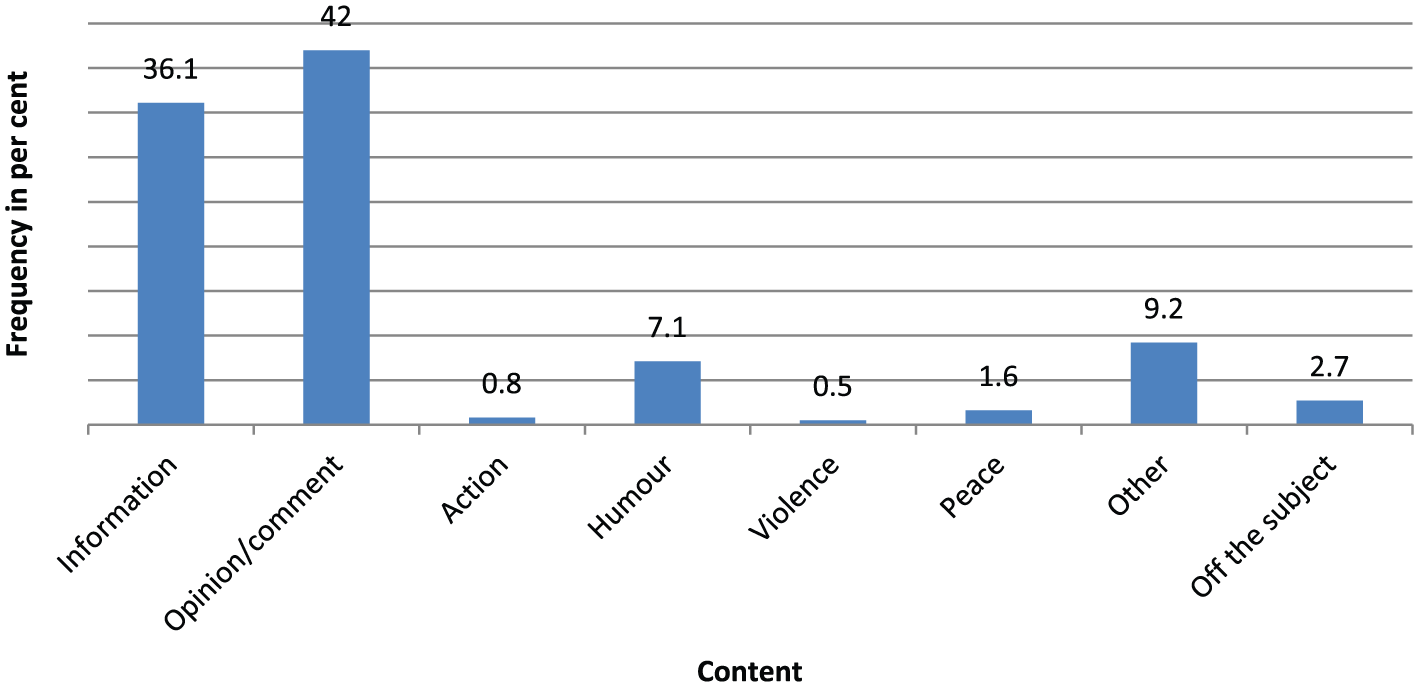
Frequency of content.
In late April 2011, a user wrote, for example, “Receiving many volunteers who declare themselves available for the creation of a psychological online- and telephone consultancy #civnext #civsocial” (tweet 11290).
Communication Patterns
A look at the communication patterns confirms these findings of comments and information as being the most used content. Less than 25% of the tweets contained a link, and around a third were retweets, indicating a high information sharing activity. The increase of retweets during the crisis confirms previous findings on information-sharing behaviors in the context of disaster by Kogan et al. (2015). Direct mentions—an indicator for comment and discussion—were found in approximately 40% of the tweets, as in March 2011, when users sent videos of acts of violence to international media to call for attention to the events happening in Côte d’Ivoire (tweet 5993; tweet 6045). However, a source was only indicated in 1.2% of cases, such as in this tweet from early 2011, referring to an article by the Ivoirian news website Abidjan.net: “The ONU investigates on arms supplies http://t.co/DrilhUg via @abidjan_net #civ2010” (tweet 1473). The higher amount of direct mentions in comparison to links and retweets indicates that, all in all, discussions were more common than information. It has to be noted, however, that conversations do not preclude the sharing of information. With regard to Weick (1993), the users may possibly also be engaged in sense-making activities in order to face the crisis.
Similar to previous research findings (Kogan et al., 2015; Oh et al., 2011; Qu et al., 2011), the interviewees reported on a high amount of locally actionable information such as the use of Twitter for social aims, helping to supply sick people with medicine, to find doctors for injured ones, to provide people with food and water, and even to create a system of transferring funds from the diaspora in Europe to Côte d’Ivoire. “Twitter was a kind of digital stage between the people in Abidjan, the Ivoirians here and elsewhere,” Person 11 (7) pointed out.
Twitter further served as an important tool of exchange and a channel of information—for the Ivoirian population in Côte d’Ivoire and the diaspora, as well as for international journalists, who used Twitter as a source of information, confirming previous research (Bruns et al., 2012; Meier, 2012; Mendoza et al., 2010; Shklovski et al., 2008). When mass media were used as propaganda tools, and fighting hindered journalists from reporting, social media provided different points of view and even replaced traditional media (Person 5, 23). As several interviewees reported scoops, such as the arrest of President Gbagbo, appearing first in social media before being confirmed by traditional media. Twitter further helped to verify information and to reject rumors through crowdsourcing information, for instance, by collecting eye-witness reports to confirm or reject a particular piece of information, making “every citizen into a journalist” (Person 2, 31). Several interviewees mentioned that Twitter became a fourth power, contributing to more transparency during the elections, for example, through a “civilian observatory for the organisation of the elections” (Person 1, 7-8), implemented by bloggers to document the elections online. Person 11 thus assessed Twitter as “a powerful instrument of clarification and watch” (32).
On the other hand, in line with previous studies (Mäkinen & Kuira, 2008; Schumann, 2015), results showed that Twitter was used to spread false information, rumors and propaganda, or to express threats and insults. It can thus be assumed that a Twitter Agenda developed online, which in part reflected the information given by the mass media and the political discourse going on offline, but more importantly brought up additional, fast and relevant information that traditional media was not able to deliver at that time of crisis and war.
Most Frequent Hashtags
All of the interviewees assessed #civ2010 and #civsocial as being the most important hashtags used during the crisis, clearly pointing out the difference between the two hashtags. #civ2010 was originally created to report on the elections, though later became highly politicized and dominated by verbal violence—as shown by the frequent use of insults or expressions of hate, hostility or anger. In answer to this, #civsocial was created in March 2011 to be dedicated solely to the organization of humanitarian help. “This hashtag really helped us,” reported Person 7,
businesses, banks, supermarkets and hospitals were closed. Illnesses and births don’t wait. All those who had problems wrote on #civsocial. We transmitted the message, we found a doctor, children were given birth to. Those who were ill asked their questions on #civsocial. [. . .] If there was anybody in the community who had a particular medicine that was looked for, we let somebody bring it to the person. There was also donation of blood.” (15)
Surprisingly, content analysis showed that only 0.3% of the tweets contained the hashtag #civsocial, whereas 98.7% only contained the hashtag #civ2010. Both hashtags were found in 1% of the tweets. These contradictory results can be explained by the fact that #civ2010 appeared 5 months before #civsocial and gained rapidly in popularity. The content analysis’ results thus have to be interpreted rather as a representative image of the Twitter activity of the hashtag #civ2010. Both methods further showed the appearance of a third hashtag around the end of the crisis: #kpakpatoya, which can be translated by “gossip” and was mainly used for jokes and entertainment. As shown by Kogan et al. (2015, p. 991), those humorous Tweets can be interpreted as a way to deal with the traumatizing events during the crisis.
Changes Over the Time Period
Considering that the electoral crisis in 2010 developed into a civil war in 2011, it is important to look at how the use of Twitter changed over time. The interviewees reported on a general increase in activity on Twitter during the course of the crisis, confirming previous findings on the use of information technologies during war by Mark and Semaan (2008). The content analysis confirms this appraisal, showing that the bulk of the 1,168 tweets was sent at the peak of the crisis, with 18.6% sent on 6 March, 32.0% on 28 March, and 20.7% on 26 April. With regard to the content, interviewees reported on the creation of new hashtags such as #civsocial to clearly differentiate political discussion on #civ2010—which over time had escalated into a platform of verbal violence and threats—from the organization of humanitarian help. These results confirm previous findings from Qu et al. (2011), who also found that the organization of social help took some time before appearing online. H2 assumed that, during the elections, Twitter was used particularly for opinion and comments, and with the outbreak of the crisis especially served as a source of information.
Results, however, showed that comments predominated on almost all analyzed days, except from late March and late May (see Table 1), refuting the initial assumption of the hypothesis.
However, results showed an increase of the number of links and retweets at the peak of the crisis, as assumed by H3. The chi-square test for this hypothesis turned out to be significant. These results suggest that, in times of war, Twitter served in particular as a source of information, as described by Bruns and Stieglitz (2012) as “gatewatching und news-sharing activities” (p. 176). With regard to the tone, H1 assumed that the messages’ tone would become more negative, the more the crisis progressed. For the whole analyzed period, the content analysis showed that over 94% of the tweets were written in a neutral tone, around 2% in a positive tone, and almost 4% in a negative one. The chi-square test did not give evidence for a deterioration of the tone over time. Interviewees perceived the tone as much more negative than it was found in the content analysis. Most bloggers mentioned the outbreak of verbal violence, such as Person 2, who explained that when “everything turned into a nightmare” (18), people gave vent to their displeasure and spread hate on #civ2010, reflecting the society’s rift. That social media can reflect the political atmosphere in a country is consonant with previous findings (Salleh, Fathir, & Rahman, 2015; Tumasjan et al., 2010). In this context, the bloggers further reported on a wave of anonymization of profiles following the decreasing condition of the country. These contradictory results of the content analysis and the interviews can be explained by the fact that the bloggers perceived negative tweets as particularly strong where they were threatened personally, as for example the following user: “@Ivoitou #civ2010 MY FRIEND you are ILL, we are going to treat you SOON!” (tweet 2865). Some bloggers even received death threats and saw themselves forced to go into hiding. In the mass of all tweets sent during the crisis, these negative tweets were simply drowned.
To answer RQ1.1: Twitter served both positive and negative causes. On the one hand, it was used for political debate, to spread and verify information—in particular in times when the mass media were flooded with propaganda or not able to publish anymore—and to organize humanitarian help during the war. On the other hand, Twitter became a platform for rumor, false information, verbal violence and threats, especially when the situation in the country deteriorated dramatically.
Users
Position
The analysis of the users investigated the most dominant users (H4) and the link between the user’s location, the content shared (H5), and the device used (H6). In regard to previous findings (Shklovski et al., 2008; Starbird & Palen, 2012), H4 assumed that journalists and bloggers were a more active and visible user group than others. Especially in terms of the organization of help, the interviewees identified bloggers disposing of technical know-how and an online community, as well as private individuals as the most active user groups. Those mentioned second were journalists and international media, politicians and their partisans, and the Ivoirian diaspora. Several bloggers explained that the crisis considerably contributed to the discovery of Twitter in Côte d’Ivoire, which until then had still been little known, confirming similar findings on Iraq by Mark and Semaan (2008). It can be assumed that Twitter thus was mainly used by people with a certain technical know-how and education, as pointed out by Person 4: “Not everybody has the capacity to give the 5 Ws in 140 signs” (48). The content analysis found that civilians were the authors of 20.3% of the tweets. In all, 4.1% were written by journalists and bloggers, whereas politicians and media institutions both made up only 1%. However, the majority of the tweets (72.8%) did not contain any information on the user’s position (see Figure 2). This can be explained by the fact that in response to the threatening situation online and offline, many people created new and anonymous accounts, as reported by several bloggers.

Most frequent users.
Activity and Visibility
The analysis of the users’ activity and visibility seems to confirm this point, showing that the conversations were dominated by very active but low-visibility profiles. As illustrated in Figure 3, active, very active and extremely active users made up 74.2%, confirming previous findings by Tumasjan et al. (2010). The majority of these very active users, however, did not indicate a particular occupation. Those who indicated personal details were found to be most often private individuals, with journalists and bloggers ranking second.
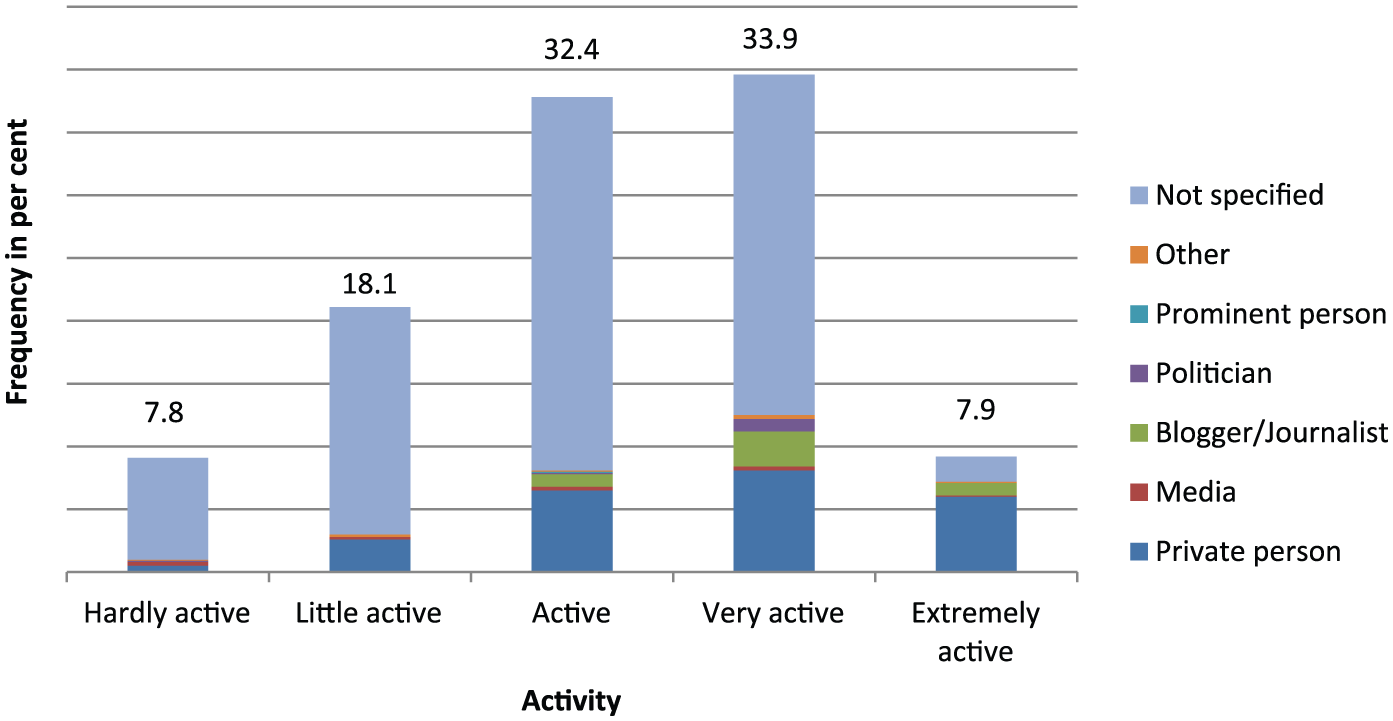
Activity (number of tweets sent from an account since its creation), depending on position.
Looking at the users’ visibility, we see that 58.8% of the tweets were sent by hardly visible users followed by a maximum of 100 people. Hardly any users were classified as very or extremely visible, with the most visible still being private individuals (see Figure 4).

Visibility (number of people following the user), depending on position.
Contradicting to H4, journalists and bloggers were neither the most active, nor the most visible cohort. These findings, being contradictory to previous research results (Shklovski et al., 2008; Starbird & Palen, 2012), can be explained first of all by the fact that the crisis only contributed to the discovery of Twitter in Côte d’Ivoire—as also found by Shklovski et al. (2008)—and second by the wave of anonymization of Twitter profiles. Furthermore, it is necessary to take into account that the content analysis’ results mainly reflect Twitter activity for the hashtag #civ2010, whereas several bloggers mainly reported on their activity on #civsocial.
Location
According to the interviewees’ appraisal, Twitter was used in Côte d’Ivoire as well as outside the country. Several bloggers further pointed out that Internet access stayed limited mainly to the big cities. Looking at the tweets’ language, the content analysis showed that almost 90% of the tweets were written in French, against only 10.4% in English, pointing to a strong use of Twitter by people living in Côte d’Ivoire, the Ivoirian diaspora and French-speaking (neighboring) countries. Whereas previous research found more people from outside the concerned country tweeting on the event than from inside the country (Starbird & Palen, 2011, 2012), in the case of Côte d’Ivoire the number of Twitter users in and outside the country was nearly the same. However, it also showed that most of the tweets (63.7%) did not contain the user’s location, which can be explained by the aforementioned anonymization of Twitter profiles. Among those users tweeting from Côte d’Ivoire, 12.4% were in Abidjan. This can be explained by the fact that in 2010/2011 Internet penetration in Côte d’Ivoire was still relatively small, as explained by Person 3: “I think that at that time we had less than two million Internet users. So if you compare two million with more than 20 million inhabitants, this only makes up 10%. So there were perhaps only 10% who managed to collect information via the Internet” (43). H5 assumed that the users’ location would have an influence on the content of their tweets. The chi-square test (p = .177), however, did not provide support to this hypothesis.
Mobile Devices
In this context, the study further investigated the significance of mobile devices for Internet access, with H6 assuming that these devices were used more often inside than outside Africa. “Taking today’s statistics, we have more mobile phones than toothbrushes on the African continent,” assumed Person 8 (53). “That means that you are going to find an illiterate having three mobile phones.” The content analysis, however, showed that altogether most of the people used fixed devices to access the Internet (44.1% of the users in Africa and 56.6% of the users abroad). Though looking closer at mobile use, we see that 23.3% of the users in Africa used a mobile device, whereas only 6.6% of the users outside Africa used a mobile device, speaking in favor of H6. The chi-square test further showed a significant difference (p = .000), providing evidence for this hypothesis. In addition to the high penetration rate of mobile phones in the country, these findings can be explained by the fact that during the crisis several Internet providers gave free fixed Internet access and mobile credit to the population that often was not able to leave their houses or pay their bills due to the ongoing war, as reported by several interviewees.
Role on Twitter
The interviews further looked at the bloggers’ personal role on Twitter, revealing positive as well as negative aspects. One person declared having spread—by order of the government—false information on social media which was later published in several local newspapers. “It was a communication battle. And in communication the first one who attacks is the one who wins,” the blogger pointed out (Person 4, 38). Still, the majority of the bloggers used Twitter for positive causes such as reporting on the elections, passing on information to people without Internet access or organizing humanitarian help. One of the bloggers indicated escape routes out of conflict zones: “I used Twitter to resume all information to see the focus of tension and violence, the ways you should take. And by this I managed to collect information on Twitter and to call people who were on their way” (Person 2, 13). This information transmission by highly connected people to either less technophile people or people not having access to the Internet can be interpreted as the existence of “technophile opinion leaders,” confirming previous findings by Shklovski et al. (2008). Another interviewee reported on the organization of seminars on the use of social media by the blogger-community, explaining to the citizens “why it was so important to use Twitter in exactly that time and how it worked” (Person 1, 10). This person later used eye-witness reports from Twitter to write blog articles on the ongoing crisis. Another blogger, being persecuted in Côte d’Ivoire, flew to the neighboring country Ghana, where he created a call center that combined telephone and Twitter to help people caught in the crisis (Person 1, 6). These findings point out that information did not initially come from the mass media, as suggested by the Two-Step Flow Model, but in most of the cases originated with the civilian population, was caught up by “technophile opinion leaders,” and thereafter spread to their online communities. This rather speaks for a Multi-Step Flow of Communication—as suggested by Sup Park (2013)—that widens the Two-Step Flow model by the components of the virtual opinion leaders and the isolated individuals (Eisenstein, 1994, pp. 153-154). These findings stress the potential of social media in times of war and a context of non-functioning of traditional media.
To answer RQ1.2, results show that people in Côte d’Ivoire, as well as from outside the country, tweeted on the crisis. The conversation on Twitter was dominated by very active, but hardly visible users who for the most part were civilians as well as journalists and bloggers, though the majority of users did not indicate a personal description, pointing to an anonymization of profiles due to the deterioration of the situation offline as well as online. Even though, in the mass of users, bloggers only made up a small share, they seem to have played an important role as information transmitters and organizers of humanitarian help.
Function
Asking about the function of Twitter for media diversity during the Ivoirian crisis, the interviews looked at different factors potentially having an influence on this diversity.
In terms of the factors limiting the social network’s influence, the bloggers cited the still limited number of Internet users as well as the insufficient Internet connection in Côte d’Ivoire in general in 2010/2011. Other points mentioned were the lack of know-how for the use of Twitter as well as the much bigger popularity of Facebook in the country. Several bloggers further stressed that in developing countries traditional media such as radio and TV still are more important than the Internet. Other mentioned factors limiting access were a rate of illiteracy of about 50%, current power cuts and a lack of financial means.
Among the factors potentially increasing the function of Twitter, it was mentioned that the network took on an important information and communication role in times when traditional media were used as propaganda tools or were not able to operate anymore because of the fighting. Furthermore, several bloggers reported that, at a certain moment, sending out text messages via mobile phones was not possible anymore even though Internet access was ensured during the whole crisis thanks to the local telephone companies providing free Internet access to their subscribers. Some bloggers further mentioned that the information on social media was given much faster than on traditional media, which confirms previous research findings (Oh et al., 2011; Shklovski et al., 2008). In contrast to other social media such as Facebook, Twitter was preferred because of its speed, immediacy, easy use via hashtags and its global reach. Several interviewees emphasized the increasing activity and user numbers as the crisis progressed. Some also pointed out that the crisis actually led to the discovery and popularity of Twitter in Côte d’Ivoire, corresponding to previous findings by Shklovski et al. (2008).
To answer RQ1.3, Twitter certainly had a positive impact on the dissemination of information and the diversity of opinions in a context of crisis, war and limited media freedom. It in part even replaced traditional media in their societal functions of information, opinion-building, criticism, and watch. Though taking into consideration the limited Internet penetration in 2010/2011, the high number of illiterate citizens as well as the existing media use habits favoring traditional media such as radio and television and Facebook among the social networking services, it has to be assumed that this potential was exhausted to only a very small extent.
Discussion
This study examined the role of Twitter for information diffusion and opinion-building during the post-electoral crisis in 2010/2011 in Côte d’Ivoire, combining qualitative expert interviews and a content analysis of Twitter. Findings showed that Twitter served on the one hand as a fifth power—while the mass media were not able to fulfill their societal functions, being used as propaganda tools or not operating anymore due to the oppression of press freedom and violence breaking out. Twitter during this time offered an anonymous platform, stimulating political discussion and thus considerably contributing to opinion-building, confirming similar findings by Mark and Semaan (2008). A Twitter Agenda developed, reflecting the political situation in the country, as found by previous studies (Salleh et al., 2015; Tumasjan et al., 2010). Particularly at the height of the crisis, it was used for information sharing, indicated by an increase of links and retweets. These strong intergroup dynamics may also speak for the use of sense-making activities (Weick, 1993) during the crisis. Twitter was further used to verify information and to reject false information, for instance, through the collection of eye-witness reports.
As interviewees reported, information given online was often locally more relevant and given faster than by traditional media. On the other hand, Twitter was also used as a platform for verbal violence, rumors and fake news. The main hashtag #civ2010, originally created by bloggers to report on the presidential elections and bring more transparency to the electoral process, turned into a sheer online battlefield. For this reason, bloggers started #civsocial, a new hashtag that was exclusively dedicated to social aims: doctors were found and sent to those injured, children were given birth to, and refugees were shown escape routes out of the conflict zones.
In compliance with previous research (Shklovski et al., 2008; Starbird & Palen, 2011), findings further point to the existence of technophile opinion leaders, mainly including committed citizens, bloggers and journalists, that are particularly active in the context of organizing humanitarian aid during the war. These opinion leaders collected information online and offline and spread it to the online community as well as to less technophile citizens, providing evidence for a multi-step process as suggested by Sup Park (2013). Contrary to this study, which found users in almost equal shares in Côte d’Ivoire—and especially in the economic capital of Abidjan as well as abroad—previous research identified those information transmitters as mainly living abroad (Starbird & Palen, 2011, 2012). In the case of Côte d’Ivoire, we further see the importance of mobile phones, with Twitter being used more often via mobile devices in the country than abroad. This can be explained by the fact that Internet access was ensured during the whole crisis thanks to local telephone companies providing free Internet access and telephone credit to their subscribers.
The Internet entails factors that not only increase but also decrease media diversity (Neuberger & Logis, 2010). The degree of a country’s development obviously has an important influence on these factors. In the case of Côte d’Ivoire, several factors considerably limited the access to Twitter for a relevant part of the population. Among these factors are insufficient know-how and financial resources, the limitation of Internet access to big cities, an illiteracy rate of 43.1% (UNDP, 2013, Table 1) as well as the popularity of traditional media such as radio and television especially in regions without Internet access. Whereas in 2010/2011 Facebook already was well known in Côte d’Ivoire, Twitter was still relatively unknown. However, results suggest that the crisis considerably contributed to the discovery of Twitter in the country, corresponding to previous findings by Shklovski et al. (2008). As results of the interviews showed, information flows are not concentrated on one platform only. It can thus be assumed that Twitter played an important role in a mechanism of information-sharing between technophile opinion leaders, their community of engaged citizens and people without Internet access.
Some limitations have to be kept in mind when interpreting the results. First of all, this study has only analyzed the social media content and the communicators’ perspective. Further research should also look at the recipients’ perspective, to be able to make valuable statements on the influence of social media. Besides, the coverage of traditional media, Twitter and other social media should be compared, to be able to better interpret the importance of a particular channel. Analyzing an event several years later also bears the risk that important online content has been deleted over the years, and experts suffer memory gaps. Further studies should realize a content analysis in parallel to the course of the event and conduct interviews as closely as possible to it. Finally, as interviews are known to be a reactive method, it has to be assumed that some questions might have evoked socially desirable answers. To investigate opinion leadership, further studies should consider using quantitative content analyses to visualize information flows and identify influential users on Twitter, for instance, by using the number of retweets as a measure of popularity, as suggested by Starbird and Palen (2012).
Nevertheless, this study points to the important potential of social media for information diffusion and verification, opinion-building and the organization of help in a context of repression and violence. The fact that Twitter was more often used via mobile advices in Côte d’Ivoire than outside the country is indicative of the strong potential of the high mobile penetration rate in the region. In future crises, help organizations, for instance, should consider using mobile phones and social media to inform the population concerned and to come to their assistance, as was done by the bloggers and civilians in Côte d’Ivoire. Results have shown that political discussion was one of the main reasons for turning to Twitter. Particularly in African countries, politics should thus pay more attention to the potential of social media and make stronger use of it for their communication—not solely during election campaigns. Especially in Africa, where around 50% of the population is under 20 years of age (Unicef, 2014, p. 18), even though the ruling political class is often far above the average age of the population, the Internet and social media could be an important means of involving youths in politics and contributing to a committed society. Social media has the potential to give a voice to the population and to contribute to more transparency and democracy. As the Internet gains in importance as an information channel, particularly for the young generation, it could be used to publish job offers and thus fight youth unemployment and bring about economic development.
Finally, in times where fake news is even spread by high-ranking politicians of the Western world, the question as to how to avoid rumors and false information on social media is particularly important. In recent years, most of the Western media institutions have already implemented diverse methods to verify the authenticity of social media content. In addition, social networking services have to take more responsibility in order to avoid inappropriate content on their websites, and they should develop programs to identify and stop intentionally spread fake news, as already started by Facebook this year. Furthermore, there is also a responsibility to the user, who needs assistance not only in developing countries in gaining media literacy. Technophile opinion leaders that are highly connected and listened to could play an important role in this education, as we have already seen in Côte d’Ivoire, where bloggers now hold social media seminars.
Footnotes
Acknowledgements
I would like to thank the supervisors of my master’s thesis Dr. Annika Sehl and Prof. Dr. Volker Lilienthal from the University of Hamburg. I specially thank my reviewers for their insightful comments and assistance.
Declaration of Conflicting Interests
The author(s) declared no potential conflicts of interest with respect to the research, authorship, and/or publication of this article.
Funding
The authors disclosed receipt of the following financial support for the research, authorship, and/or publication of this article: This research was possible by a Grant from the Übersee-Club e.V.