




Abstract
This paper identifies the visibility practices of Japanese Twitter users supporting Ukraine during Russia’s 2022 full-scale invasion. Studies of digital visibility often suggest that moral goals and ideals are not attainable in such practices, as they clash with conditions of visibility configured by social media. This has led scholars to suggest that moral paradoxes, or the need to reconcile conflicting considerations, are the main characteristic of visibility on social media platforms. In this study, through an innovative mixed-methods approach for analysing visibility practices, I also outline several moral paradoxes underlying practices through which Japanese Twitter users enhance or decrease the visibility of actors associated with Russia’s war on Ukraine. However, by adopting the conceptual approach of ‘ethics as practice’ which emphasises the moral considerations of practitioners when faced with a moral conundrum, I argue that users driven by the moral call to support Ukraine recognise the limitations of Twitter’s regime of visibility. Their grappling with the identified paradoxes as they engage in visibility practices is what gives moral value to these practices.
Introduction
Noah, 1 a 50-something Japanese woman, logs daily into one of her several Twitter (now ‘X’) accounts to ‘boost’ Ukrainian fundraisers and search for pro-Russian accounts violating the platform’s Terms of Service. In our conversation, Noah recounted an online acquaintance who ‘declared that every minute that she isn’t working or eating, or doing life necessary things, she would be reporting [Terms of Service violations] on her smartphone’. After a year of engaging in extensive reporting, Noah’s acquaintance had to take a break – despite this dedication, she felt burnt out and disillusioned as many accounts she helped suspend kept returning to the platform.
The objective of reporting accounts and other diverse user practices on Japanese Twitter was to help Ukraine, a country eight thousand kilometres away from Japan. Despite this geographic distance and lack of historic ties, for the first time since the start of Russia’s war on Ukraine in 2014, it had become visible in Japan. The word ‘Ukraine’ was announced as the number one trending topic on Japanese Twitter/X 2 in 2022 (#Twitter Torendo Taishō Jikkō Iinkai [Executive Committee of #Twitter Trend Grand Prize], 2022). Increased visibility of the war is important because the insignificance of Ukraine in the eyes of the world emboldened Russia to escalate in 2022 (Khromeychuk, 2023). As Olesya Khromeychuk (2023: para. 1) puts it, ‘[b]eing seen, however, is not the same as being understood’.
The connection between the visibility of actors and their recognition as worthy of attention, action, or potential understanding, has been questioned through the notion regimes of visibility (Brighenti, 2008; Chouliaraki and Stolic, 2017; Magalhães and Yu, 2022a). Scholars interrogating visibility conceptually or through interpretive textual analyses argue that broadcast, networked, and especially algorithmic media pre-set the conditions of how actors can be made visible, but rarely help achieve recognition of Others as morally worthy and autonomous beings (Honneth, 1997). However, to understand mediated visibility regimes’ connection to morality, we must also consider how users enact their ideas about good and bad in their practices enabled and constrained by these environments (Clegg et al., 2007). In this study, I ask: ‘how do Japanese Twitter users practice morality in their visibility practices supporting Ukraine during Russia’s full-scale invasion?’
This study addresses the gap between scholarly criticism of platforms and users’ experience of enacting morality in such spaces (Magalhães and Yu, 2022b). It focuses on the Japanese segment of Twitter – the company’s second-largest market and the second-most popular social media platform in the country (Nagata, 2023; NTT Mobile Society Research Institute, 2023). Methodologically, I combine network and textual analyses with scroll-back interviews (Robards and Lincoln, 2019) of Japanese Twitter users and interpret the data using an ethics-as-practice approach (Clegg et al., 2007; Gherardi and Rodeschini, 2016; Toffoletti et al., 2023). The findings of the study support the idea (Magalhães and Yu, 2022a, 2022b) that recognition and broader moral goodness are not realised easily through networked and algorithmic visibility regimes of the platform due to several paradoxes: the difficulty of maintaining focus on distant Others in a self-centred socio-technical environment (paradox of focus); the difficulty of combining deep engagement with a distant war and similar attention to other crises (paradox of depth of field); and lack of understanding of visibility practices as moral, or enacting judgement on good and bad, by the platform (paradox of governance).
However, I argue that users driven by the moral call to support Ukraine following the unjust and cruel invasion, recognise the limitations of Twitter’s regime of visibility. Rather than submitting to these paradoxes, Ukraine supporters on Japanese Twitter tactically navigate them, enacting moral judgement together with other users. Users’ grappling with the identified paradoxes as they engage in visibility practices is what gives moral value to these practices.
Visibility practices and moral paradoxes on social media
As a sociological category, visibility refers to the interplay between sensory, symbolic, and technological aspects of who or what can (or cannot) be seen (Brighenti, 2007, 2008, 2010). While we may seek or avoid visibility for instrumental reasons, visibility also has moral implications (Millette, 2015), as recognised in seminal studies of visibility as a sociological concept. In these formative studies, visibility is connected to morality as it divides actors by the degree of their prominence, with highly visible actors becoming models or monsters to be emulated or shunned (Brighenti, 2007). In addition, being ‘seen’ by other individuals and institutions is a necessary condition for being recognised as a morally worthy being (Brighenti, 2007; Honneth, 1996).
Visibility is established and maintained through ‘huge work that human beings do […] tirelessly’ (Brighenti, 2007: 327), relying on various media that configure the conditions of visibility (Brighenti, 2008). In other words, it is inevitably a result of an interplay between the properties of media and human action. The former aspect of this interplay is often conceptualised through the notion of ‘regimes of visibility’, or socio-technical and biopolitical conditions that ‘set up the normative dimensions of the visible’ (Brighenti, 2010: 45; see Chouliaraki and Stolic, 2017; De Backer, 2019; Geboers and Van de Wiele, 2020, inter alia, for empirical application). In contrast, to conceptualise what humans do to establish and maintain visibility using media, scholars tend to use a concept of ‘practices’ (e.g. Bishop, 2018; Geboers, 2019; Savolainen et al., 2022; Yu, 2020) or ‘visibility practices’ (e.g. Duffy and Meisner, 2023; Lokot, 2018; Stegeman et al., 2024). The parameters for visibility set up by socio-technical environments, and the moral goals and values of humans acting in such environments, often conflict, resulting in moral paradoxes (Magalhães and Yu, 2022a). As I will elaborate, previous studies have identified several such paradoxes, and this paper furthers this work by focussing on paradoxes specific to social media practices of solidarity with suffering distant Others. However, scholarship has overlooked how social media users themselves navigate such paradoxes. This study addresses this gap by adopting the approach of ‘ethics as practice’ to the study of visibility practices on social media.
The notion of practices as a unit of analysis has been increasingly utilised by studies of media and communications, following Couldry’s (2004, 2012) call for the field to engage with practice theory (Gherardi, 2012; Nicolini, 2012; Schatzki et al., 2000). Visibility practices on social media have attracted scholarly attention as they simultaneously perpetuate and challenge the conditions of visibility pre-configured by the recommender and other algorithms (Bucher, 2012, 2018; Magalhães and Yu, 2022a). Utilising practical knowledge of algorithms (Cotter, 2024) gained through research, experimentation (Magalhães, 2018) and interaction with others (Bishop, 2019), users act tactically (De Certeau, 1984) in ways that contradict and subvert power enacted over them. Not only activists (Lokot, 2018; Uldam, 2018) or creators who rely on social media visibility to sustain themselves (Bishop, 2018; Cotter, 2024; Duffy and Meisner, 2023; O’Meara, 2019; Stegeman et al., 2024), but also broader groups of users (Duffy and Pooley, 2017; Savolainen et al., 2022; Yang, 2016; Yu, 2020) adjust contents and style of their posts and collaborate with others to have their posts prioritised by the recommender algorithms or avoid moderation and surveillance (Duffy and Meisner, 2023; Stegeman et al., 2024; Yang, 2016).
User practices on social media platforms can also be directed towards the visibility of others. Platforms’ affordances such as hashtags or reposts can be used to learn about and share with others the plight of suffering strangers (Geboers, 2019; Geboers and Van de Wiele, 2020; Mortensen and Trenz, 2016). They can also be weaponised by monitoring adversarial actors (Lokot, 2018; Uldam, 2018), highlighting certain accounts to hostile groups, or releasing personal details as a form of vigilantism (Massanari, 2018; Trottier, 2017). To prevent algorithms from picking up on keywords associated with adversaries and decrease traffic to their pages or accounts, users leverage screenshots and omit or rephrase particular keywords (Van der Nagel, 2018). Lastly, by unfriending, muting, or blocking, unpleasant or hostile others can be made invisible to oneself (Yu, 2020).
In this way, the moral implications of visibility are not pre-determined by visibility regimes – as Lyon (2017) suggests, visibility guarantees neither oppression nor recognition. The same platform features that allow activists to monitor oppressive governments for the betterment of society (Lokot, 2018) are harnessed against activists by authorities and corporate actors (Uldam, 2018). This is just one of many paradoxes of visibility on social media platforms – others include perpetuation of visibility of already visible actors (Bucher, 2012; Duffy and Pooley, 2017; Neumayer and Rossi, 2018), inevitable upholding of societal standards when attempting to subvert them, and incentives to engage in a form of self-presentation when wanting to promote a broader cause (Mitra and Witherspoon, 2022; Savolainen et al., 2022). Magalhães and Yu (2022a) posit that paradoxes are the main characteristic of visibility on social media platforms. Despite this, as illustrated in Figure 1, only a handful of studies examine how users themselves navigate these conundrums in their visibility practices. Overview of visibility practices by social media users identified in prior literature. Studies in bold examine users’ perspectives on moral or normative aspects of visibility practices.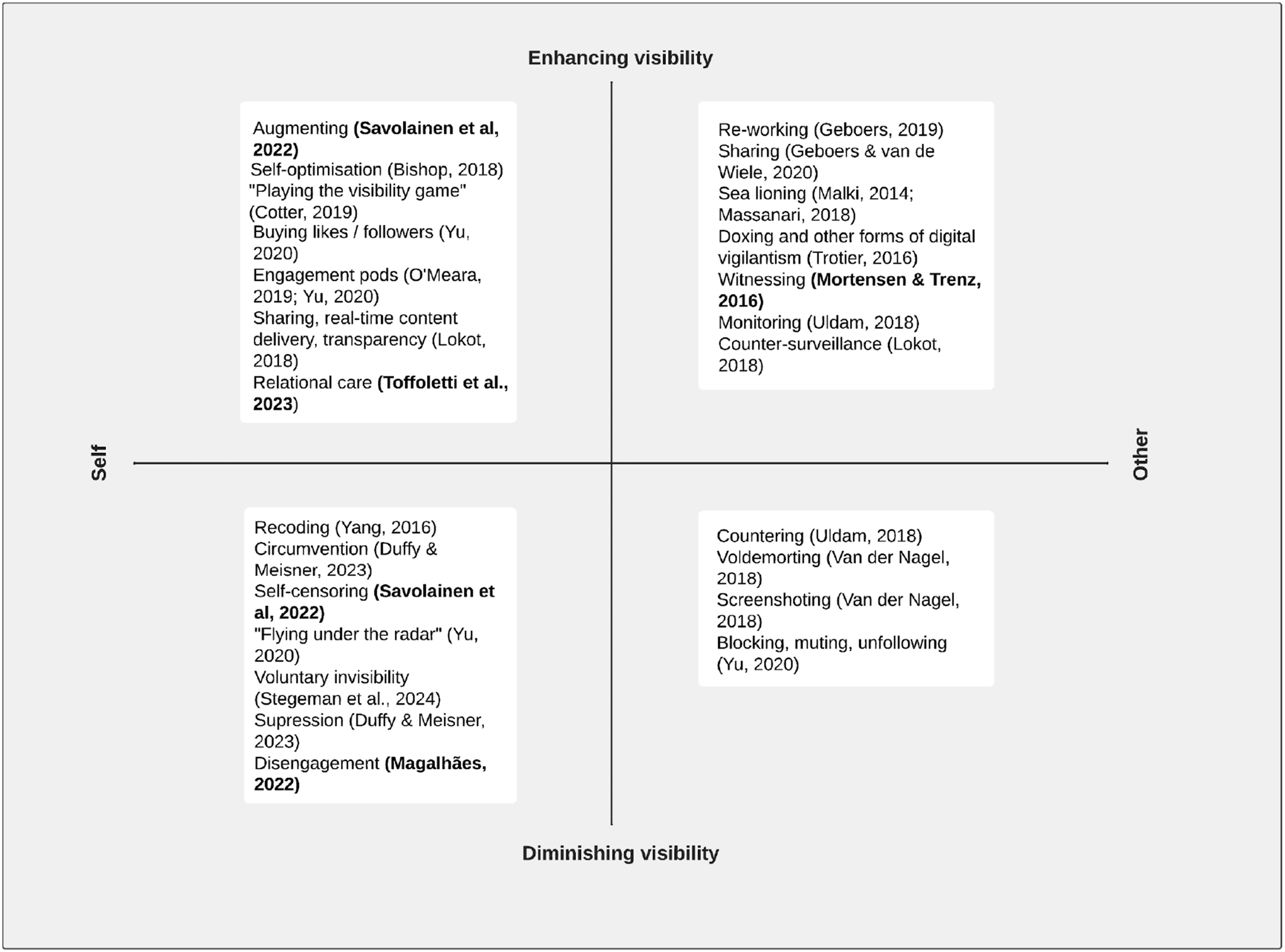
How we make sense of paradoxes related to our visibility practices is a part of ethical work through which we continuously become our desired selves (Magalhães, 2018; Weiskopf and Hansen, 2023). As Nelson (2018) argues, it is interrelated with other aspects of our individual and collective moral being. This study addresses the lack of scholarly attention to this aspect of visibility practices by focussing on a moral issue of solidarity towards suffering distant Others (Mortensen and Trenz, 2016) during Russia’s war on Ukraine.
It captures users’ moral puzzles through a perspective of ethics as practice (Clegg et al., 2007; Weiskopf and Willmott, 2013) – a conception of ethics that takes as a starting point choices people make in the face of moral dilemmas, as opposed to prescribed norms about good and bad. This approach prompts scholars to examine ‘how ethics are differentially embedded in practices that operate in an active and contextualized manner’ (Clegg et al., 2007: 111). It has been applied empirically to practices of aged care (Gherardi and Rodeschini, 2016), moral dilemmas of whistleblowers (Weiskopf and Willmott, 2013), ethnography of social enterprises (Bhatt, 2022), and more. A small number of studies (Neyland, 2016; Weiskopf and Hansen, 2023) have used the approach to consider the moral dilemmas of developers and users of algorithmic systems. In addition, while not explicitly aligning themselves with the ethics as practice approach, interview-based studies of feminist Instagram users (Savolainen et al., 2022; Toffoletti et al., 2023) examined practices of social media use and identified participants’ reflections on normative dilemmas. In addition to the theoretical contribution through highlighting users’ perspectives on paradoxes of morality in algorithmically networked environments during wars and crises, this study proposes a methodology for more systematic identification and classification of visibility practices that can enable consideration of their moral aspects.
Case studies
The 2022 full-scale invasion is a part of the ongoing war of Russia against Ukraine which began with Russia’s 2014 annexation of the Crimean Peninsula and undeclared incursion into Eastern Ukraine (Boichak and McKernan, 2022; Galeotti, 2016). However, before 2022, the visibility of the war in Japan matched Europe and North America – following the initial media attention, it was unnoticed. At the time of writing, Russia’s 2022 invasion killed at least 12 thousand Ukrainian civilians, with the actual number estimated to be much higher (Janowski, 2023). Following the full-scale invasion, the public visibility of the conflict in Japan increased, while the country’s foreign and defence policy stance shifted towards stricter sanctions on Russia, increased military spending, and a more permissive approach to military exports (Kawada and Ganaha, 2024; Tsuruoka, 2022). Japan also overturned the country’s long-standing strict refugee regulations to host more than two thousand Ukrainians (Dasgupta, 2022), introducing a special status of quasi-refugees in 2023 (Ueda, 2023). However, there was no consensus on what the changes meant for the country’s refugee policy long-term. Some experts saw this as an indication of a much-needed broader change (Rehm, 2023). Others interpreted the persistent refusal to call Ukrainians ‘refugees’ in official language as a sign of the Ukrainian case being an exception not to be extended to other groups (Yamagata, 2023).
Globally, Russia’s invasion of Ukraine caused a shift in the epistemology of warfare, as co-constitution between digital technologies and everyday user practices blurred the boundaries between civilians and combatants (Boichak and Hoskins, 2022). Social media platforms are an important part of ‘battlefront assemblages’ (Boichak, 2019), with Twitter enabling and constraining the practices of diverse actors: from propaganda and disinformation operations by Russian embassies (Graham and Thompson, 2022) to activities of NAFO (North Atlantic Fella Organisation) – an online collective of tens of thousands of users combating such propaganda (Boichak and Hoskins, 2022).
Japanese Twitter is a compelling subject of study for two reasons. First, Japan is geographically and culturally removed from Ukraine, offering an important opportunity to understand how social media platforms enable moral engagement with a distant war. It is also a nation with one of the highest per capita Twitter users and volume of traffic (Hino and Fahey, 2019). Japanese Twitter has a distinct culture of both everyday (Acar and Deguchi, 2013; Hallinan et al., 2023) and crisis use (Wilensky, 2014); and hosts diverse communities ranging from anime fans (Nishimura, 2013) to partisan political publics (Yoshida et al., 2021) including both extreme right-wing (Takikawa and Nagayoshi, 2017) and feminist movements (Mizoroki et al., 2023). Like other Twitterspheres, it has been disrupted following Elon Musk’s takeover of the platform in late 2022 (Nagata, 2023). This paper examines how two overlapping communities of Ukraine’s supporters practised morality in light of Twitter’s changing regime of visibility.
The communities and issues examined in the study were selected due to their prominence in public engagement with Russia’s war on Ukraine. NAFO, or North Atlantic Fella Organization, started on Twitter as a meme mocking Russia’s military efforts in May 2022 and expanded into a self-mobilised global community (Kasianenko and Boichak, 2024). Recognised for their Shiba Inu dog avatars, NAFO members, or ‘fellas’, use humour to derail Russian propaganda efforts and raise funds for the Ukrainian military. While not devoid of contestation and controversy (Dougherty, 2023), NAFO fellas have been recognised for their online activism (Gilbert, 2023). Japanese users are not central to NAFO but act both as a linguistically distinct part of the collective and as members of broader NAFO and more organised regional initiatives, such as the NAFO Asia Pacific Regiment (Figure 2). In addition to Japanese NAFO, there are other Japanese users vocally supportive of Ukraine. In this study, I utilised the issue of Ukrainians fleeing the war to Japan as an entry point for the identification of such users. Participants from both groups acknowledged that there is no strict boundary between the two, often referring to themselves as ‘Ukraine supporters’ (ウクライナ支援者). Logo of the NAFO Asia Pacific Regiment. Reproduced with the permission of the group.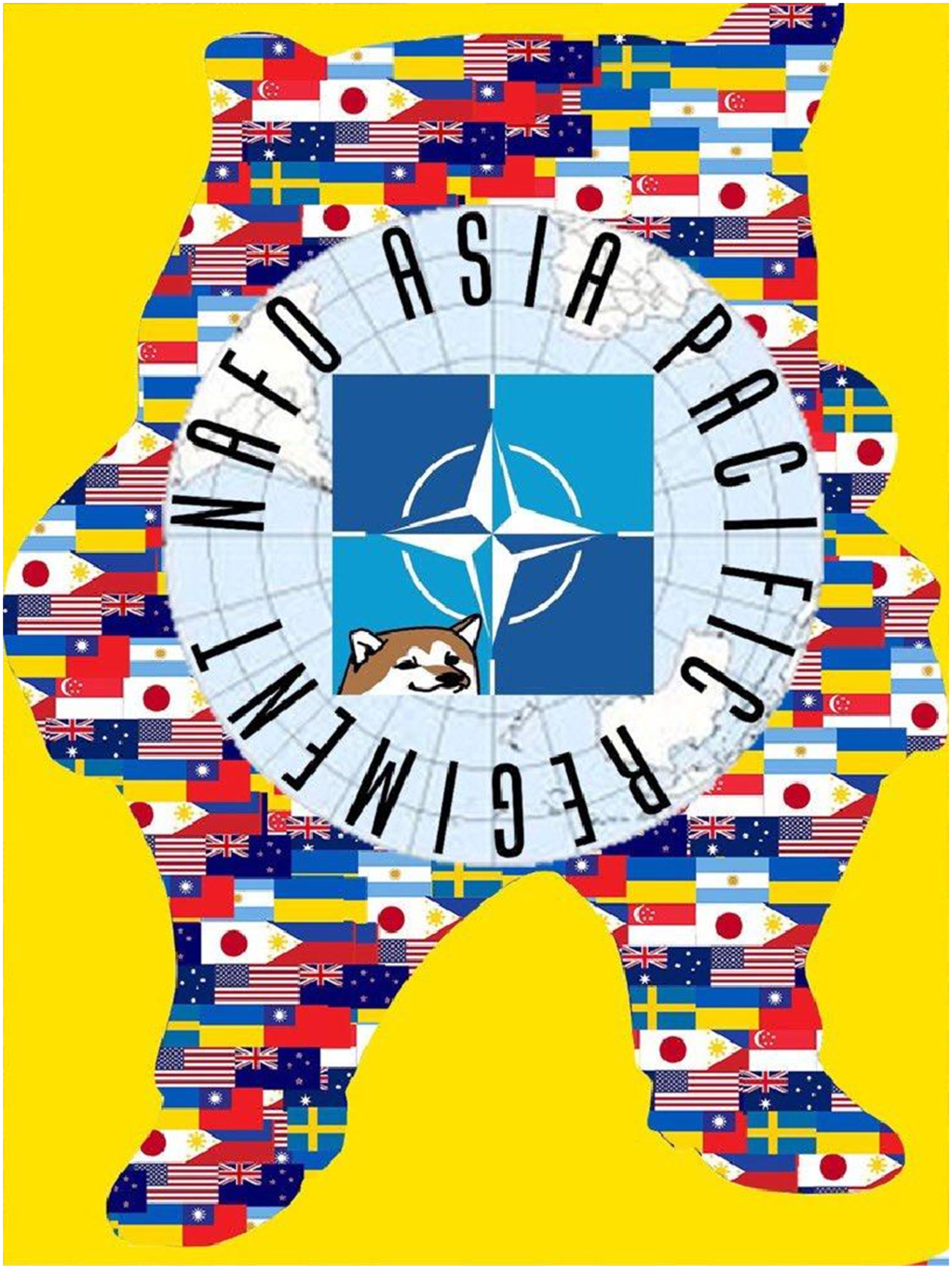
Methodology
Twitter datasets used in the study.

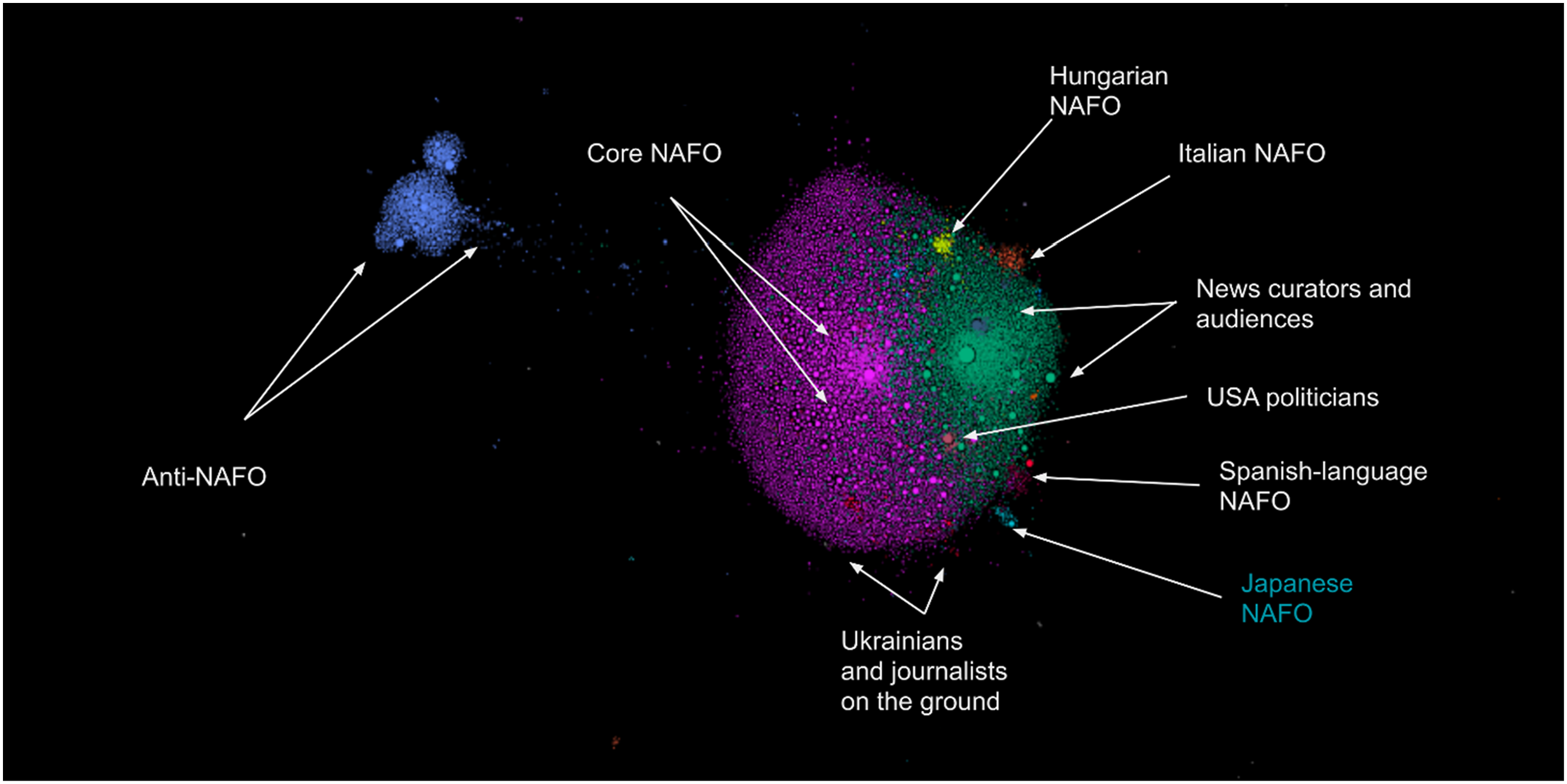
This step allowed me to fulfil two objectives. First, it helped pinpoint two distinct user practices: fundraising and news curation. The prominence of news-related hashtags in the refugee dataset (Figure 3), news-related clusters present in retweet networks constructed from both datasets (Figures 4 and 5), and two fundraising-specific clusters in the Refugee dataset (Figure 5) served as evidence for the prevalence of these practices. Second, it enhanced my understanding of the broader environment where users undertook other visibility practices in support of Ukraine. Such understanding is necessary, as studies adopting ethics as practice approaches (Gherardi and Rodeschini, 2016; Toffoletti et al., 2023) advocate for context-specific examination of the setting in which moral judgement is mobilised in the activities of practitioners. Change in hashtag volume over time (‘Refugee’ dataset, filtered by top-20 most used hashtags). Directed retweet network of the ‘NAFO’ dataset visualised using Gephi software and Force Atlas 2 algorithm (Bastian et al., 2009; Jacomy et al., 2014). 27,321 nodes, 746,030 edges, modularity = 1, weighted degree ≥ 15, giant component filter applied to remove nodes outside of the main clusters. Directed retweet network of the 'Refugee’ dataset. 31,692 nodes, 148,311 edges, modularity = 1, weighted degree ≥ 3, giant component filter applied.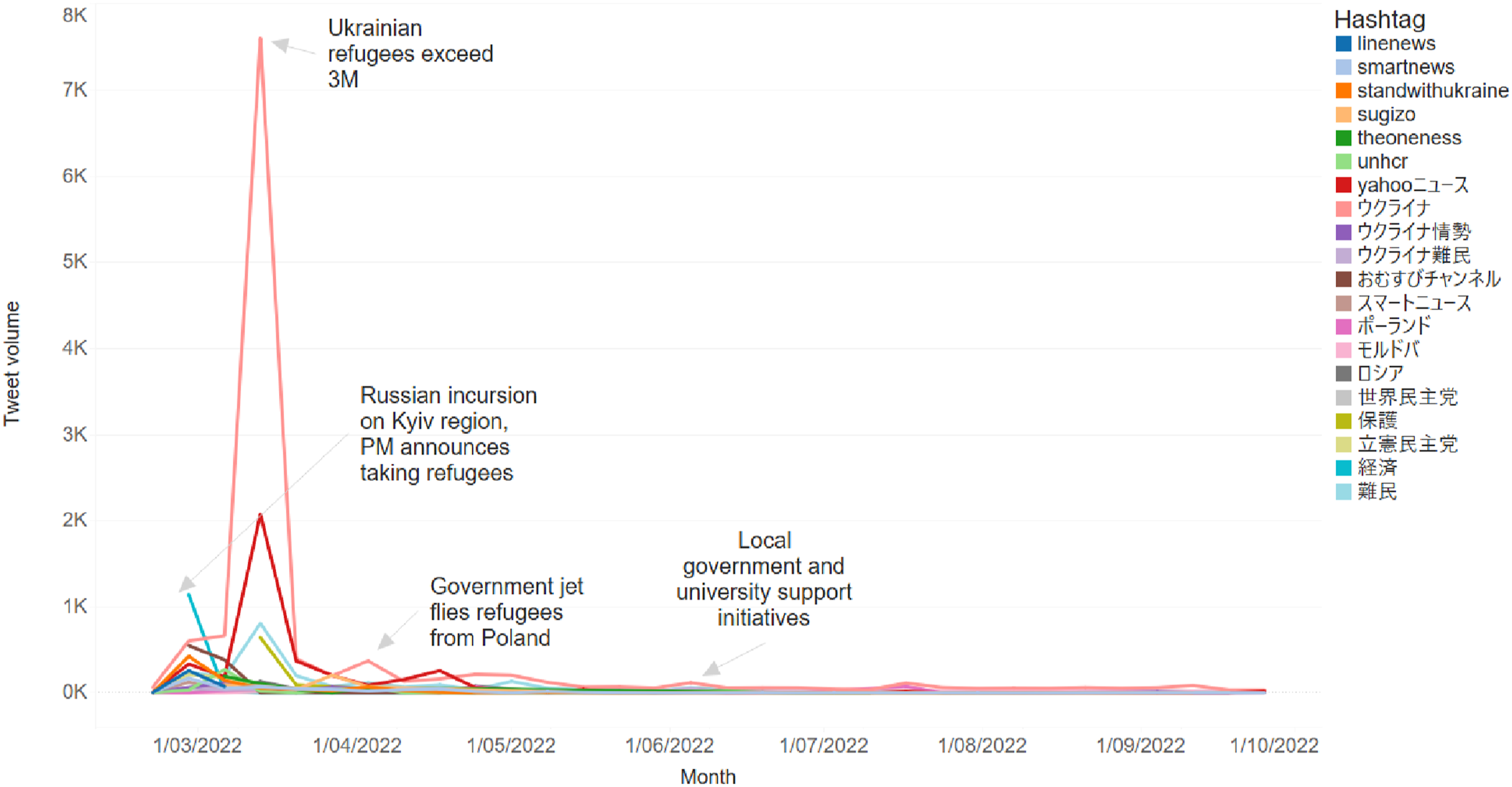
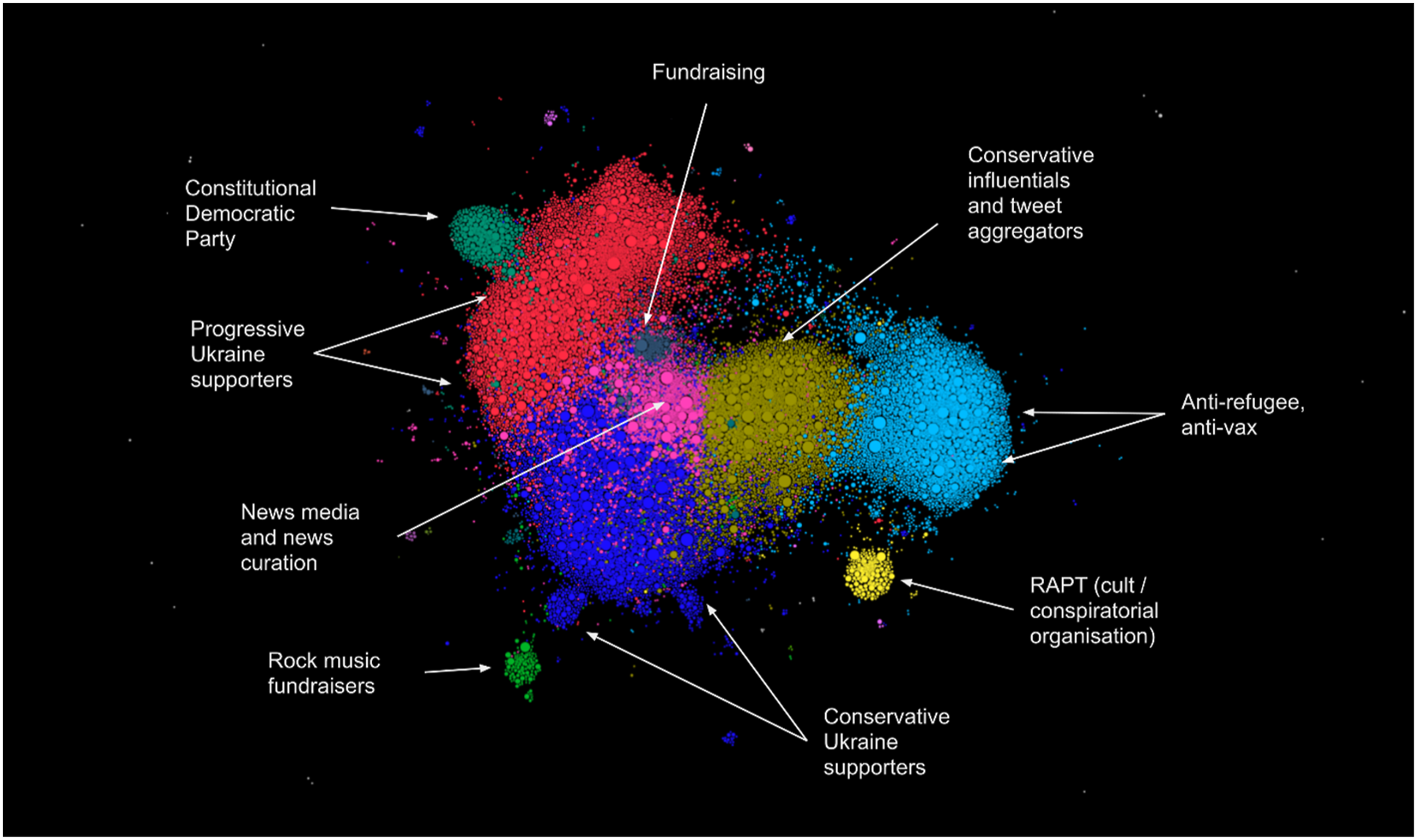
To capture practices beyond news curation and fundraising, the following steps in my methodological workflow needed to diverge from issue mapping. First, during the qualitative analysis of texts, I used Gherardi’s (2012: 125) analytical schema for discursive practice identification, whereby I identified ‘what is said, what is meant, what is done, and what the doing does’ in the analysed texts. Second, I conducted semi-structured interviews with 10 users supportive of Ukraine, recruited through purposive and snowball selection, to capture motivations, tactics, and contestations corresponding to practices from the perspective of practitioners. The interviews did not include explicit questions on moral judgements (see the interview guide in Kasianenko et al., 2024) – this topic has arisen organically. The interviews incorporated an element of the scroll-back method (Robards and Lincoln, 2019), where participants were invited to comment on their past posts as co-analysts of the traces of their practices. During the selection of interview participants and random samples of texts for qualitative analysis, I relied on users belonging to a cluster of interest in the networks mentioned above to infer their political leaning and the types of practices they are likely to engage in.
To interpret the interview responses, I followed an inductive approach from previous studies examining morality in practices of social media use (Savolainen et al., 2022; Toffoletti et al., 2023). I focused on utterances referring to passing a moral judgement, and other ‘patterned and recurring contradictions and inner struggles’ (Savolainen et al., 2022: 562) related to managing the visibility of Self and Others in digitally networked spaces. Following the grounded theory approach (Corbin and Strauss, 2014) and using NVivo software, I first assigned codes summarising parts of interview responses that were relevant to the above focus. I then grouped thematically similar codes to formulate moral considerations. The next section discusses these considerations together with the visibility practices they corresponded to. Finally, as I elaborate further, I conceptually connected a number of these moral considerations to broader paradoxes of visibility on social media.
Visibility practices and moral considerations of Ukraine supporters on Japanese Twitter
Practices of Japanese Twitter users supportive of Ukraine aimed at enhancing or diminishing visibility of oneself or others during Russia’s full-scale invasion.
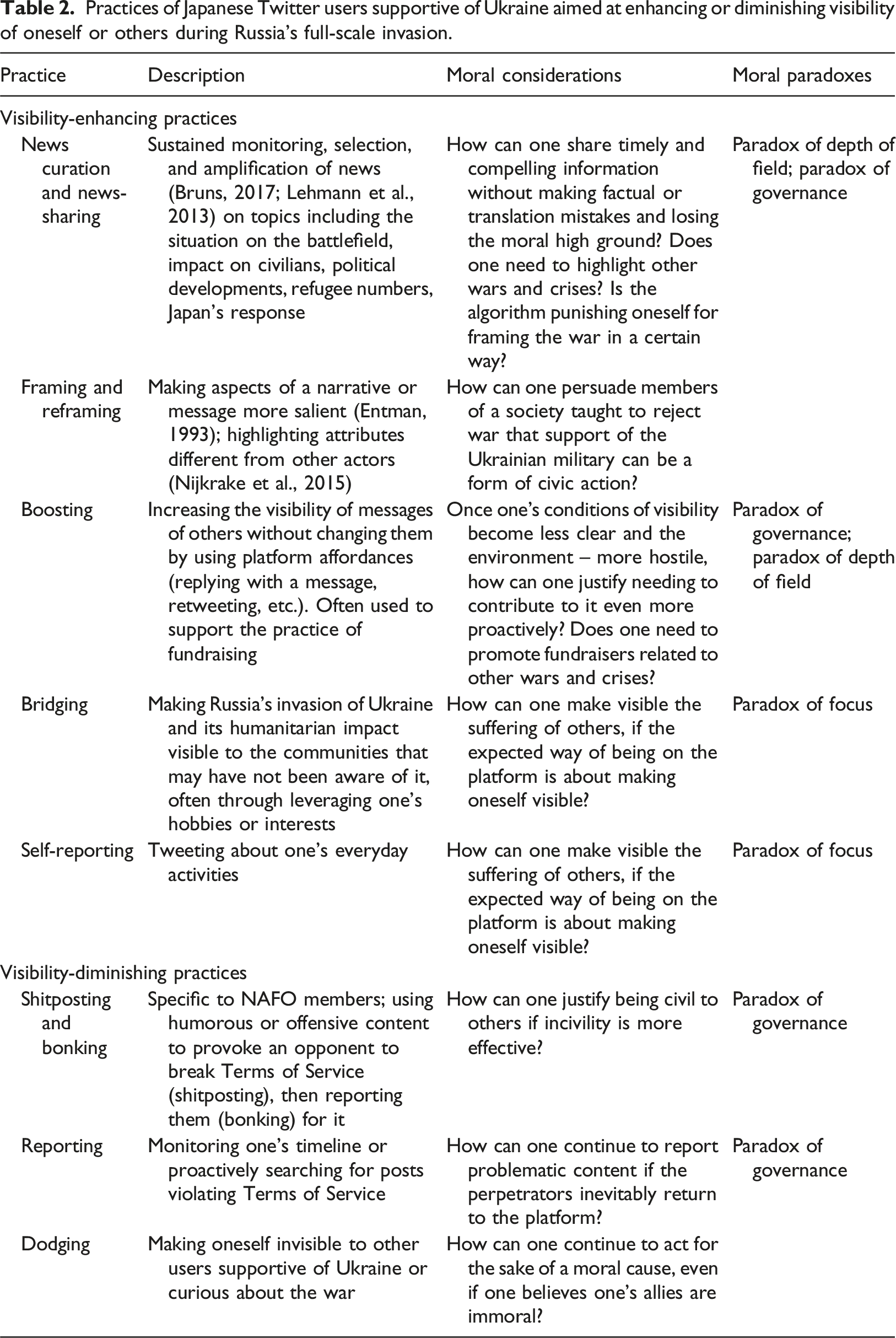
While news curation, framing or reframing one’s posts, self-reporting, or dodging interactions with unpleasant others, have been studied in other contexts (e.g. Blackwood et al., 2023; Bruns, 2017; Burgess and Baym, 2020; Frederick et al., 2017; Yu, 2020), some of the identified practices were specific to Twitter during Russia’s war on Ukraine. Namely, bonking and shitposting were two key visibility practices of NAFO that arose as a result of operating in an environment where one’s adversaries, such as the Twitter accounts of Russian officials, enjoyed high visibility (Shultz, 2023). These practices supported NAFO’s efforts to derail Russian propaganda on Twitter using humour (Zappone, 2022). Bonking is reporting an account for violation of Twitter’s Terms of Service, after having provoked that user to do so by shitposting or adding humorous or offensive replies to a post by a pro-Russian account. Not all interviewed users were comfortable with participating in such practices themselves, but all recognised their effectiveness.
Other common practices, such as news curation and framing, while not specific to the examined case studies, were undertaken in a way that accounted for the context of Japanese society. While overall the Japanese public was eager for its government to aid Ukraine, including through transfers of defensive equipment (Hōdō Station, 2020), interview participants reported initial hesitation about supporting the Ukrainian military. This created a barrier of entry to NAFO for Japanese participants, as to become a NAFO ‘fella’ and have a Shiba Inu avatar created, one was expected to donate an arbitrary amount towards crowdfunding supplies and weapons for the Ukrainian military. Here is how Himawari, one of the participants, explained this puzzle: If you want to be a part of NAFO, you need to buy weapons […]. So, I spoke to my family, and they were also hesitant – they would be alright with it if it was for medical supplies… But then as I continued to watch the situation on the battlefield, I understood that it was not like that… So, I decided to join [NAFO] about three months after I was first invited.
Even though interview participants themselves, like Himawari, overcame their hesitation, they still reported the reservations of others around them,
3
which affected how they undertook their visibility practices: I think the most humanitarian thing to do is to arm Ukraine to fight Russia so that they did (sic) see they're not the Empire they think they are. And that is a little controversial because in Japan we’re such pacifists, we admitted we were wrong in WWII, we gave up all our arms, we committed to only self-defence, we're not going to invade anywhere. So, when you say, arm somebody to the teeth to kill Russians, that's actually good for humanity... I think if I just said that outright, I would be thought of as extreme outside of my immediate family. But I want people to understand that peace is not laying down with no arms, necessarily. But yes, we are very sorry that our grandfathers or fathers did that. But we're trying to change that. It doesn't mean you can still do it. You know, that's different. (Akari)
In contrast to this perception of the military in Japan, in Ukraine since the beginning of Russia’s war in 2014, volunteer support of defenders re-emerged as a civic practice and a form of morally legitimate civilian resistance to the invasion (Boichak and McKernan, 2022). To account for this difference, participants engaged in news curation opted for preferencing stories humanising Ukrainian soldiers and highlighting the justice of their cause.
The need to reconcile the effectiveness of shitposting with its divergence from the norms of a civil online environment (McEwan, 2017), or one’s moral drive to support Ukraine with the wariness of the military are just two examples of moral considerations of Japanese supporters of Ukraine in their visibility practices. The reason they felt the need to uphold a high moral standard in their practices was because they perceived Twitter during Russia’s war on Ukraine as a low-trust environment. All respondents spoke about their concerns about false information and fundraising scams and used various tactics to distinguish themselves from morally flawed actors: from bookmarking their tweets to check on them when more information is released, to sticking to fundraisers led by the Ukrainian government, like United24, to distancing themselves from fellow Ukraine supporters whose morality they questioned. Three of the interviewed participants also probed for my moral standing through a series of questions when approached for the interview. To a varying extent, through their visibility practices Japanese supporters of Ukraine strived to make themselves a model for others to emulate – in Brighenti’s (2007) terms, someone endowed with visibility to serve as a moral example. Here is how Minoru, an on-the-ground volunteer, explained this: I did not really want to start fundraising. If you receive even a small amount of money from strangers, you will feel responsible. But the situation [with fake charities] was so dire I decided to start fundraising myself. So that people who donated even a little, a 1000 or 2000 yen, would start to follow my activism and compare how it’s different from others, and think for themselves. I use social media to make this change, one step at a time.
The need to reconcile conflicting considerations (such as the importance of civility versus the need for effectiveness of visibility practices, or preexisting beliefs about the importance of peace versus the plight of the country fighting for survival) is what constitutes a moral paradox (Sneddon, 2012). As Magalhães and Yu (2022a) stress, algorithmically curated environments like social media platforms are prone to such paradoxes. In the following section, I examine participants’ experience with three paradoxes of visibility practices on digitally networked platforms in the context of distant wars and crises.
Paradoxes of digitally networked visibility practices
Paradox of governance
As elaborated above, Ukraine’s supporters on Japanese Twitter saw the platform as an increasingly hostile and dangerous environment with main challenges including false information, propaganda, and fundraising scams. Some also reported being subject to abuse or threats, including from other users seemingly supportive of Ukraine. As Noah put it, Twitter was ‘very, very poisonous and toxic’. Practices like dodging (Table 2) were used to work around these dangers. Interview participants also welcomed the idea of the platform mitigating these risks. While NAFO arose partly as a result of Twitter’s lack of effectiveness in dealing with Russian propaganda, they actively relied on mechanisms of platform governance such as human content moderation, in their bonking and reporting practices – once they reported an account, it was up to the platform to ensure they do not perpetuate their harmful activities. At the same time, interviewees perceived these mechanisms as increasingly failing them and even working against them. […] Musk came over and changed the algorithm so much that one very, very, very bad suspended account would return within a few hours, even threatening to kill someone or rape someone. So, I think a lot of fellas in Japan and around the world, and non-fellas who were reporting together decided that they didn't want to spend so much time reporting anymore because it seemed futile. (Noah)
In addition to failures to deal with the visibility of bad actors, interview respondents suspected that algorithmically driven recommendation mechanisms punished them for their support for Ukraine. Together with sociocultural factors, this prompted Ukraine’s supporters on Japanese Twitter to prioritise the positive framing of stories they shared through their news curation practices. When I criticise Russia even a bit by saying what’s true, I see the number of likes drop. It’s possible that because of Elon Musk, my posts would not go to the top, but there is also the reluctance of Japanese people to speak badly of others. […] Because of this, I try not to overdo it with posts about what Russia is doing, and bring the Ukrainian culture to the forefront instead. (Yui)
While some Ukraine supporters, like Noah’s acquaintance mentioned in the introduction, chose to withdraw from visibility practices entirely, others persisted through multiple tactics to stay consistent with their moral beliefs. For example, NAFO members removed direct mentions of the collective from their profile descriptions. Some news curators, despite disapproving of the direction in which the platform was headed, paid for Twitter Blue, as it was ‘the only way to spread information wider’ (Kenta). Other users, like Noah, increased the intensity of their visibility practices, ‘just so that there’s some kind of AI [that] will see that my account is active’.
Paradox of focus
If users supportive of Ukraine chose to continue their practices, they needed to do so in a way that did not contradict the culture of the platform (boyd & Heer, 2006; Burgess, 2021) where they enacted these practices. This in itself was paradoxical, as Twitter was often perceived as a space to engage in the presentation of the Self and not the support of Others. In this study, this paradox of focus was most clearly seen in the practice of self-reporting.
For example, Mariko, a self-professed ‘extremely online’ woman, first found out about the full-scale invasion on Twitter. After a bout of sadness followed by a donation and attending a protest in Tokyo, Mariko stumbled upon tweets by NAFO members about volunteering in Ukraine. This led Mariko to join the movement and to travel to Ukraine several times to rebuild civilian infrastructure destroyed by Russian occupation. Her NAFO avatar also paid homage to her volunteering experience. As we scrolled back through Mariko’s stream of tweets, we saw posts on planning and executing her volunteering trips interspersed with her takes on Ukrainian food, desperation about learning Ukrainian through Duolingo and other daily thoughts and experiences unrelated to the war. She reflected: I remember tweeting about helping to fix the roof of a house where a grandma and a grandpa lived, and I was hoping that if people saw how I volunteered, they would feel encouraged to join me.
A hope that others will follow a moral model created through one’s visibility practices helped Mariko reconcile with the paradox of focus. Similarly, users engaged in bridging or making the war visible to third-place communities (Wright, 2012) not aware of the topic through common interests such as music or fandom, justified blending of one’s interests and prior ways of being online with visibility practices for the sake of distant Others. For example, Yui, a musician by training, appealed to the fans of classical music to call for cultural boycotts of Russia: I used to think that art was only about enjoying it, but since I am in a position where I can influence others, I want them to know that art is not only about enjoyment but something that can be used as a SOS signal.
However, other interviewees, like Takashi, a Japanese-Ukrainian journalist, were less comfortable with this paradox, admitting that it required a careful balancing act: If I write about running, food, or meeting friends […], this information will be a little unnecessary for people who want to learn about a place where there is war. But I also understand that this information can be useful, as it shows that life goes on in Kyiv. […] But I have to be selective, as I do not do this for fun or to get likes.
For others, like Noah, an excessive focus on oneself in other supporters of Ukraine was a sign of low moral standing and a reason to disengage or be wary of the person: There is quite a lot of NAFO fellas who, I think, love the attention, who have possibly forgotten that this is about Ukraine. […] Well, that's not for me, I really don't care. As I mentioned, I am not on Twitter to make friends. So, the only reason why it's useful to have followers, follower accounts, if you will, is that in the algorithm, a bigger account is more seen. And is weighed more by the AI of Twitter, meaning when I boost or try to support a fundraiser or disseminate news […] then a bigger account is more useful. […] And they think that it's all about them. And for me, that's okay, there's always going to be people like that in the world, but I just don't want anything to do with them. So, I either block them or mute them or I end up changing my address.
Paradox of depth of field
It was not only Ukrainians or oneself who could become the focus of one’s social media practices. Wider groups were claiming to be impacted by Russia’s war on Ukraine and victims of other wars and crises near and far. The participants often encountered their plight through the visibility afforded by Twitter. For example, Taro, a Japanese American NAFO member, reflected on his response to a Twitter backlash regarding Amnesty International
4
releasing an envelope portraying two figures in an embrace – one in the colours of the Ukrainian flag, and the other one – Russian (The Institute of Mass Information, 2022). While validating the anger felt by Ukrainians, in his response to a post about the controversy Taro defended the need to give visibility to Russians opposing Putin’s regime. He explained: People were saying, no, we shouldn't be siding with Russians, those are the Russians, that's them. And this is us. And I think that's a pretty common mentality. And if you're Ukrainian, I can’t blame people for feeling this sort of anger. I probably would feel just the same way if it was my country being invaded. But in my mind, we have to take people as individuals. […] Being Japanese, I feel that back during the Second World War, in the United States, there were a lot of Japanese Americans who were discriminated against, because of the war with Japan, they were put in camps, they were taken from their homes, in terror, and all this horrible stuff happened to them because of their race. So, I think that just makes me a little bit sensitive to this issue.
Similarly, Minoru, the on-the-ground volunteer, spoke of his hopes to support persecuted people regardless of their nationality, potentially including Russians. This wide depth of field, however, failed to consider the perspective of Ukrainians in their immediate struggle for recognition and survival. When Ukrainians were killed in the genocidal war (Shaw, 2023), not only by the orders of the regime but also through actions of regular Russian citizens, widening the focus to extend visibility to the plight of Russians decentred the urgency of the suffering and injustice that Ukrainians on the ground continued to experience. Both Taro and Minoru were aware of and acted upon this moral conundrum. While Taro reflected on the limitations of his positioning, Minoru postponed his attempts to increase the visibility of the suffering of Russians to prioritise the urgency of the need to support Ukraine. Minoru hoped that the trust of those around him would eventually expand beyond the plight of Ukrainians but acknowledged that to achieve it he needed to maintain a narrower focus: This is not something I should be saying now. […] I understand that very clearly. But there are people working together with me now, so when the war has calmed down to an extent, they will say, if Minoru says we should do it, we’ll help too.
The strive for a narrower depth of field by choosing to focus on one cause or selecting one out of many fundraisers supporting that cause is what enabled the interview participants to maintain that effort. As Akari explained, this did not come easy as this meant deprioritising other issues they cared for: I support Book Santa in Japan, it's a charity for people with children who grow up in low-income houses, who don't get Christmas presents or books. […] So, my nephew, he asked me, okay, I know you donate to Ukraine, but if there's somebody in Japan who's suffering, who are you going to give more? […] And that's actually a topic I really consider often because even with donations to Ukraine, I feel so bad that I choose one organisation over another. I'm not God or anything, but maybe if I don't add here, it will not help save somebody over there. So, it's always a dilemma. How can I choose? And so, I just told him I don't choose based on proximity. I try to choose based on urgency. I feel very sorry for little children who don't get Christmas presents, but they're not bombed, fighting for their survival. I just try to balance what seems most urgent rather than proximity – whether you're Japanese or in Asia.
Discussion
Taken together, the moral conflicts experienced by the supporters of Ukraine on Japanese Twitter hint at constraints introduced into their practices by Twitter’s regime of visibility. This is most evident in their experiences with the paradox of governance. Despite having encountered the failure of the platform to regulate problematic behaviour, many users persisted in reporting such instances to the platform. In addition, to continue one’s practices to stay consistent with one’s moral beliefs, users would contribute even more to the environment they saw as toxic.
This aspect of visibility practices in times of war demonstrates that the way platforms govern user practices is problematic not only because of the lack of a systematic, context-sensitive, or transparent approach (Duguay et al., 2020; Gorwa et al., 2020; Seering, 2020) but also because of platforms not recognising visibility practices as a way of enacting moral choices. This contradiction, namely, having to practice morality in a space where one’s practices are not recognised as moral, is in line with Magalhães and Yu (2022b, 2022a) view of platforms as offering the conditions of visibility prone to paradoxes. However, as reflections of this study’s interviewees demonstrate, users are not always oblivious to these paradoxes in their visibility practices.
Users’ exercise of morality on digitally networked platforms also does not mean that such practices are flawless. Visibility practices, specific to engagement with a distant war, have their imperfections and limitations. The paradox of focus, whereby to make distant Others visible on digitally networked platforms, one has to first become visible herself, echoes Chouliaraki’s (2013) idea of ironic spectatorship. Some participants of the study found ways to justify self-centric practices, such as posting about hobbies or personal updates, or trying to increase the number of followers or likes. Nevertheless, there was no shared understanding of how the usefulness of being a visible individual could be reconciled with the need to maintain the focus on those suffering from a distant war. It can be argued that continued grappling with this paradox in itself has moral value on social media platforms – spaces of identity performance by individuals ‘writ[ing] themselves into being’ (boyd & Heer, 2006: 1).
The paradox of the depth of field further complicated the Self-Other relationship in such practices. Participants experienced it when the visibility work and moral consideration extended to one group of people (Ukrainians suffering from Russia’s war) invited the need to offer the same to others. As elaborated above, for many the answer to this conundrum was to maintain the narrow focus and delay visibility work for others until the Ukrainian cause was no longer urgent. This stands in stark contrast to whataboutism, or bringing up examples of other wars in response to attempts to increase the visibility of the Ukrainian plight.
As in the English-speaking Twitter segment (Bowell, 2023; Labuda, 2022), whataboutism gained prominence on Japanese Twitter following Russia’s full-scale invasion. In this study, it could be observed in the text of tweets from the progressive cluster of the ‘Refugee’ network (Figure 5). Such tweets contrasted the welcoming of Ukrainians with Japan’s drastically low refugee acceptance rate and the mistreatment of people in detention centres. Why should Ukrainians be allowed to seek refuge in Japan, if people from other countries were not? As argued by Bowell (2023), such calls to widen the moral focus can be seen as productive, providing they do not remove the obligation to act upon the injustice originally highlighted. However, often users engaging in whataboutism did not actively give visibility to the impact of the Russian invasion of Ukraine, or to the other countries and causes highlighted in their claims; they merely sought to weaken support for Ukraine.
In late 2023-early 2024, the interviewees were faced by more causes demanding them to expand their moral focus. In their follow-up messages to me, some of them spoke of feeling the urge to support Israel after Hamas’ October 7 attacks, and Palestine after the increasing mass killing, displacement, and starvation on the occupied territories caused by Israel’s retaliation; as well as the participants’ efforts to help the victims of the 2024 Noto Earthquake in Japan. In this way, the paradox of the depth of field, like the two other paradoxes, could never be resolved. However, many chose to persist with their narrow but deep focus, in hopes that ‘by protecting one society – Ukraine – from the Russian threat’, they could make a small contribution to peace everywhere.
Conclusion
This study aimed to investigate how Ukraine supporters on Japanese Twitter practised morality as they diminished or increased the visibility of actors related to Russia’s invasion. Such users highlighted the human toll and the need to resist the Russian invasion through practices like news curation, (re)framing, boosting, bridging, and self-reporting. They diminished the visibility of actors perceived as damaging to Ukraine’s cause through shitposting and bonking – provoking the adversaries to violate Twitter’s Terms of Services by posting humorous or offensive content or searching for and reporting posts that were already in violation without engaging with their authors.
Affordances and (in)actions of Twitter mattered to whether, how, and at what cost such practices could be maintained. Factors shaping visibility practices in this case study included: the centrality of the performances of the self to both the design and culture of social media platforms (boyd & Heer, 2006; Burgess, 2021), insufficient or non-transparent platform moderation practices, and algorithmic downranking of tweets about the war. These factors often contradicted the moral goals of users, resulting in three paradoxes: having to rely on and contribute to an online environment one sees as immoral (paradox of governance); risking prioritising one’s visibility over the distant Others (paradox of focus); the difficulty of extending the focus of one’s practices to multiple targets (paradox of depth of field).
These findings are in line with the previous understanding of digitally networked platforms as prone to moral paradoxes (Magalhães and Yu, 2022a). However, I also demonstrate that users are not ignorant of the paradoxical nature of visibility afforded by digital platforms. This is evident in several moral considerations on visibility practices that users try to resolve by delaying certain actions, justifying other actions, increasing the intensity of their practices, or distancing themselves from those perceived as morally flawed.
The identified paradoxes are never fully resolved, and digitally networked visibility practices can never offer a perfect scope or depth of recognition. However, the enacted choices about good and bad concerning the visibility of Selves and Others mean that digitally networked platforms like Twitter are spaces where users perform their morality in times of war. While recognising this user agency, we also need to consider the toll of the incessant work necessary to maintain the moral concern for those affected by this war in the face of the paradoxes of visibility in digitally networked spaces. Some of these paradoxes are broader than socio-technical environments like Twitter. However, greater recognition by platform operators of the role of social media as spaces where users practice morality, in conjunction with a range of other practices, including those harmful to marginalised groups (Matamoros-Fernández et al., 2023), can help ensure that the visibility work users do, driven by their sense of morality, is not made more difficult.
This study focused on a subset of actors engaging with the Russo-Ukrainian war and was limited by the selection of highly active and committed users supportive of Ukraine. To fully grasp the visibility practices of users engaging with this war from afar using digitally networked technologies, further research on countries in and outside Asia is necessary. Taken comprehensively, such research will shed light on how we practice morality and negotiate the visibility of distant Others on digital platforms in times of war.
Footnotes
Acknowledgements
I am grateful to Ehsan Dehghan, Axel Bruns, Dominique Carlon, and Rei Barker for their advice, feedback, and encouragement in drafting this manuscript. The support from Brendan Keogh and other members of the DMRC’s ‘Sit Down and Write’ writing group was essential in my work on this manuscript. I also would like to thank the two anonymous reviewers who have generousely provided very well-informed and constructive comments, not all of which I was able to respond to within the scope of this manuscript. Most importantly, I am grateful to Ukraine's defenders and all my research participants. Any errors remain my own.
Declaration of conflicting interests
The author(s) declared no potential conflicts of interest with respect to the research, authorship, and/or publication of this article.
Funding
The author(s) received no financial support for the research, authorship, and/or publication of this article.
