




Abstract
Social movement scholars have long considered organizations (social movement organizations [SMOs]) vital to the success of a movement. SMOs organize events, mobilize participants, and recruit new activists into the movement. In the case of youth activism, SMOs can also play a vital role in the political socialization of youth. However, a substantial line of research finds that most SMOs do a poor job of encouraging and facilitating youth engagement in offline, face-to-face contexts. With the growing use of digital media by both social movements and youth, online activism presents another avenue through which SMOs can recruit youth participation. The extent to which SMOs are doing any better at this online than offline is an open and surprisingly new question, however. Using a unique dataset, we explore the extent to which SMOs are encouraging youth participation in social movement activity online. Based on our findings, we argue that engaging with and recruiting youth into SMOs is vital for the future health of these organizations as well as the political socialization of youth, and that SMOs are not doing enough to recruit youth online, mirroring their failure offline.
Introduction
Social movement scholars have long considered organizations vital to the success of movements (Cress & Snow, 1996; Jenkins & Eckert, 1986; Klandermans, 1984; McCarthy & Zald, 1977; Taylor, 1989). Resource mobilization theory put organizations devoted to social change advocacy—social movement organizations (SMOs)—at the very center of the study of social movements (Clemens & Minkoff, 2004; McCarthy & Zald, 1977), arguing that they fulfill important roles in the mobilization process. SMOs organize events, provide opportunities to protest (e.g., rally, sign petitions; Klandermans, 2004), work to connect people to these opportunities to protest, and recruit participants and new members (Klandermans & Oegema, 1987). SMOs also facilitate continuity for movements, recruiting new members as old ones leave, ensuring the movement continues on after the first generation of activists (Taylor, 1989; Whittier, 1997). 1
However, in research on youth activism, the role and importance of SMOs is somewhat different. While acknowledging the importance of SMOs generally to movements and finding that SMOs can help young people become politically socialized and active (Conner, 2011; Delgado & Staples, 2007; Kirshner, 2008), researchers interested in youth activism also find that SMOs are often adult-dominated (O’Donoghue & Strobel, 2007) and tend to minimize the leadership and participation available to youth (Taft, 2014). Moreover, the level of youth mobilization varies from movement to movement, with movements like immigration, feminist, and LGBT rights experiencing a surge in recent years, though there is often tension between youth and adult leaders within the movement (Ghaziani, 2011; Hunt, 2017; Miceli, 2005; Nichols, 2013; Terriquez, 2015; Whittier, 2017). Indeed, as a recent review of work on youth activism suggests (Earl, Maher, & Elliott, 2017), SMOs have historically had a fraught relationship with youth that sometimes leads youth to form their own organizations or to participate outside of organizations.
This literature on youth activism in SMOs has been heavily focused on face-to-face interactions, even though other literatures, such as scholarship on youth civic engagement has taken a substantial digital turn (Earl et al., 2017). Moreover, this focus on face-to-face interactions exists despite wide scale use of digital technologies by youth (Palfrey & Gasser, 2013) and in protest (Brunsting & Postmes, 2002; van Laer & van Aelst, 2010). In this article, we bring questions about youth engagement in SMOs into the digital world by investigating one way that SMOs may attempt to recruit and connect with youth—through their web presences—to determine if the relationship between SMOs and youth online seems as troubled as it has been offline. Referred to as the “supply side” of protest (Klandermans, 2004), materials, framings, and opportunities made available by SMOs online allow researchers into SMOs’ unmediated presentations of priorities and concerns for recruiting and representations. These data provide an unvarnished look into how youth mobilization is positioned in SMO-made material.
Specifically, we use unique empirical data to examine the extent to which web-addressable spaces run by SMOs reach out to youth on a variety of levels, from having content that is directly relevant to youth to hosting youth sections on websites or inviting youth participation in protest actions, among other potential connections. Our novel dataset consists of data from quantitatively content coding a random sample of addressable digital spaces (e.g., websites, public Facebook pages, blogs) engaged in advocacy across each of 20 different issue areas. Given that SMOs are not doing a good job engaging youth offline, we expect that SMOs are likely also doing a poor job of engaging youth through their web presences.
Our data confirm this expectation, but skeptics may be tempted to defend SMOs by arguing that SMOs fail to try to connect with youth because youth are disinterested and thus web presences simply reflect the lack of demand youth have for engagement. To address this likely criticism, we also assess the extent to which youth are becoming involved politically online, including in protest, and the extent to which youth involvement with SMOs increases their engagement. If we find low levels of youth engagement, or little impact of connecting with SMOs on youth, then it is possible that critics are correct and SMOs fail to try to connect with youth online because they know youth are disinterested and/or connecting with youth doesn’t change their engagement. Instead, though, we find that such pessimism about youth is incorrect: using national survey data, we show that youth are actually quite active in protest online, despite a lack of, rather than because of, substantial outreach and that when youth are involved with SMOs, they are more active than other youth.
The Historical Role of SMOs in Movements
Organizations have taken center stage in social movement research since McCarthy and Zald (1977) developed resource mobilization theory. SMOs are seen as the primary vehicle through which resources are collected, organized, and then directed toward advocacy (Cress & Snow, 1996; McCarthy & Zald, 1977). In fact, social movement research has come to consider SMOs as the primary actors in social movements (Clemens & Minkoff, 2004), with even other major theories acknowledging their importance. Political opportunity theory, for instance, often considers organizational formation when analyzing the emergence of political opportunities (Meyer & Minkoff, 2004). The literature on framing expects SMOs to strategically construct and realign collective action frames (Snow, Rochford, Worden & Benford, 1986). SMOs also facilitate the creation and maintenance of collective identity (Polletta & Jasper, 2001).
For movements, a diversity of SMOs allow for a diversity of ideology, strategy, tactics, and organizational forms within the same movement (Clemens & Minkoff, 2004), allowing these differences to attract more members to the movement overall as individuals find organizations that fit them well. This diversity also allows for a division of labor among organizations (Gamson & Wolfsfeld, 1993) and useful collaborations. More generally, SMOs ensure continuity of both themselves and the larger movement (Whittier, 1997). They recruit new members as older ones leave, often targeting young people for new memberships (Hirsch, 1990) and serve as abeyance structures when movements enter periods of low activity or hostile contexts (Taylor, 1989). Even Earl, who has argued that “organizing outside of organizations” (Karpf, 2012) online can be fruitful (Earl & Kimport, 2011), acknowledges that having some SMOs in a larger movement ecology is likely important for the health and vitality of large, enduring movements (Earl, 2015).
Certainly, one of the most important roles SMOs occupy is the primary supplier of opportunities to engage in protest and advocacy. SMOs use their resources to plan events designed to further their goals. In planning these events, SMOs decide what kinds of tactics to use and the frames they will use to justify the actions. Tactical and framing decisions also often contain indicators of who expected participants will be, since tactics, frames, and participants need to align for successful motivation.
As mentioned above, Klandermans (2004) argues this event planning constitutes the “supply side” of protest, a critical component of the supply and demand nexus necessary for mobilization. Beyond providing a supply of opportunities, SMOs are also instrumental in mobilizing because they target potential participants in collective action, invite them to join (Klandermans & Oegema, 1987), and incentivize participation by providing selective incentives and other rewards, particularly for risky or difficult protest (Klandermans, 1984). Indeed, the first step in this multi-step mobilization process—being directly asked to participate in a protest—is one of the best predictors of participation (Schussman & Soule, 2005). Aside from being asked, it should not be surprising that two of the other best predictors of activism are network and/or organizational connections to a movement (Gould, 1991; Klandermans, 2004; McAdam, 1988; Schussman & Soule, 2005; Tindall, 2004). SMOs also help to maintain participation across time by facilitating collective identity, which strengthens the member’s commitment to the movement (Polletta & Jasper, 2001), and by embedding members in a network of personal relationships that promote future participation (Tindall, 2004). Given this, we argue that how SMOs create the “supply side” of protest is consequential and likely, based on prevailing social movement scholarship, to effect who is mobilized for what ends. SMO web-based presences, such as SMO websites, publicly accessible Facebook pages and twitter feeds, and other publicly accessible SMO-controlled material give researchers access to this “supply side” as it exists online. While we do not claim that web presences provide an exhaustive portrait of how SMOs engage different audiences through the manifold opportunities for connection online, web presences represent a privileged site of inquiry because they embody the unmediated self-presentation of the organization and movement to others, representing their key concerns and constituencies and also courting connection and mobilization from some kinds of site visitors.
Youth Mobilization and SMOs
SMOs are also important to youth because they can provide spaces for political socialization. SMOs provide opportunities for youth to engage in politics, and youth see political activism modeled by adult members. These opportunities can help youth develop important problem solving and interpersonal skills, and help youth develop political identities (Conner, 2011; Delgado & Staples, 2007; Kirshner, 2008).
This is not to suggest that SMOs are in control of youths’ socialization process. Recent research on political socialization argues that youth, in fact, socialize themselves, synthesizing what they learn from family, friends, school, and other contexts (Yates & Youniss, 1999; Youniss et al., 2002). But, SMOs can provide important avenues for experiences that contribute to socialization. Moreover, when SMOs create egalitarian relationships between youth and adults (O’Donoghue & Strobel, 2007), youth often continue to participate, which can beget participation well into adulthood.
However, research shows that SMOs have failed to properly cultivate youth engagement in recent years (Gordon, 2007; Khalil, 2012; O’Donoghue & Strobel, 2007; Taft & Gordon, 2013). SMOs are doing a poor job of recruiting youth offline into traditional protest (Gordon, 2007; O’Donoghue & Strobel, 2007). Instead, many youth, wanting to engage in political and civic life within their community, are turning to community-based youth organizations, which facilitate the development of egalitarian relationships between youth and adult leaders (O’Donoghue & Strobel, 2007). When youth do get engaged in SMOs offline, SMOs tend to either provide adult-led participation opportunities that leave little room for youth to feel empowered (Taft & Gordon, 2013), or they engage in ageist dismissal of youths’ ability to fully participate (Taft, 2014). Youth have responded by opting out of traditional SMOs. Some youth have created their own, youth-led organizations (Gordon, 2007) in which adults either play peripheral roles or are excluded altogether.
This trend appears to be true even in movements that have seen an increase in youth mobilization in recent years. For example, in the mid-2000s, the immigration reform movement encouraged the participation of undocumented youth, termed DREAMers after the proposed DREAM Act that would offer people who entered the country as young children a path to citizenship. However, growing tension between the priorities of the adult leaders of the movement and the DREAMers led to a rift, and many undocumented youth building their own movement for immigration reform (Nichols, 2013). Likewise, young women on college campuses have mobilized in response to a lack of action by college administrators of adequately address instances of sexual assault (Whittier, 2017). Youth mobilization has been important for the LGBT movement for several decades now, particularly work done within gay straight alliances (Miceli, 2005). However, recent research suggests that young LGBT students are diverging in their identities and politics from previous LGBT generations (Ghaziani, 2011). This evidence suggests that while some movements do a better job of attracting youth activists, few are successfully integrating them into traditional SMO spaces.
Taking this work together, it is clear that SMOs play an incredibly important role in the health and effectiveness of social movements, but research has documented how SMOs have failed to properly engage youth in offline protest. This could be consequential for the future health and longevity of social movements if they fail to recruit a new generation of activists into their SMOs. With the widespread adoption of the Internet and digital media for political protest, SMOs are faced with a new arena in which youth engagement is incredibly important. Thus, we argue that it is important to understand how digital spaces run by SMOs (vs spaces not run by SMOs) attempt to connect with youth.
Our central question is whether SMOs have attempted to reach out to youth through their online presences, inviting youth to participate and creating inviting spaces for them. On the one hand, this is a straightforward question about how often SMOs explicitly attempt to connect with young people through their online content, by creating explicit spaces for them, or by inviting engagement directly. On the other hand, it is also a question of whether spaces are designed with features that prior research shows appeal to youth. For instance, existing research shows youth prefer websites that give them opportunities for interactivity (Bachen, Raphael, Lynn, McKee, & Philippi, 2008; Montgomery, 2001). However, interactivity—which includes creating or remixing content and posting it online as well interacting with other users through message boards, forums, live chatting features, or other means—may seem quite risky to professional SMOs eager to control their message and image (Earl, 2013; Meyer & Tarrow, 1998).
Data: SMOs and Youth
In order to understand the universe of online social movement material that may be accessible by youth, and evaluate the extent to which this material actively works to connect with youth, we need to access population-level data on web-addressable social movement spaces. Although we use a method that can find any web-addressable digital space that is publicly accessible (e.g., public Facebook pages, twitter feeds, etc. as well as traditional websites), for ease of terminology and to reflect that the vast majority of cases we study are traditional websites, we refer to these web-addressable spaces as websites from here forward. We also need to study more than a single social movement to ensure that our findings are not movement-specific; therefore, we collect and examine data on publicly accessible websites active in 20 different issue areas.
But, studying a random sample of sites, or an entire population, can be difficult. Identifying the population of advocacy websites is impractical, and so traditional sampling techniques are difficult to implement online. To overcome these limitations, we rely on an important simplifying assumption that makes this dilemma tractable: we assume that our population is limited to those web-addressable spaces on a topic that other users could reasonably identify and visit. Thus, we are interested in the population of spaces that potential users are at risk of finding, arguing that this represents a methodologically tractable way to examine a privileged site of organizational self-representation. While we are unable to include the deep Web, our focus on the population of “reachable websites” (i.e., web-addressable spaces we do not need the URL to be able to locate) does allow us to sample the publicly available supply of online advocacy.
We use repeated searches on Google since: (1) Google is the leading search engine and (2) Googlebot, which helps to build Google’s vast database, relies on link-crawling to identify new sites, a process that mimics the way individuals find websites and other addressable spaces. We select 20 social movement issue areas to represent those that are traditionally studied by social movement scholars (e.g., abortion and civil rights), issue areas where mobilization has increased or decreased significantly over time (e.g., immigration and globalization), and issue areas tied to the Internet (e.g., open source).
We expect each of these movements to be potentially interesting to youth. The feminist, immigration, and lesbian, gay, bisexual, transgender, and questioning (LGBTQ) movements have seen youth mobilization in recent years (Hunt, 2017; Terriquez, 2015). Movements around privacy and open source are potentially interesting for preserving privacy and freedom online, a space youth spend more time than other age cohorts. Youth enjoy remixing and redistributing pieces of culture they find online (Cohen, Kahne, Bowyer, Middaugh, & Rogowski, 2012; Ito et al, 2009), which can often run into issues of intellectual property. Youth have also been subject to heighted surveillance on the part of parents and schools online (Hope, 2005; Taylor, 2013).
We generate a list of search terms for each issue area, pre-tested to ensure validity of results. These search terms are designed to capture both the pro- and anti-side of the issue, so the abortion issue area includes search terms to identify both pro-life and pro-choice websites. To identity search terms, we first use common keywords in academic and popular literatures, for example, “free speech” for the civil liberties issue. We buttress these keywords with additional common terms drawn from exemplar websites for each issue area (e.g., NOW for the feminist issue area). From both sources, we pair terms with an action word, such as “protest” or “stop,” and verify these search terms return quality results from Google, generating 175 search terms across the 20 issues.
We use each search term as a query to a Google API that allows us to retrieve up to 1000 results per query. The results from all queries for the same issue area are combined to generate 20 independent populations of reachable websites for each issue area, in total representing over one hundred thousand unique URLs (for more details on an earlier wave of data collection, see Earl, Kimport, Prieto, Rush, & Reynoso, 2010). It is important to note that by using repetitive searches and all 1,000 results per search we avoid impacts of Google’s Page Rank on our method. Research does show that website owners try to game Page Rank to get on the first page of results, but there is no evidence that website owners game to be in the top 1,000. Moreover, an examination of results after the top-1,000 showed very poor quality returns that were irrelevant to our searches. By including all results and randomly sampling, which disregards order within the top-1,000, we avoid these problems.
We identified populations of reachable websites for 20 issue areas in August, 2010. We then drew a 1% random sample by cause, made a local archive of the sites as they appeared in 2010, and then quantitatively content coded them. Any protests linked to or hosted by one of these sites (save sampling completed for a few massive sites) were also separately coded. We coded 1,084 websites and 3,659 protest actions.
Our method of identifying websites yielded many that had content relevant to social movements, but did not engage in advocacy. For example, news sites, like pbs.org and rockymountainnews.com, online copies of books stored on Google Books, Wikipedia articles, and university websites were coded as containing material about a movement issue area, but containing no appeals for change. To focus on advocacy websites, we drop these websites that did not make appeals for change or advocacy. We also drop sites that did not advocate for change on the issue for which they were sampled (e.g., websites sampled on the abortion movement issue but did not engage in any abortion advocacy). This substantially reduces our dataset: our final sample includes 363 websites and the 1402 protest actions that were hosted on or linked from those 363 websites.
Coding
Coding proceeded in two waves. The first wave, taking place in 2010–2011, coded for 93 measures of activism on the websites and another 46 measures about every protest action hosted or linked to from those sites (e.g., online petitions users could sign; in person demonstrations users were invited to attend). The second wave, coding in 2013–2014, coded an additional 28 website measures and 7 additional protest action measures. This second wave of coding used the same archives of the websites as the first wave, to ensure the same content was coded across the two waves. Inter-coder reliability for the first wave is 98.2% for website level measures and 97.7% for protest action measures. Inter-coder reliability for the second wave is 96.9% for website level measures and 99.1% for protest action measures.
We code for three different measures of youth orientation of websites to capture the level of youth engagement. First, we code a website for youth content. This measure assesses whether the site contains material relevant to youth, whether or not the material is intended for youth. This could include sites that teach parents how to talk to their children about bullying, or websites that teaches youth how to start a gay/straight alliance at their school. Our second measure, youth audience, assesses whether the website includes youth as part of their target audience. This could be accomplished by providing a separate space on the site intended specifically for youth, or by explicitly including youth as part of their broader audience. The third measure, youth participation, captures whether websites explicitly invite or encourage youth to participate in the protest events the sites host or link to, through explicit references and invitations to youth. We define protest activities as activities outside of normal institutional political channels that call for change, which includes activities such as signing petitions, attending rallies, participating in sit-ins, or participating in boycotts. For all of the above, we conceptualize youth as persons through college age (approximately 24 years old). 2
Many advocacy sites are not run by formal SMOs, but instead are developed and maintained by individuals or informal networks (Earl, 2013). To identify which websites are affiliated with a SMO and which ones are not, we code whether the website was operated by a SMO or not; focused less on the technical operations of the site (i.e., not on who is responsible for the technical aspects of maintaining the site), but rather whether an organization was responsible for the content hosted on site. We define SMOs as formal organizations, with physical headquarters, whose primary mission is to advocate for change on behalf of a constituency. Organizations that only fund other organizations (i.e., foundations) are not considered SMOs, unless they also engage in advocacy themselves. We use this definition because it is largely consistent with the existing literature, and we identified a number of sites that claimed to represent organizations that were actually just single individuals trying to make their cause seem larger. To exclude these kinds of sites from the organizational coding, we required some sense of offline presence. For instance, we code websites run by the ACLU (http://www.aclunc.org), Amnesty International (amnesty.org), and Americans for Prosperity (http://www.americansforprosperity.org) as SMO affiliated. Examples of websites in our data that are not affiliated with a SMO include crooksandliars.com, change.org, and queerfilter.com.
We are also interested in how interactive websites feel and how often they deploy features that have been discussed for youth-specific website design. Drawing on insights from Earl (2013), we code for website features that increase the participatory nature of the website. We code for whether the site allows users to get information about an issue, such as press releases or research papers; whether the site allows users to provide information to the site, such as uploading research or news articles, or providing tip-lines that allow users to leave information about companies with contested business practices. We also code for whether the website allows users to share their opinions about an issue, or see others’ opinions hosted on the site. We code whether the websites contains polls, quizzes, games, or crossword puzzles and also code for whether the website contains features that allowed users to chat with other users live (Bachen et al., 2008; Montgomery, 2001; Montgomery, Gottlieb-Robles, & Larson, 2004).
Findings: SMOs and Youth
The goal of our first analysis is to understand the extent to which SMO-affiliated websites actively court youth through their web presences. We do this by examining the overall youth-orientations of the websites as well as specific feature sets and site production practices. Across these analyses, we find that social movement websites in general do a poor job of targeting youth, mirroring what previous research has found offline, although there is a small surprise: although both SMO-affiliated and sites not run by SMOs all do poorly in trying to connect with youth, in some cases, SMO-affiliated websites do try to connect more with youth than sites not run by SMOs.
Figure 1 graphs youth orientation based on youth content, youth audience, and youth actions and shows that websites are much more likely to host youth-relevant content than to treat youth as an audience or explicitly court youth participation. Although websites are more likely to have youth content than other forms of youth orientation, it is still the case that a minority of websites have youth-relevant content. The other two kinds of youth-oriented connections are far more infrequent. To test whether the differences we see in the figure are significant, we perform t-tests for a difference in proportion between sites run by SMOs and those not run by SMOs. 3 Across all three categories of youth-orientation, SMO-run websites are more likely to be youth oriented than non-SMO websites (p < .05). For instance, almost half of all SMO-run websites feature youth content, while less than a third of non-SMO websites contain youth content. Over 20% of SMO-run websites include youth in their targeted audience, while only 10% of non-SMO websites target a youth audience. Five percent of SMO-run websites explicitly invite youth to participate in advocacy actions, while less than 1% of non-SMO websites do so. In other words, sites in general do a poor job of trying to connect with youth in these ways, but SMO-run sites do a slightly better, although still lackluster, job at this.

Youth Engagement by SMO-affiliation and Youth Orientation.
As we previously discussed, youth mobilization varies from movement to movement, and so it is important as a check on our findings to assess whether patterns of youth-directed orientations differ substantially across issue areas: perhaps some movements are much better at connecting with youth, but this is obscured by analyzing all issue areas together. While there is no research available to support clear hypotheses about how attempts at youth engagement by SMOs might vary by issue area, examining this is an important check against potentially overgeneralized findings.
To explore how these patterns differ, Figure 2 graphs the percentage of websites that feature youth content by SMO affiliation and social movement issue area. The left panel shows issue areas in which SMO-run websites contain youth content more often than non-SMO websites. The panel on the right shows issue areas in which non-SMO websites contain youth content more often than SMO-run sites. Movements about homelessness, labor, civil liberties, and LGBTQ rights top the list in terms of SMO-run youth engagement, although labor and LGBTQ non-SMO websites also engage youth at a high rate. On the other hand, movements focused on peace, civil rights, and poverty bottom out the list in terms of SMO-run youth engagement, though even the non-SMO websites also do a relatively poor job of youth engagement in these issue areas. Interestingly, despite the high salience of DREAMers in the fall of 2010, less than 50% of SMO-run websites in the immigration issue area contain youth content, and less than a quarter of non-SMO immigration websites contain youth content.

‘Youth Content by SMO-affiliation and Movement Issue Area.
Figure 3 shows the breakdown of including youth in the targeted audience of a website by SMO affiliation and issue area. LGBTQ and labor again make the top of the list, as does green and open source. For the latter two, no non-SMO websites include youth in their intended audience. Homelessness, which topped the list for youth content, has no websites that include youth in their audience, indicating that while these sites are very concerned about youth homelessness, the websites do not speak to these youth, nor any youth, directly. Human rights, intellectual property (IP) reform, nuclear, and privacy also do not target a youth audience.
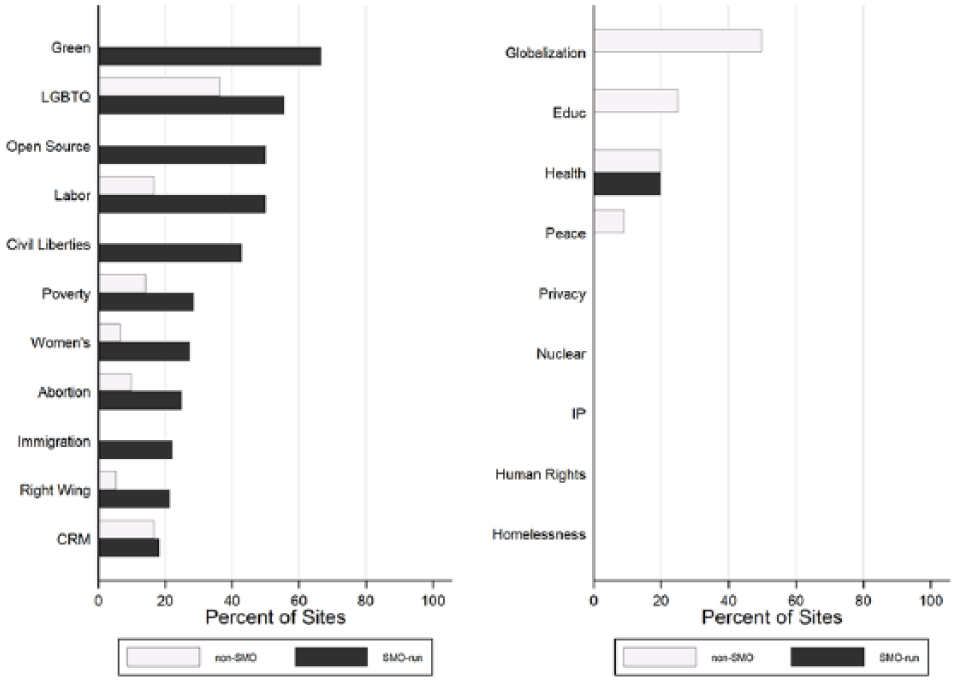
Youth Audience by SMO-affiliation and Movement Issue Area.
Explicitly inviting youth to participate in advocacy through a website shows similar patterns as the two other measures of youth orientation. As shown in Figure 4, LGBTQ and green top the list here, as they did for youth audience. Interestingly, only labor contains non-SMO websites that explicitly invite youth to participate in advocacy; all other websites that invite youth to participate are SMO-run. Overall, it appears that for some movements, such as LGBTQ, green, and labor, SMOs are more likely than non-SMO sites to try to engage youth in various ways, but this is not true across all issue areas we examined. Future research should try to understand these variations across causes.

Youth Actions by SMO-affiliation and Movement Issue Area.
Prior research has argued that youth are drawn to websites that offer opportunities to interact with other users on the site, as well as to create and post their own content (Bachen et al., 2008; Montgomery, 2001). So, even if websites don’t have apparent overall youth orientations, perhaps they are interactive and include features thought to be attractive to young users. Figure 5 graphs how often SMO-run and non-SMO websites provide these types of opportunities for users. While SMO-run websites are more likely (p < .05) to provide opportunities for users to get information about an issue, non-SMO websites are much more likely (p < .001) to allow users to express their opinions on the website through message boards, polls, or other features allowing users to express their personal opinions or experiences. Just as SMOs offline failed to provide appropriate youth-centered participation opportunities, even when they invited youth to participate, SMOs online are not providing the kinds of interactive opportunities we would expect to fully engage youth. More interactive features, like polls, games, and chatting features, are not common among both SMO-run and non-SMO websites. Instead, the most common thing websites do is treat the web as another broadcast forum in which they can distribute information.

Feature Sets by SMO-affiliation.
Figure 6 breaks out feature set availability still further by youth orientation as measured by the inclusion of youth content. Similar patterns exist as did in Figure 5, but there are some significant differences for youth-oriented websites versus non-youth oriented. SMO-run websites that are also youth oriented are much more likely to allow uses to provide info about a cause on the website (p < .05) and are also more likely to include polls (p < .01).

Feature Set Availability by SMO-affiliation and Youth Content Orientation.
Figure 7 provides the same information for youth audience oriented websites. Again, SMO-run websites are more likely to allow users to provide information about a cause if they are oriented toward a youth audience than if they are not (p < .05). SMO-run websites are also more likely to include games if they are oriented towards youth protest participation than if they are not (p < .05) (see Figure 8). Overall, while having a youth orientation does increase the likelihood that a SMO-run website will include some of interactive features, even many of these youth-oriented websites are not providing many interactive opportunities for users.

Feature Sets by SMO-affiliation and Youth Audience Orientation.

Feature Sets by SMO-affiliation and Youth Protest Participation Orientation.
We also examine who produces content for websites—young people or adults—on the assumption that youth-produced content may be more engaging for young people. We cross this characteristic with our three different measures for overall orientation, assuming, for instance, that youth-produced content directed at youth is different from adult-produced content directed at youth. Specifically, for youth content, we examine the frequency of three arrangements: (1) content produced by youth on youth-oriented websites (i.e., “by youth for youth”), (2) content produced by adults on a youth-oriented website (i.e., “by adults for youth”), and (3) content produced by adults on an adult-oriented website (i.e., “by adults for adults”). 4 Figure 9 shows the proportion of websites that fall into these categories, stratifying those figures by whether the site is SMO-run.

Youth Content Mediation by SMO-affiliation.
While there is a larger proportion of SMO-run websites in the “by youth for youth” category than non-SMO websites, the difference is not significant. But, there are significantly more SMO-run websites in the by adults for youth category (p < .01) than non-SMO sites, and significantly less SMO-run websites in the by adults for adults category (p < .01). So, in terms of mediated youth content, SMO-run websites are more likely to be youth oriented, but the content is likely to be adult produced. These data suggest that concerns about ageist practices in organizing offline (Gordon, 2007; Taft, 2014) may also be relevant online, such that many SMOs see adults as leading youth instead of youth being collaborators in change.
Figure 10 is similar to Figure 9 but uses youth audience to establish which sites are “for youth.” The difference between SMO-run and non-SMO websites is not significant for the by youth for youth category. As was true in Figure 9, there are significantly more SMO-run websites in the by adults for youth category than non-SMO websites (p < .05) and significantly less in the by adults for adults category (p < .05). Here, though, there is less youth orientation overall, with the vast majority of both SMO-run and non-SMO websites falling in the by adults for adults category.

Youth Audience Mediation by SMO-affiliation.
This is also true if we focus on websites that are considered “for youth” when they invite youth protest participation (see Figure 11). Here, the only significant difference is in the proportion of SMO-run versus non-SMO websites that fall into the by adults for youth category.

Youth Protest Participation Mediation by SMO-affiliation.
In sum, our data show that social movement presences online, like their presences offline, are failing to do a good job of engaging youth, or even at a more basic level, framing youth as an important movement constituency. Online social movement presences tend to be quite adult-oriented and adult-produced, which matches the adult orientation of most offline SMOs, and movement web presences have few feature sets that are expected to draw in youth. While this is not ubiquitously the case, or constant across different issues areas, and can be slightly less exaggerated for SMO-run sites than non-SMO sites, it nonetheless appears that the social movement sector, and SMO-run sites, are not doing much to connect with young people, even though that is important to the socialization of young people and to the generational continuity of movements.
A critical reader may reply that these findings are expected because SMOs are simply responding to a real and irremediable lack of interest on the part of youth or the unresponsiveness of youth to SMO engagement. That is, an alternative explanation for what is driving our findings is a rational decision by SMOs to not target youth because youth don’t want to be active and/or connecting with youth doesn’t affect youth engagement. This explanation is in line with claims that youth are not as politically and civically engaged as previous generations (Putnam, 2000). To assess this possibility, in the next two sections, we use survey data of youth’s political engagement to assess the extent to which youth are interested in and engage in politics, including social movements, as well as the extent to which youth are active in formal political organizations and the impacts of that involvement.
Data: Youth Participation in Activism
In order to assess the extent to which there is demand for advocacy among youth and whether SMO-membership impacts youth involvement, we use the Youth Participatory Politics (YPP) Survey. The YPP Survey is a 2011 nationally represented survey of 15- to 25-year-olds in the United States. The survey was administered by Knowledge Networks (KN), which maintains KnowledgePanel, a nationally representative pool of potential participants in online surveys. KnowledgePanel participants are identified by KN through an address-based sampling method. Participants are given a home computer, if they do not already own one, and are enrolled in the Internet-based survey service. Clients of KN may design surveys which are administered to a sample of KnowledgePanel participants, which is constructed to ensure the representativeness of the sample, the ability of researchers to analyze key populations, and prevent KnowledgePanel burnout from over sampling. The YPP survey was commissioned by Mills College and administered by KN. In addition to the online survey, a smaller sample completed the survey via the telephone. Mills also conducted their own survey, consisting of identical questions, using an address-based sampling technique. In all, 2,920 people completed the survey, with a completion rate of 94.7% of eligible participants online, 42.4% of eligible phone participants, and 46.8% of eligible participants in the address-based sampling supplement. We use the included survey weight to generate the following graphs and other analyses.
In prior work, we constructed measures for youth engagement generally (Elliott & Earl, forthcoming). We recreate and re-explain those measures here. Participants were asked about a variety of behaviors and opinions related to their use of the Internet for political, volunteer, and hobby-based purposes. From these questions, we construct measures of four different kinds of political participation: institutional, social movement, volunteer, and participatory. Each is a dummy variable, turned on if a respondent affirms they have participated in a qualifying activity in the last twelve months.
Institutional politics consists of seven activities (alpha = .65) including (1) having voted in the 2010 elections; supporting a candidate, political party, or political issue by (2) working on a campaign; (3) wearing a campaign button, putting a campaign sticker on their car, or placing a sign in their window or front yard; (4) expressing support through a social network; (5) raising or donating money online; (6) raising or donating money offline; or (6) signing up to receive information from a candidate or campaign via email.
The social movement indicator also consisted of seven qualifying activities (alpha = .71): (1) supporting a candidate, political party, or political issue by attending a meeting, rally, speech or dinner; (2) starting or joining a political group on a social network site; (3) taking part in a protest, demonstration, or sit-in; (4) participating in a boycott; (5) participating in a “buycott,” which is like a boycott except that people preferentially buy from a specific seller or buy a particularly product to show support; (6) signing a paper petition; or (7) signing an online petition.
Volunteering consisted of three qualifying activities (alpha = .67): (1) having raised money for a charitable cause, (2) participated in a community service or volunteer activity, or (3) worked on cooperated with others to try to solve a nonpolitical problem affecting their city or neighborhood.
We also include a novel category for participatory engagement in politics. Recent research on youth political participation online finds that youth haven’t disengaged from politics, rather they are engaging in new and different ways (Kahne, Middaugh, & Allen, 2014). This research conceptualizes this new engagement as “participatory politics,” which involves interactive, peer-based actions designed to give youth a political voice without deference to elites (Cohen et al., 2012). We construct an indicator for participatory politics 5 that includes six activities related to a political campaign, candidate, or issue (alpha = .74): (1) forwarded or posted someone else’s political commentary or news; (2) contributed their own article, opinion piece, picture, or video; (3) forwarded or circulated funny videos or cartoons or circulated something artistic; (4) commented on a news story or blog they read online; (5) written an email or written a blog; or (6) participated in an event where young people express their political views, such as a poetry slam, musical event, and so on.
We also use a question asking respondents if they had been active in a political or social group in the last 12 months, and an open-ended question asking what group they were active in to measure the kinds of organizations youth are likely to join.
Results: Youth Participation in Activism
Figure 12 shows the breakdown of youth who participate in any of the four categories of action (participatory, social movement, institutional or volunteering) described above as well as the breakdown of youth who are members of political or social organizations. Contrary to critical expectations that youth are uninterested in politics, nearly three quarters of youth engaged in some sort of political activity! But, only 10% of youth claimed membership in an organization, suggesting that for the majority of youth, political participation is happening outside formal organizations.

Youth Organizational Membership and Youth Participation.
This lack of organizational involvement is not stopping political engagement, but it is also not maximizing it. According to Figure 13, being a member of an organization makes one much more likely to engage in all four types of action (all p < .001). Of youth who are members of an organization, over 80% engage in institutional activity, as opposed to less than 50% of non-members. Similar patterns exist for social movement, volunteer, and participatory political activity, with organizational members roughly twice as likely to engage in the activity as non-members.

Percent of Youth Engaging in Activities by Organizational Membership.
This is a key finding because it suggests that although most youth are not connected to organizations, or SMOs specifically, organizational ties do significantly bolster engagement. This suggests that it is possible that if SMOs were better engaging youth, youth might be even more active than they already are, and they may be active through organizations that have proven effective at political socialization and strategic action. In other words, arguments that suggest that SMOs don’t target youth because youth aren’t interested in being active and because SMO-connections don’t influence youth engagement are wrong on both accounts.
Because youth are engaging in some organizations, we were interested in the correspondence at the macro level between the kinds of organizations youth are involved in and the issues areas that did better and worse at reaching out to youth in the website-based data. We lack data to assess micro-level preferences by youth and the extent to which those preferences are satisfied or not. Figure 14 shows the types of organizations in which youth reported being members. We took the open-ended question about group membership and categorized memberships according to the 20 issue areas used in collecting the website data. The most common type of organization was the catch-all “other” category. Common organizations within this category included animal welfare organizations, as well as party-affiliated (Republican and Democratic) groups. In other words, organizations aside from SMOs are much more effective at connecting with youth, suggesting that SMOs may be able to learn from volunteer and party-affiliated organizations about how to better connect with youth.

Distribution of Movement Organizational Membership for Youth Organizational Members.
The top five organizations after the “other” category were as follows: LGBTQ, civic, church, education, and right wing. Both LGBTQ and right wing organizations are likely SMO-related, but only LGBTQ appeared among the top issue areas in terms of youth orientation for SMO-run websites. This mismatch between the types of organizations youth are commonly members of and the issue areas in which organizations are most reaching out to youth may also help to explain why so few youth are members of organizations – the organizations they’d rather be members of are not doing a good job of reaching out to youth, while those that are doing a good job, youth aren’t as frequently involved in.
Discussion and Conclusion
Contrary to what some have claimed, a growing body of research is showing that youth are quite engaged in political and civic life. As past research has found, and the survey results reported on here show, youth engage in a variety of different actions, including social movement, institutional political, volunteer, and participatory political actions. However, they are largely pursuing that engagement outside of formal organizations, including SMOs, even though organizational affiliations increase the likelihood of youth engagement. As our results show, 90% of youth were not members of a political or social organization yet nearly three quarters were engaged in some sort of political or civic activity. But, when one is a member or an organization, their likelihood for acting rises sharply.
Given the historical importance of SMOs to movements, and their historically important role in recruitment and retention, these findings are surprising and troubling. And yet, our investigation of social movement web presences, including SMO-run web presences, found that movements and SMOs, themselves, are at least partly to blame for this. Social movement web presences generally do a poor job of providing opportunities for youth to become engaged online, or at even more basic level, of positioning youth as a relevant or even acknowledged constituency. Less than half of SMO-run websites were youth oriented along any of the three axis of youth engagement, and when SMO-run websites do have a youth focus, they are most likely to be produced by adults for youth, instead of by youth for youth, which is consistent with the findings in research about offline youth engagement in SMOs. Our analyses attempted to avoid painting all causes with the same brush to reduce the risk of overgeneralization. However, while there were some issue areas that did better than others, particularly the LGBT, green, and labor movements, none were consistently inviting youth to participate in advocacy activities. Furthermore, most SMO-run websites failed to include interactive features that research has shown are effective at engaging youth online, and they tend to be more likely to be adult-produced even when targeting youth, findings that are congruent with difficulties found in offline SMOs’ engagement with youth. Moreover, those issue areas that stood out as providing opportunities for youth to engage were not the same issue areas that youth themselves tended to be organizational members in, suggesting a mismatch at the macro level between the opportunities that do exist online for youth, and the kinds of opportunities youth are actually looking for. Overall, our findings show that youth are interested in being politically active, but are not being provided ample opportunities to engage through SMOs online. Instead, movements and SMOs are no more inviting to youth engagement online than prior research has found them to be offline. Given that we are studying web presences that (1) are controlled by SMOs and so represent their own strategic self-representations and (2) occur across platforms, ranging from traditional websites to publicly accessible social media presences, this lack of youth connection is particularly troubling because these should be the lowest hanging fruits for SMOs eager to engage youth online.
In examining these issues, we have addressed one of the most important questions about youth and political engagement offline in an online context, asking how SMO versus non-SMO run web presences frame youth as constituencies, collaborators, and/or participants. We find that the same problems that have dogged youth engagement in offline SMOs seem to be present online too, which can lead one to believe that the online problems we show are simply an extension of offline dynamics.
While this may be, we want to acknowledge the possibility that patterns we observed may be accelerated by trends in digital activism more generally. In other words, it is possible that causes of our findings owe to both general tendencies among movements that are reflected in both offline and online activities, but are also exaggerated by digital dynamics. Recent research suggests that formal organizations may not be necessary to organize activity online (Bimber, Flanagin, & Stohl, 2005; Earl, 2015; Earl & Kimport, 2011; Earl & Schussman, 2003). Online activity can be more spontaneous, and can require far fewer resources to plan, organize, and implement (Bimber et al., 2005). For instance, for certain types of advocacy, opportunities to participate (e.g., online petitions, distributed denial of service campaigns) can be supplied through the efforts of only one or a few individuals online and without a formal organization (Earl & Kimport, 2011; Garrett, 2006; Shirky, 2008). This activity also usually has far lower barriers to participation than its offline counterpart (Bennett & Fielding, 1999), so that organizations do not need to incentivize participation as they often need to do for offline advocacy (Bimber et al., 2005; Klandermans, 1984).
The Internet provides communication tools that make messaging and organizing groups of people orders of magnitude easier than it has been in the past (Garrett, 2006). Using social media networks, activists can spread their message broadly, potentially sending out a call to action that, through the various resharing features available on these sites, could quickly spread to reach millions. The energy and expertise required to do this is minimal, reducing the resources required to mobilize large groups of people.
If these digital trends are impacting how youth engage, and SMOs and movements more generally are failing to try to connect with youth online, a generation of young people may grow up with far more attenuated relationships to SMOs than has been true in the past. This could have a number of potentially critical implications for social movements. First and foremost, this lack of youth engagement with SMOs risks a generation or more of youth not being politically socialized into collective action through formal organizations and thus less concerned about the health and vitality about SMOs. It is too early to tell whether this will affect the frequency or persistence of activism across the lifecourse, but it certainly might. Organizations can provide stability and community that encourages future activism. If youth engage in activism without formal organizations, their participation may not persist into adulthood the way previous generations of activists have. Second, the future of SMOs themselves is imperiled if they are unable to replace their ranks and attract supporters over time. At a minimum, continued disengagement from SMOs across the lifecourse could further separate an already professionalized activist cadre from grassroots activists (Earl, 2013). But, at its most severe, if SMOs are unable to recruit youth into their membership, they may be unable to continue to be viable. Without healthy SMOs, a movement may be unable to survive rough times, leading to a precipitous decline in the movement sector.
Footnotes
Acknowledgements
The authors would like to thank the anonymous reviewers and the Editor for their comments and suggestions.
Declaration of Conflicting Interests
The author(s) declared no potential conflicts of interest with respect to the research, authorship, and/or publication of this article.
Funding
The author(s) disclosed receipt of the following financial support for the research, authorship, and/or publication of this article: We would like to thank the National Science Foundation (Award SES-0547990) and the John D. and Catherine T. MacArthur Foundation (through a sub-award from the Youth and Participatory Politics MacArthur Research Network) for critical funding that supported this research.