




Abstract
Social media research needs social theory in order to historicize and contextualize findings. At the same time, (analogue) social theory may benefit from the affordances of digital methods. This article explores this Janus-faced argument by way of a Facebook crawl of the Swedish field of culture. First, it is argued that field theory helps understand inter-institutional interaction on social media, and that it places activities on social media in a broader social context. Findings of the Facebook crawl illustrate the persistence of the structure and autonomy of the field of culture as depicted by Bourdieu. Second, despite Bourdieu’s rejection of network analysis, it is argued that it supplements empirical field research on two counts. Bourdieu argued for a relational understanding of the social world and for the study of “objective relations” between agents in a field. Following this, the network analysis provides a focus on actual practices—crystallized acts of recognition in the form of “likes” between institutions. This contrasts the somewhat oxymoronic use of self-reports to study “objective relations” that to date characterize Bourdieusian sociology. Additionally, the network analysis of a crawl of institutions on social media has the capacity to begin to uncover the amplitude, or reach, of a social field—which to date is rare in empirical field research. The article concludes by arguing for the mutual benefit of social theory and digital methods.
Introduction
The neo-positivist hype around the use of digital methods to understand social media has settled. We have come to realize that social media research needs a stronger commitment to theory, not least in order to bring historical and contextual nuance to empirical findings (Fuchs, 2017; Lindell, 2015; Lomborg, 2016). Yet, as Lomborg (2016) and Peng, Zhang, Zhong, and Zhu (2012) argue, much remains to be done in this department. The present outline is an attempt to bring Bourdieu’s field theory (Bourdieu & Wacquant, 1992) to bear upon a network analysis of the economy of “likes” between cultural institutions in Sweden. This endeavor is essentially an attempt to avoid treating technology as “ontologically special” (Sterne, 2003) and to discern the reflections of (the persistence of) social structures in patterns of interaction on social media. In other words, it is an attempt to “research social media as if the social mattered” (Couldry & van Dijck, 2015). I seek to illustrate the value of social theory for understanding what takes place on social media, and that field theory may be particularly useful to understand the relationships between institutions active on social media.
The reverse is equally true—social theory needs digital methods in order to understand phenomena of contemporary digitized and mediatized societies and life-worlds. Digital methods deployed to crawl interaction on social media may shed new light on previous, “analogue,” social theory and complement the methods that underpin it. To this end, I argue that digital network analysis can be an important supplementary tool for empirical field research (cf. De Nooy, 2003). The network analysis deployed in this study maps a specific form of crystallized action—“likes”—between cultural institutions. It visualizes a corpus of “found data” (Bruhn Jensen, 2010, p. 49) and in so doing it provides the map of “objective relations” 1 similar to what Bourdieu sought to study in order to understand social fields. What sets this approach apart from previous Bourdieusian research is the move beyond the reliance on self-reports toward a focus upon crystallized acts of recognition that “occur naturally” (Bail, 2014, p. 467), that are “already there” (unlike “made data” created by surveys and interviews) (Bruhn Jensen, 2010, p. 52). Thus, using the example of the Swedish field of culture, this article presents a novel approach to the study of social fields—a way to begin to study both the amplitude (or, reach) and the autonomy or heteronomy of a field—that is, whether a field is constituted mostly by its own internal logic, or if other fields are influencing it.
In putting forward my argument, I start by accounting for Bourdieu’s reflections on fields, their internal logics, and their relations to one another. This provides the outline of the social dynamics to be studied via the network analysis. I then move on to theorize inter-institutional interaction on social media via Bourdieu’s theory of social interaction. Here, I argue for how the transactions of “likes” between institutions on Facebook can be understood as an economy of recognition whose structure reveals the contours of a field. I then describe the steps involved in the network analysis. In the section that follows, the economy of recognition is analyzed as a manifestation of the field of culture. Results, limitations, and reflections connected to the study are discussed in a final section.
The Field of Culture
Durkheim, Weber, and later Bourdieu have argued that modern history has witnessed the gradual rise of specialized and more or less autonomous social fields (Hovden, 2012, p. 58). Modernity thus confronts us with specific social microcosms endowed with particular rationalities, or “doxa.” Fields are distinct Wertsphären (Hovden, 2012). In one such microcosm—the literary field—agents (or “players”) have in common the unstated presupposition of producing and appreciating “art for art’s sake” (Bourdieu, 1996), whereas membership in the scientific field is defined by the common search for truth (Bourdieu, 2004). The distinct rationalities that set fields apart are at the same time the foundations for differentiation within fields. In order to be part of a field one has to believe in its stakes and thus not approach “the game” of the field as merely a game—this, Bourdieu calls illusio—and, central to the concerns of this study, be recognized as a legitimate player by other players in the field. The “game” of a field can be conceptualized as a game over “who are ‘worthy’ and ‘unworthy’ agents” (Bourdieu, 1993b; Hovden, 2012, p. 58).
At this stage, it is important to dwell a moment on the definition of “field of culture,” and more specifically on the term culture, so as to avoid conceptual confusion. In contrast to the view on culture as “a whole way of life” (Williams, 2001, p. 65) and the study of, for example, working class life “from within” with ethnographic methods (Hoggart, 2009), Bourdieu was concerned with the logics of practice across various social arenas (or fields) in modern societies. In a sense, Bourdieu’s concepts habitus, illusio, and doxa allow for the study of the culture (in the anthropological sense of the word) of domination in a given field. I am here concerned with mapping flows of recognition as manifestations of patterns of domination in a specific field of Swedish society—the field of production and consumption of cultural goods (or, the field of culture). I seek to provide an illustration on how inter-institutional network analysis can be utilized to get a grip on the amplitude and autonomy/heteronomy of social fields by using the field of culture as my object of study. This implies that I do not study, for instance, the values, norms, and practices that would define the “culture” of a field in the anthropological sense of the term. Additionally, I do not know beforehand exactly which agents that are players in the field of culture, or for that matter if the field exists at all—unraveling this is the empirical endeavor of this study.
The approach presented here should by no means be limited to the study of the field of culture. On the contrary, the approach allows for the study of patterns of recognition in any social field. While the next section offers a Bourdieusian view on inter-institutional “likes” and the merits of network analysis for empirical field research, the remainder of this section spells out what we may expect of the overarching structure of the field of culture.
Along with structural-functionalism and differentiation theory, who saw the increased specialization of society and the subsequent division of society into what we may call fields (Hallin, 2005), Bourdieu discerned a general division in society between cultural and economic fields. This is manifested both in that citizenries tend to divide into cultural (e.g., academics, culture workers) and economic factions (e.g., industrialists and the petite bourgeoisie) (Bourdieu, 1984) and in that certain cultural fields are defined by their reversal of the rationalities of economic fields (such as the logic of the market) (Bourdieu, 1993a, 1996). What sets Bourdieu’s field theory apart from differentiation theory, however, is the fact that it does not assume a “unilinear move towards greater differentiation” (Hallin, 2005, p. 230). In field research, the questions of the extent to which a field exists in the first place, and the extent to which it enjoys autonomy in relation to others fields, are always empirical questions (Bourdieu & Wacquant, 1992). An inter-institutional network analysis may help illuminate such questions—questions that field research has found difficult to answer (Bail, 2014).
However, critique has emerged regarding the contemporary structure of cultural fields, where a general decline of traditional highbrow culture has been suggested (Peterson, 1992, 1997). Others have argued that highbrow culture has devalued at the expense of global (Prieur, Rosenlund, & Skjott-Larsen, 2008) or cosmopolitan (Weenink, 2008) capital. Others still contend that the relatively fast transition toward post-egalitarianism in Scandinavian societies, one of which is in focus here, have ushered them “more and more into conformity with Bourdieu’s model” (Rosenlund, 2015, p. 157; see also Hjellbrekke, Veegard, & Korsnes, 2015; Lindell & Hovden, in press). The empirical question explored here concerns the contours of the field of culture—is there a field of culture in Sweden to begin with? If so, what is the status of highbrow culture in that field?
Bourdieu, furthermore, saw the field of culture as divided into sub-fields. Producers of mass culture such as the journalistic field were thought of as susceptible to forces imposed by other fields (Bourdieu, 2005). The small-scale literary field, on the other hand, was less governed by, for instance, market logics. The worlds within niched cultural fields were described as “the economic world reversed” since financial success via the catering to mass audiences impacts negatively on agents’ positions in those fields (Bourdieu, 1993a). However, arguments have been made that the journalistic field is much more autonomous than Bourdieu and other commentators have contended (Bolin, 2014). Additional empirical questions for this study thus regard the borders of the field. Who is considered “worthy” in the contemporary Swedish field of culture? What is the position of journalism in this field? How are different communities or sub-fields within the field of culture positioned in relation to the economic field?
Field Theory and Network Analysis on Social Media
Activity on social media has frequently been studied from a political economy perspective that uncovers various forms of economic value creation on, for example, Facebook (see, for example, Fuchs, 2010; Paasonen, 2016; Terranova, 2004). Thus, when Rogers (2002) and Walker (2005) describe the “economy of linking” or when Gerlitz and Helmond (2013) unravel a “like economy,” they are concerned with the business side of social media. An economy of “likes” from a Bourdieusian perspective, nonetheless, is an economy of transactions of recognition central to the stability of social fields. 2
Bourdieu rejected network analysis because of its tendency to emphasize interpersonal relationships rather than relationships between various forms of capitals distributed in a “social space” (De Nooy, 2003). De Nooy (2003) has argued against such differences on an empirical basis. For my part, I argue for the merits of an inter-institutional network analysis when studying the structure of relations within and between fields. Along the lines of De Nooy (2003) and Singh (2016), I contend that the network analysis can actually live up to two of Bourdieu’s key expectations on empirical field research.
Applying Network Analysis to the Study of Fields
The study of fields should always be of an empirical nature (Bourdieu & Wacquant, 1992). The following key passage describes the first two steps involved in studying fields:
First, one must analyze the position of the field vis-à-vis the field of power . . . Second, one must map out the objective structure of the relations between the positions occupied by the agents or institutions who compete for the legitimate form of specific authority of which this field is the site. (Bourdieu & Wacquant, 1992, pp. 104–105)
The third step involves studying the habituses of individual agents. This final step lies beyond the scope of network analysis. The network analysis does, however, fit well with the first two steps of field research. As will be exemplified in the sections ahead, a network visualization of institutions’ official Facebook pages and the economy of “likes” between them gives a view of the relationship between various cultural institutions and, for example, institutions in the economic field (an established institution in an autonomous field of culture would not be “liking” institutions in the economic field, for instance). What we gain is an understanding of if and how a group of institutions relate to another group of institutions. Additionally, since the network of relations is made up of (non-)recognition between social actors manifested in official profiles’ patterns of “likes,” it provides a view of the “objective structure of the relations between positions occupied by the agents or institutions” in the same field (Bourdieu & Wacquant, 1992). This constitutes the second step in the field analysis where the internal structure is studied.
While the network analysis does not study “structures” in the Bourdieusian sense of mapping agents’ access to forms of capital (De Nooy, 2003), it does map the structure of recognition that reveal which “players” are considered “worthy” by other players in the field. This approach is in line with the assumption that social networks may reveal patterns of prestige (De Nooy, 2003, p. 320). An analysis of this kind is thus compatible with the scope of field theory since the hierarchical relations that define a field can be assumed to “create historical conditions for social networks to emerge as the objective form of relational structure” (Singh, 2016, p. 128). Accordingly, the analytical rationale of this study harmonizes with Bourdieu’s relational understanding of the social world—which sets out to map “objective” relations between actors in a field. In the online environment studied here, the unit of analysis is “objective” in the sense that it captures crystallized acts of recognition in the form of “likes.” The transactions of “likes” are, so to speak, “found data” rather than “made data” (Bruhn Jensen, 2010, p. 49). The advantage of the approach, and the “found data” underlying it, is that it does not require “arbitrary categorization of organizations or events according to prestige by the researcher” (De Nooy, 2003, p. 320). It includes actual practices into the study of fields (as advocated by De Nooy, 2003, p. 325) and as such it allows revealing the boundaries of a field—a notoriously difficult maneuver for empirical research (Bail, 2014). An obvious disadvantage is that it fails to capture individual habituses and capitals of agents in the field and that we in this case only deal with the transactions of recognition (“likes”). This implies, which I shall argue in the closing section, that the network analysis should be supplemented by other methods. The next section theorizes the “likes” between official Facebook pages of institutions from a Bourdieusian perspective on social interaction.
The Social Magic Behind the Economy of “Likes”
Following Bourdieu’s (1991) theory of social interaction, this study approaches the person delegated to manage an institution’s official Facebook page as the “legitimated spokesperson, that ‘imposter endowed with the skeptron’, [who has been] given control over the process of representation” (Everett, 2002, p. 68). It is crucial to realize, then, that while it may be the case that a spokesperson (in the respect that the person manages the official Facebook page) is the only one responsible for managing the page, he or she cannot be thought of as acting in isolation. As agents in a social field we are invested, pre-reflexively, in the “game” played (Bourdieu, 1990). When the spokespersons decide which other Facebook pages the institution should “like” they have “the whole social order behind them” (Bourdieu, 1991, p. 74). We can assume that this is especially true for Facebook pages of institutions in more autonomous fields where the doxa and illusio are comparably strong (in that the “game” of the field is misrecognized, and thus not treated as a game). In this sense, the “like” button is indeed a “social button” (Gerlitz & Helmond, 2013).
According to this logic, a spokesperson (be it a communication officer, an intern, or someone else) who manages the official Facebook page of, for instance, the Royal Dramatic Theatre can be expected to act in accordance with a field-specific doxa that sets the imaginative horizon on what a representative of the institution can and cannot do. Like practice in any other field, the managing of an institutional Facebook page can be viewed as the extension of a socially shaped habitus that acts in relation to the game that is played in the given field. Online practices do not escape the “logic of practice” that applies to all fields of human action (Bourdieu, 1990, 1991; Lindell, 2015). With Freishtat and Sandlin (2010) and Papacharissi and Easton (2013), we may thus argue that online practices are adapted from the normative order of a field. In this manner, Sterne (2003) argued that we must let go of the notion that technology is “ontologically special” (p. 387); rather, technologies are “sets of crystallized subsets of practices, positions and dispositions in the habitus” (p. 386). This would explain why, for instance, the Facebook page of the Royal Dramatic Theatre exclusively “likes” the pages of other institutions within the field of culture (art exhibitors, theaters, operas, and dance institutions) and not, for instance, Lolcats or the Eurovision song contest (regardless of whether the spokesperson personally enjoys those pages).
The problem identified regarding the multiplicity of meanings imbued in the “like” button for individual and personal use of Facebook—here, a “like” can be ironic, humoristic, and even an act of mocking (Baym, 2013; Gerlitz & Helmond, 2013)—is thus not as much of an issue when it comes to the official pages of institutions. In contrast to the individual Facebook user, the spokesperson embodies the institution when acting in its place in the online environment. Compared to its “private” counter-part, the “like” of an official Facebook page is also more durable since it is not attached to a specific post appearing for a moment in an ever-changing feed; rather, it sticks to the given page (in the “‘liked’ by this page” section). What takes place thus is “the delegation by virtue of which an individual—king, priest or spokesperson—is mandated to speak and act on behalf of a group, thus constituted in him and by him” (Bourdieu, 1991, p. 75). By deciding which institutions to “like” on Facebook, spokespersons “perform the field,” so to speak. The social magic behind the economy of “likes” makes it an economy of recognition.
In what follows, I treat the network of “likes” between official Facebook pages of a vast amount of institutions as a network of recognition of legitimacy—a map of who is considered “worthy” in a field. This allows for the study of the field of culture in an open-ended manner as it allows for an overview of an internal structure of a field and its relation to other fields—two key instances in empirical field research (Bourdieu & Wacquant, 1992).
Crawling the Economy of Recognition Between Official Facebook Pages
Founded in 1788 by King Gustav III and renovated into its characteristic art nouveau style by architect Fredrik Liljekvist, the Royal Dramatic Theatre stood finished as the epitome of institutionalized Swedish cultural life in Nybroplan, Stockholm, in 1908 (Image 1). If there is such a thing as an autonomous field of culture in Sweden, it is relatively safe to assume that the Royal Dramatic Theatre would occupy an established position in that field. Thus, in order to study the field of culture, the Royal Dramatic Theatre was chosen as the starting point for the network crawl. The Royal Dramatic Theatre was deemed an adequate point of departure precisely because it embodies a history of “high-brow” culture. While this should increase the chances of getting a snap-shot at the field of culture in Sweden (since actors tend to recognize dominant actors in a field), it may imply that subverted actors in the field are missed out because of their non-relation to the dominant culture represented by the theater. If one were to initialize a crawl from a subverted institution, one might get a view of a particular sub-field but risk missing the broader field of culture since dominant actors tend not to recognize dominated actors.
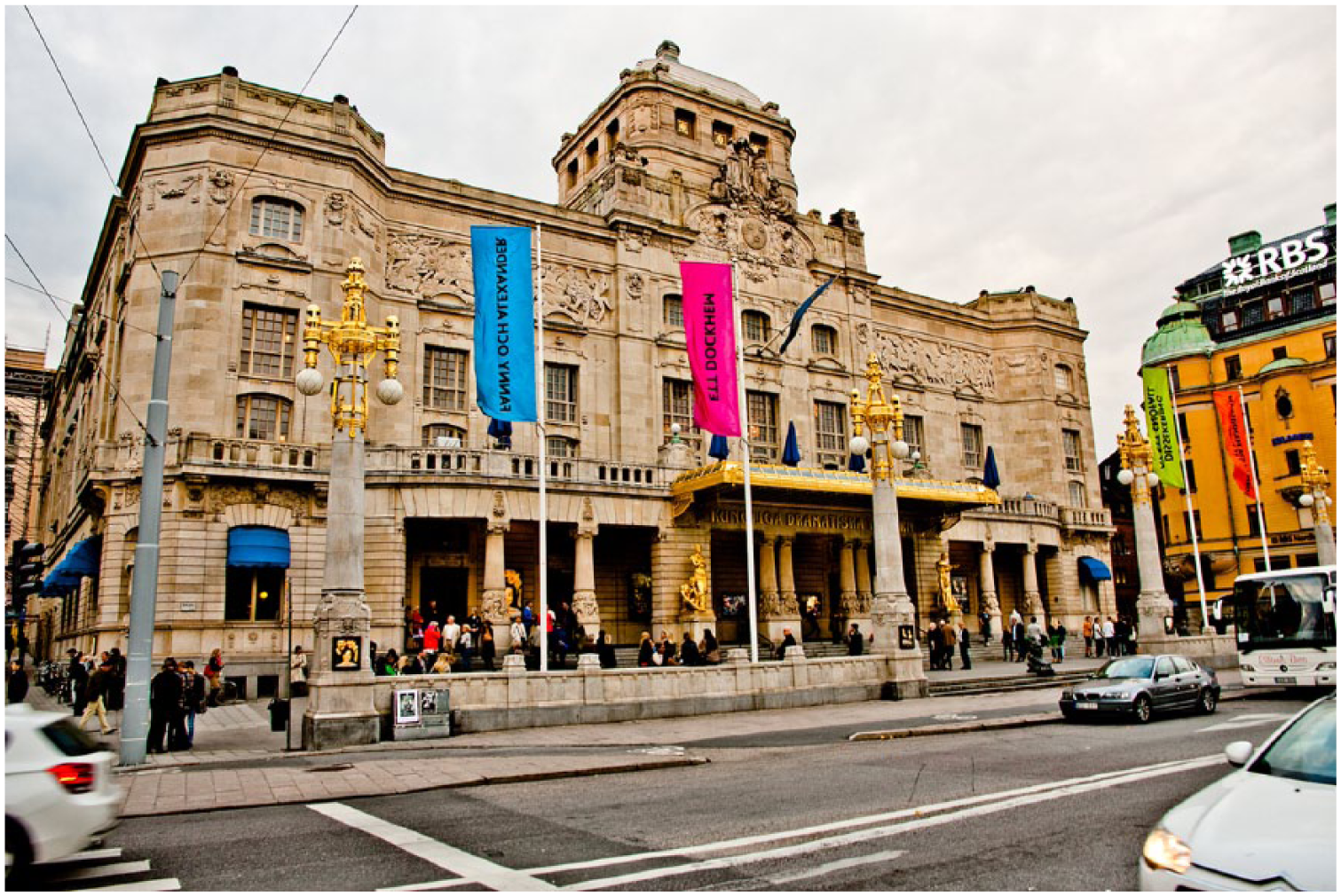
The Royal Dramatic Theatre.
Netvizz—a free-to-use application part of the Facebook app directory—allows for the extraction of data from different Facebook functions (groups, pages, search) (Digital Methods Initiative, 2016; Rieder, 2013). This study used Netvizz to generate a two-step snowball network of the “likes” between Facebook pages. Only official (or “public”) pages, and not personal pages of private individuals, were included in the Facebook crawl. It could be beneficial to include the flows of “likes” from/to individuals as well (if one would be able to include these one would, however, have to remember that an individual “like” is something altogether different compared to a “like” from an official institution; cf. Baym, 2013; Gerlitz & Helmond, 2013). Due to Facebook’s restrictions on applications (such as Netvizz), however, it is impossible to include personal pages in networks crawls such as this one. The present exercise captured all pages “liked” by the Royal Dramatic Theatre, and all the pages that have been “liked” by those pages. The crawl was conducted on 22 November 2016 and generated a total of 1,214 nodes (Facebook pages) and 8,934 edges (connections, in the form of “likes,” between the pages). In a first step, this network was analyzed to study the structure of the Swedish field of culture—that is the economy of recognition between (cultural) institutions in Sweden enabled by taking its starting point in the Royal Dramatic Theatre’s Facebook page.
In a second step, an additional crawl was conducted in order to study the relation between the field of culture and the economic field. This crawl took as its starting point the Confederation for Swedish Enterprise (Svenskt näringsliv)—an organization representing 60,000 private entrepreneurs and companies in Sweden. The confederation works toward improving the entrepreneurial climate in Sweden by lobbying for the lowering of taxes and market liberalization and a “flexible labor market” (Confederation for Swedish Enterprise, 2016). The confederation was chosen as the starting point for capturing the manifestations of the Swedish economic field in the online environment. The second crawl was conducted on 24 November 2016 and generated a network consisting of 3,050 nodes with 14,773 edges. The two networks (the Royal Dramatic Theatre and The Confederation for Swedish Enterprise) were then combined into one network and analyzed with Gephi (2016).
The Field of Culture by Way of a Network Analysis
Thus far, I have argued that network analysis may live up to the central expectations that Bourdieu placed on empirical field research. While the network analysis is unable to describe agents’ habituses and possession of capitals, it does capture an economy of recognition that unveils the general structure of a field and its relation to other fields (cf. Bourdieu & Wacquant, 1992, pp. 104–105). We note, again, that the “game” of a field is a game over who is recognized as a legitimate player in the field (Hovden, 2012). Following Bourdieu’s (1991, 1993b) theory of social interaction and fields and Sterne’s (2003) idea that technology is “little crystallized set of operations incorporated into the habitus” (p. 372), I approach inter-institutional “likes” as crystallized acts of recognition. In what follows, I provide initial answers to the questions posed above regarding the structure and autonomy or heteronomy of the Swedish field of culture.
The Economy of Recognition in the Swedish Field of Culture
Figure 1 provides a visualization of the Swedish field of culture. It is the result of the crawl of the Royal Dramatic Theatre’s official Facebook page and maps all the pages that it has “liked” and the pages that have been “liked” by those other pages. The level of ingoing “likes” (in-degree) determines the size of the nodes. This implies that the biggest nodes are the most recognized players in the field.

Visualization of the network surrounding The Royal Dramatic Theatre’s (Dramaten) official Facebook page using Gephi and Force Atlas 2 layout. Colors identify communities within the network based of modular class calculation (.67). Sizes of nodes are based on number of in-degree of connections. Pages with less than twenty likes have been excluded.
Turning to the graph displayed in Figure 1, we see, for example, that the public broadcaster Swedish Radio, The House of Culture/The City Theatre (Kulturhuset/Stadsteatern), and The Music Aid (Musikhjälpen) constitute some of the central nodes in the network. The arrows represent “likes”: an arrow that is bent clockwise indicates an outgoing “like” and a counterclockwise arrow indicates an ingoing “like.” From this, we may go into detail and discern an asymmetrical relation between the radio show “Uggla i P4,” hosted by popular music artist Magnus Uggla, who has a history of being besmirched by culture critics, and the Royal Dramatic Theatre: the “like” given to the latter by the former is unidirectional. Uggla remains unrecognized as a player in the field of highbrow culture, or, what Bourdieu (1993a) would refer to as a dominated player. In contrast, a symmetrical pattern of recognition is found, for example, between the TV-show “Babel” (a literature program hosted by culture profile Jessika Gedin) and the Gothenburg book fair.
The questions we are concerned with here, however, require an overarching view. Bourdieu argued that modernity has seen the rise of distinct social fields. An initial view of the graph below suggests that it lends itself to be conceptualized as the Swedish field of culture. Indeed, almost all nodes represent an institution concerned with the production or consumption of culture. The network thus represents an economy of recognition wherein institutions exclusively recognize other institutions engaging with culture in some way or the other. Based on the observation that all “players” in this network share a concern with culture, we gain support for Bourdieu’s notion of the field of culture as a distinct Wertsphären in the contemporary Swedish society.
Using the modularity class algorithm (see Blondel, Guillaume, Lambiotte, & Lefebvre, 2008), eight distinct clusters of nodes could be identified where colors represent distinct sub-communities. These are presented in Table 1. Since Figure 1, for layout purposes, only displays nodes with more than 20 ingoing “likes,” some sub-fields are only represented by one node in the graph.
Subfields in the Swedish Field of Culture.

PSB: Public Service Broadcasting.
In accordance with Bourdieu’s (1996) work on fields, we have here a distinct literary field composed mainly of publishers, book fairs, and libraries. There is also a journalistic field (Bourdieu, 2005). We note, first, that public service actors are the primary players in the journalistic field as represented here, and that commercial broadcasters are generally not recognized within the field of culture. This observation works in tandem with Swedish audience research showing that commercial/public service broadcasts distinguish between those poor or rich in cultural capital (Lindell & Hovden, in press). Second, many of the institutions in the field of broadcast journalism border on the field of highbrow art (Babel, Classic Morning in P2, The Culture Section of the Swedish Radio). This suggests, along the lines of Bolin (2014), that the journalistic field in Sweden is fairly recognized in the wider field of culture (for instance, Swedish Radio is the node with the highest number [101] of ingoing “likes” in this network).
Additionally, we discern a field of highbrow art. The ballets, art halls, museums, theaters, and the operas share an economy of mutual recognition. While Peterson (1997) in his argument on the decline of the “highbrow” was mainly concerned with individual lifestyles and patterns of cultural distinction between groups, the fact that the modularity class algorithm revealed an internally robust sub-field of highbrow art may present a challenge to arguments on the general decline of “the highbrow culture” in late modern societies. This sub-field, furthermore, connects to parts of the European field of culture and the Dutch field of culture, which lends support to arguments on the globalization of cultural capital (Prieur et al., 2008). Figure 1 additionally reveals a sub-field of gaming culture comprising institutions and associations concerned with roleplaying, cosplaying, and various forms digital gaming. The last sub-field is a hybrid sub-field comprising culture associations directed at youths (including Fryshuset high school, the anti-bullying organization Friends, as well as United Nations High Commissioner for Refugees [UNHCR]).
The Autonomy of the Swedish Field of Culture
Figure 2 combines the crawls of the field of economy (taking the Confederation for Swedish Enterprise as the starting point) and the field of culture (starting in the Royal Dramatic Theatre) in one network. The Force Atlas 2 layout was used after both the Royal Dramatic Theatre and the Confederation for Swedish Enterprise were set as fixed points in the network. As such, Figure 2 visualizes the gravitational pull of the two institutions: a pull toward either a cultural or an economic pole. While institutions concerned with entrepreneurship, including the universities, are pulled closer to the Confederation for Swedish Enterprise, the sub-fields in the field of culture are pulled closer to the Royal Dramatic Theatre. When combining the two distinct networks, key sub-fields in the field of culture (as discussed above) collapse into one-another. The sub-fields of radio and TV journalism have merged into one sub-field of broadcast journalism, and the literary field has merged with the field of highbrow culture. That is to say that when adding actors from the field of power or the economic field, the modularity class algorithm is unable to reveal the fine-grained differences that set sub-fields apart in the analysis that exclusively dealt with the field of culture. The museums, furthermore, have separated from the field of highbrow culture. They now make up one sub-field, located in-between the economic and the cultural pole. This is due to the fact that the Center for Entrepreneurial History (Centrum för näringslivshistoria) constitutes a bridge between the Confederation for Swedish Enterprise and the manifold of museums.

Network visualization using Gephi. Institutions The Royal Dramatic Theatre [Dramaten] and The Confederation of Swedish Enterprise [Svenskt Näringsliv] are used as fixed poles. The network combines data from Netvizz crawls of The Royal Dramatic Theatre and The Confederation of Swedish Enterprise official Facebook pages. Colors identify communities within the network based of modular class calculation (.67). Sizes of nodes are based on number of in-degree of connections. Pages with less than twenty likes have been excluded.
When set in relation to the economic field, the sub-fields in the field of culture largely remain separate economies of recognition. This means that the transactions of recognition in the forms of “likes” remain exclusive to institutions in the same social field, despite the fact that sub-fields merged with related sub-fields (e.g., the literary field with the field of highbrow culture) in the latter analysis. The transactions of recognition do not, at an overarching level, transgress the boundaries of the cultural and economic fields. The field of culture remains a distinct Wertsphären. The spokespersons who represent the various cultural institutions on Facebook are guided by a doxa strong enough to render it a tacit presupposition not to recognize players in other fields, perhaps especially players in the economic field (cf. Bourdieu, 1993a). The museums make up a special case because their social media spokespersons in fact find it reasonable to recognize the Center for Entrepreneurial History. In a network analysis, however, this pulls the sub-field of museums closer to the economic pole since the Confederation for Swedish Enterprise also “likes” the Center for Entrepreneurial History.
Discussion and Concluding Remarks
Following Bourdieu’s (1991) theory of social interaction, I have theorized the transactions of “likes” between the official Facebook pages of cultural institutions as transactions of recognition. The spokespersons who manage the Facebook pages of cultural institutions—the “imposters” endowed with the power of representation—embody the institution they represent Bourdieu’s (1991) and thus they “perform the field” in the online environment. Following this theoretical supposition—that actors in a field adhere to its doxa and illusio—we have seen that a network analysis of the economy of “likes” between cultural institutions reveals the contours of a social field in terms of who is recognized as a legitimate player. The aim of this endeavor was twofold.
First, I sought to illustrate that careful consideration of social theory might inform our understanding of what takes place on social media. Lomborg (2016) and Lindell (2015) have argued that we need social theory in order to contextualize and historicize our analyses of social media. Current social media research is under-theorized (Lomborg, 2016). At worst, “the social” is simply put into brackets and media research is pursued without consideration of the dynamics that characterize social life (Lindell, 2015). Couldry and van Dijck (2015) and Fuchs (2017) have called, thus, for a study of social media “as if the social mattered,” or, for a critical paradigm for social media research able to account for the broader picture that is social life. This study illustrates the merits of field theory for understanding the interaction between institutions on social media. On two counts we see how social dynamics described by social theory (Bourdieu, 1993a, 1996, 2005) are reproduced in patterns of interaction on social media. On one hand, all nodes connected to the Royal Dramatic Theatre were involved in the production and consumption of culture, thus lending support to the notion of an existing field of culture in contemporary Sweden—a distinct Wertsphären in society endowed with an internal economy of recognition whose point of entry implies being committed to cultural issues (Bourdieu, 1993a; Hovden, 2012). On the other hand, the sub-fields (the literary field, the field of highbrow culture, the journalistic field) discerned on the whole mirror those described in previous Bourdieusian research. The autonomy of the field of culture was subject to scrutiny through the inclusion of the economic field into the analysis. Whereas this implied that the related sub-fields merged the overall patterns remained—the transactions of recognition still did not transgress the boundaries of the cultural and economic fields. Bourdieu argued the regularities of the social world uncovered in France would apply to other “modern and differentiated societies” (Rosenlund, 2015, p. 157). Given the present results one may say that the Swedish case testifies to this argument.
Notable is the fact that there seems to exist a distinct field of gaming culture in Sweden, and that the field of journalism is almost exclusively made up of public service broadcasters. Moreover, we discerned a literary field as well as a field of highbrow culture, which challenges the ideas of the decline of “the highbrow” (Peterson, 1997). Whereas much effort has been geared toward the study of the Swedish journalistic field, more focus can be put on the field of gaming culture. Given the rather limited focus on the empirical material that I am able to fit into my argument here, a recommended avenue for future field research using network analysis is to study the transactions of recognition and directionality in detail. This would promote a deeper understanding of the dominant/dominated players in the field.
My second aim was to argue in the reverse direction: it is not only the case that social theory informs our understanding of social media, digital methods may enrich and illuminate the ideas and hypotheses brought forth by (analogue) social theory. Despite Bourdieu’s rejection of network analysis, I have, in line with De Nooy (2003) and Singh (2016), argued that it augments empirical field research. Throughout social science fields are often simply assumed to be “there” as coherent, ecological systems waiting to be studied (Bail, 2014, p. 469). Seldom are the limits—or the reach—of a field the topic of empirical inquiry. Bourdieu argued that “the limits of the field are situated at the point where the effect of the field cease” (Bourdieu & Wacquant, 1992, p. 100). The field of culture studied here, via the network analysis, ceases to exist when the recognition of legitimate players cease. The economy of recognition unraveled via the network analysis of transactions of institutions’ “likes” produces the relatively rare insight into the amplitude of the field of culture. This virtue alone renders network analysis a worthwhile endeavor for empirical field research. I call upon future research to deploy network analysis, not only to study the contours of a given field but also to identify potential sub-fields and pursue to study them in detail with the conventional methods deployed by Bourdieusian scholars—such as interviews and surveys.
A main mission for field research is, furthermore, to map objective relations between agents (Bourdieu & Wacquant, 1992). The network analysis does precisely this as it visualizes a set of “found data” (Bruhn Jensen, 2010) that deals with transaction of recognition between institutions. The transactions studied via the network crawl are “naturally occurring” (Bail, 2014) as crystallized acts of recognition (cf. Sterne, 2003) in the online environment. With this we move away from the somewhat oxymoronic use of self-reports for the study of “objective relations”—we gain a focus on actual practice (De Nooy, 2003). Thus, one of the main contributions of this study is that it suggests a way to identify social fields empirically by mapping the totality of crystallized acts of recognition—in this case, inter-institutional “likes” on Facebook. I do not suggest that self-reports such as surveys and interviews do not inform field research. As argued above, network analysis may constitute a useful supplement to these methods. Researchers could, for instance, go ahead to survey or interview their way toward an understanding of the specific forms of symbolic capitals that are valued in, for example, the sub-field of gaming culture. The network analysis crucially identified this sub-field in the economy of recognition and thus it is a suitable starting point in the study of fields. As already noted, the network analysis does not enable the studying of the detailed questions concerning the interplay between habitus and capital (step 3 in Bourdieu’s outline for field research), which is precisely where surveys and interviews would be required. Additionally, as both Baym (2013) and Hargittai (2015) have pointed out, data generated via digital methods are far from flawless. Sampling issues (inclusion in the dataset requires membership on a given platform), bots that generate “fake” data, together with the “black-boxed” nature of the (privately owned) platforms we study—to name but a few issues—propose a careful approach to findings. A critical assessment of the present outline includes the question regarding the extent to which the “likes” actually stem from human practice (as presumed in this design) or if they are auto-generated by Facebook’s algorithms. The frustrating answer to this question is that one can never know without interviewing every social media “spokesperson” of the institutions under scrutiny (which would presume that they remember). Emphasis should thus be put on the interplay between various methods in relation to the steps outlined for field research (Bourdieu & Wacquant, 1992, pp. 104–105).
Taking a step back, this outline materialized out of the somewhat unexpected combination of transactions of “likes” between institutions on Facebook, the technical affordances of digital methods and the sociology of Pierre Bourdieu. What emerges from this combination is an understanding of social interaction between official Facebook pages as an economy of recognition that unveils the persistence of the dynamics that social scientists have been concerned with throughout the 20th century and onward. Society is made up of distinct social microcosms, and with the advent of digital methods, we have gained new, supplementary, ways to study them. These tools allow the study of how a field is “performed” in terms of flows of recognition and, by extension, they provide initial views on the amplitude of a field—two rare instances in existing field research. What I hope to have illustrated is that an understanding of social dynamics in digitized and mediatized worlds requires a reflexive interplay between social theory and digital methods.
Footnotes
Acknowledgements
The author thanks Carolin Gerlitz for her comments on an early version of this article.
Declaration of Conflicting Interests
The author(s) declared no potential conflicts of interest with respect to the research, authorship, and/or publication of this article.
Funding
The author(s) received no financial support for the research, authorship, and/or publication of this article.