




Abstract
This article maps out and analyzes relationships shaping production in a growing cultural field of online gaming media production called ‘Actual Play’ (AP). AP occupies an ambiguous economic space between fan production and professional media and is marked by widespread monetization. Drawing on qualitative semi-structured interviews with 24 AP producers, this article uses actor-network theory and the concept of cultural fields to understand that space through an account of the actors constituting it. This maps the how AP producers develop their practices through complex relational networks. The analysis identifies ‘key actor types’ – the varieties of technological, human and corporate actors whose activities give shape to producers’ practices. The article concludes that despite pervasive pressures to professionalize, the field offers limited pathways to vocational sustainability.
Keywords
Introduction
Since the mid-2010s, a new transmedia genre has emerged called ‘Actual Play’ (abbrev. AP). AP presents recorded, unscripted sessions of tabletop roleplaying games (TRPGs), a form of analog gaming exemplified by Dungeons & Dragons (D&D), where players use pretend or collaborative storytelling techniques in combination with game rules to inhabit, explore and create stories about imagined worlds and characters. Traditionally, most players will each play the role of a single character, while one player assumes the role of a Referee who describes the world and situations those characters encounter. AP media is distributed online in the form of podcasts, live-streamed videos, and edited videos. It combines the narrative qualities of the game, its ability to model play, and the charisma and chemistry of the players. AP has had a transformative effect on the culture and industry of TRPGs, with popular series like Critical Role and The Adventure Zone massively expanding TRPGs’ player base (Sidhu and Carter, 2020), and AP increasingly acting as a source of visibility for TRPG products. Producing AP is highly accessible, with most of the tools needed to produce it built into the average laptop or attainable at little to no cost.
AP is also marked by widespread monetization: Rare is the producer who does not collect tips, sell subscriptions, or in some way hustle their series. AP has produced its share of commercial successes: In 2019, Critical Role broke records on the crowdfunding platform Kickstarter, when their campaign to fund an animated series based on their AP earned in excess of $11 million (Whitten, 2019). Critical Role made headlines in October 2021, when a leak from Twitch.tv revealed it to be the live streaming platform’s highest earning channel (Espinosa, 2021; Pesce, 2021). The following month, D&D’s publisher Wizards of the Coast LLC (abbrev. WotC) announced it was developing ‘the first Actual Play series to air on cable television’ (Ryan, 2021). Yet, despite the genre’s growing popularity, most of its producers do not attain these levels of mainstream success. The vast majority of AP is produced for relatively small audiences and brings in more modest revenues if any.
AP is a product of a changing cultural economy, shaped by blendings of fan production and corporate media (Jenkins, 2006) and the growing prominence of technological platforms not only in hosting and distributing media, but in fostering the very possibility of its production (Nieborg and Poell, 2018). There is no live stream without the live streaming platform. As cultural industries evolve, it is important to assess whether new forms and fields can afford gratifying careers and sustain their practitioners – whether they entail ‘good work’ (Hesmondhalgh and Baker, 2011). This also means attention to the status of non-professionals and pathways to professionalization (Hesmondhalgh, 2010). Thus, this article asks what kinds of work are possible in AP.
To approach these questions, this article examines the social relations constituting AP. While there is growing scholarship on TRPGs and AP, there has been little research on how AP is made. Such an understanding first requires an accounting of the various tasks and relationships that go into its production. I employ actor-network theory (abbrev. ANT; Latour, 2005) to develop an account of AP production as what Bourdieu (1994) terms a ‘field’ – a structure of social relations that produces differentials in the social and economic positioning of cultural products and their producers. I identify key groupings of actors, or ‘actor types’, that shape the field and exert its key pressures. My analysis indicates that while the tools needed to produce and monetize AP are ubiquitous, access to the human and social resources necessary to produce AP and work the algorithm professionally is rarified.
AP is a very recent phenomenon, and the academic literature is still in its early stages. Indeed, one of this article’s primary contributions is a detailed empirical account and analysis of labor in AP’s burgeoning field. The analytical portions of this paper draw on the extant research on AP but are also in conversation with research on digital labor, games and gaming media, and creative industries to situate AP in the wider context of user-driven cultural production on online platforms. Specifically, it aims to advance understandings of how different social actors shape possibilities for practice in these new, highly informal work environments where creative labor and analog gaming cultures converge.
Theoretical framework
I employ Bourdieu’s (1994) concept of a cultural ‘field’ to refer to the range of practices and sociocultural positions involved in AP production. This term reflects how production emerges from historical communities of producers embedded in a particular sociological context traversed by dynamics of power and operating according to particular cultural and economic logics. As such, the field provides a model for situating different AP producers and their practices in relation to one another. Bourdieu describes the field of cultural production as composed of positions, relations between positions, processes of position-taking, and forces exerted by agents and through their relations to one another (1994: 30).
Bourdieu’s theory of fields is predicated on the notion of a broader ‘social space’, itself constructed through his analyses of class (Bottero and Crossley, 2011: 101). This is reflected in his language around ‘struggles’ for position, power, and various forms of capital. His approach thereby risks overdetermining the interests of practitioners according to those categories. Moreover, constitutive forces that shape fields are taken to prefigure the field itself, obscuring the agencies through which those forces manifest (cf. Latour, 2005: 65–67). I am also not the first to note that Bourdieu overlooks the role of technology in his sociological analytic of cultural production (Prior, 2008: 312–313). Given Actual Play’s location at the intersection of industry and leisure, the question of how such manifestation takes place is a key theoretical stake of this research, and the agency of various individuals, technologies and other kinds of actors remains open for exploration.
I draw on actor-network theory (Latour, 2005) to analyze how key agencies are articulated. ANT builds on the insight that actions and actors extend and overtake one another, and coherent processes are formed in the assemblage of multiple agencies. For instance, AP as a media format emerges in the combined agencies of game players, platforms, computers and software, games, game producers, and audiences. From this perspective, producing AP ceases to be a concrete task or set of tasks and instead becomes a complex network of relationships. The producer becomes a guide and way of understanding this network; ‘production’ becomes the matter of how various agencies come together in the creation of a particular kind of media object. The stability of AP as a genre itself appears as a function of these converging agencies, whose operation allows not only for the production of media content but the generation of a production model spanning multiple media formats and encompassing numerous processes (Prior, 2008: 314).
Methodology
Table of Participants.
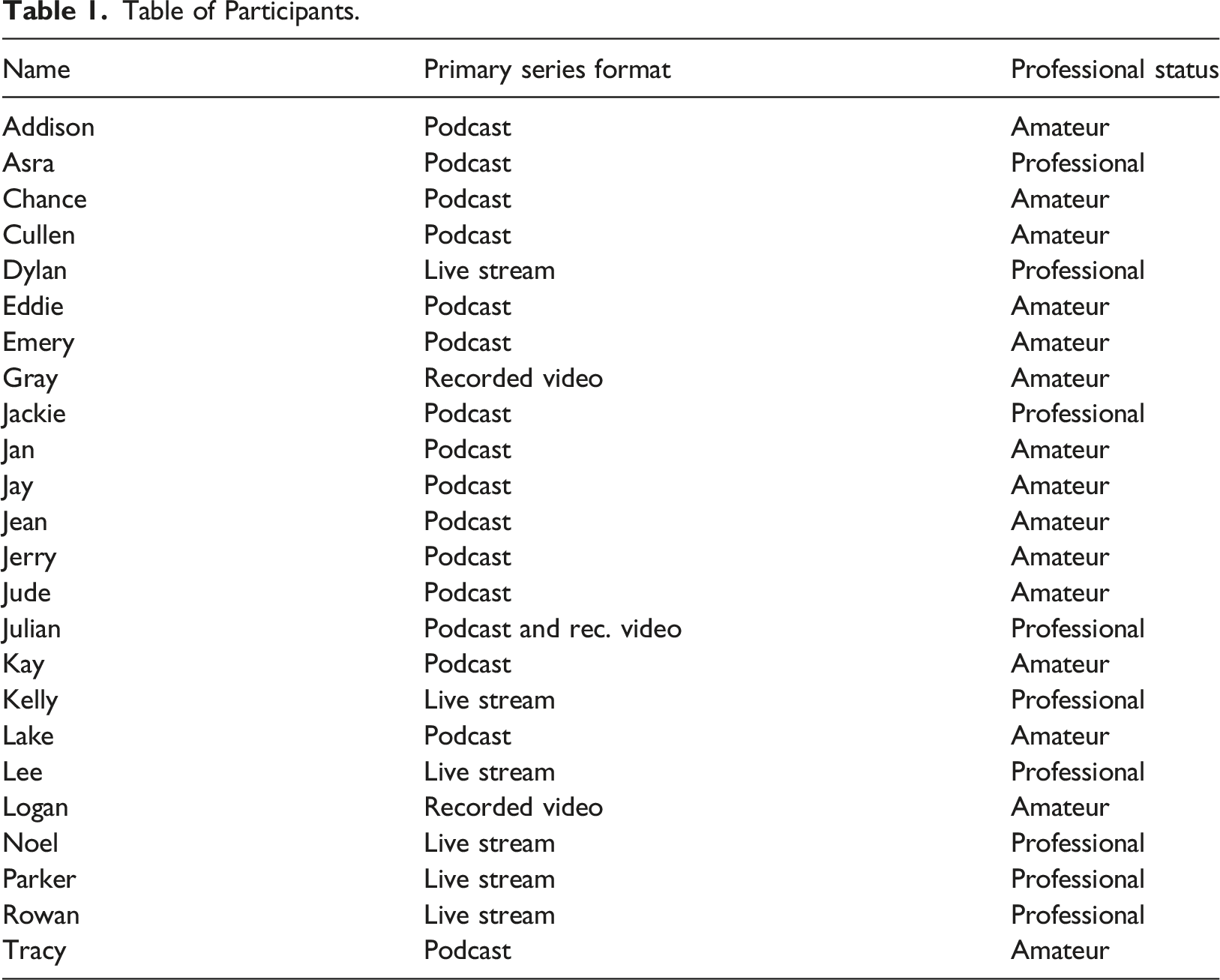
In addition to the details in Table 1, I can provide the following aggregate data about my sample: Due to some mix of self-selection bias, my own positionality as a white cisgender male, and gaps in the initial research design, participants in my interviews were overwhelmingly male-identifying (18 out of 24) and only four presented as non-white. Moreover, only one participant was located outside the United States or Canada. As such, the account of AP production in this article primarily reflects the experiences and practices of white male producers. As I discuss below, my methodology aims to identify networks of social relations, not generalize attitudes or experiences. Nevertheless, this sample occludes the practices and networks of marginalized producers, which may differ from or complexify the description given here.
I employed network mapping (see Latour, 1999, 2005) to develop a thick description of AP production. This strategy tasks the researcher with investigating situations, identifying agencies at work, and unpacking those agencies. In interviews, participants produced narrative accounts of what kinds of activity and interaction went into the full production cycle of an AP series, including efforts to promote and monetize it. My interview design reflects an approach to network mapping rooted in Ekbia and Nardi’s (2017) concept of ‘predicaments’. Predicaments are moments where subjects navigate complex, ambivalent social situations to attend to questions of wellbeing and survival, often with imperfect information. For these authors, predicaments serve as a crucial optic for understanding how political economic processes converge in everyday life, framing practice in situations steeped in affect as the ground on which political economy becomes history. Predicaments reveal the structural as it manifests in practice, and can be investigated through conversations and narratives as well as observation.
I produced the descriptive materials in the following section by coding the actors discussed in interviews. Interviews were supplemented with documentary research and secondary accounts. The initial round of coding produced a thick synthetic account of the AP production process. A second round of coding generated a list of actors, which was then recombined into second-order themes, producing the actor types that serve as my descriptive units. To improve reliability, all factual claims reported here were triangulated against other interviews, research or academic literature. The discussion section examines themes emerging from the overview of actor types. I take these themes to reflect important dynamics in AP’s cultural field, informing the kinds of working lives available to producers.
Key actor types
AP producers engage in interconnected processes of casting and planning, play, performance, recording, editing, distribution, promotion, community work and monetization. A full account of the network map discussed above exceeds the limits of this paper. Instead, I identify four key actor types integral to these processes. These are the TRPG industry, co-producers, platforms and audiences. In the following, I discuss how these actors exert their influence on the field.
Tabletop roleplaying games industry
This type incorporates both industrial actors in the production of TRPGs and the products thereof. For example, it includes both Wizards of the Coast LLC, the subsidiary of Hasbro, Inc. that publishes D&D, as well as the D&D game itself. This category also encompasses gaming accessories, such as dice, figures, and specialized gaming tables and stationary, as well as these products’ manufacturers. The TRPG industry has seen tremendous growth in recent years (Griepp, 2021; Morrissey, 2017), but remains a niche sector within the already-niche hobby games market (Griepp, 2021). Due to the industry’s modest size, producing TRPG products is a precarious endeavor and heavily reliant on free labor for marketing and public relations (Trammell, 2019). TRPG products are core creative tools in AP and play a major role in structuring play and performance; at the same time, the companies who produce them are often active in seeking exposure for their products through the visibility provided by AP.
When AP producers decide which game (or games) to play for their series, they are at once making creative decisions about the content of their series and economic decisions about access to audiences and potential backers. TRPGs are, among other things, tools for creative storytelling. Through their rules and other play materials, they define fictional settings and worlds and populate them with creatures and characters. Their mechanics pace and direct the flow of play and texture the performance at large. As such, the chosen system is a critical component in constructing narratives. For several groups I spoke to, experimenting with different systems on their series served as a means of exploring new story structures and characters: There’s one character in particular that I hold very close to my heart, who I played through a number of different campaigns and systems, where, for me, she was exploring being a victim of domestic violence. And I’m really glad that I was able to carve out a space where I could explore that using many different mediums. (Chance)
For this player, who had a background in creative and performing arts, playing the same character across multiple systems was a way of exploring different aspects of that same character. The framing of systems as ‘many different mediums’ speaks to the way different systems focalize different aspects of characters and forms of action. At the end of the first season of The Adventure Zone, which had previously featured Dungeons & Dragons, the Referee introduced a bespoke system of his own devising allowing the players to play through long periods of time at once and providing them a high degree of narrative authority. This was done specifically to break away from the relative granularity of D&D (Hedge, 2021). A hallmark of the Friends at the Table podcast is its willingness to change up systems explicitly to introduce different genre conventions and story structures and provide new perspectives on ongoing narratives.
The TRPG industry is itself interested and involved in the production of Actual Play. Like other analog gaming industries, the TRPG industry draws on internet chatter and informal cultural intermediation (as per Whitson et al., 2018). Trammel argues that analog games ‘have an oppositional yet contingent relationship to digital media’ (2019: 3), noting the importance of online communities and the ‘digital apparatus of work’ (2019: 30) in attracting buyers, providing feedback and extending the brand. AP constitutes a part of this digital apparatus, providing visibility for TRPG products and instruction in their use, paired with entertaining and charismatic performances. As such, several producers of TRPG products seek to leverage AP in their marketing. The online virtual tabletop app Roll20 produces an Actual Play series featuring popular streamers, showcasing the various systems supported by their software and, thereby, the software itself. Independent RPG publisher Magpie Games uses outreach programs to train streamers and professional Game Masters to run their games and links to Actual Plays featuring their games on their website’s product pages. Accessory manufacturers may contribute product to AP series in exchange for visibility or promotional partnerships (as the miniature terrain firm Dwarven Forge does on Critical Role).
Julian produces AP as part of a small, independent TRPG publishing operation. For them, it was important to be creating AP throughout the game development process, as a way of building up a player base and conversation about the game in anticipation of its release, and to demonstrate gameplay for crowdfunding campaigns. They described how they felt that AP has become ingrained in the broader culture of producing and consuming TRPGs: To me, one of the most fascinating angles about Actual Play is how there’s an expectation that you have more ‘stuff’ with the rules. Like, the rules of the game are one thing, but more and more, you see rulesets that are written with the understanding that you’ll be able to watch a video or read a blog post or do some other kind of supplemental thing to understand it better. (Julian)
WotC also have a long-standing investment in Actual Play as a means of promoting the Dungeons & Dragons brand. In 2008 they launched a podcast called Acquisitions Inc., featuring the authors of the popular webcomic Penny Arcade, playing the game’s 4th edition. Acquisitions Inc. would go on to spawn a host of spin-off series, live shows, and an official D&D product line featuring its world and characters. WotC regularly partners with Twitch streamers and video producers to develop D&D-focused AP, providing promotional coverage, airtime, play materials, studio spaces, talent and logistical support, and a degree of funding. They also partner with professional studios to create elaborate edited video series, like Stuff of Legends and Dimension20. These strategies underscore the use of streaming in gaining visibility for D&D, but AP also contributes value in its ability to generate fandom and cultivate followings: WotC banks on coverage from channels with consistent track records and devoted audiences, even when they do not exclusively play D&D; As Dylan, who had been working with the company for several years put it, WotC began to expand their engagement with AP when ‘they realized they could market to this crowd and get the Critical Role fanbase involved in their stuff’. WotC has publicly stated that AP is now a primary driver of engagement with D&D (Whitten, 2020).
An AP series’ reach and its connections to the TRPG industry tend to go hand in hand. More popular series often sell advertising slots to producers of TRPG products and accessories, like miniatures, terrain, dice, gaming tables, etc. APs also use monetized affiliate links to purchase the games they feature, earning a small royalty for each purchase made through the link. Among producers I spoke with, advertising was a relatively minor, often negligible source of revenue. At the same time, the involvement of larger companies like Magpie and Wizards of the Coast demonstrates the potential benefits of industry partnerships.
Co-producers
An enormous amount of work in AP goes on beyond the recording space. Producing AP requires specialized knowledge and skills to stage, produce, promote, and distribute a series. AP products are developed in relation to producers’ ability to access these elements and dialog with one another. I categorize this (admittedly broad) grouping of fellow producers, support workers and teachers as co-producers. A series’ relationship to these factors bears significantly on its reach and monetizability and proportionately inflates the necessary investment of labor and various forms of capital.
For smaller series, most of this peripheral labor is handled in-house. In many instances, the work of editing and promoting a show and managing its community is shared among members of the group, or concentrated in the hands of the Referee as a kind of de facto showrunner. In more professional efforts, these roles can be hired out to lessen the burden on the core group. Dylan’s Twitch channel was bringing in enough money to pay full-time wages to a small staff of producers and managers and part-time to its performers. Their channel ran multiple series with different groups, and each group had a designated ‘producer/player’. When I clarified that this player was not the Referee, they responded: What I found is that the GM [i.e., Referee] is usually so preoccupied with both figuring out what they’re going to do from week to week, and because of the engagement and interactivity that we do on the channel to raise money. So they have a lot that they’re taking on, that I try to take them out of thinking of all the marketing stuff. (Dylan)
To relieve the labor burden on the Referee, the producer-player would be responsible for arranging logistics and scheduling for the series, special events, and feeding updates and series news to the channel’s full-time ‘social media guru’. In brief, the ‘production’ side of Actual Play production creates the need for additional labor, which often surpasses the means of the core team of players. In terms laid out by Whitson et al. (2018), developing professional Actual Play requires ‘connecting the inside of [the production process] to outside communities of other [producers], fans, funders, and distributors, a practice we refer to as ‘‘interface work’’(2018: 2).
Interface work is managed differently depending on the format of the series and involves different actors: In podcasts, specialized networks have emerged to help producers connect, share knowledge and skills, and promote one another’s work. More formal networks like the One Shot Network may also provide a degree of resourcing and advertising connections. Less formal networks, which often take the form of Twitter lists or Discord servers, are less organized but still important sources of affective and immaterial labor. One podcaster I interviewed handled the production elements of their series more or less solo but occasionally turned to their network for help learning software or voice-acted snippets. For many podcasters, these networks are also sources of emotional support and social bonds, which help maintain motivation and enthusiasm for the series.
On Twitch, co-production operates through a platform-centered network of Actual Play performers, chat moderators, and community managers. Twitch creates conditions for the overlapping of viewing and broadcasting practices; In addition to hosting each other’s streams, as Twitch users, streamers act alongside ordinary viewers in watching, discussing, and participating in other broadcasts. Kelly, a Twitch-based performer and community manager, discovered streaming through Critical Role. After catching up on its back catalog, they began to engage with the live stream more directly: I started watching it live on Twitch and I learned about the Twitch community. And it made me want to get involved in things online. It really opened up my world, learning how to stream. And especially the AP TRPG scene, it really opened up my eyes because I would see people I would follow from Critical Role, like people I would make friends with in chat and stuff, like, ‘oh, we’re going live playing this game.’ (Kelly)
Like several other participants pursuing a living in AP on Twitch, Kelly gradually transitioned from viewer to streamer as they became more involved with the scene. Additionally, the streaming scene is heavily patronized by WotC and other RPG publishers in the form of sponsorships and partnerships that boost their visibility, making it alluring to producers seeking to establish their names and develop careers.
Edited video series, which require major labor investment and technical skill in filming and editing, are almost exclusively the purview of professional operations with strong ties to established cultural industries. Dimension20 and Stuff of Legends credit extensive production teams, including prop designers, videographers, camera operators, directors and executive producers, and are offshoots of existing media brands – CollegeHumor and Smosh, respectively. HarmonQuest and Relics & Rarities leverage the mainstream celebrity status of their hosts (Dan Harmon and Deborah Ann Woll) in addition to corporate backing. Rather than seeking to monetize the series directly, these are produced within larger media enterprises and synergistic business strategies that allow for degrees of spectacle and polish well beyond the reach of amateur practitioners.
Other forms of co-production are important in boosting a series’ visibility. Participants discussed the importance of fan art and shout-outs or guest appearances from big names in generating buzz and attracting audiences. Prior followings and relationships within and beyond the space are often key assets in a series’ professionalization. Noel discussed how prior followings from a period of variety streaming, as well as high-profile friendships in eSports, helped them to build an audience on Twitch. Their familiarity with the technology and streaming practices and ability to access support endowed them with critical cultural, social and intellectual resources well beyond what they would have to work with if they had been starting fresh.
The COVID-19 pandemic, ongoing at the time of writing, has somewhat shifted the dynamics of co-production, especially in video. Prior to the pandemic, many AP streams presented in-person play, often around elaborate gaming tables in studios with equally elaborate mic and camera riggings. A cluster of such series had emerged in and around Los Angeles, where AP could tap into local economies of acting talent, studio space, costumes and props, as well as proximity to Hollywood and Critical Role. Participants operating in this space discuss that WotC had been particularly invested in it, and drew on Los Angeles talent for its official streams. In the pandemic, most APs have transitioned to remote play formats (although some have begun to resume in-person play). This shift appears, for the moment, to have decentered the economy of talent and the calculus of costs, allowing for groups to play across long distances, but has rendered production somewhat more spartan, with the disappearance of lavish studios and props. As some begin to forecast a return to ‘normal’ life, it remains unclear to what degree these new spatial arrangements will outlast the pandemic, or whether its conclusion may reinstate prior local hierarchies.
Platforms
It is no understatement that AP is a platform product. There is no meaningful AP scene or industry without the technological platforms enabling its distribution and monetization. This section examines the roles of various platforms in brokering access to audiences, income, and networks of co-production. The use of the term platform here conforms to Poell et al.’s definition as ‘data infrastructures that facilitate, aggregate, monetize, and govern interactions between end-users and content and service providers’ (Poell et al., 2022). As AP spans multiple formats – streams, podcasts and edited video – it provides useful materials for examining how these formats entail different suites of ‘platform practices’ (Duffy et al., 2019). The data here underscores how Twitch.tv integrates various key functionalities providing significant monetary advantages to those producers who use it, while noting the more varied platform practices of podcasters and the more restricted opportunities of edited video.
The website Twitch.tv provides an all-in-one platform where AP can be produced and broadcast live, viewed, discussed and engaged with interactively by audiences; monetized, and promoted. In the previous section, I noted how Twitch’s integration of features facilitates transitions between participation and (co-)production. Indeed, the ability to ‘host’ other streams or direct one’s viewers to another’s stream in ‘raids’, create platform-specific opportunities for synergistic cross-promotion.
Monetization is also tied into Twitch’s core functionality through channel subscriptions and donations of ‘bits’ – a form of local currency which can be exchanged for money, with the platform taking a cut off every exchange. The monetization service Streamlabs can also be integrated into one’s stream, allowing for more robust donation processing and more complex incentive schemes. Streamlabs may be critical for more modest streams, as Twitch restricts its native monetization functions to ‘Affiliates’ and ‘Partners’ – status granted to channels that meet certain benchmarks for regularity and engagement (Twitch.tv, n.d.). Monetization is looped into participation in the stream through a variety of processes, some practiced and some inherent to the platform (Johnson and Woodcock, 2019).
By contrast, podcasters cannot centralize their work on a given platform. Rather, podcasting requires a highly variegated set of platform practices. Recording often involves savvy use of teleconferencing services such as Zoom, Discord audio/video chat, Google Meet, Skype and/or podcasting platforms like Anchor. fm or Zencastr, in combination with capture and editing software like Audacity and Reaper. The audio files must then be uploaded online and distributed to listeners via RSS feeds. This activity takes on several forms; some podcasters connect RSS feeds on their own private web servers to specific distributors, like Apple Podcasts and Stitcher. Most participants used services like LibSyn to host and automatically connect their podcast to multiple distributors; other series like The Adventure Zone have it handled by a podcasting network. However, these services are not entirely straightforward; different podcast distributors use different categories of metadata. Because there is a great deal of competition between aggregators, producers generally need to be hosted on as many as possible to build an audience. Maximizing one’s reach on these platforms requires a sophisticated understanding of multiple, often redundant or even conflicting sorting schemes. Nor are these aggregators necessarily friendly environments for Actual Play podcasts. Discoverability through an aggregator’s browse or search functions is managed algorithmically, with preference given to series with higher listener numbers and, on platforms that support them, better ratings and reviews. This creates pressure to push for better metrics, both through various forms of content optimization and appeals to listeners to rate and review.
Producers in both formats struggle to reach audiences in distribution environments not designed for AP. On Twitch, a platform largely focused on video games, and there are categories for two named TRPGs, but only an umbrella category for groups not playing D&D or Pathfinder. As such, the D&D category displays many series that are, in fact, playing other games but sort themselves under D&D and access its larger subscriber base.
Accordingly, AP producers depend on social media platforms to find audiences for their work. The workings of these services are often opaque, and using them involves a blend of strategy, intuition and experimentation. Twitter creates a crowded, competitive field where content requires immediate and intense engagement to gain traction. Producers I spoke with noted that the exact workings of its algorithms are unclear and seem to change frequently, suggesting, for instance, that posts containing links to outside websites seemed to get less exposure, whereas posts containing images did better. Jerry discussed a bi-weekly content cycle they followed for their series Instagram feed in order to produce diverse promotional posts on a regular basis without too much planning, all while maintaining an attractive-looking feed.
Monetizing podcasts is difficult and is not integrated into the principal act of production as on Twitch. Monetization largely falls into two types: Advertising and patronage. Most Actual Play podcasts are too small to attract advertisers, or they do not feel the advantages of advertising outweigh the cost of alienating listeners. For those who do advertise, the work of placing ads is often taken on by syndication services like LibSyn and Acast or, when available, brokered by podcast networks. Patronage can take the form of donations to a show through PayPal or other payment services, but is more often platformized through services like Patreon and Ko-Fi. Patreon offers tiered subscription models, where users can subscribe at a higher monthly rate for access to higher tiers. Many podcasters incentivize higher-level subscriptions through the creation of supplemental offerings, such as access to private community spaces, inclusion or shout-outs on the show, or even access to additional content feeds. In other words, Patreon both affords the monetization of podcasts and creates pressures to expand one’s labor investment to justify higher tiers.
Twitch streamers also promote their series on social media platforms and monetize through advertising and patronage. However, they undertake these practices in addition to those functions already provided by Twitch. In addition to the inbuilt markets of audiences and co-producers, Twitch as a platform offers certain advantages in its ability to prepackage key functionalities necessary for professional AP production, including ad placements. While Noel draws considerable income from their Patreon, their primary revenue source remained donations and subscriptions on Twitch.
Another important platform on the AP landscape is YouTube. However, YouTube tends to figure as secondary to most production practices and does not tend to play as significant a role in their structuration. YouTube serves as a repository for both podcast episodes and Twitch recordings (or ‘vods’), and expands a series’ discoverability somewhat by granting access to audiences who primarily consume online content through that site. However, it is difficult to monetize: like Twitch, YouTube channels must meet a certain baseline engagement threshold before they qualify for monetization. Because of AP’s relatively small audiences, few participants drew any revenue from YouTube views, and those that did mentioned that the income they did receive from that website was negligible. Many edited video series are distributed primarily via YouTube, but as noted elsewhere, these series tend to draw on more traditional, corporate funding structures and thereby tend to operate as parts of larger business models, not as primary revenue generators. Here, YouTube’s celebrity economy and its structural ties to formal production industries (see Burgess and Green, 2009), make it a good vehicle only for very high-profile series.
Audiences
Dealing with audiences is a fraught but necessary endeavor for AP producers. They perform what Baym (2018) terms relational labor as they continually manage tensions between making themselves available and ‘authentic’, and maintaining the boundaries required to do good work. As noted above, many producers offer access to exclusive fan community spaces for many reasons, including as monetization incentives, to grow engagement or simply to get to know some of the people who consume their work. However, maintaining such social spaces tends to require leadership and governance, especially as communities grow and become more complex. Several of my participants discussed the need to step up and resolve conflicts in their fan spaces, where they were regarded as hosts and de-facto authority figures. Furthermore, members of audience communities are rarely content to remain in purely passive consumer roles: The people that are in my Discord channel are the people who want to be community members, potentially community leaders. […] They want to be involved in the game. They want to play games with me, they want to be mentioned and get shout-outs. They want to have an interactive experience with the podcast, they want to be part of its production. (Jay)
Fan spaces, especially those where the creators of the objects of fandom are active, are sites where fannish passions are channeled into creative energies. Many such spaces are pay-gated, and AP series lean heavily on their listeners for income. Accordingly, many of my participants’ experiences reflect McMullin and Hibbard’s observation that Adventure Zone fans’ ‘direct financial contributions can facilitate increased investment and a sense of fan ownership in the narratives, as well as a more direct stake in their relationships with creators’ (McMullin and Hibbard, 2021: 157). While those authors frame such dynamics as products of The Adventure Zone’s particular funding model and positioning towards its audience, my own research indicated that model and positionality are far from unique to that series, and that similar articulations of those factors produce similar effects.
This elevated sense of ownership can encourage beneficial forms of co-production, such as fan art and hype (McMullin and Hibbard, 2021). However, it can also foster expressions of entitlement and generate feedback that is unwanted, unhelpful and unpleasant. Marsden and Mason argue audience expectations of ‘more polished entertainment during performances’ (2021: 180) can impact how producers perform their play and develop their stories. These dynamics are especially pronounced in spaces like Discord, where there are few barriers between fans and producers: It’s exhausting to see a space where you get constant, second-by-second feedback of creative work that you do, that’s separate from, for instance, thoughtful critique. […] That [critique] is different to me in a real way than, like, someone halfway through an episode saying that they didn’t like scene X. (Asra)
The ongoing dialog between a series’ producers and its fan communities creates opportunities for audiences to make demands about its development. While not all producers are as responsive to audience feedback as the cast of The Adventure Zone (McMullin and Hibbard, 2021: 160), the centrality of audience input in platformized economies of visibility and the importance of hype and fannish energies in sustaining a show, provide points of leverage where audience members can feel entitled to their say. The visibility of the processes by which stories are constructed in Actual Play may further justify these forms of feedback (Apple, 2021: 182). Failure to meet these demands can generate hostility, and managing audience affect can become more complicated as audiences grow. The Adventure Zone’s Griffin McElroy notes that as the audience for the show expanded, ‘listening to the audience became a lot harder, because there were conflicting wants and needs’ (Hedge, 2021: 152). Thus, producers must constantly evaluate their ability to manage conflict and negative affect as they develop their relationship to audiences, with ramifications on the nature and scale of the product.
Despite incentives from platforms to involve audiences in production, and particularly in live streams, producers often resist giving audiences too much control. Audiences can interfere with players’ sense of narrative control and disrupt the flow of play. Dylan discussed how, when their channel was just starting to generate profit, they had monetized it primarily through donation ‘incentives’ – personal and collective donation goals which, once achieved, would allow audiences to inject some new mechanical or narrative element in the game (c.f. Blau, 2021). However, they reflected that over the years, the channel had begun to shift its focus towards better and more sophisticated narratives. In this new context, donation incentives became more problematic: It helped propel the donations, but we can’t do that on something like [our current series], where it’s like, okay, yeah, everyone gets a jet pack. You know, everyone gets Iron Man armor. Everyone gets, you know, Cthulhu shows up. I can’t do that, because you’re really going to mess up the story that’s being developed. (Dylan)
Noel emphasized that these forms of creative interference are not only incidental but often quite intentional. They described their Twitch chat as ‘not an honest player. They have no skin in the game, they’re just here for some LOLs and some fun. […] I try to avoid them as much as possible. I tell my players not to read chat, I barely read chat. They’re the enemy’. Noel perceived the very presence of Twitch chat as a threat to the integrity of the narrative and an unwelcome distraction to the players. Kelly and Lee both explained that while, in order to preserve some creative control, they limit their donation incentives to mechanical perks to be activated at a player’s discretion, even these are threatening to the coherence of the story: Audience engagement can fluctuate from one day to the next, making the influx of these perks hard to anticipate. Moreover, audiences find ways to game even these more restricted measures, for example, by heaping bonuses on a single player rather than spreading them around evenly.
Nevertheless, audiences’ tastes are of interest to AP producers as creators of media and fans themselves. In interviews, practitioners identified multiple reasons for caring about fan engagement beyond the obvious monetary and algorithmic incentives. Jude explained their decision to feature the Alien RPG on their series as follows: [Because of] the fact that it had the Ridley Scott franchise attached to it, there were a lot of people who were suddenly interested in this game, right? And that was one of those times where I really wanted to strike while the iron was hot, because there were so many people […] that were absolutely ravenous for this content. (Jude)
Notably, this producer does not monetize their series in any way. Regardless, they remain committed not only to producing Actual Play, but to generating content that garners positive reactions from audiences and satisfies their curiosity about new products.
Discussion
The empirical material above explores the roles of various actors in structuring AP production and provides insights into the work and working lives of its producers. Specifically, it highlights important dynamics affecting pathways to professional positions, the role of formats (podcast or live stream) in brokering access to these pathways, and the influence of the Dungeons & Dragons brand in shaping professional trajectories. In this section, I examine themes emerging from the account provided above.
Advertisers, sponsors, and merchandise
It bears noting the conspicuous absence of advertisers and sponsors from the accounts above. Indeed, while sponsorships are a source of revenue for some AP series, it is not clear from my interviews nor in my analyses of AP products and discussions around them that sponsors constitute an important actor type in and of themselves. Many participants in my interviews did not seek out or use sponsorships or paid advertising to support their series, and those who did cited them as secondary sources of income. Sponsorships as such tended mostly to take the form of partnerships with publishers. This is not to say there is no interest in being sponsored. Monetizing participants were mainly audience-funded, but noted this required creative compromises and forms of emotional labor. One emphasized that they wished to pivot towards an ad- or sponsor-based business model, to focus on their production and storytelling.
Sponsors and advertisers are more visible in a number of high-profile series such as Critical Role and Weave the Tale. I was not able to get data about the comparative breakdown of revenue streams for these series, but note that at the very least, their high viewer counts surely make them a more attractive prospect for sponsorship than many of the smaller-scale producers interviewed for this research. Participants noted that advertisers do not have much interest in AP because its overall audience is relatively small. As such, they remain out of reach to those producers who would most benefit from the autonomy they afford.
Likewise, while a few participants in the study did sell merchandise for their series, they emphasized that merchandising revenues were negligible. Jackie noted that sales on merchandise only rarely balanced the costs of producing it, and concurred with Kay in framing such products as more of an offering to fans than a business strategy. While bigger series may generate profit from such products, their function for most AP producers appears to be more on the order of branding (Banet-Weiser, 2012) or relational labor (Baym, 2018).
Dungeons & Dragons as kingmaker
Throughout all sections of the field, Dungeons & Dragons and Wizards of the Coast exert a powerful structural influence on AP production. WotC is heavily involved in AP, both as a producer and as a patron to streamers and video makers. The D&D brand has unparalleled recognition among TRPGs and an overwhelming advantage on the market. Moreover, D&D may have an advantage at retaining consumers, as TRPG players who start with D&D as their first system appear to play a narrower range of TRPG products (Strejcek and Milton, 2020). On Twitch, D&D’s subscriber base far exceeds those for other TRPGs. The direct involvement of Wizards of the Coast in networks of co-production further enhances its appeal to producers. For many players, D&D’s name is synonymous with TRPGs in general, and AP audiences appear to prefer D&D to other systems; Producers who move away from D&D often see their engagement levels stagnate or drop (c.f. Apple, 2021: 184). This dynamic echoes research exploring how platforms’ visibility algorithms concentrate attention on popular content, creating pressure for producers to emulate that content (Bishop, 2018; Van Dijck et al., 2019).
Format clusters
Where opportunities for professionalization in AP do exist, they rely heavily on the particular affordances and networks of the livestream format. As I discussed above, Twitch.tv integrates key processes in and around production, including recording, distribution, networking, co-production and monetization. The somewhat porous limits between audiences and producers on that platform (and in accompanying fan communities) create opportunities for fans to organically learn to stream and develop their own practice with support from other users. The platform’s staged monetization system defines successive goals for new producers to pursue.
While podcasting affords co-production, networking, monetization and skilling, these are not as extensively centralized and platformized as in streaming, making it harder to professionalize. Conversely, podcasting’s low entry requirements, both in terms of materials and technical know-how, suit it to experimental, hobbyist, or niche products. At the same time, the ceiling for quality, skill and engagement is quite high, fostering careers for those with the right resources.
Ambivalent professionalization
In many instances, the general sense of AP as a highly professionalized space is more appearance than fact. My analysis in this paper helps identify many factors that generate pressure to create work with a professional look and feel: Audiences are understood to expect a degree of polish, quality performances and consistency (Marsden and Mason, 2021). Platforms reward series that generate views, listens and subscriptions. Moreover, platforms encourage entrepreneurial practices and styles by virtue of their design and governance (Postigo, 2016). Affordances of the platform, guidance and creator culture, invite amateurs to self-professionalize (Burgess, 2012). In AP, these dynamics underlie a culture of polish and standards of quality that resemble the most successful series, even among creators who do not necessarily aspire to commercial success.
Among producers I spoke with, only a couple had made a full-time career out of AP. Some employed AP within the framework of a wider livelihood in the TRPG industry or pursued it as a hobby in their spare time. Hobbyists expressed a wide range of attitudes towards the question of going professional; some reflected that it would be nice, but did not believe they had the time, resources, and/or talent or could not afford the risk. For others, the idea was profoundly unappealing: Making AP was a way of having fun, connecting with friends, and partaking in a community. Any money they made (and many hobbyists do monetize) was a nice bonus, but was not per se an objective, and its loss would not prevent them from continuing.
Conclusion
The prospects and positioning of an AP product are structured by its relationships to the TRPG industry, co-producers, platforms and audiences. In managing these relationships, producers situate themselves in differentials of creative autonomy and economic sustainability. My analysis indicates deep divisions in the field of AP along the lines of format, where podcasting, streaming, and edited video all engender critical differences in the balance of relationships to these key actors. These differences correspond to different prospects for profit and the establishment of careers. However, they are not enough to guarantee these outcomes; profit in AP relies heavily on the popularity of, and even patronage from, the scene’s most popular brands and products. While there is a degree of synergy between the industry’s need for visibility and AP’s focus on performance and charm, this synergy rarely pays dividends for AP producers unless they are working with Dungeons & Dragons. This research echoes findings in other emerging creative industries, such as blogging (Duffy, 2017) video game streaming, and eSports (Taylor, 2012, 2018), that careers in platformized cultural production remain dependent on traditional structures of corporate patronage and embedded in logics of scarcity (Abidin, 2018; Burgess and Green, 2009; Trammell, 2019). Moreover, while AP is rich in creative energy and enthusiasm for TRPGs, and offers easy access to critical infrastructure, that same infrastructure creates obstacles to professionalization that must be overcome using private or external resources. Amateur and professional producers often appear side by side on podcast apps and Twitch recommendations, but the structural gap between them is wide and deep.
As digital technology transforms how people work, the empirical materials above provide a glimpse of how those transformations give rise to a diverse range of (semi-)professional practices shaped through informal networks. Understanding these networks helps to clarify the actual economic conditions behind new media forms, uncovering the levers of power within a given field and demystifying its success stories. Focusing on relationships between actors, including both massive aggregate entities like platforms and individual producers, leaves the analysis open to practices that differ in their orientation to major actors – for example, between professionals and hobbyists, or streamers and podcasters. This range is necessary for understanding work in emerging creative industries and emblematic of digital labor in general, where the distinction between private and professional lives is increasingly unclear. As such, cultural fields prove a useful way of mapping out these industries constituted by differing positions and stronger or lesser ties. Moreover, the material and historical specificity of substituting major actors and actor types for capitals, draws attention to the social construction of the field, allowing for structural comparisons across different fields. Indeed, whereas the cast of actor types above may be specific to AP, the methodology through which it was generated may be applied elsewhere, allowing for a richer understanding of the differences and similarities in creative industries at large.
AP raises its own set of questions about the nature of fannish cultural work. My analysis has shown that professional AP is heavily contingent on patronage and cultural appetites promulgated by the TRPG industry, as well as the algorithmic quirks of platforms. However, my participants have also demonstrated a range of cultural and economic orientations not encompassed by professional incentives and engendering different dispositions to key actors. I suggest that further research on AP attend to different articulations of cultural expression and economic practice embodied in different approaches to the genre.
Footnotes
Funding
The author(s) disclosed receipt of the following financial support for the research, authorship, and/or publication of this article: This study is supported by Social Sciences and Humanities Research Council of Canada (752-2019-2718).
