



Abstract
Attention is a valuable and scarce resource in the online “attention economy.” But not all attention is equally valuable. This article advances a relational theory of the value of attention by situating social media content production as a field. I draw from an ethnography of a “content farm” and interviews with 60 creators who make highly-paid but low-status entertainment videos designed to go viral on Facebook, as well as on SnapChat, TikTok, and YouTube. I propose an inverse relationship between status and reach: higher reach may pose risks to a creator’s status and reputation. Furthermore, in pursuit of the highest possible reach, viral creators construct situational authenticity, rather than personal authenticity, and they relate to their audiences antagonistically, in contrast to existing studies of influencers. How creators seek attention, from whom, and with what conversion strategies, I argue, depends upon their location in a cultural field because online audiences exist in a hierarchy of perceived social worth.
Introduction
Attention is a valuable and scarce resource in the “attention economy” (Goldhaber, 1997; Marwick, 2015). But not all attention is equally valuable. Like any form of capital, the value of attention has patterned differences. The word economy, after all, refers to patterns in the arrangement of resources. To speak of an attention economy is to consider whose attention is valuable, for how long, and with which conversion potential, that is, for symbolic or economic gain.
In this article, I map the variable value of attention for creators making content on social media, and I identify a tension between symbolic and economic capitals similar to that which Pierre Bourdieu (1993) theorized in cultural production fields. I develop my argument from an ethnographic case study of viral content creators, who are positioned at the far end of large-scale cultural production, creating entertainment videos aimed to go viral among massive global audiences on Facebook, SnapChat, YouTube, and TikTok. I compare these creators with existing studies of influencers and “micro-celebrities” (Abidin, 2015). In so doing, I propose a theoretical agenda for studying social media as a field of cultural production, which can unite descriptive accounts of creators’ labor, their perceived audiences, and their quests for authenticity. I also advance the sociology of culture which has been slow to consider the platformization of culture, though platforms are now among the most significant media through which arts and entertainment are produced and consumed (Cunningham & Craig, 2019).
After a brief overview of cultural production fields, I describe my methods of immersive fieldwork and interviews with creators at a viral content farm. My argument unfolds with three main findings. First, I describe the attention that viral creators pursue: short-term with high reach and high pay. Second, I show how viral creators construct situational authenticity and forsake authentic personhood, thus diminishing their personal brand. Third, I show how viral creators relate to their mass audiences in surprisingly antagonistic ways. My findings suggest novel reconceptualizations of authenticity and relational work as variable field outcomes. In producing high-paid but low-status content, viral creators illustrate key oppositions within the field of social media production when compared to influencers. I conclude with future directions for creator studies to employ field analysis going forward.
Literature
Creativity and Commerce in Legacy Markets: An Overview of Field Theory
Scholars of cultural production in legacy markets, from fashion to television, have long noted the tension between creativity and commerce (Bourdieu, 1996; Gerber, 2017; Negus, 1995, 2013; Thompson, 2010). Cultural producers who produce for other producers can claim creative and artistic purity, while those who produce for the market are often deemed “sell outs.”
These tensions are at the heart of Pierre Bourdieu’s theory of cultural production fields. A field is a social space that conditions and constrains agency. Fields have their own logics, or “rules of the game,” which shape how people pursue locally prized capitals such as status or reputation (Bourdieu, 1993).
Since its formulation, the field of cultural production has been a dominant framework for sociologists to understand how people make and consume culture. It outlines the opposing logics of two poles, the autonomous versus the heteronomous, and their corresponding capitals, symbolic versus economic. In autonomous or “restricted” production, producers make “art for art’s sake” and mostly for other producers, including dealers and intermediaries; they win the respect of small audiences, but they rarely get commercial success. In contrast, in the heteronomous pole of large-scale production, producers create for mass audiences, and their success is measured in economic terms such as ticket and record sales.
In cultural production fields, commercial success often comes with a loss of creative autonomy and status; that is, the “winners lose” in the game of prestige. In fashion, for example, “editorial” models get more prestige, but they usually earn far less money than models posing in lower-status catalogs (Mears, 2011). In the art world, artists will not sell their work to just any buyer, because prestige is worth more to them than money in the long run (Velthuis, 2007).
Audiences play a key role here. In the restricted pole, field insiders consume and consecrate cultural goods; Bourdieu (1993) called them “tiny mutual admiration societies” (p. 116). In contrast, the audience for commercial production is the “public at large” which does not need specialized knowledge to appreciate the goods. In the literary field, for example, editors appreciate esoteric stories, but they disdain commercially successful genre fiction, despite—or rather because of—its appeal to lay readers (Thompson, 2010). In fact, disdain for mass audiences is a consistent finding in cultural production fields.
Theorizing the Creator Economy as a Field
Sociologists have described field theory as well-suited to the study of digital life (Ignatow & Robinson, 2017), and scholars have already mobilized elements of Bourdieu’s framework, such as “digital cultural capital” (Rafalow, 2018). In an early theoretical overview, Levina and Arriaga (2014) proposed that field theory can map patterns in how social media users pursue distinction in what they called “online fields.”
More recently, scholars argue that metrics are changing the “rules of the game” of cultural production. For instance, among journalists, the pursuit of metrics has partially re-oriented the journalistic field in pursuit of clicks, depending on organizational and national dynamics (Christin, 2020; Petre, 2021). Platforms quantify attention with a wide range of metrics including views, likes, comments, and watch times (Krieken et al., 2020), leading Schwarz (2021) to postulate that attention in the form of followers is a heteronomous form of capital in its own right, just like money in Bourdieu’s original model, and it threatens the autonomy of the cultural production field. Siciliano (2021, 2023) takes this further, arguing that when making content for platforms like YouTube, creators necessarily always orient to the mass market, even at the expense of their own taste; so strong is the pull of metrics.
Within the vast creator economy, several scholars have identified tensions between creativity and commerce, from Twitch gamers (Taylor, 2018) to camgirls (Senft, 2013; see also Cunningham & Craig, 2019; Poell et al., 2021). Influencers are pulled between commerciality and authenticity (Arriagada & Bishop, 2021) and between the pursuit of status or money (van Driel & Dumitrica, 2021). Influencers even confront backlash from their communities of followers who can “expose” them for seeming too eager for views (Christin & Lewis, 2021).
Together, these distinct literature works can be united under field theory which frames attention as a form of capital, which I call attention capital, defined as a resource that is convertible to economic, social, and symbolic gain. Like all capitals, attention correlates with pre-existing resources such as education, money, and, in this case, digital skills (Levina & Arriaga, 2014). The value of attention capital, and its conversion into other forms of power, very much depends on the value of those audiences who pay attention and their relation to each other. The relational value of attention is evident when we consider both the remarkable financial success of viral content creators and their relative symbolic failure.
Influence Versus Virality: Mapping the Poles in the Creator Economy
A content creator is someone who seeks to monetize their user-generated content (UGC) on social media. It has become an increasingly desirable, visible, and well-studied job in what is now called the creator economy. In her 2001 study, Senft (2013) coined the term “micro-celebrity” to refer to camgirls’ efforts to “present themselves as coherent, branded packages” and construct intimate connections to their relatively small communities of online fans (p. 1). Since Senft’s formulation, scholarship has largely assumed that creators strive for micro-celebrity, because localized online reputations are profitable, such as via brand sponsorships (Brooks et al., 2021), and because of the parallel rise in “brand me” culture (Senft, 2013).
This early emphasis on self-branding threads throughout subsequent research on “influencers,” which Abidin (2015) defined as “ordinary internet users who accumulate a relatively large following” through “narration of their personal lives and lifestyles” (p. 3). Sutured into Abidin’s definition, as well as in the definition of micro-celebrity, are two key notions: that influencers construct a sense of personal authenticity and build intimacy with their audiences.
Most of the literature on social media creators describes the mandate to be authentic and self-promote (Poell et al., 2021, p. 151; see also Hearn, 2008; Hund, 2023; Marwick & boyd, 2011; Senft, 2013). Creators are expected to perform “realness” and authenticity for their fans (Stuart, 2020, p. 6), which is always “calculated” (Pooley, 2010). Though the pressure to appear authentic is nothing new in commercial culture (Grazian, 2003), it is particularly acute for influencers, since their visibility and revenues depend on followers feeling that they can access their “real” selves (Duffy & Wissinger, 2017). Relatedly, creators engage in what Baym (2018) calls relational labor, the work of building and maintaining connections with audiences online, akin to how Zelizer (2005) defines relational work as the co-mingling of intimacy and economic interests.
The prevailing understanding of the creator economy as “promotional culture” thus assumes the primacy of authentic personhood and relatability to audiences (Abidin, 2015; Cunningham & Craig, 2017). However, this may be too strong an assumption, reflecting the distinct location of influencers in one pole of the cultural field, where they appeal centrally to circumscribed communities of followers and fans, from whom they derive reputation and status. Even the term influence connotes status. For instance, sociologists Ridgeway and Correll (2006) define status as an “evaluative hierarchy in which one person is more respected, deferred to, and influential than others” (p. 432, emphasis added).
However, plenty of creators lack claims to influence or status. The assumption that digital laborers value clout and pursue symbolic capital may describe influencers, but not the creator economy writ large. Decades of research suggest that where creators are located in a cultural field matters for their work. What labor practices are we missing by not studying creators in the far end of heteronomous production online?
The case of viral content creation can address these oversights and reveal unique features of attention capital. Media scholars typically approach virality as an issue of circulation; when something “goes viral” on the internet, it spreads to many users in a short amount of time (Nahon & Hemsley, 2013). Scholars have studied how and why we consume memes (Shifman, 2014), but to date, no research has considered how viral content is produced. Furthermore, cultural sociologists rarely study the work of producers located in large-scale commercial production (Hesmondhalgh, 2006), and rarely do they observe the “winners” of these winner-take-all economies. How do viral content creators work differently from what the literature on influencers predicts?
I begin with the observation that viral creators are located in an extreme commercial position at the far end of the heteronomous pole realtive to other creators like influencers. Viral content creators pursue the attention of mass audiences, with distinct relations to thier audiences and notions of authenticity that vary from existing studies of content creators. The main claim of this article is that the social value of attention is field-specific in ways that shape creators’ labor and content.
Research Setting and Methods
The Case
From December 2020 to July 2022, I conducted an ethnography of a social media content publishing company I call “Magic Media Productions” (a pseudonym). At the time, Magic Media managed over 120 monetized Facebook pages and SnapChat channels with roughly 150 independent contractors creating content for their own pages. The company shares skills and resources in exchange for a share of each page’s earnings, akin to a talent agency or multi-channel network. Based in the American West Coast, Magic Media also offers data analytics, props, and work spaces including a “collab” (collaboration) house. Companies like this are sometimes called content farms or mills because they produce a lot of content quickly. It sees itself in competition with some of the world’s biggest publishing companies like 5-Minute Crafts. Magic Media’s mainstay is short, scripted videos, ranging in length from 3 to 20 min, such as pranks, cooking and crafting hacks, magic tricks, and scripted dramas.
The company aims to go viral primarily on Facebook. Facebook is the world’s largest platform with 2.7 billion users as of 2022. Facebook launched its Watch feature in 2018 to promote video content, and its algorithms boost the visibility of popular videos in users’ News Feeds. Two features of Facebook are important regarding virality.
First, its videos can attain high reach in the hundreds of millions of views. The Facebook News Feed was redesigned in 2009 to model the contagion properties of Twitter, about which FB’s own data scientists used epidemiological terms like “viral contagion” to describe how fast content could reach massive audiences (Sun et al., 2009). Unlike YouTube which is search-based—users search specific terms to plug into niche communities—Facebook content can more easily go viral, by design to keep users engaged.
Second, these videos generate high profits. Facebook makes money as ads roll over content, yielding approximately $70 billion a year in profit. Facebook gives creators 55% of the money it makes per thousand views of an ad, known as CPM. The rate might be as high as $40/1,000 viewers if the video’s audience is “high value” (i.e., North American). The CPM rate drops the further a video travels from rich countries: advertisers pay as little as $1 per 1,000 views in India, a pricing system used across the global advertising market. 1
While viral creators concentrate on Facebook because of its high pay, they also have high-income generating channels on SnapChat and YouTube; thus, they are not entirely constrained by a single platform’s affordances. Furthermore, if a video is going viral on Facebook, it is likely going viral on other platforms including TikTok and Twitter. Most of my respondents had or currently have large Instagram accounts, some with millions of followers, but they do not consider these as important as Facebook because of its exceptional financial potential.
The pages at Magic Media collectively earn about $5 million a year and get 5–7 billion views monthly. Creators’ median monthly earnings were $30,000 per page in mid-2021; 6% of its pages earned more than $200,000 a month; and 94% of its pages earned over $5,000 a month.
Clearly outliers, this sample captures the “winners” in the winner-take-all creator economy which has few highly-paid creators at the top of a steep pyramid (Jin, 2020). The contribution of this study is rare access to elite creators for whom social media is a well-paid job, in contrast to previous studies which have focused on creators who earn precariously little and seek self-branding (e.g., Duffy, 2017).
Participant Observation
This research combined digital and in-person ethnography with interviews. Upon agreeing to the terms of the study which included my signing a limited non-disclosure agreement, Magic Media added me to their private Facebook group for digital observations, which included over a dozen hours of training videos on how to make viral videos. I logged in at least twice daily and kept systematic notes on their online discussions.
Next, Magic Media set up a monetized Facebook page for me to begin to make and upload my own content, so that I could learn from immersive participation. I filmed, acted in, edited, and uploaded over a dozen videos to my own page, and studied my performance metrics. Like most of the creators I studied, I used an alias for my page name to avoid permanent association with content that could be reputationally damaging, like cheater dramas and pranks.
I conducted in-person observations of their work in the American West Coast on five field trips between March 2021 and August 2022 for between 5 and 10 days each trip, including during “Meet Up” events with 50+ creators filming together in small teams. I stayed in their collab house and spent my days filming videos with them, going to Wal-Mart for prop runs, and sitting beside them as they worked on their laptops. I attended several of their house parties, in addition to their frequent evening hang-outs, during which they discussed strategies for going viral.
Interviews
I interviewed 60 viral creators, 53 of them work with Magic Media; the other seven worked at competitor companies based in the United States (n = 1), Mexico (n = 2), India (n = 3), and Cypress (n = 1). Importantly, interviews across the sample converged around similar thematic findings. These semi-structured interviews lasted 1–2 hr. Most were on Zoom, and I conducted several interviews and follow-up conversations in-person during my fieldwork. I interviewed a subset of 10 creators multiple times over the research period. I filmed videos with 25 of my interviewees.
About 70% of my sample worked previously in entertainment as magicians, singers, filmmakers, and dancers (n = 43). They are 37 men and 23 women, predominantly white (n = 50), and their median age is 30 years.
All interviews were recorded and transcribed using a software and then edited for accuracy. To analyze field notes, I first transferred the jottings I made on my phone into Word documents, where I highlighted salient text. I then moved these highlights into a separate document and began to organize them into key themes that inductively emerged: these were my first analytic memos. After 11 months of data collection, at which point I had 50 interviews and several analytic memos grouped by key themes, I entered interview transcripts into NVivo software and began to verify the themes’ significance. All names of viral creators and companies have been changed to protect their privacy.
Findings
The Work of Monetizing Attention
Viral creators by definition aim for high reach, which is the short-term attention from massive global audiences. For a video to go viral, it needs to have some combination of high watch time, engagement, and shares, decided by opaque recommender algorithms. Viral creators follow and share a “formula,” as several of them called it, to be “algorithmically recognizable” and hence promoted on the News Feed (Gillespie, 2017).
Most viral creators talk about this as a job and a demanding one. Creators come up with ideas, script, plan, and film, then edit their videos, and analyze performance metrics. They make calculated choices on their thumbnails, titles, emojis, hashtags, and storylines. They spend a lot of effort planning even the first 3 s of a video, as this is the moment to “hook” the viewers and to “stop the scroll.” They often try to arouse affect, which can heighten viewers’ attention, such as with curiosity, outrage, humor, sentimentality, and sexual innuendo. For instance, to spike views with feelings of curiosity, they film weird cooking hacks; to spike outrage and sexual affect, they film cheaters caught in bed wearing skimpy clothing, or cleavage-bearing “Bridezillas” ruining the wedding.
To maximize viewers’ attention, the viral creator imitates “UGC,” which mostly populates the Facebook News Feed. UGC is less stylized and less produced than commercial content from publishers like BuzzFeed, which the platform deprioritized in 2018 with a stated preference for more authentic content. Content creators responded by making more authentic-looking content. For instance, Julius Dein, one of the world’s most-watched creators in 2021, referred to his style of prank videos as “raw” in Wired magazine, like ordinary situations that anyone could have caught on a camera phone and uploaded to social media (Tait, 2021).
Like daytime talk and reality television, achieving the authentic look of “ordinariness” takes an extraordinary amount of work (Grindstaff, 2002; Wei, 2012). Creators shoot with professional lighting and they have practiced timing and expert editing to make it look simple, explained one top creator: I tell my editors: Anyone can make something that’s complex. But to make something simple, that is difficult. (Johnny, 27, viral creator)
They often film in public places to achieve the feel of ordinariness, like at the grocery store or gas station. Many creators have experienced getting kicked out of department stores such as Wal-Mart and Target. They simply drive to another store nearby and try again.
In the end, viewers see a “silly video,” as many creators referred to their content. By design, they do not see the craft and calculation that goes into making content that is specifically formatted to catch attention and go viral.
The Cultural Economy of Attention
Viral videos are made for mass audiences, with the distinct goal of getting views and money, for which creators have a short window of time to capitalize. I outline these main components of the field below.
Making Money, Going off Brand
Hana, a 32-year-old former beauty queen, had been an influencer for years, uploading her original comedy to YouTube and Instagram, hosting red carpet events, and consulting companies on strategy. When her friend invited her to join Magic Media, she initially saw the opportunity to go viral as a chance to build her following and strengthen her personal brand. That was a mistake, she explained to me later, because: . . . this works best for somebody that’s willing and wants to be anonymous, that’s willing to keep their head down and just be like a relatable girl- or guy-next-door and then just continues to work at making the content.
As Hana began making viral videos—from office dramas to DIY hacks like tye-dying bras—she learned that virality on Facebook is not a “vehicle for the next thing” in her career. Viral video-making is an end in itself. It can yield direct high financial rewards, which was a new way for her to think about creative labor: Like, when we made our first six figures off of the [viral] content, it was a mind-blowing moment for us because, we’d always had . . . this whole struggling artist mentality of like, well that’s what makes it art and that’s what makes us creatives. But then we realized that we could have fun and be creative . . . and make great money at the same time.
Hana initially put a link to her professional website on her viral Facebook page, but she eventually removed associations of herself with her Facebook content; if you search the internet with her full name, it is hard to find most of her Facebook videos today, even though some of them reached views in the tens of millions.
Hana made videos with her boyfriend, 41-year-old Mitch. He similarly struggled to adjust to the game of viral attention. Once a folk musician, he told me in our first meeting that he poured his heart and soul into producing a record years ago which got critical acclaim but made no money. Then, in less than an hour, he made one scripted video about a confrontation in a parking lot in which he ripped off his shirt, “And that made $30,000.” This was the hardest thing to get his head around, he said.
With high earnings pegged to their view counts, almost all of the viral creators I studied had little interest in working for free or chasing clout, and only a handful of them responded to invitations they received for paid posts or sponsorships. Margo, 34, described influencer marketing as a diversion: It’s wasting your time, really, unless you want that kind of fame . . . But it is just making someone else’s dreams come true, and not your own and it’s spending time on something that is taking a lot away from you, because consider you could have been making three or four videos that made you a ton of money in that time that you decided to spend a week doing a $30,000 brand deal.
Similarly, Selina, 43, when I asked if she was interested in influencer marketing: Oh no, no. Nothing like that is worth my time. To negotiate with a company and set up a deal, I’ll just say no . . . We are a different breed from the Instagram influencers. We are not creating content to promote a brand or to brand ourselves. We are purely about getting you to watch. It’s like TV . . . we just want to keep you watching until commercial break. It’s about getting your attention, not with fabulous things or luxurious things, but literally that instant viewer gratification.
As Selina makes clear, viral content creators understand their labor and their worth as being fundamentally different than influencers. These creators similarly appraoched the question, “What kind of creator are you?” by positioning themselves in opposition to influencers. Unlike influencers, viral creators pursue high direct payments from their content, rather than long-term marketing efforts such as selling merch or monetizing their branded selves.
Hana provides a final illustration of viral creators giving up their personal brand for financial gain. She told me about how a national U.S. morning show, Good Morning America, offered to buy the rights to air one of her videos: My old Hana self would have loved to have had a moment like that, where like a video of mine like, “Oh my gosh, it could be featured on Good Morning America!” . . . But the truth was, as we started looking into the possibility of this . . . it was more advantageous for us to keep the rights to it and, and not give out any credits to anybody else to use it.
In fact, Ryan, the founder of Magic Media, told me that many of his creators, including Hana, used to have an “influencer mind-set” that prioritized personal brand over financial gain. He explained, “I tell my creators, your new brand is making six figures a month.”
Strategizing for the Short Term
The value of viral attention, while potentially lucrative, has a relatively short shelf life. Typically, peak earnings from a viral video happen within 30 days of posting it. Furthermore, because “nobody knows” what will be successful, they over-produce akin to how legacy cultural producers manage the problem of uncertainty (Caves, 2002). Some of them film as many as eight videos each day, and many aim to post more than one video per day. Early in designing this research, I asked a research assistant to help me keep track of the videos on their pages. It proved impossible to do manually, as the assistant told me, “The scroll is just endless.”
With such a high quantity of quickly made content, creators tend to see their own content as disposable. As Quentin and Nora, two viral creators, like to say: “No ideas are precious.” When a video “flops” with just several thousand views, said one creator, “Oh well, onto the next one.”
Viral creators make a variety of styles of videos, from cooking to pranking to unboxing to staging CCTV footage. They adapt extremely quickly to the vagaries of the platform and audience tastes, sharing tips with each other about strategies that seem to be working well over the past few days, and they are ready to completely change their strategies at a moment’s notice. This is quite unlike influencers, who establish themselves within genres to appeal to “taste communities,” that is, granular-level niche audiences that do not appeal to everyone (Lynch, 2018).
This orientation to making content—fast, formulaic, and disposable—is at odds with the very logic of art, which involves the slow process of mastering the details in pursuit of originality (Wohl, 2021). Consider their viral cooking videos, which often involve dumping large volumes of low-quality ingredients like Velveeta cheese, pasta, and nachos onto countertops and into sloppy casserole molds. They are the antithesis of the culinary arts. The waste of such ingredients receives plenty of online criticism: “Tired of people wasting food like this for social media attention,” is a typical reaction on Twitter. 2 If recipes are meant to be cherished, and passed down generations, viral cooking videos are meant to be consumed for just a few minutes. As Selina put it, “These videos are meant to be watched and then forgotten.”
Seeing Low Value in the Viral Audience
Viral creators prioritize getting views over followers, because their earnings are pegged directly to high reach, and even “small pages” like those with under 50,000 followers can reach view counts in the millions. This contrasts with influencers who often aim to cultivate the “right” audiences that brands can target through sponsored posts (Arriagada & Bishop, 2021). Explained Jude, one of the highest-earning creators: It’s not followers we are after. It’s attention, or retention. Avoiding the swipe.
The more time I spent with viral creators, however, I discovered other reasons why they express disinterest in securing followers: they recognize that mass audiences are socially devalued. Unlike content made for taste communities, viral content is meant to appeal to a mass audience of “everyone” globally from Mumbai to Miami. Their videos should be able to be enjoyed even with the sound off for non-English speaking audiences.
Audiences are social constructions, only ever partially known and always imagined (Turow & Draper, 2014). As Raymond Williams reminds, there are no masses, “only ways of seeing people as masses” (Williams, 1983). Ways of seeing audiences change with different technologies (Ang, 1991), and platforms shape viral creators’ vision of the masses with the use of metrics which reveal their scale in terms of numbers, but also their demographics like country of origin, gender, and age. If a video is going viral, it has vast global reach, which, for Facebook, includes viewers in countries such as India, Pakistan, the Philippines, and Turkey, all of which are “low value” according to the global marketing system.
Viral creators imagine their audiences to be simple people, and implicitly, low status. This was apparent when filming with Jude as we filled a chocolate bunny with mustard for a prank video. In our first take, we used Gray Poupon mustard from the glass jar. Jude’s filming partner, however, suggested we reshoot it using French’s yellow mustard from the squeezable plastic bottle. French’s mustard is brighter and hence better for the screen, and, she added, “Grey Poupon is too rich.” Jude agreed, “Right, this is Facebook, it’s for Everyman. People on Facebook don’t like watching rich people.”
As the world’s oldest and largest platform, Facebook users skew older and more globally diffused than those on TikTok and Instagram (Tait, 2021). In addition, platforms and their audiences carry social connotations (boyd, 2014), and presently, Facebook is less “cool” or novel than others.
Reaching relatively poor and low-status audiences requires viral creators to make content they see as low in cultural capital, regardless of their own class power as economic elites (Bourdieu, 1993). To handle this contradiction, I found creators often joking about their audiences as a way to distance themselves from the content they make. For example, Wyatt, an aspiring writer, laughed about his choice to make cheater dramas as opposed to more complex content: “Because I make content for fucking Indians,” meaning he thinks that people in India prefer low-brow content.
One creator said in our interview with a laugh, “Not judging it, but it’s not what I would watch,” clearly judging her audience’s taste. On another occasion, while filming, I introduced myself as a sociologist studying viral media to one creator, who joked right away with me: Can you tell us why people watch our videos? Are they okay? Ask them, like, “why do you spend your time like this?”
This self-deprecating humor aimed at the content actually insults their audience, about whom something must be wrong if they watch it. Thus, as viral creators appeal to the tastes of the most amount of viewers, they often work against their own personal tastes, akin to journalists who dislike writing “clickbait” stories for metrics (Christin, 2020), and YouTubers who make generic videos they term “crap” to get more clicks (Siciliano, 2021). As viral creators dismiss the value of their work and audiences, they demonstrate a key insight of Bourdieu (1996): the bigger the size and social spread of its audience, the lower the social value for any given work of art.
To summarize the relational value of attention, I outline below the two poles of the cultural field as they describe relations between viral content creators and influencers, with viral creators oriented to the mass market, and influencers being more “field-oriented” and beholden to niche communities (see Table 1).
Poles in the Attention Economy.
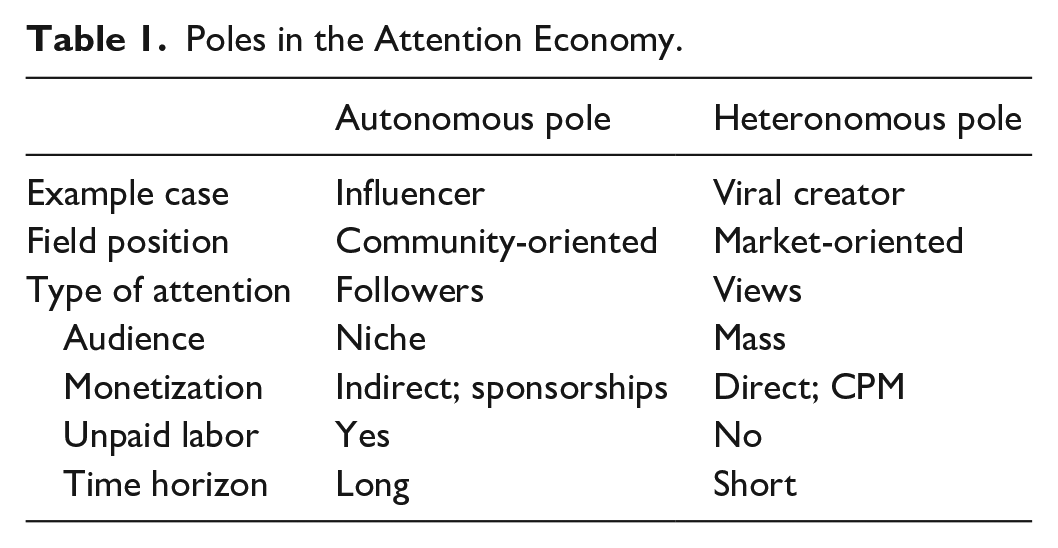
This table summarizes the path that viral creators pursue to gain attention which is short-term, highly-paid, and low in status, contrasted with prevailing findings from research on influencers. In pursuit of mass market success, viral creators lose symbolic capital or clout, a trade-off that has been well-documented in culture industries ranging from fashion (Mears, 2011), art (Bourdieu, 1996), literature (Thompson, 2010), and journalism (Christin, 2020). In Bourdieu’s terms, creators in the heteronomous pole orient primarily to the mass market: an undifferentiated and low-status global mass of viewers rendered visible in clicks and views. Here, viral creators are more market-oriented. At the other end, in the autonomous pole, influencers appeal at least to some extent to an audience of insiders, like fellow fashion consumers or leftist YouTubers or whichever niche community that matters to them (e.g., Cotter, 2022; Duffy, 2017). Influencers are hence community-oriented.
Having mapped social media content as a field and its central oppositions, we can now explain two paradoxical findings that characterize viral content creation for mass audiences: the inauthenticity of the viral creator and the indifference she feels toward her audience.
The Paradoxical Invisibility of Viral Creators: Inauthentic Selves in Authentic Situations
Despite getting billions of views, viral creators are largely invisible in that they do not get much public recognition, a paradox summed up by a creator named Kim who appears often in her kitchen making unusual viral cooking videos: I know some of our friends are like, “You are famous, look how many views you have.” We’re not really. We are made to be forgotten. Nobody sees anything. I understand that we have over 2 billion views, but I’m telling you, nobody sees anything.
Plenty of scholars have documented the invisible workforce behind social media economies such as AI annotators, talent agents, and content moderators who work behind the scenes (Gray & Suri, 2019). We typically do not expect on-camera creators to feel invisible; rather, they usually face the problems that come with hyper-visibility (Duffy & Hund, 2019). Yet I found viral creators are paradoxically both highly seen and socially invisible. For instance, Sofia, a creator from the small country of Malta, recounted a time when a Maltese friend showed her a prank video from Facebook, not realizing that it was Sofia herself in the lead role. Even in her small country, Sofia went unnoticed by people who watched her videos.
In this way, viral creators demonstrate the difference between fame and attention (van de Rijt et al., 2013). Fame is durable, but attention is short-term and internet fame is especially fleeting. For example, Johnny has 44 million Facebook followers and was the most viewed creator in the world at one point in 2021 according to Tubular (tubularlabs.com), but he complained in our interview that no one knows who he is: Like, no one cares, really. Like, you care, because you’re doing an article on it. A few people care because they see the Tubular Labs, but the reality is, like, these videos don’t have influence. They’ve not sold a single t-shirt. No one is buying anyone’s merch. . . If you had to put a gun to the average person’s head, they wouldn’t have a clue who anyone is in these videos. It’s generic content, serving a simple purpose which is to generate revenue on the algorithms.
To explain the paradoxical invisibility of viral creators, we should situate authenticity within a field of social media production. Prior studies find that social media creators and users aim to portray their personal realness, true passions, and tastes (Abidin, 2015; Hund, 2023). Authenticity here is presumed to have a singular meaning as personal authenticity, per the foundational concept of micro-celebrity (Senft, 2013). In contrast, I discovered that viral entertainers do not generally care to present their authentic selves, as Jude told me: “We’ve really leaned into the inauthenticity.”
Jude and his fellow creators film attention-grabbing scenarios with what I call situational authenticity. Situational authenticity is the staging of ordinary scenes meant to mimic everyday life situations typical of UGC. In contrast to what Pooley (2010) has called “calculated self-making” in promotional culture, viral creators engage in calculated situation-making, akin to how producers construct scenarios for drama on daytime talk shows (Grindstaff, 2002).
For example, I starred in several of their viral videos. I played a nurse who received a puppy (20 million views), a Wal-Mart shopper surprised by a prankster in a bunny costume (2 million), and a scorned lover who catches her man cheating (190 million). My name was never mentioned on camera nor in the tag or title, because viewers do not care about the identity of the nurse or the War-Mart shopper, only about what happens to her for those few minutes of the attention-grabbing situation.
I learned my own personal insignificance when I started managing my own Facebook page, for which my first task was to upload a headshot, which was taking me longer than expected because I wanted to get a high-quality picture of myself. Ryan, the head of the company, reprimanded me: You’re not doing it right. Let’s look at the “headshot” of the second most popular page on FB [his page at the time] . . . That was taken using my phone, at Starbucks, and uploaded 10 seconds later. That was like 5 years ago and I haven’t updated it because it seems to be doing just fine. The internet does not reward the influencer with the best headshot; it rewards influencers who recognize the disposability and fluidity of content (Message exchange January 2021).
The lesson from Ryan is that the content matters more than the person making it. Furthermore, that content is based on scripted scenarios meant to look real, but most often, they are staged.
Viral creators weigh the loss of their personal authenticity with the rewards of virality. Avery, a 33-year-old singer, knows her music fans are put off by her scripted viral videos, which are clearly staged and “off brand” compared with her earlier self-presentation as a “real” artist: Once your fans see enough of the videos, they start catching on that it is [fake], then they’re like, “We’ve missed your authenticity.” And so I’m forsaking a little bit of that authenticity for entertaining the masses.
Similarly, Elsa, 28, is vegan, and she used to make YouTube videos promoting vegan lifestyles, from which she had earned a few thousand dollars in the past. When she started making viral Facebook videos, she found remarkable success with dramatic sketches, even making the biggest “banger,” or hit video, in the company’s history, with over 800 million views on Facebook alone. When I asked if she considers making vegan-themed content in her videos, Elsa hesitated: Yeah, I definitely want to inspire. It’s just really hard to do with Facebook videos. I mean, I guess I could, there’s nothing stopping me, but it won’t have the same kind of reach. It’s weird. I feel like Facebook is, you know, it’s just mindless entertainment. People are just scrolling and wanting to see something crazy, real quick.
As Bourdieu’s theory suggests, in autonomous poles of artistic fields, artists prize authenticity and individual authorship (Reilly, 2018). But as they start appealing to the masses, viral creators lose authorship, and hence, viral creators deprioritize authentic personhood in favor of situational authenticity.
From Relational Work to Antagonism: How Viral Creators Relate to Audiences
When I began this ethnography, Ryan prepared me to expect “mean comments,” on my page and in my Messenger, which would come to range from critiques of the content (“This video was so fake”) to personal insults and threats.
Mean comments come with virality for two reasons. First, the scale of virality invites engagement from millions of people, sometimes hundreds of millions, which can yield thousands of comments on a video. Second, Facebook’s engagement-based ranking algorithms weigh emojis more heavily than the “Like” button (Hagey & Jeff Horwitz, 2021). The current palette of emojis captured six feelings: love, care, haha, wow, sad, and angry. Because human psychology heightens attention to strong feelings, content that elicits outrage tends to outperform that which inspires care or likes (Berger & Milkman, 2012). Since mean comments get more reactions, they rise algorithmically to the top of the comments section. Understanding this, most viral creators I interviewed were blasé about mean comments, like Quentin: I think that’s just normal to get hate with stuff like that. The people that don’t like it are louder. And those types of comments rise to the top because people are reacting to them. If somebody writes “Cool” . . . nobody reacts to it. But if somebody says “Your magic is cancer and you should die,” maybe somebody is going to react. Maybe somebody might put an angry face on it or a sad face, or a happy face or a laughing face, but whatever they do, that comment is going to rise to the top.
Viral creators dismissed mean comments by frequently reminding one another that the comments are not representative of audiences since only 1% of viewers leave a comment. As Ryan says, “If it’s getting hundreds of millions of views, it’s good,” regardless of the critical comments. Because viral creators welcome all comments and reactions—praise and critique—some even interpret mean comments as signs of success. Jude likes to say: “You’re not making money until the mean comments come in.” Similarly, Avery: Because even if they sit there and watch the whole video and say, “I hate this, it’s terrible,” well, that’s the perfect viewer right there because they’ve watched the whole video and they’ve engaged.
To date, scholarship on content creation has largely emphasized how creators try to construct relationships with audiences (Marwick & boyd, 2011). For instance, musicians engage in relational work to construct intimacy with their fans online to foster their continued economic support (Baym, 2018). On Patreon and Twitch, artists construct delicate friendships with their financially supportive fans (Hair, 2021).
Intimacy surely characterizes many content creators’ relationships with their audiences, but not all. Field analysis can explain variations creators’ relational work with audiences. Musicians and other artists are likely to nurture their niche communities who recognize and value the artist’s symbolic value and reputation. But viral creators, who are largely anonymously seeking short-term and direct payments from their content, are able to ignore what they see as their relatively low-status audiences.
In fact, most viral creators learned over time to not read their comments, unless they are trying to boost their engagement metrics by commenting back, explained Hana: I’ve just learned that it’s not a healthy place for me to engage there, I just have to let go. I had to put in a rule that I couldn’t look at the comments for the first week of a video. And now I just don’t.
Others, like Mitch, simply do not care to look, because of the separation from his self and his content: I’ve never looked at a single comment from anybody who posted on Facebook. Really, yeah. It’s not like a willpower thing. This is just like, I have zero interest. And part of it is because I have no attachment at all to the content.
Many viral creators understood that, because of their field location, mean comments are both unavoidable and irrelevant, said Kiley: A lot of influencers worry what people think of them. They’re niche so they have to cater to their following, or stay on brand. With this, you’re just making viral content, some creators are focused on brand but this has opened their mindset. . . . they see that it doesn’t matter what other people think.
Realizing this, viral creators even develop antagonistic relationships with their followers. I observed that one of their common practices is to laugh at mean comments, thus trivializing their significance. For example, Trish, a musician, described a video of herself wrapped in Christmas lights: One of the comments was literally that the video would have been funnier if I had gotten electrocuted and died on camera. [laughs] Literally I can’t repeat that back to anyone without laughing. ‘Cause, textually, it’s so over the top, like it’s hilarious. Well, not hilarious, ‘cause it’s horrible, but like, you know.
Other creators comment back antagonistically, fueling disputes in the comments section strategically to increase engagement metrics on their page. One creator, Margo, has developed an empowering response to the many critiques she gets on her appearance: “Someone said that I look like a donkey, but like a pretty donkey. I wrote back to them, ‘That’s actually pretty funny.’”
Women in my sample in particular received strikingly harsh comments on their appearances, which they interpreted as evidence that their audiences are sexist, trolls, and therefore not worth caring about. It should be noted, however, that the majority of creators I studied were white and had cis and class-privileged bodies that were conventionally attractive. These women had significant privilege that likely eased their dismissal of sexism, which, according to Gill (2014), may obfuscate other forms of sexism (and racism and classism) that structure new media industries.
Though certainly not available to all creators, this dismissal of sexist comments, and all audience commentary, stands in stark relief to previous studies of content creation. While existing research shows influencers’ concern, even agony, over what audiences think of them, viral creators learn not to care much about what their audiences say to them.
Discussion
This ethnography of viral content creation arrives at a tentative theory of social media production fields and the relational value of attention. Like other forms of capital, attention has variable value and conversion rates according to the creator’s location in a field (Bourdieu, 1993).
Thinking about the creator economy as a field, I propose that some content is situated in a semi-autonomous pole, where creators appeal primarily to niche communities and partly measure their success in metrics, while other creators appeal primarily to mass audiences in a more heteronomous pole, akin to the field of large-scale production.
To speak plainly, we can say that some creators are more community-oriented, while others are more market-oriented. These different orientations can only be understood in relation to one another, just as the value of any cultural good can only make sense in relation to others (Bourdieu & Wacquant, 1992). Indeed, several viral creators in my study explicitly contrasted their work with that of influencers, a path many of them had previously traveled in the creator economy. Once in the viral space, creators develop distinct goals, strategies, time horizons, and values that they saw as different from influencers.
These relations and oppositions can be mapped visually along axes of symbolic and economic capital in Figure 1.

The field of social media production.
Figure 1 is a visual map of the relational space between viral creators and influencers. This emic comparison describes the creator economy as viral creators see it, and it emerged in conversation with viral creators as they contrasted themselves with influencers.
Field theory offers a useful intervention to nuance understandings of the creator economy, beyond it being singularly defined by the pursuit of metrics. The social media economy, while seemingly all about selling content and monetizing attention, may be better thought of as a “hybrid setting,” with degrees of autonomy and heteronomy that give rise to patterned ways of making content (Krause 2017). There are clearly creators who make “content for content’s sake,” pursuing their passions or supporting their communities, even at the expense of their own “visibility wealth,” such as activists (e.g., Cotter, 2022). For these creators, high engagement metrics may be met with suspicion, perhaps even disdain. At the other end of the spectrum, viral creators chase high reach as an end in itself.
Because fields are “nested,” further analyses could probe tensions between the symbolic and economic gain within any given creator community. We can identify local struggles and the tradeoffs creators make in their quests for visibility. For instance, among drama channels on YouTube, creators debate who is authentic and who is “selling-out” for metrics, a tension that reflects field struggles to define legitimate ways to get attention (Christin & Lewis, 2021). Attention capital is hardly fixed or stable but reflects local understandings which are specific to each feild.
There are several implications from this field analysis for the study of the creator economy. Existing literature has assumed that, in the pursuit of status, influencers often “work for free” in hopes of future payment. This is the model of underpaid labor in traditional culture industries (Menger, 1999) and the model of influencer marketing, in which creators pursue the unpaid labor of visibility in hopes of securing brand deals (Duffy & Wissinger, 2017). But this assumption comes from a disproportionate focus on community-oriented creators like influencers who craft personal authenticity. When approaching the creator economy, analysts should begin with the question, Whose attention does the creator seek, and what is its symbolic and economic worth? Into what is that attention convertible, on which time frame, and with what losses? Not all creators pursue brand sponsorships; it depends on how they recognize the value of the attention they get.
When we begin to think relationally about content creation in a field, we can re-think dominant understandings of authenticity and relational work, because how creators present themselves, and how they relate to audiences, depends very much on how they perceive the value of those audiences and how they aim to profit from them. Going forward, analysts can use field theory to consider how, within any given online community, creators balance the tension between satisfying their “high-value” audiences with profiting from the masses. Do all content creators equally face this tension, or are some better positioned to maintain claims to authenticity while capturing mass attention? How are these fields gendered and racialized? For example, how is the perceived social value of audiences tied to their social locations in racial and global hierarchies, and what intersectional identities are privileged to not care what audiences think of them? Finally, less studied in this analysis, are questions of inequalities: how do these strategies relate to creators’ pre-existing endowments of capital, such as education, financial resources, and digital skills (Levina & Arriaga, 2014)?
Going forward, as we study how creators seek to convert attention into economic, social, and cultural capital, we can consider attention to be a field-specific form of capital, the value of which exists in a cultural economy.
Footnotes
Acknowledgements
I thank members of the Boston University Precarity Lab, which provided comments on an early version of this article, and the Institute for Advance Study at Central European University in Budapest, where this article was drafted. Thanks also to participants at the Global Digital Cultures conference at the University of Amsterdam in June 2022 and the “Social Media and Reputation” panel in the Digital Economy network of SASE in July 2022. This article benefited from valuable feedback in its various stages from Natalia Levina, David Swartz, Ori Schwarz, and Elif Birced, who also provided excellent research assistance.
Declaration of Conflicting Interests
The author(s) declared the following potential conflicts of interest with respect to the research, authorship, and/or publication of this article: The author declares that she was paid by platforms via a publishing company for the content that she posted as part of the research activities. Neither the platforms nor the publishing company had prior access to her data, analyses, or writings, nor has any entity seen any of the author’s writings prior to publication, beyond fact-checking selected statements. This research has been approved by the Institutional Review Board and cleared by the Conflict of Interest Committee at Boston University.
Funding
The author(s) received no financial support for the research, authorship, and/or publication of this article.
