




Abstract
Forward head posture (FHP), defined as the anterior positioning of the cervical spine where the head protrudes forward in relation to the body’s vertical line, has become increasingly common, primarily due to sedentary lifestyles and extensive use of technology, impacting approximately 66% of the population. This condition frequently leads to secondary hyperkyphosis and various musculoskeletal problems, highlighting the urgent need for effective intervention strategies. A systematic review was performed across multiple databases, including Web of Science, PubMed, Scopus, and Google Scholar, encompassing studies published until June 2024. The review specifically targeted studies utilizing orthotic devices to address FHP. Two independent reviewers screened titles and abstracts, followed by comprehensive data extraction using a standardized form. The review included 10 studies involving a total of 450 patients with FHP. The findings demonstrated that orthotic devices significantly enhance postural parameters, notably improving spinal alignment and reducing FHP. However, the studies also underscored the necessity for better device design to improve comfort and usability for patients. Orthotic devices exhibit considerable potential in improving postural conditions associated with FHP. Future research should concentrate on optimizing device design and examining long-term effectiveness to enhance clinical application and patient outcomes.
Introduction
Forward head posture (FHP) is defined as the anterior positioning of the cervical spine, where the head protrudes forward in relation to the body’s vertical line. FHP has become increasingly prevalent in recent decades, primarily due to sedentary lifestyles and prolonged use of technology such as computers and smartphones. 1 Studies indicate that FHP has a prevalence of approximately 66% in the population, often leading to secondary hyperkyphosis. 2 These postural abnormalities are characterized by an excessive anterior positioning of the head and thoracic spine, leading to various musculoskeletal issues, including neck pain, reduced range of motion, and dysfunction in related structures such as the temporomandibular joint. 3 The rising incidence of these conditions highlights the urgent need for effective intervention strategies. 3
In terms of treatment, a variety of therapeutic approaches have been explored to correct FHP, including exercises aimed at strengthening weakened muscles, manual therapy techniques, and ergonomic assessment. While these interventions can be beneficial, adherence to exercise regimens remains a significant challenge for many individuals, often limiting their effectiveness. Consequently, there is a growing interest in developing supportive devices that can assist in maintaining proper posture and alleviating the associated symptoms. 4
Orthotic interventions have gained traction as a potential solution for managing FHP. 5 Previous studies have assessed the efficacy of various orthotic devices in correcting postural alignment.6–9 However, many of these devices have shortcomings, including discomfort, inadequate ventilation, and a lack of simultaneous correction for both FHP.10,11 This refers to the inability of current orthoses to simultaneously correct both the FHP and thoracic hyper-kyphosis, often due to design limitations that address only one aspect of the postural deformity at a time. Research has shown mixed results regarding the effectiveness of these braces, with some studies reporting improvements in postural alignment while others have failed to demonstrate significant changes. This inconsistency underscores the need for further investigation into the design and functionality of orthotic devices.
A review of the existing literature indicates a significant gap in comprehensive studies that simultaneously address the correction of FHP through innovative orthotic solutions. While previous reviews have examined individual components of these postural disorders, 12 there is a notable absence of consensus regarding the most effective treatment strategies. This highlights the urgent need for a thorough investigation of current research to identify best practices and guide future studies. The present review seeks to fill this void by consolidating findings from diverse studies, assessing the effectiveness of orthotic interventions, and ultimately contributing to the development of more effective treatment modalities for individuals affected by these common postural conditions. Notably, this review stands out as there are no similar comprehensive reviews currently available on this specific topic.
Methodology
The research was carried out in accordance with the Preferred Reporting Items for Systematic Reviews and Meta-Analyses (PRISMA) guidelines. 13
Search strategies
A systematic exploration was conducted utilizing multiple electronic databases, including Web of Science, PubMed, Scopus, and Google Scholar. This comprehensive approach aimed to gather data from reliable academic and scientific sources. Tailored search queries were developed by incorporating specific keywords and employing Boolean logic with AND/OR operators as follows:
Keywords“orthotic devices” OR “postural supports” AND “posture improvement” AND “forward head posture”
Only articles published in English before June 2024 were included in the review.
Eligibility criteria
Articles were screened for inclusion and exclusion based on predefined criteria. The specific criteria were as follows: (1) population studies on outcomes for patients with FHP, (2) interventions involving orthotic devices, and (3) outcome measures related to postural improvement (e.g., craniovertebral angle (CVA), pectoralis minor index), excluding non-postural outcomes such as muscle tension or headaches unless directly linked to posture]. The population under consideration included individuals aged 18–65 years with diagnosed FHP, exhibiting symptoms such as neck pain or reduced range of motion, with or without comorbidities such as hyper-kyphosis.
Study selection
The inclusion and exclusion criteria were clearly defined, and articles were selected accordingly. The titles and abstracts were reviewed by two independent reviewers (M.A and R.H.). Any discrepancies were resolved through discussion and analysis of the full-text articles. Full texts meeting the inclusion criteria were thoroughly reviewed for eligibility, and the reasons for rejection were documented. Duplicate entries were removed. Additionally, the reviewers examined reference lists and gray literature, defined as unpublished or non-peer-reviewed sources (e.g., conference abstracts, theses). Data extraction was performed by R.H. and verified by the other reviewers. Systematic documentation of study outcomes was carried out using the PRISMA checklist.
Quality assessment
Studies included in the analysis were evaluated for methodological quality using the Downs and Black checklist, which comprises 27 items scored according to a binary system (1 for “yes” response and 0 for “no” or “unable to determine” response). 14 This checklist addresses issues of external and internal validity, statistical validity, and power, providing a global assessment of the methodological quality of the included studies. To maintain focus, the Downs and Black scale was adjusted to include 21 relevant items while removing those deemed irrelevant to our research questions. The higher the total checklist score, the greater the methodological quality of the evaluated studies. Two reviewers (R.H and M.A.) independently assessed the findings, resolving any discrepancies. A third reviewer was consulted in case of persistent disagreements, and scores were reevaluated after consensus among the reviewers. Each study’s quality was assessed using a scoring system, where scores of seven or lower indicated low quality, scores 8 to 14 indicated medium quality, and scores of 15 or more signified high quality (Supplementary File 1).
Data synthesis
Characteristics of included studies and results.

Abbreviations: forward head posture: FHP, Cranio vertebral Angle: CVA, Neck disability index: NDI, cervical range of motion: CROM. Northwick Park Neck Pain Questionnaire: NPNPQ.
Note: Noordin et al. (2022) does not specify the CVA measurement method, limiting the ability to confirm the precision of reported values. The CVA is reported to one decimal place, consistent with standard practice.
Results
A total of 228 citations were identified through a systematic review of four electronic databases. After removing duplicates and irrelevant articles, the initial screening of 54 records was performed based on titles and abstracts. Out of these, 32 articles were excluded because they did not meet the eligibility criteria, resulting in 22 articles selected for full-text examination. A subsequent review led to the exclusion of 12 studies due to irrelevant outcomes or failure to meet the abstract criteria, leaving 10 articles for the final selection process (Figure 1). PRISMA 2020 flow diagram for new systematic reviews which included searches of databases and registers only.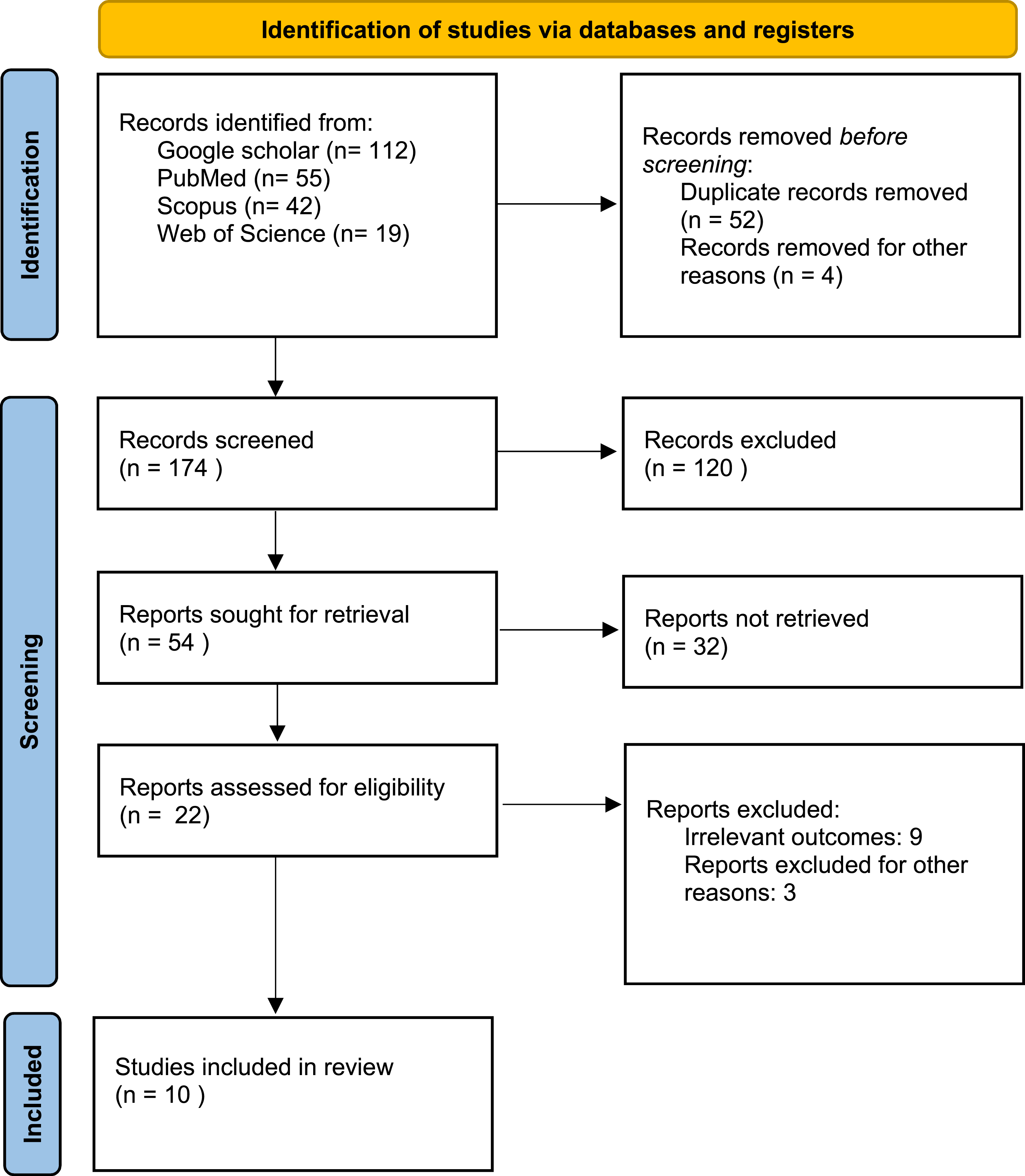
Characteristics of the included studies
The characteristics of the included studies are summarized in Table 1. The quality of the studies varied, with one classified as low quality, 15 eight as medium quality,5,6,9,11,16–19 and one as high quality 20 based on the Modified Downs and Black checklist. 14 This review examined the efficacy of orthotic devices on postural parameters at various time intervals. The range of published works spanned from 2013 to 2024, with studies conducted in various countries, including the United States, South Korea, Iran, and Malaysia.
Among the 10 studies included in this systematic review, four incorporated a randomized controlled trial (RCT) design.11,16,18,19 The participant range varied from 4 to 66 individuals, comprising a total of 358 patients with FHP. Follow-up periods ranged from 4 weeks 11,17 to 6 weeks 5,18–20, 8 weeks 6,15,16, and 3 months 9 . Seven studies assessed effects after weeks of use with immediate post-intervention testing 5,6,11,15,16,18,20. Three studies included additional follow-up testing without the orthosis 9,18,19. Four studies used orthotic devices with exercise 9,16,18,19, and six used orthotic devices alone 5,6,11,15,17,20.
Summary of results
The findings indicate that various orthotic devices can lead to significant improvements in posture, particularly when used in conjunction with rehabilitation exercises. For instance, Youn et al. (2020) demonstrated that a craniocervical brace improved posture and reduced muscle effort in key muscle groups, suggesting a potential reduction in the risk of musculoskeletal disorders in a sample of 33 participants, with a specific improvement of CVA by 5° and a 15% reduction in upper trapezius muscle effort compared to a no-intervention control group (p < .05). 11 Similarly, Eun-Byeol Oh (2023) found that sling exercise combined with a neck orthosis was more effective in improving CVA by 3° compared to a sling exercise-alone control group (p < .05) in 25 adults with FHP. 16 Kim et al. (2017) reported that upward traction and forward compression improved CVA by 4° in 20 participants. 17 In contrast, Manor et al. (2016) noted no significant changes in FHP or rounded shoulders with a posture correction garment among 24 students, suggesting limited effectiveness. 6 Lee et al. (2015) highlighted that stretching exercise with a shoulder brace increased the pectoralis minor index (PMI) compared to an exercise-alone control group, indicating increased pectoralis minor length in 15 individuals (p < .05). 20 Ashley Cole et al. (2013) reported that the scapular stabilization brace with exercise decreased upper trapezius activity during specific exercises compared to a control group using only a compression shirt (p < .05) among 38 participants. 18 Noordin (2022) found that a FHP orthosis with kyphosis brace increased the CVA from 49.658° to 51.322° in a small cohort of four individuals. 15 Salimi (2023) reported sustained improvements in posture, pain intensity, Berg Balance Score, head repositioning accuracy, and cervical range of motion at the 3-months follow-up for participants using the Denneroll cervical traction orthotic combined with exercise compared to an exercise-alone control group, which regressed to baseline (p < .001). 9 Hussein (2024) demonstrated significant enhancements in CVA and neck disability index with a posterior neck weighting orthosis compared to a control group receiving deep cervical flexion exercise (p < .0001) in 61 individuals. 5 Lastly, Hamzelouei (2021) showed that a corrective orthosis significantly improved CVA and protraction-retraction angles among 30 participants. 20
Discussion
This systematic review highlights the effectiveness of orthotic devices in improving postural parameters among patients with FHP and related conditions. The analysis of 10 studies reveals that orthotic interventions significantly enhance spinal alignment and reduce FHP. For instance, Youn et al. (2020) demonstrated that a craniocervical brace improved posture and decreased muscle effort, suggesting a potential reduction in the risk of musculoskeletal disorders. 11 This aligns with findings from Eun-Byeol Oh (2023), who reported that integrating sling exercises with a neck orthosis was more effective in alleviating muscle tension and headaches compared to exercises alone. 16 Such results underscore the potential of orthotic devices to improve both postural alignment and the overall quality of life for individuals suffering from FHP. 21 Also, Salimi et al. (2023) demonstrated that combining the Denneroll™ cervical traction orthotic with exercise led to sustained improvements in CVA, pain, and functional outcomes, unlike exercise alone, supporting the potential superiority of combined interventions for FHP correction. 21
The variability in outcomes across studies can be attributed to several factors, including the type of orthotic device used, the duration of the intervention, and the specific characteristics of the patient populations. For example, Kim et al. (2017) found that different mechanical properties of devices had varying impacts on the CVA, 17 while Manor et al. (2016) reported no significant changes in FHP among students using a posture correction garment. 6 The study by Cole et al. (2013) included overhead athletes with forward-head, rounded-shoulder posture , which encompasses FHP but focuses on a specific athletic population, introducing some heterogeneity compared to other studies targeting general adult populations with FHP. 18 The precision of CVA measurements in Noordin et al. (2022) (reported to three decimal places) may not be fully supported by the study’s methodology, given the small sample size and lack of detailed measurement protocols. 15 This inconsistency highlights the need for further investigation into which devices and methodologies yield the best results. Additionally, the quality of studies varied, with four classified as medium quality and others as high based on the modified Downs and Black checklist. This variation raises concerns about the reliability of findings and emphasizes the necessity for more rigorous research designs in future studies.
Despite the promising findings, several limitations must be acknowledged. A key limitation across several studies, such as Noordin et al. (2022) 15 and Manor et al. (2016), 6 is the lack of explicit reporting on participant compliance with orthotic device use, which may affect the reliability and generalizability of the results. Cole et al. (2013) focused on forward shoulder angle and scapular muscle activity rather than direct FHP metrics like CVA, which introduces some inconsistency with the inclusion criteria. However, the study was included due to the biomechanical linkage between shoulder posture and FHP correction. 18 The heterogeneity of the studies precluded a meta-analysis, limiting the ability to draw generalized conclusions about the effectiveness of orthotic devices. Additionally, some studies had small sample sizes, which may affect statistical power and generalizability. Variations in follow-up periods across studies complicate the assessment of long-term efficacy, leaving questions about the sustainability of observed improvements. Future research should focus on standardizing methodologies, increasing sample sizes, and extending follow-up durations to provide more definitive conclusions regarding the effectiveness of orthotic interventions.
Several potential explanations could account for the observed results. The interaction between the type of orthotic device and the specific rehabilitation exercises may significantly influence outcomes. For instance, Ashley Cole et al. (2013) found that a scapular stabilization brace reduced upper trapezius activity during exercises, suggesting a mechanism for improving posture. 18 Furthermore, individual patient characteristics, such as age, baseline posture, and severity of FHP, may also play a crucial role in determining the efficacy of these interventions. Understanding these factors is vital for tailoring treatment approaches to optimize patient outcomes.
Conclusion
In conclusion, the evidence from this systematic review indicates that orthotic devices can substantially improve postural parameters, leading to better spinal alignment and overall postural control. The findings advocate for the integration of orthotic devices into treatment plans for individuals with FHP. While the studies collectively demonstrate significant improvements in key postural metrics, further research is essential to explore the long-term effects of these interventions and identify the various factors influencing their effectiveness. Emphasizing tailored treatment approaches that consider individual patient characteristics will be crucial in optimizing the outcomes of orthotic interventions.
Supplemental Material
Supplemental Material - Effectiveness of orthotic devices in the treatment of forward head posture: A systematic review
Supplemental Material for Effectiveness of orthotic devices in the treatment of forward head posture: A systematic review by Reza hamzelouie, Mokhtar Arazpour, Mahmood Bahramizadeh, Iraj Abdollahi, Iraj Abdollahi, Yasna Shokri in Journal of Rehabilitation and Assistive Technologies Engineering
Footnotes

Author Contributions
R.H: Formal analysis, Investigation, Methodology, Writing – original draft
M.B & M.A: Funding acquisition, Project administration, Supervision
I.A: Supervision, Writing – review & editing
H.SH: Resources
A.B: Data curation, Investigation
Funding
The authors received no financial support for the research, authorship, and/or publication of this article. The authors declare there is no funding support was included in the study.
Declaration of conflicting interests
The authors declared no potential conflicts of interest with respect to the research, authorship, and/or publication of this article. The authors declare there is no conflict of interest.
Transparency Statement
The lead author Mokhtar Arazpour affirms that this manuscript is an honest, accurate, and transparent account of the study being reported; that no important aspects of the study have been omitted; and that any discrepancies from the study as planned (and, if relevant, registered) have been explained.
Supplemental Material
Supplemental material for this article is available online.
References
Supplementary Material
Please find the following supplemental material available below.
For Open Access articles published under a Creative Commons License, all supplemental material carries the same license as the article it is associated with.
For non-Open Access articles published, all supplemental material carries a non-exclusive license, and permission requests for re-use of supplemental material or any part of supplemental material shall be sent directly to the copyright owner as specified in the copyright notice associated with the article.
