




Abstract
Background
Persistent pain is prevalent within the ageing population and impacts daily functioning. Measuring daily functioning using conventional measures is problematic and novel technologies offer an alternative way of observing these behaviours.
Methods
This study aimed to consider the use of a wearable camera as a method of exploring a range of day-to-day patterns of functioning of older adults living with persistent pain. This study followed a mixed methods design. A purposive sample of 13 older adults (65±) with persistent pain (pain >3 months) took part in this study. Two younger adults (<65) with persistent pain and two older adults with no pain also participated. Individuals used a wearable camera (Microsoft SenseCam) for seven days
Results
The wearable camera recorded the frequency of body position, movement, and activities of daily living. The wearable camera also presented contextual data of location, social interactions, use of assistive devices, and behavioural adaptations and was used to inform other methods of data collection.
Conclusions
The wearable camera allowed insight into patterns and experiences of daily functioning that would not have otherwise been captured. However, not all aspects of functioning were recorded using the wearable camera, including the relationship between functioning and persistent pain.
Introduction
Persistent pain is characterised as pain that continues for more than 12 weeks or pain that continues after the period of expected healing.1,2 Persistent pain is particularly widespread in the older population, with studies reporting inconsistent prevalence from 25 to 76% of older people living with persistent pain in the community. 3 However, despite its prevalence, it is not a normal part of the ageing process. 4 Persistent pain interferes with various aspects of daily functioning and this interference increases with age. 5 Older adults living with persistent pain are less active than those without persistent pain, 6 and persistent pain is also associated with greater risk of falls in older adults. 7 Activities of daily living (ADLs) such as self-care, domestic tasks, and leisure activities are often modified, reduced, or terminated as a result of persistent pain8,9 and can lead to perceived social exclusion and isolation. 10
Collecting data about patterns of functioning can be difficult. Performance-based measures such as pedometers and accelerometers offer information regarding activity, specifically; step count, intensity of movement, and patterns of movement,11,12 but do not record contextual information. 13 Qualitative methods provide personal insight into daily living and allow in-depth data to be collected. Self-report methods, including questionnaires and semi-structured interviews, offer a valuable method of recording activity, participation, and the self-management of persistent pain;9,14 however, these methods are also limited by their subjectivity and issues of recall biases. 15
Emerging technologies offer opportunity to record data using novel methods. Known as life-logging, or the quantified self, digital technologies allow users to record and store multiple aspects of their daily experiences and behaviours. 16 Life-logging technologies allow the continuous, automatic recording of an individual’s day without much effort from the user. Life-logging is becoming increasingly used to explore individual’s health, including health improvement, rehabilitation, and prevention of illness. One type of life-logging technology is the wearable camera – a camera worn by the user and which generates a visual diary consisting of automatic images captured during its use. Unlike performance-based measures, wearable cameras are advantageous in that the photographs not only capture the tasks being carried out but also records contextual information. 13 Unlike self-report measures, the wearable camera does not rely on participants’ memory of events, as all data are stored on digital memory 17 and wearable cameras are considered as a close equivalent of the ‘gold standard’ measure of observation within the assessment of health behaviours. 18 Furthermore, evidence has demonstrated older adults’ acceptance of using wearable cameras.19,20 Although there were some technical and usability issues experienced, older adults generally found the wearable camera to be easy to use, non-intrusive, and safe.19,20
The aim of this study was to consider the use of a wearable camera when exploring day-to-day patterns of functioning of older adults living with persistent pain.
Methods
This study followed a mixed methods design. It was part of a larger study, which aimed to explore a range of day-to-day patterns of functioning and experiences of older adults living with persistent pain and examined the usability, acceptance, and experiences of using the technology as a method of data collection. 21 The larger study used a wearable camera (Microsoft® SenseCam), daily diaries, questionnaires, and semi-structured interviews as data collection tools; however, reporting these findings is out of the scope of this paper. This paper will focus specifically on the use of a wearable camera as a data collection method to monitor day-to-day patterns of functioning of older adults living with persistent pain.
Ethical approval was granted for this study by the School of Health and Social Care Research Governance and Ethics Committee at Teesside University (Ref: 262/10).
Participants
A purposive sample of older adults (≥65 years old) with persistent pain (pain ≥3 months) was recruited to participate in this study. Purposive sampling was used in order to include men and women of a range of ages who were retired and living in the community with varying experiences of persistent pain and living circumstances. Participants were recruited from various organisations throughout the North East of England including the University of 3rd Age, Age UK, and local lunch groups. Snowball sampling was also used to access individuals not attending community groups. Two younger adults (<65 years old) with persistent pain (pain ≥3 months) and two older adults (≥65 years old) without persistent pain were also recruited to gain additional insight into everyday functioning, allowing comparison between groups.
Individuals were excluded from the study if they experienced pain related to cancer, self-reported a diagnosis of dementia, were awaiting surgery, had recently undergone surgery (<6 months), or did not have the ability to press the buttons to use the equipment. All participants needed to be able to give full consent and understand spoken and written English sufficiently to be able to understand all of the instructions.
Wearable camera
The Microsoft® SenseCam was used in this study (Figure 1).
The SenseCam.
The SenseCam is a small, light (93 g) camera (640×480 pixels) fitted with a fish-eye lens to provide a full 130° field of view.
22
The SenseCam is worn on a lanyard, positioned on the user’s chest and takes at least one image every 30 s, without any user interaction (Figures 2 and 3, images from non-participant pilot data).
Sensecam image showing person walking outdoors. Sensecam image showing person sitting in living room watching T.V.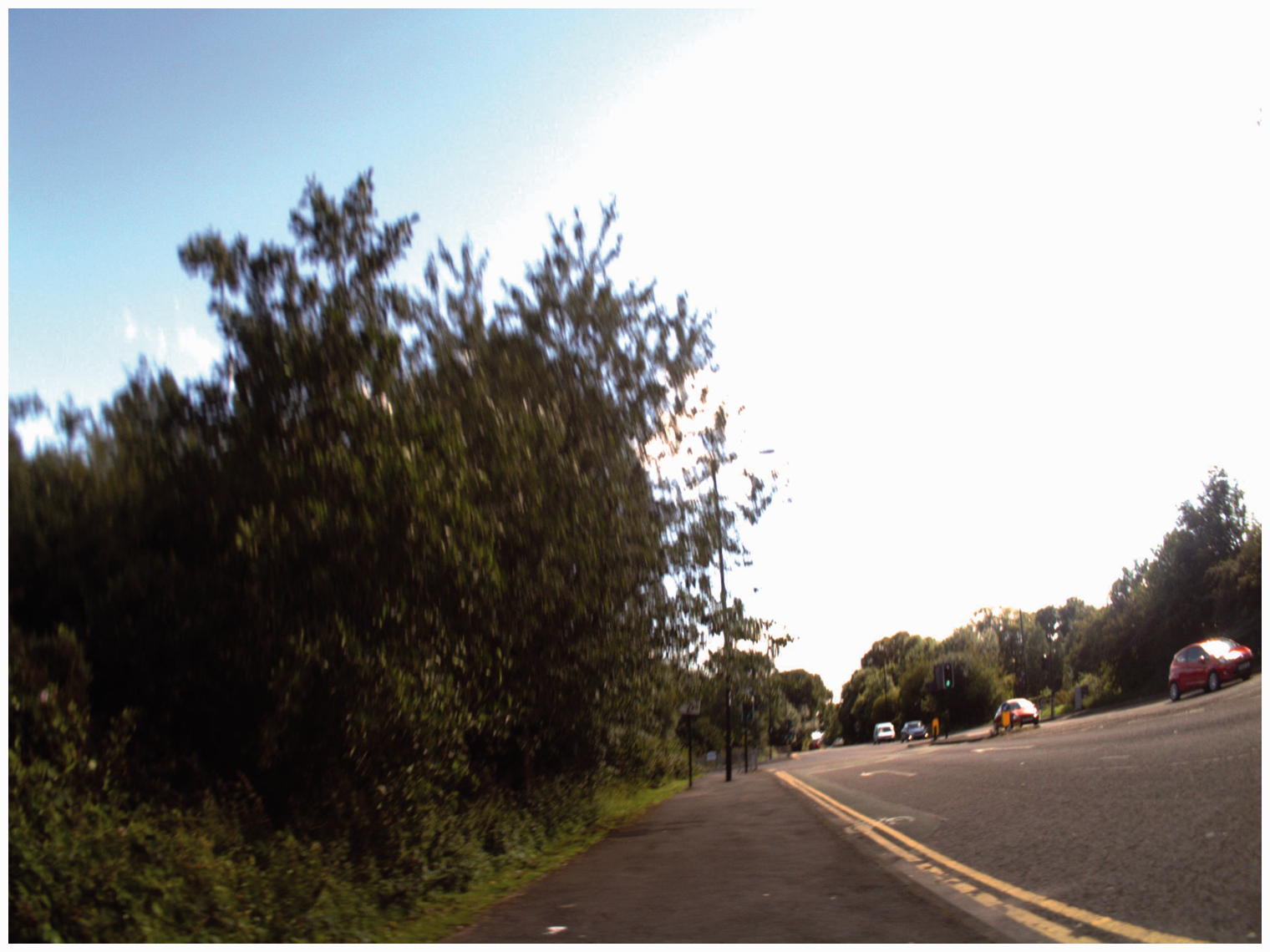

By capturing images of the user’s environment, the wearable camera enables the recording of activities of daily living, social interactions, and the user’s location. Using environmental cues, the wearable camera enables the user’s body position to be recorded, and changes in body position over sequential images also allow body movement to be recorded. Additional images are captured if the SenseCam’s motion or heat sensors are triggered (i.e. the user moves, or if the camera detects someone else in front of the camera).
Procedure
GW visited the homes of all participants that had verbally agreed to take part in the study. The visit provided participants with more information about the study and ensured that they were fully informed about the use of the wearable camera. During the visit, the use of the camera was demonstrated and participants were provided with a set of instructions that could be referred to throughout the study week. Individuals were asked to charge the camera each night and were also given verbal and written instructions to assist them in doing so.
Maintaining respect of participants and non-users was paramount. All individuals were shown how to use the ‘privacy’ button on the SenseCam. Individuals were made aware that they could either press the privacy button, or remove the wearable camera, at any time in which they did not want to record images, or if they felt that it was inappropriate to do so. Participants were advised to explain to others that the wearable camera was recording images when they entered their home, or when they entered the homes of others, and to remove the wearable camera if this was requested. Participants were given a number of note cards describing the aims of the study and included contact details for one member of the research team. Individuals were advised to give one of the note cards to anyone that asked them about the camera. All participants were told that they must remove the wearable camera when partaking in water-based tasks or when at places such as schools, swimming pools, or GP surgeries. Once individuals were aware of the purpose of the study and were fully informed about the use of the wearable camera they were asked to provide written informed consent. Participants were given contact details for GW and were encouraged to contact her if they had any questions, or needed any further guidance, at any point during the study week.
Individuals wore the wearable camera for seven days. After this time GW returned to the participants’ home to upload images onto a laptop provided specifically for use in this project. Participants were given assistance to upload their images onto the DCU SenseCam application software 23 including written instructions and illustrations, and independently reviewed and deleted any of the images recorded on the wearable camera before any of the research team viewed them.
Data analysis
Analysis of the photographic images was guided by Ethnographic Content Analysis. 24 Ethnographic Content Analysis is used to analyse data by searching for meaning within images and understanding this within the culture that it is situated. 25 Ethnographic Content Analysis produces both quantitative and qualitative data, as data are coded quantitatively as well as described narratively. 24
One image per minute (the first image of each minute) was analysed due to practicality of time restraints and the vast number of images collected from the device. Images were analysed using a set of codes under five main headings: ‘task’, ‘body position’, ‘location’, ‘interaction’, and ‘unusable’. This initial coding framework was developed from a coding strategy used to analyse images from a wearable camera 26 as well as categories within the diary used as part of the larger study. 27 Ethnographic Content Analysis is an iterative process and additional codes were added during analysis. All of the data were reanalysed upon the development of a new code. In accordance with Ethnographic Content Analysis, all photographic data were also described qualitatively. This qualitative description of the data allowed patterns of behaviour to emerge that could not have otherwise been captured using quantitative coding alone. GW discussed the qualitative description of the images with two members of the research team (DJ, DM) to ensure that the developed themes were rooted in the images recorded by the wearable camera.
Results
Participant information.
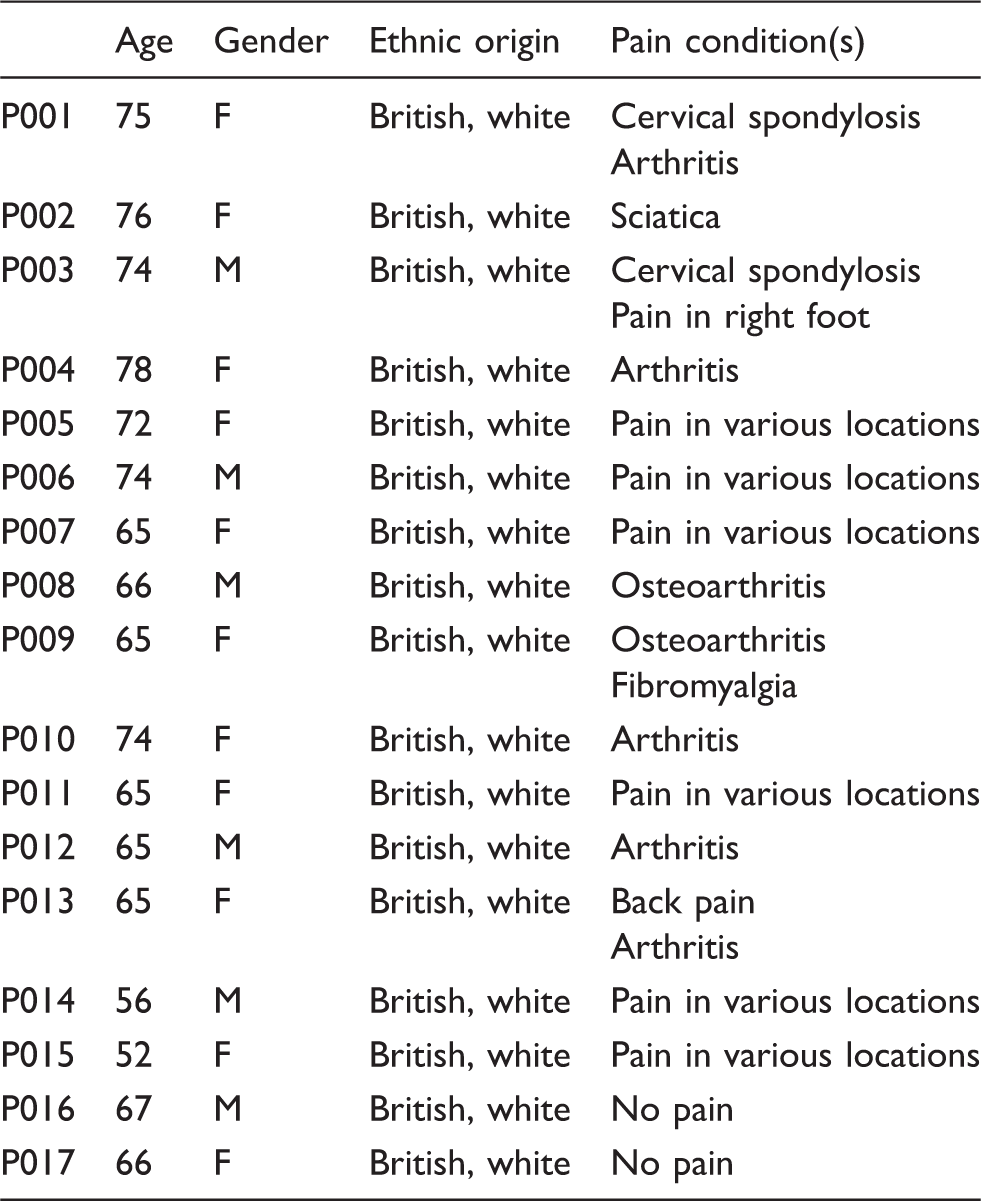
A total of 221,783 images were recorded using the wearable camera over the sample (average 13,046 images per participant). Participants wore the camera for an average of 9.52 h of each day. Of the total 116 days that participants took part in the study, 15 days of data were not recorded due to participants not wearing the wearable camera. Additionally, 7% of each user’s images (mean) were unusable as the wearable camera was covered, or the image was either blurred or unidentifiable. Therefore, no full dataset was available for any participant.
As a tool for monitoring day-to-day patterns of functioning, the wearable camera enabled the recording of the frequency of behaviours and contextual information.
Frequency of behaviours
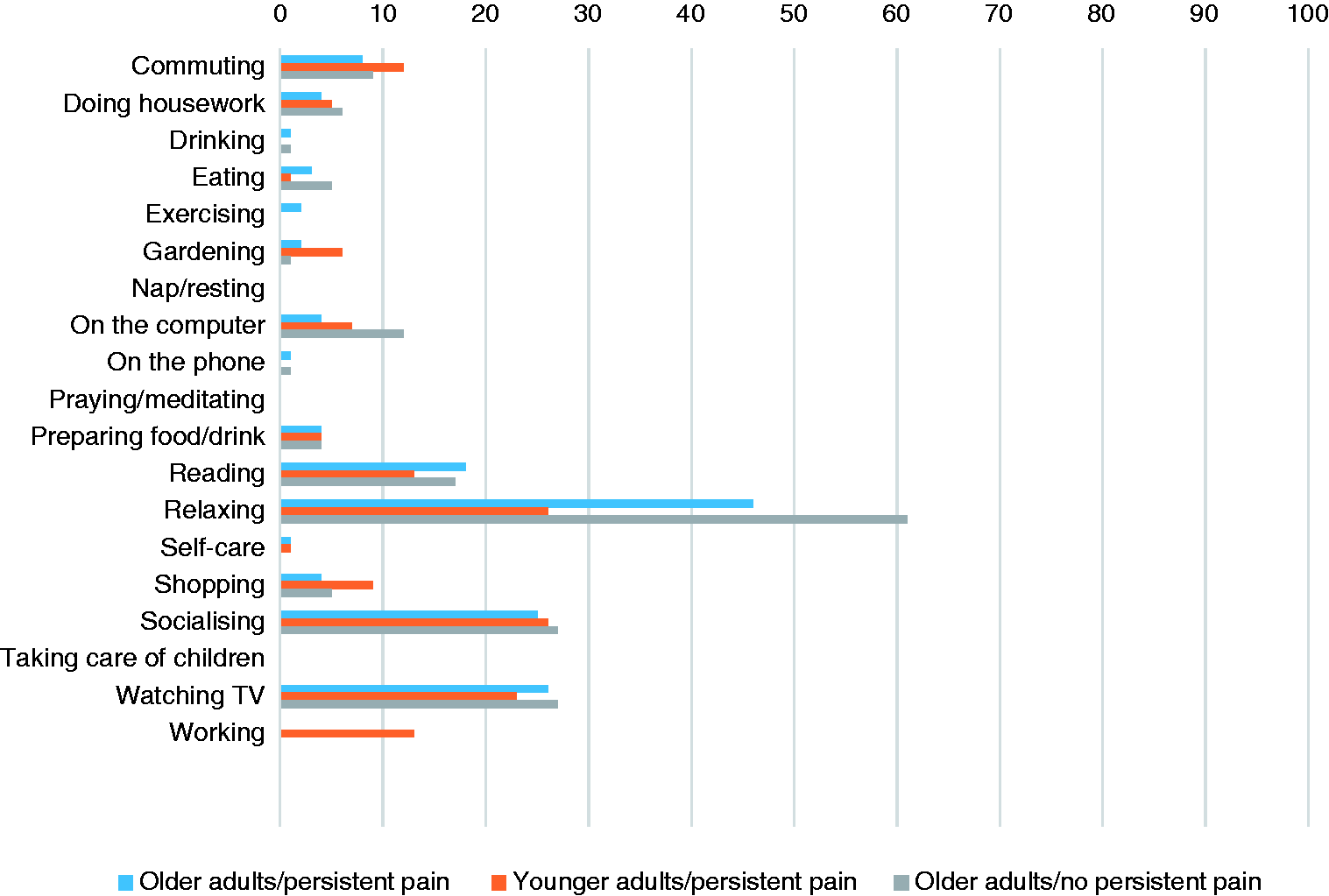
The coded dataset provided total frequency of behaviours over the study week. Frequency data enabled day-to-day patterns of behaviour to be analysed at an individual level and across the dataset allowing comparisons within and between participant groups. The wearable camera recorded frequency of body positions and movement (Figure 4) and participation in ADLs (Figure 5).
Average number of images (% of total images analysed) showing body position and movement. Average number of images (% of total images analysed) showing ADLs.
The wearable camera enabled detection of body position based on environmental cues in the background of each image and movement based on the differences between sequential images. The wearable camera illustrated time spent lying, sitting, and standing (Figure 4). The wearable camera was advantageous in that it distinguished between purposeful walking and stepping (i.e. moving whilst cooking or completing household chores) by using environmental cues to understand when individuals were moving to complete another task or when they were walking for the purpose of exercise or commuting (Figure 4).
Unlike performance-based measures, the wearable camera was also advantageous in that it recorded multiple aspects of daily living at once, using one device. Collecting multiple aspects of daily living creates a multifaceted, in-depth dataset of day-to-day patterns of functioning. For example, the data highlighted high frequency of time spent sitting over the sample; however, it was also possible to recognise the tasks carried out whilst being sedentary, with the most common tasks being relaxing, reading, watching TV, and socialising (Figure 5).
One issue with data solely being recorded by a wearable camera is that frequency data were only captured when participants used the device. Some ADLs were seldom recorded on the wearable camera: napping/resting, working, taking care of children, praying/meditating (Figure 5). Whilst participants may not have completed these tasks during the study week, some tasks may have not been captured if individuals had removed the device during this time. This was particularly recognised with two of the older adults living with persistent pain (P006; P015). Neither participant wore the camera for long periods of time over the study week, and therefore, frequency data and patterns of daily functioning gained from these participants were limited. Additionally, one older adult living with persistent pain (P009) participated in ‘exergaming’ activities (using a computer game as a method of exercising) and although this occasion was recorded on the wearable camera, the participant discussed further participation in exergaming during the semi-structured interview, but had removed the camera during this time due to its excessive movement whilst exercising. Whilst additional data collection tools may be utilised to capture this missing information, such as the use of daily diaries, this presents disadvantages relating to the use of self-report measures.
Contextual information
Frequency data are useful when monitoring day-to-day patterns of functioning; however, one of the most advantageous aspects of using a wearable camera as a data collection tool is that contextual information is also recorded. The wearable camera recorded social interactions including purposeful and spontaneous social encounters and time spent with pets (Figure 6).
Average number of images (% of total images analysed) showing social interactions.
It was possible to identify levels of social isolation using the wearable camera. The data illustrated that all groups spent more time alone than with others, and individual data showed that 11 participants spent over half of the study week on their own, with some participants experiencing very few episodes of social interaction. The visual data were advantageous in that it enabled the type of interaction to be identified, i.e. planned social interactions, or spontaneous social interactions such as chatting to others whilst walking the dog, providing more detail than is typically gathered using other methods of data collection, and therefore elicit a more detailed understanding of daily functioning.
By recording interactions with others, the data also identified occasions in which individuals were able to complete ADLs alone or when they relied on others to assist them. For example, two participants (P001; P002) relied on a cleaner to help with household chores, and two participants were restricted when travelling as both used a wheelchair (P001; P007), therefore both relied on others to travel when outside of the house, to either push their wheelchair or load the wheelchair into a car.
The wearable camera also recorded details of the user’s location (Figure 7).
Average number of images (% of total images analysed) showing location.
The visual data showed that all participants spent most time at home during the study week, and these data could be further dissected to time spent in different locations across the home. Time spent outside, time spent using transport, and time spent in other locations, such as the supermarket, cafés, or library were also recorded. It was possible to see how individuals interacted with their surroundings and changed behaviour inside or outside of their home. For example, some participants utilised a wheelchair or scooter when walking outside of the home, but not when inside the home. The use of assistive devices and walking aids was recorded as part of the contextual information recorded on the wearable camera (Figure 8).
Average number of images (% of total images analysed) showing use of assistive devices over the sample.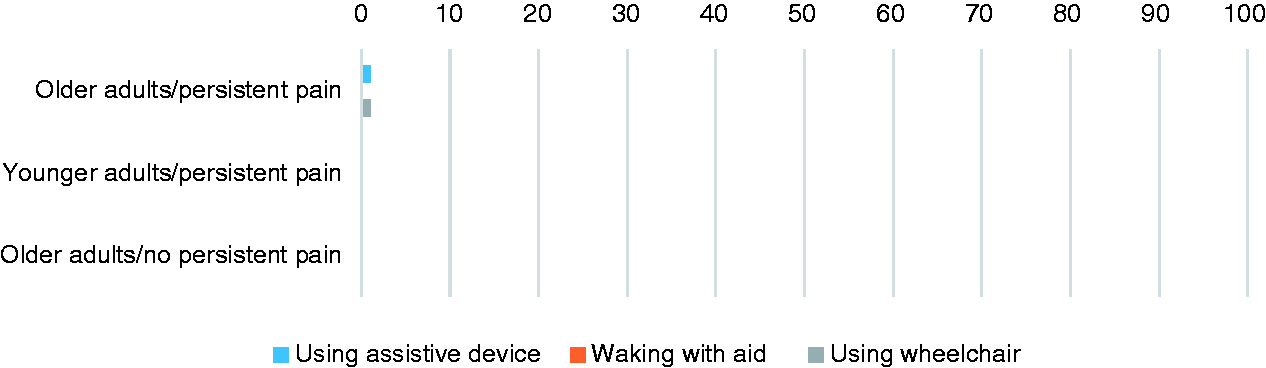
The frequency of the use of assistive devices and mobility aids was low (Figure 8); however, six of the 13 older adults living with persistent pain used assistive devices, including mobility aids, at some point over the seven-day period. None of the comparative sample used assistive devices over the study period. The visual data illustrated the use of various assistive devices by the older adults with persistent pain including a trolley to transport objects around the home (P001), a back support used in the car (P005), and a wrist rest whilst using the computer (P007). Two of the participants used a wheelchair or electric scooter outside of the home only (P001; P007). However, one downfall to the use of the wearable camera was that it did not record the use of walking sticks, crutches, or walking frames used by various participants during the study week. There are three potential reasons as to why these data were missing: the device’s position on the user’s chest may not have captured use of these aids, the device may been removed at time of use, or the aids may have been missed during the analysis process as only one image per minute was analysed.
Time-based activity pacing was also recorded on the wearable camera, in which participants interrupted tasks with periods of rest.28,29 Although this was not coded quantitatively due to the nature of the behaviour, pacing strategies emerged through qualitative narrative analysis of the images. Individuals rested in-between tasks such as walking (P002), cooking (P005), gardening (P005), household chores (P005), and shopping (P006). The wearable camera also documented six of the participants adapting their behaviour by sitting down whilst completing tasks including household chores such as ironing (P009), changing bed linen (P001; P009; P010), gardening (P002), and food preparation (P009; P010).
Discussion
This study aimed to consider the use of a wearable camera as a method to explore a range of day-to-day patterns of functioning of older adults living with persistent pain. The wearable camera captured detailed information of daily functioning that could not be gathered using alternative tools and identified individual patterns of daily functioning, as well as patterns over the sample and between participant groups.
Methodological reflections
Frequency data relating to body position and movement recorded by the wearable camera are similar to data produced by other performance-based measures.11,12 However, the wearable camera captured a novel insight into daily functioning, as unlike pedometers and accelerometers, the wearable camera also recorded contextual information, allowing multiple aspects of functioning to be recorded using one device and resulting in a deeper understanding of older adults’ daily functioning. The visual data illustrated how individuals interacted with their own environment, including the purpose of movement, types of social interaction, and adaptations to behaviour inside and outside of the home.
There were, however, disadvantages of using this technology. The wearable camera did not record all daily functioning during the study week, either due to the removal of the device or the placement of the device on the user’s chest, and the use of additional data collection tools would be valuable to record this additional information. Furthermore, using the wearable camera alone was insufficient when exploring the relationship between daily functioning and persistent pain. Depending upon the aim of the study, frequency data collected by the wearable camera alone are often adequate; however, if used alone in this study, the wearable camera would not specifically develop an understanding of the relationship between daily functioning and persistent pain. The wearable camera provided a visual diary of the individual’s patterns of functioning; however, frequency data and context alone did not provide an understanding of how persistent pain affected daily functioning. Other methods were needed to specifically understand participants’ own perceptions of their daily living, gaining an insight into the effect of persistent pain on their own daily functioning, and allowing participants to provide a longer term account of their experiences living with persistent pain.
Limitations
The study participants were a specific sample of well-functioning individuals who were willing and able to use the wearable camera and participate in the study. Most individuals were recruited from community groups and therefore were relatively highly functioning in comparison with other people with greater problems of disability due to persistent pain, therefore the results cannot be generalised to the wider population. Additionally, many of the individuals approached to participate in this study did not want to take part in the study specifically as they did not want to use the wearable camera. Although the wearable camera is a useful tool for data collection, reluctance to use this technology is an important consideration for further research when selecting this method of data collection with older adults. Finally, due to the considerably high quantity of images recorded over the study week, and the broad study aim, only one image was analysed per minute. This may have skewed findings, and further analysis may have illuminated additional data of interest.
Recommendations
The wearable camera is a useful tool to capture a deep insight into daily functioning with any specific population. As the camera records multiple aspects of daily living, its potential use is widespread. Whereas this study focused broadly on a range of day-to-day patterns of functioning, further research focusing on specific areas of daily living would allow more details of these areas of daily living to emerge and provide a more detailed analysis of specific areas of daily living. The use of additional data collection tools is also recommended, in addition to the wearable camera, if details of individuals own experiences, or perceptions, are required. One method of gathering these data is to audio record individual’s own narratives of the images during playback. This would allow participants to discuss the contents of the images themselves, and add meaning to the images from their own perspective, as opposed to from the perspective of the researcher themselves.
Conclusions
The wearable camera is an observational tool that enables a novel insight into daily functioning that could not otherwise be recorded. Used together with other data collection tools, the wearable camera is useful when exploring the daily functioning of older adults with persistent pain. The wearable camera gave insight into the frequency of body position and movement, ADLs, social interactions, location, and use of assistive devices and behavioural adaptations. This contextual information enhanced depth to the data and enabled more than one behaviour to be recorded using one device. Although the wearable camera provided valuable data, it was not enough for this study when used alone, as it was not possible to understand the relationship between persistent pain and daily functioning, therefore further data collection tools were also needed.
Footnotes
Declaration of conflicting interests
The author(s) declared no potential conflicts of interest with respect to the research, authorship, and/or publication of this article.
Funding
The author(s) disclosed receipt of the following financial support for the research, authorship, and/or publication of this article: We would like to thank the Life-Long Health and Well-being (LLHW) initiative (Ref: G0900684/2) managed by the Medical Research Council (MRC) for the research grant which has allowed this research to go ahead.
Guarantor
GW.
Contributorship
This study was part of GW's PhD thesis. DJ, PS and DM were all supervisors on this project. DM conceived the idea. All authors were involved with the design of the study. GW carried out data collection, analysed the data and drafted the manuscript. All authors edited and approved the final manuscript.
Acknowledgements
We wish to thank the Life-Long Health and Well-Being (LLHW) funding initiative for allowing this research to go ahead and all participants for taking part.
