




Abstract
Touchscreen devices (e.g. tablets) can be supportive for people with mild dementia. This study identified user requirements for the development of a tool for selecting usable apps in the domains of self-management and meaningful activities. Eight focus groups with people with mild cognitive impairment or mild dementia and informal carers were conducted using an exploratory study design. In study one, we identified meaningful activities and self-management support. In study two, we explored needs, wishes and abilities regarding the use of apps. The outcomes were analysed using inductive content analysis based on grounded theory. Three categories were identified in study one: (1) past meaningful activities, (2) present meaningful activities and (3) self-management support. Two categories emerged from the data of study two, with two and three themes, respectively. (1) Needs and wishes of users with regard to (a) the functionality of apps and (b) technical features of apps. (2) Abilities of users in terms of (a) physical and cognitive condition, (b) independent use of apps on a tablet and (c) skills to use the touchscreen and tablet. Based on these results, we will develop filters for people with mild dementia to select apps which match their individual needs, wishes and abilities.
Keywords
Introduction
In 2013, 44 million people worldwide were living with dementia. This number is expected to rise to 76 million by 2030 and as high as 135 million by 2050. 1 In the early stages of the disease, people experience insufficient support from professionals and health care services to stimulate self-management abilities. 2 Interventions for coping with the disease after confirmation of diagnosis are rare, and there is still a focus on medical treatment instead of adopting a holistic view of the person and their needs. 3 Furthermore, people with dementia and their informal carers (ICs) reported a lack of meaningful activities to carry out during the day.4–7 This can be stressful for the person with dementia as well as for their ICs. Approximately 50% of ICs in the Netherlands are highly burdened and 3% of the ICs are overburdened. 8 High burden of carers frequently results in admission of the person with dementia to a long-term care facility. 9 Nevertheless, driven by limited financial resources, the current policy of Western countries is to enable people with dementia to live in their own home as long as possible. 10 This is also in line with the new concept of social health which is described as (a) the ability to fulfil one’s potential and obligations, (b) the ability to manage life with some degree of independence and (c) participation in social activities. 11 However, for people living with dementia to maintain social health, it will be essential to create opportunities that enable them to manage their life and engage in meaningful activities and to relieve the burden of their ICs. Self-management in the context of dementia refers to dealing with, and adapting to the consequences caused by the disease, and maintaining a good quality of life.12,13 To support self-management, the challenge is therefore to focus on promoting meaningful positive experiences 2 by means of engaging people with dementia in meaningful activities, which are often still possible through stimulating the use of remaining capacities and compensating for deficits.14–16 Meaningful activities have a specific value for individual persons and can be all types of daily activities in the areas of self-management, a household or leisure activities. 18
Long-term care investments are being made in new types of health and social care services, such as eHealth. eHealth is defined as: ‘the use of new information and communication technologies (ICT), especially Internet technology, to support or improve health and health care’. 19 It is expected that eHealth can support self-management and will therefore influence health care costs. 20 New applications (apps) in the field of health and social care are becoming available daily. 21 Apps are software applications specifically developed for use on smartphones or tablets. The latter have recently been introduced in health and social care organizations because they offer a good interface for eHealth purposes, e.g. care at a distance. Based on the first positive results with the use of tablets in health care, 22 organizations are exploring whether specific target groups, such as people with dementia, could benefit from some apps on tablets and how to assist them in an effective usage of tablets. Although people with dementia will need support to learn how to use the touchscreen and apps,23–29 several mainly qualitative studies have shown that those who used the tablet and its apps evaluated it as user-friendly and valuable.24–38 The tablet and its apps may therefore be promising tools in supporting self-management activities21,24 and engaging in meaningful activities26,39 in the early stages of the disease.
The wide variety of available apps for a general audience combined with the limited availability of apps specifically developed for people with dementia means that careful consideration is required to select usable apps for people with dementia. 39 Usability refers to the extent to which an app is useful, user-friendly, easy to learn and satisfying. 40 Introducing tablets for people with dementia is a new development, and although some requirements for usable apps are described (see Appendix 1), there is no useful tool for selecting usable apps for individuals.
In the present study, user requirements were identified, by having people with mild dementia and ICs41–44 fulfil the roles of informants and advisors.
45
User requirements can be viewed as the result of user studies
46
and in this study are defined as individual needs, wishes and abilities of people with dementia regarding functional and technical aspects of apps. In the near future, a requirements-based assessment tool for selecting usable apps in the domains of self-management and meaningful activities for people with dementia will be designed based on these user requirements. This tool will be developed as part of a person-centred programme to help people with mild dementia and their carers effectively use tablets.
47
The tool aims to match important features of apps (system requirements) to individual needs, wishes and abilities of people with dementia (user requirements), also called sets of user and system requirements (filters), so that customized apps can be selected (see Figure 1). This tool will contribute to the inclusion of people with dementia so that they have access to the wide variety and dynamic supply of apps in a user-friendly manner.
Requirements-based assessment tool.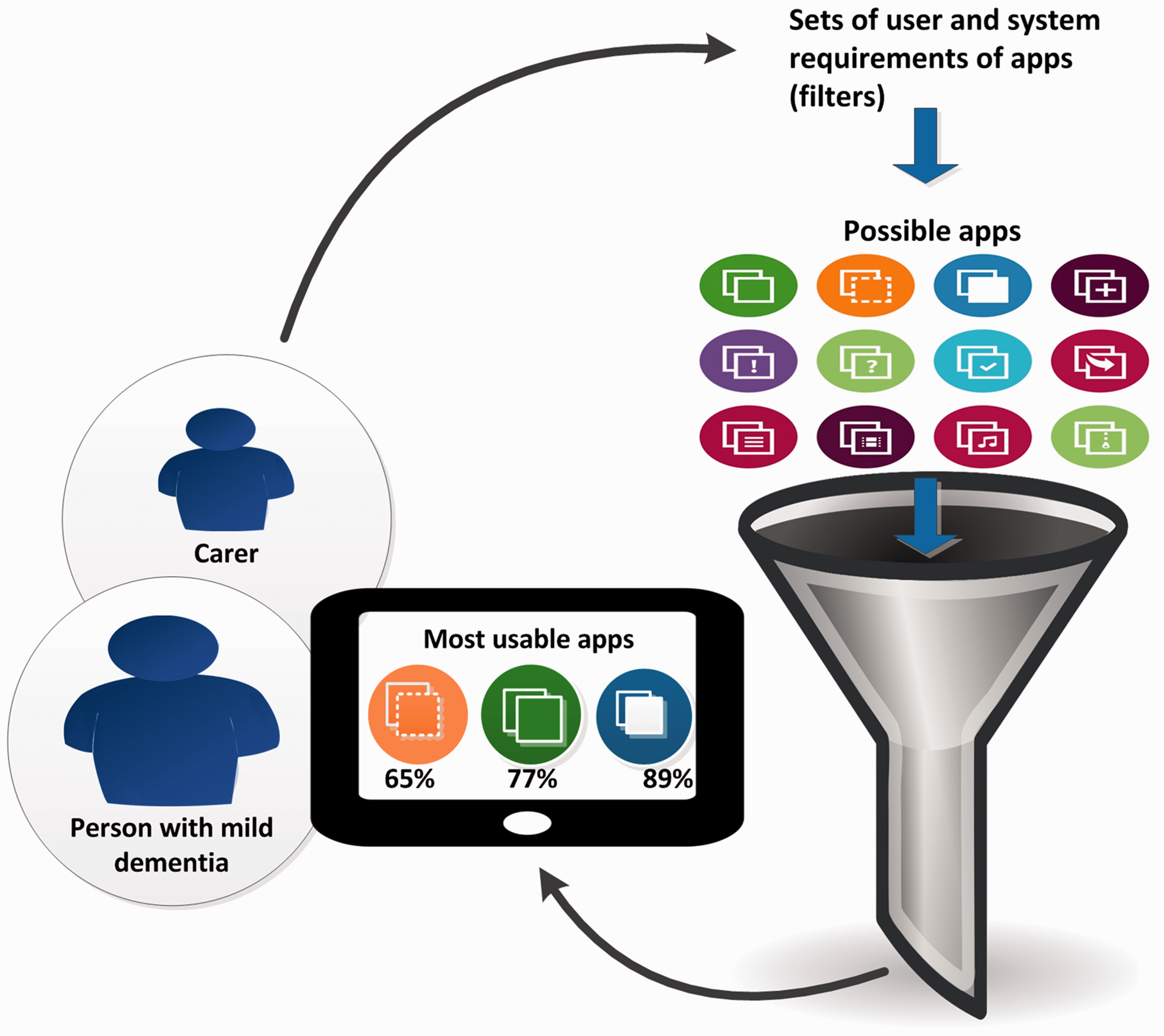
The following is the main question addressed in this study:
What do people with dementia find important in their choice and use of apps? To answer this question, we formulated three subquestions:
What kind of self-management and meaningful activities are important to people with dementia from the perspectives of people with mild dementia and carers? What are the needs, wishes and abilities of people with dementia regarding the use of apps from the perspectives of people with mild dementia and carers? What user requirements can be identified based on these perceptions?
Methods
Research design
To identify the user requirements for apps for people with mild dementia, a qualitative exploratory study was performed. An exploratory study design was used to gain an in-depth understanding of people’s needs and wishes, and their ability to fulfil these needs and wishes.41–44
To ensure an adequate identification of desired activities in the context of self-management and meaningful activities, we conducted two focus groups with people with mild dementia and two focus groups with ICs in study one (subquestion 1). In study two, two focus group sessions with people with mild dementia and two focus group sessions with ICs were held to explore the needs, wishes and abilities regarding the use of apps (subquestion 2). As a result, user requirements were listed (subquestion 3).
Setting and participants
Participants for the focus groups were recruited with help of two meeting centres located in the West and the East of the Netherlands, the Dutch Alzheimer Association and a care organization in the East of the country that delivers community care. Inclusion criteria for people with dementia were care-dependent people with cognitive impairments with and without a confirmed diagnosis of mild dementia. Inclusion criteria for the IC were caring for a person with mild cognitive impairment (MCI) or early dementia. In addition, participants had to be willing and able to participate actively in the focus groups, and for the focus group sessions with regard to subquestion 2, participants were selected that according to themselves and professional carers, of persons with dementia had at least some experience with the use of a tablet or smartphone and its apps.
The recruitment of the participants appeared challenging because most of the referred potential participants lacked experience with the use of tablets. We therefore consulted a care organization that offered tablets to their customers to promote eHealth services in practice. Participants recruited via this care organization met all criteria and most of them visited a day care centre for people with dementia or a support group for ICs of people with young-onset dementia. The recruited people with dementia and the ICs were not related, with the exception of one dyad.
In study one, eight people with dementia and 10 ICs participated in four focus groups. In study two, the same five people with dementia participated in the first and second focus group sessions. Five ICs participated in the first focus group session and three of them also participated in the second session. Two ICs withdrew from participation in the second session because of illness.
Qualitative methods and study procedure
Study one
To gain insight into the target group’s relevant self-management activities and other meaningful activities, the methodology of the Occupational History Performance Interview (OPHI-II-NL) was applied.18,48 The OPHI-II-NL is a narrative person-centred interview based on the Model of Human Occupation 16 that focuses on the identification of meaningful activities and the experiences of a person with these activities in the past and the present, and what this means for the future. Focus groups with people with mild dementia and focus groups with ICs were conducted, using a topic list based on the OPHI-II-NL interview.18,48,49 Examples of questions asked in the focus groups were: What kind of activities were/are important for you in the past/present, what kind of activities makes you feel good, what kind of activities are important to do independently and what impeded you in performing these activities?
The focus groups were voice recorded.
Study two
Two focus group sessions were organized, seperated by two weeks. They were conducted to explore the needs, wishes and abilities of people with dementia regarding the use of apps. To avoid embarrassment due to memory problems, participants were asked to bring the tablet they normally used (own tablet or tablet of the day care centre) to capture experiences while using different kinds of apps. The aim of the first session was to gain insight into the current use and types of apps, the choices made in selecting certain kind of apps, and the experiences of participants with the apps selected in advance by the researchers (Wordsearch Deluxe, WordBreaker and a Dutch history app). In the second session, the aim was to gain a more profound understanding of the experiences with the selected apps, the apps used normally, and with a newly introduced app (Dutch television app). Between the first session and the second session, participants were asked to keep a diary of their experiences (advantages and disadvantages) with the selected apps and the apps they used normally. People with dementia were stimulated by an activity therapist working at the day care centre to use the tablet and the selected apps and received help from this person. The focus groups were guided by two researchers, a primary interviewer and an observer; the latter was responsible for reporting the focus group observations. Again we used a topic list, and examples of questions asked in the focus group sessions were: what kind of apps are you currently using, what do you like/dislike of the app, what is your first reaction when you see this app and is the purpose of the app clear to you, can you tell us why (not)?
The focus group sessions were videotaped to capture the full context of the focus group sessions, in particular the non-verbal communications and interactions of people with dementia while they were using the tablet and apps. 50
Ethical considerations
The Medical Ethics Committee of the VU University Medical Centre in Amsterdam approved the study protocol. Prior to participation in the focus groups, all participants signed an informed consent form after receiving written and oral information about the research. During the sessions with persons with dementia, we performed on-going consent by regularly asking them if they still were comfortable with the procedure. 51 We created a safe environment by spending time getting to know the people, giving them positive feedback, emphasizing the importance of their participation, recognizing signs of discomfort 51 and through the use of a written time schedule (A3 paper size) that allowed participants to see what was going to happen at any given time.
Data analysis
The focus groups were all transcribed verbatim. Overall, four types of data were collected and used for the analysis: (1) participant characteristics and tablet/smartphone experience, (2) transcripts of the focus groups, (3) observed behaviour of participants during the focus groups reported in notes and (4) advantages and disadvantages of used apps noted in a diary (study two). The focus groups data were analysed using inductive content analysis based on the principles of grounded theory. 52 In this approach, focus group observations and notes are also part of the analysis to capture the total context and to ensure an in-depth understanding of users’ needs, wishes and abilities. 51 The procedure of ‘open coding’, ‘axial coding’ and ‘selective coding’ was performed to identify themes. ATLAS.ti, a software programme for qualitative analysis, was used to support the further analysis. Two researchers coded the focus groups data independently (average inter-rater reliability 79% for the last focus groups we coded) and any discrepancies in coding were discussed until consensus was reached (YK and AB). The interpretation of the findings during the procedure of coding and the reporting of this qualitative study was critically discussed by four researchers (YK, AB, MG and RMD) of the research team.
To provide an in-depth understanding of the results, quotes of participants were included, and to ensure confidentiality and anonymous presentation of the data, all participants were given a number (1–10 study one; 1–5 study two) with a letter to identify whether they were a person with dementia or an IC. It was not possible to include all the data generated from the focus groups in this article; extracts were selected to illustrate the main content of the data based on what was most illustrative for the themes and also acknowledging the diversity of the participants.
Results
Identification of meaningful and self-management activities (study one)
Characteristics of persons with dementia (PwD).

MCI: mild cognitive impairment; AD: Alzheimer disease; LB: Lewi body dementia; VD: vascular dementia.
Characteristics of informal carers (ICs).

AD: Alzheimer disease; VD: vasular dementia; FD: frontotemporal dementia.
Past meaningful activities
A variety of meaningful activities in the past were mentioned by persons with dementia and ICs. However, the most mentioned activities were reading books, practising sports, being creative and being socially active. ‘Fascination’ and ‘to get informed’ were important motives for reading books in the past. ICs mentioned that deficits in reasoning, empathizing, imagining and giving meaning to the content were important reasons why the persons with dementia no longer read books. My wife she doesn’t see cause and effect. When she does something that I am not pleased about and I tell her with a normal facial expression not to do that, it doesn’t register. And with a book you have to be able to get into the story and this ability is completely gone. She used to read a lot, but the empathy is gone.(…). She is still sensitive to feelings, for example when I am angry and I show her that I am angry. So words do not make an impression anymore, but feelings do. (IC5)
A variety of sports were practised in the past by mostly male (eight) persons with dementia. The most frequently mentioned sports were football and bicycle racing. Important motives for participating in sports were related to the drive to win and to be socially active. He always went cycling with a group of friends, which was a hobby of his. He liked the combination of being active and being in the company of his friends. (IC8)
In contrast to male participants, most female (three) persons with dementia participated in creative activities such as hand-knitting, dressmaking, making jewellery and drawing. Important motives for these activites were admiration and beautiful looks. When I was young we were with six girls and we went dancing when we were eighteen and it was important for me to look nice and do something different. That’s why I took some sewing lessons, I made dresses for myself and my sisters. I liked doing that because then I had a new dress when I went dancing. (PwD5)
Being socially active was an important motive for performing several meaningful activities in the past, but it was also an activity which in itself was perceived as meaningful, for example family meetings.
Present meaningful activities
Although a diversity of meaningful activities in the present were mentioned by persons with dementia and ICs, most cited were being socially active, listening to music, experiencing and being in nature, and watching TV. Persons with dementia found regular contact with their children and having a good relationship with them important. Furthermore, they liked to be surrounded by family members, especially their spouse, children and grandchildren. Persons with dementia who visited the meeting centres viewed their fellow visitors as a new circle of friends with whom they could share their problems, chat and undertake all kinds of other meaningful activities, such as going out for a walk, playing shuffleboard, handicrafting and looking at photographs of the past. My son arranged for me to come to the meeting centre and I am so glad to be here. Really. It is so nice to talk with my fellow visitors. This is important for me. (PwD7) Doing things together, for example when we play shuffleboard, that’s what I like. (PwD5)
Although the types of music enjoyed by the persons with dementia differed, listening to music is a very pleasant meaningful activity for many of them. It contributes to peace of mind, expressing their emotions, helps to recall memories or provides a starting point for telling a story. For some ICs, YouTube on the computer or TV appeared supportive, for example, by making a customized playlist. My husband has these outbursts of anger, then he becomes restless and he wants to walk away. I happened to notice that music calms him and that he enjoyed it. Because these outbursts are getting worse I made a playlist with his favourite music in YouTube. Now when he becomes angry or restless I turn on the TV with that list of all those videos. Then he is quiet and calm for 2 hours, enjoying the music and saying how much he likes it over and over. (IC4)
Experiencing and being in nature is a very welcome activity for many of the participants. They like to sit in the garden, walk or cycle in nature and enjoy the change of seasons or the beautiful weather. I put my bike to the side and I look around and I am amazed. Really. You see so much! Colours, scents, birds. (PwD6)
Many persons with dementia, mostly men (five), liked to watch TV. Remarkably, this helped persons with dementia to calm down or feel at peace, while some ICs interpreted this behaviour as apathetic. When I am sitting down I am calmer than when I am standing. (PwD3) He mainly watches TV beginning at 10 am, and in the afternoon he bikes to the market. Then he comes home and watches TV again. (IC8)
Many meaningful activities done in the past were shown to still be meaningful today. For example, career-related activities, such as a carpenter who still repairs chairs and tables or an art specialist who still likes to visit a museum. This was the same for participating in sports or other hobbies engaged in the past. For example, some men who played football in the past liked to watch football matches, or a woman who drew a lot in the past and at present started drawing again. She was always very creative, but this is gone. For example, I had never seen here draw. Since she started visiting the meeting centre she has been drawing again. This is awesome because she had also become very apathetic, doing nothing. (IC10)
Self-management support
Persons with dementia and ICs mentioned many issues related to self-management. Those most mentioned were different kinds of memory support, such as remembering appointments and to take medication, to maintain a daily structure, to find the way and memory training. I would like to have an alarm system, when I am at home in the evening I need to take my medication at seven, but I never think of it, my wife arranges this. (PwD1)
They also share a lot of insights into how they cope with the consequences of their disease in terms of activities they can no longer do or that are problematic. Persons with dementia differ in how they feel and deal with the losses and changes that dementia brings in their lives. Some find it very hard to accept that activities are not possible anymore while others are more resigned to their fate. Well, you have to live your life. Most preferably you do what you did in the past, but this is not always possible. You have to make choices. (PwD3)
This also depends on which kind of activity they have to say goodbye to or encounter problems with. For example, persons with communication problems found it hard to accept that they struggle to have and follow normal conversations. To join a conversation and to understand. She can’t do that anymore. (IC1)
Others find it hard to accept that their freedom of movement decreased. This was particularly true when, for example, finding one’s way or cycling becomes problematic. However, the most cited limitation experienced was losing their driver’s license. Driving is not possible anymore, the car is gone and this makes him sad. (IC3) It’s like a piece of you has been removed. (PwD6 about taking away his driver’s licence)
Another important issue related to self-management mentioned by persons with dementia was that they feel it is important to maintain their autonomy and respect, for example in conversations with others who are not suffering from dementia. When I tell my wife something, and then she says: no, that’s not right, this is what happened. You are seeing it wrong because of your illness. This really bothers me. (PwD6)
Needs of people with dementia with regard to the use of apps (study two)
Characteristics of persons with dementia (PwD).
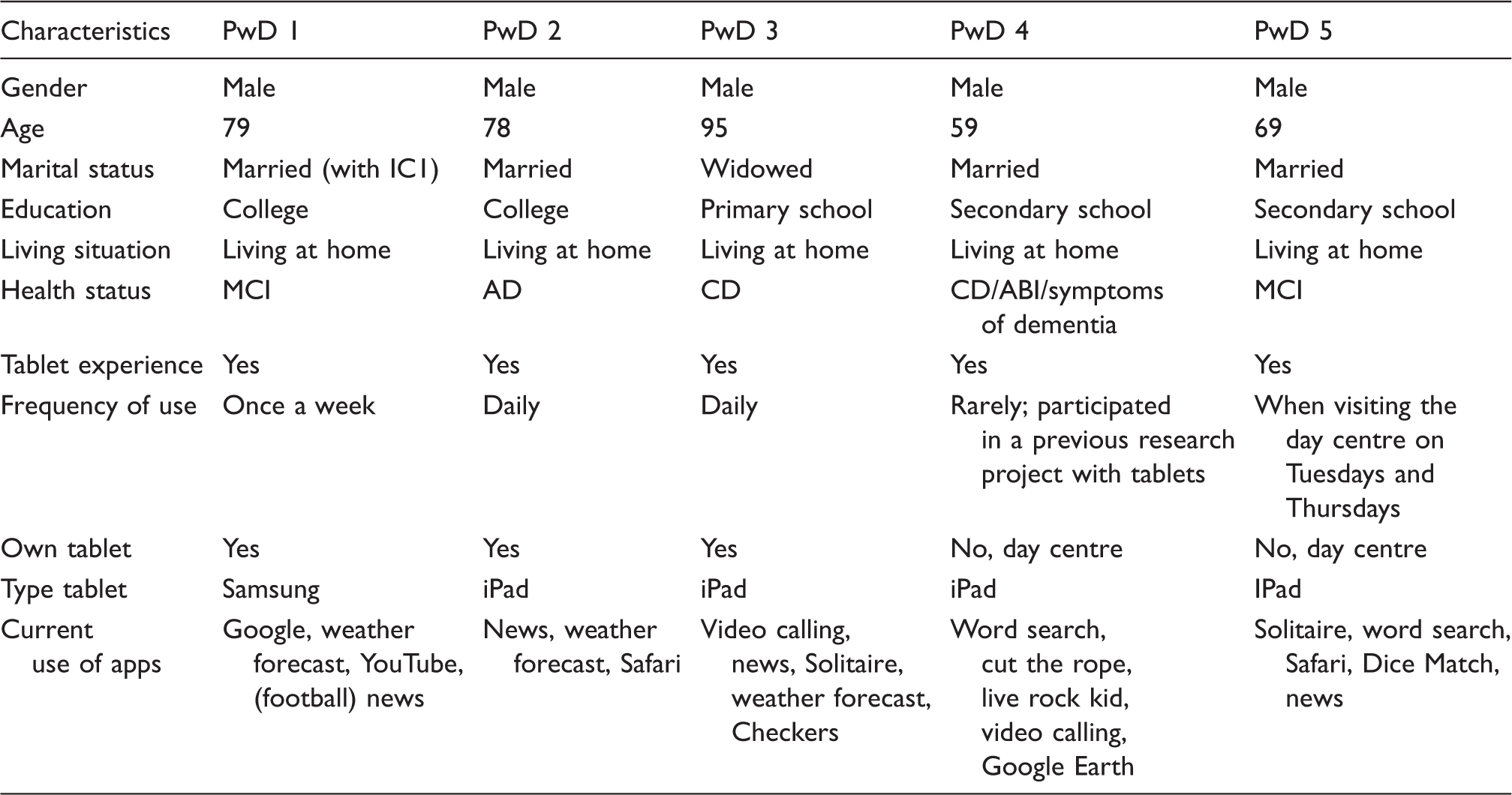
MCI: mild cognitive impairment; AD: Alzheimer disease; CD: cognitive decline; ABI: acquired brain impairment.
Characteristics of informal carers (ICs).
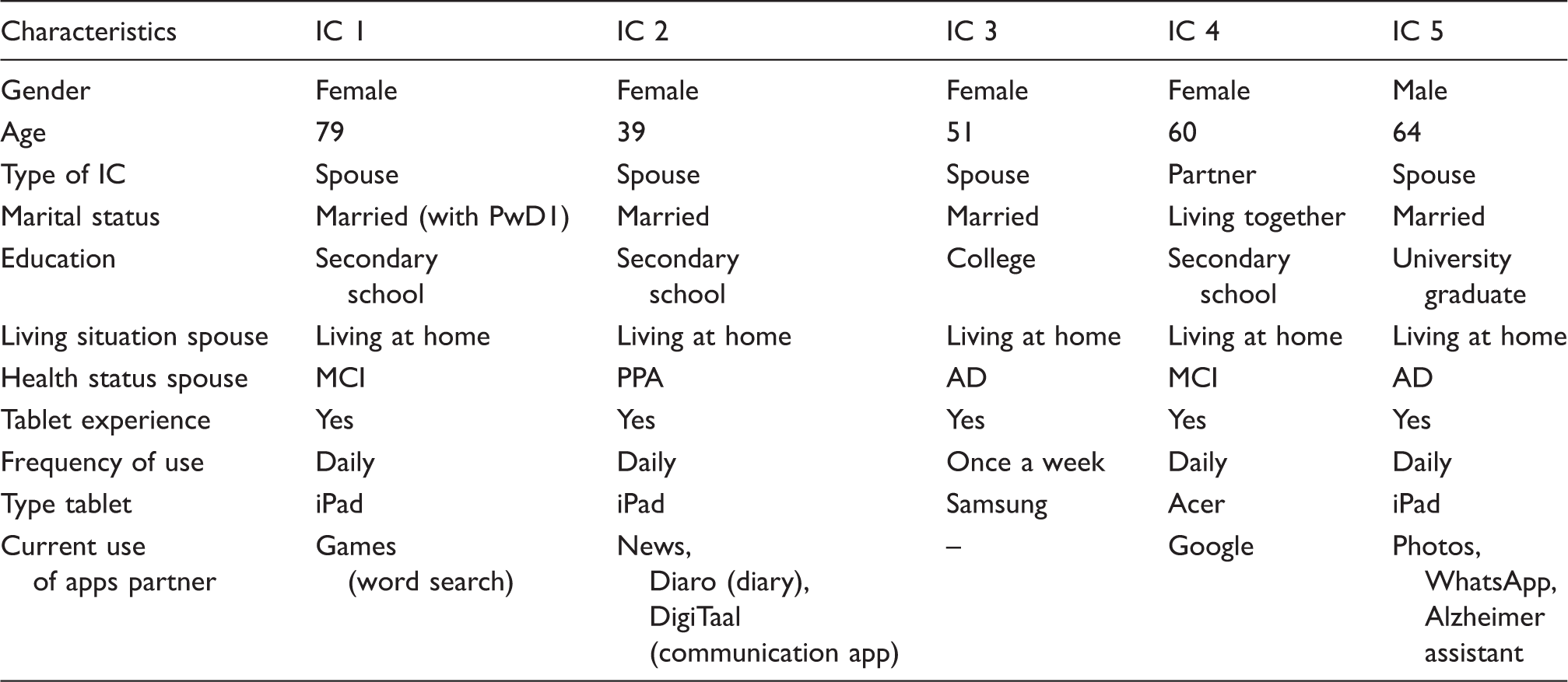
MCI: mild cognitive impairment; AD: Alzheimer disease; PPA: primary progressive aphasia.
User requirements and user characteristics resulting from the focus groups for the requirements-based assessment tool.

Needs and wishes of users for functionality of apps
Participants listed different apps they currently used to help persons with dementia engage in meaningful activities and encourage them in self-management activities, e.g. games apps, news and weather forecast apps, brain training and language exercise apps, apps that stimulate social contact and communication between the PwD and informal or formal carers, hobby apps (sport, music nature, etc.), Internet access apps, etc. I always go out in the afternoon, when it’s not raining. Last summer, I got soaked twice, not nice. Nowadays I first check the weather forecast app on the tablet. (PwD3) The speech therapist advised him to use the Diaro app. With this app you can take photographs of the activities you do in a day and type in what the activity was. Because talking is very difficult, this overview of activities stimulates the communication between us about what he does during the day. (IC2)
The use of apps as well as the tablet in general were of great benefit to the participants. It gave them feelings of pleasure, peace of mind, rest and recreation. In addition, the use of some apps such as news apps, apps for social contact and apps for access to Internet were found to be instructive, innovative and gave them access to the world or provided social inclusion. The peace, so relaxed. Nothing else on your mind, only focusing on the solitaire app. Others can ask me something but I don’t even hear them. (PwD5) Well, I don’t have to look at the newspaper, with this tablet I have access to the whole world. Everything I want to know I can look for and I manage reasonably well. (PwD2)
Participants indicated that they preferred using apps that match their personal interests, hobbies and working life. For example, while using the Dutch history app or word search app, persons with dementia looked for recognizable historical information or puzzle categories that connected with their personal interests. The first railroad, interesting! I used to volunteer at the railway museum. (PwD1) She dislikes playing games, so she is never going to play the word search apps. (IC4)
Some persons with dementia were used to playing games on the tablet. They liked the competition to improve themselves or to beat the opponent. In some cases, persons with dementia chose apps for games that were to them in the past familiar (the non-digital version) out of personal interest, but also because they were more familiar with the operation of the app. I used to play a lot of checkers competitions with my brother. I had not played it for thirty years and now I have started again, so nice! (PwD3)
During the focus groups, we introduced new apps. Although these were not always consistent with their personal interests, participants were nevertheless enthusiastic about the functionalities of some of these apps. And now the Dutch television app is also on the tablet. It’s such a wonderful tool, fantastic! (PwD2)
Additional needs and wishes for special functionalities of apps were indirectly mentioned by some participants, such as the need for apps supporting daily structure and apps that remind them to take their medication.
Needs and wishes of users for technical features of apps
Participants encountered several problems in navigating the apps. The function of buttons within apps was not always clear because symbols used for the buttons were not recognizable. Sometimes navigation buttons were not big enough or missing. For example, a clear home key was not always available. ICs stated that this was particular so in apps built for Android. Users of these apps must use the arrow on the tablet, next to home button, to get back. According to ICs, persons with dementia find this difficult to get used. It is preferable to have a clear home key in the app. Participants also indicated that the sensitivity of the touchscreen and the use of too many links and pages within apps compromises the comfort of navigation. These issues resulted in persons with dementia having difficulty understanding the operation of some apps and getting lost in the navigation menu, the settings of apps or visiting pages within the app and not knowing what to do there. Look can I make this bigger? (PwD1) PwD1 felt the letters of the Dutch History app where too small. Didn’t understand the function of the button to enlarge letters, in the top right corner. Experimented with different buttons, the assignments button and links to additional information. This took him to irrelevant pages outside the app. (Observation researcher) (see Figure 2)
Dutch history app (En Toen Lite), ©Stichting entoen.nu. The slightest touch takes you somewhere, and you think, o dear, what am I doing here. (PwD2) PwD2 didn’t understand the function (purpose) of the Word breaker app (similar to ‘Lingo’, the Dutch word game on television). Doesn’t know what to do with the letters in different colours. It might be helpful if the letters were in the same colours as the game on television. Navigation buttons were missing and he was lost in the app’s navigation menu. (Observation researcher) (see Figure 3)
WordBreaker HD, ©Douze Dix. I was playing the word search app and when you want to go back, you have to push the pause button, I thought this was not a very clear symbol for going back. And then it might be that PwD press the advertising pop-up window thinking that this is the button to go back. (IC2) (see Figure 4)
Wordsearch Deluxe HD, ©2012–2017 Akarus.

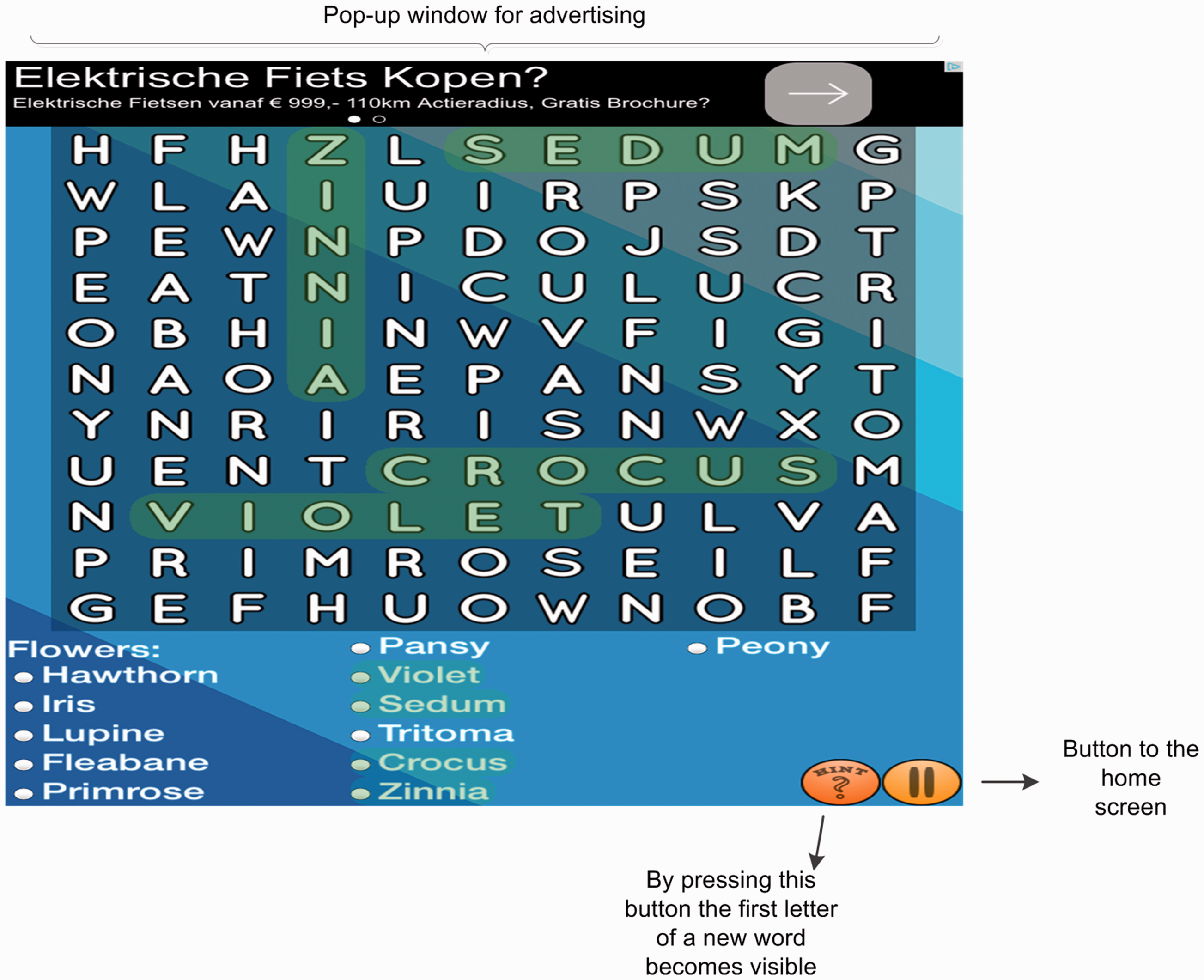
Other disadvantages impeding easy navigation were the pop-up windows used for advertising, the use of links in apps to other sites and being asked to buy the full version of an app in cases when a light version was used. This was confusing for persons with dementia because they did not know what to do or got lost in different pages not knowing how to get back to the app they were using. In addition, updates of apps also confused them because they were used to a certain operation of apps. Previously you could see the history of sites you were visiting and then you could touch it to go back to the site, but this is gone now. (PwD5) Look that’s strange. The competition between companies right now. I think this is horrible!’ (about advertisements in apps). (PwD2)
Additional features which may improve the comfort in navigating the apps for persons with dementia indicated by ICs were: minimize the need for scrolling, provide an easy and intuitive use, minimize the use of too many screens and clicks, present clear instructions on a step-by-step basis and use recognizable buttons supported by pictograms and text. The beginning of the app is important, that you instantly see what you need to do when you press the icon of the app. (IC3)
Participants mentioned many lay-out features that make apps attractive to use, e.g. the use of clear pictures and photos, readable letter types and sizes, a calm interface and background, contrast between text and background, etc. It is nice that you can see which words are done at the bottom; in the newspaper you normally cross out the words you have found but then you can’t see what you have crossed out. (PwD4) PwD4 was also crossing out the words he found on the tablet with his finger, maybe he was used to doing so. But the colours used in this app (blue and yellow) didn’t provide a clear contrast. (Observation researcher) (see Figure 4). The world comes alive again when she sees photos. For example, I take a lot of photos of old photos. This past week a grandchild was born and she was wondering which family member the baby looks like. Then I placed the photo of the baby next to old photos of family members. So I think photos are very important in an app. (IC5)
Most of the persons with dementia preferred the possibility for a landscape presentation of apps because this was perceived as bigger and clearer, but also because most of them where used to a landscape presentation.
The use of short clear sentences and the use of easy words were preferred features of the language used by the apps, for example puzzles apps. In addition, although all the apps used in the focus groups were exclusively in Dutch, the settings were sometimes in English. Persons with dementia differ in their preferences of the language used in apps. Some, including ICs, prefer that the app is fully in Dutch, while others mentioned that they did not mind the apps using English words, for example in the settings. However, during the focus groups, this caused confusion because the English words used in these apps were often not recognized. Persons with dementia found the use of technical terms and computer jargon, e.g. ‘high definition’, ‘download’, ‘upgrade’, difficult to understand in both the Dutch and these partly English apps. Do you know what upgrade means? To increase the difficulty level? (PwD1) I don’t have a clue what this all means; when I press on Pictionary, what will happen? (PwD5)
Additional wishes with regard to important features of apps were mentioned by persons with dementia included the possibility of a hint button in, for example, the puzzle apps. Also, both persons with dementia and ICs found that entering codes and passwords was annoying. Persons with dementia liked the background music and the possibilities to adapt the app to personal preferences, e.g. background sounds and lay-out, difficulty level and puzzle categories of the word search app. ICs mentioned that the background music was annoying and the choices for different puzzle categories were confusing for people with dementia and they did not know how to operate the scroll bar.
User abilities: Physical and cognitive condition
Participants mentioned different cognitive and physical disabilities which had an effect on the persons with dementia’s skills to operate the tablet and its apps. Most of them have cognitive disabilities related to dementia, e.g. memory problems and language problems (speech, word recognition and meaning). Examples of physical disabilities, frequently the result of aging, include problems with the fine motor skills and visual and hearing problems. These disabilities influenced the choices for a special functionality of the app, for example, apps that overcome language problems by supporting communication and apps for brain training, daily structure and medication alarm which compensate for memory problems. On the other hand, persons with dementia experienced problems using certain apps due to these disabilities, such as difficulties with reading and hearing, guessing and spelling the right words, not knowing how to operate the app when it was presented in portrait position and typing and tapping. I cannot get out of this app. (PwD2). PwD2 was used to having the tablet in a landscape position, did not move the tablet to a portrait position when apps were presented this way, tilted his head so he could read the app. (Observation researcher) Yes, it contains difficult words, don’t you think? (PwD4) PwD4 could not spell and type the words correctly, so the app didn’t recognize the entered words. (Observation researcher) (see Figure 3) This is useless, I cannot read it. (PwD3) PwD3 is keener to participate when apps contain less text. (Observation researcher)
Some ICs mentioned that persons with dementia had difficulties using the tablet and its apps because they were not familiar with it before the onset of dementia. One of them said that his wife had resisted new technologies before the onset of dementia, one was used collecting information from Google on the tablet instead of using special apps, and another IC stated that a step-by-step instruction in written and oral form is needed over a longer period of time in order to get her husband used to operating the tablet and its apps.
User abilities to use the apps on a tablet independently
During the focus group sessions with persons with dementia and ICs, it became clear that the level of independence in using the tablets and its apps varied greatly between persons with dementia. Some persons with dementia could operate apps independently after becoming familiar with these apps. Some needed more support because the apps were difficult for them. The participants with dementia all received support from people around them, e.g. family members, formal carers and activity therapists at the day care centre. Two ICs mentioned that the use of the tablet and its apps by persons with dementia placed heavy demands on them and increased the burden of ICs. He was constantly asking, how do I do this and how do I do that. It drove me crazy. (IC3)
One IC mentioned that the use of the tablet and its apps fully depended on how he guided his wife in using it. She merely had to look at it. I make the use of the tablet very simple for her, for example when we planned to buy a new chair I took pictures of chairs we like and when we got home I showed her the pictures again and again. (IC5)
User abilities: Touchscreen and tablet skills
Persons with dementia differed in their performance of operating the touchscreen and the tablet in general. This appeared to be related to their physical and cognitive condition but also to other factors, such as the frequency of weekly tablet use and the kind of support received by the social network. However, most of them had difficulties with touchscreen skills such as typing, unlocking the tablet by entering codes and passwords, finding apps on the screen, scrolling and navigating. This was acknowledged by the ICs. Some persons with dementia had difficulties zooming in and out, operating the sound, and swiping and tapping. One person was used to operate the computer and automatically tapped twice, blocking the navigation of some apps. One person tapped with his nails so the screen did not react. And two people were pressing too hard resulting in apps being selected or not reacting. Login and password, I don’t know the password. (PwD3) Sometimes you don’t know which side you have to swipe to, and sometimes it disappears too quickly and then you have to do it again. (PwD1)
With regard to tablet skills, most persons with dementia could find and use the home button on the tablet. When they got lost or stuck in an app, however, they also immediately used the home button, which did not solve the problem because apps were not closed. Some of them also had problems in operating the sound and tablet stand. Nevertheless, most of them were motivated to learn more skills to better operate the tablet. I am not that handy with the tablet yet, I have to learn. I want to learn how to download apps. (PwD1)
ICs were sceptical about teaching persons with dementia how to download apps because they felt there are too many steps and it requires advanced skills, such as entering codes and passwords. One IC was also afraid that the PwD would download expensive apps.
User requirements (subquestion 3)
The user requirements in Table 5 consist of needs and wishes related to functional and technical selection criteria of apps, and of user characteristics that can be used to determine user requirements adressing abilities of users in terms of their physical and cognitive condition, the independent use of apps and skills needed to use the touchscreen and tablet.
Discussion and conclusion
In this exploratory study, we identified user requirements for a new, yet to be developed, interactive tool to select usable apps for meaningful activities and self-management support for people with dementia. Based on these user-requirements, filters will be developed which will enable people with dementia to select apps that match their individual needs, wishes and abilities. Most identified user requirements address needs and wishes related to functional and technical features of apps, but we also found user characteristics that can be used to determine user requirements addressing abilities of users (see Table 5).
Study one: User requirements related to activities
Study one resulted in the identification of a wide variety of activities perceived as meaningful for persons with dementia. Together with the inventoried needs and wishes for self-management support, this contributed to the identification of functional selection criteria of apps, or, in other words, function-related user requirements. The most frequently mentioned meaningful activity in the past and present is ‘being socially active’, for example having family meetings, and regular and good contact with family members. Being socially active also appears to be a motivating factor to undertake other meaningful activities. Activities seem to become more meaningful when they are undertaken together with other people, e.g. activities that take place at the meeting centre or day care facility, such as playing shuffleboard and handicrafting, but also different kinds of sports engaged in the past, such as bicycle racing or playing football. This implies that apps that support people being socially active (e.g. Skype, Face Time and WhatsApp) or apps for other meaningful activities with a social component, such as playing games (e.g. Wordfeud) or doing sports together (e.g. football or tennis games) are desirable for people with dementia. These may also fulfil the frequently reported unmet need for social contact and company of people with dementia living at home.4–6 Furthermore, the study showed that activities done in the past can provide relevant information for preferred activities in the present, and therefore for suitable apps. For example, career-related activities such as iHandy carpenter for a carpenter who still likes to repair chairs and tables, and 3D Virtual Art Gallery for an art specialist who still likes to visit a museum.
Most of the mentioned needs and wishes for self-management were related to ‘memory support’ such as maintaining daily structure, finding the way and memory training. This finding supports the results of the study by Van der Roest et al., 4 which showed that 32.5% of people with dementia experienced unmet needs regarding memory support. Other frequently cited needs for self-management support were related to ‘maintaining freedom of movement’. For example, participants reported feelings of sadness because their driver’s license was taken away, or because cycling was no longer possible. This was perceived as a loss of meaningful activities. It is worth noting that people with dementia felt the need for maintaining autonomy and respect, for example when memory loss or communication problems affected having normal conversations. The above-mentioned needs are in line with findings concerning unmet needs reported in previous research in the areas of psychological distress, company and daytime activities.4,6 Examples of apps that may be supportive in these areas of self-management are: the Pictoplanner for maintaining daily structure, Navigation apps like Blokje Om for finding the way and maintaining freedom of movement, the Diaro App for language and communication support and brain training apps, such as Clevermind, for memory training.
Study two: User requirements related to usage
In study two, focus group sessions with the same participants as they used different kinds of apps resulted in collecting diverse and rich user requirements. Part of the user requirements mentioned concerned the functional selection criteria of apps which overlapped or supplemented the inventoried user requirements in our first study. Participants mentioned different kinds of apps which currently helped the person with dementia to engage in meaningful activities or supported their self-management. However, the majority of the user requirements identified in these sessions addressed needs and wishes related to the technical selection criteria of apps. Most of them were in line with the requirements for interfaces described in the literature (see Appendix 1). Requirements not found in the literature, but indicated during the focus group sessions were: minimal amount of typing required to navigate within the apps; the language used in apps must be adjustable in ones own language, including the settings and apps that have the possibility of landscape and portrait presentation (rotation). Additional requirements not mentioned in the focus groups sessions but mentioned in the literature were: using warm colours, 53 placing important information first and highlighting it,54–56 providing clear headings for text,55,57 providing enough space between app and tablet buttons,58,59 providing ample time to read information54,55,60 and avoiding pronouns or any language requiring the person with dementia to recall previous information.54,55,60,61 The requirements for interfaces described in the literature generally incorporated a mix of different platforms, e.g. websites and web applications, and also primarily focused on elderly people in general and not on people with cognitive impairments. Although there is growing evidence that people with dementia are able to use a tablet and its apps,24,26,28,37,38 evidence of the importance of diversity regarding functional and technical features of apps for the successful use of tablets by people with dementia is still very scarce. To our knowledge, this study is the first of this kind.
During the focus group sessions, we observed that persons with dementia generally chose apps for games they were already familiar with in the past, i.e. the non-digital version of checkers or solitaire, out of personal interest but also because of familiarity with the operation of these games. This was also recognized by Lim et al. 26 and Groenewoud and de Lange. 28 However, recent research shows that familiarity with the non-digital version of a game is not a guarantee of usability and that novel games (e.g. Bubble Xplode) should not be avoided as they can be easy to use and playable. 38 This was also found in this study. Persons with dementia were enthusiastic about apps that offered the possibility of learning new games.
ICs stated that apps built for Android were more difficult to operate than apps built for Apple, because Android misses a clear home key. Users have to use the arrow on the tablet next to the home key to get back and this is often confusing for people with dementia. Studies into the use of touchscreen technology by people with dementia showed that the Apple iPad and its apps were primarily used because of the intuitive interface and user-friendliness24,26,28,39 and that less instructions were needed for the independent use of easy to operate apps.26,38 This suggests that there is preference for Apple as a platform for people with dementia.
However, people with dementia still need support to learn how to use the tablet and its apps.24,26,28 In the present study, we also found that despite varying degrees of performance, persons with dementia needed support to operate the tablets and its apps. This appears to reflect to the individual physical and cognitive condition, as well as the kind of support received by the social network. Some of the ICs said that the use of the tablet and its apps by persons with dementia put heavy demands on them. There is evidence that people with dementia are capable of learning new skills through various coaching interventions, such as errorless learning and trial-and-error learning. 62 It is also known that people with dementia are able to learn how to use new technologies.63–65 Further research should focus on determining which coaching interventions would be effective to support people with dementia to use the tablet and its apps. This coaching intervention should be aimed at helping ICs to increase independent tablet and app use by persons with dementia.
Further development
Further development of the tool requires research into how to operationalize and validate the technical selection criteria of apps. For example, what buttons are recognizable and easily accessible and what is a calm interface for people with dementia?
Second, it is important to determine, together with the users whether (1) a prioritization system or (2) a ranking system based on personal profiles would be appropriate for the selection of customized apps. A prioritization system of technical criteria of apps may be suitable because applying all technical criteria together with the functional criteria of apps could result in no, or a very limited number of suitable apps. A ranking system is based on predetermined profiles of user characteristics addressing abilities of users. For example, visual problems will require some technical selection criteria of apps, such as clear colour contrast, sound selection cues and clear contrast between text and background. For the remainder of the technical selection criteria, a ranking system, from 1 (less priority) to 10 (priority), could then be used.
Third, it is recommended that the present supply of apps for meaningful activities and self-management support mentioned in Table 5 be researched to determine how specific we must be in categorizing apps to provide sufficient supply for each category.
Fourth, user requirements have to be translated into the system requirements of apps to enable the identification of important features of apps that match the individual needs, wishes and abilities of people with dementia. In other words, sets of user and system requirements (filters) need to be determined and apps must be rated with regard to these requirements so that customized apps can be selected (see Figure 1).
Fifth, there is a possible downside of putting the needs and wants of future users at centre stage. People with mild dementia may want to use a commercial app for brain training that, for example, promises to slow down cognitive decline, without any evidence of its effectiveness. It is unknown whether this will be a major challenge for a future selection tool, but it is important to pay attention to this aspect.
Finally, the tool must be designed and developed in close cooperation with the users and other important stakeholders, such as formal carers and experts (designers, developers and researchers), to ensure user-friendliness. The aim is that the tool can be used by the person with mild dementia him- or herself with or without support of a carer. Details of this planned development and design process can be found elsewhere. 47
Strengths and limitations
The strength of this study lies in the optimal inclusion of people with dementia in the developmental process of this tool, which will enable the development of a practical and useful tool for the target group. Span et al. 41 and Meiland et al. 42 discussed the importance of including people with dementia in the development of user-friendly ICT applications. Valuable strategies such as taking time, creating a safe environment, providing positive feedback and building a relationship, 51 resulted in rich quotes which gave an in-depth understanding of their personal experiences, needs, wishes and abilities. The results of our study show that the needs and wishes of people with dementia and their ICs are complementary, which contributed to a comprehensive picture of user requirements. With the inventoried user requirements we can provide valuable input for designers and builders of ICT regarding the development of usable apps for people with dementia and other vulnerable target groups with cognitive impairments. This will hopefully contribute to the inclusion of these target groups in an Internet society and thereby to their social health, as formulated by Huber et al. 11
This study has some methodological limitations. The qualitative study had an exploratory focus and we did not reach saturation in meaningful activities and self-management support because of the wealth of activities that can be classified as meaningful or supportive for self-management. Because this was the first stage in the development of the tool and because of the iterative approach to be used in the further development of the tool, 47 we will continue our research on this topic in future stages of our study.
A second weakness is that we used a convenience sample of respondents. We recruited members from a day care and two meeting centres, which may or may not have been a representative group of community-dwelling people with mild dementia that includes those who do not utilize day care facilities. More information about this group will be collected and utilized in next stages of the development of this tool. Another issue is that participants in study two had tablet experience, which may explain why we had more men than women in our sample, even though dementia is more common in females. Among the older population (age of 65 years and older), Internet use is a male-dominated activity. 66 As a result, our participants were likely more inclined to use technological solutions than people with dementia in general.
A third weakness of the study was that we included some people with MCI and cognitive decline in study two and assumed that their remarks and ideas were valid for people with mild dementia as well. However, we did not test this. We also did not try to quantify the needs of people with mild dementia, but instead tried to identify a variety of important themes for the development of a requirements-based assessment tool. Further research is needed to fine-tune the user requirements and to determine the percentage of people with mild dementia for whom the tool might offer assistance in maintaining or enhancing their quality of life.
A last issue is that although we performed on-going consent and we regularly repeated what the purpose of the focus group sessions was, we could not avoid that two participants believed they were attending a tablet course. The participants stated at the end of the sessions: It feels like sitting in the classroom, being in school. (PwD4) I think I learned a lot. And that was the idea. (PwD5)
Conclusion
With the exploratory approach used in this study, user needs of people with dementia and ICs concerning their choice and use of apps for meaningful activities and self-management support were identified. These user needs were translated into user requirements which will form the basis for a new interactive tool for a personalized selection of suitable apps. This tool will be further developed in close cooperation with potential users and other important stakeholders. We hope the tool will make it easy for people with dementia to select suitable apps for meaningful activities, which may stimulate their involvement in these activities. We expect that this will result in experiencing pleasure and enjoyment, feelings of connection and belonging and retaining a sense of autonomy and personal identity. 67 Because apps can be selected which are supportive in the different areas of self-management, 17 it is expected that using these apps will also increase self-management abilities.
Footnotes
Acknowledgements
We are grateful for the cooperation of the visitors of the day care centre of care organization Sensire and the meeting centres in Enschede and Amsterdam (the Netherlands). We also thank the informal carers and the staff of these organizations. We thank the Dutch Alzheimer Association (Rob Groot Zwaaftink) and Vilans, Expertise Centre for Long-term Care (Sandra Suijkerbuijk and Nienke Nijhof), for their help in recruiting participants and their participation in the focus groups sessions of study two. This study greatly benefited from the ideas and input of Guus Vrauwdeunt, lecturer at the Faculty of Creative Technology of Saxion University of Applied Sciences. Finally, we are grateful to the students of the Faculty of Health and the Faculty of Social Work of Saxion University of Applied Sciences for their work on transcribing the focus groups and for their input in this study.
Declaration of Conflicting Interests
The author(s) declared no potential conflicts of interest with respect to the research, authorship, and/or publication of this article.
Funding
The author(s) received no financial support for the research, authorship, and/or publication of this article.