



Abstract
This intervention case study is written by an Educational and Child Psychologist in the Republic of Ireland, which took place with Leah, a 15-year-old adolescent with a diagnosis of autism attending a post-primary school. Pre- and post-intervention assessment measures included the Strengths and Difficulties Questionnaire (SDQ) and the Rosenberg Self-Esteem Scale (RSE). An individualised intervention plan was designed, focussing on promoting Leah’s self-esteem, as well as her understanding of autism. Therapeutic techniques used throughout the six-session intervention involved strengths-based and Personal Construct Psychology (PCP) approaches, alongside psychoeducation about autism. Leah’s post-intervention scores on the SDQ showed slight improvements in emotional problems and conduct problems following the intervention, while her scores on the RSE demonstrated a significant improvement in self-esteem from pre- to post-intervention. The case outcomes support the adoption of individualised strengths-based approaches and PCP techniques to promote self-esteem, as well as psychoeducation about autism to promote understanding and self-acceptance.
Keywords
Introduction
The current paper is a practitioner report, written by an Educational and Child Psychologist within the context of the Republic of Ireland. This practitioner paper focusses on a real-life case study example of the use of individualised strengths-based approaches and Personal Construct Psychology (PCP) techniques to promote self-esteem, as well as psychoeducation about autism to promote understanding and self-acceptance, during a brief intervention with an adolescent in a post-primary/second-level school context. The practice described within the current report was completed in accordance with the standards for psychologists delineated in the Psychological Society of Ireland’s (2019) Code of Professional Ethics. In order to ensure confidentiality, pseudonyms have been used throughout this paper.
Case information
Background information
Leah is a 15-year-old girl attending her third year in post-primary/second-level school in an urban setting in the Republic of Ireland. During the summer of 2020, she received a diagnosis of autism from a private psychologist. Leah and her family did not receive access to any services following her diagnosis. Leah received individualised special education teaching throughout her time in primary school for literacy and numeracy, but has not received special education teaching since beginning post-primary school.
Leah attended for an in-school psychological assessment in early March 2021, which was administered by the school psychologist. This assessment consisted of a consultation with Leah, a cognitive assessment and an attainments assessment. During the student consultation, it became apparent that Leah had little knowledge of autism; Leah mentioned that her mother Anne had told her that she had autism, but that Anne had not explained a great deal about autism to Leah. Additionally, Leah stated that she struggled with all aspects of schoolwork and when she was asked about her strengths, she said that she did not have any. Leah’s performance on the cognitive assessment revealed current intellectual functioning within the borderline range of ability and her scores on the attainments assessment were in line with her overall cognitive ability. Thus, the psychologist did not diagnose Leah with dyslexia, but concluded that Leah’s difficulties with schoolwork were accounted for by her intellectual functioning and autism. During the parental feedback meeting after the assessment, Leah’s mother Anne mentioned that she would value some input with Leah in relation to helping her to understand and learn about her autism. Moreover, Anne also felt that Leah’s self-esteem was quite low and that she could benefit from some support in this area, too. Anne welcomed the involvement of the school psychologist in providing this support, and it was decided at the meeting that the psychologist would plan and implement a targeted intervention with Leah throughout April and May 2021.
Initial guiding hypotheses
Based on the information given from parents and teachers on Leah’s initial referral form, as well as observations of Leah on the day of the psychological assessment and information from Anne during the parental feedback meeting, a number of hypotheses were generated. Firstly, it was hypothesised that Leah had little knowledge about autism in general, and did not understand many of the ways through which her autism may have been impacting her. In addition, it was hypothesised that Leah had low self-esteem and poor self-confidence in her strengths and abilities. On account of Leah’s autism and self-reported lack of friendships during the student consultation, it was also hypothesised that Leah had difficulties with social interaction, particularly in relation to socialising and maintaining friendships with her peers.
Assessment procedures
In order to confirm or disregard these hypotheses, a number of assessment procedures were utilised. The psychologist visited Leah at school in order to carry out these assessments, prior to beginning the intervention.
Firstly, the psychologist engaged in an informal conversation with Leah and asked if she would like to work with the psychologist over a number of weeks, to which she responded affirmatively. The psychologist then asked Leah to recall anything that she knew about autism, and recorded her responses on a mind map diagram. Leah mentioned that she knew that she had autism, but did not know a lot about it. Leah gave one other response, which was that she thought there were different levels of autism.
The psychologist then administered the Strengths and Difficulties Questionnaire (SDQ; Goodman et al., 2004) with Leah. The SDQ was used to establish a baseline score for Leah’s prosocial behaviour, emotional symptoms, hyperactivity and inattention and peer relationship problems; it was chosen due to the scale’s good levels of reliability and validity (Goodman et al., 1998). It involved Leah reading 25 statements and indicating how true she felt each statement was, with respect to herself. According to Leah’s self-reporting on this questionnaire, her prosocial behaviour was within the average range; however, her scores were elevated within the abnormal range for emotional problems, conduct problems, hyperactivity and peer problems, with her total difficulties score falling within the abnormal range. These results revealed that Leah perceived herself to experience significant difficulties across various areas.
Following this, the psychologist administered the Rosenberg (1965) Self-Esteem Scale (RSE) with Leah. This scale was chosen as it was deemed to have good construct validity and test-retest reliability when used amongst Irish populations (Kielkiewicz et al., 2020). During this assessment, Leah was asked to read ten statements and indicate the degree to which she agreed or disagreed with each statement. This scale aimed to measure Leah’s global self-esteem, or her overall feelings of self-acceptance and self-worth. Leah’s self-reporting on this measure revealed that her self-esteem was significantly lower than average, as she scored 5 marks out of a possible 30 on this questionnaire.
Conclusions and initial formulation of presenting problems
Based on the findings of these assessment procedures, it was concluded that Leah was experiencing problems across a number of areas. Firstly, Leah had recently been diagnosed with autism; however, she lacked knowledge about the condition and its impact on her life. Additionally, Leah felt that she had significant problems regarding her emotions, behaviour, attentiveness and relationships with her peers. Furthermore, Leah perceived herself as having very low self-esteem. It was concluded that Leah’s low self-esteem had greatly impacted on her ability to provide an accurate overview of her strengths and difficulties on the SDQ, as Anne and the school’s Special Educational Needs Co-ordinator (SENCO) both felt that Leah had scored herself very harshly on this assessment when they were presented with the scores.
It is well-accepted that psychoeducation about autism is a beneficial intervention for autistic adolescents in relation to increasing their sense of empowerment, enhancing their knowledge about autism (Backman et al., 2018) and improving their social interactions (DaWalt et al., 2018). Additionally, techniques from Personal Construct Psychology have been used successfully to explore self-esteem with a variety of populations, including adolescents (Ashkar, 2015; Thomas et al., 2011), whilst research in positive psychology has demonstrated that strengths-based intervention approaches can be effective in terms of improving adolescents’ self-esteem (Toback et al., 2016). Thus, it was determined that the focus of the psychologist’s intervention with Leah would be twofold: the first aspect would pertain to psychoeducation about autism, whilst the second element of the intervention would aim to explore and improve Leah’s self-esteem, through use of Personal Construct Psychology (PCP) techniques and strengths-based approaches.
Intervention
Type, duration and structure of input
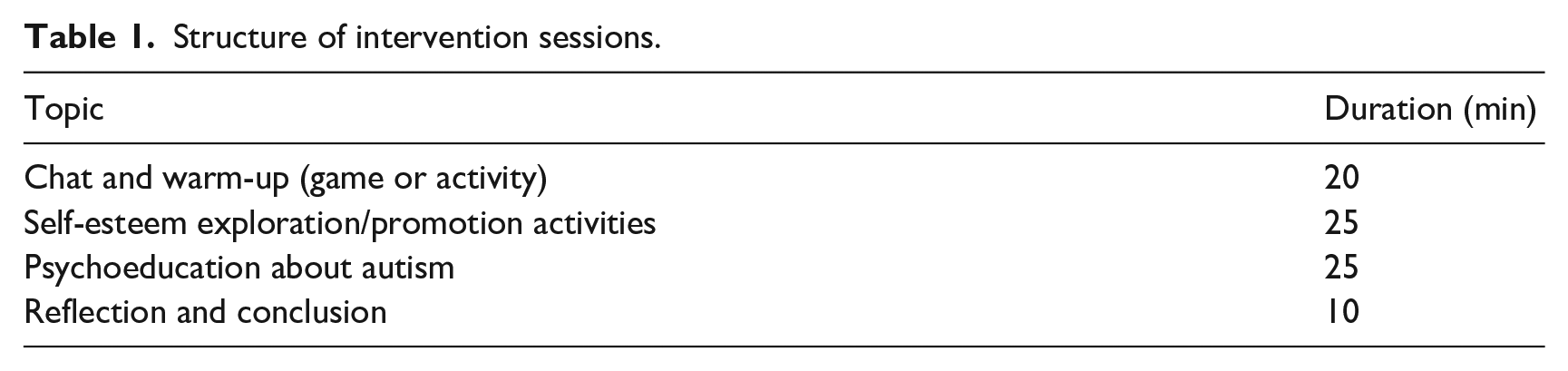
The current intervention was an individual, one-to-one intervention, which was designed and conducted by the psychologist to address Leah’s specific presenting problems. The intervention took place in a face-to-face capacity, over six discrete sessions in Leah’s school. The duration of each session was 80 min, with sessions taking place weekly throughout April and May 2021. Following each session, the psychologist phoned Anne to brief her on the content covered in the session and to discuss Leah’s progress and engagement with the content. The psychologist also emailed the outline of work to Anne and to the school’s SENCO following each session, in order to allow them the opportunity to reinforce content covered during the intervention at home and at school. The general structure adhered to within each session with Leah is presented in Table 1.
Structure of intervention sessions.
Structure and content of the intervention
A brief summary of the structure and content of the intervention is presented in Table 2.
Structure and content of the intervention.
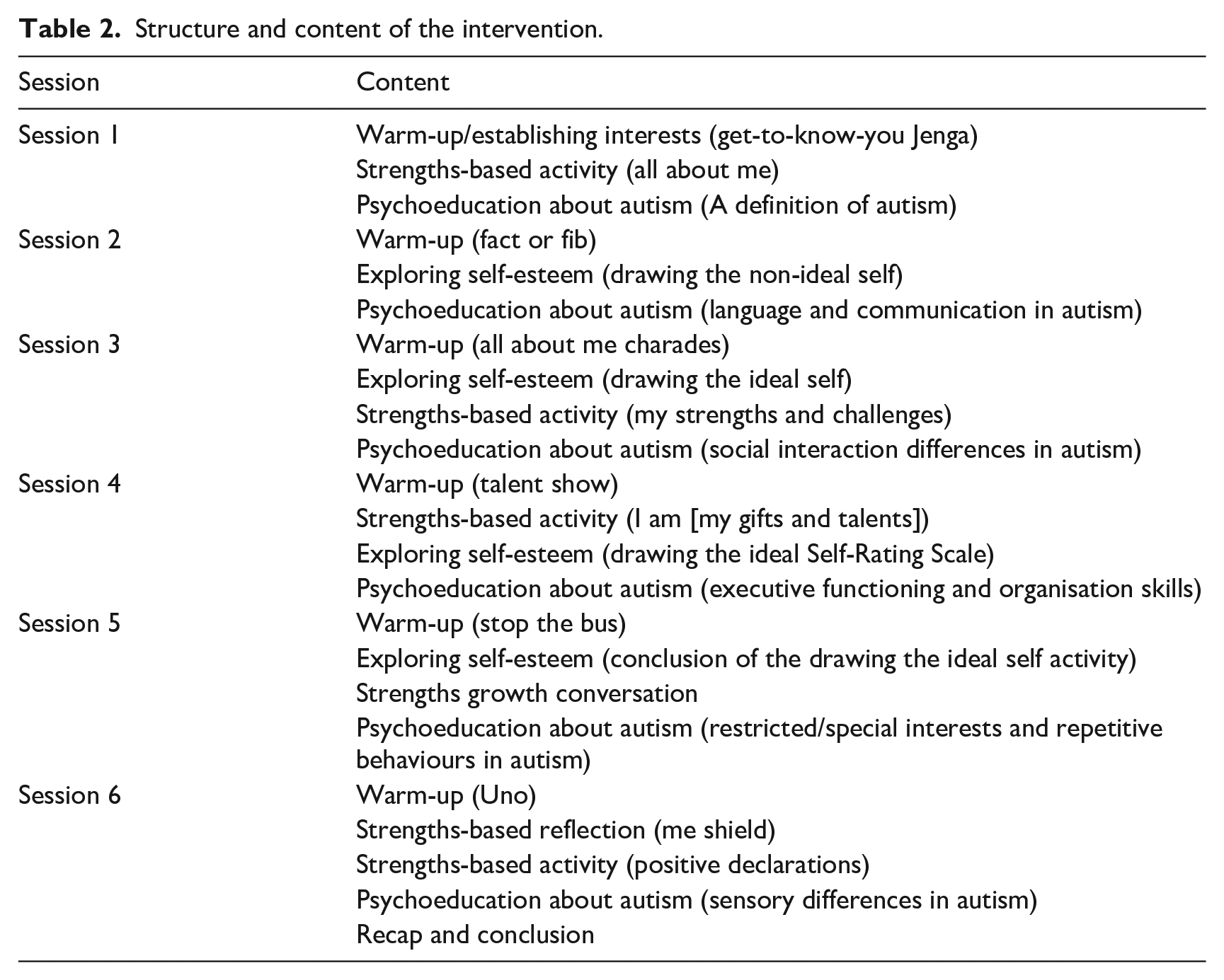
Leah and the psychologist worked on a scrapbook together throughout each session, in order to document her progress and to provide a record of learning for Leah into the future. A more detailed account of Leah’s engagement with each session is presented below.
Session 1
A large body of research has suggested that establishing rapport with adolescents from the outset can enhance therapeutic engagement and overall outcomes for interventions (Thompson et al., 2007); thus, the first portion of this session was dedicated to building rapport and establishing a therapeutic alliance with Leah. The psychologist asked Leah at the beginning of the session what she hoped to achieve from the psychologist’s involvement with her. Leah was not certain, but when the psychologist explained that she had planned work in relation to understanding her autism and improving her self-esteem, Leah agreed that she could benefit from some help in those areas. She was very comfortable identifying ‘baking’ and animals as ‘interests’ within the ‘All About Me’ activity; however, when the psychologist posited that these may be areas of strength for her, she appeared uncomfortable. Leah engaged very well in reciprocal to-and-fro conversation with the psychologist throughout the session. In relation to the psychoeducation about autism work, Leah was surprised to learn that she had been born with autism and mentioned that she thought it was a condition she had developed in late childhood.
Session 2
Following a warm-up activity, the psychologist introduced the PCP technique of ‘Drawing the Non-Ideal Self’ (Moran, 2001) to Leah, in order to begin to explore her self-esteem. The psychologist was cognisant of Leah’s cognitive ability in presenting her with this activity and was prepared to adapt or discontinue the exercise if necessary; however, Leah engaged very well with the technique and provided some excellent insights into the type of person she would not like to become. With regard to the psychoeducation portion of this session, Leah enjoyed the video of other young people with autism talking about their experiences of language and communication. She generated some insightful reflections into how language and communication is impacted for her on account of her autism; these reflections were captured in her scrapbook.
Session 3
Following on from the previous session, the psychologist continued the ‘Drawing the Ideal Self’ PCP technique (Moran, 2001) with Leah. She took part enthusiastically in this activity and drew many pictures of discrete aspects of the person she would like to be in separate bubbles; she also independently listed numerous desirable personality traits and aspirations for her future. Within the strengths-based reflection activity, Leah was reluctant to identify strengths within herself. Therefore, the psychologist adapted this activity and asked Leah to identify strengths for the psychologist, in order to help Leah to foster a ‘strength-spotting mindset’ (Linley & Burns, 2010). Thereafter, the psychologist identified strengths for Leah, which she hesitantly agreed with. Leah was far more comfortable with identifying areas of challenge for her, which is consistent with a vast body of literature in relation to self-talk; it is usually more natural for individuals with low self-esteem to notice more negative aspects about themselves than positive aspects (Hardy, 2006). Additionally, the psychologist asked Leah to prioritise the areas of challenge for her in relation to which areas she would like to work on most. Leah identified her organisation skills as the area she would most like to work on; thus, the psychologist adapted the intervention plan to reflect Leah’s priorities and planned work on organisation in the next session.
Session 4
During the strengths-based activity ‘I Am’, Leah was asked to reflect on her strengths, gifts and talents. It was noted that Leah seemed more comfortable identifying her strengths in this session than she did previously. The ‘Drawing the Ideal Self – Rating Scale’ activity (Moran, 2001) was also began with Leah, who felt that she was closer to being her ideal self than she was to her non-ideal self. This session also encompassed an exploration of executive functioning in autism and its impact on organisational skills; Leah was surprised to learn about that her autism was likely causing her to be more disorganised than others. The psychologist provided Leah with some ideas for organising herself and her belongings, including the use of apps, colour-coding her schoolbooks and timetable and setting alarms for relevant events on her phone. Then, the psychologist tasked Leah with trialling some of these strategies over the next week at home and at school.
Session 5
During this session, the ‘Drawing the Ideal Self’ activity (Moran, 2001) was concluded, with Leah identifying a number of actions she could take in order to become her ideal self. The psychologist then asked Leah to reflect on ways her teachers and parents could help her to achieve her dream; she responded by saying they could enable her to bake more, complete less schoolwork and to get her a pet dog. This session also comprised a strengths growth conversation, whereby the psychologist tried to encourage Leah to think of a new way to deal with an existing problem using one of her strengths. Leah identified playing the card game Uno as a personal strength, and thought of asking a classmate to play Uno with her during breaktime, in order to solve the problem of her often spending lunchtime alone. The psychologist encouraged Leah to trial this over the next week at school. There was also an opportunity to reflect on Leah’s task relating to organisation from the previous session; she had found the setting of alarm reminders on her phone very useful and was planning on continuing to use the Notability app to keep to-do lists.
Session 6
The sixth session involved a final reflection on Leah’s strengths, in order to consolidate them for her. Thereafter, the psychologist introduced Leah to the idea of positive declarations (NEPS, n.d.), and practised the use of them with her. Leah engaged very well with the material on sensory differences in autism and identified a number of sensory experiences she enjoyed and disliked; she related in particular to the story of Temple Grandin, due to their common love of animals. Moreover, Leah was enthused to tell the psychologist of her successes regarding playing Uno with some classmates at breaktime, and seemed motivated to continue doing this for the remainder of the school year.
Brief report of outcomes
At the end of the sixth session, the psychologist completed a number of post-intervention measures, in order to evaluate the efficacy of the intervention in relation to addressing Leah’s presenting problems. Firstly, the psychologist completed a mind map with Leah on her knowledge of autism, following the six sessions. From completing this activity with Leah and reviewing the mind map, it was evident that Leah’s overall knowledge of autism and the ways her condition was impacting her had greatly improved.
Additionally, the psychologist completed a follow-up SDQ (Goodman et al., 2004) with Leah. Her scores on this measure showed slight improvements in relation to her experience of emotional problems and conduct problems following the intervention; however, scores for hyperactivity and peer problems remained static. Leah’s total difficulties score was still elevated beyond what would be typically expected, revealing that although she may perceive some slight improvements in relation to her emotions and behaviour, she still feels that she has difficulties across the areas measured.
Following this, Leah completed the RSE (Rosenberg, 1965) following the sixth session. According to Leah’s self-reporting on this questionnaire, her self-esteem was within the average range, as she scored 16 marks out of a possible 30 on the scale. This result denotes a significant improvement in Leah’s self-esteem from pre- to post-intervention.
Qualitative feedback about the intervention from Leah, Anne and the school was extremely positive and it was evident from their comments to the psychologist that the intervention was well-received by Leah. Based on the information resulting from the intervention with Leah, as well as her priorities and conversations with Anne, a document outlining a number of target areas for the school to work on with Leah during her next year of school was created by the psychologist and shared with the school.
Conclusions and recommendations based on the case
The positive findings from the current case add to the existing literature (e.g. Ashkar, 2015; Backman et al., 2018; DaWalt et al., 2018; Thomas et al., 2011; Toback et al., 2016) surrounding the benefits of utilising individualised strengths-based approaches and PCP techniques to boost adolescents’ self-esteem, as well as the potentiality for psychoeducation about autism to impact positively on understanding and self-acceptance for autistic adolescents. The results of the current study further substantiate the utilisation of such approaches in intervention work with adolescents within post-primary school contexts.
There were a number of strengths associated with this particular intervention. For example, the biopsychosocial model (Engel, 1977) was utilised in the case conceptualisation, which enabled the psychologist to envisage Leah’s presenting problems as resulting from the interconnection of a number of biological, psychological and social factors. This allowed the psychologist to consider the involvement of family and school within the intervention itself, alongside working with the child on an individual level. In completing the work with Leah around psychoeducation about autism and self-esteem, the psychologist thought about how this approach may have been overly focussed on within-child biological and psychological factors. Therefore, in the weekly conversations with Anne, the psychologist aimed to address some of the social factors which may have been impacting on Leah, by using the phone-calls as an opportunity to provide some psychoeducation about autism to Anne, too. In addition, by sending an outline of work completed throughout the intervention to the school’s SENCO, the psychologist aimed to support the provision of additional opportunities for the content to be reinforced within the school environment, thus supporting maintenance of the gains made over the course of the intervention.
The positive findings from this case make an addition to the literature surrounding interventions for autism and self-esteem amongst adolescent students, aligning with previous research in the area in terms of supporting the adoption of individualised strengths-based approaches and PCP techniques to promote self-esteem, as well as psychoeducation about autism to promote adolescents’ understanding and self-acceptance (Ashkar, 2015; Backman et al., 2018; DaWalt et al., 2018; Thomas et al., 2011; Toback et al., 2016). However, it is possible that there are alternative explanations for the positive results in this case, which must be considered when interpreting the findings. For example, it is difficult to conclude whether the improvements in Leah’s self-esteem were directly caused by the PCP or strengths-based techniques utilised within the intervention itself, or whether these improvements were as a result of the positive personal relationships developed between the psychologist, Leah and her mother during the intervention. As the psychologist placed great emphasis on developing a positive therapeutic alliance with both Leah and her mother Anne, it is possible that the positive gains made in relation to Leah’s self-esteem could have been enhanced, or even caused, by the therapeutic rapport which was developed from the outset (Thompson et al., 2007). Should this be the case, this serves to emphasise the importance of practitioners fostering a strong therapeutic alliance with clients from the outset of interventions, regardless of the specific therapeutic approaches adopted.
Moreover, there are a number of limitations associated with the intervention itself in the current case. Firstly, this particular intervention was relatively brief, and focussed on addressing the particular needs of one student. Therefore, the types of approaches utilised are unlikely to suit the needs of every autistic adolescent presenting with similar concerns. Practitioners adopting similar approaches to those presented above should consider whether they are well-suited to the individual needs of the student they work with, and endeavour to reflect on the efficacy of the intervention at regular intervals throughout, adapting approaches as necessary. In addition, maintenance checks in terms of the gains made at a later stage would have added greatly to the strength of the findings arising from this particular case, and should be considered by practitioners as a follow-up assessment in terms of providing useful information about the long-term impact of the intervention.
Based on these limitations, a number of recommendations for future interventions and research are posited. Firstly, practitioners working on similar cases should consider increasing the number of sessions within the intervention in order to incorporate further PCP techniques, including repertory grid and self-characterisation methods (Green, 2016). Such methods may be particularly useful in cases involving female autistic adolescents in terms of developing an understanding of their sense of self, particularly given the propensity for this population to engage in masking and presenting of multiple selves across contexts (Hull et al., 2021). While there was some indirect involvement with the school’s SENCO in the current case, this was limited to brief informal discussions and sending outlines of work completed the SENCO following each session. Practitioners following a similar intervention format in the future should endeavour to more directly involve the school’s SENCO, or another key stakeholder in the school context, in the intervention: for example, by including a school staff member alongside the adolescent’s parent in the weekly conversations following each session. This involvement may aid the impact of the intervention, particularly within the school context, and allow for informal opportunities for psychoeducation about autism for school staff working closely with autistic students. Finally, it was notable that in the current case, Leah’s scores for peer problems remained static following the intervention. As issues relating to peers and friendship-making are commonly reported amongst school-going autistic adolescents (Cresswell et al., 2019), future interventions amongst this population should target this as an additional area for improvement, depending on the needs and wishes of the individual student. Research has demonstrated that therapeutic approaches akin to those utilised in the current case can aid peer relations and adolescents’ ability to make and maintain friendships. For example, the PCP approach of repertory grids has been successfully used to develop understanding of friendship formation amongst young females (Duck & Spencer, 1972). Additionally, strengths-based approaches to intervention in schools have been shown to improve peer relations and reduce bullying (Rawana et al., 2011). Therefore, future school-based interventions amongst autistic adolescents would also benefit from inclusion of PCP and strengths-based approaches designed to improve peer relations and ability to make friendships, depending on the individual needs and wishes of the student.
Footnotes
Author’s note
This manuscript is an original work that has not been submitted to nor published anywhere else.
Declaration of conflicting interests
The author(s) declared no potential conflicts of interest with respect to the research, authorship, and/or publication of this article.
Funding
The author(s) received no financial support for the research, authorship, and/or publication of this article.
