



Abstract
There are few studies examining the wellbeing of Australian school-based psychologists/counsellors (SPCs) despite the research indicating there are unique stressors associated with the role. The purpose of this study was to measure the stress perceived by working Australian SPCs. Data were collected via an online survey within which the Perceived Stress Scale – 10 item version (PSS-10) was embedded. Mean global stress for 162 participants was calculated then compared with the general population and a previous cohort of Australian SPCs. Four variables of influence were also statistically analysed: school level, years of experience, amount of time participating in supervision and alignment with two differing professional identity statements – ‘I see myself as an educator with a counselling/psychology specialisation’ or ‘as a psychologist/counsellor who works in an education setting’. Moderate – high frequency of stress, in excess of the general population and stress levels reported previously, was found. No significant relationships were found between stress and school level, years of experience or professional identity. A negative relationship was found between stress and the amount of supervision received. The level of stress experienced by Australian SPCs warrants that policies and practices monitor and protect Australian SPC wellbeing.
Introduction
School-based psychologists/counsellors (SPCs) in Australia work across all schooling levels to support the educational outcomes, behaviour, future careers and the mental health and wellbeing of students (APACS, 2018; APS, 2022). Their role encompasses individual and group work with students as well as contributing to families and whole-school practices (APACS, 2018). Of their many roles, Australian school leaders have noted that the wellbeing support provided by SPCs benefits the whole school community (Thielking & Jimerson, 2006). It is disappointing then that little research attention has focussed on the wellbeing of Australian SPCs themselves and seems neglectful given the unique stressors within the school counselling role (Fye et al., 2022; Holman et al., 2019; Kim & Lambie, 2018). School counsellor stress is important to monitor because it can be a contributor to diminished job satisfaction, burnout and attrition, potentially compromising service provision to school students (Bardhoshi et al., 2014; Greenham et al., 2019; Hemi & Maor, 2020; King et al., 2018; Mullen et al., 2018; Whitla et al., 1992).
There are very few Australian studies that have focussed on how frequently stressful thoughts and feelings are experienced by ‘school psychologists’, ‘school guidance counsellors’, ‘guidance officers’ or ‘school counsellors’ as they are known across various state and territory schools in Australia, therefore, the key purpose of the current study was to do so. The term SPC is used in this paper to simplify the array of titles given to the role in Australia. The acronym encompasses those whose credentials would allow them membership of the national professional representative body of Australian Psychologists and Counsellors in Schools (APACS, 2018). The research questions guiding this study were: Do practising Australian SPCs perceive they are stressed? If so, how frequently and to what level is the stress experienced? Is SPC stress related to school level, years of experience, professional identity and/or the amount of time participating in supervision?
Understanding stress
Many researchers define stress as ‘a particular relationship between the person and the environment that is appraised by the person as taxing or exceeding his or her resources and endangering his or her wellbeing’ (Lazarus & Folkman, 1984, p. 19). The focus of much of the research on school counsellor stress has involved identifying imbalances found between workplace demands and the capacity of counsellors to cope with those demands (Cohen et al., 1983; Gersch & Teuma, 2005; McCarthy et al., 2010; Mullen & Gutierrez, 2016; Mullen et al., 2018). According to Culbreth and colleagues (2005), stress-fostering imbalances between occupational demands and resources can be best explained by three role-related constructs: role conflict, role incongruence and role ambiguity.
Role conflict
Role conflict arises when role demands vary between differing stakeholders, including what SPCs professionally believe themselves should be informing their role and daily activities. Studies have described discrepancies in professional identity, namely, that daily activities expected of the role can vary between what SPCs think they should do, and the expectations of the parents, teachers and the school leaders with whom they work (Barletta, 1996; Bell & McKenzie, 2013; Maor & Hemi, 2021; Thielking & Jimerson, 2006; Tsartas & McKenzie, 2005). Therefore while role conflict may occur through a mismatch between professional identity and the expectations of school stakeholders in Australian settings, we do not know if this equates to a stressed Australian SPC workforce.
Role incongruence
Role incongruence exists when there are too many roles to be fulfilled without adequate support, or further, if practitioners get caught between the expectations of two or more groups so that no single group’s expectations can be met. Historical reviews of the Australian SPC profession suggest there have been many expectations placed on SPCs stemming from shifts in government policy, educational agenda or professional practice priorities (Campbell & Glasheen, 2017). SPCs have reported difficulties at the juncture of some these changes, such as those that have required the provision of support to a wider and more complex array of student issues (Bramston & Rice, 2000; Rice & Bramston, 1999; Whitla et al., 1992). Adding to the impact of role incongruence is the research suggesting there has been unsatisfactory levels of engagement with professional clinical supervision to equip SPCs with the necessary new learning and mentorship needed at such times (McMahon & Patton, 2000, 2001; Thielking et al., 2006). Ding and Swalwell (2018) suggest that supervision engagement opportunities have improved in recent years but whether the amount and nature of current supervision serves to counteract likely SPC stress relating to role incongruence is unknown.
Role ambiguity
Role ambiguity occurs within the SPC profession when policies and performance standards are not clear in the school workplace, creating confusion about role priorities and responsibilities (Bramston & Rice, 2000; Mullen et al., 2017; Thielking et al., 2018). It is thought that such imbalances are difficult to avoid for SPCs, given that their role is a ‘psychological/counselling’ one embedded in school settings which are ‘educational’ (Bardhoshi et al., 2014; Culbreth et al., 2005). For example, it has been noted that school-level stakeholder expectations sometimes conflict with gold standards of broader psychological practice, creating ethical dilemmas for SPCs (Boccio et al., 2016; Mullen et al., 2017). A position framework and practice guide for effective delivery of school-based psychology services is offered by the Australian Psychological Society (APS, 2016, 2022) to circumvent such ambiguities. However, researchers considering the degree to which aspects of the framework have been incorporated in SPC school practice have suggested that change can be slow (Thielking et al., 2018), unlikely to occur (Russell, 2019), or met with ‘ambivalence’ by schools (Eckersley & Deppeler, 2013). It is therefore possible that SPCs who are trying to shift to more effective whole school practices may experience stress associated with continuing role ambiguity (Culbreth et al., 2005).
Stress of Australian school psychologists/counsellors
There are very few studies that have measured the stress of Australian SPCs. In 1994, Dickenson undertook an exploratory study of stress using a research-developed questionnaire which was administered to 106 Queensland SPCs (i.e. guidance officers) to measure their stress and the influence of variables, such as years of service, the school level at which they worked and the seniority of their position. A single item 1 to 10 Likert scale was used to measure present level of stress, and open-ended questions asked SPCs about the factors they perceived created – or would mitigate – their stress. Contributors to SPC stress included the number and variety of student issues having to be dealt with, being time-poor, travelling vast distances to service more than one school, feeling professionally isolated, having to deal with critical incidents and the weighty ascertainment processes introduced at that time. The mean stress score was 6.54/10, with 10 being the maximum level of present stress. Senior personnel experienced the greatest stress (7.32/10), followed by SPCS working across the whole P-12 school level. Those in the field the longest experienced the most stress (6.9/10), followed by those newest to the profession (6.6/10). Networking, debriefing and peer support, as well as having opportunities for clinical supervision and professional development were nominated as areas which would reduce stress in the profession.
Since 1994, there has been only one other study that has specifically measured the stress of practising Australian SPCs (Bramston & Robertson, 2001). Participants were 147 Queensland SPCs (i.e. guidance officers) who were asked to complete the Perceived Stress Scale – 10-item (PSS-10; Cohen et al., 1983), along with measures of self-efficacy and burnout. The purpose of the study was to consider if there were wellbeing implications for SPCs who had reported they felt ill-equipped to support the many more students with mental health issues, emotional and behavioural disturbances and learning difficulties they were seeing (Bramston & Rice, 2000). The PSS-10 (Cohen et al., 1983) was selected by Bramston and Robertson (2001) as a psychometrically valid tool to measure the degree to which SPC’s appraised their stress over a 1-month period. Participants registered ‘high’ levels of stress (i.e. one standard deviation above the mean for the scale) and, in comparison to the general population, SPCs were ‘considerably more stressed’ (Bramston & Robertson, 2001, p. 148). Like Dickenson (1994), Bramston and Robertson (2001) found that SPCs in the role the longest had the highest stress, followed by those newest to the profession. However, they did not find a significant relationship between stress and whether respondents were working in primary, secondary or across P-12 settings or differences in qualifications. While stress is widely acknowledged as the main precursor to burnout, only 4% of SPC’s in Bramston and Robertson’s (2001) research met the formal criteria for burnout (Maslach & Jackson, 1981). This finding was presented as a major strength of the profession, that is, SPCs should be seen as a resilient workforce despite the demands of their role. It was reasoned that if burnout was detected this would be of much greater concern. Burnout reduces one’s personal capacity for work, negatively impacts mental and/or physical wellbeing and increases absenteeism (Maslach & Jackson, 1981). Further, burnout tends to reduce empathy and increase detachment and cynicism which would be harmful when working with students.
Most recently King and colleagues (2018) investigated the factors associated with burnout of SPCs (i.e. school psychologists) in New South Wales. Burnout was assessed by asking: ‘Have you ever experienced burnout, that is, physical and/or emotional exhaustion resulting from work related to your role as a school counsellor?’ Of concern, fifty-two percent of the participating SPCs answered ‘yes’. One factor contributing to burnout was that SPCs were experiencing a greater impact of work stress upon their wellbeing. The results of King and colleagues’ study suggest that Australian SPCs may have become more vulnerable to burnout if compared with Bramston and Robertson’s (2001) study where stress was present amongst SPCs but it had not led to burnout. Perhaps in the interim years between studies, there has been a failure to monitor the perceived stress of Australian SPCs, resulting in those working in the role becoming more vulnerable to burnout.
Aims and hypotheses
The purpose of the current study was to measure the perceived stress of practising Australian SPCs and to determine their level of stress compared to the general population (Cohen & Janicki-Deverts, 2012) and whether SPCs have become more stressed over time, for example, since Bramston and Robertson’s (2001) study two decades ago. It was also an aim of this research to determine if the variables of school level worked, years of experience, professional identity and amount of time participating in supervision were related to stress. A number of hypotheses aligning to these aims were made:
Method
Participants
In total, 163 out of a potential pool of 1,000 participants completed an online survey. There were 26 males (16%) and 137 females (84%), representative of the gender split of the profession. Table 1 describes the respondent characteristics.
Participant characteristics.
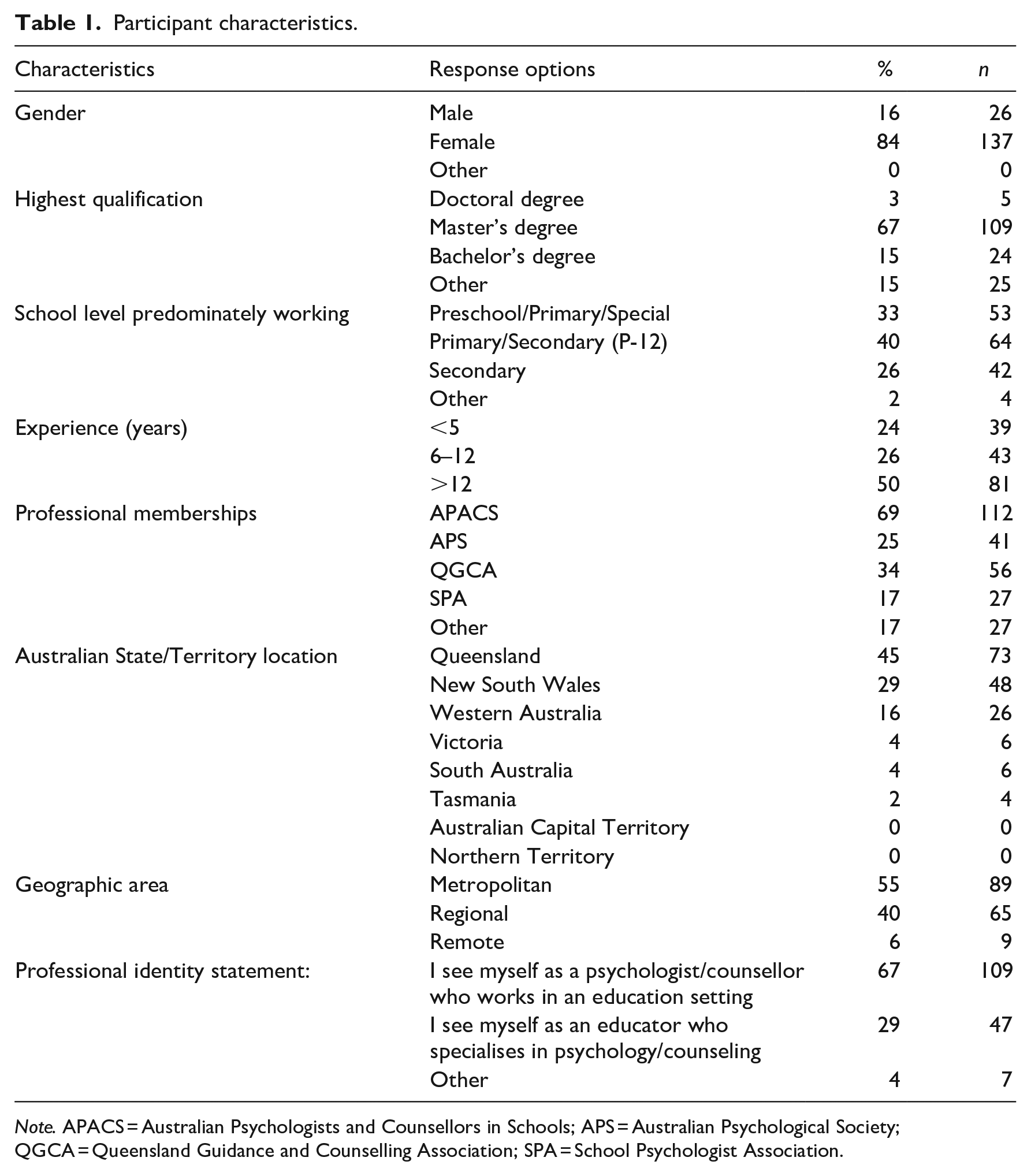
Note. APACS = Australian Psychologists and Counsellors in Schools; APS = Australian Psychological Society; QGCA = Queensland Guidance and Counselling Association; SPA = School Psychologist Association.
Measures
An online survey was distributed comprising 124 items; 8 items gathered demographic information (e.g. school level, years of experience, professional identity statement), 85 items pertained to school counsellor activities and their perceived appropriateness, 21 items gathered information on participants’ experience of clinical supervision and 10 items related to stress. This paper reports on the 10 items measure stress and its relationship to three demographic variables of interest, namely, school level (options included primary/special/prep; primary/secondary; secondary; other), years of experience in the role (options were up to 5 years; 6–12 years; and more than 12 years) and a professional identity statement (options were ‘I see myself as a psychologist/counsellor who works in an education setting’; ‘I see myself as an educator who specialises in psychology/counselling’; other). One item from the experience of supervision section of the survey – which asked about the adequacy of time participating in supervision (more than adequate; adequate; less than adequate) – was also explored in relation to stress.
The Perceived Stress Scale – 10 (PSS-10; Cohen et al., 1983) was used as the survey’s measure of SPC stress. Studies have demonstrated the PSS-10’s high internal reliability, factor structure and equivalence in predicting outcomes on other valid measures (Cohen et al., 1983; Lee, 2012; Taylor, 2015). For example, scores in the high stress range on the PSS-10 correlate with emotional problems (e.g. anxiety and depression), poorer health outcomes (e.g. vulnerability to infection and elevated markers of aging) and fewer health and wellbeing practices (e.g. sleeping less and drinking more) on other measures (Lee, 2012; Taylor, 2015). The PSS-10 is designed to measure the frequency with which situations are self-appraised as stressful over a 1-month period. Items are rated on a frequency Likert scale: Never (0), Almost Never (1), Sometimes (2), Often (3) and Very Often (4), allowing respondents to score between 0 and 40. Items numbered 4, 5, 7 and 8 require reverse scoring. Scores ranging from 0 to 13 are considered low stress. Scores ranging from 14 to 26 are considered moderate stress while scores ranging from 27 to 40 are considered high stress. Scale items are general in nature and do not focus on specific events or experiences, however, as the PSS-10 was included as part of a larger SPC role-related survey, it is likely that the workplace context was front-of-mind in SPC responses. Items ask respondents to rate the frequency of feelings or thoughts (e.g. how frequently over the past month have you been upset because something happened unexpectedly; been unable to control irritations in your life?). The internal reliability for this sample was good (α = .83). A copy of the PSS-10 can be found online (NovoPsych, 2021).
Procedure
Ethical approval to conduct an online survey of Australian SPCs’ activities, role appropriateness, supervision and stress’ was obtained from the ethics committees of Queensland University of Technology (1700000630) and University of Queensland (2017001043). A national association of Australian professional school-based counsellors – with a cross state membership of approximately one thousand SPCs – agreed to assist with recruitment. The professional body emailed its members on behalf of the researchers. Attached was a participant information sheet which communicated the study details and a link to the survey. Members willing to participate accessed the provided link, with submission signifying consent. The data was collected in 2017 before the COVID epidemic in Australia.
Data analysis
PSS-10 data cleaning
Missing data analysis was run on all 10 items. As a PSS-10 score is calculated by summation of the score for all items, participants with 10% or more missing data were deemed as incomplete and deleted listwise. In the data set (n = 163), only one participant missed five data points (i.e. they only provided 50% data) so this case was removed from further analysis, leaving the data of 162 participants.
Hypotheses testing
For hypothesis 1 and 2, z-scores were used to compare the mean of our dataset with the general population mean (Cohen & Janicki-Deverts, 2012) and Bramston and Roberston’s (2001) SPC dataset. Hypotheses 3 and 5 were analysed by using one way ANOVA. Correlations were run for Hypothesis 4 (Spearman’s rank) and Hypothesis 6 (Pearson’s).
Results
Hypothesis 1: Level of stress
It was hypothesised that SPCs in this study would have moderate – high frequency perceptions of stress, exceeding levels recorded by the general population on the PSS-10. The total score for each of the 162 participants was calculated (M = 26.17, SD = 5.36); the mean score is considered moderate to high perceived stress. The z-score for the perceived stress was computed against the general population means and standard deviations provided for the PSS-10 and listed in Cohen and Janicki-Deverts (2012). Results in Table 2 show that the SPCs’ mean is at least one standard deviation above the population means. This indicates that SPCs were highly stressed compared to the general population.
Mean and standard deviation for age and z-scores for SPCs’ compared to the population mean in Cohen and Janicki-Deverts (2012).
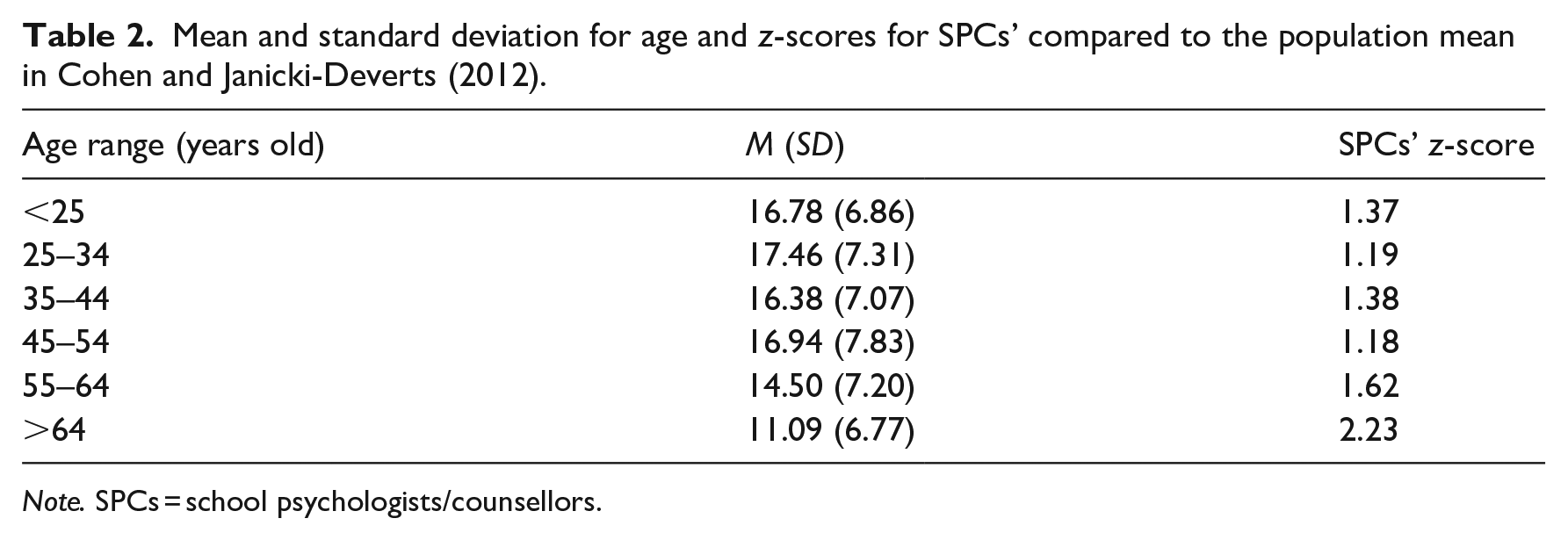
Note. SPCs = school psychologists/counsellors.
Hypothesis 2: Extent of SPC stress compared to SPC’s in 2001
It was hypothesised that SPC stress would be experienced at greater levels than the SPCs in Bramston and Robertson’s (2001) study two decades ago. The z-score for perceived stress was computed against the SPC population means and standard deviations published by Bramston and Robertson (2001). The perceived stress for the current dataset was found to be 1.13 standard deviations above the mean indicating that the SPCs’ perceived stress in this study was higher compared to the SPCs in Bramston and Robertson (2001) study.
Hypothesis 3: Stress and school level
It was hypothesised that those working across multi-school levels (e.g. Primary/Secondary) would be the more stressed than those required to work, for example, at the secondary level only. A one-way ANOVA was run to test if there was a significant difference between the SPCs’ working level (Primary/Special/Prep, Primary/Secondary, Secondary and Other) and their perceived stress (see Table 3). The perceived stress was found to be not normally distributed as indicated by a Kolmogorov-Smirnov test (D(162) = 0.08, p = .025) with skewness of −0.32 (SE = 0.19) and kurtosis of 0.03 (SE = 0.38). However, due to the large sample size and the robustness of ANOVA, no transformation was made. Levene’s test indicates that there was homogeneity of variances (p = .870). The test revealed that there was no statistically significant difference in perceived stress between Primary/Special/Prep, Primary/Secondary, Secondary and Other (F(3, 158) = 0.16, p = .924).
School level worked and perceived stress (PSS-10 score).
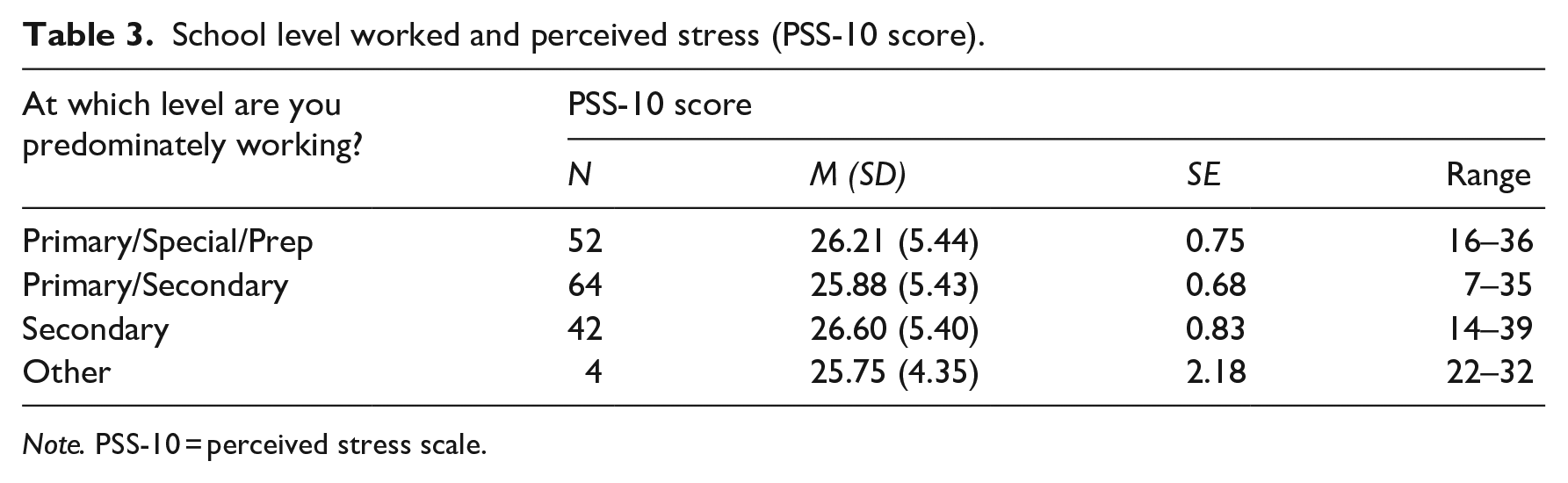
Note. PSS-10 = perceived stress scale.
Hypothesis 4: Stress and years of experience
It was hypothesised, based on previous studies, that those longer in the role would experience the most stress. Spearman rank correlation was run to assess the relationship between years of experience as SPCs (M = 2.25, SD = 0.82) and perceived stress. There was no correlation found between the two variables, r = .02, p = .838.
Hypothesis 5: Stress and professional identity
It was hypothesised that those with professional identities aligning in favour of education would have less stress than those aligning with the discipline of psychology. A one-way ANOVA was run to test if there was a significant difference between the SPCs’ professional identity (‘I see myself as a psychologist/counsellor who works in an education setting’, ‘I see myself as an educator who specialises in psychology/counselling’, ‘Other’) and their perceived stress (see Table 4). The perceived stress distribution for each professional identity statement was found to be normally distributed (Kolmogorov-Smirnov p = ns). The Levene’s test was not significant, (p = .249) indicating that there was homogeneity in variance in the dataset. The test revealed that there was no significant difference in perceived stress between professional identities (F (2, 159) = 0.28, p = .759).
Professional identity and perceived stress (PSS-10 score).
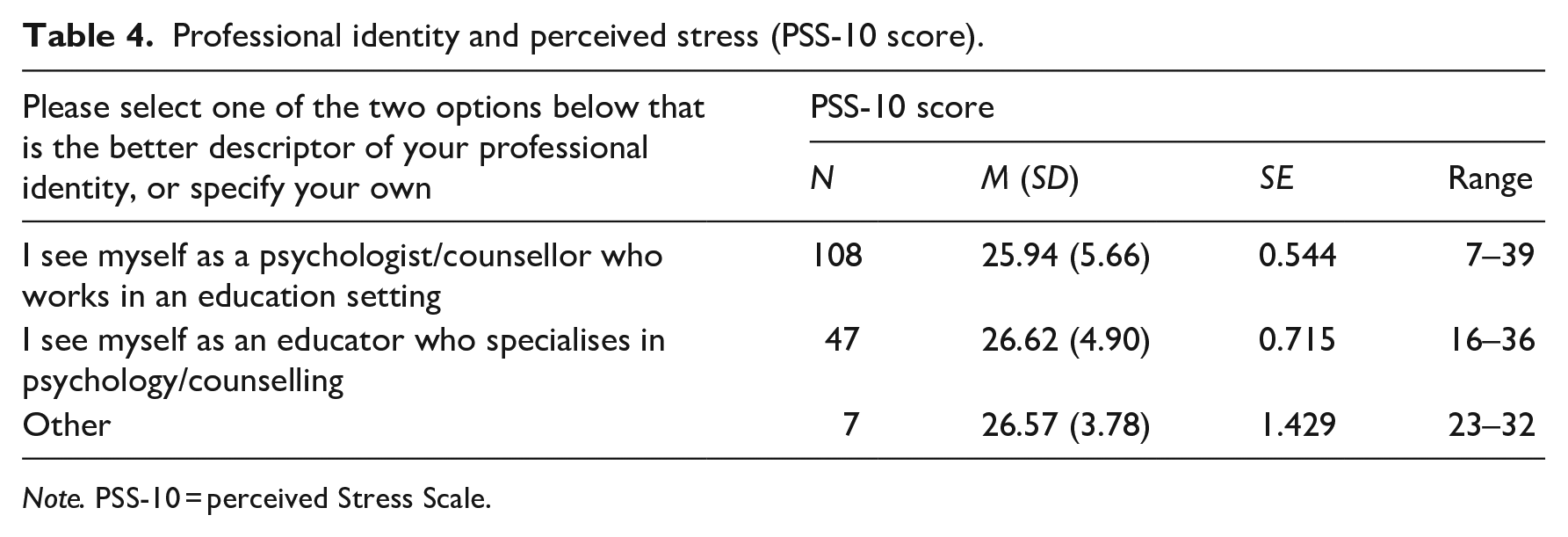
Note. PSS-10 = perceived Stress Scale.
Hypothesis 6: Stress and supervision
It was hypothesised that participants indicating ‘less than adequate’ amounts of time participating in clinical supervision would result in greater experiences of stress. A negative correlation was found between perceived stress and the amount of time SPCs participated in clinical supervision (item 102), r (134) = −.21, p = .017. That is, the more time participating in clinical supervision the less stress experienced.
Discussion
The PSS-10 administered in this research is designed to measure how unpredictable, uncontrollable and overloaded respondents perceive their lives to be. Our results showed a moderate to high level of stressful thoughts and feelings had been experienced by working Australian SPCs over their previous month in 2017. In perspective, when compared with PSS-10 scores available for the general population (Cohen & Janicki-Deverts, 2012) and for those in the same role working approximately two decades ago (Bramston & Robertson, 2001), the respondents in the current study were considerably more stressed. These results suggest that despite performing the critical role of supporting students’ learning and wellbeing needs, it must be acknowledged that SPCs in Australian schools may have their own wellbeing needs that could need support. It may bode well for current SPCs to achieve a healthy balance over their own professional and personal lives to manage or avoid excessive stress. This may mean that SPCs take regular stress check-ups, potentially using the PSS-10 as a self-report measure, and then availing themselves of participation in supervision to discuss the results. Given the frequency and level of stressful feelings in our sample, this is to be encouraged to avoid compromised professional services and personal vulnerability to burnout. As the PSS-10 is only a temporal measure which can fluctuate with daily hassles and life events (Cohen et al., 1983), stress check-ups and subsequent support should be regularly spaced and ongoing.
Further, in keeping with the APS (2016) framework of effective service delivery (i.e. developing whole-school preventative wellbeing), stress-reducing strategies should be prioritised and practised by everyone in the school setting, including SPCs themselves. The degree of stress found in this study lends strength to King and colleagues’ (2018) suggestion that certain intrapersonal practices and behaviours should be firmly encouraged, self-advocated, even mandated by professional organising bodies, to mitigate current SPC stress. Activities such as spending time in self-reflection, taking regular holidays, ensuring there is time to discuss work frustrations with a family member/peer/trained mentor may make the role more sustainable. Personal stress-management techniques that have mounting evidence, such as mindfulness, should also be considered for reducing SPC stress (di Benedetto & Swadling, 2014). The elevated levels of stress found in this study indicate that not only should SPCs be leading the way in establishing protective stress-reductive strategies for their students, but they should regularly be practising them also.
The demographic factors examined in this study, such as different school levels, appeared to have little influence on perceived stress. While this finding differed from one earlier Australian study (Dickenson, 1994), it does align with Bramston and Robertson’s (2001) findings, as well as a study by Mullen and colleagues (2018) of school counsellors in the US, where stress did not differ based on school level. It was also expected that those in the job longer were more likely to record stress, but no significant relationship between years of experience and stress was found. Again, this finding does not align with the previous Australian research. By way of explanation, it may be those possessing the necessary personal characteristics of ‘grit’ and ego maturity as found in Kim and Lambie’s (2018) review who are able to manage the role and thus remain in it over time. One implication, therefore, may be to better apprise candidates proposing to become SPCs of some of the necessary personal factors they will need for undertaking such a stressful role.
One factor that was hypothesised as having a relationship to stress was the professional identity of SPCs, namely, that those seeing themselves as educators with psychological expertise might experience less role incongruence with those in schools with whom they must work, resulting in lower perceptions of stress. However, our results did not support this. Moderate to high levels of stress were recorded for both identities, suggesting that the role may have its inherent stressors regardless of one’s professional understanding of it. Further research is needed to fully understand this finding, including how the professional identity of Australian SPCs is observed in daily activities, roles and functions in schools.
Adequacy of time devoted to clinical supervision was hypothesised to influence SPC stress. Our results indicated that adequate engagement in supervision had a reductive effect on the frequency of perceived stress. This is not surprising given that supervision provides elements of emotional support that can be a mechanism for lessening the stress of the work environment (McMahon & Patton, 2000, 2001). Our results suggest there is an imperative for continuing investment in adequate clinical supervision particularly as approximately 30 % of the school-based psychologist/counsellors in our study nominated their supervision as ‘inadequate’. One way to invest in improved supervision may be to systematically foster SPCs’ knowledge of stress-reducing strategies, role management techniques, as well as self-care approaches to the job.
Limitations and future directions
While this study contributes a fresh assessment of the temporal stress perceived by SPCs serving in Australian schools, our results must be interpreted with caution. First, our survey was conducted prior to the COVID pandemic, therefore our findings are unlikely to represent the present level of stress of SPCs. Role conditions are likely to have changed since the pandemic potentially creating greater levels of stress. Therefore, this paper sets the scene for future research which could provide a post-COVID comparison. Another limitation is the low response rate to our survey. Future researchers should consider that perhaps the length of our survey may have dissuaded time poor SPCs from participating. Further, if respondents were drawn to the survey as an avenue to express their frustration with the role, then our results may present a skewed picture of the level of stress the profession is under.
Despite the present limitations, our results indicate that future research is warranted to monitor stress within the industry. Measures which are ongoing would be of benefit as stress can be buffered by daily events or circumstances and the PSS-10 is a temporal measure. Given that stress, too, is a multi-faceted construct and the PSS-10 scale has limited factors, it is difficult to identify all of the factors that might influence SPC stress. An additional battery of measures, as well as qualitative enquiry, may be necessary to draw further conclusions regarding the true wellbeing state of those in the profession, including what might be done about it. According to Burman and Goswami’s (2018) systematic review of workplace stress, no longitudinal studies were found where the level of stress among employees is measured with the effect of treatments or workshops or other coping strategies on stress. This should be considered an important topic for future research, particularly if stress reductive or protective measures are considered important for making the SPC profession a sustainable one.
Conclusion
The present study measured how frequently, over a 1-month period, SPCs in Australian schools perceived their working lives to be unpredictable, uncontrollable and overloaded. Results indicated concerning levels of stress when compared to the general population and those working in the same profession in Australia two decades ago. All currently working SPCs, regardless of their years of service or at what school level they work, should recognise the stress they may be under and take counter measures to manage their professional and personal wellbeing. Ensuring there is adequate opportunity to engage in supervision may be one immediate way that educational authorities and professional bodies might mediate the stress the profession is under.
Footnotes
Acknowledgements
We acknowledge the participating professional association for their assistance in distributing our research materials.
Declaration of conflicting interests
The author(s) declared no potential conflicts of interest with respect to the research, authorship, and/or publication of this article.
Funding
The author(s) received no financial support for the research, authorship, and/or publication of this article.
