



Abstract
Generative artificial intelligence (AI) is not new, yet it has recently experienced an explosion of interest and debate. Among the topics of concern is how it will affect human relationships and interactions and how organisations will deploy AI in conducting their external relationships. This paper addresses an ongoing experiment which explores the impact of AI in the field of negotiation. It provides initial observations on the use of machine learning in general and ChatGPT in particular in negotiated outcomes. We provide preliminary recommendations regarding the use of AI tools and systems in negotiation and pose questions related to possible future research.
Introduction
Artificial Intelligence (AI) has already permeated our lives in many ways, often operating inconspicuously. Within the field of negotiation, where AI embedded in business applications may assist in gathering data or evaluating proposed terms and conditions, or even in equipping machines to undertake the negotiation itself. For example, when consumers buy through Amazon or similar online stores, they are presented with a variety of options around delivery, payment and alternative products. In making our selections, we may not even be conscious that we are negotiating – but by engaging with these choices we are essential. 1
This essay explores the expanding role of AI in streamlining negotiations for businesses, emphasizing its efficiency and cost-effectiveness in comparison to human-driven alternatives. The study suggests that businesses will continue to expand their use of AI to streamline negotiations. It is far more efficient and less costly than human-based alternatives. Allows products or services to be tailored or ‘customised’ to the preferences of a customer or supplier and enables them to engage in negotiations in situations where previously they would not have the necessary capacity or resources.
AI may also reduce the extent of negotiated variation because it limits choices to those that the originator can readily support. An illustrative instance of AI-facilitated negotiations comes from BP, the global energy company, which offers suppliers the opportunity to select from a portfolio of optional terms, with the extent and nature of those choices potentially influencing contract award. This approach grants suppliers a sense of control over the contract terms but is incentivised to focus only on those items that are of real importance to them. In turn, BP is also able to see patterns over time and to consider adjustments to its standards based on those consolidated insights.
The essay also draws from an early experiment by the authors of this paper, which tested the impact of machine-based negotiation versus traditional face-to-face negotiation. The human participants were volunteers, representing a variety of cultures and from different industry backgrounds. 2 They had varying levels of experience as negotiators, with a number considering themselves ‘experts’ and, in some instances, regularly training others in negotiation techniques. Operating in teams of two, each negotiator received a briefing based on whether they were acting as the buyer or the supplier. They had identical time to prepare and were informed about the key issues that they needed to resolve. If they wished, they could introduce additional topics, but they were operating under a time limit and they understood that their senior executives were demanding a rapid resolution – that is, within the time limit.
The face-to-face negotiators met on Zoom, a video-conferencing application. The machine-based negotiators did not meet their counterparty at any point. Instead, they were instructed to develop their preferred position on the negotiable items and to feed those preferences into a simulated machine. Based on the inputs received from each side, the machine calculated the optimum outcome and proposed this to the negotiators, who could then select to accept or amend the proposal. Meanwhile, the face-to-face negotiators started their online engagement.
In each case, the machine-based negotiations reached a resolution, the fastest time being 2 min and the longest taking 12 min. They therefore achieved the goal set to them by top executives and emerged with a mutually beneficial resolution.
The face-to-face teams struggled to complete within the allotted time and one team (the most experienced) failed to reach closure. The negotiations in some cases lacked structure, with the parties failing to set a clear agenda. In others, there were attempts to ‘expand the pie’ and identify additional sources of value, which distracted from the core objective, causing confusion and resulting in no final agreement.
This experiment highlighted the problems that can be created when there is direct human engagement:
The need to establish a personal connection led to a delay in engagement on the issues at hand. If there is no agreed agenda or structure to the negotiation, people become confused and the negotiation lacks discipline. Human emotion has the potential to disrupt the negotiation. Because it is difficult to establish trust, negotiators are reluctant to share data and without this, their ability to reach the optimal solution is compromised. In a competitive environment, more experienced negotiators may be distracted by the need to show their negotiating process by finding a superior, high-value-add solution, which may result in achieving no agreement, or ultimately in having to rush to an agreement on sub-optimal terms.
Results revealed that the teams which completed in the fastest time (2 min) were also the least experienced.
This essay seeks further into the implications of these findings and explores the broader implications of AI integration in the negotiation landscape. By shedding light on the benefits and limitations of AI, this research contributes to a deeper understanding of the evolving dynamics between AI and human negotiators.
Experiment design and methodology
At the time of this initial experiment, conducted in 2020, AI algorithms were embedded into business applications, rather than operating as stand-alone tools. However, the advent of Generative AI fundamentally altered this situation by making tools readily available on any mobile device. Suddenly, negotiators had the possibility to use AI at every phase of a negotiation, from analysis and planning through to the negotiation itself. Faced with this new possibility, we wanted to discover whether Generative AI – in this case, ChatGPT – provides negotiators with an advantage or has a significant influence on negotiated outcomes. Our interest was piqued by early reports from the field that ChatGPT had proven effective in suggesting negotiation strategies. 3
The experiment sought to investigate whether this AI system conferred advantages or significantly influenced negotiation results.
The experiment was designed to test and compare three distinct scenarios:
Teams that would conduct a traditional face-to-face negotiation without any access to ChatGPT. Teams where one side had access to ChatGPT and the other did not. Teams where both sides had access to ChatGPT.
To ensure a level playing field. Therefore, each team was provided with an identical situation with four primary areas where a negotiated resolution was necessary. There were additional items that they might choose to use as ‘bargaining chips’. They were given identical time to prepare and plan. The only difference was that teams using ChatGPT were provided with a short set of guidance notes, based on the fact that some had never used it before.
All negotiations were conducted using Zoom, a video-conferencing platform. The participants had not met their teammates in advance of the negotiation. Following an introductory briefing, each team was sent to its private online break-out room to prepare. The moderators periodically checked in on each team in case there were questions and to check its progress. Some teams declared themselves ready to start negotiation before the allotted preparation time was complete. Once both teams were ready (or on the expiry of the 2 h permitted), they commenced the negotiation.
Findings and observations
Planning
Teams conducting a traditional negotiation without the use of ChatGPT followed a variety of approaches to planning the negotiation. Some completed this phase in considerably less than the time allowed. The quality of planning was variable, in general reflecting the level of experience, but also illustrating the point that there is no harmonised view of the best technique or process.
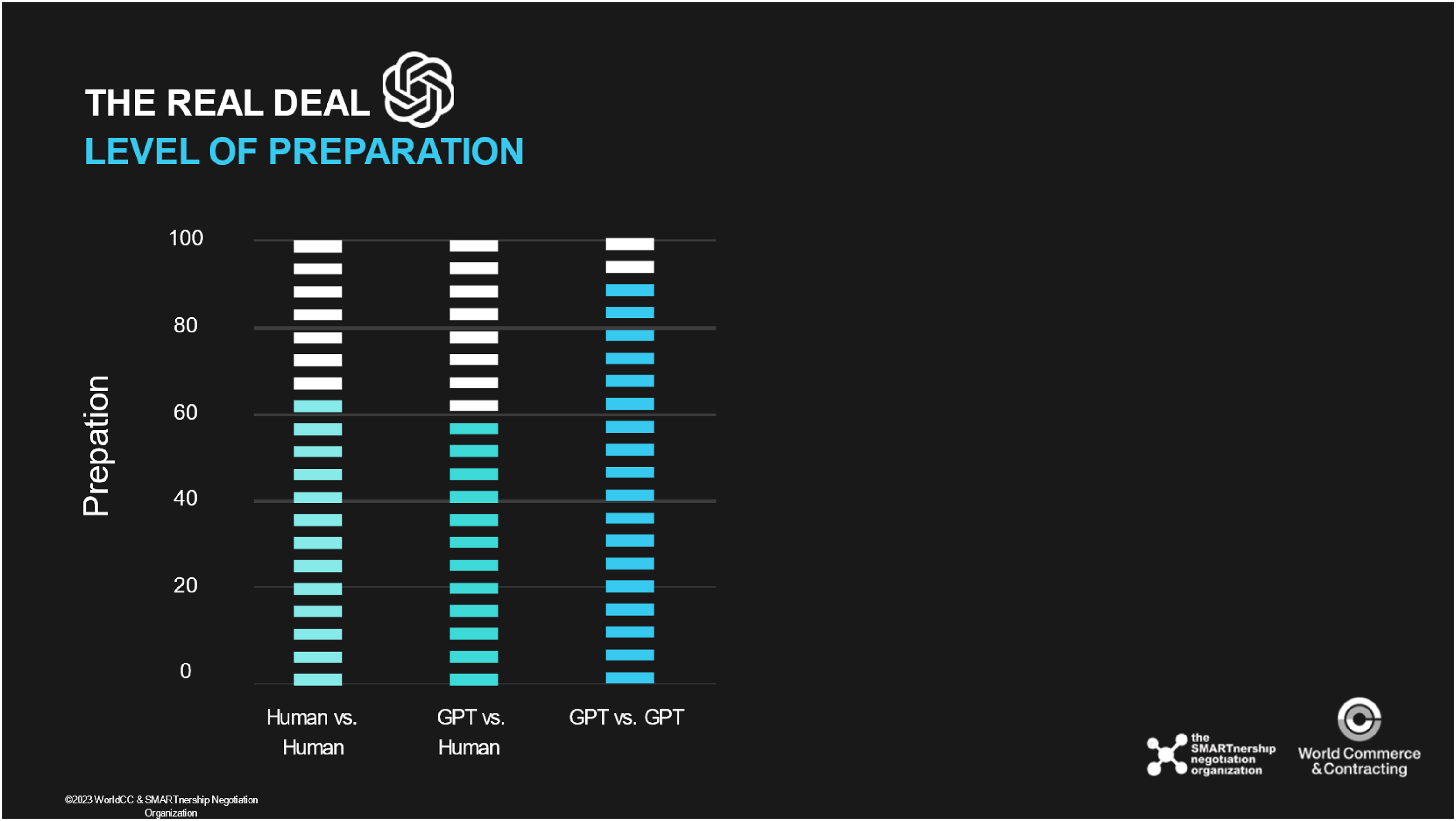
The chart above shows the comparative levels of preparation in the different teams. However, it should be noted that the teams using ChatGPT had widely varying experiences. These largely reflected the extent to which they had made prior use of a Generative AI system. Those who were unfamiliar tended to approach ChatGPT as they would a search engine, such as Google. They saw it as an information source, rather than a source of intelligence and ideas. To varying degrees, these groups abandoned using the AI tool and dismissed it as a distraction. Others appreciated the need to feed data (the case study) into the system and then pose questions that drew intelligent responses. ChatGPT offered them advice on planning and executing the negotiation, resulting in an approach that was in general far more coherent than those who did not make use of it.
Key findings during this phase were:
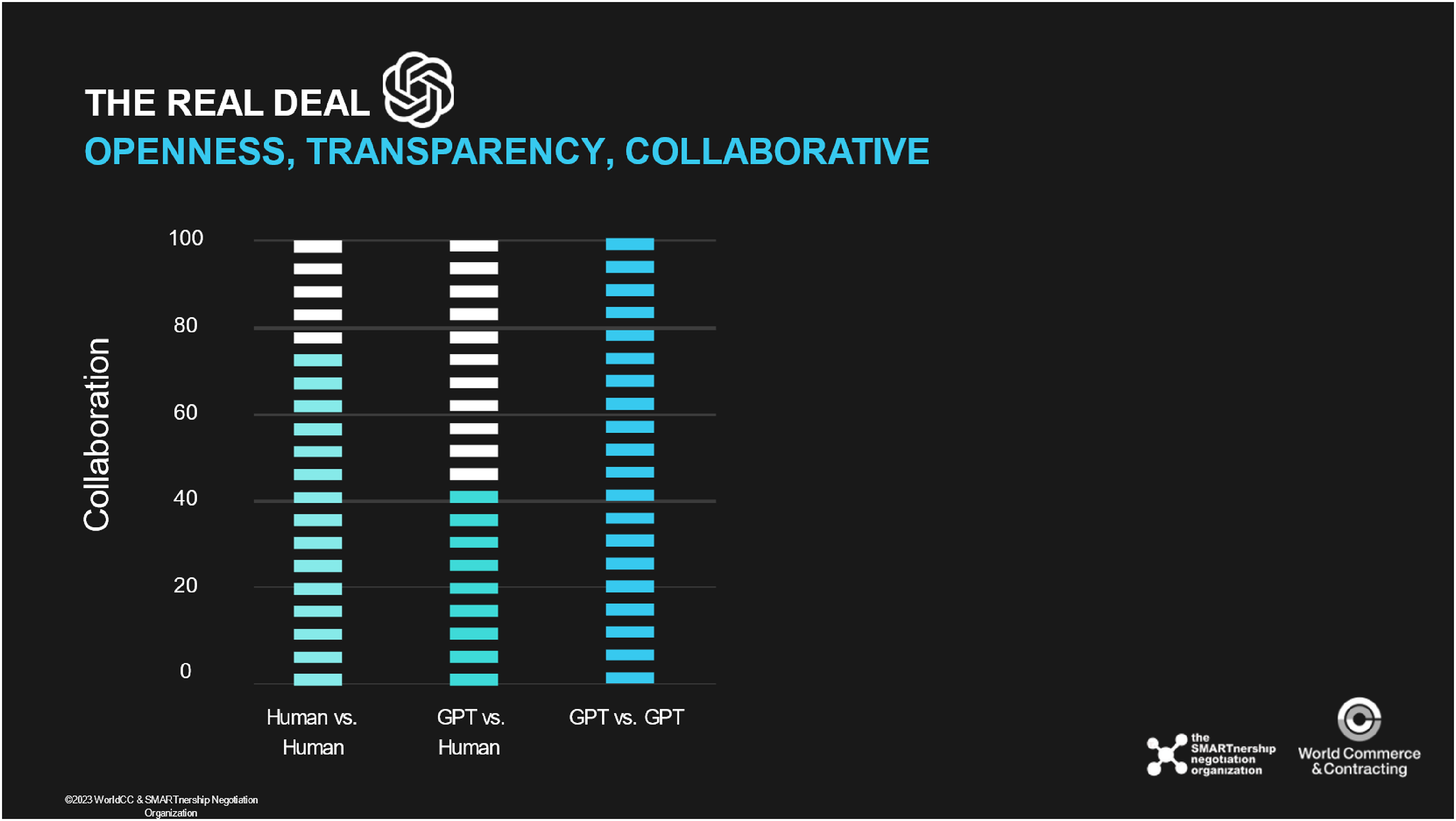
- It is important to have some prior knowledge and experience in the use of Generative AI. The benefits are not intuitive and therefore users need a degree of training. - In particular, users need to understand ‘prompting’ – that is, asking questions or provoking replies in a way that generates a meaningful response. ChatGPT does not cope with unclear or ambiguous requests. Users are therefore forced to think carefully about what information or ideas they wish to extract and may often need to alter or expand on their initial request. - ChatGPT appears to encourage ‘win–win’ or collaborative negotiations. This includes prompting negotiators to be relatively open and transparent in their goals and their readiness to share data (see chart). If the human participants appear inclined to follow a more adversarial approach, ChatGPT challenges them to consider the impact this may have on the results they achieve.
The negotiation
The duration of the physical negotiation was limited to 30 min and, as the charts below indicate, teams that were not using ChatGPT either ran out of time or rushed decisions to meet the deadline. This meant they either achieved no result or a sub-optimal result in terms of the value that they realised.
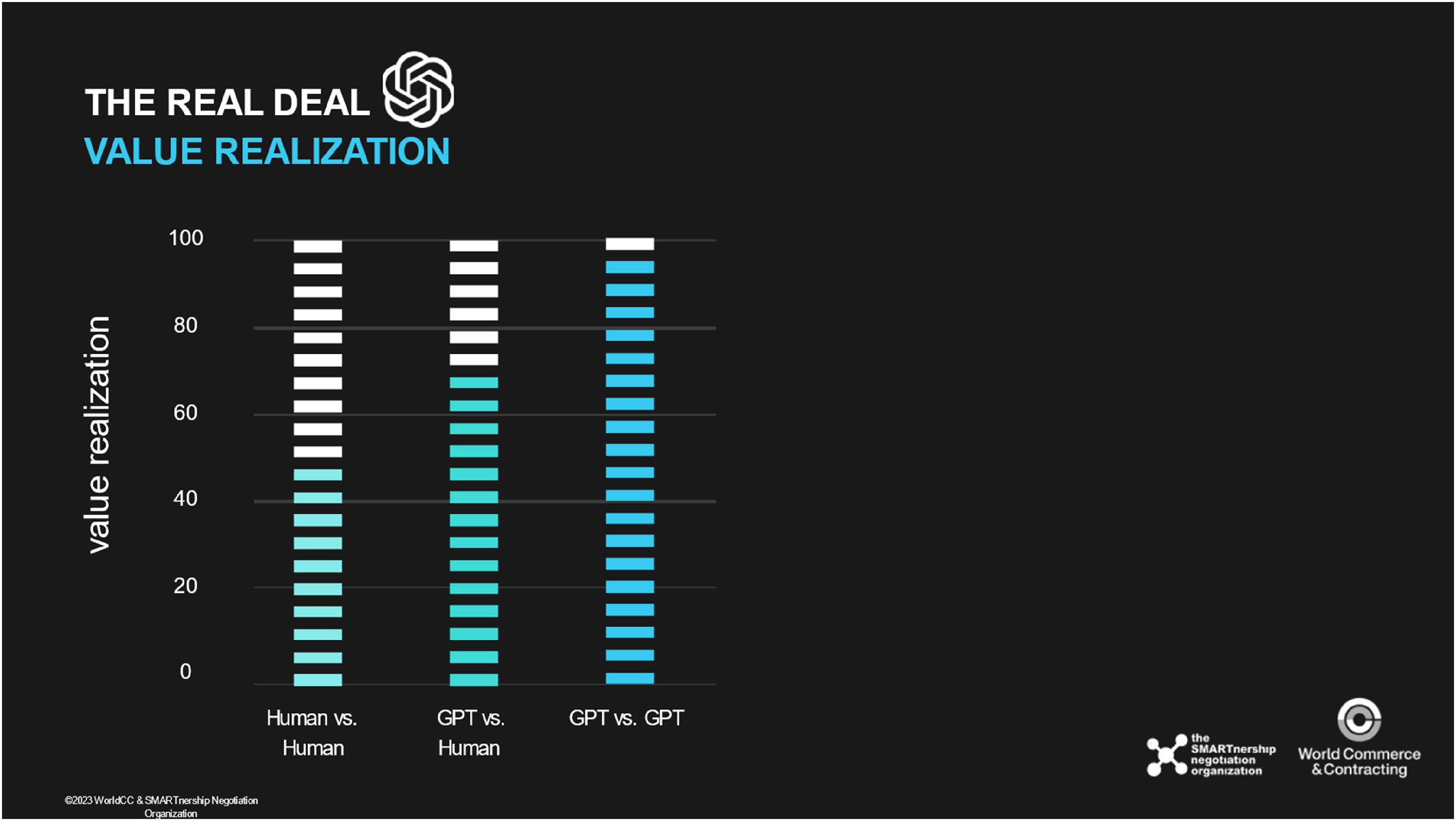
The authors attributed this failure being due in part to insufficiently structured planning, but it was also notable that teams which were not using AI took longer in making introductions and setting the scene for their negotiation. In some cases, they became distracted by topics of possible value, but that were not of high importance to the desired outcome.
In situations where only one side was making use of ChatGPT, there was a real possibility of confusion. One example of this is that ChatGPT can quickly calculate and propose options. For the side without ChatGPT, evaluating those options takes time. Another factor is that if the AI system is being used during the negotiation, one of the human participants must be dedicated to it. There also has to be an agreed method for them to communicate data and ideas to the lead negotiator, this inevitably leads to some distortion and awkwardness in the interaction between the two teams. However, unlike the teams where neither side used ChatGPT, there was in all cases a resolution within the permitted timeframe.
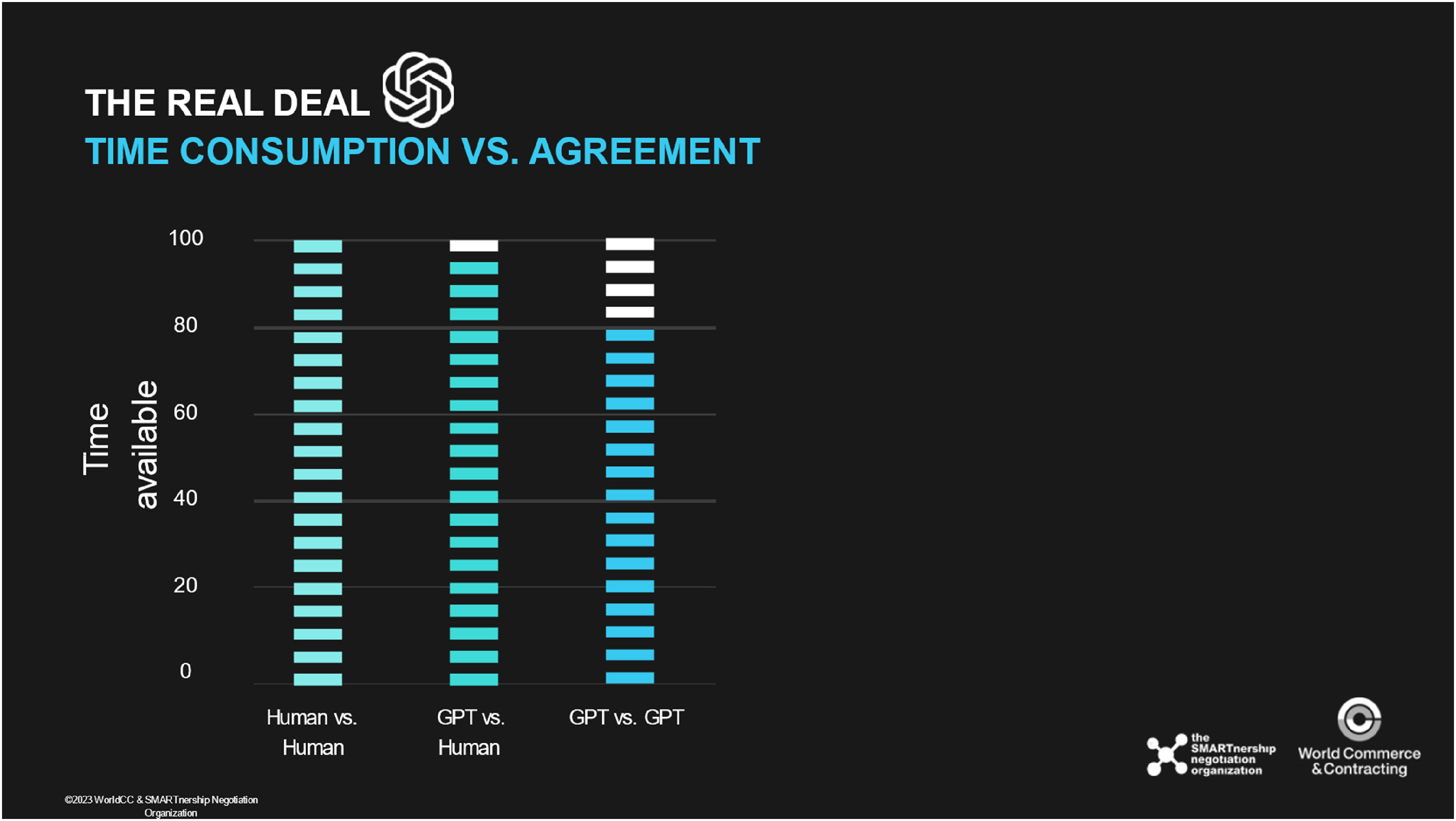
The best and fastest results were achieved by the teams where both sides made use of ChatGPT (for this purpose, those where lack of experience led to one side abandoning use during the planning phase) were discarded. The use of AI appeared to bring increased structure and discipline to the negotiation. It resulted in less time being spent on introductions and scene-setting. Having been encouraged to be open about their goals and to share data, this generally proved effective in rapidly building trust and cooperation. By inputting data throughout the process, teams were mostly able to reach decisions – or make counter-propositions – faster.
Key findings during this phase were:
- Negotiators using ChatGPT must establish how they will use the system during negotiation and how they will communicate with each other in a seamless fashion. - Given ChatGPT's propensity for ‘win–win’, it is essential to test and observe whether the counterparty is operating with a similar approach. Were unable to observe a situation where a win–win approach was met by a more adversarial style and whether or how ChatGPT would react to this. - Generative AI is not human. It does not have emotions. As an assistant or support to a negotiation, it can bring tangible and significant benefits, but in the end, it is human judgment that counts.
Extent to which meaningful lessons can be drawn
The findings we have outlined are in many cases similar to other research and observations regarding the use of Generative AI. While our experiment indicates the potential for added value. However, it ignores some of the broader concerns related to the use of tools such as ChatGPT. These include in particular issues around security and confidentiality of data – factors that mean many organisations are currently limiting or prohibiting the use of publicly available systems.
The scope and conditions surrounding this experiment were too narrow to allow firm conclusions. The fact that the negotiations were undertaken online, with negotiators who in most cases had not met before this event and came from quite varied industry and cultural backgrounds are among the factors that had the potential to distort results. Therefore, further experiments would be needed to test and validate these early, indicative conclusions.
Recommendations arising from this study
AI systems are poised to affect and influence many aspects of our lives and business operations. It is clear that this includes the field of negotiation. Embedded AI is already assisting negotiators through rapid review and assessment of proposed contract terms and language. It is supporting the rapid assembly of contract templates and starting to analyse portfolios of past agreements and negotiations to identify risks and recommend approaches that will increase the likelihood of a positive outcome. These are illustrative of the many benefits that can flow from the structure and guidance that AI systems bring to negotiation. Generative AI has the potential to add to this list and may encourage the development of standards – for example, in negotiation planning (an area of consistent past weakness) as well as in identifying optimum outcomes and adjusting these in real time, during the course of a negotiation.
Further experiments of the type outlined in this paper will clearly be beneficial, but perhaps the most important advances will be achieved through encouraging experimentation by users. Already, training tools with embedded AI are coming to market, but currently, they are more focused on supporting traditional approaches through the use of avatars. While this may be useful – and certainly cost-efficient – such systems should also be helping users learn how to use AI to bring greater speed and value to the negotiation process itself.
Future research
Beyond understanding where AI can have the greatest impact, it is necessary to investigate potential limitations and constraints on AI implementation in negotiation, for example, ethical concerns that might especially apply in consumer markets.
It is also possible that AI may offer opportunities for increased negotiation or ‘optioneering’. The efficiencies it brings may allow organisations and individuals to be more flexible in the choices and trade-offs they are able to support, allowing greater levels of customisation of terms.
There are also suggestions that Generative AI will lead to the evolution of standards – that packages of terms that deliver optimum results will evolve from the mass of data that sits within an advanced, widely used AI system.
Furthermore, there is a crucial need to explore the extent to which machine-to-machine or machine-to-human negotiations will come to dominate many transactions and whether this too represents a source of value or risk.
For example, might it place the less powerful party in a worse position? While early experiments in business-to-business negotiations suggest significant improvements are achieved through the use of machines, how extensive can this be and at what levels of complexity?
Conclusion
Based on empirical observations, the authors hypothesise that AI will not eliminate negotiators; rather, it is transforming the role of negotiators by empowering them with AI tools. Instead of replacing negotiators, AI augments their capabilities and enhances their effectiveness in the negotiation process. A recent research study 4 confirms that negotiators are starting to leverage AI technologies to gain valuable insights, analyse data, and make more informed decisions during negotiations.
With the aid of AI, negotiators can access vast amounts of information quickly, allowing them to identify patterns, trends, and potential strategies that might otherwise go unnoticed. AI-powered algorithms can help negotiators analyse complex data sets, identify optimal negotiation outcomes, and generate data-driven proposals.
Furthermore, AI can assist negotiators in simulating different scenarios and predicting potential outcomes, enabling them to develop more robust negotiation strategies. These AI-based simulations provide negotiators with a valuable tool for assessing risks, evaluating trade-offs, and optimising their negotiation approach.
Ultimately, the findings suggest that the integration of AI into the negotiation process equips negotiators with powerful tools that enhance their decision-making capabilities, increase efficiency, and improve overall outcomes. Rather than replacing negotiators, AI is complementing their expertise and transforming the way negotiations are conducted.
In conclusion, this quote from ChatGPT offers insight into how it sees its own role in negotiation: As an AI language model, my role in negotiations is to assist and provide information to the best of my abilities. I can help users by providing relevant facts, suggesting strategies, and offering insights based on the information available to me. However, it's important to note that I am just a tool, and ultimately, the decisions and actions in negotiations are the responsibility of the human participants. My purpose is to offer guidance and support, but the outcome and success of negotiations depend on the skills, judgment, and expertise of the individuals involved.
Footnotes
Declaration of conflicting interests
The authors declared no potential conflicts of interest with respect to the research, authorship, and/or publication of this article.
Funding
The authors received no financial support for the research, authorship, and/or publication of this article
