




Abstract
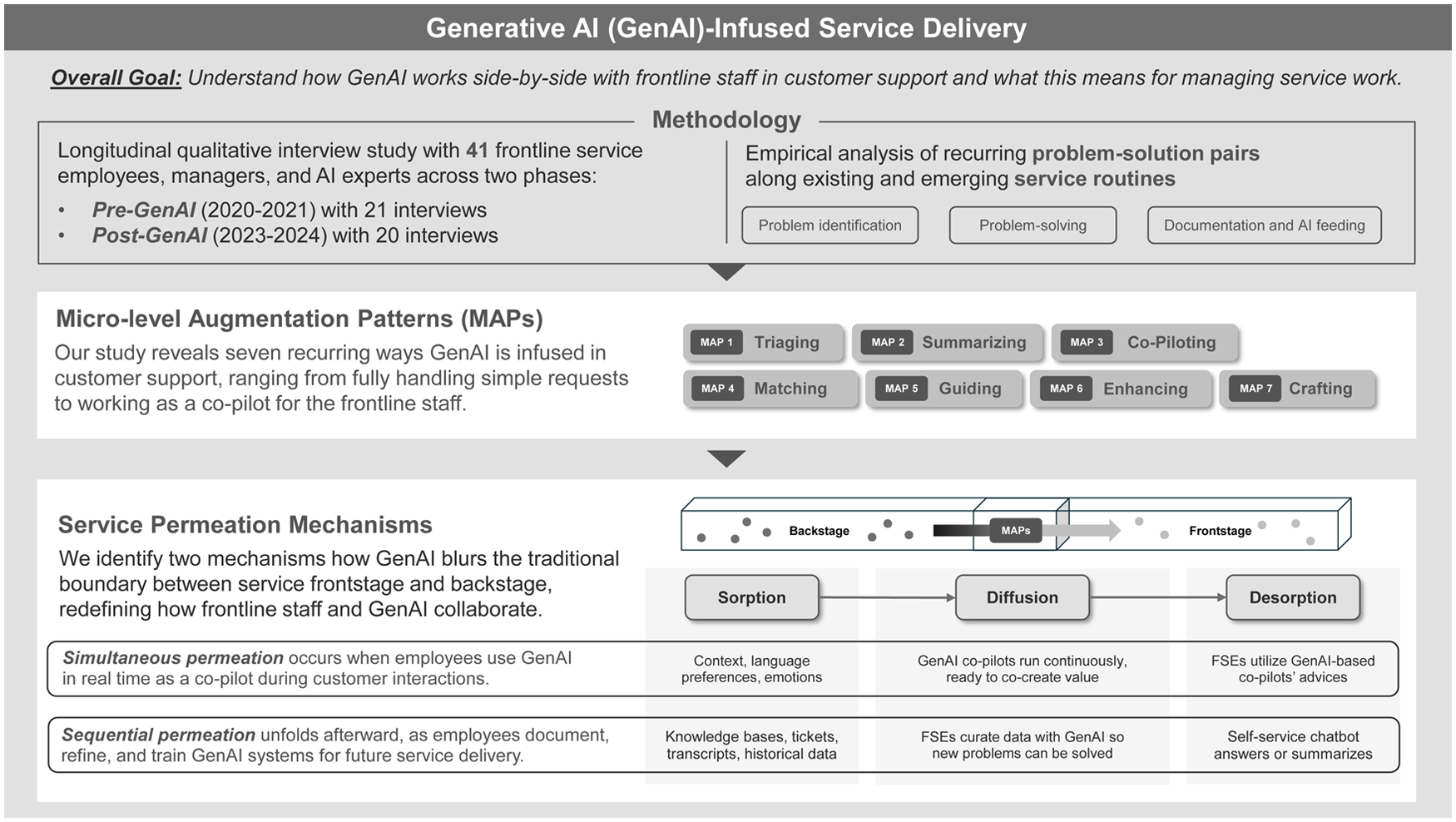
The infusion of generative AI (GenAI) is already disrupting established services. This technology’s generative and agentic nature challenges the design and management of service routines, which have been previously handled primarily by frontline service employees. Guided by organizational routines theory, our longitudinal study (2020–2024) examines how the infusion of GenAI changes routines in customer support services. We gathered interview data from 41 employees, managers, and AI experts in two phases, pre- and post-GenAI. Based on the analysis of the qualitative data, we revealed seven recurring micro-level augmentation patterns, illustrating how GenAI-infused service routines function. The results show that GenAI is primarily embedded in the backstage of knowledge-intensive services, from which it then permeates the frontstage. We contribute to the literature on hybrid human–AI service delivery by identifying augmentation patterns and conceptualizing service permeation via two mechanisms: (1) simultaneous service permeation, which unfolds as employees leverage GenAI in real-time and integrate GenAI’s responses, recommendations, and adaptations into the frontstage; (2) sequential service permeation, which emerges as employees perform new routines of documentation and AI feeding to facilitate GenAI’s adaptability in frontstage and backstage operations. The MAPs and service permeation mechanisms guide practitioners in integrating GenAI into service routines and managing novel employee-GenAI collaborations.
Introduction
Generative artificial intelligence (GenAI) is disrupting the ways service providers deliver services to their customers (Ferraro et al. 2024; Liu et al. 2024). At its core, GenAI refers to large-scale AI models, such as large language models (LLMs), that learn from vast data, can perform multiple tasks, and generate human-like outputs (Liu et al. 2024). Tech giants are investing heavily in GenAI-powered systems, with Microsoft alone reaching a record $30 billion in quarterly spending (Reuters 2025), to shape the future of work. For instance, Microsoft’s Copilot and ServiceNow’s Now Assist illustrate how GenAI copilots complement frontline service employees (FSEs) by collaboratively executing service routines, such as retrieving knowledge, automating tasks, and coordinating human-human interactions, thereby reconfiguring interactions across the service frontstage and backstage (Microsoft 2024). Similarly, Intercom’s Fin AI Copilot generates response recommendations, aiding FSEs in problem-solving and achieving a projected productivity increase of 31% (Intercom 2024).
Previous research has developed structured frameworks to navigate the complexities of AI infusion, systematizing capabilities that clarify when and where AI technologies are appropriate for performing specific tasks and substituting FSEs (Huang and Rust 2018). This perspective further shifted to an understanding of AI infusion as a continuum of substitution and complementation (e.g., Larivière et al. 2017; Marinova et al. 2017), which we refer to as augmentation of FSEs throughout this study. We adopt the conceptualization of Baer, Waardenburg, and Huysman (2025, p. 761), who define augmentation as the process of “combining humans and AI into a complementary system that exceeds the sum of its parts.” Scholars have identified multiple configurations of hybrid human–AI service delivery in which AI augments either frontstage or backstage activities (De Keyser et al. 2019; Mortati and Viana Mundstock Freitas 2025), emphasizing a greater interaction between these stages and a disruption of established service work (Bock, Wolter, and Ferrell 2020; van Doorn et al. 2023).
Despite the aforementioned advancements in service research, we still know little about how GenAI reshapes FSEs’ service routines, that is, the recurring patterns of actions through which FSEs identify and resolve customer requests and thereby deliver services (Das 2003; Pentland 1992). Archetypes and typologies of hybrid human–AI service delivery (e.g., De Keyser et al. 2019; Mortati and Viana Mundstock Freitas 2025) contribute high-level views on how augmentation configures human and AI roles and tasks. However, they provide only a partial understanding of how the substitution–complementation continuum unfolds (e.g., Baer, Waardenburg, and Huysman 2025; Marinova et al. 2017; Robinson et al. 2020), highlighting the need for micro-level investigations into how augmentation transforms service work. While prior literature acknowledges that AI affects FSEs’ routines across frontstage and backstage, and points to a growing interdependence between these stages (Bock, Wolter, and Ferrell 2020; Mortati and Viana Mundstock Freitas 2025), this interplay, and how human–AI collaboration translates into actual service delivery, require more granular understanding and explanation.
Our study aims to refine the augmentation continuum of substitution and complementation (De Keyser et al. 2019; Huang and Rust 2018) and adopts a process-centric view to discern the impacts of GenAI along FSEs’ service routines and across the service frontstage and backstage. We adopt the theoretical lens of organizational routines (Feldman and Pentland 2003; Gaskin et al. 2014) to examine recurring micro-level representations of augmentation that shape and reflect evolving GenAI-infused routines. This leads us to the following research questions (RQs):
We conducted a longitudinal qualitative study (2020–2024) of GenAI infusion in four customer support organizations, drawing on 41 interviews with FSEs, managers, and GenAI experts conducted before (pre-GenAI) and after (post-GenAI) the emergence of GenAI technologies. Adapting a grounded theory approach (Corbin and Strauss 1990), we analyzed the influence of GenAI on service routines by examining problem-solution pairs. Through selective coding, these pairs were aggregated into seven
Our results contribute a process-centric and integrative view of the emerging GenAI-infused service routines to the literature on hybrid human–AI service delivery (e.g., Koponen et al. 2023; Mortati and Viana Mundstock Freitas 2025; Robinson et al. 2020). The identified MAPs provide descriptive knowledge on how and where GenAI is infused into services. Thereby, our study refines the understanding of the continuum of substitution and complementation (e.g., Baer, Waardenburg, and Huysman 2025; Marinova et al. 2017). We extend prior research by examining the processual changes and patterns that augment service delivery—both at the service frontstage, the invisible backstage, and the interactions in between (Bock, Wolter, and Ferrell 2020; Liu et al. 2024). Furthermore, the resulting service permeation mechanisms explain a closer coupling of service frontstage and backstage along GenAI-infused service routines (Hogreve, Iseke, and Derfuss 2022; Mortati and Viana Mundstock Freitas 2025), as they highlight diverse FSE-GenAI collaborations that uncover simultaneous and sequential mechanisms. Applying the derived MAPs enables practitioners to leverage GenAI (Brynjolfsson, Li, and Raymond 2025) while concurrently addressing implications for FSEs’ service routines and the challenges of GenAI permeation within service delivery.
Theoretical Background
Hybrid Human–AI Service Delivery
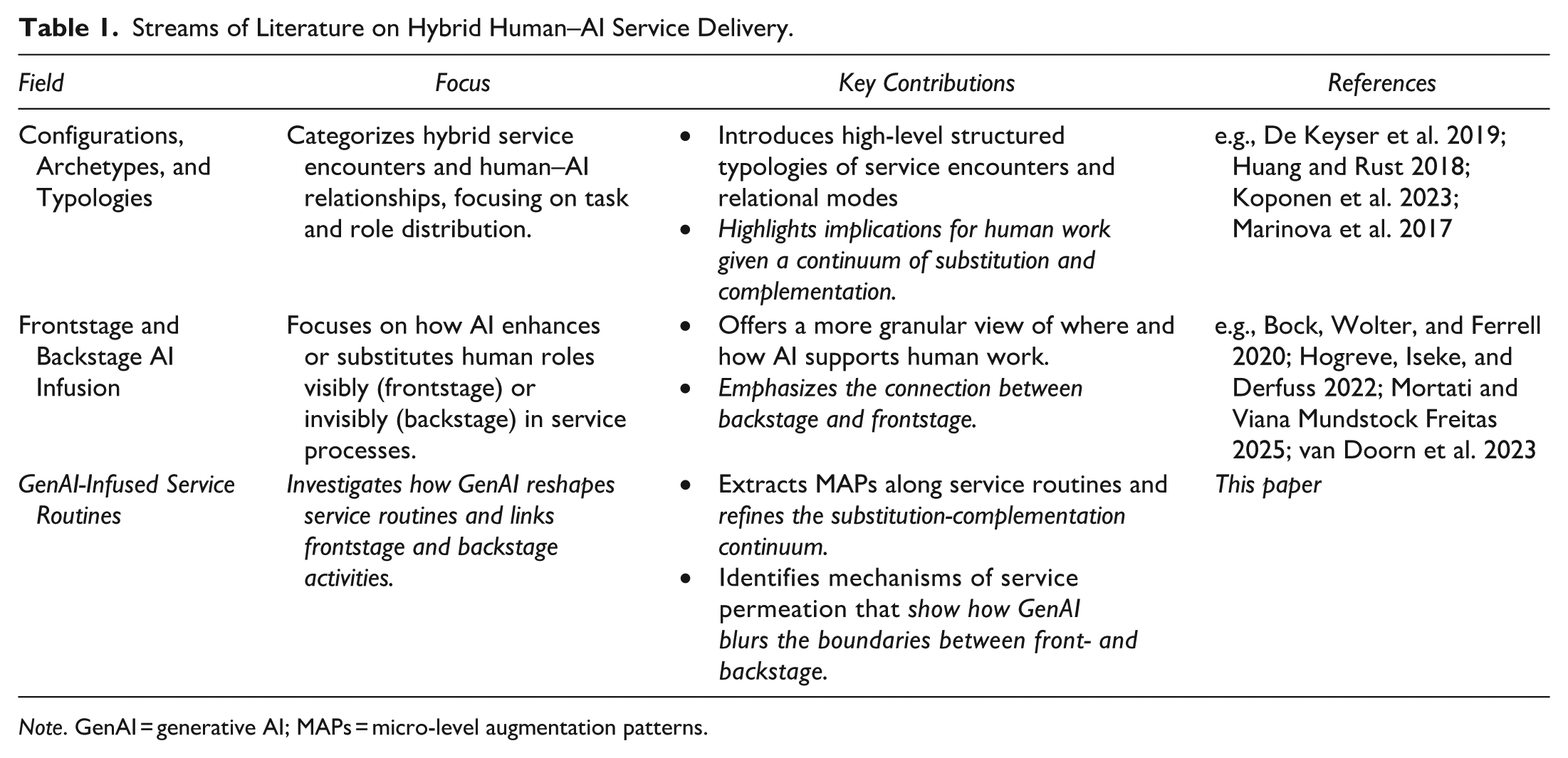
AI infusion has traditionally been seen as a means to automate service delivery by replacing FSE tasks and directly influencing customer perceptions (Huang and Rust 2018; McLeay et al. 2021). However, in light of AI’s limitations and the demands of personal, emotional, and knowledge-intensive service contexts, the focus shifted from merely designing AI technologies for customers to examining how FSEs and AI together form hybrid human–AI service delivery (Table 1).
Streams of Literature on Hybrid Human–AI Service Delivery.
Note. GenAI = generative AI; MAPs = micro-level augmentation patterns.
Recent research has advanced our understanding of the hybrid nature of AI-infused service delivery by conceptualizing how responsibilities are distributed between human and AI actors through the analysis of configurations, archetypes, and typologies (e.g., De Keyser et al. 2019; Koponen et al. 2023; Larivière et al. 2024). Advances in AI increasingly enable it to take over diverse service roles, with distinctions such as mechanical, thinking, and emotional intelligences informing predictions about when AI may substitute FSEs (Huang and Rust 2018). Building on these capability-based distinctions, scholars have moved beyond the traditional human-to-human encounter, uncovering a spectrum of configurations, from AI-to-AI to blended human–AI interactions (De Keyser et al. 2019). These evolving hybrid human–AI service encounters underscore that AI is not a one-size-fits-all solution but varies in its capacity to substitute or complement human work (Marinova et al. 2017). The augmentation of service work can thus be understood as a continuum of substitution and complementation, in which FSEs and AI perform service routines either sequentially or simultaneously (Le et al. 2025). Augmentation enables humans and AI to perform complementary or joint tasks and to co-produce the service (Blaurock, Büttgen, and Schepers 2024), while implicitly reconfiguring professional roles, positioning humans not just as service providers, but as collaborators, coordinators, or differentiators (Koponen et al. 2023; Larivière et al. 2017). For example, AI systems engage FSEs by proactively asking for input and feedback (Blaurock, Büttgen, and Schepers 2024). Despite these contributions, the literature on hybrid human–AI service delivery remains predominantly conceptual, leaving key questions unanswered about micro-level implications and the dynamics along the substitution-complementation continuum in AI-driven augmentation.
Ongoing research has also aimed to unpack human–AI hybrids by examining how AI systems enhance or substitute human roles, both visibly on the frontstage and invisibly in the backstage of service processes (e.g., Bock, Wolter, and Ferrell 2020; Mortati and Viana Mundstock Freitas 2025; van Doorn et al. 2023). Building on a service design perspective, Mortati and Viana Mundstock Freitas (2025) conceptualize AI as a technology that co-creates value and copilots service delivery with both users and machines across frontstage and backstage environments. This stream offers a more granular view of how AI supports human work (Liu et al. 2024), showing that the infusion of AI reshapes traditional boundaries between the frontstage and backstage (e.g., Mortati and Viana Mundstock Freitas 2025; Robinson et al. 2020). For example, customers may misattribute AI-generated responses to humans, resulting in counterfeit encounters and ambiguous role expectations (Robinson et al. 2020). In light of this, adequate AI support at the backstage (e.g., decision-support tools) critically impacts the quality of frontstage interactions, reinforcing their interdependence as articulated in the AI-mediated service-profit chain (Chen, Hsieh, and Chan 2024; Hogreve, Iseke, and Derfuss 2022). While the link between service frontstage and backstage is acknowledged, the influence of emerging AI technologies, such as GenAI, on this connection remains underexplored.
At the same time, growing interest in the technological capabilities of GenAI models (Ferraro et al. 2024; Liu et al. 2024) has highlighted their potential to alter how humans and AI interact in service delivery (Brynjolfsson, Li, and Raymond 2025). Given the ability to understand natural language and generate text, GenAI systems (e.g., Microsoft Copilot, SAP Joule) exhibit a higher level of agency (Chen, Hsieh, and Chan 2024; Le et al. 2025), challenging the prior insights on how FSE and AI work together along service processes and the way these systems are embedded into the service routines. Against this backdrop, the rise of GenAI introduces a new layer of complexity. Technologies such as LLMs not only extend the functional boundaries of AI in service contexts but also generate paradoxical dynamics, being perceived as both highly capable and vulnerable (e.g., prone to hallucinations and biases) and as offering personalization while raising concerns about intrusiveness (Ferraro et al. 2024; Liu et al. 2024). Recent advancements in agentic AI further accelerate these developments, as AI systems increasingly exhibit autonomy and enhanced capabilities in reasoning and learning, enabling them to leverage a wide array of enterprise tools (Acharya, Kuppan, and Divya 2025).
Despite growing interest in hybrid human–AI service delivery, our understanding of how GenAI influences FSEs’ tasks and their relationships with AI, beyond a dyadic view of substitution or complementation toward joint enactment, remains limited. Similarly, while distinctions between frontstage and backstage domains exist, the interplay introduced by AI across these layers is only beginning to be understood. As GenAI technologies are being infused in service delivery, this study examines their influence on service delivery by analyzing how they reconfigure routines across the frontstage, backstage, and their intersections.
Organizational Routines in Service Delivery
Organizational routines in service delivery provide a theoretical foundation for analyzing the augmentation of service work. Routines are behavioral patterns of actions performed repeatedly to achieve a specific goal (Pentland and Hærem 2015). Research on organizational routines examines how they are constituted and reinforced over time (Feldman and Pentland 2003). In general, the routinization of service tasks is crucial for increasing efficiency and reducing cognitive effort (Lemken and Rowe 2020). For example, frontline work in call center environments is frequently described as highly routinized, designed to efficiently manage the high volume of incoming calls (Malhotra et al. 2013). Within the realm of customer support services, two overarching organizational routines predominate: problem identification and problem solving. Pentland (1992) was among the first to examine call center agents’ work through the lens of organizational routines, focusing on problem identification and allocation activities such as assigning, referring, transferring, and escalating. Das (2003) extended this view by investigating problem-solving routines. Accordingly, solving problems can be summarized as multiple steps of locating, adapting, and generating solutions.
While early research on organizational routines emphasized their stability, later work on routine dynamics focused on how routines evolve and adapt to changing environments (Feldman and Pentland 2003). Deeply intertwined with their context, routines both shape and are shaped by it, while technologies like GenAI act as powerful exogenous forces influencing their enactment (Murray, Rhymer, and Sirmon 2021). Efforts to provide a more detailed understanding of AI technology use in routines often focus on augmentation as a feature of the infused technology itself, rather than as a function of the service routines where this augmentation occurs (e.g., Blaurock, Büttgen, and Schepers 2024; Murray, Rhymer, and Sirmon 2021). However, human actors and material aspects of technology become interconnected within the service routines (Gaskin et al. 2014), calling for an investigation of FSEs’ GenAI-infused patterns of actions and the dynamics of these socio-material ensembles in performing service routines and the resulting blurred boundaries of backstage and frontstage activities.
The organizational routines lens helps reveal how FSEs and GenAI interact at the micro level, co-performing tasks and shifting responsibilities between frontstage and backstage work. It allows us to move beyond high-level categories and to develop a more refined understanding of hybrid service delivery. This grounding motivates our study of how GenAI infusion constitutes augmentation patterns (RQ1) and their impact on frontstage and backstage service routines (RQ2). We address the gap in understanding how GenAI affects service delivery by uncovering augmentation patterns along the substitution-complementation continuum.
Methodological Approach
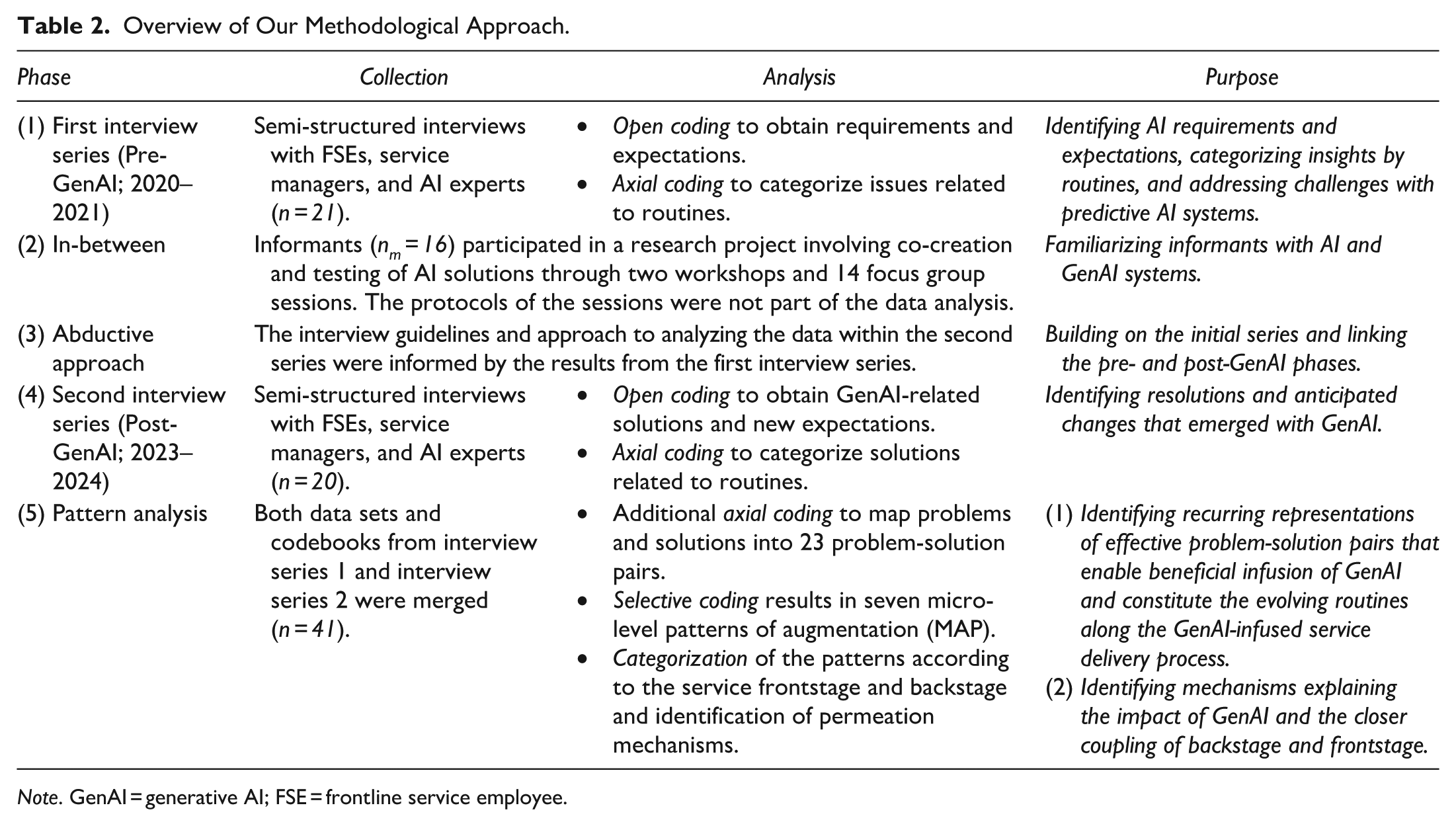
We employed a qualitative research approach grounded in extensive empirical data from the field of technical customer support services. By covering both predictive and generative AI phases, our longitudinal study setup (2020–2024) traces the shift from traditional AI to emerging and advancing GenAI solutions and their implications for service delivery. We conducted 41 semi-structured interviews with FSEs, managers, and GenAI experts to explore actual work practices and anticipated changes across pre- and post-GenAI phases. This approach is suited to capturing the evolving dynamics of GenAI infusion—how service routines, roles, and responsibilities emerge over time. Finally, we followed an adapted grounded theory approach (Corbin and Strauss 1990), combining inductive coding with abductive reasoning, to iteratively develop MAPs and identify service permeation mechanisms. An overview of our methodological design is presented in Table 2.
Overview of Our Methodological Approach.
Note. GenAI = generative AI; FSE = frontline service employee.
Sample Description
Our qualitative investigation explored the realm of technical support work and IT Service Management (ITSM) as a subfield of general customer support, a field that has been extensively studied within the longstanding body of research on organizational routines (e.g., Das 2003; Pentland 1992). When issues arise with digital technologies, customers reach out to frontline service providers through various channels to resolve their technical problems. To reflect the field’s heterogeneity, we drew data from four organizations spanning diverse service channels, IT products, customer types, and B2B and B2C contexts. Detailed descriptions of the four organizations are available in Web Appendix 1. Our empirical study is part of an overarching research project that develops advanced analytics and ticketing solutions to store and manage incoming and historical customer requests and interactions. The larger project aimed to design a holistic hybrid intelligence system with distinct modules to support FSEs through AI in a human-centered manner. The iterative development process allowed participants to gain practical experience over time, which informed their responses during the data collection phase.
Data Collection
To collect empirical data, we conducted semi-structured interviews with FSEs, managers, and AI experts, aiming to triangulate views on the underlying routines, the overarching service delivery process, and the associated technical changes. This approach allowed flexible and in-depth discussions with the informants and enabled us to detail their subjective perspectives (Ritchie, Lewis, and Elam 2013). Organizational routines informed the design of the interview guidelines in terms of addressing the problem identification and problem-solving stages (Das 2003; Pentland 1992). To examine differences in infusing predictive vs. generative AI into frontstage and backstage service delivery, we conducted two interview series: pre-GenAI and post-GenAI. Between the two interview series, we held workshops and focus groups with researchers and a development team to co-design and test GenAI solutions for augmenting customer service routines. Conducting interviews with the same individuals at different points in time provided insights into how their perceptions and experiences of AI tools evolved, particularly in response to the emergence of GenAI.
The pre-GenAI series (2020–2021), involving 21 voluntary participants, focused on identifying issues and requirements related to service routines and predictive AI. Furthermore, the first series provided knowledge of the original service routines without any AI. The post-GenAI series (2023–2024) involved 20 voluntary participants and explored GenAI solutions. Following an abductive approach, we refined the second interview series based on insights from the first, adding example prompts and an introduction to GenAI and LLMs. Each interview lasted an average of 45 minutes. We conducted the interviews online, recorded the audio, and transcribed the files accordingly. Data collection ceased upon reaching theoretical saturation, meaning that subsequent interviews confirmed earlier findings and yielded no new insights (Corbin and Strauss 2015). Interview questions, interviewee backgrounds, and an overview of the workshops and focus groups are available in Web Appendix 2.
Data Analysis
We analyzed the collected interviews through an adapted grounded theory approach following Corbin and Strauss (1990). To deepen our understanding of service routines in light of GenAI, we employed an abductive research design to not only inform our interview guidelines but also to reflect the data of both series (Pemer 2021). We iteratively moved between emerging patterns in the data and analytical lenses offered by service routine literature (Das 2003; Pentland 1992). Our approach prioritized intensive group discussions and consensus-building through an iterative process of comparing and integrating codes and categories, rather than relying solely on quantitative measures of intercoder reliability (Berente et al. 2011). The codes and categories were discussed with the entire research team, particularly on three occasions: after the first series, after the second series, and during the analysis of the problem-solution pairs and patterns of augmentation. To address the widely recognized challenge of overcoming preconceptions in qualitative data analysis (Charmaz 2014), we later incorporated an impartial co-author into our research team.
In the first interview series spanning 2020 to 2021, we employed open and axial coding to extract requirements and categorize issues (Corbin and Strauss 1990). First, we used an open coding strategy to understand FSEs’ and managers’ viewpoints and experiences with AI, drawing on the interviewees’ empirical statements (Corbin and Strauss 2015). As we gathered data before GenAI was adopted, the analysis focused on broader AI applications. Afterward, we applied axial coding to categorize the data into recurring issues related to service routines. This step was pivotal in identifying the foundational problems concerning existing service routines and aggregating expectations regarding the use of AI. Subsequently, we further categorized these concepts according to the service routine literature following our abductive approach.
Analogously, we analyzed the second interview series conducted in 2023 and 2024 by adopting the above-mentioned qualitative approach. However, the analysis of this series focused on coding solutions that emerged with GenAI. This phase was instrumental in delineating solutions from GenAI applications and attaching them to the identified issues. Accordingly, the interview guidelines and the approach to analyzing the data were informed by the results of the first interview series, in line with our abductive design. Again, we coded the interviewees’ statements and mapped the codes to the given routines during an open and axial coding phase. At this stage, we again re-engaged with the literature on service routines to interpret and categorize emerging patterns. Our abductive strategy guided the refinement of our coding scheme throughout both interview series. For example, as we encountered recurring accounts of documentation work and AI input preparation, we conceptualized a new routine category: documentation and AI feeding. The resulting data structures are available in Web Appendix 3. The data analysis was intertwined across the two series. A shared coding scheme was used by two coders and refined by the entire research team iteratively by comparing codes and categories constantly and across both series (Charmaz 2014).
Then, we employed an additional axial coding phase to map the solutions to the corresponding issues. Web Appendix 4 illustrates this mapping along the service routines. Following Berente et al. (2011), we performed selective coding to link and interpret the derived problem-solution pairs and, ultimately, to discern MAPs. To analyze the MAPs within the context of service delivery, we added additional dimensions and organized the evolved patterns according to the service frontstage and backstage (Mortati and Viana Mundstock Freitas 2025). We examined the interplay between the service frontstage and backstage through the identified MAPs to account for GenAI’s impact on service delivery and theorizing mechanisms. In line with Henfridsson and Bygstad (2013), we define mechanisms as the underlying causal structures that explain how and why phenomena unfold. In our context, mechanisms are the generative processes through which GenAI permeates service delivery, and by abstracting from the empirically grounded MAPs, we conceptualize two higher-order service permeation mechanisms that explain how GenAI reshapes the coupling of human and AI activities across frontstage and backstage domains.
Findings
Our analysis uncovers seven aggregated MAPs that capture the evolving GenAI-infused service routines throughout the service delivery process. Building on these patterns, we propose service permeation mechanisms that explicate how GenAI bridges backstage and frontstage activities and reconfigures the dynamics of hybrid human–AI service delivery.
Micro-Level Augmentation Patterns
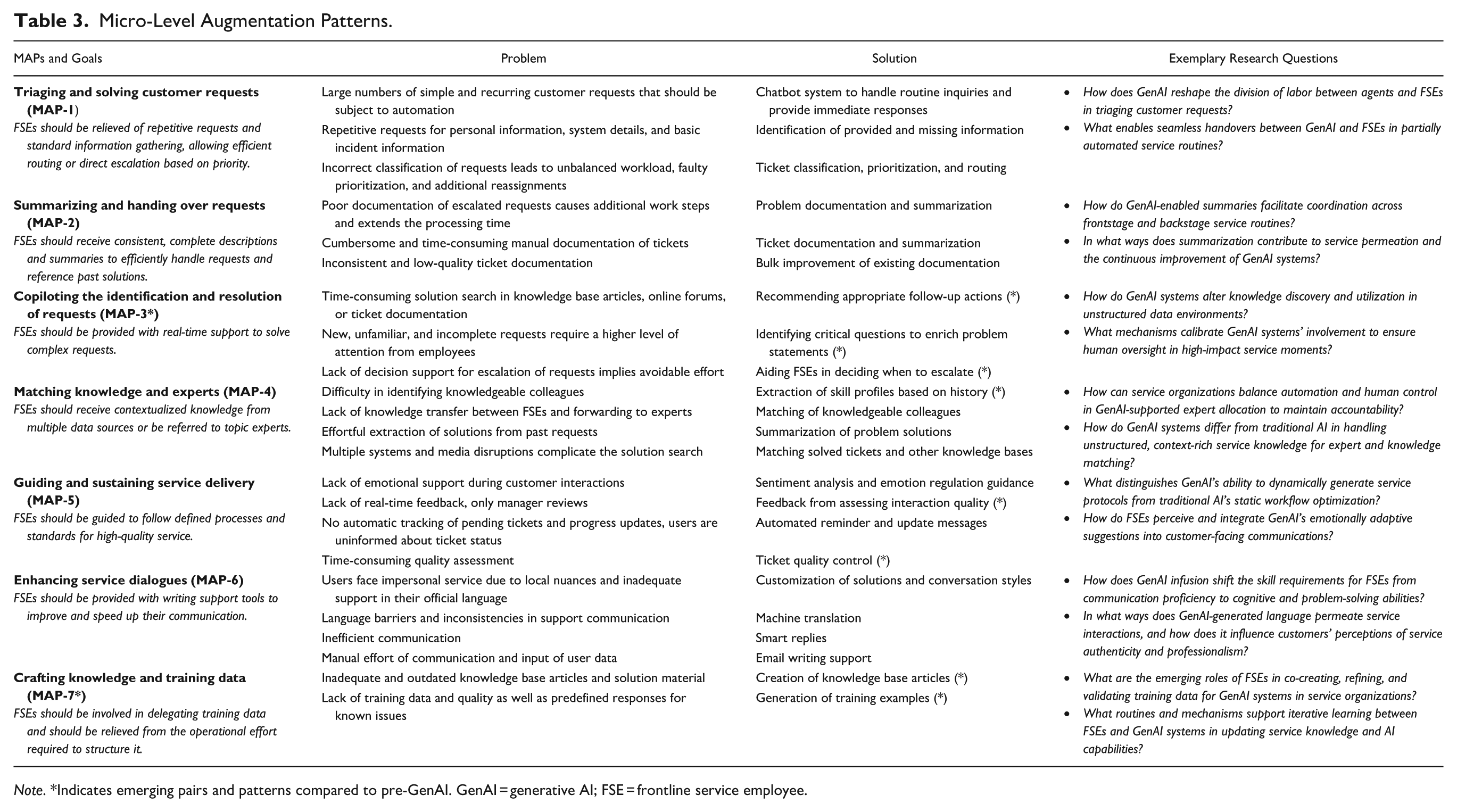
Through the aggregation of multiple micro-level problem-solution pairs that represent various forms of augmentation through GenAI-infusion, seven overarching patterns of augmentation on a continuum of substitution and complementation emerged: triaging and solving simple customer requests (MAP-1), summarizing and handing over requests (MAP-2), copiloting the identification and resolution of requests (MAP-3), matching knowledge and experts (MAP-4), guiding and sustaining service delivery (MAP-5), enhancing service dialogues (MAP-6), and crafting knowledge and training data (MAP-7). Each MAP aggregates reusable approaches to achieve specific augmentation goals. Table 3 presents excerpts of each MAP, including goals and problem-solution pairs. Pairs and patterns that emerged in the GenAI phase are marked with an asterisk. In addition, it offers illustrative future research questions for each MAP. A comprehensive MAP overview in Web Appendix 5 further details the roles of GenAI and FSEs, as well as key technological aspects, including retrieval-augmented generation (RAG) and model fine-tuning for classification tasks.
Micro-Level Augmentation Patterns.
Note. *Indicates emerging pairs and patterns compared to pre-GenAI. GenAI = generative AI; FSE = frontline service employee.
Triaging and Solving Customer Requests (MAP-1)
MAP-1 centers on the initial phase of service delivery, where FSEs traditionally invest substantial time in qualifying support requests, identifying customer needs, and referring to standardized responses. In GenAI-infused service settings, customers first interact with GenAI systems that handle simple, repetitive inquiries. GenAI automates processing these routine requests, thereby relieving FSEs of repetitive tasks and allowing them to focus on more complex cases. In this way, the pattern reflects a partial substitution of initial frontline tasks while also triggering the escalation and forwarding of critical issues to human experts. Given the current volume of customer requests, FSEs view service frontstage substitution as an opportunity rather than a threat to their jobs. Hence, dividing labor between FSEs and GenAI in terms of partially automating service delivery refers to a key leverage of augmentation (Jia et al. 2024). However, the overarching premise that AI primarily handles straightforward, less complex tasks remains valid even in the era of GenAI. FSEs’ responsibilities shift to taking care of ambiguous and complex requests which GenAI cannot handle, as this AI expert commented: “I think service tickets can be relatively well automated so that support agents only take on an approval role: ‘Does this fit or not?’ [. . .] This could simplify and process many repetitive tasks. However, when it comes to incident detection, it gets more challenging [. . .] because users often cannot describe exactly what the problem is—here, the role of the support agent remains important.” (Interview 2.02).
An essential routine in this initial part of the service delivery process is to create tickets, which involve collecting customer information and documenting service requests. Technological advances in LLMs further enhance the ability to clarify incomplete and partially ambiguous requests. As this interviewee explained, “If the bot can narrow it down directly with one or two questions, like you said, when the customer says Wi-Fi, it could simply ask again: Internet, and in what way? Only landline or something like that. [. . .] The questions could still be asked to clarify the issue further.” (Interview 2.14). Even though MAP-1 describes the partial substitution of service routines (Murray, Rhymer, and Sirmon 2021) and highlights the gradual replacement of specific tasks (Huang and Rust 2018), FSEs perceive GenAI-based self-service systems as coworkers doing the groundwork that supports FSEs in subsequent human-to-human interactions.
Summarizing and Handing Over Requests (MAP-2)
After initial contact and throughout service delivery, FSEs are required to document information and summarize the actions taken and conversations held. These documentation activities are essential not only for referring, transferring, or escalating requests to colleagues but also for retaining and institutionalizing service knowledge. The findings demonstrate GenAI’s potential to substitute summarization and ticket handoffs, providing customers and FSEs with comprehensive, coherent problem and resolution descriptions. By tracking conversations and gathering all customer-related data, GenAI systems with high agency create summaries that serve as a foundation for FSEs to craft impactful moments of truth. Thus, MAP-2 goes beyond simply summarizing the latest interactions. As one interviewee explained, “One could consider having the AI automatically identify and summarize the important information in a longer conversation or extensive history. [. . .] This way, the next support agent would have a better starting point.” (Interview 2.02). Handovers between GenAI systems and FSEs represent new forms of sequential coordination and orchestration between the service backstage and service frontstage (Le et al. 2025). In the long term, useful summaries and derived solution templates are reintegrated into GenAI systems, once again permeating the service backstage. Efficient summaries and additional contextual information (e.g., customer sentiment) are more critical than in pre-GenAI services, as FSEs are typically responsible for managing chatbot service outages and preventing negative customer experiences (Le et al. 2025). For example, the decision to escalate a ticket requires a deep understanding of the issue’s complexity and the FSE’s capability to resolve it. Hence, FSEs must verify and refine summaries and handovers, highlighting MAP-2’s dual nature as both substitution and complementation. This selected support agent commentary illustrates the challenges in this decision-making process and the challenge of handing over information: “If it was an escalation that has been ongoing for a while [. . .], then you always have to be able to trace it back from the beginning. That means you have to search the entire customer file [. . .] listen to the customer’s problem again, which they have probably already repeated several times, and if you still don’t know what to do, you can only ask the customer for patience.” (Interview 2.13).
Copiloting the Identification and Resolution of Requests (MAP-3)
When addressing complex customer issues handed over by a GenAI-based self-service system or another FSE, employees require contextual support such as knowledge sources or pre-formulated responses. Our analysis shows that GenAI complements these routines during real-time service delivery, enhancing FSEs’ ability to understand and resolve complex issues. This pattern reflects the simultaneous, synergistic collaboration between humans and GenAI, in which backstage GenAI permeates frontstage customer interactions through its use by FSEs. By comparing pre-GenAI and post-GenAI solutions, we identified this pattern as emerging, highlighting the increased agency of GenAI models. GenAI systems—such as the previously mentioned Fin AI copilot or Microsoft’s copilot—are attributed with a greater level of agency (Le et al. 2025), which allows them to follow the conversations dynamically, prepare next best actions, and thereby possess greater autonomy in terms of developing protocols (i.e., instructions) (Murray, Rhymer, and Sirmon 2021). Although these copilots remain invisible to the customer, their recommendations are permeating through the actions of the FSEs: “You could actively engage in a dialogue with generative AI: ‘What do you need to find a solution?’ or ‘What steps are missing?’ [. . .] The AI could create a roadmap to guide agents through the problem-solving process and serve as a source of inspiration for potential additional approaches.” (Interview 2.02).
The frustration with current search inefficiencies underscores GenAI’s potential to change traditional search paradigms, providing relevant results even from inadequately documented sources and ambiguous queries: “[. . .] I definitely see challenges in searching for individual topics. That is, most of the time, it is saved under a different synonym. [. . .] it [is] perhaps sometimes written with a space or something. Just small details that can result in not being able to find what one is searching for.” (Interview 2.12). GenAI infusion introduces advanced approaches like prompt engineering and retrieval-augmented generation for accessing and customizing solutions: “The challenge is that many technical documents are written in a way that neither first-level support nor users can understand [. . .] AI could support the translation or matching so that first-level agents, or ideally even the users themselves, immediately receive the correct answer in a form they can understand.” (Interview 2.03). In particular, GenAI systems should help identify a termination point at which locating, adapting, and generating solutions have been fully exhausted. GenAI can determine where FSEs reach their limits and are urged to end frontstage interactions: “You want to help and sometimes spend hours on a solution that ultimately doesn’t work. [. . .] If someone could say, ‘You can’t solve this; it requires special permissions,’ that would be really helpful. It would significantly boost efficiency and prevent disappointment on both sides.” (Interview 2.03).
Matching Knowledge and Experts (MAP-4)
Matching knowledge and experts to problems (MAP-4) has been discussed before GenAI and focuses on providing FSEs with access to contextualized knowledge and expert consultations. This approach helps them address specific service requests, particularly when transferring or escalating complex problems. The routines of allocating customer requests to the appropriate departments or experts are yet a critical field: “So far, we have also had a lot of people who have been contacted personally, so you really just have to look for experts, and that has been difficult, and we still have challenges in one place or another.” (Interview 2.07). Service organizations primarily consist of multiple layers of workers (i.e., first-, second-, and third-level support) with diverse distributions of capabilities, knowledge, and skills (Kim, Krishnan, and Argote 2012), so that knowledge is dispersed across and within departments, making it challenging to identify knowledgeable colleagues. In larger help-desk structures, this is often amplified by the high number of categories and hierarchical sub-categories. In smaller organizations (such as SMEs), knowledge management is decentralized. With the increasing complexity and the heterogeneity of topics and requests, GenAI is expected to substitute the identification of knowledge sources and experts to enable FSEs to focus on problem-solving: “In the past, it was clear which person was responsible for a specific topic. [. . .] Today, we no longer know these responsibilities. AI could help by automatically searching the relevant data sources and suggesting the correct routing, instead of shuffling tickets back and forth.” (Interview 2.03)
FSEs express dissatisfaction when they are unable to outline next steps or guide the customer, often having to defer the interaction. The following expert comments highlight a sense of inefficacy and frustration when tickets are not directed correctly: “Because you feel as if you haven’t done a good job, even though you actually did everything right. Simply because there often isn’t the possibility to forward customers to the right department” (Interview 2.13). GenAI’s ability to analyze large amounts of unstructured data and aggregate the knowledge offers potential for identifying connections between categories and topics, as well as extracting expert profiles: “You could essentially take all the tickets handled by an agent and say, ‘Hey, create a profile based on all the tickets the agent has worked on throughout their career.’ [. . .] This could then serve as a basis for matching categories with incoming tickets.” (Interview 2.09).
Guiding and Sustaining Service Delivery (MAP-5)
Traditionally, guiding and sustaining service delivery requires FSEs to follow prescribed service processes while ensuring high-quality customer interactions. This involves knowing when and how to collect customer information, adapting responses to customers’ prior knowledge and emotional states, and documenting the interactions accordingly. MAP-5 augments this process by leveraging GenAI’s capability to observe both ongoing and past service interactions. Unlike predictive AI, which relies on static protocols, GenAI dynamically develops and adjusts guidance for FSEs (Murray, Rhymer, and Sirmon 2021). This enables FSEs to perform their routines adaptively rather than adhering to rigid procedures, ensuring that service delivery remains both personalized and efficient. As one interviewee explained, “Some customers require very detailed instructions, while others are fine with a brief explanation. [. . .] [The AI] could adjust the level of the solution based on the customer's expertise—even providing screenshots or detailed click-by-click guidance if necessary.” (Interview 2.02). Furthermore, GenAI is providing FSEs with contextual information to serve customers most efficiently. This includes analyzing customers’ sentiments, emotions, and past behavior. GenAI-based coaches can complement FSEs to handle stressful situations better (Henkel et al. 2020; Luo et al. 2021). In this way, GenAI becomes an integral part of performing feeling tasks, with emerging technologies exerting an even greater influence on these service routines. Once again, the results highlight the complementary role of GenAI in tasks that demand emotional intelligence: “ChatGPT can help formulate responses that are both stylistically and contextually appropriate. It could be used, for instance, to analyze the customer’s sentiment, such as whether they are angry or frustrated. Based on this, the system could adjust its response accordingly, both in terms of tone and content.” (Interview 2.01).
Enhancing Service Dialogues (MAP-6)
Solving customer problems during service delivery involves two key routines: adapting and translating existing solutions, and crafting entirely new ones. In these interactions, FSEs may lack advanced communication or language skills to convey solutions effectively. MAP-6 augments these routines by equipping FSEs with GenAI systems that enhance the efficiency and effectiveness of service dialogues. GenAI supports translating technical expertise into clear, context-sensitive communication, shifting interactions away from one-size-fits-all responses toward highly individualized solutions. This ensures that customer communication is not only accurate but also stylistically and contextually appropriate. The adaptability of GenAI in altering the technical depth of solutions based on the customer’s understanding or requirements demonstrates a sophisticated level of customer-centric problem-solving and adaptation of solutions: “It always depends, but now let’s say we don’t necessarily provide the customer with all the information in the last detail, just as much as is interesting for him, I could also understand that we make it a bit more technical for the solution documentation.” (Interview 2.03). In text-based service interactions via mail or chat, GenAI is increasingly complementing humans’ writing skills. This shifts the focus from communication skills to thinking skills.
Analogically, GenAI’s impact extends to creating and generating solutions, where it synthesizes information from a multitude of past interactions and data sources to offer novel solutions. Especially in terms of response style and structure, FSEs can leverage GenAI’s strengths: “So, language has two perspectives, and I would say that is a little bit of form and content. . . ChatGPT is simply very good in terms of form, that is to say, it depicts words and forms, structures meaningful sentences [. . .], whereas you really hardly notice that there is not a person sitting there.” (Interview 2.01).
Crafting Knowledge and Training Data (MAP-7)
Documenting interactions, retaining knowledge, and feeding AI systems by crafting and curating training data have emerged as critical routines in service delivery. Traditionally, FSEs are responsible for capturing and structuring the knowledge gained during problem resolution. However, they often hesitate to fully document their solutions due to three key obstacles: a lack of motivation, limited time, and the absence of standardized documentation templates. MAP-7 augments these routines by leveraging GenAI to reduce the operational burden of documentation. GenAI assists FSEs in capturing and structuring knowledge more intuitively and with less effort, while simultaneously curating training data to improve AI systems. In this way, GenAI complements FSEs by overcoming documentation barriers and fostering the continuous enrichment of both organizational and AI knowledge bases: “Yes, the editorial effort is quite high. So, when something new comes in or a change is made, our knowledge managers look at it, does it fit, is everything structured, is it understandable and so on—the AI can definitely support that.” (Interview 2.03). This perspective envisions GenAI as a partner that can consolidate vast amounts of information; some of it may seem excessive to FSEs, but it can be crucial in specific contexts, thus enriching the knowledge pool. The potential for GenAI to assist in summarizing interactions and ensuring critical information is noted by a support agent: “One could [. . .] make a brief summary of the conversation [. . .] for instance, when one has to pass on manual tickets, also including the most important information in them. Also, if something is overlooked, one could check back and think: ‘Hey, I haven’t written that down yet’.” (Interview 2.17).
Service Permeation Mechanisms
The MAPs show that augmentation unfolds throughout the service delivery process (i.e., influencing multiple service routines) and across service frontstage and backstage (i.e., various interaction points involving FSEs and customers). While some of the patterns indicate the remaining distinction and transitions between frontstage and backstage via the line of visibility (e.g., MAP-1, MAP-2), the majority of patterns highlight the increasingly permeable boundaries between frontstage and backstage service routines due to the infusion of GenAI (post-GenAI), which distinguishes it from predictive AI (pre-GenAI). They illustrate how GenAI’s influence unfolds in frontstage service delivery by augmenting FSEs via the service backend, shaping how employees engage with and act on GenAI advice. At the same time, its capabilities are simultaneously reinforced through backstage data flows and continuous feedback. We account for these impacts by identifying and conceptualizing the underlying mechanisms of service permeation.
We propose
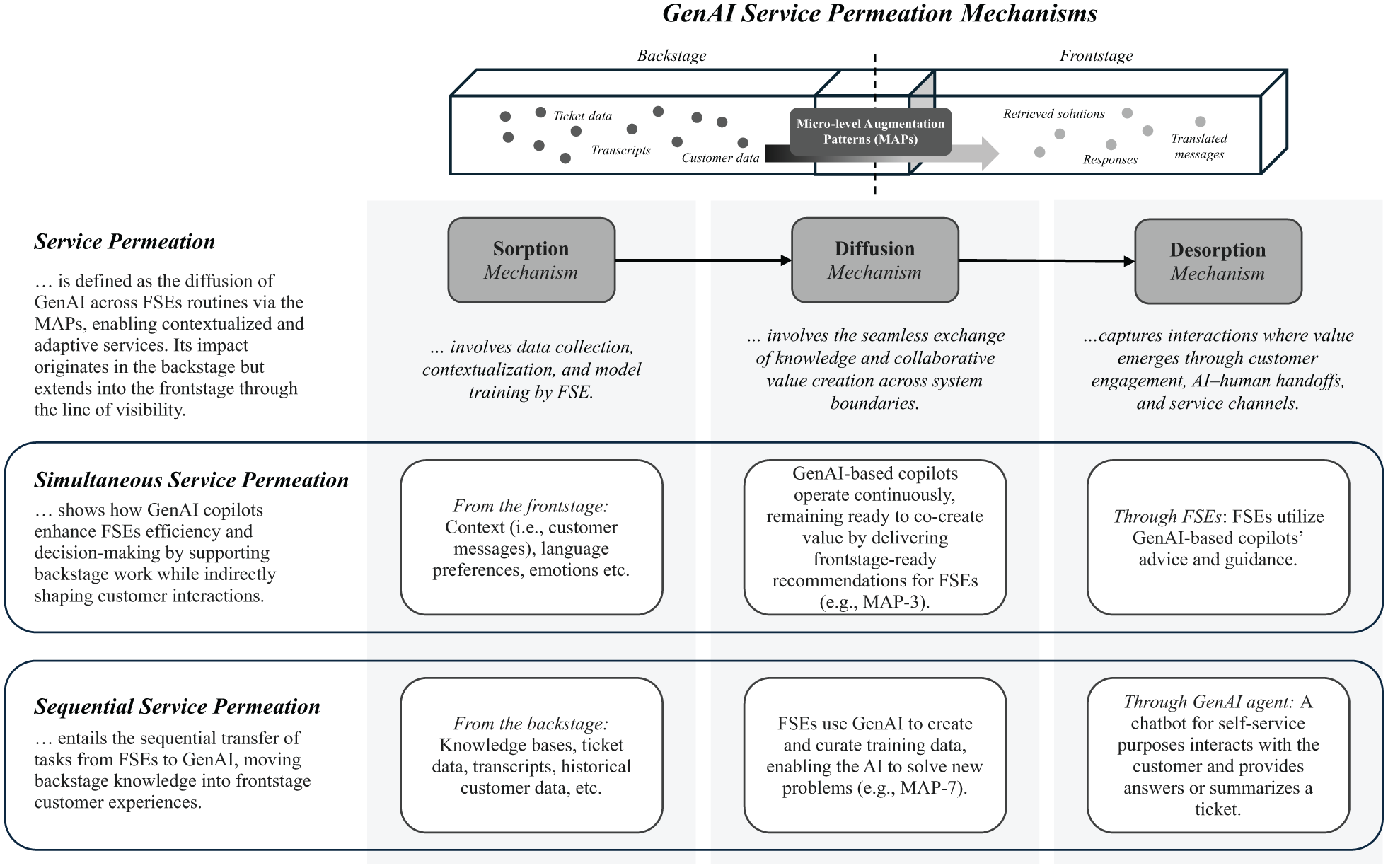
The mechanisms of GenAI service permeation.
Figure 2 depicts the MAPs across service routines and their positioning in the frontstage and backstage, separated by the line of visibility. The logic of this framework begins with understanding the underlying service routines, proceeds to identifying and implementing problem–solution pairs that constitute the MAPs, and ultimately translates the impact of GenAI on the service delivery journey at the frontstage through the mechanisms of service permeation. The arrows indicate how the patterns and resulting services permeate service delivery. According to our systematization of the MAPs and our concept of service permeation, we found two recurring instances of service permeation mechanisms:
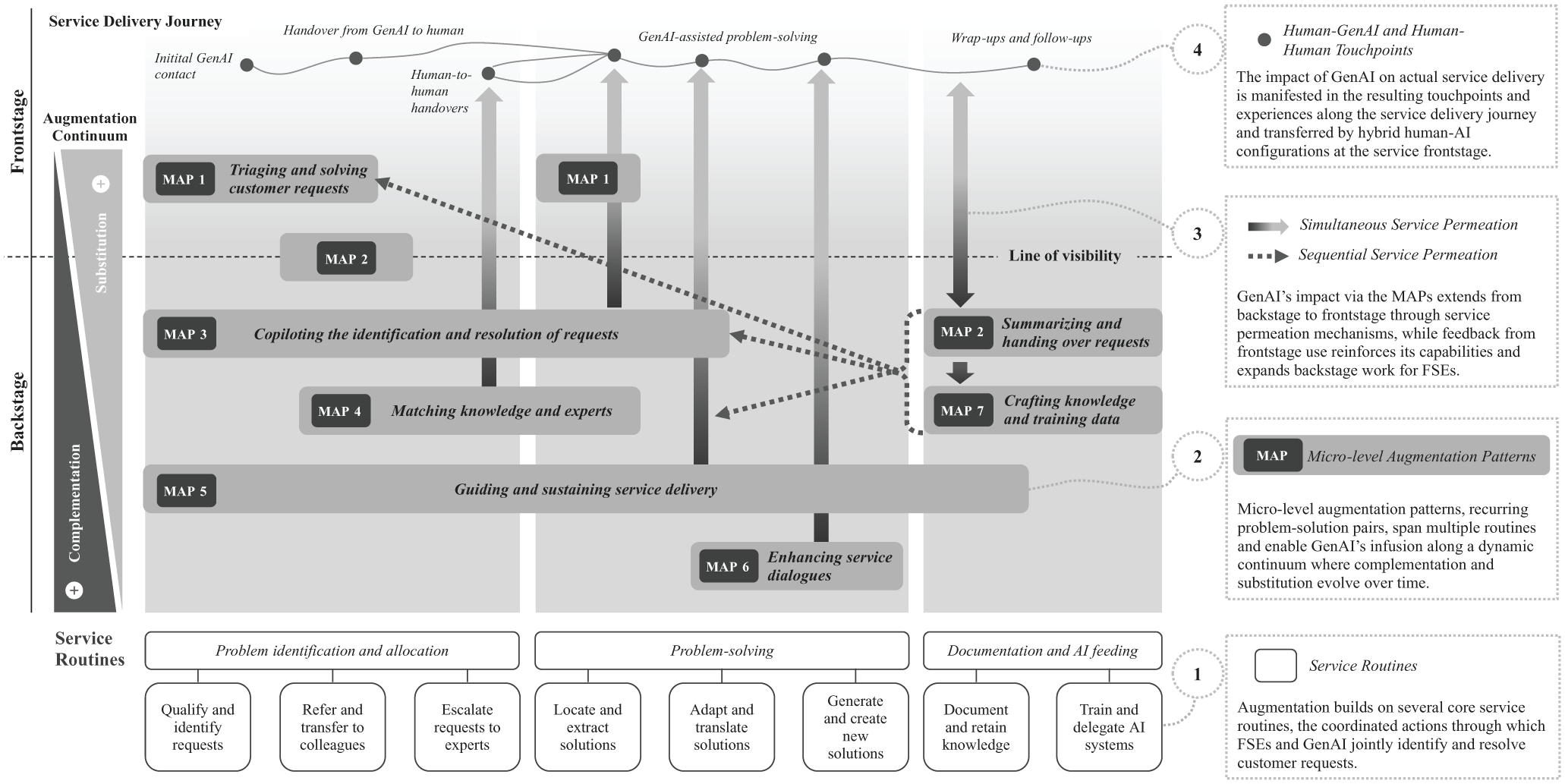
MAP-enabled service permeation in GenAI-infused service delivery.
Simultaneous Service Permeation Mechanism
The service backstage represents the focal point of GenAI’s greatest potential to impact the customer experience. While prior research has emphasized the AI frontstage (e.g., self-service, chatbots) (McLeay et al. 2021; Schepers et al. 2022), our results foreground the design of human–AI collaborations to leverage contextualization and service adaptation. Accordingly, the GenAI-infused service backstage enables the frontstage of service delivery (Chen, Hsieh, and Chan 2024; Hogreve, Iseke, and Derfuss 2022), with GenAI becoming part of the moments of truth in which customers interact with FSEs and services are realized and delivered. The mechanism of simultaneous service permeation involves augmenting FSEs’ routines through the use of GenAI in real-time service delivery.
The results emphasize GenAI’s role in simultaneously assisting FSEs with decision-making and problem-solving: “That means any help an agent can get from us, such as receiving information pre-processed, pre-searched, and pre-prepared when the ticket is assigned to them, is immensely valuable.” (Interview 2.06). For example, MAP-3 aims to improve the efficiency and accuracy of resolution during interactions between FSEs and customers. MAP-4 delves into refining knowledge matching through GenAI tools that integrate decision support to provide real-time recommendations (Subramani et al. 2021). Complementing these advancements, MAP-5 synthesizes GenAI’s role in coaching and monitoring service delivery, offering tailored solutions and customization options based on customer sentiment and emotions. These insights advance understanding of simultaneous service delivery between FSEs and GenAI in service interactions, as well as the emerging role of agentic technologies in shaping service protocols (Murray, Rhymer, and Sirmon 2021). The interconnectedness of FSEs and GenAI highlights a shift toward more interactive and adaptive service configurations, in which GenAI-generated advice is permeating into the service frontstage: “I took some sample tickets from us and simply changed the ticket description [. . .] And then an email was sent directly to the customer, without me having asked for it. Even though I can’t technically assess whether everything in there is correct, I thought it sounded very good” (Interview 2.07).
Typically, service organizations aim to address GenAI’s limitations (e.g., hallucinations, lack of transparency) by having FSEs in control. However, GenAI-infused services face the challenge of FSEs’ overreliance on GenAI’s advice, driven by LLMs’ highly persuasive conversational capabilities, with ChatGPT serving as a notable example. Although FSEs interact with customers, GenAI’s backstage activities continuously spill into frontstage service interactions and influence customer experiences (e.g., by customizing writing styles and providing emotional support). Thus, initial backstage GenAI usage can indirectly influence the critical moments of truth in service interactions. Hence, service organizations must ensure human control and agency through novel mechanisms of human–AI collaboration: “As soon as we use large language models in real-time and send over actual customer data, the value increases dramatically because we can do things that were previously impossible. [. . .] At the same time, you take on a significant risk because the responses are no longer as deterministic as we are used to.” (Interview 2.08)
Sequential Service Permeation Mechanism
Sequential service permeation is characterized by the sequential delegation of tasks from FSEs to GenAI. It involves the indirect transfer of backstage knowledge and information into frontstage customer experiences, as exemplified by training self-service chatbots to enhance service interactions. Both automating service frontstage tasks (e.g., MAP-1, MAP-2) and augmenting service backstage processes (e.g., MAP-3, MAP-4) through GenAI depend on the quality of the underlying knowledge, data, and technological advancements. Hence, to enable sequential service permeation, a documentation and AI-feeding routine emerged to provide knowledge and data to GenAI and other FSEs, in which prior frontstage activities are absorbed into backstage routines. As a result of this mechanism and the emerging routines, FSEs employ implicit and hidden influence over service interactions performed by GenAI systems or by hybrids of FSEs and GenAI systems. This creates a cycle where past service interactions paired with the knowledge and adjustments of FSEs and GenAI influence and shape future GenAI-infused service interactions: “If a solution is found, the information should feed back into the AI so that it knows for next time: This is the solution we’ve already applied for two customers. Maybe it took ten loops with the customer this time, but next time it can go straight through.” (Interview 2.05).
Emerging documentation and AI-feeding routines involve preparing training data, while GenAI supports knowledge retention by synthesizing data from multiple sources and summarizing relevant ticket documentation (MAP-2). Moreover, GenAI’s capability extends to improving existing documentation by identifying and suggesting enhancements to low-quality tickets, prompting FSEs to complete missing information: “I imagine having new content, inputting it, and then letting the AI handle the rest. Of course, you have to ensure no nonsense or inaccuracies creep in, so correctness is maintained, but that becomes more of a maintenance task rather than creation.” (Interview 2.11). FSEs are augmented when crafting knowledge base articles and training data (MAP-7), leveraging GenAI to facilitate knowledge transfer and reduce data maintenance effort. This collaborative workflow enhances knowledge retention and reinforces FSEs’ ownership of the underlying data. Sequential service permeation also involves providing feedback and correcting inaccuracies to improve both customer-facing GenAI and its backstage infusion through the MAPs. Together, MAP-2 and MAP-7 act as a catalyst for the continuous learning and adaptation of GenAI models and services. Overall, FSEs’ routines have expanded to include supporting GenAI systems behind the scenes, complementing their traditional frontline service and customer interaction duties.
Discussion
As service delivery is increasingly being performed by both FSEs and GenAI, forming hybrid human–AI service teams (Le et al. 2025; Liu et al. 2024; Mortati and Viana Mundstock Freitas 2025), our study advocates for a micro-level, process-centric view of GenAI infusion by investigating service routines. Although the automation of FSE routines is crucial for managing high volumes of customer inquiries, practice and research must explore how to align humans and AI on a dynamic continuum of substitution and complementation (e.g., Blaurock, Büttgen, and Schepers 2024; Koponen et al. 2023; Marinova et al. 2017). Based on a longitudinal qualitative study involving 41 interviews, we provide empirically grounded implications for understanding GenAI’s impact on service routines, addressing both the service frontstage and backstage, as well as the mechanisms that link them (Bock, Wolter, and Ferrell 2020; van Doorn et al. 2023).
In response to RQ1, which explored the patterns of augmentation emerging through GenAI infusion, we identified seven MAPs mapped to stages of the customer service delivery process. In line with the literature on AI infusion, the patterns illustrate augmentation as a dynamic continuum of substitution and complementation (Baer, Waardenburg, and Huysman 2025; Marinova et al. 2017), but also refine the prior understanding by explaining how GenAI impacts the underlying service routines. Although self-services (e.g., chatbots, voice bots) are evolving into primary contact points for customers (McLeay et al. 2021), the findings show that GenAI infusion influences existing service routines at the service frontstage through its application in the service backstage (Hogreve, Iseke, and Derfuss 2022; Mortati and Viana Mundstock Freitas 2025). In this way, multiple configurations between FSEs and GenAI systems go unnoticed by customers. However, given the higher level of agency of GenAI and the ability of LLMs to provide frontstage-ready recommendations (Le et al. 2025; Liu et al. 2024), GenAI permeates the frontstage via the FSE-GenAI collaboration.
As part of answering RQ2, which asks how augmentation patterns impact frontstage and backstage service delivery, our study introduces the mechanisms of service permeation. By capturing multimodal data from both the service’s frontstage and backstage, GenAI enables contextualized, adaptive services. For example, when guiding service delivery through GenAI-based coaches (MAP-5), GenAI permeates the moments of truth through close collaboration with FSEs, who handle the actual service delivery. In terms of boundary conditions, this mechanism of simultaneous service permeation is especially relevant for high-touch, complex interactions that demand real-time decision support. It is most effective when customer requests are highly uncertain or variable, requiring adaptive responses beyond static protocols. Delivering such adaptive responses relies on the availability of real-time data streams, such as sentiment analysis and historical context, that allow GenAI to tailor its guidance. However, the persuasive nature of GenAI outputs and the risk of hallucinations necessitate strong human oversight. Thus, a key contingency for simultaneous service permeation is achieving appropriate reliance, balancing trust in GenAI advice with control to prevent overreliance. Our analysis also reveals emerging service routines related to documentation and AI feeding. To enhance GenAI’s flexibility at the service frontstage, FSEs act as domain experts, delegating tasks to AI while retaining knowledge for future use. This process represents sequential service permeation, in which FSEs indirectly influence customer experiences and service quality by contributing to GenAI’s knowledge base as part of a value co-creation process. Regarding its boundary conditions, sequential service permeation is most effective when driven by strong FSE motivation and supported by standardized templates or dedicated documentation assistance. Although GenAI augmentation (MAP-7) reduces these barriers, it does not eliminate them. Sequential service permeation is most effective in standardizable, knowledge-intensive tasks. However, both mechanisms rely on high-quality, well-integrated data sources, as GenAI’s generative nature may otherwise produce inaccurate or non-compliant outcomes.
Theoretical Implications
Our study makes two main theoretical contributions to the literature on hybrid human–AI service delivery (e.g., De Keyser et al. 2019; Marinova et al. 2017; Mortati and Viana Mundstock Freitas 2025). First, the seven empirically grounded MAPs refine the view of augmentation as a continuum of substitution and complementation by providing an integrative lens on the processual changes shaping service delivery across frontstage, backstage, and their intersections (Baer, Waardenburg, and Huysman 2025; Marinova et al. 2017). As a complement to high-level typologies and archetypes of service delivery (De Keyser et al. 2019; Huang and Rust 2018; Koponen et al. 2023), we provide a routine-level and process-centric perspective on augmentation and the configurations of human–AI hybrids. As such, our study is an important account for organizational routines theory (Feldman and Pentland 2003) as we demonstrate how this theory facilitates the exploration of augmentation and its implications for FSEs’ routines. The MAPs make explicit how routines shift from being performed primarily by FSEs to being part of a GenAI-infused service delivery process. Notably, GenAI augmentation does not follow a singular or uniform pattern (Henkel et al. 2020; Jia et al. 2024). Instead, it gives rise to multiple, evolving augmentation configurations throughout the service delivery process. Some MAPs predominantly reflect task substitution (e.g., MAP-1, MAP-2), whereas others capture complementary forms of augmentation that enhance rather than replace human work (e.g., MAP-3, MAP-5, MAP-6). Consequently, FSEs must continuously adapt to these shifting configurations of human-GenAI collaboration, challenging assumptions of predictable or standardized support (Liu et al. 2024).
Second, we empirically demonstrate that GenAI fosters a closer coupling between service backstage and frontstage, driven by two self-reinforcing service permeation mechanisms that enable the delivery of contextualized and highly adaptive services. Thereby, we not only complement prior studies in identifying AI’s impact in specific frontstage and backstage routines (Bock, Wolter, and Ferrell 2020; Mortati and Viana Mundstock Freitas 2025; Robinson et al. 2020), but also explain the mechanisms through which GenAI permeates services. Service permeation is reflected in mechanisms for simultaneous service permeation (e.g., copilots or GenAI-based coaches) and sequential service permeation (e.g., supervising AI systems or curation of training data). These propositions help explain the interplay between the service backstage and frontstage (i.e., service-profit chain) by highlighting that service experience is increasingly shaped not only by FSEs, but also by GenAI models, their underlying training data, and the contextual information they utilize (Chen, Hsieh, and Chan 2024; Hogreve, Iseke, and Derfuss 2022; Knote et al. 2020). We show that through GenAI infusion, the service delivery lifecycle and prior model of organizational routines in customer support services (Das 2003; Pentland 1992) is being expanded by a new type of service routine, termed documentation and AI feeding. New routines evolve for supervising, prompting, and feeding GenAI systems, through which FSEs indirectly influence service delivery. This introduces new FSE responsibilities and adds backstage tasks to core FSE delivery duties (Huang and Rust 2018; Wirtz et al. 2018). Despite limited attention to managing GenAI systems and data in service contexts, our study provides a foundation for examining sequential service permeation and its manifestations in routines and augmentation patterns.
Managerial Implications
Our research has important implications for service organizations, managers, and designers aiming to harness the potential of GenAI in customer support and beyond. By introducing MAPs and the mechanisms of service permeation, we provide actionable guidance for integrating GenAI into both frontstage and backstage service routines and managing the continuum of substitution and complementation. Service leaders should design GenAI deployment strategies that emphasize backstage utility while preserving the human touch and controlling quality in customer-facing interactions. Our findings indicate that GenAI delivers contextual value when applied to backstage functions such as summarizing tickets (MAP-2), copiloting decision support (MAP-3), or coaching FSEs during service delivery (MAP-5). Managers should move beyond viewing GenAI as just an automation tool and recognize it as an active service actor, one that collaborates with FSEs in real time, supports decision-making, and continuously enhances service routines through knowledge sharing. With greater autonomy, agentic AI is likely to combine and amplify these patterns, enabling more sophisticated orchestration of GenAI-augmented service routines. Thus, MAPs not only offer a lens for understanding current GenAI-infused services but also serve as a foundation for designing and improving future autonomous agents and multi-agent systems, ensuring their continued relevance in increasingly agentic service contexts.
With its generative and agentic traits, GenAI blurs the boundaries between the service frontstage and backstage, a phenomenon we conceptualize as service permeation. Managing this permeation requires balancing augmentation benefits with human oversight and acknowledging the duality of GenAI’s impact (Ferraro et al. 2024). On the one hand, GenAI systems can produce highly persuasive yet hallucinated outputs, heightening the risk of overreliance during simultaneous service permeation. To mitigate such risks, firms should establish guardrails, including escalation thresholds, transparency protocols, and explanation cues, across autonomous chatbots (MAP-1) and collaborative copilots (MAP-3). Practitioners must also ensure that FSEs critically engage with GenAI recommendations and continuously refine models and data (MAP-7). Conversely, GenAI can itself function as a guardrail by identifying inconsistencies (MAP-5) or inappropriate communication (MAP-6) that might otherwise escape human attention (Henkel et al. 2020; Luo et al. 2021). For example, MAP-7 enhances documentation and data quality, fostering knowledge transfer and model improvement. Managers should therefore regularly assess the extent and quality of service permeation across the delivery process to detect infusion gaps and guide strategic adjustments that sustain human accountability and service excellence.
As service permeation becomes a critical driver of service performance, organizations should invest in workforce development initiatives that equip FSEs to collaborate effectively with GenAI systems. Decision-making by GenAI systems, and their reliance on curated frontline data, leads FSEs to take on expanded roles as co-creators and knowledge curators (Li et al. 2024). This includes developing judgment on when to act on or override AI recommendations and establishing routines for documenting, annotating, and refining service knowledge, practices that drive sequential service permeation and support continuous system learning. While our findings suggest that GenAI increasingly augments interpersonal communication and emotional expression (e.g., Brynjolfsson, Li, and Raymond 2025; Henkel et al. 2020), the skill demands for FSEs are evolving. Greater emphasis is now placed on domain knowledge and technical proficiency to ensure accurate service delivery. In addition, competencies such as AI literacy, context engineering, and prompt engineering are becoming essential for effectively managing and leveraging GenAI-infused services (Knoth et al. 2024). In conclusion, service organizations must equip FSEs with the skills to manage, guide, and improve GenAI interactions.
Limitations
While our study provides valuable contributions to the literature and practice, certain limitations must be acknowledged. A key limitation of this study is its empirical scope, as it focuses on four organizations within a single industry. While our approach followed qualitative research criteria for reliability and validity, the sampling limits the generalizability of the findings. In particular, we focused on technical customer requests, a sector promising the potential of GenAI infusion. Broadening the scope of this research to include various customer service domains, such as sales, general non-technical customer care, and contact centers, would shed light on the adaptability of GenAI-augmented service practices. Moreover, despite the variety of service organizations, digital services, and service channels, the derived patterns are not exhaustive. Our study’s reliance on qualitative data and subjective perspectives introduces an inherent bias, and the small number of AI experts consulted may not fully represent the field. For example, our interviews did not explicitly address multi-agent systems and agentic AI (Acharya, Kuppan, and Divya 2025), which only began to emerge and gain relevance for scaling GenAI infusion after our second interview series. Nevertheless, we argue that the identified MAPs are not made obsolete by technological progress. Instead, they capture fundamental augmentation logics that remain relevant as agentic AI evolves.
Finally, the timing of our first interview series, conducted during the COVID-19 pandemic, might have influenced the results, as the pandemic temporarily increased demand for support. However, according to a recent survey by McKinsey (2024), it appears that the heightened demand for customer requests has persisted despite the end of the pandemic and the use of chatbots. Although we only took into consideration the current state-of-the-art GenAI models (i.e., GPT-4) (2023–2024) and might be challenged by new technological breakthroughs (e.g., AI agents, agentic AI, and multi-agent systems) (Acharya, Kuppan, and Divya 2025; Pan et al. 2025), our results offer other researchers a basis for managing future emerging technologies.
Avenues for Future Research
Our contributed empirical foundation, comprising the MAPs and the mechanisms of service permeation, provides a basis for guiding future research on hybrid human–AI service delivery. Future research should conduct an in-depth exploration of specific problem-solution pairs and augmentation patterns, especially with a focus on assessing their practical effectiveness across different service settings. Each MAP offers a separate avenue for future research, illustrated by the exemplary research questions in Table 3. A promising area involves the analysis of prompts formulated by FSEs. Such research could comprise collecting, categorizing, and evaluating these prompts and recurring prompt patterns. This approach would deepen understanding of FSE–GenAI collaboration and contextualize the MAPs and emerging routines.
Furthermore, service permeation and the two identified mechanisms open promising avenues for future research and call for deeper empirical and theoretical exploration. First, future work should advance the theoretical understanding of service permeation itself by examining its underlying dynamics, boundary conditions, and long-term implications. This includes exploring how GenAI-driven information diffusion unfolds across the service frontstage and backstage, and how this reshapes routines, roles, and value co-creation. Second, researchers should investigate the distinct mechanisms of simultaneous and sequential service permeation. While simultaneous service permeation emphasizes real-time augmentation of FSEs through GenAI recommendations, sequential service permeation highlights iterative learning and knowledge transfer over time. Understanding when and how these mechanisms emerge and interact can offer deeper insights into human–AI hybrids. Third, we encourage exploring AI delegation systems as a conceptual extension of the sequential service permeation mechanism. This includes examining how responsibilities and tasks are distributed, escalated, or retained between GenAI systems and FSEs, how delegation impacts trust and control in service interactions, and how these arrangements configure agency (Bartelheimer et al. 2025). Fourth, further research is needed on the customer-facing implications of permeation, particularly how GenAI-generated language, decisions, and emotional cues permeate frontstage interactions and influence customer perceptions. Finally, future studies should analyze how service design and governance structures can adapt to facilitate the compliant and valuable permeation of services, ensuring the responsible deployment of GenAI while enabling continuous learning and human oversight throughout the service system.
In sum, our study provides a process-centric foundation for understanding how GenAI augments FSEs’ service routines, offering empirically grounded patterns and mechanisms that future research can build upon.
Supplemental Material
sj-docx-1-jsr-10.1177_10946705251414283 – Supplemental material for GenAI-Infused Service Delivery: Micro-Level Augmentation Patterns at the Service Frontline
Supplemental material, sj-docx-1-jsr-10.1177_10946705251414283 for GenAI-Infused Service Delivery: Micro-Level Augmentation Patterns at the Service Frontline by Philipp Reinhard, Mahei Manhai Li, Christoph Peters, Andreas Janson and Jan Marco Leimeister in Journal of Service Research
Supplemental Material
sj-docx-2-jsr-10.1177_10946705251414283 – Supplemental material for GenAI-Infused Service Delivery: Micro-Level Augmentation Patterns at the Service Frontline
Supplemental material, sj-docx-2-jsr-10.1177_10946705251414283 for GenAI-Infused Service Delivery: Micro-Level Augmentation Patterns at the Service Frontline by Philipp Reinhard, Mahei Manhai Li, Christoph Peters, Andreas Janson and Jan Marco Leimeister in Journal of Service Research
Footnotes
Declaration of Conflicting Interests
The authors declared no potential conflicts of interest with respect to the research, authorship, and/or publication of this article.
Funding
The authors disclosed receipt of the following financial support for the research, authorship, and/or publication of this article: This research was funded by the German Federal Ministry of Education and Research (BMBF) and supervised by PTKA (Project HISS, 02K18D060).

Supplemental Material
Supplemental material for this article is available online.