




Abstract
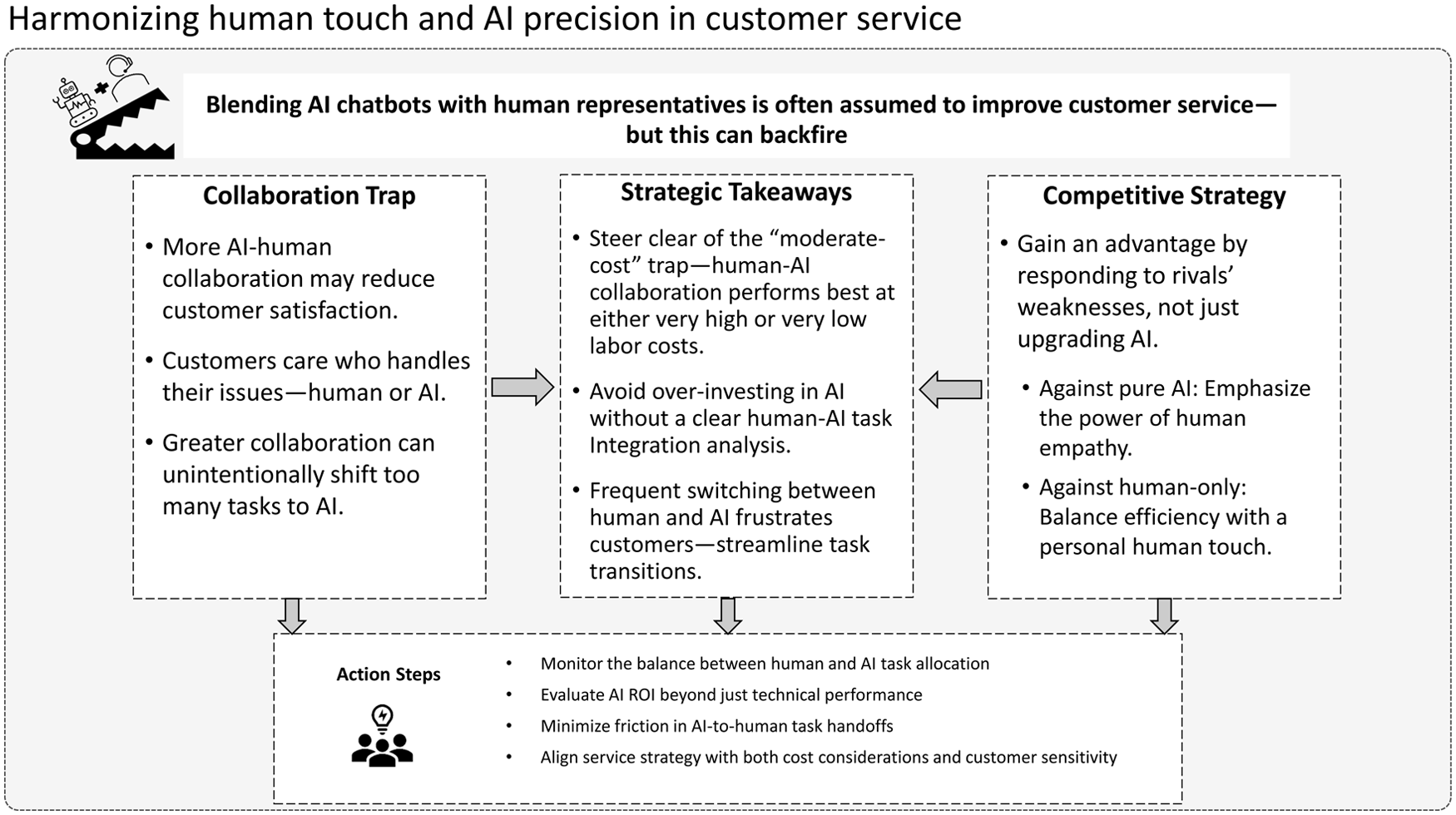
Artificial intelligence (AI)-powered chatbots offer a cost-effective solution for customer service, but often fall short in delivering personalized or complex interactions. In response, many merchants invest in AI training and explore human–AI collaboration to leverage the strengths of both automation and human touch. However, this introduces a strategic tradeoff between service quality and operational efficiency. Using a game-theoretic framework, this study examines how merchants can optimally choose service strategies with AI involvement. Our analysis reveals a critical collaboration trap. Contrary to the prevailing belief that increased collaboration consistently enhances service, consumers’ sensitivity to the identity of the service agent erodes profitability, and greater collaboration will worsen this effect by accelerating task delegation to AI, thereby amplifying negative consumer perceptions. Furthermore, the study shows that a moderate-cost collaboration trap emerges: human–AI collaboration underperforms compared to human-only service when labor costs are at intermediate levels. Collaboration yields benefits only when labor costs are either very low or prohibitively high. In competitive markets, merchants can gain a strategic advantage not by enhancing their own service quality, but by capitalizing on rivals’ inefficient AI deployment. These findings challenge the assumption that more human–AI collaboration is always better and provide actionable insights for managing hybrid service strategies and optimizing AI investments.
Keywords
Get full access to this article
View all access options for this article.
References
Supplementary Material
Please find the following supplemental material available below.
For Open Access articles published under a Creative Commons License, all supplemental material carries the same license as the article it is associated with.
For non-Open Access articles published, all supplemental material carries a non-exclusive license, and permission requests for re-use of supplemental material or any part of supplemental material shall be sent directly to the copyright owner as specified in the copyright notice associated with the article.
