



Abstract
This exploratory study examines the nexus between blockchain and collaboration towards sustainability, which has been largely understudied despite advances in understanding blockchain technology. The urgency of sustainability objectives presents an opportunity to explore blockchain’s potential as a collaboration enabler. The study investigates the opportunities and challenges associated with blockchain’s use in this context to understand the relevance and conditions for its adoption. The research draws on original survey data and insights from expert interviews, making two significant contributions: (i) expanding on the limited literature on stakeholder perceptions of blockchain, and (ii) providing a framework outlining the conditions under which blockchain may support stakeholders initiate, manage and evaluate collaborative activities. The study’s findings are illustrated with reference to the challenges of broadening and deepening collaboration towards sustainability and can inform decision-making processes related to the adoption of blockchain technologies.
Introduction
Since sustainability as a global policy imperative emerged as “meeting the needs of the present without compromising the ability of future generations to meet their own needs” out of Brundtland Report more than three decades ago, 1 it has been integrated into numerous cross-sectoral and global goals, perhaps most prominently in 2015 Sustainable Development Goals (SDGs). However, the concept of sustainability subsumes multiple normative dimensions between competing priorities, and can become nebulous when applied in practice. 2 To this day, there is still a fundamental lack of clarity over what is deemed ‘sustainable’ – just as many standard setting bodies in various domains from finance to electricity generation still grapple with defining what is ‘clean’ or ‘green’ – hindering robust measurement of progress.
The sheer breadth of actions required to address sustainability objectives can be a further impediment to advancement. Even when singling out one of the challenges – for instance, climate change – there is an enormous variation in issues and proposed solutions. 3 Given the interdependence within complex web of economies, it is beyond a purview of a single actor to deliver sustainability objectives alone, regardless of its size, capacity and influence. In this context, it is welcome that many collaborative inter-organisational and cross-sector projects aiming to advance sustainability are already under way. However, a wealth of scholarships has explored endemic challenges of initiating, sustaining and evaluating the outcomes of collaboration, which can be “often frustrating… (although sometimes exhilarating)”. 4
In light of these challenges, there is an emerging literature in organisation science and economics exploring blockchain technologies as a new governance mechanism of collaboration, which can complement, or in some cases replace, traditional contract and complement relationship management. 5 While there is no universal definition of blockchain due to its variety and design features on who can access and add information, blockchain can be understood as a type of data structure, 6 in which sequenced blocks of data are cryptographically chained. 7 The advent of blockchain has also reified ‘smart contracts’; the hitherto hypothetical idea of automatically executed contracts based on pre-defined criteria. 8 Meanwhile, blockchain's potential for enhancing sustainability has been extensively explored, particularly in making supply-chain more sustainable through enhancing traceability. 9
Despite the advances in understanding the use cases of blockchain technology, there appears to be a lack of insight on the nexus of blockchain, collaboration, and sustainability. The all-encompassing and urgent nature of sustainability objectives makes it suitable for examining blockchain's perceived and real role as an enabler of collaboration. To address this gap, this study is guided by three research questions:
What are the opportunities and challenges of blockchain in collaborative activities within and across sectors?
How is blockchain perceived across sectors?
What are the circumstances under which blockchain can be most useful for enabling collaboration towards sustainability?
Given the wealth of literature available on the first two questions, the focus of this study is the last question, and existing insights are illustrated in the context of bourgeoning multistakeholder initiatives aiming to enhance sustainability. Addressing the overarching research questions, this study makes two substantive contributions: (i) Drawing on original survey and insights from expert interviews, it adds to the limited literature on the stakeholder perspective on the nexus of blockchain, collaboration and sustainability; (ii) conceptually, it reconciles the existing literature with survey and interview findings and proposes a framework outlining conditions under which blockchain might help stakeholders initiate, manage and evaluate collaboration while building in an accountability mechanism.
This paper is structured as follows: The first section outlines the research methodology. The second section introduces emerging insights from the literature. The review of the literature is supplemented by findings from expert interviews on their experience applying blockchain-enabled solutions. The third section presents our survey findings. The fourth section discusses these findings and provide a decision framework for the use of blockchain. The paper concludes by highlighting limitations of the research and suggesting further areas of studies.
Methodology
This study has an exploratory nature and relies on rapid review of literature, semi-structured interviews, and an original survey.
The rapid review of literature was conducted using keywords including ‘blockchain in public-private partnerships’, ‘blockchain in cross-sector collaboration’, and ‘blockchain and outcome-based contracts’ on ScienceDirect, Google Scholar and web search. We reviewed both academic and grey literature written in English. Recent publications were strongly prioritised, and the review favoured policy relevant evidence while excluding purely technical literature in engineering and computer science as well as evidence exclusively focused on cryptocurrencies.
Semi-structured exploratory interviews were conducted between September 2022 and January 2023. Fifteen participants were selected using purposive sampling to identify stakeholders involved in design and/or implementation of blockchain-enabled projects across a range of domains and sectors, deploying blockchain for instance in carbon registries and humanitarian assistance. In addition, snowball sampling was used to gain insights into the technology's diverse applications. All interviews lasted approximately an hour and followed a similar structure, exploring features of the blockchain application, implementation risks and challenges and the rationale on choosing blockchain over other established technologies. All interviews were held virtually and conducted as panel interviews with more than one member of the research team present to facilitate note taking and probing to clarify responses.
An online anonymous survey of practitioners and relevant stakeholders was conducted for eight weeks between December 2022 and February 2023 using an online survey software tool (Qualtrics). The survey was disseminated across the Government Outcomes Lab (research programme within the Blavatnik School of Government, University of Oxford), Chartered Institute of Public Finance and Accountancy (CIPFA), World Commerce & Contracting (WCC) and Apolitical networks to maximise the reach of the study. The survey was intended to gather insights on stakeholder perspectives and experiences with blockchain technology, in order to evaluate its practical implications. To ensure a representative sample, the survey was distributed through membership-based platforms that cater to practitioners in relevant sectors. Specifically, the survey was disseminated to members subscribed to the newsletters of these organisations, in order to maximise its reach and engagement. The survey was deployed through platforms that were more likely to attract public sector respondents, resulting in a significant proportion of the 110 total respondents being from the public sector. Of those respondents, 62 finished more than 75% of the survey, meeting the inclusion threshold and representing a 87% local or central governments. The survey was designed and disseminated without assuming prior knowledge of blockchain or other emerging technologies, which helped to mitigate the risk of bias. Despite the efforts made to gather a diverse range of opinions on blockchain technologies, nonresponse bias may still exist in the survey results, as those who are not interested in the technology may have been less likely to participate. Overall, the survey offers preliminary insights into stakeholders’ perceptions towards blockchain technologies.
Emerging insights
This section provides insights from the evidence review and expert interviews examining blockchain's potential in addressing endemic challenges of collaboration towards sustainability. It then discusses the challenges of applying blockchain in practice and its limitations to support collaborative activities towards sustainability.
Blockchain opportunities for collaboration towards sustainability
The sustainability objectives such as SDGs have permeated policy discourses, corporate reporting, and NGO's mission statements. However, the ubiquity of sustainability-related lexicon has not yet translated into conceptual clarity to facilitate collaboration. 10 Scholarship across disciplines also points to the siloed nature of current landscape of sustainability partnerships that fall short of integrating multiple pillars of sustainability, calling for deeper understanding of the role of collaboration in enacting broader and lasting transformation. 11 Despite the increased launch of multistakeholder initiatives, an assessment of past partnership activities under the Millennium Development Goals (MDGs), a predecessor to the SDGs, suggests that many have not lived up to their stated ambitions. 12
In light of these challenges, insights from literature and interviews suggest that blockchain may contribute to antecedent conditions for successful partnerships towards sustainability. While blockchain does not appear to play a direct role, our study suggests that blockchain may act as a collaboration ‘primer’ by enhancing data visibility and transfer, improving transparency, and in some cases, automating enforcement of sustainability initiatives.
Enhancing Data Transfer Improving Transparency and Accountability Lower Uncertainty and Transaction Costs: Sustainability's interpretative flexibility is a key factor in its appeal.
27
However, although this flexibility helps to mobilise collaboration, meaningful operationalisation of the concept of sustainability requires an explicit understanding of its context-specific implications. In the case of certain types of collaborative sustainability projects, blockchain technology may offer additional efficiency gains through streamlining the processes via smart contracts. By automating the contract execution, blockchain-enabled smart contracts can reduce behavioural uncertainty. This addresses the resultant difficulty in ascertaining contractual compliance,
28
thereby offering strategic advantages.
29
Lumineau, Wang and Schilke
30
suggest that immutable records and automated enforcement enabled by smart contracts built on blockchain can reduce both the ex-ante and ex-post transaction costs through lowering searching, monitoring and enforcement costs. The authors further argue that efficiency gains of using blockchain is higher when the outcomes are explicitly defined and easily verifiable, because explicit outcomes lend themselves more easily to codification in a programming language (e.g., outcome-based financing).
31
Relatedly, procurement and contracting scholars argue that common guiding principles (such as sustainability) can reduce contractual disputes.
32
The explicit nature of blockchain-based smart contract seems to provide anchors of collaboration by operationalising guiding principles and helping to reduce uncertainty. Importantly, lower transaction costs may lead to collaboration previously perceived to be too risky. Blockchain-enabled synchronised understanding can help address the capital shortfall in sustainable infrastructure, for which environmentally conscious technology are typically perceived to be riskier, by lowering transaction costs and aligning the risk-return expectations among cross-sector stakeholders.
33
Blockchain challenges and limitations
Despite the promising opportunities of blockchain, there are key challenges and limitations that may hinder its role in collaboration for sustainability objectives in practice. These challenges relate to operational and technological issues, but also concern for new power dynamics. While these limitations apply across many blockchain-based projects, they may be amplified in collaboration towards sustainability, raising important questions as to its utility. These are further described in the below.
Implementation challenges: Blockchain faces operational challenges during implementation and governance of collaboration, raising a new set of challenges and trade-offs at various levels of governance
34
and potentially requiring more time and resources for designing blockchain-enabled solutions.
35
Interviewees highlighted designing a blockchain-based project requires the definition of clear goals at the outset, implying codification at the cost of flexibility. While this can provide efficiency gains when the outcomes are explicit and underpinned by an existing broad agreement as to how the success of collaboration is measured, the loss of flexibility can compromise the collaboration, as it eliminates the room for navigating complex trade-offs that emerge in dynamic processes of collaboration.
36
Getting the right level of precision is a balancing act – too high and it would foreclose the room for interpretation, but too low and it would allow discretion to creep in.
37
In addition, interviewees also mentioned a significant organisational resistance to changing data storage and challenges in gaining a wide-spread buy-in among stakeholders. These governance challenges may be particularly acute for smart contacts. While simple and transactional contracts may lend themselves to formulaic translation into an ‘if-then’ computer code, it may be impractical, if not impossible, for long-term and complex contracts to be translated into an algorithm. In practice, when partnerships are formalised through contracts such as in the case of public–private partnership projects lasting over decades, contracts are inevitably incomplete due to high level of uncertainties. As a result, transaction costs of forming explicitly and precisely defined smart contracts – even if we assume such complete contracts are possible – may be higher than traditional contracts.
38
This may be particularly problematic for aspects of sustainability that are less amenable to codification, such as the social dimension that has historically been overlooked.
39
In some cases, the use of blockchain technology may actually hinder collaboration by limiting the opportunity for different norms to be contested and ultimately converged upon organically within the group.
40
Experts interviewed highlighted that blockchain cannot resolve the competing interpretations of normative concepts such as social justice and equality that cannot – and indeed should not – be reduced only to quantified and codified metrics. Technological limitations New power dynamics among stakeholders: Power imbalances resulting from differences in resources and capacity is detrimental to collaboration towards sustainability.
47
Given the tensions between multiple dimensions of sustainability, striking a balance between involving influential stakeholders to mobilise action and ensuring less resourced actors (and beneficiaries) also gain from partaking in collaboration is particularly challenging. Decentralisation enabled by blockchain may not necessarily result in more equal relationships as envisioned, particularly as it may create a new gulf between the ‘code-savvy’ and the ‘code-naïve’.
48
Contrary to the claims about distributing power, some use cases demonstrate that the technology instead recentralise power by shifting them to new third parties.
49
Even though blockchain in principle can enable parties to work together without trusting one another, the mutual vulnerabilities and interdependence created by joining a blockchain network can demand conventional social trust in practice to reap the benefits.
50
These power dynamics may be detrimental to, for instance, social dimension of sustainability given that there are already certain demographic groups whose voices are marginalised. Given the presence of implementation challenges and technical limitations described, blockchain alone cannot be an antidote to power asymmetry in collaboration.
Survey findings
Emerging insights from the literature and expert interviews suggest that blockchain's potential to contribute to lay the ground for collaboration towards sustainability can be substantial, but a more contextualised understanding of the technology is needed to separate viable use cases from hype and unrealistic expectations. Moreover, the implementation challenges and technological limitations of blockchain point to the need to better engage with practitioners’ perspectives to inform the adoption of the technology. To address this gap, an anonymous online survey was designed drawing on existing literature on collaboration, blockchain and sustainability with an aim to bridge these nexuses. The primary focus of the survey was to gain empirical insights into stakeholders’ perception and experience of applying blockchain to help address the challenges of collaboration.
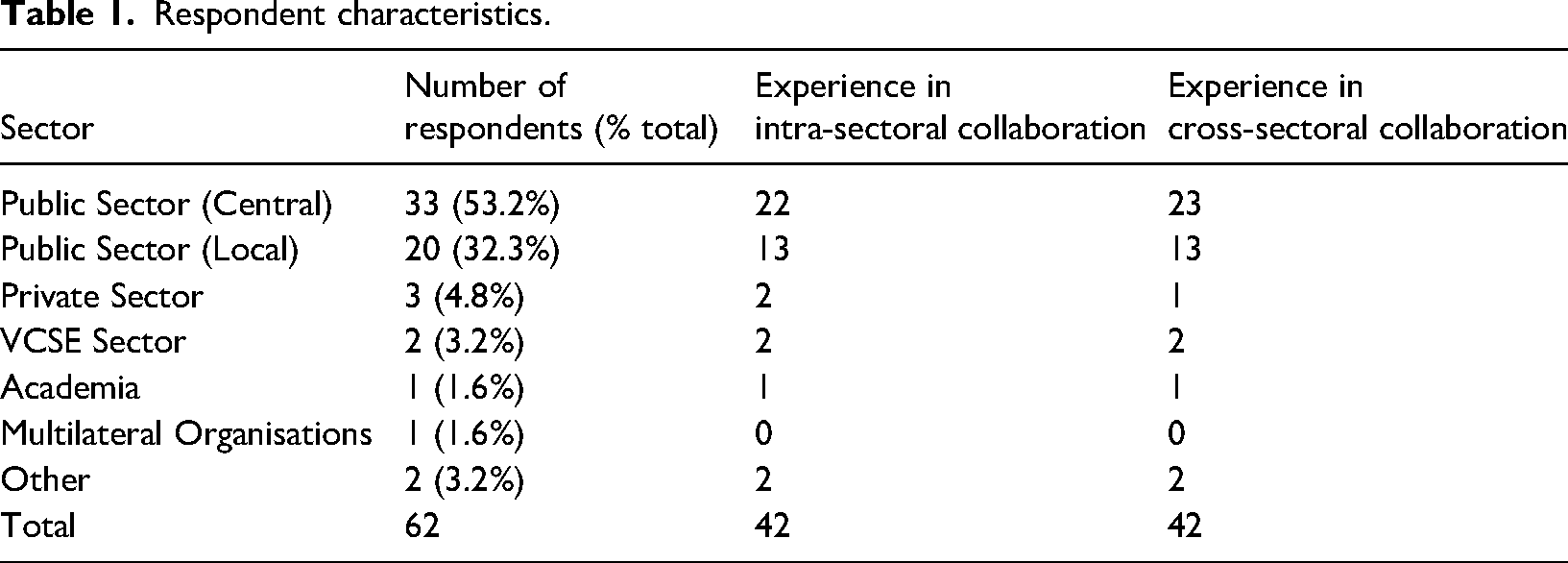
There were 110 respondents in total with 62 of them finishing more than 75% of the survey (the threshold for inclusion). As presented in Table 1, respondents were from public sector (national 53.2%, local 32.3%), private sector (4.8%), Voluntary, community, and Social Enterprise (VCSE) (3.2%) and academia (1.6%). Overall, 67.7% of respondents have experience engaging in intra-sectoral collaboration or cross-sector collaboration, with 56.5% stating that they have experience in both types of collaboration. Among those with experience in collaboration, 64.3% (cross-sector) and 35.7% (intra-sectoral) said the project was formalised by a contract. With respect to familiarity, 9.7% of respondents claimed ‘extreme familiarity’ with blockchain, while 6.5%, 29%, 38.7%, 16.1% reported ‘very familiar’, ‘moderately familiar’, ‘slightly familiar’, and ‘not familiar’ respectively.
Respondent characteristics.
Is blockchain a disruptive technology?
A multitude of adjectives have been used to capture the impact of blockchain, characterising the technology as ‘foundational’, 51 ‘disruptive’, 52 and even ‘transformational’. 53 Some point to the ideological underpinning, positing blockchain as a philosophical mindset rather than a tool, 54 while others highlight blockchain as a process-oriented innovation that changes the organisational approach to delivering objectives. 55 Societal attitude can be indicative of subsequent implementation and establishment of technologies, since it influences adoption via various channels such as through optimistic valuation of blockchain-based start-up companies. 56 Reflecting blockchain's reputation as an innovative technology, more than half of the respondents (58.1%) consider blockchain as a disruptive technology. However, a closer look into the results reveal a varied nature of perception depending on respondents’ familiarity with the technology (see Figure 1). For instance, among those respondents who are very or extremely familiar with blockchain technologies (n = 10), the opinions were divided, with half of the respondents agreeing that blockchain is a disruptive technology. In contrast, 58.8% of respondents who are not familiar or slightly familiar with blockchain (n = 34) saw it a disruptive technology, while 8.9% disagreed. Unlike those familiar with the technology, respondents in this group revealed a greater ambiguity; 32.4% indicating ambivalence towards the disruptive nature of the technology. These results describe the self-assessed level of knowledge, and we are unable to draw a firm conclusion on the perceived potential of blockchain from this data alone. However, these results highlight the varying level of knowledge and the potential existence of hype and ambivalence surrounding the technology.
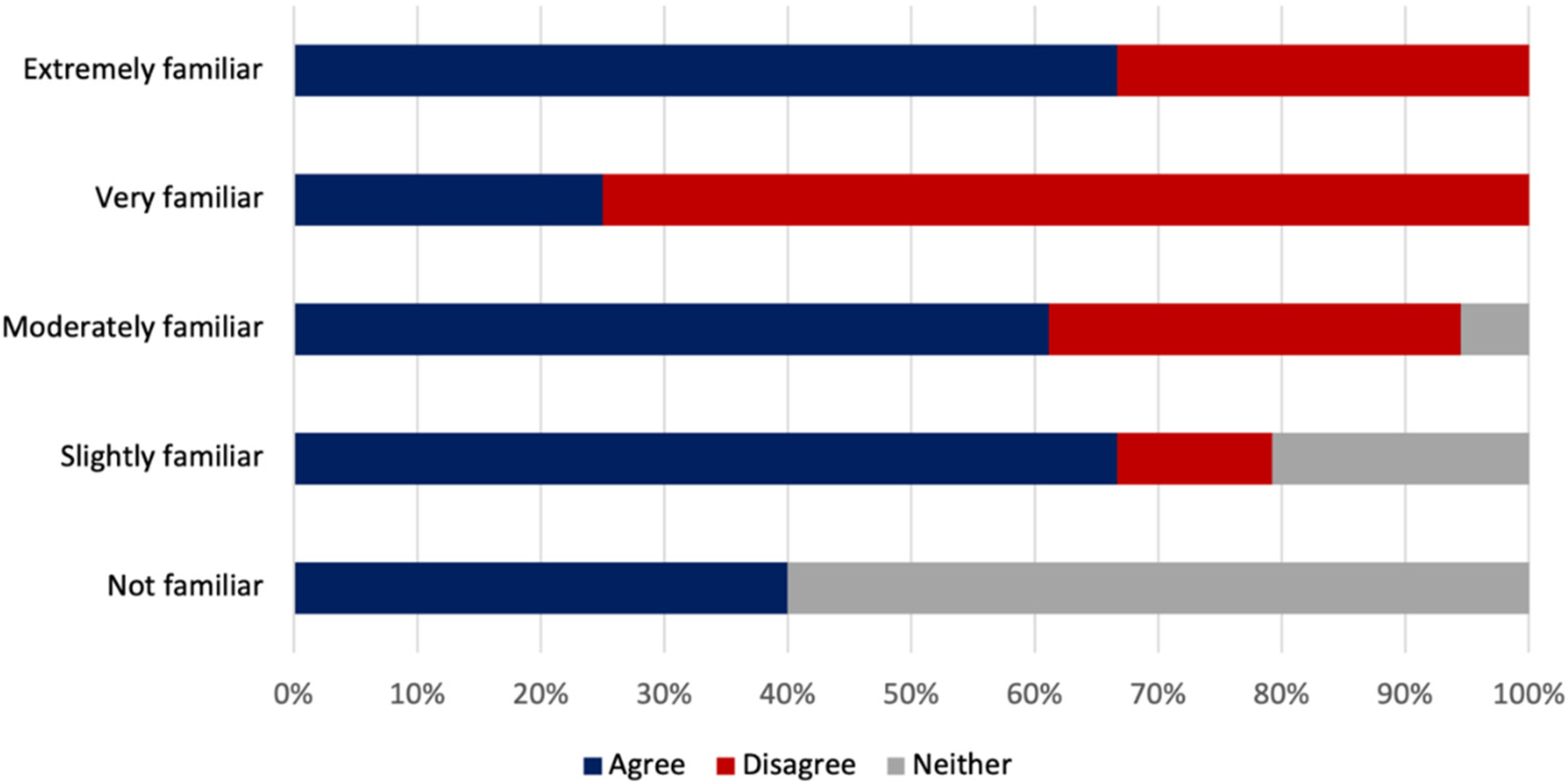
Proportion of respondents stating blockchain is a disruptive technology by the level of their stated familiarity.
What are the perceived key advantages of blockchain?
While the properties of blockchain vary widely across applications, Ali et al. 57 propose that the resultant advantages can be categorised into informational (e.g., data integrity), technological (e.g., automation, speed, and security), organisational (e.g., transparency, ownership and control), strategic (e.g., preventing fraud) and economic (e.g., cost reduction) advantages. According to our survey, 30.7% of respondents identified informational advantages as a central benefit. Further, respondents reported technological (17.7%), organisational (16.1%), strategic (14.5%) and economic advantages (3.2%). 17.7% of participants indicated that they were unsure on blockchain’ key advantage. However, there is a degree of scepticism around the added value of blockchain. A few respondents stated in open text responses that many proposed use cases do not actually require blockchain. These responses may reflect the presence of the ‘blockchain paradox’ - while blockchain seemingly provides a means to do away with governance, it needs governance to function well; but once the problem of governance is solved, blockchain can become unnecessary. 58
Relatedly, open text responses from public sector representatives indicated doubts on the value for money of blockchain in times of increasing budgetary pressures. Public sector decision making to invest in technology needs to consider the risk that the benefits may not materialise and become visible until long after the initial investment. In this context, a respondent stressed the need for government for responsive and simple solutions that work now, and cautioned against the conflation of government resources used for procurement and research and development.
Experience using blockchain
While there are bourgeoning blockchain-based initiatives across domains and jurisdictions, many of them tend to remain in pilot and prototype stages, suggesting that adoption is yet limited across sectors. In our survey, only a small minority of respondents (8%) applied blockchain to overcome the challenges associated with collaboration. However, there is some interest across respondents (16.1%) to apply blockchain to support their collaborative activities in the future; 40% of these respondents stated they would do so within the next two years. This suggests that there is a strong appetite for implementing solutions in the near-term.
Moreover, respondents reported the following challenges in collaboration were addressed through adopting blockchain (i) time and resources to build and maintain relationships (n = 3), (ii) overcoming cultural differences (n = 2), (iii) attributing the outcomes to collaborative activities (n = 2), and (iv) drawing up and negotiating terms of activities (n = 1). Regarding key challenges in adopting blockchain, respondents identified lack of skills and capacity within organisations as a key challenge (n = 4), followed by lack of interoperability with existing infrastructure (n = 3), lack of organisational commitment and buy-in (n = 2). Practitioners mitigated the implementation challenges by conducting a pilot first (n = 2), drawing on existing practice in the industry (n = 2) and hiring consultants (n = 2).
Since functionality alone does not justify adoption, especially where alternative measures exist, the survey further probed respondents’ views on the perceived value of blockchain by asking whether blockchain was viable (i.e., it was suitable for the purpose), valuable (i.e., provided the added value) or vital (i.e., only blockchain could solve the specific challenges they faced) (OECD 2019, 2020). Interestingly, 4 out of 5 respondents who have applied the technology stated that blockchain was valuable, while one respondent stated that blockchain was viable. While the small sample size compromises the generalisability of this finding, it is noteworthy that no respondent with experience using blockchain in collaborative activities stated blockchain was vital.
A few respondents also used smart contracts in collaborative activities (4.8%). These survey participants stated smart contracts replacing traditional ones, while with 2 out of 3 indicated smart contracts being complementary to relationship management. The complementarity of smart contracts to traditional relationship management mirrors organisational governance literature, suggesting that blockchain-based smart contracts can be conducive to relational norms and trust. 59 The low take-up of smart contracts may partly reflect the sample of our survey featuring a large public sector representation. Barriers to adoption of technology within the public sector is well documented, 60 with evidence suggesting public sector tends to be slower in engaging with digital technologies due to the risk of rapid obsolescence of digital transformation. 61 Furthermore, as the animated debate between two broadly defined camps of legal formalists, valuing the predictability afforded by fixed rules and contextualists, valuing the flexibility and recognising the necessarily incomplete nature of contracts, suggests, the reluctance to apply smart contracts may also reflect the uncertainty regarding the role of smart contracts within the wider legal system. 62
Can blockchain contribute to improving sustainability?
Although the distinction between the environmental, economic, and social dimensions of sustainability can sometimes obscure the inherent trade-offs between them, 63 in the context of this survey, disentangling these dimensions provides a more nuanced view of practitioner perspectives. Our survey results indicating the perceived potential of blockchain to contribute to the three dimensions of sustainability from scale of 1 (no contribution) to 5 (substantial contribution), presented in Figure 2, show that only a minority of respondents believe blockchain has the potential to contribute to economic (26%), social (25%) and environmental (21%) dimensions of sustainability. Scepticism among respondents contrasted with the level of optimism towards its substantive contribution to sustainability found in literature, particularly on its environmental dimension. 64
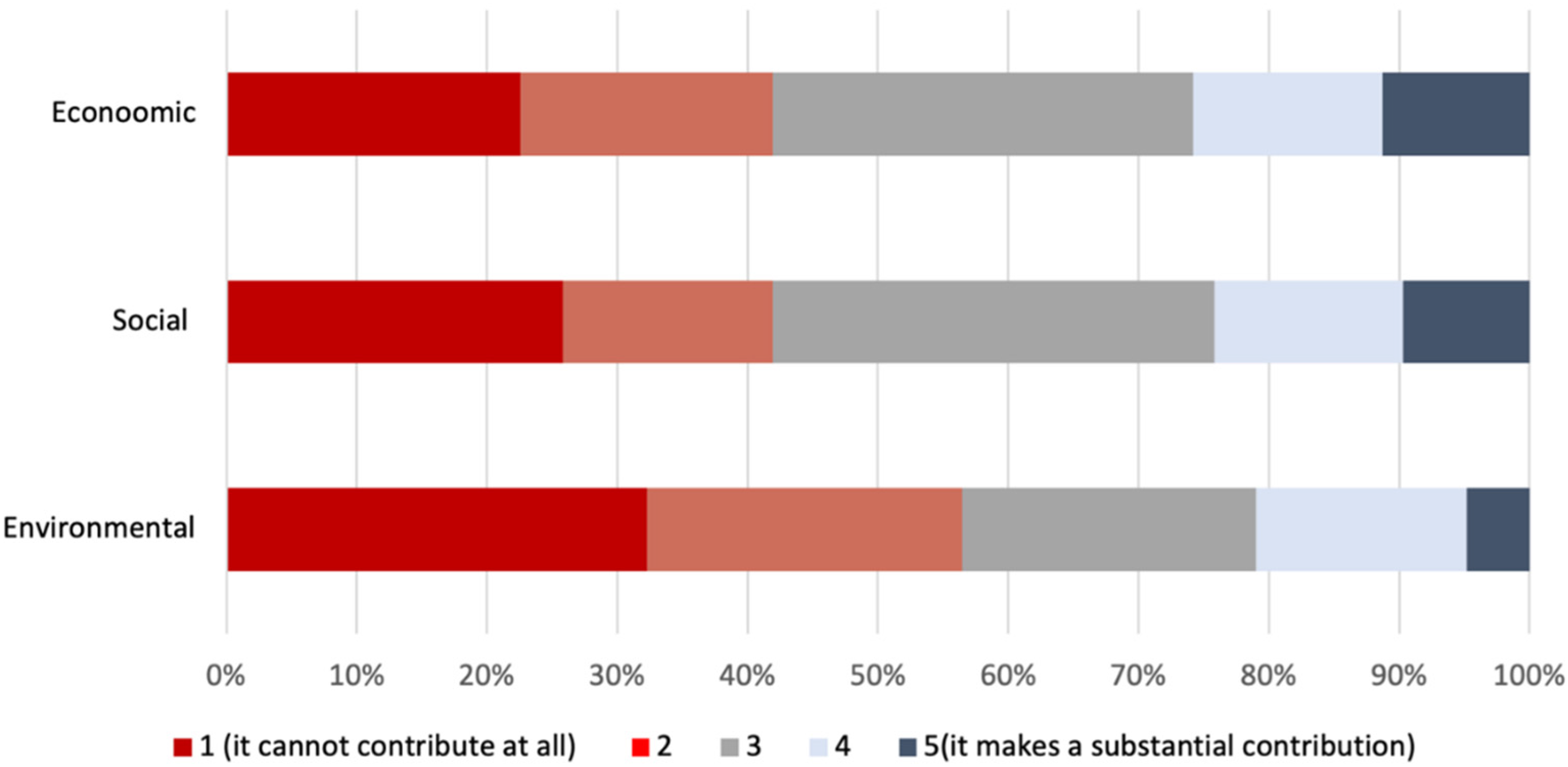
Blockchain's potential to contribute towards three dimensions of sustainability (economic, social and environmental).
This gap may be partially explained by the relative novelty of the technology. For instance, a respondent highlighted that existing public sector blockchain projects have not gone further than demonstration and pilot stages. However, there appears to be preconceptions about blockchain that may hinder robust assessment and exploration of its potential. For instance, while not all types of blockchain are energy-intensive, a few open-text comments pointed to the electricity consumption associated with some blockchains and expressed concerns over its active harm to the environment. Although ‘Proof of Work consensus mechanism underpinning Bitcoin requires substantial computational power, annual electricity consumption of which is estimated to exceed countries such as Netherlands and Belgium, 65 this is not the case with all consensus mechanisms. For instance, ‘Proof of Authority’ consensus mechanism that relies on existing trust in the organisations does not require the computational power associated with mining cryptocurrencies. 66
Reflecting broad acceptance of the importance of sustainability across sectors, discussions on collaboration towards sustainability appear to have shifted from why it matters to how to operationalise it. For instance, the SDGs concretise the shared vision, with SDG 17 on multistakeholder partnership providing a means to attain a set of interrelated ambitious goals. 67 While blockchain alone cannot provide a solution to the conceptual ambiguity of sustainability – both a source of broad acceptance as an enabler of collaboration and a hinderance to its operationalisation – blockchain appears to offer specific informational advantages such as data transfer and visibility and transparency that can prime the conditions for successful collaboration. When there is a broad agreement to how outcomes can be quantitatively measured, blockchain-enabled smart contracts can also provide efficiency gains in contractual and relationship management. In so far as sustainability initiatives suffer chronic lack of financing and capacity, 68 blockchain can be an additional tool that can be leveraged to broaden the scope of collaboration.
Although the majority of survey respondents indicated that blockchain may be disruptive, its role in enabling collaboration towards sustainability should not be overstated. Stakeholders’ scepticism towards blockchain's contribution appears to be warranted when considering its limited role in addressing current gaps in sustainability initiatives, such as integrating the social dimension 69 and addressing potential losers. 70 In some cases, the implementation challenges, such as the loss of flexibility, may be detrimental to the prospect of successful collaboration towards sustainability. Underneath the win-win framing of the multiple dimensions of sustainability, as epitomised in the ubiquity of terms such as ‘green growth’ that highlight the complementarity of economic and environmental sustainability, there are competing interpretations and trade-offs that must be negotiated.
Synthesis: towards a decision framework
The survey findings revealed a considerable uncertainty over the decision to adopt blockchain technology, punctuated by both enthusiasm and scepticism. The results also highlighted the lack of knowledge about the technology, which may hinder constructive discussions on the application of blockchain technology to facilitate collaborative working. Given the time investment and capacity requirements to implement blockchain-based solutions, decisions to apply the technology should be guided by a needs-driven approach. 71 The following decision framework in Figure 3 benefits from a blend of emerging evidence on collaboration and the existing frameworks. 72
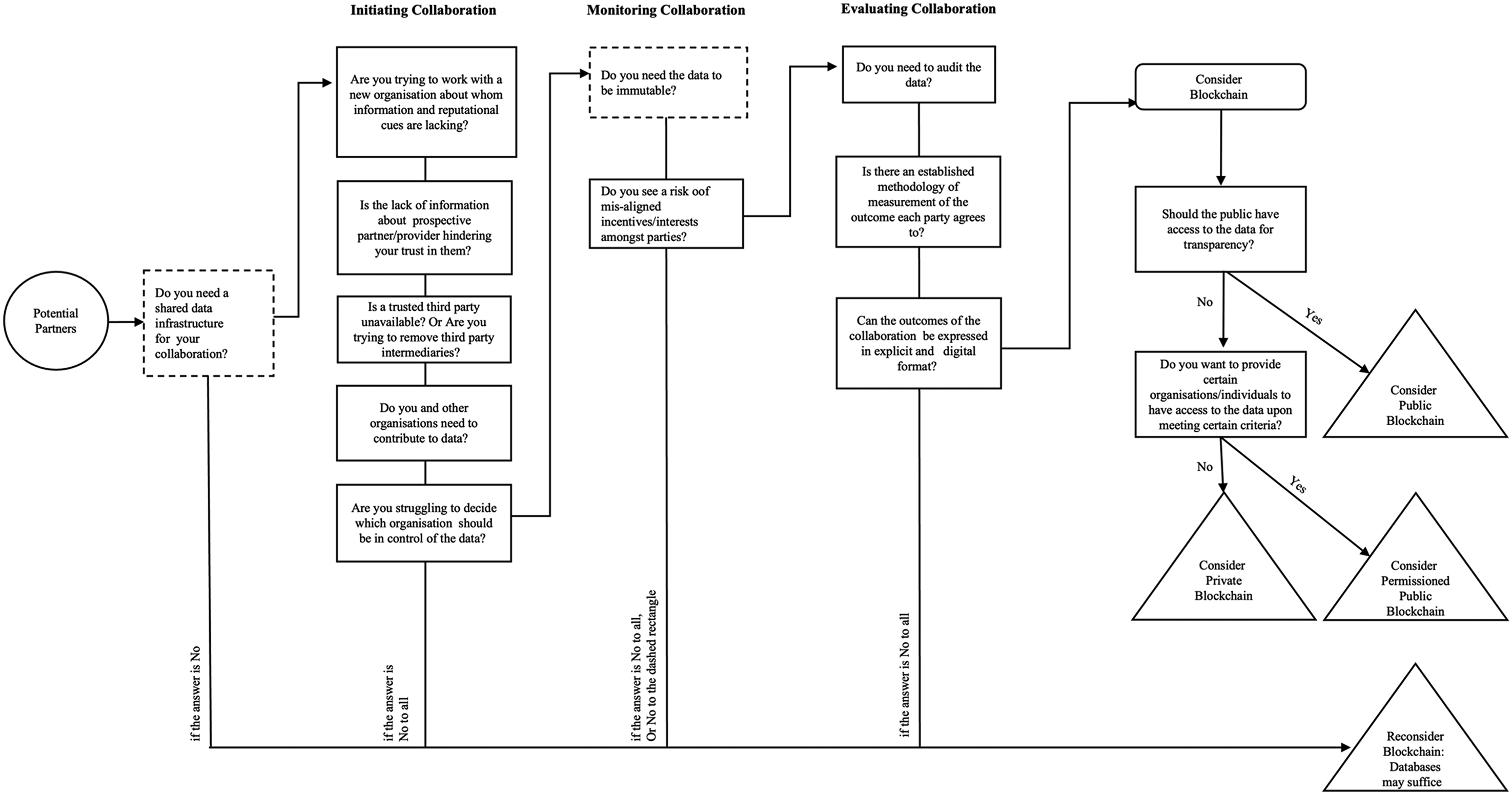
Decision framework. The standard circle, square, and triangle shapes commonly used in decision trees are present in this diagram, with each shape serving a distinct purpose. Circles mark the beginning node, triangles denote the terminal nodes, and squares signify decision points where prompts are introduced.
The framework prompts practitioners to consider key objectives across three stylised sequences of collaboration towards sustainability.
Initiating collaboration: As previously discussed, one of blockchain's key contributions is the potential to obviate or lessen the need to trust each other. The starting point is therefore to consider whether there is deficit in trust among potential partners. Such trust deficit may result, for instance, from lack of informational and reputational cues due to the size or novelty of organisations.
73
The traditional solution to this issue has been the appointment of an intermediary all parties can trust,
74
but intermediaries can sometimes be associated with inefficiency from speed and cost perspectives.
75
However, attention should be paid whether the removal of an intermediary is desirable for the collaborative project since there may be circumstances under which a third party would be beneficial or necessary, such as for compliance purposes.
76
A related but separate question following from the key question of trust is about who contributes to and controls the data. Blockchain's potential in enhancing data transfer for collaboration would be most meaningful if there is a need for multiple parties to access and add data, but the managing party that should be in control is not immediately clear. Monitoring and managing collaboration: As suggested by the findings of the survey, informational advantages of immutability of the records stored on blockchain are a central contribution of the technology. However, immutability itself is not inherently desirable since there can be circumstances where it is counterproductive.
77
As such, parties need to agree that indelible records are indeed necessary for the collaborative activities. Relatedly, the tamper-proof nature of the data underpinned by a consensus mechanism would only be in the interest of stakeholders involved in collaboration if there is a real risk of misaligned incentives.
78
Evaluation: Transparency of blockchain combined with time-stamped and immutable records offer strong data auditability, since the data would clearly indicate what has happened and when.
79
To fully reap the benefit of automatically generated records, the decision framework also prompts potential partners to consider how the outcomes of the collaboration will be assessed at the outset. Relatedly, while it recognises that explicitly defining outcomes and expressing them in a digital format is not always desirable or feasible, efficiency gains from automation are suggested to be greater for explicit and verifiable outcomes.
80
With appropriate planning around outcome measurement and attribution methods, stakeholders will be able to refine the agreement over the purpose of collaboration further.
Once there is a broad agreement towards the decision to use blockchain, the last step in the decision tree concerns the key design features over who can access and contribute the data. The distinction between public and private blockchain is about who can access the data, while the distinction between permissionless and permissioned blockchain refers to who can contribute and maintain the data.
81
Although there are other architectural design considerations when implementing a blockchain-based solution,
82
access and permission of blockchain are considered the two most foundational features.
83
Following the classification of the World Economic Forum,
84
the framework distinguishes between three main types of blockchain, depending on whether public verifiability is desirable (in which case it suggests considering a permissionless public blockchain) and whether additional access can be afforded upon meeting certain criteria (in which case it recommends considering permissioned public blockchain).
While the decision framework is not exhaustive, it is hoped that these considerations can help determine whether blockchain is value-adding and vital for a specific collaborative project. It provides a tool to be rigorous and parsimonious with the adoption of blockchain, focusing on when blockchain is necessary as opposed to simply being viable.
Conclusion
More than a decade on since the advent of blockchain technology, this exploratory study revealed there still is considerable ambivalence towards its adoption. Opinions are split between proponents and naysayers, with some questioning the added value of blockchain over other established technologies. Recognising the breadth of sustainability issues and the consequent challenges in operationalising collaboration under the principle of sustainability and measuring the overall progress, this exploratory study found that blockchain technology could act as a ‘primer’ for collaboration towards sustainability by (i) enabling and facilitating data transfer (ii) enhancing transparency for establishing and demonstrating accountability, and in some instances where explicit goals are identified, (iii) lowering uncertainty and transaction costs of inter-organisational interactions. However, the study also finds that the adoption of blockchain technology has key barriers. Some of the biggest challenges are: (i) implementation challenges arising from resource and capacity requirements for designing and organisational reluctance, (ii) technological limitations pertaining to capacity and its genesis, as well as (iii) the risks for creating new power dynamics. These concerns are particularly substantial in the presence of sustainability's competing interpretations masked by the ubiquity of its win-win framing. Drawing on experts’ interviews and new survey data, this study provides new evidence on the perceived and real benefits of using blockchain to facilitate collaboration towards sustainability and provide a guiding decision framework to consider the use of blockchain. Given the sample representation, insights presented in this paper would be of particular relevance to public sector readers seeking ways to collaborate with other organisations within and across the sector towards sustainability objectives.
The study has some key limitations. The first limitation relates to the survey sample which limits generalisability of findings (62 complete responses). Also, the design or dissemination of the survey were not based on a person's prior knowledge of blockchain and the risk of bias is moderate to low, but we are unable to eliminate the risk of self-selection bias due to its anonymous and open nature of the survey. For instance, those interested in blockchain may have been more likely to respond to the survey. Secondly, as the paper draws on existing evidence from literature and expert interviews, there is a risk of pro-innovation and survivorship bias since the failures of blockchain-based projects are less well documented and therefore less visible.
These limitations call for two interrelated areas of further research to better understand the potential of blockchain for collaboration towards sustainability. Firstly, there needs to be rigorous evaluation of pilot projects for a better evidence base. Importantly, as previously highlighted by Treiblmaier 85 and Lumineau, Wang and Schilke, 86 the research needs to advance its rigour beyond collection of anecdotal evidence through more nuanced case studies exploring the design choices as well as the rationales of applying blockchain, examining its contingent roles across contexts. Secondly, this study calls for a greater visibility of these evidence. It is recommended that the evidence be discussed from technological as well as societal standpoints, facilitating greater interactions between those who develop the technology and those who deploy them.
Footnotes
Acknowledgements
We are grateful to Jeffrey Matsu, Mara Airoldi, Tim Cummins and two anonymous referees for helpful comments and suggestions.
Declaration of conflicting interests
The author(s) declared no potential conflicts of interest with respect to the research, authorship, and/or publication of this article.
Funding
The author(s) received no financial support for the research, authorship, and/or publication of this article
