




Abstract
Federal procurement contracts incorporate multiple narrative voices representing a range of individual and organizational interests. We examine these contract voices as they act in, and speak from, a range of roles relevant to federal procurement, such as marketplace participants, taxpayer-citizens, chief adjudicator, and sovereign. Like tapestries, federal procurement contracts are made from textual threads that are woven, cut, tailored, and embellished to depict a particular cast of characters acting in accord with an underlying script. Recognizing this yields insight into the governmental values depicted within each contract’s formally structured, deliberately crafted pages.
Introduction
The academic literature on procurement contracting in both legal and management studies is deep and vast, made particularly so over the last 50 years by the influx of insights building upon the theory of “relational” contracting developed by Ian Roderick Macneil and Stewart Macauley. This literature has been especially rich in the study of strategic alliances in markets that have experienced rapid changes in the commercial sector due to technological advances (such as block-chain capability). Students of public procurement have also witnessed a surge in the number of articles posted to mainstream public administration journals in recent years. However, there has been no public administration scholarship examining the specific problems that federal officials and contractors may face in employing the insights of the strategic alliance literature to address public procurement issues in practice, particularly in terms of relational contracting.
Federal contracting is colloquially viewed by both government and business managers as stodgy, immobile, and archaic, especially with respect to describing how contracting parties navigate elements of a requirement that are unique and possibly subject to negotiation. This is not necessarily due to the complexity of the product and service requirements, nor is it due to the complexity of the legal environment that the parties must navigate. Though these certainly are factors, a large part of the complexity lies in what Brown et al. (2013: 106) refer to as “the gray areas of exchange” or the relationship between the parties. We argue that part of the difficulty stems from the fact that the federal procurement contract represents multiple voices—sometimes contradictory—speaking in a blended thread to describe for the market what a contractor must do to perform. With these multiple voices, it can be difficult to know who is speaking and when, and which “voice” takes precedence over the others in which situations. This can make informed negotiations difficult for both sides, and limits the ability of federal contracting officers (COs), in particular, to participate in complicated transactions using the principles of relational contracting.
At its heart, relational contracting is about the ability of the negotiating parties to interact on an interpersonal level (Speidel, 2000). At its most extreme ideation, the parties’ agreement may be represented by a written document, but the black letter words on the page aren’t what really matter, and everything—both before award and after award—is ultimately up for negotiation. Federal procurement practitioners likely would be made uneasy by this characterization of the contracting relationship. Through their practical experience, they know that the words on the page and the story those words tell matter to the courts and boards who handle disputes, and on a fiduciary level, to the taxpayer. For the contractor, part of the problem, as revealed by the implications of the Christian Doctrine, is whether or not the person speaking for the government when discussing details of the contract—particularly the contracting officer—speaks within the limits of their authority to represent the institution? For the government, how does a CO—the person whose signature executes the contract and who is responsible for both interpreting and enforcing it—know where their discretion to bargain begins and ends? What are their limits? How do contractors know where authority lies and what its limits are? How do contracting officers, and the contracting officer’s representatives to whom they delegate considerable, but not total authority—understand this themselves as a practical matter?
We suggest that answers to these questions may be gleaned from an appreciation of the contract’s narrative structure. Thus, this article has two purposes. First, it illuminates the narrative character of contracts in American federal procurement. Second, it assays how, and why, recognizing these contracts as narratives is useful in drafting, understanding, and negotiating them.
Federal procurement contracts, 1 like all contracts, formalize strategic alliances by incorporating multiple voices and perspectives representing the interests of a range of individuals and organizations. Yet, they differ from commercial contracts in vital respects. In directing the use of appropriated funds to acquire the goods and services needed by US executive agencies, they trigger public sector accountability requirements that reach beyond ordinary expectations of economy, efficiency, and effectiveness. Moreover, federal procurement contracts include the state as a party, and can be overshadowed by its uniquely powerful presence (Cooper, 2004; vom Bauer, 1967; Whelan and Pearson, 1961).
We thus examine the voice of the state as it acts in, and speaks from, a range of roles in federal procurement contracts, including those of the marketplace participant, taxpayer-citizen, adjudicator, and sovereign. We also assay the voices of other parties involved and liken the contract to a tapestry: a carefully crafted fabric that is woven, cut, tailored, and embellished to depict a particular cast of characters acting in accord with an underlying script. Ultimately, analyzing contracts as narratives or stories composed of interwoven voices affords insight into the values that the US government chooses to broadcast (or reflect) within the contracts’ formally structured, deliberately crafted pages. Beyond better discerning the government’s goals, requirements, and organizational culture, we can glean new understanding of how the market (in the guise of entities and actors) should receive and respond to them.
Our analysis draws upon scholarship in a range of disciplines. We rely upon literary theory to explore the writing and construction of contracts in federal procurement, focusing upon their formalized nature, language use, complexity, and structural fitness to task (Burnham, 2003; DiMatteo, 2013; Gelpern, 2009; Gerding, 2013; Hill 2001a, 2001b; Smith and King, 2009). Pentland’s narrative process theory (1999) supplies the primary methodological language for examining the federal contracting phenomenon. Neo-institutional organizational theory (Ashworth et al., 2007; DiMaggio and Powell, 1983; Frumkin and Galaskiewicz, 2004; Meyer and Rowan, 1977) provides an additional sensemaking lens to explore the ritualistic underpinnings of federal procurement as an institution. Public administration theories supply additional support for our argument that understanding contracts in federal procurement as narratives enriches our experiences of them as consumers, taxpayers, and, ultimately, as informed citizens.
Federal procurement contracts as narratives
If one imagines legal writing as a genre of written texts, with contracts as a specific sub-genre requiring further specialization, federal procurement contracts necessitate one or two more levels of classificatory difference. They are not simply contracts, but also contracts in which the state is one of the parties. Generally, the compilation techniques involved in their creation are different from those involved in commercial contracting. The federal drafting process typically and simultaneously pairs strict, authoritarian, codified technical direction with the exercise of considerable discretion by front-line workers who have limited formal legal training (Ingram, 2018). Large portions of the contract document are mandated, yet there is still substantial room for tailoring and discrete decision-making as to the content that government officials choose to include. What may be unclear to those without practitioner experience with the contract document, however, is an understanding of which parts are formally instantiated by law and regulation (and, therefore, not subject to negotiation), and which elements may be altered through negotiation by the CO who represents the government’s interests.
Further, federal procurement contracts, particularly those over the cost known as the Simplified Acquisition Threshold (SAT), 2 are highly stylized, formal, and lengthy, their pages crisscrossed with language intermixing common law principles and the dictates of agency law. This formality typically is enforced by the overarching presence of the Federal Acquisition Regulation (FAR), 3 into whose 2000+ pages of textual direction and guidance is interpolated language spawned by administrative law tribunal and federal court decisions—a large and ever-growing body of practical lessons shaping the FAR’s ongoing evolution as federal contracting’s legal framework (Cibinic and Nash, 1998). This documentary reliance on statutory law as a key determinant in the contest for legal meaning is virtually unheard of in commercial settings, where a regulation such as the Uniform Commercial Code may sometimes govern, but does so from a relative formative distance (Bernstein, 2015; Hill, 2001a, 2001b; Macaulay, 1963).
These details and distinctions matter because of the potentially significant power imbalance between the two focal actors in the federal procurement story: the US government (represented by a particular executive agency) and a contractor (a commercial entity or, increasingly, a non-profit, non-governmental organization). In essence, a federal contract tells the story of a sovereign entity wedding a “commoner” (no matter how illustrious) and embodies a strategic alliance or marriage (no matter how brief) of the state and the market. Historically, the sovereign state has wished to downplay the power asymmetry involved (for various normative and pragmatic reasons), but the nature of the arrangement and of the parties themselves can render this problematic. For the market, contracting with the state represents an unnatural marriage of different “kinds,” making the federal procurement contract document a chimera, consisting of twin distinct strains of legal “genetic” tissue that represent equally important common law and administrative law origins and traditions. This can lead to hesitation by both parties, based on perceptions of risk (particularly of opportunism) and degrees of trust, to enter into an alliance, unless the terms and conditions of the “nuptial” agreement are painstakingly clear (Morgan, 1992; vom Bauer, 1967; Whelan and Pearson, 1961).
The US federal government is the “sovereign” of a major world nation; when it enters into a contract, there are many rules, norms, and forms that must be honored, obeyed, or followed (at least according to perception) to preserve important sociopolitical boundaries. But do those rules and norms stem from law or from custom? The question typically facing COs and contractors during the performance of the contract is not “Should we do this?” but “May we do this?” 4 With federal procurement contracts, the answer is often found embedded beneath the hard shadow of the law, promulgated by the very sovereign that bends to submit itself to the dictates it itself expounds. This can lead to uneasy reconciliations, especially if the classic contract relationship is conceptualized as a democratic one taking place between relative equals, and in an environment where contracts are frequently relational rather than formal (Macaulay, 1963) and operate more fluidly under the “weak” (Bernstein, 2015) or “pale” (Hill, 2001a) “shadow of the law.”
On the surface, this description frames federal contracts as a type of “contract of adhesion,” often known as “take-it-or-leave it” contracts. 5 Traditionally, such contracts are understood as preserving a structural power imbalance between the contracting parties through the drafting party’s use of impenetrable standardized terms and conditions, commonly conceived of as “boilerplate.” Although federal procurement contracts surely contain boilerplate, we argue for a more nuanced, strategic reading, one that recognizes mediating, alternative state voices within the boilerplate text. In particular, a remarkably potent voice, representing the state as citizen advocate or taxpayer representative, buffers the impact of the state as sovereign within the contractual relationship (O’Connor, 2018). Recognizing this can underscore where the government’s intent to interact as an ideal participant with commercial contracting parties is most consequential.
Perhaps the best illustration stems from what is known as the “Christian Doctrine,” which established the precedent that the person of the CO, even when acting within their apparent authority, does not have the discretion to change certain elements of a federal contract that are required to be included by law. Moreover, a legal requirement expressing an important or deeply ingrained strand of public procurement policy will be read into a federal contract even if that provision is not explicitly spelled out in the contract (GL Christian and Associates versus United States, 312 F.2d 418 (Ct. Cl. 1963). Contractors who fail to understand the story of the Christian doctrine negotiate at their peril.
Mimesis, diegesis, and the voices within the federal procurement contract
Understanding the federal contract’s narrative character may help readers better make sense of the textually dense elements of key contract requirements, particularly those written as boilerplate. Some of these voices tell a particular story directly through explicit language; some speak indirectly through formal and stylized rhetorical devices; and some speak with consistent, clear force even when their presence is not readily apparent. The concepts of mimesis and diegesis are useful tools for distinguishing the nature of these voices. Some of the voices in a federal procurement contract “show” and demonstrate that a story unfolds through the primarily dramatic mechanism of mimesis, while others narrate or “tell” the story of the contract through diegesis (Berger, 1994; Bruner, 1991; Bunia, 2010; Kirby, 1991). The concept of narrative voices serving distinct functions within the context of a story is ancient; both Plato and Aristotle discuss mimesis and diegesis in the study of what they called “poetics,” though their approaches to the subject and its value to aesthetic practice diverge and are much more circumscribed than the application here. Here, we see diegetic and mimetic storytelling modes operating as warp and weft in the creative combination of voices that results in the federal procurement contract’s production.
Defined simply, mimesis means to copy or imitate, whereas diegesis means to tell, lead, or narrate. Mimesis “worlds” by mimicry of an external structure, whereas diegesis “worlds” through the unfolding of a unique, particular context with its own internal consistency. In other words, mimesis replicates, while diegesis creates and situates. Mimesis can be a tool of diegesis, but diegesis is not dependent on mimesis to tell a straight narrative rooted in a sequential, specific spatio-temporal context where X leads inevitably to Y. Mimesis, however, can make a story more rich, full, and connected to cultural norms and moral standards through the strategic incorporation and repetition of important texts and themes. Mimesis provides a template, a scaffold, an essential footprint; diegesis describes a building’s unique facade and details like the number of windows and how they will be dressed.
Analyzing federal procurement contracts in terms of mimesis and diegesis helps to explicate their construction and situates them in an organizational context. Here, we draw upon the insights of Pentland’s (1999) work on narrative as evidence of organizational process, and Smith and King’s (2009) application of organizational theory to the realm of contracts. We believe there is utility in characterizing mimesis and diegesis as concerned with complementary aspects of organizational culture, responding to the time-tested questions: why are organizations so similar (Ashworth et al., 2007; DiMaggio and Powell, 1983; Frumkin and Galaskiewicz, 2004; Meyer and Rowan, 1977)? And why are they so different (Thornton et al., 2012; Hannan and Freeman, 1977)? The same questions can be asked of contracts, particularly federal procurement contracts, where documents are intricately structured with a mix of mimetic elements such as boilerplate and semantic devices like the Uniform Contract Format (UCF), as well as elements that are obviously diegetic—such as the pure narrative telling of specific contract requirements and definitions pertinent to a particular contracting action.
As Pentland (1999: 713) has noted, the elements necessary for a story or narrative to occur can be examined for organizational evidence, as follows: Sequence in time (indicative of patterns of events) Focal actor or actors (indicative of social roles, networks, and demographics) Identifiable narrative voice(s) (indicative of points of view, social relationships, and power) Moral context (indicative of cultural values and assumptions) Other indicators of content and context (which do not necessarily advance the plot)
Time sequence is a straightforward element to tease out of most contract documents. Focal Actor A promises to take Action X in exchange for Focal Actor B’s promise to perform Action Y, ideally within a clearly identified time period. One action inevitably leads to another action. Focal actors, or what might be called primary characters in a typical story, are clearly identifiable as well, and generally limited to the offeror and the offeree—the parties subject to the dictates of the contract. Other key actors may be a governmental entity, or the law firm (if applicable) involved in creating the contract document. A full accounting of focal actors—or cast of “characters”—varies from contract to contract.
The worlds of contracts are fully constituted by the narratives of multiple speaking voices. This study finds evidence of identifiable narrative voices in federal contracts, and, in particular, the voice of the state as the polity’s representative. In fact, the world that the federal procurement contract wishes to represent, and the world it actually represents, can be mapped by the echolocation of those various voices signaled by changes in the text and the structure of each contract story/narrative. It is also primarily through these voices—whether emanating from focal actors or not—that the moral context, or “canonical or evaluative frame of reference,” is most clearly communicated, as well as other “indicators of content and context” (Pentland, 1999: 713).
We identify several voices in the federal procurement contract. These include, first and foremost, that of (1) the narrator, who, exercising the truly diegetic mode, sets the stage of the world that the contract inhabits or intends to constitute. Typically, this voice belongs to the federal CO (and, thus, executive agency) who drafts the “solicitation” that animates the creation of the contract. In addition, the contract contains the voices of (2) the official who signs the contract on behalf of the government (the contracting officer) and (3) the representative who signs for the contractor; (4) the representative of the government buyer, which may be the contracting officer’s representative who recommends final acceptance of the product/services to the CO; (5) the contractor (the commercial or non-profit, non-governmental vendor or contracting agency) slated to fulfill the need specified; (6) the state in its sovereign capacity; (7) the state as a representative of citizen interests; (8) the market, which though often muffled by the voice(s) of the state, still operates as a palpable presence (or absence) in the story/stories that the contract tells; and, finally, (9) the state as guardian of the law (usually represented by the courts and/or administrative adjudicatory bodies).
The federal contract drafting process offers clues to how these voices become threaded throughout the contract document. Responsibility for drafting a particular contract—primarily modular in nature, studded with boilerplate provisions and clauses, yet having key tailored elements—is vested in the CO who signs the document to award the contract. How a particular agency or contracting office assigns the actual drafting duties depends on any number of agency-specific internal policies and practices. For simplicity’s sake and for the purposes of this paper, the CO—usually a GS-1102 Contract Specialist—is conceptualized as the primary drafter of the contract document. 6
The federal procurement contract generally begins with a “solicitation,” which the FAR defines as “any request to submit offers or quotations to the Government” (FAR §2.101). In cases of competitive procurements, solicitation is a formal “question” or “query” to the market which invites a specific, targeted response. Federal procurement solicitations are aspirational documents that describe a current state of the world from the government’s perspective. They also describe the world as the government wishes it to become through the letting of the contracting opportunity and the sharing of the government’s goals with the market. 7 The market then produces the contractor whose quotation, bid, or proposal represents the “best value” as the government has defined it within the solicitation, always incorporated into “Section M: Evaluation Factors for Award” if the solicitation was drafted using the UCF (discussed below). If the solicitation is a query, the contractor’s proposal is a type of echo, and the final contract represents a narrative exchange between the focal actors involved, with their responsibilities carefully defined and embodied in the final text.
Many agencies use commercial (and modified commercial) computer software to produce a solicitation, which will become the final contract document once the successful contractor’s bid or proposal is accepted. The full contract file will usually include materials contributed by the awarded contractor (such as the contractor’s completed “Representations and Certifications” and their technical proposals for completion of the subject project). The US government requires no single software program or drafting process. Departments and individual agencies decide upon the proper tools necessary, at varying levels of customization and complexity (and notably, expense). Sometimes, the solicitation drafting tool is a text file that can be copied and pasted from an existing document template. The FAR itself provides two basic tools to guide drafters, from which a solicitation/contract can be drafted without the aid of software: (1) the “UCF” (mandatory for certain procurements over the SAT and available for use in other procurements, even where not required); and, most importantly, (2) the “Solicitation Provisions and Contract Clauses Matrix” (Matrix) located in FAR §52.301.
These mundane details are analytically relevant if a solicitation/contract reader understands that the basic structure of every federal procurement contract awarded under the FAR (when it requires use of the UCF) is the same; and, moreover, that there are elements that can be negotiated by the CO and there are elements that cannot be negotiated, and this will remain the same from federal contract to federal contract. We argue that the things that the CO is allowed to alter can be linked generally to the diegetic voice that differentiates the scene and describes the information relevant to a particular contract. The elements that cannot be changed are generally linked to the mimetic voice that establishes the rules of the contracting relationship as a result of law and regulation.
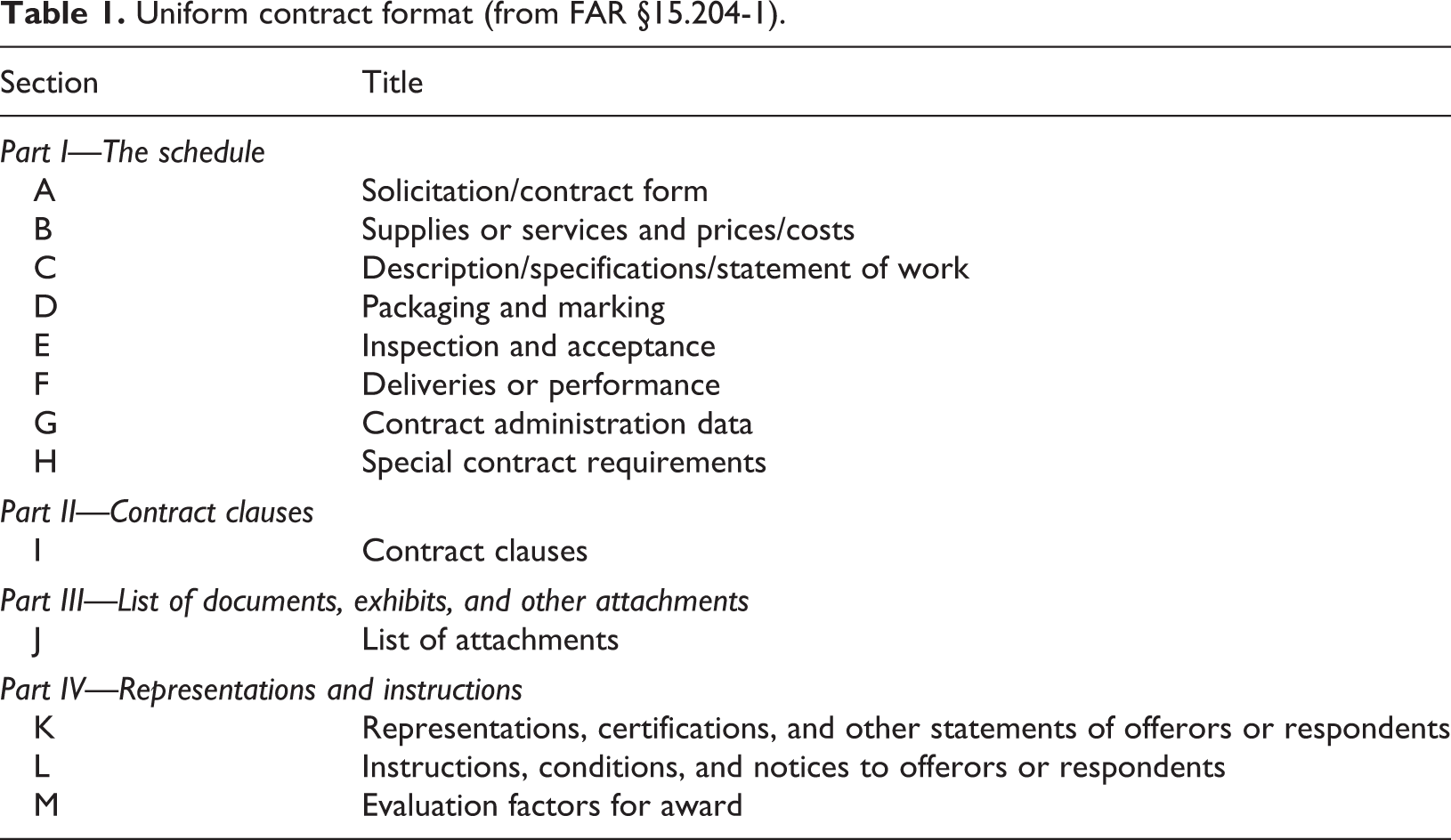
It may help to understand the UCF as a modular information management and transmission tool (Smith, 2006) dividing the complex document into four manageable semantic parts: (1) the Schedule or contract requirements; (2) the contract clauses (where what is traditionally referred to as boilerplate is included); (3) documents, exhibits, and attachments; and (4) representations, instructions, and evaluation factors, as shown in Table 1 (FAR §14.201-1; FAR §15.204-1). The information populating these parts is ultimately governed, managed, and understood by making reference to the Provision and Clause Matrix: a 35-page spreadsheet with a solicitation and contract-type “key,” which lists every solicitation provision or contract clause (all of what is traditionally known as “boilerplate”) included in the FAR. For each of those provisions and clauses, the Matrix identifies the law that requires or recommends its inclusion in the contract, whether or not the referenced text is a provision (applicable only before award of a contract) or clause (always applicable) that can be “incorporated by reference,” or whether its full text must be included in the solicitation or contract. It also indicates the section of the UCF in which that provision or clause should be included (from Section A-Section M), and whether its inclusion in the solicitation or contract is “required” (in which case, a CO has no discretion to omit contract boilerplate that is required by the contract type), “required when applicable” (in which case, the officer has reasonable discretion to decide what type of contract to award), or “optional” (in which case, the officer has full discretion to include or exclude a provision or clause, sometimes as a part of contract negotiation).
Uniform contract format (from FAR §15.204-1).
It is every CO’s responsibility to ensure that the solicitations that form a contract’s foundation include the most up-to-date boilerplate language of the FAR Council (the deliberative body in charge of incorporating changes to the FAR), frequently revised throughout the year. Boilerplate shifts often indicate new or refined interpretations by a court or board on a conflicted issue, or highlight legislative political direction related to some important sociopolitical objective (such as those related to a labor law). Some agencies use software for this, but sometimes the CO must hand-check their documents against the text of the provisions and clauses in FAR §52.201 8 to ensure they have the most current version. This can be labor-intensive, but is extremely important, because even small regulatory/statutory changes in the boilerplate of a provision or clause may significantly impact later interpretations made necessary by protests (pre-award) or disputes (post-award).
However, drafting these solicitations/contracts is not only about proper disposition of the standardized boilerplate, where the primary narrative contract voice is almost exclusively mimetic and isomorphic (once the CO determines the boilerplate provision or clause is applicable to the procurement). In rare cases, the UCF modules also provide space and require the attentive customization or tailoring of contract requirements. That customization is usually minor, but in complicated procurements, carefully tailored specifications, plans (e.g. blueprints), reports, studies, and other necessary descriptive data also require contract language that accommodates and protects those differences from being reduced to hastily dismissed afterthoughts. This is where the diegetic voice surfaces and guides the contract narrative. For example, the bulk of the information provided in Section B (Supplies or services, and prices/costs) and Section C (Descriptions/specifications/statement of work) is unique to every contract, and while there may be strong similarities between other contracts (where types of work are comparable), every project is different in some way, even if that difference only manifests in the time of performance. Again, this specificity, particularity, and tailoring for uniqueness are where the diegetic narrative direction (as opposed to mimetic dictation/scaffolding) are most clearly apparent to those reading each contract’s unique story.
Analysis: federal procurement contracts as organizational narratives
Discussing the surface and deep structures in the narratives that organizational processes tell, Pentland argues that deep structure ordinarily falls outside of the scope of standard narrative theory, “which is more concerned with the way specific events are narrated than with explaining why those events occur in the first place” (1999: 720). Pentland also situates focal actors as part of a story’s deep structure and assigns to those various narrative voices the responsibility for signaling “point of view, social relationships, and power” to the story’s surface structure. We see federal procurement narratives as offering a distinct case that departs from Pentland’s analysis in key ways.
The general deep structure of every valid contract—not just federal procurement contracts—is well established in common law and commercial custom. While the different parts of a contract might require identification, they seldom require unveiling. A valid contract must contain an (1) offer and an (2) acceptance, evidencing (3) mutual agreement as to terms and conditions with the exchange of (4) value-bearing consideration, where both parties have the (5) legal capacity to contract (age and competence being the two most important, but not only, criteria), with the (6) transaction being for a legal purpose (Wex Legal Dictionary/Encyclopedia, 2020). This can be stated even more simply: the deep structure of a contract story is always one of two (or more) parties agreeing to perform (or to not perform) an action in exchange for something of value. Contracts are, therefore, stories about promises where every party experiences a net benefit. The contract’s objective is made clear, to the extent that the deep structure is effectively a constant.
Nor do we locate the focal actors in federal procurement contracts within the deep structure of contract narrative. Instead, these repeat players—the government and the contractor, as offeror and offeree—are obvious in their generation of the contract document. Recognizing this allows us to ask whether each has distinctive voices, and if those voices are singular (monophonic) or multiple (polyphonic). We also ask whether those voices are diegetic or mimetic, and whether that makes a difference.
We argue that the voice of the government in particular is polyphonic and that the deep/surface structure separation between focal actors and narrative voices made by Pentland and some other narrative theorists is complicated, and perhaps even reversed in the contracting context. As Burnham (2003) demonstrates, reading and understanding a typical contract requires multiple sweeps of different types of reading objectives, which are all iterative. In some ways, interpreting a contract is like experiencing a work of art—all the layers of detail and meaning are experienced simultaneously, yet they can be broken apart with careful analysis for the viewer/reader to capture elements that were not clear from a superficial scan. Where the focal actors in a contract can be determined rather quickly, the existence and character of the narrative voices requires successive sweeps, careful reading, and, sometimes, creative extrapolation.
On the surface, federal procurement contracts feature a strong central narrator, represented by the purchasing executive agency or governmental entity through the individual empowered to act on the government’s behalf as agent—the CO, who “binds” the government to the contract with her signature. Even at this early stage in the story, there are three levels of narrative voice at play in the federal contract—a person, who is an individual representing an executive agency; an organization, which is the executive agency, a bureaucratic organization representing the US government; and the specific focus of this analysis, a potential deus-ex-machina, the sovereign entity of the US government, the chosen governance apparatus of the American people. All three levels of voices appear distinctly within the contract document, and there are multiple voices functionally in dialogue—or in conflict—at each of those three levels. The individual CO is represented by the choices evident from her determinations of contract requirements. For example, the organization/executive agency appears clearly in the description of the government’s needs, and the scope of the contract’s work. The state represents itself largely in the embedded boilerplate clauses throughout the contract document. It is important to note that these voices—while linked—are distinctive, self-interested, and sometimes contradictory in practice. Being able to unravel where the voices are contradictory and determine which voice has authority/precedence over the others can show the value and utility to both drafter and reader of seeing these contracts as multi-vocal narratives.
The contractor’s voice, and through it, the commercial marketplace, also make appearances in the contract story. The contractor’s representative has the personal authority to sign the offer or acceptance (and “bind” the contractor), representing a legally organized business entity, which is often a corporation with various boards and stakeholders, and which represents the market’s response to the government’s solicitation. And finally, looming over all, is the anticipated voice of an adjudicative authority—a voice invoked only in instances of a possible contract breach, but which guides and demarcates much of what the other voices say about contract formation and administration. While the other voices speak for themselves and to each other, they ultimately are speaking toward the ear of adjudicative authorities, who must be convinced of what the final story is that an individual contract should tell. Often, the courts’ and boards’ voices are represented in contract boilerplate language and speak in the past tense because judicial decisions find their way into the text of the FAR through various amendments and updates, which are then incorporated into new contracts, where the court’s voice is reified. However, boilerplate sometimes also speaks to, or for, the future by describing the possible outcomes that certain contextual actions will entail for either focal party. An example of this is found in FAR §52.233-1, “Disputes,” which describes how conflict between the government and the contractor must be resolved after an award has been made.
Therefore, there is an added complicating element to all contract narratives: they are tales of time-dependent joint ventures—an expected comedy or marriage, so to speak—told in anticipation of (or perhaps in hope of fending off, like a talisman) a nasty divorce, where enforcement or legal disposition in instances of alleged breach is necessary to sort out differences between promises made and promises kept or broken. Contracts as stories contain the possibility (or threat) of assigned alternative endings, with the legal authority’s voice having the final say as to how the story concludes. As part of the structure of the federal procurement contract, boilerplate language attempts to provide certainty in the face of ambiguity by trying to control the outcomes of “undecided” (or in contract language, “undefinitized” or “incomplete”) situations. Thus, we suggest that through boilerplate, the state attempts to exercise its control of the diegetic voice (and limit CO discretion), while also harnessing the legitimacy of an isomorphic, mimetic grammatical structure.
An illustrative example
Understanding the role boilerplate clauses and provisions of the UCF play as information management devices can help potential readers navigate all federal procurement contracts that require it and help teach a reader what to look for in contracts that do not. The UCF lays out all the mimetic peculiarities necessary for contract validity in the federal context in digestible semantic chunks while allowing the diegetic particularities of a specific contract—evident in instances of tailored, not-boilerplate language—to dictate what will actually differentiate one contract from any other. In some ways, the UCF organizes the union of both the “scaffolding” and the detailed window dressing of these incredibly complex documents and allows the two types of narrative to blend and create a full story literally within a manageable space (both cognitively and in terms of physical page count). In order to demonstrate this, we provide a hypothetical example followed by several brief examples drawn from a solicitation incorporated into an actual awarded federal contract.
The scenarios detailed here reveal how boilerplate foreshadows narration of an alternative ending to the original overall surface procurement contract story. A contractor, while working on a bridge construction contract under FAR §52.236-2, “Performance of Work by the Contractor,” encounters a “Differing Site Condition” at the worksite that could not have been reasonably foreseen, such as the presence of bedrock while excavating a streambed in southern Mississippi (something that would not be an unusual or “Differing Site Condition” in the mountains of East Tennessee, highlighting the importance of diegetic context in the individual contract). This can be conceived of as an unexpected plot twist. If included in the contract, how the story will then unfold would be addressed by FAR §52.236-2, “Differing Site Conditions.” How the government decides to handle the issue may lead to a deliberate contract change in accordance with FAR §52.243-4, “Changes,” which allows the government unilaterally to make changes to contract specifications and requirements (bilateral agreements are always preferred, but not required, particularly in cases where “time is of the essence”).
The “Changes” clause references a procedure for how contractors can petition for financial reimbursement for the cost of government-made changes to the original contract agreement. If the government and the contractor cannot agree on the change’s value, the contract narrative then shifts to the tale of a “Dispute” as outlined in the aforementioned FAR §52.233-1, “Disputes” clause. If the Contractor refuses to work while the financial details of the “Change” are being hammered out, this would represent a contract breach (under the requirements of the “Changes” clause), because contractors are required to continue work pending resolution of compensation issues once the government decides upon a course of action. This action/inaction by the contractor would then lead to the contract story having an alternate ending because it triggers the termination-for-default procedures referenced by the FAR §52.249-10, “Default (Fixed-Price Construction).” This could complicate the story by resulting in monetary damages levied against the contractor (along with a host of other negative outcomes). However, if the government acted erroneously or in bad faith, the story of the “default” could be transformed into the story of a “termination for convenience”—a narrative framed by FAR §52.249-2, “Termination for Convenience of the Government.”
It is likely that if this list of clauses (§52.236-1, §52.236-2, §52.243-4, §52.233-1, §52.249-10, and §52.249-2) alone were provided to a government CO, she would be able to reconstruct the storyline without knowing any of the other specifics. The story would read as follows: Contractor encounters plot twist at a construction worksite; government and contractor can’t come to agreement about changes to the existing contract to accommodate that plot twist; contractor refuses to perform until the dispute is settled, triggering a termination for default; and, an attempted termination for default (T4D) is converted to a termination for convenience (T4C) because the government missed something, didn’t follow procedures correctly, or comes to accept partial responsibility for the occurrence of the breach (likely because of pointed instruction or direction by an administrative law judge with a Board of Contract Appeals).
Real-world example
To demonstrate the utility of our approach, we will reference text from a recently awarded contract. This contract was selected from the Federal Business Opportunities website, where all open-market competitive procurement opportunities with an estimated value over US$25,000 are advertised. The analysis is drawn strictly from the solicitation version of the awarded contract, as an example of how a potential contractor might understand the contract story the government wants to tell. The solicitation, issued by the US Navy, was for “railroad, ground level and elevated crane rail systems at the Norfolk Naval Shipyard and Annexes in Portsmouth, Virginia.” Contract number N4008519R9161 was awarded on September 29, 2019 for US$13,214,251.29 to contractor Stampede Venture, Inc. of Nome, Alaska.
We will very briefly describe (from a solicitation document of 170 pages) two sections—categorized using the UCF—and characterize the dominant voices within these sections as mimetic or diegetic. Those sections are “Section B: Supplies or Services and Prices” (pages 3–6) and “Section I: Contract Clauses” (pages 123–140). We argue that Section B is largely diegetic (representing agency- and CO-specific decisions), while Section I is largely mimetic (representing the voice of the state).
The purpose of each paragraph of Section B, numbered from B.1 to B.24, is diegetic and dependent on a CO’s discretionary assessment that it is applies to this story. All of the information provided is tailored to the specific procurement, including the fine details pertinent to the contract’s subject matter and how the government is choosing to describe, then acquire it. B.1 and B.2 provide the easiest examples of diegesis: the title of the project, and the type of contract that the government intends to award (an indefinite delivery, indefinite quantity (IDIQ) one-year contract for the recurring and non-recurring services with the option for additional years)—specific to the contract at hand. B.3 and B.4 are also diegetic but require that “necessary when applicable” determination. An IDIQ contract requires a minimum guarantee: B.3 describes what that minimum amount will be for this contract (“the Recurring Price portion of the base year only”). For B.4, the CO (ideally through market research) has determined that a total small business set-aside (“100% Small Business Set-Aside Competitive Procurement”) will characterize the competitive marker for the acquisition.
Note, however, that B.4 also references a mimetic element, which is actually included in Section I (the boilerplate clause “FAR Clause 52.219-6, Notice of Total Small Business Set-Aside”). In B.4, the government, represented by the CO, has determined that a total small business set-aside is appropriate here (discretionary). In Section I, the meaning of a total small business set-aside is defined (non-discretionary). This pattern is repeated throughout Section B. For example, in B.5, the CO has decided that the work should be classified under a particular code: 488210, “Support Activities for Rail Transportation” (the requirement to include the code itself is mimetic: a federal procurement must be described using a North American Industry Classification System (NAICS) code). However, its fulfillment is diegetic—this is the code the CO thinks best describes the need. In B.8, the CO has determined that the contract performance period will be for a base year with potential option years (discretionary and diegetic—however, mimetic in that the term cannot exceed five total years by law). This description is again referenced in Section I for FAR 52.217-9, “Option to Extend the Term of the Contract-Services” (March 2000), which describes what the government must do to exercise those options (non-discretionary and mimetic).
Section I, however, is almost entirely mimetic: all the requirements are non-discretionary once the CO has determined they are applicable. There is “wiggle room” to describe the exact elements of the procurement in Section B. Section I contains no real wiggle room. The only elements the CO may tailor diegetically are, for example, what federal positions the CO considered equivalent to the workers the contractor will be required to hire (not completed in this solicitation, but the clause is on pages 130–131). What is included in Section I are the requirements the state (primarily through law or executive order) has determined should not be altered or subject to discretionary action—if the CO has reasonably determined they are applicable.
Limitations of the analysis and conclusion
We have argued that a federal procurement contract is like a tapestry or a painting, telling a particular story by weaving together the threads/layers of multiple voices and perspectives. Each of these voices fulfills different functional requirements in composing a coherent story. Whether mimetic or diegetic, each voice also signals distinct themes and tropes as well as specific interpretive direction to discrete audiences. As documentary artifacts, federal procurement contracts incorporate rich cultural codes articulated through words (Meyer and Rowan, 1977). These voices and the codes that they carry enact specific legitimizing activities for the persons and organizations involved in the contract—roles not limited to the offeror and offeree (Hill, 2001a, 2001b). The aesthetic theoretical tradition can aid us in interpreting what contract voices say in addition to identifying when they are speaking.
Admittedly, contracts are neither textile nor literature. They are professional documents crafted for legal purposes to protect property interests. Their primary purpose is for interpretation by administrative law tribunals and courts of law given the ever-present possibility of significant breach by one of the contracting parties. They are not designed to “tell tales” in terms of truth, but to bear “fact” when scrutinized in specific venues (whether at worksites or in adjudicative settings) and in specific circumstances (whether in everyday practice or in the face of conflict and disagreement). Though there is skill and draftsmanship—or techne—in their making, and they include constructed representations, they are not “art.” Thus, contracts first should be evaluated, like all social artifacts (Suchman, 2003), in terms of their value as crafts, tools, and professional work products—in other words, for their utility, and not for their aesthetic value. Nonetheless, federal procurement contracts can be, and often are, deeply emblematic of societal norms; we may tease out their storytelling threads to expose the cultural representations woven within their pages.
Federal contracts differ from commercial contracts because, in addition to being written through the voices representing the interests of individuals and organizations, they are deeply shadowed by the voice of the state acting in a series of roles, whether that role is as a marketplace participant, the taxpayer-citizen, or the state as sovereign entity. Through boilerplate language, the state acts to protect its interests. It also acts to protect the taxpayer. It is important to note, however, that these voices are not always the same.
Though often seen as contracts of adhesion, federal contract “stories” are written in an attempt to correct imbalances in the power relations between the contractor and the government by including a series of checks on its authority—such as the agreement to be subject to suit in a judicial forum. These checks are intended to buffer the authoritarian voice of the state as sovereign with the mediating voice of state as an ideal party to a specific contract. However, the voice of the state may, nonetheless, be intrusive and may muffle the voice of an (ostensibly) unfettered market. There also may be imbalances between the primary narrator of the federal procurement contract, the purchasing executive agency, and the other government voices. The purchasing agency’s strong diegetic voice may conflict with the deeper state voices carried by the mimetic structures codified in the FAR’s boilerplate provisions and clauses, the terms and provisions that populate the federal procurement contract.
Finally, there inevitably is competition between the voices in the federal procurement contract, particularly with respect to the involvement of normative frameworks. The result is that government actors and contractors are likely to struggle with interpretation until they know which master expects to be served during the administration and performance of any particular contract. Mastery is signaled most clearly by the contest of voices speaking both through and behind each contract text.
Footnotes
Acknowledgments
The authors thank JSCAN co-editor Amanda Girth and several anonymous reviewers for their helpful feedback.
Declaration of conflicting interests
The author(s) declared no potential conflicts of interest with respect to the research, authorship, and/or publication of this article.
Funding
The author(s) received no financial support for the research, authorship, and/or publication of this article.
