




Abstract
Process management literature is skeptical about creating legitimacy and a sense of partnership when implementing concessional Public-Private Partnerships. Within such organizational arrangements, managerial interaction often resembles zero-sum games. To explore the possibility to (re)create a sense of partnership in concessional PPPs, we developed the “3P challenge” serious game. Two gaming sessions with a mixed group of practitioners and a team of public project managers showed that the game cycle recreates adversarial situations where players can enact contractual obligations with higher or lower levels of subjectivity. When reflecting on the gaming experience, practitioners point out that PPP contracts can be creatively enacted by managers who act as brokers of diverse interests. While becoming aware of each other stakes they can blend contractual dispositions or place brackets around some contractual clauses for reaching agreement. By doing so, they can (re)create a sense of partnership, clarity, and fairness of the PPP contract.
Keywords
Introduction
The popularity of Public-Private Partnerships (PPPs) around the world paradoxically contrasts with their disputed assessments and fierce critics (Hodge & Greve, 2017). Controversial outcomes exist regardless of the formal configuration of PPP organizational structures (Hodge et al., 2017), let alone their possible misfit with different institutional contexts (Matos-Castaño et al., 2014; South et al., 2018). In this regard, the managerial process engaged by actors seems to be the key to understand why PPPs work or do not work (Hodge et al., 2018; Klijn & Koppenjan, 2016; Verweij et al., 2017). Satisfaction with project outcomes emerges from (re)creating partnership legitimacy and stakeholders’ support when dealing together with social and technical complexities (Klijn et al., 2007).
This argument has been mainly brought forward for PPPs designed as alliances, where members share risks and rewards along the process of value co-creation (Kivleniece & Quelin, 2012). Contracts are part of the partnership, but they do not become the partnership (Klijn et al., 2007). In contrast, concessional PPPs that transfer risks to private organizations through contractual agreements mainly define project interactions by the legal provisions and entitlements laid down in the contract (Kivleniece & Quelin, 2012). According to the process management literature, concessional contracts shape zero-sum game situations and limit opportunities to (re)create partnership meaning and legitimacy (Edelenbos & Klijn, 2009; Klijn et al., 2007). Public-Private Partnership as an organizational form does not need to include a sense of partnership and, even more important, concessional PPPs provide few grounds for collaborative interaction.
While the coordination of working processes might operate upon the grounds of control and formal governance mechanisms (Kadefors, 2004), there is increasing evidence that project managers attribute high value to collaborative relations in the process of implementing concessional PPPs contracts (Lenferink et al., 2013; Verweij et al., 2017; Warsen et al., 2019). What is less understood is the capacity of project managers to attribute meaning and legitimacy to a concessional partnership. We are interested in the questions whether and to what extent project managers can develop a sense of partnership in a concessional PPP.
The “3P Challenge” is a serious game to reflect with practitioners on the emergence of collaboration and the sense of partnership during the implementation of concessional PPP contracts (Donati, 2010; Donati & Archer, 2015). Serious games are an alternative tool for researching and conveying key insights into performance management in public affairs (Douglas et al., 2019). This study uses the “3P Challenge” game to gain insights into the enactment of PPP contractual relationships and at the same time to provide a space for practitioners to articulate concerns on their quality of working relations, PPP policy and implementation. The “3P challenge” was played in two sessions with PPP practitioners in the Netherlands. We discuss these results in the light of processes management for the implementation of concessional PPPs and the creative enactment of the contractual relationship between managers (re)creating a sense of clarity and contractual fairness.
Theoretical Background
Process Management of Public-Private Partnerships
The term Public-Private Partnership usually refers to an enduring contractual relationship that brings together complementary public and private resources by sharing or allocating responsibilities and risks between contracting parts (Grimsey & Lewis, 2005; Verweij et al., 2017). Formal arrangements aim at enabling the value co-creation process by addressing uncertainty and opportunistic behavior, factors that jeopardize the capture of promised payoffs (Nooteboom, 1996; Williamson, 1981). Consequently, organizational scholarship studies the underlying logic of value creation and the desired level of private autonomy or collaboration with the public sector to deliver successful PPP projects (Kivleniece, 2013; Kivleniece & Quelin, 2012). However, empirical assessments indicate that PPPs are not immune to traditional project conflicts due to risk misallocation (Hoezen, 2012), displaced-agency problems (Volker & Hoezen, 2017) and role ambiguity (Anastasopoulos et al., 2014). In the light of disputed outcomes, the process management literature points out that organizational designs are necessary to structure PPP agreements, but they are insufficient to deliver successful projects (Klijn, 2008).
The reasons for success and failure lie in the multiple and often conflicting expectations around PPP projects (Hodge et al., 2017). As PPP support cannot be taken for granted, process management focuses on re-legitimizing and (re)creating the partnership over time (Verweij et al., 2017). Partners continuously need to reconcile different stakes along the project cycle, implying that contractual forms might have only a marginal impact for accounting why PPPs work (Klijn & Koppenjan, 2016; Kort et al., 2016). Process management literature endorses the perspective of subjective satisfaction, considering that different value claims lead to a different perception of success (Atkinson, 1999; Aubry et al., 2011; Davis, 2014). Satisfactory outcomes are the result of deliberate attempts to guide interactions along the entire PPP process, addressing concerns of different actors (Edelenbos & Klijn, 2009).
Concessional PPPs as a Zero-Sum Game
However, Klijn et al. (2007) make a clear differentiation between alliance-type and concessional PPPs. An alliance PPP is an organizational cooperation method rather than a contractual arrangement, grounded in a tight organizational relationship for sharing financial risk between public and private organizations (Hodge & Greve, 2005). This sort of PPP combines substantive activities and projects for a sustainable financial case addressing the trade-offs between “profitable and less profitable but socially interesting components” (Klijn et al., 2007, p. 73). As value emerges from dealing with technical and social complexity, project sponsors recurrently can seize trade-offs, and contingent issues as opportunities to (re)create partnership meaning. The success of PPP alliances depends on good process management: negotiation, dialogue and leadership
Concessional PPPs are different, regarded as a loose organizational relationship where the public party transfers the financial risk to the private one (Hodge & Greve, 2005). Concessional PPPs bundle the entire life cycle in a contractual assignment commissioned to a Special Purpose Vehicle, which is also in charge of unlocking private financing. Concessional PPPs create value due to the optimization of capital and operational expenses leading to sustainable service (Kivleniece & Quelin, 2012; Rangan et al., 2006). The successful development of concessional PPP markets depends on the proper arrangement of payment mechanisms as incentives for performance (Smith et al., 2004), even when it is expected that risk and rewards are subject to constant negotiation (Cui et al., 2018). The idea of partnership is reduced to the process by which public and private organizations come together to engage in a long-term contractual relationship. Once the formal agreement is in place, working relationships are mostly dependent on the accurate but discrete ex-ante allocation of contractual responsibilities (Koppenjan & de Jong, 2018).
Bringing forward the logic of operation of concessional PPPs, Klijn et al. (2007) predicted that concessional PPPs constrain the opportunities for rebuilding the sense of partnership once the front-contractual agreement has been closed. The discrete allocation of obligations defines the interaction in the absence of “embedded social structures that legitimate and recreate the partnership form over time” (Klijn et al., 2007, p. 88). Hence, concessional PPPs do not substantially differ from an agent-principal relation due to the little space for collaboration and co-production when facing deadlocks (Weihe, 2008). In this context, contractual mechanisms structure a potential conflict between the imperative of collaboration to create value and the contractual distribution of value enforceable by legal means. That is why Klijn et al. (2007) refers to PPPs as a zero-sum game situation.
Although the development of concessional PPP markets depends on the accurate arrangement of incentives for performance (Smith et al., 2004), risks are often allocated to the party least able to refuse it rather than to the best party to manage it (Jin & Zhang, 2011; Ng & Loosemore, 2007). Additionally, incomplete contracting implies un-defined responsibilities that are subject to renegotiation during the implementation phase and increases risk exposure to parties. Contracting parties often have the expectation that risks and rewards can be renegotiated during the realization phase (Cui et al., 2018). In this situation, parties are exposed to opportunism due to the possibility that the counterpart takes advantage of the lock-in relationship (De Brux, 2010; Domingues & Zlatkovic, 2015). The renegotiation often implies allocating loses in adversarial environments and sometimes re-allocation of risk (Cruz et al., 2015), where one party gains what the other one assumes to lose.
The sole reliance on concessional PPP contractual designs assumes that risks can be fully assessed at the front-end of the engagement, but the practice shows way higher levels of complexity and uncertainty than the predicted (Lenferink et al., 2013). As a consequence, developing working relationships with some sense of collaboration can soften project difficulties, and also concessional PPP projects need to have a certain level of trust or conflict management practices (Warsen et al., 2019). In fact, designers of risk allocation process in US highways concessions have some expectation that parties sustain a “good” relationship over the contract duration (Nguyen et al., 2018).
Additionally, research on the institutionalization process of PPPs has shown that the quality of relationships can lead to satisfactory outcomes (Casady et al., 2020). In contrast, unsatisfactory PPPs adjustments stem from the incapacity to maintain sustainable relations given the dramatic changes in the composition of stakeholders along the project life cycle (South et al., 2018). Therefore, managers in charge of executing concessional PPPs consider a sense of working partnership as a factor of successful PPP projects (Lenferink et al., 2013; Verweij et al., 2017; Warsen et al., 2019). What is not clear is how managers can overcome the incentives shaped by PPP concessions that prevent them from building a sense of partnership. The discrete ex-ante allocation of risk and rewards in concessional PPPs potentially pushes project managers to adopt autonomy-seeking solutions, even if they personally regard close collaboration as desirable (Verweij et al., 2017).
Collaboration in the Dual Role of Project Managers
The turn to social theory in project management literature has opened up new avenues for studying how project managers enact working relations in ongoing projects. In short, they face divergent demands by virtue of their dual role as part of the temporal partnerships and members of permanent parent organizations (DeFillippi & Sydow, 2016). The dual position is intrinsic to the operation of temporary organizations emerging from permanent organizing, both operating in different strata of PPP organizing (Benitez-Avila et al., 2019).
On the one hand, project managers are related to the counterpart as member of different parent organizations interacting within a contractual framework. From this view, the demands for the person who fills the position of a project manager is caring for the organizational stakes in the process of capturing value (Turner & Müller, 2003). From this standpoint, managers find themselves in zero-sum games when dealing with project pitfalls. They have to comply with the objective demand that their organizations impose on them for minimizing loses when such deadlocks emerge (seizing gaining opportunities where they appear).
On the other hand, project managers are related to each other as members of the temporal organization in their day-to-day working practice (Sanderson, 2012). From this perspective, mastering the position of project manager demands from the person who fills it engaging in a fluid working dynamics for moving the project forward. Public and private project managers depend on the working activity of each other to fully perform their tasks at the project level (Benitez-Avila et al., 2019). People filling project management positions can define a vested interest to maintain the very existence of the project itself beyond the gains and loses captured by their organizations (DeFillippi & Sydow, 2016).
Summarizing, the predisposition toward zero-sum interactions is a vertical demand on project managers from the parent organization, that potentially creates tension with day-to-day expectation for moving the project forward. This provides an opportunity for subjective agency in prioritizing, reconciling, or even finding creative ways for circumventing diverse demands. As a result, objective organizational, contractual, and project demands do not drive the project directly, but are manifested in associative and dissociative relations that are a product of human action (Donati & Archer, 2015).
It can be expected that project managers reflect upon their dual objective predispositions (Caetano, 2015; Donati, 2016; Sanderson, 2012), in such a way that they assess, prioritize and balance competing demands (Benitez-Avila et al., 2019). This allow managers to creatively enact a pattern of relations embodied in PPP policy and contracts and build working relationships based on fulfilling contractual obligations. This subjective enactment of contractual responsibilities can produce more effective working relationships than strict adherence to the control mechanisms defined by the contract.
Methodological Considerations of Gaming
This study uses a serious game as an instrument for reflecting with practitioners on the sense of partnership emerging in the implementation of concessional PPPs contracts. Serious games provide playful experiences of real-world situations, meaningful in terms of learning, training and research (Harteveld, 2011), bringing together social and technical complexity (Mayer, 2009). For researching the delivery of public infrastructure, scholars typically make use of classical game theory (De Clerck, 2015) and experimental behavioral economics (Altamirano & de Jong, 2009) with the aim of testing (and predicting) how different contractual incentives lead to specific patterns of behavior. These games resemble the controlled setting or closed system of experimental research to “safely” explore/learn how specific rules would shape collaborative/adversarial relations in reality (Altamirano et al., 2008; Dzeng & Wang, 2017; Nassar, 2003). However, from a critical realist perspective which we adopt here, “it is a condition of the intelligibility of experimental activity that in an experiment the experimenter is a causal agent of a sequence of events but not of the causal law which the sequence of events enables him to identify” (Bhaskar, 1997, p. 11).
In other words, scholars relying on social experimentation run the risk of taking outcomes achievable in a closed environment as metaphors of human activity and organization that are inherently open to contingency and creativity (Archer, 2013). The value of a controlled research environment lies in the opportunity to reflect on deeper levels of reality that inspired the controlled research design for theorization and practice. In this regard, a game should aim at enabling experiences to reflect on the conceptualization that inspired the game design itself. By adopting this methodological stance of critical realism, the design of the “3P Challenge” game aims at triggering reflexibility by comparing PPP governance mechanisms operating in the closed system (Game) and the open system (practice).
The “3p Challenge” Game
Design Specifications
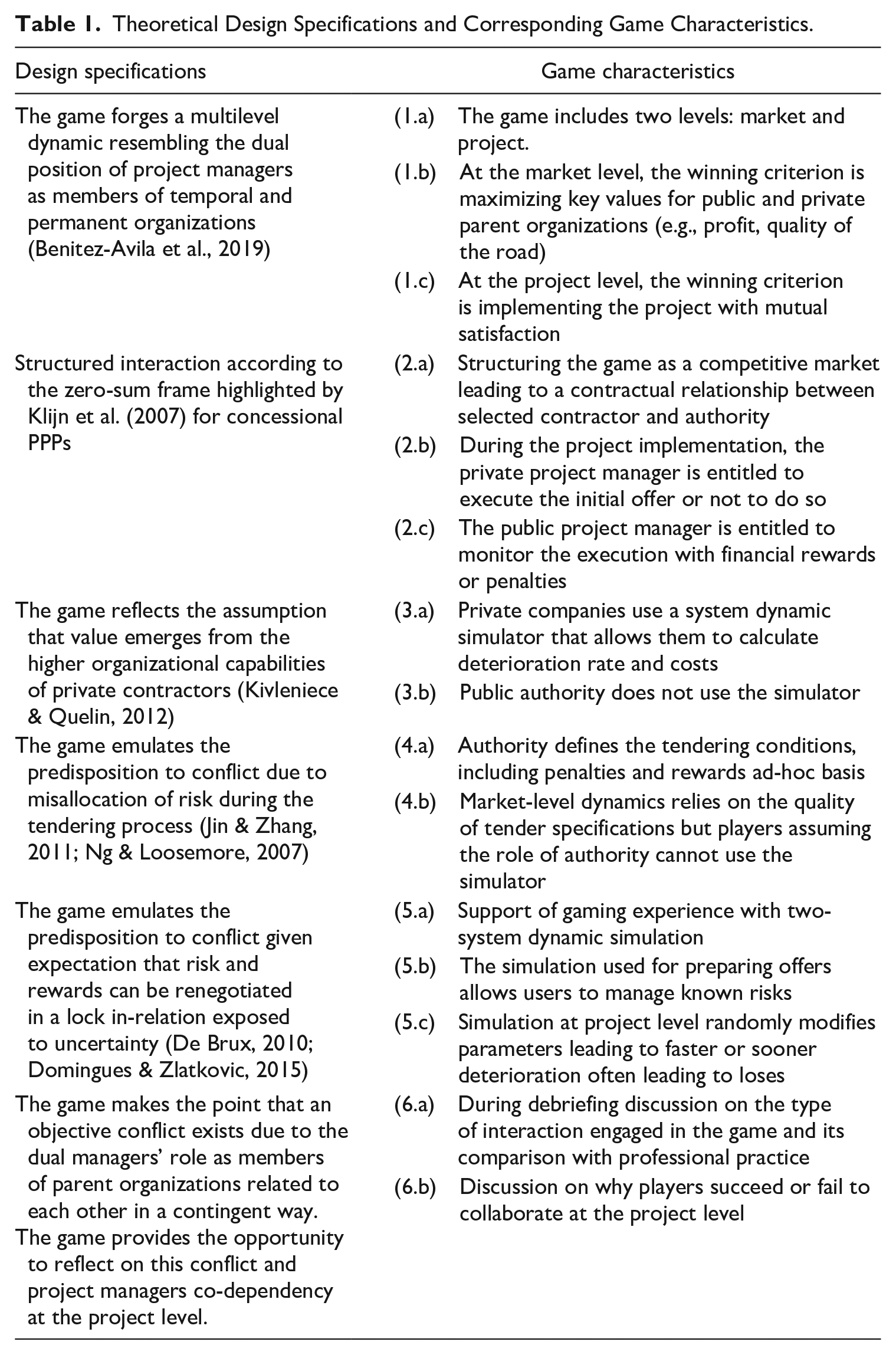
The design specifications of the game are based on the perspectives of process management in concessional PPPs (Klijn, 2008; Klijn et al., 2007) and multi-level project governance (Benitez-Avila et al., 2019). On the one hand, the game structures interaction according to the zero-sum frame highlighted by Klijn et al. (2007) and the assumption that value emerges from the higher organizational capabilities of private contractors (Kivleniece & Quelin, 2012). Additionally, the game forges a multi-level dynamic resembling of the dual position of project managers as members of temporal and permanent organizations (Benitez-Avila et al., 2019).
The “3P challenge” game consists of several rounds of tendering invitations at the market level in that each round leads to the implementation of a winning contract at the project level. The projects tendered/awarded are Design-Build-Finance-Maintain (DBFM) projects, that is, capital and maintenance investments defined by the firms upon service specifications. Therefore, there are two game levels (market and project levels) and three types of teams (road authority, firms, and temporal project teams) (Figure 1). A head leads the road authority team, supported by (two) public project managers. Likewise, firm teams consist of a CEO supported by (two) project managers. The project teams are temporal, comprised of a public project manager and the private project manager of the firm that wins the tender.
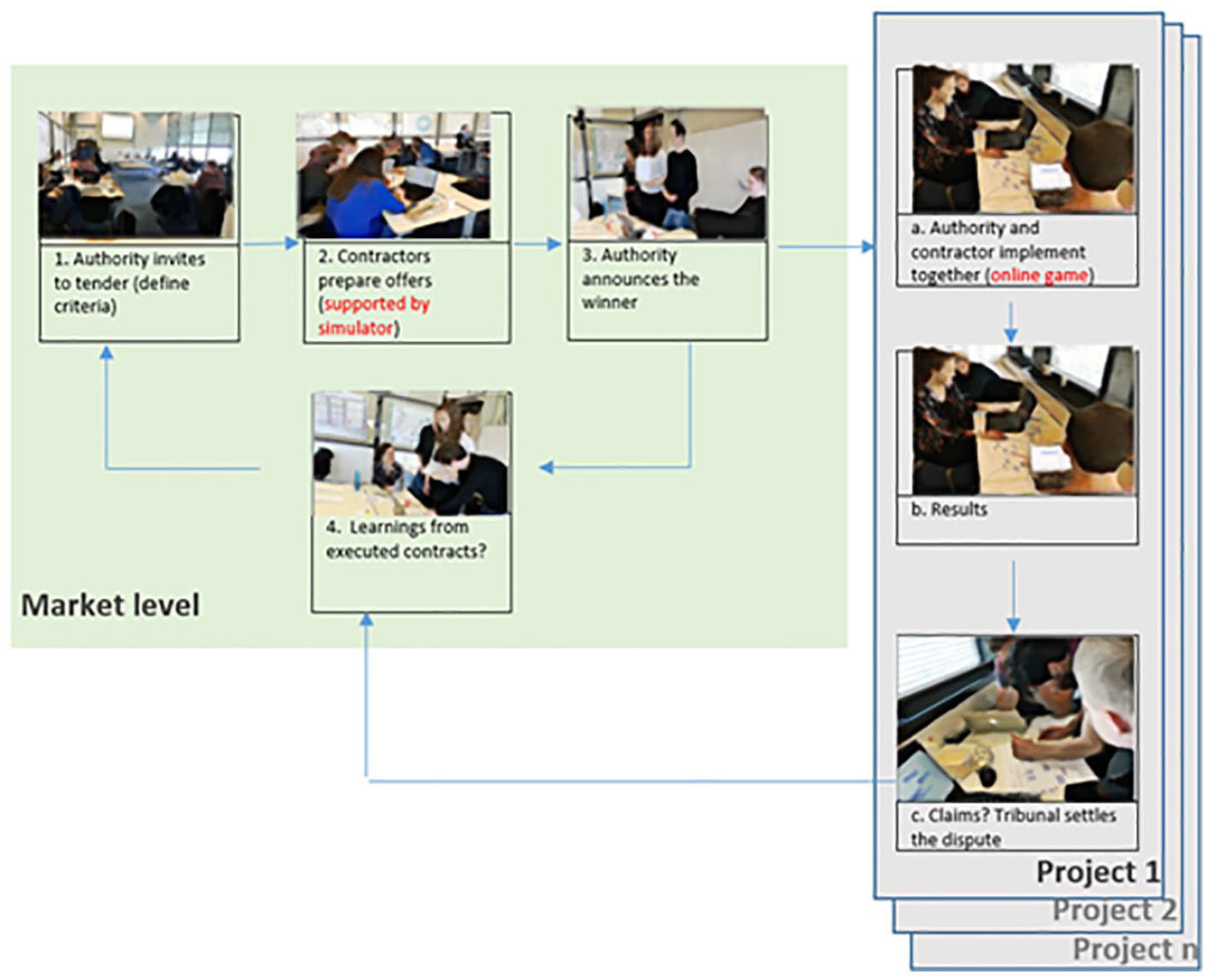
Game cycles at two levels: Market level and project level.
The 3P challenge setting simulates the zero-sum situation in concessional PPPs at the level of parent organizations. The game establishes a potential conflict between public authority and selected contractor as the tendering process unfolds without necessarily observing who is the best actor to deal with risk (Jin & Zhang, 2011; Ng & Loosemore, 2007). Along with possible risk miss allocation during the tendering phase, there is a high chance that players run into loses during the implementation phase due to uncertainty. In this context, the game enables renegotiation, where a party must settle loses for the parent organizations in a lock-in relationship (De Brux, 2010; Domingues & Zlatkovic, 2015).
At the same time, the game leaves open the possibility to team-up at project level simulating the dual role of project managers as members of permanent and temporal organization. For doing so, the game includes different options for winning. At the parent organization level, the winning criterion is maximizing the profit for companies and maximizing road quality within budget for the authority. At the same time, the public and private project management team can win the game if they mutually agree that the project was satisfactory in the shortest time. By doing so, players acting as project managers face the incentive to move the project forward while aiming at satisfaction at the project level and serving the stakes of their parent organizations. During the de-briefing, players share their experience of this uneasy situation in the game. Table 1 summarizes theoretical design specifications and corresponding game characteristics.
Theoretical Design Specifications and Corresponding Game Characteristics.
Market level game
The interaction at the market level build upon the insights from the game “Road Roles,” driven by competition and regulated by the authority (Altamirano et al., 2008). The authority is responsible for a road network and invites to tender for a 20-year maintenance contract for this network, exploring multiple types of contracting alternatives. The head of the authority can define the award criteria as fixed priced or lowest price, as well as penalties or bonuses upon service levels. Firms present offers, including the capital investment and a maintenance plan. The objective of the firms follows the logic of gain (maximizing profits), while the aim of the public authority is maximizing the quality of the road (minimizing roughness measured by the QI index) 1 and availability (minimizing interruptions for carrying out maintenance). The head of the authority and the CEOs have the last word in the decisions made at the market level. Firms use a systems dynamic simulation 2 of the road deterioration for a 20-year lifespan, according to the Highway Design and Maintenance Standards Model (HDM-III) (Watanatada et al., 1987). The flight simulator has three areas: extra-capital investment, maintenance investment over time and key indicators to track road performance. Extra-capital investments can enhance strength coefficients (investing in the quality pavement) and layer thickness (investing in layer thickness) as well as predictability of the deterioration rate. Maintenance activities can be activated along the 20 years of the simulated project, having fixed and marginal costs depending on the deteriorated area.
Key indicators include the visualization of the service variables (QI roughness index and non-availability—days closed per year for deploying maintenance activities), pavement quality (distress stocks), total cost (capital and maintenance costs), and a summary of the critical indicators over time. Firms can run different scenarios of initial investments and various combinations of heavy and low maintenance activities, estimating costs, and trade-offs between service levels. The authority does not have access to the simulator to resemble the assumption that the market has developed unique capabilities to introduce efficiencies in the delivery and maintenance of public infrastructure.
Project level game
Once the head of the authority selects the winner, he/she appoints a public project manager for implementing the project with a private project manager appointed by the CEO of the winner firm. After signing a contract, the public and private manager implement the offer in an online simulation running year by year. 3 The systems dynamic model that supports the online simulation randomly modifies parameters with high sensitivity. Players are not explicitly told so, but they are asked to bear in mind uncertainty. The public and private project manager control different decisions (different screens and panel controls). The private project manager controls maintenance activities, while the public project manager controls penalties/rewards/extra payments. As players “run into the surprise” of sooner or faster deterioration, the online simulation provides the possibility to introduce modifications of the maintenance investments. Likewise, the simulator allows the public project manager to change his/her strategy for imposing/waiving penalties and bonuses.
Once the players run the online simulation for the 20 years, they share the final screen reporting the performance of the key indicators. Players are free to negotiate/renegotiate the extra cost, taking into account that they need the authorization of their head/CEO. If there is no agreement, they can appeal to a tribunal (random card defining the winner), which settles the conflict. There is a facilitator at project level assuming the role of the bank, collecting the expenses related to capital and maintenance investments. The bank also controls debt settlements at the end of the project. The PPP winner team is the one who implements the project in the shortest time, with a positive project assessment of both managers.
Game De-briefing
After the game session, participants were individually asked to respond which type of interaction best describes their exchange with other players—and why (e.g., competitive, opportunistic, solidarity, and concessionary modes of interaction). Then, in a plenary session, the facilitator invites participants to compare the game experience with their practice. This includes questions about players’ interactions with other players when activating game mechanisms (e.g., penalties) and how these interactions and outcomes of the game resemble the characteristics of working relationships and enactment of contractual obligations in practice.
Prototyping, Testing, and Evaluation With Students
The process described above took as reference the triadic model of serious gaming of Harteveld (2011), that assesses the quality of the game design as a balance between the three aspects of reality, meaning and play (Table 2). The game was played in three preliminary sessions with Master and PhD students (n = 33) to balance game reality, meaning, and playfulness. Students assessed the flight simulator as a realistic representation of the dynamics of road deterioration and maintenance studied in their courses and research. In a second validation stage, the final version was played with students of civil engineering at the Bachelor level (n = 13) and Master level (n = 9). It aimed at testing the questionnaire to capture the interaction of players during the game, as well as establishing a benchmark for setting the terms of the de-briefing.
Final Game Design Characteristics After the Prototyping-Testing-Redesigning Process.
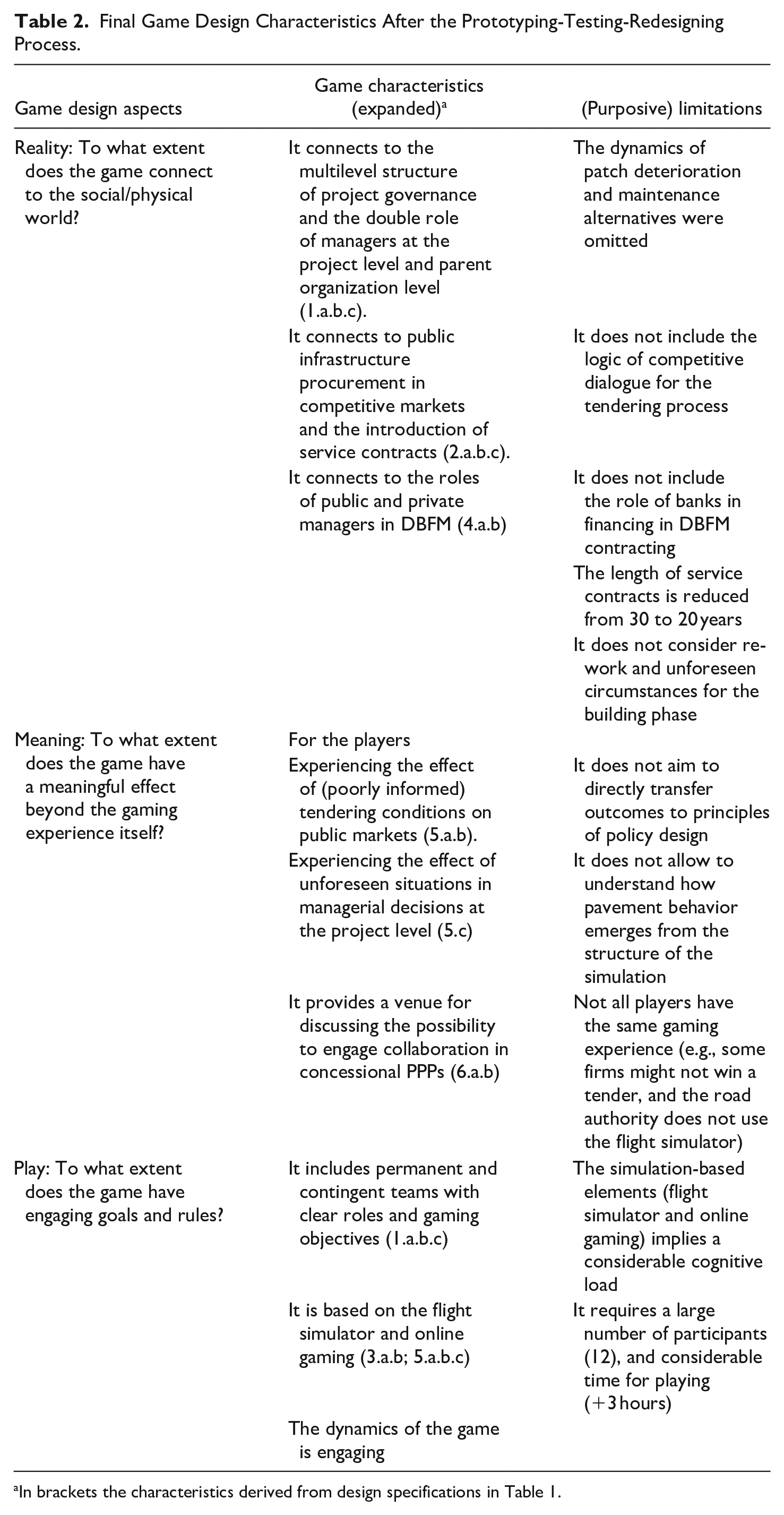
In brackets the characteristics derived from design specifications in Table 1.
Gaming with students allowed us to corroborate that our game replicated the dynamics observed in similar games at the market level (Altamirano et al., 2008). Tender invitations based on lowest price lead to underestimation of costs by companies, who aim to win the call rather than structure a feasible project. Additionally, the head of the government usually struggled to define tendering conditions lacking information to assess the feasibility of their tendering requirements. At the project level, there was a tendency toward low interaction in the case of bachelor students. Bachelor students implemented the maintenance plan in a rather mechanical way without engaging in renegotiation when the online simulator led to unexpected project performance. There was a higher level of interaction in the case of Master and PhD students. Overall, players focused on winning the game as permanent organizations rather than winning at the project level as temporal teams. In conclusion, the gaming experience emulated the zero-sum game identified by process management in concessional PPPs and predisposed conflicts.
The adversarial gaming experience was transferred into a “meaningful conflict” (Mitgutsch et al., 2013, p. 720). A meaningful conflict encourages players to engage a more critical play after some gaming rounds. Given time limitations, we focused on turning eventual adversarial gaming experiences into a source of meaningful reflection during the game de-briefing. De-briefing questions aimed to (i) identify in which circumstances players were able to deviate from conflict predisposition; (ii) compare the adversarial structure of the game with the roots of eventual conflict in concessional PPPs in practice; and (iii) explore whether and how practitioners overcome the objective predispositions to adversarial interaction in practice. Table 2 summarizes the game design characteristics after the prototyping-testing-redesigning process. Notice that the game characteristics in Table 2 expand those formulated at the beginning of the prototyping process (Table 1).
Game Sessions With Practitioners
The game was played with practitioners in two sessions. The first session was arranged as part of an applied research activity led by an organization interested in exploring service contracting for the delivery of green infrastructure. The session brought together a group of mixed practitioners (n = 10) including eco-engineers and professionals with expertise in DBFM(O) projects in the Netherlands, such as private consultants and public procurement officers. The second session was arranged as a team-building activity for DBFM(O) public project managers (n = 10), with the particularity that the team head and other members were recently appointed to their positions. Therefore, the game was an opportunity for sharing knowledge between experienced practitioners and newcomers.
Results
First Game Session
Game outcomes
The game session included three firms competing and five rounds of tendering invitations and corresponding projects. Table 3 summarizes the performance of key indicators of the game. In all rounds, public contract manager and private project manager had to settle loses, and there was no case where both managers regarded the project as satisfactory. Financial losses were the outcome of strict tendering conditions imposed by the authority, as well as the fastest deterioration of the road during the implementation phase. The satisfactory assessment of the public project manager in the first round was because of the relatively good quality of the road, considering the unexpected faster deterioration. This was also the reason for the positive outcome for public project manager in the third round, reinforced by the budget surplus. The satisfactory outcome for the private firm in the fifth round was the result of the authority overestimating rewards for good performance by the head of the authority.
Game Played With Mixed Practitioners—Tender Conditions and Performance Indicators.
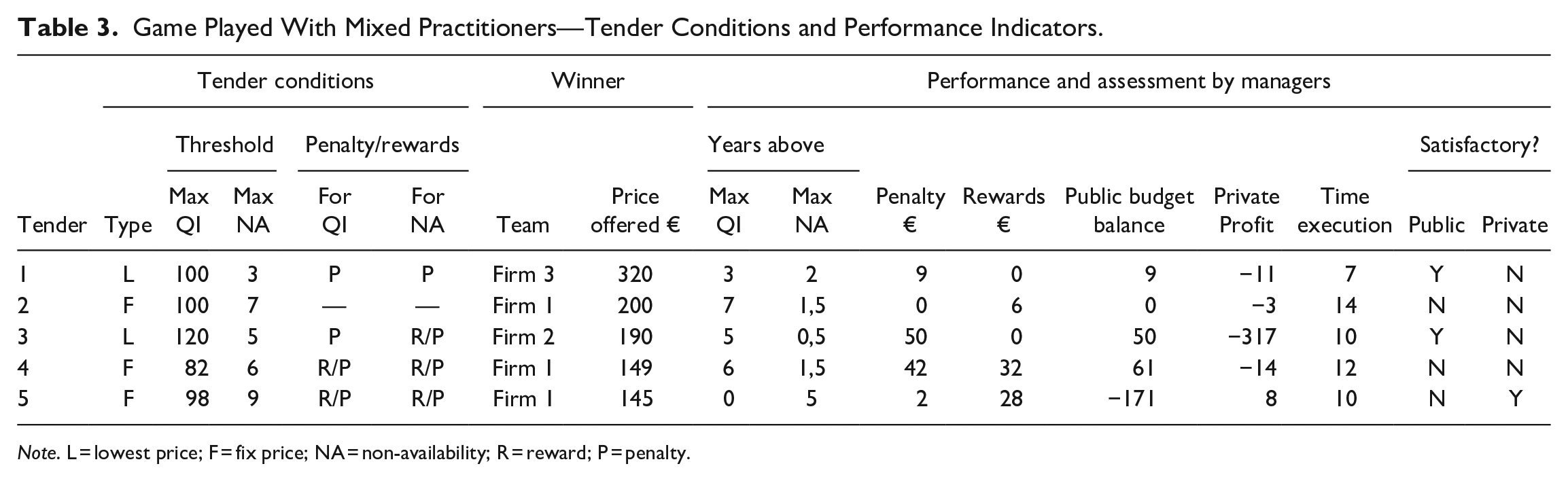
Note. L = lowest price; F = fix price; NA = non-availability; R = reward; P = penalty.
Reflection on the gaming interaction
Players identified themselves as part of the parent organization, assessing outcomes against the goals set for the authority and firms. Public contract managers worked together with the head of the authority in the market round when defining the tendering conditions. Likewise, private project managers worked closely with the CEOs while structuring proposals. These primary identities remained when managers engaged at the project level, as managers did not develop a team identity. Players were very focused on the objectives of the parent organizations in situations where the firms experienced low-profit margins and high risk (Table 4).
Interaction Assessment—Game Session With Mixed Practitioners.
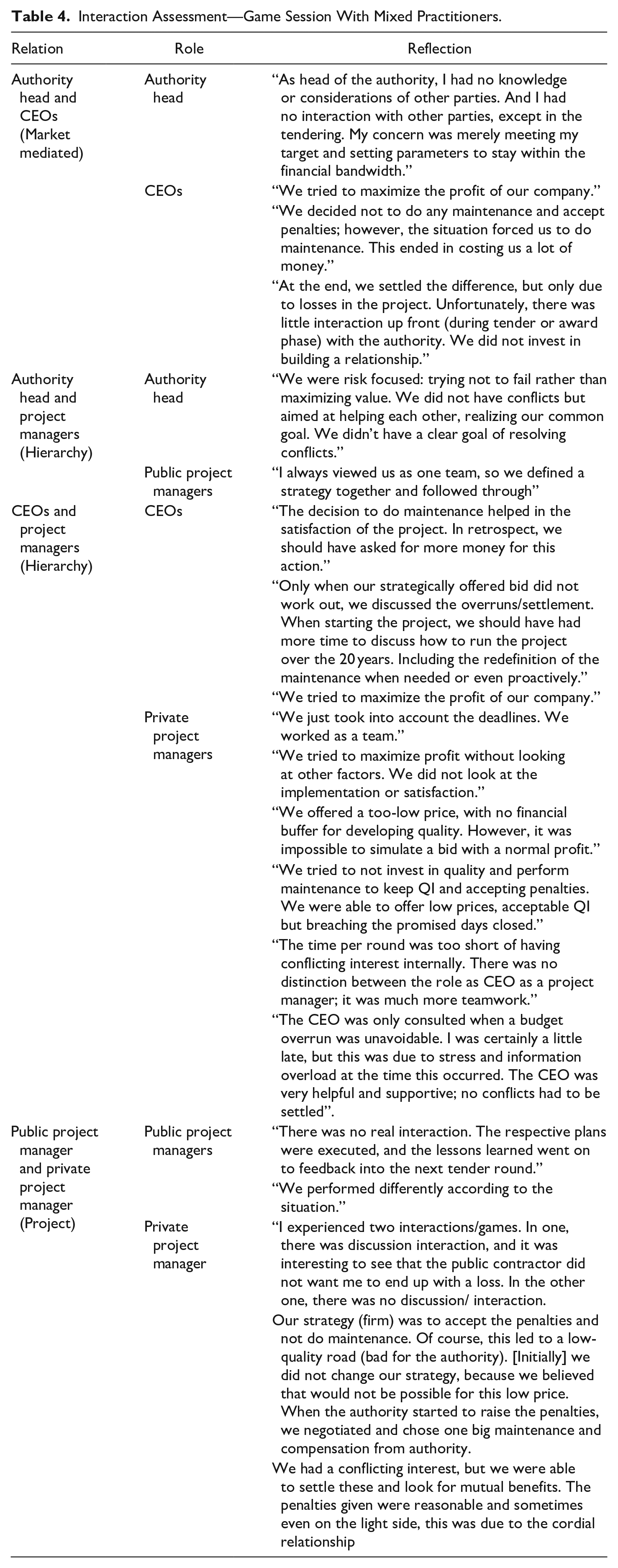
When reflecting on the causes of loses and dissatisfaction at project level players did not feel compelled to consider other player’s stakes. They argue that tendering rounds were not set up as a real “partnership,” but as a regular agent-principal relationship. Players assuming the role of firms declared that the tendering conditions were too demanding, leading to “not marketable” calls. Once these projects were awarded, they aimed at minimizing losses without considering the concern for quality. On the other hand, the head of the authority acknowledged that his objective was, foremost, focused on avoiding budgetary overruns: “I was busy with my targets, and I didn’t take into consideration other parties.” He took for granted that the available budget could be divided equally for all projects based on the perception that firms were doing fine.
In general, the space for dialogue at the project level was used for bargaining loses after parties aimed to maximize gains for their parent organizations facing uncertainty and tendering misspecification. However, the game also made the point that people enact the same role differently opening the space for walking into the shoes of the other. This space for subjective enactment of tasks was evident in the different types of interaction engaged by the two public project managers.
Predisposed by demanding conditions of the tender, one private project manager explained that he had to keep losses low given that initial estimations did not match the actual implementation of the project. The private project manager did not try to explain the situation to his counterpart, nor could he consider the public stake due to his struggle with his performance. In turn, the public project manager demanded to comply with the contract, without considering the financial loses. In contrast, the second public project manager tried to open a dialogue with his counterpart. In some cases, he waived some penalties to alleviate budget pressure for the private firm. The different managerial attitude was recognized by one contractor who could compare the rounds with the two different public contract managers.
Finally, the de-briefing enabled players to reflect on what they could have done differently. In particular, the head of the authority asserted that he could be engaged in open communication with firms and could even have carried out a market consultation. He indicated that the value of the game experience is the possibility to critically reflect on the tendency to take others’ expectations for granted. He stated that “the game makes the point that you can implement the contractual mechanism without much communication or communicate with the other party about what you have to implement.” This opinion was shared by the players assuming the role of private actors.
Reflection on PPP practice
Players regarded the interaction experienced in the game as similar to the one experienced in their working practice. There is a general sense of dissatisfaction in the Netherlands with DBFM(O) contracting because companies experience a low-profit margin and high risks. The participants pointed out that difficulties in the implementation of some DBFM(O) arrangements were due to the high appetite of the market to accept any risk. They also commented that the procurement authority is now more careful in transferring risk during the tendering process, and the Ministry of Infrastructure and Water Management is less enthusiastic about concessional PPPs.
The game brought into discussion the extent to which DBFM(O) contracts should be regarded as a partnership. One practitioner familiar with alliance PPPs pointed out that she did not see any of the typical incentives for collaboration in the game, such as sharing risks. Consultants added that the “partnership” label for DBFM(O) contracts is rather misleading as they are nothing more than private finance initiative (PFI) models. According to them, collaboration is reduced to the expectation of “helping each other” only until the point where it is “safe.” An experienced procurement officer explained that poor communication is typical in the implementation of DBFM(O) contracts. Constraints of the project are born in the tender phase. Actors lose sight of the initial goals given their natural habit to assume that the project mission can be reduced to the fulfillment of contractual obligations.
The absence of a feeling of partnership in the game triggered diverse opinions on the extent to which one should expect (and encourage) a team identity at the project level in practice. Some participants suggested that interaction over time and task at hand shape a situation where members from different organizations develop a team identity, and the project itself tends to have higher priority than the parent organization mandate. For others, this phenomenon was regarded as “projectitis,” which is undesirable, taking into account that managers are employees complying with mandates and not entrepreneurs making decisions. Therefore, sustainable collaboration in a project cannot rely on personal grounds, but rather on the objective alignment of interests between parent organizations and their materialization in agreements. Plus, stable staffing for 20 years is not realistic as people usually decide to move on after a couple of years, which implies that the agreement remains the basis for building mutual interest between newcomers.
Second Game Session
Game outcomes
The game session included three rounds of tendering invitations and corresponding project implementation. Two firms were competing. As in the previous gaming session, project-level outcomes depended on the tender conditions. The performance indicators show a contrast between the dissatisfaction experienced by managers in the first tender and the satisfactory experience in the other two tender rounds. Discontent in the execution of the first project stemmed from financial loses for both sides. The mutual satisfaction in the second project was the result of the joint agreement to focus on a common goal at the project level (avoiding loses), beyond the goals set by the parent organizations. The satisfaction in the last project was due to the tender in which only one firm submitted an offer. As the tender included a fixed price, the company presented an offer with a threshold of 150 QI, the maximum deterioration to be simulated by the systems dynamics model. Hence, there was no chance that road quality would score below the defined threshold (Table 5).
Game Played With DBFMO Project Managers—Tender Conditions and Performance Indicators.
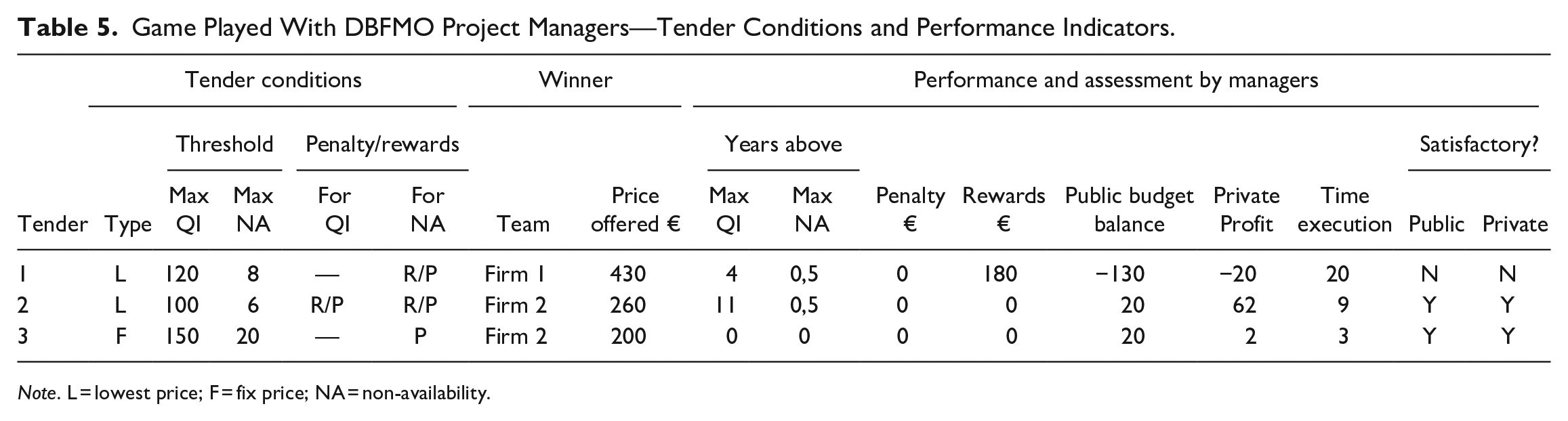
Note. L = lowest price; F = fix price; NA = non-availability.
Reflection on the gaming interaction
The game environment was less competitive than the one observed in the mixed group of practitioners due to the previous ties between colleagues with a similar background. While players still identified themselves as part of the parent organizations, they also showed some effort for project team building regardless that the game exposed firms to low-profit margins and high risk (Table 6).
Interaction Assessment—Game Session with DBFMO Project Managers.
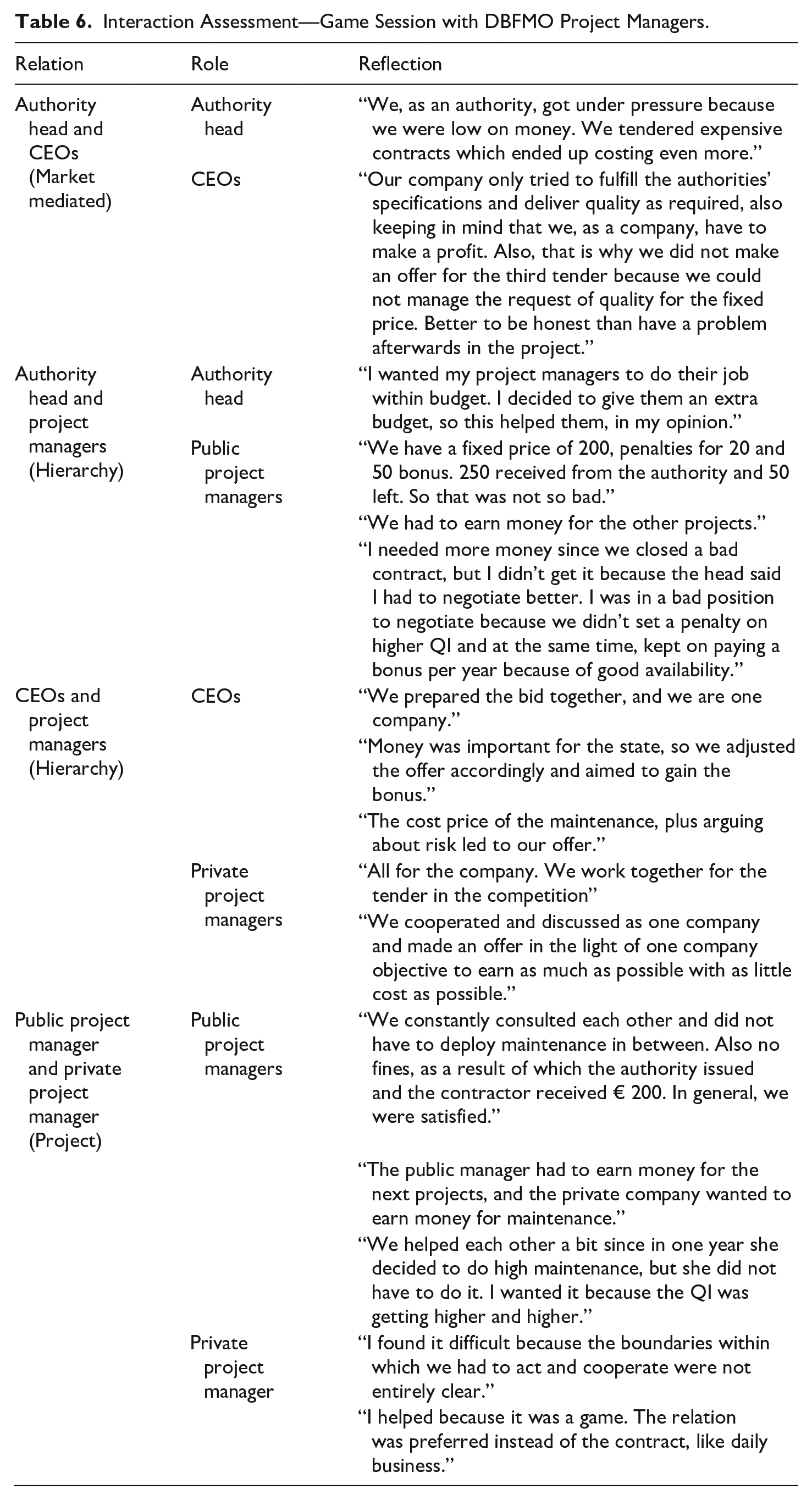
Players reflected on the dynamics at the project level as a result of tendering conditions and uncertainty leading to loses. From the public project manager perspective, the dissatisfaction in the first game round stemmed from the impossibility to enforce road quality as there were no penalties built in the contract but high availability rewards. The private project manager was not compelled to invest in road quality as the contract did not provide an incentive to do so. However, there was a point where the private project manager assumed extra maintenance costs after noticing poor quality but also big loses for the public party.
Managers in the second game took a different approach to deal with the poor conditions leading to loses. They agreed on the mutual objective to prevent economic loses for both parties over road quality. Managers claimed that their “business case” was accepting poor performance in the ongoing project in order to “earn” some money for next projects. Nevertheless, the head of the authority pointed out that the poor performance was not satisfactory from his perspective. Finally, the rather soft implementation of the project was surprising for the project manager, who was not aware that the system would not score more than 150 QI. The head of authority accepting the offer and the winning CEO also declared that they were not aware of the boundaries of the physical system simulated by the systems dynamics model.
Reflection on PPP practice
Practitioners regarded the constrictions for collaborating at the project level as familiar due to contracting misspecifications. Nevertheless, they also argued that concessional PPPs provide space for developing a sense of partnership. They explained that in the exploitation phase, the roles of client, user and public project manager are assumed by new people who often have to face the hidden defects and even contract misspecifications of the first years. During that period, actors have to engage in the process of interpretation and discussion of the contractual clauses, including the execution of penalties. Based on the participants’ experience, managers can carefully waive penalties for some issues with the expectation to find a “better solution” for all. However, they also can make clear to the contractor that “if you give less, we also pay less” to push for evidence of the contractor’s service provision. As the relationship between public and private project manager usually implies a continuous discussion and interpretation of service levels and contractual obligations, practitioners stated that collaboration emerges from the mutual clarification of contractual clauses (including penalties).
From the perspective of game participants, building a sense of fairness and clarity is critical in two specific situations. First, in some cases, all kinds of risks are transferred to the market by the procurement authority. These risks are accepted given the high appetite of contractors, even if they are not able to autonomously manage them. When the public project managers monitor the performance in the light of the risk transferred, the private counterpart may argue that “it is a partnership (and therefore) we should work together.” Here, the public project managers should avoid re-taking the transferred risk, but also should assess how to move forward in the project.
The second situation includes the introduction of functional changes that require extra investment from the user, who usually expects either a lower price or a higher service level than offered by the contractor. In this situation, the relationship built over time provides the background against which the public project manager assesses if the price offered by the contractor for the service is fair. Trusting behavior is reinforced by the long-term nature of the contractual obligation increasing the chances of penalizing circumvent behavior in future interactions. The project manager needs to make an informed assessment of the integrity of the contractor’s proposal as well as to minimize the discussion with the user of the building by clarifying the scope of the agreement and what the user can expect (or not) from a DBFM(O) contract.
Discussion
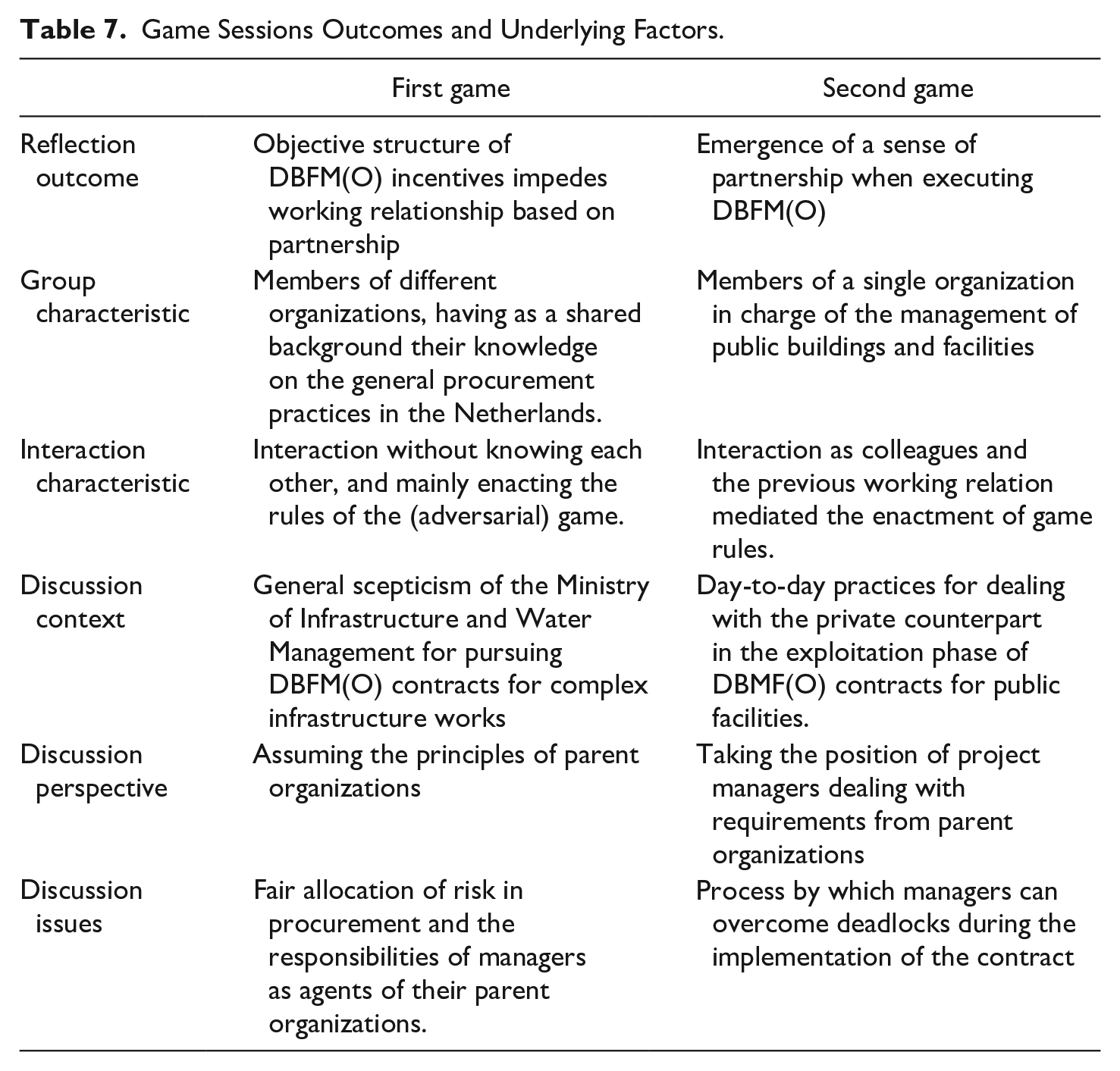
Our results indicate that the game effectively simulated the mechanisms leading to overbudgets of projects. This situation favors zero-sum interaction, as players have to negotiate how to allocate loses while dealing with service pitfalls. In both game sessions, players assuming the authority role set tendering conditions without considering the eventual burden shifted to private actors. Firms presented proposals assuming high risk to win the tender. While most of the interactions at the project level in the first game session were adversarial due to the misspecification of tendering conditions and uncertainty, players in the second session showed a higher willingness to take care of the other’s stake when dealing with loses during the implementation phase. The two groups strongly differed in their view on the possibility of developing a sense of partnership in concessional PPPs. While the second group explicitly recognized the emergence of a sense partnership in their practice, the first one declared that the objective structure of DBFM(O) incentives impedes such a type of working relationship. Table 7 summarizes the underlying explanations of such different outcomes gaming outcomes. Then, we discuss the theoretical contributions of these results and the use of the game for practice and education.
Game Sessions Outcomes and Underlying Factors.
Sense of Partnership Emerges From Dealing With Deadlocks During Implementation
The process management literature argues that satisfaction emerges from (re)creating the sense of partnership and legitimacy when addressing project issues in alliance-type PPP (Klijn, 2008; Klijn et al., 2007; Verweij et al., 2013). Our results suggest that managerial agency have a role when dealing with deadlocks in concessional PPPs too. The difference is that deadlocks in concessional PPPs can be attributed to shortcomings of the tendering phase to deal with the inherent uncertainties of these long-term agreements. As the second game session showed, contractual provisions serve as a reference for defining enforceable obligations. But dealing with project issues have a subjective dimension defined by the managerial agency. Project managers bring into play contractual obligations to clarify performative and value expectations between users, parent organizations and counterparts. This sense of transparency, clarity and fairness built over time provides extra-contractual grounds for legitimizing practices such as blending contractual dispositions or asking and giving concessions to the counterpart. Partnership in concessional PPPs can emerge as a relational good from (re)creating clarity and fairness in the process of executing front-end agreements.
Project Managerial Agency Is a Broker of Interests
What remains intriguing is that the first group of practitioners disregarded the possibility of partnership in concessional PPPs. In contrast, the second recognizes a space for building a sense of partnership in practice. These divergent perspectives can be understood in the light of the layered nature of project manager positions, considering the dualism between temporary and permanent organizing (DeFillippi & Sydow, 2016; Sydow & Braun, 2017). The first group of practitioners approached the partnership issue from the perspective of a permanent organization. From this perspective, the normative expectation is that project managers act as employees executing the front-end agreement in the interest of their organizations. The collaboration between managers at the project level can only rely on the objective alignment of organizational interest in a temporary agreement. Managers are portrayed as an instrument of organizations, tasked to materialize such alignment of interests. For this reason, the first group use the negative connotation of “projectitis” to those situations where project managers prioritize the project over the mandate of the parent collaboration.
However, by pointing out “projectitis” as a sort of pathology, the first group indirectly acknowledged the existence of a temporal and permanent interface. The agency of project managers cannot be reduced to the instrumental execution of a mandate appointed by a higher level. In inter-organizational settings, project managers engage in a day-to-day working relationship with their counterparts and their vested interest in pushing the project forward (Benitez-Avila et al., 2019). In the PPP context, project managers face colliding mandates of the two parent organizations when they have to address loses (Klijn et al., 2007). However, the participants in the second game session made the point that bottlenecks and mutual dependence open the opportunity for dialogue upon which a collaborative relationship van be built. In such a dialogue, project managers refer to contractual obligations in relation to value expectations from users, parent organizations and the project itself. They assume the vertical mandate as broker reflecting on multiple interests and finding creative ways to prioritize or reconcile differences (Fleming et al., 2007).
Building Trust Requires Breeding Reflexivity
Sense of partnership ultimately relies on trust (Klijn et al., 2007), and examining their grounds allows us to better understand the dynamics of trust in temporal organizations. Traditionally, trust-building is framed as a voluntarist outcome of actors (Poppo & Zenger, 2002), sometimes facilitated by external systems of shared meaning (Bachmann & Inkpen, 2011; Swärd, 2016). Our findings call for better articulating trust development based on actors’ capacity to reflect on their objective basis of the working relationship (Archer, 1995; Donati & Archer, 2015). Beyond its psychological dimension, trust is a property of a relation. In particular, trust is the relational surplus emerging from subjectively enacting of objective organizational bonds and predicaments but external to subjects (Donati, 2015).
The externality of such relational good can be fully grasped by examining the conditions that enable managers to blend contractual scripts when dealing with project deadlocks. On the one hand, such practice emerges as a creative solution supported by the present goodwill surplus of their past interactions. On the other hand, accumulating such surplus means that previous behaviors did not fundamentally ignore the horizontal demands from parent organization nor vertical demands from the counterpart—including the contractual engagement. Therefore, creative interactions that place contracts between brackets are legitimate because they are aligned with the objective demands that impose the dual role of managers and reproduce the sense of partnership as relational good.
Here, trust literature has overlooked the role of reflexivity linking individual dispositions and the multiple and conflicting demands imposed on people in organizational situations (Donati & Archer, 2015). Reflexivity allows individuals and groups to consider themselves in relation to their (social) context and vice versa (Donati, 2015). In the execution of PPPs, reflexivity allows managers to consider themselves as professionals when dealing with project issues in relation to the working context and vice versa. It connects the psychological dimension of trust with the context, including organizational and contractual demands mediated by relational goods (e.g., sense of partnerships). Therefore, it is not enough asking managers to “trust” each other, suggesting “open conversations” nor stating that “trust” requires time. Breeding sense of partnership demands to activate the capacity to consider how “we”—as project managers- can shape a working relationship, which basis of trust must be aligned with the diverse and often divergent external demands due to our dual positions.
Reflexivity to Support Collaboration in PPPs
The P3 challenge game aims at activating reflexivity to stimulate collaboration during the implementation of concessional PPPs. Therefore, the game can be used as a project tool for setting relational norms during the transition from the construction phase to the operation phase (Benitez-Avila et al., 2018). Typically, project teams change during this transition and can face shortcomings emerging from decisions and choices made in the design and construction phase. The game allows practitioners to experience and reflect on these constrictions imposed by front-end project decisions and their implications for project and parent organization. It provides the opportunity to discuss the conditions of transparency and trust that must be in place when looking at future conflicts and the role of contractual obligations (they are not avoidable) to solve these conflicts but also to leave room to build working relations over time.
For education, the 3P Challenge offers the opportunity to theoretically discuss with students the roots of pitfalls of PPP projects and—more generally—the delivery of public infrastructure. This includes explaining the consequences of risk misallocation, opportunistic behavior, and dealing with uncertainty. The game can also introduce relational and sociological aspects that are easier to convey by experiencing meaningful conflict in a gaming setting (Mitgutsch et al., 2013). Here the game can reveal to students the different ways of enacting contractual and organizational obligations and that turning project issues into an opportunity for developing a sense of partnership depends on how managers enact contractual obligations in difficult times. It pushes students’ mental boundaries beyond classical economic theory that reduces professionals to utility maximizers.
Conclusion
The paper introduced the 3P Challenge a game to understand the possibility of and conditions for collaboration in concessional PPPs. The application of the game in two sessions with practitioners showed that the game allows players to experience the competitive pressure of PPP markets, the difficulty in defining accurate PPP tender conditions, and the uncertainty and emerging interaction of players assuming different roles in PPP projects. The game is able to activate a reflection on the multiple demands faced by managers in charge of executing concessional PPPs in the exploitation phase and the capabilities to build a working relationship based upon the creative enactment of contractual obligations. It offers to discuss the objective constrictions to develop a sense of partnership in concessional PPPs and encourages participants to identify in their practice the agential powers to creatively enact contractual obligations.
The lessons for concessional PPP projects are clear. PPP project managers should make an effort to make sense of contractual obligations considering their dual position as members of the temporal and permanent organizations. They should aim for fairness by considering their obligations in relation to their context and vice versa. This context includes the obligations of the counterpart in the same dual-position, being responsible for pushing the project forward while having the stakes of the parent organization in mind. Only after building a sense of fairness project managers can legitimately advance practices such as blending contractual dispositions or placing brackets around some clauses. In other words, managers should aim at building a working relationship stemming from (but not reduced to) the objective demands imposed by contracts and organizational mandates. These relations operate under managerial skills as a broker of interests up to the point that value conflicts do not fundamentally affect the core values and interests of the parent organization. Therefore, arranging PPP agreements with accurate allocation of risk and responsibilities remains a critical task.
There are theoretical gaps to be considered in future process management research of concessional PPPs. On the one hand, the theory of process management is based on the idea that legitimacy is the key to success. In our analysis, managers attribute satisfaction to interactions which lead to legitimate outcomes. Yet, these legitimate outcomes are defined by the way that problems are solved but not necessarily the quality of the outcome as such. Future research should investigate the extent to which subjective managerial satisfaction relates to objective performance indicators, acknowledging the diverse standpoints of success definition (Atkinson, 1999).
On the other hand, the impact of concessional PPPs on managerial collaboration might be more related to the shadow of the past or future. Beyond the accuracy of front-end risk allocation, the emergence of trust and partnership as relational good might be more supported by managers perception of long-term engagement that pushes them to “build” a working relationship. What remains unclear is how the sense of partnership as a relational good built by people filling organizational roles changes or remains with the dramatic turnover of actors typical for concessional PPPs (South et al., 2018).
A further limitation of our research is that de-briefing took as a reference to the Dutch context, which has been characterized as a corporatist culture (Bremer & Kok, 2000). Future research can explore the extent to which the game triggers similar reactions of PPP practitioners in other national and cultural contexts—in particular, the extent to which practitioners recognize themselves as a broker of interest in the execution of concessional PPPs. Likewise, scholars studying PPPs in other cultural contexts should test the extent to which sense of partnership emerge from (re)creating a sense of fairness and contractual clarity when dealing with bottlenecks. In any case, the 3P Challenge simulates the conditions placing project managers in zero-sum situations considering tendering misspecification and uncertainty. As these problems operate upon economic incentives, the gaming setting provides an opportunity for student and practitioners to reflect on collaboration building in concessional PPPs regardless of the cultural context.
At the moment, the game does not fully articulate the role of lenders in the ex-ante governance design and governing activity during the implementation of concessional PPPs (Dupas et al., 2011). The gaming experience can be further enhanced in that direction. Additionally, the game can be further developed by including complex procurement procedures such as competitive dialogue (Hoezen, 2012). In this case, the simulation must open the possibility to increase the understanding of the physical system as firms ask questions for clarifying the scope of the contract. Another possibility to explore is setting up the game in an online platform. The feasibility of such development requires the assessment of issues that in a face-to-face setting were not considered as problematic. For example, the 3P Challenge involves some idle times for some players (e.g., losers of tenders) that were used for having fun by socializing with colleagues. In a completely online setting, such idle times would be more problematic given the isolation of people inclined to shift attention to other activities.
Footnotes
Acknowledgements
The authors also thank Monica Altamirano who shared with us the insights of Road Roles Game. The interaction at the market level build upon these insights.
Declaration of Conflicting Interests
The author(s) declared no potential conflicts of interest with respect to the research, authorship, and/or publication of this article.
Funding
The author(s) disclosed receipt of the following financial support for the research, authorship, and/or publication of this article: This article presents findings of the research project governance for smartening public–private partnerships implemented in collaboration with the Erasmus University Rotterdam and financed by the Netherlands Organization for Scientific Research (NWO; Dutch Research Council: No. 409-14-014).
