




Abstract
Background
Exercise training and lifestyle physical activity have been identified as evidence-based approaches for improving symptoms and quality of life among persons with multiple sclerosis (MS). Such evidence supported the development of physical activity guidelines (PAGs) for people with MS. The goal of such guidelines involved broad dissemination and uptake, as there is substantial evidence for low rates of participation in exercise training and physical activity in this population.
Objective
The current study evaluated the quality and consistency of information on webpages for physical activity against the established PAGs for people with MS.
Method
The search was conducted in September 2020 using the Google search engine for webpages containing physical activity information for people with MS. We evaluated the webpages with a list of 18 guidelines for adults with MS based on recommendations from three resources.
Results
The search yielded 157 webpages, of which 27 met the inclusion criteria. On average, webpages accurately addressed only 5 of the 18 guidelines. The most commonly addressed guidelines involved MS-specific symptom identification (n = 26), and example modalities for aerobic (n = 20) and strength (n = 16) training.
Conclusion
Many online recourses regarding physical activity and exercise training for MS were either inconsistent with the established PAGs or did not address the guidelines.
Keywords
Introduction
Multiple sclerosis (MS) is an immune-mediated, neurodegenerative disease of the central nervous system 1 with a prevalence of 1 million adults in the United States 2 and 2.8 million worldwide. 3 This disease manifests in a number of outcomes including walking and cognitive dysfunction and symptoms of fatigue, depression, and pain that result in compromised quality of life. 4 Such manifestations can be managed medically through pharmacological and/or rehabilitation approaches delivered in comprehensive MS care, and further through engagement in behaviors such as exercise training and lifestyle physical activity.
Over the past 20 years, there has been a tremendous growth in the number of randomized controlled trials (RCTs) documenting the effects of exercise training and lifestyle physical activity on outcomes of MS. 5 The evidence-base supports beneficial effects of exercise training and lifestyle physical activity on walking and cognitive dysfunction, fatigue, depression, and pain, and compromised quality of life in MS6,7 Such evidence has coincided with further documentation of the safety of exercise training and lifestyle physical activity for persons with MS. 8
The state of science regarding benefits and safety has supported the development of guidelines for exercise training and lifestyle physical activity in persons with MS.7,9 Those guidelines were recently summarized and consolidated by an expert panel organized by the National MS Society for broad-scale dissemination and implementation by healthcare providers and persons with MS. 10 The goal of releasing such guidelines was for broad dissemination and uptake by persons living with MS, as there is substantial evidence for low rates of participation in exercise training and lifestyle physical activity in this population.11,12
The success of changing the patterns of exercise training and lifestyle physical activity in MS, in part, depends on successful and accurate dissemination of information through internet platforms and social network sites (SNSs). Those dissemination avenues provide a broad and readily accessible avenue for knowledge translation, and are often the first source of information for the general population 13 and people with MS. 14 Indeed, people with MS 14 are among the most informed, engaged and self-advocating people with chronic illnesses, and analyses of web traffic indicates that people with MS are actively searching on internet platforms and SNSs for information on diet, exercise, and emotional self-regulation. 14
The internet platforms and SNSs present an exciting opportunity for dissemination and knowledge translation in MS, but there is limited knowledge on the accuracy of information regarding guidelines for exercise training and lifestyle physical activity in MS. There is some information regarding accuracy in populations other than MS. We are aware of one paper that examined the accuracy of free online education resources with national physical activity guidelines for adults. 15 That study focused on investigating if the content of recommendations on webpages identified through a Google search was based on the Physical Activity Guidelines (PAGs) for Americans. The Google search identified 72 webpages published and updated between 2008 and 2018 that referenced 17 PAGs for Americans 18-64 years of age. The evaluation indicated that most webpages presented information that was inconsistent with published PAGs. Indeed, the evaluation indicated that between 61.1% and 100% of the sources lacked presenting one or more messages consistent with one of the guidelines. Such data suggest that freely available PAG-related online resources for the general population of adults had poor accuracy and consistency with the Physical Activity Guidelines for Americans. 15
The current study descriptively and comparatively evaluated the quality of the content and the consistency of the information on webpages for exercise training and lifestyle physical activity among people with MS against the established PAGs for people with MS. Based on previous research in populations other than MS,15-17 we hypothesized that the majority of webpages would present advice or recommendations inconsistent with established PAGs for exercise training and physical activity among adults with MS.
Methods
Search procedure
The search was conducted in September 2020 using the Google search engine for webpages containing physical activity and exercise-related information for people with MS. When completing the search and to avoid the impact of the search history on the search results, all Google personalization features and search history were turned off and this prevented prior search history from influencing the search results. In addition, we chose to use Google as it is the most popular search engine, and Google was the primary search engine utilized by other researchers. 15 Four separate searches were completed, and the primary distinction between searches was the focus on different exercise-related keywords (i.e., exercise; physical activity; cardio or aerobic or endurance; and resistance or strength). An example of the search terms is as follows: (“multiple sclerosis” OR “MS”) AND (“exercise”) AND (“ideas” OR “recommendation” OR “routine” OR “suggestions” OR “tips” OR “workout” OR “plan”). The search terms were the same among the four searches except the exercise-related keywords varied (e.g., “physical activity” instead of “exercise”).
Inclusion criteria
We limited each search to the first four pages of search results, as this is a conservative estimate of the number of pages the average Internet user would view.18,19 We removed duplicates and the remaining webpages were assessed for inclusion based on the following criteria: (a) the webpage contained any MS-specific exercise, physical activity, or sport-related information; (b) the webpage was written in English; (c) the communication objective of the webpage was educational where the explicit goal involved teaching, guiding, or persuading the reader to plan or complete some sort of behavior related to physical activity/exercise; and (d) following other researchers, 15 the primary medium of communication was text. We excluded webpages that were directed at health professionals (e.g., academic journal articles) or were purely promotional of a product (i.e., the objective was not educational). The primary reason for exclusion for non-educational purposes was webpages that aimed to sell or promote a product. In addition, the terminology “educational” material as well as rationale for inclusion criteria was following others. 15 All webpages were scored by at least 2 authors and one author (JLB) compared all scoring to identify discrepancies. All discrepancies regarding inclusion were discussed among the research team leading to a final decision.
We collected descriptive information for each webpage that satisfied the inclusion criteria. This included the type of webpage (non-profit/voluntary agency, commercial, professional association, government), the main topic of the webpage (e.g., provided physical activity or exercise ideas or suggestions, overview of exercise training principles), publication date, if a graphic (any picture/image/figure) was present, if authorship and/or references were provided, and if author contact information was provided. These data were collected for the purpose of describing the webpages included in the analyses.
Consistency with physical activity guidelines
We created a list of 18 guidelines from the PAGs for adults with MS based on recommendations from four resources.9,10,20,21 Multiple resources were considered to ensure the list of guidelines was consistent among expert sources and included both exercise training and lifestyle physical activity recommendations. The 18 guidelines were arranged into the following categories: aerobic exercise guidelines (n = 5), strength exercise guidelines (n = 5), lifestyle physical activity guidelines (n = 3), and special considerations (e.g., rest for at least 1 day between strength sessions, n = 5). The webpages were scored for consistency with the guidelines by two raters, and each guideline was scored as consistent (accurate information provided), inconsistent (inaccurate information provided), or not present (no information provided). Raters reached full agreement on all discrepancies, and the descriptive data were summarized per guideline across all four searches.
Statistical analyses
All statistical analyses were performed in SPSS Version 25. Statistical significance was set at p ≤ 0.05. Descriptive statistics summarized characteristics of the webpages and provided an overview of the number of guidelines consistently addressed by each webpage. The main statistical analysis included a Χ2 Goodness-of-Fit Test for each guideline to determine if the consistent-inconsistent categorizations were unequal for the sample of webpages. Of note, if a guideline was scored as inconsistent (i.e., inaccurate information provided) or not present (i.e., no information provided), it was categorized as “inconsistent” in the primary statistical analysis.
Results
Descriptive results
The four unique searches yielded 157 webpages, of which 27 were duplicates and removed (Figure 1). Overall, 27 of the 130 remaining webpages met the inclusion criteria and were coded for analyses. The primary reasons for exclusion were that webpages were not for educational purposes (n = 55) or MS-specific (n = 26). Table 1 includes the direct URL for the 27 webpages and publication year, where appropriate. Fifty-nine percent of webpages were classified as Non-profit/Voluntary Agency, 30% Commercial, 7% Professional Association, and 3% Government. The purpose of the webpages was primarily to provide physical activity or exercise ideas or suggestions (52%) or provide an overview of exercise training principles (26%). Publication date and authorship were provided in 74% and 52% of webpages, respectively, and graphics were presented in 63%. Alternatively, references and author contact information were only provided in 26% and 11% of webpages, respectively. Complete information regarding the characteristics of the webpages is provided in Table 2.
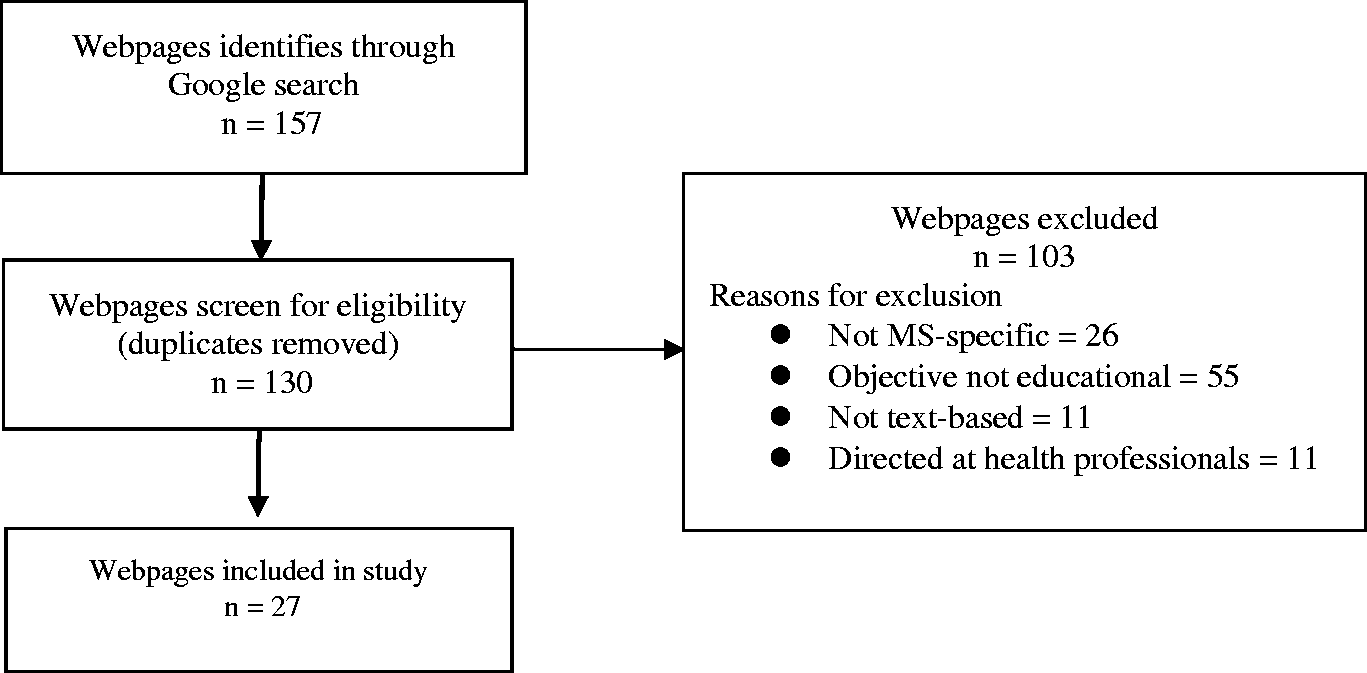
Flow diagram of the progress of searching, screening and including eligible webpages.
List of the direct URLs for the 27 included webpages identified through the Google search.

Characteristics of Webpages included in the review (n = 27).

Primary analyses
On average, webpages accurately addressed 5 of the 18 guidelines. Figure 2 represents the number of guidelines presented in each of the 27 webpages. Table 4 includes the webpages listed based on the number of considered guidelines as a marker for content-reliability. Each guideline for the PAGs was defined and assigned a number in Table 3. The most commonly addressed guidelines was PAG18 (i.e., MS-specific symptom identification and discussion) and this was included in all webpages except for 1 (n = 26). The next most frequently addressed guidelines were PAG4 (n = 20; i.e., provides example modalities for aerobic training) and PAG10 (n = 16; i.e., provides example modalities for strength training). No webpages in the search addressed PAG 5 (i.e., advanced aerobic exercise).

Patterns of presented guidelines in the included webpages (n = 27; i.e., sample number corresponds with webpages # and URLs in Table 1). Approximately 29% of articles presented messages consistent with aerobic exercise guidelines, 26% consistent with strength/resistance exercise guidelines, and 22% presented consistent with lifestyle physical activity guidelines.
Χ2 Goodness-of-fit test for the percent of webpages that presented messages consistent with physical activity guidelines for adults with MS.

Note: The null hypothesis of each goodness-of-fit test was equal distribution (n = 27; 27/2 = 13.5) between a consistent message (“Yes”) and either an inconsistent message or the absence of a message (“No”). A separate statistic was calculated for each guideline comparison. ‘+’ indicates more webpages than expected presented a message consistent with that guideline, ‘−’ indicates less webpages than expected presented a message consistent with that guideline, and ‘=’ indicates the expected number of webpages presented a message consistent with that guideline.
PAG: physical activity guideline.
Ranking of the Webpages based on the numbers of guidelines included in the content.
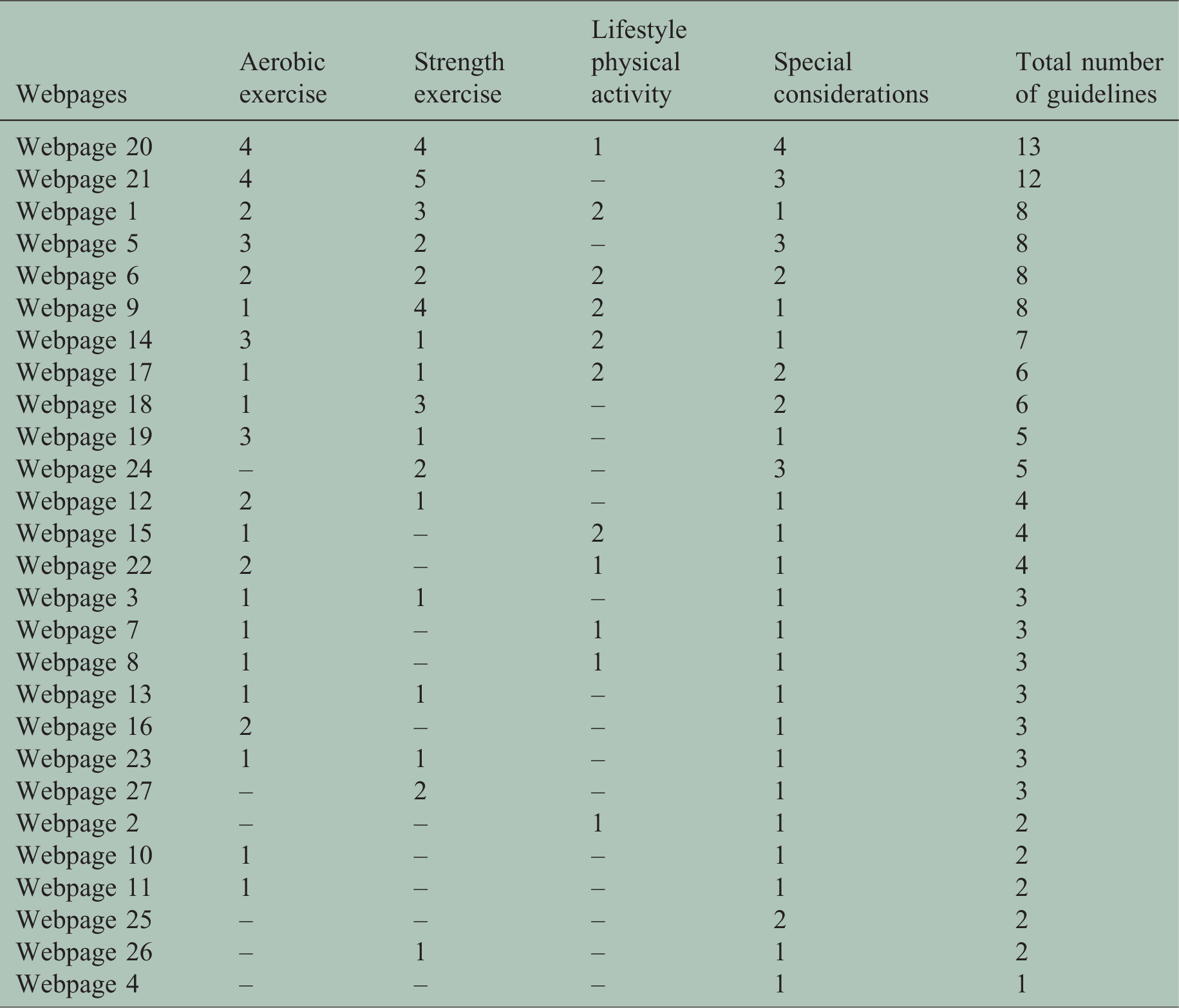
Table 3 provides the overall average use of consistent messages regarding each guideline as well as results from Χ2 Goodness-of-Fit Test for the percent of webpages that presented consistent messages. Thirteen of 18 guidelines had worse than expected distributions between being accurately addressed and not accurately addressed among the 27 webpages (Χ2 range 6.26-27.00). Three of 18 guidelines (i.e., PAG2, PAG10, & PAG13) had the expected distributions between being accurately addressed and not accurately addressed among the 27 webpages (Χ2 range 0.93-3.00). PAG18 and PAG4 had better than expected distributions between being accurately addressed and not accurately addressed in the 27 webpages (Χ2 range 6.26-23.15).
Of additional note, several guidelines were addressed among webpages, however the information was often inaccurate. For example, PAG1 (i.e., aerobic activity 2-3x/week) was the most inaccurately addressed guideline (i.e., the guideline was addressed/mentioned, but incorrect information was provided); five webpages reported information that was not consistent with the 2-3x/week guideline. Additionally, 2 webpages inaccurately addressed PAG11 (i.e., lifestyle physical activity 150 minutes/week) and PAG15 (i.e., rest between sets). Four guidelines were inaccurately addressed in one webpage: PAG6 (i.e., strength activity 2-3x/week), PAG7 (i.e., strength activity 1-3 sets, 10-15 reps), PAG9 (i.e., strength intensity safely complete 8-15 reps), and PAG17 (i.e., aerobic and strength same day).
Discussion
Our primary hypothesis was supported wherein the majority of webpages presented information inconsistent with established PAGs or did not address the guidelines. This is troubling as the Internet represents a popular source for physical activity information among people with MS, 14,22 however, the lack of consistency with established PAGs undermines the efforts of these online educational materials for promoting behavior change in MS. Indeed, the success of changing patterns of exercise training and lifestyle physical activity in MS, in part, depends on successful and accurate dissemination of information through internet platforms and SNSs, and is critical considering the substantial evidence for low rates of participation in exercise training and lifestyle physical activity in MS. 11,12
The most commonly addressed PAGs by the webpages were PAG2 and PAG18 regarding the provision of example modalities for aerobic exercise and MS-specific considerations, respectively. The inclusion of PAG2 is not surprising as examples are often presented when discussing physical activity (e.g., walking, swimming) and the appropriateness of a broad range of activities for persons with MS. Alternatively, it was encouraging that PAG18 regarding MS-specific symptoms (i.e., fatigue and heat sensitivity) was addressed considering that persons with MS may be hesitant toward engaging in exercise given symptoms such as fatigue and heat sensitivity. 23 If this guideline is presented without the added context of other guidelines or safety information, people with MS may see symptoms as barriers that limit or prevent participation in physical activity. This therefore represents a highlight of the webpages, as individual considerations for appropriate modalities should be identified and safety discussed before prescribing an exercise routine as well as evidence-based information regarding the benefits of exercise and physical activity for managing MS symptoms.
The webpages lacked a consistent message for 13 of 18 PAGs. This may not be surprising as PAGs for people with MS are relatively new and may not be widely known and applied by health promotion websites. This underscores the importance of future websites in accurately disseminating MS-specific physical activity recommendations. The most recent PAGs developed by the NMSS provide guidance for aerobic and resistance exercises as well as lifestyle physical activity. 10 In the current study, approximately 29% of articles presented 1 or more messages consistent with aerobic exercise guidelines, 26% of articles presented 1 or more messages consistent with strength/resistance exercise guidelines, and 22% presented 1 or more messages consistent with lifestyle physical activity guidelines. This suggests that lifestyle physical guidelines were addressed less often than exercise training. This is important as lifestyle physical activity may represent a better approach for rehabilitation than exercise training in MS, as it is more easily accessible and sustainable than exercise training, and there are established methods, namely behavior change interventions, for increasing lifestyle physical activity in persons with MS.24–26
There is a pressing need for dissemination of the evidence-based PAGs for MS among both consumers and health care providers. One recent qualitative study evaluating the 2013 Canadian PAGs for persons with MS highlighted that participants rated the guidelines as appropriate, but not well disseminated. 27 It is concerning that in 2019, very few participants were aware of PAGs for persons with MS or believed the name limited application to other geographic regions such as the United States. Another recent study examined priorities of neurologists in incorporating exercise training as part of comprehensive MS care and one of the primary questions was, “What are the prescriptions/guidelines for exercise among persons with MS?”. 28 The Internet is a likely source for both consumer and health care providers when seeking exercise and physical activity resources and therefore the provision of consistent information is critical within these webpages.
Based on the findings of the current study, we underline the necessity and the importance of engaging primary healthcare providers in assisting patients with finding precise and standard online information about established exercise programs. We believe primary healthcare providers can provide reputable online links among patients who seek advice on evidence-based physical activity recommendations. 29 The important first step would be to ensure that healthcare providers are trained and informed about the existing PAGs. In this view, we emphasize the possibility of the interaction of neurologists or other health care providers representing exercise behavior change within multiple sclerosis (MS) care settings. 30
The current study is not without limitations. The research team examined text-based information presented on the primary page of each webpage; further information may be provided in videos or links for subsequent pages; however, little evidence would suggest the information would be consistent with the PAGs. We focused on Google search engine, and day-to-day variance exists in the results, even when using consistent search terms. We repeated our original search in February 2021 and identified 160 sites with 106 duplicates between sites and 54 new sites. The new sites did not alter the conclusions of this paper. However, one limitation of our study was that we did not consider other search engines for two reasons: a) Google is the most popular search engine, as stated by the reviewer, 15,18,19 and b) we decided to follow other researches methodological procedure. 15 Another limitation refers to the “buying effect” which has impact on the available pages in Google search. Finally, another limitation of our study was that although the focus of the 18 guidelines are not equal, due to the primary goal of the article that was to provide a thorough summary of all components of the guidelines, we did not classify the 18 guidelines based on their focus when analyzing our data.
We descriptively and comparatively evaluated the quality of content and consistency of the information on webpages for exercise training and lifestyle physical activity among people with MS against the established PAGs for people with MS. Overall, we observed that the majority of webpages regarding physical activity and exercise for persons with MS presented information inconsistent with established PAGs or did not address the guidelines. This lays the groundwork for further research that develops widespread approaches for accurate dissemination of PAGs given the majority of sources do not mention the PAGs or provide consistent guidance.
Supplemental Material
sj-pdf-1-mso-10.1177_20552173211038035 - Supplemental material for Do internet resources align with exercise training and physical activity guidelines for people with multiple sclerosis?
Supplemental material, sj-pdf-1-mso-10.1177_20552173211038035 for Do internet resources align with exercise training and physical activity guidelines for people with multiple sclerosis? by Dena Sadeghi-Bahmani, Stephanie L Silveira, Jessica F Baird and Robert W Motl in Multiple Sclerosis Journal – Experimental, Translational and Clinical
Footnotes
Conflict of Interests
The author(s) declared no potential conflicts of interest with respect to the research, authorship, and/or publication of this article.
Funding
The author(s) disclosed receipt of the following financial support for the research, authorship, and/or publication of this article: This research was supported by a Mentor-based Postdoctoral Fellowship from the National Multiple Sclerosis Society (Grant MB 1907). This research was supported in part, by the Eunice Kennedy Shriver National Institute of Child Health & Human Development [F32HD101214] and the National Institutes of Health training grant (2T32HD071866-06). The content is solely the responsibility of the authors and does not necessarily represent the official views of the National Institutes of Health.

Supplemental Material
Supplementary material for this article is available online.
References
Supplementary Material
Please find the following supplemental material available below.
For Open Access articles published under a Creative Commons License, all supplemental material carries the same license as the article it is associated with.
For non-Open Access articles published, all supplemental material carries a non-exclusive license, and permission requests for re-use of supplemental material or any part of supplemental material shall be sent directly to the copyright owner as specified in the copyright notice associated with the article.
