



Abstract
Objective
Early osteoarthritis (EOA) detection is crucial for timely intervention, yet current methods often fail to identify early-stage disease. The popliteal crease obliquity angle (PCOA) shows promise as a novel anatomical marker, but its relationship with functional movement patterns remains unclear.
Methods
This cross-sectional study employed a two-phase machine learning approach in 43 manufacturing workers (86 legs, aged 40–70 years). Phase I used regression analysis to predict PCOA from step-down frontal plane kinematics using five algorithms. Phase II applied PCOA measurements to classify EOA status based on the Early Osteoarthritis Questionnaire. Performance was evaluated using coefficient of determination (R2) and area under the curve (AUC). To interpret and explain the predictions, we used SHapley additive explanation values and partial dependence analysis.
Results
Extreme gradient boosting achieved optimal Phase I performance in predicting PCOA from step-down kinematics (R2=0.668) on the hold-out test set. Femur horizontal displacement (valgus movement), pelvis horizontal displacement, and ankle horizontal displacement were key predictors. Random Forest demonstrated superior Phase II performance (AUC=0.885, accuracy=0.824) on the hold-out test set, with PCOA as the dominant feature. Partial dependence analysis identified a critical 7° threshold above which EOA probability increased.
Conclusions
This study establishes a strong functional-anatomical relationship between step-down kinematics and PCOA, demonstrating PCOA's association with EOA status. The 7° threshold, measurable via smartphone photography, offers a practical alternative to complex kinematic analysis for early OA screening in clinical practice.
Introduction
Osteoarthritis (OA) is a degenerative joint disease affecting millions worldwide, causing pain, stiffness, and reduced quality of life.1,2 Early OA (EOA) detection is crucial for timely intervention, yet current diagnostic methods often fail to identify early-stage disease, leading to delayed treatment and poorer outcomes.3–5 Developing novel, non-invasive diagnostic tools for EOA detection is therefore paramount for improving patient care.6,7
Recent research has highlighted the popliteal crease obliquity angle (PCOA) as a novel anatomical marker for early OA diagnosis. The PCOA, defined as the angle between the longitudinal axis of the lower leg and the popliteal crease, offers a non-invasive, easily observable parameter that may correlate with underlying biomechanical alterations associated with EOA.8,9 PCOA showed high correlations with established radiographic measures of knee alignment, particularly the hip-knee-ankle angle (HKA) and the joint line convergence angle (JLCA), which have been extensively linked to OA progression.8,10–12
However, the biomechanical foundations underlying PCOA's relationship with functional movement patterns remain unclear. Understanding how dynamic functional movements influence surface anatomical features like PCOA is crucial for establishing clinical validity and enhancing interpretability. The step-down test is particularly relevant for knee assessment because stair descent commonly provokes knee pain in individuals with early OA.13,14 The eccentric loading and single-leg support demands of step-down tasks challenge frontal plane knee stability and often reveal compensatory movement patterns not apparent during less demanding activities.15,16 Frontal plane kinematics during functional tasks may be particularly relevant, as movements such as knee adduction significantly impact joint stress and OA progression.17–19
Machine learning (ML) techniques have increasingly been applied to medical diagnostics, offering powerful tools for pattern recognition and classification in complex datasets.20,21 In the context of OA, ML algorithms have demonstrated potential in improving early detection and classification based on various clinical and imaging parameters.22,23 Recent ML advances have shown promise in establishing relationships between different biomechanical data types, including predicting one set of kinematic parameters from another.24–26 Recent advances in ML have demonstrated significant potential as a clinical marker for EOA assessment using non-invasive medical imaging and connecting this to incident disease for osteoarthritis of the hip and knee.27,28 However, these approaches typically require complex imaging infrastructure and specialized interpretation. The current study differs by establishing a functional-anatomical relationship between dynamic movement patterns and a surface anatomical marker measurable through smartphone photography, offering a practical alternative to existing imaging-based approaches. Current morphological biomarkers typically require specialized imaging equipment such as DXA scans, MRI, or CT, limiting accessibility for population-scale screening. The development of clinical markers measurable through smartphone technology could enable broad public health applications without infrastructure barriers. This capability opens possibilities for understanding interconnections between functional movement patterns and anatomical markers. By combining functional kinematic data with surface anatomical measurements through ML approaches, we can potentially bridge the gap between dynamic movement assessment and static anatomical evaluation, providing comprehensive understanding of EOA biomechanics.
Previous PCOA studies focused on static radiographic correlations with alignment parameters, while existing ML-based EOA detection relies on imaging biomarkers or complex clinical datasets. This study establishes the functional relationship between dynamic step-down kinematics and PCOA formation, then validates PCOA's EOA association using accessible smartphone photography rather than specialized imaging. To address these gaps, we employed a two-phase study design using ML approaches. Phase I utilized regression analysis to establish the functional-anatomical relationship between step-down frontal plane kinematics and PCOA formation. Phase II applied the validated PCOA measurements for EOA classification. This approach was designed to first provide biomechanical foundation for PCOA as a functional marker, then demonstrate its clinical utility as a simple alternative to complex kinematic analysis.
The purposes of the present study were to: (1) develop ML regression models to predict PCOA from step-down kinematics; (2) identify the most influential kinematic variables associated with PCOA formation; and (3) validate PCOA measurements for EOA classification.
Methods
Study design and participants
This cross-sectional study investigated EOA indicators using PCOA. The protocol was approved by Institutional Review Board. All participants provided written informed consent. We recruited 43 manufacturing workers (86 legs total) from a cosmetic production facility during routine musculoskeletal health screenings (April–September 2023). Participants were allocated to experimental or control groups based on Early Osteoarthritis Questionnaire (EOAQ) responses. 29 The experimental group comprised 42 legs from individuals responding “frequently” or “rarely” to the first two EOAQ items. The control group consisted of 44 legs from participants answering “never” to these questions. Exclusion criteria: (1) lower extremity injury within six months, (2) hip surgery history, (3) diagnosed rheumatoid arthritis, (4) diagnosed osteoarthritis, and (5) neurological conditions affecting lower limb function. Participant characteristics and study process are presented in Table 1 and Figure 1.

Flowchart of the two-phase ML approach for establishing functional-anatomical relationship and early osteoarthritis classification. (A) Phase I: PCOA prediction from step-down kinematics and (B) phase II: EOA classification using PCOA.
Participants characteristics.

EOA, early osteoarthritis; BMI, body mass index; PCOA, popliteal crease obliquity angle.
EOAQ
The EOAQ, a recently developed instrument for assessing EOA, served as the primary screening tool in this study. 29 This 11-item questionnaire includes two domains: clinical features (two items) and patient-reported outcome (nine items). The clinical features domain focuses on objective symptoms like pain during extended walking and knee instability episodes, while patient-reported outcome explores subjective experiences and functional limitations. The EOAQ captures subtle symptomatic and functional alterations characteristic of incipient knee OA for timely detection and intervention.
Step-down kinematic assessment
Kinematic data were collected using a smartphone (iPhone 15; Apple Inc., USA) with 4 K video capability (2556 × 1179 pixels, 240 fps) mounted on a tripod 60 cm above ground and 250 cm anterior to participants. Videos were processed using motion analysis software (Kinovea® version 0.8.15, Bordeaux, France). Yellow spherical markers were placed at five anatomical landmarks: anterior superior iliac spine (pelvis), femoral midpoint (femur), patellar center (knee), tibial tuberosity (lower leg), and superior navicular bone (ankle) (Figure 2). Two-dimensional video analysis quantified maximum horizontal displacement of each marker during step-down tests.
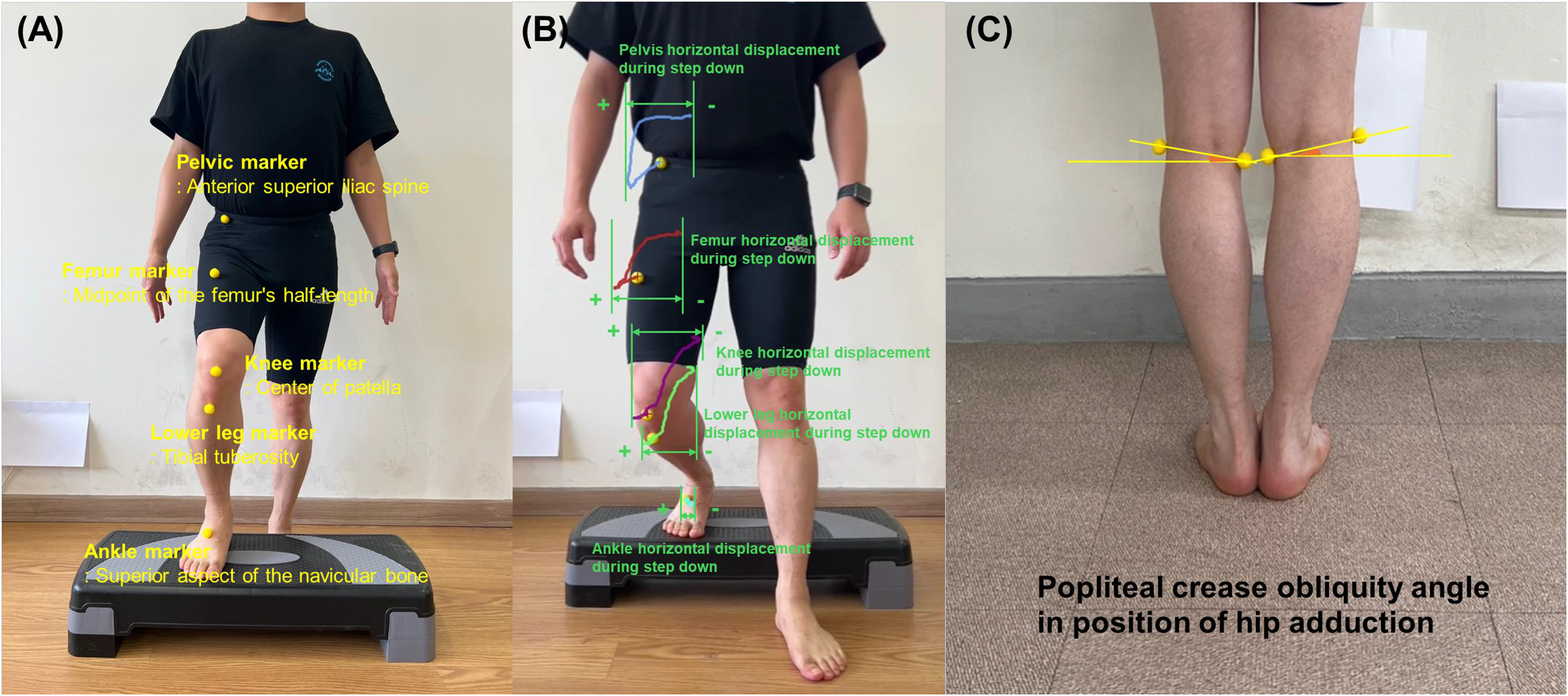
Measurement of kinematics during step-down in the frontal plane and popliteal crease obliquity angle: (A) Five yellow spherical markers in the anatomical landmarks, (B) assessment of the horizontal displacement based on trajectory of five key anatomical points during step-down in the frontal plane, and (C) popliteal crease obliquity angle with feet completely together (hip adduction).
For step-down testing, participants began with one leg on a 20 cm step box and lowered the non-stance leg until heel contact. Each participant completed three barefoot trials per leg with randomized order. Horizontal displacement measurements for pelvis (PHD), femur (FHD), knee (KHD), lower leg (LHD), and ankle (AHD) were averaged across trials. 26 Displacement was calculated as distance between each marker's initial position and maximum excursion point. Larger positive values indicated greater lateral movement, larger negative values signified greater medial movement, and values near zero suggested minimal movement and enhanced stability. The intraclass correlation coefficient was >0.90 for the hip, knee and ankle kinematics measured by Kinovea® during the initial contact of gait (intra-rater reliability). 30
Measurement of the popliteal crease obliquity angle (PCOA)
PCOA was measured with participants standing with feet together. Photographs were taken from behind using a smartphone positioned at knee height, 1 m away, aligned horizontally in standardized indoor environment (Figure 2). Yellow spherical markers were attached to medial and lateral knee crease endpoints to enhance accuracy. All participants performed tests barefoot.
PCOA was defined as the angle between the knee crease line (connecting medial and lateral femoral knee crease markers) and a horizontal line. A single trained researcher (SMH) independently measured PCOA three times bilaterally, using averaged values for final analysis. Measurements were performed using image analysis Kinovea software. Previous studies showed high reliability with intraclass correlation coefficients of 0.991 (inter-observer) and 0.957 (intra-observer). 8
Ml approaches and statistical analysis
Our study employed a two-phase ML approach utilizing Orange data mining software (Orange 3.3.0, Ljubljana, Slovenia) and Python (Version 3.6.15; Python Software Foundation) for modeling and statistical analysis. Statistical significance was set at p < 0.05. Descriptive statistics were presented as mean ± standard deviation for continuous variables and frequencies for categorical variables. The two phases address independent research questions and are computationally independent. Phase I confirms the functional-anatomical relationship between step-down kinematics and PCOA as a continuous anatomical marker. Phase II evaluates the clinical utility of PCOA for EOA classification using directly measured PCOA values as input — not the predicted values from Phase I. This design ensures that any regression error in Phase I does not propagate into Phase II.
Phase I: PCOA prediction from step-down kinematics
Data preparation
The initial dataset comprised 258 observations (86 legs × 3 trials). After removing cases with marker tracking failures (n = 49), 209 observations were included in the analysis. Ten predictor variables were used: age, height, weight, BMI, sex, and five step-down kinematic variables. The target variable was PCOA.
Model development and evaluation
To prevent data leakage arising from bilateral measurements and repeated trials, data partitioning was performed at the subject level rather than the observation level. Specifically, all observations from both legs and all trials of the same individual were assigned exclusively to either the training or testing set using subject-wise GroupShuffleSplit, resulting in training (80%, n = 134 observations from 34 subjects) and test (20%, n = 35 observations from nine subjects) sets. Five ML algorithms were evaluated: k-nearest neighbors (kNN), random forest, extreme gradient boosting (XGBoost), Lasso linear regression, and support vector machine (SVM). Hyperparameter tuning used GridSearch on training sets, with performance assessed using subject-wise group five-fold cross-validation to ensure that observations from the same subject were never present in both the training and validation folds simultaneously. Cross-validation performance is reported as mean ± standard deviation across folds, while test set performance is accompanied by 95% confidence intervals derived from 1000 bootstrap iterations using the percentile method.
Performance was evaluated using coefficient of determination (R2), mean squared error (MSE), root mean squared error (RMSE), and mean absolute error (MAE) for training and test sets. Bootstrap resampling (1000 iterations) calculated 95% confidence intervals (CI). Feature importance was assessed using feature permutation importance and shapley additive explanations (SHAP) analyses. Partial dependence plots (PDPs) examined relationships between key kinematic variables and PCOA predictions.
Phase II: EOA classification using PCOA
Data preparation
Six variables were used for EOA classification: PCOA, age, height, weight, BMI, and sex. EOAQ results were dichotomized to indicate EOA presence or absence. To prevent data leakage arising from bilateral measurements, data partitioning was performed at the subject level rather than the leg level. Both legs of the same individual were assigned exclusively to either the training or testing set using subject-wise GroupShuffleSplit, resulting in training (80%, n = 69 legs from 34 subjects) and test (20%, n = 17 legs from nine subjects) sets. Subject-wise Group five-fold cross-validation was applied within the training set to ensure strict independence between training and validation folds. Cross-validation performance is reported as mean ± standard deviation across folds, while test set performance is accompanied by 95% confidence intervals derived from 1000 bootstrap iterations using the percentile method.
Prediction instability assessment
Given the small sample size, prediction instability was assessed for model reliability across different training subsets. 31 Bootstrap resampling was performed within training sets (n = 69) with varying sample sizes using 100 iterations each. Prediction instability was quantified as standard deviation of predicted probabilities across bootstrap iterations. Models with average instability scores below 0.10 were considered stable, 0.10–0.15 acceptable, and above 0.15 unstable.
Model development and evaluation
The same five ML algorithms were evaluated using identical Phase I methodology. Hyperparameter tuning used GridSearch with five-fold cross-validation on training sets.
Performance was assessed using area under the receiver operating characteristic curve (AUC), classification accuracy, precision, recall, F1 score, Matthews correlation coefficient, Brier score, and calibration-in-the-large (Cal-in-large) for training and test sets. Brier score evaluated probabilistic prediction accuracy (lower scores = better performance). Cal-in-large assessed model calibration by measuring differences between mean predicted probabilities and observed outcome proportions. Performance was categorized by AUC values: excellent (≥0.9), good (0.8–0.9), fair (0.7–0.8), and poor (<0.7). Bootstrap resampling (1000 iterations) calculated 95% CI.
Feature importance was evaluated using feature permutation importance and SHAP analyses for the best-performing algorithm. PDPs were generated to visualize the marginal effects of PCOA measurements on EOA probability, including PDPs.
Results
Participant characteristics
No significant differences existed between EOA and non-EOA groups in demographic characteristics including sex distribution (p = 0.379), age (p = 0.498), height (p = 0.208), weight (p = 0.977), and BMI (p = 0.374) (Table 1). However, a highly significant difference was observed in PCOA measurements between groups (p < 0.001). Analysis of step-down kinematics from repeated measurements revealed significant differences between EOA and non-EOA groups across multiple kinematic variables. The EOA group demonstrated significantly greater PHD (p < 0.001), FHD (p = 0.017), LHD (p = 0.016), and AHD (p < 0.001) during step-down tasks (Table 2).
Step-down kinematics.

EOA, early osteoarthritis; SD, step-down; PHD, pelvic horizontal displacement; FHD, femur horizontal displacement; KHD, knee horizontal displacement; LHD, lower leg horizontal displacement; AHD, ankle horizontal displacement.
Phase I: PCOA prediction from step-down kinematics
Model performance
Five ML algorithms were evaluated for predicting PCOA from step-down kinematics (Table 3). XGBoost achieved highest performance, with cross-validation R2 of 0.372 ± 0.242 and test set R2 of 0.668 [95% CI: 0.381–0.855]. Random Forest demonstrated comparable performance with cross-validation R2 of 0.366 ± 0.162 and test R2 of 0.578 [95% CI: 0.361–0.733]. The remaining algorithms showed substantially lower predictive accuracy: kNN (test R2=0.211 [95% CI: −0.286–0.486]), Lasso Regression (test R2=−0.033 [95% CI: −0.460–0.134]), and SVM (test R2=−0.461 [95% CI: −2.056–0.352]).
Performance metrics of five ML algorithms for predicting popliteal crease obliquity angle from step-down frontal plane kinematics in training and test datasets.

kNN, k-nearest neighbors; LR, Lasso linear regression; RF, random forest; SVM, support vector machine; XGBoost, extreme gradient boosting; CI, confidence intervals; RMSE, root mean squared error; MSE, mean squared error; MAE, mean absolute error.
Feature importance analysis
Feature importance analysis consistently identified FHD, PHD, and AHD as the most influential predictors across both top-performing algorithms (Figure 3). In the Random Forest model, feature permutation importance scores were: FHD (0.277), PHD (0.236), and AHD (0.225), with corresponding SHAP values of 0.775, 0.594, and 0.512, respectively. Similar patterns were observed in XGBoost, with FHD (0.574) and PHD (0.548) showing highest importance scores.
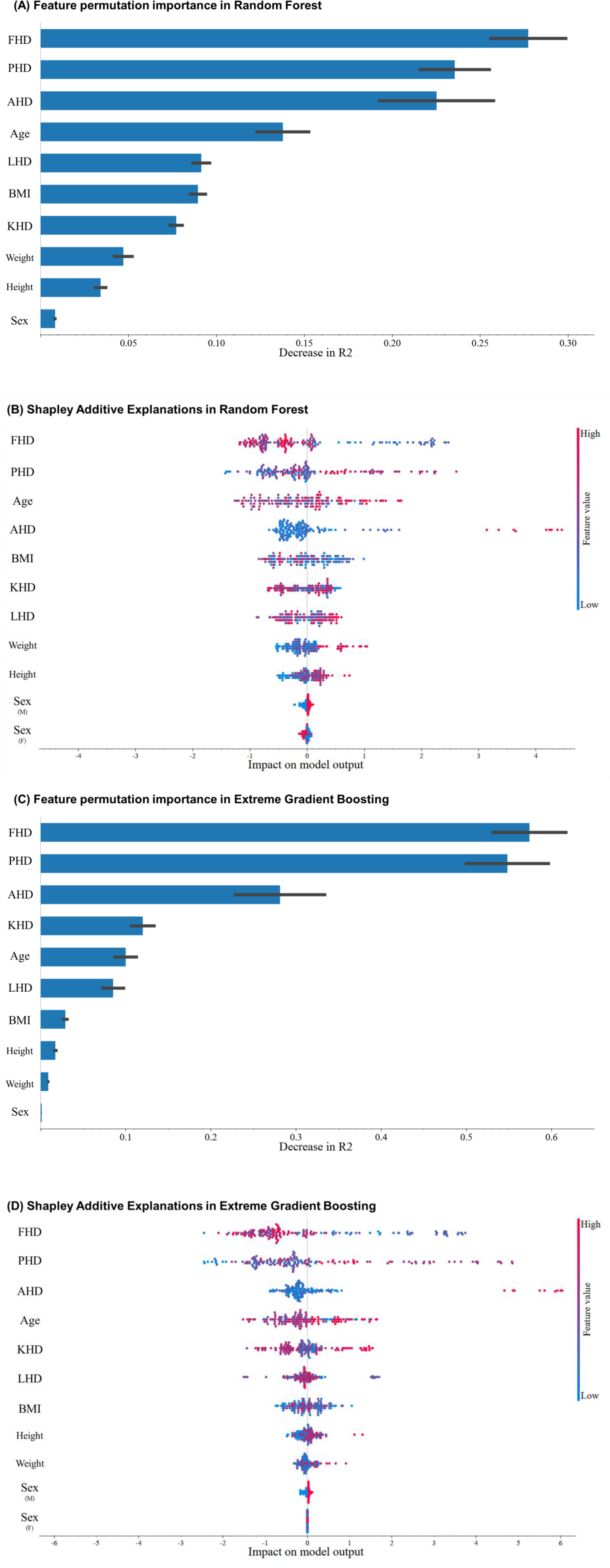
Feature importance analysis for PCOA prediction using random forest and XGBoost algorithms. (A) Feature permutation importance scores from random forest model showing relative contribution of kinematic variables, (B) Shapley additive explanation analysis for random forest model demonstrating individual feature contributions to PCOA predictions, (C) feature permutation importance analysis from XGBoost model, and (D) SHAP analysis for XGBoost model for PCOA regression in the training dataset.
PDP analysis
PDP analysis revealed distinct relationships between key kinematic variables and PCOA predictions (Figure 4). For FHD, negative values (indicating medial/valgus movement) were associated with higher PCOA values, suggesting that valgus movement patterns during step-down tasks correspond to increased popliteal crease obliquity. PHD showed a positive relationship with PCOA, where lateral pelvic movement was associated with greater PCOA. AHD demonstrated minimal influence on PCOA predictions, with changes within 0.5 degrees across the measured range.

PDPs illustrating the relationship between key kinematic variables and PCOA predictions. The plots demonstrate: (A) FHD relationship with PCOA in random forest, (B) PHD relationship with PCOA in random forest. (C) AHD with PCOA in random forest, (E) FHD relationship with PCOA in XGBoost, (F) PHD relationship with PCOA in XGBoost, (G) AHD with PCOA in XGBoost. The blue/orange solid line represents the average partial dependence showing the marginal effect of each kinematic variable on PCOA predictions while holding other variables constant. The blue/orange shaded area indicates the 95% CI around the partial dependence estimates, representing the uncertainty in the model predictions. The gray histogram bars show the data distribution (sample count) across the range of each kinematic variable, indicating the density of observations at different displacement values.
Phase II: EOA classification using PCOA
Model stability assessment
Prediction instability analysis across varying training sample sizes (20–60 participants) demonstrated that all algorithms achieved acceptable stability (≤0.15) when sample sizes exceeded 40 participants (Supplementary Figures 1 and 2). Random Forest demonstrated consistent performance, maintaining average instability below 0.14 across all sample sizes and achieving optimal stability (0.073) at n = 60. Maximum instability analysis confirmed that random forest maintained the most reliable performance with consistently lower variability compared to other algorithms.
Model performance
EOA classification using PCOA and demographic variables achieved excellent performance across multiple algorithms (Table 4). Random Forest demonstrated superior performance with cross-validation AUC of 0.911 ± 0.099 and test AUC of 0.885 [95% CI: 0.655–1.000]. Classification accuracy reached 0.884 ± 0.074 in cross-validation and 0.824 [95% CI: 0.588–1.000] in the test set. Logistic Regression and SVM showed comparable cross-validation performance (AUC 0.921 ± 0.062 and 0.933 ± 0.069, respectively), with test AUC of 0.883 [95% CI: 0.650–1.000] and 0.817 [95% CI: 0.562–1.000], respectively. Additional performance metrics confirmed model reliability: Random Forest achieved Brier Scores of 0.094 ± 0.046 in cross-validation and 0.145 [95% CI: 0.034–0.282] in the test set. Precision and recall of 0.625 [95% CI: 0.250–1.000] and 1.000 [95% CI: 1.000–1.000], respectively, further confirmed the model's discriminative capability.
Performance metrics of five ML algorithms for classifying early osteoarthritis status using popliteal crease obliquity angle and demographic variables in the training and test dataset.

AUC, area under the receiver operating characteristic curve; CA, classification accuracy; kNN, k-nearest neighbors; LR, Lasso linear regression; RF, random forest; SVM, support vector machine; XGBoost, extreme gradient boosting; CI, confidence intervals; MCC, Matthews correlation coefficient; CAL-in-large, calibration-in-the-large.
Feature importance for EOA classification
Feature importance analysis of the random forest model revealed PCOA as the dominant predictor for EOA classification, with feature permutation importance score of 0.35 and SHAP value of 0.291. Demographic variables contributed minimally: height (0.011), BMI (0.009), age (0.009), sex (0.003), and weight (0.002). This underscores PCOA's primary role in discriminating between EOA and non-EOA cases. PDP analysis using random forest identified a critical threshold at approximately 7° of PCOA, above which EOA probability increased dramatically (Figure 5).

PDP from the random forest model demonstrating the relationship between PCOA and EOA probability. The green solid line represents the average partial dependence showing the marginal effect of PCOA values on EOA prediction probability. The green shaded area indicates the 95% CI around the partial dependence estimates, representing the uncertainty in the probability predictions. The gray histogram bars show the data distribution of PCOA measurements across the study population, indicating the frequency of observations at different PCOA values.
Discussion
This study demonstrates a novel two-phase ML approach that establishes the functional-anatomical relationship between step-down kinematics and PCOA, subsequently demonstrating PCOA's association with EOA status. Our findings provide compelling evidence that step-down frontal plane kinematics accurately predict PCOA values (R2=0.668), and PCOA measurements effectively classify EOA status (AUC=0.885). This functional-anatomical bridge represents significant advancement in EOA screening methodology, offering clinicians a simple, non-invasive alternative to complex kinematic analysis while maintaining high diagnostic accuracy. 6
The relationship between step-down kinematics and PCOA revealed important biomechanical insights understood through recent advances in varus alignment classification. FHD toward the medial direction (valgus movement) was the most influential PCOA predictor, followed by lateral pelvic displacement. This aligns with research demonstrating that individuals with varus knee alignment exhibit distinct movement patterns during functional tasks. 32 Varus alignment can be categorized into two types: Type 1 (characterized by hip internal rotation and knee hyperextension) and Type 2 (characterized by hip external rotation and slight knee flexion).11,32,33
The observed valgus movement during step-down represents a critical biomechanical phenomenon in osteoarthritis progression. During single-leg support phases, this movement causes weight to shift, often accompanied by muscle weakness or joint instability, causing the knee to slide inward. Our findings suggest this valgus movement pattern may represent early manifestation of Type 1 varus alignment in manufacturing workers who have not progressed to established degenerative osteoarthritis. Importantly, Type 1 varus alignment demonstrates significantly greater horizontal displacement movements, including knee varus movement and hip lateral sway, during functional activities compared to Type 2. 32 Since our population consisted of individuals in early joint degeneration stages, the observed compensatory valgus movements during challenging functional tasks likely reflect initial adaptive responses characteristic of Type 1 alignment patterns.
This valgus movement repeatedly stresses the medial knee aspect, making it prone to cartilage and meniscus damage.18,34 Despite static varus alignment tendencies, dynamic instability induced by functional activities like step-down persistently increases mechanical stress on the medial knee compartment.18,35 This sustained loading accentuates medial structure vulnerability and accelerates degenerative progression, potentially leading to adaptive changes in posterior soft tissue tension that manifest as increased PCOA. 36 Over time, these repetitive loads accumulate and may contribute to medial knee structure collapse, worsening alignment and progressing from dynamic Type 1 compensation to the more static Type 2 deformity phase observed in established osteoarthritis. Therefore, valgus movement and PCOA inclination changes during daily movements like step-down serve as important indicators of early knee degenerative changes. Integrating dynamic movement assessment with surface anatomical measurement through PCOA provides valuable opportunity to identify individuals in this critical early transition phase, potentially enabling interventions before irreversible structural changes occur. 37
The strong association between increased PCOA and EOA status aligns with previous research demonstrating PCOA's correlation with established radiographic measures of knee alignment (HKA and JLCA). 8 Importantly, previous studies found PCOA increased with varus alignment in static standing, while our study revealed dynamic valgus movement during step-down tasks was the strongest PCOA predictor. This apparent discrepancy can be explained through several interconnected biomechanical mechanisms.
The relationship between dynamic valgus movement and PCOA involves complex compensatory mechanisms. Individuals with underlying structural changes may exhibit compensatory valgus movement during step-down tasks to redistribute load away from the overloaded medial compartment. 38 The established PCOA-JLCA correlation suggests that increased crease obliquity reflects early medial joint space narrowing, which disrupts normal knee biomechanics. 39 However, cross-sectional design prevents establishing causal relationships between movement patterns and anatomical changes, requiring longitudinal investigation to determine temporal sequences in these biomechanical interactions.
The clinical applicability of our two-phase ML approach represents significant advancement over traditional biomechanical assessment methods and previous ML applications in OA detection. Unlike traditional imaging-based biomarkers requiring specialized equipment, smartphone-based PCOA measurement offers unprecedented accessibility for population-scale screening and point-of-care assessment. This approach enables applications in resource-limited settings and routine primary care where specialized imaging infrastructure may not be available. Our model's superior performance surpasses previous ML approaches for OA detection. Earlier studies achieved AUC values of 0.93 for deep learning models detecting knee OA from radiographs 22 and 95.3% accuracy using neural network-based methods for early OA detection. 20 However, these approaches relied on complex imaging or specialized equipment. The actionable nature of our findings is particularly noteworthy: the identified 7° threshold provides clinicians with a clear, quantitative cut-point for EOA risk stratification, enabling immediate clinical decision-making. However, the generalizability of our 7° PCOA threshold to broader populations requires validation across diverse occupational and demographic groups. While the underlying biomechanical relationship between PCOA and established radiographic measures (HKA, JLCA) suggests potential broader applicability, different populations (office workers, athletes) may have distinct movement patterns and baseline PCOA values that could affect threshold accuracy. Population-specific validation studies are needed before widespread clinical implementation. This contrasts with many ML applications in healthcare that, while achieving high accuracy, provide limited interpretability or actionable insights. Our approach offers exceptional explainability through PDP analysis, allowing clinicians to understand precisely how different PCOA values influence EOA probability. The stability analysis further supports clinical implementation, demonstrating reliable performance across different sample sizes, crucial for real-world application where training data may be limited. Furthermore, the established functional-anatomical relationship between step-down kinematics and PCOA provides strong theoretical foundation for PCOA's use as a clinical marker for EOA assessment, addressing potential concerns about clinical validity of surface anatomical measurements. This combination of simplicity, interpretability, and strong theoretical grounding positions PCOA-based screening as a practical tool readily integrated into routine clinical practice, potentially transforming EOA detection from specialized assessment requiring expensive equipment to simple, accessible screening available in primary care settings.
This study has several limitations. First, the cross-sectional design limits ability to establish causal relationships between kinematic patterns and EOA development; longitudinal studies are needed to determine whether observed patterns precede or result from early joint changes. Second, this study did not conduct formal a priori sample size calculation based on power analysis. The sample size was determined by participant availability during the screening period, which may limit the generalizability of our findings. While we conducted post-hoc prediction instability assessment to evaluate model reliability, future studies should incorporate formal sample size calculations based on expected effect sizes and desired statistical power to ensure adequate study design. Focus on manufacturing workers from a single occupational setting may not represent the full spectrum of individuals at EOA risk. Third, our analysis concentrated on frontal plane kinematics during step-down tasks, which may not capture complete biomechanical complexity of early OA-related movement patterns. Future studies should incorporate multiplane kinematic analysis and additional functional tasks for more comprehensive understanding of relationships between movement patterns and PCOA. Fourth, reliance on EOAQ for EOA classification represents a methodological limitation, as traditional imaging modalities (radiographs, MRI) is considered the gold standard for OA diagnosis. While the EOAQ was specifically developed and validated to capture subtle symptomatic and functional alterations characteristic of early OA that may precede radiographic changes, the absence of concurrent imaging validation limits our ability to establish correlations with structural joint changes. The model's diagnostic accuracy therefore depends on patient-reported outcomes rather than objective structural assessment. Integration of imaging clinical markers or biochemical markers alongside EOAQ could strengthen future investigations by providing both early functional detection capability and structural validation. Finally, the identified 7° PCOA threshold requires further validation as a clinical diagnostic cut-off. While PDP analysis demonstrated this as an inflection point where EOA probability increases dramatically, sensitivity and specificity at this threshold, as well as its consistency across different populations, remain to be established. Future studies should validate this threshold's diagnostic performance characteristics before clinical implementation.
Conclusions
This study demonstrates that step-down kinematics can be associated with PCOA, and PCOA can effectively classify EOA status. The identified 7° PCOA threshold provides a practical clinical cut-point that can be easily measured using smartphone photography. This approach offers a simple, accessible alternative to complex kinematic analysis for EOA screening. By establishing the functional-anatomical relationship between dynamic movement and surface anatomy, PCOA shows potential as a clinical marker for EOA assessment for early intervention strategies. Future studies should validate these findings in larger populations and explore integration with other clinical assessments.
Supplemental Material
sj-docx-1-dhj-10.1177_20552076261435079 - Supplemental material for Machine learning based prediction of popliteal crease obliquity angle from step-down kinematics and its application in early osteoarthritis classification
Supplemental material, sj-docx-1-dhj-10.1177_20552076261435079 for Machine learning based prediction of popliteal crease obliquity angle from step-down kinematics and its application in early osteoarthritis classification by Ui-Jae Hwang, Kyu-sung Chung, Siu-ngor Fu, Arnold YL Wong, Sung-min Ha and Il-Kyu Ahn in DIGITAL HEALTH
Footnotes
Abbreviations
Acknowledgements
We would like to thank all participants in our study for their active participation and cooperation.

Ethical approval
The present study conformed to the ethical guidelines of the 1975 Declarations of Helsinki. This study was approved by the Sangji University Institutional Review Board (1040782–230814-HR-09–117). Informed consent for publication of the images was obtained from the patient.
Authorship contribution statement
UJH and SMH contributed to conceptualization, methodology, writing - original draft and visualization. KSC, AYW, SNF and SMH contributed to supervision and project administration. IKA contributed to data curation, validation and software. UJH contributed to data curation and formal analysis.
Funding
The authors received no financial support for the research, authorship, and/or publication of this article.
Declaration of conflicting interests
The authors declared no potential conflicts of interest with respect to the research, authorship, and/or publication of this article.
Availability of data and materials
The datasets analyzed during the current study are available from the corresponding author on reasonable request.
Guarantor
Sung-min Ha.
Supplemental material
Supplemental material for this article is available online.