



Abstract
Objectives
TikTok and Bilibili have gradually become important platforms for the public to access health information. This study aims to evaluate the quality and reliability of MG-related videos on these platforms.
Methods
This study collected the top 150 MG-related videos from both platforms. General characteristics, uploader identity, and engagement metrics were extracted. The Global Quality Score (GQS) and modified DISCERN (mDISCERN) were used to evaluate video quality and reliability. Mann–Whitney U-test and Kruskal–Wallis H-test were used for inter-group comparisons, and Spearman's rank correlation analysis was performed to assess correlations.
Results
A total of 225 videos were included in this study. The content of the videos predominantly focused on symptoms (63.6%) and treatment (49.3%), while diagnosis (25.3%) and prevention (13.3%) were less represented. The median GQS for TikTok was 3 (2–3), and the median mDISCERN was 2 (2–3). For Bilibili, the median GQS was 2 (1–3), and the median mDISCERN was 2 (2–2). Videos uploaded by specialists were of higher quality and reliability compared to those uploaded by individual users (P < 0.05). Engagement metrics showed weak correlations with GQS and mDISCERN (P < 0.05).
Conclusion
MG-related videos on both platforms have incomplete content structures, with low quality and reliability. Videos uploaded by specialists were of higher quality and reliability compared to those uploaded by individual users. Engagement metrics showed weak correlations with video quality and reliability. Future platforms should strengthen content moderation and professional involvement to improve the quality of digital health education.
Introduction
Myasthenia gravis (MG) is a chronic autoimmune neuromuscular disorder characterized by fluctuating weakness that may involve ocular, bulbar, limb, and respiratory muscles. Epidemiological studies indicate rising prevalence worldwide, estimated at 150–250 per million population, with even higher rates reported in certain regions.1,2 In China, MG contributes substantially to healthcare utilization, frequent hospitalizations, and long-term immunosuppressive treatment, imposing considerable medical and socioeconomic burdens.3,4 Delayed diagnosis or inadequate management may lead to progressive disability, reduced quality of life, and life-threatening crises. Enhancing public awareness and recognition of MG is crucial for facilitating early detection, promoting evidence-based treatment, and alleviating the overall disease burden. 5
In recent years, social media platforms, particularly TikTok and Bilibili, have emerged as influential channels for health communication. Their massive user base, algorithm-driven personalized recommendations, and high interactivity enable medical information to be disseminated rapidly and widely. 6 TikTok is dominated by younger, entertainment-oriented audiences who prefer concise and visually stimulating content, while Bilibili attracts users, particularly those from the generations born after the 1990s and 2000s, who seek knowledge and longer-form videos.7–9 Its content spans entertainment, technology, education, and academia, and its community-oriented nature emphasizes knowledge sharing and deep interaction. 10 Despite these advantages, the quality and reliability of health-related short videos remain concerning. Previous studies in areas such as cervical cancer, ophthalmology, and musculoskeletal disorders have consistently shown that although such videos gain substantial engagement, their overall quality is limited and reliability is insufficient.11–13 This proliferation of low-quality content may foster misinformation, potentially delaying accurate diagnosis and timely treatment. Given that MG can lead to progressive muscle weakness, respiratory compromise and life-threatening myasthenic crises, 14 early recognition and standardized management are critical and it is necessary to conduct a systematic evaluation of MG-related videos on online platforms.
This study aims to evaluate the engagement, content distribution, quality and reliability of MG-related videos on TikTok and Bilibili and to elucidate the current status and deficiencies of MG digital health communication. The findings may provide preliminary insights for optimizing strategies in digital health education.
Methods
Search strategy and data extraction
This study was conducted between 18 September and 20 September 2025. This cross-sectional study collected short videos related to MG from two major Chinese platforms, Bilibili (https://www.bilibili.com) and TikTok (https://www.douyin.com). The study employed the Chinese keyword “重症肌无力” (“myasthenia gravis”) for the search and used newly registered accounts in anonymous mode to minimize potential bias resulting from personalized recommendations or browsing history. For each platform, the top 150 videos ranked by default order were screened. The inclusion criteria for this study were Chinese-language videos related to MG, with all videos being in Mandarin Chinese. Videos in other dialects were excluded. The exclusion criteria included videos unrelated to MG, advertisements or promotional materials, duplicate or re-uploaded videos, and videos uploaded within one week prior to data collection. The flowchart of this study is shown in Figure 1, with the short video data in the Supplemental materials.

Flow chart of video selection.
For each eligible video, several types of information were systematically extracted. General characteristics included duration, number of likes, shares, collections (defined as the number of times a video was saved or bookmarked by users), comments, and uploader identity. Content was categorized into six domains: epidemiology, focusing on the prevalence and distribution of MG; etiology, addressing the causes and risk factors; clinical manifestations, covering symptoms such as muscle weakness and ptosis; diagnosis, detailing diagnostic methods like clinical examination and laboratory tests; treatment, encompassing available therapeutic options including medications and surgery; and prevention, discussing any preventive measures and awareness strategies. Based on uploader identity, videos were further grouped into three categories: specialists, referring specifically to neurologists; non-specialists, which included thoracic surgeons, ophthalmologists, traditional Chinese medicine physicians, anesthesiologists, and pediatricians; and individual users, a heterogeneous category encompassing profit-oriented organizations, health influencers, and patients.
Quality and reliability assessment
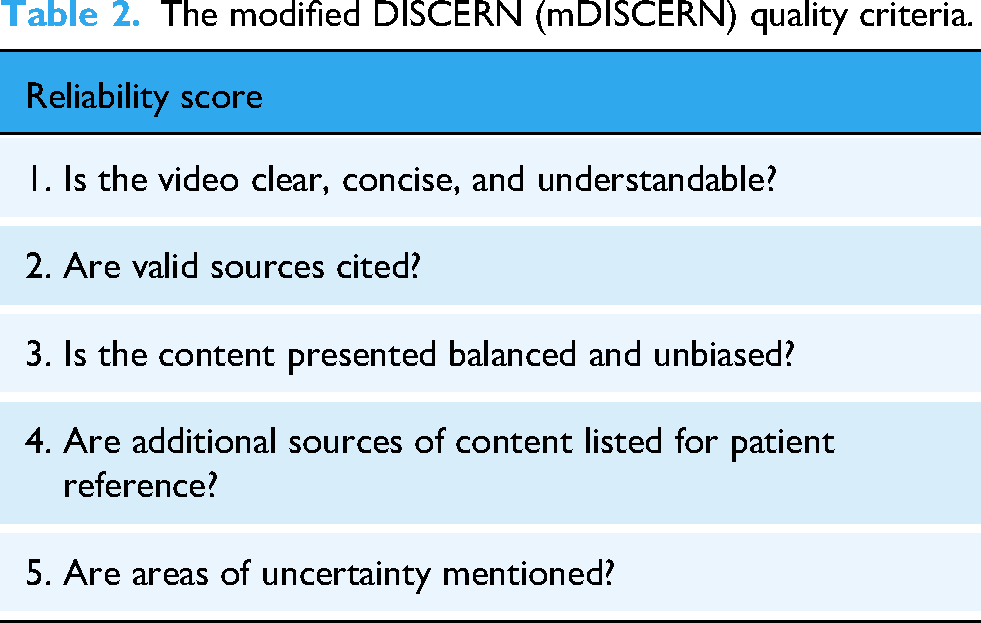
Video quality was assessed using the Global Quality Score (GQS), a validated five-point Likert scale widely applied in evaluating health information disseminated through digital platforms. 15 A score of 1 indicates very poor quality with limited usefulness, whereas a score of 5 reflects excellent quality with significant educational value (Table 1). Reliability was assessed using the modified DISCERN (mDISCERN), an adaptation of the original DISCERN instrument frequently applied in academic research. 16 The mDISCERN comprises five criteria: clarity, relevance, traceability, robustness, and fairness. Each item was scored in binary form, with one point for “yes” and zero for “no,” producing a total score ranging from 0 to 5 (Table 2). Two neurologists (Reviewer A: QL; Reviewer B: WG), each with more than five years of clinical experience in MG, independently evaluated all videos after standardized training. Discrepancies of one or more points were resolved through discussion, and if consensus could not be reached, a senior neurologist (YC) with over 15 years of MG expertise adjudicated the final score.
The global quality score (GQS) quality criteria.

The modified DISCERN (mDISCERN) quality criteria.
Statistical analysis
Descriptive statistics were used to summarize the data. Continuous variables were presented as mean ± standard deviation (SD) if normally distributed, and as median with interquartile range (IQR) otherwise. Categorical variables were described as counts and percentages. Between-group comparisons were performed using independent-sample t-tests for normally distributed variables and Mann–Whitney U-tests for non-normal data. For comparisons involving three or more groups, the Kruskal–Wallis H-test was applied, followed by Dunn's post-hoc test when significant. Cohen's kappa coefficient evaluated the inter-rater reliability for GQS and mDISCERN scores, with a kappa value ≥0.8 indicating excellent agreement. Spearman's rank correlation was used to assess associations between video quality scores (GQS, mDISCERN) and engagement metrics (likes, comments, shares, collections). A two-tailed P < 0.05 was considered statistically significant. All analyses and figure generation were performed using R software (version 4.3.2).
Results
Video characteristics
A total of 225 eligible videos were analyzed (Table 3). The overall characteristics of the videos revealed a median duration of 80 s (IQR 47–176), with engagement metrics indicating a moderate level of interaction: 125 likes (IQR 24–252), 10 comments (IQR 2–28.5), 34 collections (IQR 11–95), and 22 shares (IQR 6–70). In platform comparison, 148 videos were from TikTok, and 77 videos were from Bilibili (Table 4). TikTok videos accounted for 65.8% of the total, while Bilibili contributed 34.2% (Figure 2(A)). TikTok videos were significantly shorter (median 64.5 s vs 236.0 s, P < 0.001), but exhibited substantially higher engagement across all metrics (likes, comments, collections, shares) (P < 0.001) (Table 4). Regarding uploader types, the majority of videos on TikTok were uploaded by specialists (81%), followed by non-specialists and individual users (Figure 2(B)). In contrast, Bilibili showed a lower proportion of specialist-uploaded videos (57%), with 23% by individual users and 19% by non-specialists. Videos uploaded by specialists consistently showed significantly higher engagement and quality scores, including likes, collections, comments, shares, GQS, and mDISCERN scores (P < 0.001) (Table 5). Inter-rater consistency was excellent, with Cohen's Kappa values of 0.838 for GQS and 0.849 for mDISCERN scores.

Distribution of video uploaders on Bilibili and TikTok. (A) Overall distribution of video uploaders. (B) Distribution of professional, non-professional, and individual user uploaders on TikTok and Bilibili.
General characteristics, quality, and reliability of the videos.

GQS: Global Quality Score; mDISCERN: modified DISCERN.
General information, quality, and reliability scores of myasthenia gravis videos on TikTok and Bilibili.

GQS: Global Quality Score; mDISCERN: modified DISCERN.
Characteristics, quality, and reliability of myasthenia gravis videos by different uploaders on TikTok and Bilibili.

GQS: Global Quality Score; mDISCERN: modified DISCERN.
*P-value for the comparison between specialists and non-specialists; **P-value for the comparison between specialists and individual users; ***P-value for the comparison between non-specialists and individual users.
Video content
The included videos covered diverse themes, with symptoms (n = 143, 63.6%) and treatment (n = 111, 49.3%) being the most common. Etiology (n = 67, 29.8%), diagnosis (n = 57, 25.3%), prevention (n = 30, 13.3%), and epidemiology (n = 16, 7.1%) were less frequently represented (Table 3). Platform-stratified analysis revealed that both TikTok and Bilibili contained significant content related to symptoms and treatment (Figure 3). However, when comparing the platforms, Bilibili featured a higher proportion of videos on etiology (46.8% on Bilibili vs 21.0% on TikTok) and treatment (64.9% on Bilibili vs 41.2% on TikTok). In contrast, TikTok hosted more videos related to symptoms (59.5% on TikTok vs 71.4% on Bilibili) and epidemiology (6.8% on TikTok vs 7.8% on Bilibili). Both platforms had similar proportions of videos on prevention (13.5% on TikTok vs 13.0% on Bilibili) and diagnosis (45.6% on TikTok vs 40.3% on Bilibili) (Table 4).
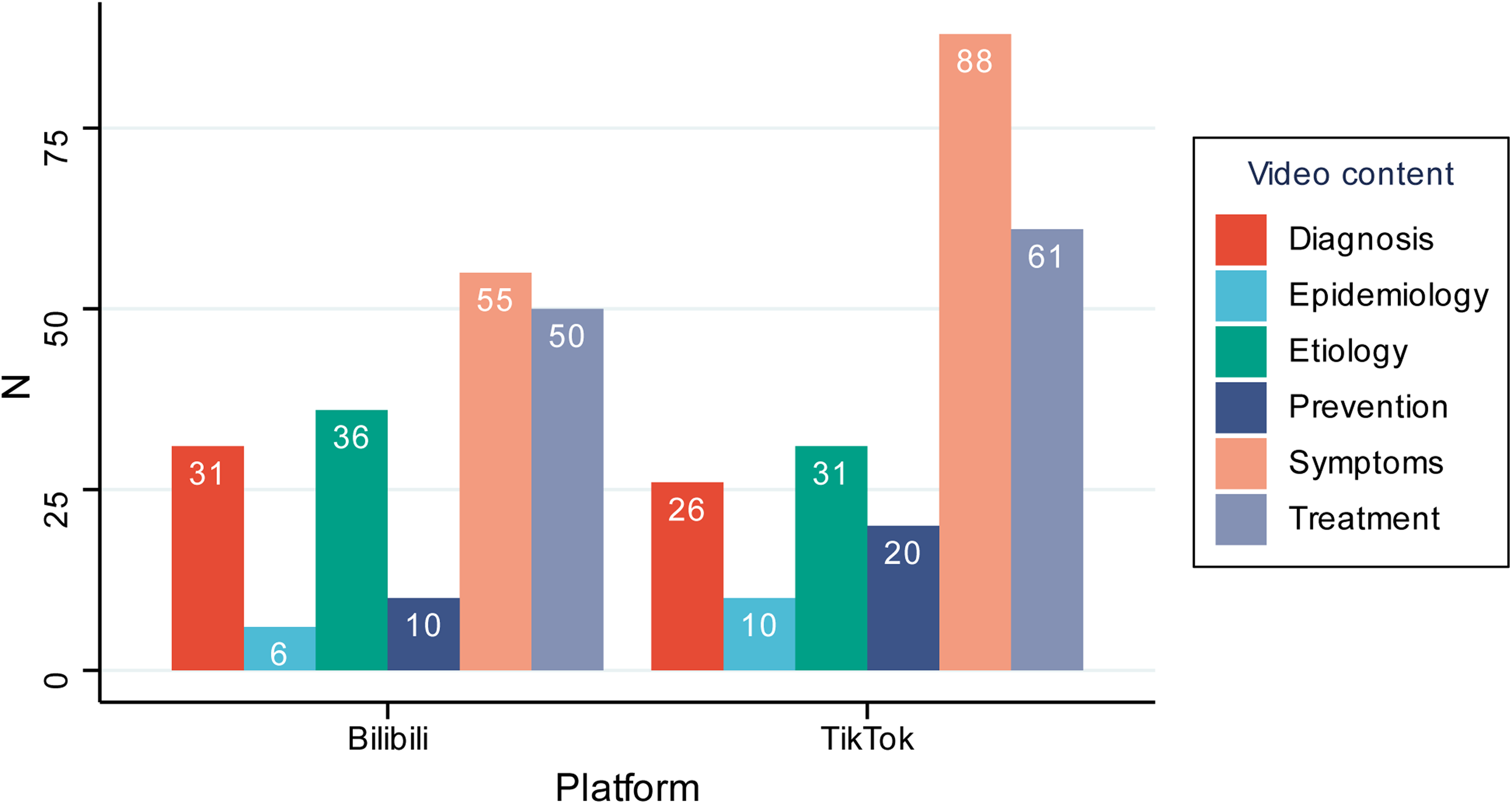
Information about MG-related video content from TikTok and Bilibili.
Video quality and reliability
The overall median GQS and mDISCERN scores were 3.0 (IQR 2.0–3.0) and 2.0 (IQR 2.0–2.0), respectively (Table 3). No significant differences were observed between TikTok and Bilibili (GQS: P = 0.735; mDISCERN: P = 0.281) (Table 4). As shown in Figure 4(A) and (B), the distributions of GQS and mDISCERN scores varied across uploader types. Figure 5(A) and (B) further revealed that videos uploaded by specialists generally achieved higher scores than those from individual users in both quality and reliability (P < 0.05).

Distribution of video quality and reliability scores across uploader groups.

Comparison of quality and reliability scores between videos on TikTok and Bilibili.
Correlation between video features and quality
As shown in Figure 6, video duration was positively correlated with GQS (r = 0.44) and mDISCERN (r = 0.25). Engagement indicators, including likes, comments, collections, and shares, were highly intercorrelated (r = 0.76–0.92). However, their associations with quality and reliability were limited; only collections showed weak positive correlations with GQS (r = 0.32) and mDISCERN (r = 0.29). Likes and comments displayed minimal or no correlation (r < 0.15).

Correlation heatmap of video characteristics, engagement, and quality scores.
Discussion
With the rapid growth of social media, particularly short-video platforms, the way the public accesses health information has undergone profound changes. 17 This study evaluated health-related short videos on China's two major digital health platforms, TikTok and Bilibili. A total of 225 videos were included and analyzed for engagement, content, quality, and reliability. Our findings demonstrate that short videos hold promise for disseminating medical information but also reveal significant shortcomings. While these platforms provide broad and convenient access to health information, the overall quality and reliability of videos remain limited. Notably, videos uploaded by specialists consistently outperformed those produced by non-specialists and individual users, underscoring the vital role of professional participation in ensuring credible digital health communication.
User engagement is widely regarded as a surrogate measure of influence in digital health communication.18,19 In this study, overall engagement levels were moderate, yet TikTok videos consistently achieved significantly higher numbers of likes, comments, collections, and shares compared with Bilibili (all P < 0.001). This discrepancy may be explained by TikTok's algorithm-driven recommendation system and its predominantly younger, entertainment-oriented audience, who prefer short, visually striking content. By contrast, Bilibili hosts longer videos and generates lower engagement, which might suggest that its user base tends to prioritize knowledge acquisition and niche interests.20,21 These findings suggest that engagement patterns are shaped not only by platform algorithms but also by differences in audience behavior, implying that dissemination strategies should be tailored accordingly.
The thematic distribution of videos was markedly unbalanced. Most focused on symptoms and treatment, whereas etiology, diagnosis, prevention, and epidemiology were underrepresented. Some treatment videos exaggerated the benefits of unproven methods such as herbal medicine and massage. For patients with MG, reliance on these unvalidated interventions may delay the use of evidence-based therapies such as acetylcholinesterase inhibitors and immunosuppressants, increasing the risk of progressive weakness, respiratory compromise, and, in severe cases, myasthenic crisis requiring intensive care or mechanical ventilation.22–24 Although many videos mentioned hallmark symptoms like ptosis and dysphagia, few presented comprehensive diagnostic processes. This omission increases the risk of misinterpretation, with audiences potentially mistaking other conditions, such as stroke or esophageal disorders, for MG, leading to unnecessary anxiety, self-misdiagnosis, and delayed care.25–27 Equally concerning was the scarcity of content on etiology and prevention. Lack of etiological explanation hinders public understanding of disease mechanisms, which is critical for informed decision-making. The lack of preventive content is concerning. Although it is not currently possible to directly prevent the occurrence of MG and reduce the number of cases, we believe that enhancing public awareness of early warning signs and acute exacerbations of MG is still important. Especially for family members of patients with MG, understanding early symptoms can aid in early intervention and prevent further progression. Furthermore, the management of myasthenic crisis should also be a point of focus. Common triggers such as infections, surgery, psychological stress, and pregnancy, when not properly managed, can lead to repeated exacerbations and the onset of crises. However, preventive content accounts for only 13.3% of the videos. Such crises may result in acute respiratory failure requiring mechanical ventilation, prolonged hospitalization, and admission to intensive care units. In addition, the crisis-related increases in healthcare resource utilization often translate into substantial economic burden and elevated mortality. For example, a nationwide Chinese study found that in patients experiencing a myasthenic crisis, respiratory failure was the leading cause of death and admission mortality reached 14.69%. 28 Economic evaluations in generalized MG have revealed that during crisis or exacerbation periods, patients may incur monthly healthcare costs in the tens of thousands of U.S. dollars. 29 Real-world analyses also show that healthcare utilization and costs increase dramatically surrounding crisis events. 30 Moreover, hospitalization data indicate that in-hospital mortality is higher and length of stay is longer for crisis admissions compared to noncrisis ones. 31
Both GQS and mDISCERN scores indicated only moderate quality.32,33 No significant differences were observed between TikTok and Bilibili, though wide variability existed within each platform. One study on the quality assessment of radiotherapy-related videos found that the overall quality of short-form videos on TikTok and Bilibili related to radiotherapy was unsatisfactory, especially those uploaded by non-professionals, whose videos had notably lower quality. 6 Another study on liver cancer-related short videos also revealed that the quality of videos on TikTok and Bilibili regarding liver cancer was generally low, despite professional health care providers uploading higher-quality content. However, overall video quality was still inadequate to meet the standards for scientific and medical information. 34 Possible explanations include TikTok's short duration format, which limits comprehensiveness, and its algorithmic emphasis on entertainment, which may dilute educational value. Bilibili, while hosting longer videos that allow more detailed explanations, lacks standardized review mechanisms, resulting in inconsistent reliability.35,36 These observations highlight the need for stricter moderation, verification of professional accounts, and integration of evidence-based labeling to enhance the credibility of health information online.
Uploader characteristics significantly influenced video quality and reliability. 37 Specialists contributed the majority of videos, followed by non-specialists and individual users. Videos produced by healthcare professionals generally outperformed those uploaded by individual users. This advantage likely derives from professional training and mastery of evidence-based knowledge, whereas individual users often rely on personal experience or unverified sources, leading to oversimplification or misinformation. Previous research in ophthalmology, musculoskeletal disorders, and chronic disease management has repeatedly confirmed the superiority of professional content.38–40 Moreover, medical professionals often simplify complex concepts into accessible language and use animations or graphics to aid comprehension. For example, three-dimensional animations showing acetylcholine receptor impairment at the neuromuscular junction can provide intuitive visualization and enhance information retention. 41 These advantages underscore the unique value of healthcare professionals in digital health communication and highlight the importance of encouraging greater professional involvement.
Correlation analyses further revealed associations between video characteristics and quality. Video duration showed a moderate correlation with GQS and a weak correlation with mDISCERN, suggesting longer videos better facilitate comprehensive explanations. 35 The symptoms of MG are highly individualized, with patients presenting with varying symptoms such as ptosis, muscle weakness, or even respiratory difficulties. For example, extending the video duration allows more space to showcase real patient cases, which helps to concretely present these symptoms and their treatment outcomes, thereby helping viewers gain a better understanding of the disease's diversity and treatment process. By contrast, likes, comments, and shares demonstrated minimal correlation with quality or reliability, with only collections showing weak positive associations. This may reflect Bilibili users’ tendency to treat the platform as an educational resource, saving professional content for repeated viewing. Bilibili tends to attract users who prioritize knowledge acquisition and have specific interests, largely due to its predominant user base, particularly those born in the 1990s and 2000s. Moreover, unlike TikTok, Bilibili leverages its unique community features to offer a platform where users can not only watch long-form videos but also engage in in-depth discussions and access content related to specific academic or professional fields. 10 These findings challenge the assumption that higher engagement equates to higher quality. 42 The discrepancy may arise from TikTok's entertainment-oriented nature, where brevity and amusement are prioritized over depth and accuracy.43,44 The “Popularity-Quality Paradox” is supported by this observation, which highlights that higher engagement with content doesn’t always correspond to better quality. Specifically, content dissemination on platforms is often driven by entertainment, music, or emotional resonance, rather than by medical accuracy.45,46 Although professional videos are more credible, they may fail to attract popularity due to limited entertainment value. Consequently, audiences may be disproportionately influenced by low-quality yet widely disseminated videos. Prior evidence has also shown that users sometimes prefer content inconsistent with standard treatment guidelines, further amplifying misinformation risks. 47 Collectively, these findings emphasize that engagement metrics alone are insufficient indicators of educational value, and algorithmic strategies are needed to prioritize evidence-based, professionally generated content.
This study has several limitations. First, it included only Chinese-language videos, which may not capture the characteristics and quality of MG-related content available in other languages, thereby limiting the cross-linguistic generalizability of the findings. Second, the analysis was confined to two major Chinese platforms, TikTok and Bilibili, without incorporating international platforms such as YouTube and Instagram or other emerging social media, which restricts the global applicability of the conclusions. Third, the sample size was relatively small, as only the top 150 videos from each platform were analyzed during a short collection period, which may not fully reflect the dynamic nature and long-term trends of short-video content. Finally, although validated assessment tools were employed, quality evaluations inevitably involved subjective interpretation. Moreover, while we used newly registered anonymous accounts to reduce bias, location-based algorithms—such as those influenced by IP addresses—may still affect video recommendations, which could introduce another potential source of bias.
Conclusion
This study evaluated MG-related short videos on TikTok and Bilibili, revealing both opportunities and challenges in digital health communication. The overall video content structure was incomplete, particularly in the areas of diagnosis and prevention. Video quality and reliability were generally suboptimal. Videos uploaded by specialists outperformed those from individual users. Video duration and collections showed weak positive associations with quality, while likes and comments were not reliable indicators of credibility. These findings underscore the importance of professional involvement and platform-level mechanisms to promote evidence-based content. Strengthening quality control and guiding audience attention toward reliable sources may enhance the role of short-video platforms in improving health literacy and supporting evidence-based decision-making.
Supplemental Material
sj-xlsx-1-dhj-10.1177_20552076261431598 - Supplemental material for Quality and reliability of myasthenia gravis-related short videos on TikTok and Bilibili: A cross-sectional study
Supplemental material, sj-xlsx-1-dhj-10.1177_20552076261431598 for Quality and reliability of myasthenia gravis-related short videos on TikTok and Bilibili: A cross-sectional study by Qian-ying Liao, Wang Guo and Yu-hao Chu in DIGITAL HEALTH
Footnotes
Acknowledgements
The authors would like to express their gratitude to the participants who participated in the study.

Ethics approval
This study did not involve human participants, clinical data, laboratory animals, or histological research. The data analyzed were sourced from publicly accessible videos on TikTok and Bilibili. All data collection procedures adhered to the terms of service of both platforms. No personally identifiable information was gathered, and no interactions with users were performed. Consequently, ethical approval was not necessary for this study.
Patient and public involvement
Patients and/or the public were not involved in the design, or conduct, or reporting, or dissemination plans of this research.
Author Contributions
All authors have read and approved the final version of the manuscript.
Funding
The authors received no financial support for the research, authorship, and/or publication of this article.
Declaration of conflicting interests
The authors declared no potential conflicts of interest with respect to the research, authorship, and/or publication of this article.
Data availability statement
The data supporting the findings of this study are available from the corresponding author upon reasonable request.
Guarantor
Yuhao Chu is the guarantor of this article. She takes full responsibility for the integrity of the research and data, has full access to all data, and had the final decision-making authority regarding publication.
Supplemental material
Supplemental material for this article is available online.
References
Supplementary Material
Please find the following supplemental material available below.
For Open Access articles published under a Creative Commons License, all supplemental material carries the same license as the article it is associated with.
For non-Open Access articles published, all supplemental material carries a non-exclusive license, and permission requests for re-use of supplemental material or any part of supplemental material shall be sent directly to the copyright owner as specified in the copyright notice associated with the article.
